
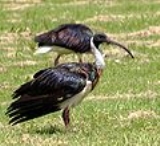
The
ibises are a group of long-legged wading
birdBirds are feathered, winged, bipedal, endothermic , egg-laying, vertebrate animals. Around 10,000 living species and 188 families makes them the most speciose class of tetrapod vertebrates. They inhabit ecosystems across the globe, from the Arctic to the Antarctic. Extant birds range in size from...
s in the family
ThreskiornithidaeThe family Threskiornithidae includes 34 species of large terrestrial and wading birds, falling into two subfamilies, the ibises and the spoonbills. It was formerly known as Plataleidae. The spoonbills and ibises were once thought to be related to other groups of long-legged wading birds in the...
.
They all have long down curved bills, and usually feed as a group, probing mud for food items, usually
crustaceanCrustaceans form a very large group of arthropods, usually treated as a subphylum, which includes such familiar animals as crabs, lobsters, crayfish, shrimp, krill and barnacles. The 50,000 described species range in size from Stygotantulus stocki at , to the Japanese spider crab with a leg span...
s. Most species nest in trees, often with
spoonbillSpoonbills are a group of large, long-legged wading birds in the family Threskiornithidae, which also includes the Ibises.All have large, flat, spatulate bills and feed by wading through shallow water, sweeping the partly opened bill from side to side...
s or
heronThe herons are long-legged freshwater and coastal birds in the family Ardeidae. There are 64 recognised species in this family. Some are called "egrets" or "bitterns" instead of "heron"....
s.
The word
ibis comes from Greek and Latin, and probably from the Ancient Egyptian. According to
JosephusTitus Flavius Josephus , also called Joseph ben Matityahu , was a 1st-century Romano-Jewish historian and hagiographer of priestly and royal ancestry who recorded Jewish history, with special emphasis on the 1st century AD and the First Jewish–Roman War, which resulted in the Destruction of...
,
MosesMoses was, according to the Hebrew Bible and Qur'an, a religious leader, lawgiver and prophet, to whom the authorship of the Torah is traditionally attributed...
employed ibes against flying serpents during a desert campaign into
EthiopiaEthiopia , officially known as the Federal Democratic Republic of Ethiopia, is a country located in the Horn of Africa. It is the second-most populous nation in Africa, with over 82 million inhabitants, and the tenth-largest by area, occupying 1,100,000 km2...
in his early life.
Pliny the ElderGaius Plinius Secundus , better known as Pliny the Elder, was a Roman author, naturalist, and natural philosopher, as well as naval and army commander of the early Roman Empire, and personal friend of the emperor Vespasian...
also recounted, “The Egyptians invoked [ibes] against the flying serpents.”
Species in taxonomic order
There are 28 extant species and 2 extinct species of ibis.
- Genus Threskiornis
Threskiornis is a genus of ibises, wading birds of the family Threskiornithidae. They occur in the warmer parts of the Old World in southern Asia, Australasia and sub-Saharan Africa....
- African Sacred Ibis, Threskiornis aethiopicus
- Malagasy Sacred Ibis, Threskiornis bernieri
- Réunion Sacred Ibis
The Réunion Sacred Ibis, Threskiornis solitarius, is an extinct bird species that was native to the island of Réunion. It is probably the same bird discovered by Portuguese sailors there in 1613...
, Threskiornis solitarius extinct
- Black-headed Ibis
The Black-headed Ibis or Oriental White Ibis is a species of wading bird of the ibis family Threskiornithidae which breeds in South Asia and Southeast Asia from Pakistan to India, Sri Lanka east up to Japan...
, Threskiornis melanocephalus
- Australian White Ibis
The Australian White Ibis , is a wading bird of the ibis family Threskiornithidae. It is widespread across much of Australia...
, Threskiornis molucca
- Straw-necked Ibis
The Straw-necked Ibis is a bird of the ibis and spoonbill family Threskiornithidae. It can be found throughout Australia, New Guinea, and parts of Indonesia. Adults have distinctive straw-like feathers on their neck....
, Threskiornis spinicollis
- Genus Pseudibis
The bird genus Pseudibis consists of two South-East Asian species in the ibis subfamily, Threskiornithinae. The Giant Ibis is also sometimes placed in this genus.Genus Pseudibis *Red-naped Ibis, Pseudibis papillosa...
- Red-naped Ibis, Pseudibis papillosa
- White-shouldered Ibis
The White-shouldered Ibis, Pseudibis davisoni, is a species of wading bird of the ibis family, Threskiornithidae. It occurs at a few sites in northern Cambodia, southern Vietnam, extreme southern Laos and East Kalimantan in Indonesia....
, Pseudibis davisoni
- Genus Thaumatibis
- Giant Ibis
The Giant Ibis, Thaumatibis gigantea, the only species in the monotypic genus Thaumatibis, is a wading bird of the ibis family, Threskiornithidae...
, Thaumatibis gigantea
- Genus Geronticus
The small bird genus Geronticus belongs to the ibis subfamily . Its name is derived from the Greek gérontos in reference to the bald head of these dark-plumaged birds; in English they are called bald ibises.Geronticus contains two living species. The Northern Bald Ibis has a neck crest of...
- Northern Bald Ibis
The Northern Bald Ibis, Hermit Ibis, or Waldrapp is a migratory bird found in barren, semi-desert or rocky habitats, often close to running water. This 70–80 cm glossy black ibis, which, unlike other members of the ibis family, is non-wading, has an unfeathered red face and head, and a long,...
, Geronticus eremita
- Southern Bald Ibis
The Southern Bald Ibis is a large bird found in open grassland or semi-desert in the mountains of southern Africa.This large, glossy, blue-black ibis has an unfeathered red face and head, and a long, decurved red bill. It breeds colonially on and amongst rocks and on cliffs, laying 2-3 eggs which...
, Geronticus calvus
- Genus Nipponia
- Crested Ibis
The Crested Ibis , also known as the Japanese Crested Ibis or Toki , is a large , white-plumaged ibis of pine forests. Its head is partially bare, showing red skin, and it has a dense crest of white plumes on the nape. This species is the only member of the genus Nipponia.Their habitat is usually...
, Nipponia nippon
- Genus Bostrychia
Bostrychia is a genus of ibises in the Threskiornithidae family. Member species are found in many countries throughout Africa. It contains the following five species:* Wattled Ibis * Hadada Ibis...
- Olive Ibis
The Olive Ibis is a species of bird in the Threskiornithidae family.It is found in Cameroon, Republic of the Congo, the Democratic Republic of the Congo, Ivory Coast, Gabon, Ghana, Kenya, Liberia, São Tomé and Príncipe, Sierra Leone, and Tanzania.- References : Database entry includes...
, Bostrychia olivacea
- São Tomé Ibis, Bostrychia bocagei
- Spot-breasted Ibis
The Spot-breasted Ibis is a species of bird and is a member of the order Ciconiiformes and the family Threskiornithidae. It is a wading bird that lives is swampy forested areas and is found in tropical regions...
, Bostrychia rara
- Hadada Ibis
The Hadada or Hadeda Ibis, Bostrychia hagedash, is an ibis found in Sub-Saharan Africa.-Appearance:The Hadeda is a large , dark brown ibis with a white "moustache", glossy greenish purple wings, a large black bill with a red stripe on the upper mandible, and blackish legs.-Call:It has a...
, Bostrychia hagedash
- Wattled Ibis
The Wattled Ibis is a species of bird in the Threskiornithidae family. It is endemic to the Ethiopian highlands and is found only in Ethiopia and Eritrea.-Description:...
, Bostrychia carunculata
- Genus Theristicus
Theristicus is a genus of birds in the Threskiornithidae family. They are found in open, grassy habitats in South America. All have a long, decurved dark bill, relatively short reddish legs that do no extend beyond the tail in flight , and at least the back is grey.-Taxonomy:Formerly, T. caudatus...
- Plumbeous Ibis
The Plumbeous Ibis is a species of bird in the Threskiornithidae family. It is found in grassland, savanna, fields and marshes in central South America, ranging in south-central and south-eastern Brazil, eastern and northern Bolivia, Paraguay, Uruguay and northern Argentina...
, Theristicus caerulescens
- Buff-necked Ibis
The Buff-necked Ibis , also known as the White-throated Ibis, is a fairly large ibis found widely in open habitats of eastern and northern South America...
, Theristicus caudatus
- Black-faced Ibis
The Black-faced Ibis is a species of bird in the Threskiornithidae family. It is found in grassland and fields in southern and western South America. It has been included as a subspecies of the similar Buff-necked Ibis, but today all major authorities accept the split...
, Theristicus melanopis
- Genus Cercibis
- Sharp-tailed Ibis
The Sharp-tailed Ibis is a species of bird in the Threskiornithidae family. It is monotypic within the genus Cercibis.It is found in Brazil, Colombia, Guyana, Suriname, and Venezuela....
, Cercibis oxycerca
- Genus Mesembrinibis
- Green Ibis
The Green Ibis is a wading bird in the ibis family Threskiornithidae. It is the only member of the genus Mesembrinibis....
, Mesembrinibis cayennensis
- Genus Phimosus
- Bare-faced Ibis, Phimosus infuscatus
- Genus Eudocimus
Eudocimus is a genus of ibises, wading birds of the family Threskiornithidae. They occur in the warmer parts of the New World with representatives from the southern United States south through Central America, the West Indies and South America....
- American White Ibis
The American White Ibis is a species of wading bird in the ibis family Threskiornithidae. It occurs from the mid-Atlantic and Gulf coast of the United States south through most of the New World tropics...
, Eudocimus albus
- Scarlet Ibis
The Scarlet Ibis is a species of ibis that inhabits tropical South America and also Trinidad and Tobago. It is the national bird of Trinidad and is featured on the Trinidad and Tobago coat of arms along with Tobago's national bird, the Rufous-vented Chachalaca.-Taxonomy:This species is very...
, Eudocimus ruber
- Genus Plegadis
Plegadis is a bird genus in the family Threskiornithidae. Member species are found on every continent except Antarctica as well as a number of islands. The Glossy Ibis is easily the most widespread of the three species...
- Glossy Ibis
The Glossy Ibis is a wading bird in the ibis family Threskiornithidae.This is the most widespread ibis species, breeding in scattered sites in warm regions of Europe, Asia, Africa, Australia, and the Atlantic and Caribbean region of the Americas...
, Plegadis falcinellus
- White-faced Ibis
The White-faced Ibis is a wading bird in the ibis family Threskiornithidae.This species breeds colonially in marshes, usually nesting in bushes or low trees. Its breeding range extends from the western USA south through Mexico, as well as from southeastern Brazil and southeastern Bolivia south to...
, Plegadis chihi
- Puna Ibis
The Puna Ibis is a species of bird in the Threskiornithidae family. It is found in Argentina, Bolivia, Chile, and Peru. Its natural habitat is swamps.-References:* BirdLife International 2004. . Downloaded on 24 July 2007....
, Plegadis ridgwayi
- Genus Lophotibis
- Madagascar Ibis, Lophotibis cristata
An extinct species, the Jamaican Ibis or Clubbed-wing Ibis (
Xenicibis xympithecus) was uniquely characterized by its club-like wings.
In culture
The African Sacred Ibis was an object of religious
venerationVeneration , or veneration of saints, is a special act of honoring a saint: an angel, or a dead person who has been identified by a church committee as singular in the traditions of the religion. It is practiced by the Eastern Orthodox Church, the Roman Catholic, and Eastern Catholic Churches...
in
ancient EgyptAncient Egypt was an ancient civilization of Northeastern Africa, concentrated along the lower reaches of the Nile River in what is now the modern country of Egypt. Egyptian civilization coalesced around 3150 BC with the political unification of Upper and Lower Egypt under the first pharaoh...
, particularly associated with the god,
ThothThoth was considered one of the more important deities of the Egyptian pantheon. In art, he was often depicted as a man with the head of an ibis or a baboon, animals sacred to him. His feminine counterpart was Seshat...
. At the town of
HermopolisHermopolis Magna or simply Hermopolis or Hermopolis Megale or Hermupolis is the site of ancient Khmun, and is located near the modern Egyptian town of El Ashmunein in Al Minya governorate.-Etymology:Khmun, the Ancient Egyptian name of the city, means "eight-town", after the Ogdoad, a group of...
, ibises were reared specifically for sacrificial purposes and in the Serapeum at
SaqqaraSaqqara is a vast, ancient burial ground in Egypt, serving as the necropolis for the Ancient Egyptian capital, Memphis. Saqqara features numerous pyramids, including the world famous Step pyramid of Djoser, sometimes referred to as the Step Tomb due to its rectangular base, as well as a number of...
, archaeologists found the mummies of one and a half million ibises and hundreds of thousands of
falconA falcon is any species of raptor in the genus Falco. The genus contains 37 species, widely distributed throughout Europe, Asia, and North America....
s.
According to local legend in the
BirecikBirecik , also formerly known as Bir and during the Crusades as Bile, is a town and district of Şanlıurfa Province of Turkey, on the River Euphrates....
area, the
Northern Bald IbisThe Northern Bald Ibis, Hermit Ibis, or Waldrapp is a migratory bird found in barren, semi-desert or rocky habitats, often close to running water. This 70–80 cm glossy black ibis, which, unlike other members of the ibis family, is non-wading, has an unfeathered red face and head, and a long,...
was one of the first birds that
NoahNoah was, according to the Hebrew Bible, the tenth and last of the antediluvian Patriarchs. The biblical story of Noah is contained in chapters 6–9 of the book of Genesis, where he saves his family and representatives of all animals from the flood by constructing an ark...
released from the Ark as a symbol of fertility, and a lingering religious sentiment in Turkey helped the colonies there to survive long after the demise of the species in Europe.
The mascot of the
University of MiamiThe University of Miami is a private, non-sectarian university founded in 1925 with its main campus in Coral Gables, Florida, a medical campus in Miami city proper at Civic Center, and an oceanographic research facility on Virginia Key., the university currently enrolls 15,629 students in 12...
is an
American White IbisThe American White Ibis is a species of wading bird in the ibis family Threskiornithidae. It occurs from the mid-Atlantic and Gulf coast of the United States south through most of the New World tropics...
. The ibis was selected as the school mascot because of its legendary bravery during hurricanes. According to legend, the ibis is the last sign of wildlife to take shelter before a hurricane hits and the first to reappear once the storm has passed.
A short story
The Scarlet Ibis"The Scarlet Ibis" is a short story written by novelist James Hurst. It was first published in The Atlantic Monthly in July 1960 and won the "Atlantic First" award...
by James Hurst uses the sable-hued bird as foreshadowing for a character's death and as the primary symbol.
The African Sacred Ibis is the unit symbol of the Israeli Special Forces unit known as Unit 212 or
MaglanMaglan is an Israeli Special Forces unit which specializes in operating behind enemy lines and deep in enemy territory using advanced technologies and weaponry....
in Hebrew: מגלן.
External links