
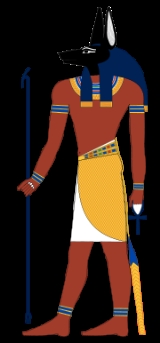
Anubis is the Greek name for a
jackalAlthough the word jackal has been historically used to refer to many small- to medium-sized species of the wolf genus of mammals, Canis, today it most properly and commonly refers to three species: the black-backed jackal and the side-striped jackal of sub-Saharan Africa, and the golden jackal of...
-headed
godA deity is a recognized preternatural or supernatural immortal being, who may be thought of as holy, divine, or sacred, held in high regard, and respected by believers....
associated with
mummificationA mummy is a body, human or animal, whose skin and organs have been preserved by either intentional or incidental exposure to chemicals, extreme coldness , very low humidity, or lack of air when bodies are submerged in bogs, so that the recovered body will not decay further if kept in cool and dry...
and the afterlife in ancient Egyptian religion. In the ancient Egyptian language, Anubis is known as
Inpu (variously spelled
Anup,
Anpu, and
Ienpw). According to the Akkadian transcription in the Amarna letters, Anubis' name was vocalized as
Anapa. The oldest known mention of Anubis is in the
Old KingdomOld Kingdom is the name given to the period in the 3rd millennium BC when Egypt attained its first continuous peak of civilization in complexity and achievement – the first of three so-called "Kingdom" periods, which mark the high points of civilization in the lower Nile Valley .The term itself was...
pyramid textsThe Pyramid Texts are a collection of ancient Egyptian religious texts from the time of the Old Kingdom. The pyramid texts are possibly the oldest known religious texts in the world. Written in Old Egyptian, the pyramid texts were carved on the walls and sarcophagi of the pyramids at Saqqara during...
, where he is associated with the burial of the
PharaohPharaoh is a title used in many modern discussions of the ancient Egyptian rulers of all periods. The title originates in the term "pr-aa" which means "great house" and describes the royal palace...
. At this time, Anubis was the most important god of the dead but he was replaced during the Middle Kingdom by
OsirisOsiris is an Egyptian god, usually identified as the god of the afterlife, the underworld and the dead. He is classically depicted as a green-skinned man with a pharaoh's beard, partially mummy-wrapped at the legs, wearing a distinctive crown with two large ostrich feathers at either side, and...
.
He takes names in connection with his funerary role, such as
He who is upon his mountain, which underscores his importance as a protector of the deceased and their tombs, and the title
He who is in the place of embalming, associating him with the process of mummification. Like many ancient Egyptian deities, Anubis assumes different roles in various contexts, and no public procession in
EgyptEgypt , officially the Arab Republic of Egypt, Arabic: , is a country mainly in North Africa, with the Sinai Peninsula forming a land bridge in Southwest Asia. Egypt is thus a transcontinental country, and a major power in Africa, the Mediterranean Basin, the Middle East and the Muslim world...
would be conducted without an Anubis to march at the head.
Anubis' wife is a goddess called
AnputAnput is a goddess from Egyptian mythology. She is also called Input, Inpewt and Yineput. Her name is written in hieroglyphs as inpwt.- Mythology :Anput is a female aspect of god Anubis. She is his wife and mother of goddess Kebechet...
, his female aspect, and their daughter is the goddess
KebechetIn Egyptian mythology, Kebechet is a goddess, a deification of embalming liquid. Her name means cooling water.- Myths :...
.
Portrayal
Anubis was associated with the mummification and protection of the dead for their journey into the afterlife.
He was usually portrayed as a half human, half jackal, or in full jackal form wearing a ribbon and holding a
flailA flail is an agricultural implement for threshing.Several tools operate similarly to the agricultural implement and are also called flails:...
in the crook of its arm. The jackal was strongly associated with cemeteries in ancient Egypt, since it was a scavenger which threatened to uncover human bodies and eat their flesh. The distinctive black color of Anubis "did not have to do with the jackal [per se] but with the color of rotting flesh and with the black soil of the Nile valley, symbolizing rebirth."
Anubis is depicted in funerary contexts where he is shown attending to the mummies of the deceased or sitting atop a tomb protecting it. In fact, during embalming, the "head embalmer" wore an Anubis costume. The critical weighing of the heart scene in the
Book of the DeadThe Book of the Dead is the modern name of an ancient Egyptian funerary text, used from the beginning of the New Kingdom to around 50 BC. The original Egyptian name for the text, transliterated rw nw prt m hrw is translated as "Book of Coming Forth by Day". Another translation would be "Book of...
also shows Anubis performing the measurement that determined the worthiness of the deceased to enter the realm of the dead (the
underworldThe Underworld is a region which is thought to be under the surface of the earth in some religions and in mythologies. It could be a place where the souls of the recently departed go, and in some traditions it is identified with Hell or the realm of death...
).
New KingdomThe New Kingdom of Egypt, also referred to as the Egyptian Empire is the period in ancient Egyptian history between the 16th century BC and the 11th century BC, covering the Eighteenth, Nineteenth, and Twentieth Dynasties of Egypt....
tomb-seals also depict Anubis sitting atop the
nine bowsThe nine bows is a term used in Ancient Egypt to represent the traditional enemies of Egypt. The peoples covered by this term changed over time, as enemies changed, and there is no true list of the nine bows...
that symbolize his domination over the enemies of Egypt.
Embalmer
One of the roles of Anubis was "Guardian of the Scales". Deciding the weight of "truth" by weighing the Heart against Ma'at, who was often depicted as an ostrich feather, Anubis dictated the fate of souls. In this manner, he was a Lord of the Underworld, only usurped by Osiris.
Anubis is a son of
RaRa is the ancient Egyptian sun god. By the Fifth Dynasty he had become a major deity in ancient Egyptian religion, identified primarily with the mid-day sun...
in early myths, but later he became known as son of
OsirisOsiris is an Egyptian god, usually identified as the god of the afterlife, the underworld and the dead. He is classically depicted as a green-skinned man with a pharaoh's beard, partially mummy-wrapped at the legs, wearing a distinctive crown with two large ostrich feathers at either side, and...
and
NephthysIn Egyptian mythology, Nephthys is a member of the Great Ennead of Heliopolis, a daughter of Nut and Geb. Nephthys was typically paired with her sister Isis in funerary rites because of their role as protectors of the mummy and the god Osiris and as the sister-wife of Seth.Nephthys is regarded as...
, and in this role he helped Isis mummify his dead father. Indeed, when the Myth of Osiris and Isis emerged, it was said that when Osiris had been killed by Set, Osiris' organs were given to Anubis as a gift. With this connection, Anubis became the patron god of embalmers: during the funerary rites of
mummificationA mummy is a body, human or animal, whose skin and organs have been preserved by either intentional or incidental exposure to chemicals, extreme coldness , very low humidity, or lack of air when bodies are submerged in bogs, so that the recovered body will not decay further if kept in cool and dry...
, illustrations from the
Book of the DeadThe Book of the Dead is the modern name of an ancient Egyptian funerary text, used from the beginning of the New Kingdom to around 50 BC. The original Egyptian name for the text, transliterated rw nw prt m hrw is translated as "Book of Coming Forth by Day". Another translation would be "Book of...
often show a priest wearing the jackal mask supporting the upright mummy. Anubis' half-brother is
HorusHorus is one of the oldest and most significant deities in the Ancient Egyptian religion, who was worshipped from at least the late Predynastic period through to Greco-Roman times. Different forms of Horus are recorded in history and these are treated as distinct gods by Egyptologists...
the Younger, son of Osiris and Isis.
Perceptions outside Egypt
In later times, during the
PtolemaicPtolemaic Egypt began when Ptolemy I Soter invaded Egypt and declared himself Pharaoh of Egypt in 305 BC and ended with the death of queen Cleopatra VII of Egypt and the Roman conquest in 30 BC. The Ptolemaic Kingdom was a powerful Hellenistic state, extending from southern Syria in the east, to...
period, Anubis was merged with the
GreekGreek mythology is the body of myths and legends belonging to the ancient Greeks, concerning their gods and heroes, the nature of the world, and the origins and significance of their own cult and ritual practices. They were a part of religion in ancient Greece...
god
HermesHermes is the great messenger of the gods in Greek mythology and a guide to the Underworld. Hermes was born on Mount Kyllini in Arcadia. An Olympian god, he is also the patron of boundaries and of the travelers who cross them, of shepherds and cowherds, of the cunning of thieves, of orators and...
, becoming
HermanubisIn classical mythology, Hermanubis was a god who combined Hermes with Anubis . Hermes and Anubis's similar responsibilities led to the god Hermanubis. He was popular during the period of Roman domination over Egypt...
. The centre of this
cultIn traditional usage, the cult of a religion, quite apart from its sacred writings , its theology or myths, or the personal faith of its believers, is the totality of external religious practice and observance, the neglect of which is the definition of impiety. Cult in this primary sense is...
was in
uten-ha/
Sa-ka/
Cynopolis-Cynopolis superior:Cynopolis, the Greek name for the ancient Egyptian town Hardai in the seventeenth nome of Upper Egypt, it was home to the cult of Anubis . A burial ground for dogs is found on the opposite Nile bank near Hamatha...
, a place whose Greek name simply means "city of dogs". In Book XI of "
The Golden AssThe Metamorphoses of Apuleius, which St. Augustine referred to as The Golden Ass , is the only Latin novel to survive in its entirety....
" by
ApuleiusApuleius was a Latin prose writer. He was a Berber, from Madaurus . He studied Platonist philosophy in Athens; travelled to Italy, Asia Minor and Egypt; and was an initiate in several cults or mysteries. The most famous incident in his life was when he was accused of using magic to gain the...
, we find evidence that the worship of this god was maintained in
RomeAncient Rome was a thriving civilization that grew on the Italian Peninsula as early as the 8th century BC. Located along the Mediterranean Sea and centered on the city of Rome, it expanded to one of the largest empires in the ancient world....
at least up to the 2nd century. Indeed, Hermanubis also appears in the
alchemicalAlchemy is an influential philosophical tradition whose early practitioners’ claims to profound powers were known from antiquity. The defining objectives of alchemy are varied; these include the creation of the fabled philosopher's stone possessing powers including the capability of turning base...
and
hermeticalHermeticism or the Western Hermetic Tradition is a set of philosophical and religious beliefs based primarily upon the pseudepigraphical writings attributed to Hermes Trismegistus...
literature of the
Middle AgesThe Middle Ages is a periodization of European history from the 5th century to the 15th century. The Middle Ages follows the fall of the Western Roman Empire in 476 and precedes the Early Modern Era. It is the middle period of a three-period division of Western history: Classic, Medieval and Modern...
and the
RenaissanceThe Renaissance was a cultural movement that spanned roughly the 14th to the 17th century, beginning in Italy in the Late Middle Ages and later spreading to the rest of Europe. The term is also used more loosely to refer to the historical era, but since the changes of the Renaissance were not...
.
Although the Greeks and Romans typically scorned Egypt's animal-headed gods as bizarre and primitive (Anubis was known to be mockingly called "Barker" by the Greeks), Anubis was sometimes associated with
SiriusSirius is the brightest star in the night sky. With a visual apparent magnitude of −1.46, it is almost twice as bright as Canopus, the next brightest star. The name "Sirius" is derived from the Ancient Greek: Seirios . The star has the Bayer designation Alpha Canis Majoris...
in the heavens, and
CerberusCerberus , or Kerberos, in Greek and Roman mythology, is a multi-headed hound which guards the gates of the Underworld, to prevent those who have crossed the river Styx from ever escaping...
in
HadesHades , Hadēs, originally , Haidēs or , Aidēs , meaning "the unseen") was the ancient Greek god of the underworld. The genitive , Haidou, was an elision to denote locality: "[the house/dominion] of Hades". Eventually, the nominative came to designate the abode of the dead.In Greek mythology, Hades...
. In his dialogues (e.g.
Republic 399e, 592a), Plato has Socrates utter, "by the dog" (
kai me ton kuna), "by the dog of Egypt", "by the dog, the god of the Egyptians" (
Gorgias, 482b), for emphasis. Anubis is also known as the god of mummification and death. Instead like other jackals Anubis' head was black to resemble the god of death.
Birth
Anubis was the son of Nephthys, and his father was Osiris. One myth says that Nephthys got Osiris drunk and the resultant seduction brought forth Anubis. Yet another says she disguised herself as Isis and seduced Osiris and subsequently gave birth to Anubis. Usually, Anubis is portrayed as the son of Nephthys and Set, Osiris' brother and the god of the desert and darkness.
External links