

Epona

Encyclopedia
Gallo-Roman religion
Gallo-Roman religion was a fusion of the traditional religious practices of the Gauls, who were originally Celtic speakers, and the Roman and Hellenistic religions introduced to the region under Roman Imperial rule. It was the result of selective acculturation....
, Epona was a protector of horse
Horse
The horse is one of two extant subspecies of Equus ferus, or the wild horse. It is a single-hooved mammal belonging to the taxonomic family Equidae. The horse has evolved over the past 45 to 55 million years from a small multi-toed creature into the large, single-toed animal of today...
s, donkey
Donkey
The donkey or ass, Equus africanus asinus, is a domesticated member of the Equidae or horse family. The wild ancestor of the donkey is the African Wild Ass, E...
s, and mule
Mule
A mule is the offspring of a male donkey and a female horse. Horses and donkeys are different species, with different numbers of chromosomes. Of the two F1 hybrids between these two species, a mule is easier to obtain than a hinny...
s. She was particularly a goddess of fertility
Fertility
Fertility is the natural capability of producing offsprings. As a measure, "fertility rate" is the number of children born per couple, person or population. Fertility differs from fecundity, which is defined as the potential for reproduction...
, as shown by her attributes of a patera
Patera
A patera was a broad, shallow dish used for drinking, primarily in a ritual context such as a libation. These paterae were often used in Rome....
, cornucopia
Cornucopia
The cornucopia or horn of plenty is a symbol of abundance and nourishment, commonly a large horn-shaped container overflowing with produce, flowers, nuts, other edibles, or wealth in some form...
, ears of grain and the presence of foal
Foal
A foal is an equine, particularly a horse, that is one year old or younger. More specific terms are colt for a male foal and filly for a female foal, but these terms are used until the horse is age three or four. When the foal is nursing from its dam , it may also be called a suckling...
s in some sculptures suggested that the goddess and her horses were leaders of the soul
Psychopomp
Psychopomps are creatures, spirits, angels, or deities in many religions whose responsibility is to escort newly deceased souls to the afterlife. Their role is not to judge the deceased, but simply provide safe passage...
in the after-life ride, with parallels in Rhiannon
Rhiannon
Rhiannon is a prominent figure in Welsh mythology, mother to the Demetian hero Pryderi and wife to Pwyll . She is probably a reflex of the Celtic Great Queen goddess Rigantona and may also be associated with the horse goddess Epona.She appears in both the first and third branches of the Mabinogi...
of the Mabinogion
Mabinogion
The Mabinogion is the title given to a collection of eleven prose stories collated from medieval Welsh manuscripts. The tales draw on pre-Christian Celtic mythology, international folktale motifs, and early medieval historical traditions...
. Unusually for a Celtic deity, most of whom were associated with specific localities, the worship of Epona, "the sole Celtic divinity ultimately worshipped in Rome itself," was widespread in the Roman Empire
Roman Empire
The Roman Empire was the post-Republican period of the ancient Roman civilization, characterised by an autocratic form of government and large territorial holdings in Europe and around the Mediterranean....
between the first and third centuries CE.
Etymology of the name
Although known only from Roman contexts, the name Epona, 'Great Mare' is from the Gaulish languageGaulish language
The Gaulish language is an extinct Celtic language that was spoken by the Gauls, a people who inhabited the region known as Gaul from the Iron Age through the Roman period...
; it is derived from the inferred proto-Celtic *ekwos 'horse' — which gives rise to modern Welsh
Welsh language
Welsh is a member of the Brythonic branch of the Celtic languages spoken natively in Wales, by some along the Welsh border in England, and in Y Wladfa...
ebol 'foal' — together with the augmentative suffix -on frequently, though not exclusively, found in theonyms (for example Sirona
Sirona
In Celtic mythology, Sirona was a goddess worshipped predominantly in East Central Gaul and along the Danubian limes. A healing deity, she was associated with healing springs; her attributes were snakes and eggs. She was sometimes depicted with Apollo Grannus or Apollo Borvo...
, Matrona
Matrona
People* Matryona Nikonova, known as Matrona of Moscow, a saint of the Russian Orthodox Church* Matrona of Barcelona, a saint of the Roman Catholic Church, born in Thessaloniki and venerated in Barcelona...
, and the usual Gaulish feminine singular -a. In an episode preserved in a remark of Pausanias
Pausanias (geographer)
Pausanias was a Greek traveler and geographer of the 2nd century AD, who lived in the times of Hadrian, Antoninus Pius and Marcus Aurelius. He is famous for his Description of Greece , a lengthy work that describes ancient Greece from firsthand observations, and is a crucial link between classical...
, an archaic Demeter too had also been a Great Mare, who was mounted by Poseidon
Poseidon
Poseidon was the god of the sea, and, as "Earth-Shaker," of the earthquakes in Greek mythology. The name of the sea-god Nethuns in Etruscan was adopted in Latin for Neptune in Roman mythology: both were sea gods analogous to Poseidon...
in the form of a stallion and foaled Arion
Arion (mythology)
In Greek mythology, Arion or Areion is a divinely-bred, extremely swift immortal horse which, according to the Latin poet Sextus Propertius, was endowed with speech....
and the Daughter
Despoina
In Greek mythology, Despoina, Despoena or Despoine, was the daughter of Demeter and Poseidon and sister of Arion. She was the goddess of mysteries of Arcadian cults worshipped under the title Despoina,"the mistress" alongside with her mother Demeter,one of the goddesses of the Eleusinian mysteries...
who was unnamed outside the Arcadian mysteries. Demeter was venerated as a mare in Lycosoura
Lycosura
Lycosura was a city of Arcadia said by Pausanias to be the oldest city in the world, though there is no evidence for its existence before the fourth century BCE...
in Arcadia
Arcadia
Arcadia is one of the regional units of Greece. It is part of the administrative region of Peloponnese. It is situated in the central and eastern part of the Peloponnese peninsula. It takes its name from the mythological character Arcas. In Greek mythology, it was the home of the god Pan...
into historical times.
Evidence for Epona
Fernand Benoit found the earliest attestations of a cult of Epona in the Danubian provincesDanubian provinces
Danubian provinces to refer to the Roman provinces of the Lower Danube: Dacia , Moesia and Scythia Minor, as well as Pannonia Inferior....
and asserted that she had been introduced in the limes
Limes
A limes was a border defense or delimiting system of Ancient Rome. It marked the boundaries of the Roman Empire.The Latin noun limes had a number of different meanings: a path or balk delimiting fields, a boundary line or marker, any road or path, any channel, such as a stream channel, or any...
of Gaul by horsemen from the east. This suggestion has not been generally taken up.
Although the name is in origin Gaulish, dedicatory inscriptions to Epona are in Latin or, rarely, Greek
Greek language
Greek is an independent branch of the Indo-European family of languages. Native to the southern Balkans, it has the longest documented history of any Indo-European language, spanning 34 centuries of written records. Its writing system has been the Greek alphabet for the majority of its history;...
. They were made not only by Celt
Celt
The Celts were a diverse group of tribal societies in Iron Age and Roman-era Europe who spoke Celtic languages.The earliest archaeological culture commonly accepted as Celtic, or rather Proto-Celtic, was the central European Hallstatt culture , named for the rich grave finds in Hallstatt, Austria....
s, but also by Germans, Romans and other inhabitants of the Roman Empire
Roman Empire
The Roman Empire was the post-Republican period of the ancient Roman civilization, characterised by an autocratic form of government and large territorial holdings in Europe and around the Mediterranean....
. An inscription to Epona from Mainz, Germany, identifies the dedicator as Syrian. A long Latin inscription of the first century BCE, engraved in a lead sheet and accompanying the sacrifice of a filly and the votive gift of a cauldron, was found in 1887 at Rom, Deux-Sèvres
Rom, Deux-Sèvres
Rom is a commune in the Deux-Sèvres department in western France.It was the Roman settlement of Rauranum, located at a ford on a little river on the Roman road between Limonum and Santonum , according to the Antonine Itinerary. At this posting stage or relay stage , fresh horses could be found...
, the Roman Rauranum. The inscription offers to the goddess an archaic profusion of epithets for a goddess, Eponina 'dear little Epona': she is Atanta, horse-goddess Potia 'powerful Mistress' (compare Greek Potnia
Potnia
Potnia , Ancient Greek for "Mistress, Lady", title of a goddess. The word was inherited by Classical Greek from Mycenean Greek with the same meaning and it was applied to several goddesses. A similar word is the title Despoina, "the mistress", which was given to the nameless chthonian goddess of...
), Dibonia (Latin, the 'good goddess')", Catona 'of battle', noble and good Vovesia.
Her feast day in the Roman calendar was December 18 as shown by a rustic calendar from Guidizzolo
Guidizzolo
Guidizzolo is a comune in the Province of Mantua in the Italian region Lombardy, located about 110 km east of Milan and about 25 km northwest of Mantua.-Geography:...
, Italy, although this may have been only a local celebration. She was incorporated into the Imperial cult
Imperial cult
An imperial cult is a form of state religion in which an emperor, or a dynasty of emperors , are worshipped as messiahs, demigods or deities. "Cult" here is used to mean "worship", not in the modern pejorative sense...
by being invoked on behalf of the Emperor, as Epona Augusta or Epona Regina.
The supposed autonomy of Celtic civilisation in Gaul suffered a further setback with Fernand Benoit's study of the funereal symbolism of the horseman with the serpent-tailed ("anguiforme") daemon, which he established as a theme of victory over death, and Epona; both he found to be late manifestations of Mediterranean-influenced symbolism, which had reached Gaul through contacts with Etruria
Etruria
Etruria—usually referred to in Greek and Latin source texts as Tyrrhenia—was a region of Central Italy, an area that covered part of what now are Tuscany, Latium, Emilia-Romagna, and Umbria. A particularly noteworthy work dealing with Etruscan locations is D. H...
and Magna Graecia
Magna Graecia
Magna Græcia is the name of the coastal areas of Southern Italy on the Tarentine Gulf that were extensively colonized by Greek settlers; particularly the Achaean colonies of Tarentum, Crotone, and Sybaris, but also, more loosely, the cities of Cumae and Neapolis to the north...
. Benoit compared the rider with most of the riders imaged around the Mediterranean shores.
Perceptions of native Celtic goddesses had changed under Roman hegemony
Hegemony
Hegemony is an indirect form of imperial dominance in which the hegemon rules sub-ordinate states by the implied means of power rather than direct military force. In Ancient Greece , hegemony denoted the politico–military dominance of a city-state over other city-states...
: only the names remained the same. As Gaul was Romanized under the early Empire, Epona’s sovereign role evolved into a protector of cavalry. The cult of Epona was spread over much of the Roman Empire by the auxiliary cavalry, alae
Ala (Roman military)
An Ala was the term used during the mid- Roman Republic to denote a military formation composed of conscripts from the socii, Rome's Italian military allies. A normal consular army during this period consisted of 2 legions, composed of Roman citizens only, and 2 allied alae...
, especially the Imperial Horse Guard or equites singulares augustii recruited from Gaul
Gaul
Gaul was a region of Western Europe during the Iron Age and Roman era, encompassing present day France, Luxembourg and Belgium, most of Switzerland, the western part of Northern Italy, as well as the parts of the Netherlands and Germany on the left bank of the Rhine. The Gauls were the speakers of...
, Lower Germany
Germania Inferior
Germania Inferior was a Roman province located on the left bank of the Rhine, in today's Luxembourg, southern Netherlands, parts of Belgium, and North Rhine-Westphalia left of the Rhine....
, and Pannonia
Pannonia
Pannonia was an ancient province of the Roman Empire bounded north and east by the Danube, coterminous westward with Noricum and upper Italy, and southward with Dalmatia and upper Moesia....
. A series of their dedications to Epona and other Celtic, Roman and German deities was found in Rome, at the Lateran. As Epane she is attested in Cantabria
Cantabria
Cantabria is a Spanish historical region and autonomous community with Santander as its capital city. It is bordered on the east by the Basque Autonomous Community , on the south by Castile and León , on the west by the Principality of Asturias, and on the north by the Cantabrian Sea.Cantabria...
, northern Spain, on Mount Bernorio, Palencia.
A bizarre euhemeristic account of the birth of Epona that does not reflect Celtic beliefs can be found in Plutarch
Plutarch
Plutarch then named, on his becoming a Roman citizen, Lucius Mestrius Plutarchus , c. 46 – 120 AD, was a Greek historian, biographer, essayist, and Middle Platonist known primarily for his Parallel Lives and Moralia...
's life of Solon
Solon
Solon was an Athenian statesman, lawmaker, and poet. He is remembered particularly for his efforts to legislate against political, economic and moral decline in archaic Athens...
: Giambattista Della Porta
Giambattista della Porta
Giambattista della Porta , also known as Giovanni Battista Della Porta and John Baptist Porta, was an Italian scholar, polymath and playwright who lived in Naples at the time of the Scientific Revolution and Reformation....
's edition of Magia naturalis (1589), a potpourri of the sensible and questionable, remarks, in the context of unseemly man-beast coupling, Plutarch's Life of Solon, in which he "reports out of Agesilaus, his third book of Italian matters, that Fulvius Stella loathing the company of a woman, coupled himself with a mare, of whom he begot a very beautiful maiden-child, and she was called by a fit name, Epona..."
Iconography

Potnia Theron
Potnia Theron is a term first used by Homer and often used to describe female divinities associated with animals...
and the symbolic mare and foal. In the Equestrian type, common in Gaul
Gaul
Gaul was a region of Western Europe during the Iron Age and Roman era, encompassing present day France, Luxembourg and Belgium, most of Switzerland, the western part of Northern Italy, as well as the parts of the Netherlands and Germany on the left bank of the Rhine. The Gauls were the speakers of...
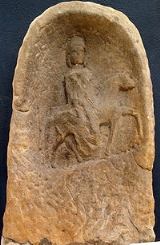
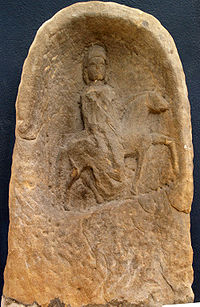
, she is depicted sitting side-saddle on a horse or (rarely) lying on one; in the Imperial type (more common outside Gaul) she sits on a throne flanked by two or more horses or foals. In distant Dacia
Dacia
In ancient geography, especially in Roman sources, Dacia was the land inhabited by the Dacians or Getae as they were known by the Greeks—the branch of the Thracians north of the Haemus range...
, she is represented on a stela (now at the Szépmüvézeti Museum, Budapest) in the format of Cybele
Cybele
Cybele , was a Phrygian form of the Earth Mother or Great Mother. As with Greek Gaia , her Minoan equivalent Rhea and some aspects of Demeter, Cybele embodies the fertile Earth...
, seated frontally on a throne with her hands on the necks of her paired animals: her horses are substitutions for Cybele's lions.
In Roman texts and inscriptions
Epona is mentioned in The Golden AssThe Golden Ass
The Metamorphoses of Apuleius, which St. Augustine referred to as The Golden Ass , is the only Latin novel to survive in its entirety....
by Apuleius
Apuleius
Apuleius was a Latin prose writer. He was a Berber, from Madaurus . He studied Platonist philosophy in Athens; travelled to Italy, Asia Minor and Egypt; and was an initiate in several cults or mysteries. The most famous incident in his life was when he was accused of using magic to gain the...
, where an aedicular niche with her image on a pillar in a stable has been garlanded with freshly picked roses. In his Satires, the Roman poet Juvenal
Juvenal
The Satires are a collection of satirical poems by the Latin author Juvenal written in the late 1st and early 2nd centuries AD.Juvenal is credited with sixteen known poems divided among five books; all are in the Roman genre of satire, which, at its most basic in the time of the author, comprised a...
also links the worship and iconography of Epona to the area of a stable. Small images of Epona have been found in Roman sites of stables and barns over a wide territory.
In Great Britain
The probable date of ca. 1400 BCE ascribed to the giant chalk horseUffington White Horse
The Uffington White Horse is a highly stylised prehistoric hill figure, 110 m long , formed from deep trenches filled with crushed white chalk...
carved into the hillside turf at Uffington
Uffington, Oxfordshire
Uffington is a village and civil parish about south of Faringdon. It was part of Berkshire until the 1974 boundary changes transferred it to Oxfordshire. Uffington is most commonly known as the location of the Uffington White Horse hill figure....
, in southern England, is too early to be directly associated with Epona a millennium and more later, but clearly represents a Bronze Age totem of some kind. The English traditional hobby-horse riders parading on May Day
May Day
May Day on May 1 is an ancient northern hemisphere spring festival and usually a public holiday; it is also a traditional spring holiday in many cultures....
at Padstow
Padstow
Padstow is a town, civil parish and fishing port on the north coast of Cornwall, England, United Kingdom. The town is situated on the west bank of the River Camel estuary approximately five miles northwest of Wadebridge, ten miles northwest of Bodmin and ten miles northeast of Newquay...
, Cornwall and Minehead
Minehead
Minehead is a coastal town and civil parish in Somerset, England. It lies on the south bank of the Bristol Channel, north-west of the county town of Taunton, from the border with the county of Devon and in proximity of the Exmoor National Park...
, Somerset, which survived to the mid-twentieth century, even though Morris dance
Morris dance
Morris dance is a form of English folk dance usually accompanied by music. It is based on rhythmic stepping and the execution of choreographed figures by a group of dancers. Implements such as sticks, swords, handkerchiefs and bells may also be wielded by the dancers...
s had been forgotten, may have deep roots in the veneration of Epona, as may the English aversion to eating horsemeat. At Padstow formerly, at the end of the festivities the hobby-horse was ritually submerged in the sea.
A provincial though not crude small (7.5 cm high) Roman bronze of a seated Epona, flanked by a small mare and stallion, found in England, is conserved in the British Museum
British Museum
The British Museum is a museum of human history and culture in London. Its collections, which number more than seven million objects, are amongst the largest and most comprehensive in the world and originate from all continents, illustrating and documenting the story of human culture from its...
. Lying on her lap and on the patera
Patera
A patera was a broad, shallow dish used for drinking, primarily in a ritual context such as a libation. These paterae were often used in Rome....
raised in her right hand are disproportionately large ears of grain; ears of grain also protrude from the mouths of the ponies, whose heads are turned towards the goddess. On her left arm she holds a yoke, which curves up above her shoulder, an attribute unique to this bronze statuette.
The Welsh
Welsh mythology
Welsh mythology, the remnants of the mythology of the pre-Christian Britons, has come down to us in much altered form in medieval Welsh manuscripts such as the Red Book of Hergest, the White Book of Rhydderch, the Book of Aneirin and the Book of Taliesin....
goddess Rhiannon
Rhiannon
Rhiannon is a prominent figure in Welsh mythology, mother to the Demetian hero Pryderi and wife to Pwyll . She is probably a reflex of the Celtic Great Queen goddess Rigantona and may also be associated with the horse goddess Epona.She appears in both the first and third branches of the Mabinogi...
rides a white horse and has many attributes of Epona. A south Welsh folk ritual call Mari Lwyd
Mari Lwyd
The Mari Lwyd , also Y Fari Lwyd, is a Welsh midwinter tradition, possibly to celebrate New Year , although it formerly took place over a period stretching from Christmas to late January...
(Grey Mare) is still undertaken in December - an apparent survival of the veneration of the goddess. The pantomime horse
Pantomime horse
A pantomime horse is atheatrical representation of a horse or other quadruped by two actors in a single costume who cooperate and synchronize their movements...
is thought to be a related survival.
Today
On Mackinac Island, Michigan, Epona is celebrated each June with stable tours, a blessing of the animals and the Epona and Barkus Parade. Mackinac Island, Michigan does not permit any personal automobiles: the primary source of transportation remains the horse, so celebrating Epona has special significance on this island in the Upper Midwest.In games
- Link, from The Legend of Zelda seriesThe Legend of Zelda series, occasionally called Legend of Zelda or simply Zelda, is a high fantasy action-adventure video game series created by Japanese game designers Shigeru Miyamoto and Takashi Tezuka. It is developed and published by Nintendo, with some portable installments outsourced to Flagship/Capcom, Vanpool, and...
games, rides a horse named Epona in four installments: The Legend of Zelda: Ocarina of TimeThe Legend of Zelda: Ocarina of Timeis an action-adventure video game developed by Nintendo's Entertainment Analysis and Development division for the Nintendo 64 video game console. It was released in Japan on November 21, 1998; in North America on November 23, 1998; and in Europe on December 11, 1998...
(1998), The Legend of Zelda: Majora's MaskThe Legend of Zelda: Majora's Maskis an action-adventure video game developed by Nintendo's Entertainment Analysis and Development division for the Nintendo 64. It was released in Japan on April 27, 2000, North America on October 26, 2000, and Europe on November 17, 2000. The game sold approximately 314,000 copies during its first...
(2000), The Legend of Zelda: Four Swords AdventuresThe Legend of Zelda: Four Swords AdventuresThe Legend of Zelda: Four Swords Adventures, released as in Japan, is the eleventh installment of Nintendo's The Legend of Zelda series. It was released for the Nintendo GameCube in Japan on March 18, 2004; in North America on June 7, 2004; in Europe on January 7, 2005; and in Australia on April...
(2004) and The Legend of Zelda: Twilight PrincessThe Legend of Zelda: Twilight Princessis an action-adventure game developed by Nintendo Entertainment Analysis and Development, and published by Nintendo for the GameCube and Wii video game consoles. It is the thirteenth installment in The Legend of Zelda series...
(2006). In Twilight Princess the player is given the option to change the name of the horse, but Epona is the default name.
An elf in the Japanese game Tears to Tiara is named Epona.
In literature
- Epona is the chief deity in P.C. Cast's Goddess of Parthalon series. Her priestess always rides a silver mare. The relevant books start with Bk. 1 Divine by Mistake and Bk. 5 is Brighid's Quest.
- In Morgan LlywelynMorgan LlywelynMorgan Llywelyn is an American-born Irish author best known for her historical fantasy, historical fiction, and historical non-fiction...
's novel, The Horse Goddess, Epona is a Celtic woman who possesses Druidic powers. - In S.M. Stirling's Dies the FireDies the FireDies the Fire is an alternate history, post-apocalyptic novel by S. M. Stirling and the first installment of the Emberverse series. The book is a spin-off from the Stirling's Nantucket series. In that series, modern-day Nantucket is thrown back in time to the Bronze Age...
series of novels, the character of Rudi Mackenzie rides a large, majestic black mare named Epona, who will allow no one but him to ride her. - In Rosemary SutcliffRosemary SutcliffRosemary Sutcliff CBE was a British novelist, and writer for children, best known as a writer of historical fiction and children's literature. Although she was primarily a children's author, the quality and depth of her writing also appeals to adults; Sutcliff herself once commented that she wrote...
's 1977 historical novel, Sun Horse, Moon HorseSun Horse, Moon HorseSun Horse, Moon Horse is a historical novel for children written by Rosemary Sutcliff and published in 1977.It takes place in Bronze Age Britain, telling the tale of a chieftain's son of the Iceni who is caught up in a conflict with the neighboring Attribates, and plays an instrumental part in...
, the White Horse of Uffington is created as an invocation to Epona.
In music
- EnyaEnyaEnya is an Irish singer, instrumentalist and songwriter. Enya is an approximate transliteration of how Eithne is pronounced in the Donegal dialect of the Irish language, her native tongue.She began her musical career in 1980, when she briefly joined her family band Clannad before leaving to...
has a song titled "Epona". - OmniaOmniaOmnia may refer to:* Omnia , PaganFolk band from the Netherlands* Omnia Township, Cowley County, Kansas* Omnia, a fictional nation in the Discworld universe* Omnia, a fictional realm in the Sudeki universe...
(a Dutch PaganFolk band) has dedicated a song called "Epona" to the Celtic goddess, which appears on the album Sine Missione. - The French Folk Metal band Heol Telwen has a song divided in two parts titled "Epona" in their album An Deiz Ruz.
Other
- As part of the European Space AgencyEuropean Space AgencyThe European Space Agency , established in 1975, is an intergovernmental organisation dedicated to the exploration of space, currently with 18 member states...
Giotto Mission to Halley's Comet, an experiment by Irish Scientists from St. Patrick's College, Maynooth was named EPONA; this was also an acronym for Energetic Particle ONset Admonitor.