

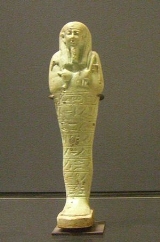
Mendes

Encyclopedia
Mendes the Greek
name of the Ancient Egyptian city of Djedet, also known in Ancient Egypt
as Per-Banebdjedet ("The Domain of the Ram Lord of Djed
et") and Anpet, is known today as Tell El-Ruba .
The city
is located in the eastern Nile delta
(30°57′30"N 31°30′57"E) and was the capital of the 16th Lower Egypt
ian nome
of Kha, until it was replaced by Thmuis
in Greco-Roman
Egypt
. The two cities are only several hundred meters apart. During the 29th dynasty
, Mendes was also the capital of Ancient Egypt, which lies on the Mendesian branch of the Nile
(now silted up), about 35 km east of al-Mansurah
.
(ii. 42, 46. 166), Diodorus (i. 84), Strabo
(xvii. p. 802), Mela
(i. 9 § 9), Pliny the Elder
(v. 10. s. 12), Ptolemy
(iv. 5. § 51), and Stephanus of Byzantium
(s. v.). The city was the capital of the Mendesian nome, situated at the point where the Mendesian arm of the Nile flows into the lake of Tanis
. Archaeological evidence attests to the existence of the town
at least as far back as the Naqada II period. Under the first Pharaoh
s, Mendes quickly became a strong seat of provincial government and remained so throughout the Ancient Egyptian period. In Classical
times, the nome it governed was one of the nomes assigned to that division of the native army which was called the Calasires, and the city was celebrated for the manufacture of a perfume
designated as the Mendesium unguentum. (Plin. xiii. 1. s. 2.) Mendes, however, declined early, and disappears in the first century AD; since both Ptolemy (l. c.) and P. Aelius Aristides (iii. p. 160) mention Thmuis
as the only town of note in the Mendesian nome. From its position at the junction of the river and the lake, it was probably encroached upon by their waters, after the canal
s fell into neglect under the Macedonian kings, and when they were repaired by Augustus
(Sueton
. Aug. 18, 63) Thmuis had attracted its trade
and population.
(lit. Ba of the Lord of Djedet), who was the Ba
of Osiris
, and his consort, the fish goddess Hatmehit
. With their child Har-pa-khered ("Horus
the Child"), they formed the triad of Mendes.
The ram deity of Mendes was described by Herodotus
in his History as being represented with the head and fleece
of a goat
: “...whereas anyone with a sanctuary of Mendes or who comes from the province of Mendes, will have nothing to do with (sacrificing
) goats, but uses sheep as his sacrificial animals... They say that Heracles’ overriding desire was to see Zeus
, but Zeus was refusing to let him do so. Eventually, as a result of Heracles’ pleading, Zeus came up with a plan. He skinned a ram and cut off his head, then he held the head in front of himself, wore the fleece, and showed himself to Heracles like that. That is why the Egyptian statues of Zeus have a ram’s head, is why rams are sacred to the Thebans, and they do not use them as sacrificial animals. However there is just one day of the year—the day of the festival of Zeus--when they chop up a single ram, skin it, dress the statue of Zeus in the way mentioned, and then bring the statue of Heracles up close to the statue of Zeus. Then everyone around the sanctuary
mourns the death of the ram and finally they bury it in a sacred tomb.”
Presumably following Herodotus' description, the occultist Eliphas Levi
in his Dogme et Rituel de la Haute Magie (1855) called his goat-headed conception of Baphomet
the "Baphomet of Mendes", thus popularizing and perpetuating this incorrect attribution, which has given rise to a flood of spurious connections, such as "The Goat of Mendes" by the blackened death metal band Akercocke
.
in the Nile delta, and consists of both Tell El-Ruba (the site of the main temple enclosure) and Tell El-Timai (the settlement site of Thmuis to the south). Overall, Mendes is about 3 km long from north to south and averages about 900m east-to-west. An Old Kingdom
necropolis
is estimated to contain over 9,000 interments. Several campaigns of 20th-century excavations have been led by North America
n institutions, including New York University
and the University of Toronto
, as well as a Pennsylvania State University
team led by Donald Redford. Under the direction of Prof. Redford, the current excavations are concentrating on a number of areas in and around the main temple
. Work on the New Kingdom
processional-style temple has recently uncovered foundation deposits of Merenptah below the second pylon
. It is thought that four separate pylons or gates existed for each of the Avatar
s of the main deity worshiped here. Evidence has suggested that their construction dates from at least the Middle Kingdom
, as foundation deposits were uncovered. The original structures were buried, added to, or incorporated into later ones over time by later rulers. Billy Morin, recently at University of Cambridge
in England
and now at Leiden University in the Netherlands led a team that investigated these further and uncovered several mud-brick walls acting as pylons and their foundations . Over thirty of the bricks were stamped with the cartouche
of Menkheperre
, the pre-nomen of Thutmose III
. A cemetery
of sacred rams was discovered in the northwest corner of Tell El-Ruba. Monument
s bearing the names of Ramesses II
, Merneptah
. and Ramesses III
were also found. A temple attested by its foundation deposits was built by Amasis. The tomb of Nepherites I, which Donald Reford concluded was destroyed by the Persians, was discovered by a joint team from the University of Washington
and the University of Toronto
in 1992-1993. On the edge of the temple mound, a sondage supervised by Matthew J. Adams has revealed uninterrupted stratification
from the Middle Kingdom down to the First Dynasty. Coring results suggest that future excavations in that sondage should expect to take the stratification down into the Buto-Maadi Period. The material excavated so far is already the longest uninterrupted stratification for all of the Nile Delta, and possibly for all of Egypt.
Greek language
Greek is an independent branch of the Indo-European family of languages. Native to the southern Balkans, it has the longest documented history of any Indo-European language, spanning 34 centuries of written records. Its writing system has been the Greek alphabet for the majority of its history;...
name of the Ancient Egyptian city of Djedet, also known in Ancient Egypt
Ancient Egypt
Ancient Egypt was an ancient civilization of Northeastern Africa, concentrated along the lower reaches of the Nile River in what is now the modern country of Egypt. Egyptian civilization coalesced around 3150 BC with the political unification of Upper and Lower Egypt under the first pharaoh...
as Per-Banebdjedet ("The Domain of the Ram Lord of Djed
Djed
The djed symbol is a pillar-like ancient Egyptian symbol representing stability. It has been interpreted as the backbone of the Egyptian god Osiris, especially in the form Banebdjedet . Djedu is the Egyptian name for Busiris, a centre of the cult of Osiris...
et") and Anpet, is known today as Tell El-Ruba .
The city
City
A city is a relatively large and permanent settlement. Although there is no agreement on how a city is distinguished from a town within general English language meanings, many cities have a particular administrative, legal, or historical status based on local law.For example, in the U.S...
is located in the eastern Nile delta
Nile Delta
The Nile Delta is the delta formed in Northern Egypt where the Nile River spreads out and drains into the Mediterranean Sea. It is one of the world's largest river deltas—from Alexandria in the west to Port Said in the east, it covers some 240 km of Mediterranean coastline—and is a rich...
(30°57′30"N 31°30′57"E) and was the capital of the 16th Lower Egypt
Lower Egypt
Lower Egypt is the northern-most section of Egypt. It refers to the fertile Nile Delta region, which stretches from the area between El-Aiyat and Zawyet Dahshur, south of modern-day Cairo, and the Mediterranean Sea....
ian nome
Nome (Egypt)
A nome was a subnational administrative division of ancient Egypt. Today's use of the Greek nome rather than the Egyptian term sepat came about during the Ptolemaic period. Fascinated with Egypt, Greeks created many historical records about the country...
of Kha, until it was replaced by Thmuis
Thmuis
Thmuis is a city of Lower Egypt, on the canal east of the Nile, between its Tanitic and Mendesian branches. In Greco-Roman Egypt, Thmuis replaced Djedet as the capital of Lower Egypt's 16th nome of Kha [ Herodotus ]. The two cities are only several hundred meters apart...
in Greco-Roman
Ancient Rome
Ancient Rome was a thriving civilization that grew on the Italian Peninsula as early as the 8th century BC. Located along the Mediterranean Sea and centered on the city of Rome, it expanded to one of the largest empires in the ancient world....
Egypt
Egypt
Egypt , officially the Arab Republic of Egypt, Arabic: , is a country mainly in North Africa, with the Sinai Peninsula forming a land bridge in Southwest Asia. Egypt is thus a transcontinental country, and a major power in Africa, the Mediterranean Basin, the Middle East and the Muslim world...
. The two cities are only several hundred meters apart. During the 29th dynasty
Twenty-ninth dynasty of Egypt
Nepherites I founded the Twenty-ninth Dynasty of ancient Egypt by defeating Amyrtaeus in open battle, and later putting him to death at Memphis. Nepherites made his capital at Mendes...
, Mendes was also the capital of Ancient Egypt, which lies on the Mendesian branch of the Nile
Nile
The Nile is a major north-flowing river in North Africa, generally regarded as the longest river in the world. It is long. It runs through the ten countries of Sudan, South Sudan, Burundi, Rwanda, Democratic Republic of the Congo, Tanzania, Kenya, Ethiopia, Uganda and Egypt.The Nile has two major...
(now silted up), about 35 km east of al-Mansurah
Al Mansurah
Mansoura is a city in Egypt, with a population of 420,000. It is the capital of the Dakahlia Governorate.- Etymology :Mansoura means 'The Victorious '. The city is named after the Egyptian victory over Louis IX of France during the Seventh Crusade.-Location:Mansoura lies on the east bank of the...
.
History
In ancient times, Mendes was a famous city that attracted the notice of most ancient geographers and historians, including HerodotusHerodotus
Herodotus was an ancient Greek historian who was born in Halicarnassus, Caria and lived in the 5th century BC . He has been called the "Father of History", and was the first historian known to collect his materials systematically, test their accuracy to a certain extent and arrange them in a...
(ii. 42, 46. 166), Diodorus (i. 84), Strabo
Strabo
Strabo, also written Strabon was a Greek historian, geographer and philosopher.-Life:Strabo was born to an affluent family from Amaseia in Pontus , a city which he said was situated the approximate equivalent of 75 km from the Black Sea...
(xvii. p. 802), Mela
Mela
Mela is a Sanskrit word meaning 'gathering' or 'to meet' or a Fair. It is used in the Indian subcontinent for all sizes of gathering and can be religious, commercial, cultural or sports. In rural traditions melas or village fairs were of great importance...
(i. 9 § 9), Pliny the Elder
Pliny the Elder
Gaius Plinius Secundus , better known as Pliny the Elder, was a Roman author, naturalist, and natural philosopher, as well as naval and army commander of the early Roman Empire, and personal friend of the emperor Vespasian...
(v. 10. s. 12), Ptolemy
Ptolemy
Claudius Ptolemy , was a Roman citizen of Egypt who wrote in Greek. He was a mathematician, astronomer, geographer, astrologer, and poet of a single epigram in the Greek Anthology. He lived in Egypt under Roman rule, and is believed to have been born in the town of Ptolemais Hermiou in the...
(iv. 5. § 51), and Stephanus of Byzantium
Stephanus of Byzantium
Stephen of Byzantium, also known as Stephanus Byzantinus , was the author of an important geographical dictionary entitled Ethnica...
(s. v.). The city was the capital of the Mendesian nome, situated at the point where the Mendesian arm of the Nile flows into the lake of Tanis
Tanis
Tanis was the capital of the 21st and 22nd dynasties of ancient Egypt, and is now an archaeological temple site. The word Tanis can also refer to:*Tanis, a little girl mummy in Scooby-Doo and the Ghoul School...
. Archaeological evidence attests to the existence of the town
Town
A town is a human settlement larger than a village but smaller than a city. The size a settlement must be in order to be called a "town" varies considerably in different parts of the world, so that, for example, many American "small towns" seem to British people to be no more than villages, while...
at least as far back as the Naqada II period. Under the first Pharaoh
Pharaoh
Pharaoh is a title used in many modern discussions of the ancient Egyptian rulers of all periods. The title originates in the term "pr-aa" which means "great house" and describes the royal palace...
s, Mendes quickly became a strong seat of provincial government and remained so throughout the Ancient Egyptian period. In Classical
Classical antiquity
Classical antiquity is a broad term for a long period of cultural history centered on the Mediterranean Sea, comprising the interlocking civilizations of ancient Greece and ancient Rome, collectively known as the Greco-Roman world...
times, the nome it governed was one of the nomes assigned to that division of the native army which was called the Calasires, and the city was celebrated for the manufacture of a perfume
Perfume
Perfume is a mixture of fragrant essential oils and/or aroma compounds, fixatives, and solvents used to give the human body, animals, objects, and living spaces "a pleasant scent"...
designated as the Mendesium unguentum. (Plin. xiii. 1. s. 2.) Mendes, however, declined early, and disappears in the first century AD; since both Ptolemy (l. c.) and P. Aelius Aristides (iii. p. 160) mention Thmuis
Thmuis
Thmuis is a city of Lower Egypt, on the canal east of the Nile, between its Tanitic and Mendesian branches. In Greco-Roman Egypt, Thmuis replaced Djedet as the capital of Lower Egypt's 16th nome of Kha [ Herodotus ]. The two cities are only several hundred meters apart...
as the only town of note in the Mendesian nome. From its position at the junction of the river and the lake, it was probably encroached upon by their waters, after the canal
Canal
Canals are man-made channels for water. There are two types of canal:#Waterways: navigable transportation canals used for carrying ships and boats shipping goods and conveying people, further subdivided into two kinds:...
s fell into neglect under the Macedonian kings, and when they were repaired by Augustus
Augustus
Augustus ;23 September 63 BC – 19 August AD 14) is considered the first emperor of the Roman Empire, which he ruled alone from 27 BC until his death in 14 AD.The dates of his rule are contemporary dates; Augustus lived under two calendars, the Roman Republican until 45 BC, and the Julian...
(Sueton
Suetonius
Gaius Suetonius Tranquillus, commonly known as Suetonius , was a Roman historian belonging to the equestrian order in the early Imperial era....
. Aug. 18, 63) Thmuis had attracted its trade
Trade
Trade is the transfer of ownership of goods and services from one person or entity to another. Trade is sometimes loosely called commerce or financial transaction or barter. A network that allows trade is called a market. The original form of trade was barter, the direct exchange of goods and...
and population.
Religion
The chief deities of Mendes were the ram deity BanebdjedetBanebdjedet
Banebdjedet was an Ancient Egyptian ram god with a cult centre at Mendes. Khnum was the equivalent god in Upper Egypt. His wife was the goddess Hatmehyt who was perhaps the original deity of Mendes. Their offspring was "Horus the Child" and they formed the so called "Mendesian Triad"...
(lit. Ba of the Lord of Djedet), who was the Ba
Egyptian soul
The ancient Egyptians believed that a human soul was made up of five parts: the Ren, the Ba, the Ka, the Sheut, and the Ib. In addition to these components of the soul there was the human body...
of Osiris
Osiris
Osiris is an Egyptian god, usually identified as the god of the afterlife, the underworld and the dead. He is classically depicted as a green-skinned man with a pharaoh's beard, partially mummy-wrapped at the legs, wearing a distinctive crown with two large ostrich feathers at either side, and...
, and his consort, the fish goddess Hatmehit
Hatmehit
Hatmehit, or Hatmehyt in the ancient Egyptian religion was a fish-goddess in the area around the delta city of Per-banebdjedet, Mendes. In ancient Egyptian art Hatmehit was depicted either as a fish, or a woman with a fish emblem or crown on her head...
. With their child Har-pa-khered ("Horus
Horus
Horus is one of the oldest and most significant deities in the Ancient Egyptian religion, who was worshipped from at least the late Predynastic period through to Greco-Roman times. Different forms of Horus are recorded in history and these are treated as distinct gods by Egyptologists...
the Child"), they formed the triad of Mendes.
The ram deity of Mendes was described by Herodotus
Herodotus
Herodotus was an ancient Greek historian who was born in Halicarnassus, Caria and lived in the 5th century BC . He has been called the "Father of History", and was the first historian known to collect his materials systematically, test their accuracy to a certain extent and arrange them in a...
in his History as being represented with the head and fleece
Wool
Wool is the textile fiber obtained from sheep and certain other animals, including cashmere from goats, mohair from goats, qiviut from muskoxen, vicuña, alpaca, camel from animals in the camel family, and angora from rabbits....
of a goat
Goat
The domestic goat is a subspecies of goat domesticated from the wild goat of southwest Asia and Eastern Europe. The goat is a member of the Bovidae family and is closely related to the sheep as both are in the goat-antelope subfamily Caprinae. There are over three hundred distinct breeds of...
: “...whereas anyone with a sanctuary of Mendes or who comes from the province of Mendes, will have nothing to do with (sacrificing
Sacrifice
Sacrifice is the offering of food, objects or the lives of animals or people to God or the gods as an act of propitiation or worship.While sacrifice often implies ritual killing, the term offering can be used for bloodless sacrifices of cereal food or artifacts...
) goats, but uses sheep as his sacrificial animals... They say that Heracles’ overriding desire was to see Zeus
Zeus
In the ancient Greek religion, Zeus was the "Father of Gods and men" who ruled the Olympians of Mount Olympus as a father ruled the family. He was the god of sky and thunder in Greek mythology. His Roman counterpart is Jupiter and his Etruscan counterpart is Tinia.Zeus was the child of Cronus...
, but Zeus was refusing to let him do so. Eventually, as a result of Heracles’ pleading, Zeus came up with a plan. He skinned a ram and cut off his head, then he held the head in front of himself, wore the fleece, and showed himself to Heracles like that. That is why the Egyptian statues of Zeus have a ram’s head, is why rams are sacred to the Thebans, and they do not use them as sacrificial animals. However there is just one day of the year—the day of the festival of Zeus--when they chop up a single ram, skin it, dress the statue of Zeus in the way mentioned, and then bring the statue of Heracles up close to the statue of Zeus. Then everyone around the sanctuary
Sanctuary
A sanctuary is any place of safety. They may be categorized into human and non-human .- Religious sanctuary :A religious sanctuary can be a sacred place , or a consecrated area of a church or temple around its tabernacle or altar.- Sanctuary as a sacred place :#Sanctuary as a sacred place:#:In...
mourns the death of the ram and finally they bury it in a sacred tomb.”
Presumably following Herodotus' description, the occultist Eliphas Levi
Eliphas Levi
Eliphas Lévi, born Alphonse Louis Constant , was a French occult author and purported magician."Eliphas Lévi," the name under which he published his books, was his attempt to translate or transliterate his given names "Alphonse Louis" into Hebrew although he was not Jewish.His second wife was...
in his Dogme et Rituel de la Haute Magie (1855) called his goat-headed conception of Baphomet
Baphomet
Baphomet is an imagined pagan deity , revived in the 19th century as a figure of occultism and Satanism. It appeared as a term for a pagan idol in trial transcripts of the Inquisition of the Knights Templar in the early 14th century...
the "Baphomet of Mendes", thus popularizing and perpetuating this incorrect attribution, which has given rise to a flood of spurious connections, such as "The Goat of Mendes" by the blackened death metal band Akercocke
Akercocke
Akercocke is an English progressive blackened death metal band from London, England. They take their name from a talking monkey in Robert Nye's interpretation of the Faust-legend, and are notable for their heavily Satanic and sexual lyrical content....
.
Ruins
The site is today the largest surviving tellTell
A tell or tel, is a type of archaeological mound created by human occupation and abandonment of a geographical site over many centuries. A classic tell looks like a low, truncated cone with a flat top and sloping sides.-Archaeology:A tell is a hill created by different civilizations living and...
in the Nile delta, and consists of both Tell El-Ruba (the site of the main temple enclosure) and Tell El-Timai (the settlement site of Thmuis to the south). Overall, Mendes is about 3 km long from north to south and averages about 900m east-to-west. An Old Kingdom
Old Kingdom
Old Kingdom is the name given to the period in the 3rd millennium BC when Egypt attained its first continuous peak of civilization in complexity and achievement – the first of three so-called "Kingdom" periods, which mark the high points of civilization in the lower Nile Valley .The term itself was...
necropolis
Necropolis
A necropolis is a large cemetery or burial ground, usually including structural tombs. The word comes from the Greek νεκρόπολις - nekropolis, literally meaning "city of the dead"...
is estimated to contain over 9,000 interments. Several campaigns of 20th-century excavations have been led by North America
North America
North America is a continent wholly within the Northern Hemisphere and almost wholly within the Western Hemisphere. It is also considered a northern subcontinent of the Americas...
n institutions, including New York University
New York University
New York University is a private, nonsectarian research university based in New York City. NYU's main campus is situated in the Greenwich Village section of Manhattan...
and the University of Toronto
University of Toronto
The University of Toronto is a public research university in Toronto, Ontario, Canada, situated on the grounds that surround Queen's Park. It was founded by royal charter in 1827 as King's College, the first institution of higher learning in Upper Canada...
, as well as a Pennsylvania State University
Pennsylvania State University
The Pennsylvania State University, commonly referred to as Penn State or PSU, is a public research university with campuses and facilities throughout the state of Pennsylvania, United States. Founded in 1855, the university has a threefold mission of teaching, research, and public service...
team led by Donald Redford. Under the direction of Prof. Redford, the current excavations are concentrating on a number of areas in and around the main temple
Temple
A temple is a structure reserved for religious or spiritual activities, such as prayer and sacrifice, or analogous rites. A templum constituted a sacred precinct as defined by a priest, or augur. It has the same root as the word "template," a plan in preparation of the building that was marked out...
. Work on the New Kingdom
New Kingdom
The New Kingdom of Egypt, also referred to as the Egyptian Empire is the period in ancient Egyptian history between the 16th century BC and the 11th century BC, covering the Eighteenth, Nineteenth, and Twentieth Dynasties of Egypt....
processional-style temple has recently uncovered foundation deposits of Merenptah below the second pylon
Pylon (architecture)
Pylon is the Greek term for a monumental gateway of an Egyptian temple It consists of two tapering towers, each surmounted by a cornice, joined by a less elevated section which enclosed the entrance between them. The entrance was generally about half the height of the towers...
. It is thought that four separate pylons or gates existed for each of the Avatar
Avatar
In Hinduism, an avatar is a deliberate descent of a deity to earth, or a descent of the Supreme Being and is mostly translated into English as "incarnation," but more accurately as "appearance" or "manifestation"....
s of the main deity worshiped here. Evidence has suggested that their construction dates from at least the Middle Kingdom
Middle Kingdom of Egypt
The Middle Kingdom of Egypt is the period in the history of ancient Egypt stretching from the establishment of the Eleventh Dynasty to the end of the Fourteenth Dynasty, between 2055 BC and 1650 BC, although some writers include the Thirteenth and Fourteenth dynasties in the Second Intermediate...
, as foundation deposits were uncovered. The original structures were buried, added to, or incorporated into later ones over time by later rulers. Billy Morin, recently at University of Cambridge
University of Cambridge
The University of Cambridge is a public research university located in Cambridge, United Kingdom. It is the second-oldest university in both the United Kingdom and the English-speaking world , and the seventh-oldest globally...
in England
England
England is a country that is part of the United Kingdom. It shares land borders with Scotland to the north and Wales to the west; the Irish Sea is to the north west, the Celtic Sea to the south west, with the North Sea to the east and the English Channel to the south separating it from continental...
and now at Leiden University in the Netherlands led a team that investigated these further and uncovered several mud-brick walls acting as pylons and their foundations . Over thirty of the bricks were stamped with the cartouche
Cartouche
In Egyptian hieroglyphs, a cartouche is an ellipse with a horizontal line at one end, indicating that the text enclosed is a royal name, coming into use during the beginning of the Fourth Dynasty under Pharaoh Sneferu, replacing the earlier serekh...
of Menkheperre
Menkheperre
Menkheperre, son of Pharaoh Pinedjem I by wife Henuttawy , was the High Priest of Amun at Thebes in Ancient Egypt from 1045 BC to 992 BC and de facto ruler of the south of the country....
, the pre-nomen of Thutmose III
Thutmose III
Thutmose III was the sixth Pharaoh of the Eighteenth Dynasty. During the first twenty-two years of Thutmose's reign he was co-regent with his stepmother, Hatshepsut, who was named the pharaoh...
. A cemetery
Cemetery
A cemetery is a place in which dead bodies and cremated remains are buried. The term "cemetery" implies that the land is specifically designated as a burying ground. Cemeteries in the Western world are where the final ceremonies of death are observed...
of sacred rams was discovered in the northwest corner of Tell El-Ruba. Monument
Monument
A monument is a type of structure either explicitly created to commemorate a person or important event or which has become important to a social group as a part of their remembrance of historic times or cultural heritage, or simply as an example of historic architecture...
s bearing the names of Ramesses II
Ramesses II
Ramesses II , referred to as Ramesses the Great, was the third Egyptian pharaoh of the Nineteenth dynasty. He is often regarded as the greatest, most celebrated, and most powerful pharaoh of the Egyptian Empire...
, Merneptah
Merneptah
Merneptah was the fourth ruler of the Nineteenth Dynasty of Ancient Egypt. He ruled Egypt for almost ten years between late July or early August 1213 and May 2, 1203 BC, according to contemporary historical records...
. and Ramesses III
Ramesses III
Usimare Ramesses III was the second Pharaoh of the Twentieth Dynasty and is considered to be the last great New Kingdom king to wield any substantial authority over Egypt. He was the son of Setnakhte and Queen Tiy-Merenese. Ramesses III is believed to have reigned from March 1186 to April 1155 BCE...
were also found. A temple attested by its foundation deposits was built by Amasis. The tomb of Nepherites I, which Donald Reford concluded was destroyed by the Persians, was discovered by a joint team from the University of Washington
University of Washington
University of Washington is a public research university, founded in 1861 in Seattle, Washington, United States. The UW is the largest university in the Northwest and the oldest public university on the West Coast. The university has three campuses, with its largest campus in the University...
and the University of Toronto
University of Toronto
The University of Toronto is a public research university in Toronto, Ontario, Canada, situated on the grounds that surround Queen's Park. It was founded by royal charter in 1827 as King's College, the first institution of higher learning in Upper Canada...
in 1992-1993. On the edge of the temple mound, a sondage supervised by Matthew J. Adams has revealed uninterrupted stratification
Stratification (archeology)
Stratification is a paramount and base concept in archaeology, especially in the course of excavation. It is largely based on the Law of Superposition...
from the Middle Kingdom down to the First Dynasty. Coring results suggest that future excavations in that sondage should expect to take the stratification down into the Buto-Maadi Period. The material excavated so far is already the longest uninterrupted stratification for all of the Nile Delta, and possibly for all of Egypt.
External links
- The Great Mendes Stela
- Egyptian Monuments: Tell el-Rub'a
- DjedDjedThe djed symbol is a pillar-like ancient Egyptian symbol representing stability. It has been interpreted as the backbone of the Egyptian god Osiris, especially in the form Banebdjedet . Djedu is the Egyptian name for Busiris, a centre of the cult of Osiris...