

Egyptian pantheon

Encyclopedia
The Egyptian pantheon consisted of the many gods worshipped by the Ancient Egyptians. A number of major deities are addressed as the creator of the cosmos. These include Atum
, Ra
, Amun
(Amen) and Ptah
amongst others, as well as composite forms of these gods such as Amun-Ra. This was not seen as contradictory by the Egyptians. The development of Egyptian religion in the New Kingdom lead some early Egyptologists such as E.A. Wallis Budge to speculate that the Egyptians were in reality monotheistic. Others such as Sir Flinders Petrie considered the Egyptians to be polytheists. Erik Hornung
argues that the best term to apply to their religion is 'henotheism' which describes 'worship of one god at a time but not a single god.'
The Egyptian
term for goddess
was (; , ) and the term for god
was (; also transliterated , ). The hieroglyph represents a pole or staff wrapped in cloth with the free end of the cloth shown at the top. The use of this sign has been connected to the flag poles at the entrance towers of Egyptian temple
s. Alternative glyphs for gods include a star, a squatting human figure or a hawk on a perch.
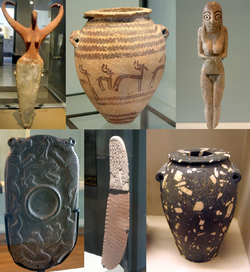 The Egyptian religion has a long history. Earliest images include the symbols for the goddess Neith
, many fertility figurines and versions of the vulture
(Nekhbet
) and cobra
(Wadjet
) goddesses which were borne on Egyptian crowns from predynastic
and protodynastic periods through to the Roman period.
The many types of animals that are native to Northern Africa were immensely influential in nearly every significant aspect of the Ancient Egyptian way of life. The people were highly dependent on, and sometimes equally highly cautious of, different animals in many differing ways. The presence of certain animals (or lack thereof) factored with their behavior and sheer numbers, could easily mean the difference between life and death to an individual Egyptian person in one common type of situation; just as easily as they could mean the difference between prosperity and poverty to a person in another type of situation. Perhaps most importantly, however, certain animals could also mean the difference between peace and war for the entire nation.
With regard to religion, there was a vast amount of varying forms of symbolism relating to animals embraced by the Ancient Egyptians -- the symbols connoted by various animals were consistently recurring themes in their religious system. For instance, there were many cow goddesses, such as Hathor
, reflecting the fact that cattle were domesticated in Egypt
by 8,000 B.C.. By 5,500 B.C., stone-roofed subterranean chambers and other subterranean complexes in Nabta Playa
were constructed for the express purpose of housing the tombs of ritually sacrificed cattle. Wild, as well as domesticated animals, inspired a truly enormous amount of religious symbolism, take for instance the fierce lioness, personified by Sekhmet
as the warrior goddess in the south.
By 4,000 B.C. Gerzean tomb-building was seen to include underground rooms and burial of furniture and amulet
s, a prelude to the funerary cult of Osiris
which appears in the 5th Dynasty.
The pharaoh
was deified
after death, and bore the title of "the good god". The title, "servant of god" was used for the priesthood, 'priestesses' and 'priests'. Over the great period of time covered by Ancient Egyptian culture the importance of certain deities would rise and fall, often because of the religious allegiance of the king. However the worship of some deities was more or less continuous.
Atum
Atum, sometimes rendered as Atem or Tem, is an important deity in Egyptian mythology.- Name :Atum's name is thought to be derived from the word 'tem' which means to complete or finish. Thus he has been interpreted as being the 'complete one' and also the finisher of the world, which he returns to...
, Ra
Ra
Ra is the ancient Egyptian sun god. By the Fifth Dynasty he had become a major deity in ancient Egyptian religion, identified primarily with the mid-day sun...
, Amun
Amun
Amun, reconstructed Egyptian Yamānu , was a god in Egyptian mythology who in the form of Amun-Ra became the focus of the most complex system of theology in Ancient Egypt...
(Amen) and Ptah
Ptah
In Ancient Egyptian Religion, Ptah was the deification of the primordial mound in the Ennead cosmogony, which was more literally referred to as Ta-tenen , meaning risen land, or as Tanen, meaning submerged land, though Tatenen was a god in his...
amongst others, as well as composite forms of these gods such as Amun-Ra. This was not seen as contradictory by the Egyptians. The development of Egyptian religion in the New Kingdom lead some early Egyptologists such as E.A. Wallis Budge to speculate that the Egyptians were in reality monotheistic. Others such as Sir Flinders Petrie considered the Egyptians to be polytheists. Erik Hornung
Erik Hornung
Erik Hornung is an Egyptologist and one of the most influential modern writers on the Ancient Egyptian religion. He is Professor Emeritus of Basle University.-Biography:...
argues that the best term to apply to their religion is 'henotheism' which describes 'worship of one god at a time but not a single god.'
The Egyptian
Egyptian language
Egyptian is the oldest known indigenous language of Egypt and a branch of the Afroasiatic language family. Written records of the Egyptian language have been dated from about 3400 BC, making it one of the oldest recorded languages known. Egyptian was spoken until the late 17th century AD in the...
term for goddess
Goddess
A goddess is a female deity. In some cultures goddesses are associated with Earth, motherhood, love, and the household. In other cultures, goddesses also rule over war, death, and destruction as well as healing....
was (; , ) and the term for god
God (male deity)
A god, as a male deity, contrasts with female deities, or "goddesses". While the term 'goddess' specifically refers to a female deity, the plural 'gods' can be applied to all gods collectively, regardless of gender....
was (; also transliterated , ). The hieroglyph represents a pole or staff wrapped in cloth with the free end of the cloth shown at the top. The use of this sign has been connected to the flag poles at the entrance towers of Egyptian temple
Egyptian temple
Egyptian temples were built for the official worship of the gods and commemoration of pharaohs in Ancient Egypt and in regions under Egyptian control. These temples were seen as houses for the gods or kings to whom they were dedicated...
s. Alternative glyphs for gods include a star, a squatting human figure or a hawk on a perch.
Background and history
Neith
In Egyptian mythology, Neith was an early goddess in the Egyptian pantheon. She was the patron deity of Sais, where her cult was centered in the Western Nile Delta of Egypt and attested as early as the First Dynasty...
, many fertility figurines and versions of the vulture
Vulture
Vulture is the name given to two groups of convergently evolved scavenging birds, the New World Vultures including the well-known Californian and Andean Condors, and the Old World Vultures including the birds which are seen scavenging on carcasses of dead animals on African plains...
(Nekhbet
Nekhbet
In Egyptian mythology, Nekhbet was an early predynastic local goddess who was the patron of the city of Nekheb, her name meaning of Nekheb...
) and cobra
Cobra
Cobra is a venomous snake belonging to the family Elapidae. However, not all snakes commonly referred to as cobras are of the same genus, or even of the same family. The name is short for cobra capo or capa Snake, which is Portuguese for "snake with hood", or "hood-snake"...
(Wadjet
Wadjet
In Egyptian mythology, Wadjet, or the Green One , was originally the ancient local goddess of the city of Dep , which became part of the city that the Egyptians named Per-Wadjet, House of...
) goddesses which were borne on Egyptian crowns from predynastic
Predynastic Egypt
The Prehistory of Egypt spans the period of earliest human settlement to the beginning of the Early Dynastic Period of Egypt in ca. 3100 BC, starting with King Menes/Narmer....
and protodynastic periods through to the Roman period.
The many types of animals that are native to Northern Africa were immensely influential in nearly every significant aspect of the Ancient Egyptian way of life. The people were highly dependent on, and sometimes equally highly cautious of, different animals in many differing ways. The presence of certain animals (or lack thereof) factored with their behavior and sheer numbers, could easily mean the difference between life and death to an individual Egyptian person in one common type of situation; just as easily as they could mean the difference between prosperity and poverty to a person in another type of situation. Perhaps most importantly, however, certain animals could also mean the difference between peace and war for the entire nation.
With regard to religion, there was a vast amount of varying forms of symbolism relating to animals embraced by the Ancient Egyptians -- the symbols connoted by various animals were consistently recurring themes in their religious system. For instance, there were many cow goddesses, such as Hathor
Hathor
Hathor , is an Ancient Egyptian goddess who personified the principles of love, beauty, music, motherhood and joy. She was one of the most important and popular deities throughout the history of Ancient Egypt...
, reflecting the fact that cattle were domesticated in Egypt
Egypt
Egypt , officially the Arab Republic of Egypt, Arabic: , is a country mainly in North Africa, with the Sinai Peninsula forming a land bridge in Southwest Asia. Egypt is thus a transcontinental country, and a major power in Africa, the Mediterranean Basin, the Middle East and the Muslim world...
by 8,000 B.C.. By 5,500 B.C., stone-roofed subterranean chambers and other subterranean complexes in Nabta Playa
Nabta Playa
Nabta Playa was once a large basin in the Nubian Desert, located approximately 800 kilometers south of modern day Cairo or about 100 kilometers west of Abu Simbel in southern Egypt, 22° 32' north, 30° 42' east...
were constructed for the express purpose of housing the tombs of ritually sacrificed cattle. Wild, as well as domesticated animals, inspired a truly enormous amount of religious symbolism, take for instance the fierce lioness, personified by Sekhmet
Sekhmet
In Egyptian mythology, Sekhmet , was originally the warrior goddess as well as goddess of healing for Upper Egypt. She is depicted as a lioness, the fiercest hunter known to the Egyptians. It was said that her breath created the desert...
as the warrior goddess in the south.
By 4,000 B.C. Gerzean tomb-building was seen to include underground rooms and burial of furniture and amulet
Amulet
An amulet, similar to a talisman , is any object intended to bring good luck or protection to its owner.Potential amulets include gems, especially engraved gems, statues, coins, drawings, pendants, rings, plants and animals; even words said in certain occasions—for example: vade retro satana—, to...
s, a prelude to the funerary cult of Osiris
Osiris
Osiris is an Egyptian god, usually identified as the god of the afterlife, the underworld and the dead. He is classically depicted as a green-skinned man with a pharaoh's beard, partially mummy-wrapped at the legs, wearing a distinctive crown with two large ostrich feathers at either side, and...
which appears in the 5th Dynasty.
The pharaoh
Pharaoh
Pharaoh is a title used in many modern discussions of the ancient Egyptian rulers of all periods. The title originates in the term "pr-aa" which means "great house" and describes the royal palace...
was deified
Imperial cult
An imperial cult is a form of state religion in which an emperor, or a dynasty of emperors , are worshipped as messiahs, demigods or deities. "Cult" here is used to mean "worship", not in the modern pejorative sense...
after death, and bore the title of "the good god". The title, "servant of god" was used for the priesthood, 'priestesses' and 'priests'. Over the great period of time covered by Ancient Egyptian culture the importance of certain deities would rise and fall, often because of the religious allegiance of the king. However the worship of some deities was more or less continuous.
Companies of Gods
- The EnneadEnneadThe Ennead was a group ofnine deities in Egyptian mythology. The Ennead were worshipped at Heliopolis and consisted of the god Atum, his children Shu and Tefnut, their children Geb and Nut and their children Osiris, Isis, Horus, Set and Nephthys.-Terminology:Egyptian mythology established multiple...
of HeliopolisHeliopolis (ancient)Heliopolis was one of the oldest cities of ancient Egypt, the capital of the 13th Lower Egyptian nome that was located five miles east of the Nile to the north of the apex of the Nile Delta...
, meaning the nine – consisted of AtumAtumAtum, sometimes rendered as Atem or Tem, is an important deity in Egyptian mythology.- Name :Atum's name is thought to be derived from the word 'tem' which means to complete or finish. Thus he has been interpreted as being the 'complete one' and also the finisher of the world, which he returns to...
, GebGebGeb was the Egyptian god of the Earth and a member of the Ennead of Heliopolis. It was believed in ancient Egypt that Geb's laughter was earthquakes and that he allowed crops to grow. The name was pronounced as such from the Greek period onward,...
, IsisIsisIsis or in original more likely Aset is a goddess in Ancient Egyptian religious beliefs, whose worship spread throughout the Greco-Roman world. She was worshipped as the ideal mother and wife as well as the matron of nature and magic...
, NutNut (goddess)In the Ennead of Egyptian mythology, Nut was the goddess of the sky.-Goddess of the sky:...
, OsirisOsirisOsiris is an Egyptian god, usually identified as the god of the afterlife, the underworld and the dead. He is classically depicted as a green-skinned man with a pharaoh's beard, partially mummy-wrapped at the legs, wearing a distinctive crown with two large ostrich feathers at either side, and...
, NephthysNephthysIn Egyptian mythology, Nephthys is a member of the Great Ennead of Heliopolis, a daughter of Nut and Geb. Nephthys was typically paired with her sister Isis in funerary rites because of their role as protectors of the mummy and the god Osiris and as the sister-wife of Seth.Nephthys is regarded as...
, SetSet (mythology)Set was in Ancient Egyptian religion, a god of the desert, storms, and foreigners. In later myths he was also the god of darkness, and chaos...
, ShuShu (Egyptian deity)In Egyptian mythology, Shu is one of the primordial gods, a personification of air, one of the Ennead of Heliopolis. He was created by Atum, his father and Iusaaset, his mother in the city of Heliopolis. With his sister, Tefnut , he was the father of Nut and Geb...
, and TefnutTefnutIn Ancient Egyptian religion, Tefnut, transliterated tfnt is a goddess of moisture, moist air, dew and rain. She is the sister and consort of the air god Shu and the mother of Geb and Nut.- Etymology :... - The OgdoadOgdoadIn Egyptian mythology, the Ogdoad were eight deities worshipped in Hermopolis during what is called the Old Kingdom, the third through sixth dynasties, dated between 2686 to 2134 BC...
of HermopolisHermopolisHermopolis Magna or simply Hermopolis or Hermopolis Megale or Hermupolis is the site of ancient Khmun, and is located near the modern Egyptian town of El Ashmunein in Al Minya governorate.-Etymology:Khmun, the Ancient Egyptian name of the city, means "eight-town", after the Ogdoad, a group of...
, eight deities who were worshipped in four female-male pairs; the females were associated with snakes and the males with frogs: NaunetNaunetIn Egyptian mythology, Nu or Nun is the deification of the primordial watery abyss. In the Ogdoad cosmogony, the name nu means "abyss"....
and Nu, Amaunet and AmunAmunAmun, reconstructed Egyptian Yamānu , was a god in Egyptian mythology who in the form of Amun-Ra became the focus of the most complex system of theology in Ancient Egypt...
, Kauket and KukKukKuk is the deification of the primordial concept of darkness in Egyptian mythology. In the Ogdoad cosmogony, his name meant darkness. As a concept, Kuk was viewed as androgynous, his female form being known as Kauket , which is simply the female form of the word Kuk...
, Hauhet and HuhHuhHuh may refer to:*HUH or Harvard University Herbaria*huH, a defunct US music magazine popular during the 1990s*Huh , from Egyptian mythological system, Ogdoad*Huh or Heo, a Korean family name...
. - The PtahPtahIn Ancient Egyptian Religion, Ptah was the deification of the primordial mound in the Ennead cosmogony, which was more literally referred to as Ta-tenen , meaning risen land, or as Tanen, meaning submerged land, though Tatenen was a god in his...
-SekhmetSekhmetIn Egyptian mythology, Sekhmet , was originally the warrior goddess as well as goddess of healing for Upper Egypt. She is depicted as a lioness, the fiercest hunter known to the Egyptians. It was said that her breath created the desert...
-NefertemNefertemIn Egyptian mythology, Nefertem was originally a lotus flower at the creation of the world, who had arisen from the primal waters.Nefertem represented both the first sunlight and the delightful smell of the Egyptian blue lotus...
triadTriple deitiesA triple deity is a deity associated with the number three. Such deities are common throughout world mythology; the number three has a long history of mythical associations. C. G...
of MemphisMemphis, EgyptMemphis was the ancient capital of Aneb-Hetch, the first nome of Lower Egypt. Its ruins are located near the town of Helwan, south of Cairo.According to legend related by Manetho, the city was founded by the pharaoh Menes around 3000 BC. Capital of Egypt during the Old Kingdom, it remained an...
Animal worship
Many animals were considered sacred to particular deities:| Deity | Animal |
|---|---|
| Ptah Ptah In Ancient Egyptian Religion, Ptah was the deification of the primordial mound in the Ennead cosmogony, which was more literally referred to as Ta-tenen , meaning risen land, or as Tanen, meaning submerged land, though Tatenen was a god in his... |
Bull |
| Thoth Thoth Thoth was considered one of the more important deities of the Egyptian pantheon. In art, he was often depicted as a man with the head of an ibis or a baboon, animals sacred to him. His feminine counterpart was Seshat... |
Ibis/Baboon |
| Amun Amun Amun, reconstructed Egyptian Yamānu , was a god in Egyptian mythology who in the form of Amun-Ra became the focus of the most complex system of theology in Ancient Egypt... |
Ram |
| Horus Horus Horus is one of the oldest and most significant deities in the Ancient Egyptian religion, who was worshipped from at least the late Predynastic period through to Greco-Roman times. Different forms of Horus are recorded in history and these are treated as distinct gods by Egyptologists... /Ra Ra Ra is the ancient Egyptian sun god. By the Fifth Dynasty he had become a major deity in ancient Egyptian religion, identified primarily with the mid-day sun... |
Falcon/Hawk |
| Anubis Anubis Anubis is the Greek name for a jackal-headed god associated with mummification and the afterlife in ancient Egyptian religion. In the ancient Egyptian language, Anubis is known as Inpu . According to the Akkadian transcription in the Amarna letters, Anubis' name was vocalized as Anapa... |
Jackal/Dog |
| Sobek Sobek Sobek , and in Greek, Suchos was the deification of crocodiles, as crocodiles were deeply feared in the nation so dependent on the Nile River... |
Crocodile |
| Hathor Hathor Hathor , is an Ancient Egyptian goddess who personified the principles of love, beauty, music, motherhood and joy. She was one of the most important and popular deities throughout the history of Ancient Egypt... |
Cow |
| Sekhmet Sekhmet In Egyptian mythology, Sekhmet , was originally the warrior goddess as well as goddess of healing for Upper Egypt. She is depicted as a lioness, the fiercest hunter known to the Egyptians. It was said that her breath created the desert... |
Lion |
| Nekhbet Nekhbet In Egyptian mythology, Nekhbet was an early predynastic local goddess who was the patron of the city of Nekheb, her name meaning of Nekheb... |
Vulture |
| Ejo or Wadjet Wadjet In Egyptian mythology, Wadjet, or the Green One , was originally the ancient local goddess of the city of Dep , which became part of the city that the Egyptians named Per-Wadjet, House of... |
Egyptian cobra |
| Khepri Khepri This article is about the Egyptian god. For the type of robot, see Khepera mobile robot.In Egyptian mythology, Khepri is the name of a major god. Khepri is associated with the dung beetle , whose behavior of maintaining spherical balls of dung represents the forces which move the sun... |
Scarab Beetle |
| Geb Geb Geb was the Egyptian god of the Earth and a member of the Ennead of Heliopolis. It was believed in ancient Egypt that Geb's laughter was earthquakes and that he allowed crops to grow. The name was pronounced as such from the Greek period onward,... |
Egyptian Goose/Snake |
List of deities of Ancient Egypt
External links
- Goddesses and Gods of the Ancient Egyptians: A Theological Encyclopedia
- List of Mythological Deities. Deurer, 1997
- Gods and Goddesses. ancientegypt.co.uk.
- List of Gods and Goddesses from Ancient Egypt
- Egyptian Gods. gwydir.demon.co.uk.
- Egyptian gods and religion