


Shrew

Encyclopedia
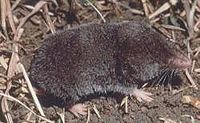
A shrew or shrew mouse (family
Soricidae) is a small mole
like mammal
classified in the order
Soricomorpha
. True shrews are also not to be confused with West Indies shrews, treeshrew
s, otter shrews, or elephant shrew
s, which belong to different families or orders.
Although its external appearance is generally that of a long-nosed mouse, a shrew is not a rodent
, as mice are, and is in fact more closely related to mole
s. Shrews have sharp, spike-like teeth, not the familiar gnawing front incisor teeth of rodents.
Shrews are distributed almost worldwide: of the major tropical and temperate land masses, only New Guinea
, Australia
, and New Zealand
do not have native shrews at all; in South America
, shrews are relatively recent immigrants
and are present only in the northern Andes
. In terms of species diversity, the shrew family is the fourth most successful of the mammal families, being rivaled only by the muroid rodent
families Muridae
and Cricetidae
and the bat
family Vespertilionidae.
, which is about 15 cm long and weighs around 100 grams; several are very small, notably the Etruscan Shrew (Suncus etruscus) which at about 3.5 cm and 2 grams is the smallest living terrestrial mammal.
In general, shrews are terrestrial creatures that forage for seeds, insects, nuts, worms and a variety of other foods in leaf litter and dense vegetation, but some specialize in climbing trees, living underground, living under snow
or even hunting in water. They have small eyes, and generally poor vision
, but have excellent senses of hearing
and smell
. They are very active animals, with voracious appetites and unusually high metabolic rates. Shrews must eat 80-90 % of their own body weight in food daily.
They do not hibernate
, but are capable of entering torpor
. In winter, many species undergo morphological
changes that drastically reduce the animal's body weight. Shrews can lose between 30% and 50% of their body weight, shrinking the size of bones, skull and internal organs.
Whereas rodents have gnawing incisor
s that grow throughout life, the teeth of shrews wear down throughout life, a problem made more extreme by the fact that they lose their milk teeth before birth, and therefore have only one set of teeth throughout their lifetime. Apart from the first pair of incisors, which are long and sharp, and the chewing molar
s at the back of the mouth, the teeth of shrews are small and peg-like, and may be reduced in number. The dental formula
of shrews is:
Shrews are fiercely territorial, driving off rivals, and only coming together to mate. Many species dig burrow
s for caching food and hiding from predators, although this is not universal.
Female shrews can have up to ten litters a year, and the animals only stop breeding in the winter in temperate zones, and breed all year round in the tropics. Shrews have a gestation
period of 17–32 days. The female often becomes pregnant within a day or so of giving birth, and lactates
during her pregnancy, weaning
one litter as the next is born. Shrews live for between 12 and 30 months.
Shrews are unusual among mammals in a number of respects. Unlike most mammals, some species of shrew are venomous. Shrew venom is not conducted into the wound by fangs, but by grooves in the teeth. The venom contains various compounds, and the contents of the venom glands of the American short-tailed shrew are sufficient to kill 200 mice by intravenous injection. One chemical extracted from shrew venom may be potentially useful in the treatment of blood pressure while another compound may be useful in the treatment of some neuromuscular disease
s and migraine
s. The saliva of the Northern Short-tailed Shrew
(Blarina brevicauda) contains the peptide
soricidin and has accordingly been studied for use in treating ovarian cancer
.
Also, along with the bat
s and toothed whale
s, some species of shrew use echolocation
. Unlike most other mammals, shrews lack a zygomatic bone
(also called the jugal
), and therefore have an incomplete zygomatic arch
.
Shrews hold nearly 10% of their mass in their brain, which is the highest brain to body mass ratio
of all animals (including humans).
 The only terrestrial mammals known to echolocate
are two genera (Sorex
and Blarina) of shrews and the tenrecs of Madagascar
. These include the Vagrant Shrew
(Sorex vagrans), the Common or Eurasian Shrew
(Sorex araneus), and the Northern Short-tailed Shrew
(Blarina brevicauda). The shrews emit series of ultrasonic squeaks. The nature of shrew sounds unlike those of bats are low amplitude, broadband, multi-harmonic and frequency modulated. They contain no ‘echolocation clicks’ with reverberation
s and would seem to be used for simple, close range spatial orientation. In contrast to bats, shrews use echolocation only to investigate their habitat rather than additionally to pinpoint food.
s), Myosoricinae
(African white-toothed shrews) and Soricinae (red-toothed shrew
s). In addition, the family contains the extinct subfamilies Limnoecinae, Crocidosoricinae, Allosoricinae and Heterosoricinae (although Heterosoricinae is also commonly considered a separate family).
Family (biology)
In biological classification, family is* a taxonomic rank. Other well-known ranks are life, domain, kingdom, phylum, class, order, genus, and species, with family fitting between order and genus. As for the other well-known ranks, there is the option of an immediately lower rank, indicated by the...
Soricidae) is a small mole
Mole
- Animals :* Mole or "true mole", many of the mammals in the family Talpidae, found in Eurasia and North America* Golden moles, southern African mammals, similar to but unrelated to Talpidae moles...
like mammal
Mammal
Mammals are members of a class of air-breathing vertebrate animals characterised by the possession of endothermy, hair, three middle ear bones, and mammary glands functional in mothers with young...
classified in the order
Order (biology)
In scientific classification used in biology, the order is# a taxonomic rank used in the classification of organisms. Other well-known ranks are life, domain, kingdom, phylum, class, family, genus, and species, with order fitting in between class and family...
Soricomorpha
Soricomorpha
The order Soricomorpha is taxon within the class of mammals. In previous years it formed a significant group within the former order Insectivora...
. True shrews are also not to be confused with West Indies shrews, treeshrew
Treeshrew
The treeshrews are small mammals native to the tropical forests of Southeast Asia. They make up the families Tupaiidae, the treeshrews, and Ptilocercidae, the pen-tailed treeshrews, and the entire order Scandentia. There are 20 species in 5 genera...
s, otter shrews, or elephant shrew
Elephant shrew
Elephant shrews or jumping shrews are small insectivorous mammals native to Africa, belonging to the family Macroscelididae, in the order Macroscelidea...
s, which belong to different families or orders.
Although its external appearance is generally that of a long-nosed mouse, a shrew is not a rodent
Rodent
Rodentia is an order of mammals also known as rodents, characterised by two continuously growing incisors in the upper and lower jaws which must be kept short by gnawing....
, as mice are, and is in fact more closely related to mole
Mole (animal)
Moles are small cylindrical mammals adapted to a subterranean lifestyle. They have velvety fur; tiny or invisible ears and eyes; and short, powerful limbs with large paws oriented for digging. The term is especially and most properly used for the true moles, those of the Talpidae family in the...
s. Shrews have sharp, spike-like teeth, not the familiar gnawing front incisor teeth of rodents.
Shrews are distributed almost worldwide: of the major tropical and temperate land masses, only New Guinea
New Guinea
New Guinea is the world's second largest island, after Greenland, covering a land area of 786,000 km2. Located in the southwest Pacific Ocean, it lies geographically to the east of the Malay Archipelago, with which it is sometimes included as part of a greater Indo-Australian Archipelago...
, Australia
Australia
Australia , officially the Commonwealth of Australia, is a country in the Southern Hemisphere comprising the mainland of the Australian continent, the island of Tasmania, and numerous smaller islands in the Indian and Pacific Oceans. It is the world's sixth-largest country by total area...
, and New Zealand
New Zealand
New Zealand is an island country in the south-western Pacific Ocean comprising two main landmasses and numerous smaller islands. The country is situated some east of Australia across the Tasman Sea, and roughly south of the Pacific island nations of New Caledonia, Fiji, and Tonga...
do not have native shrews at all; in South America
South America
South America is a continent situated in the Western Hemisphere, mostly in the Southern Hemisphere, with a relatively small portion in the Northern Hemisphere. The continent is also considered a subcontinent of the Americas. It is bordered on the west by the Pacific Ocean and on the north and east...
, shrews are relatively recent immigrants
Great American Interchange
The Great American Interchange was an important paleozoogeographic event in which land and freshwater fauna migrated from North America via Central America to South America and vice versa, as the volcanic Isthmus of Panama rose up from the sea floor and bridged the formerly separated continents...
and are present only in the northern Andes
Andes
The Andes is the world's longest continental mountain range. It is a continual range of highlands along the western coast of South America. This range is about long, about to wide , and of an average height of about .Along its length, the Andes is split into several ranges, which are separated...
. In terms of species diversity, the shrew family is the fourth most successful of the mammal families, being rivaled only by the muroid rodent
Muroidea
Muroidea is a large superfamily of rodents. It includes hamsters, gerbils, true mice and rats, and many other relatives. They occupy a vast variety of habitats on every continent except Antarctica. Some authorities have placed all members of this group into a single family, Muridae, due to...
families Muridae
Muridae
Muridae is the largest family of mammals. It contains over 600 species found naturally throughout Eurasia, Africa, and Australia. They have been introduced worldwide. The group includes true mice and rats, gerbils, and relatives....
and Cricetidae
Cricetidae
The Cricetidae are a family of rodents in the large and complex superfamily Muroidea. It includes true hamsters, voles, lemmings, and New World rats and mice...
and the bat
Bat
Bats are mammals of the order Chiroptera "hand" and pteron "wing") whose forelimbs form webbed wings, making them the only mammals naturally capable of true and sustained flight. By contrast, other mammals said to fly, such as flying squirrels, gliding possums, and colugos, glide rather than fly,...
family Vespertilionidae.
Characteristics
All shrews are comparatively small, most no larger than a mouse. The largest species is the House Shrew (Suncus murinus) of tropical AsiaAsia
Asia is the world's largest and most populous continent, located primarily in the eastern and northern hemispheres. It covers 8.7% of the Earth's total surface area and with approximately 3.879 billion people, it hosts 60% of the world's current human population...
, which is about 15 cm long and weighs around 100 grams; several are very small, notably the Etruscan Shrew (Suncus etruscus) which at about 3.5 cm and 2 grams is the smallest living terrestrial mammal.
In general, shrews are terrestrial creatures that forage for seeds, insects, nuts, worms and a variety of other foods in leaf litter and dense vegetation, but some specialize in climbing trees, living underground, living under snow
Subnivean
Subnivean refers to a zone that is in or under the snow layer. From the Latin for "under" and "snow" . This space can form when latent heat from the ground melts a thin layer of snow above it, leaving, in places, a layer of air between the ground and the additional snow cover...
or even hunting in water. They have small eyes, and generally poor vision
Visual perception
Visual perception is the ability to interpret information and surroundings from the effects of visible light reaching the eye. The resulting perception is also known as eyesight, sight, or vision...
, but have excellent senses of hearing
Hearing (sense)
Hearing is the ability to perceive sound by detecting vibrations through an organ such as the ear. It is one of the traditional five senses...
and smell
Olfaction
Olfaction is the sense of smell. This sense is mediated by specialized sensory cells of the nasal cavity of vertebrates, and, by analogy, sensory cells of the antennae of invertebrates...
. They are very active animals, with voracious appetites and unusually high metabolic rates. Shrews must eat 80-90 % of their own body weight in food daily.
They do not hibernate
Hibernation
Hibernation is a state of inactivity and metabolic depression in animals, characterized by lower body temperature, slower breathing, and lower metabolic rate. Hibernating animals conserve food, especially during winter when food supplies are limited, tapping energy reserves, body fat, at a slow rate...
, but are capable of entering torpor
Torpor
Torpor, sometimes called temporary hibernation is a state of decreased physiological activity in an animal, usually characterized by a reduced body temperature and rate of metabolism. Animals that go through torpor include birds and some mammals such as mice and bats...
. In winter, many species undergo morphological
Morphology (biology)
In biology, morphology is a branch of bioscience dealing with the study of the form and structure of organisms and their specific structural features....
changes that drastically reduce the animal's body weight. Shrews can lose between 30% and 50% of their body weight, shrinking the size of bones, skull and internal organs.
Whereas rodents have gnawing incisor
Incisor
Incisors are the first kind of tooth in heterodont mammals. They are located in the premaxilla above and mandible below.-Function:...
s that grow throughout life, the teeth of shrews wear down throughout life, a problem made more extreme by the fact that they lose their milk teeth before birth, and therefore have only one set of teeth throughout their lifetime. Apart from the first pair of incisors, which are long and sharp, and the chewing molar
Molar (tooth)
Molars are the rearmost and most complicated kind of tooth in most mammals. In many mammals they grind food; hence the Latin name mola, "millstone"....
s at the back of the mouth, the teeth of shrews are small and peg-like, and may be reduced in number. The dental formula
Dentition
Dentition pertains to the development of teeth and their arrangement in the mouth. In particular, the characteristic arrangement, kind, and number of teeth in a given species at a given age...
of shrews is:
Shrews are fiercely territorial, driving off rivals, and only coming together to mate. Many species dig burrow
Burrow
A burrow is a hole or tunnel dug into the ground by an animal to create a space suitable for habitation, temporary refuge, or as a byproduct of locomotion. Burrows provide a form of shelter against predation and exposure to the elements, so the burrowing way of life is quite popular among the...
s for caching food and hiding from predators, although this is not universal.
Female shrews can have up to ten litters a year, and the animals only stop breeding in the winter in temperate zones, and breed all year round in the tropics. Shrews have a gestation
Gestation
Gestation is the carrying of an embryo or fetus inside a female viviparous animal. Mammals during pregnancy can have one or more gestations at the same time ....
period of 17–32 days. The female often becomes pregnant within a day or so of giving birth, and lactates
Lactation
Lactation describes the secretion of milk from the mammary glands and the period of time that a mother lactates to feed her young. The process occurs in all female mammals, however it predates mammals. In humans the process of feeding milk is called breastfeeding or nursing...
during her pregnancy, weaning
Weaning
Weaning is the process of gradually introducing a mammal infant, either human or animal, to what will be its adult diet and withdrawing the supply of its mother's milk.The process takes place only in mammals, as only mammals produce milk...
one litter as the next is born. Shrews live for between 12 and 30 months.
Shrews are unusual among mammals in a number of respects. Unlike most mammals, some species of shrew are venomous. Shrew venom is not conducted into the wound by fangs, but by grooves in the teeth. The venom contains various compounds, and the contents of the venom glands of the American short-tailed shrew are sufficient to kill 200 mice by intravenous injection. One chemical extracted from shrew venom may be potentially useful in the treatment of blood pressure while another compound may be useful in the treatment of some neuromuscular disease
Neuromuscular disease
Neuromuscular disease is a very broad term that encompasses many diseases and ailments that either directly, via intrinsic muscle pathology, or indirectly, via nerve pathology, impair the functioning of the muscles....
s and migraine
Migraine
Migraine is a chronic neurological disorder characterized by moderate to severe headaches, and nausea...
s. The saliva of the Northern Short-tailed Shrew
Northern Short-tailed Shrew
The Northern Short-tailed Shrew is the largest shrew in the genus Blarina, and occurs in the northeastern region of North America. It is a semifossorial, highly active and voracious insectivore and is present in a variety of habitats. It is notable in that it is one of the few venomous mammals...
(Blarina brevicauda) contains the peptide
Peptide
Peptides are short polymers of amino acid monomers linked by peptide bonds. They are distinguished from proteins on the basis of size, typically containing less than 50 monomer units. The shortest peptides are dipeptides, consisting of two amino acids joined by a single peptide bond...
soricidin and has accordingly been studied for use in treating ovarian cancer
Ovarian cancer
Ovarian cancer is a cancerous growth arising from the ovary. Symptoms are frequently very subtle early on and may include: bloating, pelvic pain, difficulty eating and frequent urination, and are easily confused with other illnesses....
.
Also, along with the bat
Bat
Bats are mammals of the order Chiroptera "hand" and pteron "wing") whose forelimbs form webbed wings, making them the only mammals naturally capable of true and sustained flight. By contrast, other mammals said to fly, such as flying squirrels, gliding possums, and colugos, glide rather than fly,...
s and toothed whale
Toothed whale
The toothed whales form a suborder of the cetaceans, including sperm whales, beaked whales, dolphins, and others. As the name suggests, the suborder is characterized by the presence of teeth rather than the baleen of other whales.-Anatomy:Toothed whales have a single blowhole on the top of the head...
s, some species of shrew use echolocation
Animal echolocation
Echolocation, also called biosonar, is the biological sonar used by several kinds of animals.Echolocating animals emit calls out to the environment and listen to the echoes of those calls that return from various objects near them. They use these echoes to locate and identify the objects...
. Unlike most other mammals, shrews lack a zygomatic bone
Zygomatic bone
The zygomatic bone is a paired bone of the human skull. It articulates with the maxilla, the temporal bone, the sphenoid bone and the frontal bone. The zygomatic is homologous to the jugal bone of other tetrapods...
(also called the jugal
Jugal
The jugal is a skull bone found in most reptiles, amphibians, and birds. In mammals, the jugal is often called the malar or Zygomatic. It is connected to the quadratojugal and maxilla, as well as other bones, which may vary by species....
), and therefore have an incomplete zygomatic arch
Zygomatic arch
The zygomatic arch or cheek bone is formed by the zygomatic process of temporal bone and the temporal process of the zygomatic bone , the two being united by an oblique suture; the tendon of the Temporalis passes medial to the arch to gain insertion into the coronoid process...
.
Shrews hold nearly 10% of their mass in their brain, which is the highest brain to body mass ratio
Brain to body mass ratio
Brain-to-body mass ratio, also known as the brain to body weight ratio, is the ratio of brain weight to body weight, which is hypothesised to be a rough estimate of the intelligence of an animal. A more complex measurement, encephalization quotient, takes into account allometric effects of widely...
of all animals (including humans).
Echolocation
Animal echolocation
Echolocation, also called biosonar, is the biological sonar used by several kinds of animals.Echolocating animals emit calls out to the environment and listen to the echoes of those calls that return from various objects near them. They use these echoes to locate and identify the objects...
are two genera (Sorex
Sorex
The genus Sorex includes many of the common shrews of Eurasia and North America. Members of this genus, known as long-tailed shrews, are the only members of the tribe Soricini of the subfamily Soricinae...
and Blarina) of shrews and the tenrecs of Madagascar
Madagascar
The Republic of Madagascar is an island country located in the Indian Ocean off the southeastern coast of Africa...
. These include the Vagrant Shrew
Vagrant Shrew
The Vagrant Shrew is a medium-sized North American shrew. At one time, the Montane Shrew was considered to belong to the same species as this animal....
(Sorex vagrans), the Common or Eurasian Shrew
Common Shrew
The Common Shrew or Eurasian Shrew, Sorex araneus, is the most common shrew, and one of the most common mammals, throughout Northern Europe, including Great Britain, but excluding Ireland. It is long and weighs , and has velvety dark brown fur with a pale underside. Juvenile shrews have lighter...
(Sorex araneus), and the Northern Short-tailed Shrew
Northern Short-tailed Shrew
The Northern Short-tailed Shrew is the largest shrew in the genus Blarina, and occurs in the northeastern region of North America. It is a semifossorial, highly active and voracious insectivore and is present in a variety of habitats. It is notable in that it is one of the few venomous mammals...
(Blarina brevicauda). The shrews emit series of ultrasonic squeaks. The nature of shrew sounds unlike those of bats are low amplitude, broadband, multi-harmonic and frequency modulated. They contain no ‘echolocation clicks’ with reverberation
Reverberation
Reverberation is the persistence of sound in a particular space after the original sound is removed. A reverberation, or reverb, is created when a sound is produced in an enclosed space causing a large number of echoes to build up and then slowly decay as the sound is absorbed by the walls and air...
s and would seem to be used for simple, close range spatial orientation. In contrast to bats, shrews use echolocation only to investigate their habitat rather than additionally to pinpoint food.
Except for large and thus strongly reflecting objects, such as a big stone or tree trunk, they will probably not be able to disentangle echo scenes, but rather derive information on habitat type from the overall call reverberations. This might be comparable to human hearing whether one calls into a beechBeechBeech is a genus of ten species of deciduous trees in the family Fagaceae, native to temperate Europe, Asia and North America.-Habit:...
forest or into a reverberant wine cellarWine cellarA wine cellar is a storage room for wine in bottles or barrels, or more rarely in carboys, amphorae or plastic containers. In an active wine cellar, important factors such as temperature and humidity are maintained by a climate control system. In contrast, passive wine cellars are not...
.
Classification
There are 376 species of shrew in 26 genera, which are grouped into three living subfamilies: Crocidurinae (white-toothed shrewWhite-toothed shrew
The white-toothed shrews or Crocidurinae are one of three subfamilies of the shrew family Soricidae.Unlike the red-toothed shrews, the outer layer of their teeth is white. These species are typically found in Africa and southern Europe and Asia...
s), Myosoricinae
Myosoricinae
According to the current taxonomy, Myosoricinae is a subfamily of shrews. As such, they form one of three main types of shrew, the other two being the red-toothed shrews and the white-toothed shrews...
(African white-toothed shrews) and Soricinae (red-toothed shrew
Red-toothed shrew
The red-toothed shrews of the subfamily Soricinae are one of three living subfamilies of shrews, along with Crocidurinae and Myosoricinae . In addition, the family contains the extinct subfamilies Limnoecinae, Crocidosoricinae, Allosoricinae and Heterosoricinae...
s). In addition, the family contains the extinct subfamilies Limnoecinae, Crocidosoricinae, Allosoricinae and Heterosoricinae (although Heterosoricinae is also commonly considered a separate family).
- Family Soricidae
- Subfamily Crocidurinae
- CrociduraCrociduraThe genus Crocidura is one of nine genus of the shrew subfamily Crocidurinae. Members of the genus are commonly called white-toothed shrews or musk shrews, although both also apply to all of the species in the subfamily. With 182 species, Crocidura contains the largest number of species of any...
- Diplomesodon
- Feroculus
- Paracrocidura
- Ruwenzorisorex
- Scutisorex
- Solisorex
- SuncusSuncusSuncus is a genus of shrews in the family Soricidae.-Classification:*Genus Suncus**Taita Shrew **Black Shrew **Day's Shrew **Etruscan Shrew...
- Sylvisorex
- Crocidura
- Subfamily MyosoricinaeMyosoricinaeAccording to the current taxonomy, Myosoricinae is a subfamily of shrews. As such, they form one of three main types of shrew, the other two being the red-toothed shrews and the white-toothed shrews...
- Congosorex
- MyosorexMyosorexMyosorex is a mammal genus in the Soricidae family. The genus contains the following species:*Babault's Mouse Shrew, Myosorex babaulti*Montane Mouse Shrew, Myosorex blarina*Dark-footed Mouse Shrew, Myosorex cafer...
- SurdisorexSurdisorexSurdisorex is a genus of mammal in the family Soricidae. It is one of three genera of African shrews, which, in turn, are one of three living subfamilies of shrews. They are called African mole shrews because of their similarity to moles, to which they are not closely related. There are three...
- Subfamily Soricinae
- Tribe Anourosoricini
- AnourosorexAnourosorexAnourosorex is a small genus containing four species of shrew, called "Asian mole shrews" because they resemble moles and live in Asia, mostly in China, India and Indochina. Anourrosorex is the only known extant genus of the tribe Anourosoricini of red-toothed shrews...
- Anourosorex
- Tribe Blarinellini
- BlarinellaBlarinellaBlarinella is a genus of mammal in the subfamily Soricinae of the family Soricidae. It contains the following species:*Indochinese Short-tailed Shrew *Asiatic Short-tailed Shrew...
- Blarinella
- Tribe Blarinini
- Blarina
- Cryptotis
- Tribe NectogaliniNectogaliniNectogalini is a tribe of Old World water shrews within the family Soricidae. As of late 2007, it consisted of six extant genera and 25 species, with some of the latter being further divided into subspecies.-Adaptation to semi-aquatic life:...
- Chimarrogale
- ChodsigoaChodsigoaChodsigoa is a genus of shrew in the Nectogalini tribe.-Species:There are currently 8 species classified under the Chodsigoa genus:*Chodsigoa caovansunga *Chodsigoa hypsibia...
- EpisoriculusEpisoriculusEpisoriculus is a genus of shrew in the Red-toothed shrew subfamily. They have been described to have a common name as the Brown-toothed shrews. It has been described as a subgenus to Soriculus in the past...
- Nectogale
- NeomysNeomysThe genus Neomys is a group of three Eurasian water shrews from the subfamily Soricinae of the family Soricidae. These shrews are found in most of Europe, and parts of Northern Asia as well as Turkey and Iran...
- †NesiotitesNesiotitesNesiotites is an extinct genus in the shrew subfamily Soricinae.- Species :* Genus Nesiotites** Balearic Shrew ** Corsican Giant Shrew *** Sardinian Shrew...
- SoriculusSoriculusSoriculus nigrescens, also known as the Himalayan Shrew, is a species of mammal in the Soricidae family. It is found in Bhutan, China, India, Myanmar, and Nepal...
- Tribe Notiosoricini
- Megasorex
- NotiosorexNotiosorexNotiosorex is a genus of shrew from the subfamily Soricinae.- Species :* Genus Notiosorex** Cockrum's Gray Shrew ** Crawford's Gray Shrew ** Large-eared Gray Shrew...
- Tribe Soricini
- SorexSorexThe genus Sorex includes many of the common shrews of Eurasia and North America. Members of this genus, known as long-tailed shrews, are the only members of the tribe Soricini of the subfamily Soricinae...
- Sorex
- Tribe Anourosoricini
- Subfamily Crocidurinae
Further reading
- Buchler, E.R. 1973. The use of echolocation by the wandering shrew, Sorex vagrans Baird. Diss. Abstr. Int. B. Sci. Eng. 33(7): 3380-3381.
- Busnel, R.-G. (Ed.). 1963. Acoustic Behaviour of Animals. Amsterdam: Elsevier Publishing Company.
- Gould, E. 1962. Evidence for echolocation in shrews.Ph.D. Thesis, Tulane University.
- Irwin, D.V., Baxter, R.M. 1980. Evidence against the use of echolocation by Crocidura f. flavescens (Soricidae). Säugetierk. Mitt. 28(4): 323.
- Sales, G., Pye, D. 1974. Ultrasonic communication by animals. London.