
All Topics  
Mapuche

 
Mapuche

   Email Print
   Bookmark   Link


Mapuche


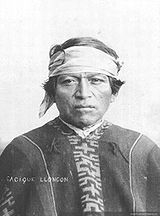
The Mapuche (Mäpfuchieu) are the indigenous
Indigenous peoples of the Americas

The indigenous peoples of the Americas are the pre-Columbian inhabitants of the Americas, their descendants, and many ethnic groups who identify with those peoples....
 inhabitants of Central and Southern Chile
Chile

Chile, officially the Republic of Chile , is a country in South America occupying a long and narrow coastal strip wedged between the Andes mountains and the Pacific Ocean....
 and Southern Argentina
Argentina

Argentina, officially the Argentine Republic , is a country in South America, constituted as a federation of 23 provinces and an autonomous city....
. They were known as Araucanians (araucanos) by the Spaniards. This is now considered pejorative by the people and the term Mapuche is the one most often used by people in conversation. Mapuche make up about 4% of the Chilean population, who are particularly concentrated in the Araucania Region
Araucanía Region

The IX Araucan?a Region is one of Chile's 15 first order administrative divisions. Its capital is Temuco. The region is divided into two provinces: Malleco Province in the north and Caut?n in the south....
.

Contrary to popular belief, the Quechua
Quechua

Quechua is a Native American language of South America. It was already widely spoken across the Central Andes long before the time of the Inca Empire, who established it as the official language of administration for their Empire, and is still spoken today in various regional forms by some 10 million people through much of South America, in...
 word awqa "rebel, enemy", is probably not the root of araucano: the latter is more likely derived from the placename rag ko (Spanish Arauco
Arauco

Arauco may refer to:* Arauco, Chile city and municipality in Chile* Arauco Province, Chile* Araucan?a* Araucan?a Region, the heartland of what the Spaniards called Arauco...
) "clayey water".

The Mapuche had an economy based on agriculture; their social organisation consisted of extended families, under the direction of a "lonko
Lonco

A lonco is a tribal chief of the Mapuches. These were often Ulmen, the wealthier men in the lof. In wartime loncos of the various local rehue or the larger aillarehue would gather in a koyag or parliament and would elect a toqui to lead the warriors in battle....
" or chief, although in times of war they would unite in larger groupings and elect a toqui
Toqui

Toqui is a title conferred by the Mapuche to those who are chosen as their leader during times of war. The toqui is chosen in an assembly or parliament , of the chiefs of the various clans or confederation of clans , allied during the war in question....
 (from Mapudungun toki "axe, axe-bearer") to lead them.

The Mapuche are a wide-ranging ethnicity composed of various groups which shared a common social, religious and economic structure, as well as a common linguistic heritage.


Discussion
Ask a question about 'Mapuche'
Start a new discussion about 'Mapuche'
Answer questions from other users
Full Discussion Forum


Recent Posts


Encyclopedia


The Mapuche (Mäpfuchieu) are the indigenous
Indigenous peoples of the Americas

The indigenous peoples of the Americas are the pre-Columbian inhabitants of the Americas, their descendants, and many ethnic groups who identify with those peoples....
 inhabitants of Central and Southern Chile
Chile

Chile, officially the Republic of Chile , is a country in South America occupying a long and narrow coastal strip wedged between the Andes mountains and the Pacific Ocean....
 and Southern Argentina
Argentina

Argentina, officially the Argentine Republic , is a country in South America, constituted as a federation of 23 provinces and an autonomous city....
. They were known as Araucanians (araucanos) by the Spaniards. This is now considered pejorative by the people and the term Mapuche is the one most often used by people in conversation. Mapuche make up about 4% of the Chilean population, who are particularly concentrated in the Araucania Region
Araucanía Region

The IX Araucan?a Region is one of Chile's 15 first order administrative divisions. Its capital is Temuco. The region is divided into two provinces: Malleco Province in the north and Caut?n in the south....
.

Contrary to popular belief, the Quechua
Quechua

Quechua is a Native American language of South America. It was already widely spoken across the Central Andes long before the time of the Inca Empire, who established it as the official language of administration for their Empire, and is still spoken today in various regional forms by some 10 million people through much of South America, in...
 word awqa "rebel, enemy", is probably not the root of araucano: the latter is more likely derived from the placename rag ko (Spanish Arauco
Arauco

Arauco may refer to:* Arauco, Chile city and municipality in Chile* Arauco Province, Chile* Araucan?a* Araucan?a Region, the heartland of what the Spaniards called Arauco...
) "clayey water".

The Mapuche had an economy based on agriculture; their social organisation consisted of extended families, under the direction of a "lonko
Lonco

A lonco is a tribal chief of the Mapuches. These were often Ulmen, the wealthier men in the lof. In wartime loncos of the various local rehue or the larger aillarehue would gather in a koyag or parliament and would elect a toqui to lead the warriors in battle....
" or chief, although in times of war they would unite in larger groupings and elect a toqui
Toqui

Toqui is a title conferred by the Mapuche to those who are chosen as their leader during times of war. The toqui is chosen in an assembly or parliament , of the chiefs of the various clans or confederation of clans , allied during the war in question....
 (from Mapudungun toki "axe, axe-bearer") to lead them.

The Mapuche are a wide-ranging ethnicity composed of various groups which shared a common social, religious and economic structure, as well as a common linguistic heritage. Their influence extended between the Aconcagua River
Aconcagua River

The Aconcagua River is a river in Chile that rises from the joint of two minor tributary rivers at above sea level in the Andes, Juncal river from the east and Blanco river from the south east....
 and Chiloé Island
Chiloé Island

Chilo? Island , also known as Greater Island of Chilo? , is the largest island of Chilo? Archipelago off the coast of Chile, in the Pacific Ocean....
 and later eastward to the Argentine pampa. The Mapuche (note that Mapuche can refer to the whole group of Picunche
Picunche

The Picunche , also referred to as picones by the Spanish, were a mapudungun speaking Chilean people living to the north of the "Mapuche" or Araucanians and south of the Choapa River and the Diaguitas....
s (people of the north), Huilliches and Moluche or Nguluche
Moluche

Moluche or Nguluche is a dialect of the Mapuche language Mapudungun that is also the ethnic description of the Mapuche peoples speaking that language....
 from Araucanía
Araucania

Araucan?a or Araucana was the Spanish language name given to the region of Chile inhabited by the Mapuche peoples known as the Moluche in the 18th century....
 or exclusively to the Moluche or Nguluche from Araucanía) inhabited the valleys between the Itata
Itata River

The Itata River flows in the B?o-B?o Region, southern Chile.Until the Conquest of Chile the Itata was the natural limit between the Mapuche, located to the south, and Picunche, to the north....
 and Toltén
Toltén

Tolt?n is a Chilean commune located at the lower flows Tolt?n River at the southern coast of Caut?n Province which is part of Araucan?a Region. The commune is administered by the municipality in Nueva Tolt?n located within the commune, that is the main harbour and town within the commune....
 Rivers, as well as the Huilliche
Huilliche

The Huilliche is an ethnic group of Chile, belonging to the Mapuche culture. They live in mountain valleys in an area south of Tolt?n River and on Chilo? Archipelago....
 (people of the South), the Cunco
Cunco

The Cuncos are a sedentary native Chilean people, belonging to the southern group of Mapuche peoples, and that inhabited the coasts of Chile from Valdivia, Chile to the Chacao Channel, including the inhabitants of the northern portion of Chilo? Island and the bordering islands....
s. In the seventeenth and eighteenth centuries the Mapuches expanded eastward into the Andes and pampas forming with the existing people the Poyas and Pehuenche
Pehuenche

Pehuenches are an indigenous people that are part of the Mapuche peoples and live in the Andes in south central Chile and Argentina. Their name derives from their diet based on the harvesting of pi?ones, the seeds of the Araucaria araucana or pehu?n....
. At about the same time ethnic groups of the pampa regions, the Puelche
Puelche

Puelche is the name that the Mapuche used to give the ethnic groups who inhabited the lands to the east of the Andes Mountains including the northern Tehuelches and Hets, these last ones were also known as the Pampas or Querand?es....
, Ranquel
Ranquel

Ranquel is an ethnic tribe of South America, part of the mapuche, with puelche origins, pehuenche and also patagones from the g?n?n-a-k?na group....
es and northern Aonikenk, called Patagons by Ferdinand Magellan
Ferdinand Magellan

Ferdinand Magellan was a Portuguese people List of maritime explorers who, while in the service of the Spanish Crown, tried to find a westward route to the Spice Islands of Indonesia....
, known now as Tehuelche
Tehuelche

Tehuelches is the collective name of the native tribes of Patagonia. They are also called Patagons.It is possible that the stories of the early European explorers about the Patagones, a race of giants in South America, are based on the Tehuelches, because the Tehuelches are typically tall....
, made contact with Mapuche groups, adopting their language and some culture (in what came to be called the Araucanization
Araucanization

The Araucanization was the process of expansion of Mapuche culture, influence and Mapudungun from Araucan?a into the Patagonia plains. Historians disagree in the time of the expansion but it would have occurred sometime between 1550 and 1850....
).

History


Origin

The origin of the Mapuche is not clear. The Mapuche language, Mapudungun
Mapudungun

Mapudungun is a language isolate spoken in central Chile and west central Argentina by the Mapuche people. It is also known as Mapudungu, Mapuche, and Araucanian ....
, has been classified by some authorities as being related to the Penutian languages
Penutian languages

Penutian is a proposed grouping of language family that includes many Native Americans in the United States languages of western North America, predominantly spoken at one time in Washington, Oregon, and California....
 of North America. Others group it among the Andean languages , and yet others postulate an Araucanian-Mayan relationship ; Croese (1989, 1991) has advanced the hypothesis that it is related to Arawak
Arawak

The term Arawak , was used to designate some of the peoples encountered by the Spain in the West Indies in 1492 and thereafter. These include the Ta?no, who occupied the Greater Antilles and the Bahamas and Bimini Florida, the Nepoya and Suppoyo of Trinidad and the Igneri, who were supposed to have preceded the Caribs in the Lesser Anti...
. Recent DNA
DNA

Deoxyribonucleic acid is a nucleic acid that contains the genetics instructions used in the development and functioning of all known living organisms and some viruses....
 analysis has found that Mapuche pre-Columbian Araucana
Araucana

The Araucana, also known as a South American Rumpless, is a breed of chicken originating in Chile. The Araucana is often confused with other fowl, especially the Ameraucana and Easter Egger chickens, but has several unusual characteristics which distinguish it....
 chicken came from Polynesia
Polynesia

Polynesia is a subregion of Oceania, comprising a large grouping of over 1,000 islands scattered over the central and southern Pacific Ocean....
, suggesting contact between the Mapuche and Polynesia. One of the earliest sites of human occupation in the Americas, Monte Verde
Monte Verde

Monte Verde is an archaeological site in south-central Chile, which has been dated to 14,500 years before present. It pre-dates the earliest known Clovis culture site of Clovis, New Mexico, by 1000 years, contradicting the previously accepted "Clovis model" which holds that settlement of the Americas began after 13,500 years before present....
, lies within what was later to become Huilliche
Huilliche

The Huilliche is an ethnic group of Chile, belonging to the Mapuche culture. They live in mountain valleys in an area south of Tolt?n River and on Chilo? Archipelago....
 territory, although there is currently no demonstrated link between the Monte Verde people and the Mapuche.

War of Arauco

The Mapuche successfully resisted many attempts by the Inca Empire
Inca Empire

The Inca Empire was the largest empire in pre-Columbian America. The administrative, political and military center of the empire was located in Cuzco in modern-day Peru....
 to subjugate them, despite their lack of state organization. They fought against the Sapa Inca Tupac Yupanqui and his army. The result of the bloody three-day confrontation known as the Battle of the Maule
Battle of the Maule

The Battle of the Maule, in modern Chile, was fought between the Mapuche people and the Inca Empire. It took place over three days and resulted in the end of the Incas' southward expansion....
 was that the Inca conquest of the territories of Chile ended at the Maule river
Maule river

The Maule river is one of the most important rivers of Chile and is inextricably linked to this country's pre-Hispanic times, the country's conquest, Colonialism period, Chilean Independence, History of Chile, agriculture , culture , religion, economy and politics....
. They fell back to the north behind the Rapel
Rapel River

Rapel River is a List of rivers in Chile located in the O'Higgins Region. It begins at the confluence of the rivers Cachapoal River and Tinguiririca River in the area known as La Junta....
 and Cachapoal River
Cachapoal River

Cachapoal River is tibutary river of the Rapel River in Chile located in the O'Higgins Region. The river gives its name to the Cachapoal Province....
s where they established a fortified border guarded by fortresses like Pucará de La Compañía and the Pucará del Cerro La Muralla
Pucara del Cerro La Muralla

Pucar? de Cerro La Muralla is a Pucara , probably Inca on a strategic mountain top, five km to the south of San Vicente de Tagua Tagua, to the south side of the dry lagoon ....
.

After the successful subjugation of the Picunche in the Conquest of Chile
Conquest of Chile

The Conquest of Chile is an historical period that includes the time from the arrival of Pedro de Valdivia to Chile in 1541 to the death of Mart?n Garc?a ??ez de Loyola, in the Battle of Curalaba in 1598....
 the Moluche
Moluche

Moluche or Nguluche is a dialect of the Mapuche language Mapudungun that is also the ethnic description of the Mapuche peoples speaking that language....
 of the area the Spanish called Araucania
Araucania

Araucan?a or Araucana was the Spanish language name given to the region of Chile inhabited by the Mapuche peoples known as the Moluche in the 18th century....
 fought against the Spaniards for over 300 years. Initial conquests of land by Spain in the late 16th century were repelled by the Mapuche, so effectively that there were areas to which Europeans did not return until late in the 19th century. One of the main geographical boundaries was the Bío-Bío River
Bío-Bío River

The Biob?o River is the second largest river in Chile. It originates from Icalma and Galletu? lakes in the Andes and flows 380 km to the Gulf of Arauco on the Pacific Ocean....
, which the Mapuche used as a natural barrier to Spanish and Chilean incursion. The 300 years were not uniformly a period of hostility, but often allowed substantial trade
Trade

Tradeis the willing exchange of goods, Service , or both. Trade is also called commerce. A mechanism that allows trade is called a market. The original form of trade was barter , the direct exchange of goods and services....
 and interchange between Mapuche and Spaniards or Chileans. Nevertheless, the long Mapuche resistance has become primarily known as the War of Arauco
Arauco War

The Arauco War was a long conflict between colonial Spaniards and the Mapuche people of the region of Araucan?a, of modern Chile. The beginning of the conflict is usually placed at the Battle of Reynog?el?n, which occurred in 1536 between an expedition of Diego de Almagro and a well-organized and numerous group of Mapuche soldiers, near the...
, and its early phase was immortalized in Alonso de Ercilla
Alonso de Ercilla

Alonso de Ercilla y Z??iga , was a Spanish people nobleman, soldier and epic poet. While in Chile he fought against the Mapuche, and there he began the epic poem La Araucana, considered the greatest Spanish historical poem....
's epic poem La Araucana
La Araucana

La Araucana is an epic poem in Spanish language about the Spanish conquest of Chile, by Alonso de Ercilla; it is also known in English as The Araucaniad....
.

From the mid 17th century the Mapuches and the governors of Chile made a series of treaties in order to end the hostilities. By the late eighteenth century many Mapuche lonco
Lonco

A lonco is a tribal chief of the Mapuches. These were often Ulmen, the wealthier men in the lof. In wartime loncos of the various local rehue or the larger aillarehue would gather in a koyag or parliament and would elect a toqui to lead the warriors in battle....
s had accepted the de jure
De jure

De jure is an expression that means "concerning law", as contrasted with de facto, which means "concerning fact".The terms de jure and de facto are used instead of "in principle" and "in practice", respectively, when one is describing politics or legal situations....
 soverignity of the Spanish king of their lands while having a de facto
De facto

De facto is a Latin expression that means "concerning the fact" or in practice but not necessarily ordained by law. It is commonly used in contrast to de jure when referring to matters of law, governance, or technique that are found in the common experience as created or developed without or contrary to a regulation....
 independence.

When Chile revolted from the Spanish crown, during the Chilean War of Independence some Mapuche chiefs sided with the royalists of Vicente Benavides
Vicente Benavides

Vicente Benavides was a Chilean soldier who fought in the Chilean War of Independence. He initially sided with the patriots but changed sides later to side with the royalists....
 in the Guerra a muerte
Guerra a muerte

Guerra a muerte is a term coined by Benjam?n Vicu?a Mackenna used in Chilean historiography to describe the irregular warfare that broke out from 1819 to 1821 during the Chilean War of Independence....
. The aid of the Mapuches were vital to the Spanish since the had lost the control of all cities and ports north of Valdivia
Valdivia, Chile

Valdivia is a city and commune in southern Chile administered by the Municipality of Valdivia. The city is named after its founder Pedro de Valdivia and is located at the confluence of the Calle-Calle River, Valdivia River and Cau-Cau River Rivers, approximately 15 km east of the coastal towns of Corral, Chile and Niebla, Chile....
. Mapuches valued the treaties made with the Spanish authorities, however most regarded the matter with indifference and took adventage of both sides. After Chile's independence from Spain, the Mapuche coexisted and traded with their neighbours, who prudently remained north of the Bío-Bío River, although clashes occurred frequently.

Occupation of the Araucanía

Chilean population pressures increased on the Mapuche borders, and by the 1880s Chile extended both to the north and to the south of the Mapuche heartlands. Further, Chile in the 1880s, as a result of its preparation for and its victory in the War of the Pacific
War of the Pacific

The War of the Pacific, occurring from 1879-1883, was a conflict between Chile and the joint forces of Bolivia and Peru. Also known as the "Sodium nitrate War", the war arose from disputes over the control of territory that contained substantial mineral-rich deposits....
 against Bolivia
Bolivia

The Republic of Bolivia , named after Sim?n Bol?var, is a landlocked country in central South America. It is bordered by Brazil on the north and east, Paraguay and Argentina on the south, and Chile and Peru on the west....
 and Peru
Peru

Peru , officially the Republic of Peru , is a country in western South America. It is bordered on the north by Ecuador and Colombia, on the east by Brazil, on the southeast by Bolivia, on the south by Chile, and on the west by the Pacific Ocean....
, found itself with a large standing army and a relatively modern arsenal for the period. Finally, in the mid- to late-1880s, partially on the pretext of crushing a French adventurer, Orelie-Antoine de Tounens, who had declared himself King of Araucania, Chile overwhelmed the Mapuche in the course of the so-called "pacification of the Araucanía".

Using a combination of force and diplomacy, Chile's government obliged some Mapuche leaders to sign a treaty absorbing the Araucanian territories into Chile. The immediate impact of the war was widespread starvation
Starvation

Starvation is a severe reduction in vitamin, nutrient, and energy intake, and is the most extreme form of malnutrition. In humans, prolonged starvation causes permanent organ damage and, eventually, death....
 and disease
Disease

A disease or medical condition is an abnormal condition of an organism that impairs bodily functions, associated with specific symptoms and Medical signs....
. It has been claimed that the Mapuche population dropped from a total of half a million to 25,000 within a generation, though the latter figure has been called an exaggeration by several authorities. In the post-conquest period, however, there was internment of a significant percentage of the Mapuche, the wholesale destruction of the Mapuche herding, agricultural and trading economies, the wholesale looting of Mapuche property (real and personal - including a large amount of silver jewelry to replenish the Chilean national coffers), and the creation and institutionalization of a system of reserves called reducciones
Indian Reductions

Reductions were settlements founded by the Spain colonizers of the New World with the purpose of assimilating indigenous populations into European culture and religion....
 along lines similar to North American reservation systems. Subsequent generations of Mapuche live in extreme poverty as a direct result of being conquered and expropriated.

Recent history

Mapuche descendants now live across southern Chile
Chile

Chile, officially the Republic of Chile , is a country in South America occupying a long and narrow coastal strip wedged between the Andes mountains and the Pacific Ocean....
 and Argentina
Argentina

Argentina, officially the Argentine Republic , is a country in South America, constituted as a federation of 23 provinces and an autonomous city....
; some maintain their traditions and continue living from agriculture, but a growing majority have migrated to cities in search of better economic opportunities. Contrary to popular imagination, the majority of the Mapuche people live in urban areas, especially around Santiago
Santiago

Santiago is Spanish and Portuguese for Saint James . It is the name of:In Argentina:*Santiago del Estero Province**Santiago del Estero, capital of the province...
  Chile's region IX
Araucania

Araucan?a or Araucana was the Spanish language name given to the region of Chile inhabited by the Mapuche peoples known as the Moluche in the 18th century....
 continues to have a rural population made up of approximately 80%; there are also substantial Mapuche populations in regions X
Los Lagos Region

The X Los Lagos Region is one of Chile's 15 first order administrative divisions.The "Los Lagos Region" contains the country's second largest island, Chilo? Island, and the second largest lake, Lake Llanquihue....
, VIII
Bío-Bío Region

The VIII Biob?o Region is one of Chile's 15 first order administrative divisions. Its capital is Concepci?n, Chile which is the main city of Greater Concepcion conurbation, the second largest urban agglomeration in Chile....
, and VII
Maule Region

The VII Maule Region is one of Chile's 15 first order administrative divisions. Its Capital is Talca. The region takes its name from the Maule River, which running westward from the Andes, bisects the region and spans a Drainage basin of about 20,600 km?....
.

In recent years, there has been an attempt by the Chilean government to redress some of the inequities of the past. The Parliament voted, in 1993, Law n° 19 253 (Indigenous Law, or Ley indígena) which recognized the Mapuche people, and seven other ethnic minorities as well as the Mapudungun
Mapudungun

Mapudungun is a language isolate spoken in central Chile and west central Argentina by the Mapuche people. It is also known as Mapudungu, Mapuche, and Araucanian ....
 language and culture. In the frame of this law, Mapundungun, which was prohibited before, was included in the curriculum of elementary schools around Temuco
Temuco

Temuco is the capital of the Araucan?a Region, Chile. The name comes from the Mapudungun language, meaning "temu water"; "Blepharocalyx cruckshankii" is a tree used by Mapuches for medicinal purposes....
.

Furthermore, representatives from Mapuche organisations joined the Unrepresented Nations and Peoples Organisation (UNPO) seeking recognition and protection for their cultural and land rights.

Land disputes

Nevertheless, land disputes and violent interactions do continue in some Mapuche areas, particularly in the northern sections of the IX region between and around Traiguén and Lumaco - where a history of conflict continues into the present. In an effort to defuse tensions, a special government body, the Commission for Historical Truth and New Treatment, issued a report in 2003 calling for drastic changes in Chile's treatment of its indigenous people, more than 80 percent of whom are Mapuche. The recommendations included the formal recognition of political and "territorial" rights for aboriginal peoples, as well as efforts to promote their cultural identity.

Though Japanese and Swiss interests are active in the region that Chileans call "Araucanía" and the Mapuche call "Ngulu Mapu", both of the main forestry companies are Chilean-owned. On land the Mapuche claim is theirs, the firms have planted hundreds of thousands of acres with Monterey pine and eucalyptus trees, species that are not native to the region and that consume large amounts of water and fertilizer.

Chilean exports of wood to the United States, almost all of which come from this southern region, are about $600 million a year and rising. Though an international campaign led by the conservation group Forest Ethics resulted in the Home Depot chain and other leading wood importers agreeing to revise their purchasing policies, to "provide for the protection of native forests in Chile," some Mapuche leaders were not satisfied.

In recent years, Mapuche activists have been prosecuted under counter-terrorism legislation originally introduced by the military dictatorship, under Pinochet. The law allows prosecutors to withhold evidence from the defense for up to six months, and to conceal the identity of witnesses, who may give evidence in court behind screens. There are several violent activist groups, such as the "Coordinadora Arauco Malleco", which utilize various tactics, including the destruction of private property, including, but not limited to, the burning of structures and pastures and the use of death threats against individuals and their families . Protesters from Mapuche communities have engaged in these tactics against multinational forestry corporations and private individuals.

Culture

Flag of the Mapuches
Due to the loss of their lands, many Mapuche now live in impoverished conditions in large cities such as Santiago (See also: Demographics of Chile
Demographics of Chile

This article is about the demographics features of the population of Chile, including population density, Ethnic group, education level, health of the popula.ce, economic status, religious affiliations and other aspects of the population....
). Mapuche resistance continues, especially against the large forestry
Forestry

Forestry is the art and science of managing forests, tree plantations, and related natural resources. Silviculture, a related science, involves the growing and tending of trees and forests....
 companies exploiting traditional lands. Pinochet-era anti-terrorism
Terrorism

Terrorism, according to the Merriam-Webster online dictionary, is the systematic use of terror, "violent or destructive acts committed by groups in order to intimidate a population or government into granting their demands." At present, there is no internationally agreed upon definition of terrorism....
 laws have frequently been used in recent years against certain community leaders and Mapuche political activists.

At the time of the arrival of Europeans, the Mapuche were capable of sufficiently organizing themselves to create a network of forts and complex defensive buildings but also ceremonial constructions such as some mound
Mound

A mound is a general term for an artificial wikt:heaped pile of earth, gravel, sand, rock s, or debris. The most common use is in reference to natural earthen formation such as hills and mountains, particularly if they appear artificial....
s recently discovered near Purén. They quickly adopted iron
Iron

Iron is a chemical element with the symbol Fe and atomic number 26. Iron is a Group 8 element and period 4 element. Iron is lustrous and silvery in color....
 metal-working (they already worked copper
Copper

Copper is a chemical element with the symbol Cu and atomic number 29.It is a ductile metal with very high thermal and electrical conductivity....
) and horseback-riding and the use of cavalry
Cavalry

The Cavalry is the second oldest of the Combat Arms, and as soldiers or warriors who fought mounted on horseback in combat, it represents the mobility and offensive power of the armed forces....
 in war from the Spaniards, along with the cultivation of wheat
Wheat

Wheat , is a worldwide cultivated Poaceae from the Levant region of the Middle East. Globally, after maize, wheat is the second most-produced food among the cereal just above rice....
 and sheep
Sheep

#REDIRECT Domestic sheep...
. In the long 300-year coexistence between the Spanish colonies and the relatively well-delineated autonomous Mapuche regions, the Mapuche also developed a strong tradition of trading with the Spanish/Chileans. It is this which lies at the heart of the Mapuche silver-working tradition, for it was from the large and widely-dispersed quantity of Spanish and Chilean silver coins that the Mapuche wrought their elaborate jewelry, head bands, etc.

Mapuche languages


Mapuche languages are spoken in Chile and to a smaller extent in Argentina. They have two branches: Huilliche
Huillice language

The Huilliche language is an Araucanian languages spoken by about 2,000 ethnic Huilliche people in Chile. It is spoken in an area south of the area inhabited by the Mapuche, in the nation's Los Lagos Region and Los R?os Region regiones ; and mountain valleys, between the city of Valdivia and south toward Chilo? Archipelago....
 and Mapudungun
Mapudungun

Mapudungun is a language isolate spoken in central Chile and west central Argentina by the Mapuche people. It is also known as Mapudungu, Mapuche, and Araucanian ....
. Although not related, there is some discernible lexical influence from Quechua
Quechua

Quechua is a Native American language of South America. It was already widely spoken across the Central Andes long before the time of the Inca Empire, who established it as the official language of administration for their Empire, and is still spoken today in various regional forms by some 10 million people through much of South America, in...
. It is estimated that only about 200,000 full-fluency speakers remain in Chile, and the language still receives only token support in the educational system. In recent years it has started to be taught in rural schools of Bio-Bio
Bío-Bío Region

The VIII Biob?o Region is one of Chile's 15 first order administrative divisions. Its capital is Concepci?n, Chile which is the main city of Greater Concepcion conurbation, the second largest urban agglomeration in Chile....
, Araucanía
Araucanía Region

The IX Araucan?a Region is one of Chile's 15 first order administrative divisions. Its capital is Temuco. The region is divided into two provinces: Malleco Province in the north and Caut?n in the south....
 and Los Lagos
Los Lagos Region

The X Los Lagos Region is one of Chile's 15 first order administrative divisions.The "Los Lagos Region" contains the country's second largest island, Chilo? Island, and the second largest lake, Lake Llanquihue....
 Regions.

Mythology and beliefs


Central to Mapuche belief
Belief

Belief is the psychological state in which an individual holds a proposition or premise to be true....
  is the role of the machi
Machi (Shaman)

A machi is a shaman or a good witch in the Mapuche culture of South America; and is also an important character and the Mapuche mythology....
 "shaman". It is usually filled by a woman, following an apprenticeship with an older Machi, and has many of the characteristics typical of shamans. The machi performs ceremonies for curing diseases, warding off evil, influencing weather, harvests, social interactions and dreamwork. Machis often have extensive knowledge of Chilean medicinal herbs, though as biodiversity in the Chilean countryside has declined due to commercial agriculture and forestry, the dissemination of such knowledge has also declined but is in revival. Machis also have an extensive knowledge of sacred stones and the sacred animals.

A book by investigative journalist Patrick Tierney
Patrick Tierney

Patrick Tierney is an investigative journalist who works as a volunteer to the UCIS at the University of Pittsburgh.In 2000, Tierney published Darkness in El Dorado, which accused geneticist James Neel and anthropologist Napoleon Chagnon of exacerbating a measles epidemic among the Yanomamo people, among other damning allegations....
, The Highest Altar: Unveiling the Mystery of Human Sacrifice (1989) ISBN 9780140139747 , documents a possible modern ritual human sacrifice during the devastating earthquake and tsunami of 1960 by a machi of the Mapuche in the Lago Budi
Budi Lake

Budi Lake is located near the coast of Araucan?a Region, southern Chile. The lake is part of the boundaries between Saavedra, Chile and Teodoro Schmidt comune....
 community. The victim, 5-year-old José Luis Painecur, had his arms and legs removed by Juan Pañán and Juan José Paincur (the victim's grandfather), and was stuck into the sand of the beach like a stake. The waters of the Pacific Ocean
Pacific Ocean

The Pacific Ocean is the largest of the Earth's oceanic divisions. Its name is derived from the Latin name Mare Pacificum, "peaceful sea", bestowed upon it by the Portugal explorer Ferdinand Magellan....
 then carried the body out to sea. The sacrifice was rumored to be at the behest of local machi, Juana Namuncurá Añen. The two men were charged with the crime and confessed, but later recanted. They were released after two years. A judge ruled that those involved in these events had "acted without free will, driven by an irresistible natural force of ancestral tradition." The story is also mentioned in a Time Magazine article from that year, although with much less detail.

An equally important part of Mapuche belief and society is the remembered history of independence and resistance from 1540 (Spanish and then Chileans) and of the treaty with the Chilean government in the 1870s. In that perception, it is important to include not exclude Mapuches in the Chilean culture. Having said that, memories, stories, and beliefs, often very local and particularized, are a significant part of the Mapuche traditional culture. To varying degrees, this history of resistance continues to this day amongst the Mapuche, though at the same time a large majority in Chile would also strongly include themselves as Chilean similarly to a large majority in Argentina including themselves as Argentines.

Further reading

  • Language of the land : the Mapuche in Argentina and Chile: http://www.iwgia.org/sw21526.asp, 2007, ISBN 9788791563379
  • When a flower is reborn : the life and times of a Mapuche feminist, 2002, ISBN 0822329344
  • Courage tastes of blood : the Mapuche community of Nicolás Ailío and the Chilean state, 1906-2001, 2005, ISBN 0822335859
  • Neoliberal economics, democratic transition, and Mapuche demands for rights in Chile, 2006, ISBN 0813029384
  • Shamans of the foye tree : gender, power, and healing among Chilean Mapuche, 2007, ISBN 9780292716582
  • A grammar of Mapuche, 2007, ISBN 9783110195583
  • Mapuche Dreamwork: http://www.clas.berkeley.edu:7001/Gallery/nakashima/index.html

See also

  • Araucanía
    Araucania

    Araucan?a or Araucana was the Spanish language name given to the region of Chile inhabited by the Mapuche peoples known as the Moluche in the 18th century....
  • Araucanization
    Araucanization

    The Araucanization was the process of expansion of Mapuche culture, influence and Mapudungun from Araucan?a into the Patagonia plains. Historians disagree in the time of the expansion but it would have occurred sometime between 1550 and 1850....
  • Araucaria
    Araucaria

    Araucaria is a genus of evergreen Pinophyta trees in the family Araucariaceae. There are 19 species in the genus, with a highly disjunct distribution in New Caledonia , Norfolk Island, eastern Australia, New Guinea, Argentina, Chile, and southern Brazil....
  • Arauco War
    Arauco War

    The Arauco War was a long conflict between colonial Spaniards and the Mapuche people of the region of Araucan?a, of modern Chile. The beginning of the conflict is usually placed at the Battle of Reynog?el?n, which occurred in 1536 between an expedition of Diego de Almagro and a well-organized and numerous group of Mapuche soldiers, near the...
  • Battle of the Maule
    Battle of the Maule

    The Battle of the Maule, in modern Chile, was fought between the Mapuche people and the Inca Empire. It took place over three days and resulted in the end of the Incas' southward expansion....
  • Caupolican
    Caupolican

    Caupolic?n was a Toqui, the military leader of the Mapuche people of Chile, that commanded their army during the first Mapuche rising against the Spanish conquistadors from 1553 to 1558....
  • Colocolo
    Colocolo (tribal chief)

    Colocolo...
  • Galvarino
    Galvarino

    Galvarino is a Chilean municipality , part of Caut?n Province, on IX Region of Araucan?a.The town of Galvarino, named for the Mapuche warrior Galvarino was founded on April 22nd, 1882 within the frame of the occupation of Araucan?a by general Gregorio Urrutia, next to river Quillem as a Fort of 2500 square meters area....
  • Isabel Allende
    Isabel Allende

    Isabel Allende Llona, , is a Chilean-United States novelist. Allende, whose works sometimes contain aspects of the "magic realism" tradition, is one of the first successful women novelists in Latin America....
     "Inés of My Soul" ("Inés del alma mía")
  • Kingdom of Araucania and Patagonia
    Kingdom of Araucania and Patagonia

    The Kingdom of Araucania and Patagonia was an ephemeral political entity established in the 19th century by a Second French Empire lawyer and adventurer named Or?lie-Antoine de Tounens in southern South America....
  • Lautaro
  • Mapuche International Link
    Mapuche International Link

    Mapuche International Link is an organization which campaigns on behalf of the Mapuche people of southern Chile and Argentina. The group was formed in 1996 and is based in Bristol, United Kingdom....


External links