
| |
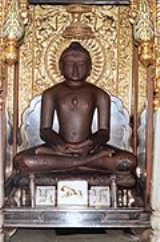
Mahavira (?????? lit. Great Hero) (599 – 527 BCE) is the name most commonly used to refer to the Indian sage Vardhamana (Sanskrit: ??????? "increasing") who established what are today considered to be the central tenets of Jainism. According to Jain tradition, he was the 24th and the last Tirthankara. He is also known in texts as Vira or Viraprabhu, ...Sanmati, Ativira,and Gnatputra.

Discussion
Ask a question about 'Mahavira'
Start a new discussion about 'Mahavira'
Answer questions from other users
|
Quotations
A living body is not merely an integration of limbs and flesh but it is the abode of the soul which potentially has perfect perception (Anant-darshana), perfect knowledge (Anant-jnana), perfect power (Anant-virya), and perfect bliss (Anant-sukha).
Non-violence and kindness to living beings is kindness to oneself. For thereby one's own self is saved from various kinds of sins and resultant sufferings and is able to secure his own welfare.
Kill Not. Cause no pain.
All breathing, existing, living, sentient creatures should not be slain, nor treated with violence, nor abused, nor tormented, nor driven away. - Acharanga Sutra (book 1, lect 4, lesson 1) Translated by H. Jacobi

Encyclopedia
Mahavira (?????? lit. Great Hero) (599 – 527 BCE) is the name most commonly used to refer to the Indian sage Vardhamana (Sanskrit: ??????? "increasing") who established what are today considered to be the central tenets of Jainism. According to Jain tradition, he was the 24th and the last Tirthankara. He is also known in texts as Vira or Viraprabhu, ...Sanmati, Ativira,and Gnatputra. In the Buddhist Pali Canon, he is referred to as Nigantha Nataputta.
Overview of Mahavira's life
Birth of Prince Vardhaman
In a place called Kshatriyastan in the ancient kingdom of Lachuar in Jamui District in modern day Bihar, India. Mahavira was born to King Siddartha and Queen Trishala on the 13th day under the rising moon of Chaitra (April 12 according to the Gregorian calendar). While still in his mother's womb it is believed he brought wealth and prosperity to the entire kingdom, which is why he was also known as Vardhaman. An increase of all good things, like the abundant bloom of beautiful flowers, was noticed in the kingdom after his conception. Queen Trishala had 16 (14 in Swetambar Sect) auspicious dreams before giving birth to Vardhaman, signs foretelling the advent of a great soul.
FOURTEEN AUSPICIOUS DREAMS OF MOTHER TRISHALA
Queen Trishala, mother of Lord Mahavir at midnight saw fourteen
beautiful and auspicious dreams after conception.
They were:
1. Elephant
2. Bull
3. Lion
4. Goddess Laxmi
5. Garland of Flowers
6. Full Moon
7. Sun
8. Large Flag
9. Silver Urn
10. Lotus-Lake
11. Milky-Sea
12. Celestial Aero-plane
13. Heap of Gems
14. Smokeless Fire
1. Elephant
-----------
The first dream Queen Trishala saw was of an elephant. She saw a
big, tall, and impetuous elephant. It had two pairs of tusks.
The color of the elephant was white and its whiteness was superior
to the color of marble. It was an auspicious elephant, and was
endowed with all the desirable marks of excellence.
This dream indicates that her son will guide the spiritual
chariot, and save human beings from misery, greed, and attraction
of life.
2. Bull
-------
The second dream Queen Trishala saw was of a bull. The color of
the bull was also white, but it was brighter than white lotuses.
It glowed with beauty and radiated a light all around. It was
noble, grand, and had a majestic hump. It had fine, bright, and
soft hair on his body. Its horns were superb and sharply-pointed.
This dream indicates that her son will be a spiritual teacher of
great ascetics, kings, and other great personalities.
3. Lion
--------
The third dream Queen Trishala saw was of a magnificent lion. Its
claws were beautiful and well-poised. The lion had a large
well-rounded head and extremely sharp teeth. Its lips were
perfect, its color was red, and its eyes were sharp and glowing.
Its tail was impressively long and well-shaped. Queen Trishala saw
this lion descending towards her and entering her mouth.
This dream indicates that her son will be as powerful and strong as
a lion. He will be fearless, almighty, and capable of ruling over
the world.
4. Goddess Laxmi
----------------
The fourth dream Queen Trishala saw was of the Goddess Laxmi, the
Goddess of wealth, prosperity and power. She was seated at the top
of mountain Himalaya. Her feet had a sheen of golden turtle. She
had a delicate and soft fingers. Her black hair was tiny, soft,
and delicate. She wore rows of pearls interlaced with emeralds and
a garland of gold. A pair of earring hung over her shoulders with
dazzling beauty. She held a pair of bright lotuses.
This dream indicates that her son will attain great wealth,
power, prosperity.
5. Garland of Flowers
---------------------
The fifth dream Queen Trishala saw was of a celestial garland of
flowers descending from the sky. It smelled of mixed fragrances of
different flowers. The whole universe was filled with fragrance.
The flowers were white and woven into the garland. They bloomed
during all different seasons. A swarm of bees flocked to it and
they made a humming sound around the region.
This dream indicates that the fragrance of her son's preaching will
spread over the entire universe.
6. Full Moon
------------
The sixth dream queen Trishala saw was of a full moon. It
presented an auspicious sight. The moon was at its full glory. It
awoke the lilies to bloom fully. It was bright like a well
polished mirror. The moon radiated whiteness like a swan. It
inspired the oceans to surge skyward. The beautiful moon looked
like a radiant beauty-mark in the sky.
This dream indicates that her son will have a great physical
structure, and be pleasing to all living beings of the universe.
7. Sun
------
The seventh dream Queen Trishala saw was of a huge disc of sun.
The sun was shining, and destroying darkness. It was red like the
flame of the forest. Lotuses bloomed at its touch. The sun is the
lamp of the sky and the lord of planets. The sun rose and an put
to end the evil activities of the creatures who thrive at night.
This dream indicates that the teaching of her son will destroy
anger, greed, ego, lust, pride, etc. from the life of the people.
8. Large Flag
-------------
The eighth dream Queen Trishala saw was of a very large flag flying
on a golden stick. The flag fluttered softly and auspiciously in
the gentle breeze. It attracted the eyes of all. Peacock feathers
decorated its crown. A radiant white lion was on it.
This dream indicates that her son will be great, noble, and a well
respected leader of the family.
9. Silver Urn
-------------
The ninth dream Queen Trishala saw was of a silver urn (kalash)
full of crystal-clear water. It was a magnificent, beautiful, and
bright pot. It shone like gold and was a joy to behold. It was
garlanded with strings of lotuses and other flowers. The pot was
holy and untouched by anything sinful.
This dream indicates that her son will be perfect in all virtues.
10. Lotus-Lake
--------------
The tenth dream Queen Trishala saw was of a lotus lake
(padma-sagar). Thousands of lotuses were floating on the lake
which opened at the touch of the sun's rays. The lotuses imparted
a sweet fragrance. There were swarms of fish in the lake. Its
water glowed like flames of fire. The lily-leaves were floating on
the water.
This dream indicates that her son will help to liberate the human
beings who are tangled in the cycle of birth, death, and misery.
11. Milky-sea
-------------
The eleventh dream Queen Trishala saw was of a milky sea. Its
water swelled out in all directions, rising to great heights with
turbulent motions. Winds blew and created waves. A great
commotion was created in the sea by huge sea animals. Great rivers
fell into the sea, producing huge whirlpools.
This dream indicates that her son will navigate through life on an
ocean of birth, death, and misery leading to Moksha or liberation.
12. Celestial air-plane
------------------------
The twelfth dream Queen Trishala saw was of a celestial airplane.
The airplane had eight thousands magnificent gold pillars
studded with gems. The plane was framed with sheets of gold and
garlands of pearls. It was decorated with rows of murals depicting
bulls, horses, men, crocodiles, birds, children, deers, elephants,
wild animals, and lotus flowers. The plane resounded with
celestial music. It was saturated with an intoxicating aroma of
incense fumes. It was illuminated with a bright silvery light.
This dream indicates that all Gods and Goddesses in heaven will
respect and salute to his spiritual teaching and will obey him.
13. Heap of Gems
----------------
The thirteenth dream Queen Trishala saw was of a great heap of
gems, as high as Mount Meru. There were gems and precious stones of
all types and kinds. These gems were heaped over the earth and they
illuminated the entire sky.
This dream indicates that her son will have infinite virtues and
wisdom.
14. Smokeless Fire
-------------------
The fourteenth dream queen Trishala saw was of a smokeless fire.
The fire burned with great intensity and emitted a radiant glow.
Great quantities of pure ghee and honey were being poured on the
fire. It burned with numerous flames.
This dream indicates that the wisdom of her son will excel the
wisdom of all other great people.
After having such fourteen wonderful dreams, Queen Trishala woke
up. Her dreams filled her with wonder. She never had such dreams
before. She narrated her dreams to King Siddharth.
The king called the soothsayers for the interpretation of dreams
and they unanimously said, "Sir, her Highness will be blessed with
a noble son. The dream augur the vast spiritual realm, the child
shall command. Her Highness will become the Universal Mother."
After nine months and fourteen days, Queen Trishala delivered a
baby boy. The boy was named Vardhaman meaning ever increasing.
Immediately after the birth of prince Vardhaman, Indra, the King of
Heaven, arrived with other gods and goddesses. He hypnotized the
whole city including mother Trishala and King Siddharth.
He took baby Vardhaman to Mount Meru and bathed him. He proclaimed
peace and harmony by reciting Bruhat Shanti during the first
bathing ceremony of the new born Tirthankara.
After renunciation and realization of Absolute Self Knowledge,
Prince Vardhaman became Lord Mahavir, the twenty fourth and the
last Tirthankara of Jain religion.
Five km away from the 125 -year old Lachaur temple is Talhatti.After another gradual climb is 'Ksatriyakund' atop another quiet , verdant hill.A temple is under construction here. It is said that the statue of Lord Mahavira was placed here by his elder brother Nandavardhan about 2600 years ago.
Jain tradition states that after his birth, Indra bathed him in celestial milk with rituals befitting a future Tirthankar and he was returned to his mother, Trishala.
Vardhaman's birthday is celebrated as Mahavir Jayanti, the most important religious holiday of Jains around the world. Mahavir Jayanti is celebrated with prayers, decorations, processions and festivity.
Early years
As King Siddartha's son, he lived as a prince. However, even at that tender age he exhibited a virtuous nature. He started engaging in meditation and immersed himself in self-contemplation. He was interested in the core beliefs of Jainism and began to distance himself from worldly matters.
Twelve years of spiritual pursuit
At the age of thirty Mahavira renounced his kingdom and family, gave up his worldly possessions, and spent twelve years as an ascetic. During these twelve years he spent most of his time meditating. He gave utmost regard to other living beings, including humans, animals and plants, and avoided harming them. He had given up all worldly possessions including his clothes, and lived an extremely austere life. He exhibited exemplary control over his senses while enduring the penance during these years. His courage and braveness earned him the name Mahavira. These were the golden years of his spiritual journey, at the end of which he achieved Kaivlya Gyan. He was now a person of infinite harmony, knowledge and self-control.
Later years
Mahavira devoted the rest of his life to preaching the eternal truth of spiritual freedom to people around India. He traveled barefoot and without clothes, in the hardest of climates, and people from all walks of life came to listen to his message. At one point Mahavira had over 400,000 followers. Mahavira's preaching and efforts to spread Jain philosophy is considered the real catalyst to the spread of this ancient religion throughout India and into the mainstream.
At the age of 72 years and 4.5 months, he attained Nirvana in the area known as Pawapuri on the last day of the Indian and Jain calendars, Dipavali. Jains celebrate this as the day he attained liberation or Moksha. Jains believe Mahavira lived from 599-527 BCE, though some scholars prefer 549-477 BCE.
Mahavira's philosophy
Mahavira's philosophy has eight cardinal principals - three metaphysical and five ethical. The objective is to elevate the quality of life. These independent principles reveal exceptional unity of purpose, and aim at achieving spiritual excellence by ethically sound behavior and metaphysical thought. Mahavira's metaphysics consist of three principles - Anekantavada, Syadvada, and Karma; and his Panchavrats, five codes of conduct - Ahimsa, Satya, Asteya, Brahmacharya, and Aparigraha. He talks of Tri-ratnas - three gems, which are the means and the goal.
Mahavira preached that from eternity, every living being (soul) is in bondage to karmic atoms accumulated by good or bad deeds. In a state of karmic delusion, the individual seeks temporary and illusory pleasure in material possessions, which are the root causes of self-centered violent thoughts and deeds as well as anger, hatred, greed, and other vices. These result in further accumulation of karma.
To liberate one's self, Mahavira taught the necessity of right faith (samyak-darshana), right knowledge (samyak-gyana), and right conduct (samyak-charitra). At the heart of right conduct for Jains lie the five great vows:
Ahimsa) - to cause no harm to any living being;Truthfulness (Satya) - to speak the harmless truth only;Non-stealing (Asteya) - to take nothing not properly given;Chastity (Brahmacharya) - to indulge in no sensual pleasure;Non-possession/Non-attachment (Aparigraha) - to detach completely from people, places, and material things.
These vows cannot be fully implemented without accepting the philosophy of non-absolutism (Anekantvada) and the theory of relativity (Syadvada, also translated "qualified prediction"). Monks and nuns adhere strictly to these vows, while the laypeople observe them as best they can.
Mahavira taught that men and women are spiritual equals and that both may renounce the world in search of moksh or ultimate happiness.
Mahavira attracted people from all walks of life, rich and poor, men and women, touchable and untouchable. He organized his followers into a fourfold order; monk (Sadhu), nun (Sadhvi), layman (Shravak), and laywoman (Shravika). This order is known as Chaturvidh Jain Sangh.
Mahavira's sermons were preserved orally by his immediate disciples in the Agam Sutras. Through time many Agam Sutras have been lost, destroyed, or modified. About one thousand years after Mahavira's time the Agam Sutras were recorded on Tadpatris (palm leaf paper used then to form books). Swetambar Jains accept these sutras as authentic teachings while Digambar Jains use them as a reference.
Jainism existed before Mahavir, and his teachings were based on those of his predecessors. Thus Mahavira was a reformer and propagator of an existing religion, rather than the founder of a new faith. He followed the well established creed of his predecessor Tirthankar Parshvanath. However, Mahavira did reorganize the philosophical tenets of Jainism to correspond to his times.
A few centuries after Mahavira's Nirvana, the Jain religious order (Sangh) grew more and more complex. There were schisms on minor points, although they did not affect Mahavira's original doctrines. Later generations saw the introduction of rituals and complexities that some criticize as placing Mahavira and other Tirthankars on the throne similar to those of Hindu deities.
Mahavira in the visual arts
Images of Mahavira came to be sculpted more than six hundred years after his 'nirvana'. These images, or rather all Tirthankara images, are employed in Jain devotions. The Jain aesthetic does not focus on physical, but rather upon spiritual versimilitude. Therfore, instead of aiming at discovering a "true" likenesses the primary focus of such images is the depiction of the Tirthankara's spiritual form.
Tirthankara images are considered images of the sacred mind transformed into stone, metal or colors. With locks of hair falling on his shoulders,serpent's hood behind his head and lion's image on his thigh right from birth as a birthmark, the images of Rishabhadeva , Parshvanatha and Mahavirswami respectively have distinct iconographies. Nonetheless, such distinctions, excepting some regional variations and a few minor and remote features, are not seen in other Tirthankara images.
Images of Mahavira are distinguished by his lion emblem and a distinct modeling of the head, otherwise images of Mahavira are mostly identical with images of other Tirthankara. In most images - at least the ancient ones which number in the thousands - the pedestals, which bore emblems of different Tirthankaras, are not intact. Thus, the identity of any particular Tirthankara image is difficult to discern.
Mahavira images typically depict him in either 'kayotsarga-mudra' or 'padmasana' postures. Other postures are not as popular - even the 'godohana-mudra', which Mahavira had when he attained 'keval gyan' is rarely displayed. Images created for devotees of Digambara sect not only lack clothes but also lack all ornamentation. Images rendered for Svetambara devotees are represented with garments, jewels and even a crown. These images are often seated on a throne.
Episodes from Mahavira's life do not figure prominently in Jain visual arts. Both sculptors and painters depict his birth, sometimes with mother Trishala lying on a bed with a number of maids attending upon her, and sometimes as dreaming with sixteen auspicious signs around. A symbolic representation of Mahavira's 'tri-ratnas' is also found in various sculptural panels. Similarly, the diagram of his 'samavasarana' has been the theme of a number of miniatures and wall paintings.
Biographies of Mahavira
There are various Jain text describing life of Lord Mahavira. Most notable of them is Kalpasutra by Acharya Bhadrabahu I.
See also:
"Lord Mahavira and his times" by Kailash Chand Jain (1991) Motilal Banarsidass Publishers PVT LTD Delhi (India)
"Lord Mahavira (A study in historical perspective)" by Bool Chand ( 1987 ) P.V. Research Institute I.T.I Road Varanasi 5 (India)
"Lord Mahavira in the eyes of foreigners" by Akshaya Kumar Jain ( 1975 ) Meena Bharati New Delhi 110003 (India)
Quotes
- "Once when he sat [in meditation]…they cut his flesh…tore his hair…picked him up and…dropped him…the Venerable One bore the pain." (from the
Akaranga Sutra)
Footnotes
See also
External links
|