


ArtScroll

Encyclopedia
ArtScroll is an imprint
of translations, books and commentaries from an Orthodox Jewish
perspective published by Mesorah Publications, Ltd., a publishing company based in Brooklyn, New York
. Its general editors are Rabbi
s Nosson Scherman
and Meir Zlotowitz
.
, was director of a high-end graphics studio in New York. The firm, named ArtScroll Studios, produced brochures, invitations, awards and ketubah
s. Rabbi Nosson Scherman
, then principal of Yeshiva Karlin Stolin Boro Park
, was recommended to Zlotowitz as someone who could write copy, and they collaborated on a few projects.
In late 1975, a close friend of Zlotowitz, Rabbi Meir Fogel, died in his sleep, prompting Zlotowitz to want to do something to honor his memory. As Purim
was a few months away, he decided to write an English
translation and commentary on the Book of Esther
, and asked Scherman to write the introduction. The book was completed in honor of the shloshim (the 30-day commemoration of a death) and sold out its first edition of 20,000 copies within two months. With the encouragement of Rabbi Moses Feinstein, Rabbi Yaakov Kamenetsky
, and other Gedolei Yisrael, the two continued producing commentaries, beginning with a translation and commentary on the rest of the Five Megillot (Song of Songs
, Ecclesiastes
, Lamentations
and Ruth
), and went on to publish translations and commentaries on the Torah
, Prophets
, Talmud
, Passover Haggadah, siddur
s and machzors. The name ArtScroll was chosen for the publishing company to emphasize the visual appeal of the books. In its first 25 years, ArtScroll produced more than 700 books, including novel
s, history books, children's books and secular textbooks, and is now one of the largest publishers of Jewish books in the United States.
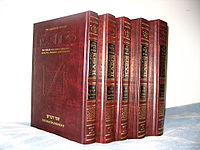 ArtScroll publishes books on a variety of Jewish
subjects. The best known is probably an annotated Hebrew
-English
siddur
("prayerbook") (the best-selling The ArtScroll Siddur). In recent years its Torah
translation and commentary, a series of translations and commentaries on books of the Tanach (Hebrew Bible
), and an English translation and elucidation of the Babylonian Talmud
have enjoyed great success. Other publications include works on Jewish Law
, novels and factual works based on Jewish life or history, and cookbooks.
Jewish community, and within a few years became a best-selling Hebrew
-English siddur
(prayerbook) in the United States. It offered the reader detailed notes and instructions on most of the prayers and versions of this prayerbook were produced for the High Holidays, and the three pilgrimage festivals Passover
, Sukkot
and Shavuot
.
In 1993 Mesorah Publications published The Chumash: The Stone Edition, a translation and commentary on the Chumash arranged for liturgical use and sponsored by Irving I. Stone
of American Greetings
, Cleveland, Ohio
. It has since become a best-selling English-Hebrew Torah translation and commentary in the U.S. and other English-speaking countries.
While ArtScroll books are not used as the official Torah commentaries by any non-Orthodox synagogues, they have some usage in the non-Orthodox Jewish community and many Reform
and Conservative Jews have purchased copies.
Since the advent of ArtScroll, a number of Jewish publishers have printed books and siddurim with similar typefaces and commentary, but with a different commentary and translation philosophy.
entitled Kosher By Design: Picture-perfect food for the holidays & every day. The cookbook contains both traditional recipes and updated versions of traditional recipes. All the recipes are kosher and the book puts an emphasis on its food photography. Since publication the book has sold over 400,000 copies from 2003 through 2010 and Fishbein has become a media personality, earning the sobriquets of "the Jewish Martha Stewart
" and the "kosher diva
". ArtScroll has realized the books' salability by extending beyond its traditional Orthodox Jewish market into the mainstream market, including sales on Amazon
, at Barnes & Noble
and Christian
evangelical booksellers
, in Williams-Sonoma
stores, and in supermarkets.
, but especially to Orthodox Jews who have come from less religious backgrounds, but are returning to the faith (Baalei Teshuva). Due to the makeup of the Jewish community in the USA, most of the prayer books are geared to the Ashkenazic
custom. In more recent years, Artscroll has collaborated with Sephardic community leaders in an attempt to bridge this gap. Examples of this include a Sephardic Haggadah published by Artscroll, written by Sephardic Rabbi Eli Mansour
, and the book Aleppo
, about a prominent Sephardic community in Syria
.
In translations and commentaries, ArtScroll works with the traditional framework of Halakha
(Jewish law) accepting midrash
ic accounts in a historical fashion, and at times literally, and generally disregards (and occasionally disagrees with) textual criticism
.
translations and commentaries, and a line of Babylonian Talmud translations and commentaries, The Schottenstein Edition of The Talmud Bavli ("Babylonian Talmud"). The set of Talmud was completed in late 2004, giving a 73 volume English edition of the entire Talmud. This was the second complete translation of the Talmud into English (the other being the Soncino
Talmud published in the United Kingdom during the mid-twentieth century).
The first volume, Tractate Makkos, was published in 1990, and dedicated by Mr. and Mrs. Marcos Katz. Jerome Schottenstein was introduced to the publication committee shortly thereafter. He began by donating funds for the project in memory of his parents Ephraim and Anna Schottenstein one volume at a time, and later decided to back the entire project. When Jerome died, his children and widow, Geraldine, rededicated the project to his memory in addition to those of his parents. The goal of the project was to, "open the doors of the Talmud and welcome its people inside."
The text generally consists of two side-by-side pages: one of the Aramaic/Hebrew
Vilna
Edition text, and the corresponding page consists of an English translation. The English translation has a bolded literal translation of the Talmud's text, but also includes un-bolded text clarifying the literal translation. (The original Talmud's text is often very unclear, referring to places, times, people, and laws that it does not explain. The un-bolded text attempts to explain these situations. The text of the Talmud also contains few prepositions, articles, etc. The un-bolded text takes the liberty of inserting these parts of speech.) The result is an English text that reads in full sentences with full explanations, while allowing the reader to distinguish between direct translation and a more liberal approach to the translation. (This also results in one page of the Vilna Talmud requiring several pages of English translation.) Below the English translation appear extensive notes including diagrams.
ArtScroll's English explanations and footnoted commentary in the Schottenstein Edition of the Talmud are based on the perspective of classical Jewish sources. The clarifying explanation is generally based on the viewpoint of Rashi
, the medieval commentator who wrote the first comprehensive commentary on the Talmud. The Schottenstein Edition does not include contemporary academic or critical scholarship.
The total cost of the project is estimated at US$21 million, most of which was contributed by private donors and foundations. Some volumes have up to 2 million copies in distribution, while more recent volumes have only 90,000 copies currently printed. A completed set was dedicated on February 9, 2005, to the Library of Congress
, and the siyum
(celebration at the "completion") was held on March 15, 2005, the 13th yahrzeit of Jerome Schottenstein, at the New York Hilton.
Mesorah and the Schottenstein family have also begun a Hebrew version of the commentary and have begun both an English and Hebrew translation of the Talmud Yerushalmi (Jerusalem Talmud
).
of Tanakh
(Hebrew Bible) and Chumash
(Pentateuch) use many more transliterated Hebrew words rather than than English words, compared to editions such as the Tanakh
of the Jewish Publication Society. This reflects a higher use of untranslated Hebrew terminology in Haredi English usage.
consonants and Sefardi vowels.
The two major differences between the way Sefardi and Ashkenazi Hebrew dialects are transcribed are as follows:
As such you would have the following transliterations:
Imprint
In the publishing industry, an imprint can mean several different things:* As a piece of bibliographic information about a book, it refers to the name and address of the book's publisher and its date of publication as given at the foot or on the verso of its title page.* It can mean a trade name...
of translations, books and commentaries from an Orthodox Jewish
Orthodox Judaism
Orthodox Judaism , is the approach to Judaism which adheres to the traditional interpretation and application of the laws and ethics of the Torah as legislated in the Talmudic texts by the Sanhedrin and subsequently developed and applied by the later authorities known as the Gaonim, Rishonim, and...
perspective published by Mesorah Publications, Ltd., a publishing company based in Brooklyn, New York
New York City
New York is the most populous city in the United States and the center of the New York Metropolitan Area, one of the most populous metropolitan areas in the world. New York exerts a significant impact upon global commerce, finance, media, art, fashion, research, technology, education, and...
. Its general editors are Rabbi
Rabbi
In Judaism, a rabbi is a teacher of Torah. This title derives from the Hebrew word רבי , meaning "My Master" , which is the way a student would address a master of Torah...
s Nosson Scherman
Nosson Scherman
Nosson Scherman born 1935, Newark, New Jersey) is an American Haredi rabbi best known as the general editor of ArtScroll/Mesorah Publications.-Biography:...
and Meir Zlotowitz
Meir Zlotowitz
Meir Zlotowitz is an Orthodox Jewish rabbi, author, and founder of ArtScroll Publications.-Biography:Zlotowitz was a talmid of Rabbi Moshe Feinstein at Mesivtha Tifereth Jerusalem....
.
History
In 1975, Zlotowitz, a graduate of Mesivtha Tifereth JerusalemMesivtha Tifereth Jerusalem
Mesivtha Tifereth Jerusalem, is one of the oldest existent yeshivot in New York City, and is renowned for being the institution led by Rabbi Moshe Feinstein.-Location:The yeshiva has two campuses....
, was director of a high-end graphics studio in New York. The firm, named ArtScroll Studios, produced brochures, invitations, awards and ketubah
Ketubah
A ketubah is a special type of Jewish prenuptial agreement. It is considered an integral part of a traditional Jewish marriage, and outlines the rights and responsibilities of the groom, in relation to the bride.-History:...
s. Rabbi Nosson Scherman
Nosson Scherman
Nosson Scherman born 1935, Newark, New Jersey) is an American Haredi rabbi best known as the general editor of ArtScroll/Mesorah Publications.-Biography:...
, then principal of Yeshiva Karlin Stolin Boro Park
Borough Park, Brooklyn
Borough Park , is a neighborhood in the southwestern part of the borough of Brooklyn, in New York City in the United States....
, was recommended to Zlotowitz as someone who could write copy, and they collaborated on a few projects.
In late 1975, a close friend of Zlotowitz, Rabbi Meir Fogel, died in his sleep, prompting Zlotowitz to want to do something to honor his memory. As Purim
Purim
Purim is a Jewish holiday that commemorates the deliverance of the Jewish people in the ancient Persian Empire from destruction in the wake of a plot by Haman, a story recorded in the Biblical Book of Esther .Purim is celebrated annually according to the Hebrew calendar on the 14th...
was a few months away, he decided to write an English
English language
English is a West Germanic language that arose in the Anglo-Saxon kingdoms of England and spread into what was to become south-east Scotland under the influence of the Anglian medieval kingdom of Northumbria...
translation and commentary on the Book of Esther
Book of Esther
The Book of Esther is a book in the Ketuvim , the third section of the Jewish Tanakh and is part of the Christian Old Testament. The Book of Esther or the Megillah is the basis for the Jewish celebration of Purim...
, and asked Scherman to write the introduction. The book was completed in honor of the shloshim (the 30-day commemoration of a death) and sold out its first edition of 20,000 copies within two months. With the encouragement of Rabbi Moses Feinstein, Rabbi Yaakov Kamenetsky
Yaakov Kamenetsky
Rabbi Yaakov Kamenetsky , was a prominent rosh yeshiva, posek and Talmudist in the post-World War II American Jewish community....
, and other Gedolei Yisrael, the two continued producing commentaries, beginning with a translation and commentary on the rest of the Five Megillot (Song of Songs
Song of songs
Song of Songs, also known as the Song of Solomon, is a book of the Hebrew Bible or Old Testament. It may also refer to:In music:* Song of songs , the debut album by David and the Giants* A generic term for medleysPlays...
, Ecclesiastes
Ecclesiastes
The Book of Ecclesiastes, called , is a book of the Hebrew Bible. The English name derives from the Greek translation of the Hebrew title.The main speaker in the book, identified by the name or title Qoheleth , introduces himself as "son of David, king in Jerusalem." The work consists of personal...
, Lamentations
Book of Lamentations
The Book of Lamentations ) is a poetic book of the Hebrew Bible composed by the Jewish prophet Jeremiah. It mourns the destruction of Jerusalem and the Holy Temple in the 6th Century BCE....
and Ruth
Book of Ruth
The Book of Ruth is one of the books of the Hebrew Bible, Tanakh, or Old Testament. In the Jewish canon the Book of Ruth is included in the third division, or the Writings . In the Christian canon the Book of Ruth is placed between Judges and 1 Samuel...
), and went on to publish translations and commentaries on the Torah
Torah
Torah- A scroll containing the first five books of the BibleThe Torah , is name given by Jews to the first five books of the bible—Genesis , Exodus , Leviticus , Numbers and Deuteronomy Torah- A scroll containing the first five books of the BibleThe Torah , is name given by Jews to the first five...
, Prophets
Nevi'im
Nevi'im is the second of the three major sections in the Hebrew Bible, the Tanakh. It falls between the Torah and Ketuvim .Nevi'im is traditionally divided into two parts:...
, Talmud
Talmud
The Talmud is a central text of mainstream Judaism. It takes the form of a record of rabbinic discussions pertaining to Jewish law, ethics, philosophy, customs and history....
, Passover Haggadah, siddur
Siddur
A siddur is a Jewish prayer book, containing a set order of daily prayers. This article discusses how some of these prayers evolved, and how the siddur, as it is known today has developed...
s and machzors. The name ArtScroll was chosen for the publishing company to emphasize the visual appeal of the books. In its first 25 years, ArtScroll produced more than 700 books, including novel
Novel
A novel is a book of long narrative in literary prose. The genre has historical roots both in the fields of the medieval and early modern romance and in the tradition of the novella. The latter supplied the present generic term in the late 18th century....
s, history books, children's books and secular textbooks, and is now one of the largest publishers of Jewish books in the United States.
Primary publications
Judaism
Judaism ) is the "religion, philosophy, and way of life" of the Jewish people...
subjects. The best known is probably an annotated Hebrew
Hebrew language
Hebrew is a Semitic language of the Afroasiatic language family. Culturally, is it considered by Jews and other religious groups as the language of the Jewish people, though other Jewish languages had originated among diaspora Jews, and the Hebrew language is also used by non-Jewish groups, such...
-English
English language
English is a West Germanic language that arose in the Anglo-Saxon kingdoms of England and spread into what was to become south-east Scotland under the influence of the Anglian medieval kingdom of Northumbria...
siddur
Siddur
A siddur is a Jewish prayer book, containing a set order of daily prayers. This article discusses how some of these prayers evolved, and how the siddur, as it is known today has developed...
("prayerbook") (the best-selling The ArtScroll Siddur). In recent years its Torah
Torah
Torah- A scroll containing the first five books of the BibleThe Torah , is name given by Jews to the first five books of the bible—Genesis , Exodus , Leviticus , Numbers and Deuteronomy Torah- A scroll containing the first five books of the BibleThe Torah , is name given by Jews to the first five...
translation and commentary, a series of translations and commentaries on books of the Tanach (Hebrew Bible
Hebrew Bible
The Hebrew Bible is a term used by biblical scholars outside of Judaism to refer to the Tanakh , a canonical collection of Jewish texts, and the common textual antecedent of the several canonical editions of the Christian Old Testament...
), and an English translation and elucidation of the Babylonian Talmud
Talmud
The Talmud is a central text of mainstream Judaism. It takes the form of a record of rabbinic discussions pertaining to Jewish law, ethics, philosophy, customs and history....
have enjoyed great success. Other publications include works on Jewish Law
Halakha
Halakha — also transliterated Halocho , or Halacha — is the collective body of Jewish law, including biblical law and later talmudic and rabbinic law, as well as customs and traditions.Judaism classically draws no distinction in its laws between religious and ostensibly non-religious life; Jewish...
, novels and factual works based on Jewish life or history, and cookbooks.
Popular acceptance
Mesorah Publications received widespread acclaim in response to its ArtScroll line of prayerbooks, starting with The Complete ArtScroll Siddur, Ed. Nosson Scherman, 1984. This work gained wide acceptance in the OrthodoxOrthodox Judaism
Orthodox Judaism , is the approach to Judaism which adheres to the traditional interpretation and application of the laws and ethics of the Torah as legislated in the Talmudic texts by the Sanhedrin and subsequently developed and applied by the later authorities known as the Gaonim, Rishonim, and...
Jewish community, and within a few years became a best-selling Hebrew
Hebrew language
Hebrew is a Semitic language of the Afroasiatic language family. Culturally, is it considered by Jews and other religious groups as the language of the Jewish people, though other Jewish languages had originated among diaspora Jews, and the Hebrew language is also used by non-Jewish groups, such...
-English siddur
Siddur
A siddur is a Jewish prayer book, containing a set order of daily prayers. This article discusses how some of these prayers evolved, and how the siddur, as it is known today has developed...
(prayerbook) in the United States. It offered the reader detailed notes and instructions on most of the prayers and versions of this prayerbook were produced for the High Holidays, and the three pilgrimage festivals Passover
Passover
Passover is a Jewish holiday and festival. It commemorates the story of the Exodus, in which the ancient Israelites were freed from slavery in Egypt...
, Sukkot
Sukkot
Sukkot is a Biblical holiday celebrated on the 15th day of the month of Tishrei . It is one of the three biblically mandated festivals Shalosh regalim on which Hebrews were commanded to make a pilgrimage to the Temple in Jerusalem.The holiday lasts seven days...
and Shavuot
Shavuot
The festival of is a Jewish holiday that occurs on the sixth day of the Hebrew month of Sivan ....
.
In 1993 Mesorah Publications published The Chumash: The Stone Edition, a translation and commentary on the Chumash arranged for liturgical use and sponsored by Irving I. Stone
Irving I. Stone
Irving I. Stone was an American philanthropist, businessman, and founder-chairman of American Greetings, which was founded by his father Jacob Sapirstein....
of American Greetings
American Greetings
American Greetings Corporation, Inc. is the world's largest publicly-traded greeting card company. It is based in Brooklyn, Ohio and sells paper greeting cards, electronic greeting cards, party products , and electronic expressive content...
, Cleveland, Ohio
Cleveland, Ohio
Cleveland is a city in the U.S. state of Ohio and is the county seat of Cuyahoga County, the most populous county in the state. The city is located in northeastern Ohio on the southern shore of Lake Erie, approximately west of the Pennsylvania border...
. It has since become a best-selling English-Hebrew Torah translation and commentary in the U.S. and other English-speaking countries.
While ArtScroll books are not used as the official Torah commentaries by any non-Orthodox synagogues, they have some usage in the non-Orthodox Jewish community and many Reform
Reform Judaism
Reform Judaism refers to various beliefs, practices and organizations associated with the Reform Jewish movement in North America, the United Kingdom and elsewhere. In general, it maintains that Judaism and Jewish traditions should be modernized and should be compatible with participation in the...
and Conservative Jews have purchased copies.
Since the advent of ArtScroll, a number of Jewish publishers have printed books and siddurim with similar typefaces and commentary, but with a different commentary and translation philosophy.
Kosher By Design
In 2003 ArtScroll published a cookbook by Susie FishbeinSusie Fishbein
Susan Beth Fishbein is an Orthodox Jewish kosher cookbook author. Her Kosher By Design series of cookbooks has been a runaway best-seller for ArtScroll, with over 400,000 copies sold from 2003 through 2010...
entitled Kosher By Design: Picture-perfect food for the holidays & every day. The cookbook contains both traditional recipes and updated versions of traditional recipes. All the recipes are kosher and the book puts an emphasis on its food photography. Since publication the book has sold over 400,000 copies from 2003 through 2010 and Fishbein has become a media personality, earning the sobriquets of "the Jewish Martha Stewart
Martha Stewart
Martha Stewart is an American business magnate, author, magazine publisher, and television personality. As founder of Martha Stewart Living Omnimedia, she has gained success through a variety of business ventures, encompassing publishing, broadcasting, and merchandising...
" and the "kosher diva
Diva
A diva is a celebrated female singer. The term is used to describe a woman of outstanding talent in the world of opera, and, by extension, in theatre, cinema and popular music. The meaning of diva is closely related to that of "prima donna"....
". ArtScroll has realized the books' salability by extending beyond its traditional Orthodox Jewish market into the mainstream market, including sales on Amazon
Amazon.com
Amazon.com, Inc. is a multinational electronic commerce company headquartered in Seattle, Washington, United States. It is the world's largest online retailer. Amazon has separate websites for the following countries: United States, Canada, United Kingdom, Germany, France, Italy, Spain, Japan, and...
, at Barnes & Noble
Barnes & Noble
Barnes & Noble, Inc. is the largest book retailer in the United States, operating mainly through its Barnes & Noble Booksellers chain of bookstores headquartered at 122 Fifth Avenue in the Flatiron District in Manhattan in New York City. Barnes & Noble also operated the chain of small B. Dalton...
and Christian
Christianity
Christianity is a monotheistic religion based on the life and teachings of Jesus as presented in canonical gospels and other New Testament writings...
evangelical booksellers
Bookselling
Bookselling is the commercial trading of books, the retail and distribution end of the publishing process. People who engage in bookselling are called booksellers or bookmen.-Bookstores today:...
, in Williams-Sonoma
Williams-Sonoma
Williams-Sonoma, Inc. is a high-end American consumer retail company that sells kitchenwares, furniture and linens, as well as other housewares and home furnishings, along with a variety of specialty foods, soaps and lotions...
stores, and in supermarkets.
Editorial policy
Works published by Mesorah under this imprint adhere to a perspective appealing to many Orthodox JewsOrthodox Judaism
Orthodox Judaism , is the approach to Judaism which adheres to the traditional interpretation and application of the laws and ethics of the Torah as legislated in the Talmudic texts by the Sanhedrin and subsequently developed and applied by the later authorities known as the Gaonim, Rishonim, and...
, but especially to Orthodox Jews who have come from less religious backgrounds, but are returning to the faith (Baalei Teshuva). Due to the makeup of the Jewish community in the USA, most of the prayer books are geared to the Ashkenazic
Ashkenazi Jews
Ashkenazi Jews, also known as Ashkenazic Jews or Ashkenazim , are the Jews descended from the medieval Jewish communities along the Rhine in Germany from Alsace in the south to the Rhineland in the north. Ashkenaz is the medieval Hebrew name for this region and thus for Germany...
custom. In more recent years, Artscroll has collaborated with Sephardic community leaders in an attempt to bridge this gap. Examples of this include a Sephardic Haggadah published by Artscroll, written by Sephardic Rabbi Eli Mansour
Eli Mansour
Eli J. Mansour is an Orthodox Sephardic rabbi in Brooklyn, New York. He is one of the leading speakers in the Syrian-Jewish community and the leader of ...
, and the book Aleppo
Aleppo
Aleppo is the largest city in Syria and the capital of Aleppo Governorate, the most populous Syrian governorate. With an official population of 2,301,570 , expanding to over 2.5 million in the metropolitan area, it is also one of the largest cities in the Levant...
, about a prominent Sephardic community in Syria
Syria
Syria , officially the Syrian Arab Republic , is a country in Western Asia, bordering Lebanon and the Mediterranean Sea to the West, Turkey to the north, Iraq to the east, Jordan to the south, and Israel to the southwest....
.
In translations and commentaries, ArtScroll works with the traditional framework of Halakha
Halakha
Halakha — also transliterated Halocho , or Halacha — is the collective body of Jewish law, including biblical law and later talmudic and rabbinic law, as well as customs and traditions.Judaism classically draws no distinction in its laws between religious and ostensibly non-religious life; Jewish...
(Jewish law) accepting midrash
Midrash
The Hebrew term Midrash is a homiletic method of biblical exegesis. The term also refers to the whole compilation of homiletic teachings on the Bible....
ic accounts in a historical fashion, and at times literally, and generally disregards (and occasionally disagrees with) textual criticism
Textual criticism
Textual criticism is a branch of literary criticism that is concerned with the identification and removal of transcription errors in the texts of manuscripts...
.
Schottenstein Edition Talmud
Mesorah has a line of MishnahMishnah
The Mishnah or Mishna is the first major written redaction of the Jewish oral traditions called the "Oral Torah". It is also the first major work of Rabbinic Judaism. It was redacted c...
translations and commentaries, and a line of Babylonian Talmud translations and commentaries, The Schottenstein Edition of The Talmud Bavli ("Babylonian Talmud"). The set of Talmud was completed in late 2004, giving a 73 volume English edition of the entire Talmud. This was the second complete translation of the Talmud into English (the other being the Soncino
Soncino Press
Soncino Press is a Jewish publishing company based in the United Kingdom that has published a variety of books of Jewish interest, most notably English translations and commentaries to the Talmud and Hebrew Bible...
Talmud published in the United Kingdom during the mid-twentieth century).
The first volume, Tractate Makkos, was published in 1990, and dedicated by Mr. and Mrs. Marcos Katz. Jerome Schottenstein was introduced to the publication committee shortly thereafter. He began by donating funds for the project in memory of his parents Ephraim and Anna Schottenstein one volume at a time, and later decided to back the entire project. When Jerome died, his children and widow, Geraldine, rededicated the project to his memory in addition to those of his parents. The goal of the project was to, "open the doors of the Talmud and welcome its people inside."
The text generally consists of two side-by-side pages: one of the Aramaic/Hebrew
Hebrew language
Hebrew is a Semitic language of the Afroasiatic language family. Culturally, is it considered by Jews and other religious groups as the language of the Jewish people, though other Jewish languages had originated among diaspora Jews, and the Hebrew language is also used by non-Jewish groups, such...
Vilna
Vilnius
Vilnius is the capital of Lithuania, and its largest city, with a population of 560,190 as of 2010. It is the seat of the Vilnius city municipality and of the Vilnius district municipality. It is also the capital of Vilnius County...
Edition text, and the corresponding page consists of an English translation. The English translation has a bolded literal translation of the Talmud's text, but also includes un-bolded text clarifying the literal translation. (The original Talmud's text is often very unclear, referring to places, times, people, and laws that it does not explain. The un-bolded text attempts to explain these situations. The text of the Talmud also contains few prepositions, articles, etc. The un-bolded text takes the liberty of inserting these parts of speech.) The result is an English text that reads in full sentences with full explanations, while allowing the reader to distinguish between direct translation and a more liberal approach to the translation. (This also results in one page of the Vilna Talmud requiring several pages of English translation.) Below the English translation appear extensive notes including diagrams.
ArtScroll's English explanations and footnoted commentary in the Schottenstein Edition of the Talmud are based on the perspective of classical Jewish sources. The clarifying explanation is generally based on the viewpoint of Rashi
Rashi
Shlomo Yitzhaki , or in Latin Salomon Isaacides, and today generally known by the acronym Rashi , was a medieval French rabbi famed as the author of a comprehensive commentary on the Talmud, as well as a comprehensive commentary on the Tanakh...
, the medieval commentator who wrote the first comprehensive commentary on the Talmud. The Schottenstein Edition does not include contemporary academic or critical scholarship.
The total cost of the project is estimated at US$21 million, most of which was contributed by private donors and foundations. Some volumes have up to 2 million copies in distribution, while more recent volumes have only 90,000 copies currently printed. A completed set was dedicated on February 9, 2005, to the Library of Congress
Library of Congress
The Library of Congress is the research library of the United States Congress, de facto national library of the United States, and the oldest federal cultural institution in the United States. Located in three buildings in Washington, D.C., it is the largest library in the world by shelf space and...
, and the siyum
Siyum
A siyum means the completion of any unit of Torah study, or book of the Mishnah or Talmud in Judaism. A siyum is usually followed by a celebratory meal, or seudat mitzvah, a meal in honor of a mitzvah, or commandment...
(celebration at the "completion") was held on March 15, 2005, the 13th yahrzeit of Jerome Schottenstein, at the New York Hilton.
Mesorah and the Schottenstein family have also begun a Hebrew version of the commentary and have begun both an English and Hebrew translation of the Talmud Yerushalmi (Jerusalem Talmud
Jerusalem Talmud
The Jerusalem Talmud, talmud meaning "instruction", "learning", , is a collection of Rabbinic notes on the 2nd-century Mishnah which was compiled in the Land of Israel during the 4th-5th century. The voluminous text is also known as the Palestinian Talmud or Talmud de-Eretz Yisrael...
).
Transliteration policy
Artscroll publications, such as the Stone EditionsIrving I. Stone
Irving I. Stone was an American philanthropist, businessman, and founder-chairman of American Greetings, which was founded by his father Jacob Sapirstein....
of Tanakh
Tanakh
The Tanakh is a name used in Judaism for the canon of the Hebrew Bible. The Tanakh is also known as the Masoretic Text or the Miqra. The name is an acronym formed from the initial Hebrew letters of the Masoretic Text's three traditional subdivisions: The Torah , Nevi'im and Ketuvim —hence...
(Hebrew Bible) and Chumash
Chumash
The Chumash are a Native American people who historically inhabited the central and southern coastal regions of California, in portions of what is now San Luis Obispo, Santa Barbara, Ventura and Los Angeles counties, extending from Morro Bay in the north to Malibu in the south...
(Pentateuch) use many more transliterated Hebrew words rather than than English words, compared to editions such as the Tanakh
Tanakh
The Tanakh is a name used in Judaism for the canon of the Hebrew Bible. The Tanakh is also known as the Masoretic Text or the Miqra. The name is an acronym formed from the initial Hebrew letters of the Masoretic Text's three traditional subdivisions: The Torah , Nevi'im and Ketuvim —hence...
of the Jewish Publication Society. This reflects a higher use of untranslated Hebrew terminology in Haredi English usage.
Transliteration system
The ArtScroll transliteration system for Hebrew transliteration for readers of the English language generally uses AshkenaziAshkenazi Hebrew
Ashkenazi Hebrew , is the pronunciation system for Biblical and Mishnaic Hebrew favored for liturgical use by Ashkenazi Jewish practice. Its phonology was influenced by languages with which it came into contact, such as Yiddish, German, and various Slavic languages...
consonants and Sefardi vowels.
The two major differences between the way Sefardi and Ashkenazi Hebrew dialects are transcribed are as follows:
- the letter TavTaw (letter)Taw, Tav or Taf is the twenty-second and last letter in many Semitic abjads, including Phoenician, Aramaic, Hebrew Taw and Arabic alphabet .Its original sound value is ....
without a dagesh (emphasis point) is transcribed as [t] and [s] respectively- ArtScroll uses the latter
- the vowel kamatz gadol, is transcribed [a] and [o] respectively
- ArtScroll uses the former
As such you would have the following transliterations:
| Ashkenazi | Sefardi | ArtScroll |
|---|---|---|
| Boruch | Barukh | Baruch |
| Shabbos | Shabbat | Shabbos (ArtScroll makes an exception due to widespread usage) |
| Succos | Succot | Succos |
| Avrohom | Avraham | Avraham |
| Akeidas Yitzchok | Akedat Yitzhak | Akeidas Yitzchak |
Criticism
This line of books has come under criticism from some scholars (both Orthodox and non-Orthodox) on a number of points:- Their Tanach commentaries make no attempt to directly translate the text of the Tanach. Rather, the introductions to their Tanach commentaries state the medieval rabbinic commentators or midrash compilations that the editors favor, and write an English language text in accord with these interpretations, thus "removing surface difficulties". However, this method is the opposite of what most translators consider translationTranslationTranslation is the communication of the meaning of a source-language text by means of an equivalent target-language text. Whereas interpreting undoubtedly antedates writing, translation began only after the appearance of written literature; there exist partial translations of the Sumerian Epic of...
. In the introduction to Koheles: Ecclesiastes (ArtScroll Tanach Series), Rabbi Meir Zlotowitz writes:
-
- As with the previously published books, we began with a new, free-flowing translation of the text - not always literal, but faithful to Rabbinic interpretation. Designed to be as readable as possible, the translation removed many of the "surface difficulties" dealt with by the Midrash, Rashi and Ibn Ezra, by incorporating their interpretations into the translation.
- In their Tanach (Bible, "Old Testament") and in their siddurSiddurA siddur is a Jewish prayer book, containing a set order of daily prayers. This article discusses how some of these prayers evolved, and how the siddur, as it is known today has developed...
im and machzorim (which are used during prayer services), Shir HaShirim (the Song of Songs or Song of SolomonSong of SolomonThe Song of Songs of Solomon, commonly referred to as Song of Songs or Song of Solomon, is a book of the Hebrew Bible—one of the megillot —found in the last section of the Tanakh, known as the Ketuvim...
, a poem describing the intimate relationship of a man and a woman) is translated following RashiRashiShlomo Yitzhaki , or in Latin Salomon Isaacides, and today generally known by the acronym Rashi , was a medieval French rabbi famed as the author of a comprehensive commentary on the Talmud, as well as a comprehensive commentary on the Tanakh...
's commentary. This provides a non-literal metaphorMetaphorA metaphor is a literary figure of speech that uses an image, story or tangible thing to represent a less tangible thing or some intangible quality or idea; e.g., "Her eyes were glistening jewels." Metaphor may also be used for any rhetorical figures of speech that achieve their effects via...
ic explanation in which the erotic elements have been eliminated. (in the one-volume Shir HaShirim a full literal translation is included.)
- A large number of grammatical errors exist in their Bible and commentary translations, changing the meaning of these passages:
- Dikduk (grammar) is anathema in many Jewish circles, but the translation and presentation of texts is, to a large extent, a philologicalPhilologyPhilology is the study of language in written historical sources; it is a combination of literary studies, history and linguistics.Classical philology is the philology of Greek and Classical Latin...
activity and must be philologically accurate. The Artscroll effort has not achieved a respectable level. There are dozens of cases where prepositions are misunderstood, where verb tenses are not perceived properly and where grammatical or linguistic terms are used incorrectly. Words are often vocalized incorrectly. These observations, it should be stressed, are not limited to the Bible text but refer to the talmudic, midrashic, targumic, medieval and modern works as well. Rabbinical passages are removed from their contexts, presented in fragmentary form thus distorting their contents, emended to update their messages even though these new ideas were not expressed in the texts themselves, misvocalized, and mistranslated: i.e. misrepresented.
External links
- Company website
- Jewish Press Interview with Nosson Scherman
- Jeremy Stolow (2006), ArtScroll, Encyclopaedia JudaicaEncyclopaedia JudaicaThe Encyclopaedia Judaica is a 26-volume English-language encyclopedia of the Jewish people and their faith, Judaism. It covers diverse areas of the Jewish world and civilization, including Jewish history of all eras, culture, holidays, language, scripture, and religious teachings...
; via Jewish Virtual LibraryJewish Virtual LibraryJewish Virtual Library is an online encyclopedia published by the American-Israeli Cooperative Enterprise . Established in 1993, it is a comprehensive website covering Israel, the Jewish people, and Jewish culture.-History:... - Critical evaluations of Artscroll