
All Topics  
Torah study


   Email Print
   Bookmark   Link


Torah study


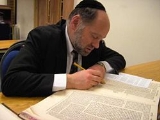
Torah study is the study by Jewish people of the Torah
Torah

The term "Torah" , or Five Books of Moses or Pentateuch, refers to the entirety of Judaism's founding Halakha and ethical religious texts....
, Hebrew Bible
Tanakh

The Tanakh is the Bible used in Judaism. The name "Tanakh" is a Hebrew language Acronym and initialism formed from the initial Hebrew alphabet of the Tanakh's three traditional subdivisions: The Torah , Nevi'im and Ketuvim - hence TaNaKh....
, Talmud
Talmud

The Talmud is a record of rabbinic discussions pertaining to Halakha, Jewish ethics, customs, and history. It is a central text of mainstream Judaism....
, responsa
Responsa

Responsa comprise a body of written decisions and rulings given by legal scholars in response to questions addressed to them....
, rabbinic literature
Rabbinic literature

Rabbinic literature, in its broadest sense, can mean the entire spectrum of rabbinic writings throughout Judaism history. But the term often refers specifically to literature from the Talmudic era, as opposed to medieval and modern rabbinic writing, and thus corresponds with the Hebrew language term Sifrut Hazal ....
 and similar works, all of which are Judaism
Judaism

Judaism is a set of beliefs and practices originating in the Hebrew Bible , as later further explored and explained in the Talmud and other texts....
's religious texts. Ideally within Judaism it is done for the purpose of the mitzvah
Mitzvah

This article is about commandments in Judaism. For the Jewish rite of passage, see Bar Mitzvah and Bat MitzvahMitzvah is a word used in Judaism to refer to the 613 Mitzvot given in the Torah and the Mitzvah#Rabbinical_mitzvot instituted later for a total of 620....
 ("commandment") of Torah study itself.

This practice is present to an extent in all branches of Judaism and is considered of paramount importance among traditional Jews. Torah study has evolved over the generations, as lifestyles changed and also as new texts were written.

h study is counted amongst the 613 mitzvot
613 mitzvot

The 613 Mitzvot are statements and principles of law and ethics contained in the Torah or Five Books of Moses. These principles of Biblical law are sometimes called commandments or collectively as the "Law of Moses" , "Mosaic Law," or simply "the Law."...
 ("[Biblical] commandments"), finding its source in the verse (Deuteronomy
Deuteronomy

Deuteronomy is the fifth book of the Hebrew Bible and of the Old Testament. In form it is a set of three sermons delivered by Moses reviewing the previous forty years of wandering in the wilderness; its central element is a detailed law-code by which the Children of Israel are to live in the Promised Land....
 6:7): "And you shall teach it to your children," upon which the Talmud comments that "Study is necessary in order to teach." The importance of study is attested to in another Talmudic discussion (Kiddushin 40b) about which is preferred: study or action.


Discussion
Ask a question about 'Torah study'
Start a new discussion about 'Torah study'
Answer questions from other users
Full Discussion Forum


Encyclopedia


Torah study is the study by Jewish people of the Torah
Torah

The term "Torah" , or Five Books of Moses or Pentateuch, refers to the entirety of Judaism's founding Halakha and ethical religious texts....
, Hebrew Bible
Tanakh

The Tanakh is the Bible used in Judaism. The name "Tanakh" is a Hebrew language Acronym and initialism formed from the initial Hebrew alphabet of the Tanakh's three traditional subdivisions: The Torah , Nevi'im and Ketuvim - hence TaNaKh....
, Talmud
Talmud

The Talmud is a record of rabbinic discussions pertaining to Halakha, Jewish ethics, customs, and history. It is a central text of mainstream Judaism....
, responsa
Responsa

Responsa comprise a body of written decisions and rulings given by legal scholars in response to questions addressed to them....
, rabbinic literature
Rabbinic literature

Rabbinic literature, in its broadest sense, can mean the entire spectrum of rabbinic writings throughout Judaism history. But the term often refers specifically to literature from the Talmudic era, as opposed to medieval and modern rabbinic writing, and thus corresponds with the Hebrew language term Sifrut Hazal ....
 and similar works, all of which are Judaism
Judaism

Judaism is a set of beliefs and practices originating in the Hebrew Bible , as later further explored and explained in the Talmud and other texts....
's religious texts. Ideally within Judaism it is done for the purpose of the mitzvah
Mitzvah

This article is about commandments in Judaism. For the Jewish rite of passage, see Bar Mitzvah and Bat MitzvahMitzvah is a word used in Judaism to refer to the 613 Mitzvot given in the Torah and the Mitzvah#Rabbinical_mitzvot instituted later for a total of 620....
 ("commandment") of Torah study itself.

This practice is present to an extent in all branches of Judaism and is considered of paramount importance among traditional Jews. Torah study has evolved over the generations, as lifestyles changed and also as new texts were written.

Origins

Torah study is counted amongst the 613 mitzvot
613 mitzvot

The 613 Mitzvot are statements and principles of law and ethics contained in the Torah or Five Books of Moses. These principles of Biblical law are sometimes called commandments or collectively as the "Law of Moses" , "Mosaic Law," or simply "the Law."...
 ("[Biblical] commandments"), finding its source in the verse (Deuteronomy
Deuteronomy

Deuteronomy is the fifth book of the Hebrew Bible and of the Old Testament. In form it is a set of three sermons delivered by Moses reviewing the previous forty years of wandering in the wilderness; its central element is a detailed law-code by which the Children of Israel are to live in the Promised Land....
 6:7): "And you shall teach it to your children," upon which the Talmud comments that "Study is necessary in order to teach." The importance of study is attested to in another Talmudic discussion (Kiddushin 40b) about which is preferred: study or action. The answer there, a seeming compromise, is "study that leads to action."

Although the word "Torah" refers specifically to the Five Books of Moses
Humash

Chumash is one of the Hebrew names for the Five Books of Moses, also known as the Pentateuch or Torah. The word comes from the Hebrew word for five, chamesh....
, in Judaism the word also refers to the Tanakh
Tanakh

The Tanakh is the Bible used in Judaism. The name "Tanakh" is a Hebrew language Acronym and initialism formed from the initial Hebrew alphabet of the Tanakh's three traditional subdivisions: The Torah , Nevi'im and Ketuvim - hence TaNaKh....
 (Hebrew Bible
Hebrew Bible

The term Hebrew Bible is a generic reference to those books of the Bible originally written mostly in Biblical Hebrew with some Biblical Aramaic....
), the Talmud
Talmud

The Talmud is a record of rabbinic discussions pertaining to Halakha, Jewish ethics, customs, and history. It is a central text of mainstream Judaism....
 and other religious works, even including the study of Kabbalah
Kabbalah

Kabbalah is a discipline and school of thought discussing the mysticism aspect of Judaism. It is a set of esoteric teachings that are meant to explain the relationship between an infinite, eternal and essentially unknowable Creator deity with the finite and mortal universe of His creation....
, Hasidism
Hasidic Judaism

Hasidic Judaism is a type of Orthodox Judaism or Haredi Judaism Orthodox Judaism religious movement. Some refer to Hasidic Judaism as Hasidism, and the adjective chasidic / hasidic applies....
, Mussar
Mussar movement

Mussar movement refers to a Judaism ethics, educational and cultural movement that developed in 19th century Orthodox Judaism Eastern Europe, particularly among the Lithuanian Jews....
 and much more.

Traditional view of Torah study

In rabbinic literature, the highest ideal of all Jews is Torah study. This literature teaches an eagerness for such study and a thirst for knowledge that expands beyond the text of the Tanakh to the entire Oral Torah
Oral Torah

A term used to denote the legal and interpretative traditions which were transmitted Speech, and which were not written in the Torah. According to Rabbinic Judaism, the oral Torah, oral Law, or oral tradition was given by God orally to Moses in conjunction with the written Torah ....
. According to many historians, this carried over into the general characteristics of Jewish society, both religious and non-religious, down to the present. Some examples of traditional teachings:

  • The study of Torah is considered to outweigh a number of mitzvot, such as visiting the sick, honouring one's parents, and bringing peace between people (Shabbat 127a). This paragraph was incorporated in the daily prayer service.
  • A number of Talmudic rabbis consider Torah study as being greater than the rescue of human life, than the building of the Temple in Jerusalem
    Temple in Jerusalem

    The Temple in Jerusalem or Holy Temple , refers to a series of structures located on the Temple Mount in the old city of Jerusalem. Historically, two temples were built at this location, and a The Third Temple features in Jewish eschatology....
    , and than the honor of father and mother (Megilah 16b), provided that the individual's life will be saved by someone else.
  • As the child must satisfy its hunger day by day, so must the grown man busy himself with the Torah each hour (Yerushalmi Berakhot ch. 9).
  • Torah study is of more value than the offering of daily sacrifice (Eruvin 63b).
  • A single day devoted to the Torah outweighs 1,000 sacrifices
    Korban

    Korban , in Judaism, is the term for a variety of Sacrifice described and commanded in the Torah. Such sacrifices were offered in a variety of settings by the ancient Israelites, and later by the Jewish priesthood, the Kohen, at the Temple in Jerusalem....
     (Tractate Shabbat 30a; comp. Tractate Menachot 100a).
  • The fable of the Fish and the Fox, in which the latter seeks to entice the former to dry land, declares Israel can live only in the Law as fish can live only in the ocean.
  • Whoever learns Torah at night is granted grace during the day and whoever neglects it will be fed burning coals in the World to Come. (Avodah Zarah 3b).
  • God weeps over one who might have occupied himself with Torah study but neglected to do so (Tractate Hagigah 5b).
  • The study must be unselfish: one should study the Torah with self-denial, even at the sacrifice of one's life; and in the very hour before death one should devote himself to this duty (Tractate Shabbat 83b).
  • All, even lepers and the ritually unclean, are required to study the Torah (Tractate Berakhot 22a).
  • It is the duty of everyone to read the entire weekly portion twice (the law of shnayim mikra ve-echad targum
    Shnayim mikra ve-echad targum

    Shnayim mikra ve-echad targum , translated as "Twice Torah and once Targum " is the Jewish practice of reading the weekly Torah portion in a prescribed manner....
    , Tractate Berakhot 8a).
  • According to R. Meir, a Gentile
    Gentile

    The term Gentile refers to non-Israelite tribes or nations in translations of the Bible, most notably the English King James Version.It serves as the Latin and subsequenly English translation of the Hebrew language words ??? and ???? in the Old Testament and the Greek language word ???? in the New Testament....
     who studies the Torah (for the purpose of finding out about the Noachide Laws) is as great as the High Priest
    Kohen

    A kohen is a Jew who is a direct male descendant of the Bible Aaron, brother of Moses, with a separate status in Judaism. Another term for the descendants of Aaron are the Aaronites or Aaronids....
     (Tractate Avodah Zarah 3a).
  • According to R. Yehudah, God Himself studies the Torah for the first three hours of every day. (Tractate Avodah Zarah 3b).


Forms of traditional Jewish Torah study

The Talmud (Tractate Kiddushin 30a) comments: "The words of Torah shall be sharp in your mouth so that if someone asks you something, you shall not fumble and then tell it to him, rather you shall tell it to him immediately." In yeshiva
Yeshiva

Yeshiva or yeshivah , or metivta or mesivta ) also frequently referred to as a Beth midrash, Talmudical Academy, Rabbinical Academy or Rabbinical School is an institution unique to classical Judaism for Torah study, the study of Talmud, Rabbinic literature and History of responsa....
s ("Talmud
Talmud

The Talmud is a record of rabbinic discussions pertaining to Halakha, Jewish ethics, customs, and history. It is a central text of mainstream Judaism....
ical schools"), rabbinical schools and kollel
Kollel

A kollel is an institute for advanced Torah study of the Talmud and of rabbinic literature for Jewish men, essentially a post-graduate yeshiva which pays married men a regular monthly stipend or annual salary to study Judaism's classic texts in depth....
s ("[post-graduate] Talmudical schools") the primary ways of studying Torah include study of:
  • The weekly Torah portion
    Parsha

    This article is about the divisions of the Torah into weekly readings. For this week's Torah portion, see Portal:Judaism/Weekly Torah portion box...
     with its Meforshim
    Rabbinic literature

    Rabbinic literature, in its broadest sense, can mean the entire spectrum of rabbinic writings throughout Judaism history. But the term often refers specifically to literature from the Talmudic era, as opposed to medieval and modern rabbinic writing, and thus corresponds with the Hebrew language term Sifrut Hazal ....
     ("Rabbinic commentators")
  • Talmud
    Talmud

    The Talmud is a record of rabbinic discussions pertaining to Halakha, Jewish ethics, customs, and history. It is a central text of mainstream Judaism....
  • Ethical works


Other less universally studied texts include the Nevi'im
Nevi'im

Nevi'im is the second of the three major sections in the Hebrew Bible, the Tanakh, between the Torah and Ketuvim .Nevi'im is traditionally divided into two parts:...
 and Ketuvim
Ketuvim

Ketuvim is the third and final section of the Tanakh , after Torah and Nevi'im. In English translations of the Hebrew Bible, this section is usually entitled "Writings" or "Hagiographa."...
, other rabbinic literature (such as midrash
Midrash

Midrash is a Hebrew language term referring to the not exact, but comparative method of exegesis of Biblical texts, which is one of four methods cumulatively called Pardes ....
) and works of religious Jewish philosophy
Jewish philosophy

Jewish philosophy refers to the conjunction between serious study of philosophy and Jewish theology. In a broad sense, it refers to all philosophical activity carried out by Jews or in relation to the religion of Judaism....
.

Most Orthodox Jews study the text of the Torah on four levels as described in the Zohar
Zohar

The Zohar is widely considered the most important work of Kabbalah, or Jewish mysticism. It is a mystical commentary on the Torah , written in medieval Aramaic language....
:
  • Peshat
    Peshat

    Peshat [or Pshat] is one of four classical methods used by Jewish bible scholars to understand the Hebrew bible. Peshat literally means "simple," and describes the meaning of the text apparent at face value, which also takes into account simple idiomatic expressions ....
    , the plain (simple) or literal reading;
  • Remez, the allegorical reading through text's hint or allusion
  • Derash, the metaphorical reading through a (rabbinic sermon's) comparison/illustration (midrash
    Midrash

    Midrash is a Hebrew language term referring to the not exact, but comparative method of exegesis of Biblical texts, which is one of four methods cumulatively called Pardes ....
    )
  • Sod, the hidden meaning reading through text's secret or mystery (Kabbalah
    Kabbalah

    Kabbalah is a discipline and school of thought discussing the mysticism aspect of Judaism. It is a set of esoteric teachings that are meant to explain the relationship between an infinite, eternal and essentially unknowable Creator deity with the finite and mortal universe of His creation....
    ).


The initial letters of the words Peshat, Remez, Derash, Sod, forming together the Hebrew
Hebrew language

Hebrew is a Semitic languages of the Afro-Asiatic languages. Modern Hebrew is spoken by more than seven million people in Israel and Classical Hebrew is used for prayer or study in Jews communities around the world....
 word PaRDeS
Pardes (Jewish exegesis)

The Pardes typology describes four different Hermeneutics to Biblical exegesis in rabbinic Judaism . The term, sometimes also spelled PaRDeS, is an acronym formed from the name initials of these four approaches, which are:...
 (also meaning "orchard"), became the designation for the four-way method of studying Torah, in which the mystical sense given in the Kabbalah
Kabbalah

Kabbalah is a discipline and school of thought discussing the mysticism aspect of Judaism. It is a set of esoteric teachings that are meant to explain the relationship between an infinite, eternal and essentially unknowable Creator deity with the finite and mortal universe of His creation....
 was the highest point.

In some traditional circles, most notably the Orthodox
Orthodox Judaism

Orthodox Judaism is a Jewish denominations of Judaism that adheres to a relatively strict constructionist and application of the laws and ethics first canonized in the Talmudic texts and as subsequently developed and applied by the later authorities known as the Gaonim, Rishonim, and Acharonim....
 and Haredi
Haredi Judaism

Haredi or Chareidi Judaism is the most theologically conservative form of Orthodox Judaism. A follower of Haredi Judaism is called a Haredi ....
, Torah study is a way of life. In some communities, men forego other occupations and study Torah full-time.

Haredi Israelis often choose to devote many years to Torah study, often studying at a Kollel
Kollel

A kollel is an institute for advanced Torah study of the Talmud and of rabbinic literature for Jewish men, essentially a post-graduate yeshiva which pays married men a regular monthly stipend or annual salary to study Judaism's classic texts in depth....
. National Religious Israelis often choose to devote time after high school to Torah study, either during their army service at a Hesder
Hesder

Hesder is an Israeli yeshiva program which combines advanced Talmudic studies with military service in the Israel Defense Forces, usually within a Religious_Zionism#Military_service framework....
 yeshiva, or before their service at a Mechina
Mechina

A Mechina is an Israeli educational institution for post-secondary youth, aimed at preparing them either for their army or Youth service, or for entrance to an institution of higher education in Israel....
.

D'var Torah


A D'var Torah (Heb: ??? ????) (Plural: Divrei Torah) is a talk on topics relating to a section (parashah
Parashah

|}A parashah formally means a section of a biblical book in the masoretic text of the Tanakh . In common usage today the word often refers to the Weekly Torah portion ....
) of the Torah
Torah

The term "Torah" , or Five Books of Moses or Pentateuch, refers to the entirety of Judaism's founding Halakha and ethical religious texts....
 – typically the weekly Torah portion. In respect to its place in synagogue
Synagogue

A synagogue is a Jewish house of prayer.Synagogues usually have a large hall for prayer , smaller rooms for study and sometimes a social hall and offices....
s, rabbis will often give their D'var Torah after the Torah service
Torah reading

Torah reading is a Judaism religion ritual that involves the public reading of a set of passages from a Sefer Torah. The term often refers to the entire ceremony of removing the Torah scroll from the ark , chanting the appropriate excerpt with special cantillation, and returning the scroll to the ark....
. Divrei Torah can range in length, depending on the rabbi and the depth of the talk. In most congregations, it will not last much longer than fifteen minutes, but in the case of Rebbe
Rebbe

Rebbe which means master, teacher, or mentor is a Yiddish word derived from the identical Hebrew language word Rabbi. It mostly refers to the leader of a Hasidic Judaism Jewish movement....
s or special occasions, a Dvar Torah can last all afternoon.

It is extremely likely that a D'var Torah will carry a life lesson, backed up by passages from certain Jewish texts like the Talmud
Talmud

The Talmud is a record of rabbinic discussions pertaining to Halakha, Jewish ethics, customs, and history. It is a central text of mainstream Judaism....
 or Mishnah
Mishnah

The Mishnah or Mishna is a major work of Rabbinic literature, and the first major redaction into written form of Jewish oral traditions, called the Oral Torah....
.

It is also known as a Drasha in Ashkenazic
Ashkenazi Jews

File:Juden 1881.JPGAshkenazi Jews, also known as Ashkenazic Jews or Ashkenazim , are the Jews descended from the medieval Jewish ethnic divisions of the Rhineland in the west of Germany....
 communities.

There are many Torah sites on the web that contain Divrei Torah to help people learn Torah. One of these sites provides users the ability to post their own Dvar Torah help others who are learning Torah.

Torah study by other Jewish denominations


Like Orthodox Jews
Orthodox Judaism

Orthodox Judaism is a Jewish denominations of Judaism that adheres to a relatively strict constructionist and application of the laws and ethics first canonized in the Talmudic texts and as subsequently developed and applied by the later authorities known as the Gaonim, Rishonim, and Acharonim....
, other Jewish denominations
Jewish denominations

Several groups, sometimes called "denominations", "branches," or "movements," have developed among Jews of the modern era, especially Ashkenazi Jews living in anglophone countries....
 may use any or all of the traditional areas and modes of Torah study. They study the weekly Torah portion
Parsha

This article is about the divisions of the Torah into weekly readings. For this week's Torah portion, see Portal:Judaism/Weekly Torah portion box...
, the Talmud, ethical works, and more. They may study simply the peshat of the text, or they may also study, to a limited extent, the remez, derash and sod, which is found in Etz Hayyim: A Torah Commentary (Rabbinical Assembly), used in many Conservative congregations. It is common in Torah study among Jews involved in Jewish Renewal
Jewish Renewal

Jewish Renewal is a Jewish denominations in Judaism which endeavors to reinvigorate modern Judaism with Mysticism, Hasidic Judaism, musical and Meditation practices....
. Some level of PaRDeS study can even be found in forms of Judaism that otherwise are strictly rationalist, such as Reconstructionist Judaism
Reconstructionist Judaism

Reconstructionist Judaism is a modern American-based Judaism Jewish denominations based on the ideas of the late Mordecai Kaplan . The movement views Judaism as a progressively evolving civilization....
. However, non-Orthodox Jews generally spend less time in detailed study of the classical Torah commentators, and spend more time studying modern Torah commentaries that draw on and include the classical commentators, but which are written from more modern perspectives. Furthermore, works of rabbinic literature (such as the Talmud
Talmud

The Talmud is a record of rabbinic discussions pertaining to Halakha, Jewish ethics, customs, and history. It is a central text of mainstream Judaism....
) typically receive less attention than the Tanakh
Tanakh

The Tanakh is the Bible used in Judaism. The name "Tanakh" is a Hebrew language Acronym and initialism formed from the initial Hebrew alphabet of the Tanakh's three traditional subdivisions: The Torah , Nevi'im and Ketuvim - hence TaNaKh....
.

Before the Enlightenment
Age of Enlightenment

The Age of Enlightenment or The Enlightenment is a term used to describe a time in Western philosophy and cultural life centered upon the eighteenth century, in which rationalism was advocated as the primary source and legitimacy for authority....
, virtually all Jews believed that the Tanakh was written by the prophets
Nevi'im

Nevi'im is the second of the three major sections in the Hebrew Bible, the Tanakh, between the Torah and Ketuvim .Nevi'im is traditionally divided into two parts:...
 who heard it from God
Names of God in Judaism

In Judaism, the name of God is more than a distinguishing title. It represents the Jewish conception of the divine nature, and of the relation of God to the Jewish people....
, and that it directly reflected God's intentions in human language. They also believed that as both divine intentions and human language are complex, the Torah required interpretation. After the Enlightenment, many Jews began to participate in wider European society, where they learned critical methods of textual study, the modern historical method, hermeneutics
Hermeneutics

Hermeneutics is the study of interpretation theory. Traditional hermeneutics - which includes Biblical hermeneutics - refers to the study of the interpretation of written texts, especially texts in the areas of literature, religion and law....
, and fields relevant to Bible study such as near-Eastern archaeology
Archaeology

Archaeology, archeology, or arch?ology is the science that studies Homo cultures through the recovery, documentation, analysis, and interpretation of material remains and environmental data, including architecture, Artifact , features, Biofact s, and cultural landscape....
 and linguistics
Linguistics

Linguistics is the science study of natural language. Linguistics encompasses a number of sub-fields. An important topical division is between the study of language structure and the study of Meaning ....
. Many Jews found the findings of these disciplines compelling and considered them relevant to Torah study. According to this view, the Bible was written by different people who may have been "divinely inspired", but who lived at different times and in different societies; and these factors should be taken into account when studying their works. Consequently, one way to add more to Torah study would be to learn more about the intentions of these people, and the circumstances in which they lived. This type of study depends on evidence external to the text, especially archeological evidence and comparative literature. See the entries on Biblical Higher criticism
Higher criticism

Historical criticism or higher criticism is a branch of literature analysis that investigates the origins of a text: as applied in biblical studies it naturally investigates foremost the books of the Bible....
 and the Documentary hypothesis
Documentary hypothesis

The documentary hypothesis is the proposal that the first five books of the Old Testament represent a combination of documents from originally independent sources....
.

Today, Reform
Reform Judaism

Reform Judaism refers to the spectrum of beliefs, practices and organizational infrastructure associated with Reform Judaism in Reform Judaism and in Reform Judaism ....
, Conservative
Conservative Judaism

Conservative Judaism is a modern Jewish denominations of Judaism that arose out of intellectual currents in Germany in the mid-19th century and took institutional form in the United States in the early 1900s....
, Reconstructionist
Reconstructionist Judaism

Reconstructionist Judaism is a modern American-based Judaism Jewish denominations based on the ideas of the late Mordecai Kaplan . The movement views Judaism as a progressively evolving civilization....
 rabbi
Rabbi

Rabbi , in Judaism, means a religious ?teacher?, or more literally, ?my great one?, when addressing any master. The word rabbi derives from the Hebrew root word , rav, which in biblical Hebrew means ?great?, used in many senses, including the sense of a ?master? and apprentice, whence someone who is a distinguished ?teacher?....
s draw on the lessons of modern critical Bible scholarship as well as the traditional forms of Biblical exegesis. Orthodox rabbis reject most or all critical Bible scholarship considering it highly speculative or simply false.

Religious Jews of all denominations hold as a belief that one must constantly strive to engage in Torah study.

Torah study in the Land of Israel


Devoting a year to Torah study in the modern Land of Israel is a common practice among American
United States

The United States of America is a Federal government constitutional republic comprising U.S. state and a federal district. The country is situated mostly in central North America, where its Contiguous United States and Washington, D.C., the Capital districts and territories, lie between the Pacific Ocean and Atlantic Oceans, Borders of the U...
, and, to a lesser extent, Europe
Europe

Europe is, conventionally, one of the world's seven continents. Comprising the westernmost peninsula of Eurasia, Europe is generally divided from Asia to its east by the water divide of the Ural Mountains, the Ural , the Caspian Sea, and by the Caucasus Mountains to the southeast....
an and South African Modern Orthodox
Modern Orthodox Judaism

Modern Orthodox Judaism is a movement within Orthodox Judaism that attempts to synthesize halakha and Jewish principles of faith with the secular, modern world....
 Jews. Young adults spend a year studying Torah in the Land of Israel
Land of Israel

For other uses, see Israel The Land of Israel is the region which, according to the Hebrew Bible, was promised by God to the descendants of Abraham through his son Isaac and to the Israelites, descendants of Jacob, Abraham's grandson....
. It is common both among males and females, with the boys normally going to a yeshiva
Yeshiva

Yeshiva or yeshivah , or metivta or mesivta ) also frequently referred to as a Beth midrash, Talmudical Academy, Rabbinical Academy or Rabbinical School is an institution unique to classical Judaism for Torah study, the study of Talmud, Rabbinic literature and History of responsa....
 and the girls to a midrasha
Midrasha

A refers to an institute of Torah study for women. In Israel, it is often an Orthodox Judaism institution that caters solely to women, and roughly the equivalent of a yeshiva for men....
 (often called seminary or seminaria). Common Yeshivot with year-in-Israel programs include: Yeshivat Har Etzion
Yeshivat Har Etzion

Yeshivat Har Etzion , commonly known as "Gush," is an elite Hesder located in Alon Shvut, a settlement in Gush Etzion near Jerusalem, Israel....
, Yeshivat HaMivtar
Yeshivat HaMivtar

yeshivah Hamivtar Torat Yosef is a men's yeshiva located in Efrat, Israel. The Rosh yeshiva are Rabbi Joel Zeff and Rabbi Shlomo Riskin. The institution is primarily focused on post college-aged students....
, Machon Meir
Machon Meir

Machon Meir' is a religious Zionist Baal teshuva organization and yeshiva situated in the Jerusalem neighborhood of Kiryat Moshe, close to Givat Shaul....
, Aish HaTorah
Aish HaTorah

Aish HaTorah is a Orthodox Judaism organization and yeshiva. Aish HaTorah, is a staunchly pro-Israel, Religious Zionism organization, that promotes Jewish pride and helps send young American Jews to Israel....
. Common seminaries or midrashot include: Midreshet Lindenbaum
Midreshet Lindenbaum

Midreshet Lindenbaum , originally named Michlelet Bruria, was one of the early leaders in the women's talmud study movement. Michlelet Bruria was founded in 1976 by Rabbi Chaim Brovender as the woman's component of Yeshivat Hamivtar....
, Migdal Oz
Migdal Oz

The Stella K. Abraham Beit Midrash for Women, more commonly known as Migdal Oz , which is the name of Migdal Oz in which it is located, is a midrasha, or Orthodox Judaism institution of higher Torah study for women, located in Gush Etzion, Israel....
, Nishmat
Nishmat

Nishmat is a prayer that is recited following the Song of the Sea during Pesukei D'Zimrah but before Yishtabach on Shabbat and Yom Tov. It is also recited during the Passover seder in some traditions....
, Bnos Chava. Chasidic and Charedi boys from abroad often spend many years studying in the Land of Israel.

See also

  • Judaism
    Judaism

    Judaism is a set of beliefs and practices originating in the Hebrew Bible , as later further explored and explained in the Talmud and other texts....
  • Kollel
    Kollel

    A kollel is an institute for advanced Torah study of the Talmud and of rabbinic literature for Jewish men, essentially a post-graduate yeshiva which pays married men a regular monthly stipend or annual salary to study Judaism's classic texts in depth....
  • Mechina
    Mechina

    A Mechina is an Israeli educational institution for post-secondary youth, aimed at preparing them either for their army or Youth service, or for entrance to an institution of higher education in Israel....
  • Midrasha
    Midrasha

    A refers to an institute of Torah study for women. In Israel, it is often an Orthodox Judaism institution that caters solely to women, and roughly the equivalent of a yeshiva for men....
  • Yeshiva
    Yeshiva

    Yeshiva or yeshivah , or metivta or mesivta ) also frequently referred to as a Beth midrash, Talmudical Academy, Rabbinical Academy or Rabbinical School is an institution unique to classical Judaism for Torah study, the study of Talmud, Rabbinic literature and History of responsa....
  • Torah
    Torah

    The term "Torah" , or Five Books of Moses or Pentateuch, refers to the entirety of Judaism's founding Halakha and ethical religious texts....
  • Torah reading
    Torah reading

    Torah reading is a Judaism religion ritual that involves the public reading of a set of passages from a Sefer Torah. The term often refers to the entire ceremony of removing the Torah scroll from the ark , chanting the appropriate excerpt with special cantillation, and returning the scroll to the ark....
  • Parsha
    Parsha

    This article is about the divisions of the Torah into weekly readings. For this week's Torah portion, see Portal:Judaism/Weekly Torah portion box...
     and links to articles on individual Torah portions found there


External links and references

  • (Audio)
  • (Audio)
  • (Audio)
  • (Audio)


Laws Pertaining to Torah Study

  • , (site follows the Kitzur Yomi schedule; fully searchable)


Bibliography

  • A Practical Guide to Torah Learning, D. Landesman, Jason Aronson 1995. ISBN 1-56821-320-4


Wikimedia Torah study projects

Text study projects at Wikisource. Please note that in many instances, these projects proceed much faster in Hebrew than in English!
  • Mikraot Gedolot
    Mikraot Gedolot

    Mikraot Gedolot , often called the "Rabbinic literature Bible" in English, is anedition of Tanakh that generally includes four distinct elements:...
     (Rabbinic Bible) in Hebrew (sample) and English (sample).
  • Cantillation
    Cantillation

    Cantillation is the ritual chanting of readings from the Bible in synagogue Jewish services.The chants are rendered in accordance with the special signs or marks printed in the Masoretic text of the Hebrew Bible to complement the letters and vowel points....
     at the "Vayavinu Bamikra" Project in Hebrew (lists nearly 200 recordings!) and English.
  • Mishnah
    Mishnah

    The Mishnah or Mishna is a major work of Rabbinic literature, and the first major redaction into written form of Jewish oral traditions, called the Oral Torah....
     in Hebrew (sample) and English (sample).
  • Shulchan Aruch
    Shulchan Aruch

    The Shulchan Aruch is a codification, or written manual, of halacha , composed by Rabbi Yosef Karo in the 16th century. Together with its commentaries, it is considered the most authoritative compilation of halakha since the Talmud....
     in Hebrew and English (Hebrew text with English translation).