


Yehezkel Kaufmann

Encyclopedia
Biography
Kaufmann was born in UkraineUkraine
Ukraine is a country in Eastern Europe. It has an area of 603,628 km², making it the second largest contiguous country on the European continent, after Russia...
. His Talmudic knowledge was acquired at the yeshiva
Yeshiva
Yeshiva is a Jewish educational institution that focuses on the study of traditional religious texts, primarily the Talmud and Torah study. Study is usually done through daily shiurim and in study pairs called chavrutas...
of Rav Tzair in Odessa
Odessa
Odessa or Odesa is the administrative center of the Odessa Oblast located in southern Ukraine. The city is a major seaport located on the northwest shore of the Black Sea and the fourth largest city in Ukraine with a population of 1,029,000 .The predecessor of Odessa, a small Tatar settlement,...
and in Petrograd, and his philosophical and Biblical training were at the University of Berne
University of Berne
The University of Bern is a university in the Swiss capital of Bern and was founded in 1834. It is regulated and financed by the Canton of Bern. It is a comprehensive university offering a broad choice of courses and programmes in eight faculties and some 160 institutes. The university is an...
. He completed his doctorate on "the principle of sufficient reason
Principle of sufficient reason
The principle of sufficient reason states that anything that happens does so for a reason: no state of affairs can obtain, and no statement can be true unless there is sufficient reason why it should not be otherwise...
" in 1918, and had it published in 1920 in Berlin. He began teaching in Palestine
Palestine
Palestine is a conventional name, among others, used to describe the geographic region between the Mediterranean Sea and the Jordan River, and various adjoining lands....
in 1928, and became Professor of Bible at Hebrew University in 1949.
Awards
- In 1933, Kaufmann was awarded the first Bialik PrizeBialik PrizeThe Bialik Prize is an annual literary award given by the municipality of Tel Aviv, Israel for significant accomplishments in Hebrew literature. The prize is named in memory of Hayyim Nahman Bialik. There are two separate prizes, one specifically for "Literature", which is in the field of fiction,...
for Jewish thought. He was awarded the prize again in 1956. - In 1958, he was awarded the Israel PrizeIsrael PrizeThe Israel Prize is an award handed out by the State of Israel and is largely regarded as the state's highest honor. It is presented annually, on Israeli Independence Day, in a state ceremony in Jerusalem, in the presence of the President, the Prime Minister, the Knesset chairperson, and the...
, in Jewish studies.
Primary works
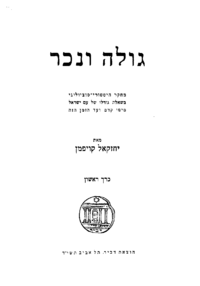
Exile and estrangement
His first major work was Exile and Estrangement: A Socio-Historical Study on the Issue of the Fate of the Nation of Israel from Ancient Times until the Present (1930), in which he suggests that what preserved Israel's uniqueness through the ages was solely its religion. Among the basic themes of this work is that it is the tension between "universalism" and "nationalism" that comprises the foundational problem of JudaismJudaism
Judaism ) is the "religion, philosophy, and way of life" of the Jewish people...
. This tension reaches back to the earliest eras of Judaism in which a universalistic conception of God was juxtaposed with the local socio-political issues of a small tribal people, even after that people had been exiled from its homeland. YHVH is the ruler of the entire universe, but he reveals Himself and His commandments only to Israel. It is this same tension which Kaufmann traces to the more modern phenomenon of exile and ghettoization. Among Kaufmann's contentious positions were his belief that Zionism
Zionism
Zionism is a Jewish political movement that, in its broadest sense, has supported the self-determination of the Jewish people in a sovereign Jewish national homeland. Since the establishment of the State of Israel, the Zionist movement continues primarily to advocate on behalf of the Jewish state...
could not provide the ultimate solution to the Jewish problem.
The Religion of Israel
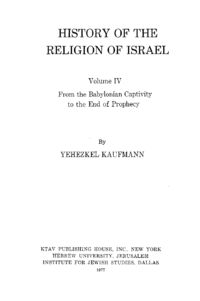
Kaufmann's best-known work is the massive תולדות האמונה הישראלית, (Toledot HaEmunah HaYisraelit) The Religion of Israel, from Its Beginnings to the Babylonian Exile (1960), encompassing the history of religion and Biblical literatureBible
The Bible refers to any one of the collections of the primary religious texts of Judaism and Christianity. There is no common version of the Bible, as the individual books , their contents and their order vary among denominations...
. The work is important both because of its profound scope, and because it offered a critical approach to Biblical study which was nevertheless in opposition to the theories of Wellhausen, which dominated Biblical study at that time (Hyatt 1961). Among Kaufmann's opinions expressed in this work are that neither a symbiotic nor syncretistic relationship obtained between the ancient Canaan
Canaan
Canaan is a historical region roughly corresponding to modern-day Israel, Palestine, Lebanon, and the western parts of Jordan...
ites and Israelites. External influences on the Israelite religion occurred solely prior to the time of Moses
Moses
Moses was, according to the Hebrew Bible and Qur'an, a religious leader, lawgiver and prophet, to whom the authorship of the Torah is traditionally attributed...
. However, Monotheism
Monotheism
Monotheism is the belief in the existence of one and only one god. Monotheism is characteristic of the Baha'i Faith, Christianity, Druzism, Hinduism, Islam, Judaism, Samaritanism, Sikhism and Zoroastrianism.While they profess the existence of only one deity, monotheistic religions may still...
– which on Kaufmann's view began at the time of Moses – was not the result of influences from any surrounding cultures, but was solely an Israelite phenomenon. After the adoption of Monotheism, Israelite belief is found to be free from mythological foundations, to the extent that the Scriptures do not even understand paganism
Paganism
Paganism is a blanket term, typically used to refer to non-Abrahamic, indigenous polytheistic religious traditions....
(which, on Kauffman's view, is any religion other than Judaism
Judaism
Judaism ) is the "religion, philosophy, and way of life" of the Jewish people...
, Christianity
Christianity
Christianity is a monotheistic religion based on the life and teachings of Jesus as presented in canonical gospels and other New Testament writings...
, or Islam
Islam
Islam . The most common are and . : Arabic pronunciation varies regionally. The first vowel ranges from ~~. The second vowel ranges from ~~~...
(Hyatt 1961)). Kaufmann summed up his position in these words: "Israelite religion was an original creation of the people of Israel. It was absolutely different from anything the pagan world knew; its monotheistic world view has no antecedents in paganism."
The occasional worship of Baal
Heresy of Peor
The heresy of Peor is an event related in the Torah at Numbers 25:1-15. Back references to the event occur in Numbers 25:18 and 31:16, Deuteronomy 4:3, Joshua 22:17, Hosea 9:10; Psalm 106:28...
was never an organic movement of the people, but instead was only promoted by the royal court, mainly under Ahab
Ahab
Ahab or Ach'av or Achab in Douay-Rheims was king of Israel and the son and successor of Omri according to the Hebrew Bible. His wife was Jezebel....
and Jezebel
Jezebel (Bible)
Jezebel was a princess, identified in the Hebrew Book of Kings as the daughter of Ethbaal, King of Tyre and the wife of Ahab, king of north Israel. According to genealogies given in Josephus and other classical sources, she was the great-aunt of Dido, Queen of Carthage.The Hebrew text portrays...
. What idol-worship the Scriptures speak of was only "vestigial fetishistic idolatry," and not a genuine attachment of the people to such forms of worship, or the influence of foreign culture.
The apostle-prophet
Kaufmann sees the classical "apostle-prophet" or "messenger-prophet" of the Prophetic literature (Nevi'imNevi'im
Nevi'im is the second of the three major sections in the Hebrew Bible, the Tanakh. It falls between the Torah and Ketuvim .Nevi'im is traditionally divided into two parts:...
) as a uniquely Israelite phenomenon, the culmination of a long process of religious development not in any way influenced by surrounding cultures. This position is in most ways quite traditional; for example, it accords well with Rambam's statement that "Yet that an individual should make a claim to prophecy on the ground that God had spoken to him and had sent him on a mission was a thing never heard of prior to Moses our Master" (GP I:63, S. Pines, 1963). The major innovation of the prophets was thus not the creation of the religion of Israel de novo (since this had already existed, and had facilitated their own emergence), but rather the unique focus on the ethical aspect of religion, the shift in primacy from cult to morality, and the insistence that the fulfillment of God's will lay in the moral domain.
Biblical authorship
Kaufmann regards the non-prophetic parts of scripture as reflecting an earlier stage of the Israelite religion. While he accepts the existence of the three primary sourcesDocumentary hypothesis
The documentary hypothesis , holds that the Pentateuch was derived from originally independent, parallel and complete narratives, which were subsequently combined into the current form by a series of redactors...
JE, P, and D, he claims – in opposition to Wellhausen and others – that the P-source significantly predates the Babylonian exile and Deuteronomy
Deuteronomy
The Book of Deuteronomy is the fifth book of the Hebrew Bible, and of the Jewish Torah/Pentateuch...
. Supporting this view, according to Kaufmann, is that the P-source does not recognize centralization of the cult, and deals only with issues related to the local sacrificial rituals. He suggests that the historiographical parts of Scripture did not receive the heavy editing that is posited by Biblical Criticism
Biblical criticism
Biblical criticism is the scholarly "study and investigation of Biblical writings that seeks to make discerning judgments about these writings." It asks when and where a particular text originated; how, why, by whom, for whom, and in what circumstances it was produced; what influences were at work...
of the time.
Translations
Kaufmann's Toldot Ha'Emunah Ha'Yisraelit is a massive, 4-volume work, written, of course, in Hebrew. A well-written and highly accessible alternative is the one-volume English languageEnglish language
English is a West Germanic language that arose in the Anglo-Saxon kingdoms of England and spread into what was to become south-east Scotland under the influence of the Anglian medieval kingdom of Northumbria...
translation and abridgement by Prof. Moshe Greenberg, entitled The Religion of Israel, by Yehezkel Kaufmann, published by the University of Chicago, 1960.
Other works
Kaufmann additionally wrote commentaries on the Book of JoshuaBook of Joshua
The Book of Joshua is the sixth book in the Hebrew Bible and of the Old Testament. Its 24 chapters tell of the entry of the Israelites into Canaan, their conquest and division of the land under the leadership of Joshua, and of serving God in the land....
and the Book of Judges
Book of Judges
The Book of Judges is the seventh book of the Hebrew bible and the Christian Old Testament. Its title describes its contents: it contains the history of Biblical judges, divinely inspired prophets whose direct knowledge of Yahweh allows them to act as decision-makers for the Israelites, as...
. Zeligman (1960) contains an extensive annotated Hebrew bibliography.
See also
- List of Israel Prize recipients
- List of Bialik Prize recipientsBialik PrizeThe Bialik Prize is an annual literary award given by the municipality of Tel Aviv, Israel for significant accomplishments in Hebrew literature. The prize is named in memory of Hayyim Nahman Bialik. There are two separate prizes, one specifically for "Literature", which is in the field of fiction,...
- KaufmannKaufmannKaufmann is a surname with many variants such as Kauffmann, Kaufman, and Kauffman. In German, the name means merchant. It is the cognate of the English Chapman . "Kaufmann" may refer to:- Kaufmann :* Aloys P. Kaufmann , Mayor of St...
External links
- Official Religion and Popular Religion in Pre-Exilic Ancient Israel, an academic paper discussing Kaufmann’s hypothesis.