


Mount Horeb

Encyclopedia
Hebrew language
Hebrew is a Semitic language of the Afroasiatic language family. Culturally, is it considered by Jews and other religious groups as the language of the Jewish people, though other Jewish languages had originated among diaspora Jews, and the Hebrew language is also used by non-Jewish groups, such...
: , Greek
Koine Greek
Koine Greek is the universal dialect of the Greek language spoken throughout post-Classical antiquity , developing from the Attic dialect, with admixture of elements especially from Ionic....
in the Septuagint: , Latin
Latin
Latin is an Italic language originally spoken in Latium and Ancient Rome. It, along with most European languages, is a descendant of the ancient Proto-Indo-European language. Although it is considered a dead language, a number of scholars and members of the Christian clergy speak it fluently, and...
in the Vulgate
Vulgate
The Vulgate is a late 4th-century Latin translation of the Bible. It was largely the work of St. Jerome, who was commissioned by Pope Damasus I in 382 to make a revision of the old Latin translations...
: , is the mountain at which the book of Deuteronomy
Deuteronomy
The Book of Deuteronomy is the fifth book of the Hebrew Bible, and of the Jewish Torah/Pentateuch...
in the Hebrew Bible
Hebrew Bible
The Hebrew Bible is a term used by biblical scholars outside of Judaism to refer to the Tanakh , a canonical collection of Jewish texts, and the common textual antecedent of the several canonical editions of the Christian Old Testament...
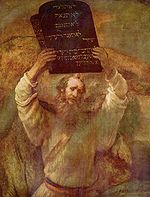
states that the Ten Commandments
Ten Commandments
The Ten Commandments, also known as the Decalogue , are a set of biblical principles relating to ethics and worship, which play a fundamental role in Judaism and most forms of Christianity. They include instructions to worship only God and to keep the Sabbath, and prohibitions against idolatry,...
were given to Moses
Moses
Moses was, according to the Hebrew Bible and Qur'an, a religious leader, lawgiver and prophet, to whom the authorship of the Torah is traditionally attributed...
by God
God
God is the English name given to a singular being in theistic and deistic religions who is either the sole deity in monotheism, or a single deity in polytheism....
. It is described in two places as the Mountain of God or perhaps Mountain of the gods. The mountain is also called the Mountain of Yhwh.
In other biblical passages, these events are described as having transpired at Mount Sinai
Biblical Mount Sinai
The Biblical Mount Sinai is the mountain at which the Book of Exodus states that the Ten Commandments were given to Moses by God...
, but though Sinai and Horeb are often considered to have been different names for the same place, there is a body of opinion that they may have been different locations.
Etymology
Horeb is thought to mean glowing/heat, which seems to be a reference to the sunSun
The Sun is the star at the center of the Solar System. It is almost perfectly spherical and consists of hot plasma interwoven with magnetic fields...
, while Sinai may have derived from the name of Sin
Sin (mythology)
Sin or Nanna was the god of the moon in Mesopotamian mythology. Nanna is a Sumerian deity, the son of Enlil and Ninlil, and became identified with Semitic Sin. The two chief seats of Nanna's/Sin's worship were Ur in the south of Mesopotamia and Harran in the north.- Name :The original meaning of...
, the Sumerian deity of the moon
Moon
The Moon is Earth's only known natural satellite,There are a number of near-Earth asteroids including 3753 Cruithne that are co-orbital with Earth: their orbits bring them close to Earth for periods of time but then alter in the long term . These are quasi-satellites and not true moons. For more...
, and thus Sinai and Horeb would be the mountain of the moon and sun, respectively.
Other interpreters show the etymology of Sinai (Hebrew letters: Samech, Yud, Nun, Yud) as being related to the word for bush (Hebrew: סנה, Samech, Nun, Hey), hence Sinai being where Moses saw the Hasneh HaBoeir or the burning bush
Burning bush
The burning bush is an object described by the Book of Exodus as being located on Mount Sinai; according to the narrative, the bush was on fire, but was not consumed by the flames, hence the name...
.
In Matityahu Clark's Etymological Dictionary of Biblical Hebrew, the root for Horev, "Chorev", (Hebrew: חרב, Chet, Reish, Beit) is related to the Hebrew word for sword Cherev (Hebrew: חרב) (again Chet, Reish, Beit) showing the meaning of Chorev being "desolation as after a mighty battle", where the root for Sinai being Sineh (Samech, Nun, Hey) relating to both "bush" and the idea "to fend off an attack". The relationship between "fend off" and "bush" being that this bush has thorns to in fact "fend off" its enemies. Both of these words tend to paint a word picture of a very desolate place that defends itself by the very rough terrain and thorny bushes that surround it.
Occurrences
Documentary hypothesis
The documentary hypothesis , holds that the Pentateuch was derived from originally independent, parallel and complete narratives, which were subsequently combined into the current form by a series of redactors...
, the name Sinai is only used in the Torah
Torah
Torah- A scroll containing the first five books of the BibleThe Torah , is name given by Jews to the first five books of the bible—Genesis , Exodus , Leviticus , Numbers and Deuteronomy Torah- A scroll containing the first five books of the BibleThe Torah , is name given by Jews to the first five...
by the Jahwist
Jahwist
The Jahwist, also referred to as the Jehovist, Yahwist, or simply as J, is one of the sources of the Torah. It gets its name from the fact that it characteristically uses the term Yahweh for God in the book of Genesis...
and Priestly Source
Priestly source
The Priestly Source is one of the sources of the Torah/Pentateuch in the bible. Primarily a product of the post-Exilic period when Judah was a province of the Persian empire , P was written to show that even when all seemed lost, God remained present with Israel...
, whereas Horeb is only used by the Elohist
Elohist
The Elohist is one of four sources of the Torah described by the Documentary Hypothesis. Its name comes from the term it uses for God: Elohim; it is characterised by, among other things, an abstract view of God, using "Horeb" instead of "Sinai" for the mountain where Moses received the laws of...
and Deuteronomist
Deuteronomist
The Deuteronomist, or simply D, is one of the sources underlying the Hebrew bible . It is found in the book of Deuteronomy, in the books of Joshua, Judges, Samuel, and Kings and also in the book of Jeremiah...
.
The name Horeb first occurs at , with the story of Moses
Moses
Moses was, according to the Hebrew Bible and Qur'an, a religious leader, lawgiver and prophet, to whom the authorship of the Torah is traditionally attributed...
and the Burning Bush
Burning bush
The burning bush is an object described by the Book of Exodus as being located on Mount Sinai; according to the narrative, the bush was on fire, but was not consumed by the flames, hence the name...
. According to , the ground of the mountain was considered holy, and Moses was commanded by God to remove his shoes.
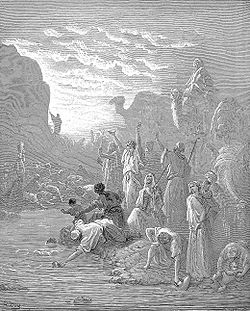
describes the incident when the Israelites were in the wilderness without water. Moses was upon the rock at Horeb, where he struck the rock (defying God's instruction Numbers 20:1-13) and obtained drinking water from the cracking rock. The only other use of the name in Exodus is at , where Horeb is the location where the Israelites stripped off their ornaments.
In Deuteronomy
Deuteronomy
The Book of Deuteronomy is the fifth book of the Hebrew Bible, and of the Jewish Torah/Pentateuch...
, Horeb is mentioned several times in the account of the wanderings of the Israelites in the wilderness, , , . The account of the delivery to Moses of the Ten Commandments, and references back to it, include mentions of Horeb at , , ,, , . There are similar references back at and .
At it is stated that the Ark of the Covenant
Ark of the Covenant
The Ark of the Covenant , also known as the Ark of the Testimony, is a chest described in Book of Exodus as solely containing the Tablets of Stone on which the Ten Commandments were inscribed...
contained only the tablets
Tablets of stone
The Tablets of Stone, Stone Tablets, Tablets of Law, or Tablets of Testimony in the Bible, were the two pieces of special stone inscribed with the Ten Commandments when Moses ascended Mount Sinai as recorded in the Book of Exodus...
delivered to Moses at Horeb.
At , Elijah visits Horeb the mount of God.
There are no occurrences of Horeb under that name in the New Testament
New Testament
The New Testament is the second major division of the Christian biblical canon, the first such division being the much longer Old Testament....
. At , in the Epistle of Saint Paul
Pauline epistles
The Pauline epistles, Epistles of Paul, or Letters of Paul, are the thirteen New Testament books which have the name Paul as the first word, hence claiming authorship by Paul the Apostle. Among these letters are some of the earliest extant Christian documents...
to the Galatians
Epistle to the Galatians
The Epistle of Paul to the Galatians, often shortened to Galatians, is the ninth book of the New Testament. It is a letter from Paul of Tarsus to a number of Early Christian communities in the Roman province of Galatia in central Anatolia...
, Mount Sinai is mentioned:
" ... One covenant is from Mount Sinai and bears children who are to be slaves: This is Hagar
Hagar (Bible)
Hagar , according to the Abrahamic faiths, was the second wife of Abraham, and the mother of his first son, Ishmael. Her story is recorded in the Book of Genesis, mentioned in Hadith, and alluded to in the Qur'an...
. Now Hagar stands for Mount Sinai in Arabia and corresponds to the present city of Jerusalem, because she is in slavery with her children."