


List of artifacts significant to the Bible

Encyclopedia

Artifact (archaeology)
An artifact or artefact is "something made or given shape by man, such as a tool or a work of art, esp an object of archaeological interest"...
, objects created or modified by human culture, that are significant to the historicity of the Bible
The Bible and history
The Bible from a historical perspective, includes numerous fields of study, ranging from archeology and astronomy to linguistics and methods of comparative literature. The Bible may provide insight into pursuits, including but not limited to; our understanding of ancient and modern culture,...
.
Artifacts
- Amarna lettersAmarna lettersThe Amarna letters are an archive of correspondence on clay tablets, mostly diplomatic, between the Egyptian administration and its representatives in Canaan and Amurru during the New Kingdom...
(c. 1300s BC) - correspondence on clay tablets between the EgyptianAncient EgyptAncient Egypt was an ancient civilization of Northeastern Africa, concentrated along the lower reaches of the Nile River in what is now the modern country of Egypt. Egyptian civilization coalesced around 3150 BC with the political unification of Upper and Lower Egypt under the first pharaoh...
administration and various Middle East kings petty sub-rulers in CanaanCanaanCanaan is a historical region roughly corresponding to modern-day Israel, Palestine, Lebanon, and the western parts of Jordan...
during the New Kingdom. - Amman Citadel Inscription - 9th century BC inscription in the Ammonite languageAmmonite languageThe Ammonite language is the extinct Canaanite language of the Ammonite people mentioned in the Bible, who used to live in modern-day Jordan, and after whom its capital Amman is named. Only fragments of their language survive - chiefly the 9th century BC , the 7th-6th century BC Tell Siran bronze...
, one of the few surviving written records of AmmonAmmonAmmon , also referred to as the Ammonites and children of Ammon, was an ancient nation located east of the Jordan River, Gilead, and the Dead Sea, in present-day Jordan. The chief city of the country was Rabbah or Rabbath Ammon, site of the modern city of Amman, Jordan's capital...
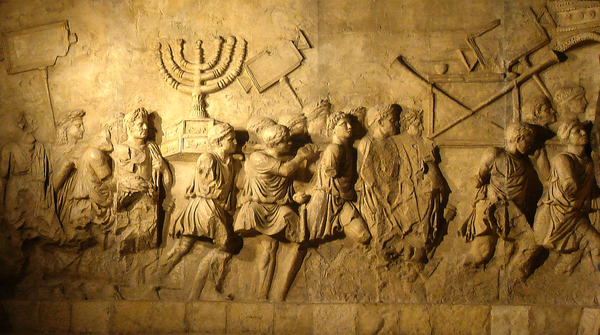
. - Arch of TitusArch of TitusThe Arch of Titus is a 1st-century honorific arch located on the Via Sacra, Rome, just to the south-east of the Roman Forum. It was constructed in c.82 AD by the Roman Emperor Domitian shortly after the death of his older brother Titus to commemorate Titus' victories, including the Siege of...
- (c. 82 AD) relief shows spoils from the sack of Jerusalem by the Romans in 70 AD. Depicted are the menorah and trumpetTrumpetThe trumpet is the musical instrument with the highest register in the brass family. Trumpets are among the oldest musical instruments, dating back to at least 1500 BCE. They are played by blowing air through closed lips, producing a "buzzing" sound which starts a standing wave vibration in the air...
s, as well as what might be the Table of Showbread. (see: Judaea Capta coinageJudaea Capta coinageJudaea Capta coins were a series of commemorative coins originally issued by the Roman Emperor Vespasian to celebrate the capture of Judaea and the destruction of the Jewish Temple in Jerusalem by his son Titus in 70 AD during the First Jewish Revolt. There are several variants of the coinage...
) - Babylonian ChroniclesBabylonian ChroniclesThe Babylonian Chronicles are many series of tablets recording major events in Babylonian history. They are thus one of the first steps in the development of ancient historiography...
(c. 747 BC - 247 BC) - dealing with Nebuchadnezzar's siegeSiegeA siege is a military blockade of a city or fortress with the intent of conquering by attrition or assault. The term derives from sedere, Latin for "to sit". Generally speaking, siege warfare is a form of constant, low intensity conflict characterized by one party holding a strong, static...
of Jerusalem, etc. (see Siege of Jerusalem (587 BC)Siege of Jerusalem (587 BC)In 589 BC, Nebuchadnezzar II laid siege to Jerusalem, culminating in the destruction of the city and its temple in 587 BC.-Siege:Following the siege of 597 BC, Nebuchadnezzar installed Zedekiah as tributary king of Judah at the age of twenty-one. However, Zedekiah revolted against Babylon, and...
, ZedekiahZedekiahZedekiah or Tzidkiyahu was the last king of Judah before the destruction of the kingdom by Babylon. He was installed as king of Judah by Nebuchadnezzar II, king of Babylon, after a siege of Jerusalem to succeed his nephew, Jeconiah, who was overthrown as king after a reign of only three months and...
and Book of KingsBooks of KingsThe Book of Kings presents a narrative history of ancient Israel and Judah from the death of David to the release of his successor Jehoiachin from imprisonment in Babylon, a period of some 400 years...
, Book of JeremiahBook of JeremiahThe Book of Jeremiah is the second of the Latter Prophets in the Hebrew Bible, following the book of Isaiah and preceding Ezekiel and the Book of the Twelve....
, LamentationsBook of LamentationsThe Book of Lamentations ) is a poetic book of the Hebrew Bible composed by the Jewish prophet Jeremiah. It mourns the destruction of Jerusalem and the Holy Temple in the 6th Century BCE....
.) - Balaam inscriptionDeir Alla InscriptionThe Deir 'Alla Inscription was the product of a 1967 excavation in Deir 'Alla, Jordan. The excavation revealed a many-chambered structure that had also been destroyed by earthquake, during the Persian period at the site, on the wall of which was written a previously unknown prophecy by the seer...
(c. 840-760 BC) 9th or 8th century BC inscription about a prophet named BalaamBalaamBalaam is a diviner in the Torah, his story occurring towards the end of the Book of Numbers. The etymology of his name is uncertain, and discussed below. Every ancient reference to Balaam considers him a non-Israelite, a prophet, and the son of Beor, though Beor is not so clearly identified...
(cf. the Book of NumbersBook of NumbersThe Book of Numbers is the fourth book of the Hebrew Bible, and the fourth of five books of the Jewish Torah/Pentateuch....
). - Biblical period ostraca (broken pottery used for writing brief notes, the ancient equivalent of notepaper) are relatively common in archaeological digs. One ostracon, found at ElahValley of ElahThe Valley of Elah, "the valley of the oak or terebinth" , best known as the place described in the Bible where the Israelites were encamped when David fought Goliath . It was near Azekah and Socho...
, may contain the earliest known example of HebrewHebrew languageHebrew is a Semitic language of the Afroasiatic language family. Culturally, is it considered by Jews and other religious groups as the language of the Jewish people, though other Jewish languages had originated among diaspora Jews, and the Hebrew language is also used by non-Jewish groups, such...
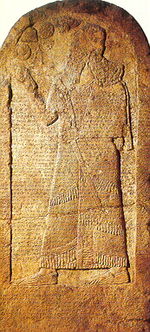
. - The Black ObeliskBlack ObeliskThe "Black Obelisk of Shalmaneser III" is a black limestone Neo-Assyrian bas-relief sculpture from Nimrud , in northern Iraq, commemorating the deeds of King Shalmaneser III . It is the most complete Assyrian obelisk yet discovered, and is historically significant because it displays the earliest...
of Shalmaneser IIIShalmaneser IIIShalmaneser III was king of Assyria , and son of the previous ruler, Ashurnasirpal II....
(c. 858-824 BC) - scholars believe the obelisk depicts either JehuJehuJehu was a king of Israel. He was the son of Jehoshaphat, and grandson of Nimshi.William F. Albright has dated his reign to 842-815 BC, while E. R. Thiele offers the dates 841-814 BC...
son of OmriOmriOmri was a king of Israel, successful military campaigner and first in the line of Omride kings that included Ahab, Ahaziah and Joram.He was "commander of the army" of king Elah when Zimri murdered Elah and made himself king. Instead, the troops at Gibbethon chose Omri as king, and he led them to...
(a king of Israel mentioned in 2 Kings), or Jehu's ambassador, paying homage to Assyrian king Shalmaneser IIIShalmaneser IIIShalmaneser III was king of Assyria , and son of the previous ruler, Ashurnasirpal II....
(c.825 BC); an early, possibly the earliest, surviving picture of an IsraeliteIsraeliteAccording to the Bible the Israelites were a Hebrew-speaking people of the Ancient Near East who inhabited the Land of Canaan during the monarchic period .The word "Israelite" derives from the Biblical Hebrew ישראל...
. The inscription identifies "the tribute of JehuJehuJehu was a king of Israel. He was the son of Jehoshaphat, and grandson of Nimshi.William F. Albright has dated his reign to 842-815 BC, while E. R. Thiele offers the dates 841-814 BC...
, son of OmriOmriOmri was a king of Israel, successful military campaigner and first in the line of Omride kings that included Ahab, Ahaziah and Joram.He was "commander of the army" of king Elah when Zimri murdered Elah and made himself king. Instead, the troops at Gibbethon chose Omri as king, and he led them to...
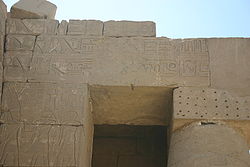
: I received from him silver, gold, a golden bowl, a golden vase with pointed bottom, golden tumblers, golden buckets, tin, a staff for a king [and] spears." - Bubastis portalBubastis PortalThis portal gate is located in Karnak, within the Precinct of Amun-Re temple complex, between the temple of Ramesses III and the second pylon.It records the conquests and military campaigns in Syria-Palestine of Shoshenq I, of the Twenty-second Dynasty....
- showing a series of inscriptions recounting pharaoh Shishaq's invasion of Judah and Israel in 925 BC, located outside the Temple of Amun at KarnakKarnakThe Karnak Temple Complex—usually called Karnak—comprises a vast mix of decayed temples, chapels, pylons, and other buildings, notably the Great Temple of Amun and a massive structure begun by Pharaoh Ramses II . Sacred Lake is part of the site as well. It is located near Luxor, some...
.. - BullaeBulla (seal)Bulla , is a type of seal impression. It comes in two forms: metal and clay.- Clay bullae :The original bulla was a lump of clay molded around a cord and stamped with a seal...
(c.715 – 687 BC or 716 – 687 BC) (clay roundels impressed with a personal seal identifying the owner of an object, the author of a document, etc) are, like ostraka, relatively common, both in digs and on the antiquities market. The identification of individuals named in bullae with equivalent names from the Bible is difficult, but identifications have been made with king HezekiahHezekiahHezekiah was the son of Ahaz and the 14th king of Judah. Edwin Thiele has concluded that his reign was between c. 715 and 686 BC. He is also one of the most prominent kings of Judah mentioned in the Hebrew Bible....
and his servants (עבדים avadim in Hebrew). - Bulla of Jehucal - son of Shelemiah, son of Shevi. This person seems to be mentioned (twice) in the Book of JeremiahBook of JeremiahThe Book of Jeremiah is the second of the Latter Prophets in the Hebrew Bible, following the book of Isaiah and preceding Ezekiel and the Book of the Twelve....
who thus presumably lived in the late 7th century BC7th century BCThe 7th century BC started the first day of 700 BC and ended the last day of 601 BC.The Assyrian Empire continued to dominate the Near East during this century, exercising formidable power over neighbors like Babylon and Egypt. In the last two decades of the century, however, the empire began to...
(i.e. at about the same time as JeremiahJeremiahJeremiah Hebrew:יִרְמְיָה , Modern Hebrew:Yirməyāhū, IPA: jirməˈjaːhu, Tiberian:Yirmĭyahu, Greek:Ἰερεμίας), meaning "Yahweh exalts", or called the "Weeping prophet" was one of the main prophets of the Hebrew Bible...
). (see Large Stone StructureLarge Stone StructureThe Large Stone Structure is the name given to the remains of a large public building in the City of David neighborhood of central Jerusalem, south of the Old City, tentatively dated to 10th to 9th century BCE. The name was given to the structure, as a result of its proximity with another site...
for discovery) (see also Book of JeremiahBook of JeremiahThe Book of Jeremiah is the second of the Latter Prophets in the Hebrew Bible, following the book of Isaiah and preceding Ezekiel and the Book of the Twelve....
). - Bulla of ShaphanShaphanShaphan is a scribe or court secretary mentioned several times in the Old Testament .-Biblical account:...
(r. 609-598 BC.) - possible link to a figure during the reign of JehoiakimJehoiakimJehoiakim .On Josiah's death, Jehoiakim's younger brother Jehoahaz was proclaimed king, but after three months pharaoh Necho II deposed him and replaced him with the eldest son, Eliakim, who adopted the name Jehoiakim and became king at the age of twenty-five...
. - Bulla of Gedalyahu/Galihu Ben Immer - A bulla was excavated that contains part of a name Gabriel BarkayGabriel BarkayGabriel Barkay is an Israeli archaeologist. Born in 1944 in Hungary, he immigrated to Israel in 1950. He received his PhD in Archaeology from Tel Aviv University in 1985. His dissertation was about LMLK seal impressions on jar handles. He participated in the Lachish excavations with David Ussishkin...
suggests may have been Galihu son of Immer, a brother of Pashur son of Immer, who is described in the Bible [Jeremiah 20:1] as a priest and temple official." - Cave of the PatriarchsCave of the PatriarchsThe Cave of the Patriarchs or the Cave of Machpelah , is known by Muslims as the Sanctuary of Abraham or Ibrahimi Mosque ....
- The compound, located in the ancient city of HebronHebronHebron , is located in the southern West Bank, south of Jerusalem. Nestled in the Judean Mountains, it lies 930 meters above sea level. It is the largest city in the West Bank and home to around 165,000 Palestinians, and over 500 Jewish settlers concentrated in and around the old quarter...
, is the second holiest site for JewsJewsThe Jews , also known as the Jewish people, are a nation and ethnoreligious group originating in the Israelites or Hebrews of the Ancient Near East. The Jewish ethnicity, nationality, and religion are strongly interrelated, as Judaism is the traditional faith of the Jewish nation...
(after the Temple MountTemple MountThe Temple Mount, known in Hebrew as , and in Arabic as the Haram Ash-Sharif , is one of the most important religious sites in the Old City of Jerusalem. It has been used as a religious site for thousands of years...
in Jerusalem) and is also venerated by Christians and Muslims all of whom have some traditions which maintain that the site is the burial place of three Biblical couples: (1) AbrahamAbrahamAbraham , whose birth name was Abram, is the eponym of the Abrahamic religions, among which are Judaism, Christianity and Islam...
and SarahSarahSarah or Sara was the wife of Abraham and the mother of Isaac as described in the Hebrew Bible and the Quran. Her name was originally Sarai...
; (2) IsaacIsaacIsaac as described in the Hebrew Bible, was the only son Abraham had with his wife Sarah, and was the father of Jacob and Esau. Isaac was one of the three patriarchs of the Israelites...
and Rebekah; (3) JacobJacobJacob "heel" or "leg-puller"), also later known as Israel , as described in the Hebrew Bible, the Talmud, the New Testament and the Qur'an was the third patriarch of the Hebrew people with whom God made a covenant, and ancestor of the tribes of Israel, which were named after his descendants.In the...
and LeahLeahLeah , as described in the Hebrew Bible, is the first of the two concurrent wives of the Hebrew patriarch Jacob and mother of six of sons whose descendants became the Twelve Tribes of Israel, along with at least one daughter, Dinah. She is the daughter of Laban and the older sister of Rachel, whom...
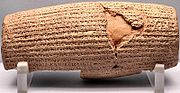
. - Cylinder of Cyrus (c. 559 BC-530 BC) - regarding King CyrusCyrus the GreatCyrus II of Persia , commonly known as Cyrus the Great, also known as Cyrus the Elder, was the founder of the Achaemenid Empire. Under his rule, the empire embraced all the previous civilized states of the ancient Near East, expanded vastly and eventually conquered most of Southwest Asia and much...
's treatment of religion, which is significant to the books of ChroniclesBooks of ChroniclesThe Books of Chronicles are part of the Hebrew Bible. In the Masoretic Text, it appears as the first or last book of the Ketuvim . Chronicles largely parallels the Davidic narratives in the Books of Samuel and the Books of Kings...
, Ezra and Nehemiah. - Cylinder of NabonidusCylinder of NabonidusThe Nabonidus Cylinder from Sippar is a long text in which king Nabonidus of Babylonia describes how he repaired three temples: the sanctuary of the moon god Sin in Harran, the sanctuary of the warrior goddess Anunitu in Sippar, and the temple of Šamaš in Sippar...
(555-539 BC) - proves BelshazzarBelshazzarBelshazzar, or Balthazar , was a 6th century BC prince of Babylon, the son of Nabonidus and the last king of Babylon according to the Book of Daniel . Like his father, it is believed by many scholars that he was an Assyrian. In Daniel Belshazzar, or Balthazar , was a 6th century BC prince of...
's existence. See DanielDanielDaniel is the protagonist in the Book of Daniel of the Hebrew Bible. In the narrative, when Daniel was a young man, he was taken into Babylonian captivity where he was educated in Chaldean thought. However, he never converted to Neo-Babylonian ways...
5; 7:1; 8:1. Daniel 5 describes Belshazzar's FeastBelshazzarBelshazzar, or Balthazar , was a 6th century BC prince of Babylon, the son of Nabonidus and the last king of Babylon according to the Book of Daniel . Like his father, it is believed by many scholars that he was an Assyrian. In Daniel Belshazzar, or Balthazar , was a 6th century BC prince of...
where a hand was seen writing on the wallWriting on the WallWriting on the Wall is an album by British pop group Bucks Fizz. It was released in 1986 and featured the comeback single "New Beginning ". It was the first album to feature member Shelley Preston and their only album released on Polydor Records...
of the chamber a mysterious sentence mene mene tekel upharsin. (see also Nabonidus ChronicleNabonidus ChronicleThe Nabonidus Chronicle is an ancient Babylonian text, part of a larger series of Babylonian Chronicles incribed in cuneiform script on clay tablets...
) - Dead Sea ScrollsDead Sea scrollsThe Dead Sea Scrolls are a collection of 972 texts from the Hebrew Bible and extra-biblical documents found between 1947 and 1956 on the northwest shore of the Dead Sea, from which they derive their name...
- Elephantine papyriElephantine papyriThe Elephantine Papyri are a collection of ancient Jewish manuscripts dating from the 5th century BC. They come from a Jewish community at Elephantine, then called Yeb, the island in the Nile at the border of Nubia, which was probably founded as a military installation in about 650 BC during...
, ancient Jewish papyri dating to the 5th century BC, name three persons mentioned in Nehemiah: Darius IIDarius IIDarius II , was king of the Persian Empire from 423 BC to 405 BC.Artaxerxes I, who died on December 25, 424 BC, was followed by his son Xerxes II. After a month and a half Xerxes II was murdered by his brother Secydianus or Sogdianus...
, Sanballat the HoroniteSanballat the HoroniteSanballat the Horonite or Sanballat I was a Samaritan leader and official of the Persian Achaemenid Empire who lived in the mid to late fifth century BC...
and JohananJohanan (High Priest)Johanan , son of Joiada, was the fifth Jewish high priest after the rebuilding of the temple in Jerusalem by the Jews who had returned from the Babylonian captivity. His reign is estimated to have been from c. 410-371 BCE; he was succeeded by his son Jaddua. The bible gives no details about his life...
the high priest. - Deluge TabletEpic of GilgameshEpic of Gilgamesh is an epic poem from Mesopotamia and is among the earliest known works of literature. Scholars believe that it originated as a series of Sumerian legends and poems about the protagonist of the story, Gilgamesh king of Uruk, which were fashioned into a longer Akkadian epic much...
- The Epic of GilgameshEpic of GilgameshEpic of Gilgamesh is an epic poem from Mesopotamia and is among the earliest known works of literature. Scholars believe that it originated as a series of Sumerian legends and poems about the protagonist of the story, Gilgamesh king of Uruk, which were fashioned into a longer Akkadian epic much...
records a Babylonian flood story (see: NoahNoahNoah was, according to the Hebrew Bible, the tenth and last of the antediluvian Patriarchs. The biblical story of Noah is contained in chapters 6–9 of the book of Genesis, where he saves his family and representatives of all animals from the flood by constructing an ark...
). - Ekron dedicatory inscription (7th century BC) - a dedicatory inscription of the seventh-century king of EkronEkronThe city of Ekron , was one of the five cities of the famed Philistine pentapolis, located in southwestern Canaan. Ekron lies 35 kilometers west of Jerusalem, and 18 kilometers north of ancient Gath, on the eastern edge of Israel's coastal plain.-History:...
, AchishAchishAchish is a name used in the Hebrew Bible for two Philistine rulers of Gath. It is perhaps only a general title of royalty, applicable to the Philistine kings. The two kings of Gath, which is identified by most scholars as Tell es-Safi, are:...
. Achish is a name used in the Hebrew Bible for two Philistine rulers of Gath. The inscription states "This temple was built by 'Akish, son of Padi, son of Yasid, son of Ada, son of Ya'ir, ruler of Ekron..." The inscription not only securely identifies the site, it gives a brief king-list of rulers of Ekron, fathers to sons: Ya'ir, Ada, Yasid, Padi, 'Akish. - Erastus Inscription
- Foundation Stone - stone also called the Well of SoulsWell of SoulsThis article describes the cave in Jerusalem. For the series of novels by Jack Chalker see Well World.The Well of Souls is a natural cave located immediately beneath the Foundation Stone, under the Dome of the Rock on the Temple Mount in Jerusalem...
, now located in the Dome of the RockDome of the RockThe Dome of the Rock is a shrine located on the Temple Mount in the Old City of Jerusalem. The structure has been refurbished many times since its initial completion in 691 CE at the order of Umayyad Caliph Abd al-Malik...
. According to the Bible, King David purchased a threshing floor owned by AraunahAraunahAraunah was a Jebusite who was mentioned in the Books of Samuel who owned the threshing floor on the summit of Mount Moriah that David purchased and used as the site for assembling an altar to God. The Scholar renders his name as Arunah....
the JebusiteJebusiteAccording to the Hebrew Bible, the Jebusites were a Canaanite tribe who inhabited and built Jerusalem prior to its conquest by King David; the Books of Kings state that Jerusalem was known as Jebus prior to this event...
, and some believe that it was upon this rock that he offered the sacrifice mentioned in the verse. David wanted to construct a Temple in JerusalemTemple in JerusalemThe Temple in Jerusalem or Holy Temple , refers to one of a series of structures which were historically located on the Temple Mount in the Old City of Jerusalem, the current site of the Dome of the Rock. Historically, these successive temples stood at this location and functioned as the centre of...
, but as his hands were "bloodied," he was forbidden to do so himself. The task was left to his son SolomonSolomonSolomon , according to the Book of Kings and the Book of Chronicles, a King of Israel and according to the Talmud one of the 48 prophets, is identified as the son of David, also called Jedidiah in 2 Samuel 12:25, and is described as the third king of the United Monarchy, and the final king before...
, who completed the TempleSolomon's TempleSolomon's Temple, also known as the First Temple, was the main temple in ancient Jerusalem, on the Temple Mount , before its destruction by Nebuchadnezzar II after the Siege of Jerusalem of 587 BCE....
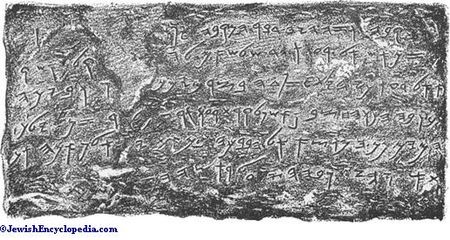
in c. 950 BC. - Gezer calendarGezer calendarThe Gezer calendar is a tablet of soft limestone inscription, dating to the 10th century BCE. Scholars are divided as to whether the script and language are Phoenician or paleo-Hebrew, which were linguistically very similar in this period....
(10th century BC) - calendar from the Biblical city of GezerGezerGezer was a Canaanite city-state and biblical town in ancient Israel. Tel Gezer , an archaeological site midway between Jerusalem and Tel Aviv, is now an Israeli national park....
. It is one of the oldest known examples of Hebrew writing. - Goliath Potsherd (10th to mid 9th centuries BC) - Potsherd inscribed with the two names "alwt" and "wlt", etymologically related to the name Goliath. The artifacts are therefore connected with Tell es-SafiTell es-SafiGath, Gat, or Geth , often referred to as Gath of the Philistines, was one of the five Philistine city-states, established in northwestern Philistia. According to the Bible, the king of the city was Achish, in the times of Saul, David, and Solomon. It is not certain whether this refers to two or...
, the traditional identification of Gath. - Hasmonean coinage
- HerodiumHerodiumHerodium or Herodion is a volcano-like hill with a truncated cone located south of Jerusalem, near the city of Bethlehem in the West Bank. Herod the Great built a fortress and palace on the top of Herodium, and may have been buried there...
- Herod's temple
- Hezekiah's tunnel (c. 701 BC) - a tunnel created by King HezekiahHezekiahHezekiah was the son of Ahaz and the 14th king of Judah. Edwin Thiele has concluded that his reign was between c. 715 and 686 BC. He is also one of the most prominent kings of Judah mentioned in the Hebrew Bible....
in anticipation of an AssyriaAssyriaAssyria was a Semitic Akkadian kingdom, extant as a nation state from the mid–23rd century BC to 608 BC centred on the Upper Tigris river, in northern Mesopotamia , that came to rule regional empires a number of times through history. It was named for its original capital, the ancient city of Assur...
n invasion. From National Geographic: "The tunnel, which is about 500 meters (550 yards) long, brings water from the Gihon SpringGihon SpringThe Gihon Spring was the main source of water for the City of David, the original site of Jerusalem. One of the world's major intermittent springs - and a reliable water source that made human settlement possible in ancient Jerusalem - the spring was not only used for drinking water, but also...
s [sic], located some 300 meters (330 yards) outside the walls of old Jerusalem, to the Siloan PoolPool of SiloamPool of Siloam is a rock-cut pool on the southern slope of the City of David, the original site of Jerusalem, located outside the walls of the Old City to the southeast. The pool was fed by the waters of the Gihon Spring, carried there by two aqueducts.-History:The Pool of Siloam is mentioned...
[sic] inside the ancient city. It was built to protect the city's water supply during an Assyrian siege". - Hittite textsHittite textsThe corpus of texts written in the Hittite language is indexed by the Catalogue des Textes Hittites...
- Ipuwer PapyrusIpuwer papyrusThe Ipuwer Papyrus is a single papyrus holding an ancient Egyptian poem, called The Admonitions of Ipuwer or The Dialogue of Ipuwer and the Lord of All. Its official designation is Papyrus Leiden I 344 recto...
(c. 13th century BC) - ancient papyrusPapyrusPapyrus is a thick paper-like material produced from the pith of the papyrus plant, Cyperus papyrus, a wetland sedge that was once abundant in the Nile Delta of Egypt....
manuscript describing Egypt as afflicted by natural disasters and in a state of chaos. Statements such as "the River is blood" have been interpreted by some as an Egyptian account of the Plagues of EgyptPlagues of EgyptThe Plagues of Egypt , also called the Ten Plagues or the Biblical Plagues, were ten calamities that, according to the biblical Book of Exodus, Israel's God, Yahweh, inflicted upon Egypt to persuade Pharaoh to release the ill-treated Israelites from slavery. Pharaoh capitulated after the tenth...
described in the Book of Exodus in the Bible. - Jehoiachin's Rations TabletsJehoiachin's Rations TabletsJehoiachin's rations tablets date from the 6th century BC and describe the rations set aside for a royal captive identified with Jehoiachin, king of Judah.Tablets from the royal archives of Nebuchadnezzar king of Babylon were unearthed in the ruins of Babylon that contain food rations paid to...
(6th century BC) - Describe the rations set aside for a royal captive identified with JehoiachinJeconiahJeconiah "; ; ), also known as Coniah and as Jehoiachin , was a king of Judah who was dethroned by the King of Babylon in the 6th Century BCE and was taken into captivity. Most of what is known about Jeconiah is found in the Hebrew Bible. After many excavations in Iraq, records of Jeconiah's...
, king of JudahKingdom of JudahThe Kingdom of Judah was a Jewish state established in the Southern Levant during the Iron Age. It is often referred to as the "Southern Kingdom" to distinguish it from the northern Kingdom of Israel....
(Cf. 2 Kings 24:12,15–6; 25:27–30; 2 Chronicles 36:9–10; JeremiahJeremiahJeremiah Hebrew:יִרְמְיָה , Modern Hebrew:Yirməyāhū, IPA: jirməˈjaːhu, Tiberian:Yirmĭyahu, Greek:Ἰερεμίας), meaning "Yahweh exalts", or called the "Weeping prophet" was one of the main prophets of the Hebrew Bible...
22:24–6; 29:2; 52:31–4; EzekielEzekielEzekiel , "God will strengthen" , is the central protagonist of the Book of Ezekiel in the Hebrew Bible. In Judaism, Christianity and Islam, Ezekiel is acknowledged as a Hebrew prophet...
17:12). - Jehohanan Crucifixion Nail (1st century AD) - Skeletal remains of crucified individual, showing a nail through the right calcaneus bone. It gives insight into the method of crucifixion used around the time of JesusJesusJesus of Nazareth , commonly referred to as Jesus Christ or simply as Jesus or Christ, is the central figure of Christianity...
. - Judaea Capta coinageJudaea Capta coinageJudaea Capta coins were a series of commemorative coins originally issued by the Roman Emperor Vespasian to celebrate the capture of Judaea and the destruction of the Jewish Temple in Jerusalem by his son Titus in 70 AD during the First Jewish Revolt. There are several variants of the coinage...
- King Ahaz's Seal (732 to 716 BC) - Ahaz was a king of Judah but "did not do what was right in the sight of the Lord his God, as his ancestor David had done" (2 Kings 16:2; 2 Chronicles 28:1). He worshiped idols and followed pagan practices. "He even made his son pass through fire, according to the abominable practices of the nations" (2 Kings 16:3). Ahaz was the son and successor of JothamJothamJotham was the youngest of Gideon's seventy sons. He escaped when the rest were put to death by the order of Abimelech . When "the citizens of Shechem and the whole house of Millo" were gathered together "by the plain of the pillar" "that was in Shechem, to make Abimelech king," from one of the...
. - Khirbet Qeiyafa pottery sherd - (10th Century BC) early Hebrew inscription dates from the reign of King David and contains lines similar to Isaiah 1:17, Psalms 72:3, and Exodus 23:3. Was discovered in excavations near Israel's Elah valley.
- Kurkh MonolithKurkh MonolithThe Kurkh Monolith is an Assyrian document that contains a description of the Battle of Qarqar at the end. Today it stands in the British Museum but it was originally found at the Kurdish village of Kurkh , near the town of Bismil in the province of Diyarbakır, Turkey...
(c. 859-824 BC) - names King AhabAhabAhab or Ach'av or Achab in Douay-Rheims was king of Israel and the son and successor of Omri according to the Hebrew Bible. His wife was Jezebel....
of Israel, erected by Shalmaneser IIIShalmaneser IIIShalmaneser III was king of Assyria , and son of the previous ruler, Ashurnasirpal II....
to commemorate the Battle of Karkar, which Ahab participated in along with many other regional leaders. - Lachish letters - letters written in carbon ink by Hoshaiah, a military officer stationed near Jerusalem, to Joash the commanding officer at LachishLachishLachish was an ancient Near East town located at the site of modern Tell ed-Duweir in the Shephelah, a region between Mount Hebron and the maritime plain of Philistia . The town was first mentioned in the Amarna letters as Lakisha-Lakiša...
during the last years of Jeremiah during ZedekiahZedekiahZedekiah or Tzidkiyahu was the last king of Judah before the destruction of the kingdom by Babylon. He was installed as king of Judah by Nebuchadnezzar II, king of Babylon, after a siege of Jerusalem to succeed his nephew, Jeconiah, who was overthrown as king after a reign of only three months and...
’s reign (c.588 BC) (see NehemiahNehemiahNehemiah ]]," Standard Hebrew Nəḥemya, Tiberian Hebrew Nəḥemyāh) is the central figure of the Book of Nehemiah, which describes his work rebuilding Jerusalem and purifying the Jewish community. He was the son of Hachaliah, Nehemiah ]]," Standard Hebrew Nəḥemya, Tiberian Hebrew Nəḥemyāh) is the...
12:32, JeremiahJeremiahJeremiah Hebrew:יִרְמְיָה , Modern Hebrew:Yirməyāhū, IPA: jirməˈjaːhu, Tiberian:Yirmĭyahu, Greek:Ἰερεμίας), meaning "Yahweh exalts", or called the "Weeping prophet" was one of the main prophets of the Hebrew Bible...
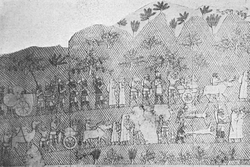
42:1, 43:2). Lachish fell soon after, two years before the fall of Jerusalem. - Lachish reliefSiege of LachishThe siege of Lachish is the name given to the Assyrian siege and conquest of the Judean town of Lachish in 701 B.C. The siege is documented in several sources including the Hebrew Bible as well as in Assyrian documents and in a well-preserved series of reliefs which once decorated the Assyrian king...
- portion of the SennacheribSennacheribSennacherib |Sîn]] has replaced brothers for me"; Aramaic: ) was the son of Sargon II, whom he succeeded on the throne of Assyria .-Rise to power:...
relief, which depicts captives from Judah being led into captivity after the fall of LachishLachishLachish was an ancient Near East town located at the site of modern Tell ed-Duweir in the Shephelah, a region between Mount Hebron and the maritime plain of Philistia . The town was first mentioned in the Amarna letters as Lakisha-Lakiša...
in 701 BC - Large Stone StructureLarge Stone StructureThe Large Stone Structure is the name given to the remains of a large public building in the City of David neighborhood of central Jerusalem, south of the Old City, tentatively dated to 10th to 9th century BCE. The name was given to the structure, as a result of its proximity with another site...
- possible site of King DavidDavidDavid was the second king of the united Kingdom of Israel according to the Hebrew Bible and, according to the Gospels of Matthew and Luke, an ancestor of Jesus Christ through both Saint Joseph and Mary...
's palace. - Law tablets - ancient Near East legal tablets: Code of HammurabiCode of HammurabiThe Code of Hammurabi is a well-preserved Babylonian law code, dating to ca. 1780 BC . It is one of the oldest deciphered writings of significant length in the world. The sixth Babylonian king, Hammurabi, enacted the code, and partial copies exist on a human-sized stone stele and various clay...
, Laws of EshnunnaLaws of EshnunnaThe Laws of Eshnunna are inscribed on two cuneiform tablets discovered in Tell Abū Harmal, Baghdad, Iraq. The Iraqi Directorate of Antiquities headed by Taha Baqir unearthed two parallel sets of tablets in 1945 and 1947. The two tablets are separate copies of an older source and date back to ca....
, the Code of Ur-NammuCode of Ur-NammuThe Code of Ur-Nammu is the oldest known tablet containing a law code surviving today. It was written in the Sumerian language circa 2100 BC-2050 BC...
, king of UrUrUr was an important city-state in ancient Sumer located at the site of modern Tell el-Muqayyar in Iraq's Dhi Qar Governorate...
(ca. 2050 BC), the Laws of EshnunnaLaws of EshnunnaThe Laws of Eshnunna are inscribed on two cuneiform tablets discovered in Tell Abū Harmal, Baghdad, Iraq. The Iraqi Directorate of Antiquities headed by Taha Baqir unearthed two parallel sets of tablets in 1945 and 1947. The two tablets are separate copies of an older source and date back to ca....
(ca. 1930 BC) and the codex of Lipit-IshtarLipit-IshtarLipit-Ishtar , was the fifth ruler of the first dynasty of Isin, and ruled from around 1934 BCE to 1924 BCE. Some documents and royal inscriptions from his time have survived, but he is mostly known because Sumerian language hymns written in his honor, as well as a legal code written in his name ,...
of IsinIsinIsin was an ancient city-state of lower Mesopotamia about 20 miles south of Nippur at the site of modern Ishan al-Bahriyat in Iraq's Al-Qādisiyyah Governorate.-History:...
(ca. 1870 BC). Later codes than Hammurabi's include the Code of the NesilimCode of the NesilimThe Code of Nesilim is an ancient Hittite legal code dating from c. 1650-1500 BCE.-Translation:From the Ancient History Sourcebook, The Code of the Nesilim, c. 1650-1500 BCE, Paul Halsall, August 1998, from: Oliver J. Thatcher, ed., The Library of Original Sources , Vol. III: The Roman World, pp....
. Hittite lawsHittite lawsThe Hittite laws have been preserved on a number of Hittite cuneiform tablets found at Hattusa . Copies have been found written in Old Hittite as well as in Middle and Late Hittite, indicating that they had validity throughout the duration of the Hittite Empire The Hittite laws have been preserved...
, the Assyrian lawAssyrian lawAssyrian law was very similar to Sumerian and Babylonian law, however, notably more brutal than its predecessors. The first copy of the code to come to light, dated to the reign of Tiglath-Pileser I, was discovered in the course of excavations by the German Oriental Society . Three Assyrian law...
s, and Mosaic Law613 mitzvotThe 613 commandments is a numbering of the statements and principles of law, ethics, and spiritual practice contained in the Torah or Five Books of Moses...
/ Ten CommandmentsTen CommandmentsThe Ten Commandments, also known as the Decalogue , are a set of biblical principles relating to ethics and worship, which play a fundamental role in Judaism and most forms of Christianity. They include instructions to worship only God and to keep the Sabbath, and prohibitions against idolatry,...
. (see Cuneiform lawCuneiform LawCuneiform law refers to any of the legal codes written in cuneiform script, that were developed and used throughout the ancient Middle East among the Sumerians, Babylonians, Assyrians, Elamites, Hurrians, Kassites, and Hittites...
). - List of New Testament papyri
- LMLK sealLMLK sealLMLK seals were stamped on the handles of large storage jars mostly in and around Jerusalem during the reign of King Hezekiah based on several complete jars found in situ buried under a destruction layer caused by Sennacherib at Lachish...
s on storage jar handles, excavated from strata formed by SennacheribSennacheribSennacherib |Sîn]] has replaced brothers for me"; Aramaic: ) was the son of Sargon II, whom he succeeded on the throne of Assyria .-Rise to power:...
's invasion during the reign of HezekiahHezekiahHezekiah was the son of Ahaz and the 14th king of Judah. Edwin Thiele has concluded that his reign was between c. 715 and 686 BC. He is also one of the most prominent kings of Judah mentioned in the Hebrew Bible....
. - Melcarth/Ben-Hadad stele - William F. AlbrightWilliam F. AlbrightWilliam Foxwell Albright was an American archaeologist, biblical scholar, philologist and expert on ceramics. From the early twentieth century until his death, he was the dean of biblical archaeologists and the universally acknowledged founder of the Biblical archaeology movement...
identifies Bir-hadad with Ben-hadad IAramaean kingsThe Syro-Hittite states of the Early Iron Age were partly ruled by Aramaean kings. Some of these kingdoms persisted into the 9th or 8th century BC before being absorbed into the Neo-Assyrian Empire.Some royal names are found in the Hebrew Bible....
, who was a contemporary of the biblical AsaAsa of JudahAsa was the third king of the Kingdom of Judah and the fifth king of the House of David. He was the son of Abijam, grandson of Rehoboam, and great-grandson of Solomon. The Hebrew Bible gives the period of his reign as 41 years. His reign is dated between 913-910 BCE to 873-869 BCE. He was...
and Baasha. - Merneptah SteleMerneptah SteleThe Merneptah Stele — also known as the Israel Stele or Victory Stele of Merneptah — is an inscription by the Ancient Egyptian king Merneptah , which appears on the reverse side of a granite stele erected by the king Amenhotep III...
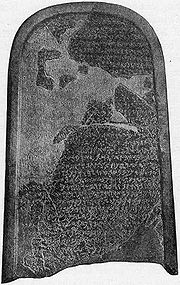
(c. 1209/1208 BC).- one of the earliest known references to Israel or to the Israelites. - Mesha steleMesha SteleThe Mesha Stele is a black basalt stone bearing an inscription by the 9th century BC ruler Mesha of Moab in Jordan....
(also called the MoabMoabMoab is the historical name for a mountainous strip of land in Jordan. The land lies alongside much of the eastern shore of the Dead Sea. The existence of the Kingdom of Moab is attested to by numerous archeological findings, most notably the Mesha Stele, which describes the Moabite victory over...
ite stone) (c.850 BC) - a TransjordanTransjordanThe Emirate of Transjordan was a former Ottoman territory in the Southern Levant that was part of the British Mandate of Palestine...
steleSteleA stele , also stela , is a stone or wooden slab, generally taller than it is wide, erected for funerals or commemorative purposes, most usually decorated with the names and titles of the deceased or living — inscribed, carved in relief , or painted onto the slab...
describing the victories of MoabMoabMoab is the historical name for a mountainous strip of land in Jordan. The land lies alongside much of the eastern shore of the Dead Sea. The existence of the Kingdom of Moab is attested to by numerous archeological findings, most notably the Mesha Stele, which describes the Moabite victory over...
ite king MeshaMeshaKing Mesha of Moab was a king of Moabites around the 9th century BC, known most famous for writing the Mesha stela.The books of Samuel record that Moab was conquered by David and retained in the territories of his son Solomon . Later, King Omri of Israel reconquered Moab after Moab was lost...
over the Kingdom of Israel. French scholar André Lemaire suggested that line 31 of the Stele bears the phrase "the house of David" (in Biblical Archaeology Review [May/June 1994], pp. 30–37). - Midianite potteryMidianite potteryMidianite pottery, also known as “Qurayya ware” is a ware type found in the Hejaz , southern and central Jordan, southern Israel and the Sinai, generally dated to the 13th-12th centuries BCE, although later dates are also possible...
- The Biblical account states that MidianMidianMidian , Madyan , or Madiam is a geographical place and a people mentioned in the Bible and in the Qur'an. It is believed to be in northwest Saudi Arabia on the east shore of the Gulf of Aqaba and the northern Red Sea...
was where MosesMosesMoses was, according to the Hebrew Bible and Qur'an, a religious leader, lawgiver and prophet, to whom the authorship of the Torah is traditionally attributed...
spent the 40 years between the time that he fled EgyptEgyptEgypt , officially the Arab Republic of Egypt, Arabic: , is a country mainly in North Africa, with the Sinai Peninsula forming a land bridge in Southwest Asia. Egypt is thus a transcontinental country, and a major power in Africa, the Mediterranean Basin, the Middle East and the Muslim world...
after killing an EgyptianEgyptiansEgyptians are nation an ethnic group made up of Mediterranean North Africans, the indigenous people of Egypt.Egyptian identity is closely tied to geography. The population of Egypt is concentrated in the lower Nile Valley, the small strip of cultivable land stretching from the First Cataract to...
who had been beating a Hebrew, and his return to lead the Israelites. During those years, he married ZipporahZipporahZipporah or Tzipora is mentioned in the Book of Exodus as the wife of Moses, and the daughter of Reuel/Jethro, the priest or prince of Midian...
, the daughter of JethroJethroIn the Old Testament or the Hebrew Bible, Jethro |Shu-ayb]]) is Moses' father-in-law, a Kenite shepherd and priest of Midian. He is also revered as a prophet in his own right in the Druze religion, and considered an ancestor of the Druze.-In Exodus:...
, the priest of Midian. In later years the Midianites were often oppressive and hostile to the Israelites, at least partly as God's punishment for their idolatryIdolatryIdolatry is a pejorative term for the worship of an idol, a physical object such as a cult image, as a god, or practices believed to verge on worship, such as giving undue honour and regard to created forms other than God. In all the Abrahamic religions idolatry is strongly forbidden, although...
. - Nabonidus ChronicleNabonidus ChronicleThe Nabonidus Chronicle is an ancient Babylonian text, part of a larger series of Babylonian Chronicles incribed in cuneiform script on clay tablets...
- Amélie KuhrtAmélie KuhrtAmélie Kuhrt FBA is a historian and specialist in the history of the ancient Near East.Professor Emerita at University College London, she specialises in the social, cultural and political history of the region from c.3000-100 BC, especially the Assyrian, Babylonian, Persian and Seleucid empires....
describes it as "the most reliable and sober [ancient] account of the fall of Babylon." - Necho II basalt cartouche-found at SidonSidonSidon or Saïda is the third-largest city in Lebanon. It is located in the South Governorate of Lebanon, on the Mediterranean coast, about 40 km north of Tyre and 40 km south of the capital Beirut. In Genesis, Sidon is the son of Canaan the grandson of Noah...
, suggesting Necho IINecho IINecho II was a king of the Twenty-sixth dynasty of Egypt .Necho II is most likely the pharaoh mentioned in several books of the Bible . The Book of Kings states that Necho met King Josiah of the Kingdom of Judah at Megiddo and killed him...
's involvement in the region (see: JosiahJosiahJosiah or Yoshiyahu or Joshua was a king of Judah who instituted major reforms. Josiah is credited by most historians with having established or compiled important Jewish scriptures during the Deuteronomic reform that occurred during his rule.Josiah became king of Judah at the age of eight, after...
) - Ketef Hinnom priestly blessingKetef HinnomKetef Hinnom is an archaeological site southwest of the Old City of Jerusalem, adjacent to St. Andrew's Church of Scotland. The site consists of a series of rock-hewn burial chambers based on natural caverns...
- Probably the oldest surviving texts currently known from the Hebrew BibleHebrew BibleThe Hebrew Bible is a term used by biblical scholars outside of Judaism to refer to the Tanakh , a canonical collection of Jewish texts, and the common textual antecedent of the several canonical editions of the Christian Old Testament...
- Priestly blessingPriestly BlessingThe Priestly Blessing, , also known in Hebrew as Nesiat Kapayim, , or Dukhanen , is a Jewish prayer recited by Kohanim during certain Jewish services...
dated to 600 BC. Text from the Book of NumbersBook of NumbersThe Book of Numbers is the fourth book of the Hebrew Bible, and the fourth of five books of the Jewish Torah/Pentateuch....
in the Old TestamentOld TestamentThe Old Testament, of which Christians hold different views, is a Christian term for the religious writings of ancient Israel held sacred and inspired by Christians which overlaps with the 24-book canon of the Masoretic Text of Judaism...
. Described as "one of most significant discoveries ever made" for biblical studies. - Nebo-Sarsekim TabletNebo-Sarsekim TabletNebo-Sarsekim Tablet is a clay cuneiform inscription referring to an official at the court of Nebuchadrezzar II, king of Babylon. It may also refer to an official named in the Biblical Book of Jeremiah....
- a clay cuneiformCuneiform scriptCuneiform script )) is one of the earliest known forms of written expression. Emerging in Sumer around the 30th century BC, with predecessors reaching into the late 4th millennium , cuneiform writing began as a system of pictographs...
inscription referring to an official at the court of Nebuchadrezzar IINebuchadrezzar IINebuchadnezzar II was king of the Neo-Babylonian Empire, who reigned c. 605 BC – 562 BC. According to the Bible, he conquered Judah and Jerusalem, and sent the Jews into exile. He is credited with the construction of the Hanging Gardens of Babylon and also known for the destruction...
, king of BabylonBabylonBabylon was an Akkadian city-state of ancient Mesopotamia, the remains of which are found in present-day Al Hillah, Babil Province, Iraq, about 85 kilometers south of Baghdad...
, possibly the same official named in the Biblical JeremiahBook of JeremiahThe Book of Jeremiah is the second of the Latter Prophets in the Hebrew Bible, following the book of Isaiah and preceding Ezekiel and the Book of the Twelve....
. - Ostraca HouseOstraca HouseOstraca of Samaria are Sixty-four legible ostraca which were found in Samaria. These are written in early Hebrew characters, which very closely resemble those of the Siloam Inscription, but show a slight development of the cursive script. These ostraca were found in the treasury of the palace of...
- 64 legible ostraca found in the treasury of AhabAhabAhab or Ach'av or Achab in Douay-Rheims was king of Israel and the son and successor of Omri according to the Hebrew Bible. His wife was Jezebel....
- written in early Hebrew. - Pim weightPim weightPim weight, a polished stone about 15 mm diameter, equal to about two-thirds of a Hebrew shekel. Many specimens have been found since their initial discovery early in the 20th century, and each one weighs about 7.6 grams compared to 11.5 grams of a shekel...
- evidence of the use of an ancient source for the Book of Samuel due to the use of an archaic term. - Seal of JehucalJehucalJehucal or Jucal [heb. יְהוּכַל] is mentioned in chapters 37 and 38 of the Book of Jeremiah:King Zedekiah sent Jehucal son of Shelemiah and the priest Zephaniah son of Maaseiah to the prophet Jeremiah, saying `Please pray for us to the Lord our God`...
- Jehucal or Jucal is mentioned in chapters 37 and 38 of the Book of JeremiahBook of JeremiahThe Book of Jeremiah is the second of the Latter Prophets in the Hebrew Bible, following the book of Isaiah and preceding Ezekiel and the Book of the Twelve....
where King ZedekiahZedekiahZedekiah or Tzidkiyahu was the last king of Judah before the destruction of the kingdom by Babylon. He was installed as king of Judah by Nebuchadnezzar II, king of Babylon, after a siege of Jerusalem to succeed his nephew, Jeconiah, who was overthrown as king after a reign of only three months and...
sends Jehucal son of Shelemiah and the priest ZephaniahZephaniahZephaniah or Tzfanya is the name of several people in the Bible Old Testament and Jewish Tanakh. He is also called Sophonias as in the New Catholic Encyclopaedia and in Easton's [Bible] Dictionary....
son of Maaseiah to the prophet JeremiahJeremiahJeremiah Hebrew:יִרְמְיָה , Modern Hebrew:Yirməyāhū, IPA: jirməˈjaːhu, Tiberian:Yirmĭyahu, Greek:Ἰερεμίας), meaning "Yahweh exalts", or called the "Weeping prophet" was one of the main prophets of the Hebrew Bible...
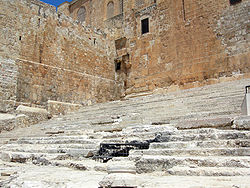
saying `Please pray for us to the Lord our God` (Chapter 38 verse 3). - Second Temple Inscription - inscription from Herod's Temple, late 1st century BC. It warns gentiles to refrain from entering the Temple enclosure, on pain of death.
- Trumpeting place inscriptionSecond TempleThe Jewish Second Temple was an important shrine which stood on the Temple Mount in Jerusalem between 516 BCE and 70 CE. It replaced the First Temple which was destroyed in 586 BCE, when the Jewish nation was exiled to Babylon...
- A stone (2.43x1 meters) with Hebrew language inscription "To the Trumpeting Place" excavated by B. Mazar at the southern-western corner of the Temple Mount. It is believed to be a directional sign for the priests who blew a trumpet announcing the beginning and end of the ShabbatShabbatShabbat is the seventh day of the Jewish week and a day of rest in Judaism. Shabbat is observed from a few minutes before sunset on Friday evening until a few minutes after when one would expect to be able to see three stars in the sky on Saturday night. The exact times, therefore, differ from...
in the Second Temple period. - Sefire steleSefireThe Sfire or Sefire steles refers to three 8th C. BCE basalt stelae containing Aramaic inscriptions discovered at Al-Safirah near Aleppo that date back to the mid eighth-century BCE. The Sefire treaty inscriptions are the three inscriptions on the steles...
- described as "the best extrabiblical source for West SemiticWest Semitic languagesThe West Semitic languages are a proposed major sub-grouping of Semitic languages. One widely accepted analysis, supported by semiticists like Robert Hetzron and John Huehnergard, divides the Semitic language family into two branches: Eastern and Western. The former consists of the extinct Eblaite...
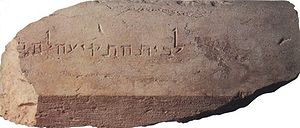
traditions of covenantal blessings and curses." - ShebnaShebnaShebna was "treasurer over the house" in the reign of king Hezekiah of Judah, according to the Old Testament....
's lintel inscription - found over the doorway of a tombTombA tomb is a repository for the remains of the dead. It is generally any structurally enclosed interment space or burial chamber, of varying sizes...
, has been ascribed to HezekiahHezekiahHezekiah was the son of Ahaz and the 14th king of Judah. Edwin Thiele has concluded that his reign was between c. 715 and 686 BC. He is also one of the most prominent kings of Judah mentioned in the Hebrew Bible....
's comptroller ShebnaShebnaShebna was "treasurer over the house" in the reign of king Hezekiah of Judah, according to the Old Testament....
. - Shiphrah slave listShiphrahShiphrah was one of two midwives who helped prevent the genocide of Hebrew children by the Egyptians, according to Exodus 1:15-21.The name is found in a list of slaves in Egypt during the reign of Sobekhotep III. This list is on Brooklyn 35.1446, a papyrus scroll kept in the Brooklyn Museum. The...
- Shiphrah was one of two midwives who helped prevent the genocideGenocideGenocide is defined as "the deliberate and systematic destruction, in whole or in part, of an ethnic, racial, religious, or national group", though what constitutes enough of a "part" to qualify as genocide has been subject to much debate by legal scholars...
of Hebrew children by the Egyptians, according to the Book of Exodus 1:15-21. The name is found in a list of slavesSlaverySlavery is a system under which people are treated as property to be bought and sold, and are forced to work. Slaves can be held against their will from the time of their capture, purchase or birth, and deprived of the right to leave, to refuse to work, or to demand compensation...
in EgyptEgyptEgypt , officially the Arab Republic of Egypt, Arabic: , is a country mainly in North Africa, with the Sinai Peninsula forming a land bridge in Southwest Asia. Egypt is thus a transcontinental country, and a major power in Africa, the Mediterranean Basin, the Middle East and the Muslim world...
during the reign of Sobekhotep IIISobekhotep IIISobekhotep III was an Egyptian king of the 13th dynasty.-Family:The family of the king is known from several sources. A monument from Sehel Island shows Sobekhotep with his father Mentuhotep, his mother was Iuhetibu , his brothers Seneb and Khakau, and a half-sister called Reniseneb...
. This list is on Brooklyn 35.1446, a papyrus scroll kept in the Brooklyn MuseumBrooklyn MuseumThe Brooklyn Museum is an encyclopedia art museum located in the New York City borough of Brooklyn. At 560,000 square feet, the museum holds New York City's second largest art collection with roughly 1.5 million works....
. - Shishaq ReliefShishaq ReliefThe Shishaq Relief is a series of inscriptions recounting pharaoh Shishaq's invasion of Judah and Israel in 925 BC. It is located at the Bubastis Portal outside the Temple of Amun at Karnak.-Biblical narrative:The Biblical narrative recounts:...
- depicts Egypt's victory over King RehoboamRehoboamRehoboam was initially king of the United Monarchy of Israel but after the ten northern tribes of Israel rebelled in 932/931 BC to form the independent Kingdom of Israel he was king of the Kingdom of Judah, or southern kingdom. He was a son of Solomon and a grandson of David...
c. 925 BC, time of the plunder of Solomon's Temple in JudahKingdom of JudahThe Kingdom of Judah was a Jewish state established in the Southern Levant during the Iron Age. It is often referred to as the "Southern Kingdom" to distinguish it from the northern Kingdom of Israel....
. - Siloam inscriptionSiloam inscriptionThe Siloam inscription or Silwan inscription is a passage of inscribed text found in the Hezekiah tunnel which brings water from the Gihon Spring to the Pool of Siloam, located in the East Jerusalem neighborhood of Silwan. The inscription records the construction of the tunnel in the 8th century...
- Records the construction of Hezekiah's tunnel in the 8th century BC . - Stele of ZakkurStele of ZakkurThe Stele of Zakkur is a royal stele discovered in 1903 at Tell Afis, 45 km southeast of Aleppo, in the territory of the ancient kingdom of Hamath. It was published in 1907. It reads in part:-See also:...
- Mentions HazaelHazaelHazael was a court official and later an Aramean king who is mentioned in the Bible. Under his reign, Aram-Damascus became an empire that ruled over large parts of Syria and Palestine....
king of AramAram (Biblical region)Aram is the name of a region mentioned in the Bible located in central Syria, including where the city of Aleppo now stands.-Etymology:The etymology is uncertain. One standard explanation is an original meaning of "highlands"...
.
- Stepped Stone StructureStepped Stone StructureThe Stepped Stone Structure is the name given to the remains at a particular archaeological site on the eastern side of the City of David, the oldest part of Jerusalem. The curved, 60ft high, narrow stone structure is built over a series of terraces...
- has been suggested as being JebusiteJebusiteAccording to the Hebrew Bible, the Jebusites were a Canaanite tribe who inhabited and built Jerusalem prior to its conquest by King David; the Books of Kings state that Jerusalem was known as Jebus prior to this event...
, the MilloMilloThe Millo was a structure in Jerusalem mentioned by the Books of Kings, and corresponding passages in the Books of Chronicles. The texts simply describe the Millo as having been built by Solomon and repaired by Hezekiah,, without giving an explanation of what exactly the Millo was...
, or part of the Large Stone StructureLarge Stone StructureThe Large Stone Structure is the name given to the remains of a large public building in the City of David neighborhood of central Jerusalem, south of the Old City, tentatively dated to 10th to 9th century BCE. The name was given to the structure, as a result of its proximity with another site...
, which has been suggested as being part of King DavidDavidDavid was the second king of the united Kingdom of Israel according to the Hebrew Bible and, according to the Gospels of Matthew and Luke, an ancestor of Jesus Christ through both Saint Joseph and Mary...
's palace. - Susa remainsSusaSusa was an ancient city of the Elamite, Persian and Parthian empires of Iran. It is located in the lower Zagros Mountains about east of the Tigris River, between the Karkheh and Dez Rivers....
- Susa is mentioned in the KetuvimKetuvimKetuvim or Kəṯûḇîm in actual Biblical Hebrew is the third and final section of the Tanak , after Torah and Nevi'im . In English translations of the Hebrew Bible, this section is usually entitled "Writings" or "Hagiographa"...
of the Hebrew BibleHebrew BibleThe Hebrew Bible is a term used by biblical scholars outside of Judaism to refer to the Tanakh , a canonical collection of Jewish texts, and the common textual antecedent of the several canonical editions of the Christian Old Testament...
, mainly in EstherBook of EstherThe Book of Esther is a book in the Ketuvim , the third section of the Jewish Tanakh and is part of the Christian Old Testament. The Book of Esther or the Megillah is the basis for the Jewish celebration of Purim...
, but also once each in NehemiahBook of NehemiahThe Book of Nehemiah is a book of the Hebrew Bible. Told largely in the form of a first-person memoir, it concerns the rebuilding of the walls of Jerusalem by Nehemiah, a Jew who is a high official at the Persian court, and the dedication of the city and its people to God's laws...
and DanielBook of DanielThe Book of Daniel is a book in the Hebrew Bible. The book tells of how Daniel, and his Judean companions, were inducted into Babylon during Jewish exile, and how their positions elevated in the court of Nebuchadnezzar. The court tales span events that occur during the reigns of Nebuchadnezzar,...
. Both Daniel and Nehemiah lived in Susa during the Babylonian captivity of Judah of the 6th century BC. EstherEstherEsther , born Hadassah, is the eponymous heroine of the Biblical Book of Esther.According to the Bible, she was a Jewish queen of the Persian king Ahasuerus...
became queen there, and saved the Jews from genocide. A tomb presumed to be that of Daniel is located in the area, known as Shush-Daniel. The tomb is marked by an unusual white, stone cone, which is neither regular nor symmetric. Many scholars believe it was at one point a Star of DavidStar of DavidThe Star of David, known in Hebrew as the Shield of David or Magen David is a generally recognized symbol of Jewish identity and Judaism.Its shape is that of a hexagram, the compound of two equilateral triangles...
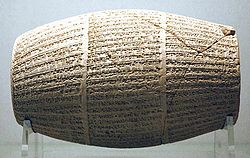
. - Taylor Prism - a clay prism inscribed with the annals of the AssyriaAssyriaAssyria was a Semitic Akkadian kingdom, extant as a nation state from the mid–23rd century BC to 608 BC centred on the Upper Tigris river, in northern Mesopotamia , that came to rule regional empires a number of times through history. It was named for its original capital, the ancient city of Assur...
n king SennacheribSennacheribSennacherib |Sîn]] has replaced brothers for me"; Aramaic: ) was the son of Sargon II, whom he succeeded on the throne of Assyria .-Rise to power:...
notable for describing his siege of Jerusalem in 701 BCAssyrian Siege of JerusalemIn approximately 701 BCE, Sennacherib, king of Assyria, attacked the fortified cities of Judah, laying siege on Jerusalem. The historical outcome of the siege is unclear.-Background:...
during the reign of king HezekiahHezekiahHezekiah was the son of Ahaz and the 14th king of Judah. Edwin Thiele has concluded that his reign was between c. 715 and 686 BC. He is also one of the most prominent kings of Judah mentioned in the Hebrew Bible....
. This event is recorded in several books contained in BibleBibleThe Bible refers to any one of the collections of the primary religious texts of Judaism and Christianity. There is no common version of the Bible, as the individual books , their contents and their order vary among denominations...
including IsaiahIsaiahIsaiah ; Greek: ', Ēsaïās ; "Yahu is salvation") was a prophet in the 8th-century BC Kingdom of Judah.Jews and Christians consider the Book of Isaiah a part of their Biblical canon; he is the first listed of the neviim akharonim, the later prophets. Many of the New Testament teachings of Jesus...
chapters 33 and 36; 2 Kings 18:17; 2 ChroniclesBooks of ChroniclesThe Books of Chronicles are part of the Hebrew Bible. In the Masoretic Text, it appears as the first or last book of the Ketuvim . Chronicles largely parallels the Davidic narratives in the Books of Samuel and the Books of Kings...
32:9. This event is also recorded by HerodotusHerodotusHerodotus was an ancient Greek historian who was born in Halicarnassus, Caria and lived in the 5th century BC . He has been called the "Father of History", and was the first historian known to collect his materials systematically, test their accuracy to a certain extent and arrange them in a...
. - Tel Dan SteleTel Dan SteleThe Tel Dan Stele is a stele discovered in 1993/94 during excavations at Tel Dan in northern Israel. Its author was a king of Damascus, Hazael or one of his sons, and it contains an Aramaic inscription commemorating victories over local ancient peoples including "Israel" and the "House of...
- a stele commemorating victory by Aramaeans against the Israelites. It is claimed by a number of scholars that the inscription contains the phrase House of DavidDavidic lineThe Davidic line refers to the tracing of lineage to the King David referred to in the Hebrew Bible, as well as the New Testament...
although others dispute this . - Cave of the PatriarchsCave of the PatriarchsThe Cave of the Patriarchs or the Cave of Machpelah , is known by Muslims as the Sanctuary of Abraham or Ibrahimi Mosque ....
- Tomb of DanielTomb of DanielThe Tomb of Daniel is the traditional burial place of the biblical prophet Daniel. Various locations have been named for the site, but the tomb in Susa, Iran, is the most widely accepted, it being first mentioned by Benjamin of Tudela, who visited Asia between 1160 and 1163.-Susa, Iran:The Book of...
- Rachel's TombRachel's TombRachel's Tomb , also known as the Dome of Rachel, , is an ancient structure believed to be the burial place of the biblical matriarch Rachel. It is located on the outskirts of Bethlehem, a Palestinian city just south of Jerusalem, in the West Bank...
outside BethlehemBethlehemBethlehem is a Palestinian city in the central West Bank of the Jordan River, near Israel and approximately south of Jerusalem, with a population of about 30,000 people. It is the capital of the Bethlehem Governorate of the Palestinian National Authority and a hub of Palestinian culture and tourism... - Ugaritic religious texts - verifies the account of PhiloPhiloPhilo , known also as Philo of Alexandria , Philo Judaeus, Philo Judaeus of Alexandria, Yedidia, "Philon", and Philo the Jew, was a Hellenistic Jewish Biblical philosopher born in Alexandria....
, preserved by Eusebius, regarding the Canaanite religionCanaanite religionCanaanite religion is the name for the group of Ancient Semitic religions practiced by the Canaanites living in the ancient Levant from at least the early Bronze Age through the first centuries of the Common Era....
. - Uzziah Tablet - controversial tablet discovered in 1931 by Professor E.L. Sukenik of the Hebrew University of JerusalemHebrew University of JerusalemThe Hebrew University of Jerusalem ; ; abbreviated HUJI) is Israel's second-oldest university, after the Technion – Israel Institute of Technology. The Hebrew University has three campuses in Jerusalem and one in Rehovot. The world's largest Jewish studies library is located on its Edmond J...
in a Russian convent. - Warren's ShaftWarren's ShaftWarren's Shaft is an archaeological feature in Jerusalem discovered in 1867 by British engineer Sir Charles Warren . It runs from within the old city to a spot near the Gihon Spring, and after its 19th century discovery was thought to have been the centrepiece of the city's early water supply...
- possible route corresponding to the biblical account of JoabJoabJoab the son of Zeruiah, was the nephew of King David and the commander of his army, according to the Hebrew Bible.- Name :...
, king DavidDavidDavid was the second king of the united Kingdom of Israel according to the Hebrew Bible and, according to the Gospels of Matthew and Luke, an ancestor of Jesus Christ through both Saint Joseph and Mary...
's commander, launching a secretive attack against the Jebusites, who controlled Jerusalem. - Western WallWestern WallThe Western Wall, Wailing Wall or Kotel is located in the Old City of Jerusalem at the foot of the western side of the Temple Mount...
- is an important Jewish religious site located in the Old City of Jerusalem. Just over half the wall, including its 17 courses located below street level, dates from the end of the Second Temple period, being constructed around 19 BC by Herod the GreatHerod the GreatHerod , also known as Herod the Great , was a Roman client king of Judea. His epithet of "the Great" is widely disputed as he is described as "a madman who murdered his own family and a great many rabbis." He is also known for his colossal building projects in Jerusalem and elsewhere, including his...
. The remaining layers were added from the 7th century onwards. - Pool of BethesdaPool of BethesdaThe Pool of Bethesda is a pool of water in the Muslim Quarter of Jerusalem, on the path of the Beth Zeta Valley. The Gospel of John describes such a pool in Jerusalem, near the Sheep Gate, which is surrounded by five covered colonnades. It is associated with healing. Until the 19th century, there...
- in the nineteenth century, archaeologists discovered the remains of a pool exactly matching the description in John’s Gospel.
Controversial
- AcheiropoietaAcheiropoietaAcheiropoieta — also called Icons Made Without Hands — are a particular kind of icon which are alleged to have come into existence miraculously, not created by a human painter. Invariably these are images of Jesus or the Virgin Mary...
(see Shroud of TurinShroud of TurinThe Shroud of Turin or Turin Shroud is a linen cloth bearing the image of a man who appears to have suffered physical trauma in a manner consistent with crucifixion. It is kept in the royal chapel of the Cathedral of Saint John the Baptist in Turin, northern Italy. The image on the shroud is...
, Image of EdessaImage of EdessaAccording to Christian legend, the Image of Edessa was a holy relic consisting of a square or rectangle of cloth upon which a miraculous image of the face of Jesus was imprinted — the first icon ....
, and the Veil of VeronicaVeil of VeronicaThe Veil of Veronica, or Sudarium , often called simply "The Veronica" and known in Italian as the Volto Santo or Holy Face is a Catholic relic, which, according to legend, bears the likeness of the Face of Jesus not made by human hand The Veil of Veronica, or Sudarium (Latin for sweat-cloth),...
) - Ivory pomegranateIvory pomegranateThe Ivory Pomegranate is a thumb-sized ivory decorative item acquired by the Israel Museum.-Description:The Ivory Pomegranate is a small ornamental bone object engraved with a short inscription in paleo-Hebrew. The inscription is inscribed in circular fashion along the shoulders of the pomegranate...
- James OssuaryJames OssuaryThe James Ossuary is a 2,000-year old chalk box that was used for containing the bones of the dead. The Aramaic inscription: Ya'akov bar-Yosef akhui diYeshua is cut into one side of the box...
- Jehoash InscriptionJehoash InscriptionThe Jehoash Inscription is the name of a controversial artifact rumored to have surfaced in the construction site or in the Muslim cemetery near the Temple Mount of Jerusalem...
- controversial black stone tablet in Phoenician regarding King JehoashJehoash of JudahJehoash or Joas , sometimes written Joash or Joás , was the eighth king of the southern Kingdom of Judah, and the sole surviving son of Ahaziah. His mother was Zibiah of Beersheba ....
's repair work. Suspected to be a forgery, (but see: Book of KingsBooks of KingsThe Book of Kings presents a narrative history of ancient Israel and Judah from the death of David to the release of his successor Jehoiachin from imprisonment in Babylon, a period of some 400 years...
). - Shlomit / Temech seal
- Sudarium of OviedoSudarium of OviedoThe Sudarium of Oviedo, or Shroud of Oviedo, is a bloodstained cloth, measuring c. 84 x 53 cm, kept in the Cámara Santa of the Cathedral of San Salvador, Oviedo, Spain. The Sudarium is claimed to be the cloth wrapped around the head of Jesus Christ after he died, as mentioned in the Gospel of...
- Tower of SiloamTower of SiloamAccording to the Bible, the Tower of Siloam was an ancient tower in Siloam in south Jerusalem, which fell during the time of Jesus, killing 18 people.-Mentioned in the Bible:...
- ruins possibly mentioned in the Gospel of LukeGospel of LukeThe Gospel According to Luke , commonly shortened to the Gospel of Luke or simply Luke, is the third and longest of the four canonical Gospels. This synoptic gospel is an account of the life and ministry of Jesus of Nazareth. It details his story from the events of his birth to his Ascension.The...
.
Artifacts described but unknown to modern scholarship
- The Ark of the Covenant
- EphodEphodAn ephod was an article of clothing, and a worship object, in ancient Israelite culture, and was closely connected with oracular practices....
- HoshenHoshenThe priestly breastplate was a sacred breastplate worn by the High Priest for the Israelites, according to the Book of Exodus...
- Noah's ArkNoah's ArkNoah's Ark is a vessel appearing in the Book of Genesis and the Quran . These narratives describe the construction of the ark by Noah at God's command to save himself, his family, and the world's animals from the worldwide deluge of the Great Flood.In the narrative of the ark, God sees the...
- Searches for Noah's ArkSearches for Noah's ArkFrom at least the time of Eusebius to the present day, the search for the physical remains of Noah's Ark has held a fascination for many people... - Solomonic columnSolomonic columnThe Solomonic column, also called Barley-sugar column, is a helical column, characterized by a spiraling twisting shaft like a corkscrew...
- (see Boaz and JachinBoaz and JachinBoaz and Jachin were two copper, brass or bronze pillars which stood in the porch of Solomon's Temple, the first Temple in Jerusalem.-Description:...
)
Forgery
- Stone Seal of Manasseh - Stone seal of ManassehManasseh of JudahManasseh was a king of the Kingdom of Judah. He was the only son of Hezekiah with Hephzi-bah. He became king at an age 12 years and reigned for 55 years. Edwin Thiele has concluded that he commenced his reign as co-regent with his father Hezekiah in 697/696 BC, with his sole reign beginning in...
, King of JudahKingdom of JudahThe Kingdom of Judah was a Jewish state established in the Southern Levant during the Iron Age. It is often referred to as the "Southern Kingdom" to distinguish it from the northern Kingdom of Israel....
c.687-642 BC. Reportedly offered to a private collector for one million dollars.
Significant museums
- Israel MuseumIsrael MuseumThe Israel Museum, Jerusalem was founded in 1965 as Israel's national museum. It is situated on a hill in the Givat Ram neighborhood of Jerusalem, near the Bible Lands Museum, the Knesset, the Israeli Supreme Court, and the Hebrew University of Jerusalem....
, Jerusalem - Bible Lands MuseumBible Lands MuseumThe Bible Lands Museum is a museum in Jerusalem, Israel, that explores the culture of the peoples mentioned in the Bible, among them the ancient Egyptians, Canaanites, Philistines, Arameans, Hittites, Elamites, Phoenicians and Persians...
, Jerusalem - Hecht Museum
- Oriental Institute, ChicagoOriental Institute, ChicagoThe Oriental Institute , established in 1919, is the University of Chicago's archeology museum and research center for ancient Near Eastern studies.- History and purpose:James Henry Breasted built up the collection of the Haskell Oriental Museum...
See also
- Archaeology of IsraelArchaeology of IsraelThe archaeology of Israel is the study of the archaeology of Israel, stretching from prehistory through three millennia of documented history. The ancient Land of Israel was a geographical bridge between the political and cultural centers of Mesopotamia and Egypt...
- Assyrian Siege of JerusalemAssyrian Siege of JerusalemIn approximately 701 BCE, Sennacherib, king of Assyria, attacked the fortified cities of Judah, laying siege on Jerusalem. The historical outcome of the siege is unclear.-Background:...
- Assyro-Babylonian religion
- The Bible and historyThe Bible and historyThe Bible from a historical perspective, includes numerous fields of study, ranging from archeology and astronomy to linguistics and methods of comparative literature. The Bible may provide insight into pursuits, including but not limited to; our understanding of ancient and modern culture,...
- Biblical archaeology (excavations and artifacts)
- Chronology of the BibleChronology of the BibleThe chronology of the Bible is the elaborate system of genealogies, generations, reign-periods, and other means by which Hebrew Bible measures the passage of time and thus give a chronological framework to biblical history from the Creation until the historical kingdoms of Israel and Judah.The...
- Cities of the Ancient Near EastCities of the ancient Near EastThe largest cities in the Bronze Age ancient Near East housed several tens of thousands. Memphis in the Early Bronze Age with some 30,000 inhabitants was the largest city of the time by far...
- Hittite sitesHittite sitesThe geography of the Hittite Empire is known from Hittite texts on one hand, and from archaeological excavation on the other. Matching philology to archaeology is a difficult task, and only a handful of sites are identified with their ancient name with certainty....
- HittitesHittitesThe Hittites were a Bronze Age people of Anatolia.They established a kingdom centered at Hattusa in north-central Anatolia c. the 18th century BC. The Hittite empire reached its height c...
- History of the HittitesHistory of the HittitesHittites were an ancient people who spoke an Indo-European language and established a kingdom centered in Hattusa in northern Anatolia from the 18th century BC. In the 14th century BC, the Hittite Kingdom was at its height, encompassing central Anatolia, south-western Syria as far as Ugarit, and... - Library of AshurbanipalLibrary of Ashurbanipal-External links:. In our time discussion programme. 45 minutes....
- List of biblical figures identified in extra-biblical sources
- List of burial places of Biblical figures
- List of Egyptian papyri by date
- List of megalithic sites
- Model of Jerusalem in the Late 2nd Temple PeriodModel of Jerusalem in the Late 2nd Temple PeriodThe Holyland Model of Jerusalem is a 1:50 scale-model of the city of Jerusalem in the late Second Temple Period. The model was moved from its original location at the Holyland Hotel in Bayit VeGan, Jerusalem, to a new site at the Israel Museum in June 2006....
- Near Eastern archaeologyNear Eastern archaeologyNear Eastern Archaeology is a regional branch of the wider, global discipline of Archaeology...
- Nag Hammadi libraryNag Hammadi libraryThe Nag Hammadi library is a collection of early Christian Gnostic texts discovered near the Upper Egyptian town of Nag Hammadi in 1945. That year, twelve leather-bound papyrus codices buried in a sealed jar were found by a local peasant named Mohammed Ali Samman...
- early ChristianChristianA Christian is a person who adheres to Christianity, an Abrahamic, monotheistic religion based on the life and teachings of Jesus of Nazareth as recorded in the Canonical gospels and the letters of the New Testament...
gnostic papyri. - Non-canonical books referenced in the BibleNon-canonical books referenced in the BibleThe non-canonical books in this article include Biblical apocrypha and Deuterocanonical books , Pseudepigrapha, writings from Hellenistic and other non-Biblical cultures, and lost works of known or unknown status...
- Oxyrhynchus PapyriOxyrhynchus PapyriThe Oxyrhynchus Papyri are a very numerous group of manuscripts discovered by archaeologists including Bernard Pyne Grenfell and Arthur Surridge Hunt at an ancient rubbish dump near Oxyrhynchus in Egypt . The manuscripts date from the 1st to the 6th century AD. They include thousands of Greek and...
- collection of Old and New Testament papyri, Apocryphal works and works of PhiloPhiloPhilo , known also as Philo of Alexandria , Philo Judaeus, Philo Judaeus of Alexandria, Yedidia, "Philon", and Philo the Jew, was a Hellenistic Jewish Biblical philosopher born in Alexandria.... - Relics attributed to JesusRelics attributed to JesusA number of relics associated with Jesus have been claimed and displayed throughout the history of Christianity. Some people believe in the authenticity of some relics; others doubt the authenticity of various items...
- Syro-Palestinian archaeologySyro-Palestinian archaeologySyro-Palestinian archaeology is a term used to refer to archaeological research conducted in the southern Levant. Palestinian archaeology is also commonly used in its stead, particularly when the area of inquiry centers on ancient Palestine...