

Roman Catholic theology

Encyclopedia
Roman Catholic theology comprises the "Roman Catholic
teachings" (cf Latin Rite) of the Catholic Church which bases its conclusions on Scripture
and Sacred Tradition
, as interpreted by the Magisterium
. The Church teaches that salvation
comes through faith in Jesus Christ, keeping of the Ten commandments
and receiving the sacraments. There are a number of teachings which differentiate the Latin Rite Catholic Church from other Christian churches and even from the Eastern Rite Catholic Churches
. The most notable differences include Catholic beliefs in the existence of Purgatory
, the Pope
as the "Vicar of Christ on Earth", papal infallibility
, and the Immaculate Conception
of Mary.
Church belief is encapsulated in the Nicene Creed
and the Apostle's Creed. Formal Catholic worship is ordered by means of the liturgy
, which is regulated by church authority. The celebration of the Eucharist
, one of seven church sacraments
, is considered the center of Catholic worship. However there are numerous additional forms of personal prayer and devotion including the Rosary
, Stations of the Cross
, and Eucharistic adoration
. The church community consists of the ordained priesthood
and deaconate, those like monk
s and nun
s living a consecrated life under rule, and the laity
.
The Catholic Church is a trinitarian
Christian
church whose beliefs are detailed in the Catechism of the Catholic Church
. The Nicene Creed
, sets out the main principles of Catholic Christian belief. This creed is recited at Sunday Masses and is the core statement of belief in many other Christian churches as well. Catholic teachings have been refined and clarified by major councils of the Church
, convened by Church leaders at important points throughout history. The first such council, the Council of Jerusalem
was convened by the apostles around the year 50. The most recent was Vatican II, which closed in 1965.
 The Catholic Church believes that it is guided by the Holy Spirit
, and that it is protected by divine revelation from falling into error on certain fundamental doctrines
. It bases this belief on biblical promises that Jesus made to his apostles. In the Gospel of Matthew, Jesus tells Peter, "... the gates of hell will not prevail against" the church, and in the Gospel of John, Jesus states, "I have much more to tell you, but you cannot bear it now. But when he comes, the Spirit of truth, he will guide you to all truth". According to the church, the Holy Spirit reveals God's truth through Sacred Scripture
, Sacred Tradition
and the Magisterium
. Sacred Tradition consists of those beliefs handed down through the church since the time of the Apostles. Sacred Scripture and Sacred Tradition are collectively known as the deposit of faith. This is in turn interpreted by the Magisterium, or the teaching authority of the Church. The Magisterium includes those pronouncements of the pope that are considered infallible
, as well as the pronouncements of ecumenical councils and those of the college of bishops
in union with the pope when they condemn false interpretations of scripture or define truths.
According to the Catechism, Christ instituted seven sacraments
and entrusted them to the Church. These are Baptism
, Confirmation, the Eucharist
, Penance
, the Anointing of the Sick
, Holy Orders
and Holy Matrimony
. They are vehicles through which God's grace
is said to flow into all those who receive them with the proper disposition. The Church encourages individuals to engage in adequate preparation before receiving certain sacraments.
The beliefs of other Christian denominations differ from those of Catholics in varying degrees. Eastern Orthodox
belief differs mainly with regard to papal infallibility
, the filioque clause
and the immaculate conception
of Mary, but is otherwise quite similar. Protestant
churches vary in their beliefs, but they generally differ from Catholics regarding the authority of the pope and church tradition, as well as the role of Mary
and the saint
s, the role of the priesthood
, and issues pertaining to grace
, good works and salvation
. The five solas
were one attempt to express these differences.
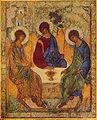 Trinity refers to the teaching that the one God comprises three distinct aspects or 'persons'; these being referred to as 'the Father' (the heavenly existence of God), 'the Son' (Jesus Christ - God's earthly incarnation as related in the Bible
, and now held to coexist with the Father), and 'the Holy Spirit' (sometimes referred to as 'the Holy Ghost'). Together, these three persons are sometimes called the Godhead
although there is no single term in use in Scripture to denote the unified Godhead. In the words of the Athanasian Creed
, an early statement of Christian belief, "the Father is God, the Son is God, and the Holy Spirit is God, and yet there are not three Gods but one God.".
According to this doctrine, God is not divided in the sense that each person has a third of the whole; rather, each person is considered to be fully God (see Perichoresis
). The distinction lies in their relations, the Father being unbegotten; the Son being eternal yet begotten of the Father; and the Holy Spirit 'proceeding' from Father and (in Western theology) from the Son. Regardless of this apparent difference in their origins, the three 'persons' are each eternal
and omnipotent. This is thought by Trinitarian Christians to be the revelation regarding God's nature which Jesus Christ came to deliver to the world, and is the foundation of their belief system.
The word trias, from which trinity is derived, is first seen in the works of Theophilus of Antioch
. He wrote of "the Trinity of God (the Father), His Word (the Son) and His Wisdom (Holy Spirit)". The term may have been in use before this time. Afterwards it appears in Tertullian
. In the following century the word was in general use. It is found in many passages of Origen
.
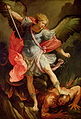 The central statement of Catholic faith, the Nicene Creed, begins, "We believe in one God, the Father, the Almighty, maker of heaven and earth, of all that is, seen and unseen." Thus, Catholics believe that God is not a part of nature, but that he created nature and all that exists. He is viewed as a loving and caring God who is active both in the world and in people's lives. He desires his creatures to love him and to love one another. Before the creation of mankind, however, God made spiritual beings called angel
s.
and "true God and true man
" (or both fully divine and fully human). Jesus, having become fully human
, suffered the pains and temptations of a mortal man, yet he did not sin. As fully God, he defeated death and rose to life again. According to the Bible
, "God raised him from the dead," he ascended to heaven
, is "seated at the right hand of the Father" and will return again
to fulfil the rest of Messianic prophecy such as the Resurrection of the dead
, the Last Judgment
and final establishment of the Kingdom of God
.
According to the Gospel
s of Matthew
and Luke
, Jesus was conceived
by the Holy Spirit
and born
from the Virgin Mary
. Little of Jesus' childhood is recorded in the canonical Gospels, however infancy Gospels were popular in antiquity. In comparison, his adulthood, especially the week before his death, are well documented in the Gospels contained within the New Testament
. The Biblical accounts of Jesus' ministry include: his baptism
, miracles, preaching, teaching, and deeds
.
he would send them the "Advocate", the "Holy Spirit
", who "will teach you everything and remind you of all that I told you". In the Gospel of Luke, Jesus tells his disciples "If you then, who are evil, know how to give good gifts to your children, how much more will the heavenly Father give the Holy Spirit to those who ask him!" The Nicene Creed states that the Holy Spirit is one with God the Father and God the Son (Jesus) thus, for Catholics, receiving the Holy Spirit is receiving God, the source of all that is good. Catholics formally ask for and receive the Holy Spirit through the sacrament of Confirmation. Sometimes called the sacrament of Christian maturity, Confirmation is believed to bring an increase and deepening of the grace received at Baptism. Spiritual graces or gifts of the Holy Spirit can include wisdom to see and follow God's plan, right judgment, love for others, courage in witnessing the faith, knowledge, reverence, and rejoicing in the presence of God. The corresponding fruits of the Holy Spirit
are love, joy, peace, patience, kindness, goodness, faithfulness, gentleness, and self control. To be validly confirmed, a person must be in a state of grace, which means that they cannot be conscious of having committed a mortal sin. They must also have prepared spiritually for the sacrament, chosen a sponsor or godparent
for spiritual support, and selected a saint
to be their special patron and intercessor.
is the branch of Christian doctrinal theology
that deals with salvation through Jesus Christ. Some Christians believe salvation
is a gift by means of the unmerited grace of God
. Some Christians believe that, through faith in Jesus, one can be saved from sin
and eternal death. The crucifixion of Jesus is explained as an atoning sacrifice, which, in the words of the Gospel of John
, "takes away the sins of the world." One's reception of salvation is related to justification
.
. The sin of pride, considered one of seven deadly sins
, is attributed to Satan for desiring to be God's equal. A fallen angel
tempted the first humans, Adam and Eve
, who then committed the original sin which brought suffering and death into the world. This event, known as the Fall of Man, left humans separated from their original state of intimacy with God, a separation that can persist beyond death. The Catechism states that
resulting in
is a "grave violation of God's law" that "turns man away from God", and if it is not redeemed by repentance and God's forgiveness, it can cause exclusion from Christ's kingdom and the eternal death of hell.
In contrast, venial sin
(meaning "forgivable" sin) "does not set us in direct opposition to the will and friendship of God" and, although still "constituting a moral disorder", does not deprive the sinner of friendship with God, and consequently the eternal happiness of heaven.
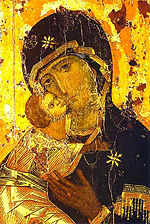 In the Old Testament
, God promised to send his people a savior. The Church believes that this savior was Jesus whom John the Baptist
called "the lamb of God who takes away the sin of the world". The Nicene Creed refers to Jesus as "the only begotten son of God, ... one in being with the Father. Through him all things were made." In a supernatural event called the Incarnation
, Catholics believe that God came down from heaven for our salvation, became man through the power of the Holy Spirit and was born of a virgin Jewish girl named Mary
. They believe that Jesus' mission on earth included giving people his word and example to follow, as recorded in the four Gospel
s. The Church teaches that following the example of Jesus helps believers to grow more like him, and therefore to true love, freedom, and the fullness of life.
The focus of a Christian's life is a firm belief in Jesus
as the Son of God
and the "Messiah
" or "Christ
". The title "Messiah" comes from the Hebrew
word מָשִׁיחַ (māšiáħ) meaning anointed one. The Greek translation (Christos) is the source of the English word "Christ".
Christians believe that, as the Messiah, Jesus was anointed
by God as ruler and savior of humanity, and hold that Jesus' coming was the fulfillment of messianic prophecies
of the Old Testament
. The Christian concept of the Messiah differs significantly from the contemporary Jewish concept
. The core Christian belief is that, through the death and resurrection of Jesus
, sinful
humans can be reconciled to God and thereby are offered salvation and the promise of eternal life
.
Roman Catholics believe in the resurrection of Jesus. According to the New Testament
, Jesus
, the central figure of Christianity, was crucified
, died, buried within a tomb, and resurrected three days later. The New Testament mentions several resurrection appearances of Jesus
on different occasions to his twelve apostles and disciples, including "more than five hundred brethren at once", before Jesus' Ascension. Jesus's death and resurrection are the essential doctrines of the Christian faith, and are commemorated by Christians during Good Friday
and Easter
, particularly during the liturgical time
of Holy Week
. Arguments over death and resurrection claims occur at many religious debate
s and interfaith dialogues
.
As Paul the Apostle, an early Christian convert, wrote, "If Christ was not raised, then all our preaching is useless, and your trust in God is useless". The death and resurrection of Jesus are the most important events in Christian Theology
, as they form the point in scripture where Jesus gives his ultimate demonstration that he has power over life and death and thus the ability to give people eternal life
.
Generally, Christian churches accept and teach the New Testament account of the resurrection of Jesus. Some modern scholars use the belief of Jesus' followers in the resurrection as a point of departure for establishing the continuity of the historical Jesus and the proclamation of the early church. Some liberal Christians
do not accept a literal bodily resurrection, seeing the story as richly symbolic and spiritually nourishing myth
.
The Church teaches that through the passion
of Jesus and his crucifixion
, all people have an opportunity for forgiveness and freedom from sin, and so can be reconciled to God.
Sinning is the opposite of following Jesus, robbing people of their resemblance to God while turning their souls away from God's love. People can sin by failing to obey the Ten Commandments
, failing to love God, and failing to love other people. Some sins are more serious than others, ranging from lesser, venial sin
s, to grave, mortal sin
s that sever a person's relationship with God.
will appear before the judgment seat of Christ immediately after death and receive a particular judgment
based on the deeds of their earthly life. Chapter 25:35–46 of the Gospel of Matthew underpins the Catholic belief that a day will also come when Jesus will sit in a universal judgment of all mankind. The final judgment
will bring an end to human history. It will also mark the beginning of a new heaven and earth in which righteousness dwells and God will reign forever.
There are three states of afterlife in Catholic belief. Heaven is a time of glorious union with God and a life of unspeakable joy that lasts forever. Purgatory is a temporary place for the purification of souls who, although saved, are not free enough from sin to enter directly into heaven. It is a state requiring penance and purgation of sin through God's mercy aided by the prayers of others. Finally, those who freely chose a life of sin and selfishness, were not sorry for their sins and had no intention of changing their ways go to hell, an everlasting separation from God. The Church teaches that no one is condemned to hell without freely deciding to reject God and his love. He predestines
no one to hell and no one can determine whether anyone else has been condemned. Catholicism teaches that God's mercy is such that a person can repent even at the point of death and be saved, like the good thief who was crucified next to Jesus.
Most Christians believe that upon bodily death the soul
experiences the particular judgment
and is either rewarded with eternal heaven
or condemned to an eternal hell
. The elect are called "saints" (Latin sanctus: "holy") and the process of being made holy is called sanctification. In Catholicism, those who die in a state of grace but with either unforgiven venial sins or incomplete penance
, undergo purification in purgatory
to achieve the holiness necessary for entrance into heaven. At the second coming of Christ
at the end of time
, all who have died will be resurrected bodily from the dead
for the Last Judgement, whereupon Jesus will fully establish the Kingdom of God
in fulfillment of scriptural prophecies
.
to cooperate with grace. Reformed theology places distinctive emphasis on grace by teaching that individuals are completely incapable of self-redemption
, but the grace of God overcomes even the unwilling heart
. Arminianism
takes a synergistic approach while Lutheran doctrine teaches justification by grace alone through faith alone.
. However, if this purification is not achieved in life, venial sins can still be purified after death. The specific name given to this purification of sin after death is "purgatory".
. This sacramental act of cleansing admits one as a full member of the natural and supernatural Church and is only conferred once in a person's lifetime.
The Catholic Church considers baptism, even for infants, so important that "parents are obliged to see that their infants are baptised within the first few weeks" and, "if the infant is in danger of death, it is to be baptised without any delay." It declares: "The practice of infant Baptism is an immemorial tradition of the Church. There is explicit testimony to this practice from the second century on, and it is quite possible that, from the beginning of the apostolic preaching, when whole 'households' received baptism, infants may also have been baptized."
At the Council of Trent
, on 15 November 1551, the necessity of a second conversion after baptism
was delineated:
David MacDonald
, a Catholic apologist
, has written in regards to paragraph 1428, that "this endeavor of conversion is not just a human work. It is the movement of a "contrite heart," drawn and moved by grace
to respond to the merciful love of God who loved us first."
is the principal means by which Catholics may obtain forgiveness for subsequent sin and receive God's grace and assistance not to sin again. This is based on Jesus' words to his disciples in the Gospel of John 20:21–23. A penitent confesses his sins to a priest who may then offer advice or impose a particular penance to be performed. The penitent then prays an act of contrition
and the priest administers absolution
, formally forgiving the person of his sins. A priest is forbidden under penalty of excommunication
to reveal any matter heard under the seal of confession. Penance helps prepare Catholics before they can validly receive the Holy Spirit in the sacraments of Confirmation and the Eucharist.
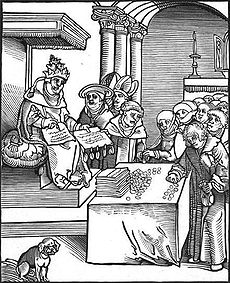 The Roman Catholic Church teaches that the fate of those in purgatory can be affected by the actions of the living.
In the same context there is mention of the practice of indulgence
s. An indulgence is a remission before God of the temporal punishment due to sins whose guilt has already been forgiven. Indulgences may be obtained for oneself, or on behalf of Christians who have died.
Prayers for the dead and indulgences have been envisioned as decreasing the "duration" of time the dead would spend in purgatory. Traditionally, most indulgences were measured in term of days, "quarantines" (i.e. 40-day periods as for Lent), or years, meaning that they were equivalent to that length of canonical penance on the part of a living Christian. When the imposition of such canonical penances of a determinate duration fell into desuetude these expressions were sometimes popularly misinterpreted as reduction of that much time of a soul's stay in purgatory. (The concept of time, like that of space, is of doubtful applicability to souls in purgatory.) In Pope Paul VI
's revision of the rules concerning indulgences, these expressions were dropped, and replaced by the expression "partial indulgence", indicating that the person who gained such an indulgence for a pious action is granted, "in addition to the remission of temporal punishment acquired by the action itself, an equal remission of punishment through the intervention of the Church"
Historically, the practice of granting indulgences, and the widespread associated abuses, which led to them being seen as increasingly bound up with money, with criticisms being directed against the "sale" of indulgences, were a source of controversy that was the immediate occasion of the Protestant Reformation
in Germany and Switzerland.
, the church acknowledges that the Holy Spirit is active in Christian churches and communities separated from itself, and that Catholics are called by the Holy Spirit to work for unity among all Christians; but only in commmunion with the Pope in Rome.
.
Catholic belief holds that the Church exists simultaneously on earth (Church militant)
, in purgatory
(Church suffering), and in heaven (Church triumphant); thus Mary, the mother of Jesus, and the other saints are alive and part of the living Church. This unity of the Church in heaven and on earth is called the "communion of saints
".
's Dogmatic Constitution on the Church, Lumen Gentium
stated that "the one Church of Christ which in the Nicene Creed
is professed as one, holy, catholic and apostolic" subsists "in the Catholic Church, which is governed by the successor of Peter and by the bishops in communion with him." (The term successor of Peter refers in to the Bishop of Rome, the Pope
; see Petrine theory).
Protestants have rejected the pope's statement that Jesus established ‘only one church’ (Catholic Church.)
They also rejected the remark by the pope that only the Catholic Church could be called church. The pope said that Protestant denominations are not even churches "in the proper sense." Protestants argued that pope is wrong, and that they were churches as well.
Although the Catholic Church establishes, believes and teaches that it is the one, holy, catholic, and apostolic church, it also believes that the Holy Spirit can work through and make use of other churches to bring people to salvation. In its Constitution
, the church acknowledges that the Holy Spirit is active in the Christian churches and communities separated from itself and is called by the Holy Spirit to work for unity amongst all Christians.
is based on the teaching of Jesus and commits Catholics to the welfare of others. Although the Catholic Church operates numerous social ministries throughout the world, individual Catholics are also required to practice spiritual and corporal works of mercy
. Corporal works of mercy include feeding the hungry, welcoming strangers, immigrants or refugees, clothing the naked, taking care of the sick and visiting those in prison. Spiritual works require the Catholic to share their knowledge with others, to give advice to those who need it, comfort those who suffer, have patience, forgive those who hurt them, give correction to those who need it, and pray for the living and the dead. The sacrament of Anointing of the Sick
, however, is performed by a priest, who will anoint with oil the head and hands of the ill person and pray a special prayer for them while laying on hands.
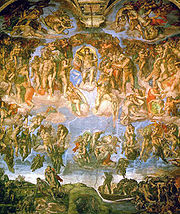
, a collection of canonical
books in two parts (the Old Testament
and the New Testament
), as authoritative. It is believed by Christians to have been written by human authors under the inspiration of the Holy Spirit, and therefore for many it is held to be the inerrant
Word of God. Protestant Christians believe that the Bible contains all revealed truth
necessary for salvation. This concept is known as Sola scriptura
. The books
that are considered canon in the Bible vary depending upon the denomination using or defining it. These variations are a reflection of the range of traditions and councils
that have convened on the subject. The Bible always includes books of the Jewish scriptures, the Tanakh
, and includes additional books and reorganizes them into two parts: the books of the Old Testament
primarily sourced from the Tanakh (with some variations), and the 27 books of the New Testament
containing books originally written primarily in Greek
. The Roman Catholic and Orthodox canons include other books from the Septuagint Greek Jewish canon which Roman Catholics call Deuterocanonical
. Protestants consider these books apocryphal
. Some versions of the Christian Bible have a separate Apocrypha section for the books not considered canonical by the publisher.
Roman Catholic theology distinguishes two senses of scripture: the literal and the spiritual.
The literal sense of understanding scripture is the meaning conveyed by the words of Scripture and discovered by exegesis, following the rules of sound interpretation. It has three subdivisions: the allegorical, moral, and anagogical
(meaning mystical or spiritual) senses.
Roman Catholic theology adds other rules of interpretation which include:
and is fairly non-specific, stating only that faith
and scientific findings
regarding human evolution
are not in conflict, specifically:
This view falls into the spectrum of viewpoints that are grouped under the concept of theistic evolution
(which is itself opposed by several other significant points-of-view; see Creation-evolution controversy
for further discussion).
controversies of the 4th and 5th centuries to become statements of faith.
The Apostles Creed (Symbolum Apostolorum) was developed between the 2nd and 9th centuries. It is the most popular creed used in worship by Western Christians. Its central doctrines are those of the Trinity and God the Creator. Each of the doctrines found in this creed can be traced to statements current in the apostolic period. The creed was apparently used as a summary of Christian doctrine for baptismal candidates in the churches of Rome.
The Nicene Creed
, largely a response to Arianism
, was formulated at the Councils of Nicaea
and Constantinople
in 325 and 381 respectively, and ratified as the universal creed of Christendom by the Council of Ephesus in 431.
The Chalcedonian Creed
, developed at the Council of Chalcedon
in 451,
though not accepted by the Oriental Orthodox Churches, taught Christ "to be acknowledged in two natures, inconfusedly, unchangeably, indivisibly, inseparably": one divine and one human, and that both natures are perfect but are nevertheless perfectly united into one person
.
The Athanasian Creed
, received in the western Church as having the same status as the Nicene and Chalcedonian, says: "We worship one God in Trinity, and Trinity in Unity; neither confounding the Persons nor dividing the Substance."
is the belief that the Pope and Catholic bishop
s are the spiritual successors of the original twelve apostles, through the historically unbroken chain of consecration (see: Holy Orders
). The Pope is the spiritual head and leader of the Roman Catholic Church who makes use of the Roman Curia
to assist him in governing. He is elected by the College of Cardinals
who may choose from any male member of the church but who must be ordained a bishop before taking office. Since the 15th century, a current cardinal has always been elected.
The New Testament
contains warnings against teachings considered to be only masquerading as Christianity, and shows how reference was made to the leaders of the church to decide what was true doctrine. The Catholic Church believes it is the continuation of those who remained faithful to the apostolic leadership and rejected false teachings.Papal infallibility
is the belief that when a pope speaks as head of the Church defining a doctrine concerning faith and morals to be held by the whole Church he does so without error because of the promises made by Jesus in his act of consecration of Peter as the foundation of his church.
of the church, of which the most important is the Eucharist
. According to the Catechism, these sacraments were instituted by Christ and entrusted to the church. They are vehicles through which God's grace flows into the person who receives them with the proper disposition. In order to obtain the proper disposition, individuals are encouraged to attend classes before being permitted by pastors to receive certain sacraments. Participation in the sacraments, offered to them through the church, is how Catholics obtain forgiveness of sins and formally ask for the Holy Spirit. These sacraments are: Baptism
, Confirmation, Eucharist
, Penance
, Anointing of the Sick
, Holy Orders
, Holy Matrimony
.jpg) Sunday is a Holy Day of Obligation
Sunday is a Holy Day of Obligation
for Catholics that requires them to attend Mass. At Mass, Catholics believe that they respond to Jesus' command to "do this in remembrance of me." In 1570 at the Council of Trent
, Pope Pius V
codified a standard book for the celebration of Mass for the Roman Rite. Everything in this decree pertained to the priest celebrant and his action at the altar. The participation of the people was devotional rather than liturgical. The Mass text was in Latin as this was the universal language of the church. This was called the Tridentine Mass
and endured universally up to Vatican II and the vernacular Mass known as the Novus Ordo Missae.
Catholic mass is separated into two parts. The first part is called Liturgy of the Word; readings from the Old
and New Testament
are read prior to the Gospel reading and priest's homily. The second part is called Liturgy of the Eucharist where the actual sacrament of the Eucharist is celebrated.
Catholics regard the Eucharist as the source and summit of the Christian life, and believe that the bread and wine brought to the altar are changed through the power of the Holy Spirit into the true Body and the true Blood of Christ. This is called transubstantiation
. The Holy Mass is a re-presentation of Christ's sacrifice on Calvary.
, the time of preparation for both the celebration of Jesus' birth and his second coming at the end of time, the liturgical year follows events in the life of Jesus. Christmas
follows Advent beginning on December 25, Christmas Eve, and ends on the feast of the baptism of Jesus on January 13.
Lent
is a time purification and penance that consists of the 40 days in each calendar year, excluding Sundays, that begin with Ash Wednesday
and end with Holy Saturday, the day before Easter Sunday.
The Easter (or Paschal) Triduum
("tri" as in "trip", "du" as "dew", "um" as in "hum") consists of three liturgies that are each practiced once per year in any Roman Catholic parish or community. The Holy Thursday evening Mass of the Lord's Supper
is the first of these liturgies. The Easter Triduum continues with the liturgy of Good Friday
, the only day of the year on which mass is not celebrated. The Easter Triduum culminates with the celebration of Jesus' resurrection, the most solemn observance of which is the Easter Vigil. The specific liturgy of the Easter Vigil is a mass celebrated only during the Saturday evening preceding Easter Sunday and contains ritual elements not performed at any other point in the liturgical year. Masses celebrated on Easter Sunday also celebrate the Resurrection but are closer in structure to other masses than is the Easter Vigil. These days recall Jesus' last supper with his disciples, his passion, death on the cross, his burial, and his resurrection on Easter Sunday. The season of Easter
follows the Triduum and climaxes on Pentecost
, recalling the descent of the Holy Spirit upon Jesus' disciples in the upper room.
The rest of the liturgical year is called Ordinary Time
.
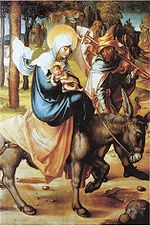 Catholic belief holds that the church exists both on earth and in heaven simultaneously and thus, the Virgin Mary and the saints are alive and part of the living church. Prayers and devotions to Mary and the saints are common practices in Catholic life. These devotions are not worship
, since only God is worshiped. The church teaches that the saints "do not cease to intercede with the Father for us... So by their fraternal concern is our weakness greatly helped."
Catholics venerate Mary with many loving titles such as "Blessed Virgin", "Mother of God,"
"Help of Christians", "Mother of the Faithful." She is given special honor and devotion above all other saints but this honor and devotion differs essentially from the adoration given to God. Catholics do not worship Mary but honor her as mother of Christ, mother of the church and as a spiritual mother to each believer of Christ. She is called the greatest of the saints, the first disciple, and Queen of Heaven
. Catholic belief encourages following her example of holiness. Prayers and devotions asking for her intercession, such as the rosary
, the Hail Mary
, and the Memorare
are common Catholic practice. The Church devotes several liturgical feasts to Mary. Although there are others, the major feasts of Mary celebrated on the liturgical calendar
are: The Immaculate Conception
, Mary, Mother of God, The Visitation
, The Assumption, The Nativity of the Blessed Virgin Mary; and in the Americas the Feast of Our Lady of Guadalupe
. Pilgrimages to Marian shrines like Lourdes
, France and Fátima, Portugal
are also a common form of devotion and prayer asking for her intercession.
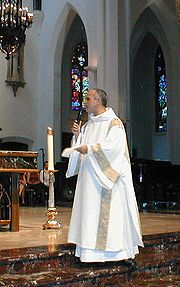 Men become bishops, priests or deacon
s through the sacrament of Holy Orders
. Candidates to the priesthood must have college degree in addition to another four to five years of seminary formation. This formation includes not only academic classes but also human, spiritual and pastoral education. The Catholic Church only ordains men, as the Twelve Apostles were all male. The Church teaches that women have a different yet equally important role in church ministry, prayer and life.
The bishops
are believed to possess the fullness of Christian priesthood; priests and deacons participate in the ministry of the bishop. As a body (the College of Bishops
) are considered to be the successors of the Apostles. The pope, cardinals, patriarchs, primates, archbishops and metropolitans
are all bishops and members of the Catholic Church episcopate or College of Bishops. Only bishops are allowed to perform the sacraments of holy orders and confirmation.
Many bishops head a diocese
, which is divided into parish
es. A parish is usually staffed by at least one priest. Beyond their pastoral activity, a priest may perform other functions, including study, research, teaching or office work. They may also be rectors or chaplain
s. Other titles or functions held by priests include those of Archimandrite
, Canon
Secular or Regular, Chancellor
, Chorbishop
, Confessor, Dean of a Cathedral Chapter, Hieromonk, Prebendary, Precentor, etc. Permanent deacons preach and teach. They may also baptize, lead the faithful in prayer, witness marriages, and conduct wake and funeral services. Candidates for the diaconate go through a diaconate formation program and must meet minimum standards set by the bishops' conference in their home country. Upon completion of their formation program and acceptance by their local bishop, candidates receive the sacrament of Holy Orders.
While deacons may be married, only celibate men are ordained as priests in the Latin Rite. Protestant clergy who have converted to the Catholic Church are sometimes excepted from this rule. The Eastern Rites ordain both celibate and married men. All rites of the Catholic Church maintain the ancient tradition that, after ordination, marriage is not allowed. A married priest whose wife dies may not remarry. Men with "transitory" homosexual leanings may be ordained deacons following three years of prayer and chastity, but men with "deeply rooted homosexual tendencies" who are sexually active cannot be ordained.
for Latin-Rite priests (while allowing very limited individual exceptions) is criticized for differing from Christian traditions issuing from the Protestant Reformation
, which apply no limitations, and even from the practice of the ancient Eastern Orthodox
and Eastern Catholic Churches, which, while requiring celibacy for bishops and priestmonks and excluding marriage by priests after ordination, do allow married men to be ordained to the priesthood. Some also claim that mandatory priestly celibacy appeared only in the Middle Ages
.
Some have argued that abolishing the rule of celibacy and opening the priesthood to women would update the Church's image as more relevant to modern society, and would help solve the problem of an insufficiency of candidates for priesthood in Western countries.
Many contend that maintaining the tradition in the modern age is unrealistic. In July 2006, Bishop Emmanuel Milingo
created the organization Married Priests Now!
. Responding to Milingo's November 2006 consecration of bishops, the Vatican stated "The value of the choice of priestly celibacy... has been reaffirmed."
s hold to certain traditional positions that have been rejected by mainstream society in the last half-century.
By contrast, "liberal Catholics" typically question some of the church's teachings on a variety of issues, e.g. artificial contraception
, clerical celibacy
, sexual morality
, and abortion.
Roman Catholic (term)
The term Roman Catholic appeared in the English language at the beginning of the 17th century, to differentiate specific groups of Christians in communion with the Pope from others; comparable terms in other languages already existed...
teachings" (cf Latin Rite) of the Catholic Church which bases its conclusions on Scripture
Bible
The Bible refers to any one of the collections of the primary religious texts of Judaism and Christianity. There is no common version of the Bible, as the individual books , their contents and their order vary among denominations...
and Sacred Tradition
Sacred Tradition
Sacred Tradition or Holy Tradition is a theological term used in some Christian traditions, primarily in the Roman Catholic, Anglican, Eastern Orthodox and Oriental Orthodox traditions, to refer to the fundamental basis of church authority....
, as interpreted by the Magisterium
Magisterium
In the Catholic Church the Magisterium is the teaching authority of the Church. This authority is understood to be embodied in the episcopacy, which is the aggregation of the current bishops of the Church in union with the Pope, led by the Bishop of Rome , who has authority over the bishops,...
. The Church teaches that salvation
Salvation
Within religion salvation is the phenomenon of being saved from the undesirable condition of bondage or suffering experienced by the psyche or soul that has arisen as a result of unskillful or immoral actions generically referred to as sins. Salvation may also be called "deliverance" or...
comes through faith in Jesus Christ, keeping of the Ten commandments
The Ten Commandments in Roman Catholic theology
Catholic doctrine regarding the Ten Commandments refers to the official teaching of the Catholic Church in their Catechism, concerning the Commandments listed in and , which are part of the covenant between God and the Israelites. Catholicism teaches that the commandments are essential for...
and receiving the sacraments. There are a number of teachings which differentiate the Latin Rite Catholic Church from other Christian churches and even from the Eastern Rite Catholic Churches
Eastern Rite Catholic Churches
The Eastern Catholic Churches are autonomous, self-governing particular churches in full communion with the Bishop of Rome, the Pope. Together with the Latin Church, they compose the worldwide Catholic Church...
. The most notable differences include Catholic beliefs in the existence of Purgatory
Purgatory
Purgatory is the condition or process of purification or temporary punishment in which, it is believed, the souls of those who die in a state of grace are made ready for Heaven...
, the Pope
Pope
The Pope is the Bishop of Rome, a position that makes him the leader of the worldwide Catholic Church . In the Catholic Church, the Pope is regarded as the successor of Saint Peter, the Apostle...
as the "Vicar of Christ on Earth", papal infallibility
Papal infallibility
Papal infallibility is a dogma of the Catholic Church which states that, by action of the Holy Spirit, the Pope is preserved from even the possibility of error when in his official capacity he solemnly declares or promulgates to the universal Church a dogmatic teaching on faith or morals...
, and the Immaculate Conception
Immaculate Conception
The Immaculate Conception of Mary is a dogma of the Roman Catholic Church, according to which the Virgin Mary was conceived without any stain of original sin. It is one of the four dogmata in Roman Catholic Mariology...
of Mary.
Church belief is encapsulated in the Nicene Creed
Nicene Creed
The Nicene Creed is the creed or profession of faith that is most widely used in Christian liturgy. It is called Nicene because, in its original form, it was adopted in the city of Nicaea by the first ecumenical council, which met there in the year 325.The Nicene Creed has been normative to the...
and the Apostle's Creed. Formal Catholic worship is ordered by means of the liturgy
Liturgy
Liturgy is either the customary public worship done by a specific religious group, according to its particular traditions or a more precise term that distinguishes between those religious groups who believe their ritual requires the "people" to do the "work" of responding to the priest, and those...
, which is regulated by church authority. The celebration of the Eucharist
Eucharist (Catholic Church)
"At the Last Supper, on the night he was betrayed, our Savior instituted the Eucharistic sacrifice of his Body and Blood."...
, one of seven church sacraments
Sacraments of the Catholic Church
The Sacraments of the Catholic Church are, the Roman Catholic Church teaches, "efficacious signs of grace, instituted by Christ and entrusted to the Church, by which divine life is dispensed to us. The visible rites by which the sacraments are celebrated signify and make present the graces proper...
, is considered the center of Catholic worship. However there are numerous additional forms of personal prayer and devotion including the Rosary
Rosary
The rosary or "garland of roses" is a traditional Catholic devotion. The term denotes the prayer beads used to count the series of prayers that make up the rosary...
, Stations of the Cross
Stations of the Cross
Stations of the Cross refers to the depiction of the final hours of Jesus, and the devotion commemorating the Passion. The tradition as chapel devotion began with St...
, and Eucharistic adoration
Eucharistic adoration
Eucharistic adoration is a practice in the Roman Catholic Church, and in a few Anglican and Lutheran churches, in which the Blessed Sacrament is exposed to and adored by the faithful....
. The church community consists of the ordained priesthood
Priesthood (Catholic Church)
The ministerial orders of the Catholic Church include the orders of bishops, deacons and presbyters, which in Latin is sacerdos. The ordained priesthood and common priesthood are different in function and essence....
and deaconate, those like monk
Monk
A monk is a person who practices religious asceticism, living either alone or with any number of monks, while always maintaining some degree of physical separation from those not sharing the same purpose...
s and nun
Nun
A nun is a woman who has taken vows committing her to live a spiritual life. She may be an ascetic who voluntarily chooses to leave mainstream society and live her life in prayer and contemplation in a monastery or convent...
s living a consecrated life under rule, and the laity
Laity
In religious organizations, the laity comprises all people who are not in the clergy. A person who is a member of a religious order who is not ordained legitimate clergy is considered as a member of the laity, even though they are members of a religious order .In the past in Christian cultures, the...
.
The Catholic Church is a trinitarian
Trinity
The Christian doctrine of the Trinity defines God as three divine persons : the Father, the Son , and the Holy Spirit. The three persons are distinct yet coexist in unity, and are co-equal, co-eternal and consubstantial . Put another way, the three persons of the Trinity are of one being...
Christian
Christianity
Christianity is a monotheistic religion based on the life and teachings of Jesus as presented in canonical gospels and other New Testament writings...
church whose beliefs are detailed in the Catechism of the Catholic Church
Catechism of the Catholic Church
The Catechism of the Catholic Church is the official text of the teachings of the Catholic Church. A provisional, "reference text" was issued by Pope John Paul II on October 11, 1992 — "the thirtieth anniversary of the opening of the Second Vatican Ecumenical Council" — with his apostolic...
. The Nicene Creed
Nicene Creed
The Nicene Creed is the creed or profession of faith that is most widely used in Christian liturgy. It is called Nicene because, in its original form, it was adopted in the city of Nicaea by the first ecumenical council, which met there in the year 325.The Nicene Creed has been normative to the...
, sets out the main principles of Catholic Christian belief. This creed is recited at Sunday Masses and is the core statement of belief in many other Christian churches as well. Catholic teachings have been refined and clarified by major councils of the Church
Ecumenical council
An ecumenical council is a conference of ecclesiastical dignitaries and theological experts convened to discuss and settle matters of Church doctrine and practice....
, convened by Church leaders at important points throughout history. The first such council, the Council of Jerusalem
Council of Jerusalem
The Council of Jerusalem is a name applied by historians and theologians to an Early Christian council that was held in Jerusalem and dated to around the year 50. It is considered by Catholics and Orthodox to be a prototype and forerunner of the later Ecumenical Councils...
was convened by the apostles around the year 50. The most recent was Vatican II, which closed in 1965.
Holy Spirit
Holy Spirit is a term introduced in English translations of the Hebrew Bible, but understood differently in the main Abrahamic religions.While the general concept of a "Spirit" that permeates the cosmos has been used in various religions Holy Spirit is a term introduced in English translations of...
, and that it is protected by divine revelation from falling into error on certain fundamental doctrines
Infallibility of the Church
The Infallibility of the Church is the belief that the Holy Spirit will not allow the Church to err in its belief or teaching under certain circumstances...
. It bases this belief on biblical promises that Jesus made to his apostles. In the Gospel of Matthew, Jesus tells Peter, "... the gates of hell will not prevail against" the church, and in the Gospel of John, Jesus states, "I have much more to tell you, but you cannot bear it now. But when he comes, the Spirit of truth, he will guide you to all truth". According to the church, the Holy Spirit reveals God's truth through Sacred Scripture
Books of the Bible
The Books of the Bible are listed differently in the canons of Judaism and the Catholic, Protestant, Greek Orthodox, Slavonic Orthodox, Georgian, Armenian Apostolic, Syriac and Ethiopian churches, although there is substantial overlap. A table comparing the canons of some of these traditions...
, Sacred Tradition
Sacred Tradition
Sacred Tradition or Holy Tradition is a theological term used in some Christian traditions, primarily in the Roman Catholic, Anglican, Eastern Orthodox and Oriental Orthodox traditions, to refer to the fundamental basis of church authority....
and the Magisterium
Magisterium
In the Catholic Church the Magisterium is the teaching authority of the Church. This authority is understood to be embodied in the episcopacy, which is the aggregation of the current bishops of the Church in union with the Pope, led by the Bishop of Rome , who has authority over the bishops,...
. Sacred Tradition consists of those beliefs handed down through the church since the time of the Apostles. Sacred Scripture and Sacred Tradition are collectively known as the deposit of faith. This is in turn interpreted by the Magisterium, or the teaching authority of the Church. The Magisterium includes those pronouncements of the pope that are considered infallible
Papal infallibility
Papal infallibility is a dogma of the Catholic Church which states that, by action of the Holy Spirit, the Pope is preserved from even the possibility of error when in his official capacity he solemnly declares or promulgates to the universal Church a dogmatic teaching on faith or morals...
, as well as the pronouncements of ecumenical councils and those of the college of bishops
College of Bishops
The term "College of Bishops" is used in Catholic theology to denote the bishops in communion with the Pope as a body, not as individuals...
in union with the pope when they condemn false interpretations of scripture or define truths.
According to the Catechism, Christ instituted seven sacraments
Sacraments of the Catholic Church
The Sacraments of the Catholic Church are, the Roman Catholic Church teaches, "efficacious signs of grace, instituted by Christ and entrusted to the Church, by which divine life is dispensed to us. The visible rites by which the sacraments are celebrated signify and make present the graces proper...
and entrusted them to the Church. These are Baptism
Baptism
In Christianity, baptism is for the majority the rite of admission , almost invariably with the use of water, into the Christian Church generally and also membership of a particular church tradition...
, Confirmation, the Eucharist
Eucharist
The Eucharist , also called Holy Communion, the Sacrament of the Altar, the Blessed Sacrament, the Lord's Supper, and other names, is a Christian sacrament or ordinance...
, Penance
Penance
Penance is repentance of sins as well as the proper name of the Roman Catholic, Orthodox Christian, and Anglican Sacrament of Penance and Reconciliation/Confession. It also plays a part in non-sacramental confession among Lutherans and other Protestants...
, the Anointing of the Sick
Anointing of the Sick
Anointing of the Sick, known also by other names, is distinguished from other forms of religious anointing or "unction" in that it is intended, as its name indicates, for the benefit of a sick person...
, Holy Orders
Holy Orders
The term Holy Orders is used by many Christian churches to refer to ordination or to those individuals ordained for a special role or ministry....
and Holy Matrimony
Christian views of marriage
Christian views on marriage typically regard it as instituted and ordained by God for the lifelong relationship between one man as husband and one woman as wife, and is to be "held in honour among all...."...
. They are vehicles through which God's grace
Divine grace
In Christian theology, grace is God’s gift of God’s self to humankind. It is understood by Christians to be a spontaneous gift from God to man - "generous, free and totally unexpected and undeserved" - that takes the form of divine favour, love and clemency. It is an attribute of God that is most...
is said to flow into all those who receive them with the proper disposition. The Church encourages individuals to engage in adequate preparation before receiving certain sacraments.
The beliefs of other Christian denominations differ from those of Catholics in varying degrees. Eastern Orthodox
Eastern Orthodox Church
The Orthodox Church, officially called the Orthodox Catholic Church and commonly referred to as the Eastern Orthodox Church, is the second largest Christian denomination in the world, with an estimated 300 million adherents mainly in the countries of Belarus, Bulgaria, Cyprus, Georgia, Greece,...
belief differs mainly with regard to papal infallibility
Papal infallibility
Papal infallibility is a dogma of the Catholic Church which states that, by action of the Holy Spirit, the Pope is preserved from even the possibility of error when in his official capacity he solemnly declares or promulgates to the universal Church a dogmatic teaching on faith or morals...
, the filioque clause
Filioque clause
Filioque , Latin for "and the Son", is a phrase found in the form of Nicene Creed in use in the Latin Church. It is not present in the Greek text of the Nicene Creed as originally formulated at the First Council of Constantinople, which says only that the Holy Spirit proceeds "from the Father":The...
and the immaculate conception
Immaculate Conception
The Immaculate Conception of Mary is a dogma of the Roman Catholic Church, according to which the Virgin Mary was conceived without any stain of original sin. It is one of the four dogmata in Roman Catholic Mariology...
of Mary, but is otherwise quite similar. Protestant
Protestantism
Protestantism is one of the three major groupings within Christianity. It is a movement that began in Germany in the early 16th century as a reaction against medieval Roman Catholic doctrines and practices, especially in regards to salvation, justification, and ecclesiology.The doctrines of the...
churches vary in their beliefs, but they generally differ from Catholics regarding the authority of the pope and church tradition, as well as the role of Mary
Mary (mother of Jesus)
Mary , commonly referred to as "Saint Mary", "Mother Mary", the "Virgin Mary", the "Blessed Virgin Mary", or "Mary, Mother of God", was a Jewish woman of Nazareth in Galilee...
and the saint
Saint
A saint is a holy person. In various religions, saints are people who are believed to have exceptional holiness.In Christian usage, "saint" refers to any believer who is "in Christ", and in whom Christ dwells, whether in heaven or in earth...
s, the role of the priesthood
Priesthood (Catholic Church)
The ministerial orders of the Catholic Church include the orders of bishops, deacons and presbyters, which in Latin is sacerdos. The ordained priesthood and common priesthood are different in function and essence....
, and issues pertaining to grace
Divine grace
In Christian theology, grace is God’s gift of God’s self to humankind. It is understood by Christians to be a spontaneous gift from God to man - "generous, free and totally unexpected and undeserved" - that takes the form of divine favour, love and clemency. It is an attribute of God that is most...
, good works and salvation
Salvation
Within religion salvation is the phenomenon of being saved from the undesirable condition of bondage or suffering experienced by the psyche or soul that has arisen as a result of unskillful or immoral actions generically referred to as sins. Salvation may also be called "deliverance" or...
. The five solas
Five solas
The Five solas are five Latin phrases that emerged during the Protestant Reformation and summarize the Reformers' basic theological beliefs in contradistinction to the teaching of the Roman Catholic Church of the day. The Latin word sola means "alone" or "only" in English...
were one attempt to express these differences.
The Trinity
Bible
The Bible refers to any one of the collections of the primary religious texts of Judaism and Christianity. There is no common version of the Bible, as the individual books , their contents and their order vary among denominations...
, and now held to coexist with the Father), and 'the Holy Spirit' (sometimes referred to as 'the Holy Ghost'). Together, these three persons are sometimes called the Godhead
Godhead (Christianity)
Godhead is a Middle English variant of the word godhood, and denotes the Divine Nature or Substance of the Christian God, or the Trinity. Within some traditions such as Mormonism, the term is used as a nontrinitarian substitute for the term Trinity, denoting the Father, Son, and Holy Spirit not as...
although there is no single term in use in Scripture to denote the unified Godhead. In the words of the Athanasian Creed
Athanasian Creed
The Athanasian Creed is a Christian statement of belief, focusing on Trinitarian doctrine and Christology. The Latin name of the creed, Quicumque vult, is taken from the opening words, "Whosoever wishes." The Athanasian Creed has been used by Christian churches since the sixth century...
, an early statement of Christian belief, "the Father is God, the Son is God, and the Holy Spirit is God, and yet there are not three Gods but one God.".
According to this doctrine, God is not divided in the sense that each person has a third of the whole; rather, each person is considered to be fully God (see Perichoresis
Perichoresis
Perichoresis is a term in Christian theology first found within the Church Fathers but now reinvigorated among contemporary figures such as C. Baxter Kruger, Jurgen Moltmann, Miroslav Volf and John Zizioulas, amongst others. The term first appears in Gregory of Nazianzus but was explored more...
). The distinction lies in their relations, the Father being unbegotten; the Son being eternal yet begotten of the Father; and the Holy Spirit 'proceeding' from Father and (in Western theology) from the Son. Regardless of this apparent difference in their origins, the three 'persons' are each eternal
Eternity
While in the popular mind, eternity often simply means existence for a limitless amount of time, many have used it to refer to a timeless existence altogether outside time. By contrast, infinite temporal existence is then called sempiternity. Something eternal exists outside time; by contrast,...
and omnipotent. This is thought by Trinitarian Christians to be the revelation regarding God's nature which Jesus Christ came to deliver to the world, and is the foundation of their belief system.
The word trias, from which trinity is derived, is first seen in the works of Theophilus of Antioch
Theophilus of Antioch
Theophilus, Patriarch of Antioch, succeeded Eros c. 169, and was succeeded by Maximus I c.183, according to Henry Fynes Clinton, but these dates are only approximations...
. He wrote of "the Trinity of God (the Father), His Word (the Son) and His Wisdom (Holy Spirit)". The term may have been in use before this time. Afterwards it appears in Tertullian
Tertullian
Quintus Septimius Florens Tertullianus, anglicised as Tertullian , was a prolific early Christian author from Carthage in the Roman province of Africa. He is the first Christian author to produce an extensive corpus of Latin Christian literature. He also was a notable early Christian apologist and...
. In the following century the word was in general use. It is found in many passages of Origen
Origen
Origen , or Origen Adamantius, 184/5–253/4, was an early Christian Alexandrian scholar and theologian, and one of the most distinguished writers of the early Church. As early as the fourth century, his orthodoxy was suspect, in part because he believed in the pre-existence of souls...
.
God the Father and the Creator
Angel
Angels are mythical beings often depicted as messengers of God in the Hebrew and Christian Bibles along with the Quran. The English word angel is derived from the Greek ἄγγελος, a translation of in the Hebrew Bible ; a similar term, ملائكة , is used in the Qur'an...
s.
Jesus the Son of God
Catholics believe that Jesus is God incarnateIncarnation (Christianity)
The Incarnation in traditional Christianity is the belief that Jesus Christ the second person of the Trinity, also known as God the Son or the Logos , "became flesh" by being conceived in the womb of a woman, the Virgin Mary, also known as the Theotokos .The Incarnation is a fundamental theological...
and "true God and true man
Hypostatic union
Hypostatic union is a technical term in Christian theology employed in mainstream Christology to describe the union of Christ's humanity and divinity in one hypostasis.The First Council of Ephesus recognised this doctrine and affirmed its importance, stating that the...
" (or both fully divine and fully human). Jesus, having become fully human
Incarnation (Christianity)
The Incarnation in traditional Christianity is the belief that Jesus Christ the second person of the Trinity, also known as God the Son or the Logos , "became flesh" by being conceived in the womb of a woman, the Virgin Mary, also known as the Theotokos .The Incarnation is a fundamental theological...
, suffered the pains and temptations of a mortal man, yet he did not sin. As fully God, he defeated death and rose to life again. According to the Bible
Bible
The Bible refers to any one of the collections of the primary religious texts of Judaism and Christianity. There is no common version of the Bible, as the individual books , their contents and their order vary among denominations...
, "God raised him from the dead," he ascended to heaven
Heaven
Heaven, the Heavens or Seven Heavens, is a common religious cosmological or metaphysical term for the physical or transcendent place from which heavenly beings originate, are enthroned or inhabit...
, is "seated at the right hand of the Father" and will return again
Second Coming
In Christian doctrine, the Second Coming of Christ, the Second Advent, or the Parousia, is the anticipated return of Jesus Christ from Heaven, where he sits at the Right Hand of God, to Earth. This prophecy is found in the canonical gospels and in most Christian and Islamic eschatologies...
to fulfil the rest of Messianic prophecy such as the Resurrection of the dead
Resurrection of the dead
Resurrection of the Dead is a belief found in a number of eschatologies, most commonly in Christian, Islamic, Jewish and Zoroastrian. In general, the phrase refers to a specific event in the future; multiple prophesies in the histories of these religions assert that the dead will be brought back to...
, the Last Judgment
Last Judgment
The Last Judgment, Final Judgment, Day of Judgment, Judgment Day, or The Day of the Lord in Christian theology, is the final and eternal judgment by God of every nation. The concept is found in all the Canonical gospels, particularly the Gospel of Matthew. It will purportedly take place after the...
and final establishment of the Kingdom of God
Kingdom of God
The Kingdom of God or Kingdom of Heaven is a foundational concept in the Abrahamic religions: Judaism, Christianity and Islam.The term "Kingdom of God" is found in all four canonical gospels and in the Pauline epistles...
.
According to the Gospel
Gospel
A gospel is an account, often written, that describes the life of Jesus of Nazareth. In a more general sense the term "gospel" may refer to the good news message of the New Testament. It is primarily used in reference to the four canonical gospels of Matthew, Mark, Luke, and John...
s of Matthew
Gospel of Matthew
The Gospel According to Matthew is one of the four canonical gospels, one of the three synoptic gospels, and the first book of the New Testament. It tells of the life, ministry, death, and resurrection of Jesus of Nazareth...
and Luke
Gospel of Luke
The Gospel According to Luke , commonly shortened to the Gospel of Luke or simply Luke, is the third and longest of the four canonical Gospels. This synoptic gospel is an account of the life and ministry of Jesus of Nazareth. It details his story from the events of his birth to his Ascension.The...
, Jesus was conceived
Incarnation (Christianity)
The Incarnation in traditional Christianity is the belief that Jesus Christ the second person of the Trinity, also known as God the Son or the Logos , "became flesh" by being conceived in the womb of a woman, the Virgin Mary, also known as the Theotokos .The Incarnation is a fundamental theological...
by the Holy Spirit
Holy Spirit
Holy Spirit is a term introduced in English translations of the Hebrew Bible, but understood differently in the main Abrahamic religions.While the general concept of a "Spirit" that permeates the cosmos has been used in various religions Holy Spirit is a term introduced in English translations of...
and born
Nativity of Jesus
The Nativity of Jesus, or simply The Nativity, refers to the accounts of the birth of Jesus in two of the Canonical gospels and in various apocryphal texts....
from the Virgin Mary
Mary (mother of Jesus)
Mary , commonly referred to as "Saint Mary", "Mother Mary", the "Virgin Mary", the "Blessed Virgin Mary", or "Mary, Mother of God", was a Jewish woman of Nazareth in Galilee...
. Little of Jesus' childhood is recorded in the canonical Gospels, however infancy Gospels were popular in antiquity. In comparison, his adulthood, especially the week before his death, are well documented in the Gospels contained within the New Testament
New Testament
The New Testament is the second major division of the Christian biblical canon, the first such division being the much longer Old Testament....
. The Biblical accounts of Jesus' ministry include: his baptism
Baptism of Jesus
The baptism of Jesus marks the beginning of Jesus Christ's public ministry. This event is recorded in the Canonical Gospels of Matthew, Mark and Luke. In John 1:29-33 rather than a direct narrative, the Baptist bears witness to the episode...
, miracles, preaching, teaching, and deeds
Ministry of Jesus
In the Christian gospels, the Ministry of Jesus begins with his Baptism in the countryside of Judea, near the River Jordan and ends in Jerusalem, following the Last Supper with his disciples. The Gospel of Luke states that Jesus was "about 30 years of age" at the start of his ministry...
.
The Holy Spirit
Jesus told his apostles that after his death and resurrectionDeath and Resurrection of Jesus
The Christian belief in the resurrection of Jesus states that Jesus returned to bodily life on the third day following his death by crucifixion. It is a key element of Christian faith and theology and part of the Nicene Creed: "On the third day he rose again in fulfillment of the Scriptures"...
he would send them the "Advocate", the "Holy Spirit
Holy Spirit
Holy Spirit is a term introduced in English translations of the Hebrew Bible, but understood differently in the main Abrahamic religions.While the general concept of a "Spirit" that permeates the cosmos has been used in various religions Holy Spirit is a term introduced in English translations of...
", who "will teach you everything and remind you of all that I told you". In the Gospel of Luke, Jesus tells his disciples "If you then, who are evil, know how to give good gifts to your children, how much more will the heavenly Father give the Holy Spirit to those who ask him!" The Nicene Creed states that the Holy Spirit is one with God the Father and God the Son (Jesus) thus, for Catholics, receiving the Holy Spirit is receiving God, the source of all that is good. Catholics formally ask for and receive the Holy Spirit through the sacrament of Confirmation. Sometimes called the sacrament of Christian maturity, Confirmation is believed to bring an increase and deepening of the grace received at Baptism. Spiritual graces or gifts of the Holy Spirit can include wisdom to see and follow God's plan, right judgment, love for others, courage in witnessing the faith, knowledge, reverence, and rejoicing in the presence of God. The corresponding fruits of the Holy Spirit
Fruits of the Holy Spirit
Fruit of the Holy Spirit is the descriptive name given by the Apostle Paul to a nine-point list of Christ-like attributes of a true Christian life. In the...
are love, joy, peace, patience, kindness, goodness, faithfulness, gentleness, and self control. To be validly confirmed, a person must be in a state of grace, which means that they cannot be conscious of having committed a mortal sin. They must also have prepared spiritually for the sacrament, chosen a sponsor or godparent
Godparent
A godparent, in many denominations of Christianity, is someone who sponsors a child's baptism. A male godparent is a godfather, and a female godparent is a godmother...
for spiritual support, and selected a saint
Saint
A saint is a holy person. In various religions, saints are people who are believed to have exceptional holiness.In Christian usage, "saint" refers to any believer who is "in Christ", and in whom Christ dwells, whether in heaven or in earth...
to be their special patron and intercessor.
Soteriology
SoteriologySoteriology
The branch of Christian theology that deals with salvation and redemption is called Soteriology. It is derived from the Greek sōtērion + English -logy....
is the branch of Christian doctrinal theology
Theology
Theology is the systematic and rational study of religion and its influences and of the nature of religious truths, or the learned profession acquired by completing specialized training in religious studies, usually at a university or school of divinity or seminary.-Definition:Augustine of Hippo...
that deals with salvation through Jesus Christ. Some Christians believe salvation
Salvation
Within religion salvation is the phenomenon of being saved from the undesirable condition of bondage or suffering experienced by the psyche or soul that has arisen as a result of unskillful or immoral actions generically referred to as sins. Salvation may also be called "deliverance" or...
is a gift by means of the unmerited grace of God
Divine grace
In Christian theology, grace is God’s gift of God’s self to humankind. It is understood by Christians to be a spontaneous gift from God to man - "generous, free and totally unexpected and undeserved" - that takes the form of divine favour, love and clemency. It is an attribute of God that is most...
. Some Christians believe that, through faith in Jesus, one can be saved from sin
Sin
In religion, sin is the violation or deviation of an eternal divine law or standard. The term sin may also refer to the state of having committed such a violation. Christians believe the moral code of conduct is decreed by God In religion, sin (also called peccancy) is the violation or deviation...
and eternal death. The crucifixion of Jesus is explained as an atoning sacrifice, which, in the words of the Gospel of John
Gospel of John
The Gospel According to John , commonly referred to as the Gospel of John or simply John, and often referred to in New Testament scholarship as the Fourth Gospel, is an account of the public ministry of Jesus...
, "takes away the sins of the world." One's reception of salvation is related to justification
Justification (theology)
Rising out of the Protestant Reformation, Justification is the chief article of faith describing God's act of declaring or making a sinner righteous through Christ's atoning sacrifice....
.
The Fall
According to church teaching, in an event known as the "fall of the angels" a number of angels chose to rebel against God and his reign. The leader of this rebellion has been given many names including "Lucifer" (meaning "light bearer" in Latin), "Satan" and the devilDevil in Christianity
In mainstream Christianity, the Devil is named Satan, and sometimes Lucifer. He is a fallen angel who rebelled against God. He is often identified as the serpent in the Garden of Eden, whose persuasions led to original sin and the need for Jesus Christ's redemption...
. The sin of pride, considered one of seven deadly sins
Seven deadly sins
The 7 Deadly Sins, also known as the Capital Vices or Cardinal Sins, is a classification of objectionable vices that have been used since early Christian times to educate and instruct followers concerning fallen humanity's tendency to sin...
, is attributed to Satan for desiring to be God's equal. A fallen angel
Fallen angel
Fallen angel is a concept developed in Jewish mythology from interpretation of the Book of Enoch. The actual term fallen angel is not found in either the Hebrew Bible or the New Testament. Christians adopted the concept of fallen angels mainly based on their interpretations of the Book of...
tempted the first humans, Adam and Eve
Adam and Eve
Adam and Eve were, according to the Genesis creation narratives, the first human couple to inhabit Earth, created by YHWH, the God of the ancient Hebrews...
, who then committed the original sin which brought suffering and death into the world. This event, known as the Fall of Man, left humans separated from their original state of intimacy with God, a separation that can persist beyond death. The Catechism states that
resulting in
Sin
Christians classify certain behaviors and acts to be "Sinful". Which means that these certain acts are a violation of conscience or divine law. Roman Catholics make a distinction between two types of sin. Mortal sinMortal sin
Mortal sins are in the theology of some, but not all Christian denominations wrongful acts that condemn a person to Hell after death. These sins are considered "mortal" because they constitute a rupture in a person's link to God's saving grace: the person's soul becomes "dead", not merely weakened...
is a "grave violation of God's law" that "turns man away from God", and if it is not redeemed by repentance and God's forgiveness, it can cause exclusion from Christ's kingdom and the eternal death of hell.
In contrast, venial sin
Venial sin
According to Roman Catholicism, a venial sin is a lesser sin that does not result in a complete separation from God and eternal damnation in Hell...
(meaning "forgivable" sin) "does not set us in direct opposition to the will and friendship of God" and, although still "constituting a moral disorder", does not deprive the sinner of friendship with God, and consequently the eternal happiness of heaven.
Jesus Christ as Savior
Old Testament
The Old Testament, of which Christians hold different views, is a Christian term for the religious writings of ancient Israel held sacred and inspired by Christians which overlaps with the 24-book canon of the Masoretic Text of Judaism...
, God promised to send his people a savior. The Church believes that this savior was Jesus whom John the Baptist
John the Baptist
John the Baptist was an itinerant preacher and a major religious figure mentioned in the Canonical gospels. He is described in the Gospel of Luke as a relative of Jesus, who led a movement of baptism at the Jordan River...
called "the lamb of God who takes away the sin of the world". The Nicene Creed refers to Jesus as "the only begotten son of God, ... one in being with the Father. Through him all things were made." In a supernatural event called the Incarnation
Incarnation (Christianity)
The Incarnation in traditional Christianity is the belief that Jesus Christ the second person of the Trinity, also known as God the Son or the Logos , "became flesh" by being conceived in the womb of a woman, the Virgin Mary, also known as the Theotokos .The Incarnation is a fundamental theological...
, Catholics believe that God came down from heaven for our salvation, became man through the power of the Holy Spirit and was born of a virgin Jewish girl named Mary
Mary (mother of Jesus)
Mary , commonly referred to as "Saint Mary", "Mother Mary", the "Virgin Mary", the "Blessed Virgin Mary", or "Mary, Mother of God", was a Jewish woman of Nazareth in Galilee...
. They believe that Jesus' mission on earth included giving people his word and example to follow, as recorded in the four Gospel
Gospel
A gospel is an account, often written, that describes the life of Jesus of Nazareth. In a more general sense the term "gospel" may refer to the good news message of the New Testament. It is primarily used in reference to the four canonical gospels of Matthew, Mark, Luke, and John...
s. The Church teaches that following the example of Jesus helps believers to grow more like him, and therefore to true love, freedom, and the fullness of life.
The focus of a Christian's life is a firm belief in Jesus
Jesus
Jesus of Nazareth , commonly referred to as Jesus Christ or simply as Jesus or Christ, is the central figure of Christianity...
as the Son of God
Son of God
"Son of God" is a phrase which according to most Christian denominations, Trinitarian in belief, refers to the relationship between Jesus and God, specifically as "God the Son"...
and the "Messiah
Messiah
A messiah is a redeemer figure expected or foretold in one form or another by a religion. Slightly more widely, a messiah is any redeemer figure. Messianic beliefs or theories generally relate to eschatological improvement of the state of humanity or the world, in other words the World to...
" or "Christ
Christ
Christ is the English term for the Greek meaning "the anointed one". It is a translation of the Hebrew , usually transliterated into English as Messiah or Mashiach...
". The title "Messiah" comes from the Hebrew
Hebrew language
Hebrew is a Semitic language of the Afroasiatic language family. Culturally, is it considered by Jews and other religious groups as the language of the Jewish people, though other Jewish languages had originated among diaspora Jews, and the Hebrew language is also used by non-Jewish groups, such...
word מָשִׁיחַ (māšiáħ) meaning anointed one. The Greek translation (Christos) is the source of the English word "Christ".
Christians believe that, as the Messiah, Jesus was anointed
Anointing
To anoint is to pour or smear with perfumed oil, milk, water, melted butter or other substances, a process employed ritually by many religions. People and things are anointed to symbolize the introduction of a sacramental or divine influence, a holy emanation, spirit, power or God...
by God as ruler and savior of humanity, and hold that Jesus' coming was the fulfillment of messianic prophecies
Messianic prophecies of Jesus
Jews and Christians do not agree on what Biblical statements constitute messianic prophecies. Christians point to many statements that they assert are messianic prophecies that Jews do not hold as referring to the Jewish Messiah at all....
of the Old Testament
Old Testament
The Old Testament, of which Christians hold different views, is a Christian term for the religious writings of ancient Israel held sacred and inspired by Christians which overlaps with the 24-book canon of the Masoretic Text of Judaism...
. The Christian concept of the Messiah differs significantly from the contemporary Jewish concept
Jewish Messiah
Messiah, ; mashiah, moshiah, mashiach, or moshiach, is a term used in the Hebrew Bible to describe priests and kings, who were traditionally anointed with holy anointing oil as described in Exodus 30:22-25...
. The core Christian belief is that, through the death and resurrection of Jesus
Death and Resurrection of Jesus
The Christian belief in the resurrection of Jesus states that Jesus returned to bodily life on the third day following his death by crucifixion. It is a key element of Christian faith and theology and part of the Nicene Creed: "On the third day he rose again in fulfillment of the Scriptures"...
, sinful
Original sin
Original sin is, according to a Christian theological doctrine, humanity's state of sin resulting from the Fall of Man. This condition has been characterized in many ways, ranging from something as insignificant as a slight deficiency, or a tendency toward sin yet without collective guilt, referred...
humans can be reconciled to God and thereby are offered salvation and the promise of eternal life
Immortality
Immortality is the ability to live forever. It is unknown whether human physical immortality is an achievable condition. Biological forms have inherent limitations which may or may not be able to be overcome through medical interventions or engineering...
.
Roman Catholics believe in the resurrection of Jesus. According to the New Testament
New Testament
The New Testament is the second major division of the Christian biblical canon, the first such division being the much longer Old Testament....
, Jesus
Jesus
Jesus of Nazareth , commonly referred to as Jesus Christ or simply as Jesus or Christ, is the central figure of Christianity...
, the central figure of Christianity, was crucified
Crucifixion
Crucifixion is an ancient method of painful execution in which the condemned person is tied or nailed to a large wooden cross and left to hang until dead...
, died, buried within a tomb, and resurrected three days later. The New Testament mentions several resurrection appearances of Jesus
Resurrection appearances of Jesus
The major Resurrection appearances of Jesus in the Canonical gospels are reported to have occurred after his death, burial and resurrection, but prior to his Ascension. Among these primary sources, most scholars believe First Corinthians was written first, authored by Paul of Tarsus along with...
on different occasions to his twelve apostles and disciples, including "more than five hundred brethren at once", before Jesus' Ascension. Jesus's death and resurrection are the essential doctrines of the Christian faith, and are commemorated by Christians during Good Friday
Good Friday
Good Friday , is a religious holiday observed primarily by Christians commemorating the crucifixion of Jesus Christ and his death at Calvary. The holiday is observed during Holy Week as part of the Paschal Triduum on the Friday preceding Easter Sunday, and may coincide with the Jewish observance of...
and Easter
Easter
Easter is the central feast in the Christian liturgical year. According to the Canonical gospels, Jesus rose from the dead on the third day after his crucifixion. His resurrection is celebrated on Easter Day or Easter Sunday...
, particularly during the liturgical time
Liturgical year
The liturgical year, also known as the church year, consists of the cycle of liturgical seasons in Christian churches which determines when feast days, including celebrations of saints, are to be observed, and which portions of Scripture are to be read. Distinct liturgical colours may appear in...
of Holy Week
Holy Week
Holy Week in Christianity is the last week of Lent and the week before Easter...
. Arguments over death and resurrection claims occur at many religious debate
Debate
Debate or debating is a method of interactive and representational argument. Debate is a broader form of argument than logical argument, which only examines consistency from axiom, and factual argument, which only examines what is or isn't the case or rhetoric which is a technique of persuasion...
s and interfaith dialogues
Interfaith
The term interfaith dialogue refers to cooperative, constructive and positive interaction between people of different religious traditions and/or spiritual or humanistic beliefs, at both the individual and institutional levels...
.
As Paul the Apostle, an early Christian convert, wrote, "If Christ was not raised, then all our preaching is useless, and your trust in God is useless". The death and resurrection of Jesus are the most important events in Christian Theology
Christian theology
- Divisions of Christian theology :There are many methods of categorizing different approaches to Christian theology. For a historical analysis, see the main article on the History of Christian theology.- Sub-disciplines :...
, as they form the point in scripture where Jesus gives his ultimate demonstration that he has power over life and death and thus the ability to give people eternal life
Eternal life (Christianity)
In Christianity the term eternal life traditionally refers to continued life after death, rather than immortality. While scholars such as John H. Leith assert that...
.
Generally, Christian churches accept and teach the New Testament account of the resurrection of Jesus. Some modern scholars use the belief of Jesus' followers in the resurrection as a point of departure for establishing the continuity of the historical Jesus and the proclamation of the early church. Some liberal Christians
Liberal Christianity
Liberal Christianity, sometimes called liberal theology, is an umbrella term covering diverse, philosophically and biblically informed religious movements and ideas within Christianity from the late 18th century and onward...
do not accept a literal bodily resurrection, seeing the story as richly symbolic and spiritually nourishing myth
Mythology
The term mythology can refer either to the study of myths, or to a body or collection of myths. As examples, comparative mythology is the study of connections between myths from different cultures, whereas Greek mythology is the body of myths from ancient Greece...
.
The Church teaches that through the passion
Passion (Christianity)
The Passion is the Christian theological term used for the events and suffering – physical, spiritual, and mental – of Jesus in the hours before and including his trial and execution by crucifixion...
of Jesus and his crucifixion
Crucifixion of Jesus
The crucifixion of Jesus and his ensuing death is an event that occurred during the 1st century AD. Jesus, who Christians believe is the Son of God as well as the Messiah, was arrested, tried, and sentenced by Pontius Pilate to be scourged, and finally executed on a cross...
, all people have an opportunity for forgiveness and freedom from sin, and so can be reconciled to God.
Sinning is the opposite of following Jesus, robbing people of their resemblance to God while turning their souls away from God's love. People can sin by failing to obey the Ten Commandments
Ten Commandments
The Ten Commandments, also known as the Decalogue , are a set of biblical principles relating to ethics and worship, which play a fundamental role in Judaism and most forms of Christianity. They include instructions to worship only God and to keep the Sabbath, and prohibitions against idolatry,...
, failing to love God, and failing to love other people. Some sins are more serious than others, ranging from lesser, venial sin
Venial sin
According to Roman Catholicism, a venial sin is a lesser sin that does not result in a complete separation from God and eternal damnation in Hell...
s, to grave, mortal sin
Mortal sin
Mortal sins are in the theology of some, but not all Christian denominations wrongful acts that condemn a person to Hell after death. These sins are considered "mortal" because they constitute a rupture in a person's link to God's saving grace: the person's soul becomes "dead", not merely weakened...
s that sever a person's relationship with God.
Afterlife and Eschaton
The Nicene Creed ends with, "We look for the resurrection of the dead and the life of the world to come." Accordingly, the Church teaches that each soulSoul
A soul in certain spiritual, philosophical, and psychological traditions is the incorporeal essence of a person or living thing or object. Many philosophical and spiritual systems teach that humans have souls, and others teach that all living things and even inanimate objects have souls. The...
will appear before the judgment seat of Christ immediately after death and receive a particular judgment
Particular judgment
Particular judgment, according to Christian eschatology, is the judgment given by God that a departed person undergoes immediately after death, in contradistinction to the General judgment of all people at the end of the world....
based on the deeds of their earthly life. Chapter 25:35–46 of the Gospel of Matthew underpins the Catholic belief that a day will also come when Jesus will sit in a universal judgment of all mankind. The final judgment
Last Judgment
The Last Judgment, Final Judgment, Day of Judgment, Judgment Day, or The Day of the Lord in Christian theology, is the final and eternal judgment by God of every nation. The concept is found in all the Canonical gospels, particularly the Gospel of Matthew. It will purportedly take place after the...
will bring an end to human history. It will also mark the beginning of a new heaven and earth in which righteousness dwells and God will reign forever.
There are three states of afterlife in Catholic belief. Heaven is a time of glorious union with God and a life of unspeakable joy that lasts forever. Purgatory is a temporary place for the purification of souls who, although saved, are not free enough from sin to enter directly into heaven. It is a state requiring penance and purgation of sin through God's mercy aided by the prayers of others. Finally, those who freely chose a life of sin and selfishness, were not sorry for their sins and had no intention of changing their ways go to hell, an everlasting separation from God. The Church teaches that no one is condemned to hell without freely deciding to reject God and his love. He predestines
Predestination
Predestination, in theology is the doctrine that all events have been willed by God. John Calvin interpreted biblical predestination to mean that God willed eternal damnation for some people and salvation for others...
no one to hell and no one can determine whether anyone else has been condemned. Catholicism teaches that God's mercy is such that a person can repent even at the point of death and be saved, like the good thief who was crucified next to Jesus.
Most Christians believe that upon bodily death the soul
Soul
A soul in certain spiritual, philosophical, and psychological traditions is the incorporeal essence of a person or living thing or object. Many philosophical and spiritual systems teach that humans have souls, and others teach that all living things and even inanimate objects have souls. The...
experiences the particular judgment
Particular judgment
Particular judgment, according to Christian eschatology, is the judgment given by God that a departed person undergoes immediately after death, in contradistinction to the General judgment of all people at the end of the world....
and is either rewarded with eternal heaven
Heaven
Heaven, the Heavens or Seven Heavens, is a common religious cosmological or metaphysical term for the physical or transcendent place from which heavenly beings originate, are enthroned or inhabit...
or condemned to an eternal hell
Hell
In many religious traditions, a hell is a place of suffering and punishment in the afterlife. Religions with a linear divine history often depict hells as endless. Religions with a cyclic history often depict a hell as an intermediary period between incarnations...
. The elect are called "saints" (Latin sanctus: "holy") and the process of being made holy is called sanctification. In Catholicism, those who die in a state of grace but with either unforgiven venial sins or incomplete penance
Penance
Penance is repentance of sins as well as the proper name of the Roman Catholic, Orthodox Christian, and Anglican Sacrament of Penance and Reconciliation/Confession. It also plays a part in non-sacramental confession among Lutherans and other Protestants...
, undergo purification in purgatory
Purgatory
Purgatory is the condition or process of purification or temporary punishment in which, it is believed, the souls of those who die in a state of grace are made ready for Heaven...
to achieve the holiness necessary for entrance into heaven. At the second coming of Christ
Second Coming
In Christian doctrine, the Second Coming of Christ, the Second Advent, or the Parousia, is the anticipated return of Jesus Christ from Heaven, where he sits at the Right Hand of God, to Earth. This prophecy is found in the canonical gospels and in most Christian and Islamic eschatologies...
at the end of time
Eschatology
Eschatology is a part of theology, philosophy, and futurology concerned with what are believed to be the final events in history, or the ultimate destiny of humanity, commonly referred to as the end of the world or the World to Come...
, all who have died will be resurrected bodily from the dead
Resurrection of the dead
Resurrection of the Dead is a belief found in a number of eschatologies, most commonly in Christian, Islamic, Jewish and Zoroastrian. In general, the phrase refers to a specific event in the future; multiple prophesies in the histories of these religions assert that the dead will be brought back to...
for the Last Judgement, whereupon Jesus will fully establish the Kingdom of God
Kingdom of God
The Kingdom of God or Kingdom of Heaven is a foundational concept in the Abrahamic religions: Judaism, Christianity and Islam.The term "Kingdom of God" is found in all four canonical gospels and in the Pauline epistles...
in fulfillment of scriptural prophecies
Bible prophecy
Bible prophecy or biblical prophecy is the prediction of future events based on the action, function, or faculty of a prophet. Such passages are widely distributed throughout the Bible, but those most often cited are from Ezekiel, Daniel, Matthew 24, Matthew 25, and Revelation.Believers in biblical...
.
Grace and free will
The operation and effects of grace are understood differently by different traditions. Roman Catholicism and Eastern Orthodoxy teach the necessity of the free willFree will
"To make my own decisions whether I am successful or not due to uncontrollable forces" -Troy MorrisonA pragmatic definition of free willFree will is the ability of agents to make choices free from certain kinds of constraints. The existence of free will and its exact nature and definition have long...
to cooperate with grace. Reformed theology places distinctive emphasis on grace by teaching that individuals are completely incapable of self-redemption
Total depravity
Total depravity is a theological doctrine that derives from the Augustinian concept of original sin...
, but the grace of God overcomes even the unwilling heart
Irresistible grace
Irresistible Grace is a doctrine in Christian theology particularly associated with Calvinism, which teaches that the saving grace of God is effectually applied to those whom he has determined to save and, in God's timing, overcomes their resistance to obeying the call of the gospel, bringing...
. Arminianism
Arminianism
Arminianism is a school of soteriological thought within Protestant Christianity based on the theological ideas of the Dutch Reformed theologian Jacobus Arminius and his historic followers, the Remonstrants...
takes a synergistic approach while Lutheran doctrine teaches justification by grace alone through faith alone.
Forgiveness of sins
According to Roman Catholicism, pardon of sins and purification can occur during life - for example, in the Sacrament of Baptism and the Sacrament of PenanceSacrament of Penance (Catholic Church)
In the teachings of the Roman Catholic Church, the Sacrament of Penance and Reconciliation is the method by which individual men and women may be freed from sins committed after receiving the sacrament of Baptism...
. However, if this purification is not achieved in life, venial sins can still be purified after death. The specific name given to this purification of sin after death is "purgatory".
Baptism and Second Conversion
People can be cleansed from this original sin and all personal sins through BaptismBaptism
In Christianity, baptism is for the majority the rite of admission , almost invariably with the use of water, into the Christian Church generally and also membership of a particular church tradition...
. This sacramental act of cleansing admits one as a full member of the natural and supernatural Church and is only conferred once in a person's lifetime.
The Catholic Church considers baptism, even for infants, so important that "parents are obliged to see that their infants are baptised within the first few weeks" and, "if the infant is in danger of death, it is to be baptised without any delay." It declares: "The practice of infant Baptism is an immemorial tradition of the Church. There is explicit testimony to this practice from the second century on, and it is quite possible that, from the beginning of the apostolic preaching, when whole 'households' received baptism, infants may also have been baptized."
At the Council of Trent
Council of Trent
The Council of Trent was the 16th-century Ecumenical Council of the Roman Catholic Church. It is considered to be one of the Church's most important councils. It convened in Trent between December 13, 1545, and December 4, 1563 in twenty-five sessions for three periods...
, on 15 November 1551, the necessity of a second conversion after baptism
Baptism
In Christianity, baptism is for the majority the rite of admission , almost invariably with the use of water, into the Christian Church generally and also membership of a particular church tradition...
was delineated:
David MacDonald
David MacDonald (Christian musician)
David MacDonald is a Canadian songwriter, producer and performer born in Ottawa, Canada. He is also a well known activist of the Christian right in Ottawa.-Career:...
, a Catholic apologist
Christian apologetics
Christian apologetics is a field of Christian theology that aims to present a rational basis for the Christian faith, defend the faith against objections, and expose the perceived flaws of other world views...
, has written in regards to paragraph 1428, that "this endeavor of conversion is not just a human work. It is the movement of a "contrite heart," drawn and moved by grace
Divine grace
In Christian theology, grace is God’s gift of God’s self to humankind. It is understood by Christians to be a spontaneous gift from God to man - "generous, free and totally unexpected and undeserved" - that takes the form of divine favour, love and clemency. It is an attribute of God that is most...
to respond to the merciful love of God who loved us first."
Penance
Since Baptism can only be received once, the sacrament of PenancePenance
Penance is repentance of sins as well as the proper name of the Roman Catholic, Orthodox Christian, and Anglican Sacrament of Penance and Reconciliation/Confession. It also plays a part in non-sacramental confession among Lutherans and other Protestants...
is the principal means by which Catholics may obtain forgiveness for subsequent sin and receive God's grace and assistance not to sin again. This is based on Jesus' words to his disciples in the Gospel of John 20:21–23. A penitent confesses his sins to a priest who may then offer advice or impose a particular penance to be performed. The penitent then prays an act of contrition
Act of Contrition
An act of contrition is a Catholic prayer that expresses sorrow for sins. It may be used in a liturgical service or be used privately, especially in connection with an examination of conscience....
and the priest administers absolution
Absolution
Absolution is a traditional theological term for the forgiveness experienced in the Sacrament of Reconciliation. This concept is found in the Roman Catholic Church, as well as the Eastern Orthodox churches, the Anglican churches, and most Lutheran churches....
, formally forgiving the person of his sins. A priest is forbidden under penalty of excommunication
Excommunication
Excommunication is a religious censure used to deprive, suspend or limit membership in a religious community. The word means putting [someone] out of communion. In some religions, excommunication includes spiritual condemnation of the member or group...
to reveal any matter heard under the seal of confession. Penance helps prepare Catholics before they can validly receive the Holy Spirit in the sacraments of Confirmation and the Eucharist.
Prayer for the dead and Indulgences
In the same context there is mention of the practice of indulgence
Indulgence
In Catholic theology, an indulgence is the full or partial remission of temporal punishment due for sins which have already been forgiven. The indulgence is granted by the Catholic Church after the sinner has confessed and received absolution...
s. An indulgence is a remission before God of the temporal punishment due to sins whose guilt has already been forgiven. Indulgences may be obtained for oneself, or on behalf of Christians who have died.
Prayers for the dead and indulgences have been envisioned as decreasing the "duration" of time the dead would spend in purgatory. Traditionally, most indulgences were measured in term of days, "quarantines" (i.e. 40-day periods as for Lent), or years, meaning that they were equivalent to that length of canonical penance on the part of a living Christian. When the imposition of such canonical penances of a determinate duration fell into desuetude these expressions were sometimes popularly misinterpreted as reduction of that much time of a soul's stay in purgatory. (The concept of time, like that of space, is of doubtful applicability to souls in purgatory.) In Pope Paul VI
Pope Paul VI
Paul VI , born Giovanni Battista Enrico Antonio Maria Montini , reigned as Pope of the Catholic Church from 21 June 1963 until his death on 6 August 1978. Succeeding Pope John XXIII, who had convened the Second Vatican Council, he decided to continue it...
's revision of the rules concerning indulgences, these expressions were dropped, and replaced by the expression "partial indulgence", indicating that the person who gained such an indulgence for a pious action is granted, "in addition to the remission of temporal punishment acquired by the action itself, an equal remission of punishment through the intervention of the Church"
Historically, the practice of granting indulgences, and the widespread associated abuses, which led to them being seen as increasingly bound up with money, with criticisms being directed against the "sale" of indulgences, were a source of controversy that was the immediate occasion of the Protestant Reformation
Protestant Reformation
The Protestant Reformation was a 16th-century split within Western Christianity initiated by Martin Luther, John Calvin and other early Protestants. The efforts of the self-described "reformers", who objected to the doctrines, rituals and ecclesiastical structure of the Roman Catholic Church, led...
in Germany and Switzerland.
Salvation outside the church
Although the Catholic Church teaches that it is the one, holy, Catholic, and apostolic Church founded by Jesus, it also believes that the Holy Spirit can make use of other churches to bring people to salvation. In its apostolic constitutionLumen Gentium
Lumen Gentium, the Dogmatic Constitution on the Church, is one of the principal documents of the Second Vatican Council. This dogmatic constitution was promulgated by Pope Paul VI on November 21, 1964, following approval by the assembled bishops by a vote of 2,151 to 5...
, the church acknowledges that the Holy Spirit is active in Christian churches and communities separated from itself, and that Catholics are called by the Holy Spirit to work for unity among all Christians; but only in commmunion with the Pope in Rome.
Church as the Body of Christ
Catholics believe that the Church is the continuing presence of Jesus on earth. Jesus told his disciples "Abide in me, and I in you ... I am the vine, you are the branches". Thus, for Catholics, the term "Church" refers not merely to a building or even to the organizational hierarchy but first and foremost to the people of God who abide in Jesus and form the different parts of his spiritual bodyBody of Christ
In Christian theology, the term Body of Christ has two separate connotations: it may refer to Jesus's statement about the Eucharist at the Last Supper that "This is my body" in , or the explicit usage of the term by the Apostle Paul in to refer to the Christian Church.Although in general usage the...
.
Catholic belief holds that the Church exists simultaneously on earth (Church militant)
Church militant and church triumphant
In Christian theology, the Christian Church, or Church Universal, is traditionally divided into:*the Church Militant , comprising Christians on earth who are living; christian militia, who struggle against sin, devil and "..the rulers of the darkness of this world, against spiritual wickedness in...
, in purgatory
Purgatory
Purgatory is the condition or process of purification or temporary punishment in which, it is believed, the souls of those who die in a state of grace are made ready for Heaven...
(Church suffering), and in heaven (Church triumphant); thus Mary, the mother of Jesus, and the other saints are alive and part of the living Church. This unity of the Church in heaven and on earth is called the "communion of saints
Communion of Saints
The communion of saints , when referred to persons, is the spiritual union of the members of the Christian Church, living and the dead, those on earth, in heaven, and, for those who believe in purgatory, those also who are in that state of purification.They are all part of a single "mystical body",...
".
One, Holy, Catholic, and Apostolic
Section 8 of the Second Vatican CouncilSecond Vatican Council
The Second Vatican Council addressed relations between the Roman Catholic Church and the modern world. It was the twenty-first Ecumenical Council of the Catholic Church and the second to be held at St. Peter's Basilica in the Vatican. It opened under Pope John XXIII on 11 October 1962 and closed...
's Dogmatic Constitution on the Church, Lumen Gentium
Lumen Gentium
Lumen Gentium, the Dogmatic Constitution on the Church, is one of the principal documents of the Second Vatican Council. This dogmatic constitution was promulgated by Pope Paul VI on November 21, 1964, following approval by the assembled bishops by a vote of 2,151 to 5...
stated that "the one Church of Christ which in the Nicene Creed
Nicene Creed
The Nicene Creed is the creed or profession of faith that is most widely used in Christian liturgy. It is called Nicene because, in its original form, it was adopted in the city of Nicaea by the first ecumenical council, which met there in the year 325.The Nicene Creed has been normative to the...
is professed as one, holy, catholic and apostolic" subsists "in the Catholic Church, which is governed by the successor of Peter and by the bishops in communion with him." (The term successor of Peter refers in to the Bishop of Rome, the Pope
Pope
The Pope is the Bishop of Rome, a position that makes him the leader of the worldwide Catholic Church . In the Catholic Church, the Pope is regarded as the successor of Saint Peter, the Apostle...
; see Petrine theory).
Protestants have rejected the pope's statement that Jesus established ‘only one church’ (Catholic Church.)
They also rejected the remark by the pope that only the Catholic Church could be called church. The pope said that Protestant denominations are not even churches "in the proper sense." Protestants argued that pope is wrong, and that they were churches as well.
Although the Catholic Church establishes, believes and teaches that it is the one, holy, catholic, and apostolic church, it also believes that the Holy Spirit can work through and make use of other churches to bring people to salvation. In its Constitution
Lumen Gentium
Lumen Gentium, the Dogmatic Constitution on the Church, is one of the principal documents of the Second Vatican Council. This dogmatic constitution was promulgated by Pope Paul VI on November 21, 1964, following approval by the assembled bishops by a vote of 2,151 to 5...
, the church acknowledges that the Holy Spirit is active in the Christian churches and communities separated from itself and is called by the Holy Spirit to work for unity amongst all Christians.
Catholic social teaching
Catholic social teachingCatholic social teaching
Catholic social teaching is a body of doctrine developed by the Catholic Church on matters of poverty and wealth, economics, social organization and the role of the state...
is based on the teaching of Jesus and commits Catholics to the welfare of others. Although the Catholic Church operates numerous social ministries throughout the world, individual Catholics are also required to practice spiritual and corporal works of mercy
Works of Mercy
The Works of Mercy or Acts of Mercy are actions and practices which Christianity in general, and the Methodist Church, Roman Catholic Church and the Eastern Orthodox Church in particular, consider expectations to be fulfilled by believers, and are a means of grace, which aid in sanctification.The...
. Corporal works of mercy include feeding the hungry, welcoming strangers, immigrants or refugees, clothing the naked, taking care of the sick and visiting those in prison. Spiritual works require the Catholic to share their knowledge with others, to give advice to those who need it, comfort those who suffer, have patience, forgive those who hurt them, give correction to those who need it, and pray for the living and the dead. The sacrament of Anointing of the Sick
Anointing of the Sick
Anointing of the Sick, known also by other names, is distinguished from other forms of religious anointing or "unction" in that it is intended, as its name indicates, for the benefit of a sick person...
, however, is performed by a priest, who will anoint with oil the head and hands of the ill person and pray a special prayer for them while laying on hands.
Scriptures
Christianity regards the BibleBible
The Bible refers to any one of the collections of the primary religious texts of Judaism and Christianity. There is no common version of the Bible, as the individual books , their contents and their order vary among denominations...
, a collection of canonical
Biblical canon
A biblical canon, or canon of scripture, is a list of books considered to be authoritative as scripture by a particular religious community. The term itself was first coined by Christians, but the idea is found in Jewish sources. The internal wording of the text can also be specified, for example...
books in two parts (the Old Testament
Old Testament
The Old Testament, of which Christians hold different views, is a Christian term for the religious writings of ancient Israel held sacred and inspired by Christians which overlaps with the 24-book canon of the Masoretic Text of Judaism...
and the New Testament
New Testament
The New Testament is the second major division of the Christian biblical canon, the first such division being the much longer Old Testament....
), as authoritative. It is believed by Christians to have been written by human authors under the inspiration of the Holy Spirit, and therefore for many it is held to be the inerrant
Biblical inerrancy
Biblical inerrancy is the doctrinal position that the Bible is accurate and totally free of error, that "Scripture in the original manuscripts does not affirm anything that is contrary to fact." Some equate inerrancy with infallibility; others do not.Conservative Christians generally believe that...
Word of God. Protestant Christians believe that the Bible contains all revealed truth
Revelation
In religion and theology, revelation is the revealing or disclosing, through active or passive communication with a supernatural or a divine entity...
necessary for salvation. This concept is known as Sola scriptura
Sola scriptura
Sola scriptura is the doctrine that the Bible contains all knowledge necessary for salvation and holiness. Consequently, sola scriptura demands that only those doctrines are to be admitted or confessed that are found directly within or indirectly by using valid logical deduction or valid...
. The books
Books of the Bible
The Books of the Bible are listed differently in the canons of Judaism and the Catholic, Protestant, Greek Orthodox, Slavonic Orthodox, Georgian, Armenian Apostolic, Syriac and Ethiopian churches, although there is substantial overlap. A table comparing the canons of some of these traditions...
that are considered canon in the Bible vary depending upon the denomination using or defining it. These variations are a reflection of the range of traditions and councils
Ecumenical council
An ecumenical council is a conference of ecclesiastical dignitaries and theological experts convened to discuss and settle matters of Church doctrine and practice....
that have convened on the subject. The Bible always includes books of the Jewish scriptures, the Tanakh
Tanakh
The Tanakh is a name used in Judaism for the canon of the Hebrew Bible. The Tanakh is also known as the Masoretic Text or the Miqra. The name is an acronym formed from the initial Hebrew letters of the Masoretic Text's three traditional subdivisions: The Torah , Nevi'im and Ketuvim —hence...
, and includes additional books and reorganizes them into two parts: the books of the Old Testament
Old Testament
The Old Testament, of which Christians hold different views, is a Christian term for the religious writings of ancient Israel held sacred and inspired by Christians which overlaps with the 24-book canon of the Masoretic Text of Judaism...
primarily sourced from the Tanakh (with some variations), and the 27 books of the New Testament
New Testament
The New Testament is the second major division of the Christian biblical canon, the first such division being the much longer Old Testament....
containing books originally written primarily in Greek
Greek language
Greek is an independent branch of the Indo-European family of languages. Native to the southern Balkans, it has the longest documented history of any Indo-European language, spanning 34 centuries of written records. Its writing system has been the Greek alphabet for the majority of its history;...
. The Roman Catholic and Orthodox canons include other books from the Septuagint Greek Jewish canon which Roman Catholics call Deuterocanonical
Deuterocanonical books
Deuterocanonical books is a term used since the sixteenth century in the Catholic Church and Eastern Christianity to describe certain books and passages of the Christian Old Testament that are not part of the Hebrew Bible. The term is used in contrast to the protocanonical books, which are...
. Protestants consider these books apocryphal
Biblical apocrypha
The word "apocrypha" is today often used to refer to the collection of ancient books printed in some editions of the Bible in a separate section between the Old and New Testaments...
. Some versions of the Christian Bible have a separate Apocrypha section for the books not considered canonical by the publisher.
Roman Catholic theology distinguishes two senses of scripture: the literal and the spiritual.
The literal sense of understanding scripture is the meaning conveyed by the words of Scripture and discovered by exegesis, following the rules of sound interpretation. It has three subdivisions: the allegorical, moral, and anagogical
Anagoge
Anagoge is a Greek word suggesting a "climb" or "ascent" upwards. The anagogical is a method of spiritual interpretation of literal statements or events, especially the Scriptures....
(meaning mystical or spiritual) senses.
- The allegorical sense includes typologyTypology (theology)Typology in Christian theology and Biblical exegesis is a doctrine or theory concerning the relationship between the Old and New Testaments...
. An example would be the parting of the Red SeaPassage of the Red SeaThe Crossing of the Red Sea is a passage in the Biblical narrative of the escape of the Israelites from the pursuing Egyptians in the Book of Exodus . This story is also mentioned in the Qur'an in Surah 26: Al-Shu'ara' in verses 60-67...
being understood as a "type" (sign) of baptism. - The moral sense understands the scripture to contain some ethical teaching.
- The anagogical interpretation includes eschatologyEschatologyEschatology is a part of theology, philosophy, and futurology concerned with what are believed to be the final events in history, or the ultimate destiny of humanity, commonly referred to as the end of the world or the World to Come...
and applies to eternity and the consummation of the worldApocalypseAn Apocalypse is a disclosure of something hidden from the majority of mankind in an era dominated by falsehood and misconception, i.e. the veil to be lifted. The Apocalypse of John is the Book of Revelation, the last book of the New Testament...
.
Roman Catholic theology adds other rules of interpretation which include:
- the injunction that all other senses of sacred scripture are based on the literal;
- that the historicity of the Gospels must be absolutely and constantly held;
- that scripture must be read within the "living Tradition of the whole Church"; and
- that "the task of interpretation has been entrusted to the bishops in communion with the successor of Peter, the Bishop of Rome".
Creation and evolution
Today, the official Church's position remains a focus of controversyControversy
Controversy is a state of prolonged public dispute or debate, usually concerning a matter of opinion. The word was coined from the Latin controversia, as a composite of controversus – "turned in an opposite direction," from contra – "against" – and vertere – to turn, or versus , hence, "to turn...
and is fairly non-specific, stating only that faith
Faith
Faith is confidence or trust in a person or thing, or a belief that is not based on proof. In religion, faith is a belief in a transcendent reality, a religious teacher, a set of teachings or a Supreme Being. Generally speaking, it is offered as a means by which the truth of the proposition,...
and scientific findings
Science
Science is a systematic enterprise that builds and organizes knowledge in the form of testable explanations and predictions about the universe...
regarding human evolution
Human evolution
Human evolution refers to the evolutionary history of the genus Homo, including the emergence of Homo sapiens as a distinct species and as a unique category of hominids and mammals...
are not in conflict, specifically:
Concerning human evolution, the Church has a more definite teaching. It allows for the possibility that man's body developed from previous biological forms, under God's guidance, but it insists on the special creation of his soul.
This view falls into the spectrum of viewpoints that are grouped under the concept of theistic evolution
Theistic evolution
Theistic evolution or evolutionary creation is a concept that asserts that classical religious teachings about God are compatible with the modern scientific understanding about biological evolution...
(which is itself opposed by several other significant points-of-view; see Creation-evolution controversy
Creation-evolution controversy
The creation–evolution controversy is a recurring cultural, political, and theological dispute about the origins of the Earth, humanity, life, and the universe....
for further discussion).
Creeds
Creeds (from Latin credo meaning "I believe") are concise doctrinal statements or confessions, usually of religious beliefs. They began as baptismal formulas and were later expanded during the ChristologicalChristology
Christology is the field of study within Christian theology which is primarily concerned with the nature and person of Jesus Christ as recorded in the Canonical gospels and the letters of the New Testament. Primary considerations include the relationship of Jesus' nature and person with the nature...
controversies of the 4th and 5th centuries to become statements of faith.
The Apostles Creed (Symbolum Apostolorum) was developed between the 2nd and 9th centuries. It is the most popular creed used in worship by Western Christians. Its central doctrines are those of the Trinity and God the Creator. Each of the doctrines found in this creed can be traced to statements current in the apostolic period. The creed was apparently used as a summary of Christian doctrine for baptismal candidates in the churches of Rome.
The Nicene Creed
Nicene Creed
The Nicene Creed is the creed or profession of faith that is most widely used in Christian liturgy. It is called Nicene because, in its original form, it was adopted in the city of Nicaea by the first ecumenical council, which met there in the year 325.The Nicene Creed has been normative to the...
, largely a response to Arianism
Arianism
Arianism is the theological teaching attributed to Arius , a Christian presbyter from Alexandria, Egypt, concerning the relationship of the entities of the Trinity and the precise nature of the Son of God as being a subordinate entity to God the Father...
, was formulated at the Councils of Nicaea
First Council of Nicaea
The First Council of Nicaea was a council of Christian bishops convened in Nicaea in Bithynia by the Roman Emperor Constantine I in AD 325...
and Constantinople
First Council of Constantinople
The First Council of Constantinople is recognized as the Second Ecumenical Council by the Assyrian Church of the East, the Oriental Orthodox, the Eastern Orthodox, the Roman Catholics, the Old Catholics, and a number of other Western Christian groups. It was the first Ecumenical Council held in...
in 325 and 381 respectively, and ratified as the universal creed of Christendom by the Council of Ephesus in 431.
The Chalcedonian Creed
Chalcedonian Creed
The Confession of Chalcedon , also known as the Doctrine of the Hypostatic Union or the Two-Nature Doctrine, was adopted at the Council of Chalcedon in 451 in Asia Minor. That Council of Chalcedon is one of the first seven Ecumenical Councils accepted by Eastern Orthodox, Catholic, and many...
, developed at the Council of Chalcedon
Council of Chalcedon
The Council of Chalcedon was a church council held from 8 October to 1 November, 451 AD, at Chalcedon , on the Asian side of the Bosporus. The council marked a significant turning point in the Christological debates that led to the separation of the church of the Eastern Roman Empire in the 5th...
in 451,
though not accepted by the Oriental Orthodox Churches, taught Christ "to be acknowledged in two natures, inconfusedly, unchangeably, indivisibly, inseparably": one divine and one human, and that both natures are perfect but are nevertheless perfectly united into one person
Hypostatic union
Hypostatic union is a technical term in Christian theology employed in mainstream Christology to describe the union of Christ's humanity and divinity in one hypostasis.The First Council of Ephesus recognised this doctrine and affirmed its importance, stating that the...
.
The Athanasian Creed
Athanasian Creed
The Athanasian Creed is a Christian statement of belief, focusing on Trinitarian doctrine and Christology. The Latin name of the creed, Quicumque vult, is taken from the opening words, "Whosoever wishes." The Athanasian Creed has been used by Christian churches since the sixth century...
, received in the western Church as having the same status as the Nicene and Chalcedonian, says: "We worship one God in Trinity, and Trinity in Unity; neither confounding the Persons nor dividing the Substance."
Apostolic Succession
Apostolic SuccessionApostolic Succession
Apostolic succession is a doctrine, held by some Christian denominations, which asserts that the chosen successors of the Twelve Apostles, from the first century to the present day, have inherited the spiritual, ecclesiastical and sacramental authority, power, and responsibility that were...
is the belief that the Pope and Catholic bishop
Bishop
A bishop is an ordained or consecrated member of the Christian clergy who is generally entrusted with a position of authority and oversight. Within the Catholic Church, Eastern Orthodox, Oriental Orthodox Churches, in the Assyrian Church of the East, in the Independent Catholic Churches, and in the...
s are the spiritual successors of the original twelve apostles, through the historically unbroken chain of consecration (see: Holy Orders
Holy Orders
The term Holy Orders is used by many Christian churches to refer to ordination or to those individuals ordained for a special role or ministry....
). The Pope is the spiritual head and leader of the Roman Catholic Church who makes use of the Roman Curia
Roman Curia
The Roman Curia is the administrative apparatus of the Holy See and the central governing body of the entire Catholic Church, together with the Pope...
to assist him in governing. He is elected by the College of Cardinals
College of Cardinals
The College of Cardinals is the body of all cardinals of the Catholic Church.A function of the college is to advise the pope about church matters when he summons them to an ordinary consistory. It also convenes on the death or abdication of a pope as a papal conclave to elect a successor...
who may choose from any male member of the church but who must be ordained a bishop before taking office. Since the 15th century, a current cardinal has always been elected.
The New Testament
New Testament
The New Testament is the second major division of the Christian biblical canon, the first such division being the much longer Old Testament....
contains warnings against teachings considered to be only masquerading as Christianity, and shows how reference was made to the leaders of the church to decide what was true doctrine. The Catholic Church believes it is the continuation of those who remained faithful to the apostolic leadership and rejected false teachings.Papal infallibility
Papal infallibility
Papal infallibility is a dogma of the Catholic Church which states that, by action of the Holy Spirit, the Pope is preserved from even the possibility of error when in his official capacity he solemnly declares or promulgates to the universal Church a dogmatic teaching on faith or morals...
is the belief that when a pope speaks as head of the Church defining a doctrine concerning faith and morals to be held by the whole Church he does so without error because of the promises made by Jesus in his act of consecration of Peter as the foundation of his church.
Seven sacraments
There are seven sacramentsSacraments of the Catholic Church
The Sacraments of the Catholic Church are, the Roman Catholic Church teaches, "efficacious signs of grace, instituted by Christ and entrusted to the Church, by which divine life is dispensed to us. The visible rites by which the sacraments are celebrated signify and make present the graces proper...
of the church, of which the most important is the Eucharist
Eucharist
The Eucharist , also called Holy Communion, the Sacrament of the Altar, the Blessed Sacrament, the Lord's Supper, and other names, is a Christian sacrament or ordinance...
. According to the Catechism, these sacraments were instituted by Christ and entrusted to the church. They are vehicles through which God's grace flows into the person who receives them with the proper disposition. In order to obtain the proper disposition, individuals are encouraged to attend classes before being permitted by pastors to receive certain sacraments. Participation in the sacraments, offered to them through the church, is how Catholics obtain forgiveness of sins and formally ask for the Holy Spirit. These sacraments are: Baptism
Baptism
In Christianity, baptism is for the majority the rite of admission , almost invariably with the use of water, into the Christian Church generally and also membership of a particular church tradition...
, Confirmation, Eucharist
Eucharist
The Eucharist , also called Holy Communion, the Sacrament of the Altar, the Blessed Sacrament, the Lord's Supper, and other names, is a Christian sacrament or ordinance...
, Penance
Penance
Penance is repentance of sins as well as the proper name of the Roman Catholic, Orthodox Christian, and Anglican Sacrament of Penance and Reconciliation/Confession. It also plays a part in non-sacramental confession among Lutherans and other Protestants...
, Anointing of the Sick
Anointing of the Sick
Anointing of the Sick, known also by other names, is distinguished from other forms of religious anointing or "unction" in that it is intended, as its name indicates, for the benefit of a sick person...
, Holy Orders
Holy Orders
The term Holy Orders is used by many Christian churches to refer to ordination or to those individuals ordained for a special role or ministry....
, Holy Matrimony
Holy Matrimony
Holy matrimony is a phrase used by Christians to describe marriage. See also Christian views of marriage. It may also refer to:*Holy Matrimony , a 1943 comedy starring Monty Woolley and Gracie Fields...
Mass
Holy Day of Obligation
In the Catholic Church, Holy Days of Obligation or Holidays of Obligation, less commonly called Feasts of Precept, are the days on which, as of the Code of Canon Law states,-Eastern Catholic Churches:...
for Catholics that requires them to attend Mass. At Mass, Catholics believe that they respond to Jesus' command to "do this in remembrance of me." In 1570 at the Council of Trent
Council of Trent
The Council of Trent was the 16th-century Ecumenical Council of the Roman Catholic Church. It is considered to be one of the Church's most important councils. It convened in Trent between December 13, 1545, and December 4, 1563 in twenty-five sessions for three periods...
, Pope Pius V
Pope Pius V
Pope Saint Pius V , born Antonio Ghislieri , was Pope from 1566 to 1572 and is a saint of the Catholic Church. He is chiefly notable for his role in the Council of Trent, the Counter-Reformation, and the standardization of the Roman liturgy within the Latin Church...
codified a standard book for the celebration of Mass for the Roman Rite. Everything in this decree pertained to the priest celebrant and his action at the altar. The participation of the people was devotional rather than liturgical. The Mass text was in Latin as this was the universal language of the church. This was called the Tridentine Mass
Tridentine Mass
The Tridentine Mass is the form of the Roman Rite Mass contained in the typical editions of the Roman Missal that were published from 1570 to 1962. It was the most widely celebrated Mass liturgy in the world until the introduction of the Mass of Paul VI in December 1969...
and endured universally up to Vatican II and the vernacular Mass known as the Novus Ordo Missae.
Catholic mass is separated into two parts. The first part is called Liturgy of the Word; readings from the Old
Old Testament
The Old Testament, of which Christians hold different views, is a Christian term for the religious writings of ancient Israel held sacred and inspired by Christians which overlaps with the 24-book canon of the Masoretic Text of Judaism...
and New Testament
New Testament
The New Testament is the second major division of the Christian biblical canon, the first such division being the much longer Old Testament....
are read prior to the Gospel reading and priest's homily. The second part is called Liturgy of the Eucharist where the actual sacrament of the Eucharist is celebrated.
Catholics regard the Eucharist as the source and summit of the Christian life, and believe that the bread and wine brought to the altar are changed through the power of the Holy Spirit into the true Body and the true Blood of Christ. This is called transubstantiation
Transubstantiation
In Roman Catholic theology, transubstantiation means the change, in the Eucharist, of the substance of wheat bread and grape wine into the substance of the Body and Blood, respectively, of Jesus, while all that is accessible to the senses remains as before.The Eastern Orthodox...
. The Holy Mass is a re-presentation of Christ's sacrifice on Calvary.
Liturgical calendar
Beginning with AdventAdvent
Advent is a season observed in many Western Christian churches, a time of expectant waiting and preparation for the celebration of the Nativity of Jesus at Christmas. It is the beginning of the Western liturgical year and commences on Advent Sunday, called Levavi...
, the time of preparation for both the celebration of Jesus' birth and his second coming at the end of time, the liturgical year follows events in the life of Jesus. Christmas
Christmas
Christmas or Christmas Day is an annual holiday generally celebrated on December 25 by billions of people around the world. It is a Christian feast that commemorates the birth of Jesus Christ, liturgically closing the Advent season and initiating the season of Christmastide, which lasts twelve days...
follows Advent beginning on December 25, Christmas Eve, and ends on the feast of the baptism of Jesus on January 13.
Lent
Lent
In the Christian tradition, Lent is the period of the liturgical year from Ash Wednesday to Easter. The traditional purpose of Lent is the preparation of the believer – through prayer, repentance, almsgiving and self-denial – for the annual commemoration during Holy Week of the Death and...
is a time purification and penance that consists of the 40 days in each calendar year, excluding Sundays, that begin with Ash Wednesday
Ash Wednesday
Ash Wednesday, in the calendar of Western Christianity, is the first day of Lent and occurs 46 days before Easter. It is a moveable fast, falling on a different date each year because it is dependent on the date of Easter...
and end with Holy Saturday, the day before Easter Sunday.
The Easter (or Paschal) Triduum
Easter Triduum
Easter Triduum, Holy Triduum, or Paschal Triduum is the period of three days that begins with the Mass of the Lord's Supper on the evening of Maundy Thursday and ends with evening prayer on Easter Sunday...
("tri" as in "trip", "du" as "dew", "um" as in "hum") consists of three liturgies that are each practiced once per year in any Roman Catholic parish or community. The Holy Thursday evening Mass of the Lord's Supper
Last Supper
The Last Supper is the final meal that, according to Christian belief, Jesus shared with his Twelve Apostles in Jerusalem before his crucifixion. The Last Supper provides the scriptural basis for the Eucharist, also known as "communion" or "the Lord's Supper".The First Epistle to the Corinthians is...
is the first of these liturgies. The Easter Triduum continues with the liturgy of Good Friday
Good Friday
Good Friday , is a religious holiday observed primarily by Christians commemorating the crucifixion of Jesus Christ and his death at Calvary. The holiday is observed during Holy Week as part of the Paschal Triduum on the Friday preceding Easter Sunday, and may coincide with the Jewish observance of...
, the only day of the year on which mass is not celebrated. The Easter Triduum culminates with the celebration of Jesus' resurrection, the most solemn observance of which is the Easter Vigil. The specific liturgy of the Easter Vigil is a mass celebrated only during the Saturday evening preceding Easter Sunday and contains ritual elements not performed at any other point in the liturgical year. Masses celebrated on Easter Sunday also celebrate the Resurrection but are closer in structure to other masses than is the Easter Vigil. These days recall Jesus' last supper with his disciples, his passion, death on the cross, his burial, and his resurrection on Easter Sunday. The season of Easter
Easter
Easter is the central feast in the Christian liturgical year. According to the Canonical gospels, Jesus rose from the dead on the third day after his crucifixion. His resurrection is celebrated on Easter Day or Easter Sunday...
follows the Triduum and climaxes on Pentecost
Pentecost
Pentecost is a prominent feast in the calendar of Ancient Israel celebrating the giving of the Law on Sinai, and also later in the Christian liturgical year commemorating the descent of the Holy Spirit upon the disciples of Christ after the Resurrection of Jesus...
, recalling the descent of the Holy Spirit upon Jesus' disciples in the upper room.
The rest of the liturgical year is called Ordinary Time
Ordinary Time
Ordinary Time is a season of the Christian liturgical calendar, in particular the calendar of the Roman rite and related liturgical rites. The English name is intended to translate the Latin term Tempus per annum...
.
Devotion to the Virgin Mary and the saints
Latria
Latrīa is a Latin term used in Eastern Orthodox and Roman Catholic theology to mean adoration, a reverence directed only to the Holy Trinity. Latria carries an emphasis on the internal form of worship, rather than external ceremonies.-Catholic teachings:In Catholic teachings, latria also applies...
, since only God is worshiped. The church teaches that the saints "do not cease to intercede with the Father for us... So by their fraternal concern is our weakness greatly helped."
Catholics venerate Mary with many loving titles such as "Blessed Virgin", "Mother of God,"
Theotokos
Theotokos is the Greek title of Mary, the mother of Jesus used especially in the Eastern Orthodox, Oriental Orthodox, and Eastern Catholic Churches. Its literal English translations include God-bearer and the one who gives birth to God. Less literal translations include Mother of God...
"Help of Christians", "Mother of the Faithful." She is given special honor and devotion above all other saints but this honor and devotion differs essentially from the adoration given to God. Catholics do not worship Mary but honor her as mother of Christ, mother of the church and as a spiritual mother to each believer of Christ. She is called the greatest of the saints, the first disciple, and Queen of Heaven
Queen of Heaven
Queen of Heaven is a title given to the Blessed Virgin Mary by Christians, mainly of the Roman Catholic Church, and also, to some extent, in the Anglican, Lutheran, and Eastern Orthodox churches, to whom the title is a consequence of the Council of Ephesus in the fifth century, where the Virgin...
. Catholic belief encourages following her example of holiness. Prayers and devotions asking for her intercession, such as the rosary
Rosary
The rosary or "garland of roses" is a traditional Catholic devotion. The term denotes the prayer beads used to count the series of prayers that make up the rosary...
, the Hail Mary
Hail Mary
The Angelic Salutation, Hail Mary, or Ave Maria is a traditional biblical Catholic prayer asking for the intercession of the Virgin Mary, the mother of Jesus. The Hail Mary is used within the Catholic Church, and it forms the basis of the Rosary...
, and the Memorare
Memorare
Memorare is a Roman Catholic prayer to the Blessed Virgin Mary. Memorare, from the Latin "Remember", is frequently misattributed to the 12th century Cistercian monk Saint Bernard of Clairvaux, apparently due to confusion with its 17th century popularizer, Father Claude Bernard, who stated that he...
are common Catholic practice. The Church devotes several liturgical feasts to Mary. Although there are others, the major feasts of Mary celebrated on the liturgical calendar
Liturgical year
The liturgical year, also known as the church year, consists of the cycle of liturgical seasons in Christian churches which determines when feast days, including celebrations of saints, are to be observed, and which portions of Scripture are to be read. Distinct liturgical colours may appear in...
are: The Immaculate Conception
Immaculate Conception
The Immaculate Conception of Mary is a dogma of the Roman Catholic Church, according to which the Virgin Mary was conceived without any stain of original sin. It is one of the four dogmata in Roman Catholic Mariology...
, Mary, Mother of God, The Visitation
The Visitation
The Visitation is a serial in the British science fiction television series Doctor Who, which was first broadcast in four twice-weekly parts from 15–23 February 1982.-Synopsis:...
, The Assumption, The Nativity of the Blessed Virgin Mary; and in the Americas the Feast of Our Lady of Guadalupe
Our Lady of Guadalupe
Our Lady of Guadalupe , also known as the Virgin of Guadalupe is a celebrated Catholic icon of the Virgin Mary.According to tradition, on December 9, 1531 Juan Diego, a simple indigenous peasant, had a vision of a young woman while he was on a hill in the Tepeyac desert, near Mexico City. The lady...
. Pilgrimages to Marian shrines like Lourdes
Lourdes
Lourdes is a commune in the Hautes-Pyrénées department in the Midi-Pyrénées region in south-western France.Lourdes is a small market town lying in the foothills of the Pyrenees, famous for the Marian apparitions of Our Lady of Lourdes occurred in 1858 to Bernadette Soubirous...
, France and Fátima, Portugal
Fátima, Portugal
Fátima is a city in Portugal famous for the Marian apparitions, recognized by the Catholic Church, that took place there in 1917. The town itself has a population of 7,756 and is located in the municipality of Ourém, in the Centro Region and Médio Tejo Subregion...
are also a common form of devotion and prayer asking for her intercession.
Ordained ministry: Bishops, priests, and deacons
Deacon
Deacon is a ministry in the Christian Church that is generally associated with service of some kind, but which varies among theological and denominational traditions...
s through the sacrament of Holy Orders
Holy Orders
The term Holy Orders is used by many Christian churches to refer to ordination or to those individuals ordained for a special role or ministry....
. Candidates to the priesthood must have college degree in addition to another four to five years of seminary formation. This formation includes not only academic classes but also human, spiritual and pastoral education. The Catholic Church only ordains men, as the Twelve Apostles were all male. The Church teaches that women have a different yet equally important role in church ministry, prayer and life.
The bishops
Bishop (Catholic Church)
In the Catholic Church, a bishop is an ordained minister who holds the fullness of the sacrament of Holy Orders and is responsible for teaching the Catholic faith and ruling the Church....
are believed to possess the fullness of Christian priesthood; priests and deacons participate in the ministry of the bishop. As a body (the College of Bishops
College of Bishops
The term "College of Bishops" is used in Catholic theology to denote the bishops in communion with the Pope as a body, not as individuals...
) are considered to be the successors of the Apostles. The pope, cardinals, patriarchs, primates, archbishops and metropolitans
Metropolitan bishop
In Christian churches with episcopal polity, the rank of metropolitan bishop, or simply metropolitan, pertains to the diocesan bishop or archbishop of a metropolis; that is, the chief city of a historical Roman province, ecclesiastical province, or regional capital.Before the establishment of...
are all bishops and members of the Catholic Church episcopate or College of Bishops. Only bishops are allowed to perform the sacraments of holy orders and confirmation.
Many bishops head a diocese
Diocese
A diocese is the district or see under the supervision of a bishop. It is divided into parishes.An archdiocese is more significant than a diocese. An archdiocese is presided over by an archbishop whose see may have or had importance due to size or historical significance...
, which is divided into parish
Parish
A parish is a territorial unit historically under the pastoral care and clerical jurisdiction of one parish priest, who might be assisted in his pastoral duties by a curate or curates - also priests but not the parish priest - from a more or less central parish church with its associated organization...
es. A parish is usually staffed by at least one priest. Beyond their pastoral activity, a priest may perform other functions, including study, research, teaching or office work. They may also be rectors or chaplain
Chaplain
Traditionally, a chaplain is a minister in a specialized setting such as a priest, pastor, rabbi, or imam or lay representative of a religion attached to a secular institution such as a hospital, prison, military unit, police department, university, or private chapel...
s. Other titles or functions held by priests include those of Archimandrite
Archimandrite
The title Archimandrite , primarily used in the Eastern Orthodox and the Eastern Catholic churches, originally referred to a superior abbot whom a bishop appointed to supervise...
, Canon
Canon (priest)
A canon is a priest or minister who is a member of certain bodies of the Christian clergy subject to an ecclesiastical rule ....
Secular or Regular, Chancellor
Chancellor (ecclesiastical)
Two quite distinct officials of some Christian churches have the title Chancellor.*In some churches, the Chancellor of a diocese is a lawyer who represents the church in legal matters....
, Chorbishop
Chorbishop
A chorbishop is a rank of Christian clergy below bishop. The name chorepiscope or chorepiscopus is taken from the Greek and means rural bishop.-History:Chorepiscopi are first mentioned by Eusebius in the second century...
, Confessor, Dean of a Cathedral Chapter, Hieromonk, Prebendary, Precentor, etc. Permanent deacons preach and teach. They may also baptize, lead the faithful in prayer, witness marriages, and conduct wake and funeral services. Candidates for the diaconate go through a diaconate formation program and must meet minimum standards set by the bishops' conference in their home country. Upon completion of their formation program and acceptance by their local bishop, candidates receive the sacrament of Holy Orders.
While deacons may be married, only celibate men are ordained as priests in the Latin Rite. Protestant clergy who have converted to the Catholic Church are sometimes excepted from this rule. The Eastern Rites ordain both celibate and married men. All rites of the Catholic Church maintain the ancient tradition that, after ordination, marriage is not allowed. A married priest whose wife dies may not remarry. Men with "transitory" homosexual leanings may be ordained deacons following three years of prayer and chastity, but men with "deeply rooted homosexual tendencies" who are sexually active cannot be ordained.
Clerical celibacy
The Catholic Church's discipline of mandatory celibacyCelibacy
Celibacy is a personal commitment to avoiding sexual relations, in particular a vow from marriage. Typically celibacy involves avoiding all romantic relationships of any kind. An individual may choose celibacy for religious reasons, such as is the case for priests in some religions, for reasons of...
for Latin-Rite priests (while allowing very limited individual exceptions) is criticized for differing from Christian traditions issuing from the Protestant Reformation
Protestant Reformation
The Protestant Reformation was a 16th-century split within Western Christianity initiated by Martin Luther, John Calvin and other early Protestants. The efforts of the self-described "reformers", who objected to the doctrines, rituals and ecclesiastical structure of the Roman Catholic Church, led...
, which apply no limitations, and even from the practice of the ancient Eastern Orthodox
Eastern Orthodox Church
The Orthodox Church, officially called the Orthodox Catholic Church and commonly referred to as the Eastern Orthodox Church, is the second largest Christian denomination in the world, with an estimated 300 million adherents mainly in the countries of Belarus, Bulgaria, Cyprus, Georgia, Greece,...
and Eastern Catholic Churches, which, while requiring celibacy for bishops and priestmonks and excluding marriage by priests after ordination, do allow married men to be ordained to the priesthood. Some also claim that mandatory priestly celibacy appeared only in the Middle Ages
Middle Ages
The Middle Ages is a periodization of European history from the 5th century to the 15th century. The Middle Ages follows the fall of the Western Roman Empire in 476 and precedes the Early Modern Era. It is the middle period of a three-period division of Western history: Classic, Medieval and Modern...
.
Some have argued that abolishing the rule of celibacy and opening the priesthood to women would update the Church's image as more relevant to modern society, and would help solve the problem of an insufficiency of candidates for priesthood in Western countries.
Many contend that maintaining the tradition in the modern age is unrealistic. In July 2006, Bishop Emmanuel Milingo
Emmanuel Milingo
Emmanuel Milingo is a former Roman Catholic archbishop from Zambia. In 1969, aged 39, Milingo was consecrated by Pope Paul VI as Bishop of the Archdiocese of Lusaka....
created the organization Married Priests Now!
Married Priests Now!
Married Priests Now! is an advocacy group headed by Emmanuel Milingo, a former Roman Catholic bishop from Zambia. MPN is a liberal Catholic organization calling for relaxing the rules concerning marriage in the Latin Rite Catholic priesthood...
. Responding to Milingo's November 2006 consecration of bishops, the Vatican stated "The value of the choice of priestly celibacy... has been reaffirmed."
Theological differences within Roman Catholicism
A theological spectrum exists within Roman Catholicism. Traditionalist CatholicTraditionalist Catholic
Traditionalist Catholics are Roman Catholics who believe that there should be a restoration of many or all of the liturgical forms, public and private devotions and presentations of Catholic teachings which prevailed in the Catholic Church before the Second Vatican Council...
s hold to certain traditional positions that have been rejected by mainstream society in the last half-century.
By contrast, "liberal Catholics" typically question some of the church's teachings on a variety of issues, e.g. artificial contraception
Birth control
Birth control is an umbrella term for several techniques and methods used to prevent fertilization or to interrupt pregnancy at various stages. Birth control techniques and methods include contraception , contragestion and abortion...
, clerical celibacy
Clerical celibacy
Clerical celibacy is the discipline by which some or all members of the clergy in certain religions are required to be unmarried. Since these religions consider deliberate sexual thoughts, feelings, and behavior outside of marriage to be sinful, clerical celibacy also requires abstension from these...
, sexual morality
Catholic teachings on sexual morality
Catholic teachings on sexual morality draw from natural law, Sacred Scripture and Sacred Tradition and are promulgated authoritatively by the Magisterium...
, and abortion.
See also
- Roman Catholic ChurchRoman Catholic ChurchThe Catholic Church, also known as the Roman Catholic Church, is the world's largest Christian church, with over a billion members. Led by the Pope, it defines its mission as spreading the gospel of Jesus Christ, administering the sacraments and exercising charity...
- CatholicCatholicThe word catholic comes from the Greek phrase , meaning "on the whole," "according to the whole" or "in general", and is a combination of the Greek words meaning "about" and meaning "whole"...
- CatholicismCatholicismCatholicism is a broad term for the body of the Catholic faith, its theologies and doctrines, its liturgical, ethical, spiritual, and behavioral characteristics, as well as a religious people as a whole....
- ChristianityChristianityChristianity is a monotheistic religion based on the life and teachings of Jesus as presented in canonical gospels and other New Testament writings...
- Christian theologyChristian theology- Divisions of Christian theology :There are many methods of categorizing different approaches to Christian theology. For a historical analysis, see the main article on the History of Christian theology.- Sub-disciplines :...
- Ten Commandments in Roman Catholicism
- Catholic–Orthodox theological differencesCatholic–Orthodox theological differencesThis article discusses Catholic–Orthodox theological differences, based on the views of some Eastern Orthodox Church and Catholic Church theologians on what they see as differences between their theologies, along with ecclesiastical differences...
- Criticism of the Roman Catholic Church
- Indult CatholicIndult CatholicIndult Catholic was a term used to denote a traditionalist Catholic who preferred to attend the older Tridentine form of Mass instead of the ordinary present-day form of the Roman-rite liturgy, the Mass of Paul VI, but who attended only those celebrations that had the explicit approval of the...
- List of canonizations
- Lists of Roman Catholics
- Roman Catholic calendar of saintsRoman Catholic calendar of saintsThe General Roman Calendar indicates the days of the year to which are assigned the liturgical celebrations of saints and of the mysteries of the Lord that are to be observed wherever the Roman Rite is used...
- Traditionalist CatholicTraditionalist CatholicTraditionalist Catholics are Roman Catholics who believe that there should be a restoration of many or all of the liturgical forms, public and private devotions and presentations of Catholic teachings which prevailed in the Catholic Church before the Second Vatican Council...