

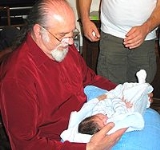
Godparent

Encyclopedia
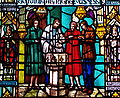
Christianity
Christianity is a monotheistic religion based on the life and teachings of Jesus as presented in canonical gospels and other New Testament writings...
, is someone who sponsors a child's baptism
Baptism
In Christianity, baptism is for the majority the rite of admission , almost invariably with the use of water, into the Christian Church generally and also membership of a particular church tradition...
. A male godparent is a godfather, and a female godparent is a godmother. The child is a godchild (godson, goddaughter).
Christianity
Traditionally, godparents were informally responsible for ensuring the child's religious education was carried out, and for caring for the child should he/she be orphaned. Today, the word godparent might not have explicitly religious overtones. The modern view of a godparent tends to be an individual chosen by the parents to take an interest in the child's upbringing and personal development.Origins
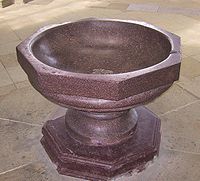
Baptism
In Christianity, baptism is for the majority the rite of admission , almost invariably with the use of water, into the Christian Church generally and also membership of a particular church tradition...
had become accepted as a ceremony largely for the spiritual purification and social initiation of infants. The requirement for some confession of faith necessitated the use of adults who acted as sponsors for the child. They vocalized the confession of faith and acted as guarantors of the child’s spiritual upbringing. Normally, these sponsors were the natural parents of a child, as emphasized in 408 by St. Augustine
St. Augustine
-People:* Augustine of Hippo or Augustine of Hippo , father of the Latin church* Augustine of Canterbury , first Archbishop of Canterbury* Augustine Webster, an English Catholic martyr.-Places:*St. Augustine, Florida, United States...
who suggested that they could, it seems exceptionally, be other individuals. Within a century, the Corpus Juris Civilis
Corpus Juris Civilis
The Corpus Juris Civilis is the modern name for a collection of fundamental works in jurisprudence, issued from 529 to 534 by order of Justinian I, Eastern Roman Emperor...
indicates that parents had been replaced in this role almost completely. This was clarified in 813 when the Council of Munich prohibited natural parents from acting as godparents to their own children.
By the 5th century AD, male sponsors were referred to as "spiritual fathers", and by the end of the 6th century, they were being noted to as "compaters" and "commaters", suggesting that these were being seen as spiritual co-parents. This pattern was marked by the creation of legal barriers to marriage that paralleled those for other forms of kin. A decree of Justinian, dated to 530, outlawed marriage between a godfather and his goddaughter, and these barriers continued to multiply until the 11th century, forbidding marriage between natural and spiritual parents, or those directly related to them. As confirmation emerged as a separate rite from baptism from the 8th century, a second set of sponsors, with similar prohibitions, also emerged. The exact extent of these spiritual relationships as a bar to marriage in Catholicism was unclear until the Council of Trent, which limited it to relationships between the godparents, the child, and the parents.
During the Reformation
LutherMartin Luther
Martin Luther was a German priest, professor of theology and iconic figure of the Protestant Reformation. He strongly disputed the claim that freedom from God's punishment for sin could be purchased with money. He confronted indulgence salesman Johann Tetzel with his Ninety-Five Theses in 1517...
, Zwingli
Huldrych Zwingli
Ulrich Zwingli was a leader of the Reformation in Switzerland. Born during a time of emerging Swiss patriotism and increasing criticism of the Swiss mercenary system, he attended the University of Vienna and the University of Basel, a scholarly centre of humanism...
, and Calvin
John Calvin
John Calvin was an influential French theologian and pastor during the Protestant Reformation. He was a principal figure in the development of the system of Christian theology later called Calvinism. Originally trained as a humanist lawyer, he broke from the Roman Catholic Church around 1530...
preserved infant baptism against the attacks of more radical reformers including Anabaptists, and with it, sponsors at baptism. However, Luther strongly objected to the marriage barriers it created, Zwingli stressed the role of parents and pastors, rather than the "witnesses", in religious instruction, and Calvin and his followers tended to prefer the sponsors to be the natural parents. A single godparent was retained in baptism at Geneva and among French Calvinists, but some followers of Calvin, most notably in Scotland and eventually the English colonies in America, rejected them altogether.
Numbers of sponsors
In the early church, one sponsor seems to have been the norm, but in the early Middle Ages, there seems to have been two, one of each sex, and this practice has been largely maintained in Orthodox ChristianityOrthodox Christianity
The term Orthodox Christianity may refer to:* the Eastern Orthodox Church and its various geographical subdivisions...
. In 888, the Catholic Council of Metz attempted to limit the number to one, but proliferation seems to have continued. In early 14th-century Spain, as many as 20 godparents were being chosen. In England, the Synod of Worcester
Synod of Worcester
The Synod of Worcester was conducted by the Bishop of Worcester, England, Walter de Cantilupe on July 26, 1240. The diocesan synod was held in his cathedral. A number of statutes were settled regarding godparents, the life of the clergy and lay people. Among these were that godparents must be three...
(1240) stipulated three sponsors (two of the same sex and one of the opposite), and this has remained the norm in the Church of England. The Council of Trent attempted to limit the numbers of godparents to one or two, but practice has differed across the Catholic world.
The Church of England
The Church of England retained godparents in baptism, formally removing the marriage barriers in 1540, but the issue of the role and status of godparents continued to be debated in the English Church. They were abolished in 1644 by the Directory of Public WorshipDirectory of Public Worship
The Directory for Public Worship was a manual of directions for worship approved by an ordinance of Parliament early in 1645 to replace the Book of Common Prayer .-Origins:The movement against the Book of Common...
promulgated by the English Civil War
English Civil War
The English Civil War was a series of armed conflicts and political machinations between Parliamentarians and Royalists...
Parliamentary regime, but continued to be used in some parishes in the north of England. After the Restoration in 1660, they were reintroduced to Anglicanism, with occasional objections, but dropped by almost every dissenting church. There is some evidence that the restored institution had lost some of its social importance as well as its universality.
At present, in the Church of England, relatives can stand as godparents, and although it is not clear that parents can be godparents, they sometimes are. Godparents should be both baptized and confirmed (although it is not clear in which Church), but the requirement for confirmation can be waived. There is no requirement for clergy to baptize those from outside of their parishes, and baptism can be reasonably delayed so that the conditions, including suitable godparents, can be met. As a result, individual clergy have considerable discretion over the qualifications of godparents.
The Roman Catholic Church
The Catholic institution of godparenthood survived the Reformation largely unchanged. A godparent must normally be an appropriate person, at least sixteen years of age, a confirmed Catholic who has received the EucharistEucharist
The Eucharist , also called Holy Communion, the Sacrament of the Altar, the Blessed Sacrament, the Lord's Supper, and other names, is a Christian sacrament or ordinance...
, not under any canonical penalty, and may not be the parent of the child. Someone who belongs to another Christian church cannot become a godparent but can be a 'witness' in conjunction with a Catholic sponsor. A witness does not have any religious role recognized by the Church.
The Lutheran Church
Lutherans follow a similar theology of godparents as Roman Catholics. They believe that godparents "help [children] with their Christian upbringing, especially if they should lose their parents". Lutherans, like Roman Catholics, believe that a godparent must be both baptized and confirmed in the Church. Lutherans also follow the Roman Catholic tradition that a Christian who is not affiliated with the Church may serve as a witness.The Orthodox Church
The Orthodox institution of godparenthood has been the least affected of the major traditions by change. In some Orthodox churches (Serbian, Greek) usually the best man (кум, koumbaros) or bridesmaid (kuma, кума, koumbara) at a couple's wedding act as a godparent to the first or all children of the marriage. In some instances, the godfather is responsible for naming the child. A godparent to a child will then act as a sponsor at the child's wedding. Godparents are expected to be in good standing in the Orthodox church, including its rulings on divorce, and aware of the meaning and responsibilities of their role. They cannot be a minor, a parent of the child, or a non-Orthodox Christian. Like Western-Roman Catholicism, some parts of the church, including the Archdiocese of North America, allow members of other churches to be witnesses at baptism, but they have no formal role, for example, at the child's wedding when they mature.Spiritual kinship
In some Catholic and Orthodox countries, particularly in southern Europe and Latin America, the relationship between parents and godparents or co-godparents has been seen as particularly important and distinctive. These relationships create mutual obligations and responsibilities that may be socially useful for participants. The PortuguesePortuguese language
Portuguese is a Romance language that arose in the medieval Kingdom of Galicia, nowadays Galicia and Northern Portugal. The southern part of the Kingdom of Galicia became independent as the County of Portugal in 1095...
and Spanish
Spanish language
Spanish , also known as Castilian , is a Romance language in the Ibero-Romance group that evolved from several languages and dialects in central-northern Iberia around the 9th century and gradually spread with the expansion of the Kingdom of Castile into central and southern Iberia during the...
compadre
Compadre
The compadre relationship between the parents and godparents of a child is an important bond which originates when a child is baptized in Hispanic families...
(literally, "co-father") and comadre ("co-mother"), the French
French language
French is a Romance language spoken as a first language in France, the Romandy region in Switzerland, Wallonia and Brussels in Belgium, Monaco, the regions of Quebec and Acadia in Canada, and by various communities elsewhere. Second-language speakers of French are distributed throughout many parts...
commère and compère, and the archaic meaning of the English word gossip
Gossip
Gossip is idle talk or rumour, especially about the personal or private affairs of others, It is one of the oldest and most common means of sharing facts and views, but also has a reputation for the introduction of errors and variations into the information transmitted...
(from godsib, "god-sibling"), describe these relationships. By extension, they can also be used to describe a friendship. The Spanish words for the godparent roles are used for members of the wedding party—padrino meaning "godfather" or "best man" and madrina meaning "godmother" or "matron of honor"—reflecting the custom of baptismal sponsors acting in this role in a couple's wedding.
Literature and folklore
Godparents are noted features of fairy tales and folklore written from the 17th century onwards, and by extension, have found their way into many modern works of fiction. In Godfather DeathGodfather Death
Godfather Death is a German fairy tale collected by the Brothers Grimm as tale number 44. It is Aarne-Thompson type 332.-Synopsis:...
, presented by the Brothers Grimm
Brothers Grimm
The Brothers Grimm , Jacob Grimm and Wilhelm Grimm , were German academics, linguists, cultural researchers, and authors who collected folklore and published several collections of it as Grimm's Fairy Tales, which became very popular...
, the archetype is, unusually, a supernatural godfather. However, most are a fairy godmother
Fairy godmother
In fairy tales, a fairy godmother is a fairy with magical powers who acts as a mentor or parent to someone, in the role that an actual godparent was expected to play in many societies...
as in versions of Cinderella
Cinderella
"Cinderella; or, The Little Glass Slipper" is a folk tale embodying a myth-element of unjust oppression/triumphant reward. Thousands of variants are known throughout the world. The title character is a young woman living in unfortunate circumstances that are suddenly changed to remarkable fortune...
, Sleeping Beauty
Sleeping Beauty
Sleeping Beauty by Charles Perrault or Little Briar Rose by the Brothers Grimm is a classic fairytale involving a beautiful princess, enchantment, and a handsome prince...
, and The Blue Bird
The Blue Bird (fairy tale)
"The Blue Bird" is a French literary fairy tale by Madame d'Aulnoy, published in 1697. An English translation was included in The Green Fairy Book, 1892, collected by Andrew Lang.The tale is Aarne-Thompson type 432, The Prince as Bird...
. This feature may simply reflect the Catholic milieu in which most fairy tales were created, or at least recorded, and the accepted role of godparents as helpers from outside the family, but feminist Marina Warner suggests that they may be a form of wish fulfilment by female narrators.
Santeria
In the Yoruba religion SanteríaSantería
Santería is a syncretic religion of West African and Caribbean origin influenced by Roman Catholic Christianity, also known as Regla de Ocha, La Regla Lucumi, or Lukumi. Its liturgical language, a dialect of Yoruba, is also known as Lucumi....
, godparents must have completed their santo or their Ifá
Ifá
Ifá refers to the system of divination and the verses of the literary corpus known as the Odú Ifá. Yoruba religion identifies Orunmila as the Grand Priest; as that which revealed Oracle divinity to the world...
. A person gets his Madrina and Yubona (co-godmother) or his Padrino and Yubon (co-godfather) or some santeros aside from his co-godparents may have an oluo (babalao, initiate of ifa) who consults him with an ekuele (divinating chain).
Judaism
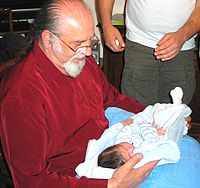
Sandek
Sandak is the term for a person honored at a Jewish brit milah ceremony, traditionally either by holding the baby boy on the knees or thighs while the mohel performs the brit milah or by handing the baby to the mohel...
holds the baby boy while he is circumcised. Among Orthodox Ashkenazi, the kvater (or kvaterin if female) is the person who takes the child from his mother and carries him into the room in which the circumcision is performed. Kvater is etymologically derived from the German Gevatter ("godfather").