


Bible prophecy

Encyclopedia
Bible prophecy or biblical prophecy is the prediction of future events based on the action, function, or faculty of a prophet. Such passages are widely distributed throughout the Bible
, but those most often cited are from Ezekiel
, Daniel
, Matthew 24
, Matthew 25
, and Revelation
.
Believers in biblical prophecy engage in exegesis
and hermeneutics of scriptures which they believe contain descriptions of global politics
, natural disaster
s, the future of the nation of Israel
, the coming of a Messiah
and a Messianic Kingdom
, and the ultimate destiny of humankind
.
Some prophecies in the Bible are conditional, with either the conditions implicitly assumed or explicitly stated. Some prophetic passages are depicted as direct statements from God while other statements are expressed as the privileged perspective of the biblical author
considered to be a prophet
. The Biblical prophets are usually considered to have received revelations from God, subsequently recording them in the relevant writings.
prophets often warn the Israelites to repent of their sin
s and idolatries
, with the threat of punishment or reward. Blessing
s and ruinations are attributed to the deity. According to believers in Bible prophecy, many of these prophecies are viewed as having been fulfilled within later passages.
A second prophetic theme is the coming of a Messiah
: Christians believe that these Messianic prophecies are fulfilled by Christ Jesus
, while followers of Rabbinic Judaism
still await the arrival of the Jewish Messiah
and other signs of Jewish eschatology
. Most Christians believe many messianic prophecies will be fulfilled with the Second Coming of Christ, though some Christians (Full Preterism) believe that all Messianic prophecies have already been fulfilled. Rabbinic Judaism does not separate the original coming of the Messiah and the advent of the Messianic Age
. For details of the differences, see Christianity and Judaism.
Another major theme concerns the "end times
", or "last days", particularly according to the Revelation of John.
Non-predictive prophecy can include:
Predictive prophecy can be broken down into several groups of related prophecies sharing a central theme.
Verses such as Acts
7:4-5 and Hebrews
11:13 indicate this was not accomplished during Abraham's time. F. F. Bruce argues this was accomplished during David's reign. He writes:
Christian apologists point to corporate personality
here to connect Abraham with the Jewish nation. H. Wheeler Robinson
writes:
says that the patriarchs longed for the heavenly country which explains that Hebrews 11:13 speaks about the promise of the heavenly home.
In Exodus 34:10-27 this is referred to as a covenant, commandments being given. In Judges, the Israelites are described as disobeying the commandment to worship no other god (Judges 3:6) and as a result not being able to drive out the Jebusites (Joshua 15:63). The Israelites did not drive all of the Canaanite tribes out in the lifetime of Joshua. The books of Joshua
and Judges
(Chapters 1) mention towns that could not be defeated. According to 2 Samuel
, the Israelites occupied Canaan but the complete seizure took place only when David defeated the Jebusites in Jerusalem and made it the capital of his empire.(2 Sam 5:6-7),.
Solomon
built the temple in Jerusalem (2 Chronicles 2:1; 6:7-10) and did not obey God's commandments (1 Kings 11:1-14).
The destruction of the Kingdom of Judah
by Nebuchadnezzar II in 586 BC brought an end to the rule of the royal house of David.
Some scholars state that God has promised an eternal dynasty to David unconditionally.(1 Kings 11:36, 15:4, 2 Kings 8:19) They feel the conditional promise of 1 Kings 9:4-7 seems to undercut this unconditional covenant. Most interpreters have taken the expression "throne of Israel" as a reference to the throne of the United Monarchy
. They see this as a conditionalization of the unconditional dynastic promise to David's house expressed in 1 Kings 11:36, 15:4 and 2 Kings 8:19. They argue the presence of both unconditional and conditional promises to the house of David would create intense theological dissonance in the Book of Kings
.
Christian
s believe that the promise is of surviving descendants that could fulfil the role of king rather than a permanent earthly kingship.
The Books of Kings and Jeremiah
relate that Zedekiah's eyes were put out after he was taken to the King of Babylon and that he remained a prisoner in Babylon until his death (2 Kings 25:6-7 and Jeremiah 52:10-11). There is no other historical record of what happened with Zedekiah in Babylon.
Josiah fought against the Egyptians although the pharaoh, Necho II
, prophesied that God would destroy him if he did (2 Chronicles 35:21-22) - posssibly Josiah was "opposing the faithful prophetic party". Josiah was killed in battle against the Egyptians (2 Kings 23:29-30).
According to "God delivered the King of the Jews, Ahaz
, into the hands of the King of Syria, who carried away a great multitude of them captives to Damascus
. And he was also delivered into the hand of the King of Israel, who smote him with a great slaughter".
In the prophet says clearly that a prerequisite for the fulfillment of the prophecy is that Ahaz stands firm in his faith. This means that he should trust God and not seek military help in the Assyrians which Ahaz nevertheless did.
The Book of Isaiah also foretold;
Christian apologists state that the prophecy in Isaiah chapters 13 and 21 could possibly have been directed originally against Assyria
whose capital Nineveh was defeated in 612 BC by a combined onslaught of the Medes and Babylonians. According to this explanation the prophecy was later updated and referred to Babylon not recognizing the rising power of Persia. On the other hand it can be mentioned that the Persian King Cyrus
after overthrowing Media in 550 BC did not treat the Medes
as a subject nation.
The prophecy may date from 735 BC when Damascus and Israel were allied against Judah. Tiglath-Pileser took Damascus in 732, which some apologists point to as a fulfillment of this prophecy, but this campaign never reduced the city to rubble. Rather, the campaign temporarily forced the inhabitants to flee for a few days before returning. The city remained intact. Damascus has never become a heap of ruins and is the oldest standing city in the world.
The passage is consistent with , which states that Assyria defeated the city and exiled the civilians to Kir.
Some theologians argue the statement that the "land of Judah" will terrify the Egyptians is not a reference to a large army from Judah attacking Egypt but a circumlocution for the place where God lives. They argue it is God and his plans that will cause Egypt to be terrified. They go on to argue the second "in that day" message from verse 18 announces the beginning of a deeper relationship between God and Egypt which leads to Egypt's conversion and worshiping God (verses 19-21). They say the last "in that day" prophecy (verses 23-25) speaks about Israel, Assyria and Egypt as God's special people, thus, describing eschatological events.
There are many scholars, however, who point out that the prophet himself spoke of Cyrus arguing that Deutero-Isaiah interpreted Cyrus' victorious entry into Babylon in 539 BC as evidence of divine commission to benefit Israel. The main argument against the idols in these chapters is that they cannot declare the future, whereas God does tell future events like the Cyrus predictions.
prophesied that;
It lasted 68 years (605 BC-537 BC) from the capture of the land of Israel by Babylon and the exile of a small number of hostages including Daniel, Hananiah, Azariah, and Mishael . It lasted 60 years (597-537 BC) from the deportation of the 10,000 elite including Jehoiachin and Ezekiel though there is a discrepancy with Jeremiah's numbers of exiles . It lasted 49 years (586-537 BC) from the exile of the majority of Judah including Jeremiah who was taken to Egypt and leaving behind a poor remnant .
However, some Christian scholars try to explain the figure in a different way stating that Jeremiah gave a round number.
Christian commentaries have considered the conquering Persian force an alliance between the Persians and the Medes. One suggests the use of the term "Medes" is due to earlier recognition among the Jews and because the generals of Cyrus were apparently Medes.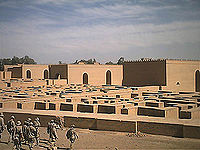
Tyre was an island fortress-city with mainland villages along the shore. These mainland settlements were destroyed by Nebuchadnezzar II, but after a 13-year siege from 585-573 BC, the King of Tyre made peace with Nebuchadnezzar, going into exile and leaving the island city itself intact. Alexander the Great used debris from the mainland to build a causeway to the island, entered the city, and plundered the city, sacking it without mercy. Most of the residents were either killed in the battle or sold into slavery. It was quickly repopulated by colonists and escaped citizens, and later regained its independence. Tyre did eventually enter a period of decline, being reduced to a small remnant. Echoing Ezekiel's words, historian Philip Myers writes in 1889:
This includes the claim that God will make Egypt so weak that it will never again rule over other nations. Pharaoh Amasis II
(who drove off Nebuchadnezzar) also conquered Cyprus, ruling it until 545 BC. Despite being a powerful nation in ancient times, Egypt has since been ruled by the Persians, Macedonians, Romans, Byzantine Empire, Ottomans, British and the French, and has also enjoyed periods of independence from external rule. During the Hellenistic period, the break-up of the empire of Alexander the Great left the Ptolemaic Dynasty (of Macedonian/Greek origin) as rulers of Egypt: the Ptolemies then conquered and ruled Cyrenaica (now northeastern Libya), Palestine, and Cyprus at various times. (see also History of Ptolemaic Egypt and Ptolemaic kingdom
).
There is some uncertainty among modern scholars regarding when (and by whom) various portions of the Book of Ezekiel were written, making the timing of prophecies difficult to unravel (see Book of Ezekiel
).
Nebuchadnezzar invaded Egypt around 568 BC. However, the armies of Pharaoh Amasis II defeated the Babylonians (though the author did not elaborate and there are no known detailed accounts of this invasion). Herodotus reports that this Pharaoh had a long and prosperous reign. The Egyptians were conquered by the Persians in 525 BC.
The Christian response is varied:
Preterist scholars explain this verse as referring to the destruction of the Jerusalem temple in 70 AD with the phrase "before the Son of Man
comes" meaning before judgment comes upon the nation of Israel and the city of Jerusalem for rejecting Jesus Christ as The Messiah
. They reject to refer Matthew 10:23 to the second coming of Jesus because Jesus speaks to his disciples about the towns of Israel:
The Wycliffe Bible Commentary disagrees with this view:
It is customary for eastern nations to count part of a day as a whole 24 hour day.
Christian responses have been varied:
Preterists
respond that Jesus did not mean His second coming but a demonstration of His might when He says "coming in his kingdom". In this view, this was accomplished by the destruction of the Jerusalem temple in 70 AD when some of the Apostles were still living and thus fulfilling the word of Jesus that only some will not have died.
Others argue it refers to the Transfiguration. The Wycliffe Bible Commentary states:
The word "you will see" is in Greek "ὄψεσθε" [opheste, from the infinitive optomai] which is plural. Jesus meant that the Jews, and not just the high priest, will see his coming.
Christians argue that the first cock-crow is simply missing from Matthew, Luke, and John. In Matthew , Luke , and John , Jesus foretells three denials of Peter before cock-crow. , , report the fulfillment of this prophecy. In , Jesus speaks of two cock-crows, which is mentioned in as having taken place. Christians argue that Matthew, Luke, and John removed the first cock-crow and diminished (Luke even eliminated) the partial exit by Peter after the first denial (which Mark reports). If Mark was the "interpreter of Peter", he would have gotten his information directly and thus would be considered the more reliable source.
Preterists claim these verses are metaphorical. Others claim that the destruction of the temple in A.D. 70 fulfilled this despite the existence of the wailing wall. The IVP Bible Background Commentary states:
The famines part of this verse has often been associated with the third seal of Revelation (Rev. 6:5-6), and the pestilences and earthquakes aspect has often been associated with the fourth seal of Revelation (Rev. 6:7-8). The presence of the term birthpains could be representative of better times ahead. Scholars point out that these events have always been on earth, so the verse must refer to a significant increase in the intensity of them.
There are also instances of erroneous, or untraceable, quotations from the prophets cited by the early Christians:
Christians writers have given several responses. First is that the use of Jeremiah is meant to refer to all the books of prophecy. Second is that although Jeremiah said this, any record has not survived. Third is this was the result of a scribal error because of the single letter difference in the abridged versions of the names.
Christians have given several responses. First is that this prophecy has not survived to the present day. Second is the Greek word nazaret does not mean Nazarene but is related to the Hebrew word netzer which can be translated as 'branch'. Third is that the verse is not a prophetic saying but simply reflects an Old Testament requirement for the Messiah to be held in contempt, (Psalm 22:6-8; 69:9-11, 19-21; Isaiah 53:2-4, 7-9) which they argue Nazarenes were (John 1:46; John 7:52).
quotes from both and but attributes to Isaiah only.
Some scholars respond that this is because the Malachi reference was just an introduction, which made it significantly less important than Isaiah 40:3, leading to the whole being attributed to the prophet Isaiah. Other reasons given are Isaiah's authority was considered higher than Malachi and the Isaiah text was better known.
Christians argue that Paul speaks about his own presence at the last day only hypothetically. They point out Paul later states the Day of the Lord comes like a thief which is a word Jesus uses himself expressing the impossibility of predicting His second coming .
There are different attempts to explain the term "to take his seat in the temple of God". Some understand it as a divine attribute which the man of lawlessness arrogates to himself and hence no conclusion can be drawn for time and place. Many in the early Church, such as Irenaeus, Hippolytus of Rome, Origen and Cyril of Jerusalem, believed a literal Temple would be rebuilt by the Antichrist
before the Lord's Second Coming whereas Jerome and John Chrysostom referred the Temple to the Church. Also some today's scholars refer the phrase "God's temple" to the Church pointing out that Paul used this term five other times outside 2 Thessalonians and does not refer it to a literal temple.
The Church fathers
such as John Chrysostom
who lived at the time of Gnostics, the Marcionites, the Encratites
, the Manicheans - who rejected Christian marriage and the eating of because they believed that all flesh was from an evil principle - asserted this text referred to such sects and that they were therefore "in the latter times". The Protestant theologian John Gill
believed that this refers to the Canon Law
of the Catholic Church, particularly priestly celibacy
and Lent
as promulgated by the medieval church. (see Great Apostasy
)
Some Christian scholars believe the verses 11-14 refer to the era of salvation beginning with Christ's resurrection and its coming fulfillment on the last day. Thus, they think that the claim Paul makes here about salvation is a claim every Christian and not only Paul in his time can affirm. Some see this verse as indicating that there are no prophesied or salvation events before the Lord comes. Those holding the belief that Paul has a longer time span in view point to its context after Romans 11, which describes the repentance of all of Israel in future. They also point to Paul's plan to visit Rome and more wester places in Romans 15 as indicating that he did not believe Christ's return would be soon enough to simply wait for it.
The word "soon" (other translations use "shortly" or "quickly") does not have to be understood in the sense of close future. The Norwegian
scholar Thorleif Boman explained that the Israelites, unlike Europeans or people in the West, did not understand time as something measurable or calculable according to Hebrew thinking but as something qualitative:
In this way, the use of "soon" may mean this will be the next significant event which will take place with certainty.
while Jewish scholars state there is no concept of a second coming in the Hebrew Bible.
. This claim has always been unacceptable to most Bible scholars. All the following are Muslim scholars' interpretations of various Biblical passages.
is the return of Christ "in the glory of the Father" and that the passages below were fulfilled by the coming of the Báb
and Bahá'u'lláh, the two most recent Manifestations of God, in 1844 AD and 1863 AD, respectively.
believe that the following biblical passages prophesy or otherwise support the provenance of the Book of Mormon
:
by a number of conservative Christians. Interpreters uphold this principle by providing details of prophecies that have been fulfilled. In this view it is usually maintained that no Bible prophecy has ever failed, or ever will. It is therefore up to the interpreter to find a meaning in the words that is true. They also dispute the legitimacy of non-biblical prophets and psychic
s. Professor Peter Stoner
and Dr. Hawley O. Taylor, for example, believed the Bible prophecies were too remarkable and detailed to occur by chance. Arthur C. Custance maintained that the Ezekiel Tyre prophecy (Ezek. 26: 1-11; 29:17-20) was remarkable.
These interpretive issues are related to the more general idea of how passages should be read or interpreted—a concept known as Biblical hermeneutics
. Bible prophecy is an area which is often discussed in regard to Christian apologetics
. Traditional Jewish readings of the Bible do not generally reflect the same attention to the details of prophecies. Maimonides
stated that Moses
was the greatest of the prophets and only he experienced direct revelation. Concern with Moses' revelation involves law and ethical teaching
more than predictive prophecy. According to Maimonides' Guide for the Perplexed
the prophets used metaphors and analogies and, except for Moses, their words are not to be taken literally.
According to the Talmud
, prophecy ceased in Israel following the rebuilding of the second temple. Nonetheless Maimonides
held that a prophet can be identified if his or her predictions come true. Some Orthodox Jews
believe that a future prophet, perhaps a returned Elijah, will identify the future Messiah
, the correct location of the Holy of Holies
, and other matters essential for the restoration of Jewish worship.
) is a major doctrine, which can be seen by its inclusion in the Nicene Creed
. Many specific timeframes for this prediction have been declared by individuals and groups, although many of these dates have expired without the occurrences predicted. An official statement of the Vatican
, issued in 1993, asserted, "we are already in the last hour".
Biblical references claimed to prophesy the end times include: The Old Testament prophet Isaiah prophesied that in the end times the Kingdom of God
would be established in Jerusalem
, as chief among the nations. This prophecy was also asserted by Micah of Moreseth The Old Testament prophet Hosea indicated that in the end times Israel would return to their land and seek the Lord their God. This prophecy predicts that the gospel will be preached globally before the end occurs. The Apostle Peter said that in the end times, God would pour out His spirit on all people and show signs in the heaven and on the earth before the coming great and dreadful Day of the Lord. The Apostle Paul wrote that there would be terrible times in the end times. People would have a form of godliness but denying its power and moral decay will increase. The author of Hebrews wrote that the world was already in the end times. James wrote that people would hoard wealth in the end times to their destruction. The Apostle Peter indicated that in the end times even religious people would dismiss the idea of Christ's return.
, it was said that words and short phrases were hidden in the Hebrew Bible as skip-letter sequences (every 30th letter, for example). The mathematical probability for several coded words which are related to occur within the same area of the Bible was calculated by Rips to be enormously greater than chance, though mathematicians with formal training in statistical analysis place this figure at 1:2. A comprehensive explanation of how this phenomenon can occur naturally was later published in 1999 by Brendan McKay et al., although the Bible code continues to be explored and debated.
Bible
The Bible refers to any one of the collections of the primary religious texts of Judaism and Christianity. There is no common version of the Bible, as the individual books , their contents and their order vary among denominations...
, but those most often cited are from Ezekiel
Book of Ezekiel
The Book of Ezekiel is the third of the Latter Prophets in the Hebrew Bible, following the books of Isaiah and Jeremiah and preceding the Book of the Twelve....
, Daniel
Book of Daniel
The Book of Daniel is a book in the Hebrew Bible. The book tells of how Daniel, and his Judean companions, were inducted into Babylon during Jewish exile, and how their positions elevated in the court of Nebuchadnezzar. The court tales span events that occur during the reigns of Nebuchadnezzar,...
, Matthew 24
Olivet discourse
The Olivet discourse or Olivet prophecy is a biblical passage found in the Synoptic Gospels of Mark 13, Matthew 24, Luke 21. It is known as the "Little Apocalypse" because it includes Jesus' descriptions of the end times, the use of apocalyptic language, and Jesus' warning to his followers that...
, Matthew 25
The Sheep and the Goats
The Sheep and the Goats or "The Judgment of the Nations" was a discourse of Jesus recorded in the New Testament. It is sometimes characterized as a parable, although unlike most parables it does not purport to relate a story of events happening to other characters.One explanation is that it tells...
, and Revelation
Book of Revelation
The Book of Revelation is the final book of the New Testament. The title came into usage from the first word of the book in Koine Greek: apokalupsis, meaning "unveiling" or "revelation"...
.
Believers in biblical prophecy engage in exegesis
Exegesis
Exegesis is a critical explanation or interpretation of a text, especially a religious text. Traditionally the term was used primarily for exegesis of the Bible; however, in contemporary usage it has broadened to mean a critical explanation of any text, and the term "Biblical exegesis" is used...
and hermeneutics of scriptures which they believe contain descriptions of global politics
Global politics
Global politics is the discipline that studies the political and economical patterns of the world. It studies the relationships between cities, nation-states, shell-states, multinational corporations, non-governmental organizations and international organizations.It has been argued that global...
, natural disaster
Natural disaster
A natural disaster is the effect of a natural hazard . It leads to financial, environmental or human losses...
s, the future of the nation of Israel
Israel
The State of Israel is a parliamentary republic located in the Middle East, along the eastern shore of the Mediterranean Sea...
, the coming of a Messiah
Messiah
A messiah is a redeemer figure expected or foretold in one form or another by a religion. Slightly more widely, a messiah is any redeemer figure. Messianic beliefs or theories generally relate to eschatological improvement of the state of humanity or the world, in other words the World to...
and a Messianic Kingdom
Kingdom of God
The Kingdom of God or Kingdom of Heaven is a foundational concept in the Abrahamic religions: Judaism, Christianity and Islam.The term "Kingdom of God" is found in all four canonical gospels and in the Pauline epistles...
, and the ultimate destiny of humankind
Eschatology
Eschatology is a part of theology, philosophy, and futurology concerned with what are believed to be the final events in history, or the ultimate destiny of humanity, commonly referred to as the end of the world or the World to Come...
.
Some prophecies in the Bible are conditional, with either the conditions implicitly assumed or explicitly stated. Some prophetic passages are depicted as direct statements from God while other statements are expressed as the privileged perspective of the biblical author
Authors of the Bible
The various books of the Jewish and Christian Bibles were the work of many persons over many centuries. While most biblical books have traditional authors ascribed to them, biblical scholars regard few of the books in either the Jewish or Christian Bibles as being the work of the individuals whose...
considered to be a prophet
Prophet
In religion, a prophet, from the Greek word προφήτης profitis meaning "foreteller", is an individual who is claimed to have been contacted by the supernatural or the divine, and serves as an intermediary with humanity, delivering this newfound knowledge from the supernatural entity to other people...
. The Biblical prophets are usually considered to have received revelations from God, subsequently recording them in the relevant writings.
Overview
Hebrew BibleHebrew Bible
The Hebrew Bible is a term used by biblical scholars outside of Judaism to refer to the Tanakh , a canonical collection of Jewish texts, and the common textual antecedent of the several canonical editions of the Christian Old Testament...
prophets often warn the Israelites to repent of their sin
Sin
In religion, sin is the violation or deviation of an eternal divine law or standard. The term sin may also refer to the state of having committed such a violation. Christians believe the moral code of conduct is decreed by God In religion, sin (also called peccancy) is the violation or deviation...
s and idolatries
Idolatry
Idolatry is a pejorative term for the worship of an idol, a physical object such as a cult image, as a god, or practices believed to verge on worship, such as giving undue honour and regard to created forms other than God. In all the Abrahamic religions idolatry is strongly forbidden, although...
, with the threat of punishment or reward. Blessing
Blessing
A blessing, is the infusion of something with holiness, spiritual redemption, divine will, or one's hope or approval.- Etymology and Germanic paganism :...
s and ruinations are attributed to the deity. According to believers in Bible prophecy, many of these prophecies are viewed as having been fulfilled within later passages.
A second prophetic theme is the coming of a Messiah
Messiah
A messiah is a redeemer figure expected or foretold in one form or another by a religion. Slightly more widely, a messiah is any redeemer figure. Messianic beliefs or theories generally relate to eschatological improvement of the state of humanity or the world, in other words the World to...
: Christians believe that these Messianic prophecies are fulfilled by Christ Jesus
Jesus
Jesus of Nazareth , commonly referred to as Jesus Christ or simply as Jesus or Christ, is the central figure of Christianity...
, while followers of Rabbinic Judaism
Rabbinic Judaism
Rabbinic Judaism or Rabbinism has been the mainstream form of Judaism since the 6th century CE, after the codification of the Talmud...
still await the arrival of the Jewish Messiah
Jewish Messiah
Messiah, ; mashiah, moshiah, mashiach, or moshiach, is a term used in the Hebrew Bible to describe priests and kings, who were traditionally anointed with holy anointing oil as described in Exodus 30:22-25...
and other signs of Jewish eschatology
Jewish eschatology
Jewish eschatology is concerned with the Jewish Messiah, afterlife, and the revival of the dead. Eschatology, generically, is the area of theology and philosophy concerned with the final events in the history of the world, the ultimate destiny of humanity, and related concepts.-The Messiah:The...
. Most Christians believe many messianic prophecies will be fulfilled with the Second Coming of Christ, though some Christians (Full Preterism) believe that all Messianic prophecies have already been fulfilled. Rabbinic Judaism does not separate the original coming of the Messiah and the advent of the Messianic Age
Messianic Age
Messianic Age is a theological term referring to a future time of universal peace and brotherhood on the earth, without crime, war and poverty. Many religions believe that there will be such an age; some refer to it as the "Kingdom of God" or the "World to Come".- Terminology: "messianic" and...
. For details of the differences, see Christianity and Judaism.
Another major theme concerns the "end times
End times
The end time, end times, or end of days is a time period described in the eschatological writings in the three Abrahamic religions and in doomsday scenarios in various other non-Abrahamic religions...
", or "last days", particularly according to the Revelation of John.
Classifications
Although the main use of the Hebrew and Greek terms for prophecy in the Bible is unquestionably predictive prophecy, not all prophecy is predictive. Some may simply be inspired comments on present day events or inspired praise.Non-predictive prophecy can include:
- Revelation of hidden things - past or current.
- WorshipWorshipWorship is an act of religious devotion usually directed towards a deity. The word is derived from the Old English worthscipe, meaning worthiness or worth-ship — to give, at its simplest, worth to something, for example, Christian worship.Evelyn Underhill defines worship thus: "The absolute...
- Musical prophecy in the temple, 1 Chronicles 25:1-3, etc. - Teaching in Church - This possible definition was advanced by W.E. Vine but is disputed.
Predictive prophecy can be broken down into several groups of related prophecies sharing a central theme.
- General — Bible prophecies that deal with various places and people.
- Eschatology — The prophecies concerning the last things.
- Christian eschatologyChristian eschatologyChristian eschatology is a major branch of study within Christian theology. Eschatology, from two Greek words meaning last and study , is the study of the end of things, whether the end of an individual life, the end of the age, or the end of the world...
— Christian viewpoint of final events. - Jewish eschatologyJewish eschatologyJewish eschatology is concerned with the Jewish Messiah, afterlife, and the revival of the dead. Eschatology, generically, is the area of theology and philosophy concerned with the final events in the history of the world, the ultimate destiny of humanity, and related concepts.-The Messiah:The...
- Jewish viewpoint of future events - MillennialismMillennialismMillennialism , or chiliasm in Greek, is a belief held by some Christian denominations that there will be a Golden Age or Paradise on Earth in which "Christ will reign" for 1000 years prior to the final judgment and future eternal state...
— Belief in a thousand year reign of Christ on earth - Israel — Prophecies concerning Israel, the nation, the people and the man.
- Messianic — The prophecies concerning the Messiah.
Genesis
- In Genesis 6, God is quoted as saying "My Spirit will not contend with man forever, for he is mortal; his days will be a hundred and twenty years."(Genesis 6:3) There is uncertainty as whether that refers to man's lifespan or to the amount of time that will elapse before the great flood. The oldest undisputed people to have livedOldest peopleThis is a list of tables of the verified oldest people in the world in ordinal rank, such as oldest person or oldest man. In these tables, a supercentenarian is considered 'verified' if his or her claim has been validated by an international body that specifically deals in longevity research, such...
are a 122 year old female named Jeanne CalmentJeanne CalmentJeanne Louise Calment was a French supercentenarian who had the longest confirmed human life span in history, living to the age of . She lived in Arles, France, for her entire life, and outlived both her daughter and grandson. She became especially well known from the age of 113, when the...
and a 115 year old male named Christian Mortensen. The Book of Genesis as well as Exodus gives several people living to be older than 120 years after Genesis 6:3 (Genesis 9:29, 11:11-32, 23:1, 25:7, 25:17, 35:28, Exodus 6:16-20).
- Genesis 15:18 promises AbrahamAbrahamAbraham , whose birth name was Abram, is the eponym of the Abrahamic religions, among which are Judaism, Christianity and Islam...
and his descendants the land of CanaanCanaanCanaan is a historical region roughly corresponding to modern-day Israel, Palestine, Lebanon, and the western parts of Jordan...
from the river of Egypt to the EuphratesEuphratesThe Euphrates is the longest and one of the most historically important rivers of Western Asia. Together with the Tigris, it is one of the two defining rivers of Mesopotamia...
and Genesis 17:8 states:
The whole land of Canaan, where you are now an alien, I will give as an everlasting possession to you and your descendants after you; and I will be their God.
Verses such as Acts
Acts of the Apostles
The Acts of the Apostles , usually referred to simply as Acts, is the fifth book of the New Testament; Acts outlines the history of the Apostolic Age...
7:4-5 and Hebrews
Epistle to the Hebrews
The Epistle to the Hebrews is one of the books in the New Testament. Its author is not known.The primary purpose of the Letter to the Hebrews is to exhort Christians to persevere in the face of persecution. The central thought of the entire Epistle is the doctrine of the Person of Christ and his...
11:13 indicate this was not accomplished during Abraham's time. F. F. Bruce argues this was accomplished during David's reign. He writes:
David's sphere of influence now extended from the Egyptian frontier on the Wadi el-Arish (the "brook of Egypt") to the EuphratesEuphratesThe Euphrates is the longest and one of the most historically important rivers of Western Asia. Together with the Tigris, it is one of the two defining rivers of Mesopotamia...
; and these limits remained the ideal boundaries of Israel's dominion long after David's empire had disappeared.
Christian apologists point to corporate personality
Corporate personality
Corporate personality is a concept in Christian theology that was articulated by H. Wheeler Robinson. As originally formulated, it dealt with areas of the Old Testament where the relationships between individuals and the groups that they were part of were treated...
here to connect Abraham with the Jewish nation. H. Wheeler Robinson
H. Wheeler Robinson
The Reverend Henry Wheeler Robinson, known universally as H. Wheeler Robinson, was born on 7 February 1872 at Northampton, United Kingdom and died on 12 May 1945 in Oxford, United Kingdom.-Career:H...
writes:
Corporate personality is the important Semitic complex of thought in which there is a constant oscillation between the individual and the group – family, tribe, or nation – to which he belongs, so that the king or some other representative figure may be said to embody the group, or the group may be said to sum up the host of individuals.
says that the patriarchs longed for the heavenly country which explains that Hebrews 11:13 speaks about the promise of the heavenly home.
Exodus, Deuteronomy, Joshua, and Judges
- God is represented as guaranteeing that the Israelites would drive out the AmoriteAmoriteAmorite refers to an ancient Semitic people who occupied large parts of Mesopotamia from the 21st Century BC...
s, Canaanites, HittiteHittitesThe Hittites were a Bronze Age people of Anatolia.They established a kingdom centered at Hattusa in north-central Anatolia c. the 18th century BC. The Hittite empire reached its height c...
s, PerizzitePerizziteThe Perizzites are a group of people mentioned many times in the Bible as having lived in Canaan before the arrival of the Jews.-History:The Bible mentions a specific group of people who lived in the Promised land for many generations, from the time of Abraham even to the time of Ezra and Nehemiah...
s, Hivites and JebusiteJebusiteAccording to the Hebrew Bible, the Jebusites were a Canaanite tribe who inhabited and built Jerusalem prior to its conquest by King David; the Books of Kings state that Jerusalem was known as Jebus prior to this event...
s from their lands, which the Jews wanted to appropriate (Exodus 34:10-11). The same applies to the Girgashites (Deuteronomy 7:1-2).
In Exodus 34:10-27 this is referred to as a covenant, commandments being given. In Judges, the Israelites are described as disobeying the commandment to worship no other god (Judges 3:6) and as a result not being able to drive out the Jebusites (Joshua 15:63). The Israelites did not drive all of the Canaanite tribes out in the lifetime of Joshua. The books of Joshua
Book of Joshua
The Book of Joshua is the sixth book in the Hebrew Bible and of the Old Testament. Its 24 chapters tell of the entry of the Israelites into Canaan, their conquest and division of the land under the leadership of Joshua, and of serving God in the land....
and Judges
Book of Judges
The Book of Judges is the seventh book of the Hebrew bible and the Christian Old Testament. Its title describes its contents: it contains the history of Biblical judges, divinely inspired prophets whose direct knowledge of Yahweh allows them to act as decision-makers for the Israelites, as...
(Chapters 1) mention towns that could not be defeated. According to 2 Samuel
Books of Samuel
The Books of Samuel in the Jewish bible are part of the Former Prophets, , a theological history of the Israelites affirming and explaining the Torah under the guidance of the prophets.Samuel begins by telling how the prophet Samuel is chosen by...
, the Israelites occupied Canaan but the complete seizure took place only when David defeated the Jebusites in Jerusalem and made it the capital of his empire.(2 Sam 5:6-7),.
Davidic dynasty
God states that the house, throne and kingdom of David and his offspring (called "the one who will build a house for my Name" in the verse) will last forever.(2 Samuel 7:12-16, 2 Chronicles 13:5, Psalm 89:20-37) 1 Kings 9:4-7 as well as 1 Chronicles 28:5 and 2 Chronicle 7:17 state that Solomon's establishment is conditional on Solomon obeying God's commandments.Solomon
Solomon
Solomon , according to the Book of Kings and the Book of Chronicles, a King of Israel and according to the Talmud one of the 48 prophets, is identified as the son of David, also called Jedidiah in 2 Samuel 12:25, and is described as the third king of the United Monarchy, and the final king before...
built the temple in Jerusalem (2 Chronicles 2:1; 6:7-10) and did not obey God's commandments (1 Kings 11:1-14).
The destruction of the Kingdom of Judah
Kingdom of Judah
The Kingdom of Judah was a Jewish state established in the Southern Levant during the Iron Age. It is often referred to as the "Southern Kingdom" to distinguish it from the northern Kingdom of Israel....
by Nebuchadnezzar II in 586 BC brought an end to the rule of the royal house of David.
Some scholars state that God has promised an eternal dynasty to David unconditionally.(1 Kings 11:36, 15:4, 2 Kings 8:19) They feel the conditional promise of 1 Kings 9:4-7 seems to undercut this unconditional covenant. Most interpreters have taken the expression "throne of Israel" as a reference to the throne of the United Monarchy
United Monarchy
According to Biblical tradition, the united Kingdom of Israel was a kingdom that existed in the Land of Israel, a period referred to by scholars as the United Monarchy. Biblical historians date the kingdom from c. 1020 BCE to c...
. They see this as a conditionalization of the unconditional dynastic promise to David's house expressed in 1 Kings 11:36, 15:4 and 2 Kings 8:19. They argue the presence of both unconditional and conditional promises to the house of David would create intense theological dissonance in the Book of Kings
Books of Kings
The Book of Kings presents a narrative history of ancient Israel and Judah from the death of David to the release of his successor Jehoiachin from imprisonment in Babylon, a period of some 400 years...
.
Christian
Christian
A Christian is a person who adheres to Christianity, an Abrahamic, monotheistic religion based on the life and teachings of Jesus of Nazareth as recorded in the Canonical gospels and the letters of the New Testament...
s believe that the promise is of surviving descendants that could fulfil the role of king rather than a permanent earthly kingship.
Kings
- According to The Book of Kings God told ZedekiahZedekiahZedekiah or Tzidkiyahu was the last king of Judah before the destruction of the kingdom by Babylon. He was installed as king of Judah by Nebuchadnezzar II, king of Babylon, after a siege of Jerusalem to succeed his nephew, Jeconiah, who was overthrown as king after a reign of only three months and...
:
I am about to hand this city over to the king of Babylon, and he will burn it down. You will not escape from his grasp but will surely be captured and handed over to him. You will see the king of Babylon with your own eyes, and he will speak with you face to face. And you will go to Babylon... You will not die by the sword; you will die peacefully. (Jeremiah 34:2-5)
The Books of Kings and Jeremiah
Jeremiah
Jeremiah Hebrew:יִרְמְיָה , Modern Hebrew:Yirməyāhū, IPA: jirməˈjaːhu, Tiberian:Yirmĭyahu, Greek:Ἰερεμίας), meaning "Yahweh exalts", or called the "Weeping prophet" was one of the main prophets of the Hebrew Bible...
relate that Zedekiah's eyes were put out after he was taken to the King of Babylon and that he remained a prisoner in Babylon until his death (2 Kings 25:6-7 and Jeremiah 52:10-11). There is no other historical record of what happened with Zedekiah in Babylon.
- God is also represented as promising Josiah that because he humbled himself before God, he would be "buried in peace" and the book goes on to say he shall not see the disaster to come on Judah (2 Kings 22:19-20).
Josiah fought against the Egyptians although the pharaoh, Necho II
Necho II
Necho II was a king of the Twenty-sixth dynasty of Egypt .Necho II is most likely the pharaoh mentioned in several books of the Bible . The Book of Kings states that Necho met King Josiah of the Kingdom of Judah at Megiddo and killed him...
, prophesied that God would destroy him if he did (2 Chronicles 35:21-22) - posssibly Josiah was "opposing the faithful prophetic party". Josiah was killed in battle against the Egyptians (2 Kings 23:29-30).
Isaiah
- When the Jews heard that "Aram has allied itself with Ephraim" God is said to have told them:
It will not take place, it will not happen... Within sixty-five years Ephraim will be too shattered to be a people.
According to "God delivered the King of the Jews, Ahaz
Ahaz
Ahaz was king of Judah, and the son and successor of Jotham. He is one of the kings mentioned in the genealogy of Jesus in the Gospel of Matthew....
, into the hands of the King of Syria, who carried away a great multitude of them captives to Damascus
Damascus
Damascus , commonly known in Syria as Al Sham , and as the City of Jasmine , is the capital and the second largest city of Syria after Aleppo, both are part of the country's 14 governorates. In addition to being one of the oldest continuously inhabited cities in the world, Damascus is a major...
. And he was also delivered into the hand of the King of Israel, who smote him with a great slaughter".
In the prophet says clearly that a prerequisite for the fulfillment of the prophecy is that Ahaz stands firm in his faith. This means that he should trust God and not seek military help in the Assyrians which Ahaz nevertheless did.
The Book of Isaiah also foretold;
- Babylon would be overthrown by the MedesMedesThe MedesThe Medes...
and its palaces taken over by wild animals.
Christian apologists state that the prophecy in Isaiah chapters 13 and 21 could possibly have been directed originally against Assyria
Assyria
Assyria was a Semitic Akkadian kingdom, extant as a nation state from the mid–23rd century BC to 608 BC centred on the Upper Tigris river, in northern Mesopotamia , that came to rule regional empires a number of times through history. It was named for its original capital, the ancient city of Assur...
whose capital Nineveh was defeated in 612 BC by a combined onslaught of the Medes and Babylonians. According to this explanation the prophecy was later updated and referred to Babylon not recognizing the rising power of Persia. On the other hand it can be mentioned that the Persian King Cyrus
Cyrus the Great
Cyrus II of Persia , commonly known as Cyrus the Great, also known as Cyrus the Elder, was the founder of the Achaemenid Empire. Under his rule, the empire embraced all the previous civilized states of the ancient Near East, expanded vastly and eventually conquered most of Southwest Asia and much...
after overthrowing Media in 550 BC did not treat the Medes
Medes
The MedesThe Medes...
as a subject nation.
Instead of treating the Medes as a beaten foe and a subject nation, he had himself installed as king of Media and governed Media and Persia as a dual monarchy, each part of which enjoyed equal rights.
- Damascus will become a "heap of ruins. The cities of Aroer will be deserted and left to flocks".
The prophecy may date from 735 BC when Damascus and Israel were allied against Judah. Tiglath-Pileser took Damascus in 732, which some apologists point to as a fulfillment of this prophecy, but this campaign never reduced the city to rubble. Rather, the campaign temporarily forced the inhabitants to flee for a few days before returning. The city remained intact. Damascus has never become a heap of ruins and is the oldest standing city in the world.
The passage is consistent with , which states that Assyria defeated the city and exiled the civilians to Kir.
- The river of Ancient EgyptAncient EgyptAncient Egypt was an ancient civilization of Northeastern Africa, concentrated along the lower reaches of the Nile River in what is now the modern country of Egypt. Egyptian civilization coalesced around 3150 BC with the political unification of Upper and Lower Egypt under the first pharaoh...
(identified as the Nile in RSV) shall dry up.(19:5). - "The land of Judah shall be a terror unto Egypt."
- "There shall be five cities in Ancient EgyptAncient EgyptAncient Egypt was an ancient civilization of Northeastern Africa, concentrated along the lower reaches of the Nile River in what is now the modern country of Egypt. Egyptian civilization coalesced around 3150 BC with the political unification of Upper and Lower Egypt under the first pharaoh...
that speak the Canaanite language." - "In that day there will be a highway from Egypt to Assyria. The Assyrians will go to Egypt and the Egyptians to Assyria. The Egyptians and Assyrians will worship together. 24 In that day Israel will be the third, along with Egypt and Assyria, a blessing on the earth. 25 The LORD Almighty will bless them, saying, 'Blessed be Egypt my people, Assyria my handiwork, and Israel my inheritance.'"
Some theologians argue the statement that the "land of Judah" will terrify the Egyptians is not a reference to a large army from Judah attacking Egypt but a circumlocution for the place where God lives. They argue it is God and his plans that will cause Egypt to be terrified. They go on to argue the second "in that day" message from verse 18 announces the beginning of a deeper relationship between God and Egypt which leads to Egypt's conversion and worshiping God (verses 19-21). They say the last "in that day" prophecy (verses 23-25) speaks about Israel, Assyria and Egypt as God's special people, thus, describing eschatological events.
- The generals of AstyagesAstyagesAstyages Astyages Astyages (spelled by Herodotus as Ἀστυάγης - Astyages; by Ctesias as Astyigas; by Diodorus as Aspadas; Akkadian: Ištumegu, was the last king of the Median Empire, r...
, the last king of the Medes, mutinied at PasargadaePasargadaePasargadae , the capital of Cyrus the Great and also his last resting place, was a city in ancient Persia, and is today an archaeological site and one of Iran's UNESCO World Heritage Sites.-History:...
and the empire surrendered to the Persian Empire, which conquered Babylon in 539 BC under Cyrus the GreatCyrus the GreatCyrus II of Persia , commonly known as Cyrus the Great, also known as Cyrus the Elder, was the founder of the Achaemenid Empire. Under his rule, the empire embraced all the previous civilized states of the ancient Near East, expanded vastly and eventually conquered most of Southwest Asia and much...
. The unknown second prophet (See Deutero-Isaiah) predicts the coming of Cyrus, who will liberate the Jews from their Babylonian exile and bring them to the promised land. The second Isaiah, 40-55, comes from the late exilic period, about 540 BC. Some scholars believe the reference to Cyrus is a vaticinium ex eventu or "prophecy from the event".
There are many scholars, however, who point out that the prophet himself spoke of Cyrus arguing that Deutero-Isaiah interpreted Cyrus' victorious entry into Babylon in 539 BC as evidence of divine commission to benefit Israel. The main argument against the idols in these chapters is that they cannot declare the future, whereas God does tell future events like the Cyrus predictions.
Jeremiah
JeremiahJeremiah
Jeremiah Hebrew:יִרְמְיָה , Modern Hebrew:Yirməyāhū, IPA: jirməˈjaːhu, Tiberian:Yirmĭyahu, Greek:Ἰερεμίας), meaning "Yahweh exalts", or called the "Weeping prophet" was one of the main prophets of the Hebrew Bible...
prophesied that;
- "...all nations will gather in Jerusalem to honour the name of the Lord.".(3:17 (NIV))
- Hazor will be desolated.(49:33)
- The Babylonian captivityBabylonian captivityThe Babylonian captivity was the period in Jewish history during which the Jews of the ancient Kingdom of Judah were captives in Babylon—conventionally 587–538 BCE....
would end when the "70 years" ended.
It lasted 68 years (605 BC-537 BC) from the capture of the land of Israel by Babylon and the exile of a small number of hostages including Daniel, Hananiah, Azariah, and Mishael . It lasted 60 years (597-537 BC) from the deportation of the 10,000 elite including Jehoiachin and Ezekiel though there is a discrepancy with Jeremiah's numbers of exiles . It lasted 49 years (586-537 BC) from the exile of the majority of Judah including Jeremiah who was taken to Egypt and leaving behind a poor remnant .
However, some Christian scholars try to explain the figure in a different way stating that Jeremiah gave a round number.
- The "kings of the MedesMedesThe MedesThe Medes...
" would "take vengeance" on Babylon.
Christian commentaries have considered the conquering Persian force an alliance between the Persians and the Medes. One suggests the use of the term "Medes" is due to earlier recognition among the Jews and because the generals of Cyrus were apparently Medes.
- Jeremiah prophesied that Babylon would be destroyed at the end of the seventy years.(25:12) (Babylon fell to the Persians under Cyrus in 539 BC (66, 58 or 47 years after the beginning of the Babylonian exile depending on how you count). According to Daniel 5:31, it was the currently unidentified "Darius the Mede" who captured Babylon.)
- BabylonBabylonBabylon was an Akkadian city-state of ancient Mesopotamia, the remains of which are found in present-day Al Hillah, Babil Province, Iraq, about 85 kilometers south of Baghdad...
would never again be inhabited.(50:39) (Saddam HusseinSaddam HusseinSaddam Hussein Abd al-Majid al-Tikriti was the fifth President of Iraq, serving in this capacity from 16 July 1979 until 9 April 2003...
began to reconstruct it in 1985, but was abruptly halted by the invasion of Iraq. Iraqi leaders and UN officials now plan to restore Babylon.) - "The Levitical priests shall never lack a man in my presence to offer burnt offerings, to burn cereal offerings, and to make sacrifices for ever". (but the destruction of temple by the Romans in 70 brought an end to the Jewish sacrificial system) (33:18) (See KorbanKorbanThe term offering as found in the Hebrew Bible in relation to the worship of Ancient Israel is mainly represented by the Hebrew noun korban whether for an animal or other offering...
) - God will make Jerusalem a heap of ruins, a haunt of jackals; and will lay waste the towns of Judah so no one can live there.(9:11)
- God will have compassion on Israel and cause them to return to the land after scattering them among the nations (12:14, 15; 31:8-10; 33:7).
Daniel
Ezekiel
- EzekielEzekielEzekiel , "God will strengthen" , is the central protagonist of the Book of Ezekiel in the Hebrew Bible. In Judaism, Christianity and Islam, Ezekiel is acknowledged as a Hebrew prophet...
prophesied the permanent destruction of Tyre.(Ezekiel 26:3-14)
Tyre was an island fortress-city with mainland villages along the shore. These mainland settlements were destroyed by Nebuchadnezzar II, but after a 13-year siege from 585-573 BC, the King of Tyre made peace with Nebuchadnezzar, going into exile and leaving the island city itself intact. Alexander the Great used debris from the mainland to build a causeway to the island, entered the city, and plundered the city, sacking it without mercy. Most of the residents were either killed in the battle or sold into slavery. It was quickly repopulated by colonists and escaped citizens, and later regained its independence. Tyre did eventually enter a period of decline, being reduced to a small remnant. Echoing Ezekiel's words, historian Philip Myers writes in 1889:
The city never recovered from this blow. The site of the once brilliant maritime capital is now "bare as the top of a rock," a place where the few fishermen that still frequent the spot spread their nets to dry.Older sources often refer to the locations as a "fishing village". However, it recovered and grew rapidly in the 20th century. The ruins of a part of ancient Tyre (a protected site) can still be seen on the southern half of the island whereas modern Tyre occupies the northern half and also sprawls across Alexander's causeway and onto the mainland. It is now the fourth largest city in Lebanon with a population in excess of 100,000 people
- Ezekiel then prophesies the conquest of Egypt, the scattering of its entire population (it was to be uninhabited for 40 years), and Nebuchadnezzar plundering Egypt (Ezekiel 29:3 - Ezekiel 30:26).
This includes the claim that God will make Egypt so weak that it will never again rule over other nations. Pharaoh Amasis II
Amasis II
Amasis II or Ahmose II was a pharaoh of the Twenty-sixth dynasty of Egypt, the successor of Apries at Sais. He was the last great ruler of Egypt before the Persian conquest.-Life:...
(who drove off Nebuchadnezzar) also conquered Cyprus, ruling it until 545 BC. Despite being a powerful nation in ancient times, Egypt has since been ruled by the Persians, Macedonians, Romans, Byzantine Empire, Ottomans, British and the French, and has also enjoyed periods of independence from external rule. During the Hellenistic period, the break-up of the empire of Alexander the Great left the Ptolemaic Dynasty (of Macedonian/Greek origin) as rulers of Egypt: the Ptolemies then conquered and ruled Cyrenaica (now northeastern Libya), Palestine, and Cyprus at various times. (see also History of Ptolemaic Egypt and Ptolemaic kingdom
Ptolemaic Kingdom
The Ptolemaic Kingdom in and around Egypt began following Alexander the Great's conquest in 332 BC and ended with the death of Cleopatra VII and the Roman conquest in 30 BC. It was founded when Ptolemy I Soter declared himself Pharaoh of Egypt, creating a powerful Hellenistic state stretching from...
).
There is some uncertainty among modern scholars regarding when (and by whom) various portions of the Book of Ezekiel were written, making the timing of prophecies difficult to unravel (see Book of Ezekiel
Book of Ezekiel
The Book of Ezekiel is the third of the Latter Prophets in the Hebrew Bible, following the books of Isaiah and Jeremiah and preceding the Book of the Twelve....
).
Nebuchadnezzar invaded Egypt around 568 BC. However, the armies of Pharaoh Amasis II defeated the Babylonians (though the author did not elaborate and there are no known detailed accounts of this invasion). Herodotus reports that this Pharaoh had a long and prosperous reign. The Egyptians were conquered by the Persians in 525 BC.
Minor prophets
- AmosAmos (prophet)Amos is a minor prophet in the Old Testament, and the author of the Book of Amos. Before becoming a prophet, Amos was a sheep herder and a sycamore fig farmer. Amos' prior professions and his claim "I am not a prophet nor a son of a prophet" indicate that Amos was not from the school of prophets,...
prophesied that when Israel is restored they will possess the remnant of Edom.(AmosBook of AmosThe Book of Amos is a prophetic book of the Hebrew Bible, one of the Twelve Minor Prophets. Amos, an older contemporary of Hosea and Isaiah, was active c. 750 BCE during the reign of Jeroboam II, making the Book of Amos the first biblical prophetic book written. Amos lived in the kingdom of Judah...
9:12) - ObadiahObadiahObadiah is a Biblical theophorical name, meaning "servant of Yahweh" or "worshipper of Yahweh." It is related to "Abdeel", "servant of God", which is also cognate to the Arabic name "Abdullah". Turkish name Abdil or Abdi. The form of Obadiah's name used in the Septuagint is Obdios; in Latin it is...
prophesied that Israel will destroy the house of Esau in the day of the Lord.(ObadiahBook of ObadiahThe canonical Book of Obadiah is an oracle concerning the divine judgment of Edom and the restoration of Israel. The text consists of a single chapter, divided into 21 verses, making it the shortest book in the Hebrew Bible....
18) - Zechariah prophesied; "Never again will an oppressor overrun my people, for now I am keeping watch."
- The river of Ancient EgyptAncient EgyptAncient Egypt was an ancient civilization of Northeastern Africa, concentrated along the lower reaches of the Nile River in what is now the modern country of Egypt. Egyptian civilization coalesced around 3150 BC with the political unification of Upper and Lower Egypt under the first pharaoh...
(identified as the Nile in NIV, NASB, and RSV) shall dry up.(ZechariahBook of ZechariahThe Book of Zechariah is the penultimate book of the twelve minor prophets in the Hebrew and Christian Bible, attributed to the prophet Zechariah.-Historical context:...
10:11) - HaggaiHaggaiHaggai was a Hebrew prophet during the building of the Second Temple in Jerusalem, and one of the twelve minor prophets in the Hebrew Bible and the author of the Book of Haggai. His name means "my holiday"...
prophesied; "In a little while God will shake the heavens, and the earth, and the sea, and the dry land."(HaggaiBook of HaggaiThe Book of Haggai is a book of the Hebrew Bible or Tanak, and has its place as the antepenultimate of the Minor Prophets or the "Book of the Twelve." It is a short book, consisting of only two chapters. The historical setting dates around 520 BCE before the Temple has been rebuilt...
2:6) - MalachiMalachiMalachi, Malachias or Mal'achi was a Jewish prophet in the Hebrew Bible. He had two brothers, Nathaniel and Josiah. Malachi was the writer of the Book of Malachi, the last book of the Neviim section in the Jewish Tanakh...
prophesied that God would send Elijah before "the great and dreadful day of the LORD" in which the world will be consumed by fire.(MalachiBook of MalachiMalachi is a book of the Hebrew Bible, the last of the twelve minor prophets and the final book of the Neviim...
3:1, 4:1, 5) (In MarkGospel of MarkThe Gospel According to Mark , commonly shortened to the Gospel of Mark or simply Mark, is the second book of the New Testament. This canonical account of the life of Jesus of Nazareth is one of the three synoptic gospels. It was thought to be an epitome, which accounts for its place as the second...
9:13 and MatthewGospel of MatthewThe Gospel According to Matthew is one of the four canonical gospels, one of the three synoptic gospels, and the first book of the New Testament. It tells of the life, ministry, death, and resurrection of Jesus of Nazareth...
17:11-13, JesusJesusJesus of Nazareth , commonly referred to as Jesus Christ or simply as Jesus or Christ, is the central figure of Christianity...
states that John the BaptistJohn the BaptistJohn the Baptist was an itinerant preacher and a major religious figure mentioned in the Canonical gospels. He is described in the Gospel of Luke as a relative of Jesus, who led a movement of baptism at the Jordan River...
fulfilled the prophecy, despite John's apparent denial in JohnGospel of JohnThe Gospel According to John , commonly referred to as the Gospel of John or simply John, and often referred to in New Testament scholarship as the Fourth Gospel, is an account of the public ministry of Jesus...
1:21.)
Gospels
- In Matthew 10, when Jesus sent forth the twelve disciples, he told them:
"When you are persecuted in one place, flee to another. I tell you the truth, you will not finish going through the cities of Israel before the Son of ManSon of manThe phrase son of man is a primarily Semitic idiom that originated in Ancient Mesopotamia, used to denote humanity or self. The phrase is also used in Judaism and Christianity. The phrase used in the Greek, translated as Son of man is ὁ υἱὸς τοὺ ἀνθρώπου...
comes."(Matthew 10:23)
The Christian response is varied:
Moffatt puts it "before the Son of man arrives" as if Jesus referred to this special tour of Galilee. Jesus could overtake them. Possibly so, but it is by no means clear. Some refer it to the TransfigurationTransfiguration of JesusThe Transfiguration of Jesus is an event reported in the New Testament in which Jesus is transfigured and becomes radiant upon a mountain. The Synoptic Gospels describe it, and 2 Peter 1:16-18 refers to it....
, others to the coming of the Holy SpiritHoly Spirit (Christianity)For the majority of Christians, the Holy Spirit is the third person of the Holy Trinity—Father, Son, and Holy Spirit, and is Almighty God...
at PentecostPentecostPentecost is a prominent feast in the calendar of Ancient Israel celebrating the giving of the Law on Sinai, and also later in the Christian liturgical year commemorating the descent of the Holy Spirit upon the disciples of Christ after the Resurrection of Jesus...
, others to the Second ComingSecond ComingIn Christian doctrine, the Second Coming of Christ, the Second Advent, or the Parousia, is the anticipated return of Jesus Christ from Heaven, where he sits at the Right Hand of God, to Earth. This prophecy is found in the canonical gospels and in most Christian and Islamic eschatologies...
. Some hold that Matthew has put the saying in the wrong context. Others bluntly say that Jesus was mistaken, a very serious charge to make in his instructions to these preachers. The use of ἑως [heōs] with aorist subjunctive for a future event is a good Greek idiom.
Preterist scholars explain this verse as referring to the destruction of the Jerusalem temple in 70 AD with the phrase "before the Son of Man
Son of man
The phrase son of man is a primarily Semitic idiom that originated in Ancient Mesopotamia, used to denote humanity or self. The phrase is also used in Judaism and Christianity. The phrase used in the Greek, translated as Son of man is ὁ υἱὸς τοὺ ἀνθρώπου...
comes" meaning before judgment comes upon the nation of Israel and the city of Jerusalem for rejecting Jesus Christ as The Messiah
Rejection of Jesus
The Canonical Gospels of the New Testament include some accounts of the rejection of Jesus in the course of his ministry. Judaism's view of Jesus, Jesus in Islam, and the view of the Historical Jesus all differ from Christian views of Jesus.-Hometown rejection:...
. They reject to refer Matthew 10:23 to the second coming of Jesus because Jesus speaks to his disciples about the towns of Israel:
Such a view completely divorces the passage from its immediate and localized context, such as the fact that this was an admonition to the apostles - and not directed to a generation several millennia removed from the first century.
The Wycliffe Bible Commentary disagrees with this view:
In the similar context of Mt 24:8-31 the great tribulation and the second advent are in view. Hence, the "coming of the Son of man" is probably eschatological here also. This would have been more readily understood by the disciples, who would hardly have thought to equate this "coming" with the destruction of Jerusalem in A.D. 70.
- In Matthew 12:40 Jesus says; "as Jonas was three days and three nights in the whale's belly; so shall the Son of man be three days and three nights in the heart of the earth." (See also Matthew 16:21, 20:19, Mark 8:31, 9:31, 10:34, Luke 11:29-30 and John 2:19) According to Mark 15:42-46, Jesus was buried in Friday night and according to Matthew 28:1-6 and John 20:1, Jesus' tomb was found empty on Sunday dawn.
It is customary for eastern nations to count part of a day as a whole 24 hour day.
- Jesus prophesies in Matthew 16:27-28:
For the Son of Man is going to come in his Father'sGod the FatherGod the Father is a gendered title given to God in many monotheistic religions, particularly patriarchal, Abrahamic ones. In Judaism, God is called Father because he is the creator, life-giver, law-giver, and protector...
glory with his angels, and then he will reward each person according to what he has done. I tell you the truth, some who are standing here will not taste death before they see the Son of Man coming in his kingdom.
Christian responses have been varied:
Some of them that stand here (τινες των ὁδε ἑστωτων [tines tōn hode hestōtōn]). A crux interpretum in reality. Does Jesus refer to the transfiguration, the resurrection of Jesus, the great day of Pentecost, the destruction of Jerusalem, the second coming and judgment? We do not know, only that Jesus was certain of his final victory which would be typified and symbolized in various ways.
Preterists
Preterism
Preterism is a Christian eschatological view that interprets prophecies of the Bible, especially Daniel and Revelation, as events which have already happened in the first century A.D. Preterism holds that Ancient Israel finds its continuation or fulfillment in the Christian church at the...
respond that Jesus did not mean His second coming but a demonstration of His might when He says "coming in his kingdom". In this view, this was accomplished by the destruction of the Jerusalem temple in 70 AD when some of the Apostles were still living and thus fulfilling the word of Jesus that only some will not have died.
Others argue it refers to the Transfiguration. The Wycliffe Bible Commentary states:
This coming of the Son of Man in his kingdom is explained by some as the destruction of Jerusalem and by others as the beginning of the Church. But referring it to the Transfiguration meets the requirements of the context (all Synoptists follow this statement with the Transfiguration, Mk 9:1; Lk 9:27). Furthermore, Peter, who was one of those standing here, referred to the Transfiguration in the same words (II Pet 1:16-18). Chafer calls the Transfiguration a "preview of the coming kingdom on earth" (L. S. Chafer, Systematic Theology, V, 85).
- He also prophesies to CaiaphasCaiaphasJoseph, son of Caiaphas, Hebrew יוסף בַּר קַיָּפָא or Yosef Bar Kayafa, commonly known simply as Caiaphas in the New Testament, was the Roman-appointed Jewish high priest who is said to have organized the plot to kill Jesus...
(Matthew 26:64, KJV):
Hereafter you will see the Son of Man sitting at the right hand of the Power, and coming on the clouds of heaven.
The word "you will see" is in Greek "ὄψεσθε" [opheste, from the infinitive optomai] which is plural. Jesus meant that the Jews, and not just the high priest, will see his coming.
- Jesus declared in GospelGospelA gospel is an account, often written, that describes the life of Jesus of Nazareth. In a more general sense the term "gospel" may refer to the good news message of the New Testament. It is primarily used in reference to the four canonical gospels of Matthew, Mark, Luke, and John...
accounts of Matthew, Luke and John that PeterSaint PeterSaint Peter or Simon Peter was an early Christian leader, who is featured prominently in the New Testament Gospels and the Acts of the Apostles. The son of John or of Jonah and from the village of Bethsaida in the province of Galilee, his brother Andrew was also an apostle...
would deny him three times before cock-crow. Mark states that the cock crowed after the first denial as well as after the third denial. (First crow is not found in the NIV version)
Christians argue that the first cock-crow is simply missing from Matthew, Luke, and John. In Matthew , Luke , and John , Jesus foretells three denials of Peter before cock-crow. , , report the fulfillment of this prophecy. In , Jesus speaks of two cock-crows, which is mentioned in as having taken place. Christians argue that Matthew, Luke, and John removed the first cock-crow and diminished (Luke even eliminated) the partial exit by Peter after the first denial (which Mark reports). If Mark was the "interpreter of Peter", he would have gotten his information directly and thus would be considered the more reliable source.
- Matthew 24:1-2 states (cf Luke 21:6):
Jesus left the temple and was walking away when his disciples came up to him to call his attention to its buildings. "Do you see all these things?" he asked. "I tell you the truth, not one stone here will be left on another; every one will be thrown down."
Preterists claim these verses are metaphorical. Others claim that the destruction of the temple in A.D. 70 fulfilled this despite the existence of the wailing wall. The IVP Bible Background Commentary states:
Some stones were left on others (e.g., part of one wall still stands), but this fact does not weaken the force of the hyperbole: the temple was almost entirely demolished in A.D. 70.
- Matthew 24:7-8 is part of Jesus response to the disciples in verse 5 asking, "when will this happen, and what will be the sign of your coming and of the end of the age?" It states:
Nation will rise against nation, and kingdom against kingdom. There will be famines and earthquakes in various places. All these are the beginning of birth pains.
The famines part of this verse has often been associated with the third seal of Revelation (Rev. 6:5-6), and the pestilences and earthquakes aspect has often been associated with the fourth seal of Revelation (Rev. 6:7-8). The presence of the term birthpains could be representative of better times ahead. Scholars point out that these events have always been on earth, so the verse must refer to a significant increase in the intensity of them.
There are also instances of erroneous, or untraceable, quotations from the prophets cited by the early Christians:
- Matthew 27:9 paraphrases Zechariah 11:12 and 13 in relation to buying a field for 30 pieces of silver, but attributes it as a saying of Jeremiah. Jeremiah is described as buying a field (Jeremiah 32:6-9) but for seventeen shekelShekelShekel , is any of several ancient units of weight or of currency. The first usage is from Mesopotamia around 3000 BC. Initially, it may have referred to a weight of barley...
s of silver rather than 30.
Christians writers have given several responses. First is that the use of Jeremiah is meant to refer to all the books of prophecy. Second is that although Jeremiah said this, any record has not survived. Third is this was the result of a scribal error because of the single letter difference in the abridged versions of the names.
- Matthew 2:23 refers to a prophecy being fulfilled by Jesus living in NazarethNazarethNazareth is the largest city in the North District of Israel. Known as "the Arab capital of Israel," the population is made up predominantly of Palestinian Arab citizens of Israel...
which is not found in the Old Testament.
Christians have given several responses. First is that this prophecy has not survived to the present day. Second is the Greek word nazaret does not mean Nazarene but is related to the Hebrew word netzer which can be translated as 'branch'. Third is that the verse is not a prophetic saying but simply reflects an Old Testament requirement for the Messiah to be held in contempt, (Psalm 22:6-8; 69:9-11, 19-21; Isaiah 53:2-4, 7-9) which they argue Nazarenes were (John 1:46; John 7:52).
quotes from both and but attributes to Isaiah only.
Some scholars respond that this is because the Malachi reference was just an introduction, which made it significantly less important than Isaiah 40:3, leading to the whole being attributed to the prophet Isaiah. Other reasons given are Isaiah's authority was considered higher than Malachi and the Isaiah text was better known.
Letters of Paul
- Paul the apostle prophesied about the Second ComingSecond ComingIn Christian doctrine, the Second Coming of Christ, the Second Advent, or the Parousia, is the anticipated return of Jesus Christ from Heaven, where he sits at the Right Hand of God, to Earth. This prophecy is found in the canonical gospels and in most Christian and Islamic eschatologies...
:
...we tell you that we who are still alive, who are left till the coming of the Lord, will certainly not precede those who have fallen asleep. For the Lord himself will come down from heaven, with a loud command, with the voice of the archangel and with the trumpet call of God, and the dead in Christ will rise first. After that, we who are still alive and are left will be caught up together with them in the clouds to meet the Lord in the air. And so we will be with the Lord forever. (1 Thessalonians 4:15-17)
Christians argue that Paul speaks about his own presence at the last day only hypothetically. They point out Paul later states the Day of the Lord comes like a thief which is a word Jesus uses himself expressing the impossibility of predicting His second coming .
- Paul prophesied in 1 Thessalonians 5:2-11: "For you know very well that the day of the Lord will come like a thief in the night. While people are saying, Peace and safety, destruction will come on them suddenly, as labor pains on a pregnant woman, and they will not escape."
- In , Paul prophesied that the Man of sinMan of SinThe Man of Sin or Man of Lawlessness is a figure referred to in 2 Thessalonians 2:3, who is usually equated with the Antichrist.-Second Thessalonians, Chapter Two:...
would sit in the temple of God declaring himself as God. The Temple in JerusalemTemple in JerusalemThe Temple in Jerusalem or Holy Temple , refers to one of a series of structures which were historically located on the Temple Mount in the Old City of Jerusalem, the current site of the Dome of the Rock. Historically, these successive temples stood at this location and functioned as the centre of...
was destroyed in 70 AD.
There are different attempts to explain the term "to take his seat in the temple of God". Some understand it as a divine attribute which the man of lawlessness arrogates to himself and hence no conclusion can be drawn for time and place. Many in the early Church, such as Irenaeus, Hippolytus of Rome, Origen and Cyril of Jerusalem, believed a literal Temple would be rebuilt by the Antichrist
Antichrist
The term or title antichrist, in Christian theology, refers to a leader who fulfills Biblical prophecies concerning an adversary of Christ, while resembling him in a deceptive manner...
before the Lord's Second Coming whereas Jerome and John Chrysostom referred the Temple to the Church. Also some today's scholars refer the phrase "God's temple" to the Church pointing out that Paul used this term five other times outside 2 Thessalonians and does not refer it to a literal temple.
- 1 Timothy 4:1-3 says "in the latter times some shall depart from the faith, giving heed to seducing spirits, and doctrines of devils; Speaking lies in hypocrisy; having their conscience seared with a hot iron; Forbidding to marry, and commanding to abstain from meats, which God hath created to be received with thanksgiving of them which believe and know the truth".
The Church fathers
Church Fathers
The Church Fathers, Early Church Fathers, Christian Fathers, or Fathers of the Church were early and influential theologians, eminent Christian teachers and great bishops. Their scholarly works were used as a precedent for centuries to come...
such as John Chrysostom
John Chrysostom
John Chrysostom , Archbishop of Constantinople, was an important Early Church Father. He is known for his eloquence in preaching and public speaking, his denunciation of abuse of authority by both ecclesiastical and political leaders, the Divine Liturgy of St. John Chrysostom, and his ascetic...
who lived at the time of Gnostics, the Marcionites, the Encratites
Encratites
The Encratites were an ascetic 2nd century sect of Christians who forbade marriage and counselled abstinence from meat. Eusebius says that Tatian was the author of this heresy...
, the Manicheans - who rejected Christian marriage and the eating of because they believed that all flesh was from an evil principle - asserted this text referred to such sects and that they were therefore "in the latter times". The Protestant theologian John Gill
John Gill (theologian)
John Gill was an English Baptist pastor, biblical scholar, and theologian who held to a firm Calvinistic soteriology. Born in Kettering, Northamptonshire, he attended Kettering Grammar School where he mastered the Latin classics and learned Greek by age 11...
believed that this refers to the Canon Law
Canon law (Catholic Church)
The canon law of the Catholic Church, is a fully developed legal system, with all the necessary elements: courts, lawyers, judges, a fully articulated legal code and principles of legal interpretation. It lacks the necessary binding force present in most modern day legal systems. The academic...
of the Catholic Church, particularly priestly celibacy
Clerical celibacy (Catholic Church)
Clerical celibacy is the discipline by which, in some Churches, only unmarried men are, as a rule, to be ordained to the priesthood. The same discipline holds in some other Churches for ordination to the episcopate....
and Lent
Lent
In the Christian tradition, Lent is the period of the liturgical year from Ash Wednesday to Easter. The traditional purpose of Lent is the preparation of the believer – through prayer, repentance, almsgiving and self-denial – for the annual commemoration during Holy Week of the Death and...
as promulgated by the medieval church. (see Great Apostasy
Great Apostasy
The Great Apostasy is a term used by some religious groups to describe a general fallen state of traditional Christianity, especially the Papacy, because it allowed the traditional Roman mysteries and deities of solar monism such as Mithras and Sol Invictus and idol worship back into the church,...
)
- Paul wrote in Romans 13:11-12: "...our salvation is nearer now than when we first believed. The night is nearly over; the day is almost here."
Some Christian scholars believe the verses 11-14 refer to the era of salvation beginning with Christ's resurrection and its coming fulfillment on the last day. Thus, they think that the claim Paul makes here about salvation is a claim every Christian and not only Paul in his time can affirm. Some see this verse as indicating that there are no prophesied or salvation events before the Lord comes. Those holding the belief that Paul has a longer time span in view point to its context after Romans 11, which describes the repentance of all of Israel in future. They also point to Paul's plan to visit Rome and more wester places in Romans 15 as indicating that he did not believe Christ's return would be soon enough to simply wait for it.
Other New Testament books
- The Epistle of JudeEpistle of JudeThe Epistle of Jude, often shortened to Jude, is the penultimate book of the New Testament and is attributed to Jude, the brother of James the Just. - Composition :...
quotes a prophecy from the pseudepigraphical Book of EnochBook of EnochThe Book of Enoch is an ancient Jewish religious work, traditionally ascribed to Enoch, the great-grandfather of Noah. It is not part of the biblical canon as used by Jews, apart from Beta Israel...
. Christians have argued that a canonical book quoting from a noncanonical source does not elevate the source to the same level; doing so simply addresses a point made by the other author. They point out the Old Testament quotes books never used in the canon, such as and quoting from the Book of Jashar, and in the New Testament, Paul quotes pagan writers AratusAratusAratus was a Greek didactic poet. He is best known today for being quoted in the New Testament. His major extant work is his hexameter poem Phaenomena , the first half of which is a verse setting of a lost work of the same name by Eudoxus of Cnidus. It describes the constellations and other...
, MenanderMenanderMenander , Greek dramatist, the best-known representative of Athenian New Comedy, was the son of well-to-do parents; his father Diopeithes is identified by some with the Athenian general and governor of the Thracian Chersonese known from the speech of Demosthenes De Chersoneso...
, and EpimenidesEpimenidesEpimenides of Knossos was a semi-mythical 6th century BC Greek seer and philosopher-poet. While tending his father's sheep, he is said to have fallen asleep for fifty-seven years in a Cretan cave sacred to Zeus, after which he reportedly awoke with the gift of prophecy...
. It is also suggested that the author of Jude might have been aware that the text of 1 Enoch 1:9 which he was quoting is in fact a form of midrashMidrashThe Hebrew term Midrash is a homiletic method of biblical exegesis. The term also refers to the whole compilation of homiletic teachings on the Bible....
of Deuteronomy 33:2, so the prophecy is originally that of Moses, not "Enoch the Seventh from Adam" (itself a section heading from 1En.60:8)
Revelation
- In this first-century text, Jesus is spoken of as telling the Seven churches of AsiaSeven churches of AsiaThe Seven Churches of Revelation, also known as The Seven Churches of the Apocalypse and The Seven Churches of Asia , are seven major churches of Early Christianity, as mentioned in the New Testament Book of Revelation and written to by Ignatius of Antioch...
Seven churches of Asia Minor]] that he will come "soon".
(see also Four Horsemen of the ApocalypseFour Horsemen of the ApocalypseThe Four Horsemen of the Apocalypse are described in the last book of the New Testament of the Bible, called the Book of Revelation of Jesus Christ to Saint John the Evangelist at 6:1-8. The chapter tells of a "'book'/'scroll' in God's right hand that is sealed with seven seals"...
, Two WitnessesTwo WitnessesThe two witnesses are two of God's prophets who are seen in a vision by John of Patmos, who appear during the Second woe in the Book of Revelation 11:1-14....
, Woman of the ApocalypseWoman of the ApocalypseThe phrase Woman of the Apocalypse refers to a character from the Book of Revelation 12:1-18:1 And a great sign appeared in heaven: A woman clothed with the sun, and the moon under her feet, and on her head a crown of twelve stars. 2 And being with child, she cried travailing in birth: and was in...
, The BeastThe Beast (Bible)The Beast of Revelation, may refer to two beasts in the apocalyptic visions by John of Patmos, as written in the Book of Revelation. The first beast comes from "out of the sea". The second beast comes from "out of the earth" and directs all peoples of the earth to worship the first. This first...
, Whore of BabylonWhore of BabylonThe Whore of Babylon or "Babylon the great" is a Christian allegorical figure of evil mentioned in the Book of Revelation in the Bible. Her full title is given as "Babylon the Great, the Mother of Prostitutes and Abominations of the Earth." -Symbolism:...
, MillennialismMillennialismMillennialism , or chiliasm in Greek, is a belief held by some Christian denominations that there will be a Golden Age or Paradise on Earth in which "Christ will reign" for 1000 years prior to the final judgment and future eternal state...
)
The word "soon" (other translations use "shortly" or "quickly") does not have to be understood in the sense of close future. The Norwegian
Norway
Norway , officially the Kingdom of Norway, is a Nordic unitary constitutional monarchy whose territory comprises the western portion of the Scandinavian Peninsula, Jan Mayen, and the Arctic archipelago of Svalbard and Bouvet Island. Norway has a total area of and a population of about 4.9 million...
scholar Thorleif Boman explained that the Israelites, unlike Europeans or people in the West, did not understand time as something measurable or calculable according to Hebrew thinking but as something qualitative:
We have examined the ideas underlying the expression of calculable time and more than once have found that the Israelites understood time as something qualitative, because for them time is determined by its content.
...the Semitic concept of time is closely coincident with that of its content without which time would be quite impossible. The quantity of duration completely recedes behind the characteristic feature that enters with time or advances in it. Johannes Pedersen comes to the same conclusion when he distinguishes sharply between the Semitic understanding of time and ours. According to him, time is for us an abstraction since we distinguish time from the events that occur in time. The ancient Semites did not do this; for them time is determined by its content.
In this way, the use of "soon" may mean this will be the next significant event which will take place with certainty.
Messianic prophecies in Judaism
The following are the scriptural requirements in Judaism concerning the Messiah, his actions, and his reign. Jewish sources insist that the Messiah will fulfill the prophecies outright. Some Christians maintain that some of these prophecies are associated with a putative second comingSecond Coming
In Christian doctrine, the Second Coming of Christ, the Second Advent, or the Parousia, is the anticipated return of Jesus Christ from Heaven, where he sits at the Right Hand of God, to Earth. This prophecy is found in the canonical gospels and in most Christian and Islamic eschatologies...
while Jewish scholars state there is no concept of a second coming in the Hebrew Bible.
- The SanhedrinSanhedrinThe Sanhedrin was an assembly of twenty-three judges appointed in every city in the Biblical Land of Israel.The Great Sanhedrin was the supreme court of ancient Israel made of 71 members...
will be re-established. (Isaiah 1:26) - Once he is King, leaders of other nations will look to him for guidance. (Isaiah 2:4)
- The whole world will worship the One God of Israel. (Isaiah 2:17)
- Jews will return to full Torah observance and practice it.
- He will be descended from King DavidDavidDavid was the second king of the united Kingdom of Israel according to the Hebrew Bible and, according to the Gospels of Matthew and Luke, an ancestor of Jesus Christ through both Saint Joseph and Mary...
. (Isaiah 11:1) via SolomonSolomonSolomon , according to the Book of Kings and the Book of Chronicles, a King of Israel and according to the Talmud one of the 48 prophets, is identified as the son of David, also called Jedidiah in 2 Samuel 12:25, and is described as the third king of the United Monarchy, and the final king before...
(1 Chron. 22:8-10) - The Messiah will be a man of this world, an observant Jew with "fear of God". (Isaiah 11:2)
- EvilEvilEvil is the violation of, or intent to violate, some moral code. Evil is usually seen as the dualistic opposite of good. Definitions of evil vary along with analysis of its root motive causes, however general actions commonly considered evil include: conscious and deliberate wrongdoing,...
and tyranny will not be able to stand before his leadership. (Isaiah 11:4) - Knowledge of God will fill the world. (Isaiah 11:9)
- He will include and attract people from all cultures and nations. (Isaiah 11:10)
- All Israelites will be returned to the Land of IsraelLand of IsraelThe Land of Israel is the Biblical name for the territory roughly corresponding to the area encompassed by the Southern Levant, also known as Canaan and Palestine, Promised Land and Holy Land. The belief that the area is a God-given homeland of the Jewish people is based on the narrative of the...
. (Isaiah 11:12) - Death will be swallowed up forever. There will be no more hunger or illness, and death will cease. (Isaiah 25:8)
- All of the dead will rise againResurrection of the deadResurrection of the Dead is a belief found in a number of eschatologies, most commonly in Christian, Islamic, Jewish and Zoroastrian. In general, the phrase refers to a specific event in the future; multiple prophesies in the histories of these religions assert that the dead will be brought back to...
. According to the ZoharZoharThe Zohar is the foundational work in the literature of Jewish mystical thought known as Kabbalah. It is a group of books including commentary on the mystical aspects of the Torah and scriptural interpretations as well as material on Mysticism, mythical cosmogony, and mystical psychology...
this will happen forty years after the arrival of the Messiah. (Isaiah 26:19) - The Jewish people will experience eternal joy and gladness. (Isaiah 51:11)
- He will be a messenger of peace. (Isaiah 52:7)
- Nations will end up recognizing the wrongs they did to Israel. (Isaiah 52:13-53:5)
- The peoples of the world will turn to the Jews for spiritual guidance. (Zechariah 8:23)
- The ruined cities of Israel will be restored. (Ezekiel 16:55)
- Weapons of war will be destroyed. (Ezekiel 39:9)
- The TempleTemple in JerusalemThe Temple in Jerusalem or Holy Temple , refers to one of a series of structures which were historically located on the Temple Mount in the Old City of Jerusalem, the current site of the Dome of the Rock. Historically, these successive temples stood at this location and functioned as the centre of...
will be rebuilt. (Ezekiel 40) resuming many of the suspended 613 commandments. - He will rebuild the Jewish Temple in Jerusalem. (Micah 4:1)
- He will gather the Jewish people from exile and return them to Israel. (Isaiah 11:12, 27:12-13)
- He will bring world peace. (Isaiah 2:4, Isaiah 11:6, Micah 4:3)
- He will influence the entire world to acknowledge and serve one God. (Isaiah 11:9, Isaiah 40:5, Zephaniah 3:9)
- He will then perfect the entire world to serve God together. (Zephaniah 3:9)
- He will give you all the worthy desires of your heart. (Psalms 37:4)
- He will take the barren land and make it abundant and fruitful. (Isaiah 51:3, Amos 9:13-15, Ezekiel 36:29-30, Isaiah 11:6-9)
Jesus
While Bible scholars have cited the following as prophecies referencing the life, status, and legacy of Jesus, Jewish scholars maintain that these passages are not messianic prophecies and are based on mistranslations/misunderstanding of the Hebrew texts.- Deuteronomy 18:18
- Isaiah 7:14Isaiah 7:14Isaiah 7:14 is a verse of the Book of Isaiah in which the prophet Isaiah, addressing king Ahaz of Judah , promises the king a sign that his oracle is a true one...
- Matthew 1:22-23 states "The virgin will be with child and will give birth to a son, and they will call him Immanuel" — which means, "God with us". However the Jewish translation of that passage reads "Behold, the young woman is with child and will bear a son and she will call his name Immanuel." Isaiah chapter 7 speaks of a prophecy made to the Jewish King AhazAhazAhaz was king of Judah, and the son and successor of Jotham. He is one of the kings mentioned in the genealogy of Jesus in the Gospel of Matthew....
to allay his fears of two invading kings (those of Damascus and of Samaria) who were preparing to invade Jerusalem, about 600 years before Jesus’ birth. Isaiah 7:16: "For before the boy will know enough to refuse evil and choose good, the land whose two kings you dread will be forsaken." - Isaiah 53Isaiah 53Isaiah 53, taken from the Book of Isaiah, is the last of the four Songs of the Suffering Servant, and tells the story of the Man of Sorrows or "The Suffering Servant", which became a common theme in medieval and later Christian art. The passage is known for its interpretation by many Christians to...
- According to many Christians, the suffering servant mentioned in this chapter is actually a reference to the crucifixion and suffering of Jesus on the cross to atone for the sins of mankind. However according to the Bible commentator RashiRashiShlomo Yitzhaki , or in Latin Salomon Isaacides, and today generally known by the acronym Rashi , was a medieval French rabbi famed as the author of a comprehensive commentary on the Talmud, as well as a comprehensive commentary on the Tanakh...
, the suffering servant described in Isaiah chapter 53 is actually the Jewish people; sometimes Isaiah mentions groups of people as if they were one person. - Isaiah 9:1-2 - In Isaiah, the passage describes how Assyrian invaders are increasingly aggressive as they progress toward the sea, while Matthew 4:13-15 has re-interpreted the description as a prophecy stating that Jesus would progress (without any hint of becoming more aggressive) toward Galilee. While Matthew uses the Septuagint rendering of Isaiah, in the Masoretic textMasoretic TextThe Masoretic Text is the authoritative Hebrew text of the Jewish Bible and is regarded as Judaism's official version of the Tanakh. While the Masoretic Text defines the books of the Jewish canon, it also defines the precise letter-text of these biblical books, with their vocalization and...
it refers to the region of the gentiles rather than Galilee of the nations. - Daniel 9:24-27Prophecy of Seventy WeeksThe Prophecy of Seventy Septets appears in the angel Gabriel's reply to Daniel, beginning with verse 22 and ending with verse 27 in the ninth chapter of the Book of Daniel, a work included in both the Jewish Tanakh and the Christian Bible; as well as the Septuagint...
- King James Version puts a definite article before "Messiah the Prince". (Daniel 9:25) The original Hebrew text does not read "the Messiah the Prince", but, having no article, it is to be rendered "a mashiach, a prince". The word mashiach["anointed one", "messiah"] is nowhere used in the Jewish Scriptures as a proper name, but as a title of authority of a king or a high priest. Therefore, a correct rendering of the original Hebrew should be: "an anointed one, a prince." - Hosea 11:1 - Matthew 2:14 states, "So he got up, took the child and his mother during the night and left for Egypt, where he stayed until the death of Herod. And so was fulfilled what the Lord had said through the prophet: 'Out of Egypt I called my son.'" However, that passage reads, "When Israel was a child, I loved him, and out of Egypt I called my son."
- Psalm 22:16 - The NIVNew International VersionThe New International Version is an English translation of the Christian Bible. Published by Zondervan in the United States and by Hodder & Stoughton in the UK, it has become one of the most popular modern translations in history.-History:...
renders this verse as "they have pierced my hands and my feet", based on the Septuagint. However, there is some controversyThey have pierced my hands and my feetThey have pierced my hands and my feet is a phrase that occurs in English translations of Psalm 22:16.-Text of Psalm 22:16:This verse, which is Psalm 22:17 in the Hebrew verse numbering, reads כארי ידי ורגלי in the Masoretic Text...
over this translation, since the Hebrew Masoretic TextMasoretic TextThe Masoretic Text is the authoritative Hebrew text of the Jewish Bible and is regarded as Judaism's official version of the Tanakh. While the Masoretic Text defines the books of the Jewish canon, it also defines the precise letter-text of these biblical books, with their vocalization and...
reads כארי ידי ורגלי ("like a lion my hands and my feet"). - Psalm 16:10
- Psalm 34:20
- Psalm 69:21
- Isaiah 9:6 - The verse reads: "For unto us a child is born, unto us a son is given: and the government shall be upon his shoulder: and his name shall be called Wonderful, Counselor, The mighty God, The everlasting Father, The Prince of Peace."
- Psalm 110:1 - Matthew 22:44 states "The Lord said to my Lord: Sit at my right hand until I put your enemies under your feet." Although Hebrew has no capital letters, the Hebrew translation of that passage reads "The Lord said to my lord" indicating that it is not speaking of God.
- Micah 5:2 - Matthew 2:6 quotes this prophecy as fulfillment of the prophecy: "But you, Bethlehem, in the land of Judah, are by no means least among the rulers of Judah; for out of you will come a ruler who will be the shepherd of my people Israel." The verse in the Old Testament reads "But you, Bethlehem Ephrathah, though you are small among the clans of Judah, out of you will come for me one who will be ruler over Israel, whose origins are from of old, from ancient times." It describes the clan of Bethlehem, who was the son of Caleb's second wife, Ephrathah. (1 Chr. 2:18, 2:50-52, 4:4)
- Zechariah 12:10 - According to many Christians this passage predicts the people looking on the Messiah whom they have pierced, while God's grace is being poured out on the House of David (Israel) and the city of Jerusalem.
- Zechariah 9:9 - The Gospel of MatthewGospel of MatthewThe Gospel According to Matthew is one of the four canonical gospels, one of the three synoptic gospels, and the first book of the New Testament. It tells of the life, ministry, death, and resurrection of Jesus of Nazareth...
describes Jesus' triumphant entry on Palm SundayPalm SundayPalm Sunday is a Christian moveable feast that falls on the Sunday before Easter. The feast commemorates Jesus' triumphal entry into Jerusalem, an event mentioned in all four Canonical Gospels. ....
as a fulfillment of this verse in ZechariahBook of ZechariahThe Book of Zechariah is the penultimate book of the twelve minor prophets in the Hebrew and Christian Bible, attributed to the prophet Zechariah.-Historical context:...
. Matthew describes the prophecy in terms of a coltColt (horse)A colt is a young male horse, under the age of four. The term "colt" is often confused with foal, which refers to a horse of either sex under one year of age....
and a separate donkey, whereas the original only mentions the colt. Matthew 21:1-5 reads: . The Hebrew translation of the prophecy reads: The gospels of MarkGospel of MarkThe Gospel According to Mark , commonly shortened to the Gospel of Mark or simply Mark, is the second book of the New Testament. This canonical account of the life of Jesus of Nazareth is one of the three synoptic gospels. It was thought to be an epitome, which accounts for its place as the second...
, LukeGospel of LukeThe Gospel According to Luke , commonly shortened to the Gospel of Luke or simply Luke, is the third and longest of the four canonical Gospels. This synoptic gospel is an account of the life and ministry of Jesus of Nazareth. It details his story from the events of his birth to his Ascension.The...
, and JohnGospel of JohnThe Gospel According to John , commonly referred to as the Gospel of John or simply John, and often referred to in New Testament scholarship as the Fourth Gospel, is an account of the public ministry of Jesus...
state Jesus sent his disciples after only one animal. (Mark 11:1-7, Luke 19:30-35, John 12: 14-15) Critics claim this is a contradiction with some mocking the idea of Jesus riding two animals at the same time. A response is that the text allows for Jesus to have ridden on a colt that was accompanied by a donkey, perhaps its mother. - - Matthew 2:17-18 gives the killing of innocents by Herod as the fulfillment of a prophecy in Jeremiah 31:15-23: "A voice is heard in Ramah, weeping and great mourning, Rachel weeping for her children and refusing to be comforted because they are no more. (The phrase "because her children are no more" refers to the captivity of Rachel's children. The subsequent verses describe their return to Israel.)
- II Samuel 7:14 - Hebrews 1:5 quotes this verse as, "I will be his Father, and he will be my Son.". The Old Testament verse is referring to SolomonSolomonSolomon , according to the Book of Kings and the Book of Chronicles, a King of Israel and according to the Talmud one of the 48 prophets, is identified as the son of David, also called Jedidiah in 2 Samuel 12:25, and is described as the third king of the United Monarchy, and the final king before...
.
Muhammad
These passages have been interpreted by some Muslim scholars as prophetic references to MuhammadMuhammad
Muhammad |ligature]] at U+FDF4 ;Arabic pronunciation varies regionally; the first vowel ranges from ~~; the second and the last vowel: ~~~. There are dialects which have no stress. In Egypt, it is pronounced not in religious contexts...
. This claim has always been unacceptable to most Bible scholars. All the following are Muslim scholars' interpretations of various Biblical passages.
- Genesis 21:13,18 - God promises to make IshmaelIshmaelIshmael is a figure in the Hebrew Bible and the Qur'an, and was Abraham's first born child according to Jews, Christians and Muslims. Ishmael was born of Abraham's marriage to Sarah's handmaiden Hagar...
a great nation. Ishmael is the half brother of IsaacIsaacIsaac as described in the Hebrew Bible, was the only son Abraham had with his wife Sarah, and was the father of Jacob and Esau. Isaac was one of the three patriarchs of the Israelites...
, the father of the Jews. Ishmael is the great grandfather of MuhammadMuhammadMuhammad |ligature]] at U+FDF4 ;Arabic pronunciation varies regionally; the first vowel ranges from ~~; the second and the last vowel: ~~~. There are dialects which have no stress. In Egypt, it is pronounced not in religious contexts...
, and, according to tradition, is the ancestor of Arab people. - Deuteronomy 18:18 and 33:1-2 - God promises to raise a prophet who would be among the brethren of the Jews and like unto Moses. Muslim scholars interpret "brethren" as a reference to IshmaelitesIshmaelitesAccording to the Book of Genesis, Ishmaelites are the descendants of Ishmael, the elder son of Abraham.-Traditional Origins:According to the Book of Genesis, Abraham's first wife was named Sarah and his second wife Hagar. However Sarah was old and barren, and could not conceive...
, the ancestors of Muhammad. Muslims think that Muhammad resembled Moses as a married father; warrior; law-giver; who was forced to immigrate; and raised by non-parents. - Habakkuk 3:3 - MuhammadMuhammadMuhammad |ligature]] at U+FDF4 ;Arabic pronunciation varies regionally; the first vowel ranges from ~~; the second and the last vowel: ~~~. There are dialects which have no stress. In Egypt, it is pronounced not in religious contexts...
's migration from MeccaMeccaMecca is a city in the Hijaz and the capital of Makkah province in Saudi Arabia. The city is located inland from Jeddah in a narrow valley at a height of above sea level...
to MedinaMedinaMedina , or ; also transliterated as Madinah, or madinat al-nabi "the city of the prophet") is a city in the Hejaz region of western Saudi Arabia, and serves as the capital of the Al Madinah Province. It is the second holiest city in Islam, and the burial place of the Islamic Prophet Muhammad, and...
. Since according to Genesis 21:21 the wilderness of Paran was the place where Ishmael settled (i.e. Arabia, specifically Mecca). - Song of Solomon 5:16 - The name "Mahammadim", pluralized with "im" for respect, prophesied in the Hebrew pronunciation. Some Christians argue that this is a prophecy for Jesus
- Isaiah 21:13-17 - Arabia is the land of the promised one
- Isaiah 29:12 conforms the way Muhammad first received his revelation from the angel Gabriel
- John 1:19-25 has John the Baptist being asked if he was "the Prophet" after refuting he was the Messiah or Elijah. Islamic scholar Ahmed DeedatAhmed DeedatAhmed Hussein Deedat was a Muslim writer and public speaker of Indian South African descent. He was best known for his numerous inter-religious public debates with evangelical Christians, as well as pioneering video lectures, most of which centered around Islam, Christianity and the Bible...
said this was a prophecy of Muhammad. - John 14:16, 15:26, 16:7 and John 18:36 - These verses describe a ParacleteParacleteParaclete means advocate or helper. In Christianity, the term most commonly refers to the Holy Spirit.-Etymology:...
or comforter. John 14:26, identifies it as the Holy Ghost, while Muslim scholars doubt the underlying meaning of the term. - John 16:12-14 - Comforter was to bring complete teachings. Christians actually believe this prophecy was the outpouring of the holy spirit on the day of Pentecost.
- Matthew 21:42-44 - The rejected stone according to Islamic understanding of these passages is the nation of Ishmael's descendants which was victorious against all super-powers of its time. "The kingdom of God shall be taken from you, and given to a nation bringing forth the fruits thereof. And whosoever shall fall on this stone shall be broken: but on whomsoever it shall fall, it will grind him to powder."
- Acts 3:20-22 - Muhammad to come before the second adventSecond ComingIn Christian doctrine, the Second Coming of Christ, the Second Advent, or the Parousia, is the anticipated return of Jesus Christ from Heaven, where he sits at the Right Hand of God, to Earth. This prophecy is found in the canonical gospels and in most Christian and Islamic eschatologies...
of Jesus - Song of Solomon 5:16 - A book of the Hebrew Bible, Old Testament Muhammad is mentioned by name
The Báb and Bahá'u'lláh
Baha'is believe that Bahá'u'lláhBahá'u'lláh
Bahá'u'lláh , born ' , was the founder of the Bahá'í Faith. He claimed to be the prophetic fulfilment of Bábism, a 19th-century outgrowth of Shí‘ism, but in a broader sense claimed to be a messenger from God referring to the fulfilment of the eschatological expectations of Islam, Christianity, and...
is the return of Christ "in the glory of the Father" and that the passages below were fulfilled by the coming of the Báb
Báb
Siyyid `Alí Muḥammad Shírází was the founder of Bábism, and one of three central figures of the Bahá'í Faith. He was a merchant from Shíráz, Persia, who at the age of twenty-four claimed to be the promised Qá'im . After his declaration he took the title of Báb meaning "Gate"...
and Bahá'u'lláh, the two most recent Manifestations of God, in 1844 AD and 1863 AD, respectively.
- Daniel 8:14 - According to the day-year principleDay-year principleThe day-year principle, year-day principle or year-for-a-day principle is a method of interpretation of Bible prophecy in which the word day in apocalyptic prophecy is symbolic for a year of actual time. It is used principally by the historicist school of prophetic interpretation...
, this period of 2300 days is interpreted as 2300 years. Beginning in the year of an edict by Artaxerxes to rebuild Jerusalem (457 B.C.), this period ends in the year 1844 AD. - Micah 7:12-15 - Prophesies the place of the second appearance of Christ. Bahá'u'lláh proclaimed He was the Promised One in Baghdad, one of the main centers of the Assyrian Empire.
- Revelation 11 - Refers to a period of 1260 years, "the cycle of the Qur’án," which ends in the year 1844 AD (the year 1260 of the Islamic calendar).
- Revelation 12:1-6 - Refers again to a period of 1260 years according to the day-year principle (see above).
Book of Mormon
MormonsMormons
The Mormons are a religious and cultural group related to Mormonism, a religion started by Joseph Smith during the American Second Great Awakening. A vast majority of Mormons are members of The Church of Jesus Christ of Latter-day Saints while a minority are members of other independent churches....
believe that the following biblical passages prophesy or otherwise support the provenance of the Book of Mormon
Book of Mormon
The Book of Mormon is a sacred text of the Latter Day Saint movement that adherents believe contains writings of ancient prophets who lived on the American continent from approximately 2600 BC to AD 421. It was first published in March 1830 by Joseph Smith, Jr...
:
- (Gold plates to come out of the earth) - Truth shall spring out of the earth; and righteousness shall look down from heaven. (Psalm 85:11)
- (Book of Mormon = Stick of Joseph, the Bible = Stick of Judah) - The word of the LORD came again unto me, saying, Moreover, thou son of man, take thee one stick, and write upon it, For Judah, and for the children of Israel his companions: then take another stick, and write upon it, For Joseph, the stick of Ephraim, and for all the house of Israel his companions: And join them one to another into one stick; and they shall become one in thine hand. And when the children of thy people shall speak unto thee, saying, Wilt thou not shew us what thou meanest by these? Say unto them, Thus saith the Lord GOD; Behold, I will take the stick of Joseph, which is in the hand of Ephraim, and the tribes of Israel his fellows, and will put them with him, even with the stick of Judah, and make them one stick, and they shall be one in mine hand. And the sticks whereon thou writest shall be in thine hand before their eyes.(Ezekiel 37: 15-20)
- (Book of Mormon people are the "other sheep" referred to by Jesus) - "As the Father knoweth Me, even so know I the Father: and I lay down my life for the sheep. And other sheep I have, which are not of this fold: them also I must bring, and they shall hear my voice; and there shall be one fold, and one shepherd." (John 10: 15-16)
- (Book of Mormon is a second witness of the truth) - "THIS is the third time I am coming to you. In the mouth of two or three witnesses shall every word be established." (2 Corinthians 13:1)
- (Moroni thought to be the angel bringing the gospel in the form of the Book of Mormon) - "And I saw another angel fly in the midst of heaven, having the everlasting gospel to preach unto them that dwell on the earth, and to every nation, and kindred, and tongue, and people, Saying with a loud voice, Fear God, and give glory to him; for the hour of his judgment is come: and worship him that made heaven, and earth, and the sea, and the fountains of waters." (Revelations 14:6-7)
Use by conservative Christians
Biblical prophecy is believed to be literally trueBiblical literalism
Biblical literalism is the interpretation or translation of the explicit and primary sense of words in the Bible. A literal Biblical interpretation is associated with the fundamentalist and evangelical hermeneutical approach to Scripture, and is used almost exclusively by conservative Christians...
by a number of conservative Christians. Interpreters uphold this principle by providing details of prophecies that have been fulfilled. In this view it is usually maintained that no Bible prophecy has ever failed, or ever will. It is therefore up to the interpreter to find a meaning in the words that is true. They also dispute the legitimacy of non-biblical prophets and psychic
Psychic
A psychic is a person who professes an ability to perceive information hidden from the normal senses through extrasensory perception , or is said by others to have such abilities. It is also used to describe theatrical performers who use techniques such as prestidigitation, cold reading, and hot...
s. Professor Peter Stoner
Peter Stoner
Peter Stoner was Chairman of the Departments of Mathematics and Astronomy at Pasadena City College until 1953; Chairman of the science division, Westmont College, 1953–57; Professor Emeritus of Science, Westmont College; Professor Emeritus of Mathematics and Astronomy, Pasadena City College.Stoner...
and Dr. Hawley O. Taylor, for example, believed the Bible prophecies were too remarkable and detailed to occur by chance. Arthur C. Custance maintained that the Ezekiel Tyre prophecy (Ezek. 26: 1-11; 29:17-20) was remarkable.
These interpretive issues are related to the more general idea of how passages should be read or interpreted—a concept known as Biblical hermeneutics
Biblical hermeneutics
Biblical hermeneutics is the study of the principles of interpretation concerning the books of the Bible. It is part of the broader field of hermeneutics which involves the study of principles for the text and includes all forms of communication: verbal and nonverbal.While Jewish and Christian...
. Bible prophecy is an area which is often discussed in regard to Christian apologetics
Christian apologetics
Christian apologetics is a field of Christian theology that aims to present a rational basis for the Christian faith, defend the faith against objections, and expose the perceived flaws of other world views...
. Traditional Jewish readings of the Bible do not generally reflect the same attention to the details of prophecies. Maimonides
Maimonides
Moses ben-Maimon, called Maimonides and also known as Mūsā ibn Maymūn in Arabic, or Rambam , was a preeminent medieval Jewish philosopher and one of the greatest Torah scholars and physicians of the Middle Ages...
stated that Moses
Moses
Moses was, according to the Hebrew Bible and Qur'an, a religious leader, lawgiver and prophet, to whom the authorship of the Torah is traditionally attributed...
was the greatest of the prophets and only he experienced direct revelation. Concern with Moses' revelation involves law and ethical teaching
Torah
Torah- A scroll containing the first five books of the BibleThe Torah , is name given by Jews to the first five books of the bible—Genesis , Exodus , Leviticus , Numbers and Deuteronomy Torah- A scroll containing the first five books of the BibleThe Torah , is name given by Jews to the first five...
more than predictive prophecy. According to Maimonides' Guide for the Perplexed
Guide for the Perplexed
The Guide for the Perplexed is one of the major works of Rabbi Moshe ben Maimon, better known as Maimonides or "the Rambam"...
the prophets used metaphors and analogies and, except for Moses, their words are not to be taken literally.
According to the Talmud
Talmud
The Talmud is a central text of mainstream Judaism. It takes the form of a record of rabbinic discussions pertaining to Jewish law, ethics, philosophy, customs and history....
, prophecy ceased in Israel following the rebuilding of the second temple. Nonetheless Maimonides
Maimonides
Moses ben-Maimon, called Maimonides and also known as Mūsā ibn Maymūn in Arabic, or Rambam , was a preeminent medieval Jewish philosopher and one of the greatest Torah scholars and physicians of the Middle Ages...
held that a prophet can be identified if his or her predictions come true. Some Orthodox Jews
Orthodox Judaism
Orthodox Judaism , is the approach to Judaism which adheres to the traditional interpretation and application of the laws and ethics of the Torah as legislated in the Talmudic texts by the Sanhedrin and subsequently developed and applied by the later authorities known as the Gaonim, Rishonim, and...
believe that a future prophet, perhaps a returned Elijah, will identify the future Messiah
Messiah
A messiah is a redeemer figure expected or foretold in one form or another by a religion. Slightly more widely, a messiah is any redeemer figure. Messianic beliefs or theories generally relate to eschatological improvement of the state of humanity or the world, in other words the World to...
, the correct location of the Holy of Holies
Holy of Holies
The Holy of Holies is a term in the Hebrew Bible which refers to the inner sanctuary of the Tabernacle and later the Temple in Jerusalem where the Ark of the Covenant was kept during the First Temple, which could be entered only by the High Priest on Yom Kippur...
, and other matters essential for the restoration of Jewish worship.
Multiple fulfillments
Some interpreters have argued that a prophecy may have several fulfillments. This belief has been termed the "apotelesmatic principle".End times
Among most Christian denominations, the prophecy that Jesus will return to Earth (see second comingSecond Coming
In Christian doctrine, the Second Coming of Christ, the Second Advent, or the Parousia, is the anticipated return of Jesus Christ from Heaven, where he sits at the Right Hand of God, to Earth. This prophecy is found in the canonical gospels and in most Christian and Islamic eschatologies...
) is a major doctrine, which can be seen by its inclusion in the Nicene Creed
Nicene Creed
The Nicene Creed is the creed or profession of faith that is most widely used in Christian liturgy. It is called Nicene because, in its original form, it was adopted in the city of Nicaea by the first ecumenical council, which met there in the year 325.The Nicene Creed has been normative to the...
. Many specific timeframes for this prediction have been declared by individuals and groups, although many of these dates have expired without the occurrences predicted. An official statement of the Vatican
Holy See
The Holy See is the episcopal jurisdiction of the Catholic Church in Rome, in which its Bishop is commonly known as the Pope. It is the preeminent episcopal see of the Catholic Church, forming the central government of the Church. As such, diplomatically, and in other spheres the Holy See acts and...
, issued in 1993, asserted, "we are already in the last hour".
Biblical references claimed to prophesy the end times include: The Old Testament prophet Isaiah prophesied that in the end times the Kingdom of God
Kingdom of God
The Kingdom of God or Kingdom of Heaven is a foundational concept in the Abrahamic religions: Judaism, Christianity and Islam.The term "Kingdom of God" is found in all four canonical gospels and in the Pauline epistles...
would be established in Jerusalem
Jerusalem in Christianity
For Christians, Jerusalem's place in the ministry of Jesus and the Apostolic Age gives it great importance, in addition to its place in the Old Testament, the Hebrew Bible.-Jerusalem in the New Testament and early Christianity:...
, as chief among the nations. This prophecy was also asserted by Micah of Moreseth The Old Testament prophet Hosea indicated that in the end times Israel would return to their land and seek the Lord their God. This prophecy predicts that the gospel will be preached globally before the end occurs. The Apostle Peter said that in the end times, God would pour out His spirit on all people and show signs in the heaven and on the earth before the coming great and dreadful Day of the Lord. The Apostle Paul wrote that there would be terrible times in the end times. People would have a form of godliness but denying its power and moral decay will increase. The author of Hebrews wrote that the world was already in the end times. James wrote that people would hoard wealth in the end times to their destruction. The Apostle Peter indicated that in the end times even religious people would dismiss the idea of Christ's return.
Bible code
In the 1990s, a new way to prophetically interpret the Bible was instigated. Proposed by Eliyahu RipsEliyahu Rips
Eliyahu Rips, also Ilya Rips is a Latvian-born Israeli mathematician known for his research in geometric group theory. He became known to the general public following his coauthoring a paper on the Torah Code....
, it was said that words and short phrases were hidden in the Hebrew Bible as skip-letter sequences (every 30th letter, for example). The mathematical probability for several coded words which are related to occur within the same area of the Bible was calculated by Rips to be enormously greater than chance, though mathematicians with formal training in statistical analysis place this figure at 1:2. A comprehensive explanation of how this phenomenon can occur naturally was later published in 1999 by Brendan McKay et al., although the Bible code continues to be explored and debated.
See also
- Abomination of DesolationAbomination of DesolationThe abomination of desolation is a term found in the Hebrew Bible, in the book of Daniel. It also occurs in the book of 1 Maccabees and in the New Testament gospels....
- AntichristAntichristThe term or title antichrist, in Christian theology, refers to a leader who fulfills Biblical prophecies concerning an adversary of Christ, while resembling him in a deceptive manner...
- Apocalyptic literatureApocalyptic literatureApocalyptic literature is a genre of prophetical writing that developed in post-Exilic Jewish culture and was popular among millennialist early Christians....
- Bible codeBible codeThe Bible code , also known as the Torah code, is a purported set of secret messages encoded within the text Hebrew Bible and describing prophesies and other guidance regarding the future. This hidden code has been described as a method by which specific letters from the text can be selected to...
- Day-year principleDay-year principleThe day-year principle, year-day principle or year-for-a-day principle is a method of interpretation of Bible prophecy in which the word day in apocalyptic prophecy is symbolic for a year of actual time. It is used principally by the historicist school of prophetic interpretation...
- Unfulfilled religious propheciesUnfulfilled religious propheciesThis article lists predictions of notable religious figures that failed to come about in the specified time frame. They are listed according to the religious groups of which they were members.-Adventism, Millerism:...
- False prophetFalse prophetIn religion, a false prophet is one who falsely claims the gift of prophecy, or who uses that gift for evil ends. Often, someone who is considered a "true prophet" by some people is simultaneously considered a "false prophet" by others....
- Messianic prophecy
- Messianic prophecies of Jesus
- Christian apologeticsChristian apologeticsChristian apologetics is a field of Christian theology that aims to present a rational basis for the Christian faith, defend the faith against objections, and expose the perceived flaws of other world views...
- Christian eschatologyChristian eschatologyChristian eschatology is a major branch of study within Christian theology. Eschatology, from two Greek words meaning last and study , is the study of the end of things, whether the end of an individual life, the end of the age, or the end of the world...
- DispensationalismDispensationalismDispensationalism is a nineteenth-century evangelical development based on a futurist biblical hermeneutic that sees a series of chronologically successive "dispensations" or periods in history in which God relates to human beings in different ways under different Biblical covenants.As a system,...
- Christian ZionismChristian ZionismChristian Zionism is a belief among some Christians that the return of the Jews to the Holy Land, and the establishment of the State of Israel in 1948, is in accordance with Biblical prophecy. It overlaps with, but is distinct from, the nineteenth century movement for the Restoration of the Jews...
- Christian theologyChristian theology- Divisions of Christian theology :There are many methods of categorizing different approaches to Christian theology. For a historical analysis, see the main article on the History of Christian theology.- Sub-disciplines :...
- Covenantalism
- Jewish messianism
- Post Tribulation
- Summary of Christian eschatological differences
- RaptureRaptureThe rapture is a reference to the "being caught up" referred to in 1 Thessalonians 4:17, when the "dead in Christ" and "we who are alive and remain" will be caught up in the clouds to meet "the Lord"....
- List of Biblical prophets
- Gathering of IsraelGathering of IsraelThe Gathering of Israel is the promise given by Moses, in the Hebrew Bible, to the People of Israel before his death, prior to their entrance to Eretz Israel...
- New World Order (conspiracy)New World Order (conspiracy)In conspiracy theory, the term New World Order or NWO refers to the emergence of a totalitarian one-world government.The common theme in conspiracy theories about a New World Order is that a secretive power elite with a globalist agenda is conspiring to eventually rule the world through an...
- Second ComingSecond ComingIn Christian doctrine, the Second Coming of Christ, the Second Advent, or the Parousia, is the anticipated return of Jesus Christ from Heaven, where he sits at the Right Hand of God, to Earth. This prophecy is found in the canonical gospels and in most Christian and Islamic eschatologies...
- New CovenantNew CovenantThe New Covenant is a concept originally derived from the Hebrew Bible. The term "New Covenant" is used in the Bible to refer to an epochal relationship of restoration and peace following a period of trial and judgment...
- Two WitnessesTwo WitnessesThe two witnesses are two of God's prophets who are seen in a vision by John of Patmos, who appear during the Second woe in the Book of Revelation 11:1-14....
- Whore of BabylonWhore of BabylonThe Whore of Babylon or "Babylon the great" is a Christian allegorical figure of evil mentioned in the Book of Revelation in the Bible. Her full title is given as "Babylon the Great, the Mother of Prostitutes and Abominations of the Earth." -Symbolism:...
Further reading
- Amerding, Carl E., and W. Ward Gasque, Handbook of Biblical Prophecy, Grand Rapids, Baker, 1977.
- Boyer, Paul, When Time Shall Be No More: Prophecy Belief in Modern American Culture, Cambridge, Massachusetts, Harvard University Press, 1992.
- Cross, F. L., and E. A. Livingstone, eds., The Oxford Dictionary of the Christian Church, "Prophecy", pp. 1132–1133, 2nd ed. Oxford, Oxford University Press, 1974.
- Russell, D. S., Prophecy and the Apocalyptic Dream, Peabury, Massachusetts, Hendrickson, 1994.
- Stoner, Peter, Science Speaks, Chapter 2: Prophetic Accuracy, Chicago, Moody Press, 1963. (online version available)
- Taylor, Hawley O., "Mathematics and Prophecy", Modern Science and Christian Faith, Wheaton,: Van Kampen, 1948, pp. 175–183.
- Wycliffe Bible Encyclopedia, (Prophecy, p. 1410, Book of Ezekiel, p. 580), Chicago, Moody Bible Press, 1986.
- Jeffrey, Grant R., Armageddon:Appointment With Destiny, Bantam (1988)
External links
- Prophecy Charts
- Custance, Arthur, "Prophetic Fulfillments That Are Irrefutable: Or, A Tale of Two Cities"
- Bratcher, Dennis, "Doomsday Prophets: The Difference between Prophetic and Apocalyptic Eschatology" From CRI/Voice, Institute, 2006.
- Pratt, Richard L. Jr. "Historical Contingencies and Biblical Predictions" - An essay on the importance of conditionality in Bible prophecy