

Northampton

Encyclopedia
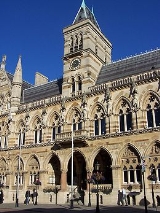
Northampton is a large market town
and local government district
in the East Midlands
region of England. Situated about 67 miles (108 km) north-west of London and around 50 miles (80 km) south-east of Birmingham
, Northampton lies on the River Nene
and is the county town
of Northamptonshire
. The demonym
of Northampton is Northamptonian.
Original settlements in Northampton date back to the 6th century. Its modern development is largely due to its rapid population increase since the 1960s after a planned expansion occurred under the New Towns Commission in the early 1970s. In 2001, its urban area population was 197,199 while its town population was 189,474, making Northampton the 27th largest settlement in England, and the UK's 3rd largest town without official city status
after Reading
and Dudley
. Northampton is the most populous district in England that is not a unitary authority
, a status it failed to obtain in the 1990s local government reform
.
Northampton has a history of the manufacture of boots and shoes yet engineering has taken over as a modern key industry; other industries include food processing, brewing, and the manufacture of shoe machinery, cosmetics, leather goods, and car accessories. At present, the major employers are public administration, financial services, and the distribution trade.
. Farming settlement probably began around the 7th century AD. In the 8th century it was an administrative and/or religious centre for the kingdom of Mercia
. The pre-Norman town was known as Hamtun and was only ca.0.6 acres (2,428.1 m²).
A large hall was discovered just west of St. Peter's church that is estimated to be 8–9th century
built town walls and a large castle under the stewardship of the Norman earl, Simon de Senlis. The original defence line of the walls is preserved in today's street pattern (Bridge St, The Drapery, Bearward St and Scarletwell Street). The town grew rapidly after the Normans
arrived, and beyond the early defences. By the time of the Domesday Book
, the town had a population of about 1500 residents, living in 300 houses.
The town and its castle were important in the early 12th century and the King often held Court in the town. During his famous fallout with Henry II
, Thomas Becket
at one time escaped from Northampton Castle
through the unguarded Northern gate to flee the country.
Northampton had a large Jewish population in the 13th century, centred around Gold Street. In 1277 300 Jews were executed, allegedly for clipping the King's coin, and the Jews of Northampton were driven out of the town. Archaeological sites include a medieval Jewish cemetery and the Northampton Medieval Synagogue
.
The town was originally controlled by officials acting for the King who collected taxes and upheld the law. In 1189 King Richard I
gave the town its first charter. In 1215 King John
authorised the appointment of William Tilly as the town's first Mayor and ordered that: 'twelve of the better and more discreet residents of the town join him as a council to assist him' . In 1176 the Assize of Northampton
laid down new powers for dealing with law breakers.
A university
was established in 1261 by scholars from the University of Cambridge. It briefly flourished, but was dissolved by Henry III
in 1265 apparently as it posed a threat to the University of Oxford.
The first Battle of Northampton
took place at the site of Northampton Castle in 1264 – when the forces of Henry III overran the supporters of Simon de Montfort
. In 1460, a second Battle of Northampton
took place in the grounds of Delapré Abbey
– and was a decisive battle of the Wars of the Roses
, and King Henry VI
was captured in the town by the Yorkists
.
In May 1328 the Treaty of Northampton was signed – being a peace treaty between the English and the Scots in which Edward III recognised the authority of Robert the Bruce as King of Scotland and betrothed Bruce's still infant son to the king's sister Joanna.
A large network of medieval tunnels
remains under the centre around All Saints church.
 Northampton supported the Parliamentarian
s during the English Civil War
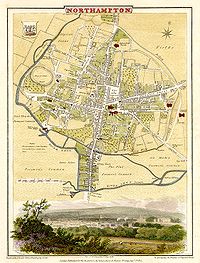
. For this reason the town walls and castle were later torn down on the orders of King Charles II
as punishment. The railway station in Northampton stands on the site of the former castle, and used to be called "Northampton Castle Station".
The town was destroyed by fire in both 1516 and 1675 (for the latter see Great Fire of Northampton
), and was rebuilt as a spacious and well-planned town. In the 18th century Northampton became a major centre of footwear and leather manufacture. The prosperity of the town was greatly aided by demand for footwear caused by the Napoleonic Wars
of the late 18th and early 19th centuries. In his 18th century "Tour through the Whole Island of Great Britain", Daniel Defoe
described Northampton as, "...the handsomest town in all this part of England."
Northampton's growth was accelerated in the 19th century, first by the Grand Union Canal
, which reached the town in 1815 and later the coming of the railways. The first railway to be built into Northampton was a branch from the main London-Birmingham line
at Blisworth
to Peterborough
through Northampton which opened in 1845. This was followed by lines to Market Harborough
(1859) and Bedford
(1872). The Northampton loop
of the West Coast Main Line
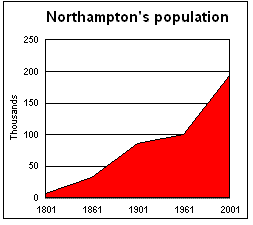
was built in the late 1870s. After 1850 the town grew beyond the old town walls. In 1800 the population was round 7,000 and was 87,000 a century later. In the 19th century Northampton acquired a reputation for political radicalism when radical non-conformist Charles Bradlaugh
was elected as the town's Member of Parliament.
Growth after 1900 slowed until the 1960s. The shoe industry declined and other employment was slow to arrive. In the 1920s and 30s, council houses were built in the east of the town at Headlands; north at St. David's; and south in Far Cotton. The Borough boundary, first extended in 1900, expanded again in 1932. From the 1920s until 1975 the town had its own power station
supplying electricity to areas as far away as Wolverton
.
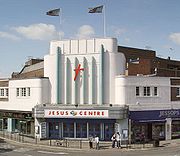
In the 1960s The Deco was an ABC
cinema. The Beatles
appeared there twice on stage in 1963, on Wednesday, 27 March as part of the Tommy Roe
/Chris Montez
Tour. Montez commented "Who are these guys The Beatles? I try to keep up with the British scene, but I don't know their work". The Beatles were back on Wednesday, 6 November, in their own right and on their own tour.
Northampton was designated a New Town
in 1968, and the Northampton Development Corporation (NDC) was set up to almost double the size of the town, with a population target of 230,000 by 1981, rising to 260,000 in later years. In 1959 the M1 motorway
was opened nearby. Growth was slower than planned. The 1960s and 70s saw the town centre change with development of a new bus station, the Grosvenor Shopping Centre, flats and hotels.
The population grew to 100,000 by 1961, and 130,000 by 1971. When NDC wound up after 20 years, another 40,000 residents and 20,000 houses had been added. The borough boundaries changed in 1974 with the abolition of Northampton county borough
and its reconstitution as a non-metropolitan district
also covering areas outside the former borough boundaries but inside the designated New Town.
The rail link and busy M1 motorway to London helped the growth as a commuter town
for London. Northampton's housing expansion was east with the 1970s eastern district estates built mainly for the London overflow population and more recently, in the west at Upton and south near M1 junction 15 at Grange Park
, initially of 1,500 houses actually in South Northants Council
area.
as a part of the 'millennium cities' scheme. The University of Northampton
was established in 2005 after several years as a University College and before that being Nene College.
In 2006 Northampton became a government expansion zone with new growth by West Northamptonshire Development Corporation
(WNDC) an unelected quango
. Expansion began in 2007 at Upton and St Crispins spreading west towards junction 16 of the M1. The other major projected area was south-east of the town enveloping villages such as Little and Great Houghton
, Quinton
, Hackleton
and Cogenhoe
though as at 2011 nothing had happened. Some expansion will be on brownfield sites such as Ransome Road, Far Cotton
, an inner suburb, and in existing borough boundaries.
and from 2011 by the Conservatives, and also Northamptonshire County Council. From 2005 the latter has been controlled by the Conservative Party
. The Borough Council runs services such as housing, waste collection and smaller planning items in the Borough. The County Council looks after social services, education and libraries in the whole county. Since April 2006 major planning decisions such as large housing schemes and new roads have been the responsibility of the WNDC.
Northampton is represented in Parliament
by three MPs:
Northampton's constituency boundaries changed significantly for the 2010 General Election with the creation of a new constituency, South Northamptonshire
, which includes large residential areas in the south of Northampton borough, including East and West Hunsbury and Upton.
, Daventry
and Towcester
Rainfall, at around 650mm per year is not high, though is often unpredictable, giving rise to flooding events such as 1998, but also short term droughts. Desborough Weather Station also supplies the public with a local weather service.
and Trickers, formerly located in nearby Earls Barton
, survive. A large number of old shoe factories remain, mostly now converted to offices or accommodation, some of which are surrounded by terraced houses built for factory workers. Northampton's main private-sector employers are now in distribution and finance rather than manufacturing, and include Avon Products
, Barclaycard
, Blacks Leisure Group
, Nationwide Building Society
, Panasonic
, Travis Perkins
, Coca Cola, Schweppes, National Grid
, Texas Instruments
and Carlsberg. The University of Northampton
is also a major employer, as is St Andrew's Healthcare, a national mental health charity whose St Andrew's Hospital campus in Northampton is by far the UK's largest psychiatric hosptial.
Anglia Building Society
was formed by amalgamation of Northampton Town and County Building Society with Leicestershire Building Society in 1966 and subsequently merged with Nationwide Building Society
in 1987.
 Northampton is near junctions 15, 15a and 16 of the M1 London to North Yorkshire
motorway. The A45 and A43 can be accessed by a partially completed ring road
. The A14 is close by to the north.
Northampton railway station
is on the Northampton Loop
of the West Coast Main Line
, and has regular services to London and Birmingham
provided by London Midland
. Virgin Trains
provide one commuter service to London and a departure from Birmingham New Street late at night. These two Virgin Train services are scheduled to be Pendolino
s.
Sywell Aerodrome
is the nearest airfield which has recently been upgraded with a 1000 metre concrete runway. For international links, East Midlands Airport and Luton Airport are quickly accessible by the M1; Birmingham International Airport via the M1/M6
and also by train.
In the town, buses are operated by Stagecoach Northants
and First Northampton
from the Greyfriars bus station
. Stagecoach provide travel to outlying villages and towns during the day. National Express
cover routes between major towns. There are good local links to Daventry
, Wellingborough
, Oxford
, Milton Keynes
, Rushden
, Kettering
, Corby
and Market Harborough
.
Northampton is the terminus of an arm of the Grand Union Canal
. The arm connects to the River Nene
and from that to the River Great Ouse
and the North Sea
. No longer used for freight, the waterway is now popular with anglers and narrowboat
ers. Principal outlying villages on the canal include Gayton
, Blisworth
, Braunston
and Stoke Bruerne
.
Northampton had a horse-drawn tramway which opened in 1881. The system was extended in stages and taken over by the council in 1897 and named Northampton Corporation Tramways. It was electrified in 1904, but closed in 1934 mainly as a result of competition from motor buses which were introduced in 1929. Two of the original tram shelters are preserved: one at the Racecourse park and another in Kingsthorpe opposite the Cock Hotel.
 Formal parks include: Abington Park
; The Racecourse, which used to be home in summer to the Balloon Festival
and originally used for horse-racing until 1904 and also used as a cricket ground between 1844–1885; Delapré Park
; Bradlaugh
Fields; Becket's Park, named after Thomas Becket
as are nearby Becket's Well and Thomas á Becket pub. There is a park
around an Iron Age
fort in West Hunsbury.
Billing Aquadrome
leisure park is on the eastern outskirts with a caravan site, marina, funfair, bar, riverside restaurant and converted water mill with original workings. Other smaller ones are Thorntons Park and Victoria Park.
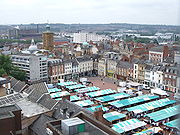
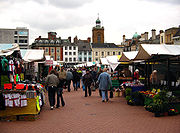
The main shopping centre is the Grosvenor Centre built in the 1970s. The town has one of Britain's largest market square
s, dating from 1235. Outside the centre the Weston Favell
Centre built in the 1970s is in the eastern district together with various out of town retail and leisure parks.
and Royal theatres are in Guildhall Road, opposite Northampton Museum and Art Gallery. They were renovated and reopened in 2006, at a cost of £15 million. The Deco is a 900-seat theatre/conference centre based on the Grade-II listed former Cannon Cinema, in Abington Square used mainly by the voluntary and charitable sector. It was restored by the Jesus Army
as part of their Jesus Centre project.
 Northampton Museum and Art Gallery has a world-class collection of historical footwear, and also Italian art, glass and ceramics, plus visiting exhibitions and local history. There is also a smaller historical museum in a former mansion within Abington Park.
The old Fishmarket opposite the market square, was renovated by the Northampton Arts Collective. It has three art gallery spaces, retail units, a café, and an arts studio and is host to exhibitions by leading artists and live music, community events and workshops.
An independent contemporary arts gallery and studios, The Sanctuary, self-funded and supported by the Arts Council has 16 studios. The Avenue Gallery is at the Avenue campus of Northampton University. Northamptonshire runs an annual county-wide Open Studios event in which artists' studios are open to the public.
The university spent £3m on its Portfolio Innovation Centre, and in early 2011 it now houses around 60 creative freelancers, digital media developers, and designers.
Two commercial cinemas are also in the town: Vue
(formerly UCI) at Sol Central
, Cineworld
(formerly UGC
, Virgin Cinema and MGM) at Sixfields
. There is also the subsidised Forum Cinema at Lings Forum
, whose film programme is widely varied and includes art-house and non-mainstream films.
Many local music venues provide events. One venue is The Roadmender, which used to be run and funded by the council and later bought by The Purplehaus group. It is host to mainstream touring bands and one off gigs. Alan Moore
's underground magazine Dodgem Logic
included a CD "Nation of Saints, 50 Years of Northampton Music" in the first issue, December 2009.
Rugby union
club Northampton Saints
, who play at Franklin's Gardens in the St James area. "The Saints" had their greatest moment when they won the Heineken Cup
in 2000 at Twickenham
, beating Munster
9–8. There are also a number of "Junior" rugby clubs in the area, the most successful of these at producing young players is Northampton Old Scouts RFC who have produced Ben Cohen
and Steve Thompson amongst others.
League Two
football club Northampton Town
, known as "The Cobblers" from the town's shoemaking background, are based at Sixfields Stadium
. Established in 1897, in their centenary season of 1997 they reached Wembley through the play-offs and beat Swansea City 1–0 with an injury time winning free kick from John Frain. In 2010, they were drawn against premiership team Liverpool
in the 2010-11 Football League Cup 3rd round/last 32. They were drawing 1–1 after full-time but won 2–4 on penalties. But they lost out against Ipswich Town 3-1 in the 4th round/last 16. It was the first club to set up a trust for supporters to work with the club as many have done. There is an athletics track adjacent to the ground. There are also three non-league clubs in the United Counties Football League
: Northampton Spencer; Northampton Sileby Rangers
; and Northampton Old Northamptonian Chenecks.
Northamptonshire County Cricket Club
, known in limited overs cricket as "The Steelbacks", play at the County Ground
, in the Abington area.
Nene Whitewater Centre provides an artificial whitewater
course for canoe
s, kayak
s and raft
s.
Northampton Swimming Club trained the young Olympic swimmer Caitlin McClatchey
.
Collingtree
Golf Club hosted the British Masters in 1995.
Northampton International Raceway near Brafield is a leading venue for stock-car racing and hosts the European Championships every July. Speedway racing has been staged at Brafield in the 1950s and again in the 1960s. In the 1950s the team was known as The Flying Foxes and in the 1960s they were known as The Badgers.
Speedway was also staged at the greyhound stadium in Northampton in the pioneer days of the late 1920s.
became the top performing comprehensive school in the country in 2007.
For a complete list see the NCC site.
Northampton School for Girls
was the first school in England to gain Specialist Music College status.
website.
is the town's only paid-for newspaper. There are other free newspapers, but with a town circulation only: The Mercury (Thursday) and Northants on Sunday, both from the publishers of the Chronicle & Echo, and the Herald and Post (Thursday). These free papers are mostly advertising with limited news. The Mercury is one of the oldest newspapers still in circulation first published in 1720. It is the fifth-oldest such newspaper in the UK and the tenth-oldest such in the world.
Radio Three stations are based in the town, two of which broadcast county-wide. BBC Radio Northampton
broadcasts news, topical items and some music, switching to a regional network after 7 pm. A commercial station, Heart 96.6 (formerly Northants 96), broadcasts mostly popular music. A community radio station, Inspiration FM
was awarded a 5 year licence on 24 July 2008 and officially launched on Saturday 24 July 2010.
Regional TV news is broadcast on the BBC East (terrestrial and satellite) with a main programme, BBC Look East, and on ITV
's Anglia News
. From 1999–2004, Northants TV (NTV) on cable and later terrestrial showed local ads, sport, and limited local activities.
Film and TV
Northampton was the town location in the BBC
's Keeping Up Appearances
from 1990–1995. Parts of the 2005 film Kinky Boots
were made in Northampton and featured shots of the statue outside the Grosvenor Centre in the Town Centre and inside RE Tricker's shoe factory in St. Michaels Road representing the original factory, in Earls Barton
. The third series of BBC Three's Bizarre ER
was filmed at Northampton General Hospital.


Other notable church buildings include: St Edmunds, closed 1978 and demolished 2007 with the bells now in St Paul's Cathedral, Wellington
, New Zealand; St Giles; St Matthew's in Phippsville
, built 1891-4 has a Henry Moore
sculpture of the Madonna
; Cathedral of Our Lady Immaculate & St Thomas of Canterbury
, the mother church of the Roman Catholic Diocese of Northampton and seat of the Bishop of Northampton
.
with: Marburg
, Hessen, Germany Poitiers
, Vienne, France
Northampton is also a sister town of: Northampton, Maryland
, United States Northampton, Massachusetts
, United States Northampton, New York, United States Northampton, North Carolina
, United States Northampton, Pennsylvania
, United States Northampton, Virginia
, United States
Market town
Market town or market right is a legal term, originating in the medieval period, for a European settlement that has the right to host markets, distinguishing it from a village and city...
and local government district
Non-metropolitan district
Non-metropolitan districts, or colloquially shire districts, are a type of local government district in England. As created, they are sub-divisions of non-metropolitan counties in a so-called "two-tier" arrangement...
in the East Midlands
East Midlands
The East Midlands is one of the regions of England, consisting of most of the eastern half of the traditional region of the Midlands. It encompasses the combined area of Nottinghamshire, Derbyshire, Leicestershire, Rutland, Northamptonshire and most of Lincolnshire...
region of England. Situated about 67 miles (108 km) north-west of London and around 50 miles (80 km) south-east of Birmingham
Birmingham
Birmingham is a city and metropolitan borough in the West Midlands of England. It is the most populous British city outside the capital London, with a population of 1,036,900 , and lies at the heart of the West Midlands conurbation, the second most populous urban area in the United Kingdom with a...
, Northampton lies on the River Nene
River Nene
The River Nene is a river in the east of England that rises from three sources in the county of Northamptonshire. The tidal river forms the border between Cambridgeshire and Norfolk for about . It is the tenth longest river in the United Kingdom, and is navigable for from Northampton to The...
and is the county town
County town
A county town is a county's administrative centre in the United Kingdom or Ireland. County towns are usually the location of administrative or judicial functions, or established over time as the de facto main town of a county. The concept of a county town eventually became detached from its...
of Northamptonshire
Northamptonshire
Northamptonshire is a landlocked county in the English East Midlands, with a population of 629,676 as at the 2001 census. It has boundaries with the ceremonial counties of Warwickshire to the west, Leicestershire and Rutland to the north, Cambridgeshire to the east, Bedfordshire to the south-east,...
. The demonym
Demonym
A demonym , also referred to as a gentilic, is a name for a resident of a locality. A demonym is usually – though not always – derived from the name of the locality; thus, the demonym for the people of England is English, and the demonym for the people of Italy is Italian, yet, in english, the one...
of Northampton is Northamptonian.
Original settlements in Northampton date back to the 6th century. Its modern development is largely due to its rapid population increase since the 1960s after a planned expansion occurred under the New Towns Commission in the early 1970s. In 2001, its urban area population was 197,199 while its town population was 189,474, making Northampton the 27th largest settlement in England, and the UK's 3rd largest town without official city status
City status in the United Kingdom
City status in the United Kingdom is granted by the British monarch to a select group of communities. The holding of city status gives a settlement no special rights other than that of calling itself a "city". Nonetheless, this appellation carries its own prestige and, consequently, competitions...
after Reading
Reading, Berkshire
Reading is a large town and unitary authority area in England. It is located in the Thames Valley at the confluence of the River Thames and River Kennet, and on both the Great Western Main Line railway and the M4 motorway, some west of London....
and Dudley
Dudley
Dudley is a large town in the West Midlands county of England. At the 2001 census , the Dudley Urban Sub Area had a population of 194,919, making it the 26th largest settlement in England, the second largest town in the United Kingdom behind Reading, and the largest settlement in the UK without...
. Northampton is the most populous district in England that is not a unitary authority
Unitary authorities of England
Unitary authorities of England are areas where a single local authority is responsible for a variety of services for a district that elsewhere are administered separately by two councils...
, a status it failed to obtain in the 1990s local government reform
1990s UK local government reform
The structure of local government in the United Kingdom underwent large changes in the 1990s. The system of two-tier local government introduced in the 1970s by the Local Government Act 1972 and the Local Government Act 1973 was abolished in Scotland and Wales on April 1, 1996, and replaced with...
.
Northampton has a history of the manufacture of boots and shoes yet engineering has taken over as a modern key industry; other industries include food processing, brewing, and the manufacture of shoe machinery, cosmetics, leather goods, and car accessories. At present, the major employers are public administration, financial services, and the distribution trade.
Early history
Remains found here date from the Bronze AgeBronze Age
The Bronze Age is a period characterized by the use of copper and its alloy bronze as the chief hard materials in the manufacture of some implements and weapons. Chronologically, it stands between the Stone Age and Iron Age...
. Farming settlement probably began around the 7th century AD. In the 8th century it was an administrative and/or religious centre for the kingdom of Mercia
Mercia
Mercia was one of the kingdoms of the Anglo-Saxon Heptarchy. It was centred on the valley of the River Trent and its tributaries in the region now known as the English Midlands...
. The pre-Norman town was known as Hamtun and was only ca.0.6 acres (2,428.1 m²).
A large hall was discovered just west of St. Peter's church that is estimated to be 8–9th century
Medieval
The town became significant in the 11th century, when the NormansNormans
The Normans were the people who gave their name to Normandy, a region in northern France. They were descended from Norse Viking conquerors of the territory and the native population of Frankish and Gallo-Roman stock...
built town walls and a large castle under the stewardship of the Norman earl, Simon de Senlis. The original defence line of the walls is preserved in today's street pattern (Bridge St, The Drapery, Bearward St and Scarletwell Street). The town grew rapidly after the Normans
Normans
The Normans were the people who gave their name to Normandy, a region in northern France. They were descended from Norse Viking conquerors of the territory and the native population of Frankish and Gallo-Roman stock...
arrived, and beyond the early defences. By the time of the Domesday Book
Domesday Book
Domesday Book , now held at The National Archives, Kew, Richmond upon Thames in South West London, is the record of the great survey of much of England and parts of Wales completed in 1086...
, the town had a population of about 1500 residents, living in 300 houses.
The town and its castle were important in the early 12th century and the King often held Court in the town. During his famous fallout with Henry II
Henry II of England
Henry II ruled as King of England , Count of Anjou, Count of Maine, Duke of Normandy, Duke of Aquitaine, Duke of Gascony, Count of Nantes, Lord of Ireland and, at various times, controlled parts of Wales, Scotland and western France. Henry, the great-grandson of William the Conqueror, was the...
, Thomas Becket
Thomas Becket
Thomas Becket was Archbishop of Canterbury from 1162 until his murder in 1170. He is venerated as a saint and martyr by both the Roman Catholic Church and the Anglican Communion...
at one time escaped from Northampton Castle
Northampton Castle
Northampton Castle was built under the stewardship of Simon de Senlis, the first Earl of Northampton, in 1084. It took several years to complete, as there is no mention of it in the Domesday Book, a great survey of England completed in 1086....
through the unguarded Northern gate to flee the country.
Northampton had a large Jewish population in the 13th century, centred around Gold Street. In 1277 300 Jews were executed, allegedly for clipping the King's coin, and the Jews of Northampton were driven out of the town. Archaeological sites include a medieval Jewish cemetery and the Northampton Medieval Synagogue
Northampton Medieval Synagogue
The Northampton Medieval Synagogue is an archaeological site and medieval synagogue building in Sheep Street, Northampton, England.The synagogue was discovered in 2010 by Marcus Roberts of National Anglo-Jewish Heritage Trail after many years of researching Northampton's medieval Jewish history...
.
The town was originally controlled by officials acting for the King who collected taxes and upheld the law. In 1189 King Richard I
Richard I of England
Richard I was King of England from 6 July 1189 until his death. He also ruled as Duke of Normandy, Duke of Aquitaine, Duke of Gascony, Lord of Cyprus, Count of Anjou, Count of Maine, Count of Nantes, and Overlord of Brittany at various times during the same period...
gave the town its first charter. In 1215 King John
John of England
John , also known as John Lackland , was King of England from 6 April 1199 until his death...
authorised the appointment of William Tilly as the town's first Mayor and ordered that: 'twelve of the better and more discreet residents of the town join him as a council to assist him' . In 1176 the Assize of Northampton
Assize of Northampton
The Assize of Northampton, largely based on the Assize of Clarendon of 1166, is among a series of measures taken by King Henry II of England that solidified the rights of the knightly tenants and made all possession of land subject to and guaranteed by royal law.The assize is believed to have been...
laid down new powers for dealing with law breakers.
A university
University of Northampton (thirteenth century)
The University of Northampton was based in Northampton from 1261 to 1265.The university was established by Royal Charter after approval from King Henry III in 1261. It was the third university established in England and the United Kingdom after the University of Oxford and the University of...
was established in 1261 by scholars from the University of Cambridge. It briefly flourished, but was dissolved by Henry III
Henry III of England
Henry III was the son and successor of John as King of England, reigning for 56 years from 1216 until his death. His contemporaries knew him as Henry of Winchester. He was the first child king in England since the reign of Æthelred the Unready...
in 1265 apparently as it posed a threat to the University of Oxford.
The first Battle of Northampton
Battle of Northampton (1264)
The Battle of Northampton was a battle in the Second Barons' War.In April 1264 an encounter took place, as part of the Baron's War wherein Henry III of England besieged Simon de Montfort's supporters who were holed in at Northampton Castle...
took place at the site of Northampton Castle in 1264 – when the forces of Henry III overran the supporters of Simon de Montfort
Simon de Montfort, 6th Earl of Leicester
Simon de Montfort, 6th Earl of Leicester, 1st Earl of Chester , sometimes referred to as Simon V de Montfort to distinguish him from other Simon de Montforts, was an Anglo-Norman nobleman. He led the barons' rebellion against King Henry III of England during the Second Barons' War of 1263-4, and...
. In 1460, a second Battle of Northampton
Battle of Northampton (1460)
The Battle of Northampton was a battle in the Wars of the Roses, which took place on 10 July 1460.-Background:The Yorkist cause seemed finished after the previous disaster at Ludford Bridge...
took place in the grounds of Delapré Abbey
Delapré Abbey
Delapré Abbey , or more properly, the Convent of St Mary De La Pré, was founded as a Cluniac nunnery about the year 1145, situated in the meadows of the River Nene to the south of Northampton ....
– and was a decisive battle of the Wars of the Roses
Wars of the Roses
The Wars of the Roses were a series of dynastic civil wars for the throne of England fought between supporters of two rival branches of the royal House of Plantagenet: the houses of Lancaster and York...
, and King Henry VI
Henry VI of England
Henry VI was King of England from 1422 to 1461 and again from 1470 to 1471, and disputed King of France from 1422 to 1453. Until 1437, his realm was governed by regents. Contemporaneous accounts described him as peaceful and pious, not suited for the violent dynastic civil wars, known as the Wars...
was captured in the town by the Yorkists
House of York
The House of York was a branch of the English royal House of Plantagenet, three members of which became English kings in the late 15th century. The House of York was descended in the paternal line from Edmund of Langley, 1st Duke of York, the fourth surviving son of Edward III, but also represented...
.
In May 1328 the Treaty of Northampton was signed – being a peace treaty between the English and the Scots in which Edward III recognised the authority of Robert the Bruce as King of Scotland and betrothed Bruce's still infant son to the king's sister Joanna.
A large network of medieval tunnels
Northampton's tunnels
Northampton is a large market town and a local government district in central England upon the River Nene, and the county town of Northamptonshire; its history goes back many centuries with much of the present town's development taking place during medieval times.-Underground:Today underneath the...
remains under the centre around All Saints church.
Civil War to 1900
Roundhead
"Roundhead" was the nickname given to the supporters of the Parliament during the English Civil War. Also known as Parliamentarians, they fought against King Charles I and his supporters, the Cavaliers , who claimed absolute power and the divine right of kings...
s during the English Civil War
English Civil War
The English Civil War was a series of armed conflicts and political machinations between Parliamentarians and Royalists...
. For this reason the town walls and castle were later torn down on the orders of King Charles II
Charles II of England
Charles II was monarch of the three kingdoms of England, Scotland, and Ireland.Charles II's father, King Charles I, was executed at Whitehall on 30 January 1649, at the climax of the English Civil War...
as punishment. The railway station in Northampton stands on the site of the former castle, and used to be called "Northampton Castle Station".
The town was destroyed by fire in both 1516 and 1675 (for the latter see Great Fire of Northampton
Great Fire of Northampton
The Great Fire of Northampton occurred in 1675 in the town of Northampton in Northamptonshire, England. The blaze was caused by sparks from an open fire in St. Mary’s Street near Northampton castle, and devastated the town centre, destroying about 600 buildings including All Saints church, in 6 hours...
), and was rebuilt as a spacious and well-planned town. In the 18th century Northampton became a major centre of footwear and leather manufacture. The prosperity of the town was greatly aided by demand for footwear caused by the Napoleonic Wars
Napoleonic Wars
The Napoleonic Wars were a series of wars declared against Napoleon's French Empire by opposing coalitions that ran from 1803 to 1815. As a continuation of the wars sparked by the French Revolution of 1789, they revolutionised European armies and played out on an unprecedented scale, mainly due to...
of the late 18th and early 19th centuries. In his 18th century "Tour through the Whole Island of Great Britain", Daniel Defoe
Daniel Defoe
Daniel Defoe , born Daniel Foe, was an English trader, writer, journalist, and pamphleteer, who gained fame for his novel Robinson Crusoe. Defoe is notable for being one of the earliest proponents of the novel, as he helped to popularise the form in Britain and along with others such as Richardson,...
described Northampton as, "...the handsomest town in all this part of England."
Northampton's growth was accelerated in the 19th century, first by the Grand Union Canal
Grand Union Canal
The Grand Union Canal in England is part of the British canal system. Its main line connects London and Birmingham, stretching for 137 miles with 166 locks...
, which reached the town in 1815 and later the coming of the railways. The first railway to be built into Northampton was a branch from the main London-Birmingham line
London and Birmingham Railway
The London and Birmingham Railway was an early railway company in the United Kingdom from 1833 to 1846, when it became part of the London and North Western Railway ....
at Blisworth
Blisworth
Blisworth is a village and civil parish in the South Northamptonshire district of Northamptonshire, England. The West Coast Main Line, from London Euston to Manchester and Scotland, runs alongside the village partly hidden and partly on an embankment...
to Peterborough
Peterborough
Peterborough is a cathedral city and unitary authority area in the East of England, with an estimated population of in June 2007. For ceremonial purposes it is in the county of Cambridgeshire. Situated north of London, the city stands on the River Nene which flows into the North Sea...
through Northampton which opened in 1845. This was followed by lines to Market Harborough
Market Harborough
Market Harborough is a market town within the Harborough district of Leicestershire, England.It has a population of 20,785 and is the administrative headquarters of Harborough District Council. It sits on the Northamptonshire-Leicestershire border...
(1859) and Bedford
Bedford
Bedford is the county town of Bedfordshire, in the East of England. It is a large town and the administrative centre for the wider Borough of Bedford. According to the former Bedfordshire County Council's estimates, the town had a population of 79,190 in mid 2005, with 19,720 in the adjacent town...
(1872). The Northampton loop
Northampton loop
The Northampton loop is a railway line serving the town of Northampton. It is a branch of the West Coast Main Line, deviating from the faster direct main line which runs to the west....
of the West Coast Main Line
West Coast Main Line
The West Coast Main Line is the busiest mixed-traffic railway route in Britain, being the country's most important rail backbone in terms of population served. Fast, long-distance inter-city passenger services are provided between London, the West Midlands, the North West, North Wales and the...
was built in the late 1870s. After 1850 the town grew beyond the old town walls. In 1800 the population was round 7,000 and was 87,000 a century later. In the 19th century Northampton acquired a reputation for political radicalism when radical non-conformist Charles Bradlaugh
Charles Bradlaugh
Charles Bradlaugh was a political activist and one of the most famous English atheists of the 19th century. He founded the National Secular Society in 1866.-Early life:...
was elected as the town's Member of Parliament.
20th century
Growth after 1900 slowed until the 1960s. The shoe industry declined and other employment was slow to arrive. In the 1920s and 30s, council houses were built in the east of the town at Headlands; north at St. David's; and south in Far Cotton. The Borough boundary, first extended in 1900, expanded again in 1932. From the 1920s until 1975 the town had its own power station
Northampton Power Station
Northampton Power Station was a electricity generating station in Northampton, Northamptonshire, England, which began operation for the Northampton Electric Light and Power Company in the 1920s and generated power until closure in 1975.-Location:The plant was located on the south bank of the...
supplying electricity to areas as far away as Wolverton
Wolverton
Wolverton is part of Milton Keynes, Buckinghamshire, England.Wolverton may also refer to:Places in England:*Wolverton, Dorset*Wolverton, Kent*Wolverton, Hampshire*Wolverton, Shropshire*Wolverton, WarwickshirePlaces in the United States:...
.
In the 1960s The Deco was an ABC
Associated British Cinemas
ABC Cinemas was a cinema chain in the United Kingdom. A wholly owned subsidiary of Associated British Picture Corporation , it operated between the 1930s and the late 1960s...
cinema. The Beatles
The Beatles
The Beatles were an English rock band, active throughout the 1960s and one of the most commercially successful and critically acclaimed acts in the history of popular music. Formed in Liverpool, by 1962 the group consisted of John Lennon , Paul McCartney , George Harrison and Ringo Starr...
appeared there twice on stage in 1963, on Wednesday, 27 March as part of the Tommy Roe
Tommy Roe
Tommy Roe is an American pop music singer-songwriter.Best-remembered for his hits "Sheila" and "Dizzy" , critic Bill Dahl wrote that Roe was "widely perceived as one of the archetypal bubblegum artists of the late 1960s, but Roe cut some pretty decent rockers along the way, especially early in his...
/Chris Montez
Chris Montez
Chris Montez , is an American singer.-Early life:Montez grew up in Hawthorne, California, influenced by the Latino-flavored music of his community and the success of Ritchie Valens....
Tour. Montez commented "Who are these guys The Beatles? I try to keep up with the British scene, but I don't know their work". The Beatles were back on Wednesday, 6 November, in their own right and on their own tour.
Northampton was designated a New Town
New towns in the United Kingdom
Below is a list of some of the new towns in the United Kingdom created under the various New Town Acts of the 20th century. Some earlier towns were developed as Garden Cities or overspill estates early in the twentieth century. The New Towns proper were planned to disperse population following the...
in 1968, and the Northampton Development Corporation (NDC) was set up to almost double the size of the town, with a population target of 230,000 by 1981, rising to 260,000 in later years. In 1959 the M1 motorway
M1 motorway
The M1 is a north–south motorway in England primarily connecting London to Leeds, where it joins the A1 near Aberford. While the M1 is considered to be the first inter-urban motorway to be completed in the United Kingdom, the first road to be built to motorway standard in the country was the...
was opened nearby. Growth was slower than planned. The 1960s and 70s saw the town centre change with development of a new bus station, the Grosvenor Shopping Centre, flats and hotels.
The population grew to 100,000 by 1961, and 130,000 by 1971. When NDC wound up after 20 years, another 40,000 residents and 20,000 houses had been added. The borough boundaries changed in 1974 with the abolition of Northampton county borough
County borough
County borough is a term introduced in 1889 in the United Kingdom of Great Britain and Ireland , to refer to a borough or a city independent of county council control. They were abolished by the Local Government Act 1972 in England and Wales, but continue in use for lieutenancy and shrievalty in...
and its reconstitution as a non-metropolitan district
Non-metropolitan district
Non-metropolitan districts, or colloquially shire districts, are a type of local government district in England. As created, they are sub-divisions of non-metropolitan counties in a so-called "two-tier" arrangement...
also covering areas outside the former borough boundaries but inside the designated New Town.
The rail link and busy M1 motorway to London helped the growth as a commuter town
Commuter town
A commuter town is an urban community that is primarily residential, from which most of the workforce commutes out to earn their livelihood. Many commuter towns act as suburbs of a nearby metropolis that workers travel to daily, and many suburbs are commuter towns...
for London. Northampton's housing expansion was east with the 1970s eastern district estates built mainly for the London overflow population and more recently, in the west at Upton and south near M1 junction 15 at Grange Park
Grange Park, Northamptonshire
Grange Park is a large residential housing estate on the edge of the Borough of Northampton but outside the Borough boundary. Some residents refer to its status as a "village", although in reality it is an extension to the Northampton urban area. It is south of Northampton town centre, in the...
, initially of 1,500 houses actually in South Northants Council
South Northamptonshire
South Northamptonshire is a local government district in Northamptonshire, England. Its council is based in Towcester.The district is rural and sparsely populated with just over 79,293 people in 2000 and 91,000 in 2008, a 14.8% increase. The largest town in the district is Brackley, which has a...
area.
21st century
Current projections (February 2008) are that the district's population will grow to 226,400 by 2016 and to 261,300 by 2026. Northampton asked, unsuccessfully, for city statusCity status in the United Kingdom
City status in the United Kingdom is granted by the British monarch to a select group of communities. The holding of city status gives a settlement no special rights other than that of calling itself a "city". Nonetheless, this appellation carries its own prestige and, consequently, competitions...
as a part of the 'millennium cities' scheme. The University of Northampton
University of Northampton
The University of Northampton is a university in Northampton, Northamptonshire, England.-History:In 1924, Northampton Technical College was opened at St George's Avenue, site of the current Avenue Campus. A new building for the college was formally opened by the then Duke and Duchess of York in 1932...
was established in 2005 after several years as a University College and before that being Nene College.
In 2006 Northampton became a government expansion zone with new growth by West Northamptonshire Development Corporation
West Northamptonshire Development Corporation
The West Northamptonshire Development Corporation is an urban Development Corporation set up to cover parts of Northamptonshire in England, by the United Kingdom government in December 2004. WNDC was set up by the Secretary of State under the provisions of the Local Government Planning and Land...
(WNDC) an unelected quango
Quango
Quango or qango is an acronym used notably in the United Kingdom, Ireland and elsewhere to label an organisation to which government has devolved power...
. Expansion began in 2007 at Upton and St Crispins spreading west towards junction 16 of the M1. The other major projected area was south-east of the town enveloping villages such as Little and Great Houghton
Great Houghton, Northamptonshire
Great Houghton is an averaged sized village in the Borough of Northampton.It lays right on the edge of the large market town, on the Bedford Road .The village has two pubs, a large village hall...
, Quinton
Quinton, Northamptonshire
Quinton is a village and civil parish in South Northamptonshire, England. It is about south of Northampton town centre along the road from Wootton to Hanslope, near Salcey Forest.-Geography:...
, Hackleton
Hackleton
Hackleton is a village located in the south of the English shire county of Northamptonshire in the district of South Northamptonshire, just north of Buckinghamshire. It is south of Northampton town centre, and by road to the M1 London to Yorkshire motorway junction 15 and north of junction 14....
and Cogenhoe
Cogenhoe
Cogenhoe is a village in South Northamptonshire, England. The civil parish of Cogenhoe and Whiston had a population at the 2001 census of 1,439 ....
though as at 2011 nothing had happened. Some expansion will be on brownfield sites such as Ransome Road, Far Cotton
Far Cotton
Far Cotton, many years ago a village in its own right, is a district of the English county town of Northampton.Far Cotton is due south of the town centre, beyond Cotton End - hence the 'Far' - and south of the River Nene...
, an inner suburb, and in existing borough boundaries.
Government and politics
Northampton is administered by both Northampton Borough Council, run from May 2007 for the first time by the Liberal DemocratsLiberal Democrats
The Liberal Democrats are a social liberal political party in the United Kingdom which supports constitutional and electoral reform, progressive taxation, wealth taxation, human rights laws, cultural liberalism, banking reform and civil liberties .The party was formed in 1988 by a merger of the...
and from 2011 by the Conservatives, and also Northamptonshire County Council. From 2005 the latter has been controlled by the Conservative Party
Conservative Party (UK)
The Conservative Party, formally the Conservative and Unionist Party, is a centre-right political party in the United Kingdom that adheres to the philosophies of conservatism and British unionism. It is the largest political party in the UK, and is currently the largest single party in the House...
. The Borough Council runs services such as housing, waste collection and smaller planning items in the Borough. The County Council looks after social services, education and libraries in the whole county. Since April 2006 major planning decisions such as large housing schemes and new roads have been the responsibility of the WNDC.
Northampton is represented in Parliament
Parliament of the United Kingdom
The Parliament of the United Kingdom of Great Britain and Northern Ireland is the supreme legislative body in the United Kingdom, British Crown dependencies and British overseas territories, located in London...
by three MPs:
- Brian BinleyBrian BinleyBrian Arthur Roland Binley is a British Conservative politician, and the Member of Parliament for Northampton South.-Early life:...
, ConservativeConservative Party (UK)The Conservative Party, formally the Conservative and Unionist Party, is a centre-right political party in the United Kingdom that adheres to the philosophies of conservatism and British unionism. It is the largest political party in the UK, and is currently the largest single party in the House...
, (Northampton SouthNorthampton South (UK Parliament constituency)Northampton South is a parliamentary constituency represented in the House of Commons of the Parliament of the United Kingdom. It was created for February 1974 general election when the old constituency of Northampton was split into Northampton North and Northampton South.-Boundary...
) - Michael EllisMichael Ellis (British politician)Michael Tyrone Ellis is a British Conservative Party politician. Since 2010 he is the MP for the Northampton North constituency.- Background :...
, ConservativeConservative Party (UK)The Conservative Party, formally the Conservative and Unionist Party, is a centre-right political party in the United Kingdom that adheres to the philosophies of conservatism and British unionism. It is the largest political party in the UK, and is currently the largest single party in the House...
, (Northampton NorthNorthampton North (UK Parliament constituency)Northampton North is a borough constituency represented in the House of Commons of the Parliament of the United Kingdom. It elects one Member of Parliament by the first past the post system of election. It was created before the election of February 1974 when the old constituency of Northampton...
) - Andrea LeadsomAndrea LeadsomAndrea Jacqueline Leadsom , is the Conservative Member of Parliament for South Northamptonshire.-Personal life:She is married to Ben Leadsom, with whom she has three children...
, ConservativeConservative Party (UK)The Conservative Party, formally the Conservative and Unionist Party, is a centre-right political party in the United Kingdom that adheres to the philosophies of conservatism and British unionism. It is the largest political party in the UK, and is currently the largest single party in the House...
, (South NorthamptonshireSouth Northamptonshire (UK Parliament constituency)South Northamptonshire is a county constituency of the House of Commons of the Parliament of the United Kingdom. The current Member of Parliament is Andrea Leadsom of the Conservative Party.-History:...
)
Northampton's constituency boundaries changed significantly for the 2010 General Election with the creation of a new constituency, South Northamptonshire
South Northamptonshire (UK Parliament constituency)
South Northamptonshire is a county constituency of the House of Commons of the Parliament of the United Kingdom. The current Member of Parliament is Andrea Leadsom of the Conservative Party.-History:...
, which includes large residential areas in the south of Northampton borough, including East and West Hunsbury and Upton.
Compass
Northampton's nearest towns are WellingboroughWellingborough
Wellingborough is a market town and borough in Northamptonshire, England, situated some from the county town of Northampton. The town is situated on the north side of the River Nene, most of the older town is sited on the flanks of the hills above the river's current flood plain...
, Daventry
Daventry
Daventry is a market town in Northamptonshire, England, with a population of 22,367 .-Geography:The town is also the administrative centre of the larger Daventry district, which has a population of 71,838. The town is 77 miles north-northwest of London, 13.9 miles west of Northampton and 10.2...
and Towcester
Towcester
Towcester , the Roman town of Lactodorum, is a small town in south Northamptonshire, England.-Etymology:Towcester comes from the Old English Tófe-ceaster. Tófe refers to the River Tove; Bosworth and Toller compare it to the "Scandinavian proper names" Tófi and Tófa...
Climate
As with the rest of the British Isles, Northampton experiences a maritime climate with cool summers and mild winters. The official Metoffice Weather Station for Northampton is the Moulton Park Weather Station at the University of Northampton. Situated at an elevation of around 130m above sea level compared to Northampton town centre at 50-60metres, it is one of the highest points in the Borough, and so may not be a perfect representation of other parts of the town. Its hilltop location means less pooling of cold air on calm clear nights, and lower maximums during summer. The absolute maximum recorded is 34.7c (94.5f) on 3 August 1990. A high of 34.4c (93.9f) was recorded on 19 July 2006. The absolute minimum is −16.8c (1.8f), recorded during February 1986. It is likely the absolute maximum in the town centre is a degree or so higher owing to the lower elevation, and absolute minimum on the eastern and western edges of the Borough around the Nene valley a couple of degrees colder due to katabatic drainage of cold air allowing a frost hollow effect. Most recently, the temperature fell to −9.6c(14.7f) on 20 December 2010.Rainfall, at around 650mm per year is not high, though is often unpredictable, giving rise to flooding events such as 1998, but also short term droughts. Desborough Weather Station also supplies the public with a local weather service.
Economy
Northampton was a major centre of shoemaking and other leather industries, although only specialist shoemaking companies such as Church'sChurch's
Church’s is a high-end English footwear manufacturer founded in 1873 by Thomas Church and his three sons.Over time, the little family business grew into a corporation currently employing nearly 700 people....
and Trickers, formerly located in nearby Earls Barton
Earls Barton
Earls Barton is a village and civil parish in eastern Northamptonshire, notable for its Saxon church and shoe-making heritage.The village was the inspiration for the film Kinky Boots and part of the film was shot here...
, survive. A large number of old shoe factories remain, mostly now converted to offices or accommodation, some of which are surrounded by terraced houses built for factory workers. Northampton's main private-sector employers are now in distribution and finance rather than manufacturing, and include Avon Products
Avon Products
Avon Products, Inc. is a US cosmetics, perfume and toy seller with markets in over 140 countries across the world and sales of $9.9 billion worldwide as of 2007.-Business Model:...
, Barclaycard
Barclaycard
Barclaycard, part of Barclays Retail and Business Banking, is a global payment business. The Barclaycard was the first credit card introduced in the UK, coming into service in 1966. It enjoyed a monopoly until the introduction of the Access card in 1972....
, Blacks Leisure Group
Blacks Leisure Group
Blacks Leisure Group plc of Northampton, UK owns British outdoor retailers Blacks, Millets and Free Spirit. It is listed on the London Stock Exchange and is a constituent of the FTSE Fledgling Index.-Structure:It is based at , Northampton...
, Nationwide Building Society
Nationwide Building Society
Nationwide Building Society is a British building society, and is the largest in the world. It has its headquarters in Swindon, England, and maintains significant administration centres in Bournemouth and Northampton...
, Panasonic
Panasonic
Panasonic is an international brand name for Japanese electric products manufacturer Panasonic Corporation, which was formerly known as Matsushita Electric Industrial Co., Ltd...
, Travis Perkins
Travis Perkins
Travis Perkins plc is a British builders merchant based in Northampton. It is listed on the London Stock Exchange and is a constituent of the FTSE 250 Index.-History:...
, Coca Cola, Schweppes, National Grid
National Grid plc
National Grid plc is a multinational electricity and gas utility company headquartered in London, United Kingdom. Its principal activities are in the United Kingdom and northeastern United States and it is one of the largest investor-owned energy companies in the world.National Grid is listed on...
, Texas Instruments
Texas Instruments
Texas Instruments Inc. , widely known as TI, is an American company based in Dallas, Texas, United States, which develops and commercializes semiconductor and computer technology...
and Carlsberg. The University of Northampton
University of Northampton
The University of Northampton is a university in Northampton, Northamptonshire, England.-History:In 1924, Northampton Technical College was opened at St George's Avenue, site of the current Avenue Campus. A new building for the college was formally opened by the then Duke and Duchess of York in 1932...
is also a major employer, as is St Andrew's Healthcare, a national mental health charity whose St Andrew's Hospital campus in Northampton is by far the UK's largest psychiatric hosptial.
Anglia Building Society
Anglia Building Society
The Anglia Building Society was first formed by the merger of the Northampton Town and County and Leicestershire building societies in the United Kingdom in 1966...
was formed by amalgamation of Northampton Town and County Building Society with Leicestershire Building Society in 1966 and subsequently merged with Nationwide Building Society
Nationwide Building Society
Nationwide Building Society is a British building society, and is the largest in the world. It has its headquarters in Swindon, England, and maintains significant administration centres in Bournemouth and Northampton...
in 1987.
Transport
North Yorkshire
North Yorkshire is a non-metropolitan or shire county located in the Yorkshire and the Humber region of England, and a ceremonial county primarily in that region but partly in North East England. Created in 1974 by the Local Government Act 1972 it covers an area of , making it the largest...
motorway. The A45 and A43 can be accessed by a partially completed ring road
Ring road
A ring road, orbital motorway, beltway, circumferential highway, or loop highway is a road that encircles a town or city...
. The A14 is close by to the north.
Northampton railway station
Northampton railway station
Northampton railway station is a railway station serving the large town of Northampton and other parts of Northamptonshire in England. Other parts of South Northamptonshire are better served by Kings Sutton, Banbury and Milton Keynes Central stations....
is on the Northampton Loop
Northampton loop
The Northampton loop is a railway line serving the town of Northampton. It is a branch of the West Coast Main Line, deviating from the faster direct main line which runs to the west....
of the West Coast Main Line
West Coast Main Line
The West Coast Main Line is the busiest mixed-traffic railway route in Britain, being the country's most important rail backbone in terms of population served. Fast, long-distance inter-city passenger services are provided between London, the West Midlands, the North West, North Wales and the...
, and has regular services to London and Birmingham
Birmingham
Birmingham is a city and metropolitan borough in the West Midlands of England. It is the most populous British city outside the capital London, with a population of 1,036,900 , and lies at the heart of the West Midlands conurbation, the second most populous urban area in the United Kingdom with a...
provided by London Midland
London Midland
London Midland is a train operating company in the United Kingdom. Legally named London and Birmingham Railway Ltd, it is a subsidiary of Govia, and has operated the West Midlands franchise since 11 November 2007....
. Virgin Trains
Virgin Trains
Virgin Trains is a train operating company in the United Kingdom. It operates long-distance passenger services on the West Coast Main Line between London, the West Midlands, North West England, North Wales and Scotland...
provide one commuter service to London and a departure from Birmingham New Street late at night. These two Virgin Train services are scheduled to be Pendolino
British Rail Class 390
The Class 390 Pendolino is a type of train used in Great Britain. They are electric multiple units using Fiat's tilting train pendolino technology and built by Alstom. Fifty-three 9-car units were originally built for Virgin Trains from 2001 to 2004 for operation on the West Coast Main Line , with...
s.
Sywell Aerodrome
Sywell Aerodrome
Sywell Aerodrome is the local aerodrome serving Northampton, Wellingborough and Kettering as it is situated midway between these towns. The airport is located northeast of Northampton and was originally opened in 1928 on the edge of Sywell village....
is the nearest airfield which has recently been upgraded with a 1000 metre concrete runway. For international links, East Midlands Airport and Luton Airport are quickly accessible by the M1; Birmingham International Airport via the M1/M6
M6 motorway
The M6 motorway runs from junction 19 of the M1 at the Catthorpe Interchange, near Rugby via Birmingham then heads north, passing Stoke-on-Trent, Manchester, Preston, Carlisle and terminating at the Gretna junction . Here, just short of the Scottish border it becomes the A74 which continues to...
and also by train.
In the town, buses are operated by Stagecoach Northants
Stagecoach in Northants
Stagecoach Northants is the name for most bus routes operated by Stagecoach Midlands in Northamptonshire. The legal name for the company is United Counties Omnibus Company Ltd...
and First Northampton
First Northampton
First in Northampton is a bus company which serves the towns of Northampton and Wellingborough in Northamptonshire, England. The legal name of the company is Northampton Transport Limited...
from the Greyfriars bus station
Greyfriars bus station
Greyfriars bus station serves the town of Northampton, Northamptonshire, England. The bus station is owned and managed by Northampton Borough Council....
. Stagecoach provide travel to outlying villages and towns during the day. National Express
National Express
National Express Coaches, more commonly known as National Express, is a brand and company, owned by the National Express Group, under which the majority of long distance bus and coach services in Great Britain are operated,...
cover routes between major towns. There are good local links to Daventry
Daventry
Daventry is a market town in Northamptonshire, England, with a population of 22,367 .-Geography:The town is also the administrative centre of the larger Daventry district, which has a population of 71,838. The town is 77 miles north-northwest of London, 13.9 miles west of Northampton and 10.2...
, Wellingborough
Wellingborough
Wellingborough is a market town and borough in Northamptonshire, England, situated some from the county town of Northampton. The town is situated on the north side of the River Nene, most of the older town is sited on the flanks of the hills above the river's current flood plain...
, Oxford
Oxford
The city of Oxford is the county town of Oxfordshire, England. The city, made prominent by its medieval university, has a population of just under 165,000, with 153,900 living within the district boundary. It lies about 50 miles north-west of London. The rivers Cherwell and Thames run through...
, Milton Keynes
Milton Keynes
Milton Keynes , sometimes abbreviated MK, is a large town in Buckinghamshire, in the south east of England, about north-west of London. It is the administrative centre of the Borough of Milton Keynes...
, Rushden
Rushden
Rushden is a town and civil parish in the county of Northamptonshire, England.The parish of Rushden covers an area of some and is part of the district of East Northamptonshire. The population of Rushden was estimated at around 28,368, making it the fifth largest town in the county...
, Kettering
Kettering
Kettering is a market town in the Borough of Kettering, Northamptonshire, England. It is situated about from London. Kettering is mainly situated on the west side of the River Ise, a tributary of the River Nene which meets at Wellingborough...
, Corby
Corby
Corby Town is a town and borough located in the county of Northamptonshire. Corby Town is 23 miles north-east of the county town, Northampton. The borough had a population of 53,174 at the 2001 Census; the town on its own accounted for 49,222 of this figure...
and Market Harborough
Market Harborough
Market Harborough is a market town within the Harborough district of Leicestershire, England.It has a population of 20,785 and is the administrative headquarters of Harborough District Council. It sits on the Northamptonshire-Leicestershire border...
.
Northampton is the terminus of an arm of the Grand Union Canal
Grand Union Canal
The Grand Union Canal in England is part of the British canal system. Its main line connects London and Birmingham, stretching for 137 miles with 166 locks...
. The arm connects to the River Nene
River Nene
The River Nene is a river in the east of England that rises from three sources in the county of Northamptonshire. The tidal river forms the border between Cambridgeshire and Norfolk for about . It is the tenth longest river in the United Kingdom, and is navigable for from Northampton to The...
and from that to the River Great Ouse
River Great Ouse
The Great Ouse is a river in the east of England. At long, it is the fourth-longest river in the United Kingdom. The river has been important for navigation, and for draining the low-lying region through which it flows. Its course has been modified several times, with the first recorded being in...
and the North Sea
North Sea
In the southwest, beyond the Straits of Dover, the North Sea becomes the English Channel connecting to the Atlantic Ocean. In the east, it connects to the Baltic Sea via the Skagerrak and Kattegat, narrow straits that separate Denmark from Norway and Sweden respectively...
. No longer used for freight, the waterway is now popular with anglers and narrowboat
Narrowboat
A narrowboat or narrow boat is a boat of a distinctive design, made to fit the narrow canals of Great Britain.In the context of British Inland Waterways, "narrow boat" refers to the original working boats built in the 18th, 19th, and 20th centuries for carrying goods on the narrow canals...
ers. Principal outlying villages on the canal include Gayton
Gayton, Northamptonshire
Gayton is a rural village from Northampton town centre in South Northamptonshire. It is situated on a hill close to the larger villages of Bugbrooke, Milton Malsor and Blisworth, with a linked public footpath network. -History:...
, Blisworth
Blisworth
Blisworth is a village and civil parish in the South Northamptonshire district of Northamptonshire, England. The West Coast Main Line, from London Euston to Manchester and Scotland, runs alongside the village partly hidden and partly on an embankment...
, Braunston
Braunston
Braunston is a village and civil parish in the county of Northamptonshire, England. It has a population of 1,675 . Braunston is situated just off the A45 main road and lies between the towns of Rugby and Daventry....
and Stoke Bruerne
Stoke Bruerne
Stoke Bruerne is a small village and civil parish in South Northamptonshire, England about north of Milton Keynes and south of Northampton.-History:...
.
Northampton had a horse-drawn tramway which opened in 1881. The system was extended in stages and taken over by the council in 1897 and named Northampton Corporation Tramways. It was electrified in 1904, but closed in 1934 mainly as a result of competition from motor buses which were introduced in 1929. Two of the original tram shelters are preserved: one at the Racecourse park and another in Kingsthorpe opposite the Cock Hotel.
Leisure
Abington Park
Abington Park, in the Abington district of Northampton, has lakes, aviaries, and a museum, as well as trees and grassy open spaces.The park contains the ruins of the former village of Abington, the site of a medieval manorhouse with a mill attached, mentioned in the Domesday book in 1086...
; The Racecourse, which used to be home in summer to the Balloon Festival
Northampton Balloon Festival
The Northampton Balloon Festival is an annual hot air balloon festival held in the English town of Northampton.The original festival was held in the Racecourse park and managed by the Borough Council, and took place over a Friday, Saturday and Sunday in mid-August...
and originally used for horse-racing until 1904 and also used as a cricket ground between 1844–1885; Delapré Park
Delapré Abbey
Delapré Abbey , or more properly, the Convent of St Mary De La Pré, was founded as a Cluniac nunnery about the year 1145, situated in the meadows of the River Nene to the south of Northampton ....
; Bradlaugh
Charles Bradlaugh
Charles Bradlaugh was a political activist and one of the most famous English atheists of the 19th century. He founded the National Secular Society in 1866.-Early life:...
Fields; Becket's Park, named after Thomas Becket
Thomas Becket
Thomas Becket was Archbishop of Canterbury from 1162 until his murder in 1170. He is venerated as a saint and martyr by both the Roman Catholic Church and the Anglican Communion...
as are nearby Becket's Well and Thomas á Becket pub. There is a park
Hunsbury Hill
Hunsbury Hill is an Iron Age hill fort two miles south-west of the centre of the town of Northampton in the county of Northamptonshire.It is probable that defences were built at Hunsbury Hill between the 7th and 4th centuries BC. The deep ditch excavated has survived to the present day...
around an Iron Age
Iron Age
The Iron Age is the archaeological period generally occurring after the Bronze Age, marked by the prevalent use of iron. The early period of the age is characterized by the widespread use of iron or steel. The adoption of such material coincided with other changes in society, including differing...
fort in West Hunsbury.
Billing Aquadrome
Billing Aquadrome
Billing Aquadrome is a leisure park in Great Billing, in the eastern district of Northampton, England. Facilities within the 235-acre park, which is based around various mature gravel pits, include a caravan site, marina and funfair...
leisure park is on the eastern outskirts with a caravan site, marina, funfair, bar, riverside restaurant and converted water mill with original workings. Other smaller ones are Thorntons Park and Victoria Park.
The main shopping centre is the Grosvenor Centre built in the 1970s. The town has one of Britain's largest market square
Market square
The market square is a feature of many European and colonial towns. It is an open area where market stalls are traditionally set out for trading, commonly on one particular day of the week known as market day....
s, dating from 1235. Outside the centre the Weston Favell
Weston Favell
Weston Favell is a former village in the English town of Northampton, Northamptonshire.-Location:Since the Industrial Revolution and 20th Century, the town of Northampton has grown closer and closer to the village boundaries, such that it is an outer district of Northampton, near to several other...
Centre built in the 1970s is in the eastern district together with various out of town retail and leisure parks.
Contemporary culture
The DerngateDerngate
Derngate is a part of Northampton, England, with a theatre complex of the same name. It refers to a gate in the old town walls, which was located there....
and Royal theatres are in Guildhall Road, opposite Northampton Museum and Art Gallery. They were renovated and reopened in 2006, at a cost of £15 million. The Deco is a 900-seat theatre/conference centre based on the Grade-II listed former Cannon Cinema, in Abington Square used mainly by the voluntary and charitable sector. It was restored by the Jesus Army
Jesus Army
The Jesus Army is the identity that the Jesus Fellowship Church uses in its outreach and street-based work. It is a neocharismatic evangelical Christian movement based in the United Kingdom, that is part of the British New Church Movement....
as part of their Jesus Centre project.
The old Fishmarket opposite the market square, was renovated by the Northampton Arts Collective. It has three art gallery spaces, retail units, a café, and an arts studio and is host to exhibitions by leading artists and live music, community events and workshops.
An independent contemporary arts gallery and studios, The Sanctuary, self-funded and supported by the Arts Council has 16 studios. The Avenue Gallery is at the Avenue campus of Northampton University. Northamptonshire runs an annual county-wide Open Studios event in which artists' studios are open to the public.
The university spent £3m on its Portfolio Innovation Centre, and in early 2011 it now houses around 60 creative freelancers, digital media developers, and designers.
Two commercial cinemas are also in the town: Vue
Vue (cinema)
Vue Entertainment , formerly known as SBC International Cinemas, is a cinema company in the UK and the Republic of Ireland. The company was formed in May 2003 when SBC acquired 36 Warner Village cinemas. There are now 69 Vue cinemas, with 654 screens totaling 140,500 seats, including the rebranded...
(formerly UCI) at Sol Central
Sol Central Northampton
Sol Central is a leisure complex in Northampton, England that contains a cinema, health club, casino and restaurants among other facilities. It was constructed in 2002 to replace the Barclaycard head office building previously sited there before relocating to the nearby Brackmills industrial...
, Cineworld
Cineworld
Cineworld Group plc is a cinema chain operating in the United Kingdom, the Republic of Ireland and Jersey. The chain consists of 78 cinemas; 76 of which are located in the UK and one each in Ireland and Jersey. It is the second-largest cinema operator in the UK with 801 screens, and the owner of...
(formerly UGC
UGC
UGC is the second largest cinema operator in Europe with, as of August 2005, 49 sites and 553 screens across four countries:* France: 37 cinemas, 357 screens* Spain: 5 cinemas, 88 screens* Belgium: 3 cinemas, 43 screens* Italy: 4 cinemas, 66 screens...
, Virgin Cinema and MGM) at Sixfields
Sixfields
Sixfields in Northampton, Northamptonshire was a Landfill until a few years ago, when it was converted into a leisure area to accommodate the new Sixfields Stadium for Northampton Town Football Club....
. There is also the subsidised Forum Cinema at Lings Forum
Lings Forum
Lings Forum is a leisure centre located in the suburbs of Northampton. It is annexed to Weston Favell Shopping Centre and Northampton Academy. The forum has a gym, swimming-pool, sporting arena and a one screen cinema....
, whose film programme is widely varied and includes art-house and non-mainstream films.
Many local music venues provide events. One venue is The Roadmender, which used to be run and funded by the council and later bought by The Purplehaus group. It is host to mainstream touring bands and one off gigs. Alan Moore
Alan Moore
Alan Oswald Moore is an English writer primarily known for his work in comic books, a medium where he has produced a number of critically acclaimed and popular series, including Watchmen, V for Vendetta, and From Hell...
's underground magazine Dodgem Logic
Dodgem Logic
Dodgem Logic is a bimonthly underground magazine edited and published by Alan Moore. The first issue appeared in December 2009, and there have been eight issues published as of Spring 2011. Each issue features comics, stories, and articles by Moore, including the regular feature "Great Hipsters...
included a CD "Nation of Saints, 50 Years of Northampton Music" in the first issue, December 2009.
Sport
The town is home to PremiershipGuinness Premiership
The English Premiership, also currently known as the Aviva Premiership because of the league's sponsorship by Aviva, is a professional league competition for rugby union football clubs in the top division of the English rugby system. There are twelve clubs in the Premiership...
Rugby union
Rugby union
Rugby union, often simply referred to as rugby, is a full contact team sport which originated in England in the early 19th century. One of the two codes of rugby football, it is based on running with the ball in hand...
club Northampton Saints
Northampton Saints
Northampton Saints are a professional rugby union club from Northampton, England. The Northampton Saints were formed in 1880. They play in green, black and gold colours. They play their home games at Franklin's Gardens, which has a capacity of 13,591....
, who play at Franklin's Gardens in the St James area. "The Saints" had their greatest moment when they won the Heineken Cup
Heineken Cup
The Heineken Cup is one of two annual rugby union competitions organised by European Rugby Cup involving leading club, regional and provincial teams from the six International Rugby Board countries in Europe whose national teams compete in the Six Nations Championship: England, France, Ireland,...
in 2000 at Twickenham
Twickenham Stadium
Twickenham Stadium is a stadium located in Twickenham, in the London Borough of Richmond upon Thames. It is the largest rugby union stadium in the United Kingdom and has recently been enlarged to seat 82,000...
, beating Munster
Munster Rugby
Munster Rugby is an Irish professional rugby union team based in Munster, that competes in the RaboDirect Pro12 and Heineken Cup.The team represents the Irish Rugby Football Union Munster Branch which is one of four primary branches of the IRFU, and is responsible for rugby union in the Irish...
9–8. There are also a number of "Junior" rugby clubs in the area, the most successful of these at producing young players is Northampton Old Scouts RFC who have produced Ben Cohen
Ben Cohen (rugby player)
Benjamin Christopher "Ben" Cohen, MBE is a former England rugby union international. He began his professional career with Northampton Saints in 1996; in 2007 he moved to France to represent Brive before returning to England two years later to join Sale Sharks...
and Steve Thompson amongst others.
League Two
Football League Two
Football League Two is the third-highest division of The Football League and fourth-highest division overall in the English football league system....
football club Northampton Town
Northampton Town F.C.
Northampton Town Football Club are an English professional football club based in Northampton, Northamptonshire. They currently play in Football League Two, the lowest league division, after being relegated from League One on the last day of the 2008–09 season...
, known as "The Cobblers" from the town's shoemaking background, are based at Sixfields Stadium
Sixfields Stadium
Sixfields Stadium is a 7,653-capacity all-seater sports stadium in Northampton, England. It has been the home ground of Northampton Town Football Club following their move from the County Ground in October 1994....
. Established in 1897, in their centenary season of 1997 they reached Wembley through the play-offs and beat Swansea City 1–0 with an injury time winning free kick from John Frain. In 2010, they were drawn against premiership team Liverpool
Liverpool F.C.
Liverpool Football Club is an English Premier League football club based in Liverpool, Merseyside. Liverpool has won eighteen League titles, second most in English football, seven FA Cups and a record seven League Cups...
in the 2010-11 Football League Cup 3rd round/last 32. They were drawing 1–1 after full-time but won 2–4 on penalties. But they lost out against Ipswich Town 3-1 in the 4th round/last 16. It was the first club to set up a trust for supporters to work with the club as many have done. There is an athletics track adjacent to the ground. There are also three non-league clubs in the United Counties Football League
United Counties Football League
The United Counties Football League is an English football league covering Northamptonshire and Bedfordshire, as well as parts of Buckinghamshire, Cambridgeshire, Leicestershire, Lincolnshire and Norfolk. It has a total of four divisions, two for first teams and two for reserve teams...
: Northampton Spencer; Northampton Sileby Rangers
Northampton Sileby Rangers F.C.
Northampton Sileby Rangers F.C. is a football club based in Northampton, England. They currently play in Division One of the United Counties League.-History:...
; and Northampton Old Northamptonian Chenecks.
Northamptonshire County Cricket Club
Northamptonshire County Cricket Club
Northamptonshire County Cricket Club is one of the 18 major county clubs which make up the English and Welsh domestic cricket structure, representing the historic county of Northamptonshire. Its limited overs team is called the Northants Steelbacks. The traditional club colour is Maroon. During the...
, known in limited overs cricket as "The Steelbacks", play at the County Ground
County Cricket Ground, Northampton
The County Ground, is a cricket venue on Wantage Road in the Abington area of Northampton, UK. It is home to Northamptonshire County Cricket Club....
, in the Abington area.
Nene Whitewater Centre provides an artificial whitewater
Whitewater
Whitewater is formed in a rapid, when a river's gradient increases enough to disturb its laminar flow and create turbulence, i.e. form a bubbly, or aerated and unstable current; the frothy water appears white...
course for canoe
Canoe
A canoe or Canadian canoe is a small narrow boat, typically human-powered, though it may also be powered by sails or small electric or gas motors. Canoes are usually pointed at both bow and stern and are normally open on top, but can be decked over A canoe (North American English) or Canadian...
s, kayak
Kayak
A kayak is a small, relatively narrow, human-powered boat primarily designed to be manually propelled by means of a double blade paddle.The traditional kayak has a covered deck and one or more cockpits, each seating one paddler...
s and raft
Raft
A raft is any flat structure for support or transportation over water. It is the most basic of boat design, characterized by the absence of a hull...
s.
Northampton Swimming Club trained the young Olympic swimmer Caitlin McClatchey
Caitlin McClatchey
Caitlin McClatchey is a Scottish swimmer. To date her greatest sporting achievement was winning two gold medals at the 2006 Commonwealth Games....
.
Collingtree
Collingtree
Collingtree is a village within the Borough of Northampton and a civil parish in Northamptonshire, England.- Location and context :The village is about from Northampton town centre, close to the A45 trunk road which heads east to Wellingborough and Peterborough...
Golf Club hosted the British Masters in 1995.
Northampton International Raceway near Brafield is a leading venue for stock-car racing and hosts the European Championships every July. Speedway racing has been staged at Brafield in the 1950s and again in the 1960s. In the 1950s the team was known as The Flying Foxes and in the 1960s they were known as The Badgers.
Speedway was also staged at the greyhound stadium in Northampton in the pioneer days of the late 1920s.
Education
Until 2004 the county operated a three-tier system involving lower, middle and upper schools. In 2001 the move to a two-tier system began, aiming at improving educational standards. A complete list of primary and secondary schools in the town and surrounding area is available on the County Council website.Primary and secondary schools
Northampton School for BoysNorthampton School For Boys
Northampton School for Boys is a secondary school in Northampton, England.- Foundation and History :The school was originally founded in 1541 by mayor Thomas Chipsey, as the town's free boys grammar school. In 1557, the school moved to St. Gregory's church, which was adapted for its use...
became the top performing comprehensive school in the country in 2007.
For a complete list see the NCC site.
Northampton School for Girls
Northampton School For Girls
Northampton School for Girls is a girls-only comprehensive secondary school in Northampton, England.In 2004, the school gained specialist Music College status, the first school in England to do so, and as a result provides a wide range of musical opportunities for both its students and the local...
was the first school in England to gain Specialist Music College status.
Independent schools
Independent government reports on all schools can be obtained from the OfstedOfsted
The Office for Standards in Education, Children's Services and Skills is the non-ministerial government department of Her Majesty's Chief Inspector of Schools In England ....
website.
- Great HoughtonGreat Houghton, NorthamptonshireGreat Houghton is an averaged sized village in the Borough of Northampton.It lays right on the edge of the large market town, on the Bedford Road .The village has two pubs, a large village hall...
(co-educational, 1–13) - Maidwell Hall for boys aged 8–13
- Northampton High SchoolNorthampton High SchoolNorthampton High School is a private selective day school for girls in Hardingstone, Northampton, England.- Location :The school is about from Northampton town centre along the Newport Pagnell road which separates the school from Wootton.- History :The school was founded in 1878 by a committee of...
, girls 2–18 - Northamptonshire Grammar SchoolNorthamptonshire Grammar SchoolNorthamptonshire Grammar School, established 1989, is a co-educational, 3-18 independent grammar school in Pitsford, Northamptonshire. Going from a 47 pupil school, with 4 buildings, it has expanded with a recent science building, The Sunley Building , and a new library. The school is currently...
(co-educational, 3–18) - Overstone Park SchoolOverstone Park SchoolOverstone Park School is an independent co-educational day school near Northampton, England, for pupils aged 3 months to 18 years.-School:The school was established in 1983 by husband and wife Corville Oliver Brown and Marion Faith Brown. Mrs. Brown is now the Principal of the school, while Mr....
(co-educational, 2–18) - Quinton House SchoolQuinton House SchoolQuinton House School is a profit-making coeducational independent school located in Upton, Northampton, England. The school is owned and operated by the Cognita Group...
(co-educational, 2–18) - St Peter's Independent School(co-educational, 5–18)
- Spratton Hall School, co-educational, 4–13
Media
Newspapers The Northampton Chronicle & EchoNorthampton Chronicle & Echo
The Northampton Chronicle & Echo is a local newspaper serving Northampton, England, and the surrounding towns and villages, with editions from Monday to Saturday...
is the town's only paid-for newspaper. There are other free newspapers, but with a town circulation only: The Mercury (Thursday) and Northants on Sunday, both from the publishers of the Chronicle & Echo, and the Herald and Post (Thursday). These free papers are mostly advertising with limited news. The Mercury is one of the oldest newspapers still in circulation first published in 1720. It is the fifth-oldest such newspaper in the UK and the tenth-oldest such in the world.
Radio Three stations are based in the town, two of which broadcast county-wide. BBC Radio Northampton
BBC Radio Northampton
BBC Radio Northampton is the BBC Local Radio service for the English county of Northamptonshire. It broadcasts from its studios in Broadcasting House, Northampton on 104.2 and 103.6 FM. The station also has two studios in Daventry and Corby...
broadcasts news, topical items and some music, switching to a regional network after 7 pm. A commercial station, Heart 96.6 (formerly Northants 96), broadcasts mostly popular music. A community radio station, Inspiration FM
Inspiration FM
Inspiration FM is a community radio station in Northampton, United Kingdom.Inspiration FM is a community led and managed radio service, providing access, information, entertainment and training...
was awarded a 5 year licence on 24 July 2008 and officially launched on Saturday 24 July 2010.
Regional TV news is broadcast on the BBC East (terrestrial and satellite) with a main programme, BBC Look East, and on ITV
ITV
ITV is the major commercial public service TV network in the United Kingdom. Launched in 1955 under the auspices of the Independent Television Authority to provide competition to the BBC, it is also the oldest commercial network in the UK...
's Anglia News
Anglia Television
Anglia Television is the ITV franchise holder for the East Anglia franchise region. Although Anglia Television takes its name from East Anglia, its transmission coverage extends beyond the generally accepted boundaries of that region. The station is based at Anglia House in Norwich, with regional...
. From 1999–2004, Northants TV (NTV) on cable and later terrestrial showed local ads, sport, and limited local activities.
Film and TV
Northampton was the town location in the BBC
BBC
The British Broadcasting Corporation is a British public service broadcaster. Its headquarters is at Broadcasting House in the City of Westminster, London. It is the largest broadcaster in the world, with about 23,000 staff...
's Keeping Up Appearances
Keeping Up Appearances
Keeping Up Appearances is a British sitcom created and written by Roy Clarke for the BBC. Centred on the life of eccentric, social-climbing snob Hyacinth Bucket , the sitcom portrays a social hierarchy-ruled British society...
from 1990–1995. Parts of the 2005 film Kinky Boots
Kinky Boots (film)
Kinky Boots is a 2005 comedy film written by Geoff Deane and Tim Firth, about a traditional Northampton shoemaker, based in Earls Barton, who turns to producing fetishism footwear in order to save the failing family business and the jobs of his workers...
were made in Northampton and featured shots of the statue outside the Grosvenor Centre in the Town Centre and inside RE Tricker's shoe factory in St. Michaels Road representing the original factory, in Earls Barton
Earls Barton
Earls Barton is a village and civil parish in eastern Northamptonshire, notable for its Saxon church and shoe-making heritage.The village was the inspiration for the film Kinky Boots and part of the film was shot here...
. The third series of BBC Three's Bizarre ER
Bizarre ER
Bizarre ER is a BBC Three television show that deals with hospital mishaps. It was narrated by Freema Agyeman and is now narrated by Sheridan Smith from Series 4 onwards....
was filmed at Northampton General Hospital.
Notable buildings
- Northampton's oldest standing building, the Church of The Holy SepulchreThe Holy Sepulchre, NorthamptonThe Holy Sepulchre is a Norman round church in Sheep Street, Northampton, England.Simon de Senlis, Earl of Northampton, was responsible for making Northampton, England, a Norman stronghold by building a castle and a town wall...
, is one of the largest and best-preserved round churches in England. It was built in 1100 on the orders of the first Earl of NorthamptonEarl of NorthamptonEarl of Northampton is a title that has been created five times.-Earls in for the Honour of Huntingdon, first Creation :*Waltheof *Maud, Countess of Huntingdon** m. Simon I de Senlis** m...
, Simon de SenlisMarquess of NorthamptonMarquess of Northampton is a title that has been created twice.-William Parr:First creation, 1547–1571The title was created for the first time in the Peerage of England in 1547 in favour of William Parr, brother of Catherine Parr, the sixth and last wife of King Henry VIII. The title was forfeited...
, who had just returned from the first Crusade. It is based on a plan of the original Church of the Holy Sepulchre in Jerusalem. - The current All Saints' ChurchAll Saints' Church, NorthamptonAll Saints' Church, Northampton situated in the centre of Northampton, is a Parish Church of the Church of England and Northampton's Civic Church....
was built on the site of a great Norman church, All Hallows, which was almost completely destroyed by the Fire of Northampton in 1675. All that remained was the medieval tower and the fine vaulted crypt, but by 1680 All SaintsAll Saints' Church, NorthamptonAll Saints' Church, Northampton situated in the centre of Northampton, is a Parish Church of the Church of England and Northampton's Civic Church....
had been rebuilt, with the help of donations from all over England, including 1,000 tons of timber from King Charles IICharles II of EnglandCharles II was monarch of the three kingdoms of England, Scotland, and Ireland.Charles II's father, King Charles I, was executed at Whitehall on 30 January 1649, at the climax of the English Civil War...
, whose statue can be seen above the porticoPorticoA portico is a porch leading to the entrance of a building, or extended as a colonnade, with a roof structure over a walkway, supported by columns or enclosed by walls...
. Famously, the poet John ClareJohn ClareJohn Clare was an English poet, born the son of a farm labourer who came to be known for his celebratory representations of the English countryside and his lamentation of its disruption. His poetry underwent a major re-evaluation in the late 20th century and he is often now considered to be among...
liked to sit beneath the portico of the church.
- The GuildhallNorthampton GuildhallNorthampton Guildhall is a building which stands on St Giles' Square in Northampton, England.-Original building:It was built to the design of Edward William Godwin begun when he was only 28 between 1861 and 1864 in neo-gothic style. As well as housing Northampton Borough Council, it is also used...
in Northampton (see picture at top) was constructed mostly in the 1860s in Victorian Gothic architecture, and extended in the 1990s. It is built on the site of the old town hall. - 78 Derngate78 Derngate78 Derngate is a Grade II* listed Georgian house in the Derngate area of Northampton, England, originally built in the 1820s. It's noted for its interior, which was extensively remodelled in 1916 and 1917 by noted architect Charles Rennie Mackintosh for businessman Wenman Joseph Bassett-Lowke as...
is a Grade II* listed Georgian Town House remodelled by Charles Rennie MackintoshCharles Rennie MackintoshCharles Rennie Mackintosh was a Scottish architect, designer, watercolourist and artist. He was a designer in the Arts and Crafts movement and also the main representative of Art Nouveau in the United Kingdom. He had a considerable influence on European design...
for Wenman Joseph Bassett-LowkeWenman Joseph Bassett-LowkeWenman Joseph Bassett-Lowke was the son of Joseph Tom Lowke, a Northampton boilermaker and his wife, Eliza, and is noted for having founded the firm of Bassett-Lowke which specialised in producing construction sets, and model railways, boats and ships...
in 1916–17. It contains notable Mackintosh interiors (which have been restored) and is his only major domestic commission outside Scotland. It is open to the public. - The 127.45 metre tall Express Lift TowerExpress Lift TowerThe National Lift Tower is a lift testing tower built by the Express Lift Company off the Weedon Road in Northampton, England...
is a dominant feature and visible from most of the town. A Terry WoganTerry WoganSir Michael Terence Wogan, KBE, DL , or also known as Terry Wogan, is a veteran Irish radio and television broadcaster who holds dual Irish and British citizenship. Wogan has worked for the BBC in the United Kingdom for most of his career...
radio phone-in during the 1980s to came up with the name "Northampton Lighthouse" as Northampton is one of the furthest places from the sea. It is also known as the "Cobblers' Needle". It was built for testing new lifts at the Express Lifts factory, now closed. Though now redundant, it is a listed building.
- Northampton Castle (now only remaining as a rebuilt postern gate in a wall outside the railway station and the hill on which it stood) was for many years one of the country's most important castles. The country's parliament sat here many times and Thomas BecketThomas BecketThomas Becket was Archbishop of Canterbury from 1162 until his murder in 1170. He is venerated as a saint and martyr by both the Roman Catholic Church and the Anglican Communion...
was imprisoned here until he escaped. - The Carlsberg UK brewery.
- Delapre AbbeyDelapré AbbeyDelapré Abbey , or more properly, the Convent of St Mary De La Pré, was founded as a Cluniac nunnery about the year 1145, situated in the meadows of the River Nene to the south of Northampton ....
– former Cluniac nunnery, founded by Simon de SenlisMarquess of NorthamptonMarquess of Northampton is a title that has been created twice.-William Parr:First creation, 1547–1571The title was created for the first time in the Peerage of England in 1547 in favour of William Parr, brother of Catherine Parr, the sixth and last wife of King Henry VIII. The title was forfeited...
– later the County Records Office and site of the second Battle of NorthamptonBattle of Northampton (1460)The Battle of Northampton was a battle in the Wars of the Roses, which took place on 10 July 1460.-Background:The Yorkist cause seemed finished after the previous disaster at Ludford Bridge...
. - Queen EleanorEleanor of CastileEleanor of Castile was the first queen consort of Edward I of England. She was also Countess of Ponthieu in her own right from 1279 until her death in 1290, succeeding her mother and ruling together with her husband.-Birth:...
's body rested here on its way to London – and the nearby Eleanor crossEleanor crossThe Eleanor crosses were twelve originally wooden, but later lavishly decorated stone, monuments of which three survive intact in a line down part of the east of England. King Edward I had the crosses erected between 1291 and 1294 in memory of his wife Eleanor of Castile, marking the nightly...
in HardingstoneHardingstoneHardingstone is a village in Northamptonshire, England. It is on the southern edge of Northampton, and now forms a suburb of the town within the Northampton Borough Council area. It is about from the town centre...
, now part of the Delapre area of the town, commemorates this. Out of the twelve originally erected, this cross is one of only three left including others at GeddingtonGeddingtonGeddington is a village and civil parish on the A43 in north-east Northamptonshire between Kettering and Corby.It contains what is thought to be the best surviving Eleanor cross. The monument dates from 1294, when the crosses were raised as a memorial by Edward I to his late wife, Eleanor of...
and Waltham. The original top of the monument widely thought to have been an ornate cross has apparently been destroyed and replaced several times from as early as 1460. The last cross is reported to have been knocked off by a low flying aircraft from a nearby airfiled during WWII. However The Friends of Delapré Abbey charity is raising funds for the restoration of the cross in their tea room inside the abbey. The Cross is also referred to in Daniel DefoeDaniel DefoeDaniel Defoe , born Daniel Foe, was an English trader, writer, journalist, and pamphleteer, who gained fame for his novel Robinson Crusoe. Defoe is notable for being one of the earliest proponents of the novel, as he helped to popularise the form in Britain and along with others such as Richardson,...
's a "Tour through the whole island of Great Britain" where he describes the Great Fire of Northampton, "...a townsman being at Queen's Croos upon a hill on the south side of the town, about two miles off, saw the fire at one end of the town then newly begun, and that before he could get to the town it was burning at the remotest end, opposite where he first saw it." - The 1970s Greyfriars Bus Station was built which replaced one in Derngate. In the 2000s it was featured on Channel 4Channel 4Channel 4 is a British public-service television broadcaster which began working on 2 November 1982. Although largely commercially self-funded, it is ultimately publicly owned; originally a subsidiary of the Independent Broadcasting Authority , the station is now owned and operated by the Channel...
's Demolition programme as the ugliest transport station in the UK and worthy of demolition.
- St Andrew's Hospital, opened 1838, and its new building William Wake House, the largest neo-classical structure in England since the Ministry of Defence.
- Northampton & County Club, established 1873, was the old county hospital before becoming a private members' club; the cellars are medieval.
Other notable church buildings include: St Edmunds, closed 1978 and demolished 2007 with the bells now in St Paul's Cathedral, Wellington
Wellington Cathedral of Saint Paul
This article relates to the Anglican Cathedral of Wellington. For the two other Wellington Cathedrals see: Sacred Heart Cathedral and Cathedral of the Annunciation of the Virgin Mary thumb|View of the chancel...
, New Zealand; St Giles; St Matthew's in Phippsville
Pickering Phipps
Pickering Phipps is the name of three related men, father, grandson and great grandson, who were all residents of Northampton, England from 19th and early 20th century. The first began the Phipps Brewery in Towcester in 1801. The company survives today as Phipps NBC.-Pickering Phipps I:Pickering...
, built 1891-4 has a Henry Moore
Henry Moore
Henry Spencer Moore OM CH FBA was an English sculptor and artist. He was best known for his semi-abstract monumental bronze sculptures which are located around the world as public works of art....
sculpture of the Madonna
Madonna (art)
Images of the Madonna and the Madonna and Child or Virgin and Child are pictorial or sculptured representations of Mary, Mother of Jesus, either alone, or more frequently, with the infant Jesus. These images are central icons of Roman Catholicism and Eastern Orthodox Christianity where Mary remains...
; Cathedral of Our Lady Immaculate & St Thomas of Canterbury
Northampton Cathedral
The Cathedral Church of St Mary and St Thomas is a Roman Catholic cathedral in Northampton, England. It is the seat of the Bishop of Northampton and mother church of the Diocese of Northampton which covers the counties of Northamptonshire, Bedfordshire, Buckinghamshire and that part of Berkshire ...
, the mother church of the Roman Catholic Diocese of Northampton and seat of the Bishop of Northampton
Bishop of Northampton
The Bishop of Northampton is the Ordinary of the Roman Catholic Diocese of Northampton in the Province of Westminster, England.The see is in the town of Northampton where the bishop's seat is located in the Cathedral Church of Our Lady and Saint Thomas of Canterbury.The current bishop is the Right...
.
Modern
- Will AlsopWill AlsopWill Allen Alsop, OBE RA is a British architect based in London. He is responsible for several distinctive and controversial modernist buildings, most in the United Kingdom. Alsop's buildings are usually distinguished by their use of bright colour and unusual forms...
architect, was born, raised, and studied for his Foundation degreeFoundation degreeThe Foundation Degree is a vocational qualification introduced by the government of the United Kingdom in September 2001, which is available in England, Wales and Northern Ireland...
in the town. Designed the Sharp Centre for Design in Toronto and North Greenwich tube stationNorth Greenwich tube stationNorth Greenwich is a station on London Underground's Jubilee Line, opened on 14 May 1999.Despite its name, North Greenwich is not in the area historically known as North Greenwich, on the Isle of Dogs, north of the river; an entirely different station used to be there, between 1872 and 1926...
on the London UndergroundLondon UndergroundThe London Underground is a rapid transit system serving a large part of Greater London and some parts of Buckinghamshire, Hertfordshire and Essex in England...
Jubilee LineJubilee LineThe Jubilee line is a line on the London Underground , in the United Kingdom. It was built in two major sections—initially to Charing Cross, in central London, and later extended, in 1999, to Stratford, in east London. The later stations are larger and have special safety features, both aspects... - Dallas CampbellDallas CampbellDallas Campbell is a British television presenter and television and stage actor. His acting credits include Spender, A Touch of Frost, Family Affairs, Casualty and Holby City...
, TV presenter, studied Drama and English at the University of Northampton between 1989~1992 - Judy CarneJudy CarneJudy Carne is an English actress best remembered for the phrase "Sock it to me!" on Rowan & Martin's Laugh-In.-Career:...
, actress, born Joyce Botterill 27 April 1939 in the town. - Alan CarrAlan CarrAlan Carr is an English comedian and television personality. Born in Weymouth, he was raised in Northampton before moving to Manchester during his early 20's....
, comedian, attended what is now Weston Favell School, but was not born locally. His father Graham CarrGraham CarrWilliam Graham Carr is an English former professional footballer and football club manager. He is currently Head Scout at Newcastle United.-Club career:...
managed Northampton Town FC - Andrew Collins journalist and broadcaster, grew up in the town and wrote about it in his memoir Where Did It All Go Right?
- Delia DerbyshireDelia DerbyshireDelia Ann Derbyshire was an English musician and composer of electronic music and musique concrète. She is best known for her electronic realisation of Ron Grainer's theme music to the British science fiction television series Doctor Who and for her work with the BBC Radiophonic Workshop.-Early...
(deceased), who produced the original Doctor WhoDoctor WhoDoctor Who is a British science fiction television programme produced by the BBC. The programme depicts the adventures of a time-travelling humanoid alien known as the Doctor who explores the universe in a sentient time machine called the TARDIS that flies through time and space, whose exterior...
theme tune, spent her final years in the town - Marcia Matilda Falkender, Baroness FalkenderMarcia Falkender, Baroness FalkenderMarcia Matilda Falkender, Baroness Falkender CBE , formerly Marcia Williams , is a British Labour politician, being first the private secretary for, and then the political secretary and head of political office to, Harold Wilson.-Background and early career:Born Marcia Field, Falkender was educated...
, formerly Marcia Williams, private secretary to Prime Minister Harold WilsonHarold WilsonJames Harold Wilson, Baron Wilson of Rievaulx, KG, OBE, FRS, FSS, PC was a British Labour Member of Parliament, Leader of the Labour Party. He was twice Prime Minister of the United Kingdom during the 1960s and 1970s, winning four general elections, including a minority government after the...
was educated at Northampton High School for GirlsNorthampton High SchoolNorthampton High School is a private selective day school for girls in Hardingstone, Northampton, England.- Location :The school is about from Northampton town centre along the Newport Pagnell road which separates the school from Wootton.- History :The school was founded in 1878 by a committee of... - Anne FineAnne FineAnne Fine, OBE FRSL is a British author best known for her children's books, of which she has written more than 50. She also writes for adults...
– Author of Madame Doubtfire attended Northampton High School for Girls - Joan HicksonJoan HicksonJoan Hickson OBE was an English actress of theatre, film and television, famed for playing Agatha Christie's Miss Marple in the television series Miss Marple.- Wivenhoe :...
, who played Miss MarpleMiss MarpleJane Marple, usually referred to as Miss Marple, is a fictional character appearing in twelve of Agatha Christie's crime novels and in twenty short stories. Miss Marple is an elderly spinster who lives in the village of St. Mary Mead and acts as an amateur detective. She is one of the most famous...
, comes from KingsthorpeKingsthorpeKingsthorpe was once a Northamptonshire village but is now an extremely affluent suburb to the north-west of the major town of Northampton, England. The River Nene flows through the area to the west... - Ruaridh JacksonRuaridh JacksonRuaridh James Howard Jackson is a Scottish rugby union footballer. He plays professional rugby for Glasgow Warriors....
, who plays rugby union for Glasgow WarriorsGlasgow WarriorsThe Glasgow Warriors, formerly Glasgow Rugby, are one of two professional rugby union teams in Scotland, Edinburgh being the other. They play in the RaboDirect Pro12 and their home ground is Firhill Stadium, also the home of Partick Thistle Football Club.-History:Glasgow Rugby were created to...
and ScotlandScotlandScotland is a country that is part of the United Kingdom. Occupying the northern third of the island of Great Britain, it shares a border with England to the south and is bounded by the North Sea to the east, the Atlantic Ocean to the north and west, and the North Channel and Irish Sea to the...
, was born in the town - Lesley JosephLesley JosephLesley D Joseph is an English actress and broadcaster.-Life and career:Joseph was born in Northampton. She is best known for starring in the BBC sitcom Birds of a Feather from 1989–1998, in which she played Dorien Green, the Jewish next-door neighbour of the main characters Sharon and Tracy...
Birds of a FeatherBirds of a FeatherBirds of a Feather was a British sitcom that was broadcast on BBC1 from 1989 until 1998. Starring Pauline Quirke, Linda Robson and Lesley Joseph, it was created by Laurence Marks and Maurice Gran, who also wrote some of the episodes along with many other writers.The first episode sees sisters...
actress grew up in the town - Robert LlewellynRobert LlewellynRobert Llewellyn is an English actor, presenter, and writer. He is best known as the mechanoid Kryten in the hit sitcom Red Dwarf, and for his role as presenter of Scrapheap Challenge.-Early career:...
, actor, (Kryten from Red DwarfRed DwarfRed Dwarf is a British comedy franchise which primarily comprises eight series of a television science fiction sitcom that aired on BBC Two between 1988 and 1999 and Dave from 2009–present. It gained cult following. It was created by Rob Grant and Doug Naylor, who also wrote the first six series...
) was born here and lived at 47 Booth Rise until the age of 13 - Tim MinchinTim MinchinTimothy David "Tim" Minchin is a British-Australian comedian, actor, and musician.Tim Minchin is best known for his musical comedy, which has featured in six CDs, three DVDs and a number of live comedy shows which he has performed internationally. He has also appeared on television in Australia,...
comedian, actor and musician was born here - Alan MooreAlan MooreAlan Oswald Moore is an English writer primarily known for his work in comic books, a medium where he has produced a number of critically acclaimed and popular series, including Watchmen, V for Vendetta, and From Hell...
, writer of V for VendettaV for VendettaV for Vendetta is a ten-issue comic book series written by Alan Moore and illustrated mostly by David Lloyd, set in a dystopian future United Kingdom imagined from the 1980s to about the 1990s. A mysterious masked revolutionary who calls himself "V" works to destroy the totalitarian government,...
, WatchmenWatchmenWatchmen is a twelve-issue comic book limited series created by writer Alan Moore, artist Dave Gibbons, and colourist John Higgins. The series was published by DC Comics during 1986 and 1987, and has been subsequently reprinted in collected form...
, The League of Extraordinary GentlemenThe League of Extraordinary GentlemenThe League of Extraordinary Gentlemen is a comic book series written by Alan Moore and illustrated by Kevin O'Neill, publication of which began in 1999. The series spans two six-issue limited series and a graphic novel from the America's Best Comics imprint of Wildstorm/DC, and a third miniseries...
, Voice of the FireVoice of the FireVoice of the Fire is the first novel from Alan Moore, acclaimed comic book writer. The twelve-chapter book was initially published in the United Kingdom c. 1996. The narratives take place around Moore's hometown of Northampton, England during the month of November, and span several millennia — from...
, a fictionalised history of the town, is a lifelong resident - James MorrisonJames Morrison (singer)James Morrison is a BRIT Award-winning English singer-songwriter and guitarist from Rugby, Warwickshire. In 2006, his debut single "You Give Me Something" became a hit in Europe, Australia, and Japan, peaking in the top five in the UK and New Zealand. His debut album, Undiscovered, debuted at the...
singer/songwriter lived in the town for 18 months and went to Kingsthorpe Middle School - Nanette NewmanNanette Newman-Early life:Newman was born in Northampton, England. She was educated at Sternhold College, the Italia Conti Academy of Theatre Arts stage school and the Royal Academy of Dramatic Art in London.-Career:...
, actress and author, wife of Bryan ForbesBryan ForbesBryan Forbes, CBE is an English film director, actor and writer.-Career:Bryan Forbes was born John Theobald Clarke on 22 July 1926 in Queen Mary's Hospital, Stratford, West Ham, Essex , and grew up at 43 Cranmer Road, Forest Gate, West Ham, Essex .Forbes trained as an actor at the Royal Academy of...
was born here - Anna Murby, former BBC radio presenter attended Campion School, BugbrookeCampion School (Bugbrooke)The Campion School is a co-educational comprehensive school in Bugbrooke, about from Northampton, England. Founded in 1967, it has been a Language College since September 1997. In 2011, the school became an academy....
- Des O'ConnorDes O'ConnorDes O'Connor, CBE is an English comedian and singer. A former talkshow host, he was the presenter of the long-running Channel 4 gameshow Countdown for two years...
, television presenter and singer, evacuated to the town in 1932 during WWII and briefly played for Northampton Town FC - Myrea PettitMyrea PettitMyrea Pettit is an English fantasy and fairy artist and illustrator born in Northampton. She studied with famed Swedish illustrator Ann Mari Sjogren painting flowers, butterflies and fairies like Tinkerbell from Peter Pan....
, fantasy artist of fairies, flowers and butterflies learned her craft in the county - Former Blue PeterBlue PeterBlue Peter is the world's longest-running children's television show, having first aired in 1958. It is shown on CBBC, both in its BBC One programming block and on the CBBC channel. During its history there have been many presenters, often consisting of two women and two men at a time...
presenter Peter PurvesPeter PurvesPeter Purves is an English television presenter and actor.Purves was born in New Longton, near Preston, Lancashire, and was educated at the independent Arnold School in Blackpool, he had originally planned to go into teaching, training at Alsager College of Education, but began to act with the...
lived for a number of years at the old rectory in CogenhoeCogenhoeCogenhoe is a village in South Northamptonshire, England. The civil parish of Cogenhoe and Whiston had a population at the 2001 census of 1,439 .... - Derek RedmondDerek RedmondDerek Anthony Redmond is a retired British athlete. During his career, he held the British record for the 400 metres sprint, and won gold medals in the 4x400 metres relay at the World Championships, European Championships and Commonwealth Games.However his career was blighted by a series of...
, Olympic runner, was born and raised here and attended RoadeRoadeRoade is a village in Northamptonshire, England and in the area of the South Northamptonshire District Council where it is in the two-member Blisworth and Roade ward.-Location:...
Comprehensive School, now Roade Sports College, where the sports hall is named after him - Norman SmileyNorman SmileyNorman Anthony Smiley is a British professional wrestler best known for his appearances in World Championship Wrestling...
, professional wrestler, was born here - Matt SmithMatt Smith (British actor)Matthew Robert Smith is an English stage and television actor. He is known for his role as the eleventh incarnation of the Doctor in the British television series Doctor Who, for which he received a BAFTA Award nomination in 2011....
, actor, who plays the eleventh DoctorEleventh DoctorThe Eleventh Doctor is the eleventh incarnation of the protagonist of the BBC television science-fiction series Doctor Who. Matt Smith plays this incarnation, replacing David Tennant's Tenth Doctor in the 2010 episode "The End of Time, Part Two"...
in Doctor WhoDoctor WhoDoctor Who is a British science fiction television programme produced by the BBC. The programme depicts the adventures of a time-travelling humanoid alien known as the Doctor who explores the universe in a sentient time machine called the TARDIS that flies through time and space, whose exterior...
went to Northampton School for BoysNorthampton School For BoysNorthampton School for Boys is a secondary school in Northampton, England.- Foundation and History :The school was originally founded in 1541 by mayor Thomas Chipsey, as the town's free boys grammar school. In 1557, the school moved to St. Gregory's church, which was adapted for its use... - Diana, Princess of WalesDiana, Princess of WalesDiana, Princess of Wales was the first wife of Charles, Prince of Wales, whom she married on 29 July 1981, and an international charity and fundraising figure, as well as a preeminent celebrity of the late 20th century...
(Diana Spencer) is buried at AlthorpAlthorpAlthorp is a country estate of about and a stately home in Northamptonshire, England. It is about north-west of the county town of Northampton. The late Diana, Princess of Wales is buried in the estate.-History:...
, the country estate of Earl SpencerEarl SpencerEarl Spencer is a title in the Peerage of Great Britain that was created on 1 November 1765, along with the title Viscount Althorp, of Althorp in the County of Northamptonshire, for John Spencer, 1st Viscount Spencer, a great-grandson of the 1st Duke of Marlborough...
where Charles Spencer, the current and 9th Earl SpencerCharles Spencer, 9th Earl SpencerCharles Edward Maurice Spencer, 9th Earl Spencer, DL , styled Viscount Althorp between 1975 and 1992, is a British peer and brother of Diana, Princess of Wales...
(b.1964) is her brother. In 1989, the Prince and Princess of Wales, Charles & Diana, made an official visit to Northampton and Diana was made an Honorary Freeman of the Borough. The Royal Pioneer CorpsRoyal Pioneer CorpsThe Royal Pioneer Corps was a British Army combatant corps used for light engineering tasks.The Royal Pioneer Corps was raised on 17 October 1939 as the Auxiliary Military Pioneer Corps. It was renamed the Pioneer Corps on 22 November 1940...
from the former Simpson Barracks, which were located at WoottonWootton, NorthamptonshireWootton, Northamptonshire is a village about south of Northampton town centre and now part of the Northampton Borough Council area.The village is separated from Hardingstone by the Newport Pagnell Road the B526, formerly part of the A50 road...
in the south of the town, stood guard of honour on the day. There is a bronze plaque in her memory on the outside of the GuildhallNorthampton GuildhallNorthampton Guildhall is a building which stands on St Giles' Square in Northampton, England.-Original building:It was built to the design of Edward William Godwin begun when he was only 28 between 1861 and 1864 in neo-gothic style. As well as housing Northampton Borough Council, it is also used...
1992 extension - Graeme SwannGraeme SwannGraeme Peter Swann is an English international cricketer. He is primarily a right-arm offspinner, and also bats right-handed. After initially playing for his home county Northamptonshire, for whom he made his debut in 1997, he moved to Nottinghamshire in 2005. He often fields at slip...
, cricketer was born in Northampton and played for Northamptonshire County Cricket ClubNorthamptonshire County Cricket ClubNorthamptonshire County Cricket Club is one of the 18 major county clubs which make up the English and Welsh domestic cricket structure, representing the historic county of Northamptonshire. Its limited overs team is called the Northants Steelbacks. The traditional club colour is Maroon. During the...
from 1998–2004 before moving to Nottinghamshire County Cricket ClubNottinghamshire County Cricket ClubNottinghamshire County Cricket Club is one of the 18 major county clubs which make up the English and Welsh domestic cricket structure, representing the historic county of Nottinghamshire, and the current county champions. Its limited overs team is called the Nottinghamshire Outlaws...
. He currently plays in both the England TestTest cricketTest cricket is the longest form of the sport of cricket. Test matches are played between national representative teams with "Test status", as determined by the International Cricket Council , with four innings played between two teams of 11 players over a period of up to a maximum five days...
and One Day International teams - Michael UnderwoodMichael UnderwoodMichael Paul Underwood is a British television presenter. He famously won a six week CBBC presenting contract on Gaby Roslin's BBC television show Whatever You Want.-Career:...
, TV presenter, lives in the town and attended what is now Weston Favell School - Marc WarrenMarc WarrenMarc Warren is an English actor, known for his British television roles as Danny Blue in Hustle, Dougie Raymond in The Vice and Dominic Foy in State of Play.-Career:...
, played Danny Blue in the BBC's Hustle series, was born in KingsthorpeKingsthorpeKingsthorpe was once a Northamptonshire village but is now an extremely affluent suburb to the north-west of the major town of Northampton, England. The River Nene flows through the area to the west... - Jo WhileyJo WhileyJohanne "Jo" Whiley is a British radio disc jockey and television presenter. She was the host of the long running weekday Jo Whiley Show on Radio 1.-Early life and education:...
, a former BBC Radio 1BBC Radio 1BBC Radio 1 is a British national radio station operated by the British Broadcasting Corporation which also broadcasts internationally, specialising in current popular music and chart hits throughout the day. Radio 1 provides alternative genres after 7:00pm including electronic dance, hip hop, rock...
presenter, now presenting on BBC Radio 2, attended Campion School, Bugbrooke - Stuart Pearson WrightStuart Pearson WrightStuart Pearson Wright is an award winning English artist who works mainly in paint. He was educated at Slade School of Fine Art, University College of London , where he graduated with honours, receiving a B.A. in Fine Art...
, award winning artist, was born here in 1975 - Lee HasdellLee HasdellLee Hasdell is a former British mixed martial artist, kickboxer and promoter. He promoted the first professional mixed martial arts events in the United Kingdom. Lee Hasdell began his professional career as a Kickboxer in 1989, eventually winning three British Kickboxing titles...
, a former professional kickboxer and mixed martial artist. Also pioneer of British mixed martial arts.
Historical
- Robert AdamsRobert Adams (sculptor and designer)Robert Adams , was a sculptor and designer. From about 1930 -1950 he lived in Hardingstone then a village about four miles outside Northampton.-Education and early life:...
Sculptor and designer born in the Far Cotton area of the town - William AlwynWilliam AlwynWilliam Alwyn, CBE, born William Alwyn Smith was an English composer, conductor, and music teacher.-Life and music:...
, composer born in the town - Sir Malcolm ArnoldMalcolm ArnoldSir Malcolm Henry Arnold, CBE was an English composer and symphonist.Malcolm Arnold began his career playing trumpet professionally, but by age thirty his life was devoted to composition. He was ranked with Benjamin Britten as one of the most sought-after composers in Britain...
composer - George Baker (topographer)George Baker (topographer)George Baker , topographer and historian, was a native of Northampton, England.While a schoolboy, at the age of 13, he wrote a manuscript history of Northampton, and from that time he was always engaged in enlarging his collections...
- Margaret BondfieldMargaret BondfieldMargaret Grace Bondfield was an English Labour politician and feminist, the first woman Cabinet minister in the United Kingdom and one of the first three female Labour MPs...
Labour MP for Northampton in 1923, first woman Cabinet minister in the United Kingdom and one of the first three female Labour MPs - John de BothbyJohn de BothbyJohn de Bothby, or Boothby was an English-born cleric and judge who became Lord Chancellor of Ireland.He was born at Boothby Pagnall in Lincolnshire; his family were Lords of the manor of Bourne...
, former Lord Chancellor of IrelandLord Chancellor of IrelandThe office of Lord Chancellor of Ireland was the highest judicial office in Ireland until the establishment of the Irish Free State in 1922. From 1721 to 1801 it was also the highest political office of the Irish Parliament.-13th century:...
, spent his last years as vicar of the church of The Holy Sepulchre, NorthamptonThe Holy Sepulchre, NorthamptonThe Holy Sepulchre is a Norman round church in Sheep Street, Northampton, England.Simon de Senlis, Earl of Northampton, was responsible for making Northampton, England, a Norman stronghold by building a castle and a town wall...
c.1380. - Elizabeth BowenElizabeth BowenElizabeth Dorothea Cole Bowen, CBE was an Irish novelist and short story writer.-Life:Elizabeth Bowen was born on 7 June 1899 at 15 Herbert Place in Dublin, Ireland and was baptized in the nearby St Stephen's Church on Upper Mount Street...
, 20th century Anglo-Irish writer, lived here after her marriage - Charles BradlaughCharles BradlaughCharles Bradlaugh was a political activist and one of the most famous English atheists of the 19th century. He founded the National Secular Society in 1866.-Early life:...
radical MP and member for the town - Anne BradstreetAnne BradstreetAnne Dudley Bradstreet was New England's first published poet. Her work met with a positive reception in both the Old World and the New World.-Biography:...
(1612–1672) a puritan poet later based in MassachusettsMassachusettsThe Commonwealth of Massachusetts is a state in the New England region of the northeastern United States of America. It is bordered by Rhode Island and Connecticut to the south, New York to the west, and Vermont and New Hampshire to the north; at its east lies the Atlantic Ocean. As of the 2010... - Alban ButlerAlban ButlerAlban Butler , English Roman Catholic priest and hagiographer, was born at Appletree, Northamptonshire.He was educated at the English College, Douai, where on his ordination to the priesthood in 1735 he held successively the chairs of philosophy and divinity...
(1710–1773) the author of Lives of the Saints - John ClareJohn ClareJohn Clare was an English poet, born the son of a farm labourer who came to be known for his celebratory representations of the English countryside and his lamentation of its disruption. His poetry underwent a major re-evaluation in the late 20th century and he is often now considered to be among...
, the poet, was detained in Northampton County Lunatic Asylum, now St Andrew's HospitalSt Andrew's HospitalSt Andrew's Hospital in Northampton, England is a psychiatric hospital run by a non-profit-making, charitable trust. It is by far the largest mental health facility in UK, providing national specialist services for adolescents, men, women and older people with mental illness, learning disability,...
, and remained until his death in 1864 - Francis CrickFrancis CrickFrancis Harry Compton Crick OM FRS was an English molecular biologist, biophysicist, and neuroscientist, and most noted for being one of two co-discoverers of the structure of the DNA molecule in 1953, together with James D. Watson...
, scientist, born in the town in 1916. With James D. WatsonJames D. WatsonJames Dewey Watson is an American molecular biologist, geneticist, and zoologist, best known as one of the co-discoverers of the structure of DNA in 1953 with Francis Crick...
discovered the structure of DNADNADeoxyribonucleic acid is a nucleic acid that contains the genetic instructions used in the development and functioning of all known living organisms . The DNA segments that carry this genetic information are called genes, but other DNA sequences have structural purposes, or are involved in...
and Nobel Prize winner. In December 2005, a public sculpture called Discovery by Lucy Glendinning was erected in Abington Street as a memorial to him - Philip DoddridgePhilip DoddridgePhilip Doddridge DD was an English Nonconformist leader, educator, and hymnwriter.-Early life:...
(1702–1751) was an English Nonconformist leader, educator, and hymnwriter. - Errol FlynnErrol FlynnErrol Leslie Flynn was an Australian-born actor. He was known for his romantic swashbuckler roles in Hollywood films, being a legend and his flamboyant lifestyle.-Early life:...
acted in the Northampton Repertory Theatre 1933–34 - Violet GibsonViolet GibsonHon. Violet Albina Gibson , the daughter of the 1st Lord Ashbourne, is best known for shooting Benito Mussolini in Rome in 1926....
, would-be assassin of Benito MussoliniBenito MussoliniBenito Amilcare Andrea Mussolini was an Italian politician who led the National Fascist Party and is credited with being one of the key figures in the creation of Fascism....
, is buried in Kingsthorpe - James Harrington (1611–1677), philosopher and author of "OceanaThe Commonwealth of OceanaThe Commonwealth of Oceana, published 1656, is a composition of political philosophy written by the English politician and essayist, James Harrington . When first attempted to be published, it was officially censored by Lord Protector Oliver Cromwell...
", was born at nearby Upton HallUpton, NorthamptonshireUpton is a civil parish north-east of Kislingbury and south-west of Dallington, in Northamptonshire, England about west of Northampton town centre along the A45 road. Formerly a scattered hamlet, it is now part of the town... - Jerome K. JeromeJerome K. JeromeJerome Klapka Jerome was an English writer and humorist, best known for the humorous travelogue Three Men in a Boat.Jerome was born in Caldmore, Walsall, England, and was brought up in poverty in London...
, author of Three Men in a BoatThree Men in a BoatThree Men in a Boat ,The Penguin edition punctuates the title differently: Three Men in a Boat: To Say Nothing of the Dog! published in 1889, is a humorous account by Jerome K...
and other works, died here in 1927 - Spencer PercevalSpencer PercevalSpencer Perceval, KC was a British statesman and First Lord of the Treasury, making him de facto Prime Minister. He is the only British Prime Minister to have been assassinated...
was a local MP and Prime Minister. Shot in the House of CommonsBritish House of CommonsThe House of Commons is the lower house of the Parliament of the United Kingdom, which also comprises the Sovereign and the House of Lords . Both Commons and Lords meet in the Palace of Westminster. The Commons is a democratically elected body, consisting of 650 members , who are known as Members...
by assassinAssassinationTo carry out an assassination is "to murder by a sudden and/or secret attack, often for political reasons." Alternatively, assassination may be defined as "the act of deliberately killing someone, especially a public figure, usually for hire or for political reasons."An assassination may be...
John BellinghamJohn BellinghamJohn Bellingham was the assassin of British Prime Minister Spencer Perceval. This murder was the only successful attempt on the life of a British Prime Minister...
in 1812 - Pickering PhippsPickering PhippsPickering Phipps is the name of three related men, father, grandson and great grandson, who were all residents of Northampton, England from 19th and early 20th century. The first began the Phipps Brewery in Towcester in 1801. The company survives today as Phipps NBC.-Pickering Phipps I:Pickering...
Brewer and local MP - Edmund RubbraEdmund RubbraEdmund Rubbra was a British composer. He composed both instrumental and vocal works for soloists, chamber groups and full choruses and orchestras. He was greatly esteemed by fellow musicians and was at the peak of his fame in the mid-20th century. The most famous of his pieces are his eleven...
composer born in the town - Charles ("C.T.") StuddCharles StuddCharles Thomas Studd, often known as C. T. Studd, was born 2 December 1860, Spratton, Northamptonshire, England, and died 16 July 1931, Ibambi, Belgian Congo....
Victorian cricketer and pioneer missionary who played in the first AshesThe AshesThe Ashes is a Test cricket series played between England and Australia. It is one of the most celebrated rivalries in international cricket and dates back to 1882. It is currently played biennially, alternately in the United Kingdom and Australia. Cricket being a summer sport, and the venues...
test, was born at SprattonSprattonSpratton is a village and civil parish in the English county of Northamptonshire. The local government authority is Daventry District Council. At the time of the 2001 census, the parish's population was 1,099 people. Spratton is 7.1 miles north of Northampton, 6.5 miles from Long Buckby and 11.4... - Walter TullWalter TullWalter Daniel John Tull was an English professional footballer who played as an inside forward for Tottenham Hotspur and Northampton Town...
, Northampton Town FC player who became Britain's first black army officer in the First World War.
Musical
- BauhausBauhaus (band)Bauhaus was an English rock band formed in Northampton in 1978. The group consisted of Peter Murphy , Daniel Ash , Kevin Haskins and David J . The band was originally Bauhaus 1919 before they dropped the numerical portion within a year of formation...
- VV BrownVV BrownVanessa Brown , also known as VV Brown, is an English singer, songwriter, model, and producer signed to Island Records in the United Kingdom and to Universal Republic Records and Capitol Records in the United States...
, artist-songwriter-producer - New CassettesNew CassettesNew Cassettes are a five piece indie rock band from Northampton, England, formed in 2005.-History:New Cassettes is a five-piece band from Northampton, England who have been leaving audiences wanting more since 2005...
, indie rock band formed in 2005 - The DepartureThe DepartureThe Departure was an English rock band from Northampton, formed in October 2003. Their debut album, Dirty Words, was released 13 June 2005 by Parlophone. A second album, Inventions, was expected to be released in early 2008, but was not...
, rock band who have gone on to gain mainstream success - Pat FishPat FishPat Fish is an English musician best known for his work as a member of the band The Jazz Butcher. -Early career:...
, leader of the Jazz ButcherJazz ButcherThe Jazz Butcher, also known as The Jazz Butcher Conspiracy and The Jazz Butcher And His Sikkorskis From Hell, are a British musical group founded by Pat Fish.-History:... - Rebecca HunterRebecca HunterRebecca Hunter, sometimes credited as Becky Hunter , is a British actress and singer.Hunter has a diploma in acting from the London Academy of Music and Dramatic Art. She is best known for playing Melanie Costello on the five soap opera Family Affairs between 2003 and 2005...
singer from pop group allSTARS* - James ChapmanMaps (band)-Start Something:In 2006, he recorded his Start Something EP by himself on his 16-track recorder. He released it on his own record label, Last Space Recordings, and it was met with some critical acclaim. The single "Lost My Soul" polled at No. 26 in NMEs top 50 singles of 2006.-We Can Create:On 19...
, Northampton-based Mercury-nominated musician - MoomMoomMoom were a British progressive rock band that formed in Northampton, Midlands, England in 1992. The band was formed from the members of Medicinal Compound, Ain Bum Beef, along with Kristian Hartridge returning from living in Birmingham doing occasional guitar and vocals for Ominia Opera connected...
, progressive rock band formed in 1992 - Medium 21Medium 21 (band)Medium 21 were a rock band from Northampton, England. The group formed whilst studying at Northampton College in 1999.- Band lineup :The band lineup was:*Jon Clough *Craig Brown ...
, alternative rock band formed in 1999 - SlipstreamSlipstream (band)Slipstream were formed in 1994 after Mark Refoy left Spiritualized. The band consisted of Ian Anderson on guitar, Gary Lennon on bass, Steve Beswick on drums and occasional appearances from Jonny Mattock who had also stopped drumming for Spiritualized later that year...
, alternative band formed in 1994 - Faye TozerFaye TozerFaye Louise Tozer is an English singer, songwriter and actress; famous for being a member of pop group Steps.-Music:Steps were a pop group that achieved a series of charted singles between 1997 and 2001...
, singer from pop group Steps
Related towns
Northampton is twinnedTown twinning
Twin towns and sister cities are two of many terms used to describe the cooperative agreements between towns, cities, and even counties in geographically and politically distinct areas to promote cultural and commercial ties.- Terminology :...
with: Marburg
Marburg
Marburg is a city in the state of Hesse, Germany, on the River Lahn. It is the main town of the Marburg-Biedenkopf district and its population, as of March 2010, was 79,911.- Founding and early history :...
, Hessen, Germany Poitiers
Poitiers
Poitiers is a city on the Clain river in west central France. It is a commune and the capital of the Vienne department and of the Poitou-Charentes region. The centre is picturesque and its streets are interesting for predominant remains of historical architecture, especially from the Romanesque...
, Vienne, France
Northampton is also a sister town of: Northampton, Maryland
Maryland
Maryland is a U.S. state located in the Mid Atlantic region of the United States, bordering Virginia, West Virginia, and the District of Columbia to its south and west; Pennsylvania to its north; and Delaware to its east...
, United States Northampton, Massachusetts
Massachusetts
The Commonwealth of Massachusetts is a state in the New England region of the northeastern United States of America. It is bordered by Rhode Island and Connecticut to the south, New York to the west, and Vermont and New Hampshire to the north; at its east lies the Atlantic Ocean. As of the 2010...
, United States Northampton, New York, United States Northampton, North Carolina
North Carolina
North Carolina is a state located in the southeastern United States. The state borders South Carolina and Georgia to the south, Tennessee to the west and Virginia to the north. North Carolina contains 100 counties. Its capital is Raleigh, and its largest city is Charlotte...
, United States Northampton, Pennsylvania
Pennsylvania
The Commonwealth of Pennsylvania is a U.S. state that is located in the Northeastern and Mid-Atlantic regions of the United States. The state borders Delaware and Maryland to the south, West Virginia to the southwest, Ohio to the west, New York and Ontario, Canada, to the north, and New Jersey to...
, United States Northampton, Virginia
Virginia
The Commonwealth of Virginia , is a U.S. state on the Atlantic Coast of the Southern United States. Virginia is nicknamed the "Old Dominion" and sometimes the "Mother of Presidents" after the eight U.S. presidents born there...
, United States
See also
Districts of Northampton- St Peter's Church, NorthamptonSt Peter's Church, NorthamptonSt Peter's Church, Northampton, is a redundant Anglican church in Marefair, Northampton, England. It has been designated by English Heritage as a Grade I listed building, and is under the care of the Churches Conservation Trust...
- HMS LaforeyHMS Laforey (G99)HMS Laforey was a L class destroyer of the Royal Navy. She was commissioned in and served during the Second World War, and was torpedoed and sunk by a U-boat in 1944...
- Flooding in Weedon Road, St James and Far Cotton around Easter 1998