


Lyme Regis

Encyclopedia
Lyme Regis is a coastal town in West Dorset
, England
, situated 25 miles west of Dorchester and 25 miles (40.2 km) east of Exeter
. The town lies in Lyme Bay
, on the English Channel
coast at the Dorset-Devon
border. It is nicknamed "The Pearl of Dorset." The town is noted for the fossil
s found in the cliffs and beaches, which are part of the Heritage Coast
—known commercially as the Jurassic Coast
—a World Heritage Site
. The harbour wall, "The Cobb", features in Jane Austen
's novel Persuasion
, and in the film
and novel
, The French Lieutenant's Woman, by local writer John Fowles
.
The town was home to Admiral Sir George Somers
, its one time mayor and parliamentarian, who founded the Somers Isles, better known as Bermuda
.
The town's population at the most recent census was 4,406, 45% of whom were retired.
of 1086. In the 13th century it developed into one of the major British ports. A Royal Charter
was granted by King Edward I
in 1284, with the addition of 'Regis' to the town's name. This charter was confirmed by Elizabeth I in 1591.
In 1644, during the English Civil War
, Parliamentarians
here withstood an eight week siege by Royalist
forces under Prince Maurice. It was at Lyme Regis that the Duke of Monmouth
landed at the start of the Monmouth Rebellion
in 1685.
In 1965, the town's railway station was closed, as part of the Beeching Axe
. It was rebuilt at Alresford
, on the Mid Hants Watercress Railway in Hampshire
. The route to Lyme Regis had been notable for being operated by aged Victorian locomotives, one of which is now used on the Bluebell Railway
in Sussex
.
In 2005, as part of the bicentenary re-enactment of the arrival of the news, aboard the Bermuda sloop
HMS Pickle
, of Admiral Nelson's victory at the Battle of Trafalgar
in 1805, the actor playing the part of Trafalgar messenger Lieutenant Lapenotiere was welcomed at Lyme Regis.
.
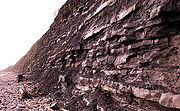 Lyme Regis is a coastal town in West Dorset
, situated 25 miles west of Dorchester and 25 miles (40.2 km) east of Exeter
. The town lies in Lyme Bay
, on the English Channel
coast at the Dorset-Devon
border. It has a population of about 4,406, 45% of whom are retired.
The town is noted for the fossil
s found in the cliffs and beaches, which are part of the Heritage Coast
—known commercially as the Jurassic Coast
—a World Heritage Site
. The Jurassic Coast stretches over a distance of 153 kilometres (95 mi), from Orcombe Point
near Exmouth
, in the west, to Old Harry Rocks
, in the east. The coastal exposures along the coastline provide a continuous sequence of Triassic
, Jurassic
and Cretaceous
rock formations spanning approximately 185 million years of the Earth's history. The localities along the Jurassic Coast include a large range of important fossil zones.
The Blue Lias
rock is host to a multitude of remains from the early Jurassic, a time from which good fossil records are rare. Many of the remains are well preserved, with complete specimens of several important species. Many of the earliest discoveries of dinosaur
and other prehistoric reptile remains were made in the area surrounding Lyme Regis, notably those discovered by Mary Anning
(1799–1847). Significant finds include Ichthyosaur
, Plesiosaur
, Dimorphodon
, Scelidosaurus
(one of the first armoured
dinosaurs) and Dapedium
. The town now holds an annual Mary Anning Day and Lyme Regis Fossil Festival. A fossil of the world's largest moth was discovered in 1966 at Lyme Regis.
Landslips
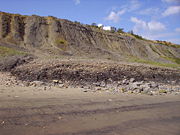 To the southwest of Lyme Regis lie Poker's Pool, Seven Rock Point and Pinhay Bay
, to the northeast lies Charmouth
. The coastal region near Lyme Regis is subject to large landslips
. This means that Jurassic age fossils are regularly exposed and can be found on the beaches, but also causes devastation to the town.
One of the most spectacular landslips occurred on 24 December 1839, 3 miles (4.8 km) west along the coast in Devon belonging to Bindon Manor and known as "The Dowlands Landslip". About 45 acres (18.2 ha) of fields growing wheat and turnips were dislodged when a great chasm was formed more than 300 feet (91.4 m) across, 160 feet (48.8 m) deep and 0.75 miles (1.2 km) long. The crops remained intact on the top of what became known as "Goat Island" among the newly formed gullies. On 3 February 1840, five weeks later, there was a second landslip nearby but much smaller than the former. This strange phenomenon attracted many visitors, and the canny farmers charged sixpence for entrance and held a grand reaping party when the wheat ripened. The area is now known as The Undercliff
and is of great interest because of its diverse natural history.
In 2005, work began on a £16 million engineering project to stabilise the cliffs and protect the town from coastal erosion. The town's main beach was reconstructed and re-opened on 1 July 2006.
On the evening of 6 May 2008, a 400 metres (1,312.3 ft) section of land slipped onto the beach between Lyme Regis and Charmouth. Local Police described the landslip as the "worst for 100 years". This has necessitated the diversion of the South West Coast Path
inland from Lyme Regis to Charmouth via the Lyme Regis Golf Course.
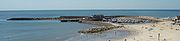 The first written mention of the Cobb is in a 1328 document describing it as having been damaged by storms. The structure was made of oak piles driven into the seabed with boulders stacked between them. The boulders were floated into place tied between empty barrels.
Lyme Regis is well-known for "The Cobb", a harbour wall full of character and history. It is an important feature in Jane Austen
's novel Persuasion
(1818), and in the film The French Lieutenant's Woman
, based on the 1969 novel of the same name
by local writer John Fowles
.
The Cobb was of economic importance to the town and surrounding area, allowing it to develop as both a major port and a shipbuilding centre from the 13th century onwards. Shipbuilding was particularly significant between 1780 and 1850 with around 100 ships launched including a 12-gun Royal Navy brig called HMS Snap. The wall of the Cobb provided both a breakwater to protect the town from storms and an artificial harbour.
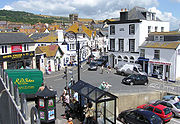 Well-sited for trade with France
, the port's most prosperous period was from the 16th century until the end of the 18th century, and as recently as 1780 it was larger than Liverpool
. The town's importance as a port declined in the 19th century because it was unable to handle the increase in ship sizes.
It was in the Cobb harbour, after the great storm of 1824, that Captain Sir Richard Spencer RN
carried out his pioneering lifeboat design work.
A 1685 account describes it as being made of boulders simply heaped up on each other: "an immense mass of stone, of a shape of a demi-lune, with a bar in the middle of the concave: no one stone that lies there was ever touched with a tool or bedded in any sort of cement, but all the pebbles of the see are piled up, and held by their bearings only, and the surge plays in and out through the interstices of the stone in a wonderful manner."
The Cobb has been destroyed or severely damaged by storms several times; it was swept away in 1377 which led to the destruction of 50 boats and 80 houses. The southern arm was added in the 1690s, and rebuilt in 1793 following its destruction in a storm the previous year. This is thought to be the first time that mortar
was used in the Cobb's construction. The Cobb was reconstructed in 1820 using Portland Admiralty Roach
, a type of Portland stone
.
The Cobb also separates Monmouth Beach
and Cobb Gate Beach.
, dating from 1340, has been restored to working order and produces flour which is used in the mill's bakery and also sold in its shop. The water comes from the River Lym (also called Lim), which feeds the mill via a "leat". This runs along a terrace
or lynch
, hence the description of lynch mill. The Domesday Book records the existence of a mill at Lyme in 1086, so the site could be much older. A small brewery, Town Mill Brewery, opened in a part of the Town Mill in March 2010.
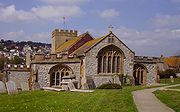 The parish church is St Michael's
, on Church Street. Its full title is parish church of St Michael the Archangel
. It is situated above Church Cliff and dominates the old town. The church was originally a 12th century tripartite structure including an axial tower but transepts were added ca. 1200 and later in the 13th century two aisles. Early in the 16th century a new church was built east of the tower and transepts and the old chancel and aisles removed. The old nave was shortened in the 19th century.
There are three ways to access the churchyard. From Church Street, enter through the archway and up the steps, next to the Boys' Club or from higher up the hill, direct from Church Street. From Long Entry, there is a steep climb either up steps or up the service road in front of the flats overlooking Lyme Bay. Mary Anning
is buried here and there is a stained-glass window dedicated to her memory by members of the Geological Society of London
, an organisation that did not admit women until 1904.

The museum, built on the site of paelontologist Mary Anning
's birthplace and family shop off Bridge Street, houses a large collection of local memorabilia, historical items and exhibits explaining the local geological
and palaeontological
treasures. The museum was formerly known as the Philpot Museum.
Set into the pavement, outside the museum, is an ornate example of Coade stone
work, in the form of ammonite
s, reflecting both local history (Eleanor Coade) and the palaeontology for which the town is famous.
The Dinosaurland Fossil Museum
is also located in Lyme Regis in the former church where Mary Anning was baptised.
stayed in Hiscott’s Boarding house on the same site in 1804. The front section of the current building dates from 1807. The hotel has played host to many famous and influential people including Alfred Lord Tennyson, Henry Wadsworth Longfellow
, Hilaire Belloc
, G.K. Chesterton and J. R. R. Tolkien
who spent several holidays there. In 1944, General Eisenhower delivered an important briefing to senior officers in the first floor lounge prior to D-Day. The building is of significant architectural and historical interest being mentioned in Pevsner’s Buildings of England volume on Dorset. The hotel was used in the making of the film The French Lieutenant’s Woman
in 1981, featuring Jeremy Irons
and Meryl Streep
. The current owners, Palmers Brewery of Bridport closed the hotel in May 1990 and have announced plans to demolish the significantly historic rear of the building and replace it with retail units, restaurant, visitor and private accommodation.
is a former coaching inn, dated to to the first decade of the 17th century. It is reputedly haunted; many unexplained ectoplasm
s have been sighted in the corridors and cold spots.
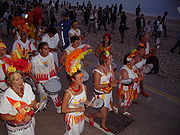 The town has a number of annual events, including the 'Lyme Regis Carnival and Regatta', the Lyme Regis Fossil Festival (in conjunction with the London Natural History Museum
) and Mary Anning Day. The traditional conger cuddling
event takes place during Lifeboat Week. The carnival and regatta is an event which takes place over a whole week, during August and is organised by a committee of local volunteers. All proceeds from the week will be given to local good causes – especially those supporting the young and the old. The week-long summer programme includes yacht and dinghy racing, power boat rides, parades, open air performances in the shelters, sand based games such as egg catching, events such as the golf ball derby and rubber duck races on the River Lym, chinese lanterns and fireworks.
Lyme Regis has a recent history of record breaking attempts, 410 people singing Frère Jacques and largest sand ammonite.
The bonfire night spectacular includes torchlight procession, bonfire on the beach and a firework display. The Christmas Tree Festival has over 30 trees decorated by local organisations in Lyme Regis Baptist Church. An Easter bonnet parade takes place each year in the town on Easter Sunday. A May Day fete has stalls and entertainment from different Lyme groups.
Thanks Giving Day has been held since Parliament decreed at the end of the English Civil War that there should be a day of celebration and prayer in Lyme to commemorate the end of the unsuccessful siege of Lyme by the Royalist forces, which was one of the longest sieges of the Civil War. It is celebrated in Lyme by dressing in clothes of the period and parading through the streets.
Lyme Regis Football club was formed in 1885 and celebrated its 125th anniversary in 2010. To mark the event Ex-West Ham
, Everton
and England striker Tony Cottee
was made club patron. The club, known as 'the Seasiders', is situated on at the Davey Fort Ground on Charmouth Road and has three senior teams and five junior teams. The senior teams play in the Perry Street & District League.

Dorset
Dorset , is a county in South West England on the English Channel coast. The county town is Dorchester which is situated in the south. The Hampshire towns of Bournemouth and Christchurch joined the county with the reorganisation of local government in 1974...
, England
England
England is a country that is part of the United Kingdom. It shares land borders with Scotland to the north and Wales to the west; the Irish Sea is to the north west, the Celtic Sea to the south west, with the North Sea to the east and the English Channel to the south separating it from continental...
, situated 25 miles west of Dorchester and 25 miles (40.2 km) east of Exeter
Exeter
Exeter is a historic city in Devon, England. It lies within the ceremonial county of Devon, of which it is the county town as well as the home of Devon County Council. Currently the administrative area has the status of a non-metropolitan district, and is therefore under the administration of the...
. The town lies in Lyme Bay
Lyme Bay
Lyme Bay is an area of the English Channel situated in the southwest of England between Torbay in the west and Portland in the east. The counties of Devon and Dorset front onto the bay,-Geology:...
, on the English Channel
English Channel
The English Channel , often referred to simply as the Channel, is an arm of the Atlantic Ocean that separates southern England from northern France, and joins the North Sea to the Atlantic. It is about long and varies in width from at its widest to in the Strait of Dover...
coast at the Dorset-Devon
Devon
Devon is a large county in southwestern England. The county is sometimes referred to as Devonshire, although the term is rarely used inside the county itself as the county has never been officially "shired", it often indicates a traditional or historical context.The county shares borders with...
border. It is nicknamed "The Pearl of Dorset." The town is noted for the fossil
Fossil
Fossils are the preserved remains or traces of animals , plants, and other organisms from the remote past...
s found in the cliffs and beaches, which are part of the Heritage Coast
Heritage Coast
A Heritage Coast is a strip of UK coastline designated by the Countryside Agency in England and the Countryside Council for Wales as having notable natural beauty or scientific significance.- Designated coastline :...
—known commercially as the Jurassic Coast
Jurassic Coast
The Jurassic Coast is a World Heritage Site on the English Channel coast of southern England. The site stretches from Orcombe Point near Exmouth in East Devon to Old Harry Rocks near Swanage in East Dorset, a distance of ....
—a World Heritage Site
World Heritage Site
A UNESCO World Heritage Site is a place that is listed by the UNESCO as of special cultural or physical significance...
. The harbour wall, "The Cobb", features in Jane Austen
Jane Austen
Jane Austen was an English novelist whose works of romantic fiction, set among the landed gentry, earned her a place as one of the most widely read writers in English literature, her realism and biting social commentary cementing her historical importance among scholars and critics.Austen lived...
's novel Persuasion
Persuasion (novel)
Persuasion is Jane Austen's last completed novel. She began it soon after she had finished Emma, completing it in August 1816. She died, aged 41, in 1817; Persuasion was published in December that year ....
, and in the film
The French Lieutenant's Woman (film)
The French Lieutenant's Woman is a 1981 film directed by Karel Reisz and adapted by playwright Harold Pinter. It is based on the novel of the same title by John Fowles...
and novel
The French Lieutenant's Woman
The French Lieutenant’s Woman , by John Fowles, is a period novel inspired by the 1823 novel Ourika, by Claire de Duras, which Fowles translated into English in 1977...
, The French Lieutenant's Woman, by local writer John Fowles
John Fowles
John Robert Fowles was an English novelist and essayist. In 2008, The Times newspaper named Fowles among their list of "The 50 greatest British writers since 1945".-Birth and family:...
.
The town was home to Admiral Sir George Somers
George Somers
This article is about the English naval hero. For the American football player, see George Somers Admiral Sir George Somers was an English naval hero. Born in Lyme Regis, Dorset, the son of John Somers, his first fame came as part of an expedition led by Sir Amyas Preston against the Spanish...
, its one time mayor and parliamentarian, who founded the Somers Isles, better known as Bermuda
Bermuda
Bermuda is a British overseas territory in the North Atlantic Ocean. Located off the east coast of the United States, its nearest landmass is Cape Hatteras, North Carolina, about to the west-northwest. It is about south of Halifax, Nova Scotia, Canada, and northeast of Miami, Florida...
.
The town's population at the most recent census was 4,406, 45% of whom were retired.
History
Lyme is mentioned in the Domesday BookDomesday Book
Domesday Book , now held at The National Archives, Kew, Richmond upon Thames in South West London, is the record of the great survey of much of England and parts of Wales completed in 1086...
of 1086. In the 13th century it developed into one of the major British ports. A Royal Charter
Royal Charter
A royal charter is a formal document issued by a monarch as letters patent, granting a right or power to an individual or a body corporate. They were, and are still, used to establish significant organizations such as cities or universities. Charters should be distinguished from warrants and...
was granted by King Edward I
Edward I of England
Edward I , also known as Edward Longshanks and the Hammer of the Scots, was King of England from 1272 to 1307. The first son of Henry III, Edward was involved early in the political intrigues of his father's reign, which included an outright rebellion by the English barons...
in 1284, with the addition of 'Regis' to the town's name. This charter was confirmed by Elizabeth I in 1591.
In 1644, during the English Civil War
English Civil War
The English Civil War was a series of armed conflicts and political machinations between Parliamentarians and Royalists...
, Parliamentarians
Parliament of England
The Parliament of England was the legislature of the Kingdom of England. In 1066, William of Normandy introduced a feudal system, by which he sought the advice of a council of tenants-in-chief and ecclesiastics before making laws...
here withstood an eight week siege by Royalist
Cavalier
Cavalier was the name used by Parliamentarians for a Royalist supporter of King Charles I and son Charles II during the English Civil War, the Interregnum, and the Restoration...
forces under Prince Maurice. It was at Lyme Regis that the Duke of Monmouth
James Scott, 1st Duke of Monmouth
James Scott, 1st Duke of Monmouth, 1st Duke of Buccleuch, KG, PC , was an English nobleman. Originally called James Crofts or James Fitzroy, he was born in Rotterdam in the Netherlands, the eldest illegitimate son of Charles II and his mistress, Lucy Walter...
landed at the start of the Monmouth Rebellion
Monmouth Rebellion
The Monmouth Rebellion,The Revolt of the West or The West Country rebellion of 1685, was an attempt to overthrow James II, who had become King of England, King of Scots and King of Ireland at the death of his elder brother Charles II on 6 February 1685. James II was a Roman Catholic, and some...
in 1685.
In 1965, the town's railway station was closed, as part of the Beeching Axe
Beeching Axe
The Beeching Axe or the Beeching Cuts are informal names for the British Government's attempt in the 1960s to reduce the cost of running British Railways, the nationalised railway system in the United Kingdom. The name is that of the main author of The Reshaping of British Railways, Dr Richard...
. It was rebuilt at Alresford
Alresford (Hampshire) railway station
Alresford station is a railway station in New Alresford, Hampshire, UK.-History:Constructed in 1865 for the new Alton, Alresford and Winchester Railway Company which later became the first incarnation of the Mid-Hants Railway, the station later joined the London and South Western Railway. It was...
, on the Mid Hants Watercress Railway in Hampshire
Hampshire
Hampshire is a county on the southern coast of England in the United Kingdom. The county town of Hampshire is Winchester, a historic cathedral city that was once the capital of England. Hampshire is notable for housing the original birthplaces of the Royal Navy, British Army, and Royal Air Force...
. The route to Lyme Regis had been notable for being operated by aged Victorian locomotives, one of which is now used on the Bluebell Railway
Bluebell Railway
The Bluebell Railway is a heritage line running for nine miles along the border between East and West Sussex, England. Steam trains are operated between and , with an intermediate station at .The railway is managed and run largely by volunteers...
in Sussex
Sussex
Sussex , from the Old English Sūþsēaxe , is an historic county in South East England corresponding roughly in area to the ancient Kingdom of Sussex. It is bounded on the north by Surrey, east by Kent, south by the English Channel, and west by Hampshire, and is divided for local government into West...
.
In 2005, as part of the bicentenary re-enactment of the arrival of the news, aboard the Bermuda sloop
Bermuda sloop
The Bermuda sloop is a type of fore-and-aft rigged sailing vessel developed on the islands of Bermuda in the 17th century. In its purest form, it is single-masted, although ships with such rigging were built with as many as three masts, which are then referred to as schooners...
HMS Pickle
HMS Pickle (1800)
HMS Pickle was a topsail schooner of the Royal Navy. She was originally a civilian vessel named Sting. of six guns, that Lord Hugh Seymour purchased to use as an armed tender on the Jamaica Station...
, of Admiral Nelson's victory at the Battle of Trafalgar
Battle of Trafalgar
The Battle of Trafalgar was a sea battle fought between the British Royal Navy and the combined fleets of the French Navy and Spanish Navy, during the War of the Third Coalition of the Napoleonic Wars ....
in 1805, the actor playing the part of Trafalgar messenger Lieutenant Lapenotiere was welcomed at Lyme Regis.
Governance
Lyme Regis is twinned with St. George's, BermudaSt. George's, Bermuda
St. George's , located on the island and within the parish of the same names, was the first permanent settlement on the islands of Bermuda, and is often described as the third successful English settlement in the Americas, after St. John's, Newfoundland, and Jamestown, Virginia. However, St...
.
Geography
Dorset
Dorset , is a county in South West England on the English Channel coast. The county town is Dorchester which is situated in the south. The Hampshire towns of Bournemouth and Christchurch joined the county with the reorganisation of local government in 1974...
, situated 25 miles west of Dorchester and 25 miles (40.2 km) east of Exeter
Exeter
Exeter is a historic city in Devon, England. It lies within the ceremonial county of Devon, of which it is the county town as well as the home of Devon County Council. Currently the administrative area has the status of a non-metropolitan district, and is therefore under the administration of the...
. The town lies in Lyme Bay
Lyme Bay
Lyme Bay is an area of the English Channel situated in the southwest of England between Torbay in the west and Portland in the east. The counties of Devon and Dorset front onto the bay,-Geology:...
, on the English Channel
English Channel
The English Channel , often referred to simply as the Channel, is an arm of the Atlantic Ocean that separates southern England from northern France, and joins the North Sea to the Atlantic. It is about long and varies in width from at its widest to in the Strait of Dover...
coast at the Dorset-Devon
Devon
Devon is a large county in southwestern England. The county is sometimes referred to as Devonshire, although the term is rarely used inside the county itself as the county has never been officially "shired", it often indicates a traditional or historical context.The county shares borders with...
border. It has a population of about 4,406, 45% of whom are retired.
The town is noted for the fossil
Fossil
Fossils are the preserved remains or traces of animals , plants, and other organisms from the remote past...
s found in the cliffs and beaches, which are part of the Heritage Coast
Heritage Coast
A Heritage Coast is a strip of UK coastline designated by the Countryside Agency in England and the Countryside Council for Wales as having notable natural beauty or scientific significance.- Designated coastline :...
—known commercially as the Jurassic Coast
Jurassic Coast
The Jurassic Coast is a World Heritage Site on the English Channel coast of southern England. The site stretches from Orcombe Point near Exmouth in East Devon to Old Harry Rocks near Swanage in East Dorset, a distance of ....
—a World Heritage Site
World Heritage Site
A UNESCO World Heritage Site is a place that is listed by the UNESCO as of special cultural or physical significance...
. The Jurassic Coast stretches over a distance of 153 kilometres (95 mi), from Orcombe Point
Orcombe Point
Orcombe Point is a coastal feature near Exmouth, Devon, on the south coast of England. It lies about south of the city of Exeter, southeast of Exmouth town centre and about southwest of Sidmouth....
near Exmouth
Exmouth, Devon
Exmouth is a port town, civil parish and seaside resort in East Devon, England, sited on the east bank of the mouth of the River Exe. In 2001, it had a population of 32,972.-History:...
, in the west, to Old Harry Rocks
Old Harry Rocks
The Old Harry Rocks are two chalk sea stacks located at Handfast Point, on the Isle of Purbeck in Dorset, southern England.- Location :Old Harry Rocks lie directly east of Studland, about 4 kilometres northeast of Swanage, and about 10 kilometres south of the large towns of Poole and...
, in the east. The coastal exposures along the coastline provide a continuous sequence of Triassic
Triassic
The Triassic is a geologic period and system that extends from about 250 to 200 Mya . As the first period of the Mesozoic Era, the Triassic follows the Permian and is followed by the Jurassic. Both the start and end of the Triassic are marked by major extinction events...
, Jurassic
Jurassic
The Jurassic is a geologic period and system that extends from about Mya to Mya, that is, from the end of the Triassic to the beginning of the Cretaceous. The Jurassic constitutes the middle period of the Mesozoic era, also known as the age of reptiles. The start of the period is marked by...
and Cretaceous
Cretaceous
The Cretaceous , derived from the Latin "creta" , usually abbreviated K for its German translation Kreide , is a geologic period and system from circa to million years ago. In the geologic timescale, the Cretaceous follows the Jurassic period and is followed by the Paleogene period of the...
rock formations spanning approximately 185 million years of the Earth's history. The localities along the Jurassic Coast include a large range of important fossil zones.
The Blue Lias
Blue Lias
The Blue Lias is a geologic formation in southern, eastern and western England and parts of South Wales, part of the Lias Group. The Blue Lias consists of a sequence of limestone and shale layers, laid down in latest Triassic and early Jurassic times, between 195 and 200 million years ago...
rock is host to a multitude of remains from the early Jurassic, a time from which good fossil records are rare. Many of the remains are well preserved, with complete specimens of several important species. Many of the earliest discoveries of dinosaur
Dinosaur
Dinosaurs are a diverse group of animals of the clade and superorder Dinosauria. They were the dominant terrestrial vertebrates for over 160 million years, from the late Triassic period until the end of the Cretaceous , when the Cretaceous–Paleogene extinction event led to the extinction of...
and other prehistoric reptile remains were made in the area surrounding Lyme Regis, notably those discovered by Mary Anning
Mary Anning
Mary Anning was a British fossil collector, dealer and palaeontologist who became known around the world for a number of important finds she made in the Jurassic age marine fossil beds at Lyme Regis where she lived...
(1799–1847). Significant finds include Ichthyosaur
Ichthyosaur
Ichthyosaurs were giant marine reptiles that resembled fish and dolphins...
, Plesiosaur
Plesiosaur
Plesiosauroidea is an extinct clade of carnivorous plesiosaur marine reptiles. Plesiosauroids, are known from the Jurassic and Cretaceous Periods...
, Dimorphodon
Dimorphodon
Dimorphodon was a genus of medium-sized pterosaur from the early Jurassic Period. It was named by paleontologist Richard Owen in 1859. Dimorphodon means "two-form tooth", derived from Greek δι/di meaning 'two', μορφη/morphe meaning 'shape' and οδων/odon meaning 'tooth', referring to the fact that...
, Scelidosaurus
Scelidosaurus
Scelidosaurus is a genus of quadrupedal, lightly plated, herbivorous dinosaur about long. It lived during the Early Jurassic Period, during the Hettangian to Sinemurian stages around 199.6 to 194 million years ago. Its fossils have been found in both England and in Arizona, in the United...
(one of the first armoured
Armour (zoology)
Armour in animals is external or superficial protection against attack by predators, formed as part of the body , usually through the hardening of body tissues, outgrowths or secretions. It has therefore mostly developed in 'prey' species...
dinosaurs) and Dapedium
Dapedium
Dapedium is an extinct genus of primitive neopterygian ray-finned fish. The first-described finding was an example of D. politum, found in the Lower Lias of Lyme Regis, on the Jurassic Coast of England...
. The town now holds an annual Mary Anning Day and Lyme Regis Fossil Festival. A fossil of the world's largest moth was discovered in 1966 at Lyme Regis.
Landslips
Pinhay Bay
Pinhay Bay is a bay in Devon, on the south coast of England. Pinhay Bay lies about two kilometres southwest of Lyme Regis and about six kilometres east of Seaton....
, to the northeast lies Charmouth
Charmouth
Charmouth is a village at the mouth of the River Char in West Dorset, England, with a population of 1,687 according to the 2001 census.-The village:...
. The coastal region near Lyme Regis is subject to large landslips
Landslide
A landslide or landslip is a geological phenomenon which includes a wide range of ground movement, such as rockfalls, deep failure of slopes and shallow debris flows, which can occur in offshore, coastal and onshore environments...
. This means that Jurassic age fossils are regularly exposed and can be found on the beaches, but also causes devastation to the town.
One of the most spectacular landslips occurred on 24 December 1839, 3 miles (4.8 km) west along the coast in Devon belonging to Bindon Manor and known as "The Dowlands Landslip". About 45 acres (18.2 ha) of fields growing wheat and turnips were dislodged when a great chasm was formed more than 300 feet (91.4 m) across, 160 feet (48.8 m) deep and 0.75 miles (1.2 km) long. The crops remained intact on the top of what became known as "Goat Island" among the newly formed gullies. On 3 February 1840, five weeks later, there was a second landslip nearby but much smaller than the former. This strange phenomenon attracted many visitors, and the canny farmers charged sixpence for entrance and held a grand reaping party when the wheat ripened. The area is now known as The Undercliff
The Undercliff
The Undercliff is the name of several areas of landslip on the south coast of England. They include ones on the Isle of Wight; on the Dorset-Devon border near Lyme Regis; on cliffs near Branscombe in East Devon; and at White Nothe, Dorset...
and is of great interest because of its diverse natural history.
In 2005, work began on a £16 million engineering project to stabilise the cliffs and protect the town from coastal erosion. The town's main beach was reconstructed and re-opened on 1 July 2006.
On the evening of 6 May 2008, a 400 metres (1,312.3 ft) section of land slipped onto the beach between Lyme Regis and Charmouth. Local Police described the landslip as the "worst for 100 years". This has necessitated the diversion of the South West Coast Path
South West Coast Path
The South West Coast Path is Britain's longest waymarked long-distance footpath and a National Trail. It stretches for , running from Minehead in Somerset, along the coasts of Devon and Cornwall, to Poole Harbour in Dorset. Since it rises and falls with every river mouth, it is also one of the more...
inland from Lyme Regis to Charmouth via the Lyme Regis Golf Course.
The Cobb
Lyme Regis is well-known for "The Cobb", a harbour wall full of character and history. It is an important feature in Jane Austen
Jane Austen
Jane Austen was an English novelist whose works of romantic fiction, set among the landed gentry, earned her a place as one of the most widely read writers in English literature, her realism and biting social commentary cementing her historical importance among scholars and critics.Austen lived...
's novel Persuasion
Persuasion (novel)
Persuasion is Jane Austen's last completed novel. She began it soon after she had finished Emma, completing it in August 1816. She died, aged 41, in 1817; Persuasion was published in December that year ....
(1818), and in the film The French Lieutenant's Woman
The French Lieutenant's Woman (film)
The French Lieutenant's Woman is a 1981 film directed by Karel Reisz and adapted by playwright Harold Pinter. It is based on the novel of the same title by John Fowles...
, based on the 1969 novel of the same name
The French Lieutenant's Woman
The French Lieutenant’s Woman , by John Fowles, is a period novel inspired by the 1823 novel Ourika, by Claire de Duras, which Fowles translated into English in 1977...
by local writer John Fowles
John Fowles
John Robert Fowles was an English novelist and essayist. In 2008, The Times newspaper named Fowles among their list of "The 50 greatest British writers since 1945".-Birth and family:...
.
The Cobb was of economic importance to the town and surrounding area, allowing it to develop as both a major port and a shipbuilding centre from the 13th century onwards. Shipbuilding was particularly significant between 1780 and 1850 with around 100 ships launched including a 12-gun Royal Navy brig called HMS Snap. The wall of the Cobb provided both a breakwater to protect the town from storms and an artificial harbour.
France
The French Republic , The French Republic , The French Republic , (commonly known as France , is a unitary semi-presidential republic in Western Europe with several overseas territories and islands located on other continents and in the Indian, Pacific, and Atlantic oceans. Metropolitan France...
, the port's most prosperous period was from the 16th century until the end of the 18th century, and as recently as 1780 it was larger than Liverpool
Liverpool
Liverpool is a city and metropolitan borough of Merseyside, England, along the eastern side of the Mersey Estuary. It was founded as a borough in 1207 and was granted city status in 1880...
. The town's importance as a port declined in the 19th century because it was unable to handle the increase in ship sizes.
It was in the Cobb harbour, after the great storm of 1824, that Captain Sir Richard Spencer RN
Richard Spencer RN
Captain Sir Richard Spencer KCH was a sea captain of the Royal Navy who served in a number of battles, particularly against the French. Later in life he settled in Albany, Western Australia and was appointed Government Resident in 1833...
carried out his pioneering lifeboat design work.
A 1685 account describes it as being made of boulders simply heaped up on each other: "an immense mass of stone, of a shape of a demi-lune, with a bar in the middle of the concave: no one stone that lies there was ever touched with a tool or bedded in any sort of cement, but all the pebbles of the see are piled up, and held by their bearings only, and the surge plays in and out through the interstices of the stone in a wonderful manner."
The Cobb has been destroyed or severely damaged by storms several times; it was swept away in 1377 which led to the destruction of 50 boats and 80 houses. The southern arm was added in the 1690s, and rebuilt in 1793 following its destruction in a storm the previous year. This is thought to be the first time that mortar
Mortar (masonry)
Mortar is a workable paste used to bind construction blocks together and fill the gaps between them. The blocks may be stone, brick, cinder blocks, etc. Mortar becomes hard when it sets, resulting in a rigid aggregate structure. Modern mortars are typically made from a mixture of sand, a binder...
was used in the Cobb's construction. The Cobb was reconstructed in 1820 using Portland Admiralty Roach
Portland Admiralty Roach
Portland Admiralty Roach is a kind of stone from the Isle of Portland used to construct "The Cobb", the well-known seawall at Lyme Regis in Dorset....
, a type of Portland stone
Portland stone
Portland stone is a limestone from the Tithonian stage of the Jurassic period quarried on the Isle of Portland, Dorset. The quarries consist of beds of white-grey limestone separated by chert beds. It has been used extensively as a building stone throughout the British Isles, notably in major...
.
The Cobb also separates Monmouth Beach
Monmouth Beach, Lyme Regis
Monmouth Beach is a pebble and rock beach stretching approximately 1 mile from Lyme Regis's harbour, the Cobb, to Pinhay Bay,...
and Cobb Gate Beach.
The Town Mill
The watermillWatermill
A watermill is a structure that uses a water wheel or turbine to drive a mechanical process such as flour, lumber or textile production, or metal shaping .- History :...
, dating from 1340, has been restored to working order and produces flour which is used in the mill's bakery and also sold in its shop. The water comes from the River Lym (also called Lim), which feeds the mill via a "leat". This runs along a terrace
Terrace (agriculture)
Terraces are used in farming to cultivate sloped land. Graduated terrace steps are commonly used to farm on hilly or mountainous terrain. Terraced fields decrease erosion and surface runoff, and are effective for growing crops requiring much water, such as rice...
or lynch
Terrace (agriculture)
Terraces are used in farming to cultivate sloped land. Graduated terrace steps are commonly used to farm on hilly or mountainous terrain. Terraced fields decrease erosion and surface runoff, and are effective for growing crops requiring much water, such as rice...
, hence the description of lynch mill. The Domesday Book records the existence of a mill at Lyme in 1086, so the site could be much older. A small brewery, Town Mill Brewery, opened in a part of the Town Mill in March 2010.
St Michael's Church
St Michael
St Michael was a brand that was owned and used by Marks & Spencer from 1928 until 2000.-History:The brand was introduced by Simon Marks in 1928, after his father and co-founder of Marks & Spencer, Michael Marks. By 1950, virtually all goods were sold under the St Michael brand...
, on Church Street. Its full title is parish church of St Michael the Archangel
Archangel
An archangel is an angel of high rank. Archangels are found in a number of religious traditions, including Judaism, Christianity and Islam. Michael and Gabriel are recognized as archangels in Judaism and by most Christians. Michael is the only archangel specifically named in the Protestant Bible...
. It is situated above Church Cliff and dominates the old town. The church was originally a 12th century tripartite structure including an axial tower but transepts were added ca. 1200 and later in the 13th century two aisles. Early in the 16th century a new church was built east of the tower and transepts and the old chancel and aisles removed. The old nave was shortened in the 19th century.
There are three ways to access the churchyard. From Church Street, enter through the archway and up the steps, next to the Boys' Club or from higher up the hill, direct from Church Street. From Long Entry, there is a steep climb either up steps or up the service road in front of the flats overlooking Lyme Bay. Mary Anning
Mary Anning
Mary Anning was a British fossil collector, dealer and palaeontologist who became known around the world for a number of important finds she made in the Jurassic age marine fossil beds at Lyme Regis where she lived...
is buried here and there is a stained-glass window dedicated to her memory by members of the Geological Society of London
Geological Society of London
The Geological Society of London is a learned society based in the United Kingdom with the aim of "investigating the mineral structure of the Earth"...
, an organisation that did not admit women until 1904.
Lyme Regis Museum
The museum, built on the site of paelontologist Mary Anning
Mary Anning
Mary Anning was a British fossil collector, dealer and palaeontologist who became known around the world for a number of important finds she made in the Jurassic age marine fossil beds at Lyme Regis where she lived...
's birthplace and family shop off Bridge Street, houses a large collection of local memorabilia, historical items and exhibits explaining the local geological
Geology
Geology is the science comprising the study of solid Earth, the rocks of which it is composed, and the processes by which it evolves. Geology gives insight into the history of the Earth, as it provides the primary evidence for plate tectonics, the evolutionary history of life, and past climates...
and palaeontological
Paleontology
Paleontology "old, ancient", ὄν, ὀντ- "being, creature", and λόγος "speech, thought") is the study of prehistoric life. It includes the study of fossils to determine organisms' evolution and interactions with each other and their environments...
treasures. The museum was formerly known as the Philpot Museum.
Set into the pavement, outside the museum, is an ornate example of Coade stone
Coade stone
Lithodipyra , or Coade stone, was ceramic stoneware that was often described as an artificial stone in the late 18th and early 19th centuries. It was used for moulding Neoclassical statues, architectural decorations and garden ornaments that were both of the highest quality and remain virtually...
work, in the form of ammonite
Ammonite
Ammonite, as a zoological or paleontological term, refers to any member of the Ammonoidea an extinct subclass within the Molluscan class Cephalopoda which are more closely related to living coleoids Ammonite, as a zoological or paleontological term, refers to any member of the Ammonoidea an extinct...
s, reflecting both local history (Eleanor Coade) and the palaeontology for which the town is famous.
The Dinosaurland Fossil Museum
Dinosaurland Fossil Museum
Dinosaurland Fossil Museum is a privately owned fossil museum in Lyme Regis, on the Jurassic Coast in Dorset, England....
is also located in Lyme Regis in the former church where Mary Anning was baptised.
Lepers Well
On the West bank of the River Lym near the Town Mill is the site of an old chapel "St Mary & the Holy Spirits", known locally as "Lepers Well". The term "Leper" was used as a blanket description of medieval skin diseases and not necessarily "Leprosy" as it is understood today. There is a small plaque on the wall telling of the hospital which stood on the site 700 years ago. The water still runs today although one assumes in a much reduced flow. Little information survives today, the land was left untouched for many years and some locals can remember livestock being kept on the land before it was landscaped into a visitors garden in the 1970s.Three Cups Hotel
The Three Cups Hotel between 15 and 19 Broad Street has associations with many famous literary and historical figures. It is believed that Jane AustenJane Austen
Jane Austen was an English novelist whose works of romantic fiction, set among the landed gentry, earned her a place as one of the most widely read writers in English literature, her realism and biting social commentary cementing her historical importance among scholars and critics.Austen lived...
stayed in Hiscott’s Boarding house on the same site in 1804. The front section of the current building dates from 1807. The hotel has played host to many famous and influential people including Alfred Lord Tennyson, Henry Wadsworth Longfellow
Henry Wadsworth Longfellow
Henry Wadsworth Longfellow was an American poet and educator whose works include "Paul Revere's Ride", The Song of Hiawatha, and Evangeline...
, Hilaire Belloc
Hilaire Belloc
Joseph Hilaire Pierre René Belloc was an Anglo-French writer and historian who became a naturalised British subject in 1902. He was one of the most prolific writers in England during the early twentieth century. He was known as a writer, orator, poet, satirist, man of letters and political activist...
, G.K. Chesterton and J. R. R. Tolkien
J. R. R. Tolkien
John Ronald Reuel Tolkien, CBE was an English writer, poet, philologist, and university professor, best known as the author of the classic high fantasy works The Hobbit, The Lord of the Rings, and The Silmarillion.Tolkien was Rawlinson and Bosworth Professor of Anglo-Saxon at Pembroke College,...
who spent several holidays there. In 1944, General Eisenhower delivered an important briefing to senior officers in the first floor lounge prior to D-Day. The building is of significant architectural and historical interest being mentioned in Pevsner’s Buildings of England volume on Dorset. The hotel was used in the making of the film The French Lieutenant’s Woman
The French Lieutenant's Woman (film)
The French Lieutenant's Woman is a 1981 film directed by Karel Reisz and adapted by playwright Harold Pinter. It is based on the novel of the same title by John Fowles...
in 1981, featuring Jeremy Irons
Jeremy Irons
Jeremy John Irons is an English actor. After receiving classical training at the Bristol Old Vic Theatre School, Irons began his acting career on stage in 1969, and has since appeared in many London theatre productions including The Winter's Tale, Macbeth, Much Ado About Nothing, The Taming of the...
and Meryl Streep
Meryl Streep
Mary Louise "Meryl" Streep is an American actress who has worked in theatre, television and film.Streep made her professional stage debut in 1971's The Playboy of Seville, before her screen debut in the television movie The Deadliest Season in 1977. In that same year, she made her film debut with...
. The current owners, Palmers Brewery of Bridport closed the hotel in May 1990 and have announced plans to demolish the significantly historic rear of the building and replace it with retail units, restaurant, visitor and private accommodation.
Royal Lion Hotel
The Royal Lion HotelRoyal Lion Hotel
The Royal Lion Hotel is a hotel in Lyme Regis, Dorset, England. It lies to the northwest of the Lyme Regis Philapot Museum, about 100 metres from the sea. It is a former coaching inn, dated to 1610 ....
is a former coaching inn, dated to to the first decade of the 17th century. It is reputedly haunted; many unexplained ectoplasm
Ectoplasm (paranormal)
Ectoplasm is a term coined by Charles Richet to denote a substance or spiritual energy "exteriorized" by physical mediums...
s have been sighted in the corridors and cold spots.
Culture
Natural History Museum
The Natural History Museum is one of three large museums on Exhibition Road, South Kensington, London, England . Its main frontage is on Cromwell Road...
) and Mary Anning Day. The traditional conger cuddling
Conger cuddling
Conger coddling is a traditional event in Lyme Regis, Dorset, England, in which a dead conger eel is thrown at members of the Royal National Lifeboat Institution . Part of the town's "Lifeboat Week", the eel is attached to a rope and thrown at nine people standing on flowerpots in a manner similar...
event takes place during Lifeboat Week. The carnival and regatta is an event which takes place over a whole week, during August and is organised by a committee of local volunteers. All proceeds from the week will be given to local good causes – especially those supporting the young and the old. The week-long summer programme includes yacht and dinghy racing, power boat rides, parades, open air performances in the shelters, sand based games such as egg catching, events such as the golf ball derby and rubber duck races on the River Lym, chinese lanterns and fireworks.
Lyme Regis has a recent history of record breaking attempts, 410 people singing Frère Jacques and largest sand ammonite.
The bonfire night spectacular includes torchlight procession, bonfire on the beach and a firework display. The Christmas Tree Festival has over 30 trees decorated by local organisations in Lyme Regis Baptist Church. An Easter bonnet parade takes place each year in the town on Easter Sunday. A May Day fete has stalls and entertainment from different Lyme groups.
Thanks Giving Day has been held since Parliament decreed at the end of the English Civil War that there should be a day of celebration and prayer in Lyme to commemorate the end of the unsuccessful siege of Lyme by the Royalist forces, which was one of the longest sieges of the Civil War. It is celebrated in Lyme by dressing in clothes of the period and parading through the streets.
Lyme Regis Football club was formed in 1885 and celebrated its 125th anniversary in 2010. To mark the event Ex-West Ham
West Ham
West Ham is in the London Borough of Newham in London, England. In the west it is a post-industrial neighbourhood abutting the site of the London Olympic Park and in the east it is mostly residential, consisting of Victorian terraced housing interspersed with higher density post-War social housing...
, Everton
Everton
Everton is a district of Liverpool, in Merseyside, England and a Liverpool City Council ward. At the 2001 Census the population was recorded as 7,398.-Toponymy:...
and England striker Tony Cottee
Tony Cottee
Anthony Richard "Tony" Cottee is a former football player who now works as a television football commentator...
was made club patron. The club, known as 'the Seasiders', is situated on at the Davey Fort Ground on Charmouth Road and has three senior teams and five junior teams. The senior teams play in the Perry Street & District League.
Notable people
- Mary AnningMary AnningMary Anning was a British fossil collector, dealer and palaeontologist who became known around the world for a number of important finds she made in the Jurassic age marine fossil beds at Lyme Regis where she lived...
(1799–1847) was an early British fossil collector and palaeontologist. - Jane AustenJane AustenJane Austen was an English novelist whose works of romantic fiction, set among the landed gentry, earned her a place as one of the most widely read writers in English literature, her realism and biting social commentary cementing her historical importance among scholars and critics.Austen lived...
visited Lyme Regis three times in 1803 and 1804 staying for several weeks in the summer of 1804. The dramatic events in Persuasion led to a flow of fans to the town: the poet Tennyson is said to have gone straight to the Cobb on his arrival, saying, "Show me the exact spot where Louisa Musgrove fell!" - Thomas Coram (c 1688–1751), founder of the Foundling HospitalFoundling HospitalThe Foundling Hospital in London, England was founded in 1741 by the philanthropic sea captain Thomas Coram. It was a children's home established for the "education and maintenance of exposed and deserted young children." The word "hospital" was used in a more general sense than it is today, simply...
in London. - Eleanor CoadeEleanor CoadeEleanor Coade was a devout Baptist and remained unmarried until her death on 16 November 1821 in Camberwell Grove, Camberwell, London. Her obituary notice was published in The Gentleman's Magazine which declared her ‘the sole inventor and proprietor of an art which deserves considerable notice’...
(1733–1821), manufacturer of the artificial stone known as coade stoneCoade stoneLithodipyra , or Coade stone, was ceramic stoneware that was often described as an artificial stone in the late 18th and early 19th centuries. It was used for moulding Neoclassical statues, architectural decorations and garden ornaments that were both of the highest quality and remain virtually...
, owned 'Belmont House' from 1784 until 1821. - John FowlesJohn FowlesJohn Robert Fowles was an English novelist and essayist. In 2008, The Times newspaper named Fowles among their list of "The 50 greatest British writers since 1945".-Birth and family:...
, who lived in Lyme Regis for 35 years, latterly in 'Belmont House', based his novel The French Lieutenant's WomanThe French Lieutenant's WomanThe French Lieutenant’s Woman , by John Fowles, is a period novel inspired by the 1823 novel Ourika, by Claire de Duras, which Fowles translated into English in 1977...
there. - Percy GilchristPercy GilchristPercy Carlyle Gilchrist FRS was a British chemist and metallurgist born in Lyme Regis, Dorset, and who studied at Felsted and the Royal School of Mines...
, the metallurgist, was born in Lyme Regis. He is most notable for his work in steel production. - Abraham HaywardAbraham HaywardAbraham Hayward was an English man of letters.-Life:He was son of Joseph Hayward, and was born in Wilton, near Salisbury, Wiltshire....
(1801–1884), writer and essayist who, with his father Joseph Hayward, an amateur horticulturist of 'Westhill', Silver Street, Lyme Regis, successfully brought a landmark case in the 1840s on behalf of the citizens of Lyme Regis, to maintain a permanent right of way for the town's citizens across the cliffs to Axmouth and Seaton. - John GouldJohn GouldJohn Gould was an English ornithologist and bird artist. The Gould League in Australia was named after him. His identification of the birds now nicknamed "Darwin's finches" played a role in the inception of Darwin's theory of evolution by natural selection...
(1804-1881), artist and ornithologist, was born in Lyme Regis. He wrote and illustrated 18 books about birds including those from Australia. The Gould League is named after him. - Beatrix PotterBeatrix PotterHelen Beatrix Potter was an English author, illustrator, natural scientist and conservationist best known for her imaginative children’s books featuring animals such as those in The Tale of Peter Rabbit which celebrated the British landscape and country life.Born into a privileged Unitarian...
's 1904 holiday in the town resulted in illustrations for her book Little Pig Robinson. - Maj Gen Sir E. B. RowcroftEric Bertram RowcroftMajor General Sir Eric Bertram Rowcroft CB, KBE, M.I.Mech.E., M.I.E.E.; 1891 – 12 March 1963), was a British Army officer. His military career started in 1908 as a TA Officer in the Royal Engineers and retired at the rank of Major General in 1946...
(1881-1963), British ArmyBritish ArmyThe British Army is the land warfare branch of Her Majesty's Armed Forces in the United Kingdom. It came into being with the unification of the Kingdom of England and Scotland into the Kingdom of Great Britain in 1707. The new British Army incorporated Regiments that had already existed in England...
officer and founder of REMERemeReme may refer to:*Rəmə, Azerbaijan*Royal Electrical and Mechanical Engineers...
retired to and died in Lyme Regis. - J. M. W. TurnerJ. M. W. TurnerJoseph Mallord William Turner RA was an English Romantic landscape painter, watercolourist and printmaker. Turner was considered a controversial figure in his day, but is now regarded as the artist who elevated landscape painting to an eminence rivalling history painting...
(1755–1851), EnglishEnglish peopleThe English are a nation and ethnic group native to England, who speak English. The English identity is of early mediaeval origin, when they were known in Old English as the Anglecynn. England is now a country of the United Kingdom, and the majority of English people in England are British Citizens...
RomanticRomanticismRomanticism was an artistic, literary and intellectual movement that originated in the second half of the 18th century in Europe, and gained strength in reaction to the Industrial Revolution...
artist painted a scene of Lyme Regis around 1834 that is now in the Cincinnati Art MuseumCincinnati Art MuseumThe Cincinnati Art Museum is one of the oldest art museums in the United States. Founded in 1881, it was the first purpose-built art museum west of the Alleghenies. Its collection of over 60,000 works make it one of the most comprehensive collections in the Midwest.Museum founders debated locating...
, OhioOhioOhio is a Midwestern state in the United States. The 34th largest state by area in the U.S.,it is the 7th‑most populous with over 11.5 million residents, containing several major American cities and seven metropolitan areas with populations of 500,000 or more.The state's capital is Columbus...
, USA. - Ian GillanIan GillanIan Gillan is an English rock music vocalist and songwriter, best known as the lead singer and lyricist for Deep Purple. During his career Gillan also fronted his own band, had a year-long stint as the vocalist for Black Sabbath, and sang the role of Jesus in the original recording of Andrew Lloyd...
, vocalist for hard rock band Deep PurpleDeep PurpleDeep Purple are an English rock band formed in Hertford in 1968. Along with Led Zeppelin and Black Sabbath, they are considered to be among the pioneers of heavy metal and modern hard rock, although some band members believe that their music cannot be categorised as belonging to any one genre...
lives in Lyme Regis.
See also
- Regis (Place)Regis (Place)Regis, Latin for "of the king", occurs in numerous English place names. The name usually recalls the historical ownership of lands or manors by the Crown. - in other places it honours Royal associations rather than ownership...
- List of place names with royal patronage in the United Kingdom
- East Devon WayEast Devon WayThe East Devon Way is a long distance footpath in England. It runs for 38 miles between Exmouth in East Devon and Lyme Regis in Dorset.Landscapes seen on the path include; estuary, high open commons, woodlands and river valleys. The route includes some fairly steep climbs but is generally not...
- List of Dorset Beaches
- List of places on the Jurassic Coast
- List of fossil sites
External links
- Town council
- Geology of Lyme Regis area (Southampton University)
- Landslides at Lyme Regis British Geological Survey