

Ojibwa

Encyclopedia
Native Americans in the United States
Native Americans in the United States are the indigenous peoples in North America within the boundaries of the present-day continental United States, parts of Alaska, and the island state of Hawaii. They are composed of numerous, distinct tribes, states, and ethnic groups, many of which survive as...
–First Nations
First Nations
First Nations is a term that collectively refers to various Aboriginal peoples in Canada who are neither Inuit nor Métis. There are currently over 630 recognised First Nations governments or bands spread across Canada, roughly half of which are in the provinces of Ontario and British Columbia. The...
north of Mexico
Mexico
The United Mexican States , commonly known as Mexico , is a federal constitutional republic in North America. It is bordered on the north by the United States; on the south and west by the Pacific Ocean; on the southeast by Guatemala, Belize, and the Caribbean Sea; and on the east by the Gulf of...
. They are divided between Canada
Canada
Canada is a North American country consisting of ten provinces and three territories. Located in the northern part of the continent, it extends from the Atlantic Ocean in the east to the Pacific Ocean in the west, and northward into the Arctic Ocean...
and the United States
United States
The United States of America is a federal constitutional republic comprising fifty states and a federal district...
. In Canada, they are the third-largest population among First Nations, surpassed only by Cree
Cree
The Cree are one of the largest groups of First Nations / Native Americans in North America, with 200,000 members living in Canada. In Canada, the major proportion of Cree live north and west of Lake Superior, in Ontario, Manitoba, Saskatchewan, Alberta and the Northwest Territories, although...
and Inuit
Inuit
The Inuit are a group of culturally similar indigenous peoples inhabiting the Arctic regions of Canada , Denmark , Russia and the United States . Inuit means “the people” in the Inuktitut language...
. In the United States, they had the fourth-largest population among Native American tribes, surpassed only by Navajo
Navajo Nation
The Navajo Nation is a semi-autonomous Native American-governed territory covering , occupying all of northeastern Arizona, the southeastern portion of Utah, and northwestern New Mexico...
, Cherokee
Cherokee
The Cherokee are a Native American people historically settled in the Southeastern United States . Linguistically, they are part of the Iroquoian language family...
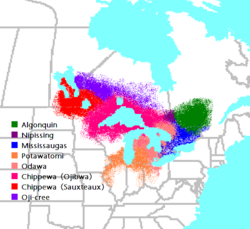
and the Lakota. Because many Ojibwe were historically formerly located mainly around the outlet of Lake Superior
Lake Superior
Lake Superior is the largest of the five traditionally-demarcated Great Lakes of North America. It is bounded to the north by the Canadian province of Ontario and the U.S. state of Minnesota, and to the south by the U.S. states of Wisconsin and Michigan. It is the largest freshwater lake in the...
, which the French
French people
The French are a nation that share a common French culture and speak the French language as a mother tongue. Historically, the French population are descended from peoples of Celtic, Latin and Germanic origin, and are today a mixture of several ethnic groups...
colonists called Sault Ste. Marie
Sault Ste. Marie, Ontario
Sault Ste. Marie is a city on the St. Marys River in Algoma District, Ontario, Canada. It is the third largest city in Northern Ontario, after Sudbury and Thunder Bay, with a population of 74,948. The community was founded as a French religious mission: Sault either means "jump" or "rapids" in...
, they referred to the Ojibwe as Saulteurs. Ojibwe who subsequently moved to the prairie provinces of Canada have retained the name Saulteaux
Saulteaux
The Saulteaux are a First Nation in Ontario, Manitoba, Saskatchewan, Alberta and British Columbia, Canada.-Ethnic classification:The Saulteaux are a branch of the Ojibwe nations. They are sometimes also called Anihšināpē . Saulteaux is a French term meaning "people of the rapids," referring to...
. Ojibwe who were originally located about the Mississagi River
Mississagi River
The Mississagi River is a river in Algoma and Sudbury Districts, Ontario, Canada, that originates in Sudbury District and flows to Lake Huron at Blind River, Algoma District.-Etymology:...
and made their way to southern Ontario
Southern Ontario
Southern Ontario is a region of the province of Ontario, Canada that lies south of the French River and Algonquin Park. Depending on the inclusion of the Parry Sound and Muskoka districts, its surface area would cover between 14 to 15% of the province. It is the southernmost region of...
are known as the Mississaugas
Mississaugas
The Mississaugas are a subtribe of the Anishinaabe-speaking First Nations people located in southern Ontario, Canada. They are closely related to the Ojibwa...
.
The Ojibwe peoples are a major component group of the Anishinaabe
Anishinaabe
Anishinaabe or Anishinabe—or more properly Anishinaabeg or Anishinabek, which is the plural form of the word—is the autonym often used by the Odawa, Ojibwe, and Algonquin peoples. They all speak closely related Anishinaabemowin/Anishinaabe languages, of the Algonquian language family.The meaning...
-speaking peoples, a branch of the Algonquian
Algonquian languages
The Algonquian languages also Algonkian) are a subfamily of Native American languages which includes most of the languages in the Algic language family. The name of the Algonquian language family is distinguished from the orthographically similar Algonquin dialect of the Ojibwe language, which is a...
language family which includes the Algonquin, Nipissing
Nipissing First Nation
The Nipissing First Nation consists of first nation people of Ojibwa and Algonquin descent who have lived in the area of Lake Nipissing in the Canadian province of Ontario for about 9,400 years. Though in history known by many names, they are generally considered part of the Anishinaabe peoples,...
, Oji-Cree, Odawa
Ottawa (tribe)
The Odawa or Ottawa, said to mean "traders," are a Native American and First Nations people. They are one of the Anishinaabeg, related to but distinct from the Ojibwe nation. Their original homelands are located on Manitoulin Island, near the northern shores of Lake Huron, on the Bruce Peninsula in...
and the Potawatomi
Potawatomi
The Potawatomi are a Native American people of the upper Mississippi River region. They traditionally speak the Potawatomi language, a member of the Algonquian family. In the Potawatomi language, they generally call themselves Bodéwadmi, a name that means "keepers of the fire" and that was applied...
. The Ojibwe peoples number over 56,440 in the U.S., living in an area stretching across the northern tier from Michigan
Michigan
Michigan is a U.S. state located in the Great Lakes Region of the United States of America. The name Michigan is the French form of the Ojibwa word mishigamaa, meaning "large water" or "large lake"....
west to Montana
Montana
Montana is a state in the Western United States. The western third of Montana contains numerous mountain ranges. Smaller, "island ranges" are found in the central third of the state, for a total of 77 named ranges of the Rocky Mountains. This geographical fact is reflected in the state's name,...
. Another 77,940 of main-line Ojibwe; 76,760 Saulteaux and 8,770 Mississaugas, in 125 bands, live in Canada, stretching from western Quebec
Quebec
Quebec or is a province in east-central Canada. It is the only Canadian province with a predominantly French-speaking population and the only one whose sole official language is French at the provincial level....
to eastern British Columbia
British Columbia
British Columbia is the westernmost of Canada's provinces and is known for its natural beauty, as reflected in its Latin motto, Splendor sine occasu . Its name was chosen by Queen Victoria in 1858...
. They are historically known for their crafting of birch bark
Birch bark
Birch bark or birchbark is the bark of several Eurasian and North American birch trees of the genus Betula.The strong and water-resistant cardboard-like bark can be easily cut, bent, and sewn, which made it a valuable building, crafting, and writing material, since pre-historic times...
canoe
Canoe
A canoe or Canadian canoe is a small narrow boat, typically human-powered, though it may also be powered by sails or small electric or gas motors. Canoes are usually pointed at both bow and stern and are normally open on top, but can be decked over A canoe (North American English) or Canadian...
s, sacred birch bark scrolls
Birch bark scrolls
Wiigwaasabak are birch bark scrolls, on which the Ojibwa people of North America wrote complex geometrical patterns and shapes. When used specifically for Midewiwin ceremonial use, these scrolls are called mide-wiigwaas...
, use of cowrie shells for trading, cultivation of wild rice
Wild rice
Wild rice is four species of grasses forming the genus Zizania, and the grain which can be harvested from them. The grain was historically gathered and eaten in both North America and China...
, and use of copper arrow points. In 1745 they adopted guns from the British to use to defeat and push the Dakota
Sioux
The Sioux are Native American and First Nations people in North America. The term can refer to any ethnic group within the Great Sioux Nation or any of the nation's many language dialects...
nation of the Sioux
Sioux
The Sioux are Native American and First Nations people in North America. The term can refer to any ethnic group within the Great Sioux Nation or any of the nation's many language dialects...
to the south.
The Ojibwe Nation was the first to set the agenda with European-Canadian leaders for signing more detailed treaties before many European settlers were allowed too far west. The Midewiwin
Midewiwin
The Midewiwin or the Grand Medicine Society is a secretive religion of the aboriginal groups of the Maritimes, New England and Great Lakes regions in North America. Its practitioners are called Midew and the practices of Midewiwin referred to as Mide...
Society is well respected as the keeper of detailed and complex scrolls of events, history, songs, maps, memories, stories, geometry, and mathematics.
Name
The autonymExonym and endonym
In ethnolinguistics, an endonym or autonym is a local name for a geographical feature, and an exonym or xenonym is a foreign language name for it...
for this group of Anishinaabeg is Ojibwe (plural: Ojibweg). This name is commonly anglicized as "Ojibwa" or "Ojibway." The name "Chippewa" is an alternative anglicization. Although many variations exist in literature, "Chippewa" is more common in the United States and "Ojibwa" predominates in Canada, but both terms are used in each country. In many Ojibwe communities throughout Canada and the U.S., more members have been using the generalized name Anishinaabe(-g).
The exact meaning of the name Ojibwe is not known; the most common explanations for the name derivations are:
- from ojiibwabwe (/o/ + /jiibw/ + /abwe/), meaning "those who cook\roast until it puckers", referring to their fire-curing of moccasinMoccasin (footwear)A moccasin is a slipper made of deerskin or other soft leather, consisting of a sole and sides made of one piece of leather, stitched together at the top, and sometimes with a vamp . Though sometimes worn inside, it is chiefly intended for outdoor use, as in exploring wildernesses and running from...
seams to make them water-proof. Some early sources say this name described a method of ritualRitualA ritual is a set of actions, performed mainly for their symbolic value. It may be prescribed by a religion or by the traditions of a community. The term usually excludes actions which are arbitrarily chosen by the performers....
torture which the Ojibwe applied to enemies.; - from ozhibii'iwe (/o/ + /zhibii'/ + /iwe/), meaning "those who keep records [of a Vision]", referring to their form of pictorial writing, and pictographs used in Midewiwin sacred rites; or
- from ojiibwe (/o/ + /jiib/ + /we/), meaning "those who speak-stiffly"\"those who stammer", an exonym or name given to them by the CreeCreeThe Cree are one of the largest groups of First Nations / Native Americans in North America, with 200,000 members living in Canada. In Canada, the major proportion of Cree live north and west of Lake Superior, in Ontario, Manitoba, Saskatchewan, Alberta and the Northwest Territories, although...
, characterizing their language as heard by different language speakers.
Language
The Ojibwe language is known as Anishinaabemowin or Ojibwemowin, and is still widely spoken, but the number of fluent speakers has declined sharply. Today, most of the language's fluent speakers are elders. A movement has picked up in recent years to revitalize the language, and restore its strength as an anchor of Ojibwe culture. The language belongs to the AlgonquianAlgonquian languages
The Algonquian languages also Algonkian) are a subfamily of Native American languages which includes most of the languages in the Algic language family. The name of the Algonquian language family is distinguished from the orthographically similar Algonquin dialect of the Ojibwe language, which is a...
linguistic group, and is descended from Proto-Algonquian
Proto-Algonquian language
Proto-Algonquian is the name given to the proto-language from which the various languages of the Algonquian family are descended. It is generally estimated to have been spoken around 2,500 to 3,000 years ago, but on the question of where it was spoken there is less agreement...
. Its sister languages include Blackfoot
Blackfoot language
Blackfoot, also known as Siksika , Pikanii, and Blackfeet, is the Algonquian language spoken by the Blackfoot tribes of Native Americans, who currently live in the northwestern plains of North America...
, Cheyenne
Cheyenne language
The Cheyenne language is a Native American language spoken by the Cheyenne people, predominantly in present-day Montana and Oklahoma in the United States. It is part of the Algonquian language family...
, Cree
Cree language
Cree is an Algonquian language spoken by approximately 117,000 people across Canada, from the Northwest Territories and Alberta to Labrador, making it the aboriginal language with the highest number of speakers in Canada. It is also spoken in the U.S. state of Montana...
, Fox
Meskwaki
The Meskwaki are a Native American people often known to outsiders as the Fox tribe. They have often been closely linked to the Sauk people. In their own language, the Meskwaki call themselves Meshkwahkihaki, which means "the Red-Earths." Historically their homelands were in the Great Lakes region...
, Menominee
Menominee language
The Menominee language is an Algonquian language originally spoken by the Menominee people of northern Wisconsin and Michigan. It is still spoken on the Menominee Nation lands in Northern Wisconsin in the United States....
, Potawatomi
Potawatomi language
Potawatomi is a Central Algonquian language and is spoken around the Great Lakes in Michigan and Wisconsin, as well as in Kansas in the United States, and in southern Ontario in Canada, 1300 Potawatomi people, all elderly...
, and Shawnee
Shawnee language
The Shawnee language is a Central Algonquian language spoken in parts of central and northeastern Oklahoma by only around 200 Shawnee, making it an endangered language. It was originally spoken in Ohio, West Virginia, Kentucky, and Pennsylvania...
. Anishinaabemowin is frequently referred to as a "Central Algonquian" language; however, Central Algonquian is an area grouping rather than a linguistic genetic one. Ojibwemowin is the fourth-most spoken Native language in North America
North America
North America is a continent wholly within the Northern Hemisphere and almost wholly within the Western Hemisphere. It is also considered a northern subcontinent of the Americas...
(US and Canada) after Navajo
Navajo language
Navajo or Navaho is an Athabaskan language spoken in the southwestern United States. It is geographically and linguistically one of the Southern Athabaskan languages .Navajo has more speakers than any other Native American language north of the...
, Cree
Cree language
Cree is an Algonquian language spoken by approximately 117,000 people across Canada, from the Northwest Territories and Alberta to Labrador, making it the aboriginal language with the highest number of speakers in Canada. It is also spoken in the U.S. state of Montana...
, and Inuktitut
Inuit language
The Inuit language is traditionally spoken across the North American Arctic and to some extent in the subarctic in Labrador. The related Yupik languages are spoken in western and southern Alaska and Russian Far East, particularly the Diomede Islands, but is severely endangered in Russia today and...
. Many decades of fur trading
Fur trade
The fur trade is a worldwide industry dealing in the acquisition and sale of animal fur. Since the establishment of world market for in the early modern period furs of boreal, polar and cold temperate mammalian animals have been the most valued...
with the French established the language as one of the key trade languages of the Great Lakes
Great Lakes
The Great Lakes are a collection of freshwater lakes located in northeastern North America, on the Canada – United States border. Consisting of Lakes Superior, Michigan, Huron, Erie, and Ontario, they form the largest group of freshwater lakes on Earth by total surface, coming in second by volume...
and the northern Great Plains
Great Plains
The Great Plains are a broad expanse of flat land, much of it covered in prairie, steppe and grassland, which lies west of the Mississippi River and east of the Rocky Mountains in the United States and Canada. This area covers parts of the U.S...
.
The popularity of the epic poem The Song of Hiawatha
The Song of Hiawatha
The Song of Hiawatha is an 1855 epic poem, in trochaic tetrameter, by Henry Wadsworth Longfellow, featuring an Indian hero and loosely based on legends and ethnography of the Ojibwe and other Native American peoples contained in Algic Researches and additional writings of Henry Rowe Schoolcraft...
, written by Henry Wadsworth Longfellow
Henry Wadsworth Longfellow
Henry Wadsworth Longfellow was an American poet and educator whose works include "Paul Revere's Ride", The Song of Hiawatha, and Evangeline...
in 1855, publicized the Ojibwe culture. The epic contains many toponyms that originate from Ojibwe words.
Pre-contact and spiritual beliefs
According to their tradition, and from recordings in birch bark scrolls, many Ojibwe came from the eastern areas of North America, which they called Turtle IslandTurtle Island (North America)
Turtle Island is a term used by several Northeastern Woodland Native American tribes, especially the Haudenosaunee or Iroquois Confederacy, for the continent of North America.-Iroquois:...
, and from along the east coast. They traded widely across the continent for thousands of years and knew of the canoe routes west and a land route to the west coast. The identification of the Ojibwe as a culture or people may have occurred in response to contact with Europeans. The Europeans preferred to deal with bounded groups and tried to identify those they encountered.
According to the oral history, seven great miigis (radiant/iridescent) beings appeared to the peoples in the Waabanakiing (Land of the Dawn, i.e., Eastern Land) to teach them the mide way
Midewiwin
The Midewiwin or the Grand Medicine Society is a secretive religion of the aboriginal groups of the Maritimes, New England and Great Lakes regions in North America. Its practitioners are called Midew and the practices of Midewiwin referred to as Mide...
of life. One of the seven great miigis beings was too spiritually powerful and killed the peoples in the Waabanakiing when they were in its presence. The six great miigis beings remained to teach, while the one returned into the ocean. The six great miigis beings established doodem (clans) for the peoples in the east, symbolized by animal, fish or bird species. The five original Anishinaabe doodem were the Wawaazisii (Bullhead
Brown bullhead
The brown bullhead, Ameiurus nebulosus, is a fish of the Ictaluridae family that is widely distributed in North America. It is a species of bullhead catfish and is similar to the black bullhead and yellow bullhead...
), Baswenaazhi (Echo-maker, i.e., Crane
Crane (bird)
Cranes are a family, Gruidae, of large, long-legged and long-necked birds in the order Gruiformes. There are fifteen species of crane in four genera. Unlike the similar-looking but unrelated herons, cranes fly with necks outstretched, not pulled back...
), Aan'aawenh (Pintail
Northern Pintail
The Pintail or Northern Pintail is a widely occurring duck which breeds in the northern areas of Europe, Asia and North America. It is strongly migratory and winters south of its breeding range to the equator...
Duck), Nooke (Tender, i.e., Bear
Bear
Bears are mammals of the family Ursidae. Bears are classified as caniforms, or doglike carnivorans, with the pinnipeds being their closest living relatives. Although there are only eight living species of bear, they are widespread, appearing in a wide variety of habitats throughout the Northern...
) and Moozoonsii (Little Moose
Moose
The moose or Eurasian elk is the largest extant species in the deer family. Moose are distinguished by the palmate antlers of the males; other members of the family have antlers with a dendritic configuration...
), then these six miigis beings returned into the ocean as well. If the seventh miigis being stayed, it would have established the Thunderbird
Thunderbird (mythology)
The Thunderbird is a legendary creature in certain North American indigenous peoples' history and culture. It is considered a "supernatural" bird of power and strength...
doodem.
At a later time, one of these miigis appeared in a vision to relate a prophecy. It said that if the Anishinaabeg did not move further west, they would not be able to keep their traditional ways alive because of the many new settlements and European immigrants who would arrive soon in the east. Their migration path would be symbolized by a series of smaller Turtle Islands, which was confirmed with miigis shells (i.e., cowry
Cowry
Cowry, also sometimes spelled cowrie, plural cowries, is the common name for a group of small to large sea snails, marine gastropod molluscs in the family Cypraeidae, the cowries...
shells). After receiving assurance from the their "Allied Brothers" (i.e., Mi'kmaq) and "Father" (i.e., Abnaki) of their safety to move inland, the Anishinaabeg gradually migrated along the St. Lawrence River to the Ottawa River
Ottawa River
The Ottawa River is a river in the Canadian provinces of Ontario and Quebec. For most of its length, it now defines the border between these two provinces.-Geography:...
to Lake Nipissing
Lake Nipissing
Lake Nipissing is a lake in the Canadian province of Ontario. It has a surface area of , a mean elevation of above sea level, and is located between the Ottawa River and Georgian Bay. Excluding the Great Lakes, Lake Nipissing is the fifth-largest lake in Ontario. It is relatively shallow for a...
, and then to the Great Lakes
Great Lakes
The Great Lakes are a collection of freshwater lakes located in northeastern North America, on the Canada – United States border. Consisting of Lakes Superior, Michigan, Huron, Erie, and Ontario, they form the largest group of freshwater lakes on Earth by total surface, coming in second by volume...
.
The first of the smaller Turtle Islands was Mooniyaa, where Mooniyaang (present-day Montreal, Quebec) now stands. The "second stopping place" was in the vicinity of the Wayaanag-gakaabikaa (Concave Waterfalls, i.e., Niagara Falls
Niagara Falls
The Niagara Falls, located on the Niagara River draining Lake Erie into Lake Ontario, is the collective name for the Horseshoe Falls and the adjacent American Falls along with the comparatively small Bridal Veil Falls, which combined form the highest flow rate of any waterfalls in the world and has...
). At their "third stopping place" near the present-day city of Detroit, Michigan
Detroit, Michigan
Detroit is the major city among the primary cultural, financial, and transportation centers in the Metro Detroit area, a region of 5.2 million people. As the seat of Wayne County, the city of Detroit is the largest city in the U.S. state of Michigan and serves as a major port on the Detroit River...
, the Anishinaabeg divided into six groups, of which the Ojibwe was one. The first significant new Ojibwe culture-centre was their "fourth stopping place" on Manidoo Minising (Manitoulin Island
Manitoulin Island
Manitoulin Island is a Canadian island in Lake Huron, in the province of Ontario. It is the largest island in a freshwater lake in the world. In addition to the historic Anishinaabe and European settlement of the island, archeological discoveries at Sheguiandah have demonstrated Paleo-Indian and...
). Their first new political-centre was referred as their "fifth stopping place", in their present country at Baawiting (Sault Ste. Marie).
Continuing their westward expansion, the Ojibwe divided into the "northern branch," following the north shore of Lake Superior
Lake Superior
Lake Superior is the largest of the five traditionally-demarcated Great Lakes of North America. It is bounded to the north by the Canadian province of Ontario and the U.S. state of Minnesota, and to the south by the U.S. states of Wisconsin and Michigan. It is the largest freshwater lake in the...
, and "southern branch," along its south shore. As the peoples continued to migrate westward, the "northern branch" divided into a "westerly group" and a "southerly group". The "southern branch" and the "southerly group" of the "northern branch" came together at their "sixth stopping place" on Spirit Island (46°41′15"N 092°11′21"W) located in the St. Louis River
Saint Louis River
The St. Louis River is a river in the U.S. states of Minnesota and Wisconsin that flows into Lake Superior. The largest U.S. river to flow into the lake, it is 179 miles in length and starts near Hoyt Lakes, Minnesota. The river's watershed is in area...
estuary of the present-day Duluth
Duluth, Minnesota
Duluth is a port city in the U.S. state of Minnesota and is the county seat of Saint Louis County. The fourth largest city in Minnesota, Duluth had a total population of 86,265 in the 2010 census. Duluth is also the second largest city that is located on Lake Superior after Thunder Bay, Ontario,...
/Superior
Superior, Wisconsin
Superior is a city in and the county seat of Douglas County, Wisconsin, United States. The population was 26,960 at the 2010 census. Located at the junction of U.S. Highways 2 and 53, it is north of and adjacent to both the Village of Superior and the Town of Superior.Superior is at the western...
region. The people were directed in a vision by the miigis being to go to the "place where there is food (i.e., wild rice) upon the waters." Their second major settlement, referred as their "seventh stopping place", was at Shaugawaumikong (or Zhaagawaamikong, French, Chequamegon
Chequamegon Bay
Chequamegon Bay is an inlet of Lake Superior, NE-SW and 2- wide, in Ashland and Bayfield counties in the extreme northern part of Wisconsin. It lies largely inside the barrier of Chequamegon Point and Long Island, with the Bad River Indian Reservation to the east. Ashland, Wisconsin is on its...
) on the southern shore of Lake Superior, near the present La Pointe, Wisconsin
La Pointe, Wisconsin
La Pointe is a town in Ashland County in the U.S. state of Wisconsin. The town includes all of the Apostle Islands. There is also an unincorporated community named La Pointe on Madeline Island, the largest of the Apostle Islands . The population was 246 at the 2000 census...
.
The "westerly group" of the "northern branch" migrated along the Rainy River, Red River of the North
Red River of the North
The Red River is a North American river. Originating at the confluence of the Bois de Sioux and Otter Tail rivers in the United States, it flows northward through the Red River Valley and forms the border between the U.S. states of Minnesota and North Dakota before continuing into Manitoba, Canada...
, and across the northern Great Plains
Great Plains
The Great Plains are a broad expanse of flat land, much of it covered in prairie, steppe and grassland, which lies west of the Mississippi River and east of the Rocky Mountains in the United States and Canada. This area covers parts of the U.S...
until reaching the Pacific Northwest
Pacific Northwest
The Pacific Northwest is a region in northwestern North America, bounded by the Pacific Ocean to the west and, loosely, by the Rocky Mountains on the east. Definitions of the region vary and there is no commonly agreed upon boundary, even among Pacific Northwesterners. A common concept of the...
. Along their migration to the west, they came across many miigis, or cowry shells, as told in the prophecy.
Post-contact with Europeans
The first historical mention of the Ojibwe occurs in the French Jesuit Relation of 1640, a report by the missionary priests to their superiors in France. Through their friendship with the French traders (coureur des boisCoureur des bois
A coureur des bois or coureur de bois was an independent entrepreneurial French-Canadian woodsman who traveled in New France and the interior of North America. They travelled in the woods to trade various things for fur....
and voyageurs
Voyageurs
The Voyageurs were the persons who engaged in the transportation of furs by canoe during the fur trade era. Voyageur is a French word which literally translates to "traveler"...
), the Ojibwe gained guns, began to use European goods, and began to dominate their traditional enemies, the Lakota and Fox
Meskwaki
The Meskwaki are a Native American people often known to outsiders as the Fox tribe. They have often been closely linked to the Sauk people. In their own language, the Meskwaki call themselves Meshkwahkihaki, which means "the Red-Earths." Historically their homelands were in the Great Lakes region...
to their west and south. They drove the Sioux from the Upper Mississippi
Mississippi River
The Mississippi River is the largest river system in North America. Flowing entirely in the United States, this river rises in western Minnesota and meanders slowly southwards for to the Mississippi River Delta at the Gulf of Mexico. With its many tributaries, the Mississippi's watershed drains...
region to the area of the present-day Dakotas, and forced the Fox down from northern Wisconsin
Wisconsin
Wisconsin is a U.S. state located in the north-central United States and is part of the Midwest. It is bordered by Minnesota to the west, Iowa to the southwest, Illinois to the south, Lake Michigan to the east, Michigan to the northeast, and Lake Superior to the north. Wisconsin's capital is...
. The latter allied with the Sauk for protection.
By the end of the 18th century, the Ojibwe controlled nearly all of present-day Michigan, northern Wisconsin, and Minnesota, including most of the Red River
Red River of the North
The Red River is a North American river. Originating at the confluence of the Bois de Sioux and Otter Tail rivers in the United States, it flows northward through the Red River Valley and forms the border between the U.S. states of Minnesota and North Dakota before continuing into Manitoba, Canada...
area. They also controlled the entire northern shores of lakes Huron
Lake Huron
Lake Huron is one of the five Great Lakes of North America. Hydrologically, it comprises the larger portion of Lake Michigan-Huron. It is bounded on the east by the Canadian province of Ontario and on the west by the state of Michigan in the United States...
and Superior on the Canadian side and extending westward to the Turtle Mountains
Turtle Mountain (plateau)
Turtle Mountain, or the Turtle Mountains, is an area in central North America, in the north-central portion of the U.S. state of North Dakota and southwestern portion of the Canadian province of Manitoba...
of North Dakota
North Dakota
North Dakota is a state located in the Midwestern region of the United States of America, along the Canadian border. The state is bordered by Canada to the north, Minnesota to the east, South Dakota to the south and Montana to the west. North Dakota is the 19th-largest state by area in the U.S....
. In the latter area, the French Canadians called them Ojibwe or Saulteaux.
The Ojibwe (Chippewa) were part of a long-term alliance with the Anishinaabe Ottawa
Ottawa
Ottawa is the capital of Canada, the second largest city in the Province of Ontario, and the fourth largest city in the country. The city is located on the south bank of the Ottawa River in the eastern portion of Southern Ontario...
and Potawatomi
Potawatomi
The Potawatomi are a Native American people of the upper Mississippi River region. They traditionally speak the Potawatomi language, a member of the Algonquian family. In the Potawatomi language, they generally call themselves Bodéwadmi, a name that means "keepers of the fire" and that was applied...
peoples, called the Council of Three Fires
Council of Three Fires
The Council of Three Fires, also known as the People of the Three Fires, the Three Fires Confederacy, the United Nations of Chippewa, Ottawa, and Potawatomi Indians, or Niswi-mishkodewin in the Anishinaabe language, is a long-standing Anishinaabe alliance of the Ojibwe , Ottawa , and Potawatomi...
. They fought against the Iroquois Confederacy, based mainly to the southeast of the Great Lakes in present-day New York, and the Sioux. The Ojibwe expanded eastward, taking over the lands along the eastern shores of Lake Huron and Georgian Bay
Georgian Bay
Georgian Bay is a large bay of Lake Huron, located entirely within Ontario, Canada...
. In part due to its long trading alliance, the Ojibwe allied with the French against Great Britain and its colonists in the Seven Years' War
Seven Years' War
The Seven Years' War was a global military war between 1756 and 1763, involving most of the great powers of the time and affecting Europe, North America, Central America, the West African coast, India, and the Philippines...
(also called the French and Indian War
French and Indian War
The French and Indian War is the common American name for the war between Great Britain and France in North America from 1754 to 1763. In 1756, the war erupted into the world-wide conflict known as the Seven Years' War and thus came to be regarded as the North American theater of that war...
). After losing the war, in 1763 France was forced to cede "its" colonial claims to lands in Canada and east of the Mississippi River to Britain. After adjusting to British colonial rule, the Ojibwe allied with them and against the United States in the War of 1812
War of 1812
The War of 1812 was a military conflict fought between the forces of the United States of America and those of the British Empire. The Americans declared war in 1812 for several reasons, including trade restrictions because of Britain's ongoing war with France, impressment of American merchant...
. They had hoped a British victory could protect against United States settlers' encroachment on their territory.
Following the war, the United States government tried to forcibly remove
Indian Removal
Indian removal was a nineteenth century policy of the government of the United States to relocate Native American tribes living east of the Mississippi River to lands west of the river...
all the Ojibwe to Minnesota
Minnesota
Minnesota is a U.S. state located in the Midwestern United States. The twelfth largest state of the U.S., it is the twenty-first most populous, with 5.3 million residents. Minnesota was carved out of the eastern half of the Minnesota Territory and admitted to the Union as the thirty-second state...
west of Mississippi River. The Ojibwe resisted, and there were violent confrontations. In the Sandy Lake Tragedy
Sandy Lake Tragedy
The Sandy Lake Tragedy was the culmination of a series of events centered in Sandy Lake, Minnesota, that resulted in the deaths in 1850 of several hundred Lake Superior Chippewa. Officials of the Zachary Taylor Administration and Minnesota Territory sought to relocate several bands of the tribe to...
, the US killed several hundred Ojibwe. Through the efforts of Chief Buffalo and the rise of popular opinion in the US against Ojibwe removal, the bands east of the Mississippi were allowed to return to reservations on ceded territory. A few families were removed to Kansas
Kansas
Kansas is a US state located in the Midwestern United States. It is named after the Kansas River which flows through it, which in turn was named after the Kansa Native American tribe, which inhabited the area. The tribe's name is often said to mean "people of the wind" or "people of the south...
as part of the Potawatomi removal.
In British North America, the Royal Proclamation of 1763
Royal Proclamation of 1763
The Royal Proclamation of 1763 was issued October 7, 1763, by King George III following Great Britain's acquisition of French territory in North America after the end of the French and Indian War/Seven Years' War...
following the Seven Years' War
Seven Years' War
The Seven Years' War was a global military war between 1756 and 1763, involving most of the great powers of the time and affecting Europe, North America, Central America, the West African coast, India, and the Philippines...
governed the cession of land by treaty
Treaty
A treaty is an express agreement under international law entered into by actors in international law, namely sovereign states and international organizations. A treaty may also be known as an agreement, protocol, covenant, convention or exchange of letters, among other terms...
or purchase . Subsequently France ceded most of the land in Upper Canada
Upper Canada
The Province of Upper Canada was a political division in British Canada established in 1791 by the British Empire to govern the central third of the lands in British North America and to accommodate Loyalist refugees from the United States of America after the American Revolution...
to Great Britain
Kingdom of Great Britain
The former Kingdom of Great Britain, sometimes described as the 'United Kingdom of Great Britain', That the Two Kingdoms of Scotland and England, shall upon the 1st May next ensuing the date hereof, and forever after, be United into One Kingdom by the Name of GREAT BRITAIN. was a sovereign...
. Even with the Jay Treaty
Jay Treaty
Jay's Treaty, , also known as Jay's Treaty, The British Treaty, and the Treaty of London of 1794, was a treaty between the United States and Great Britain that is credited with averting war,, resolving issues remaining since the Treaty of Paris of 1783, which ended the American Revolution,, and...
signed between the Great Britain and the United States, the newly formed United States did not fully uphold the treaty. Illegal United States immigration into Ojibwe and other Native American lands continued, and the tribes retaliated in the series of battles called the Northwest Indian War
Northwest Indian War
The Northwest Indian War , also known as Little Turtle's War and by various other names, was a war fought between the United States and a confederation of numerous American Indian tribes for control of the Northwest Territory...
. As it was still preoccupied by war with France, Great Britain ceded to the United States much of the lands in Ohio
Ohio
Ohio is a Midwestern state in the United States. The 34th largest state by area in the U.S.,it is the 7th‑most populous with over 11.5 million residents, containing several major American cities and seven metropolitan areas with populations of 500,000 or more.The state's capital is Columbus...
, Indiana
Indiana
Indiana is a US state, admitted to the United States as the 19th on December 11, 1816. It is located in the Midwestern United States and Great Lakes Region. With 6,483,802 residents, the state is ranked 15th in population and 16th in population density. Indiana is ranked 38th in land area and is...
, Michigan, parts of Illinois
Illinois
Illinois is the fifth-most populous state of the United States of America, and is often noted for being a microcosm of the entire country. With Chicago in the northeast, small industrial cities and great agricultural productivity in central and northern Illinois, and natural resources like coal,...
and Wisconsin, and northern Minnesota and North Dakota to settle the boundary of their holdings in Canada.
Many of the land cession treaties the British made with the Ojibwe provided for their rights for continued hunting, fishing and gathering of natural resources after land sales. The government signed numbered treaties in northwestern Ontario, Manitoba
Manitoba
Manitoba is a Canadian prairie province with an area of . The province has over 110,000 lakes and has a largely continental climate because of its flat topography. Agriculture, mostly concentrated in the fertile southern and western parts of the province, is vital to the province's economy; other...
, Saskatchewan
Saskatchewan
Saskatchewan is a prairie province in Canada, which has an area of . Saskatchewan is bordered on the west by Alberta, on the north by the Northwest Territories, on the east by Manitoba, and on the south by the U.S. states of Montana and North Dakota....
, and Alberta
Alberta
Alberta is a province of Canada. It had an estimated population of 3.7 million in 2010 making it the most populous of Canada's three prairie provinces...
. British Columbia
British Columbia
British Columbia is the westernmost of Canada's provinces and is known for its natural beauty, as reflected in its Latin motto, Splendor sine occasu . Its name was chosen by Queen Victoria in 1858...
had no signed treaties until the late 20th century, and most areas have no treaties yet. The government and First Nations are continuing to negotiate treaty land entitlements and settlements. The treaties are constantly being reinterpreted by the courts because many of them are vague and difficult to apply in modern times. The numbered treaties were some of the most detailed treaties signed for their time. The Ojibwe Nation set the agenda and negotiated the first numbered treaties before they would allow safe passage of many more British settlers to the prairies.
Often, earlier treaties were known as "Peace and Friendship Treaties" to establish community bonds between the Ojibwe and the European settlers. These earlier treaties established the groundwork for cooperative resource-sharing between the Ojibwe and the settlers. The United States and Canada viewed later treaties offering land cessions as offering territorial advantages. The Ojibwe did not understand the land cession terms in the same way because of the cultural differences in understanding the uses of land. The governments of the US and Canada considered land a commodity of value that could be freely bought, owned and sold.
The Ojibwe believed it was a fully shared resource, along with air, water and sunlight. At the time of the treaty councils, they could not conceive of separate land sales or exclusive ownership of land. Consequently, today in both Canada and the US, legal arguments in treaty-rights and treaty interpretations often bring to light the differences in cultural understanding of treaty terms to come to legal understanding of the treaty obligations.
During its Indian Removal
Indian Removal
Indian removal was a nineteenth century policy of the government of the United States to relocate Native American tribes living east of the Mississippi River to lands west of the river...
of the 1830s, US government attempted to relocate tribes from the east to the west of the Mississippi River as the white pioneers increasingly migrated west. By the late 19th century, the government policy was to move tribes onto reservations
Indian reservation
An American Indian reservation is an area of land managed by a Native American tribe under the United States Department of the Interior's Bureau of Indian Affairs...
within their territories. The government attempted to do this to the Anishinaabe
Anishinaabe
Anishinaabe or Anishinabe—or more properly Anishinaabeg or Anishinabek, which is the plural form of the word—is the autonym often used by the Odawa, Ojibwe, and Algonquin peoples. They all speak closely related Anishinaabemowin/Anishinaabe languages, of the Algonquian language family.The meaning...
in the Keweenaw Peninsula
Keweenaw Peninsula
The Keweenaw Peninsula is the northern-most part of Michigan's Upper Peninsula. It projects into Lake Superior and was the site of the first copper boom in the United States. As of the 2000 census, its population was roughly 43,200...
in the Upper Peninsula of Michigan
Upper Peninsula of Michigan
The Upper Peninsula of Michigan is the northern of the two major land masses that make up the U.S. state of Michigan. It is commonly referred to as the Upper Peninsula, the U.P., or Upper Michigan. It is also known as the land "above the Bridge" linking the two peninsulas. The peninsula is bounded...
.
Culture
Great Plains
The Great Plains are a broad expanse of flat land, much of it covered in prairie, steppe and grassland, which lies west of the Mississippi River and east of the Rocky Mountains in the United States and Canada. This area covers parts of the U.S...
bands, lived a sedentary lifestyle, engaging in fishing
Fishing
Fishing is the activity of trying to catch wild fish. Fish are normally caught in the wild. Techniques for catching fish include hand gathering, spearing, netting, angling and trapping....
and hunting
Hunting
Hunting is the practice of pursuing any living thing, usually wildlife, for food, recreation, or trade. In present-day use, the term refers to lawful hunting, as distinguished from poaching, which is the killing, trapping or capture of the hunted species contrary to applicable law...
to supplement the women's cultivation of numerous varieties of maize
Maize
Maize known in many English-speaking countries as corn or mielie/mealie, is a grain domesticated by indigenous peoples in Mesoamerica in prehistoric times. The leafy stalk produces ears which contain seeds called kernels. Though technically a grain, maize kernels are used in cooking as a vegetable...
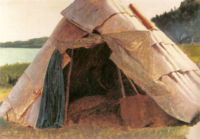
and squash, and the harvesting of manoomin (wild rice). Their typical dwelling was the wiigiwaam (wigwam
Wigwam
A wigwam or wickiup is a domed room dwelling used by certain Native American tribes. The term wickiup is generally used to label these kinds of dwellings in American Southwest and West. Wigwam is usually applied to these structures in the American Northeast...
), built either as a waginogaan (domed-lodge) or as a nasawa'ogaan (pointed-lodge), made of birch bark, juniper
Juniper
Junipers are coniferous plants in the genus Juniperus of the cypress family Cupressaceae. Depending on taxonomic viewpoint, there are between 50-67 species of juniper, widely distributed throughout the northern hemisphere, from the Arctic, south to tropical Africa in the Old World, and to the...
bark and willow
Willow
Willows, sallows, and osiers form the genus Salix, around 400 species of deciduous trees and shrubs, found primarily on moist soils in cold and temperate regions of the Northern Hemisphere...
saplings.
They developed a form of pictorial writing, used in religious rites of the Midewiwin
Midewiwin
The Midewiwin or the Grand Medicine Society is a secretive religion of the aboriginal groups of the Maritimes, New England and Great Lakes regions in North America. Its practitioners are called Midew and the practices of Midewiwin referred to as Mide...
and recorded on birch bark scroll
Scroll
A scroll is a roll of parchment, papyrus, or paper, which has been drawn or written upon.Scroll may also refer to:*Scroll , the decoratively curved end of the pegbox of string instruments such as violins...
s and possibly on rock. The many complex pictures on the sacred scrolls communicate much historical, geometrical, and mathematical knowledge. Ceremonies also used the miigis shell (cowry shell), which is found naturally in distant coastal areas. Their use of such shells demonstrates there was a vast trade network across the continent at some time. The use and trade of copper
Copper
Copper is a chemical element with the symbol Cu and atomic number 29. It is a ductile metal with very high thermal and electrical conductivity. Pure copper is soft and malleable; an exposed surface has a reddish-orange tarnish...
across the continent has also been proof of a large trading network that took place for thousands of years, as far back as the Hopewell culture
Hopewell culture
The Hopewell tradition is the term used to describe common aspects of the Native American culture that flourished along rivers in the northeastern and midwestern United States from 200 BCE to 500 CE. The Hopewell tradition was not a single culture or society, but a widely dispersed set of related...
. Certain types of rock used for spear and arrow heads were also traded over large distances. The use of petroforms, petroglyphs, and pictographs was common throughout the Ojibwe traditional territories. Petroforms and medicine wheels were a way to teach the important concepts of four directions and astronomical observations about the seasons, and to use as a memorizing tool for certain stories and beliefs.
During the summer months, the people attend jiingotamog for the spiritual and niimi'idimaa for a social gathering (pow-wow
Pow-wow
A pow-wow is a gathering of North America's Native people. The word derives from the Narragansett word powwaw, meaning "spiritual leader". A modern pow-wow is a specific type of event where both Native American and non-Native American people meet to dance, sing, socialize, and honor American...
s or "pau waus") at various reservations in the Anishinaabe-Aki (Anishinaabe Country). Many people still follow the traditional ways of harvesting wild rice, picking berries, hunting, making medicines, and making maple sugar
Maple sugar
Maple sugar is a traditional sweetener in the northeastern United States and Canada, prepared from the sap of the sugar maple tree.-Preparation:...
. Many of the Ojibwe take part in sun dance
Sun Dance
The Sun Dance is a religious ceremony practiced by a number of Native American and First Nations peoples, primarily those of the Plains Nations. Each tribe has its own distinct practices and ceremonial protocols...
ceremonies across the continent. The sacred scrolls are kept hidden away until those who are worthy and respect them are given permission to see and interpret them properly.
The Ojibwe would bury their dead in a burial mound. Many erect a jiibegamig or a "spirit-house" over each mound. A traditional burial mound would typically have a wooden marker, inscribed with the deceased's doodem (clan sign). Because of the distinct features of these burials, Ojibwe graves have been often looted by grave robbers. In the United States, many Ojibwe communities safe-guard their burial mounds through the enforcement of the 1990 Native American Graves Protection and Repatriation Act
Native American Graves Protection and Repatriation Act
The Native American Graves Protection and Repatriation Act , Pub. L. 101-601, 25 U.S.C. 3001 et seq., 104 Stat. 3048, is a United States federal law passed on 16 November 1990 requiring federal agencies and institutions that receive federal funding to return Native American "cultural items" to...
.
The Ojibwe viewed the world in two genders: animate and inanimate, rather than male and female. As an animate, a person could serve the society as a male-role or a female-role. John Tanner
John Tanner (narrator)
John Tanner was captured by Shawnee American Indians as a child of ten, after his family had moved to territory on the Ohio River in present-day Kentucky. He grew up with the Ojibwa nation, becoming fully acculturated and learning the Saulteaux language...
and the anthropologist Hermann Baumann have documented that Ojibwe peoples do not live according to the European ideas of gender and its roles. Individuals known as egwakwe (or Anglicised to "agokwa"), contribute in ways that cross European gender lines. Though these egwakweg may contribute to their communities in whatever way brings out their best character, these documented male-to-female transsexual midew among the Ojibwe were more readily noticed by the ethnic European documenters. A well-known egwakwe warrior and guide in Minnesota history was Ozaawindib
Ozaawindib
Ozaawindib was an Ojibwa warrior who lived in the early 19th century and was described as an egwakwe —what a modern Ojibwa would describe as a niizh manidoowag...
.
Several Ojibwe bands in the United States cooperate in the Great Lakes Indian Fish & Wildlife Commission
Great Lakes Indian Fish & Wildlife Commission
The Great Lakes Indian Fish & Wildlife Commission is an inter-tribal, co-management agency committed to the implementation of off-reservation treaty rights on behalf of its eleven-member Ojibwa tribes...
, which manages the treaty hunting and fishing rights in the Lake Superior-Lake Michigan
Lake Michigan
Lake Michigan is one of the five Great Lakes of North America and the only one located entirely within the United States. It is the second largest of the Great Lakes by volume and the third largest by surface area, after Lake Superior and Lake Huron...
areas. The commission follows the directives of U.S. agencies to run several wilderness areas. Some Minnesota Ojibwe tribal councils cooperate in the 1854 Treaty Authority
1854 Treaty Authority
The 1854 Treaty Authority is an inter-tribal, co-management agency committed to the implementation of off-reservation treaty rights on behalf of its two-member Ojibwa tribes.-Governance:...
, which manages their treaty hunting and fishing rights in the Arrowhead Region
Arrowhead Region
The Arrowhead Region is located in the northeastern part of the U.S. state of Minnesota, so called because of its pointed shape. The predominantly rural region encompasses of land area and comprises Carlton, Cook, Lake and St. Louis Counties. Its population at the 2000 census was 248,425 residents...
. In Michigan, the Chippewa-Ottawa Resource Authority manages the hunting, fishing and gathering rights about Sault Ste. Marie
Sault Ste. Marie, Michigan
Sault Ste. Marie is a city in and the county seat of Chippewa County in the U.S. state of Michigan. It is in the north-eastern end of Michigan's Upper Peninsula, on the Canadian border, separated from its twin city of Sault Ste. Marie, Ontario, by the St. Marys River...
, and the resources of the waters of lakes Michigan and Huron. In Canada, the Grand Council of Treaty #3 manages the Treaty 3
Treaty 3
Treaty 3 was an agreement entered into on October 3, 1873, by the Ojibway Nation and Queen Victoria. The treaty ceded a vast tract of Ojibway territory, including large parts of what is now northwestern Ontario and a small part of eastern Manitoba, to the Government of Canada...
hunting and fishing rights related to the area around Lake of the Woods
Lake of the Woods
Lake of the Woods is a lake occupying parts of the Canadian provinces of Ontario and Manitoba and the U.S. state of Minnesota. It separates a small land area of Minnesota from the rest of the United States. The Northwest Angle and the town of Angle Township can only be reached from the rest of...
.
Kinship and clan system
Ojibwe understanding of kinship is complex, and includes not only the immediate family but also the extended family. It is considered a modified bifurcate mergingIroquois kinship
Iroquois kinship is a kinship system used to define family. Identified by Lewis Henry Morgan in his 1871 work Systems of Consanguinity and Affinity of the Human Family, the Iroquois system is one of the six major kinship systems .-Kinship system:The system has both classificatory and...
kinship system. As with any bifurcate-merging kinship system, siblings generally share the same kinship term term with parallel cousin
Parallel cousin
In discussing consanguineal kinship in anthropology, a parallel cousin is a cousin from a parent's same sex sibling, while a cross cousin is from a parent's opposite-sexed sibling...
s, because they are all part of the same clan. The modified system allows for younger siblings to share the same kinship term with younger cross-cousins. Complexity wanes further from the speaker's immediate generation, but some complexity is retained with female relatives. For example, ninooshenh is "my mother's sister" or "my father's sister-in-law"—i.e., my parallel-aunt, but also "my parent's female cross-cousin". Great-grandparents and older generations, as well as great-grandchildren and younger generations, are collectively called aanikoobijigan. This system of kinship speaks of the nature of the Anishinaabe's philosophy and lifestyle, that is, of interconnectedness and balance among all living generations, as well as of all generations of the past and of the future.
The Ojibwe people were divided into a number of odoodeman (clans; singular: doodem) named primarily for animals and birds totem
Totem
A totem is a stipulated ancestor of a group of people, such as a family, clan, group, lineage, or tribe.Totems support larger groups than the individual person. In kinship and descent, if the apical ancestor of a clan is nonhuman, it is called a totem...
s . The five original totems were Wawaazisii (Bullhead), Baswenaazhi ("Echo-maker", i.e., Crane), Aan'aawenh (Pintail Duck), Nooke ("Tender", i.e., Bear) and Moozwaanowe ("Little" Moose-tail). The Crane totem was the most vocal among the Ojibwe, and the Bear was the largest — so large, in fact, that it was sub-divided into body parts such as the head, the ribs and the feet.
Traditionally, each band had a self-regulating council consisting of leaders of the communities' clans, or odoodemaan. The band was often identified by the principal doodem. In meeting others, the traditional greeting among the Ojibwe peoples is, "What is your 'doodem'?" ("Aaniin gidoodem?" or "Awanen gidoodem?") to establish social conduct by identifying each of the parties as family, friends or enemies. Today, the greeting has been shortened to "Aaniin."
Spiritual beliefs
The Ojibwe have a number of spiritual beliefs passed down by oral traditionOral tradition
Oral tradition and oral lore is cultural material and traditions transmitted orally from one generation to another. The messages or testimony are verbally transmitted in speech or song and may take the form, for example, of folktales, sayings, ballads, songs, or chants...
under the Midewiwin teachings. These include a creation story and a recounting of the origins of ceremonies and rituals. Spiritual beliefs and rituals were very important to the Ojibwe because spirits guided them through life. Birch bark scrolls and petroforms were used to pass along knowledge and information, as well as for ceremonies. Pictographs were also used for ceremonies.
The sweatlodge is still used during important ceremonies about the four directions, when oral history is recounted. Teaching lodges are common today to teach the next generations about the language and ancient ways of the past. The traditional ways, ideas, and teachings are preserved and practiced in such living ceremonies. The Ojbwe crafted the dreamcatcher
Dreamcatcher
Dreamcatcher is a Native American cultural object.Dreamcatcher may also refer to:-Entertainment:* Dreamcatcher , a 2001 novel by Stephen King** Dreamcatcher , based on the Stephen King novel...
. They believe that if one is hung above the head of a sleeper, it will catch and trap bad dreams, preventing them from reaching the dreamer. Traditional Ojibwe use dreamcatchers only for children, as they believe that adults should be able to interpret their dreams, good or bad and use them in their lives.
In legends and fiction
- The legend of the Ojibwe WendigoWendigoThe Wendigo is a mythical creature appearing in the mythology of the Algonquian people. It is a malevolent cannibalistic spirit into which humans could transform, or which could possess humans...
, in which tribesmen identify with a cannibalistic monster and prey on their families, is a story with many meanings. One points to the consequences of greed and the destruction that results from it. Thomas PynchonThomas PynchonThomas Ruggles Pynchon, Jr. is an American novelist. For his most praised novel, Gravity's Rainbow, Pynchon received the National Book Award, and is regularly cited as a contender for the Nobel Prize in Literature...
, Ramsey CampbellRamsey CampbellJohn Ramsey Campbell is an English horror fiction author.Since he first came to prominence in the mid-1960s, critics have cited Campbell as one of the leading writers in his field: T. E. D. Klein has written that "Campbell reigns supreme in the field today", while S. T...
and Stephen KingStephen KingStephen Edwin King is an American author of contemporary horror, suspense, science fiction and fantasy fiction. His books have sold more than 350 million copies and have been adapted into a number of feature films, television movies and comic books...
reference this story in their fiction. - The novelist Louise ErdrichLouise ErdrichKaren Louise Erdrich, known as Louise Erdrich, is an author of novels, poetry, and children's books featuring Native American heritage. She is widely acclaimed as one of the most significant writers of the second wave of what critic Kenneth Lincoln has called the Native American Renaissance...
is Anishinaabe. She has written about characters from her culture in TracksTracks (novel)Tracks is a novel by Louise Erdrich, published in 1988. It is the third in a tetralogy of novels beginning with Love Medicine that explores the interrelated lives of four Anishinaabe families living on an Indian reservation near the fictional town of Argus, North Dakota...
, Love MedicineLove MedicineLove Medicine is Louise Erdrich’s first novel, published in 1984. Erdrich revised and expanded the novel for an edition issued in 1993, and this version was considered the definitive edition until 2009 when Erdrich re-edited it...
, and The Bingo Palace. - In his story, "Fathers and SonsFathers and Sons (short story)"Fathers and Sons" is a short story by Ernest Hemingway published 1933, in the collection Winner Take Nothing. It later appeared in The Fifth Column and the First Forty-Nine Stories and The Snows of Kilimanjaro and Other Stories...
", Ernest HemingwayErnest HemingwayErnest Miller Hemingway was an American author and journalist. His economic and understated style had a strong influence on 20th-century fiction, while his life of adventure and his public image influenced later generations. Hemingway produced most of his work between the mid-1920s and the...
uses two Ojibwe as secondary characters. - Winona LaDukeWinona LaDukeWinona LaDuke is a Native American activist, environmentalist, economist, and writer. In 1996 and 2000, she ran for vice president as the nominee of the United States Green Party, on a ticket headed by Ralph Nader. In the 2004 election, however, she endorsed one of Nader's opponents, Democratic...
is a popular political and intellectual voice for the Anishinaabe people. - The Medicine woman Keewaydinoquay PeschelKeewaydinoquay PeschelKeewaydinoquay Pakawakuk Peschel was a scholar, ethnobotanist, herbalist, medicine woman, teacher and author. She was an Anishinaabeg Elder of the Crane Clan...
has written books on ethnobotanyEthnobotanyEthnobotany is the scientific study of the relationships that exist between people and plants....
and books for children. - The literary theorist and writer Gerald VizenorGerald VizenorGerald Robert Vizenor is a Native American writer, and an enrolled member of the Minnesota Chippewa Tribe, White Earth Reservation. One of the most prolific Native American writers, with over 30 books to his name, Vizenor also taught for many years at the University of California, Berkeley, where...
has drawn extensively on Anishinaabe philosophies of language. - The writer William Kent Krueger has written a series of crime novels chronicling the adventures of a character named Corcoran “Cork” O’Connor, the Ojibwe sheriff of Aurora, MinnesotaAurora, MinnesotaAurora is a city in Saint Louis County, Minnesota, United States. The population was 1,682 at the 2010 census.State Highway 135, County Highway 100, and County Highway 110 are three of the main arterial routes in the community.-Geography:...
. The novels expresses how Cork uses his Ojibwe heritage and Anglo-American culture to solve local crimes. Ojibwe spirituality is an important element of the subtext of many of the storylines.
In music
- Composer Ferde GrofeFerde GroféFerde Grofé was a prominent American composer, arranger and pianist. During the 1920s and 1930s, he went by the name Ferdie Grofé.-Early life:...
composed a movement, "Father of the Waters", of his Mississippi SuiteMississippi SuiteThe Mississippi Suite is an orchestral suite in four movements by Ferde Grofé, depicting scenes along a journey down the Mississippi River from its headwaters of Minnesota down to New Orleans.-History:...
, which represents the Chippewa Indians and the headwaters of the Mississippi.
In television
- In several episodes of the HBO series The SopranosThe SopranosThe Sopranos is an American television drama series created by David Chase that revolves around the New Jersey-based Italian-American mobster Tony Soprano and the difficulties he faces as he tries to balance the often conflicting requirements of his home life and the criminal organization he heads...
(e.g., "Mayham" and "The Fleshy Part of the Thigh"), an Ojibwe Indian saying is left by the bedside of Tony SopranoTony SopranoAnthony John "Tony" Soprano, Sr. is an Italian-American fictional character and the protagonist on the HBO television drama series The Sopranos, on which he is portrayed by James Gandolfini. The character was conceived by The Sopranos creator and show runner David Chase, who was also largely...
whilst he recovers from a gunshot wound: "Sometimes I go about in pity for myself, and all the while, a great wind carries me across the sky".
Bands
In his History of the Ojibway People (1855), William W. WarrenWilliam Whipple Warren
William Whipple Warren was a mixed-blood Ojibwe historian, interpreter, and legislator in the Minnesota Territory. He moved from Wisconsin to Crow Wing in the fall of 1845. Warren suffered from lung problems for many years and died as a young man of 28 from tuberculosis on June 1, 1853.-Early life...
recorded 10 major divisions of the Ojibwe in the United States. He mistakenly omitted the Ojibwe located in Michigan, western Minnesota and westward, and all of Canada. When identified major historical bands located in Michigan and Ontario are added, the count becomes 15:
| English Name | Ojibwe Name (in double-vowel spelling) |
Location |
|---|---|---|
| Saulteaux Saulteaux The Saulteaux are a First Nation in Ontario, Manitoba, Saskatchewan, Alberta and British Columbia, Canada.-Ethnic classification:The Saulteaux are a branch of the Ojibwe nations. They are sometimes also called Anihšināpē . Saulteaux is a French term meaning "people of the rapids," referring to... |
Baawitigowininiwag | Sault Ste. Marie area of Ontario Ontario Ontario is a province of Canada, located in east-central Canada. It is Canada's most populous province and second largest in total area. It is home to the nation's most populous city, Toronto, and the nation's capital, Ottawa.... and Michigan Michigan Michigan is a U.S. state located in the Great Lakes Region of the United States of America. The name Michigan is the French form of the Ojibwa word mishigamaa, meaning "large water" or "large lake".... |
| Border-Sitters St. Croix Chippewa Indians The St. Croix Chippewa Indians are a historical Band of Ojibwe located along the St. Croix River, which forms the boundary between the U.S. states of Wisconsin and Minnesota. Majority of the St. Croix Band are divided into two groups: the Federally recognized St... |
Biitan-akiing-enabijig | St. Croix-Namakegon River valleys in eastern Minnesota and northern Wisconsin |
| Lake Superior Band Lake Superior Chippewa The Lake Superior Chippewa were a historical band of Ojibwe Indians living around Lake Superior in what is now the northern parts of Michigan, Wisconsin, and Minnesota.-Origins:... |
Gichi-gamiwininiwag | south shore of Lake Superior |
| Mississippi River Band Mississippi River Band of Chippewa Indians Mississippi River Band of Chippewa Indians or simply the Mississippi Chippewa, are a historical Ojibwa Band inhabiting the head-waters of the Mississippi River and its tributaries.... |
Gichi-ziibiwininiwag | upper Mississippi River in Minnesota Minnesota Minnesota is a U.S. state located in the Midwestern United States. The twelfth largest state of the U.S., it is the twenty-first most populous, with 5.3 million residents. Minnesota was carved out of the eastern half of the Minnesota Territory and admitted to the Union as the thirty-second state... |
| Rainy Lake Band Rainy Lake and River Bands of Saulteaux Rainy Lake and River Bands of Saulteaux were a historical Saulteaux group located in Northwestern Ontario and northern Minnesota, along and about the Rainy Lake and the Rainy River.... |
Goojijiwininiwag | Rainy Lake Rainy Lake Rainy Lake is a relatively large freshwater lake that straddles the border between the United States and Canada. The Rainy River issues from the west side of the lake and is harnessed to make hydroelectricity for US and Canadian locations. The U.S... and River Rainy River (Minnesota-Ontario) The Rainy River is a river, approximately long, which forms part of the U.S.-Canada border separating northern Minnesota and Northwestern Ontario.... , about the northern boundary of Minnesota |
| Ricing-Rails St. Croix Chippewa Indians The St. Croix Chippewa Indians are a historical Band of Ojibwe located along the St. Croix River, which forms the boundary between the U.S. states of Wisconsin and Minnesota. Majority of the St. Croix Band are divided into two groups: the Federally recognized St... |
Manoominikeshiinyag | along headwaters of St. Croix River St. Croix River (Wisconsin-Minnesota) The St. Croix River is a tributary of the Mississippi River, approximately long, in the U.S. states of Wisconsin and Minnesota. The lower of the river form the border between Wisconsin and Minnesota. The river is a National Scenic Riverway under the protection of the National Park Service. A... in Wisconsin and Minnesota |
| Pillagers Pillager Band of Chippewa Indians Pillager Band of Chippewa Indians are a historical band of Chippewa , originally living at the headwaters of the Mississippi River. Their name "Pillagers" is a translation of Makandwewininiwag, which literally means "Pillaging Men"... |
Makandwewininiwag | North-central Minnesota and Mississippi River headwaters |
| Mississaugas Mississaugas The Mississaugas are a subtribe of the Anishinaabe-speaking First Nations people located in southern Ontario, Canada. They are closely related to the Ojibwa... |
Misi-zaagiwininiwag | north of Lake Erie Lake Erie Lake Erie is the fourth largest lake of the five Great Lakes in North America, and the tenth largest globally. It is the southernmost, shallowest, and smallest by volume of the Great Lakes and therefore also has the shortest average water residence time. It is bounded on the north by the... , extending north of Lake Huron about the Mississaugi River |
| Algonquins (Nipissing) | Odishkwaagamiig | Quebec-Ontario Ontario Ontario is a province of Canada, located in east-central Canada. It is Canada's most populous province and second largest in total area. It is home to the nation's most populous city, Toronto, and the nation's capital, Ottawa.... border, about Lake Nipissing |
| Dokis Band | N/A | Along French River French River (Ontario) The French River is a river in Central Ontario, Canada. It flows from Lake Nipissing west to Georgian Bay. The river largely follows the boundary between the Parry Sound District and the Sudbury District, and in most contexts is considered the dividing line between Northern Ontario and Southern... region in Ontario, near Lake Nipissing |
| Ottawa Lake (Lac Courte Oreilles) Band Lac Courte Oreilles Band of Lake Superior Chippewa Indians The Lac Courte Oreilles Tribe are one of seven federally recognized Wisconsin bands of Ojibwa. The band is based at the Lac Courte Oreilles Indian Reservation, at in northwestern Wisconsin, which surrounds Lac Courte Oreilles... |
Odaawaa-zaaga'iganiwininiwag | Lac Courte Oreilles Lac Courte Oreilles Lac Courte Oreilles is a large freshwater lake located in north central Wisconsin in Sawyer County in townships 39 and 40 north, ranges 8 and 9 west. It is irregular in shape having numerous peninsulas and bays, being approximately six miles long in a southwest to northeast direction and with a... , Wisconsin |
| Bois Forte Band Bois Forte Band of Chippewa Bois Forte Band of Chippewa are an Ojibwe Band located in northern Minnesota, along the border between the United States and Canada... |
Zagaakwaandagowininiwag | north of Lake Superior |
| Lac du Flambeau Band Lac du Flambeau Band of Lake Superior Chippewa The Lac du Flambeau Band of Lake Superior Chippewa are an Ojibwa Native American tribe, with an Indian reservation lying mostly in the Town of Lac du Flambeau in south-western Vilas County, and in the Town of Sherman in south-eastern Iron County in the U.S. state of Wisconsin... |
Waaswaaganiwininiwag | head of Wisconsin River Wisconsin River -External links:* * * , Wisconsin Historical Society* * * *... |
| Muskrat Portage Band | Wazhashk-Onigamininiwag | northwest side of Lake Superior at the Canadian border |
| Nopeming Band | Noopiming Azhe-ininiwag | northeast of Lake Superior and west of Lake Nipissing |
These 15 major divisions developed into the following Ojibwe Bands and First Nations of today. Bands are listed under their respective tribes where possible. See also the listing of Saulteaux communities.
- Aamjiwnaang First NationAamjiwnaang First NationThe Aamjiwnaang First Nation is a First Nations community of about 850 Chippewa Aboriginal peoples. They live on the Sarnia 45 Indian Reserve, located on the shores of the St...
- Aroland First NationAroland First NationAroland is an Ojibwa and Oji-Cree First Nation in the Canadian province of Ontario, located in the Thunder Bay District approximately 20 kilometres west of Nakina...
- Batchewana First Nation of Ojibways
- Bay Mills Indian CommunityBay Mills Indian CommunityThe Bay Mills Indian Community , known in Ojibwe as Gnoozhekaaning or Place of the Pike, is an Indian reservation forming the land base of one of the many Sault Ste. Marie bands of Chippewa Indians....
- Biinjitiwabik Zaaging Anishnabek First NationBiinjitiwabik Zaaging Anishnabek First NationThe Biinjitiwaabik Zaaging Anishinaabek is an Ojibway First Nation in Northwestern Ontario, Canada. Their territory is located on the Rocky Bay 1 Indian reserve in Greenstone, Ontario, near Macdiarmid...
- Chapleau Ojibway First NationChapleau Ojibway First NationThe people of Chapleau Ojibwe First Nation live on the only Ojibway based reserve in the Chapleau area. Their historical kinship and relationship with the land therefore draws them west to the shores of Lake Superior and south to the shores of Lake Huron, rather than north into Cree territory to...
- Chippewas of Kettle and Stony Point
- Chippewas of Lake Simcoe and Huron (Historical)
- Beausoleil First NationBeausoleil First NationThe Beausoleil First Nation is an Ojibwa First Nation located in Simcoe County, Ontario, Canada. The Beausoleil First Nations occupies three Indian reserves...
- Chippewas of Georgina Island First NationChippewas of Georgina Island First Nationframe|right|Map of [[York Regional Municipality, Ontario|York Region]] showing Fox, Snake, and Georgina islands.thumb|Georgina Island, Lake Simcoe, Ontario...
- Chippewas of Rama First Nation (formerly known as Chippewas of Mnjikaning First Nation)
- Beausoleil First Nation
- Chippewas of Nawash Unceded First NationChippewas of Nawash Unceded First NationChippewas of Nawash Unceded First Nation formerly "Cape Croker" is an Ojibway First Nation living on unceded territory in the Bruce Peninsula in Ontario, Canada. Along with the Saugeen First Nation, they form the Chippewas of Saugeen Ojibway Territory...
- Chippewa of the Thames First Nation
- Chippewas of Saugeen Ojibway TerritoryChippewas of Saugeen Ojibway TerritorySaugeen First Nation is an Ojibway First Nation located along the Saugeen River and Bruce Peninsula in Ontario, Canada. Organized in the mid 1970s, Saugeen First Nation is the primary political successor apparent to the Chippewas of Saugeen Ojibway Territory....
(Historical)- Chippewas of Nawash Unceded First NationChippewas of Nawash Unceded First NationChippewas of Nawash Unceded First Nation formerly "Cape Croker" is an Ojibway First Nation living on unceded territory in the Bruce Peninsula in Ontario, Canada. Along with the Saugeen First Nation, they form the Chippewas of Saugeen Ojibway Territory...
- Saugeen First Nation
- Chippewas of Nawash Unceded First Nation
- Chippewa CreeChippewa CreeThe Chippewa Cree Tribe is a mixed group of Native Americans in Montana, among the last to come into the state. They are descended from Cree that had come south from Canada, and from Chippewa that had moved west from the Turtle Mountains in North Dakota....
Tribe of Rocky Boys Indian Reservation - Curve Lake First NationCurve Lake First NationThe Curve Lake First Nation is Mississauga Ojibway First Nation located in Peterborough County of Ontario. The Curve Lake First Nation occupies three reserves; Curve Lake First Nation 35 Reserve, Curve Lake 35A Reserve, and Islands in the Trent Waters Indian Reserve 36A. The last of these reserves...
- Cutler First Nation
- Dokis First NationDokis 9, OntarioDokis 9 is a First Nations reserve and community in the Canadian province of Ontario, assigned to the Dokis First Nation. The reserve is located approximately 16 kilometers southwest of central southern Lake Nipissing along the French River. It is divided into two large parts consisting of a north...
- Eabametoong First NationEabametoong First NationEabametoong, also known as Fort Hope, is an Ojibway First Nation in Kenora District, Ontario, Canada. Located on the shore of Eabamet Lake in the Albany River system, the community is located approximately 300 kilometres northeast of Thunder Bay and is accessible only by airplane to Fort Hope...
- Grand Traverse Band of Ottawa and Chippewa IndiansGrand Traverse Band of Ottawa and Chippewa IndiansThe Grand Traverse Band of Ottawa and Chippewa Indians is a federally recognized Native American tribe in Michigan. Derek Bailey is the current chairman of the Tribal Council, whose offices are in Peshawbestown, Michigan...
- Garden River First NationGarden River First NationGarden River First Nation, also known as Ketegaunseebee , is an Ojibwa band located at Garden River 14 near Sault Ste. Marie....
- Grassy Narrows First Nation (Asabiinyashkosiwagong Nitam-Anishinaabeg)AsubpeeschoseewagongAsubpeeschoseewagong First Nation is an Ojibwa First Nation located 80 km north of Kenora, Ontario. Their landbase is the 4145 ha English River 21 Indian Reserve...
- Islands in the Trent WatersIslands in the Trent WatersIslands in the Trent Waters is an Indian reserve about 15 kilometres north of Peterborough, Ontario on scattered islands in the Kawartha lakes, including Buckhorn Lake, Pigeon Lake, Lower Buckhorn Lake, Lovesick Lake and Stony Lake. The largest concentration of such islands are in Lower Buckhorn...
- Keeseekoowenin Ojibway First NationKeeseekoowenin Ojibway First NationKeeseekoowenin Ojibway First Nation has their main population located near Elphinstone, Manitoba on 61which is located south of Riding Mountain National Park. They are sometimes referred to as the Riding Mountain Band. They have IR 61A located within the National Park. There is also a third and...
- Koocheching First Nation
- Lac des Mille Lacs First Nation
- Lac La Croix First NationLac La Croix First NationLac La Croix First Nation is a Saulteaux First Nation located in Rainy River District in northwestern Ontario, Canada, along the Ontario-Minnesota border. It is approximately 200 km northwest of Thunder Bay, Ontario...
- Lac Seul First NationLac Seul First NationLac Seul First Nation is located on the southeastern shores of Lac Seul, northeast of the city of Dryden, Ontario. Though Lac Seul First Nation is a treaty signatory to Treaty 3, the First Nation is a member of the Independent First Nations Alliance, a regional tribal council and a member of the...
- Lake Nipigon Ojibway First Nation
- Lake Superior Chippewa Tribe
- Bad River Chippewa BandBad River Chippewa BandThe Bad River LaPointe Band of Chippewa Indians is located on a reservation on the south shore of Lake Superior. The reservation, which has a land area of 497.477 km² , is in northern Wisconsin straddling Ashland and Iron counties. The band has approximately 7,000 members, of whom about 1,800...
- Lac Vieux Desert Band of Lake Superior ChippewaLac Vieux Desert Band of Lake Superior ChippewaLac Vieux Desert Band of Lake Superior Chippewa is a band of the Lake Superior Chippewa, many of whom reside on the Lac Vieux Desert Indian Reservation, an Indian reservation located near Watersmeet, Michigan.-Early history:As the Ojibwe Nation divided into two and expand westward from Sault Ste...
- Keweenaw Bay Indian CommunityL'Anse Indian ReservationThe L'Anse Indian Reservation is the land base of the Keweenaw Bay Indian Community of the Lake Superior Bands of Chippewa Indians . It is located primarily in two non-contiguous sections on either side of the Keweenaw Bay in Baraga County in the Upper Peninsula of the U.S. state of Michigan...
- L'Anse Band of Chippewa Indians
- Ontonagon Band of Chippewa Indians
- Lac Courte Oreilles Band of Lake Superior Chippewa IndiansLac Courte Oreilles Band of Lake Superior Chippewa IndiansThe Lac Courte Oreilles Tribe are one of seven federally recognized Wisconsin bands of Ojibwa. The band is based at the Lac Courte Oreilles Indian Reservation, at in northwestern Wisconsin, which surrounds Lac Courte Oreilles...
- Bois Brule River Band of Lake Superior Chippewa
- Chippewa River Band of Lake Superior Chippewa
- Lac Courte Oreilles Band of Lake Superior Chippewa Indians
- Removable St. Croix Chippewa Indians of Wisconsin
- Lac du Flambeau Band of Lake Superior ChippewaLac du Flambeau Band of Lake Superior ChippewaThe Lac du Flambeau Band of Lake Superior Chippewa are an Ojibwa Native American tribe, with an Indian reservation lying mostly in the Town of Lac du Flambeau in south-western Vilas County, and in the Town of Sherman in south-eastern Iron County in the U.S. state of Wisconsin...
- Red Cliff Band of Lake Superior ChippewaRed Cliff Band of Lake Superior ChippewaRed Cliff Band of Lake Superior Chippewa is a band of Ojibwe Indians. The Red Cliff Band is located on the Red Cliff Indian Reservation, on Lake Superior in Bayfield County, Wisconsin. Red Cliff, Wisconsin, is the administrative center...
- Sokaogon Chippewa CommunitySokaogon Chippewa CommunityThe Sokaogon Chippewa Community, or the Mole Lake Band of Lake Superior Chippewa, is a band of the Lake Superior Chippewa, many of whom reside on the Mole Lake Indian Reservation, an Indian reservation located at in Mole Lake, Wisconsin, in Forest County near Crandon.The Mole Lake Indian...
- St. Croix Chippewa IndiansSt. Croix Chippewa IndiansThe St. Croix Chippewa Indians are a historical Band of Ojibwe located along the St. Croix River, which forms the boundary between the U.S. states of Wisconsin and Minnesota. Majority of the St. Croix Band are divided into two groups: the Federally recognized St...
of Wisconsin
- Bad River Chippewa Band
- Little Traverse Bay Bands of Odawa IndiansLittle Traverse Bay Bands of Odawa IndiansThe Little Traverse Bay Bands of Odawa Indians is a federally recognized Native American tribe of Odawa Indians. A large percentage of the more than 4000 tribal members continue to reside within the tribe's traditional homelands on the northwestern shores of the state of Michigan's Lower Peninsula...
- Magnetawan First NationMagnetawan First NationThe Magnetawan First Nation is an Ojibway First Nation in Canada. Their territory is located on the Magnetawan 1 Indian reserve in Ontario. The Nation is led by Chief .-References:...
- Minnesota Chippewa TribeMinnesota Chippewa TribeThe Minnesota Chippewa Tribe is a centralized government for six Chippewa bands in the U.S. state of Minnesota. It was created on June 18, 1934, and the organization and its constitution were recognized by the Secretary of the Interior two years later on July 24, 1936...
- Mississaugi First Nation
- Bois Forte Band of ChippewaBois Forte Band of ChippewaBois Forte Band of Chippewa are an Ojibwe Band located in northern Minnesota, along the border between the United States and Canada...
- Bois Forte Band of Chippewa
- Lake Vermilion Band of Lake Superior Chippewa
- Little Forks Band of Rainy River Saulteaux
- Fond du Lac Band of Lake Superior ChippewaFond du Lac Band of Lake Superior ChippewaFond du Lac Band of Lake Superior Chippewa is an Anishinaabe band located near Cloquet, Minnesota. Their land-base is the Fond du Lac Indian Reservation , located mainly in Carlton and St...
- Grand Portage Band of Chippewa
- Leech Lake Band of OjibweLeech Lake Band of OjibweThe Leech Lake Band of Ojibwe, also known as the Leech Lake Band of Chippewa Indians or the Leech Lake Band of Minnesota Chippewa Tribe, and as Gaa-zagaskwaajimekaag Ojibweg in the Ojibwe language, is an Ojibwa tribe located in Minnesota. The tribe boasts 8,861 tribal members as of July, 2007...
- Cass Lake Band of Chippewa
- Lake Winnibigoshish Band of Chippewa
- Leech Lake Band of Pillagers
- Removable Lake Superior Bands of Chippewa of the Chippewa Reservation
- White Oak Point Band of Mississippi Chippewa
- Mille Lacs Band of OjibweMille Lacs Band of OjibweThe Mille Lacs Band of Ojibwe , also known as the Mille Lacs Band of Chippewa Indians or the Mille Lacs Band of Minnesota Chippewa Tribe, is an Ojibwa tribe located in Minnesota. The tribe boasts 3,942 tribal members as of July, 2007...
- Mille Lacs IndiansMille Lacs IndiansThe Mille Lacs Indians are a Band of Indians formed from the unification of the Mille Lacs Band of Mississippi Chippewa with the Mille Lacs Band of Mdewakanton Sioux...
- Sandy Lake Band of Mississippi ChippewaSandy Lake Band of Mississippi ChippewaSandy Lake Band of Mississippi Chippewa are a historical Ojibwa tribe located in the upper Mississippi River basin, on and around Big Sandy Lake in what today is in Aitkin County, Minnesota...
- Rice Lake Band of Mississippi Chippewa
- St. Croix Band of Chippewa Indians of Minnesota
- Kettle River Band of Chippewa Indians
- Snake and Knife Rivers Band of Chippewa Indians
- Mille Lacs Indians
- White Earth Band of Chippewa
- Gull Lake Band of Mississippi Chippewa
- Otter Tail Band of Pillagers
- Rabbit Lake Band of Mississippi Chippewa
- Removable Mille Lacs Indians
- Removable Sandy Lake Band of Mississippi Chippewa
- Rice Lake Band of Mississippi Chippewa
- Bois Forte Band of Chippewa
- North Caribou Lake First NationNorth Caribou Lake First NationNorth Caribou Lake First Nation or Weagamow First Nation, sometimes also known as Round Lake First Nation, is an Oji-Cree First Nation located in Kenora District in northern Ontario, Canada. It is approximately 320 km or 202 air miles north of Sioux Lookout, Ontario...
- Ojibway Nation of Saugeen First NationOjibway Nation of Saugeen First NationOjibway Nation of Saugeen is an Ojibwa First Nation in the Canadian province of Ontario. The Nation is located in the Thunder Bay District, approximately 20 kilometres northwest of Savant Lake...
- Ojibways of the Pic River First NationOjibways of the Pic River First NationOjibways of the Pic River First Nation is an Ojibwa First Nation band on the north shore of Lake Superior at the mouth of the Pic River. Pic River is not a signatory to the Robinson Superior treaty. The community is located on 316.6 ha Pic River 50 Indian reserve...
- Osnaburg House Band of Ojibway (Historical)
- Cat Lake First NationCat Lake First NationCat Lake First Nation is an Ojibwa community approximately 180 kilometres northwest of Sioux Lookout in northwestern Ontario. Wasaya Airways run daily on regular schedules. Winter/ice roads also connects from Pickle Lake, Ontario, via Northern Ontario Resource Trail during the winter months, which...
- Mishkeegogamang First NationMishkeegogamang First NationMishkeegogamang First Nation, also known as New Osnaburgh, Osnaburgh House, Osnaburgh or "Oz" for short, is an Ojibwa First Nation in the Canadian province of Ontario. It is located on Highway 599 in the Kenora District, approximately 20 kilometres south of Pickle Lake...
(formerly known as New Osnaburgh First Nation) - Slate Falls First NationSlate Falls First NationSlate Falls is a First Nation in Ontario....
- Cat Lake First Nation
- Pembina Band of Chippewa IndiansPembina Band of Chippewa IndiansPembina Band of Chippewa Indians are a historical band of Chippewa , originally living along the Red River of the North and its tributaries....
(Historical) - Pikangikum First NationPikangikum First NationThe Pikangikum First Nation is an Ojibwe First Nation located on the Pikangikum 14 Reserve, in Unorganized Kenora District in Northwestern Ontario, Canada...
- Poplar Hill First NationPoplar Hill First NationPoplar Hill First Nation is an Anishinaabe First Nation located in Northern Ontario, approximately 120 km north of Red Lake, Ontario near the Ontario-Manitoba border. The First Nation is accessible by air and winter road...
- Red Lake Band of Chippewa Indians
- Lac des Bois Band of Chippewa Indians
- Sagamok Anishnawbek First NationSagamok Anishnawbek First NationThe Sagamok Anishnawbek First Nation, also known as Many Rivers Joining-Human Beings, is a First Nations group located in Ontario, Canada. The Sagamok occupy a reserve approximately 120 kilometres west of Sudbury, Ontario, and have a population of approximately 1400.In the early years of Canada's...
- Saginaw Chippewa Tribal CouncilSaginaw Chippewa Tribal CouncilSaginaw Chippewa Tribal Nation is a band of Chippewa Indians located in central Michigan in the United States. The tribal government offices are located on the Isabella Indian Reservation, near the city of Mount Pleasant. The tribe owns and operates Soaring Eagle Casino in Mount Pleasant and...
- Sault Tribe of Chippewa IndiansSault Tribe of Chippewa IndiansThe Sault Ste. Marie Tribe of Chippewa Indians of Michigan, commonly shortened to Sault Tribe of Chippewa Indians or the more colloquial Sault Tribe, is an indigenous community located in what is now known as Michigan's Upper Peninsula. The tribal headquarters is located within the major city in...
- SaulteauxSaulteauxThe Saulteaux are a First Nation in Ontario, Manitoba, Saskatchewan, Alberta and British Columbia, Canada.-Ethnic classification:The Saulteaux are a branch of the Ojibwe nations. They are sometimes also called Anihšināpē . Saulteaux is a French term meaning "people of the rapids," referring to...
First Nation - Shawanaga First Nation
- Southeast Tribal Council
- Berens River First Nation
- Bloodvein First NationBloodvein First NationThe Bloodvein First Nation is located on the east side of Lake Winnipeg, along the Bloodvein River in Manitoba, Canada. This area is a part of Treaty 5, and has long been inhabited by native peoples. The name “Bloodvein” was used in an 1818-19 Hudson's Bay Company journal...
- Brokenhead First Nation
- Buffalo Point First Nation (Saulteaux)
- Hollow Water First Nation
- Black River First Nation
- Little Grand Rapids First Nation
- Pauingassi First Nation (Saulteaux)
- Poplar River First NationPoplar River First NationPoplar River First Nation is an Ojibwa First Nation in Manitoba, Canada. Its landbase is the Poplar River 16 First Nation Reserve, located approximately on the east side of Lake Winnipeg at the mouth of the Poplar River. Geographically, it is located at latitude 52°59′46″ north and longitude...
- Turtle Mountain Band of Chippewa IndiansTurtle Mountain Band of Chippewa IndiansThe Turtle Mountain Band of Chippewa Indians is a Native American tribe of Ojibwa and Métis peoples, based on the Turtle Mountain Indian Reservation in Belcourt, North Dakota. The tribe has 30,000 enrolled members...
- Wabaseemoong Independent Nation
- Wabauskang First Nation
- Wabun Tribal CouncilWabun Tribal CouncilWabun Tribal Council is a non-profit Regional Chiefs' Council representing Ojibway and Cree First Nations in northern Ontario, Canada. The Council provides advisory services and program delivery to its seven Status and non-Status member-Nations.-Background:...
- Beaverhouse First Nation
- Brunswick House First Nation
- Chapleau Ojibwe First Nation
- Matachewan First Nation
- Mattagami First Nation
- Wahgoshig First Nation
- Wabigoon Lake Ojibway NationWabigoon Lake Ojibway NationWabigoon Lake Ojibway Nation, or commonly as Wabigoon First Nation, is a Saulteaux First Nation located in Rainy River District in northwestern Ontario, Canada. It is approximately 19 km southeast of Dryden, Ontario...
- Wahnapitae First NationWahnapitae First NationThe Wahnapitae First Nation is an Ojibwa First Nation in the Canadian province of Ontario, who primarily reside on the Wahnapitae 11 reserve on the northwestern shore of Lake Wanapitei. The First Nation is a signatory to the Robinson-Huron Treaty of 1850 as the Tahgaiwenene's Band...
- Washagamis Bay First Nation
- Whitefish Bay First Nation
- Whitefish Lake First NationWhitefish Lake First NationThe Atikameksheng Anishnawbek First Nation , formerly known as the Whitefish Lake First Nation, is an Ojibwa First Nation in Ontario, Canada, who live mainly on the Whitefish Lake reserve, 20 km southwest of Sudbury.Atikameksheng Anishnawbek have hunting and fishing rights...
- Whitefish River First Nation
- Whitesand First NationWhitesand First NationThe Whitesand First Nation is an Ojibwa First Nation in Northern Ontario. They have reserved for themselves the Whitesand reserve. The community of Armstrong Settlement is their main community, located coterminously with Armstrong, Thunder Bay District, Ontario...
- Whitewater Lake First Nation
- Wikwemikong Unceded First Nation
Other tribes known by their Ojibwe/Ottawa names
| Known Name |
Ojibwe Name |
Ojibwe Meaning |
Own Name |
|---|---|---|---|
| Arkansas Quapaw The Quapaw people are a tribe of Native Americans who historically resided on the west side of the Mississippi River in what is now the state of Arkansas.They are federally recognized as the Quapaw Tribe of Indians.-Government:... (Quapaw) |
Aakaanzhish(ag) | Dang little Kansas | Ugahxpa (down-stream people) |
| Assiniboine | Asiniibwaan(ag) | Stoney Cookers | Nakota (allies) |
| Blackfoot Blackfoot The Blackfoot Confederacy or Niitsítapi is the collective name of three First Nations in Alberta and one Native American tribe in Montana.... |
Makadewanazid(ag) | Black-foot | Niitsítapi (original people) |
| Chipewyan Chipewyan The Chipewyan are a Dene Aboriginal people in Canada, whose ancestors were the Taltheilei... |
Ojiibwayaan(ag) | Pointed Skin | Dënesųłiné |
| Eskimo Eskimo Eskimos or Inuit–Yupik peoples are indigenous peoples who have traditionally inhabited the circumpolar region from eastern Siberia , across Alaska , Canada, and Greenland.... |
Ashki-amaw | Eats It Raw | Inupiaq |
| Flathead | Nebagindibe(g) | Flat-head | Salish |
| Iroquois Iroquois The Iroquois , also known as the Haudenosaunee or the "People of the Longhouse", are an association of several tribes of indigenous people of North America... |
Naadowe(g) | Massassauga Rattlesnake | Akunęhsyę̀niʼ in Tuscarora, Rotinonsionni in Mohawk |
| Kansas Kaw (tribe) The Kaw Nation are an American Indian people of the central Midwestern United States. The tribe known as Kaw have also been known as the "People of the South wind", "People of water", Kansa, Kaza, Kosa, and Kasa. Their tribal language is Kansa, classified as a Siouan language.The toponym "Kansas"... |
Aakaans(ag) | [Lives at the] Little Hell-hole | Kaw (People of the South Wind) |
| Kaskaskia Kaskaskia The Kaskaskia were one of about a dozen cognate tribes that made up the Illiniwek Confederation or Illinois Confederation. Their longstanding homeland was in the Great Lakes region... |
Gaaskaaskeyaa(g) | Hide-scraper | |
| Kickapoo | Giiwigaabaw(ag) | Stands here-and-there | Kiikaapoa |
| Menominee Menominee Some placenames use other spellings, see also Menomonee and Menomonie.The Menominee are a nation of Native Americans living in Wisconsin. The Menominee, along with the Ho-Chunk, are the only tribes that are indigenous to what is now Wisconsin... |
Omanoominii(g) | Wild Rice People | Omāēqnomenew |
| Miami Miami tribe The Miami are a Native American nation originally found in what is now Indiana, southwest Michigan, and western Ohio. The Miami Tribe of Oklahoma is the only federally recognized tribe of Miami Indians in the United States... |
Omaamii(g) | Downstream people | Myaamia |
| Micmac | Miijimaa(g) | Allied-Brothers | Mi'kmaq / L'nu |
| Moingwena | Moowiingwenaa(g) | Have a Filthy Face | |
| Ottawa Ottawa (tribe) The Odawa or Ottawa, said to mean "traders," are a Native American and First Nations people. They are one of the Anishinaabeg, related to but distinct from the Ojibwe nation. Their original homelands are located on Manitoulin Island, near the northern shores of Lake Huron, on the Bruce Peninsula in... |
Odaawaa(g) | Trader | Odawa |
| Potawatomi Potawatomi The Potawatomi are a Native American people of the upper Mississippi River region. They traditionally speak the Potawatomi language, a member of the Algonquian family. In the Potawatomi language, they generally call themselves Bodéwadmi, a name that means "keepers of the fire" and that was applied... |
Boodewaadamii(g) | Fire Keeper | Bodéwadmi |
| Sauk/Sac | Ozaagii(g) | [Lives at the] Outlet | Asakiwaki |
| Shawnee Shawnee The Shawnee, Shaawanwaki, Shaawanooki and Shaawanowi lenaweeki, are an Algonquian-speaking people native to North America. Historically they inhabited the areas of Ohio, Virginia, West Virginia, Western Maryland, Kentucky, Indiana, and Pennsylvania... |
Zhaawanoo(g) | Southerners | Chowanoc |
| Sioux Sioux The Sioux are Native American and First Nations people in North America. The term can refer to any ethnic group within the Great Sioux Nation or any of the nation's many language dialects... |
Naadowensiw(ag) | Little like the Iroquois | Aioe Iowa tribe The Iowa , also known as the Báxoje, are a Native American Siouan people. Today they are enrolled in either of two federally recognized tribes, the Iowa Tribe of Oklahoma and the Ioway Tribe of Kansas and Nebraska.... -Dakota-Lakota-Nakota |
| Snake Shoshone The Shoshone or Shoshoni are a Native American tribe in the United States with three large divisions: the Northern, the Western and the Eastern.... (Shoshoni) |
Ginebigowinini(wag) | Snake People | Panamint (grass house), Tukuaduka (sheep eaters), or Toi Ticutta (cattail eaters) |
| Wea Wea The Wea were a Miami-Illinois-speaking tribe originally located in western Indiana, closely related to the Miami. The name Wea is used today as the a shortened version of their many recorded names... |
Waawiyaataan(oog) | [Those at the] Rounded [Lake] | Waayaahtanwa |
| Winnebago Ho-Chunk The Ho-Chunk, also known as Winnebago, are a tribe of Native Americans, native to what is now Wisconsin and Illinois. There are two federally recognized Ho-Chunk tribes, the Ho-Chunk Nation of Wisconsin and Winnebago Tribe of Nebraska.... |
Wiinibiigoo(g) | [Lives at the] Stinking Waters | Ho-Chunk Ho-Chunk The Ho-Chunk, also known as Winnebago, are a tribe of Native Americans, native to what is now Wisconsin and Illinois. There are two federally recognized Ho-Chunk tribes, the Ho-Chunk Nation of Wisconsin and Winnebago Tribe of Nebraska.... ([people of the] Big Voice) |
Notable people
- Ah-shah-way-gee-she-go-qua (Aazhawigiizhigokwe/Hanging Cloud)Hanging CloudHanging Cloud was an Ojibwa woman who was a full warrior among her people, and claimed by the Wisconsin Historical Society as the only woman to ever become one...
(Warrioress) - David Wayne "Famous Dave" AndersonDavid W. AndersonDavid W. "Famous Dave" Anderson, best known as the founder of the Famous Dave's restaurant chain, was the former Assistant Secretary - Indian Affairs in the Department of the Interior, with jurisdiction over the Bureau of Indian Affairs and the Office of Indian Education Programs . Anderson is a...
(Business Entrepreneur) - Arron AshamArron AshamArron Asham is a Canadian professional ice hockey right winger who plays for the Pittsburgh Penguins of the National Hockey League .-Playing career:...
(Canadian professional ice hockey player for the Pittsburgh PenguinsPittsburgh PenguinsThe Pittsburgh Penguins are a professional ice hockey team based in Pittsburgh, Pennsylvania. They are members of the Atlantic Division of the Eastern Conference of the National Hockey League . The franchise was founded in 1967 as one of the first expansion teams during the league's original...
) - Edward Benton Banai (Writer)
- Dennis BanksDennis BanksDennis Banks , a Native American leader, teacher, lecturer, activist and author, is an Anishinaabe born on Leech Lake Indian Reservation in northern Minnesota. Banks is also known as Nowa Cumig...
(Political Activist) - James Bartleman (Diplomat, Author)
- Adam BeachAdam BeachAdam Ruebin Beach is a Canadian Saulteaux actor.He is best known for his roles as Tommy on Walker, Texas Ranger, Kickin' Wing in Joe Dirt, Marine Private First Class Ira Hayes in Flags of Our Fathers, Private Ben Yazzie in Windtalkers, Dr...
(Actor, Writer) - Carl BeamCarl BeamCarl Beam R.C.A. , born Carl Edward Migwans, made Canadian art history as the first artist of Native Ancestry , to have his work purchased by the National Gallery of Canada as Contemporary Art...
(Artist) - Jason BehrJason BehrJason Nathaniel Behr is an American film and television actor. He first starred in the American television series Roswell, for which he was twice nominated for a Saturn Award, followed by roles in the films The Shipping News and the American remake of the Japanese horror film The Grudge...
(Actor) - Archibald "Grey Owl" BelaneyGrey OwlGrey Owl was the name Archibald Belaney adopted when he took on a First Nations identity as an adult...
(Naturalist and Writer) —English, but presented himself an Ojibwe - Clyde BellecourtClyde BellecourtClyde Howard Bellecourt is a White Earth Ojibwe civil rights organizer noted for co-founding the American Indian Movement in 1968 with Dennis Banks, Herb Powless, and Eddie Benton Banai, among others. His older brother, the late Vernon Bellecourt, was also active...
(Social Activist) - Vernon BellecourtVernon BellecourtVernon Bellecourt, Indian name WaBun-Inini, was a member of the White Earth Band of Ojibwe , and a Native American rights activist, one of the highest leaders in the American Indian Movement...
(Social Activist) - Chief BenderChief BenderCharles Albert "Chief" Bender was a pitcher in Major League Baseball during the first two decades of the 20th century...
(Baseball player) - Benjamin Chee CheeBenjamin Chee CheeBenjamin Chee Chee, artist, of Ojibwa descent, born Kenneth Thomas Benjamin at Temagami, Ontario 26 March 1944; died at Ottawa 14 March 1977. His early life was troubled and he lost track of his mother, who he spent many years searching for. He moved to Montreal in 1965 where he developed his...
(Artist) - Henry BouchaHenry BouchaHenry Charles Boucha is a retired American professional ice hockey centerman who played 247 games over 6 seasons in the National Hockey League for the Detroit Red Wings, Minnesota North Stars, Kansas City Scouts and Colorado Rockies whose career was cut short by eye injury...
(American former professional ice hockey player, United States Hockey Hall of FameUnited States Hockey Hall of FameThe United States Hockey Hall of Fame was established in 1973 with the goal of preserving the rich history of the game in the United States while recognizing the extraordinary contributions of select players, coaches, administrators, officials and teams....
) - Al HunterAl HunterAl Hunter is an Anishinaabe writer who has published poetry in books and journals, taught extensively, and performed internationally. A member of Rainy River First Nations and former chief, Hunter has expertise in land claims negotiations, and is a longstanding activist on behalf of indigenous...
(Poet and Writer) - George CopwayGeorge CopwayGeorge Copway was a Mississaugas Ojibwa writer, lecturer, and advocate of Native Americans. His Ojibwa name was Kah-Ge-Ga-Gah-Bowh , meaning "He Who Stands Forever"....
(Missionary and Writer) - Eddy CobinessEddy CobinessEddy Cobiness, was a Canadian artist. He was an Ojibwa-Indian and his art work is characterized by scenes from the life outdoors and nature. He began with realistic scenes and then evolved into more abstract work...
(Artist) - Jim DenomieJim DenomieJim Denomie is an Ojibwe painter. He is known for his colorful, at times comical, looks at United States history and Native Americans.-Early life:...
(Artist) - Patrick DesJarlaitPatrick DesJarlaitPatrick DesJarlait, Sr. was an Ojibwa artist, known for his watercolor paintings and his commercial art work.- Background :Born to Solomon and Elizabeth Blake Desjarlait, he was the fourth of seven children. He is a member of the Red Lake Ojibwa. As a child Patrick spent a lot of his time...
(Commercial Artist) - Louise ErdrichLouise ErdrichKaren Louise Erdrich, known as Louise Erdrich, is an author of novels, poetry, and children's books featuring Native American heritage. She is widely acclaimed as one of the most significant writers of the second wave of what critic Kenneth Lincoln has called the Native American Renaissance...
(Writer) - Phil FontainePhil FontaineLarry Phillip Fontaine, OM is an Aboriginal Canadian leader. He completed his third and final term as National Chief of the Assembly of First Nations in 2009....
(Politician) - William GardnerBill Gardner (Untouchables)William Jennings Gardner was one of Eliot Ness's "Untouchables," a group of 11 hand-picked United States federal law-enforcement agents who, from 1929 to 1931, sought to put an end to Al Capone's illegal empire. Ness chose Gardner for his team because he was an expert at undercover work.-Early...
—(One of the Untouchables) - Carl Gawboy (Artist, Historian)
- Gordon Henry Jr. (Writer)
- Tara Hedican (World Junior Wrestling Champion 2001)
- Virgil Hill (Boxer)
- Vincent J Holland-Mason (Young Atlanta icon, Writer, Broadcastor)
- Basil Johnston (Historian and Cultural Essayist)
- Peter Jones (Missionary and Writer)
- Ke-che-waish-ke (Gichi-Weshkiinh/Buffalo) (Chief)
- Maude KeggMaude KeggMaude Kegg was an Ojibwa writer, folk artist, and cultural interpreter...
(Author, Cultural Embassidor) - Winona LaDukeWinona LaDukeWinona LaDuke is a Native American activist, environmentalist, economist, and writer. In 1996 and 2000, she ran for vice president as the nominee of the United States Green Party, on a ticket headed by Ralph Nader. In the 2004 election, however, she endorsed one of Nader's opponents, Democratic...
(Activist and Writer) - Carole LaFavorCarole LaFavorCarole S. LaFavor is an Ojibwe novelist, activist and nurse. She was a member of the President's Advisory Council on HIV/AIDS from 1995–1997 and a founding member of Positively Native, an organisation that supports Native American people with HIV/AIDS. She was featured in Mona Smith's 1988 film...
(Writer) - Joe Lumsden (Chairman, Sault Tribe of Chippewa Indians)
- Loma LynsLoma LynsLoma Lynn Mathias, known professionally as Loma Lyns, is a Canadian country music singer-songwriter and television personality. Her single "Red Handed" was a Top 40 hit on the Canadian country charts in 1990, and her single "Countin' on You This Time" was a Top 40 hit in Europe...
(Singer, Songwriter) - Karinn Martel (Poet and Author of the Vampires and Chocolate Book Series)
- Cody McCormickCody McCormickCody McCormick is a Canadian ice hockey player who currently plays for the Buffalo Sabres of the NHL. He is of First Nations descent, with both Oneida and Chippewa/Ojibway ancestors, and he also has European heritage.-Playing career:...
(Canadian professional ice hockey player for the Colorado AvalancheColorado AvalancheThe Colorado Avalanche are a professional ice hockey team based in Denver, Colorado, United States. They are members of the Northwest Division of the Western Conference of the National Hockey League . The Avalanche have won the Stanley Cup twice, in 1995–96 and 2000–01. The franchise...
) - Rod MichanoRod MichanoRod Michano, is a noted Canadian First Nations HIV/AIDS activist and educator...
(AIDS Activist/Educator) - Norval MorrisseauNorval MorrisseauNorval Morrisseau, CM , also known as Copper Thunderbird, was an Aboriginal Canadian artist. Known as the "Picasso of the North", Morrisseau created works depicting the legends of his people, the cultural and political tensions between native Canadian and European traditions, his existential...
(Artist) - Ted NolanTed NolanTheodore John Nolan is currently the Head Coach of Latvia men's national ice hockey team...
(Canadian former professional ice hockey player and coach, Jack Adams AwardJack Adams AwardThe Jack Adams Award is awarded annually to the National Hockey League coach "adjudged to have contributed the most to his team's success." It has been awarded 37 times to 32 different coaches. The winner is selected by a poll of the National Hockey League Broadcasters Association at the end of the...
winner) - Jim NorthrupJim Northrup (writer)Jim Northrup is an Anishinaabe newspaper columnist, poet, performer and political commentator from the Fond du Lac Indian Reservation in Minnesota...
(Columnist) - O-zaw-wen-dib (Ozaawindib/Yellow Head) (Warrioress, Guide)
- Francis PegahmagabowFrancis PegahmagabowFrancis Pegahmagabow MM & Two Bars, was the First Nations soldier most highly decorated for bravery in Canadian military history and the most effective sniper of World War I. Three times awarded the Military Medal and seriously wounded, he was an expert marksman and scout, credited with killing...
, warrior - Leonard PeltierLeonard PeltierLeonard Peltier is a Native American activist and member of the American Indian Movement . In 1977 he was convicted and sentenced to two consecutive terms of life imprisonment for first degree murder in the shooting of two Federal Bureau of Investigation agents during a 1975 conflict on the Pine...
(Political Activist, Prisoner) - Mel PervaisMel PervaisMelvin "Mel" Pervais is a Canadian-American business executive, entrepreneur, engineer and member of the Ojibwa Nation.-Early life and education:...
(Entrepreneur) - Po-go-ne-gi-shik (Bagonegiizhig/Hole in the Day) (Chief)
- Tommy PrinceTommy PrinceThomas George "Tommy" Prince, MM was one of Canada's most decorated First Nations soldiers, serving in World War II and the Korean War.-Early life:...
(Soldier) - D'Arcy Rheault (Writer, Philosopher, College Professor)
- Buffy Sainte-MarieBuffy Sainte-MarieBuffy Sainte-Marie, OC is a Canadian Cree singer-songwriter, musician, composer, visual artist, educator, pacifist, and social activist. Throughout her career in all of these areas, her work has focused on issues of Indigenous peoples of the Americas. Her singing and writing repertoire includes...
(Singer) - Keith SecolaKeith SecolaKeith Secola is an award-winning figure in contemporary Native American music. He is an Ojibwa originally from Minnesota.Keith Secola plays guitar, flute, and also sings. In 1982 he graduated from the University of Minnesota with a degree in American Indian Studies. He has a band that's had the...
(Rock and Blues Singer) - Chris SimonChris SimonChris Simon is a former Canadian professional ice hockey left winger whose last club was UHC Dynamo of the Kontinental Hockey League . He played 15 seasons in the NHL.-Minor hockey:...
(Canadian professional ice hockey player, Stanley CupStanley CupThe Stanley Cup is an ice hockey club trophy, awarded annually to the National Hockey League playoffs champion after the conclusion of the Stanley Cup Finals. It has been referred to as The Cup, Lord Stanley's Cup, The Holy Grail, or facetiously as Lord Stanley's Mug...
winner w/ 1996 Colorado AvalancheColorado AvalancheThe Colorado Avalanche are a professional ice hockey team based in Denver, Colorado, United States. They are members of the Northwest Division of the Western Conference of the National Hockey League . The Avalanche have won the Stanley Cup twice, in 1995–96 and 2000–01. The franchise...
) - John Smith/Gaa-binagwiiyaas)John Smith (Native American)John Smith , also known as Gaa-binagwiiyaas —recorded variously as Kahbe nagwi wens, Ka-be-na-gwe-wes, Ka-be-nah-gwey-wence, Kay-bah-nung-we-way, Kay-bah-nung-we-way or Ga-Be-Nah-Gewn-Wonce—translated into English as "Sloughing Flesh", "Wrinkle Meat", or Old "Wrinkled Meat"...
(Chief)—reported to have lived 137 years - Drew Hayden TaylorDrew Hayden TaylorDrew Hayden Taylor is a Canadian playwright, author and journalist.Born in Curve Lake, Ontario, Taylor is part Ojibwa and part Caucasian. About his background Taylor says: "I plan to start my own nation. Because I am half Ojibway half Caucasian, we will be called the occasions...
(Playwright, Author and Journalist) - Roy ThomasRoy ThomasRoy William Thomas, Jr. is an American comic book writer and editor, and Stan Lee's first successor as editor-in-chief of Marvel Comics. He is possibly best known for introducing the pulp magazine hero Conan the Barbarian to American comics, with a series that added to the storyline of Robert E...
(Artist) - Anton Treuer (Writer, Historian, Professor of Ojibwe)
- David TreuerDavid TreuerDavid Treuer is a writer of Ojibwe and Jewish descent. He was born in Washington, D.C. and raised on the Leech Lake Indian Reservation in northern Minnesota. He attended Princeton University and was graduated in 1992 after writing two senior theses, one in the anthropology department and one in...
(Writer) - Dale Turner (Dartmouth CollegeDartmouth CollegeDartmouth College is a private, Ivy League university in Hanover, New Hampshire, United States. The institution comprises a liberal arts college, Dartmouth Medical School, Thayer School of Engineering, and the Tuck School of Business, as well as 19 graduate programs in the arts and sciences...
Professor) - Shania TwainShania TwainShania Twain, OC is a Canadian country pop singer-songwriter. Her album The Woman in Me , brought her fame and her 1997 album Come On Over, became the best-selling album of all time by a female musician in any genre, and the best-selling country album of all time. It has sold over 40 million...
(Singer)—non-Ojibwe of Cree heritage adopted by her Ojibwe stepfather - E. Donald Two-RiversE. Donald Two-RiversE. Donald "Ed" Two-Rivers was Anishinaabe...
(Poet, Playwright) - Alfred Michael "Chief" VenneAlfred Michael "Chief" VenneAlfred Michael Venne was an Ojibwa Native American. He was educated at the Carlisle Indian Industrial School, Pennsylvania. He later became an educator, athletic manager and coach, administrator and mentor to countless young men....
(Athletic manager and coach) - Gerald VizenorGerald VizenorGerald Robert Vizenor is a Native American writer, and an enrolled member of the Minnesota Chippewa Tribe, White Earth Reservation. One of the most prolific Native American writers, with over 30 books to his name, Vizenor also taught for many years at the University of California, Berkeley, where...
(Writer) - WawatamWawatamWawatam was an Ojibwa chief at Michilimackinac. He is known through his rescue of British trader Alexander Henry from the Ojibwas' capture of Fort Michilimackinac in June 1763 during the Pontiac War...
(Chief) - Waabaanakwad (White Cloud)Wabanquot (Chippewa chief)Wabanquot, Wabonaquod, Wah-bon-ah-quot, Wau-bon-a-quat or Wa-bon-o-quot was an Ojibwa chief.-Biography:Wabanquot was born at Gull Lake, Minnesota, around 1830...
(Chief) - John Whitecloud (Radio Personality)
- William Whipple WarrenWilliam Whipple WarrenWilliam Whipple Warren was a mixed-blood Ojibwe historian, interpreter, and legislator in the Minnesota Territory. He moved from Wisconsin to Crow Wing in the fall of 1845. Warren suffered from lung problems for many years and died as a young man of 28 from tuberculosis on June 1, 1853.-Early life...
(Historian, Politician) - Gregory L. Ybarra (N8HXQ ARES/RACES Radio Officer and Genesee County Emergency Coordinator).
Ojibwe treaties
Tribal Treaty Administrants- 1854 Treaty Authority1854 Treaty AuthorityThe 1854 Treaty Authority is an inter-tribal, co-management agency committed to the implementation of off-reservation treaty rights on behalf of its two-member Ojibwa tribes.-Governance:...
—1854CT - Chippewa Ottawa Resource Authority—1836CT fisheries
- Grand Council of Treaty 3Grand Council of Treaty 3Grand Council of Treaty 3 is a political organization representing 24 First Nation communities across Treaty 3 areas of northern Ontario and southeastern Manitoba, Canada, and additional 4 First Nations in specific regards to their Treaty rights....
—Treaty 3 - Grand Council of Treaty 8—Treaty 8
- Great Lakes Indian Fish & Wildlife CommissionGreat Lakes Indian Fish & Wildlife CommissionThe Great Lakes Indian Fish & Wildlife Commission is an inter-tribal, co-management agency committed to the implementation of off-reservation treaty rights on behalf of its eleven-member Ojibwa tribes...
—1837CT, 1836CT, 1842CT and 1854CT - Nishnawbe Aski NationNishnawbe Aski NationNishnawbe Aski Nation is a political organization representing 49 First Nation communities across Treaty 9 and Treaty 5 areas of northern Ontario, Canada...
—Treaty 5 and Treaty 9 - Red Lake Band of Chippewa—1886CT and 1889CT
- Union of Ontario IndiansUnion of Ontario IndiansThe Union of Ontario Indians is an Aboriginal political organization representing 42 member First Nations in the Canadian province of Ontario. It was formed in 1919 and incorporated in 1949, to serve as a political advocate and secretariat for the Anishinabek Nation...
—RS, RH1, RH2, misc. pre-confederation treaties
Treaties with France
- La Grande Paix de MontréalGreat Peace of MontrealThe Great Peace of Montreal was a peace treaty between New France and 40 First Nations of North America. It was signed on August 4, 1701, by Louis-Hector de Callière, governor of New France, and 1300 representatives of 40 aboriginal nations of the North East of North America...
(1701)
Treaties with Great Britain
- Treaty of Fort Niagara (1764)
- Treaty of Fort Niagara (1781)
- Indian Officers' Land Treaty (1783)
- The Crawford Purchases (1783)
- Between the Lakes Purchase (1784)
- The McKee Purchase (1790)
- Between the Lakes Purchase (1792)
- Chenail Ecarte (Sombra Township) Purchase (1796)
- London Township Purchase (1796)
- Land for Joseph Brant (1797)
- Penetanguishene Bay PurchasePenetanguishene Bay PurchaseThe Penetanguishene Bay Purchase, registered as Crown Treaty Number Five, was signed May 22, 1798 between the Chippeway and the government of Upper Canada...
(1798) - St. Joseph Island (1798)
- Toronto Purchase (1805)
- Head-of-the-Lake Purchase (1806)
- Lake Simcoe-Lake Huron PurchaseLake Simcoe-Lake Huron PurchaseThe Lake Simcoe-Lake Huron Purchase, registered as Crown Treaty Number Sixteen, was signed November 18, 1815 between the Ojibwa and the government of Upper Canada...
(1815) - Lake Simcoe-Nottawasaga Purchase (1818)
- Ajetance Purchase (1818)
- Rice Lake Purchase (1818)
- The Rideau Purchase (1819)
- Long Woods Purchase (1822)
- Huron TractHuron TractThe Huron Tract Purchase also known as the Huron Block, registered as Crown Treaty Number 29, is a large area of land in southwestern Ontario bordering on Lake Huron to the west and Lake Erie to the east...
Purchase (1827) - Saugeen Tract AgreementSaugeen Tract AgreementSaugeen Tract Agreement, registered as Crown Treaty Number 45, was signed August 9, 1836 between the Saugeen Ojibwa and Ottawa and the government of Upper Canada...
(1836) - Manitoulin Agreement (1836)
- The Robinson TreatiesRobinson TreatyRobinson Treaty may refer to one of three treaties signed between the Ojibwa chiefs and The Crown.-Lake Superior:The Robinson Treaty for the Lake Superior region, commonly called Robinson Superior Treaty, was entered into agreement on September 7, 1850, at Sault Ste...
- Ojibewa Indians of Lake Superior (1850)
- Ojibewa Indians of Lake Huron (1850)
- Manitoulin Island Treaty (1862)
Treaties with Canada
- Treaty No. 1Treaty 1Treaty 1 is a controversial agreement established August 3, 1871 between Queen Victoria and various First Nations in South Eastern Manitoba including the Chippewa and Swampy Cree tribes.-History:...
(1871)—Stone Fort Treaty - Treaty No. 2Treaty 2Treaty 2 was an agreement established August 21, 1871, between the Queen Victoria and various First Nations in southwest Manitoba and a small part of southeast Saskatchewan; treaty signatories from this region included the Ojibway tribes.-History:...
(1871) - Treaty No. 3Treaty 3Treaty 3 was an agreement entered into on October 3, 1873, by the Ojibway Nation and Queen Victoria. The treaty ceded a vast tract of Ojibway territory, including large parts of what is now northwestern Ontario and a small part of eastern Manitoba, to the Government of Canada...
(1873)—Northwest AngleNorthwest AngleThe Northwest Angle, known simply as the Angle by locals, and coextensive with Angle Township, is a part of northern Lake of the Woods County, Minnesota, and is the only place in the United States outside Alaska that is north of the 49th parallel...
Treaty - Treaty No. 4Treaty 4Treaty 4 was a treaty established between Queen Victoria and the Cree and Saulteaux First Nations. The area covered by Treaty 4 represents most of current day southern Saskatchewan, plus small portions of what are today western Manitoba and southeastern Alberta....
(1874)—Qu'Appelle Treaty - Treaty No. 5Treaty 5Treaty 5 is a treaty that was first established in September, 1875, between Queen Victoria and Saulteaux and Swampy Cree non-treaty tribes and peoples around Lake Winnipeg in the District of Keewatin. Much of what is today central and northern Manitoba was covered by the treaty, as were a few small...
(1875) - Treaty No. 6Treaty 6Treaty 6 is an agreement between the Canadian monarch and the Plain and Wood Cree Indians and other tribes of Indians at Fort Carlton, Fort Pitt and Battle River. The area agreed upon by the Plain and Wood Cree represents most of the central area of the current provinces of Saskatchewan and...
(1876) - Treaty No. 8Treaty 8Treaty 8 was an agreement signed on June 21, 1899, between Queen Victoria and various First Nations of the Lesser Slave Lake area. The Treaty was signed just south of present-day Grouard, Alberta.-Treaty:...
(1899) - Treaty No. 9Treaty 9Treaty 9 was an agreement established in July, 1905, between the Government of Canada in the name of King Edward VII and various First Nations in northern Ontario. One First Nation community in the bordering Abitibi region of northwestern Quebec is included in this treaty...
(1905–1906)—James BayJames BayJames Bay is a large body of water on the southern end of Hudson Bay in Canada. Both bodies of water extend from the Arctic Ocean. James Bay borders the provinces of Quebec and Ontario; islands within the bay are part of Nunavut...
Treaty - Treaty No. 5, Adhesions (1908–1910)
- The Williams Treaties (1923)
- The Chippewa Indians
- The Mississauga Indians
- Treaty No. 9, Adhesions (1929–1930)
Treaties with the United States
- Treaty of Fort McIntoshTreaty of Fort McIntoshThe Treaty of Fort McIntosh was a treaty between the United States government and representatives of the Wyandotte, Delaware, Chippewa and Ottawa nations of Native Americans...
(1785) - Treaty of Fort HarmarTreaty of Fort HarmarThe Treaty of Fort Harmar was an agreement between the United States government and numerous Native American tribes with claims to the Ohio Country. it was signed at Fort Harmar, near present-day Marietta, Ohio, on January 9, 1789. Representatives of the Six Nations and other groups including the...
(1789) - Treaty of GreenvilleTreaty of GreenvilleThe Treaty of Greenville was signed at Fort Greenville , on August 3, 1795, between a coalition of Native Americans & Frontiers men, known as the Western Confederacy, and the United States following the Native American loss at the Battle of Fallen Timbers. It put an end to the Northwest Indian War...
(1795) - Fort Industry (1805)
- Treaty of DetroitTreaty of DetroitThe Treaty of Detroit was a treaty between the United States and the Ottawa, Chippewa, Wyandot and Potawatomi Native American nations. The treaty was signed at Detroit, Michigan on November 17, 1807, with William Hull, governor of the Michigan Territory and superintendent of Indian affairs the sole...
(1807) - Treaty of BrownstownTreaty of BrownstownThe Treaty of Brownstown was between the United States and the Council of Three Fires , Wyandott, and Shawanoese Indian Nations...
(1808) - Treaty of SpringwellsTreaty of SpringwellsThe Treaty of Springwells was signed at Springwells, Michigan on September 8, 1815. The agreement was signed between the United States federal government and the Chippewa, Ottawa, and Pottawatomi tribes inhabiting the Genessee County. This treaty officially ended all hostilities between the U.S....
(1815) - Treaty of St. LouisTreaty of St. LouisThe Treaty of St. Louis is one of many treaties signed between the United States and various Native American tribes.-1804 - Sauk and Fox :...
(1816)—Ottawa, Ojibwe, and Potawatomi - Treaty of Miami Rapids (1817)
- St. Mary's Treaty (1818)
- Treaty of SaginawTreaty of SaginawThe Treaty of Saginaw, also known as the Treaty with the Chippewa, was made between Gen. Lewis Cass and Chief John Okemos, Chief Wasso and other Native American tribes of the Great Lakes region in what is now the United States, on September 24, 1819, proclaimed by the President of the United...
(1819) - Treaty of Saúlt Ste. Marie (1820)
- Treaty of L'Arbre Croche and Michilimackinac (1820)
- Treaty of ChicagoTreaty of ChicagoThe Treaty of Chicago may refer to either of two treaties made and signed in Chicago, Illinois between the United States and the Ottawa, Ojibwe , and Potawatomi Native American peoples.-1821 Treaty of Chicago:...
(1821) - Treaty of Prairie du Chien (1825)
- Treaty of Fond du LacTreaty of Fond du LacThe Treaty of Fond du Lac may refer to either of two treaties made and signed in Duluth, Minnesota between the United States and the Ojibwe Native American peoples.-1826 Treaty of Fond du Lac:...
(1826) - Treaty of Butte des Morts (1827)
- Treaty of Green Bay (1828)
- Treaty of Prairie du Chien (1829)
- Treaty of ChicagoTreaty of ChicagoThe Treaty of Chicago may refer to either of two treaties made and signed in Chicago, Illinois between the United States and the Ottawa, Ojibwe , and Potawatomi Native American peoples.-1821 Treaty of Chicago:...
(1833) - Treaty of WashingtonTreaty of Washington (1836)The Treaty of Washington is a treaty between the United States and representatives of the Ottawa and Chippewa nations of Native Americans. With this treaty, the tribes ceded an area of approximately 13,837,207 acres in the northwest portion of the Lower Peninsula of Michigan and the eastern...
(1836)—Ottawa & Chippewa - Treaty of Washington (1836)—Swan Creek & Black River Bands
- Treaty of DetroitTreaty of DetroitThe Treaty of Detroit was a treaty between the United States and the Ottawa, Chippewa, Wyandot and Potawatomi Native American nations. The treaty was signed at Detroit, Michigan on November 17, 1807, with William Hull, governor of the Michigan Territory and superintendent of Indian affairs the sole...
(1837) - Treaty of St. PetersTreaty of St. PetersTreaty of St. Peters may be one of two treaties conducted between the United States and Native American peoples, conducted at the confluence of the Minnesota River with the Mississippi River, in what today is Mendota, Minnesota....
(1837)—White Pine Treaty - Treaty of Flint River (1837)
- Saganaw Treaties
- Treaty of Saganaw (1838)
- Supplemental Treaty (1839)
- Treaty of La Pointe (1842)—Copper Treaty
- Isle Royale Agreement (1844)
- Treaty of Potawatomi Creek (1846)
- Treaty of Fond du LacTreaty of Fond du LacThe Treaty of Fond du Lac may refer to either of two treaties made and signed in Duluth, Minnesota between the United States and the Ojibwe Native American peoples.-1826 Treaty of Fond du Lac:...
(1847) - Treaty of Leech Lake (1847)
- Treaty of La Pointe (1854)
- Treaty of Washington (1855)Treaty of Washington (1855)The 1855 Treaty of Washington may refer to any of the four treaties signed between the United States and various Native American governments.-Treaty with the Wyandot:...
- Treaty of Detroit (1855)—Ottawa & Chippewa
- Treaty of Detroit (1855)—Sault Ste. Marie Band
- Treaty of Detroit (1855)—Swan Creek & Black River Bands
- Treaty of Sac and Fox Agency (1859)
- Treaty of Washington (1863)
- Treaty of Old Crossing (1863)
- Treaty of Old Crossing (1864)
- Treaty of Washington (1864)
- Treaty of Isabella Reservation (1864)
- Treaty of Washington (1866)
- Treaty of Washington (1867)
Further reading
- Aaniin Ekidong: Ojibwe Vocabulary Project. St. Paul: Minnesota Humanities Center, 2009.http://www.amazon.com/s/ref=nb_sb_ss_i_0_6?url=search-alias%3Dstripbooks&field-keywords=aaniin+ekidong&sprefix=aaniin
- Bento-Banai, Edward (2004). Creation- From the Ojibwa. The Mishomis Book.
- Danziger, E.J., Jr. (1978). The Chippewa of Lake Superior. Norman: University of Oklahoma PressUniversity of Oklahoma PressThe University of Oklahoma Press is the publishing arm of the University of Oklahoma. It has been in operation for over seventy-five years, and was the first university press established in the American Southwest. It was founded by William Bennett Bizzell, the fifth president of the University of...
. - Densmore, F. (1979). Chippewa customs. St. Paul: Minnesota Historical Society Press. (Published originally 1929)
- Grim, J.A. (1983). The shaman: Patterns of religious healing among the Ojibway Indians. Norman: University of Oklahoma Press.
- Gross, L.W. (2002). The comic vision of Anishinaabe culture and religion. American Indian Quarterly, 26, 436-459.
- Howse, Joseph. A Grammar of the Cree Language; With which is combined an analysis of the Chippeway dialect. London: J.G.F. & J. Rivington, 1844.
- Johnston, B. (1976). Ojibway heritage. Toronto: McClelland and Stewart.
- Long, J. Voyages and Travels of an Indian Interpreter and Trader Describing the Manners and Customs of the North American Indians, with an Account of the Posts Situated on the River Saint Laurence, Lake Ontario, & C., to Which Is Added a Vocabulary of the Chippeway Language ... a List of Words in the Iroquois, Mehegan, Shawanee, and Esquimeaux Tongues, and a Table, Shewing the Analogy between the Algonkin and the Chippeway Languages. London: Robson, 1791.
- Nichols, J.D., & Nyholm, E. (1995). A concise dictionary of Minnesota Ojibwe. Minneapolis: University of Minnesota Press.
- Treuer, Anton. The Assassination of Hole in the Day. St. Paul: Minnesota Historical Society Press, 2011.
- Treuer, Anton. Ojibwe in Minnesota. St. Paul: Minnesota Historical Society, 2010. Ojibwe in Minnesota. St. Paul: Minnesota Historical Society Press, 2010.
- Treuer, Anton. Living Our Language: Ojibwe Tales & Oral Histories. St. Paul: Minnesota Historical Society Press, 2001. http://www.amazon.com/Living-Our-Language-Ojibwe-Histories/dp/0873514041/ref=sr_1_2?ie=UTF8&s=books&qid=1274417157&sr=8-2
- Vizenor, G. (1972). The everlasting sky: New voices from the people named the Chippewa. New York: Crowell-Collier Press.
- Vizenor, G. (1981). Summer in the spring: Ojibwe lyric poems and tribal stories. Minneapolis: The Nodin Press.
- Vizenor, G. (1984). The people named the Chippewa: Narrative histories. Minneapolis: University of Minnesota PressUniversity of Minnesota PressThe University of Minnesota Press is a university press that is part of the University of Minnesota.Founded in 1925, the University of Minnesota Press is best known for its books in social and cultural thought, critical theory, race and ethnic studies, urbanism, feminist criticism, and media...
. - Warren, William W. (1851). History of the Ojibway People.
- White, Richard (1991). The Middle Ground: Indians, Empires, and Republics in the Great Lakes Region, 1650-1815 (Studies in North American Indian History) Cambridge University Press, Cambridge, England, ISBN 0-521-37104-X
- White, Richard (July 31, 2000). Chippewas of the Sault. The Sault Tribe News.
- Wub-e-ke-niew. (1995). We have the right to exist: A translation of aboriginal indigenous thought. New York: Black Thistle Press.
External links
- Great Lakes Indian Fish & Wildlife Commission
- Chief Buffalo and Benjamin Armstrong
- Ojibwe culture and history, a lengthy and detailed discussion
- Kevin L. Callahan's An Introduction to Ojibway Culture and History
- Ojibwe Song Pictures, recorded by Frances Desmore
- Digital recreation of the 'Chippewa' entry from Handbook of American Indians North of Mexico, edited by Frederick Webb Hodge
- Ojibwa migration through Manitoba
- video: The Making of an Ojibwe Hand Drum
- Nindoodemag: The Significance of Algonquian Kinship Networks in the Eastern Great Lakes Region, 1600–1701
- Ojibwe Waasa-Inaabidaa—PBSPublic Broadcasting ServiceThe Public Broadcasting Service is an American non-profit public broadcasting television network with 354 member TV stations in the United States which hold collective ownership. Its headquarters is in Arlington, Virginia....
documentary featuring the history and culture of the Anishinaabe-Ojibwe people of the Great Lakes (United States-focused).- Ojibwe migratory map from Ojibwe Waasa-Inaabidaa
- Encyclopedia of Oklahoma History and Culture - Chippewa
- 1836 Chippewa-Ottawa Resource Authority
- Grand Council of Treaty #3
- Batchewana First Nation of Ojibways
- Red Cliff Band of Lake Superior Chippewa
- Mississaugi First Nation
- Southeast Tribal Council
- Wabun Tribal Council