
All Topics  
Algonquian languages


   Email Print
   Bookmark   Link


Algonquian languages


The Algonquian (also Algonkian, and pronounced both and ) languages are a subfamily of Native American languages that includes most of the languages in the Algic
Algic languages

The Algic languages are an Indigenous language language family of North America. They are all thought to descend from Proto-Algic, a second-order proto language reconstructed using Proto-Algonquian and the attested languages Wiyot language and Yurok language....
 language family
Language family

A language family is a group of languages related Genetic from a common ancestor, called the proto-language of that family.As with Alpha taxonomy, the evidence of relationship is observable shared characteristics....
 (the two Algic languages that are not Algonquian are Wiyot
Wiyot language

Wiyot is an extinct language Algic languages language, spoken by the Wiyot people of Humboldt Bay, California. The language's last native speaker, Della Prince, died in 1962....
 and Yurok
Yurok language

Yurok is a moribund language Algic languages. It is the traditional language of the Yurok tribe of Humboldt County, California on the far North Coast of California, United States, most of whom now speak English language....
 of northwestern California
California

California is a U.S. state on the West Coast of the United States of the United States, along the Pacific Ocean. It is bordered by Oregon to the north, Nevada to the east, Arizona to the southeast, and to the south the Mexico state of Baja California....
). The name of the Algonquian language family is distinguished from the orthographically similar Algonquin
Algonquin language

Algonquin is either a distinct Algonquian languages closely related to the Anishinaabe language or a particularly divergent Anishinaabe language dialects....
 dialect of the Ojibwa language, which is itself a member of the Algonquian language family.


Discussion
Ask a question about 'Algonquian languages'
Start a new discussion about 'Algonquian languages'
Answer questions from other users
Full Discussion Forum


Encyclopedia


The Algonquian (also Algonkian, and pronounced both and ) languages are a subfamily of Native American languages that includes most of the languages in the Algic
Algic languages

The Algic languages are an Indigenous language language family of North America. They are all thought to descend from Proto-Algic, a second-order proto language reconstructed using Proto-Algonquian and the attested languages Wiyot language and Yurok language....
 language family
Language family

A language family is a group of languages related Genetic from a common ancestor, called the proto-language of that family.As with Alpha taxonomy, the evidence of relationship is observable shared characteristics....
 (the two Algic languages that are not Algonquian are Wiyot
Wiyot language

Wiyot is an extinct language Algic languages language, spoken by the Wiyot people of Humboldt Bay, California. The language's last native speaker, Della Prince, died in 1962....
 and Yurok
Yurok language

Yurok is a moribund language Algic languages. It is the traditional language of the Yurok tribe of Humboldt County, California on the far North Coast of California, United States, most of whom now speak English language....
 of northwestern California
California

California is a U.S. state on the West Coast of the United States of the United States, along the Pacific Ocean. It is bordered by Oregon to the north, Nevada to the east, Arizona to the southeast, and to the south the Mexico state of Baja California....
). The name of the Algonquian language family is distinguished from the orthographically similar Algonquin
Algonquin language

Algonquin is either a distinct Algonquian languages closely related to the Anishinaabe language or a particularly divergent Anishinaabe language dialects....
 dialect of the Ojibwa language, which is itself a member of the Algonquian language family. The term "Algonquin" derives from the Maliseet
Maliseet

The Wolastoqiyik or Maliseet are a Wabanaki Indigenous peoples of the Americas/First Nations/ Aboriginal people who are the Indigenous peoples of the Saint John River valley and its tributaries, between New Brunswick, Quebec, and Maine....
 word elakómkwik , "they are our relatives/allies". Many Algonquian languages are extremely endangered today, while a number of others have already died out completely.

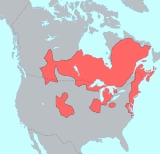
Speakers of Algonquian languages stretch from the east coast of North America
North America

North America is the northern continent of the Americas, situated in the Earth's northern hemisphere and almost totally in the western hemisphere....
 all the way to the Rocky Mountains
Rocky Mountains

The Rocky Mountains, often called the Rockies, are a mountain range in western North America. The Rocky Mountains stretch more than 4,800 kilometre from the northernmost part of British Columbia, in Canada, to New Mexico, in the United States....
. The proto-language
Proto-language

A proto-language is the common ancestor of the languages that form a language family. Occasionally, the German language term Ursprache is used instead....
 from which all of the languages of the family descend, Proto-Algonquian
Proto-Algonquian language

Proto-Algonquian is the name given to the posited proto-language of the languages of the Algonquian languages. One theory, first put forth by Frank Siebert in 1967, is that it was spoken between 2500 and 3000 years ago between Georgian Bay, Ontario and Lake Ontario, Ontario, in Canada, and at least as far south as Niagara Falls , although th...
, was spoken at least 3,000 years ago, though there is still no scholarly consensus as to where this language was spoken. For information on the peoples speaking Algonquian languages, see Algonquian peoples
Algonquian peoples

The Algonquian are one of the most populous and widespread North American Indigenous peoples of the Americas groups, with tribes originally numbering in the hundreds, and hundreds of thousands who still identify with various Algonquian peoples....
.

Family division

This large family of 27 languages is generally divided roughly into three major groupings. These are as follows: Central
Central Algonquian languages

The Central Algonquian languages are commonly grouped together as a subgroup of the larger Algonquian languages, itself a member of the Algic languages....
, Plains
Plains Algonquian languages

The Plains Algonquian languages are commonly grouped together as a subgroup of the larger Algonquian languages, itself a member of the Algic languages....
, and Eastern Algonquian
Eastern Algonquian languages

The Eastern Algonquian languages constitute a subgroup of the larger Algonquian languages, itself a member of the Algic languages. Prior to European contact, Eastern Algonquian consisted of some seventeen or more languages occupying contiguous territory on the Atlantic coast of North America and adjacent inland areas, from the Canadian Mariti...
, primarily out of convenience. Only Eastern Algonquian constitutes a true genetic subgroup. The languages are listed below (dialects and subdialects are listed on the Central Algonquian
Central Algonquian languages

The Central Algonquian languages are commonly grouped together as a subgroup of the larger Algonquian languages, itself a member of the Algic languages....
, Plains Algonquian
Plains Algonquian languages

The Plains Algonquian languages are commonly grouped together as a subgroup of the larger Algonquian languages, itself a member of the Algic languages....
, and Eastern Algonquian
Eastern Algonquian languages

The Eastern Algonquian languages constitute a subgroup of the larger Algonquian languages, itself a member of the Algic languages. Prior to European contact, Eastern Algonquian consisted of some seventeen or more languages occupying contiguous territory on the Atlantic coast of North America and adjacent inland areas, from the Canadian Mariti...
 pages). This classification follows Goddard (1996) and Mithun (1999).

A. Plains
Plains Algonquian languages

The Plains Algonquian languages are commonly grouped together as a subgroup of the larger Algonquian languages, itself a member of the Algic languages....
1. Blackfoot
Blackfoot language

Blackfoot also known as Siksika , Pikanii, and Blackfeet, is the name of any of the Algonquian languages spoken by the Blackfoot tribe of Native Americans in the United States, who currently live in the northwestern plains of North America....
2. Arapahoan
Arapaho language

The Arapaho language or "hinono'eitiit" is a Plains Algonquian languages spoken almost entirely by elders in Wyoming, and to a much lesser extent in Oklahoma....
 (including Arapaho proper, Gros Ventre (AKA Atsina), Nawathinehena, and Besawunena)
3. Cheyenne
Cheyenne language

The Cheyenne language is a Native Americans in the United States language spoken in present-day Montana and Oklahoma in the United States. It is part of the Algonquian language family....


B. Central
Central Algonquian languages

The Central Algonquian languages are commonly grouped together as a subgroup of the larger Algonquian languages, itself a member of the Algic languages....
4. Cree-Montagnais
Cree language

Cree is the name for a group of closely-related Algonquian languages spoken by approximately 117,000 people across Canada, from the Northwest Territories to Labrador, making it by far the most spoken Native American languages in Canada....
5. Menominee
Menominee language

The Menominee language is an Algonquian language originally spoken by the Menominee people of northern Wisconsin and Michigan. It is still spoken on the Menominee Nation lands in Northern Wisconsin in the United States....
 (also known as Menomini)
I. Eastern Great Lakes (also known as Core Central)
a. Ojibwe-Potawatomi (also known as Ojibwe-Potawatomi-Ottawa, Anishinaabemowin, or the Anishinaabe language) 6. Ojibwa-Ottawa (also known as Ojibwe, Ojibwa, Ojibway, or the Anishinaabe language) 7. Potawatomi
Potawatomi language

Potawatomi is a Central Algonquian languages Algonquian languages and is spoken around the Great Lakes in Michigan and Wisconsin, as well as in Kansas in the United States, and in southern Ontario in Canada, by fewer than 50 Potawatomi people, all elderly....
8. Fox (also known as Fox-Sauk-Kickapoo or Mesquakie-Sauk-Kickapoo) 9. Shawnee
Shawnee language

The Shawnee language is a Central Algonquian languages spoken in parts of central and northeastern Oklahoma by only around 200 Shawnee, making it very endangered....
10. Miami-Illinois

C. Eastern
Eastern Algonquian languages

The Eastern Algonquian languages constitute a subgroup of the larger Algonquian languages, itself a member of the Algic languages. Prior to European contact, Eastern Algonquian consisted of some seventeen or more languages occupying contiguous territory on the Atlantic coast of North America and adjacent inland areas, from the Canadian Mariti...
11. Mi'kmaq
Mi'kmaq language

The M?kmaq or Mi'kmaq language is an Eastern Algonquian languages language spoken by nearly 11,000 Mi'kmaq in Canada and the United States out of a total ethnic M?kmaq population of roughly 20,000....
 (also known as Micmac, Míkmaq, Mi'gmaq, or Mi'kmaw)
I. Abenakian
Abenaki language

Abenaki is the cover term for a complex of dialects of one of the Eastern Algonquian languages, originally spoken in what is now Vermont, New Hampshire,northern massachusetts and Maine....
12. Eastern Abenaki (also known as Abenaki or Abenaki-Penobscot) 13. Western Abenaki (also known as Abnaki, St. Francis, Abenaki, or Abenaki-Penobscot) 14. Maliseet
Maliseet

The Wolastoqiyik or Maliseet are a Wabanaki Indigenous peoples of the Americas/First Nations/ Aboriginal people who are the Indigenous peoples of the Saint John River valley and its tributaries, between New Brunswick, Quebec, and Maine....
 (also known as Maliseet-Passamquoddy or Malecite-Passamquoddy)
15. Etchemin (uncertain - See Note 1)
II. Southern New England
16. Massachusett
Massachusett language

The Massachusett language was a Native American languages, a member of the Algonquian language family. It is also known as the Wampanoag, Natick, or Pokanoket language....
 (also known as Massachusett-Narragansett) 17. Loup A (probably Nipmuck) (uncertain - See Note 1) 18. Loup B (uncertain - See Note 1) 19. Mohegan
Mohegan

The Mohegan tribe is an Algonquian-speaking tribe that lives in eastern upper Thames valley Connecticut. The Mohegan were originally a conjoined tribe with the Pequot until the period of European contact in the 17th century, briefly coming under Pequot rule in the 1630s until the dominant tribe was destroyed in 1637....
-Pequot
Pequot

See Main articles:*Mashantucket Pequots*Eastern Pequot Tribal Nation.The 'Pequot' are a tribal nation of Native Americans in the United Statess who, in the 17th century, inhabited much of what is now Connecticut....
20. Quiripi-Naugatuck-Unquachog
Quiripi language

Quiripi is the name of a Native Americans in the United States language , spoken by the Quinnipiac - the indigenous people of Connecticut, Long Island, eastern New York, and northern New Jersey....
 (also known as Quiripi-Unquachog)
III. Delawarean
21. Mahican
Mahican language

Mahican is an extinct language of the Eastern Algonquian languages subgroup of the Algonquian languages language family, itself a member of the Algic languages language family....
 (also known as Mohican) i. Lenape
Lenape language

The Delaware languages, also known as the Lenape languages, are Munsee language and Unami language, two closely related languages of the Eastern Algonquian languages subgroup of the Algonquian languages language family....
 (also known as Delaware) 22. Munsee 23. Unami
Unami

Unami may refer to:*the Delaware languages, or its sublanguage the Unami language*Unami Creek*the United Nations Assistance Mission in Iraq *the Unami Lodge...
24. Nanticoke
Nanticoke

Nanticoke may refer to a place in North America* Nanticoke, New York* Nanticoke, Pennsylvania* Nanticoke, Ontario* Nanticoke, Maryland* Nanticoke Hundred, an unincorporated subdivision of Sussex County, Delaware; see List of Delaware Hundreds....
25. Piscataway
Piscataway language

Piscataway is an extinct Algonquian languages language formerly spoken on the western shore of the Chesapeake Bay, in present-day Maryland, United States....
 (also known as Conoy)
26. Carolina Algonquian
Carolina Algonquian language

Carolina Algonquian is an extinct Algonquian languages language formerly spoken in North Carolina, United States. ...
 (also known as Pamlico, Pamtico, Pampticough, Christianna Algonquian)
27. Powhatan
Powhatan language

Powhatan or Virginia Algonquian is an extinct language of the Eastern Algonquian languages subgroup of the Algonquian languages language family, itself a member of the Algic languages language family....
 (also known as Virginia Algonquian)
28. Shinnecock
Shinnecock Indian Nation

The Shinnecock Indian Nation is an Algonquian tribe whose reservation is located within the geographic boundaries of Southampton , New York on the east end of Long Island....
 (uncertain)


Genetic and areal relationships

It is important to note that only Eastern Algonquian is a true genetic subgrouping. The Plains Algonquian and the Central Algonquian groups are not genetic groupings but rather areal groupings. This means that Blackfoot is no more closely related to Cheyenne than it is to Menominee. However, these areal groups often do have certain shared linguistic features, but the features in question are attributed to language contact
Language contact

Language contact occurs when speakers of distinct speech varieties interact. The study of language contact is called contact linguistics....
. While Paul Proulx recently argued that this traditional view is incorrect, and that Central Algonquian (in which he includes the Plains Algonquian languages) is a genetic subgroup, with Eastern Algonquian now being seen as several different subgroups, this point of view has failed to gain acceptance by any other specialists in the Algonquian languages.

Instead, the commonly-accepted subgrouping scheme is that proposed by Ives Goddard
Ives Goddard

R. H. Ives Goddard, III is curator and senior linguist in the Department of Anthropology of the National Museum of Natural History at the Smithsonian Institution....
 (1994); the essence of this proposal is that Proto-Algonquian originated to the west, perhaps in the Plateau region of Idaho and Oregon or the Rocky Mountain-Great Plains boundary of Montana, and then moved east, dropping off subgroups as it went along. By this scenario, Blackfoot was the first language to branch off, which coincides well with its position as the most divergent language of Algonquian. In west-to-east order, the subsequent branchings were Arapaho-Gros Ventre, Cree-Montagnais, Menominee, Cheyenne, then the core Great Lakes languages (Ojibwe-Potawatomi, Shawnee, Sauk-Fox-Kickapoo, and Miami-Illinois), then finally, Proto-Eastern Algonquian. This historical reconstruction accords best with the observed levels of divergence within the family, whereby the most divergent languages are found furthest west (since they constitute the earliest branchings), and the shallowest subgroupings are found furthest to the east (Eastern Algonquian, and arguably Core Central). Goddard also points out that there is clear evidence for pre-historical contact between Eastern Algonquian and Cree-Montagnais as well as between Cheyenne and Arapaho-Gros Ventre, and that there has long been especially extensive back-and-forth influence between Cree and Ojibwe.

It has been suggested that the 'Eastern Great Lakes' languages -- what Goddard has called 'Core Central', e.g., Ojibwe-Potawatomi, Shawnee, Sauk-Fox-Kickapoo, and Miami-Illinois (but not Cree-Montagnais or Menominee), may also constitute their own genetic grouping within Algonquian, since they share certain intriguing lexical and phonological innovations. However, this theory has not yet been fully fleshed out and is still considered conjectural.

Algonquian is sometimes said to have included the extinct Beothuk language
Beothuk language

The Beothuk language was spoken by the indigenous Beothuk people of Newfoundland . As the Beothuk are extinct and few written accounts of their language exist, little is known about it....
 of Newfoundland
Newfoundland and Labrador

Newfoundland and Labrador is a Provinces and territories of Canada of Canada, on the country's Atlantic Ocean coast in northeastern North America....
, although evidence is scarce and poorly recorded, and the claim is mainly based on geographic proximity. Etchemin and the pre-colonial language of the Lumbee
Lumbee

The Lumbee are a Native Americans in the United States tribe of North Carolina, though their origins are disputed. The name "Lumbee" is derived from the region near the Lumber River that winds through Robeson County, North Carolina....
s may also have been Algonquian languages, but in both cases documentary evidence is at best very weak. There is no documentary evidence whatsoever of an aboriginal Lumbee language.

Grammatical features

The Algonquian language family is known for its complex polysynthetic
Polysynthetic language

Polysynthetic languages are highly synthetic languages, i.e. languages in which words are composed of many morphemes.Not all languages can be easily classified as being completely polysynthetic....
 morphology
Morphology (linguistics)

Morphology is the identification, analysis and description of structure of words . While words are generally accepted as being the smallest units of syntax, it is clear that in most languages, words can be related to other words by rules....
 and sophisticated verb
Verb

In syntax, a verb is a word that usually denotes an action , an occurrence , or a state of being . Depending on the language, a verb may vary in form according to many factors, possibly including its grammatical tense, grammatical aspect, grammatical mood and grammatical voice....
 system. Statements that take many words to say in English
English language

English is a West Germanic language that originated in Anglo-Saxon England and has lingua franca status in many parts of the world as a result of the military, economic, scientific, political and cultural influence of the British Empire in the 18th, 19th and early 20th centuries and that of the United States from the mid 20th century onwa...
 can be expressed with a single word. Ex: (Menominee
Menominee language

The Menominee language is an Algonquian language originally spoken by the Menominee people of northern Wisconsin and Michigan. It is still spoken on the Menominee Nation lands in Northern Wisconsin in the United States....
) paehtawaewesew "He is heard by higher powers" (paeht- 'hear', -awae- 'spirit', -wese- passivizer, -w third-person subject) or (Plains Cree
Plains Cree language

Plains Cree is an Algonquian languages, often considered a dialect of Cree language, spoken by about 34,000 people in Manitoba, Saskatchewan, Alberta, and Montana....
) kastahikoyahk "it frightens us". Languages in this family typically mark at least two distinct third persons, so that speakers can keep track of central characters in narrative. These languages have been famously studied in the structuralist tradition by Leonard Bloomfield
Leonard Bloomfield

Leonard Bloomfield was an United States linguistics, whose influence dominated the development of structuralism#Structuralism in linguistics in America between the 1930s and the 1950s....
 and Edward Sapir
Edward Sapir

Edward Sapir , was a Jewish-Germany-United States anthropologist-linguistics and a leader in American structuralism. He was one of the creators of what is now called the Sapir-Whorf hypothesis....
 among others.

Algonquian nouns have an animate/inanimate
Animacy

Animacy is a grammatical category and/or semantic category of nouns based on how sentient or life the referent of the noun is. Animacy can have various effects on the grammar of a language, such as word order, grammatical case endings, or the form a verb takes when it is associated with that noun....
 contrast: some nouns are classed as animate, while all other nouns are inanimate. There is ongoing debate over whether there is a semantic significance to the categorization of nouns as animate or inanimate, with scholars arguing for it as either a clearly semantic
Semantics

Semantics is the study of meaning in communication. The word is derived from the Greek language word s??a?t???? , "significant", from s??a??? , "to signify, to indicate" and that from s??a , "sign, mark, token"....
 issue, or a purely syntactic
Syntax

In linguistics, syntax is the study of the principles and rules for constructing Sentence s in natural languages. In addition to referring to the discipline, the term syntax is also used to refer directly to the rules and principles that govern the sentence structure of any individual language, as in "the Irish syntax"....
 issue, along with a variety of arguments in between. More structurally-inclined linguistic scholars have argued that since there is no consistent semantic system for determining the animacy of a noun, that it must be a purely linguistic characterization. Anthropological linguists have conversely argued the strong connection between animacy and items viewed as having spiritual importance.

Another important distinction involves the contrast between nouns marked as proximate and those marked as obviative. Proximate nouns are those deemed most central or important to the discourse, while obviative nouns are those less important to the discourse.

There are personal pronouns which distinguish three persons, two numbers (singular and plural), inclusive and exclusive first person plural, and proximate and obviative third persons. Verbs are divided into four classes: transitive
Transitive verb

In syntax, a transitive verb is a verb that requires both a direct subject and one or more object s....
 verbs with an animate object (abbreviated "TA"), transitive verbs with an inanimate object ("TI"), intransitive
Intransitive verb

In grammar, an intransitive verb does not take an Object . In more technical terms, an intransitive verb has only one verb argument , and hence has a valency of one....
 verbs with an animate subject ("AI"), and intransitive verbs with an inanimate subject ("II").

Vocabulary

See the lists of words in the Algonquian languages and the list of words of Algonquian origin at Wiktionary
Wiktionary

Wiktionary is a multilingualism, World Wide Web-based project to create a free content dictionary, available in over 151 languages. Unlike standard dictionaries, it is written collaboratively by volunteers, dubbed "Wiktionarians", using wiki software, allowing articles to be changed by almost anyone with access to the website....
, the free dictionary and Wikipedia's sibling project.


Loan words Because Algonquian languages were some of the first that Europeans came in contact with in North America, the language family has given many words to English
English language

English is a West Germanic language that originated in Anglo-Saxon England and has lingua franca status in many parts of the world as a result of the military, economic, scientific, political and cultural influence of the British Empire in the 18th, 19th and early 20th centuries and that of the United States from the mid 20th century onwa...
. Many eastern and midwestern U.S. states have names of Algonquian origin (Massachusetts
Massachusetts

The Commonwealth of Massachusetts is a U.S. state located in the New England region of the Northeastern United States United States. It borders Rhode Island and Connecticut to the south, New York to the west, and Vermont and New Hampshire to the north....
, Connecticut
Connecticut

Connecticut is a U.S. state located in the New England region of the northeastern United States. The state borders New York to the west and south , Massachusetts to the north, and Rhode Island to the east....
, Illinois
Illinois

The State of Illinois is a U.S. state of the United States, the 21st to be admitted to the United States. Illinois is the most populous and demographically diverse Midwestern United States state and the fifth most populous state in the nation....
, Michigan
Michigan

Michigan is a Midwestern United States U.S. state of the United States of America. It was named after Lake Michigan, whose name is a French adaptation of the Anishinaabe language term mishigama, meaning "large water" or "large lake"....
, Wisconsin
Wisconsin

Wisconsin is one of the fifty U.S. state in the United States of America, located in the north central part of the United States. It borders two of the five Great Lakes and four U.S....
, etc.), as do many cities: Milwaukee
Milwaukee, Wisconsin

Milwaukee is the largest city in Wisconsin and List of United States cities by population in the United States. It is the county seat of Milwaukee County, Wisconsin and is located on the southwestern shore of Lake Michigan....
, Chicago
Chicago

Chicago is the largest city in the U.S. state of Illinois and the Midwestern United States, as well as the List of United States cities by population city in the United States with more than 2.8 million residents....
, et al. The capital of Canada
Canada

Canada is a country occupying most of northern North America, extending from the Atlantic Ocean in the east to the Pacific Ocean in the west and northward into the Arctic Ocean....
 is named after an Algonquian nation - the Odawa
Odawa

Odawa may refer to:*Odawa people*Odawa language...
. For a more detailed treatment of geographical names in three Algonquian languages see the external link to the book by Trumbull.

See also

  • Indigenous languages of the Americas
    Indigenous languages of the Americas

    Indigenous languages of the Americas are spoken by Indigenous peoples of the Americas from the southern tip of South America to Alaska and Greenland, encompassing the land masses which constitute the Americas....
  • Algonquian peoples
    Algonquian peoples

    The Algonquian are one of the most populous and widespread North American Indigenous peoples of the Americas groups, with tribes originally numbering in the hundreds, and hundreds of thousands who still identify with various Algonquian peoples....
  • Algonquin
    Algonquin

    The Algonquins are an aboriginal peoples in Canada/Indigenous people of North American speaking Algonquin language. Culturally and linguistically, they are closely related to the Ottawa and Ojibwe, with whom they form the larger Anishinaabe grouping....
  • Algic languages
    Algic languages

    The Algic languages are an Indigenous language language family of North America. They are all thought to descend from Proto-Algic, a second-order proto language reconstructed using Proto-Algonquian and the attested languages Wiyot language and Yurok language....
  • Central Algonquian languages
    Central Algonquian languages

    The Central Algonquian languages are commonly grouped together as a subgroup of the larger Algonquian languages, itself a member of the Algic languages....
  • Eastern Algonquian languages
    Eastern Algonquian languages

    The Eastern Algonquian languages constitute a subgroup of the larger Algonquian languages, itself a member of the Algic languages. Prior to European contact, Eastern Algonquian consisted of some seventeen or more languages occupying contiguous territory on the Atlantic coast of North America and adjacent inland areas, from the Canadian Mariti...
  • Plains Algonquian languages
    Plains Algonquian languages

    The Plains Algonquian languages are commonly grouped together as a subgroup of the larger Algonquian languages, itself a member of the Algic languages....


Bibliography

  • Bloomfield, Leonard (1946). "Algonquian". Linguistic Structures of Native America, ed. Harry Hoijer. Viking Fund Publications in Anthropology: 6. New York.
  • Campbell, Lyle (1997). American Indian languages: The historical linguistics of Native America. New York: Oxford University Press. ISBN 0-19-509427-1.
  • Goddard, Ives (1994). "The West-to-East Cline in Algonquian Dialectology." In William Cowan, ed., Papers of the 25th Algonquian Conference, pp. 187-211. Ottawa: Carleton University.
  • ———— (1996). "Introduction". In Ives Goddard, ed., "Languages". Vol. 17 of William Sturtevant, ed., The Handbook of North American Indians. Washington, D.C.: The Smithsonian Institution.
  • Grimes, Barbara F. (ed.). (2000). Ethnologue: Languages of the world, (14th ed.). Dallas, TX: SIL International. ISBN 1-55671-106-9. Online edition: http://www.ethnologue.com/, accessed on Mar 3, 2005.
  • Mithun, Marianne (1999). The languages of Native North America. Cambridge: Cambridge University Press. ISBN 0-521-23228-7 (hbk); ISBN 0-521-29875-X.
  • Moondancer and Strong Woman (2007). "A Cultural History of the Native Peoples of Southern New England: Voices from Past and Present." Boulder, CO: Bauu Press. ISBN 0-9721349-3-X.
  • Proulx, Paul (2003). "The Evidence on Algonquian Genetic Grouping: A Matter of Relative Chronology." Anthropological Linguistics 45:201-25.


External links