


Cree

Encyclopedia
The Cree are one of the largest groups of First Nations
/ Native Americans
in North America
, with 200,000 members living in Canada. In Canada
, the major proportion of Cree live north and west of Lake Superior
, in Ontario
, Manitoba
, Saskatchewan
, Alberta
and the Northwest Territories
, although 15,000 live in eastern Quebec
.
In the United States
, this Algonquian
-speaking people lived historically from Lake Superior westward. Today, they live mostly in Montana
, where they share a reservation with the Ojibwe (Chippewa).
The documented westward migration over historic time has been strongly associated with their roles as middle men and hunters in the North American Fur Trade
.
Collectively the Cree used the autonym Nēhilawē (those who speak our language). They used "Cree" to refer to their people only when speaking the languages of the European colonists, French
or English
.
Skilled American bison
hunters and horsemen, the Plains Cree were allied with the Assiniboine and the Saulteaux
before they encountered French settlers in the 18th century.
-language exonym Kiristino, which the Ojibwa
used for tribes around Hudson Bay
. The French colonists and explorers, who spelled the term Kilistinon, Kiristinon, and Cristinaux, used the term for numerous tribes which they encountered north of Lake Superior, in Manitoba, and west of there. The French used these terms to refer to various groups of peoples in Canada, some of which are now better distinguished as Severn Anishinaabe
(Ojibwa), who speak languages different from the Algonkian or the Cree.
Depending on the community, the Cree may call themselves by the following names: the nēhiyaw, nīhithaw, nēhilaw, and nēhinaw; or ininiw, ililiw, iynu (innu), or iyyu. These names are derived from the historical autonym nēhiraw (uncertain meaning) or from the historical autonym iriniw (meaning "person"). Cree using the latter autonym tend to be those living in the territories of Quebec and Labrador.
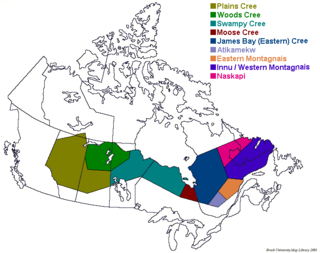 The Cree language (also known in the most broad classification as Cree-Montagnais, Cree-Montagnais-Naskapi, to show the groups included within it) is the name for a group of closely related Algonquian languages
spoken by approximately 117,000 people across Canada
, from the Northwest Territories to Labrador
. It is the most widely spoken aboriginal language in Canada. The only region where Cree has official status
is in the Northwest Territories, together with eight other aboriginal languages.
The two major groups: Nehiyaw and Innu, speak a mutually intelligible, Cree dialect continuum
, which can be divided by many criteria. In a dialect continuum, "It is not so much a language, as a chain of dialects, where speakers from one community can very easily understand their neighbours, but a Plains Cree speaker from Alberta would find a Quebec Cree speaker difficult to speak to without practice."
One major division between the groups is that the Eastern group palatalizes the sound /k/ to either /ts/ (c) or to /tʃ/ (č) when it precedes front vowel
s. There is also a major difference in grammatical vocabulary (particles) between the groups. Within both groups, another set of variations has arisen around the pronunciation of the Proto-Algonquian phoneme
*l, which can be realized as /l/, /r/, /y/, /n/, or /ð/ (th) by different groups. Yet in other dialects, the distinction between /eː/ (ē) and /iː/ (ī) has been lost, merging to the latter. In more western dialects, the distinction between /s/ and /ʃ/ (š) has been lost, both merging to the former.
If the consonants /p/ /t/ /c/ and /k/* used in Cree are compared to their English counterparts, it is noticeable that there is little distinction of voicing. In English, voicing marks the difference of meaning in words such as "bin : pin". Since there is not distinction of voicing in Cree, it is common for variants of /t/ to sound more like [d] without any difference in meaning.
Victor Gollum lists Cree in the Encyclopedia of the World's Endangered Languages as one of fifty-fve languages that have more than 1,000 speakers which are being actively acquired by children.
in Canada, with over 200,000 members and 135 registered bands. This large population may be a result of the Crees' traditional openness to inter-tribal marriage. Together, their reserve lands are the largest of any First Nations group in the country. The largest Cree band and the second largest First Nations Band in Canada after the Six Nations Iroquois
is the Lac La Ronge Band
in northern Saskatchewan.
The Métis
(from French Métis - any person of mixed ancestry) are people of mixed ancestry, such as Nehiyaw (or Anishinaabe) and French
, English
, or Scottish
heritage. According to Indian and Northern Affairs Canada
, the Métis were historically the children of French fur traders and Nehiyaw women or, from unions of English or Scottish traders and northern Dene
women (Anglo-Métis
). Generally in academic circles, the term Métis
can be used to refer to any combination of persons of mixed Native American and European heritage, although historical definitions for Métis remain. Canada's Indian and Northern Affairs broadly define Métis as those persons of mixed First Nation and European ancestry.
tribe, located on the Rocky Boy Indian Reservation
in Montana
. They share the reservation with the Pembina Band of Chippewa Indians
, who form the "Chippewa" half of the Chippewa Cree tribe. (In Canada the Chippewa are known as Ojibwa
.) Traditionally, the southern limits of the Cree territory in the United States were the Missouri River
and the Milk River
in Montana.
2 Montagnais
a Eastern Montagnais (Innu)
b Western Montagnais (Nehilaw and Ilniw)
3 Atikamekw (Nehiraw)
4 James Bay Cree
a Northern James Bay Cree (Iyiyiw)
b Southern James Bay Cree (Iyniw (inland) and Iyyiw (coastal))
5 Moose Cree (Mōsonī / ililī)
6 Swampy Cree (Maškēkowak / nēhinawak)
7 Woodland Cree
a Rocky Cree (Asinīskāwiyiniwak)
b Woods Cree (Sakāwithiniwak / nīhithawak)
8 Plains Cree (Paskwāwiyiniwak / nēhiyawak)
a Downstream People (Māmihkiyiniwak)
i Calling River / Qu'Appelle Cree (Kātēpwēwi-sīpīwiyiniwak)
ii Rabbit skins (Wāpošwayānak)
iii Touchwood Hills Cree (Pasākanacīwiyiniwak)(also Saulteaux
) – Punnichy, Saskatchewan
iv Cree-Assiniboine / Young Dogs (Nēhiyawi-pwātak)
b Upstream People (Natimiyininiwak)
i Beaver Hills Cree (Amiskwacīwiyiniwak)
ii House Cree (wāskahikaniwiyiniwak)
iii Parklands Cree / Willow Cree (Paskokopāwiyiniwak)
iv River Cree (Sīpīwininiwak)
v Northern Plains Cree / Western Woodland Cree / Bush Cree (Sakāwiyiniwak)
First Nations
First Nations is a term that collectively refers to various Aboriginal peoples in Canada who are neither Inuit nor Métis. There are currently over 630 recognised First Nations governments or bands spread across Canada, roughly half of which are in the provinces of Ontario and British Columbia. The...
/ Native Americans
Native Americans in the United States
Native Americans in the United States are the indigenous peoples in North America within the boundaries of the present-day continental United States, parts of Alaska, and the island state of Hawaii. They are composed of numerous, distinct tribes, states, and ethnic groups, many of which survive as...
in North America
North America
North America is a continent wholly within the Northern Hemisphere and almost wholly within the Western Hemisphere. It is also considered a northern subcontinent of the Americas...
, with 200,000 members living in Canada. In Canada
Canada
Canada is a North American country consisting of ten provinces and three territories. Located in the northern part of the continent, it extends from the Atlantic Ocean in the east to the Pacific Ocean in the west, and northward into the Arctic Ocean...
, the major proportion of Cree live north and west of Lake Superior
Lake Superior
Lake Superior is the largest of the five traditionally-demarcated Great Lakes of North America. It is bounded to the north by the Canadian province of Ontario and the U.S. state of Minnesota, and to the south by the U.S. states of Wisconsin and Michigan. It is the largest freshwater lake in the...
, in Ontario
Ontario
Ontario is a province of Canada, located in east-central Canada. It is Canada's most populous province and second largest in total area. It is home to the nation's most populous city, Toronto, and the nation's capital, Ottawa....
, Manitoba
Manitoba
Manitoba is a Canadian prairie province with an area of . The province has over 110,000 lakes and has a largely continental climate because of its flat topography. Agriculture, mostly concentrated in the fertile southern and western parts of the province, is vital to the province's economy; other...
, Saskatchewan
Saskatchewan
Saskatchewan is a prairie province in Canada, which has an area of . Saskatchewan is bordered on the west by Alberta, on the north by the Northwest Territories, on the east by Manitoba, and on the south by the U.S. states of Montana and North Dakota....
, Alberta
Alberta
Alberta is a province of Canada. It had an estimated population of 3.7 million in 2010 making it the most populous of Canada's three prairie provinces...
and the Northwest Territories
Northwest Territories
The Northwest Territories is a federal territory of Canada.Located in northern Canada, the territory borders Canada's two other territories, Yukon to the west and Nunavut to the east, and three provinces: British Columbia to the southwest, and Alberta and Saskatchewan to the south...
, although 15,000 live in eastern Quebec
Quebec
Quebec or is a province in east-central Canada. It is the only Canadian province with a predominantly French-speaking population and the only one whose sole official language is French at the provincial level....
.
In the United States
United States
The United States of America is a federal constitutional republic comprising fifty states and a federal district...
, this Algonquian
Algonquian languages
The Algonquian languages also Algonkian) are a subfamily of Native American languages which includes most of the languages in the Algic language family. The name of the Algonquian language family is distinguished from the orthographically similar Algonquin dialect of the Ojibwe language, which is a...
-speaking people lived historically from Lake Superior westward. Today, they live mostly in Montana
Montana
Montana is a state in the Western United States. The western third of Montana contains numerous mountain ranges. Smaller, "island ranges" are found in the central third of the state, for a total of 77 named ranges of the Rocky Mountains. This geographical fact is reflected in the state's name,...
, where they share a reservation with the Ojibwe (Chippewa).
The documented westward migration over historic time has been strongly associated with their roles as middle men and hunters in the North American Fur Trade
North American Fur Trade
The North American fur trade was the industry and activities related to the acquisition, exchange, and sale of animal furs in the North American continent. Indigenous peoples of different regions traded among themselves in the Pre-Columbian Era, but Europeans participated in the trade beginning...
.
Tribes
The Cree Nation is generally divided into eight groups (some political, others cultural):- NaskapiNaskapiThe Naskapi are the indigenous Innu inhabitants of an area they refer to as Nitassinan, which comprises most of what other Canadians refer to as eastern Quebec and Labrador, Canada....
(InnuInnuThe Innu are the indigenous inhabitants of an area they refer to as Nitassinan , which comprises most of the northeastern portions of the provinces of Quebec and some western portions of Labrador...
) and - MontagnaisInnuThe Innu are the indigenous inhabitants of an area they refer to as Nitassinan , which comprises most of the northeastern portions of the provinces of Quebec and some western portions of Labrador...
(Innu) are inhabitants of an area they refer to as NitassinanNitassinanNitassinan is the ancestral homeland of the Innu, an Aboriginal people of Eastern Quebec and Labrador, Canada. The territory covers the eastern portion of the Labrador peninsula....
. Their territories comprise most of the present-day political jurisdictions of eastern QuebecQuebecQuebec or is a province in east-central Canada. It is the only Canadian province with a predominantly French-speaking population and the only one whose sole official language is French at the provincial level....
and LabradorLabradorLabrador is the distinct, northerly region of the Canadian province of Newfoundland and Labrador. It comprises the mainland portion of the province, separated from the island of Newfoundland by the Strait of Belle Isle...
. Their cultures are differentiated, as the Naskapi are still caribou hunters and more nomadic than the Montagnais, but the Montagnais have more settlements. The total population of the two groups in 2003 was about 18,000 people, of which 15,000 lived in Quebec. Their dialects and languages are the most distinct from the Cree spoken by the groups west of Lake Superior. - Attikamekw are inhabitants of the area they refer to as NitaskinanNitaskinanNitaskinan is the ancestral homeland of the Atikamekw people. It is located in the St. Maurice valley, in Québec, Canada....
(Our Land), in the upper St. Maurice River valley of Quebec (about 300 km north of MontrealMontrealMontreal is a city in Canada. It is the largest city in the province of Quebec, the second-largest city in Canada and the seventh largest in North America...
). Their population is around 4,500. - James Bay Cree - Grand Council of the CreesGrand Council of the CreesThe Grand Council of the Crees , or the GCC, is the political body that represents the approximately 16,357 Crees or “Iyyu” / “Iynu” of the Eeyou Istchee territory in the James Bay and Nunavik regions of Northern Quebec, Canada...
; approximately 16,357 Cree (Iyyu in Coastal Dialect / Iynu in Inland Dialect) of the James BayJames BayJames Bay is a large body of water on the southern end of Hudson Bay in Canada. Both bodies of water extend from the Arctic Ocean. James Bay borders the provinces of Quebec and Ontario; islands within the bay are part of Nunavut...
and NunavikNunavikNunavik comprises the northern third of the province of Quebec, Canada. Covering a land area of 443,684.71 km² north of the 55th parallel, it is the homeland of the Inuit of Quebec...
regions of Northern Quebec. - Moose CreeMoose Cree First NationThe Moose Cree First Nation is a Cree First Nation in northern Ontario, Canada. Since time immemorial, their traditional territory is on the west side of James Bay...
- Moose FactoryMoose Factory, OntarioMoose Factory is a community in the Cochrane District, Ontario, Canada. It is on Moose Factory Island, near the mouth of the Moose River, which is at the southern end of James Bay. It was the first English-speaking settlement in Ontario and the second Hudson's Bay Company post to be set up in North...
in the Cochrane District, OntarioCochrane District, OntarioCochrane District, Ontario is a district and census division in Northeastern Ontario in the Canadian province of Ontario. It was created in 1921 from parts of Timiskaming and Thunder Bay districts....
; this group lives on Moose Factory IslandMoose Factory IslandMoose Factory Island is an island in the Moose River, Ontario, Canada, about from its mouth at James Bay. It is adjacent to the community of Moosonee across the Moose River, from which it is accessible by water taxi....
, near the mouth of the Moose RiverMoose River (Ontario)The Moose River is a Canadian river in the Hudson Plains ecozone of northern Ontario which flows 100 km northeast from the junction of the Mattagami and Missinaibi Rivers into James Bay. Its drainage basin is 108,500 km² and it has a mean discharge rate of 1370 m³/s. Its full length...
, at the southern end of James Bay. - Swampy Cree - this group lives in northern Manitoba along the Hudson BayHudson BayHudson Bay , sometimes called Hudson's Bay, is a large body of saltwater in northeastern Canada. It drains a very large area, about , that includes parts of Ontario, Quebec, Saskatchewan, Alberta, most of Manitoba, southeastern Nunavut, as well as parts of North Dakota, South Dakota, Minnesota,...
coast and adjacent inland areas to the south and west, and in Ontario along the coast of Hudson Bay and James Bay. Some also in eastern Saskatchewan around Cumberland HouseCumberland House, SaskatchewanCumberland House is a village in Census Division No. 18 in north-eastern Saskatchewan, Canada on the Saskatchewan River. It is the oldest community in Saskatchewan and has a population of about 2000 people...
. It has 4,500 speakers. - Woods Cree group in northern Alberta and Saskatchewan.
- Plains Cree 34,000 people in Manitoba, Saskatchewan, Alberta, and Montana.
Collectively the Cree used the autonym Nēhilawē (those who speak our language). They used "Cree" to refer to their people only when speaking the languages of the European colonists, French
French language
French is a Romance language spoken as a first language in France, the Romandy region in Switzerland, Wallonia and Brussels in Belgium, Monaco, the regions of Quebec and Acadia in Canada, and by various communities elsewhere. Second-language speakers of French are distributed throughout many parts...
or English
English language
English is a West Germanic language that arose in the Anglo-Saxon kingdoms of England and spread into what was to become south-east Scotland under the influence of the Anglian medieval kingdom of Northumbria...
.
Skilled American bison
American Bison
The American bison , also commonly known as the American buffalo, is a North American species of bison that once roamed the grasslands of North America in massive herds...
hunters and horsemen, the Plains Cree were allied with the Assiniboine and the Saulteaux
Saulteaux
The Saulteaux are a First Nation in Ontario, Manitoba, Saskatchewan, Alberta and British Columbia, Canada.-Ethnic classification:The Saulteaux are a branch of the Ojibwe nations. They are sometimes also called Anihšināpē . Saulteaux is a French term meaning "people of the rapids," referring to...
before they encountered French settlers in the 18th century.
Name
The name "Cree" is derived from the AlgonkianAlgonquian languages
The Algonquian languages also Algonkian) are a subfamily of Native American languages which includes most of the languages in the Algic language family. The name of the Algonquian language family is distinguished from the orthographically similar Algonquin dialect of the Ojibwe language, which is a...
-language exonym Kiristino, which the Ojibwa
Ojibwa
The Ojibwe or Chippewa are among the largest groups of Native Americans–First Nations north of Mexico. They are divided between Canada and the United States. In Canada, they are the third-largest population among First Nations, surpassed only by Cree and Inuit...
used for tribes around Hudson Bay
Hudson Bay
Hudson Bay , sometimes called Hudson's Bay, is a large body of saltwater in northeastern Canada. It drains a very large area, about , that includes parts of Ontario, Quebec, Saskatchewan, Alberta, most of Manitoba, southeastern Nunavut, as well as parts of North Dakota, South Dakota, Minnesota,...
. The French colonists and explorers, who spelled the term Kilistinon, Kiristinon, and Cristinaux, used the term for numerous tribes which they encountered north of Lake Superior, in Manitoba, and west of there. The French used these terms to refer to various groups of peoples in Canada, some of which are now better distinguished as Severn Anishinaabe
Anishinaabe
Anishinaabe or Anishinabe—or more properly Anishinaabeg or Anishinabek, which is the plural form of the word—is the autonym often used by the Odawa, Ojibwe, and Algonquin peoples. They all speak closely related Anishinaabemowin/Anishinaabe languages, of the Algonquian language family.The meaning...
(Ojibwa), who speak languages different from the Algonkian or the Cree.
Depending on the community, the Cree may call themselves by the following names: the nēhiyaw, nīhithaw, nēhilaw, and nēhinaw; or ininiw, ililiw, iynu (innu), or iyyu. These names are derived from the historical autonym nēhiraw (uncertain meaning) or from the historical autonym iriniw (meaning "person"). Cree using the latter autonym tend to be those living in the territories of Quebec and Labrador.
Language
Algonquian languages
The Algonquian languages also Algonkian) are a subfamily of Native American languages which includes most of the languages in the Algic language family. The name of the Algonquian language family is distinguished from the orthographically similar Algonquin dialect of the Ojibwe language, which is a...
spoken by approximately 117,000 people across Canada
Canada
Canada is a North American country consisting of ten provinces and three territories. Located in the northern part of the continent, it extends from the Atlantic Ocean in the east to the Pacific Ocean in the west, and northward into the Arctic Ocean...
, from the Northwest Territories to Labrador
Labrador
Labrador is the distinct, northerly region of the Canadian province of Newfoundland and Labrador. It comprises the mainland portion of the province, separated from the island of Newfoundland by the Strait of Belle Isle...
. It is the most widely spoken aboriginal language in Canada. The only region where Cree has official status
Official language
An official language is a language that is given a special legal status in a particular country, state, or other jurisdiction. Typically a nation's official language will be the one used in that nation's courts, parliament and administration. However, official status can also be used to give a...
is in the Northwest Territories, together with eight other aboriginal languages.
The two major groups: Nehiyaw and Innu, speak a mutually intelligible, Cree dialect continuum
Dialect continuum
A dialect continuum, or dialect area, was defined by Leonard Bloomfield as a range of dialects spoken across some geographical area that differ only slightly between neighboring areas, but as one travels in any direction, these differences accumulate such that speakers from opposite ends of the...
, which can be divided by many criteria. In a dialect continuum, "It is not so much a language, as a chain of dialects, where speakers from one community can very easily understand their neighbours, but a Plains Cree speaker from Alberta would find a Quebec Cree speaker difficult to speak to without practice."
One major division between the groups is that the Eastern group palatalizes the sound /k/ to either /ts/ (c) or to /tʃ/ (č) when it precedes front vowel
Front vowel
A front vowel is a type of vowel sound used in some spoken languages. The defining characteristic of a front vowel is that the tongue is positioned as far in front as possible in the mouth without creating a constriction that would be classified as a consonant. Front vowels are sometimes also...
s. There is also a major difference in grammatical vocabulary (particles) between the groups. Within both groups, another set of variations has arisen around the pronunciation of the Proto-Algonquian phoneme
Phoneme
In a language or dialect, a phoneme is the smallest segmental unit of sound employed to form meaningful contrasts between utterances....
*l, which can be realized as /l/, /r/, /y/, /n/, or /ð/ (th) by different groups. Yet in other dialects, the distinction between /eː/ (ē) and /iː/ (ī) has been lost, merging to the latter. In more western dialects, the distinction between /s/ and /ʃ/ (š) has been lost, both merging to the former.
If the consonants /p/ /t/ /c/ and /k/* used in Cree are compared to their English counterparts, it is noticeable that there is little distinction of voicing. In English, voicing marks the difference of meaning in words such as "bin : pin". Since there is not distinction of voicing in Cree, it is common for variants of /t/ to sound more like [d] without any difference in meaning.
Victor Gollum lists Cree in the Encyclopedia of the World's Endangered Languages as one of fifty-fve languages that have more than 1,000 speakers which are being actively acquired by children.
In Canada
The Cree are the largest group of First NationsFirst Nations
First Nations is a term that collectively refers to various Aboriginal peoples in Canada who are neither Inuit nor Métis. There are currently over 630 recognised First Nations governments or bands spread across Canada, roughly half of which are in the provinces of Ontario and British Columbia. The...
in Canada, with over 200,000 members and 135 registered bands. This large population may be a result of the Crees' traditional openness to inter-tribal marriage. Together, their reserve lands are the largest of any First Nations group in the country. The largest Cree band and the second largest First Nations Band in Canada after the Six Nations Iroquois
Iroquois
The Iroquois , also known as the Haudenosaunee or the "People of the Longhouse", are an association of several tribes of indigenous people of North America...
is the Lac La Ronge Band
Lac La Ronge First Nation
Located in north-central Saskatchewan, the Lac La Ronge Indian Band is the largest First Nation in Saskatchewan, and one of the 10 largest in Canada, with a 2010 population of 8,954....
in northern Saskatchewan.
The Métis
Métis people (Canada)
The Métis are one of the Aboriginal peoples in Canada who trace their descent to mixed First Nations parentage. The term was historically a catch-all describing the offspring of any such union, but within generations the culture syncretised into what is today a distinct aboriginal group, with...
(from French Métis - any person of mixed ancestry) are people of mixed ancestry, such as Nehiyaw (or Anishinaabe) and French
French people
The French are a nation that share a common French culture and speak the French language as a mother tongue. Historically, the French population are descended from peoples of Celtic, Latin and Germanic origin, and are today a mixture of several ethnic groups...
, English
English people
The English are a nation and ethnic group native to England, who speak English. The English identity is of early mediaeval origin, when they were known in Old English as the Anglecynn. England is now a country of the United Kingdom, and the majority of English people in England are British Citizens...
, or Scottish
Scottish people
The Scottish people , or Scots, are a nation and ethnic group native to Scotland. Historically they emerged from an amalgamation of the Picts and Gaels, incorporating neighbouring Britons to the south as well as invading Germanic peoples such as the Anglo-Saxons and the Norse.In modern use,...
heritage. According to Indian and Northern Affairs Canada
Indian and Northern Affairs Canada
The Department of Aboriginal Affairs and Northern Development is the department of the government of Canada with responsibility for policies relating to Aboriginal peoples...
, the Métis were historically the children of French fur traders and Nehiyaw women or, from unions of English or Scottish traders and northern Dene
Dene
The Dene are an aboriginal group of First Nations who live in the northern boreal and Arctic regions of Canada. The Dené speak Northern Athabaskan languages. Dene is the common Athabaskan word for "people" . The term "Dene" has two usages...
women (Anglo-Métis
Anglo-Métis
A 19th-century community of the Métis people of Canada, the Anglo-Métis, more commonly known as Countryborn, were children of fur traders; they typically had Orcadian, Scottish, or English fathers and Aboriginal mothers. Their first languages were generally those of their mothers: Cree, Saulteaux,...
). Generally in academic circles, the term Métis
Métis
A Métis is a person born to parents who belong to different groups defined by visible physical differences, regarded as racial, or the descendant of such persons. The term is of French origin, and also is a cognate of mestizo in Spanish, mestiço in Portuguese, and mestee in English...
can be used to refer to any combination of persons of mixed Native American and European heritage, although historical definitions for Métis remain. Canada's Indian and Northern Affairs broadly define Métis as those persons of mixed First Nation and European ancestry.
In the United States
At one time the Cree were located in northern Minnesota, North Dakota and Montana. Today they live as part of the federally recognized Chippewa CreeChippewa Cree
The Chippewa Cree Tribe is a mixed group of Native Americans in Montana, among the last to come into the state. They are descended from Cree that had come south from Canada, and from Chippewa that had moved west from the Turtle Mountains in North Dakota....
tribe, located on the Rocky Boy Indian Reservation
Rocky Boy Indian Reservation
The Rocky Boy's Indian Reservation is an Indian reservation of the Chippewa Cree Tribe located in the U.S. state of Montana. The smallest reservation in the state, it was established by Executive Order on September 7, 1916. The Chippewa Cree Tribe of the Rocky Boy's Indian Reservation was...
in Montana
Montana
Montana is a state in the Western United States. The western third of Montana contains numerous mountain ranges. Smaller, "island ranges" are found in the central third of the state, for a total of 77 named ranges of the Rocky Mountains. This geographical fact is reflected in the state's name,...
. They share the reservation with the Pembina Band of Chippewa Indians
Pembina Band of Chippewa Indians
Pembina Band of Chippewa Indians are a historical band of Chippewa , originally living along the Red River of the North and its tributaries....
, who form the "Chippewa" half of the Chippewa Cree tribe. (In Canada the Chippewa are known as Ojibwa
Ojibwa
The Ojibwe or Chippewa are among the largest groups of Native Americans–First Nations north of Mexico. They are divided between Canada and the United States. In Canada, they are the third-largest population among First Nations, surpassed only by Cree and Inuit...
.) Traditionally, the southern limits of the Cree territory in the United States were the Missouri River
Missouri River
The Missouri River flows through the central United States, and is a tributary of the Mississippi River. It is the longest river in North America and drains the third largest area, though only the thirteenth largest by discharge. The Missouri's watershed encompasses most of the American Great...
and the Milk River
Milk River (Montana-Alberta)
The Milk River is a tributary of the Missouri River, long, in the United States state of Montana and the Canadian province of Alberta. Rising in the Rocky Mountains, the river drains a sparsely populated, semi-arid watershed of , ending just east of Fort Peck, Montana.-Geography:It is formed in...
in Montana.
Cree First Nation communities
1 Naskapi (Iyiyiw and Innu)- Kawawachikamach
- Natuashish
2 Montagnais
a Eastern Montagnais (Innu)
- Mingan
- Uashat-Maliotenam
- Matimekosh
- Natashquan
- Pakua-Shipi
- La RomaineLa Romaine, QuebecLa Romaine, also known as Unamenshipit in Innu-aimun, is an Innu First Nations reserve in the Côte-Nord region of Quebec, Canada, at the mouth of the Olomane River on the Gulf of Saint Lawrence. It belongs to the Innu band of Unamen Shipu...
- Sheshatshiu
b Western Montagnais (Nehilaw and Ilniw)
- Mashteuiatsh
- BetsiamitesInnuThe Innu are the indigenous inhabitants of an area they refer to as Nitassinan , which comprises most of the northeastern portions of the provinces of Quebec and some western portions of Labrador...
- Essipit
3 Atikamekw (Nehiraw)
- Atikamekw d'Opitciwan
- Les Atikamekw de ManawanManawan, QuebecManawan is a First Nation reserve on the south-western shores of Lake Métabeskéga in the Lanaudière region of Quebec, Canada. It belongs to the Atikamekw de Manawan band of the Atikamekw Nation....
- Conseil des Atikamekw de WemotaciWemotaci, QuebecWemotaci is a First Nation reserve on the north shore of the Saint-Maurice River at the mouth of the Manouane River in the Mauricie region of Quebec, Canada...
4 James Bay Cree
a Northern James Bay Cree (Iyiyiw)
- Cree Nation of Chisasibi
- Eastmain First Nation (also Southern James Bay Cree)
- Cree Nation of Wemindji
- Cree Nation of Whapmagoostui
b Southern James Bay Cree (Iyniw (inland) and Iyyiw (coastal))
- Eastmain First Nation (also Northern James Bay Cree)
- Cree Nation of MistissiniMistissini, QuebecMistissini is a Cree town located in the south-east corner of the largest natural lake in Quebec, Lake Mistassini . The town is inside the boundaries of the Baie-James Municipality, and is the largest Cree community with a population of around 4000 people...
- Cree Nation of Nemaska
- Oujé-Bougoumou First Nation – Oujé-Bougoumou, QuebecOujé-Bougoumou, QuebecOujé-Bougoumou is the newest Cree community located on the shores of Lake Opemisca, in the Jamésie region of Quebec, Canada...
- The Crees of the Waskaganish First Nation
- Waswanipi Cree First Nation
5 Moose Cree (Mōsonī / ililī)
- Moose Cree First NationMoose Cree First NationThe Moose Cree First Nation is a Cree First Nation in northern Ontario, Canada. Since time immemorial, their traditional territory is on the west side of James Bay...
– Moose Factory, OntarioMoose Factory, OntarioMoose Factory is a community in the Cochrane District, Ontario, Canada. It is on Moose Factory Island, near the mouth of the Moose River, which is at the southern end of James Bay. It was the first English-speaking settlement in Ontario and the second Hudson's Bay Company post to be set up in North...
6 Swampy Cree (Maškēkowak / nēhinawak)
- Attawapiskat First NationAttawapiskat First NationAttawapiskat First Nation is an isolated First Nation located in Kenora District in northern Ontario, Canada, at the mouth of the Attawapiskat River at James Bay...
– Attawapiskat, Ontario - Black Sturgeon First Nation
- Brunswick House First NationBrunswick House First NationBrunswick House First Nation is an Ojibway-Cree First Nation in the Canadian province of Ontario, located in the Sudbury District, northeast of Sault Ste Marie, Ontario. The First Nation have reserved for themselves the Mountbatten 76A Indian Reserve and the Duck Lake 76B Indian Reserve...
(also OjibwaOjibwaThe Ojibwe or Chippewa are among the largest groups of Native Americans–First Nations north of Mexico. They are divided between Canada and the United States. In Canada, they are the third-largest population among First Nations, surpassed only by Cree and Inuit...
) - Chapleau Cree First NationChapleau Cree First NationChapleau Cree First Nation is a Mushkegowuk Cree First Nation located by Chapleau Township, Sudbury District, Ontario, Canada. The First Nation have reserved for themselves the Chapleau 75 Indian Reserve and the Chapleau Cree Indian Reserve...
- Chemawawin Cree NationChemawawin Cree NationThe Chemawawin Cree Nation is located next to Easterville, Manitoba in Central Manitoba. The population of this First Nation is identified as Swampy Cree and also Rocky Cree .- References :*...
(also Rocky Cree) - Constance Lake First NationConstance Lake First NationConstance Lake First Nation is an Oji-Cree First Nation in Cochrane District in northeastern Ontario, Canada, directly north of the community of Calstock along a continuation of Ontario Highway 663...
(also Ojibwa) - Cumberland House Cree Nation
- Fisher River Cree Nation
- Flying Post First Nation (also Ojibwa)
- Fort Albany First Nation (also known as Albany First Nation) - Fort Albany, OntarioFort Albany, OntarioFort Albany First Nation is a community in within the Cochrane District of Northern Ontario, Canada. Situated on the southern shore of the Albany River, Fort Albany First Nation is only accessible by air or by winter road....
- Fort Severn First Nation
- Fox Lake Cree NationFox Lake Cree NationFox Lake Cree Nation is a First Nation located in Fox Lake, Bird, Manitoba, Canada.On November 8th, 2007, Fox Lake Cree Nation dedicated a monumental statue in Gillam, Manitoba...
- Kashechewan First NationKashechewan First NationThe Kashechewan First Nation is a Cree First Nation located near James Bay in Northern Ontario, Canada. The community is located on the northern shore of the Albany River. Kashechewan First Nation is one of two communities that were established from Old Fort Albany in the 1950s...
- Marcel Colomb First NationMarcel Colomb First NationMarcel Colomb First Nation is a First Nations tribe of approximately 300 Swampy Cree people located in the area of Lynn Lake, Manitoba. There is a reserve under development on Black Sturgeon IR 198a at Hughes Lake approximately 30 kilometres southeast of Lynn Lake.- References :* *...
- Matachewan First Nation (also Ojibwa)
- Mathias Colomb First NationMathias Colomb First NationThe Mathias Colomb First Nation is located on IR Pukatawagan 198 and the main community is at Pukatawagan, Manitoba. The reserve consists of 1536.6 Hectares on the shore of Pukatawagan Lake and lies about 210 kilometers north of The Pas, Manitoba. There are about 1400 residents who are...
(also Rocky Cree) - Misipawistik Cree Nation (formerly known as Grande Rapids First Nation)(also Rocky Cree)
- Missanabie Cree First NationMissanabie Cree First Nation-Historical Timeline:Evidence and records suggest that by as early as the 1570s, members of the Missanabie Cree had settled in the areas surrounding present day Missinaibi Lake, Dog Lake and Wabatongushi Lake...
- Mosakahiken Cree Nation (Also 'Cree' name for Moose Lake First Nation)
- Neskantaga First Nation
- Opaskwayak Cree NationOpaskwayak Cree NationThe Opaskwayak Cree Nation is a First Nation in Manitoba, Canada. Opaskwayak means "where the two rivers meet". The First Nation has territory near The Pas, Manitoba, along the Saskatchewan River. The First Nation hosts the Opaskwayak Indian Days annually each August. The OCN Blizzard, a...
– The Pas, ManitobaThe Pas, ManitobaThe Pas is a town in Manitoba, Canada, located in Division No. 21, Manitoba in the Northern Region, some 630 kilometres northwest of the provincial capital, Winnipeg, near the border of Saskatchewan. It is sometimes still called Paskoyac by locals as the first trading post was called Fort Paskoyac... - Red Earth Cree Nation (also Woods Cree)
- Sapotaweyak Cree NationSapotaweyak Cree NationThe Sapotaweyak Cree Nation are a Cree population located in Central Manitoba north of Swan River. They are in possession of a number of reserves. The largest on-reserve population occupies Shoal River 65A which is located adjacent to Pelican Rapids, Manitoba....
- Shamattawa Cree Nation
- Shoal Lake Cree Nation (also Woods Cree)
- Tataskweyak Cree NationTataskweyak Cree NationThe Tataskweyak Cree Nation are located on IR Split Lake 171 at Split Lake, Manitoba. The Reserve is on the Nelson River system about 150 miles from the river's mouth at Hudson Bay...
- Taykwa Tagamou Nation (formerly known as New Post First Nation)
- War Lake First NationWar Lake First NationThe War Lake First Nation are residents of the Mooseocoot IR. The reserve lies within the boundaries of Ilford, Manitoba.- References :*...
- Weenusk First NationWeenusk First NationWeenusk First Nation ; unpointed: ᐧᐃᓇᐢᑯ ᐃᓂᓂᐧᐊᐠ) is a Cree First Nation in the Canadian province of Ontario. In September, 2007, its total registered population was 516...
- Wuskwi Sipihk First NationWuskwi Sipihk First NationWuskwi Sipihk First Nation is a Swampy Cree First Nation located northeast Birch River, Manitoba, along the western shores of Swan Lake. As of April, 2011, the First Nation had a total registered population of 623 people, of which 197 people lived on their own Indian Reserve. The current Chief for...
- York Factory First Nation
7 Woodland Cree
a Rocky Cree (Asinīskāwiyiniwak)
- Barren Lands First NationBarren Lands First NationThe Barren Lands First Nation occupy Brochet Reserve No. 197 which is on the north shore of Reindeer Lake in Northern Manitoba close to the Saskatchewan border....
- Bunibonibee Cree NationBunibonibee Cree NationBunibonibee Cree Nation, formerly known as Oxford House First Nation and as Oxford House Band of Indians, is a First Nation located along the eastern shoreline of Oxford Lake at the mouth of the Hayes River and is approximately northeast of Winnipeg, Manitoba. The residents are predominantly...
(formerly known as Oxford House First Nation) - Chemawawin Cree NationChemawawin Cree NationThe Chemawawin Cree Nation is located next to Easterville, Manitoba in Central Manitoba. The population of this First Nation is identified as Swampy Cree and also Rocky Cree .- References :*...
(also Swampy Cree) - God’s Lake First NationGod’s Lake First NationGod’s Lake First Nation is primarily located at an area known as God’s Lake Narrows, about 250 kilometers southeast of Thompson, Manitoba. There are about 2500 registered members of First Nation # 296. They are Woodland Cree, and more specifically, Rocky Cree .- References :* *...
- Manto Sipi Cree Nation
- Mathias Colomb First NationMathias Colomb First NationThe Mathias Colomb First Nation is located on IR Pukatawagan 198 and the main community is at Pukatawagan, Manitoba. The reserve consists of 1536.6 Hectares on the shore of Pukatawagan Lake and lies about 210 kilometers north of The Pas, Manitoba. There are about 1400 residents who are...
(also Swampy Cree) - Misipawistik Cree Nation (formerly known as Grand Rapids First NationGrand Rapids First NationMisipawistik Cree Nation is a Cree community formerly known as "Grand Rapids First Nation". "Misipawistik" in the local Cree language means "Rushing rapids", which were once an historical landmark in Misipawistik before the construction of the Hydroelectric Dam. MCN is located near Grand Rapids,...
)(also Swampy Cree) - Moose Lake First Nation (Also Mosakahiken First Nation)
- Nelson House Band of Cree (Historical)
- Nisichawayasihk Cree NationNisichawayasihk Cree NationThe Nisichawayasihk Cree Nation is a Cree-speaking community of about 4,200 Cree centered in Nelson House, Manitoba, Canada. Nelson House is located about 80 km west of Thompson and is accessible via the mixed paved and gravel Provincial Road 391...
- O-Pipon-Na-Piwin Cree NationO-Pipon-Na-Piwin Cree NationThe O-Pipon-Na-Piwin Cree Nation is a community of about 1,100 Cree centered in the Southern Indian Lake community of Manitoba, Canada. It is located on the shores of Southern Indian Lake, about 130 km north of the city of Thompson....
- Nisichawayasihk Cree Nation
- Norway House Cree NationNorway House Cree NationThe Norway House Cree Nation is based at Norway House, Manitoba which is located on the Playgreen Lake section of the Nelson River system. The people are Woodland Cree from the Rocky Cree group. They are in possession of a number of reserves but population is centered at IR Norway House 17...
- PimicikamakPimicikamakPimicikamak is the name of one of the Cree-speaking aboriginal peoples of Canada. Pimicikamak is "a people of rivers and lakes. The traditional territory of Pimicikamak is around Sipiwesk Lake in the heart of the boreal forest, five hundred kilometres north of Winnipeg, Manitoba...
- Cross Lake First NationCross Lake First NationCross Lake First Nation is a band of Cree First Nations people in Canada governed under the Indian Act. Its members occupy several reserves within the town of Cross Lake situated on the east shore of Cross Lake in the province of Manitoba...
- Cross Lake First Nation
- Split Lake First Nation
- The Pas First Nation ( Also Opaskwayak First Nation)
b Woods Cree (Sakāwithiniwak / nīhithawak)
- Bigstone Cree NationBigstone Cree NationThe Bigstone Cree Nation is a First Nation in Alberta, Canada. As Woodland Cree, they are a western branch of the larger Cree Nation.With lands adjacent to four lakes in northern Alberta's boreal forest, the First Nation is rich in fishing and wild game.In 2005, there were 5,874 registered...
- Canoe Lake First Nation(also Bush Cree)
- Driftpile First NationDriftpile First NationThe Driftpile First Nation is a First Nation with a reserve located on the southern shore of the Lesser Slave Lake in Northern Alberta. The band has approximately 1200 members....
- Duncan's First Nation
- Fort McMurray First NationFort McMurray First NationFort McMurray First Nation is a Cree and Chipewyan nation located near Fort McMurray, Alberta. It is a member of the Athabasca Tribal Council and a Treaty 8 nation....
(also ChipewyanChipewyanThe Chipewyan are a Dene Aboriginal people in Canada, whose ancestors were the Taltheilei...
) - Grouard First Nation
- Green Lake Band of Cree (historical)
- Lac La Ronge First NationLac La Ronge First NationLocated in north-central Saskatchewan, the Lac La Ronge Indian Band is the largest First Nation in Saskatchewan, and one of the 10 largest in Canada, with a 2010 population of 8,954....
(formerly known as Lac La Ronge Indian Band)- La Ronge & Stanley Mission Band of Cree Indians (Historical), which divided and then re-amalgamated:
- James Roberts Band of Cree Indians (Historical)
- Amos Charles Band of Cree Indians (Historical)
- La Ronge & Stanley Mission Band of Cree Indians (Historical), which divided and then re-amalgamated:
- Montreal Lake First Nation
- Peter Ballantyne Cree NationPeter Ballantyne Cree NationPeter Ballantyne Cree Nation is a Cree First Nations group in northern Saskatchewan consisting of eight communities: Amisk Lake, Deschambeault Lake, Kinoosao, Pelican Narrows, Prince Albert, Sandy Bay, Southend and Sturgeon Landing...
- Lac La Ronge First Nation
- Heart Lake First Nation
- Kapawe'no First Nation
- Little Red River Cree Nation
- Loon River First Nation
- Lubicon Lake Indian NationLubicon Lake Indian NationThe Lubicon Lake Indian Nation is a Cree First Nation in Northern Alberta, Canada. They are commonly referred to as the Lubicon Lake Nation, Lubicon Cree or the Lubicon Lake Cree. The Nation has been embroiled with the Government of Canada regarding disputed land claims for decades...
- Mikisew Cree First Nation
- Red Earth Cree Nation (also Swampy Cree)
- Sawridge First Nation
- Shoal Lake Cree Nation (also Swampy Cree)
- Sturgeon Lake Cree NationSturgeon Lake Cree NationThe Sturgeon Cree Nation is a First Nations government or "band", part of the Cree ethnic group, a member of the Western Cree Tribal Council, and a party to Treaty 8. The band controls three Indian Reserves, the large Sturgeon Lake 154 and the smaller 154A and 154B...
- Sucker Creek First Nation
- Swan River First Nation
- Wabasca First Nation
- Whitefish Lake First Nation 128
8 Plains Cree (Paskwāwiyiniwak / nēhiyawak)
a Downstream People (Māmihkiyiniwak)
- Cowessess First Nation
- Little Black Bear First Nation
- Muscowpetung First Nation (also Saulteaux)
- Nekaneet First Nation
- Ochapowace First Nation
- One Arrow First NationOne Arrow First NationOne Arrow First Nation is a Canadian Cree First Nation. Its reserve is located just south of Batoche, Saskatchewan near the South Saskatchewan River about 100 km Northeast of Saskatoon. The One Arrow First Nation is in the aspen parkland biome. It is bordered by the Rural Municipalities of St....
- Peepeekisis First Nation
- Star Blanket First Nation
i Calling River / Qu'Appelle Cree (Kātēpwēwi-sīpīwiyiniwak)
- Ocean Man First Nation (also Assiniboine and Saulteaux)
- Pheasant Rump Nakota Nation (also Nakoda and Saulteaux)
- Whitebear First Nation
ii Rabbit skins (Wāpošwayānak)
- Kahkewistahaw First Nation
- Okanese First NationOkanese First NationThe Okanese First Nation is a First Nations in Saskatchewan, Canada.The Okanese First Nation was a signatory to Treaty number four.It is named after a leader named Okanis, who signed the treaty on their behalf, on September 9, 1875....
(also Saulteaux) - Pasqua First Nation (also Saulteaux)
- Sakimay First Nation (also Saulteaux)
iii Touchwood Hills Cree (Pasākanacīwiyiniwak)(also Saulteaux
Saulteaux
The Saulteaux are a First Nation in Ontario, Manitoba, Saskatchewan, Alberta and British Columbia, Canada.-Ethnic classification:The Saulteaux are a branch of the Ojibwe nations. They are sometimes also called Anihšināpē . Saulteaux is a French term meaning "people of the rapids," referring to...
) – Punnichy, Saskatchewan
Punnichy, Saskatchewan
- Notable people :Nolan Yonkman, a defenceman for the Florida Panthers, was born in Punnichy.- See also :* List of communities in Saskatchewan* Villages of Saskatchewan-External links:*******...
- Daystar First Nation
- Gordon First NationGordon First NationThe George Gordon First Nation is located near the village of Punnichy, Saskatchewan, in Canada. The First Nation has a population of 2,774 people, 1,060 of whom live on-reserve and 1,714 who live off-reserve. Elected Chief Glen Pratt leads the First Nation...
- Kawacatoose First Nation
- Muskowekwan First NationMuskowekwan First NationMuskowekwan First Nation is a Saulteaux First Nation located approximately 100 km northwest of Melville, Saskatchewan, Canada. As of May, 2008, the First Nation have 1,517 registered people, of which their on-Reserve population was 400.- History :...
iv Cree-Assiniboine / Young Dogs (Nēhiyawi-pwātak)
- Piapot First Nation (also Assiniboine)
b Upstream People (Natimiyininiwak)
- Beaver Lake Cree Nation – Lac la Biche, Alberta
- Big Island Lake First Nation (also known as Joseph Bighead First Nation)
- Chippewa-Cree Indians of the Rocky Boy’s Reservation, Montana (also Ojibwa)
- Frog Lake First Nation
- Kehewin Cree Nation
- Lucky Man First Nation
- Moosomin First NationMoosomin First NationThe Moosomin First Nation is a First Nation in Saskatchewan, Canada. Moosomin First Nation is located approximately 35 kilometres north of North Battleford, Saskatchewan. It borders the rural municipalities of Meota No. 468 and Round Hill No. 467...
- Mosquito Grizzly Bear's Head First Nation (also Nakoda)
- Muskeg First Nation
- Pelican Lake First NationPelican Lake First NationPelican Lake First Nation -History:Pelican Lake First Nation is located on the shore of Chitek Lake, approximately 170 miles northeast of Saskatoon 115 miles northwest of North Battleford and 120 miles west of Prince Albert....
- Saulteaux First Nation (also Saulteaux)
- St. Peter's Band of Cree and Saulteaux (Historical)(also Saulteaux)
- Muskoday First NationMuskoday First NationThe Muskoday First Nation is a First Nation in Saskatchewan, Canada, composed of Cree and Saulteaux peoples. The First Nation has a registered population of 1552 people as of December 2007, of which approximately 560 members of the First Nation live on-reserve, and approximately 980 live...
(formerly: John Smith First Nation) – Muskoday, Saskatchewan - Peguis First NationPeguis First NationPeguis First Nation is the largest First Nations community in Manitoba, Canada,with a population of approximately 7,338 people. It is located approximately 145 kilometres north of Winnipeg. The citizens of Peguis are of Ojibway and Cree descent.-History:...
– Peguis, Manitoba
- Muskoday First Nation
- Sturgeon Lake First NationSturgeon Lake First NationThe Sturgeon Lake First Nation is located on the eastern shores of Sturgeon Lake about 29 km northwest of Prince Albert, Saskatchewan. The First Nations territory consists of one Indian Reserve, Number 101. It is located in the transition zone between the aspen parkland and boreal forest biomes....
- Thunderchild First NationThunderchild First NationThunderchild First Nation is an independent Cree First Nation in Saskatchewan, Canada with no affiliation with any Tribal Council and is located approximately 113 kilometers northwest of North Battleford...
- Waterhen Lake First NationWaterhen Lake First NationWaterhen Lake First Nation is a Cree First Nation located in northwestern Saskatchewan. Total registered population in September, 2007, was 1749, of which the on-reserve Status population was 790. The First Nation is a member of the MLTC Program Services, a regional tribal Chiefs' Council...
- Witchekan Lake First Nation
i Beaver Hills Cree (Amiskwacīwiyiniwak)
- Alexander First NationAlexander First NationAlexander First Nation is a First Nation government , headquartered in Morinville, Alberta. This First Nation is part of the Cree ethno-linguistic group, is a member of the Yellowhead Tribal Development Foundation , and is party to Treaty Six. The band controls three Indian reserves: Alexander...
(also Wapski Mahikan Society) – Morinville, AlbertaMorinville, AlbertaMorinville is a town in central Alberta, Canada. It is located north of Edmonton on Highway 2.- History :Morinville was settled by Father Morin, an Oblate missionary, who brought many French settlers in the late 1800s, followed by several German pioneers—hence its many French and German families... - Alexis Nakota First Nation (also Nakoda)
- Enoch Cree NationEnoch Cree NationThe Enoch Cree Nation is a First Nations band in Alberta that is part of the Cree language group. It is also part of the larger Yellowhead Tribal Development Foundation tribal council....
– Winterburn, Alberta - Ermineskin Cree NationErmineskin Cree NationErmineskin Cree Nation is a First Nation, a western branch of the large Cree Nation, and a Treaty 6 nation.As of 2008, there are 3,758 registered Ermineskin Cree, of which 2,606 were living on reserve....
– Hobbema, AlbertaHobbema, AlbertaHobbema is an unincorporated community in central Alberta, Canada, a portion of which is designated a hamlet within Ponoka County. It is located near the intersection of Highway 2A and Highway 611, approximately south of the City of Edmonton.... - Louis Bull First Nation – Hobbema, AlbertaHobbema, AlbertaHobbema is an unincorporated community in central Alberta, Canada, a portion of which is designated a hamlet within Ponoka County. It is located near the intersection of Highway 2A and Highway 611, approximately south of the City of Edmonton....
- Montana First Nation – Hobbema, AlbertaHobbema, AlbertaHobbema is an unincorporated community in central Alberta, Canada, a portion of which is designated a hamlet within Ponoka County. It is located near the intersection of Highway 2A and Highway 611, approximately south of the City of Edmonton....
- O'Chiese First NationO'Chiese First NationThe O'Chiese First Nation is a Saulteaux First Nation in Alberta, Canada. The First Nation's homeland is the 14131.9 ha O'Chiese 203A Indian reserve, located approximately 23 kilometres northwest of Rocky Mountain House. Also reserved is the O'Chiese Cemetery 203A...
(also Saulteaux) - Onion Lake Cree Nation
- Paul First Nation (also NakodaNakotaThe term Nakota is the endonym used by the native peoples of North America who usually go by the name of Assiniboine , in the United States, and of Stoney, in Canada....
) – Duffield, AlbertaDuffield, AlbertaDuffield is a hamlet in central Alberta, Canada within Parkland County. It is located south of Highway 16, approximately west of Spruce Grove.- Demographics :The population of Duffield according to Parkland County's 2009 municipal census is 69.... - Saddle Lake Cree First Nation
- Blue Quills Band of Cree (Historical)
- Saddle Lake Band of Cree (Historical)
- Wahsatenaw Band of Cree (Historical)
- Whitefish (Goodfish) Lake First Nation
- Samson Cree Nation – Hobbema, AlbertaHobbema, AlbertaHobbema is an unincorporated community in central Alberta, Canada, a portion of which is designated a hamlet within Ponoka County. It is located near the intersection of Highway 2A and Highway 611, approximately south of the City of Edmonton....
- Sunchild First NationSunchild First NationThe Sunchild First Nation is a First Nation in Alberta, Canada. The First Nation has one reserve, Sunchild 202. The reserve has an area of 52.18 square kilometres, and is located roughly 40 kilometres northwest of Rocky Mountain House, Alberta. James Frencheater was elected Chief of the First...
ii House Cree (wāskahikaniwiyiniwak)
- Ahtahkakoop First NationAhtahkakoop First NationThe Ahtahkakoop First Nation is a First Nation in Saskatchewan, Canada, composed of mainly of Cree peoples. Ahtahkakoop First Nation is located 72 kilometers northwest of Prince Albert, Saskatchewan and is 17,347 hectares in size.-Background:...
- Mistawasis First NationMistawasis First NationThe Mistawasis First Nation is a Cree First Nation in Saskatchewan, Canada. Their territory is located roughly 68 kilometres west of the city of Prince Albert, Saskatchewan. The Nation has one reserve with an area of approximately 125.44 square kilometres....
iii Parklands Cree / Willow Cree (Paskokopāwiyiniwak)
- Beardy's and Okemasis First Nations
- James Smith First NationJames Smith First NationThe James Smith First Nation is a Cree First Nation in Saskatchewan, Canada. James Smith has one Indian Reserve Fort à la Corne #100 located north of Kinistino, Saskatchewan near Fort de la Corne on the Saskatchewan River. This reserve is shared between three first nations, the other two being the...
- Peter Chapman Cree Nation (incorporated into James Smith First Nation, but with some legal status as a separate entity).
iv River Cree (Sīpīwininiwak)
- Little Pine First Nation
- Poundmaker First Nation
- Red Pheasant Cree Nation
- Sweetgrass First NationSweetgrass First NationThe Sweetgrass First Nation is a First Nation in Saskatchewan, Canada. Their territory is located 35 kilometres west of Battleford, Saskatchewan. The reserve was established as part of Treaty 6. The Nation is led by Chief Wayne Standinghorn..Registred population -1751.-External links:*...
v Northern Plains Cree / Western Woodland Cree / Bush Cree (Sakāwiyiniwak)
- Big River First Nation
- Canoe Lake First Nation (also Woods Cree)
- Flying Dust First Nation
- Island Lake First Nation
- Makwa Sahgaiehcan First NationMakwa Sahgaiehcan First NationMakwa Sahgaiehcan is a Cree First Nation. Its reserve is in Loon Lake, Saskatchewan, Canada.The English translation of Makwa Sahgaiehcan from Plains Cree language is "loon lake"....
Notable Cree Chiefs
- Mistāwasis ("Big Child", also known as Pierre Belanger), Chief of the Parklands/Willow Cree (Paskokopāwiyiniwak), born about 1813. He was one of the influential chiefs of the House Cree or Wāskahikaniwiyiniwak, supplied between 1852–1854 Fort Carlton with bison meat and pemmican, acquired in his youth by constant military conflicts the respect of CrowfootCrowfootCrowfoot or Isapo-Muxika was a chief of the Siksika First Nation. His parents, Istowun-eh'pata and Axkahp-say-pi , were Kainai. His brother Iron Shield became Chief Bull...
, the chief of the Siksika, the Blackfoot called Mistāwasis respectfully “The Iron Buffalo of the Plains”) - Ahtahkakoop ("Starblanket"), Chief of the House Cree (Wāskahikaniwiyiniwak). He was born about 1815-16, signed together with his cousin, Mistāwasis in 1876 the Treaty 6Treaty 6Treaty 6 is an agreement between the Canadian monarch and the Plain and Wood Cree Indians and other tribes of Indians at Fort Carlton, Fort Pitt and Battle River. The area agreed upon by the Plain and Wood Cree represents most of the central area of the current provinces of Saskatchewan and...
at Fort Carlton, where he agreed that his group were settled into a reserve near the present-day Prince Albert, died 4 December 1896 at the age of 81 years) - Ahchuchhwahauhhatohapit (Ahchacoosacootacoopits - ‘Starblanket’, Chief of a band of Calling River Cree (Kātēpwēwi-sīpīwiyiniwak), born about 1845 in the lower Qu’Appelle Valley, son of Wāpiy-mōsētōsis ("White Calf"), his tribal group was closely associated with the Ka Kichi Wi Winiwak under the leadership of chief Kakeesheway (‘Loud Voice’), and a close ally of Payipwāt ("Piapot"), the chief of the Cree-Assiniboine or "Young Dogs", 1879 after the disappearance of the bison Ahchuchhwahauhhatohapit settled on a reserve in the File Hills of the lower Qu'Appelle Valley, died 1917 in the Star Blanket reserve, Saskatchewan)
- PayipwātPiapotPiapot, a Chief of First Nations people in southern Saskatchewan in the late 19th century. His name “Payepot” means Hole-in-the-Sioux. He became a well known leader, diplomat, warrior, horse thief, and spiritualist.-Childhood:...
(or Piapot: "[One who Knows the] Secrets of the Sioux"), also known as "Hole in the Sioux" or Kisikawasan - ‘Flash in the Sky’, Chief of the Cree-Assiniboine or the Young Dogs with great influence on neighboring Assiniboine, Downstream People, southern groups of the Upstream People and Saulteaux (Plains Ojibwa), born 1816, kidnapped as a child by the SiouxSiouxThe Sioux are Native American and First Nations people in North America. The term can refer to any ethnic group within the Great Sioux Nation or any of the nation's many language dialects...
, he was freed about 1830 by Plains Cree, significant Shaman, most influential chief of the feared Young Dogs, convinced the Plains Cree to expand west in the Cypress Hills, the last refugee for bison groups, therefore disputed border area between Sioux, Assiniboine, Siksika Kainai and Cree, refused to participate in the raid on a Kainai camp near the present LethbridgeLethbridgeLethbridge is a city in the province of Alberta, Canada, and the largest city in southern Alberta. It is Alberta's fourth-largest city by population after Calgary, Edmonton and Red Deer, and the third-largest by area after Calgary and Edmonton. The nearby Canadian Rockies contribute to the city's...
, Alberta, then the Young Dogs and their allies were content with the eastern Cypress Hills to the Milk River, Montana, does not participate at the negotiations on the Treaty 4Treaty 4Treaty 4 was a treaty established between Queen Victoria and the Cree and Saulteaux First Nations. The area covered by Treaty 4 represents most of current day southern Saskatchewan, plus small portions of what are today western Manitoba and southeastern Alberta....
of 1874, he and Cheekuk, the most important chief of the Plains Ojibwa in the Qu'Appelle area, signed on 9 September 1875 the treaty only as preliminary contract, tried with the chiefs of the River Cree Minahikosis ("Little Pine") and Mistahi-maskwa ("Big Bear") to erect a kind of Indian Territory for all the Plains Cree, Plains Ojibwa and Assiniboine - as OttawaOttawaOttawa is the capital of Canada, the second largest city in the Province of Ontario, and the fourth largest city in the country. The city is located on the south bank of the Ottawa River in the eastern portion of Southern Ontario...
refused, he asked 1879-80 along with Kiwisünce (cowessess- 'Little Child') and the Assiniboine for adjacent reserves in the Cypress Hills, Payipwāt settled in a reserve about 37 miles northeast of Fort Walsh, Minahikosis ("Little Pine") and Papewes (‘Lucky Man’) asked successfully for reserves near the Assiniboine or Payipwāt - this allowed the Cree and Assiniboine to preserve their autonomy - because they went 1881 in Montana on bison hunting, stole Absarokee horses and alleged cattle killed, arrested the U.S. Army the Cree-Assiniboine group, disarmed and escorted them back to Canada - now unarmed, denied rations until the Cree and Assiniboine gave up their claims to the Cypress Hills and went north - in the following years the reserves changed several times and the tribes were trying repeated until to the Northwest Rebellion in 1885 to build an Indian Territory, Payipwāt remained under heavy guard, until his death he was a great spiritual leader, therefore Ottawa deposed Payipwāt on 15 April 1902 as chief, died in April 1908 on Piapot Reserve, Saskatchewan) - Kee-a-kee-ka-sa-coo-way (‘The Man Who gives the War Whoop’), Chief of the Plains Cree, was in the middle of the 19th century the leading chief of the Plains Cree, had also a large following among the Plains Ojibwa around Fort Pitt, his sub-chief was Mukitou (‘Black Powder’), the father of Mistahi-maskwa.
- Mistahi-maskwa (recorded as Mistihui'muskwa or as Mistahimusqua; better known as Big BearBig BearBig Bear or Mistahi-maskwa was a Cree leader notable for his involvement in the North-West Rebellion and his subsequent imprisonment.-Early life and leadership:...
in English and as Gros Ours in French), Chief of the Plains Cree, born about 1825, son of the OjibwaOjibwaThe Ojibwe or Chippewa are among the largest groups of Native Americans–First Nations north of Mexico. They are divided between Canada and the United States. In Canada, they are the third-largest population among First Nations, surpassed only by Cree and Inuit...
-Chief Mukitou (‘Black Powder’), mastered his native language, the Cree languageCree languageCree is an Algonquian language spoken by approximately 117,000 people across Canada, from the Northwest Territories and Alberta to Labrador, making it the aboriginal language with the highest number of speakers in Canada. It is also spoken in the U.S. state of Montana...
, as well as Ojibwe languageOjibwe languageOjibwe , also called Anishinaabemowin, is an indigenous language of the Algonquian language family. Ojibwe is characterized by a series of dialects that have local names and frequently local writing systems...
, led the last resistance to the dispersal of the Cree on many reservations and asked for a big total reserve, a revolt of the young warriors under the leadership of one of his sons in 1885 destroyed these plans, died 17 January 1888 on the Poundmaker reservation in North Battleford in Saskatchewan. - Kapapamahchakwew (Kā-papāmahcahkwêw, Kapapa Machatiwe, Papamahchakwayo, French: ‘Esprit Errant’, better known as Wandering Spirit, war chief of the Plains Cree under Mistahimaskwa, born 1845 near Jackfish Lake, Saskatchewan, committed on 2 April 1885, the so-called Frog Lake massacre, killed the Indian Agent Thomas Quinn and eight whites and one Métis, surrendered in July at Fort Pitt, was hanged on 27 November 1885 in Battleford, Saskatchewan)
- Kamiokisihkwew (Miyo Kisikaw - Fine Day, Chief of the Plains Cree, born 1850 in the Battle River region, died 193[?], was a shaman and war chief under Pitikwahanapiwiyin`s River Cree, during the North-West RebellionNorth-West RebellionThe North-West Rebellion of 1885 was a brief and unsuccessful uprising by the Métis people of the District of Saskatchewan under Louis Riel against the Dominion of Canada...
Battleford was sacked by River Cree, subsequently Fine Day was as war chief the leader in the uprising, defeated the Canadian army in the Battle of Cut KnifeBattle of Cut KnifeThe Battle of Cut Knife, fought on May 2, 1885, occurred when a small force of Cree and Assiniboine warriors were attacked by a flying column of mounted police, militia, and Canadian army regulars...
, later joined a group of Plains Cree under the leadership of Chief Wikaskokiseyin(‘Sweet Grass’), whose chief he became later) - PitikwahanapiwiyinPitikwahanapiwiyinPitikwahanapiwiyin , commonly known as Poundmaker, was a Plains Cree chief known as a peacemaker and defender of his people.-Name:...
(Pîhtokahânapiwiyin - ‘Poundmaker’, Chief of the River Cree, born about 1842 in the North Battleford Region in Saskatchewan; son of Sikakwayan (‘Skunk Skin’), an shaman of the Assiniboine and a Franco-Canadian MétisseMétis people (Canada)The Métis are one of the Aboriginal peoples in Canada who trace their descent to mixed First Nations parentage. The term was historically a catch-all describing the offspring of any such union, but within generations the culture syncretised into what is today a distinct aboriginal group, with...
, the sister of Chief Mistāwasis ("Big Child"), Chief of a band consisting of Plains River Cree (Sīpīwininiwak-paskwāwiyiniwak), Woods River Cree (‘Sīpīwininiwak-sakāwiyiniwak’), Western Woodland Cree (Sakāwiyiniwak) and Nakoda (Stoney), was adopted in 1873 by the Siksika chief Crowfoot as son, lived several years by the Blackfeet-name Makoyi-koh-kin (‘Wolf Thin Legs’) under the Siksika, returned to the Cree, became counselor of the Chief Pihew-kamihkosit (‘Red Pheasant’), was involved in the negotiations for the Treaty 6Treaty 6Treaty 6 is an agreement between the Canadian monarch and the Plain and Wood Cree Indians and other tribes of Indians at Fort Carlton, Fort Pitt and Battle River. The area agreed upon by the Plain and Wood Cree represents most of the central area of the current provinces of Saskatchewan and...
in 1876 and went in 1879 in the Poundmaker reservation, later he participated in the siege of Battleford and the Battle of Cut Knife, died 4 July 1886 in Blackfoot Crossing, Alberta) - Wikaskokiseyin (Wee-kas-kookee-sey-yin, better known as Chief Sweet GrassSweet grassHierochloe odorata or Anthoxanthum nitens, also known as sweet grass, buffalo grass, bison grass, holy grass , manna grass, Mary’s grass, seneca grass, sweetgrass, or vanilla grass, is an aromatic herb which grows in northern Eurasia and in North America...
, Chief of the Plains Cree, his mother was a captured Absaroke, as he grew up he was also called Apistchi-okimas- 'Little Chief', signed the Treaty 6Treaty 6Treaty 6 is an agreement between the Canadian monarch and the Plain and Wood Cree Indians and other tribes of Indians at Fort Carlton, Fort Pitt and Battle River. The area agreed upon by the Plain and Wood Cree represents most of the central area of the current provinces of Saskatchewan and...
on 9 September 1876 at Fort Pitt, along with bands of Woodland CreeWoodland CreeThe Woodland Cree or the Sakāwithiniwak , calling themselves Nīhithawak, comprises the largest Amerindian group in northern Alberta. They are Algonquian linguistic stock...
, Chipewyan, some SaulteauxSaulteauxThe Saulteaux are a First Nation in Ontario, Manitoba, Saskatchewan, Alberta and British Columbia, Canada.-Ethnic classification:The Saulteaux are a branch of the Ojibwe nations. They are sometimes also called Anihšināpē . Saulteaux is a French term meaning "people of the rapids," referring to...
, only a quarter of the participating groups were Plains Cree, while his successor as chief Wah-wee-oo-kah-tah-mah-hote ('Strike him on the back') signed the Treaty 6 at Fort Carlton on the 28th August 1876 together with the Willow Cree, died 11 January 1877 in a shootout accident on the Plains, probably at Saint-Paul-des-Cris, Alberta) - Peechee (Pesew - ‘Mountain Lion’, also known as Louis Piche), Chief of the Asini Wachi Nehiyawak and later the head chief of the 'Rocky/Mountain Cree' or Asini Wachi Wi Iniwak, born about 1821, introduced under the Asini Wachi Wi Iniwak the Catholic rite, his three sons, Piyesew Chak, Keskayiwew('Bobtail') and Ermineskin were also significant chiefs, Pesew and his elder son Chak Piyesew were killed during a gambling dispute in 1843, among his sons-in-law were the chiefs Samson, Chiniki, Bearspaw, Capote Blank and Jacques Cardinal)
- Ermineskin (‘One with teh skin like a ermineErmineErmine has several uses:* A common name for the stoat * The white fur and black tail end of this animal, which is historically worn by and associated with royalty and high officials...
’, Sehkosowayanew, Sikosew Inew, also known as Baptiste Piche, Chief of the Bear Hills Cree (Maskwa Wachi-is Ininiwak), son of Pesew (‘Mountain Lion’), brother-in-law of Pitikwahanapiwiyin) - Keskayiwew (Kiskiyew, Kiskiyo - Bobtail, also known as Alexis Piche, Chief of the Bear Hills Cree (Maskwa-wachi-is Ininiwak), son of Pesew (‘Mountain Lion’), brother of Ermineskin, became chief after the death of his older brother, was elected instead of Maskepetoon ('Broken Arm') to the chieftainship of the Rocky Cree and later became head chief of the Western Cree(‘Pakisimotan Wi Iniwak’) and soon after became the head chief of all the groups of the Upstream People)
- Kamdyistowesit (Kanaweyihimitowin, ‘Beardy’, French: ‘Barbu’, Chief of the Parklands or Willow Cree, born 1828 near Duck Lake, became in the 1870th chief, married Yaskuttsu-s, the half-sister of chief Küpeyakwüskonam (‘One Arrow’), among the members of his tribal group were many Métis descendants of the Hudson's Bay Company employee George Sutherland)
- Küpeyakwüskonam (Kupeyakwuskonam, Kah-pah-yak-as-to-cum - One Arrow, French: ‘Une Flèche’, Chief of the Parklands or Willow Cree, born 1815 in the Saskatchewan River Valley, son of George Sutherland (‘Okayasiw’) and his second wife Paskus (‘Rising’), tried to prevent in 1876 negotiations on the Treaty 6 at Fort Carlton along with Kamdyistowesit ('Beardy') and Saswaypew ('Cut Nose'), but finally signed on August 28 the treaty, in August 1884 he attended a meeting with chief Mistahimaskwa ('Big Bear') and Papewes (‘Papaway’ - 'Lucky Man'), his tribal group joined first the Métis in 1885, died on 25 April 1886 in the prison)
- Minahikosis (Little Pine, French: ‘Petit Pin’, Chief of the Plains Cree, born about 1830 in the vicinity of Fort Pitt, Saskatchewan, his mother was a Blackfeet, became famous in the 1860s, as armed Plains Cree to find the last remaining bison, penetrated more and more into the territory of the Blackfoot Confederacy, led three years bitter resistance, signed however, in view of his starving people in 1879 the Treaty 6, and moved into a reserve at the foot of Blue Hill along the Battle River, his reputation was comparable to that of Mistahimaskwa' ('Big Bear'))
- Papewes (Papaway - ‘Lucky Man’, Chief of the Plains River Cree (Sīpīwininiwak-paskwāwiyiniwak), born in the late 1830s near Fort Pitt, was in the 1870s a leader of Mistahimaskwa´s Plains River Cree, as the bison disappeared, signed along with Little Pine on the 2nd July 1879 for the 470 members of his tribal group an annex to the Agreement No. 6 at Fort Walsh, in vain he asked for a reserve in the Cypress Hills and the Buffalo Lake, so many members went back to Mistahimaskwa ("Big Bear") or joined Minahikosis ("Little Pine"), Papewes asked 1884 in vain a reserve adjacent to the reserves of Pitikwahanapiwiyin (' Poundmaker'), Minahikosis and Mistahimaskwa, during the rebellion of 1885 were the two groups of Papewes and Minahikosis scattered and some of their members fled in the U.S., 1886 settled the remaining members of the two groups in the Little Pine's reserve died 1901 nahe Fort Assiniboine, Montana)
- Saswaypew (Sayswaypus, Seswepiu - ‘Cut Nose’, Chief of the Parklands or Willow Cree, son of Wimtchik, a Franco-Canadian Métis, married One Arrow’s sister Nawapukayus, his sisters Ayamis and Minuskipuihat were both married to ‘One Arrow’, Kamdyistowesit (‘Beardy’) and he were brother-in-law, because both were married to daughters of George Sutherland)
- Maskepetoon (Maski Pitonew - ‘Broken Arm’, ‘Crooked Arm’, later called Peacemaker, Chief of a group of Rocky /Mountain Cree or Asini Wachi Wi Iniwak, born about 1807 in the Saskatchewan River region, because of his bravery he was called by the hostile Blackfoot Mon-e-ba-guh-now or Mani-kap-ina (‘Young Man Chief’), turned later to the Methodist missionaries, what him and his followers brought into conflict with the Catholic free Rocky Cree under the leadership of Pesew, moved to the reserve and was soon known as the Peacemaker, was killed in 1869 in a Blackfoot camp in Alberta by the enemy war chief Big Swan, in an attempt to make peace between the two peoples unarmed)
- Pihew-kamihkosit (Pee-yahn-kah-nihk-oo-sit, better known as Red Pheasant, Chief of the Plains River Cree, brother and counselor of the chief Wuttunee (‘Porcupine’), signed on on behalf of his brother Wuttunee the Treaty 6, he was then regarded as a so called Treaty Chief by the Canadian government, moved with his tribal group 1878 onto the present Red Pheasant Reserve, about 33 km south of North Battleford, Saskatchewan)
- Peayasis (better known as François Desjarlais, Chief of the Beaver River Cree or Amisk Sipi Wi Iniwak, a subgroup of the Woodland CreeWoodland CreeThe Woodland Cree or the Sakāwithiniwak , calling themselves Nīhithawak, comprises the largest Amerindian group in northern Alberta. They are Algonquian linguistic stock...
(Sakāwithiniwak), born 1824 at the Beaver River, son of Ladoucoeur dit Desjarlais and Josephte Suzette Cardinal, signed on 8 August 1876 the Treaty 6Treaty 6Treaty 6 is an agreement between the Canadian monarch and the Plain and Wood Cree Indians and other tribes of Indians at Fort Carlton, Fort Pitt and Battle River. The area agreed upon by the Plain and Wood Cree represents most of the central area of the current provinces of Saskatchewan and...
, participated in battle of Battle River) - Kahkewistahaw, Chief of the Rabbit Skin Cree (Wāpošwayānak) and SaulteauxSaulteauxThe Saulteaux are a First Nation in Ontario, Manitoba, Saskatchewan, Alberta and British Columbia, Canada.-Ethnic classification:The Saulteaux are a branch of the Ojibwe nations. They are sometimes also called Anihšināpē . Saulteaux is a French term meaning "people of the rapids," referring to...
, signed in 15 September 1874 the Treaty 4Treaty 4Treaty 4 was a treaty established between Queen Victoria and the Cree and Saulteaux First Nations. The area covered by Treaty 4 represents most of current day southern Saskatchewan, plus small portions of what are today western Manitoba and southeastern Alberta....
, his tribal group was hunting in the area around Wood Mountain and the Cypress Hills and went back to the Qu'Appelle Valley to get once in the year their payments and gifts until a reserve was established in 1881) - Paskwüw (Paskwa, Pisqua, usually called Pasquah - ‘The Plain’; French: Les Prairies), Chief of the Plains Cree, born 1828, son of the famous chief Mahkaysis, 1874 his tribal group were making their living with bison hunting in the vicinity of today's Leech Lake, Saskatchewan, they had also created gardens and raised a small herd of cattle, in September 1874 Pasqua took part in the negotiations on the Treaty 4Treaty 4Treaty 4 was a treaty established between Queen Victoria and the Cree and Saulteaux First Nations. The area covered by Treaty 4 represents most of current day southern Saskatchewan, plus small portions of what are today western Manitoba and southeastern Alberta....
in Qu'Appelle Valley, he asked the Canadian government for the payment of £ 300,000 to the tribes, which the Hudson's Bay CompanyHudson's Bay CompanyThe Hudson's Bay Company , abbreviated HBC, or "The Bay" is the oldest commercial corporation in North America and one of the oldest in the world. A fur trading business for much of its existence, today Hudson's Bay Company owns and operates retail stores throughout Canada...
had received for the sale of Rupert's landRupert's LandRupert's Land, or Prince Rupert's Land, was a territory in British North America, consisting of the Hudson Bay drainage basin that was nominally owned by the Hudson's Bay Company for 200 years from 1670 to 1870, although numerous aboriginal groups lived in the same territory and disputed the...
to Canada, despite the refusal of Canada he finally signed the treaty and moved to a reserve five miles west of Fort Qu'AppelleFort Qu'Appelle, SaskatchewanThese figures do not include the substantial population living along the shores of the Fishing Lakes.-Origins:The current site is the third Fort Qu'Appelle. The first was a North West Company trading post , also in the valley but near what is now the Saskatchewan-Manitoba border...
, stayed out with his tribal group from the Northwest Rebellion of 1885, died in March 1889 he succumbed to the tuberculosisTuberculosisTuberculosis, MTB, or TB is a common, and in many cases lethal, infectious disease caused by various strains of mycobacteria, usually Mycobacterium tuberculosis. Tuberculosis usually attacks the lungs but can also affect other parts of the body...
) - Petequakey (‘Comes to Us With the Sound of Wings’, better known as Isidore Cayen dit Boudreau, Chief of the Parklands or Willow Cree at Muskeg Lake, born in St. Boniface, Manitoba, as son of Pierre Narcisse Cayen dit Boudreau and Adelaide Catherine Arcand (‘Kaseweetin’), though he was a Métis he became chief of the Willow Cree an the Métis, who were living with the Cree, brother and counselor of chief Kee-too-way-how (a.k.a. Alexander Cayen dit Boudreau), after Kee-too-way-how had left the reserve on the Muskeg Lake to live around Batoche, became Petequakey chief (1880–1889) of the remaining Cree and Métis living in the reserve, he participated on 26 March 1885 along with the Métis leader Gabriel Dumont at the battle at Duck Lake, thereafter he led his tribal group to St. Laurent to participate in the defense of Batoche, one of the largest Métis settlements and the seat of the Saskatchewan's provisional government during the rebellion)
- Kee-too-way-how (‘Sounding With Flying Wings’, better known as Alexander Cayen dit Boudreau, Chief of the Parklands or Willow Cree at Muskeg Lake, born 1834 St. Boniface, Manitoba, son of Pierre Narcisse Cayen dit Boudreau and Adelaide Catherine Arcand (‘Kaseweetin’), though he was of Métis descent he became chief of the Willow Cree and the Métis, who were living with the Cree, brother of Petequakey (‘Isidore Cayen dit Boudreau’), lived along Duck Lake, signed 1876 Treaty 6Treaty 6Treaty 6 is an agreement between the Canadian monarch and the Plain and Wood Cree Indians and other tribes of Indians at Fort Carlton, Fort Pitt and Battle River. The area agreed upon by the Plain and Wood Cree represents most of the central area of the current provinces of Saskatchewan and...
and settled in a reserve at Muskeg Lake - that was later named after his brother Petequakey - but left the reserve in 1880 and lived again in the following years close to St. Laurent de Grandin mission, played a prominent role during the Northwest Rebellion of 1885 in which he participated in every battle, served also as an emissary of the Métis leader Gabriel Dumont to ask the Assiniboine for support, on 23 May 1885 he also submitted the declaration of surrender of Pitikwahanapiwiyin ('Poundmaker') to General Middleton, was captured on the 1st June 1885, in the subsequent trial of Kee-too-way-how at ReginaRegina, SaskatchewanRegina is the capital city of the Canadian province of Saskatchewan. The city is the second-largest in the province and a cultural and commercial centre for southern Saskatchewan. It is governed by Regina City Council. Regina is the cathedral city of the Roman Catholic and Romanian Orthodox...
, Louis Cochin testified that he and the carters in the camp of Pitikwahanapiwiyin survived only thanks to the intercession by Kee-way-too-how and its people, despite the positive testimony, he was on 14 August 1885 sentenced to imprisonment for seven years for his involvement in the Métis rebellion, died 1886).
Notable Cree
- Janice AcooseJanice AcooseJanice Acoose is a Canadian author, newspaper columnist, filmmaker, indigenous language advocate and professor of indigenous and English literature at First Nations University of Canada in Saskatchewan.-Early life and family:...
, author, of Sakimay (SaulteauxSaulteauxThe Saulteaux are a First Nation in Ontario, Manitoba, Saskatchewan, Alberta and British Columbia, Canada.-Ethnic classification:The Saulteaux are a branch of the Ojibwe nations. They are sometimes also called Anihšināpē . Saulteaux is a French term meaning "people of the rapids," referring to...
) and Ninankawe Marival Métis ancestry - Nathaniel ArcandNathaniel ArcandNathaniel Arcand is a Canadian actor and raised in Edmonton, Alberta, Canada. He is Nēhilawē , from the Alexander First Nation Reserve. Essential supports throughout his life are Nathaniel's mother and his great grandparents...
, actor - Irene BedardIrene BedardIrene Bedard is an American actress best known for her portrayal of Native American characters in a variety of films. Bedard was born in Anchorage, Alaska...
, actress - Mary Katherine CampbellMary Katherine CampbellMary Katherine Campbell was the only person to win the Miss America pageant twice. Campbell was Miss America 1922 and Miss America 1923, and she was also First Runner Up at the 1924 Miss America Pageant...
, former Miss AmericaMiss AmericaThe Miss America pageant is a long-standing competition which awards scholarships to young women from the 50 states plus the District of Columbia, Puerto Rico and the US Virgin Islands...
pageant titleholder - Harold CardinalHarold CardinalDr. Harold Cardinal was a Cree writer, political leader, teacher, negotiator and lawyer.Dr. Harold Cardinal was a Cree writer, political leader, teacher, negotiator and lawyer.Dr...
, writer, political leader, teacher, and lawyer - Lorne CardinalLorne CardinalLorne Cardinal is a stage, television and film actor, best known for portraying character Davis Quinton on the Canadian television series Corner Gas.-Personal life:...
, actor - Tantoo CardinalTantoo CardinalRose Marie "Tantoo" Cardinal, CM is a Canadian film and television actress.-Career:Cardinal was born in Anzac, Fort McMurray, Alberta. Her mother, Julia Cardinal, was a Métis of Cree descent...
, actor - Jonathan CheechooJonathan CheechooJonathan Earl Cheechoo is a Canadian professional ice hockey right winger currently playing for the Peoria Rivermen of the American Hockey League. During the 2005–06 National Hockey League season, he led the NHL with 56 goals and won the Maurice "Rocket" Richard Trophy...
, NHL hockey player - Theoren FleuryTheoren FleuryTheoren Wallace "Theo" Fleury is a Canadian former professional ice hockey player for the Calgary Flames, Colorado Avalanche, New York Rangers, and Chicago Blackhawks of the National Hockey League , Tappara of Finland's SM-liiga, and the Belfast Giants of the UK's Elite Ice Hockey League...
, retired NHL hockey player, humanitarian, spokesperson, and author - Michael GreyeyesMichael GreyeyesMichael Greyeyes is a Canadian actor. He was born June 4, 1967. He is Plains Cree from the Muskeg Lake First Nation in Saskatchewan, Canada. His father is from the Muskeg Lake First Nation and his mother is from the Sweetgrass First Nation, both located in Saskatchewan, Canada.He completed his...
, actor - Tomson HighwayTomson HighwayTomson Highway, CM is a celebrated Canadian and Cree playwright, novelist, and children's author. He is the author of the plays The Rez Sisters and Dry Lips Oughta Move to Kapuskasing, both of which won him the Dora Mavor Moore Award and the Floyd S...
, playwright, librettist of the first Cree-language opera - Tyson HousemanTyson HousemanTyson Connor Houseman is a Canadian actor who appeared in The Twilight Saga: New Moon as Quil Ateara.-Background:...
, actor - Cody LightningCody LightningCody Lightning is a Cree Native American actor.He is son of Georgina Lightning, and brother of William Lightning and Crystle Lightning....
, actor - Wilton Littlechild, lawyer, former Member of Parliament
- Delia OpekokewDelia OpekokewDelia Opekokew is a Canadian lawyer. A Cree from the Canoe Lake First Nation in Saskatchewan, she was the first First Nations lawyer ever admitted to the bar association in Ontario and in Saskatchewan, as well as the first woman ever to run for the leadership of the Assembly of First...
, lawyer and activist - Bronson PelletierBronson PelletierBronson Pelletier is a Canadian television actor, best known for his role as Jack Sinclair in renegadepress.com , and for his role in New Moon.He also had roles in Art Zone and Dinosapien...
, actor - Roméo SaganashRoméo SaganashRomeo Saganash, is a Canadian politician and the Member of Parliament for the Quebec riding of Abitibi—Baie-James—Nunavik—Eeyou...
, Member of Parliament for Abitibi—Baie-James—Nunavik—EeyouAbitibi—Baie-James—Nunavik—EeyouAbitibi and Abitibi—Baie-James—Nunavik—Eeyou is a federal riding in the province of Quebec, Canada, that have been represented in the Canadian House of Commons since 1966."Abitibi" was created in 1966, and renamed "Abitibi—Baie-James—Nunavik"...
, Quebec - Buffy Sainte-MarieBuffy Sainte-MarieBuffy Sainte-Marie, OC is a Canadian Cree singer-songwriter, musician, composer, visual artist, educator, pacifist, and social activist. Throughout her career in all of these areas, her work has focused on issues of Indigenous peoples of the Americas. Her singing and writing repertoire includes...
, singer - Cree SummerCree SummerCree Summer Francks , best known as Cree Summer, is a Canadian actress, musician and voice actress. She is perhaps best known for her role as college student Winifred "Freddie" Brooks on the NBC sitcom A Different World...
, singer/actress - Richard ThrosselRichard ThrosselRichard Throssel was a Cree photographer, who documented life on the Crow Reservation at the beginning of the 20th century.-Background:...
(1882–1933), photographer - Michelle ThrushMichelle ThrushMichelle Thrush is a Canadian film and television actor, who won the Gemini Award for Best Performance by an Actress in a Continuing Leading Dramatic Role in 2011 for her role in Blackstone....
, actor - Gordon Tootoosis, actor
- Shania TwainShania TwainShania Twain, OC is a Canadian country pop singer-songwriter. Her album The Woman in Me , brought her fame and her 1997 album Come On Over, became the best-selling album of all time by a female musician in any genre, and the best-selling country album of all time. It has sold over 40 million...
, singer/songwriter - Alfred Young ManAlfred Young ManAlfred Young Man, Ph.D. is a Cree artist, writer, educator, and an enrolled member of the Chippewa-Cree Indian Reservation, Rocky Boy, Montana, USA...
(b. 1948), educator, writer, curator, artist
See also
- Cree languageCree languageCree is an Algonquian language spoken by approximately 117,000 people across Canada, from the Northwest Territories and Alberta to Labrador, making it the aboriginal language with the highest number of speakers in Canada. It is also spoken in the U.S. state of Montana...
- Cree syllabicsCree syllabicsCree syllabics, found in two primary variants, are the versions of Canadian Aboriginal syllabics used to write Cree dialects, including the original syllabics system created for Cree and Ojibwe. Syllabics were later adapted to several other languages...
- Iynu
- James Bay Cree hydroelectric conflictJames Bay Cree hydroelectric conflictThe James Bay Cree hydroelectric conflict refers to the resistance by James Bay Cree to the James Bay Hydroelectric Project and the Quebec Government, beginning in 1971.-A brief timeline of the James Bay Cree :...
- MétisMétisA Métis is a person born to parents who belong to different groups defined by visible physical differences, regarded as racial, or the descendant of such persons. The term is of French origin, and also is a cognate of mestizo in Spanish, mestiço in Portuguese, and mestee in English...
- Michif
- Oji-Cree
- OkichitawOkichitawOkichitaw is a martial art based on the fighting techniques of the Plains Cree First Nations. It was founded and developed by Canadian martial artist, George J. Lépine.- Origins :In his youth, founder George J...
- Politics of SaskatchewanPolitics of SaskatchewanThe Politics of Saskatchewan are part of the Canadian federal political system along with the other Canadian provinces. Saskatchewan has a Lieutenant-Governor, Gordon Barnhart, who is the representative of the Crown in Right of Saskatchewan, an elected premier, Brad Wall, leading the Cabinet, and a...
External links
- Cree cultural site
- The East Cree language web
- The Cree-Innu linguistic atlas
- Grand Council of the Crees (GCC) website
- The Plains Cree - Ethnographic, Historical and Comparative Study by David Mandelbaum
- Lac La Ronge Band website
- Little Red River Cree Nation website
- Brief history of Cree from Canadian GeographicCanadian GeographicCanadian Geographic is the bimonthly magazine of the Royal Canadian Geographical Society . It was first published in May 1930 under the name Canadian Geographical Journal. The society's objective was to produce a popular magazine dealing primarily with Canadian geography...
- CBC Digital Archives - James Bay Project and the Cree
- Pimooteewin, a first Cree language opera
- Fisher River Cree Nation Official Website
- The Gift of Language and Culture website
- Cree language Wikipedia
- CBC Digital Archives – Eeyou Istchee: Land of the Cree
- On the Path of the Elders