
See Also

Canoe

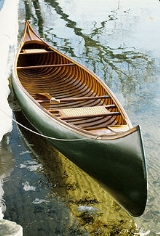
A canoe is a relatively small boat Boat

A boat is a structure designed to float on water coupled with a system of propulsion, such as a screw [i] ... 

, typically human-powered, but also commonly sailed. Canoes are pointed at both ends and usually open on top, but can be covered. For the activity of using a canoe in sport or for recreation, see canoeing Canoeing

Canoeing is the activity of paddling [i] a canoe [i] or kayak [i] for the purpose of recreation, sport [i] ... 

. In its human-powered form, the canoe is propelled by the use of paddle Paddle

A paddle is a tool, originally a propulsion [i] implement for mixing or pushing agains ... 

s, with the number of paddlers depending on the size of canoe. Paddlers face in the direction of travel, either seated on supports in the hull, or kneeling directly upon the hull. In this way paddling a canoe can be contrasted with rowing Watercraft rowing

With regard to watercraft [i], rowing is propulsion, usually of a small boat, by forcing one or more oars [i] ... 

, where the rowers face away from the direction of travel.

Discussions

  Discussion Features

   Ask a question about 'Canoe'

   Start a new discussion about 'Canoe'

   Answer questions about 'Canoe'

   'Canoe' discussion forum


Encyclopedia


A canoe is a relatively small boat Boat

A boat is a structure designed to float on water coupled with a system of propulsion, such as a screw [i] ... 

, typically human-powered, but also commonly sailed. Canoes are pointed at both ends and usually open on top, but can be covered. For the activity of using a canoe in sport or for recreation, see canoeing Canoeing

Canoeing is the activity of paddling [i] a canoe [i] or kayak [i] for the purpose of recreation, sport [i] ... 

.

In its human-powered form, the canoe is propelled by the use of paddle Paddle

A paddle is a tool, originally a propulsion [i] implement for mixing or pushing agains... 

s, with the number of paddlers depending on the size of canoe. Paddlers face in the direction of travel, either seated on supports in the hull, or kneeling directly upon the hull. In this way paddling a canoe can be contrasted with rowing Watercraft rowing

With regard to watercraft [i], rowing is propulsion, usually of a small boat, by forcing one or more oars [i]... 

, where the rowers face away from the direction of travel. Paddle Paddle

A paddle is a tool, originally a propulsion [i] implement for mixing or pushing agains... 

s may be single-bladed or double-bladed.

Sailing canoes are propelled by means of a variety of sailing rigs. Common classes of modern sailing canoes include the 5mē and the International 10mē Sailing canoes. The latter is otherwise known as the International Canoe, and is one of the fastest and oldest competitively sailed boat classes in the western world.

Ambiguity over the word canoe

The sport of canoeing, organised at the international level by the International Canoe Federation, uses the word canoe to cover both canoes as defined here, and kayak Kayak

A kayak is a small human-powered boat [i]. ... 

s . In fact, the sport of canoe polo Canoe polo

Canoe polo is a competitive ball sport [i] played on water, in a defined "field", between two teams of 5 ... 

 is exclusively played in kayaks. The first use of the word canoe from the Arawack in the Caribbean Sea Caribbean Sea

[image:IMG_2908.JPG|thumb|250px|right|A Caribbean beach in Isla Margarita [i], Venezuela [i].]] [i]
... 

 was by Christopher Columbus Christopher Columbus

Christopher Columbus Italian [i] Cristoforo Colombo; Spanish [i]: ... 

. Later Garcilaso de la Vega defined it as an open boat, but the British British Empire

The British Empire was the most extensive empire [i] in world history and for a ... 

 used it for all boats of the Indigenous peoples of the Americas Indigenous peoples of the Americas

The term Indigenous peoples of the Americas encompasses the inhabitants of the Americas [i] before the European discovery of the Americas [i] ... 

. This use of canoe to generically cover both canoes and kayaks is not so common in North American usage, but is common in Britain, Australia and presumably many parts of the world, both in sporting jargon and in colloquial speech. In these circumstances, the canoe as defined here is sometimes referred to as an open, Canadian, or Indian canoe, though these terms have their own ambiguities.

A 'canoe' in this ambiguous sense is a paddled vessel in which the user faces the direction of travel.

Design and construction


Parts of a canoe


  1. Bow
  2. Stern Stern

    The stern is the rear or after part of a ship [i] or boat [i], technically defined as the area built up ... 

  3. Hull
  4. Seat
  5. Thwart - a horizontal crossbeam near the top of the hull
  6. Gunwale  - the top edge of the hull
  7. Deck

Optional features in modern canoes :
  1. Yoke Yoke

    A bow yoke is a shaped wooden crosspiece bound to the necks of a pair of oxen [i], occasionally horses. ... 

     - a thwart across the centre of the boat to allow one person to carry the canoe, and is sometimes molded to the shape of the shoulders.
  2. Keel
  3. Floatation bags - inflatable air bags to prevent swamping the canoe in rapids
  4. Spraydeck Spraydeck

    A spraydeck is a flexible cover for a boat [i], in particular for a kayak [i] or a canoe [i]. ... 

     - cover to prevent water entering the canoe


The portion of the hull between the waterline and the top of the gunwale is called freeboard.

Canoe materials

The earliest canoes were made from natural materials:
  • Early canoes were wood Wood

    Wood is derived from woody plant [i]s, notably tree [i]s but also shrub [i]s. ... 

    en, often simply hollowed-out tree trunks. This technology is still practiced in some parts of the world. Modern wooden canoes are typically strip-built Strip-built

    Strip-built is a method of boat building [i] commonly used for canoe [i]s and kayak [i]s, but also suita ... 

     by woodworking Woodworking

    Woodworking is the process of building, making or carving something using wood [i]. ... 

     craftsmen Artisan

    An artisan, also called a craftsman, is a skilled manual worker who uses tools and machinery in a ... 

    . Such canoes can be very functional, lightweight, and strong, and are frequently quite beautiful works of art.
  • Many indigenous peoples of the Americas Indigenous peoples of the Americas

    The term Indigenous peoples of the Americas encompasses the inhabitants of the Americas [i] before the European discovery of the Americas [i] ... 

     built canoes of tree bark, sewn with tree roots and sealed with resin Resin

    Resin is a hydrocarbon [i] secretion [i] of many plant [i]s, particularly coniferous trees [i]... 

    . The indigenous people of the Amazon Amazon Basin

    Amazonian redirects here, for other uses see Amazonian [i]

... 

 commonly used Hymenaea trees. In temperate North America, cedar was used for the frame and Birch bark for the hull, with charcoal Charcoal

Charcoal is the blackish residue consisting of impure carbon [i] obtained by removing water and other vo... 

 and fats mixed into the resin.

Modern technology has expanded the range of materials available for canoe construction.
  • Wood-and-canvas canoes are made by fastening an external canvas shell to a wooden hull formed with cedar planks and ribs. These canoes evolved from birch bark construction but the transition record is not clear. In areas where birch bark was scarce, other natural materials such as cedar had to be used and there was known success in patching birch bark canoes with canvas or cloth because these materials were readily available. Efforts were made in various locations to improve upon the bark design such as in Peterborough, Ontario Peterborough, Ontario

    Peterborough is a city [i] on the Otonabee River [i] in central-eastern Ontario [i], Canada [i], 125km n ... 

    , Canada Canada

    Canada is the world's second-largest [i] country by total area, occupying most ... 

     where rib and plank construction was used by the Peterborough Canoe Company, and in Old Town Old Town, Maine

    Old Town is a city in Penobscot County [i], Maine [i], United States [i]. ... 

    , Maine Maine

    Maine is a U.S. state [i] in the New England [i] region of the northeastern United States [i]. ... 

     in the U.S United States

    The United States of America, also known as the United States, the U.S., the U.S.A., a... 

     where similar construction was used by the Old Town Canoe Company.
  • Aluminum Aluminium

    Aluminium or aluminum is the chemical element in the periodic table that has the symbol Al ... 

     canoes were first made by the Grumman Grumman Aircraft Engineering Corporation

    The Grumman Aircraft Engineering Corporation, later Grumman Aerospace Corporation, was a leading p... 

     company in 1944, when demand for airplane Fixed-wing aircraft

    A fixed-wing aircraft is a heavier-than-air craft where movement of the wings in relation to the aircra... 

    s for World War II World War II

    World War II, or the Second World War, was a worldwide [i] conflict [i] fought betwe ... 

     began to drop off. Aluminum allowed a lighter and much stronger construction than contemporary wood technology. However, a capsized aluminium canoe will sink unless the ends are filled with flotation blocks.
  • Plywood canoes are sealed with epoxy resin, or the inferior but cheaper polyester resin, and reinforced with glass fibre tape or cloth.
  • Composites of fiberglass Fiberglass

    Fiberglass or glassfibre is material made from extremely fine fiber [i]s of glass [i]. ... 

    , Kevlar Kevlar

    Kevlar is DuPont Company [i]'s brand name for a particular light but very strong aramid [i] fibre ... 

     and carbon fiber Carbon fiber

    Carbon fiber can refer to carbon [i] filament thread, or to felt or woven cloth made from those carbon f ... 

     are used for modern canoe construction. These compounds are light and strong, and the maneuverable, easily portaged canoes allow experienced paddlers access to some of the most remote wilderness areas.
  • Royalex is another modern composite material that makes an extremely flexible and durable hull suitable, in particular, for whitewater canoes. Royalex canoes have been known to pop back into their original shape with minimal creasing of the hull after having been wrapped around a rock in strong river currents.
  • Polyethylene Polyethylene

    Polyethylene or polyethene is a thermoplastic [i] commodity heavily used in consumer products. ... 

     is a cheaper and heavier material used for modern canoe construction.
  • Graphite Graphite

    Graphite is one of the allotropes of [i] carbon [i]. ... 

     canoes are the lightest boats on the market and tend to be 3-6 pounds lighter than a kevlar Kevlar

    Kevlar is DuPont Company [i]'s brand name for a particular light but very strong aramid [i] fibre ... 

     boat. Because graphite lacks the impact and abrasion resistance of other composite materials, graphite boats are used almost exclusively by flatwater canoeists.


Depending on the intended use of a canoe, the various kinds have different advantages. For example, a canvas canoe is more fragile than an aluminum canoe, and thus less suitable for use in rough water; but it is quieter, and so better for observing wildlife. However, canoes made of natural materials require regular maintenance, and are lacking in durability.

Shape

Many canoes are symmetrical about the centerline, meaning their shape can be mirrored along the center. And theoretically they should handle the same whether paddling forward or backward. But some advanced designs are asymmetrical, usually placing the widest part of the canoe slightly farther back. This increases the ability to 'track' in a straight line without compromising the maneuverability much.

A traditionally shaped canoe, like a voyageur Coureur des bois

A coureur de bois was an individual who engaged in the fur trade [i] without permission from the French ... 

 canoe, will have a tall rounded bow and stern. Although tall ends tend to catch the wind, they serve the purpose of shedding waves in rough whitewater or ocean travel.
Cross section
The shape of the hull's cross section and bottom determines how stable the canoe is in different conditions. A flat-bottomed canoe has excellent initial stability, but if tilted beyond a threshold, becomes unstable and may capsize. It is suitable for flatwater but it will rock more with larger waves.

A rounded-bottom canoe exhibits poor resistance to tilt. Its initial stability is poor, but its final stability is better. Furthermore, because of the optimal volume to surface ratio, it will have less draft than any other shape, making a canoe with a rounded bottom suitable for racing. Round-bottomed designs are also able to go over obstructions more easily, due to a small area of contact with the obstruction.

In between these two shapes is the more common shallow-arc bottom. It combines reasonable initial stability with a reasonable secondary stability. Similar is the tumblehome hull which has the top potion of the hull curving back in slightly, providing even more secondary stability when tilting.

Some canoes have a shallow-vee bottom, where the hull centerline forms a ridge like a shallow "V". It will behave similar to a shallow-arc bottom but its volume to surface ratio is worse.

Modern manufactures may combine a variety of cross sections to suit the canoe's purpose.
Keels
Keels on canoes will slightly increase the ability to 'track' in a straight line, but decrease the ability to turn quickly to avoid an obstacle. Consequently, canoes with a keel are better suited for lake travel, especially when traveling on open water with crosswinds. However, the hull has a larger cross-section than the keel, and has therefore a greater effect on a canoe's path through the water. Keels and "Vee"-bottoms are undesirable for whitewater Whitewater

Whitewater is formed in a rapid [i], when a river [i]'s gradient [i] drops enough to for ... 

 because they increase the draft.

In aluminum canoes, small keels occur as manufacturing artifacts when the two halves of the hull are joined. In wood-and-canvas canoes, keels are rub-strips to protect the boat from rocks and as they are pulled up on shore. Plastic canoes feature keels to stiffen the hull and allow internal tubular framing to lie flush with the sole of the canoe.
Rocker
Some hulls protrude downward in the middle and rise upward toward the bow and stern; this is called "rocker". More rocker affects handling in the opposite way as having a keel: it improves maneuverability at the expense of tracking. Specialized canoes for whitewater play have an extreme rocker and therefore allow quick turns and tricks.

Types of canoes

In the past, people around the world have built very different kinds of canoes, ranging from simple dugouts to large outrigger Outrigger canoe

The outrigger canoe is a type of canoe [i] featuring one or more lateral support floats known as outrigger [i] ... 

 varieties. More recently, technologically advanced designs have emerged for particular sports.

Traditional designs

Early canoes have always incorporated the natural materials available to the local people. The different canoes in many parts of the world were:
  • Dugout - formed of hollowed logs; may have outrigger Outrigger

    * Outrigger canoe racing [i]


... 

s in some cultures. On the west coast of North America, large dugout canoes were used in the Pacific Ocean, even for whaling.
  • Birch-bark canoe - in the temperate regions of eastern North America, canoes were traditionally made of a wooden frame covered with bark of a birch Birch

    Birch is the name of any tree [i] of the genus Betula, in the family Betulaceae [i], closely r ... 

     tree, pitched to make it waterproof.
    • Voyageur canoe - traditional voyageur canoes were similar to birch-bark canoes but larger and purpose built for the fur trade Fur trade

      The fur trade is a worldwide industry involving capturing of animals for their fur.... 

       business, capable of carrying 12 to 16 passengers and 3000 lbs of cargo.
  • Canvas canoe - similar to the birch-bark canoe in frame construction and size but covered with canvas, and painted for smoothness and watertightness.

Modern designs

Modern canoe types are usually categorized by the intended use. Many modern canoe designs are hybrids . The purpose of the canoe will also often determine the materials used. Most canoes are designed for either one person or two persons , but some are designed for more than 2 persons.
  • Touring canoe - made of lighter materials and built for comfort and cargo space; usually a more traditional design.
    • Prospector canoe - a popular type of touring canoe marked by a symmetrical hull and a continuous arc from bow to stern; made in a variety of materials.
    • Long Distance Touring canoe - A cockpit has many unique advantages. The main one is being able to make the gunnel line lower and narrower so the paddler can reach the water better. At the same time a cockpit makes the rim of the boat higher and therefore the boat is dryer. With the rounded hull shape and full ends there is nothing for turbulent water to work on.
  • Whitewater canoe - typically made of tough man-made materials, such as ABS Acrylonitrile butadiene styrene

    Acrylonitrile butadiene styrene, or ABS, is a common thermoplastic [i] used to make light, rigid, ... 

    , for strength; no keel and increased rocker for manuverability; often extra internal lashing points are present to secure floatation bags, harness, and spraydeck. Some canoes are decked and look very much like a kayak, but are still paddled with the paddler in a kneeling position and with a single bladed paddle.
    • Playboating Playboating

      Playboating is a discipline of kayaking [i] or canoeing [i] where the paddler performs various technical ... 

       open canoe
      - a subgroup of whitewater canoes specialized for whitewater play and tricks or for competitive whitewater slalom. Some of these canoes are short in length and have such extreme rocker that they are also known as banana boats.
  • Square stern canoe - asymmetrical canoe with a squared off stern for the mounting of an outboard motor Outboard motor

    An outboard motor is a propulsion [i] system for boat [i]s. ... 

    ; meant for lake travel or fishing.
  • Racing canoe - purpose-built racing Canoe racing

    This article discusses flatwater racing and marathon racing, competitive forms of canoeing [i] and ... 

     canoe for use in racing on flat water. To reduce drag, they are built long and with a narrow beam, which makes them very unstable. A 1-person sprint canoe is 5.2 meters or 17 feet long. Sprint canoes are paddled kneeling on one knee, and only paddled on one side; in a C-1, the canoeist will have to j-stroke constantly to maintain a straight course. Marathon canoe races use a similar narrow boat.
  • Inflatable canoe - similar in construction and materials to other inflatable boat Inflatable boat

    An inflatable boat is a lightweight boat constructed with its sides and bow made of flexible tubes and a... 

    s but shaped like a canoe; meant for serious whitewater; usually difficult to use for flatwater travel.

Differences from other paddled boats

  • Kayak Kayak

    A kayak is a small human-powered boat [i]. ... 

    - The main difference between a kayak and a canoe is that a kayak is a closed canoe meant to be used with a double-bladed paddle, one blade on each end, instead of a single bladed paddle. The double-bladed paddle makes it easier for a single person to handle a kayak. Kayaks are more commonly enclosed on top with a deck, making it possible to recover from a capsize Capsize

    Capsizing refers to when a boat [i] is inverted such that the bottom of the boat is on top. ... 

     without the kayak filling with water in most cases, although there are also closed canoes, which are common in competition. The deck is an extension of the hull, with a special sheet called a spraydeck sealing the gap between deck and the paddler Canoeing

    Canoeing is the activity of paddling [i] a canoe [i] or kayak [i] for the purpose of recreation, sport [i] ... 

    .
  • Rowboat Watercraft rowing

    With regard to watercraft [i], rowing is propulsion, usually of a small boat, by forcing one or more oars [i]... 

    - Not considered a canoe. It is propelled by oars resting in pivots on the gunwales or on 'riggers' that extend out from the boat. A rower may use one or two oars . A rower sits with his or her back toward the direction of travel. Some rowboats, such as a River Dory or a raft outfitted with a rowing frame are suitable for whitewater.
  • Adirondack guideboat - a rowboat that has similar lines to a canoe. However the rower sits closer to the bilge and uses a set of pinned oars to propel the boat.
  • Dragon boat Dragon boat

    A Dragon boat is a very long and narrow human powered [i] boat [i] used in the t ... 

    - while it handles similar to and is paddled the same way as a large canoe, a dragon boat is not considered a canoe since its construction is markedly different.
  • Sit-on-tops - more akin to kayaks in design, handling, and propulsion .

Use

Canoes have a reputation for instability, but this is not true if they are handled properly. For example, the occupants need to keep their centre of gravity Center of mass

In physics [i], the center of mass of a system of particles is a specific point at which, for many purpo ... 

 as low as possible. Canoes can navigate swift-moving water with careful scouting of rapids and good communication between the paddlers.

When two people occupy a canoe, they paddle on opposite sides. For example, the person in the bow might hold the paddle on the port Port

A port is a facility for receiving ship [i]s and transferring cargo [i] to and from them.... 

 side, with the left hand just above the blade and the right hand at the top end of the paddle. The left hand acts mostly as a pivot and the right arm supplies most of the power. Conversely, the sternman would paddle to starboard Starboard

Starboard is the nautical term [i] that refers to the right [i] si ... 

, with the right hand just above the blade and the left hand at the top. For travel straight ahead, they draw the paddle from bow to stern, in a straight line parallel to the gunwale.

Gunwale bobbing

A trick called "gunwale bobbing" or "gunwaling" allows a canoe to be propelled without a paddle. The canoeist stands on the gunwales, near the bow or the stern, and squats up and down to make the canoe rock backward and forward. This propulsion method is inefficient and unstable; additionally, standing on the gunwales can be dangerous.

Steering

The paddling action of two paddlers will tend to turn the canoe toward the opposite side that on which the sternman is paddling. Thus, steering is particularly important, particularly because canoes have flat-bottomed hulls and are very responsive to turning actions. Steering techniques vary widely, even as to the basic question of which paddler should be responsible for steering.

Among experienced white water canoeists, the sternman is primarily responsible for steering the canoe, with the exception of two cases. The bowman will steer when avoiding rocks and other obstacles that the sternman cannot see. Also, in the case of backferrying, the bowman is responsible for steering the canoe using small correctional strokes while backpaddling with the sternman.

Among less-experienced canoeists, the canoe is typically steered from the bow. The advantage of steering in the bow is that the bowman can change sides more easily than the sternman. Steering in the bow is initially more intuitive than steering in the stern, because to steer to starboard, the stern must actually move to port. On the other hand, the paddler who does not steer usually produces the most forward power or thrust Thrust

Thrust is a reaction force [i] described quantitatively by Newton [i]'s Second and Third Laws [i] ... 

, and the greater source of thrust should be placed in the bow for greater steering stability.

Paddle strokes

Paddle strokes are important to learn if the canoe is to move through the water in a safe and precise manner. Categorizing strokes makes learning them easier. After the strokes are mastered, they can be combined or even changed so that handling the canoe is smooth and done in an efficient, effective, and skillful manner. Here are the main ones:

  • The cruising stroke or forward stroke is the easiest stroke and is considered to be the foundation of all the other strokes. It is used mainly by the bowman to simply propel the canoe forward without turning. The paddle blade is brought forward along the side of the canoe, dipped into the water, and drawn back. The paddle should be drawn straight back rather than following the gunwale's curvature. The back stroke is essentially the same movement, but done in reverse. The back face of the blade is used in this case. This stroke is used to make the canoe go backward or to stop the canoe.
  • Advocates of steering in the stern often use the J-stroke, which is so named because, when done on the port side, it resembles the letter J. It begins like a standard stroke, but towards the end, the paddle is rotated and pushed away from the canoe with the power face of the paddle remaining the same throughout the stroke. This conveniently counteracts the natural tendency of the canoe to steer away from the side of the sternman's paddle. This stroke is used in reverse by the bowman while backpaddling or backferrying in white water.
  • A less elegant but more effective stroke which is used in the stern is the Superior stroke, more commonly referred to as the goon or rudder stroke. Unlike the J-stroke in which the side of the paddle pushing against the water during the stroke is the side which is used to straighten the canoe, this stroke uses the opposite face of the paddle to make the steering motion. It is somewhat like a stroke with a small pry at the end of it. This stroke uses larger muscle groups, is preferable in rough water and is the one used in white water. It is commonly thought to be less efficient than the J-stroke when paddling long distances across relatively calm water.
  • Another stroke which may be used by either the bow or stern paddler is the pry stroke. The paddle is inserted vertically in the water, with the power face outward, and the shaft braced against the gunwale. A gentle prying motion is applied, forcing the canoe in the opposite direction of the paddling side.
  • The running pry can be applied while the canoe is moving. As in the standard pry, the paddle is turned sideways and braced against the gunwale, but rather than forcing the paddle away from the hull, the paddler simply turns it at an angle and allows the motion of the water to provide the force.
  • The draw stroke exerts a force opposite to that of the pry. The paddle is inserted vertically in the water at arm's length from the gunwale, with the power face toward the canoe, and is then pulled inward to the paddler's hip. A draw can be applied while moving to create a running or hanging draw.
  • The cross-draw stroke is a bowman's stroke that exerts the same vector of force as a pry, by moving the blade of the paddle to the other side of the canoe without moving the paddler's hands. The arm of bottom hand crosses in front of the bowman's body to insert the paddle in the water on the opposite side of the canoe some distance from the gunwale, facing towards the canoe, and is then pulled inward while the top hand pushes outward. The cross-draw is much stronger than the draw stroke.
  • The sweep is unique in that it steers the canoe away from the paddle regardless of which end of the canoe it is performed in. The paddle is inserted in the water some distance from the gunwale, facing forward, and is drawn backward in a wide sweeping motion. The paddler's bottom hand is choked up to extend the reach of the paddle. In the case of the bowman, the blade will pull a quarter-circle from the bow to the paddler's waist. If in the stern, the paddler pulls from the waist to the stern of the canoe. Backsweeps are the same stroke done in reverse.


Complementary strokes are selected by the bow and stern paddlers in order to safely and quickly steer the canoe. It is important that the paddlers remain in unison, particularly in white water, in order to keep the boat stable and to maximize efficiency.
There are some differences in techniques in how the above strokes are utilized.
  • One of these techniques involves locking or nearly locking the elbow, that is on the side of the canoe the paddle is, to minimize muscular usage of that arm to increase endurance. Another benefit of this technique is that along with using less muscle you gain longer strokes which results in an increase of the power to stroke ratio. This is generally used more with the 'stay on one side' method of paddling.
  • The other technique is generally what newer canoeists use and that is where they bend the elbow to pull the paddle out of the water before they have finished the stroke. This is generally used more with the 'switch sides often' method of paddling.
  • The stay on one side method is where each canoeist takes opposite sides and the sternman uses occasional J-strokes to correct direction of travel. The side chosen is usually the paddlers' stronger side, since this is more comfortable and less tiring. Some canoeists do, however, switch sides after twenty to thirty minutes or longer as a means of lessening muscle fatigue.
  • The switch sides often method allows the canoeists to switch sides frequently to maintain their heading. This method is the fastest one on flat water and is used by all marathon canoeists in the US and Canada. The method works well with bent-shaft paddles. Racer/designer Eugene Jensen is credited with the development of both "hit and switch" paddling and the bent shaft paddle.

Setting poles

On swift river River

A river is a large natural waterway [i]. ... 

s, the sternman may use a setting pole. It allows the canoe to move through water too shallow for a paddle to create thrust, or against a current too quick for the paddlers to make headway. With skillful use of eddies, a setting pole can propel a canoe even against moderate rapids.

Image gallery


External links


References

  • The Survival of the Bark Canoe ISBN 0-374-27207-7, by John McPhee John McPhee

    John Angus McPhee is a writer widely considered one of the pioneers of literary non-fiction.... 

  • Path of the Paddle ISBN 1-55209-328-X, by Bill Mason
  • Song of the Paddle ISBN 1-55209-089-2, by Bill Mason
  • Thrill of the Paddle ISBN 1-55209-451-0, by Paul Mason