
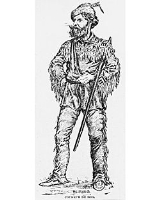
A
coureur des bois or
coureur de bois (kuʁœʁ de bwa,
woodlandEcologically, a woodland is a low-density forest forming open habitats with plenty of sunlight and limited shade. Woodlands may support an understory of shrubs and herbaceous plants including grasses. Woodland may form a transition to shrubland under drier conditions or during early stages of...
s runner; plural: coureurs de bois) was an independent entrepreneurial French-Canadian woodsman who traveled in
New FranceNew France was the area colonized by France in North America during a period beginning with the exploration of the Saint Lawrence River by Jacques Cartier in 1534 and ending with the cession of New France to Spain and Great Britain in 1763...
and the interior of
North AmericaNorth America is a continent wholly within the Northern Hemisphere and almost wholly within the Western Hemisphere. It is also considered a northern subcontinent of the Americas...
. They travelled in the woods to trade various things for fur.
A coureur des bois was an adventurer with many skills, including those of businessman, and of an expert canoeist. They engaged in a range of activities; the term is most strongly associated with those who engaged in the
fur tradeThe fur trade is a worldwide industry dealing in the acquisition and sale of animal fur. Since the establishment of world market for in the early modern period furs of boreal, polar and cold temperate mammalian animals have been the most valued...
in ways that were considered to be outside of the mainstream. Early in the fur trade era this meant circumventing the normal channels by going deeper into the wilderness to trade. Later it involved trading without permission from the
FrenchThe French Republic , The French Republic , The French Republic , (commonly known as France , is a unitary semi-presidential republic in Western Europe with several overseas territories and islands located on other continents and in the Indian, Pacific, and Atlantic oceans. Metropolitan France...
authorities during the late 17th century and early 18th century when such permission was required.
Although the term is most strongly associated with those who engaged in the fur trade, the most prominent coureurs des bois generally gained their reputation for being explorers rather than for being fur traders.
Coureur des bois and the fur trade
Native peoplesThe indigenous peoples of the Americas are the pre-Columbian inhabitants of North and South America, their descendants and other ethnic groups who are identified with those peoples. Indigenous peoples are known in Canada as Aboriginal peoples, and in the United States as Native Americans...
were essential to the fur trade because they traded for and brought
furFur is a synonym for hair, used more in reference to non-human animals, usually mammals; particularly those with extensives body hair coverage. The term is sometimes used to refer to the body hair of an animal as a complete coat, also known as the "pelage". Fur is also used to refer to animal...
s from the interior regions of French,
BritishBritish North America is a historical term. It consisted of the colonies and territories of the British Empire in continental North America after the end of the American Revolutionary War and the recognition of American independence in 1783.At the start of the Revolutionary War in 1775 the British...
, and later, American territories in North America to French trading posts. During times of hostilities, it was safer for French traders to have their Native allies hunt and trap for furs, but more money could be made by those who were willing to venture into the interior rivers and lakes and bring back
beaverThe beaver is a primarily nocturnal, large, semi-aquatic rodent. Castor includes two extant species, North American Beaver and Eurasian Beaver . Beavers are known for building dams, canals, and lodges . They are the second-largest rodent in the world...
pelts and other furs themselves. During peaceful times, many young men in
New FranceNew France was the area colonized by France in North America during a period beginning with the exploration of the Saint Lawrence River by Jacques Cartier in 1534 and ending with the cession of New France to Spain and Great Britain in 1763...
were attracted to the high profits and adventure of the trade. They were entrepreneurs, working for themselves rather than representing a company, and became known as coureurs de bois, or "woodland runners". By 1680, approximately 500 coureurs de bois were working in the
Lake SuperiorLake Superior is the largest of the five traditionally-demarcated Great Lakes of North America. It is bounded to the north by the Canadian province of Ontario and the U.S. state of Minnesota, and to the south by the U.S. states of Wisconsin and Michigan. It is the largest freshwater lake in the...
region attempting to outdistance the middlemen.
During the 17th century, the fur trade was very lucrative for New France. Competition was fierce, and many colonists risked the journey west and north through hostile
IroquoisThe Iroquois , also known as the Haudenosaunee or the "People of the Longhouse", are an association of several tribes of indigenous people of North America...
territory from the settlements around
MontrealMontreal is a city in Canada. It is the largest city in the province of Quebec, the second-largest city in Canada and the seventh largest in North America...
to the
pays d'en haut, or "upper country" (the area around the
Great LakesThe Great Lakes are a collection of freshwater lakes located in northeastern North America, on the Canada – United States border. Consisting of Lakes Superior, Michigan, Huron, Erie, and Ontario, they form the largest group of freshwater lakes on Earth by total surface, coming in second by volume...
) to trade with Native trappers. These
coureurs des bois were not looked upon favorably by Montreal authorities or royal officials. They disapproved of settlers leaving the developing agricultural areas to seek their fortune trading. French authorities preferred that the transportation of furs be handled by the natives (and later the
VoyageursThe Voyageurs were the persons who engaged in the transportation of furs by canoe during the fur trade era. Voyageur is a French word which literally translates to "traveler"...
) than have independent unregulated traders. The unregulated traffic in furs also undermined Montreal's role as the focal point for the fur trade — where traders would exchange
beaverThe beaver is a primarily nocturnal, large, semi-aquatic rodent. Castor includes two extant species, North American Beaver and Eurasian Beaver . Beavers are known for building dams, canals, and lodges . They are the second-largest rodent in the world...
pelts for trade goods such as clothing,
musketA musket is a muzzle-loaded, smooth bore long gun, fired from the shoulder. Muskets were designed for use by infantry. A soldier armed with a musket had the designation musketman or musketeer....
s and copper pots. Some illicit traders also caused problems by trading
alcoholAn alcoholic beverage is a drink containing ethanol, commonly known as alcohol. Alcoholic beverages are divided into three general classes: beers, wines, and spirits. They are legally consumed in most countries, and over 100 countries have laws regulating their production, sale, and consumption...
for furs.
Relation to voyageurs
Coureur des bois and
voyageursThe Voyageurs were the persons who engaged in the transportation of furs by canoe during the fur trade era. Voyageur is a French word which literally translates to "traveler"...
both played prominent roles in the North American fur trade era.
By 1681, the French authorities realized the traders had to be controlled so that the industry might remain profitable. They therefore legitimized and limited the amount of fur trading by establishing a system that used permits (
congés). At the same time the fur trade also moved further into the continent, favoring organized long distance transportation of furs and trading goods.
The combination of these factors helped create a new player in the fur trade business, the
voyageurThe Voyageurs were the persons who engaged in the transportation of furs by canoe during the fur trade era. Voyageur is a French word which literally translates to "traveler"...
, which literally means "traveler". Voyageurs typically worked for or were allied with a Montreal merchant who held a permit.
The licensed efforts which utilized voyageurs substantially displaced the coureur des bois' role in the fur trade business, but did not eliminate it. During the voyageur era, the term coureur des bois in the context of the fur trade business took on an additional meaning of "unlicensed".
The fur trade was thus controlled by a small number of Montreal merchants. New France also began a policy of expansion in an attempt to dominate the trade. French influence extended west, north and south. Forts and trading posts were built with the help of explorers and traders. Treaties were negotiated with native groups, and fur trading became very profitable and organized. The system became complex and efficient; to a certain extent, entrepreneurs were replaced by hired laborers.
Notable coureurs des bois
Notable coureurs des bois include Étienne Brûlé-Valiquette,
Louis JollietLouis Jolliet , also known as Louis Joliet, was a French Canadian explorer known for his discoveries in North America...
,Nicolas Marsolet,
Médard des GroseilliersMédard Chouart des Groseilliers was a French explorer and fur trader in Canada. He is often paired with his brother-in-law Pierre-Esprit Radisson who was about 20 years his junior...
,
Pierre-Esprit RadissonPierre-Esprit Radisson was a French-Canadian fur trader and explorer. He is often linked to his brother-in-law Médard des Groseilliers who was about 20 years older. The decision of Radisson and Groseilliers to enter the English service led to the formation of the Hudson's Bay Company.Born near...
,
Jean NicoletJean Nicolet de Belleborne was a French coureur des bois noted for exploring Green Bay in what is now the U.S. state of Wisconsin.-Life:...
,
Guillaume CoutureGuillaume Cousture was a citizen of New France. During his life he was a lay missonary with the Jesuits, a survivor of torture, a member of an Iroquois council, a translator, a diplomat, a militia captain, and a lay leader among the colonists of the Pointe-Lévy in the Seigneury of Lauzon...
, Jean-Baptiste Chalifoux and
Jacques de NoyonJacques de Noyon was a French Canadian explorer and coureur des bois. He is the first known European to visit the Boundary Waters region west of Lake Superior.Jacques de Noyon was born on February 12, 1668, in Trois-Rivières, New France...
. These coureurs des bois achieved significance because of their role as explorers rather than for their role as fur traders.
See also
- European colonization of the Americas
The start of the European colonization of the Americas is typically dated to 1492. The first Europeans to reach the Americas were the Vikings during the 11th century, who established several colonies in Greenland and one short-lived settlement in present day Newfoundland...
- Canadian canoe routes (early)
This article covers the water routes used by early explorers of Canada with special emphasis on the fur trade.-Canada and Siberia:Both Canada and Siberia were explored mainly by river. Both countries have many navigable rivers with short portages between them. There are no serious barriers to canoe...
For further reading
- Podruchny, Carolyn. Making the Voyageur World : Travelers and Traders in the North American Fur Trade. Toronto : University of Toronto Press, 2006. ISBN
9780802094285.
- Brown, Craig, editor. The Illustrated History of Canada. Toronto: Lester & Orpen Dennys Ltd., 1987. ISBN 0-88619-147-5.
External links