
Home      Discussion      Topics      Dictionary      Almanac
Signup       Login
Royal Proclamation of 1763

Royal Proclamation of 1763

Overview
The Royal Proclamation of 1763 was issued October 7, 1763, by King George III
George III of the United Kingdom
George III was King of Great Britain and King of Ireland from 25 October 1760 until the union of these two countries on 1 January 1801, after which he was King of the United Kingdom of Great Britain and Ireland until his death...

 following Great Britain
Kingdom of Great Britain
The former Kingdom of Great Britain, sometimes described as the 'United Kingdom of Great Britain', That the Two Kingdoms of Scotland and England, shall upon the 1st May next ensuing the date hereof, and forever after, be United into One Kingdom by the Name of GREAT BRITAIN. was a sovereign...

's acquisition of French territory
New France
New France was the area colonized by France in North America during a period beginning with the exploration of the Saint Lawrence River by Jacques Cartier in 1534 and ending with the cession of New France to Spain and Great Britain in 1763...

 in North America
North America
North America is a continent wholly within the Northern Hemisphere and almost wholly within the Western Hemisphere. It is also considered a northern subcontinent of the Americas...

 after the end of the French and Indian War
French and Indian War
The French and Indian War is the common American name for the war between Great Britain and France in North America from 1754 to 1763. In 1756, the war erupted into the world-wide conflict known as the Seven Years' War and thus came to be regarded as the North American theater of that war...

/Seven Years' War
Seven Years' War
The Seven Years' War was a global military war between 1756 and 1763, involving most of the great powers of the time and affecting Europe, North America, Central America, the West African coast, India, and the Philippines...

. The purpose of the proclamation was to organize Great Britain's new North American empire and to stabilize relations with Native North Americans
Indigenous peoples of the Americas
The indigenous peoples of the Americas are the pre-Columbian inhabitants of North and South America, their descendants and other ethnic groups who are identified with those peoples. Indigenous peoples are known in Canada as Aboriginal peoples, and in the United States as Native Americans...

 through regulation of trade
Fur trade
The fur trade is a worldwide industry dealing in the acquisition and sale of animal fur. Since the establishment of world market for in the early modern period furs of boreal, polar and cold temperate mammalian animals have been the most valued...

, settlement, and land purchases on the western frontier. The Royal Proclamation continues to be of legal importance to First Nations
First Nations
First Nations is a term that collectively refers to various Aboriginal peoples in Canada who are neither Inuit nor Métis. There are currently over 630 recognised First Nations governments or bands spread across Canada, roughly half of which are in the provinces of Ontario and British Columbia. The...

 in Canada and is significant for the variation of indigenous status in the United States.
Discussion
Ask a question about 'Royal Proclamation of 1763'
Start a new discussion about 'Royal Proclamation of 1763'
Answer questions from other users
Full Discussion Forum
 
Unanswered Questions
Encyclopedia
The Royal Proclamation of 1763 was issued October 7, 1763, by King George III
George III of the United Kingdom
George III was King of Great Britain and King of Ireland from 25 October 1760 until the union of these two countries on 1 January 1801, after which he was King of the United Kingdom of Great Britain and Ireland until his death...

 following Great Britain
Kingdom of Great Britain
The former Kingdom of Great Britain, sometimes described as the 'United Kingdom of Great Britain', That the Two Kingdoms of Scotland and England, shall upon the 1st May next ensuing the date hereof, and forever after, be United into One Kingdom by the Name of GREAT BRITAIN. was a sovereign...

's acquisition of French territory
New France
New France was the area colonized by France in North America during a period beginning with the exploration of the Saint Lawrence River by Jacques Cartier in 1534 and ending with the cession of New France to Spain and Great Britain in 1763...

 in North America
North America
North America is a continent wholly within the Northern Hemisphere and almost wholly within the Western Hemisphere. It is also considered a northern subcontinent of the Americas...

 after the end of the French and Indian War
French and Indian War
The French and Indian War is the common American name for the war between Great Britain and France in North America from 1754 to 1763. In 1756, the war erupted into the world-wide conflict known as the Seven Years' War and thus came to be regarded as the North American theater of that war...

/Seven Years' War
Seven Years' War
The Seven Years' War was a global military war between 1756 and 1763, involving most of the great powers of the time and affecting Europe, North America, Central America, the West African coast, India, and the Philippines...

. The purpose of the proclamation was to organize Great Britain's new North American empire and to stabilize relations with Native North Americans
Indigenous peoples of the Americas
The indigenous peoples of the Americas are the pre-Columbian inhabitants of North and South America, their descendants and other ethnic groups who are identified with those peoples. Indigenous peoples are known in Canada as Aboriginal peoples, and in the United States as Native Americans...

 through regulation of trade
Fur trade
The fur trade is a worldwide industry dealing in the acquisition and sale of animal fur. Since the establishment of world market for in the early modern period furs of boreal, polar and cold temperate mammalian animals have been the most valued...

, settlement, and land purchases on the western frontier. The Royal Proclamation continues to be of legal importance to First Nations
First Nations
First Nations is a term that collectively refers to various Aboriginal peoples in Canada who are neither Inuit nor Métis. There are currently over 630 recognised First Nations governments or bands spread across Canada, roughly half of which are in the provinces of Ontario and British Columbia. The...

 in Canada and is significant for the variation of indigenous status in the United States.

Background


The Treaty of Paris
Treaty of Paris (1763)
The Treaty of Paris, often called the Peace of Paris, or the Treaty of 1763, was signed on 10 February 1763, by the kingdoms of Great Britain, France and Spain, with Portugal in agreement. It ended the French and Indian War/Seven Years' War...

, ending Britain's participation in the Seven Years War, had seen large swaths of new land brought under British Crown control
Crown land
In Commonwealth realms, Crown land is an area belonging to the monarch , the equivalent of an entailed estate that passed with the monarchy and could not be alienated from it....

, as Britain was ceded all North America east of the Mississippi River
Mississippi River
The Mississippi River is the largest river system in North America. Flowing entirely in the United States, this river rises in western Minnesota and meanders slowly southwards for to the Mississippi River Delta at the Gulf of Mexico. With its many tributaries, the Mississippi's watershed drains...

.

New colonies


Besides regulating colonial expansion, the proclamation dealt with the management of newly ceded French colonies. It established government for four areas: Quebec, West Florida
West Florida
West Florida was a region on the north shore of the Gulf of Mexico, which underwent several boundary and sovereignty changes during its history. West Florida was first established in 1763 by the British government; as its name suggests it largely consisted of the western portion of the region...

, East Florida
East Florida
East Florida was a colony of Great Britain from 1763–1783 and of Spain from 1783–1822. East Florida was established by the British colonial government in 1763; as its name implies it consisted of the eastern part of the region of Florida, with West Florida comprising the western parts. Its capital...

, and Grenada
Grenada
Grenada is an island country and Commonwealth Realm consisting of the island of Grenada and six smaller islands at the southern end of the Grenadines in the southeastern Caribbean Sea...

.

Native lands


One of the biggest problems confronting the British Empire in 1763 was controlling land speculators in both Europe and the British colonies whose activities often led to frontier conflicts. Many Native American peoples—primarily in the Great Lakes region
Great Lakes region (North America)
The Great Lakes region of North America, occasionally known as the Third Coast or the Fresh Coast , includes the eight U.S. states of Illinois, Indiana, Michigan, Minnesota, New York, Ohio, Pennsylvania and Wisconsin as well as the Canadian province of Ontario...

—had a long and close relationship with France, and were dismayed to find that they were now under British sovereignty. Pontiac's Rebellion
Pontiac's Rebellion
Pontiac's War, Pontiac's Conspiracy, or Pontiac's Rebellion was a war that was launched in 1763 by a loose confederation of elements of Native American tribes primarily from the Great Lakes region, the Illinois Country, and Ohio Country who were dissatisfied with British postwar policies in the...

 (1763–66) was an unsuccessful effort by Native Americans to prevent Great Britain from occupying the land previously claimed by France. The Proclamation of 1763 had been in the works before Pontiac's Rebellion, but the outbreak of the conflict hastened the process. British officials thought/hoped the proclamation would reconcile American Indians to British rule and thus help to prevent future hostilities.

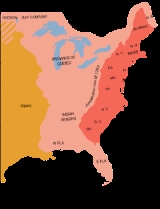
The proclamation created a boundary line (often called the proclamation line) between the British colonies on the Atlantic coast and American Indian lands (called the Indian Reserve
Indian Reserve (1763)
The Indian Reserve was a territory under British rule in North America set aside in the Royal Proclamation of 1763 for use by American Indians between 1763 and 1783....

) west of the Appalachian Mountains
Appalachian Mountains
The Appalachian Mountains #Whether the stressed vowel is or ,#Whether the "ch" is pronounced as a fricative or an affricate , and#Whether the final vowel is the monophthong or the diphthong .), often called the Appalachians, are a system of mountains in eastern North America. The Appalachians...

. The proclamation line was not intended to be a permanent boundary between white and American Indian lands, but rather a temporary boundary which could be extended further west in an orderly, lawful manner. Its contour was defined by the headwaters that formed the watershed along the Appalachia—all land with rivers that flowed into the Atlantic was designated for the colonial entities while all the land with rivers that flowed into the Mississippi was reserved for the native Indian population. The proclamation outlawed private purchase of Native American land, which had often created problems in the past; instead, all future land purchases were to be made by Crown officials "at some public Meeting or Assembly of the said Indians". Furthermore, British colonists were forbidden to move beyond the line and settle on native lands, and colonial officials were forbidden to grant grounds or lands without royal approval. The proclamation gave the Crown a monopoly on all future land purchases from American Indians.

Almost immediately, many British colonists and land speculators objected to the proclamation boundary, since there were already many settlements beyond the line (some of which had been temporarily evacuated during Pontiac's War), as well as many existing land claims yet to be settled. Indeed, the proclamation itself called for lands to be granted to British soldiers that had served in the Seven Years' War. Prominent American colonists joined with land speculators in Britain to lobby the government to move the line further west. As a result, the boundary line was adjusted in a series of treaties with Native Americans. The Treaty of Fort Stanwix
Treaty of Fort Stanwix
The Treaty of Fort Stanwix was an important treaty between North American Indians and the British Empire. It was signed in 1768 at Fort Stanwix, located in present-day Rome, New York...

 and the Treaty of Hard Labor (both 1768) and the Treaty of Lochaber
Treaty of Lochaber
The Treaty of Lochaber was signed on October 18, 1770 by British representative John Stuart and the Cherokees. Based on the terms of the accord, the Cherokee relinquished all claims to property from the North Carolina and Virginia border to a point near Long Island on the Holston River to the mouth...

 (1770) opened much of what is now West Virginia
West Virginia
West Virginia is a state in the Appalachian and Southeastern regions of the United States, bordered by Virginia to the southeast, Kentucky to the southwest, Ohio to the northwest, Pennsylvania to the northeast and Maryland to the east...

 and Kentucky
Kentucky
The Commonwealth of Kentucky is a state located in the East Central United States of America. As classified by the United States Census Bureau, Kentucky is a Southern state, more specifically in the East South Central region. Kentucky is one of four U.S. states constituted as a commonwealth...

 to British settlement.

Canadian Aboriginals


The Royal Proclamation continued to govern the cession of aboriginal land in British North America
British North America
British North America is a historical term. It consisted of the colonies and territories of the British Empire in continental North America after the end of the American Revolutionary War and the recognition of American independence in 1783.At the start of the Revolutionary War in 1775 the British...

, especially Upper Canada
Upper Canada
The Province of Upper Canada was a political division in British Canada established in 1791 by the British Empire to govern the central third of the lands in British North America and to accommodate Loyalist refugees from the United States of America after the American Revolution...

 and Rupert's Land
Rupert's Land
Rupert's Land, or Prince Rupert's Land, was a territory in British North America, consisting of the Hudson Bay drainage basin that was nominally owned by the Hudson's Bay Company for 200 years from 1670 to 1870, although numerous aboriginal groups lived in the same territory and disputed the...

. The proclamation forms the basis of land claims of aboriginal peoples in Canada – First Nations
First Nations
First Nations is a term that collectively refers to various Aboriginal peoples in Canada who are neither Inuit nor Métis. There are currently over 630 recognised First Nations governments or bands spread across Canada, roughly half of which are in the provinces of Ontario and British Columbia. The...

, Inuit
Inuit
The Inuit are a group of culturally similar indigenous peoples inhabiting the Arctic regions of Canada , Denmark , Russia and the United States . Inuit means “the people” in the Inuktitut language...

, and Métis. The Royal Proclamation of 1763 is thus mentioned in section 25
Section Twenty-five of the Canadian Charter of Rights and Freedoms
Section Twenty-five of the Canadian Charter of Rights and Freedoms is the first section under the heading "General" in the Charter, and like other sections within the "General" sphere, it aids in the interpretation of rights elsewhere in the Charter...

 of the Canadian Charter of Rights and Freedoms
Canadian Charter of Rights and Freedoms
The Canadian Charter of Rights and Freedoms is a bill of rights entrenched in the Constitution of Canada. It forms the first part of the Constitution Act, 1982...

.

According to historian Colin Calloway, "scholars disagree on whether the proclamation recognized or undermined tribal sovereignty". The language of the proclamation made it clear that the British still believed that all native lands ultimately belonged to the Crown. However, the proclamation established the important precedent that the indigenous population had certain rights to the lands they occupied—in the past, by contrast, the Crown had granted lands without regard to native claims.

Some see the Royal Proclamation of 1763 as a “fundamental document” for First Nations
First Nations
First Nations is a term that collectively refers to various Aboriginal peoples in Canada who are neither Inuit nor Métis. There are currently over 630 recognised First Nations governments or bands spread across Canada, roughly half of which are in the provinces of Ontario and British Columbia. The...

 land claims and self-government. It is “the first legal recognition by the British Crown of Aboriginal rights.” The intent and promises made to the native in the Proclamation have been argued to be of a temporary nature, only meant to appease the Native peoples who were becoming increasingly resentful of “settler encroachments on their lands” and were capable of becoming a serious threat to British colonial settlement. While advising the Board of Trade on August 30, 1764, Sir William Johnson expressed that

The Indians all know we cannot be a Match for them in the midst of an extensive woody Country…from whence I infer that if we are determined to possess Our Posts, Trade & ca securely, it cannot be done for a Century by any other means than that of purchasing the favour of the numerous Indian inhabitants.
With the proclamation, “the British were trying to convince Native people that there was nothing to fear from the colonists, while at the same time trying to increase political and economic power relative to First Nations and other European powers.” However, the Royal Proclamation along with the subsequent Treaty of Niagara
Treaty of Fort Niagara
The Treaty of Fort Niagara is one of several treaties signed between the British Crown and various indigenous peoples of North America.-Treaty of Fort Niagara :...

, provide for an argument that “discredits the claims of the Crown to exercise sovereignty
Sovereignty
Sovereignty is the quality of having supreme, independent authority over a geographic area, such as a territory. It can be found in a power to rule and make law that rests on a political fact for which no purely legal explanation can be provided...

 over First Nations” and affirms Aboriginal “powers of self-determination
Self-determination
Self-determination is the principle in international law that nations have the right to freely choose their sovereignty and international political status with no external compulsion or external interference...

 in, among other things, allocating lands.” Further so, the Royal Proclamation outlined a policy in which to protect and extinguish Aboriginal rights and in doing so, recognized these rights existed.

For the United States


The influence of the Royal Proclamation of 1763 on the coming of the American Revolution
American Revolution
The American Revolution was the political upheaval during the last half of the 18th century in which thirteen colonies in North America joined together to break free from the British Empire, combining to become the United States of America...

 has been variously interpreted. Many historians argue that the proclamation ceased to be a major source of tension after 1768, since the aforementioned treaties opened up extensive lands for settlement. Others have argued that colonial resentment of the proclamation contributed to the growing divide between the colonies and the mother country.

Historian Woody Holton
Woody Holton
Abner Linwood "Woody" Holton, III is an Associate Professor of History at the University of Richmond in Virginia and is a member of the Richmond Research Institute.-Life:He is a graduate of the University of Virginia and received his PhD from Duke University....

, for example, argued that even though the boundary was pushed west in subsequent treaties, the British government refused to permit new colonial settlements for fear of instigating a war with Native Americans, which angered colonial land speculators. George Washington
George Washington
George Washington was the dominant military and political leader of the new United States of America from 1775 to 1799. He led the American victory over Great Britain in the American Revolutionary War as commander-in-chief of the Continental Army from 1775 to 1783, and presided over the writing of...

 was given 20000 acres (80.9 km²) of wild land in the Ohio region for his services in the French and Indian War.

In 1770, Washington took the lead in securing the rights of him and his old soldiers in the French War, advancing money to pay expenses in behalf of the common cause and using his influence in the proper quarters. In August 1770, it was decided that Washington should personally make a trip to the western region, where he located tracts for himself and military comrades and eventually was granted letters patent for tracts of land there. The lands involved were open to Virginians under terms of the Treaty of Lochaber
Treaty of Lochaber
The Treaty of Lochaber was signed on October 18, 1770 by British representative John Stuart and the Cherokees. Based on the terms of the accord, the Cherokee relinquished all claims to property from the North Carolina and Virginia border to a point near Long Island on the Holston River to the mouth...

 of 1770.

In the United States, the Royal Proclamation of 1763 ended with the American Revolutionary War because Great Britain ceded the land in question to the United States in the Treaty of Paris (1783)
Treaty of Paris (1783)
The Treaty of Paris, signed on September 3, 1783, ended the American Revolutionary War between Great Britain on the one hand and the United States of America and its allies on the other. The other combatant nations, France, Spain and the Dutch Republic had separate agreements; for details of...

. Afterward, the US government also faced difficulties in preventing frontier violence and eventually adopted policies similar to those of the Royal Proclamation. The first in a series of Indian Intercourse Act
Indian Intercourse Act
The Nonintercourse Act is the collective name given to six statutes passed by the United States Congress in 1790, 1793, 1796, 1799, 1802, and 1834. The Act regulates commerce between Native Americans and non-Indians...

s was passed in 1790, prohibiting unregulated trade and travel in Native American lands. Additionally, the U.S. Supreme Court case Johnson v. M'Intosh
Johnson v. M'Intosh
Johnson v. M'Intosh, 21 U.S. 543 , is a landmark decision of the U.S. Supreme Court that held that private citizens could not purchase lands from Native Americans...

(1823) established that only the U.S. government, and not private individuals, could purchase land from Native Americans.

Further reading


  • Cashin, Edward J. "Governor Henry Ellis and the Transformation of British North America." Athens: University of Georgia Press, 1994.
  • Lawson, Philip. The Imperial Challenge: Quebec and Britain in the Age of the American Revolution. Montreal/Kingston: McGill-Queen’s University Press, 1989.
  • Roth, Christopher F. (2002) "Without Treaty, without Conquest: Indigenous Sovereignty in Post-Delgamuukw British Columbia." Wicazo Sa Review, vol. 17, no. 2, pp. 143–165.
  • Stonechild, Blair A. "Indian-White Relations in Canada, 1763 to the Present." In Encyclopedia of North American Indians, ed. Frederick E. Hoxie, 277–81. Boston: Houghton Mifflin Company, 1996.
  • Tousignant, Pierre. "The Integration of the Province of Quebec into the British Empire, 1763–91. Part 1: From the Royal Proclamation to the Quebec Act." In Dictionary of Canadian Biography, vol. 4. Toronto: University of Toronto Press, 1980.


External links