

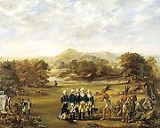
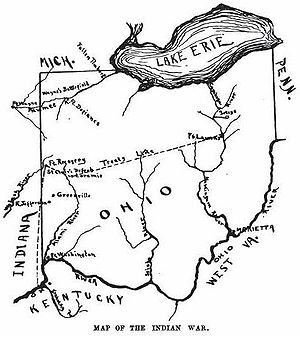
Northwest Indian War

Encyclopedia
United States
The United States of America is a federal constitutional republic comprising fifty states and a federal district...
and a confederation of numerous American Indian
Native Americans in the United States
Native Americans in the United States are the indigenous peoples in North America within the boundaries of the present-day continental United States, parts of Alaska, and the island state of Hawaii. They are composed of numerous, distinct tribes, states, and ethnic groups, many of which survive as...
tribes for control of the Northwest Territory
Northwest Territory
The Territory Northwest of the River Ohio, more commonly known as the Northwest Territory, was an organized incorporated territory of the United States that existed from July 13, 1787, until March 1, 1803, when the southeastern portion of the territory was admitted to the Union as the state of Ohio...
. It followed centuries of conflict over this territory, first among Indian nations, and then with the added shifting alliances among the tribes and European powers, such as France
France
The French Republic , The French Republic , The French Republic , (commonly known as France , is a unitary semi-presidential republic in Western Europe with several overseas territories and islands located on other continents and in the Indian, Pacific, and Atlantic oceans. Metropolitan France...
and Great Britain
Great Britain
Great Britain or Britain is an island situated to the northwest of Continental Europe. It is the ninth largest island in the world, and the largest European island, as well as the largest of the British Isles...
, and their colonists.
Under the Treaty of Paris (1783)
Treaty of Paris (1783)
The Treaty of Paris, signed on September 3, 1783, ended the American Revolutionary War between Great Britain on the one hand and the United States of America and its allies on the other. The other combatant nations, France, Spain and the Dutch Republic had separate agreements; for details of...
, which terminated the American Revolutionary War
American Revolutionary War
The American Revolutionary War , the American War of Independence, or simply the Revolutionary War, began as a war between the Kingdom of Great Britain and thirteen British colonies in North America, and ended in a global war between several European great powers.The war was the result of the...
, Great Britain ceded to the U.S. "control" of the Northwest Territory
Northwest Territory
The Territory Northwest of the River Ohio, more commonly known as the Northwest Territory, was an organized incorporated territory of the United States that existed from July 13, 1787, until March 1, 1803, when the southeastern portion of the territory was admitted to the Union as the state of Ohio...
, which was occupied by numerous American Indian tribes. Despite the treaty, the British
United Kingdom
The United Kingdom of Great Britain and Northern IrelandIn the United Kingdom and Dependencies, other languages have been officially recognised as legitimate autochthonous languages under the European Charter for Regional or Minority Languages...
kept forts and policies there that supported the Indians living in the Northwest Territories. President George Washington
George Washington
George Washington was the dominant military and political leader of the new United States of America from 1775 to 1799. He led the American victory over Great Britain in the American Revolutionary War as commander-in-chief of the Continental Army from 1775 to 1783, and presided over the writing of...
directed the U.S. Army to halt the hostilities between the Indians and settlers and enforce U.S. sovereignty over the territory. The United States Army, fighting with mostly untrained troops supported by equally untrained militiamen, suffered a series of major defeats, including that of generals Harmar
Harmar Campaign
The Harmar Campaign was an attempt by the United States to subdue Native Americans in the Northwest Territory in the Autumn of 1790. It was led by General Josiah Harmar and was part of the Northwest Indian War...
(1790) and St. Clair
St. Clair's Defeat
St. Clair's Defeat also known as the Battle of the Wabash, the Battle of Wabash River or the Battle of a Thousand Slain, was fought on November 4, 1791 in the Northwest Territory between the United States and the Western Confederacy of American Indians, as part of the Northwest Indian War...
(1791), which were resounding Indian victories. About 1,000 soldiers and militiamen were killed and the U.S. forces suffered many more casualties than their opponents.
After St Clair's disaster, Washington ordered General “Mad” Anthony Wayne
Anthony Wayne
Anthony Wayne was a United States Army general and statesman. Wayne adopted a military career at the outset of the American Revolutionary War, where his military exploits and fiery personality quickly earned him a promotion to the rank of brigadier general and the sobriquet of Mad Anthony.-Early...
to organize and train a proper fighting force. Wayne took command of the new Legion of the United States
Legion of the United States
The Legion of the United States was a reorganization and extension of the United States Army from 1792 to 1796 under the command of Major General Anthony Wayne.-Origins:The impetus for the Legion came from General Arthur St...
late in 1793. He led United States forces to a decisive victory at the Battle of Fallen Timbers
Battle of Fallen Timbers
The Battle of Fallen Timbers was the final battle of the Northwest Indian War, a struggle between American Indian tribes affiliated with the Western Confederacy and the United States for control of the Northwest Territory...
in 1794. This finally brought the conflict to an end. Indian tribes were forced to cede extensive territory, including much of present-day Ohio
Ohio
Ohio is a Midwestern state in the United States. The 34th largest state by area in the U.S.,it is the 7th‑most populous with over 11.5 million residents, containing several major American cities and seven metropolitan areas with populations of 500,000 or more.The state's capital is Columbus...
, in the Treaty of Greenville
Treaty of Greenville
The Treaty of Greenville was signed at Fort Greenville , on August 3, 1795, between a coalition of Native Americans & Frontiers men, known as the Western Confederacy, and the United States following the Native American loss at the Battle of Fallen Timbers. It put an end to the Northwest Indian War...
in 1795.
Beaver Wars (1650s)
The land east of the Mississippi RiverMississippi River
The Mississippi River is the largest river system in North America. Flowing entirely in the United States, this river rises in western Minnesota and meanders slowly southwards for to the Mississippi River Delta at the Gulf of Mexico. With its many tributaries, the Mississippi's watershed drains...
and south of the Great Lakes
Great Lakes
The Great Lakes are a collection of freshwater lakes located in northeastern North America, on the Canada – United States border. Consisting of Lakes Superior, Michigan, Huron, Erie, and Ontario, they form the largest group of freshwater lakes on Earth by total surface, coming in second by volume...
had been fought over for centuries before the United States
United States
The United States of America is a federal constitutional republic comprising fifty states and a federal district...
government was formed. About 1200 AD, after years of fierce warfare, the Iroquois
Iroquois
The Iroquois , also known as the Haudenosaunee or the "People of the Longhouse", are an association of several tribes of indigenous people of North America...
invasions from the north pushed several tribes out of the Ohio Valley. These included the Osage
Osage Nation
The Osage Nation is a Native American Siouan-language tribe in the United States that originated in the Ohio River valley in present-day Kentucky. After years of war with invading Iroquois, the Osage migrated west of the Mississippi River to their historic lands in present-day Arkansas, Missouri,...
, Kaw
Kaw (tribe)
The Kaw Nation are an American Indian people of the central Midwestern United States. The tribe known as Kaw have also been known as the "People of the South wind", "People of water", Kansa, Kaza, Kosa, and Kasa. Their tribal language is Kansa, classified as a Siouan language.The toponym "Kansas"...
, Ponca
Ponca
The Ponca are a Native American people of the Dhegihan branch of the Siouan-language group. There are two federally recognized Ponca tribes: the Ponca Tribe of Nebraska and the Ponca Tribe of Indians of Oklahoma...
and other Siouan-language tribes. Over the next centuries, they migrated to what were later historically considered their traditional lands west of the Mississippi River at the time of European contact. These tribes in turn drove other tribes, such as the Caddo
Caddo
The Caddo Nation is a confederacy of several Southeastern Native American tribes, who traditionally inhabited much of what is now East Texas, northern Louisiana and portions of southern Arkansas and Oklahoma. Today the Caddo Nation of Oklahoma is a cohesive tribe with its capital at Binger, Oklahoma...
, farther to the west.
In 1608, French
France
The French Republic , The French Republic , The French Republic , (commonly known as France , is a unitary semi-presidential republic in Western Europe with several overseas territories and islands located on other continents and in the Indian, Pacific, and Atlantic oceans. Metropolitan France...
explorer Samuel Champlain sided with the Huron Indians living along the St. Lawrence River against the Haudenosaunee (Iroquois
Iroquois
The Iroquois , also known as the Haudenosaunee or the "People of the Longhouse", are an association of several tribes of indigenous people of North America...
) living in what is now upper and western New York
New York
New York is a state in the Northeastern region of the United States. It is the nation's third most populous state. New York is bordered by New Jersey and Pennsylvania to the south, and by Connecticut, Massachusetts and Vermont to the east...
state. The result was a lasting enmity by the Iroquois against the French, which caused them to side with the Dutch
Dutch people
The Dutch people are an ethnic group native to the Netherlands. They share a common culture and speak the Dutch language. Dutch people and their descendants are found in migrant communities worldwide, notably in Suriname, Chile, Brazil, Canada, Australia, South Africa, New Zealand, and the United...
fur traders coming up the Hudson River
Hudson River
The Hudson is a river that flows from north to south through eastern New York. The highest official source is at Lake Tear of the Clouds, on the slopes of Mount Marcy in the Adirondack Mountains. The river itself officially begins in Henderson Lake in Newcomb, New York...
in about 1626. The Dutch offered better prices than the French and traded firearm
Firearm
A firearm is a weapon that launches one, or many, projectile at high velocity through confined burning of a propellant. This subsonic burning process is technically known as deflagration, as opposed to supersonic combustion known as a detonation. In older firearms, the propellant was typically...
s, hatchet
Hatchet
A hatchet is a single-handed striking tool with a sharp blade used to cut and split wood...
s and knives to the Iroquois in exchange for furs.
With these more sophisticated iron age
Iron Age
The Iron Age is the archaeological period generally occurring after the Bronze Age, marked by the prevalent use of iron. The early period of the age is characterized by the widespread use of iron or steel. The adoption of such material coincided with other changes in society, including differing...
arms, the Iroquois nearly exterminated the Huron and all of the Indians to their west in the Northwest Territory or Ohio country
Ohio Country
The Ohio Country was the name used in the 18th century for the regions of North America west of the Appalachian Mountains and in the region of the upper Ohio River south of Lake Erie...
in the Beaver Wars
Beaver Wars
The Beaver Wars, also sometimes called the Iroquois Wars or the French and Iroquois Wars, commonly refers to a series of conflicts fought in the mid-17th century in eastern North America...
, which began in the 1650s. The Native American tribes were competing for hunting grounds for the fur trade. The western tribes had also been weakened by epidemics of Eurasian infectious diseases, against which they had no acquired immunity
Immunity (medical)
Immunity is a biological term that describes a state of having sufficient biological defenses to avoid infection, disease, or other unwanted biological invasion. Immunity involves both specific and non-specific components. The non-specific components act either as barriers or as eliminators of wide...
. The Iroquois armed with steel knives and hatchets, and muskets caused the wars became much more deadly. Historians consider the Beaver Wars some of the bloodiest conflicts in the history of North America.
After their victory, the Iroquois enlarged their territory by right of conquest. The number of tribes' paying tribute to them realigned the tribal map of eastern North America. Several large confederacies were destroyed, including the Neutral
Neutral Nation
The Neutrals, also known as the Attawandaron, were an Iroquoian nation of North American native people who lived near the shores of Lake Ontario and Lake Erie.-Territory:...
, Erie
Erie (tribe)
The Erie were an Native American people historically living on the south shore of Lake Erie. An Iroquoian group, they lived in what is now western New York, northwestern Pennsylvania, and northern Ohio...
, and Susquehannock
Susquehannock
The Susquehannock people were Iroquoian-speaking Native Americans who lived in areas adjacent to the Susquehanna River and its tributaries from the southern part of what is now New York, through Pennsylvania, to the mouth of the Susquehanna in Maryland at the north end of the Chesapeake Bay...
. The Iroquois pushed several other eastern tribes to or even across the Mississippi River
Mississippi River
The Mississippi River is the largest river system in North America. Flowing entirely in the United States, this river rises in western Minnesota and meanders slowly southwards for to the Mississippi River Delta at the Gulf of Mexico. With its many tributaries, the Mississippi's watershed drains...
. The Ohio country
Ohio Country
The Ohio Country was the name used in the 18th century for the regions of North America west of the Appalachian Mountains and in the region of the upper Ohio River south of Lake Erie...
was virtually emptied of native people, as the defeated tries fled west to escape the Iroquois warriors. After the Iroquois returned to New York
New York
New York is a state in the Northeastern region of the United States. It is the nation's third most populous state. New York is bordered by New Jersey and Pennsylvania to the south, and by Connecticut, Massachusetts and Vermont to the east...
and the Northeast, they left much of the Northwest territory
Northwest Territory
The Territory Northwest of the River Ohio, more commonly known as the Northwest Territory, was an organized incorporated territory of the United States that existed from July 13, 1787, until March 1, 1803, when the southeastern portion of the territory was admitted to the Union as the state of Ohio...
, Kentucky
Kentucky
The Commonwealth of Kentucky is a state located in the East Central United States of America. As classified by the United States Census Bureau, Kentucky is a Southern state, more specifically in the East South Central region. Kentucky is one of four U.S. states constituted as a commonwealth...
territory and Ohio Territory almost unpopulated and with empty villages. They kept the Ohio Valley for their own exclusive hunting ground.
About 1664, the Iroquois became trading partners with the British
Kingdom of England
The Kingdom of England was, from 927 to 1707, a sovereign state to the northwest of continental Europe. At its height, the Kingdom of England spanned the southern two-thirds of the island of Great Britain and several smaller outlying islands; what today comprises the legal jurisdiction of England...
, who conquered the New Netherland
New Netherland
New Netherland, or Nieuw-Nederland in Dutch, was the 17th-century colonial province of the Republic of the Seven United Netherlands on the East Coast of North America. The claimed territories were the lands from the Delmarva Peninsula to extreme southwestern Cape Cod...
s (renamed New York
New York
New York is a state in the Northeastern region of the United States. It is the nation's third most populous state. New York is bordered by New Jersey and Pennsylvania to the south, and by Connecticut, Massachusetts and Vermont to the east...
) from the Dutch
Netherlands
The Netherlands is a constituent country of the Kingdom of the Netherlands, located mainly in North-West Europe and with several islands in the Caribbean. Mainland Netherlands borders the North Sea to the north and west, Belgium to the south, and Germany to the east, and shares maritime borders...
. After about 1700, some remnants of the Indian tribes began returning to the Northwest Territory
Northwest Territory
The Territory Northwest of the River Ohio, more commonly known as the Northwest Territory, was an organized incorporated territory of the United States that existed from July 13, 1787, until March 1, 1803, when the southeastern portion of the territory was admitted to the Union as the state of Ohio...
. They were often conglomerations of several tribes who paid tribute to the Iroquois.
French and British occupation
Throughout the 17th and 18th centuries, both Britain and France claimed ownership of the Ohio Country, in competition with the Haudenosaunee. By the mid-18th century, both nations had sent merchants and fur traders into the area to trade with local Indians. Violence quickly erupted. During the French and Indian WarFrench and Indian War
The French and Indian War is the common American name for the war between Great Britain and France in North America from 1754 to 1763. In 1756, the war erupted into the world-wide conflict known as the Seven Years' War and thus came to be regarded as the North American theater of that war...
, an expression in North America of the Seven Years War in Europe, Indian tribes allied with either the French or British, often depending on trading priorities, and warred with each other and the colonists. With its defeat, France relinquished all claims to Britain in the Treaty of Paris
Treaty of Paris (1763)
The Treaty of Paris, often called the Peace of Paris, or the Treaty of 1763, was signed on 10 February 1763, by the kingdoms of Great Britain, France and Spain, with Portugal in agreement. It ended the French and Indian War/Seven Years' War...
in 1763.
The British still faced competition from numerous Indian tribes, including in the Great Lakes region: the Ottawa
Ottawa (tribe)
The Odawa or Ottawa, said to mean "traders," are a Native American and First Nations people. They are one of the Anishinaabeg, related to but distinct from the Ojibwe nation. Their original homelands are located on Manitoulin Island, near the northern shores of Lake Huron, on the Bruce Peninsula in...
, Ojibwa
Ojibwa
The Ojibwe or Chippewa are among the largest groups of Native Americans–First Nations north of Mexico. They are divided between Canada and the United States. In Canada, they are the third-largest population among First Nations, surpassed only by Cree and Inuit...
, Pottawatomi, and Huron; in the eastern Illinois Country
Illinois Country
The Illinois Country , also known as Upper Louisiana, was a region in what is now the Midwestern United States that was explored and settled by the French during the 17th and 18th centuries. The terms referred to the entire Upper Mississippi River watershed, though settlement was concentrated in...
: the Miami, Wea
Wea
The Wea were a Miami-Illinois-speaking tribe originally located in western Indiana, closely related to the Miami. The name Wea is used today as the a shortened version of their many recorded names...
, Kickapoo, Mascouten
Mascouten
The Mascouten were a tribe of Algonquian-speaking native Americans who are believed to have dwelt on both sides of the Mississippi River adjacent to the present-day Wisconsin-Illinois border....
, and Piankashaw; and in the Ohio Country: the Delaware (Lenape
Lenape
The Lenape are an Algonquian group of Native Americans of the Northeastern Woodlands. They are also called Delaware Indians. As a result of the American Revolutionary War and later Indian removals from the eastern United States, today the main groups live in Canada, where they are enrolled in the...
), Shawnee
Shawnee
The Shawnee, Shaawanwaki, Shaawanooki and Shaawanowi lenaweeki, are an Algonquian-speaking people native to North America. Historically they inhabited the areas of Ohio, Virginia, West Virginia, Western Maryland, Kentucky, Indiana, and Pennsylvania...
, Mingo
Mingo
The Mingo are an Iroquoian group of Native Americans made up of peoples who migrated west to the Ohio Country in the mid-eighteenth century. Anglo-Americans called these migrants mingos, a corruption of mingwe, an Eastern Algonquian name for Iroquoian-language groups in general. Mingos have also...
, and Wyandot. The tribes were angered by British colonials moving into their territories. They attacked in Pontiac's Rebellion
Pontiac's Rebellion
Pontiac's War, Pontiac's Conspiracy, or Pontiac's Rebellion was a war that was launched in 1763 by a loose confederation of elements of Native American tribes primarily from the Great Lakes region, the Illinois Country, and Ohio Country who were dissatisfied with British postwar policies in the...
of 1763-66, when the Indians succeeded in burning several British forts. They killed and drove many settlers out of the Northwest Territory. Britain had to send troops to reinforce Fort Pitt
Fort Pitt (Pennsylvania)
Fort Pitt was a fort built at the location of Pittsburgh, Allegheny County, Pennsylvania.-French and Indian War:The fort was built from 1759 to 1761 during the French and Indian War , next to the site of former Fort Duquesne, at the confluence the Allegheny River and the Monongahela River...
and finally defeated the Indians in the Battle of Bushy Run
Battle of Bushy Run
The Battle of Bushy Run was fought on August 5-6, 1763, in western Pennsylvania, between a British column under the command of Colonel Henry Bouquet and a combined force of Delaware, Shawnee, Mingo, and Huron warriors. This action occurred during Pontiac's Rebellion...
. The war came to a close with nothing resolved.
Britain officially closed the Northwest Territories to colonial settlement by the Proclamation of 1763, in an effort to create peace with the tribes west of the Appalachian Mountains. On June 22, 1774, the British Parliament passed the Quebec Act
Quebec Act
The Quebec Act of 1774 was an Act of the Parliament of Great Britain setting procedures of governance in the Province of Quebec...
, which annexed the Northwest Territories to the province of Quebec
Quebec
Quebec or is a province in east-central Canada. It is the only Canadian province with a predominantly French-speaking population and the only one whose sole official language is French at the provincial level....
. Some colonials, wanting to move to "new lands", described this as one of the Intolerable Acts
Intolerable Acts
The Intolerable Acts or the Coercive Acts are names used to describe a series of laws passed by the British Parliament in 1774 relating to Britain's colonies in North America...
that contributed to the American Revolution
American Revolution
The American Revolution was the political upheaval during the last half of the 18th century in which thirteen colonies in North America joined together to break free from the British Empire, combining to become the United States of America...
.
American Revolution
The Chickamauga, a faction of the CherokeeCherokee
The Cherokee are a Native American people historically settled in the Southeastern United States . Linguistically, they are part of the Iroquoian language family...
led by Dragging Canoe
Dragging Canoe
Tsiyu Gansini , "He is dragging his canoe", known to whites as Dragging Canoe, was a Cherokee war chief who led a band of Cherokee against colonists and United States settlers...
, and the Shawnee
Shawnee
The Shawnee, Shaawanwaki, Shaawanooki and Shaawanowi lenaweeki, are an Algonquian-speaking people native to North America. Historically they inhabited the areas of Ohio, Virginia, West Virginia, Western Maryland, Kentucky, Indiana, and Pennsylvania...
were already at war with the "Long Knives
Long Knives
Long Knives or Big Knives was a term used by the Iroquois and later by American Indians of the Ohio Country to designate British colonists of Virginia, in contradistinction to those of New York and Pennsylvania...
" starting in 1776, in the Chickamauga Wars
Chickamauga wars
The Chickamauga Wars were a series of raids, campaigns, ambushes, minor skirmishes, and several full-scale frontier battles which were a continuation of the Cherokee struggle against encroachment by American frontiersmen from the former British colonies...
, which merged into the Northwest Indian Wars.
During the American Revolution
American Revolution
The American Revolution was the political upheaval during the last half of the 18th century in which thirteen colonies in North America joined together to break free from the British Empire, combining to become the United States of America...
, four of the six nations of the Iroquois League sided with the British. The Mohawk, Onondaga, Cayuga and Tuscarora fought against colonists in the Battle of Oriskany
Battle of Oriskany
The Battle of Oriskany, fought on August 6, 1777, was one of the bloodiest battles in the North American theater of the American Revolutionary War and a significant engagement of the Saratoga campaign...
, aided the British in the Battle of Wyoming in Pennsylvania
Pennsylvania
The Commonwealth of Pennsylvania is a U.S. state that is located in the Northeastern and Mid-Atlantic regions of the United States. The state borders Delaware and Maryland to the south, West Virginia to the southwest, Ohio to the west, New York and Ontario, Canada, to the north, and New Jersey to...
, and at Saratoga
Battle of Saratoga
The Battles of Saratoga conclusively decided the fate of British General John Burgoyne's army in the American War of Independence and are generally regarded as a turning point in the war. The battles were fought eighteen days apart on the same ground, south of Saratoga, New York...
, the Cherry Valley
Cherry Valley massacre
The Cherry Valley Massacre was an attack by British and Seneca forces on a fort and the village of Cherry Valley in eastern New York on the cold, snowy and rainy morning of November 11, 1778, during the American Revolutionary War. It has been described as one of the most horrific frontier...
, and raids throughout the Mohawk Valley
Mohawk Valley
The Mohawk Valley region of the U.S. state of New York is the area surrounding the Mohawk River, sandwiched between the Adirondack Mountains and Catskill Mountains....
in New York, as well as in numerous other actions on the frontier throughout New York and Pennsylvania. As the British concentrated on the southern United States
Southern United States
The Southern United States—commonly referred to as the American South, Dixie, or simply the South—constitutes a large distinctive area in the southeastern and south-central United States...
in 1779, General George Washington
George Washington
George Washington was the dominant military and political leader of the new United States of America from 1775 to 1799. He led the American victory over Great Britain in the American Revolutionary War as commander-in-chief of the Continental Army from 1775 to 1783, and presided over the writing of...
took action against the Iroquois.
He instructed
Sullivan Expedition
The Sullivan Expedition, also known as the Sullivan-Clinton Expedition, was an American campaign led by Major General John Sullivan and Brigadier General James Clinton against Loyalists and the four nations of the Iroquois who had sided with the British in the American Revolutionary War.The...
General John Sullivan
John Sullivan
John Sullivan was the third son of Irish immigrants, a United States general in the Revolutionary War, a delegate in the Continental Congress and a United States federal judge....
to attack and destroy Iroquois villages in upper New York. Leading about 5,000 troops, Sullivan defeated the Iroquois in the Battle of Newtown
Battle of Newtown
The Battle of Newtown , also known as the Battle of Chemung, was the only major battle of the Sullivan Expedition, an armed offensive led by General John Sullivan that was ordered by the Continental Congress to end the threat of the Iroquois who had sided with the British in the American...
, then destroyed over 40 Iroquois villages and all their stored crops in the fall of 1779. His army destroyed over 10 more in other parts of New York. Because of the social disruption and crop losses, some Iroquois men, women, and children died of starvation that winter. Many of the Iroquois retreated to Fort Niagara
Fort Niagara
Fort Niagara is a fortification originally built to protect the interests of New France in North America. It is located near Youngstown, New York, on the eastern bank of the Niagara River at its mouth, on Lake Ontario.-Origin:...
and other parts of Canada
Canada
Canada is a North American country consisting of ten provinces and three territories. Located in the northern part of the continent, it extends from the Atlantic Ocean in the east to the Pacific Ocean in the west, and northward into the Arctic Ocean...
, where they spent a cold and hungry winter. Their power in the present-day United States territory was lessened, and their claim to the Northwest Territories was challenged.
In 1778, American General George Rogers Clark
George Rogers Clark
George Rogers Clark was a soldier from Virginia and the highest ranking American military officer on the northwestern frontier during the American Revolutionary War. He served as leader of the Kentucky militia throughout much of the war...
and 178 men captured the British forts on the Ohio River
Ohio River
The Ohio River is the largest tributary, by volume, of the Mississippi River. At the confluence, the Ohio is even bigger than the Mississippi and, thus, is hydrologically the main stream of the whole river system, including the Allegheny River further upstream...
. This gave the United States control of the river and a claim to all the land north of the Ohio. In the Fall of 1779, Indians allied with the British attacked a company of men under Col. David Rogers and Captain Robert Benham near Cincinnati; only a handful of men survived the attack. Benham later served as Packhorse Master under generals Harmar, St. Clair and Wayne during the wars of the 1790s.
The Battle of Blue Licks
Battle of Blue Licks
The Battle of Blue Licks, fought on August 19, 1782, was one of the last battles of the American Revolutionary War. The battle occurred ten months after Lord Cornwallis's famous surrender at Yorktown, which had effectively ended the war in the east...
was the last battle of the American Revolutionary War fought in Kentucky
Kentucky
The Commonwealth of Kentucky is a state located in the East Central United States of America. As classified by the United States Census Bureau, Kentucky is a Southern state, more specifically in the East South Central region. Kentucky is one of four U.S. states constituted as a commonwealth...
. On a hill next to the Licking River in what is now Robertson County, Kentucky
Robertson County, Kentucky
Robertson County is a county located in the U.S. state of Kentucky. As of 2010, the population was 2,282. Its county seat is Mount Olivet, Kentucky. The county is named for George Robertson, a Kentucky Congressman from 1817 to 1821. Robertson is a prohibition or dry county...
, a force of about 50 British rangers and 300 American Indians ambushed and routed 182 Kentucky militiamen.
With the end of the war, the Treaty of Paris (1783)
Treaty of Paris (1783)
The Treaty of Paris, signed on September 3, 1783, ended the American Revolutionary War between Great Britain on the one hand and the United States of America and its allies on the other. The other combatant nations, France, Spain and the Dutch Republic had separate agreements; for details of...
with Great Britain gave the United States independence and control of the Northwest Territories, at least on paper. The Iroquois allies were forced to cede most of their land in New York state to the new nation, and many of the Iroquois moved on to land reserves in Canada, in the area which became known as Upper Canada (now Ontario).
Postwar tensions
The Ohio territory was subject to overlapping and conflicting claims by the states of MassachusettsMassachusetts
The Commonwealth of Massachusetts is a state in the New England region of the northeastern United States of America. It is bordered by Rhode Island and Connecticut to the south, New York to the west, and Vermont and New Hampshire to the north; at its east lies the Atlantic Ocean. As of the 2010...
, Connecticut
Connecticut
Connecticut is a state in the New England region of the northeastern United States. It is bordered by Rhode Island to the east, Massachusetts to the north, and the state of New York to the west and the south .Connecticut is named for the Connecticut River, the major U.S. river that approximately...
, New York, and Virginia
Virginia
The Commonwealth of Virginia , is a U.S. state on the Atlantic Coast of the Southern United States. Virginia is nicknamed the "Old Dominion" and sometimes the "Mother of Presidents" after the eight U.S. presidents born there...
, in addition to those by the Shawnee, Mingo, Lenape and other actual inhabitants, who were no longer considered tributary to the Six Nations. While the British had suffered a major defeat at the Battle of Yorktown (1781), there had been no decisive defeat for their Indian allies in the Northwest Territories. In addition, the Indian tribes in the Old Northwest were not parties to the treaty. Many leaders, especially Little Turtle and Blue Jacket
Blue Jacket
Blue Jacket or Weyapiersenwah was a war chief of the Shawnee people, known for his militant defense of Shawnee lands in the Ohio Country...
, refused to recognize United States claims to the area northwest of the Ohio River. The British remained in possession of their Great Lakes forts, through which they continued to supply Indian allies with trade items and weapons in exchange for furs. Some in the British government wished to maintain a neutral Indian territory between Canada and the United States, but most agreed that immediate withdrawal was not possible without sparking a new Indian war. The lingering British presence was not formally ended until their withdrawal from the Great Lakes forts pursuant to the Jay Treaty
Jay Treaty
Jay's Treaty, , also known as Jay's Treaty, The British Treaty, and the Treaty of London of 1794, was a treaty between the United States and Great Britain that is credited with averting war,, resolving issues remaining since the Treaty of Paris of 1783, which ended the American Revolution,, and...
negotiated in 1794, and it would continue informally afterward until the War of 1812
War of 1812
The War of 1812 was a military conflict fought between the forces of the United States of America and those of the British Empire. The Americans declared war in 1812 for several reasons, including trade restrictions because of Britain's ongoing war with France, impressment of American merchant...
.
Through the public sale of western lands, the Continental Congress
Continental Congress
The Continental Congress was a convention of delegates called together from the Thirteen Colonies that became the governing body of the United States during the American Revolution....
sought to stabilize the dollar and pay down some of its war debt. The Land Ordinance of 1785
Land Ordinance of 1785
The Land Ordinance of 1785 was adopted by the United States Congress on May 20, 1785. Under the Articles of Confederation, Congress did not have the power to raise revenue by direct taxation of the inhabitants of the United States...
gave encouragement to land speculators, surveyors, and settlers who sought to gain new land from the Indians who may or may not have had a claim to it. To acquire most of the eastern portion of the Ohio Country, Congress negotiated the Treaty of Fort McIntosh
Treaty of Fort McIntosh
The Treaty of Fort McIntosh was a treaty between the United States government and representatives of the Wyandotte, Delaware, Chippewa and Ottawa nations of Native Americans...
in 1785 with several Indian tribes. Settlers from Connecticut were already streaming into the Western Reserve, which extended into part of a reservation set aside for some of the tribes.
The Northwest Ordinance
Northwest Ordinance
The Northwest Ordinance was an act of the Congress of the Confederation of the United States, passed July 13, 1787...
of 1787, passed by the US Congress under the Articles of Confederation
Articles of Confederation
The Articles of Confederation, formally the Articles of Confederation and Perpetual Union, was an agreement among the 13 founding states that legally established the United States of America as a confederation of sovereign states and served as its first constitution...
, gave Indians title, under U.S. law, to enjoy whatever lands they lived on. It also encouraged the influx of U.S. settlers north of the Ohio River. Localized ambushes and engagements between those settlers and Indians continued. The failure of the 1789 Treaty of Fort Harmar
Treaty of Fort Harmar
The Treaty of Fort Harmar was an agreement between the United States government and numerous Native American tribes with claims to the Ohio Country. it was signed at Fort Harmar, near present-day Marietta, Ohio, on January 9, 1789. Representatives of the Six Nations and other groups including the...
to address underlying grievances between the two sides exacerbated the problems.
Formation of the confederacy
Co-operation among the Indian nations forming the Western ConfederacyWestern Confederacy
The Western Confederacy, also known as Western Indian Confederacy, was a loose confederacy of North American Natives in the Great Lakes region following the American Revolutionary War...
had gone back to the French colonial era
French colonization of the Americas
The French colonization of the Americas began in the 16th century, and continued in the following centuries as France established a colonial empire in the Western Hemisphere. France founded colonies in much of eastern North America, on a number of Caribbean islands, and in South America...
. It was renewed during the American Revolutionary War. The Confederacy first came together in the autumn of 1785 at Fort Detroit
Fort Shelby (Michigan)
Fort Shelby was a military fort in Detroit, Michigan that played a significant role in the War of 1812. It was built by the British in 1779 as Fort Lernoult, and was ceded to the United States by the Jay Treaty in 1796. It was renamed Fort Detroit by Secretary of War Henry Dearborn in 1805...
, proclaiming that the parties to the Confederacy would deal jointly with the United States, rather than individually. This determination was renewed in 1786 at the Wyandot (Huron) village of Upper Sandusky
Upper Sandusky
Upper Sandusky was a 19th century Wyandot town, near what is now Upper Sandusky, Ohio, in the United States. It was the primary Wyandot town during the American Revolutionary War , and was sometimes also known as Half-King's Town, after Dunquat, the Wyandot "Half-King"...
. The Confederacy declared the Ohio River as the boundary between their lands and those of American settlers. The Wyandot were the nominal "fathers," or senior guaranteeing nation of the Confederacy, but the Shawnee and Miami provided the greatest share of the fighting forces.
The Confederacy included warriors from a wide variety of peoples:
- Wyandot (Huron)
- ShawneeShawneeThe Shawnee, Shaawanwaki, Shaawanooki and Shaawanowi lenaweeki, are an Algonquian-speaking people native to North America. Historically they inhabited the areas of Ohio, Virginia, West Virginia, Western Maryland, Kentucky, Indiana, and Pennsylvania...
- Council of the Three FiresCouncil of Three FiresThe Council of Three Fires, also known as the People of the Three Fires, the Three Fires Confederacy, the United Nations of Chippewa, Ottawa, and Potawatomi Indians, or Niswi-mishkodewin in the Anishinaabe language, is a long-standing Anishinaabe alliance of the Ojibwe , Ottawa , and Potawatomi...
- Ojibwe
- OdawaOdawa peopleThe Odawa or Ottawa, said to mean "traders," are a Native American and First Nations people. They are one of the Anishinaabeg, related to but distinct from the Ojibwe nation. Their original homelands are located on Manitoulin Island, near the northern shores of Lake Huron, on the Bruce Peninsula in...
- PotawatomiPotawatomiThe Potawatomi are a Native American people of the upper Mississippi River region. They traditionally speak the Potawatomi language, a member of the Algonquian family. In the Potawatomi language, they generally call themselves Bodéwadmi, a name that means "keepers of the fire" and that was applied...
- Lenape
- Miami
- Kickapoo
- KaskaskiaKaskaskiaThe Kaskaskia were one of about a dozen cognate tribes that made up the Illiniwek Confederation or Illinois Confederation. Their longstanding homeland was in the Great Lakes region...
- Wabash ConfederacyWabash ConfederacyThe Wabash Confederacy, also referred to as the Wabash Indians or the Wabash tribes, is a term used to describe a number of 18th century Native American villagers in the area of the Wabash River in what are now the U.S. states of Illinois, Indiana, and Ohio. The Wabash Indians were primarily Weas...
(Wea, Piankashaw, and others) - Chickamauga-CherokeeCherokeeThe Cherokee are a Native American people historically settled in the Southeastern United States . Linguistically, they are part of the Iroquoian language family...
In most cases, an entire "tribe
Tribe
A tribe, viewed historically or developmentally, consists of a social group existing before the development of, or outside of, states.Many anthropologists use the term tribal society to refer to societies organized largely on the basis of kinship, especially corporate descent groups .Some theorists...
" or "nation
Nation
A nation may refer to a community of people who share a common language, culture, ethnicity, descent, and/or history. In this definition, a nation has no physical borders. However, it can also refer to people who share a common territory and government irrespective of their ethnic make-up...
" was not involved in the war; the Indian societies were generally not centralized. Villages and individual warriors and chiefs decided on participation in the war.
Nearly 200 Cherokee
Cherokee
The Cherokee are a Native American people historically settled in the Southeastern United States . Linguistically, they are part of the Iroquoian language family...
warriors from two bands of the Upper Towns group known as Chickamauga lived and fought alongside the Shawnee
Shawnee
The Shawnee, Shaawanwaki, Shaawanooki and Shaawanowi lenaweeki, are an Algonquian-speaking people native to North America. Historically they inhabited the areas of Ohio, Virginia, West Virginia, Western Maryland, Kentucky, Indiana, and Pennsylvania...
from the time of the Revolution through the years of the Indian Confederacy. In addition, the Cherokee leader Dragging Canoe
Dragging Canoe
Tsiyu Gansini , "He is dragging his canoe", known to whites as Dragging Canoe, was a Cherokee war chief who led a band of Cherokee against colonists and United States settlers...
sent a contingent of warriors for a specific action.
Some warriors of the Choctaw
Choctaw
The Choctaw are a Native American people originally from the Southeastern United States...
and Chickasaw
Chickasaw
The Chickasaw are Native American people originally from the region that would become the Southeastern United States...
tribes, which had been traditional enemies of the northwest Indians, served as scouts for the United States during these years.
Course of the war
Still opposed to the US, some British agents in the region sold weapons and ammunition to the Indians and encouraged attacks on American settlers. War parties launched a series of isolated raids in the mid-1780s, resulting in escalating bloodshed and mistrust. In the fall of 1786, General Benjamin LoganBenjamin Logan
Benjamin Logan was an American pioneer, soldier, and politician from Shelby County, Kentucky. As colonel of the Kentucky County militia of Virginia during the American Revolutionary War, he was second-in-command of militia in Kentucky. Logan was a leader in Kentucky's efforts to become a state...
led a force of Federal soldiers and mounted Kentucky militia
Militia (United States)
The role of militia, also known as military service and duty, in the United States is complex and has transformed over time.Spitzer, Robert J.: The Politics of Gun Control, Page 36. Chatham House Publishers, Inc., 1995. " The term militia can be used to describe any number of groups within the...
against several Shawnee towns along the Mad River
Mad River (Ohio)
The Mad River is a stream located in the west central part of the U.S. state of Ohio. It flows from Logan County to downtown Dayton, where it meets the Great Miami River. The stream flows southwest from its source near Campbell Hill through West Liberty, along U.S...
. These were protected primarily by noncombatants while the warriors were raiding forts in Kentucky. Logan burned the Indian towns and food supplies, and killed or captured numerous Indians, including their chief
Moluntha
Moluntha or Malunthy was a chief of the Shawnee people following the death of Cornstalk.-Struggle for the Old Northwest:Moluntha fought at the Siege of Boonesborough on the side of the British in 1778...
, who was murdered by one of Logan's men. Logan's raid and the execution of the chief angered the Shawnees, who retaliated by escalating their attacks on American settlers.
Indian raids on both sides of the Ohio River resulted in increasing casualties. During the mid- and late-1780s, American settlers south of the Ohio River in Kentucky and travelers on and north of the Ohio River suffered approximately 1,500 casualties. Settlers retaliated with attacks on Indians.
In 1790, President
President of the United States
The President of the United States of America is the head of state and head of government of the United States. The president leads the executive branch of the federal government and is the commander-in-chief of the United States Armed Forces....
George Washington and Secretary of War
United States Secretary of War
The Secretary of War was a member of the United States President's Cabinet, beginning with George Washington's administration. A similar position, called either "Secretary at War" or "Secretary of War," was appointed to serve the Congress of the Confederation under the Articles of Confederation...
Henry Knox
Henry Knox
Henry Knox was a military officer of the Continental Army and later the United States Army, and also served as the first United States Secretary of War....
ordered General Josiah Harmar
Josiah Harmar
Josiah Harmar was an officer in the United States Army during the American Revolution and the Northwest Indian War. He was the senior officer in the Army for seven years....
to launch a major western offensive
Harmar Campaign
The Harmar Campaign was an attempt by the United States to subdue Native Americans in the Northwest Territory in the Autumn of 1790. It was led by General Josiah Harmar and was part of the Northwest Indian War...
into the Shawnee and Miami country. In October 1790, a force of 1,453 men under Brigadier General Josiah Harmar
Josiah Harmar
Josiah Harmar was an officer in the United States Army during the American Revolution and the Northwest Indian War. He was the senior officer in the Army for seven years....
was assembled near present-day Fort Wayne, Indiana
Fort Wayne, Indiana
Fort Wayne is a city in the US state of Indiana and the county seat of Allen County. The population was 253,691 at the 2010 Census making it the 74th largest city in the United States and the second largest in Indiana...
. Harmar committed only 400 of his men under Colonel John Hardin
John Hardin
John J. Hardin was a soldier, farmer, rancher, noted marksman and hunter. He was wounded fighting in Lord Dunmore's War; served as a Continental Army officer in the American Revolutionary War and as a Kentucky Co., Virginia militia commander in the Northwest Indian War...
to attack an Indian force of some 1,100 warriors, and Hardin was handily defeated. He lost at least 129 soldiers.
Washington ordered Major General Arthur St. Clair
Arthur St. Clair
Arthur St. Clair was an American soldier and politician. Born in Scotland, he served in the British Army during the French and Indian War before settling in Pennsylvania, where he held local office...
, who served as governor of the Northwest Territory, to mount a more vigorous effort by summer 1791. After considerable trouble finding men and supplies, St. Clair was somewhat ready, but the troops had received little training. At dawn on November 4, 1791, St. Clair's force, accompanied by about 200 camp followers, was camped near the present-day location of Fort Recovery, Ohio
Fort Recovery, Ohio
Fort Recovery is a village in Mercer County, Ohio, United States. The population was 1,273 at the 2000 census. The village is near the location of Fort Recovery, first established in 1793 under orders from General Anthony Wayne....
, with only weak defenses set up on the perimeter. An Indian force consisting of about 2,000 warriors, led by Little Turtle, Blue Jacket, and Tecumseh
Tecumseh
Tecumseh was a Native American leader of the Shawnee and a large tribal confederacy which opposed the United States during Tecumseh's War and the War of 1812...
, struck quickly. Surprising the Americans, they soon overran the poorly prepared perimeter. The barely trained recruits panicked and were slaughtered
St. Clair's Defeat
St. Clair's Defeat also known as the Battle of the Wabash, the Battle of Wabash River or the Battle of a Thousand Slain, was fought on November 4, 1791 in the Northwest Territory between the United States and the Western Confederacy of American Indians, as part of the Northwest Indian War...
, along with many of their officers, who frantically attempted to restore order and stop the rout. The American casualty rate was 69%, based on the deaths of 632 of the 920 soldiers and officers, with 264 wounded. Nearly all of the 200 unarmed camp followers were slaughtered, for a total of about 832 deaths—the highest United States losses in any of its Indian battles. In 1792 Washington's emissaries Colonel John Hardin
John Hardin
John J. Hardin was a soldier, farmer, rancher, noted marksman and hunter. He was wounded fighting in Lord Dunmore's War; served as a Continental Army officer in the American Revolutionary War and as a Kentucky Co., Virginia militia commander in the Northwest Indian War...
and Major Alexander Truman were murdered while on peace missions in Shelby County
Shelby County, Ohio
As of the census of 2000, there were 47,910 people, 17,636 households, and 13,085 families residing in the county. The population density was 117 people per square mile . There were 18,682 housing units at an average density of 46 per square mile...
and Ottawa, Ohio
Ottawa, Ohio
Ottawa is a village in and the county seat of Putnam County, Ohio, United States. The population was 4,460 at the 2010 census.-History:In 1792 Major Alexander Truman, his servant William Lynch and guide/interpreter William Smalley were sent by George Washington on a peace mission...
.
After St Clair's disaster, Washington ordered General “Mad” Anthony Wayne
Anthony Wayne
Anthony Wayne was a United States Army general and statesman. Wayne adopted a military career at the outset of the American Revolutionary War, where his military exploits and fiery personality quickly earned him a promotion to the rank of brigadier general and the sobriquet of Mad Anthony.-Early...
to form a well-trained force and put an end to the situation. Wayne took command of the new Legion of the United States
Legion of the United States
The Legion of the United States was a reorganization and extension of the United States Army from 1792 to 1796 under the command of Major General Anthony Wayne.-Origins:The impetus for the Legion came from General Arthur St...
late in 1793. After extensive training, his troops advanced into Indian country and built Fort Recovery
Fort Recovery
Fort Recovery was a United States Army fort begun in late 1793 and completed in March 1794 under orders by General "Mad" Anthony Wayne. It was located on the site of the present-day village of Fort Recovery, Ohio, United States, on the Wabash River within two miles of the boundary with...
at the site of St. Clair's defeat. In June 1794, Little Turtle led an unsuccessful attack on Fort Recovery. Wayne's well-trained Legion advanced deeper into the territory of the Wabash Confederacy
Wabash Confederacy
The Wabash Confederacy, also referred to as the Wabash Indians or the Wabash tribes, is a term used to describe a number of 18th century Native American villagers in the area of the Wabash River in what are now the U.S. states of Illinois, Indiana, and Ohio. The Wabash Indians were primarily Weas...
. Blue Jacket replaced Little Turtle in command, but the Indian forces were defeated at the Battle of Fallen Timbers
Battle of Fallen Timbers
The Battle of Fallen Timbers was the final battle of the Northwest Indian War, a struggle between American Indian tribes affiliated with the Western Confederacy and the United States for control of the Northwest Territory...
in August 1794.
Blue Jacket's warriors fled from the battlefield to regroup at British-held Fort Miami
Fort Miami (Ohio)
Fort Miami was a fort built on the Maumee River at the eastern edge of the present-day city of Maumee, Ohio, and southwest of the present-day city of Toledo, Ohio. It was built by the British on territory disputed between Britain and the USA; according to the U.S. interpretation of the terms of the...
. However, they found themselves locked out of the fort. Britain and the United States were by then reaching a close rapprochement to counter Jacobin
Jacobin (politics)
A Jacobin , in the context of the French Revolution, was a member of the Jacobin Club, a revolutionary far-left political movement. The Jacobin Club was the most famous political club of the French Revolution. So called from the Dominican convent where they originally met, in the Rue St. Jacques ,...
France
France
The French Republic , The French Republic , The French Republic , (commonly known as France , is a unitary semi-presidential republic in Western Europe with several overseas territories and islands located on other continents and in the Indian, Pacific, and Atlantic oceans. Metropolitan France...
during the French Revolution
French Revolution
The French Revolution , sometimes distinguished as the 'Great French Revolution' , was a period of radical social and political upheaval in France and Europe. The absolute monarchy that had ruled France for centuries collapsed in three years...
.
In 1795 the United States signed two treaties that recognized the changes in power. By the Treaty of Greenville
Treaty of Greenville
The Treaty of Greenville was signed at Fort Greenville , on August 3, 1795, between a coalition of Native Americans & Frontiers men, known as the Western Confederacy, and the United States following the Native American loss at the Battle of Fallen Timbers. It put an end to the Northwest Indian War...
, the northwest Indian tribes were forced to cede most of Ohio and a slice of Indiana
Indiana
Indiana is a US state, admitted to the United States as the 19th on December 11, 1816. It is located in the Midwestern United States and Great Lakes Region. With 6,483,802 residents, the state is ranked 15th in population and 16th in population density. Indiana is ranked 38th in land area and is...
; to recognize the U.S., rather than Britain, as the ruling power in the Old Northwest; and to surrender ten chiefs as hostages until all American prisoners were returned. Also that year, the United States negotiated the Jay Treaty
Jay Treaty
Jay's Treaty, , also known as Jay's Treaty, The British Treaty, and the Treaty of London of 1794, was a treaty between the United States and Great Britain that is credited with averting war,, resolving issues remaining since the Treaty of Paris of 1783, which ended the American Revolution,, and...
with Great Britain, which required British withdrawal from the western forts while opening up some British territory in the Caribbean for American trade.
Legacy
The war has no widely accepted name; other names include the "Old Northwest Indian War", the "Ohio War", the "Ohio Indian War", and the "War for the Ohio River Boundary". In U.S. Army records, it is known as the "Miami Campaign". One historian has recently suggested naming it the "Miami Confederacy War", but other scholars have resisted naming the war after the Miamis (or Little Turtle, as was once common), arguing that this overlooks the centrality of Blue Jacket and the Ohio Country Indians in the war. Many books avoid the problem of what to call the war by describing it without putting a name to it, or ignoring it. Similarly, the battles and expeditions of the war do not have "standard" names in U.S. history books, except for the Battle of Fallen TimbersBattle of Fallen Timbers
The Battle of Fallen Timbers was the final battle of the Northwest Indian War, a struggle between American Indian tribes affiliated with the Western Confederacy and the United States for control of the Northwest Territory...
.
Although this war was the first major military endeavor of the post-Revolutionary United States, and a major crisis of President George Washington's Administration, historians have sometimes overlooked it. Although 19th-century Indian Wars
Indian Wars
American Indian Wars is the name used in the United States to describe a series of conflicts between American settlers or the federal government and the native peoples of North America before and after the American Revolutionary War. The wars resulted from the arrival of European colonizers who...
became more famous in American popular culture (in part because of being more recent), the Northwest Indian War resulted in more casualties of the United States military and noncombatants than the combined battles of Geronimo
Geronimo
Geronimo was a prominent Native American leader of the Chiricahua Apache who fought against Mexico and the United States for their expansion into Apache tribal lands for several decades during the Apache Wars. Allegedly, "Geronimo" was the name given to him during a Mexican incident...
, Crazy Horse
Crazy Horse
Crazy Horse was a Native American war leader of the Oglala Lakota. He took up arms against the U.S...
, Sitting Bull
Sitting Bull
Sitting Bull Sitting Bull Sitting Bull (Lakota: Tȟatȟáŋka Íyotake (in Standard Lakota Orthography), also nicknamed Slon-he or "Slow"; (c. 1831 – December 15, 1890) was a Hunkpapa Lakota Sioux holy man who led his people as a tribal chief during years of resistance to United States government policies...
, Cochise
Cochise
Cochise was a chief of the Chokonen band of the Chiricahua Apache and the leader of an uprising that began in 1861. Cochise County, Arizona is named after him.-Biography:...
, and Red Cloud
Red Cloud
Red Cloud , was a war leader and the head Chief of the Oglala Lakota . His reign was from 1868 to 1909...
. In the Battle of the Wabash
St. Clair's Defeat
St. Clair's Defeat also known as the Battle of the Wabash, the Battle of Wabash River or the Battle of a Thousand Slain, was fought on November 4, 1791 in the Northwest Territory between the United States and the Western Confederacy of American Indians, as part of the Northwest Indian War...
(St. Clair's Defeat) American Indians achieved their highest rate of casualties against the US Army.
The Northwest Indian War was part of a long frontier struggle in the Ohio Country, which included the French and Indian War (1754–1763), Pontiac's Rebellion (1763–1764), Lord Dunmore's War (1774) and the American Revolutionary War (1775–1783). Many Indian communities perceived the wars as a kind of endemic warfare with European and American settlers that spanned several generations. For example, historian Francis Jennings
Francis Jennings
Francis Jennings was an American historian, best known for his works on the colonial history of the United States.Jennings taught at Cedar Crest College....
suggested that the Northwest Indian War was, for the Lenape
Lenape
The Lenape are an Algonquian group of Native Americans of the Northeastern Woodlands. They are also called Delaware Indians. As a result of the American Revolutionary War and later Indian removals from the eastern United States, today the main groups live in Canada, where they are enrolled in the...
people, the end of a "Forty Years' War" that began soon after the Braddock Expedition
Braddock expedition
The Braddock expedition, also called Braddock's campaign or, more commonly, Braddock's Defeat, was a failed British military expedition which attempted to capture the French Fort Duquesne in the summer of 1755 during the French and Indian War. It was defeated at the Battle of the Monongahela on...
in 1755. For some American Indians, the conflict resumed a generation later with Tecumseh's War
Tecumseh's War
Tecumseh's War or Tecumseh's Rebellion are terms sometimes used to describe a conflict in the Old Northwest between the United States and an American Indian confederacy led by the Shawnee leader Tecumseh...
(1811) and the War of 1812 (hence their term Sixty Years' War
Sixty Years' War
The Sixty Years' War was a military struggle for control of the Great Lakes region in North America, encompassing a number of wars over several generations. The term Sixty Years' War is not widely known, and is used primarily by academic historians who specialize in various aspects of the conflict...
). Conflict with the US continued to the 1830s era of Indian removal
Indian Removal
Indian removal was a nineteenth century policy of the government of the United States to relocate Native American tribes living east of the Mississippi River to lands west of the river...
s from east of the Mississippi.
United States
- George WashingtonGeorge WashingtonGeorge Washington was the dominant military and political leader of the new United States of America from 1775 to 1799. He led the American victory over Great Britain in the American Revolutionary War as commander-in-chief of the Continental Army from 1775 to 1783, and presided over the writing of...
, President of the United States - Henry KnoxHenry KnoxHenry Knox was a military officer of the Continental Army and later the United States Army, and also served as the first United States Secretary of War....
, Secretary of War - Josiah HarmarJosiah HarmarJosiah Harmar was an officer in the United States Army during the American Revolution and the Northwest Indian War. He was the senior officer in the Army for seven years....
, general - Arthur St. ClairArthur St. ClairArthur St. Clair was an American soldier and politician. Born in Scotland, he served in the British Army during the French and Indian War before settling in Pennsylvania, where he held local office...
, governor of the Northwest Territory, major general - Anthony WayneAnthony WayneAnthony Wayne was a United States Army general and statesman. Wayne adopted a military career at the outset of the American Revolutionary War, where his military exploits and fiery personality quickly earned him a promotion to the rank of brigadier general and the sobriquet of Mad Anthony.-Early...
, major general - Timothy PickeringTimothy PickeringTimothy Pickering was a politician from Massachusetts who served in a variety of roles, most notably as the third United States Secretary of State, serving in that office from 1795 to 1800 under Presidents George Washington and John Adams.-Early years:Pickering was born in Salem, Massachusetts to...
, diplomat, secretary of war, secretary of state - John HardinJohn HardinJohn J. Hardin was a soldier, farmer, rancher, noted marksman and hunter. He was wounded fighting in Lord Dunmore's War; served as a Continental Army officer in the American Revolutionary War and as a Kentucky Co., Virginia militia commander in the Northwest Indian War...
, Colonel - killed on a peace mission at what would later become Hardin, Shelby County, OhioShelby County, OhioAs of the census of 2000, there were 47,910 people, 17,636 households, and 13,085 families residing in the county. The population density was 117 people per square mile . There were 18,682 housing units at an average density of 46 per square mile...
. - Alexander Truman, Major - killed on a peace mission at what later became Ottawa, OhioOttawa, OhioOttawa is a village in and the county seat of Putnam County, Ohio, United States. The population was 4,460 at the 2010 census.-History:In 1792 Major Alexander Truman, his servant William Lynch and guide/interpreter William Smalley were sent by George Washington on a peace mission...
.
Indian Confederacy
- Little Turtle (Miami)
- Blue JacketBlue JacketBlue Jacket or Weyapiersenwah was a war chief of the Shawnee people, known for his militant defense of Shawnee lands in the Ohio Country...
(Shawnee) - TecumsehTecumsehTecumseh was a Native American leader of the Shawnee and a large tribal confederacy which opposed the United States during Tecumseh's War and the War of 1812...
(Shawnee) - BuckongahelasBuckongahelasBuckongahelas was a regionally and nationally renowned Lenape chief, councilor and warrior. He was active from the days of the French and Indian War through the Northwest Indian Wars, after the United States achieved independence and settlers encroached on territory beyond the Appalachian...
(Lenape) - RoundheadRoundhead (Wyandot)Roundhead , also known as Bark Carrier, Round Head, Stayeghtha, and Stiahta, was a Native American chief of the Wyandot tribe...
, aka Stayeghtha (Wyandot) - EgushawaEgushawaEgushawa , also spelled Egouch-e-ouay, Agushaway, Agashawa, Negushwa, and many other variants, was a war chief and principal political chief of the Ottawa tribe of North American Indians. His name is loosely translated as "The Gatherer" or "Brings Together"...
(Ottawa)
Further reading
- Dowd, Gregory Evans. A Spirited Resistance: The North American Indian Struggle for Unity, 1745-1815. Baltimore and London: Johns Hopkins University, 1992.
- Jennings, Francis. The Founders of America. New York: Norton, 1993.
- Skaggs, David Curtis and Larry L. Nelson, eds. The Sixty Years' War for the Great Lakes, 1754-1814. East Lansing: Michigan State University Press, 2001. ISBN 0-87013-569-4.
- Sugden, John. Blue Jacket: Warrior of the Shawnees. Lincoln and London: University of Nebraska Press, 2000.
- Sword, Wiley. President Washington's Indian War: The Struggle for the Old Northwest, 1790-1795. Norman and London: University of Oklahoma Press, 1985.
- White, Richard. The Middle Ground: Indians, Empires, and Republics in the Great Lakes Region, 1650-1815. Cambridge University Press, 1991.
External links
- Bibliography of The Continental Army Operations against the Indians compiled by the United States Army Center of Military History