


Moose

Encyclopedia
The moose or Eurasian elk (Europe) (Alces alces) is the largest extant species
in the deer
family
. Moose are distinguished by the palmate antler
s of the males; other members of the family have antlers with a dendritic
("twig-like") configuration. Moose typically inhabit boreal and mixed deciduous forests
of the Northern Hemisphere
in temperate
to subarctic
climates. Moose used to have a much wider range but hunting and other human activities greatly reduced it over the years. Moose have been re-introduced to some of their former habitats. Their diet consists of both terrestrial and aquatic vegetation. The most common moose predators are wolves, bears, and humans. Unlike most other deer species, moose are solitary animals and do not form herds. Although generally slow-moving and sedentary, moose can become aggressive and move surprisingly fast if angered or startled. Their mating season in the autumn can lead to spectacular fights between males competing for the right to mate with a particular female.
as the moose.
The British English
word elk has cognates in other Indo-European
languages, for example elg in Norwegian
, älg in Swedish
, Elch in German
and łoś in Polish
. Confusingly, the word elk is used in North America to refer to a different animal, Cervus canadensis, also known as the wapiti which is similar though slightly smaller (the wapiti is the second largest deer
species), and behaviorally divergent from the smaller red deer
of central and western Europe. Presumably early European explorers in North America called it elk because of its size and presumably because, as men coming from the British Isles they would have had no opportunity to see the difference between a member of the genus Cervus and an animal fitting the description of Alces at home, where the latter was nowhere present in the 17th and 18th century.
The word "moose" first entered English by 1606, and is a borrowing from Algonquian languages
(compare Narragansett
moos and Eastern Abenaki mos, according to early sources likely derived from moosu meaning "he strips off"), possibly involving forms from multiple languages mutually reinforcing one another. The Proto-Algonquian
form was *mo·swa.
A mature male moose is called a bull moose, a mature female moose is called a cow moose, and an immature moose of either sex is called a (moose) calf.
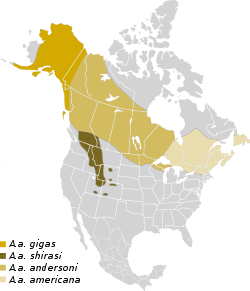 In North America
, the moose range includes almost all of Canada
(excluding the arctic
), most of Alaska
, northern New England
and upstate New York, the upper Rocky Mountains
, northeastern Minnesota
, Michigan
's Upper Peninsula, and Isle Royale
in Lake Superior
. Within this massive range, the most diverse range of subspecies exist, containing habitat for four of the six subspecies. In western portions of the continent, moose populations extend well north into Canada (British Columbia and Alberta) and more isolated groups have been verified as far south as the mountains of Utah
and Colorado
and as far west as the Lake Wenatchee area of the Washington Cascades. In 1978, a few breeding pairs were reintroduced in western Colorado, and the state's moose population is now more than 1,000 with great potential to grow.
In Northeastern North America, the Eastern moose's
history is very well documented: moose meat was often a staple in the diet of Native Americans going back centuries and it is a tribe that occupied present day coastal Rhode Island
that gave this deer its distinctive name in American English
. The Native Americans often used moose hides for leather and its meat as an ingredient in pemmican, a type of dried jerky used as a source of sustenance in winter or on long journeys from home. Eastern tribes also valued moose leather as a source to make moccasins and other decorations.
The historical range of the subspecies extended from well into Quebec, the Maritimes, and Eastern Ontario south to include all of New England finally ending in the very northeastern tip of Pennsylvania
in the west, cutting off somewhere near the mouth of the Hudson River
in the east. Within the eastern U.S. it has up until recently been extirpated for up to a hundred fifty years or more, due to colonial era overhunting and destruction of its habitat: Dutch, French, and British colonial sources all attest to its presence in the mid 17th century from Maine south to areas within a hundred miles of present day Manhattan. However, by the 1870s, only a handful of them existed in this entire region in very remote pockets of forest; less than 20% of suitable habitat remained.
Between the 1980s to 2010s, however, this has changed dramatically, predicated on the regrowth of plentiful food sources, abandonment of farmland, better land management, cleanup of pollution and natural dispersal from the Canadian Maritimes and Quebec
. South of the Canadian border Maine
has the most of the population with a current headcount of about 30,000 moose and dispersals from Maine over the years have resulted in healthy, growing populations each in Vermont
and New Hampshire
, notably near bodies of water and as high up as 3,000 feet above sea level in the mountains. In turn dispersals from northern New England have resulted in a growing population of roughly 1,000 moose in Massachusetts
(where it has been absent since the early 18th century) plus reports of new dispersals to eastern New York
, Rhode Island
, and Connecticut
.
Moose were successfully introduced on Newfoundland in 1878 and 1904 where they are now the dominant ungulate
, and somewhat less successfully on Anticosti Island
in the Gulf of St. Lawrence.
, moose are currently found in large numbers throughout Norway
, Sweden
, Finland
, Poland
, and the Baltic States
, with more modest numbers in the southern Czech Republic
, Belarus
and northern Ukraine
. They are also widespread through Russia
on up through the borders with Finland south towards the border with Estonia, Belarus and Ukraine and stretching far away eastwards to the Yenisei River
in Siberia
. The European moose was native to most temperate areas that it could physically inhabit on the continent and even Scotland
from the end of the last Ice Age as Europe's traditional habitat had a natural mix of temperate boreal and deciduous forest. It was certainly thriving in both Gaul and Magna Germania as it appears in military and hunting accounts of the age. However, as the Roman era faded into medieval times, the beast slowly disappeared: it survived in Alsace
and the Netherlands
until the 9th century as the marshlands in the latter were drained and the forests were being cleared away for feudal lands in the former. It was gone from Switzerland by 1000 AD, gone from the western Czech Republic by 1300, gone from Mecklenburg
in Germany by c. 1600, and has been gone from Hungary and the Caucasus since the 18th and 19th century respectively.
By the early 20th century the very last strongholds of the European moose appeared to be in Scandinavian countries and patchy tracts of Russia. The USSR and Poland managed to restore portions of the range within its borders (such as the 1951 reintroduction into Kampinos National Park
and the later 1958 reintroduction in Belarus) but political complications obviously limited its ability to be reintroduced to other portions of its range. Attempts in 1930 and again in 1967 in marshland north of Berlin were unsuccessful. At present in Poland populations are recorded in the Biebrza river valley, Kampinos, and in Białowieża National Park. Overall it is recorded as a migrant into other parts of Eastern Europe and has been spotted in Eastern and Southern Germany. Unsuccessful thus far in recolonizing these areas via natural dispersal from source populations in Poland
, Belarus
, Ukraine
, Czech Republic
and Slovakia
, it appears to be having more success migrating south into the Caucasus
. It is listed under Appendix III of the Bern Convention.
In 2008, two moose were reintroduced into the Scottish Highlands
in Alladale Wilderness Reserve.
in 1910. The last proven sighting of a moose in New Zealand was in 1952. A moose antler was found in 1972 and DNA tests showed that hair collected in 2002 was from a moose. Extensive searching has been carried out and while automated cameras failed to capture photographs, evidence was seen of bedding spots, browsing and antler marks.
Finland: In 2009, there was a summer population of 115,000 moose.
Sweden: The summer population is 300,000–400,000 moose. 100,000 are shot each fall.
Norway: In 2007, there were some 120,000 moose.
Canada: There are an estimated 500,000 to 1,000,000 moose with 150,000 in Newfoundland in 2007 descended from just four that were introduced in the 1900s.
United States: probably around 300,000, as follows:
and is capable of consuming many types of plant or fruit. The average adult moose needs to consume 9770 Calories per day to maintain its body weight. Much of a moose's energy is derived from terrestrial vegetation, mainly consisting of forbs and other non-grasses, and fresh shoots from trees such as willow
and birch
. These plants are rather low in sodium, and moose generally need to consume a good quantity of aquatic plants. While much lower in energy, these plants provide the moose with its sodium requirements, and as much as half of their diet usually consists of aquatic plant life. In winter, moose are often drawn to roadways, to lick salt that is used as a snow and ice melter. A typical moose, weighing 360 kilograms, can eat up to 32 kg of food per day.
Moose lack upper front teeth, but have eight sharp incisors on the lower jaw. They also have a tough tongue, lips and gums, which aid in the eating of woody vegetation. Moose have six pairs of molars and, ahead of those, six pairs of premolars, to grind up their food. A moose's diet often depends on its location, but they seem to prefer the new growths from trees such as white birch, trembling aspen
and striped maple
, among many others. Many aquatic plants include lilies
and pondweed
. Moose are excellent swimmers and are known to wade into water to eat aquatic plants. In non polar regions this trait serves a second purpose in cooling down the moose on summer days and ridding itself of black flies. Moose are thus attracted to marshes and river banks during warmer months as both provide suitable vegetation to eat and water to wet themselves in.
In the North Siberian elk (A. a. bedfordiae), the posterior division of the main fork divides into three tines, with no distinct flattening. In the common elk (A. a. alces) this branch usually expands into a broad palmation, with one large tine at the base, and a number of smaller snags on the free border. There is, however, a Scandinavia
n breed of the common elk in which the antlers are simpler, and recall those of the East Siberian animals.
The palmation appears to be more marked in North American moose (A. a. americanus) than in the typical Scandinavian elk.
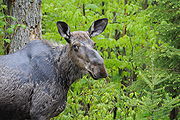 The male will drop its antlers after the mating season and conserve energy for the winter. A new set of antlers will then regrow in the spring. Antlers take three to five months to fully develop, making them one of the fastest growing animal organs. They initially have a layer of skin, called "velvet," which is shed once the antlers become fully grown. Immature bulls may not shed their antlers for the winter, but retain them until the following spring.
If a bull moose is castrated, either by accidental or chemical means, he will quickly shed his current set of antlers and then immediately begin to grow a new set of misshapen and deformed antlers that he will wear the rest of his life without ever shedding again. The distinctive looking appendages (often referred to as "devil's antlers") are the source of several myths and legends among many groups of Inuit
as well as several other tribes of indigenous peoples of North America.
In extremely rare circumstances a cow moose may grow antlers. This is usually attributed to a hormone imbalance.
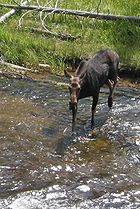 On average, an adult moose stands 1.8–2.1 m (6–7 ft) high at the shoulder. Males weigh 380–720 kg (850–1580 pound
s) and females weigh 270–360 kg (600–800 pounds). The largest of all is the Alaskan subspecies (A. a. gigas), which can stand over 2.1 m (7 ft) at the shoulder, has a span across the antlers of 1.8 m (6 ft) and averages 634.5 kg (1,396 lbs) in males and 478 kg (1,052 lbs) in females. Typically, however, the antlers of a mature specimen are between 1.2 m (3.9 ft) and 1.5 m (4.9 ft). The largest confirmed size for this species was a bull shot at the Yukon River
in September 1897 weighing 820 kg (1,800 lb) and was 233 cm (92 in) tall at the shoulder. The Moose of Alaska matches the extinct Irish Elk
as the largest deer of all time. Behind only the bison
, the Moose is the second largest land animal in both North America
and Europe
. The life span of an average moose is about 15–25 years.
Mating occurs in September and October. The males are polygamous and will seek several females to breed with. During this times both sexes will call to each other. Males produce heavy grunting sounds that can be heard from up to 500 meters away, while females produce wail-like sounds. Males will fight for access to females. They either assess which is larger, with the smaller bull retreating, or they may engage in battles, usually only involving the antlers.
Female moose have an eight-month gestation period, usually bearing one calf, or twins if food is plentiful, in May or June. Newborn moose have fur with a reddish hue in contrast to the brown appearance of an adult. The young will stay with the mother until just before the next young are born.
s and wolves combined, but usually with only minor consequences. When harassed or startled by people or in the presence of a dog
, moose may charge. Also, as with bears or any wild animal, moose that have become habituated to being fed by people may act aggressively when denied food. During the fall mating season, bull moose may be aggressive toward humans due to the high hormone levels they experience. Cows with young calves are very protective and will attack humans who come too close, especially if they come between mother and calf. Unlike other dangerous animals, moose are not territorial, and do not view humans as food, and will therefore usually not pursue humans if they simply run away. Like any wild animal, moose are unpredictable and should be given a respectful amount of space.
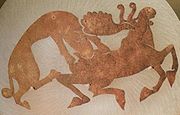
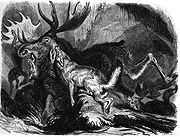 A full-grown moose has few enemies, but a pack of wolves can still pose a threat, especially to females with calves. Siberian Tigers and Brown bear
are also known to prey on moose, although bears are more likely to take over a wolf kill or to take young moose than to hunt adult moose on their own. American black bear
s and cougars can be significant predators of moose calves in May and June. Killer Whales are the moose's only known marine predator as they have been known to prey on them when swimming between islands out of North America's Northwest Coast.
In some areas, moose are the primary source of food for wolves. Moose usually flee upon detecting wolves. Wolves usually follow moose at a distance of 100 to 400 m (328.1 to 1,312.3 ), occasionally at a distance of 2 to 3 km (1.2 to 1.9 ). Attacks from wolves against young moose may last seconds, though sometimes they can be drawn out for days with adults. Sometimes, wolves will chase moose into shallow streams or onto frozen rivers, where their mobility is greatly impeded. Moose will sometimes stand their ground and defend themselves by charging at the wolves or lashing out at them with their powerful hooves. Wolves typically kill moose by tearing at their haunches and perineum
, causing massive blood loss. Occasionally, a wolf may immobilise a moose by biting its sensitive nose, the pain of which can paralyze
a moose. Wolf packs primarily target calves and elderly animals, but can and will take healthy, adult moose. Moose between the ages of two and eight are rarely killed by wolves. Though moose are usually hunted by packs, there are cases in which single wolves have successfully killed moose.
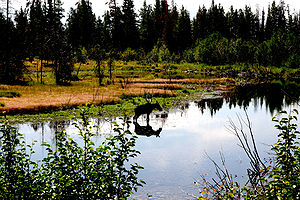 European rock drawings and cave painting
s reveal that moose have been hunted since the Stone Age
. Excavations in Alby, Sweden
, adjacent to the Stora Alvaret
have yielded elk antlers in wooden hut remains from 6000 BC, indicating some of the earliest elk hunting in northern Europe. In northern Scandinavia one can still find remains of trapping pit
s used for hunting elk. These pits, which can be up to 4 × 7 m wide and 2 m deep, would have been camouflaged with branches and leaves. They would have had steep sides lined with planks, making it impossible for the elk to escape once it fell in. The pits are normally found in large groups, crossing the elk's regular paths and stretching over several kilometres. Remains of wooden fences designed to guide the animals toward the pits have been found in bogs and peat. In Norway, an early example of these trapping devices has been dated to around 3,700 BC. Trapping elk in pits is an extremely effective hunting method, and as early as the 16th century the Norwegian government tried to restrict their use. Nevertheless, the method was in use until the 19th century.
The earliest recorded description of the elk is in Julius Caesar
's Commentarii de Bello Gallico
, where it is described thus:
In book 8, chapter 16 of Pliny the Elder
's Natural History from 77 AD the elk and an animal called achlis, which is presumably the same animal, are described thus:
species in many of the countries where they are found. Moose meat tastes, wrote Henry David Thoreau
in “The Maine Woods”, “like tender beef, with perhaps more flavour; sometimes like veal
”. While the flesh has protein
levels similar to other comparable red meat
s (e.g. beef
, deer
and elk
) it has a low fat
content and the fat that is found is made up of a higher proportion of polyunsaturated fat
s (rather than saturated fat
s).
Cadmium
levels are high in Finnish elk liver
and kidneys, with the result that consumption of these organs from elk more than one year old is prohibited in Finland. Cadmium intake has been found to be elevated amongst all consumers of elk meat, though the elk meat was found to contribute only slightly to the daily cadmium intake. However the consumption of moose liver or kidneys significantly increased cadmium intake, with the study revealing that heavy consumers of moose organs have a relatively narrow safety margin below the levels which would probably cause adverse health effects.
Dr. Valerius Geist, who emigrated to Canada from the Soviet Union, wrote in his 1999 book Moose: Behaviour, Ecology, Conservation:
Boosting of moose populations in Alaska for hunting purposes is one of the reasons given for allowing aerial or airborne methods to remove wolves in designated areas, e.g., Craig Medred: "A kill of 124 wolves would thus translate to [the survival of] 1488 moose or 2976 caribou or some combination thereof". Many scientists believe that this artificial inflation of game populations is actually detrimental to both caribou and moose populations as well as the ecosystem as a whole. This is because studies have shown that when these game populations are artificially boosted, it leads to both habitat destruction and a crash in these populations
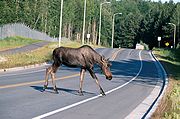 A moose's body structure, with a large heavy body suspended on long spindly legs, makes these animals particularly dangerous when hit by passenger cars with low ground clearances. Generally, when colliding with a moose at high speed, the car's bumper and front grille will break the moose's legs, causing the body of the moose to fall onto the car's hood and delivering the bulk of the animal's weight into the windshield
, crushing the front roof support beams and anyone in the front seats. Collisions of this type are frequently lethal; seatbelts offer no protection, and airbag
s may not deploy or be of much use if they do. Although vehicles with higher clearances (such as trucks) are typically immune from this effect, the force of striking any 270+ kg (600+ pound) object at high speed should not be underestimated. These risks led to the development of a vehicle test referred to as the "moose test
" .
Moose warning signs are used on roads in regions where there is a danger of collision with the animal. The triangular warning signs common in Sweden, Norway, and Finland have become coveted souvenirs among tourists traveling in these countries, causing the road authorities so much expense that the moose signs have been replaced with image-less generic warning signs in some regions.
Norwegian newspaper Aftenposten
estimated in January 2008 that some 13,000 moose had died in collisions with Norwegian trains since 2000. The state agency in charge of railroad infrastructure (Jernbaneverket) plans to spend 80 million Norwegian kroner to reduce collision rate in the future by fencing the railways, clearing vegetation from near the tracks, and providing alternative snow-free feeding places for the animals elsewhere.
In the Canadian province of New Brunswick
, collisions with moose are frequent enough that all new highways have fences to prevent moose from accessing the road, similar to how it has long been done in Finland, Norway, and Sweden. Demonstratively, Highway 7 between Fredericton and Saint John
, which has one of the highest frequencies of moose collisions in the province, did not have these fences until 2008, although it was and continues to be extremely well signed. In Newfoundland and Labrador
, it is recommended to motorists to use caution between dusk and dawn, because that is when moose are most active and most difficult to see, increasing the risk of collisions. Local moose sightings are often reported on radio stations so that motorists can take care while driving in particular areas.
In Sweden a fence will not be placed unless the road meets the minimum requirement of one accident, involving a moose, per kilometre road and year.
before World War II
. Early experiments were inconclusive, but with the creation of a moose farm at Pechora-Ilych Nature Reserve
in 1949 a small-scale moose domestication program was started, involving attempts at selective breeding
of animals based on their behavioural characteristics. Since 1963, the programme has continued at Kostroma Moose Farm
, which had a herd of 33 tame
moose as of 2003. Although at this stage the farm is not expected to be a profit-making enterprise, it obtains some income from the sale of moose milk and from visiting tourist groups. Its main value, however, is seen in the opportunities it offers for the research in the physiology
and behaviour of the moose, as well as in the insights it provides into the general principles of animal domestication
.
In Sweden there was a debate in the late 18th century about the national value of using the moose as a domestic animal. Among other things, the moose was proposed to be used in postal distribution, and there was a suggestion to develop a moose-mounted cavalry. Such proposals remained unimplemented, mainly because the extensive hunting for moose nearly drove it to extinction and because of moose aggressiveness during the rutting period.
Species
In biology, a species is one of the basic units of biological classification and a taxonomic rank. A species is often defined as a group of organisms capable of interbreeding and producing fertile offspring. While in many cases this definition is adequate, more precise or differing measures are...
in the deer
Deer
Deer are the ruminant mammals forming the family Cervidae. Species in the Cervidae family include white-tailed deer, elk, moose, red deer, reindeer, fallow deer, roe deer and chital. Male deer of all species and female reindeer grow and shed new antlers each year...
family
Family (biology)
In biological classification, family is* a taxonomic rank. Other well-known ranks are life, domain, kingdom, phylum, class, order, genus, and species, with family fitting between order and genus. As for the other well-known ranks, there is the option of an immediately lower rank, indicated by the...
. Moose are distinguished by the palmate antler
Antler
Antlers are the usually large, branching bony appendages on the heads of most deer species.-Etymology:Antler originally meant the lowest tine, the "brow tine"...
s of the males; other members of the family have antlers with a dendritic
Dendrite (mathematics)
In topology, a locally connected dendroid is called a dendrite. Equivalently a dendrite is a locally connected continuum that contains no simple closed curves....
("twig-like") configuration. Moose typically inhabit boreal and mixed deciduous forests
Temperate broadleaf and mixed forests
Mixed forests are a temperate and humid biome. The typical structure of these forests includes four layers. The uppermost layer is the canopy composed of tall mature trees ranging from 33 to 66 m high. Below the canopy is the three-layered, shade-tolerant understory that is roughly 9 to...
of the Northern Hemisphere
Northern Hemisphere
The Northern Hemisphere is the half of a planet that is north of its equator—the word hemisphere literally means “half sphere”. It is also that half of the celestial sphere north of the celestial equator...
in temperate
Temperate
In geography, temperate or tepid latitudes of the globe lie between the tropics and the polar circles. The changes in these regions between summer and winter are generally relatively moderate, rather than extreme hot or cold...
to subarctic
Subarctic climate
The subarctic climate is a climate characterized by long, usually very cold winters, and short, cool to mild summers. It is found on large landmasses, away from the moderating effects of an ocean, generally at latitudes from 50° to 70°N poleward of the humid continental climates...
climates. Moose used to have a much wider range but hunting and other human activities greatly reduced it over the years. Moose have been re-introduced to some of their former habitats. Their diet consists of both terrestrial and aquatic vegetation. The most common moose predators are wolves, bears, and humans. Unlike most other deer species, moose are solitary animals and do not form herds. Although generally slow-moving and sedentary, moose can become aggressive and move surprisingly fast if angered or startled. Their mating season in the autumn can lead to spectacular fights between males competing for the right to mate with a particular female.
Etymology and naming
The animal bearing the scientific name Alces alces is known in Britain as the elk, and in North AmericaNorth America
North America is a continent wholly within the Northern Hemisphere and almost wholly within the Western Hemisphere. It is also considered a northern subcontinent of the Americas...
as the moose.
The British English
British English
British English, or English , is the broad term used to distinguish the forms of the English language used in the United Kingdom from forms used elsewhere...
word elk has cognates in other Indo-European
Indo-European languages
The Indo-European languages are a family of several hundred related languages and dialects, including most major current languages of Europe, the Iranian plateau, and South Asia and also historically predominant in Anatolia...
languages, for example elg in Norwegian
Norwegian language
Norwegian is a North Germanic language spoken primarily in Norway, where it is the official language. Together with Swedish and Danish, Norwegian forms a continuum of more or less mutually intelligible local and regional variants .These Scandinavian languages together with the Faroese language...
, älg in Swedish
Swedish language
Swedish is a North Germanic language, spoken by approximately 10 million people, predominantly in Sweden and parts of Finland, especially along its coast and on the Åland islands. It is largely mutually intelligible with Norwegian and Danish...
, Elch in German
German language
German is a West Germanic language, related to and classified alongside English and Dutch. With an estimated 90 – 98 million native speakers, German is one of the world's major languages and is the most widely-spoken first language in the European Union....
and łoś in Polish
Polish language
Polish is a language of the Lechitic subgroup of West Slavic languages, used throughout Poland and by Polish minorities in other countries...
. Confusingly, the word elk is used in North America to refer to a different animal, Cervus canadensis, also known as the wapiti which is similar though slightly smaller (the wapiti is the second largest deer
Deer
Deer are the ruminant mammals forming the family Cervidae. Species in the Cervidae family include white-tailed deer, elk, moose, red deer, reindeer, fallow deer, roe deer and chital. Male deer of all species and female reindeer grow and shed new antlers each year...
species), and behaviorally divergent from the smaller red deer
Red Deer
The red deer is one of the largest deer species. Depending on taxonomy, the red deer inhabits most of Europe, the Caucasus Mountains region, Asia Minor, parts of western Asia, and central Asia. It also inhabits the Atlas Mountains region between Morocco and Tunisia in northwestern Africa, being...
of central and western Europe. Presumably early European explorers in North America called it elk because of its size and presumably because, as men coming from the British Isles they would have had no opportunity to see the difference between a member of the genus Cervus and an animal fitting the description of Alces at home, where the latter was nowhere present in the 17th and 18th century.
The word "moose" first entered English by 1606, and is a borrowing from Algonquian languages
Algonquian languages
The Algonquian languages also Algonkian) are a subfamily of Native American languages which includes most of the languages in the Algic language family. The name of the Algonquian language family is distinguished from the orthographically similar Algonquin dialect of the Ojibwe language, which is a...
(compare Narragansett
Narragansett language
Narragansett is an extinct Algonquian language formerly spoken in most of what is today Rhode Island by the Narragansett people. It was closely related to the other Algonquian languages of southern New England like Massachusett and Mohegan-Pequot...
moos and Eastern Abenaki mos, according to early sources likely derived from moosu meaning "he strips off"), possibly involving forms from multiple languages mutually reinforcing one another. The Proto-Algonquian
Proto-Algonquian language
Proto-Algonquian is the name given to the proto-language from which the various languages of the Algonquian family are descended. It is generally estimated to have been spoken around 2,500 to 3,000 years ago, but on the question of where it was spoken there is less agreement...
form was *mo·swa.
A mature male moose is called a bull moose, a mature female moose is called a cow moose, and an immature moose of either sex is called a (moose) calf.
North America
North America
North America is a continent wholly within the Northern Hemisphere and almost wholly within the Western Hemisphere. It is also considered a northern subcontinent of the Americas...
, the moose range includes almost all of Canada
Canada
Canada is a North American country consisting of ten provinces and three territories. Located in the northern part of the continent, it extends from the Atlantic Ocean in the east to the Pacific Ocean in the west, and northward into the Arctic Ocean...
(excluding the arctic
Arctic
The Arctic is a region located at the northern-most part of the Earth. The Arctic consists of the Arctic Ocean and parts of Canada, Russia, Greenland, the United States, Norway, Sweden, Finland, and Iceland. The Arctic region consists of a vast, ice-covered ocean, surrounded by treeless permafrost...
), most of Alaska
Alaska
Alaska is the largest state in the United States by area. It is situated in the northwest extremity of the North American continent, with Canada to the east, the Arctic Ocean to the north, and the Pacific Ocean to the west and south, with Russia further west across the Bering Strait...
, northern New England
New England
New England is a region in the northeastern corner of the United States consisting of the six states of Maine, New Hampshire, Vermont, Massachusetts, Rhode Island, and Connecticut...
and upstate New York, the upper Rocky Mountains
Rocky Mountains
The Rocky Mountains are a major mountain range in western North America. The Rocky Mountains stretch more than from the northernmost part of British Columbia, in western Canada, to New Mexico, in the southwestern United States...
, northeastern Minnesota
Minnesota
Minnesota is a U.S. state located in the Midwestern United States. The twelfth largest state of the U.S., it is the twenty-first most populous, with 5.3 million residents. Minnesota was carved out of the eastern half of the Minnesota Territory and admitted to the Union as the thirty-second state...
, Michigan
Michigan
Michigan is a U.S. state located in the Great Lakes Region of the United States of America. The name Michigan is the French form of the Ojibwa word mishigamaa, meaning "large water" or "large lake"....
's Upper Peninsula, and Isle Royale
Isle Royale
Isle Royale is an island of the Great Lakes, located in the northwest of Lake Superior, and part of the state of Michigan. The island and the 450 surrounding smaller islands and waters make up Isle Royale National Park....
in Lake Superior
Lake Superior
Lake Superior is the largest of the five traditionally-demarcated Great Lakes of North America. It is bounded to the north by the Canadian province of Ontario and the U.S. state of Minnesota, and to the south by the U.S. states of Wisconsin and Michigan. It is the largest freshwater lake in the...
. Within this massive range, the most diverse range of subspecies exist, containing habitat for four of the six subspecies. In western portions of the continent, moose populations extend well north into Canada (British Columbia and Alberta) and more isolated groups have been verified as far south as the mountains of Utah
Utah
Utah is a state in the Western United States. It was the 45th state to join the Union, on January 4, 1896. Approximately 80% of Utah's 2,763,885 people live along the Wasatch Front, centering on Salt Lake City. This leaves vast expanses of the state nearly uninhabited, making the population the...
and Colorado
Colorado
Colorado is a U.S. state that encompasses much of the Rocky Mountains as well as the northeastern portion of the Colorado Plateau and the western edge of the Great Plains...
and as far west as the Lake Wenatchee area of the Washington Cascades. In 1978, a few breeding pairs were reintroduced in western Colorado, and the state's moose population is now more than 1,000 with great potential to grow.
In Northeastern North America, the Eastern moose's
Eastern Moose
The Eastern Moose is a subspecies of Moose that ranges from Eastern Ontario, all of Quebec, all of the Maritime Provinces including New Brunswick, Nova Scotia, Prince Edward Island,and Newfoundland and Labrador. It also ranges in the United States in Maine, New Hampshire, Vermont, Massachusetts,...
history is very well documented: moose meat was often a staple in the diet of Native Americans going back centuries and it is a tribe that occupied present day coastal Rhode Island
Rhode Island
The state of Rhode Island and Providence Plantations, more commonly referred to as Rhode Island , is a state in the New England region of the United States. It is the smallest U.S. state by area...
that gave this deer its distinctive name in American English
American English
American English is a set of dialects of the English language used mostly in the United States. Approximately two-thirds of the world's native speakers of English live in the United States....
. The Native Americans often used moose hides for leather and its meat as an ingredient in pemmican, a type of dried jerky used as a source of sustenance in winter or on long journeys from home. Eastern tribes also valued moose leather as a source to make moccasins and other decorations.
The historical range of the subspecies extended from well into Quebec, the Maritimes, and Eastern Ontario south to include all of New England finally ending in the very northeastern tip of Pennsylvania
Pennsylvania
The Commonwealth of Pennsylvania is a U.S. state that is located in the Northeastern and Mid-Atlantic regions of the United States. The state borders Delaware and Maryland to the south, West Virginia to the southwest, Ohio to the west, New York and Ontario, Canada, to the north, and New Jersey to...
in the west, cutting off somewhere near the mouth of the Hudson River
Hudson River
The Hudson is a river that flows from north to south through eastern New York. The highest official source is at Lake Tear of the Clouds, on the slopes of Mount Marcy in the Adirondack Mountains. The river itself officially begins in Henderson Lake in Newcomb, New York...
in the east. Within the eastern U.S. it has up until recently been extirpated for up to a hundred fifty years or more, due to colonial era overhunting and destruction of its habitat: Dutch, French, and British colonial sources all attest to its presence in the mid 17th century from Maine south to areas within a hundred miles of present day Manhattan. However, by the 1870s, only a handful of them existed in this entire region in very remote pockets of forest; less than 20% of suitable habitat remained.
Between the 1980s to 2010s, however, this has changed dramatically, predicated on the regrowth of plentiful food sources, abandonment of farmland, better land management, cleanup of pollution and natural dispersal from the Canadian Maritimes and Quebec
Quebec
Quebec or is a province in east-central Canada. It is the only Canadian province with a predominantly French-speaking population and the only one whose sole official language is French at the provincial level....
. South of the Canadian border Maine
Maine
Maine is a state in the New England region of the northeastern United States, bordered by the Atlantic Ocean to the east and south, New Hampshire to the west, and the Canadian provinces of Quebec to the northwest and New Brunswick to the northeast. Maine is both the northernmost and easternmost...
has the most of the population with a current headcount of about 30,000 moose and dispersals from Maine over the years have resulted in healthy, growing populations each in Vermont
Vermont
Vermont is a state in the New England region of the northeastern United States of America. The state ranks 43rd in land area, , and 45th in total area. Its population according to the 2010 census, 630,337, is the second smallest in the country, larger only than Wyoming. It is the only New England...
and New Hampshire
New Hampshire
New Hampshire is a state in the New England region of the northeastern United States of America. The state was named after the southern English county of Hampshire. It is bordered by Massachusetts to the south, Vermont to the west, Maine and the Atlantic Ocean to the east, and the Canadian...
, notably near bodies of water and as high up as 3,000 feet above sea level in the mountains. In turn dispersals from northern New England have resulted in a growing population of roughly 1,000 moose in Massachusetts
Massachusetts
The Commonwealth of Massachusetts is a state in the New England region of the northeastern United States of America. It is bordered by Rhode Island and Connecticut to the south, New York to the west, and Vermont and New Hampshire to the north; at its east lies the Atlantic Ocean. As of the 2010...
(where it has been absent since the early 18th century) plus reports of new dispersals to eastern New York
New York
New York is a state in the Northeastern region of the United States. It is the nation's third most populous state. New York is bordered by New Jersey and Pennsylvania to the south, and by Connecticut, Massachusetts and Vermont to the east...
, Rhode Island
Rhode Island
The state of Rhode Island and Providence Plantations, more commonly referred to as Rhode Island , is a state in the New England region of the United States. It is the smallest U.S. state by area...
, and Connecticut
Connecticut
Connecticut is a state in the New England region of the northeastern United States. It is bordered by Rhode Island to the east, Massachusetts to the north, and the state of New York to the west and the south .Connecticut is named for the Connecticut River, the major U.S. river that approximately...
.
Moose were successfully introduced on Newfoundland in 1878 and 1904 where they are now the dominant ungulate
Ungulate
Ungulates are several groups of mammals, most of which use the tips of their toes, usually hoofed, to sustain their whole body weight while moving. They make up several orders of mammals, of which six to eight survive...
, and somewhat less successfully on Anticosti Island
Anticosti Island
Anticosti Island is an island at the outlet of the Saint Lawrence River into the Gulf of Saint Lawrence, in Quebec, Canada, between 49° and 50° N., and between 61° 40' and 64° 30' W. At in size, it is the 90th largest island in the world and 20th largest island in Canada...
in the Gulf of St. Lawrence.
Europe
In EuropeEurope
Europe is, by convention, one of the world's seven continents. Comprising the westernmost peninsula of Eurasia, Europe is generally 'divided' from Asia to its east by the watershed divides of the Ural and Caucasus Mountains, the Ural River, the Caspian and Black Seas, and the waterways connecting...
, moose are currently found in large numbers throughout Norway
Norway
Norway , officially the Kingdom of Norway, is a Nordic unitary constitutional monarchy whose territory comprises the western portion of the Scandinavian Peninsula, Jan Mayen, and the Arctic archipelago of Svalbard and Bouvet Island. Norway has a total area of and a population of about 4.9 million...
, Sweden
Sweden
Sweden , officially the Kingdom of Sweden , is a Nordic country on the Scandinavian Peninsula in Northern Europe. Sweden borders with Norway and Finland and is connected to Denmark by a bridge-tunnel across the Öresund....
, Finland
Finland
Finland , officially the Republic of Finland, is a Nordic country situated in the Fennoscandian region of Northern Europe. It is bordered by Sweden in the west, Norway in the north and Russia in the east, while Estonia lies to its south across the Gulf of Finland.Around 5.4 million people reside...
, Poland
Poland
Poland , officially the Republic of Poland , is a country in Central Europe bordered by Germany to the west; the Czech Republic and Slovakia to the south; Ukraine, Belarus and Lithuania to the east; and the Baltic Sea and Kaliningrad Oblast, a Russian exclave, to the north...
, and the Baltic States
Baltic states
The term Baltic states refers to the Baltic territories which gained independence from the Russian Empire in the wake of World War I: primarily the contiguous trio of Estonia, Latvia, Lithuania ; Finland also fell within the scope of the term after initially gaining independence in the 1920s.The...
, with more modest numbers in the southern Czech Republic
Czech Republic
The Czech Republic is a landlocked country in Central Europe. The country is bordered by Poland to the northeast, Slovakia to the east, Austria to the south, and Germany to the west and northwest....
, Belarus
Belarus
Belarus , officially the Republic of Belarus, is a landlocked country in Eastern Europe, bordered clockwise by Russia to the northeast, Ukraine to the south, Poland to the west, and Lithuania and Latvia to the northwest. Its capital is Minsk; other major cities include Brest, Grodno , Gomel ,...
and northern Ukraine
Ukraine
Ukraine is a country in Eastern Europe. It has an area of 603,628 km², making it the second largest contiguous country on the European continent, after Russia...
. They are also widespread through Russia
Russia
Russia or , officially known as both Russia and the Russian Federation , is a country in northern Eurasia. It is a federal semi-presidential republic, comprising 83 federal subjects...
on up through the borders with Finland south towards the border with Estonia, Belarus and Ukraine and stretching far away eastwards to the Yenisei River
Yenisei River
Yenisei , also written as Yenisey, is the largest river system flowing to the Arctic Ocean. It is the central of the three great Siberian rivers that flow into the Arctic Ocean...
in Siberia
Siberia
Siberia is an extensive region constituting almost all of Northern Asia. Comprising the central and eastern portion of the Russian Federation, it was part of the Soviet Union from its beginning, as its predecessor states, the Tsardom of Russia and the Russian Empire, conquered it during the 16th...
. The European moose was native to most temperate areas that it could physically inhabit on the continent and even Scotland
Scotland
Scotland is a country that is part of the United Kingdom. Occupying the northern third of the island of Great Britain, it shares a border with England to the south and is bounded by the North Sea to the east, the Atlantic Ocean to the north and west, and the North Channel and Irish Sea to the...
from the end of the last Ice Age as Europe's traditional habitat had a natural mix of temperate boreal and deciduous forest. It was certainly thriving in both Gaul and Magna Germania as it appears in military and hunting accounts of the age. However, as the Roman era faded into medieval times, the beast slowly disappeared: it survived in Alsace
Alsace
Alsace is the fifth-smallest of the 27 regions of France in land area , and the smallest in metropolitan France. It is also the seventh-most densely populated region in France and third most densely populated region in metropolitan France, with ca. 220 inhabitants per km²...
and the Netherlands
Netherlands
The Netherlands is a constituent country of the Kingdom of the Netherlands, located mainly in North-West Europe and with several islands in the Caribbean. Mainland Netherlands borders the North Sea to the north and west, Belgium to the south, and Germany to the east, and shares maritime borders...
until the 9th century as the marshlands in the latter were drained and the forests were being cleared away for feudal lands in the former. It was gone from Switzerland by 1000 AD, gone from the western Czech Republic by 1300, gone from Mecklenburg
Mecklenburg
Mecklenburg is a historical region in northern Germany comprising the western and larger part of the federal-state Mecklenburg-Vorpommern...
in Germany by c. 1600, and has been gone from Hungary and the Caucasus since the 18th and 19th century respectively.
By the early 20th century the very last strongholds of the European moose appeared to be in Scandinavian countries and patchy tracts of Russia. The USSR and Poland managed to restore portions of the range within its borders (such as the 1951 reintroduction into Kampinos National Park
Kampinos National Park
Kampinos National Park is a National Park in east-central Poland, in Masovian Voivodeship, on the north-west outskirts of Warsaw. It has a sister park agreement with Indiana Dunes National Lakeshore, Indiana, United States....
and the later 1958 reintroduction in Belarus) but political complications obviously limited its ability to be reintroduced to other portions of its range. Attempts in 1930 and again in 1967 in marshland north of Berlin were unsuccessful. At present in Poland populations are recorded in the Biebrza river valley, Kampinos, and in Białowieża National Park. Overall it is recorded as a migrant into other parts of Eastern Europe and has been spotted in Eastern and Southern Germany. Unsuccessful thus far in recolonizing these areas via natural dispersal from source populations in Poland
Poland
Poland , officially the Republic of Poland , is a country in Central Europe bordered by Germany to the west; the Czech Republic and Slovakia to the south; Ukraine, Belarus and Lithuania to the east; and the Baltic Sea and Kaliningrad Oblast, a Russian exclave, to the north...
, Belarus
Belarus
Belarus , officially the Republic of Belarus, is a landlocked country in Eastern Europe, bordered clockwise by Russia to the northeast, Ukraine to the south, Poland to the west, and Lithuania and Latvia to the northwest. Its capital is Minsk; other major cities include Brest, Grodno , Gomel ,...
, Ukraine
Ukraine
Ukraine is a country in Eastern Europe. It has an area of 603,628 km², making it the second largest contiguous country on the European continent, after Russia...
, Czech Republic
Czech Republic
The Czech Republic is a landlocked country in Central Europe. The country is bordered by Poland to the northeast, Slovakia to the east, Austria to the south, and Germany to the west and northwest....
and Slovakia
Slovakia
The Slovak Republic is a landlocked state in Central Europe. It has a population of over five million and an area of about . Slovakia is bordered by the Czech Republic and Austria to the west, Poland to the north, Ukraine to the east and Hungary to the south...
, it appears to be having more success migrating south into the Caucasus
Caucasus
The Caucasus, also Caucas or Caucasia , is a geopolitical region at the border of Europe and Asia, and situated between the Black and the Caspian sea...
. It is listed under Appendix III of the Bern Convention.
In 2008, two moose were reintroduced into the Scottish Highlands
Scottish Highlands
The Highlands is an historic region of Scotland. The area is sometimes referred to as the "Scottish Highlands". It was culturally distinguishable from the Lowlands from the later Middle Ages into the modern period, when Lowland Scots replaced Scottish Gaelic throughout most of the Lowlands...
in Alladale Wilderness Reserve.
New Zealand
In 1900 an attempt to introduce moose into the Hokitika area failed and ten moose, four bulls and six cows, were introduced into FiordlandFiordland
Fiordland is a geographic region of New Zealand that is situated on the south-western corner of the South Island, comprising the western-most third of Southland. Most of Fiordland is dominated by the steep sides of the snow-capped Southern Alps, deep lakes and its ocean-flooded, steep western valleys...
in 1910. The last proven sighting of a moose in New Zealand was in 1952. A moose antler was found in 1972 and DNA tests showed that hair collected in 2002 was from a moose. Extensive searching has been carried out and while automated cameras failed to capture photographs, evidence was seen of bedding spots, browsing and antler marks.
Populations
Russia: In 2008, there were approximately 730,000 moose.Finland: In 2009, there was a summer population of 115,000 moose.
Sweden: The summer population is 300,000–400,000 moose. 100,000 are shot each fall.
Norway: In 2007, there were some 120,000 moose.
Canada: There are an estimated 500,000 to 1,000,000 moose with 150,000 in Newfoundland in 2007 descended from just four that were introduced in the 1900s.
United States: probably around 300,000, as follows:
- Northeast: A wildlife ecologist estimated 50,000 in New York State and New England in 2007.
- Upper Midwest: Michigan estimated 433 (in its Upper Peninsula) in 2011, Wisconsin Department of Natural Resources 20-40 (close to its UP border with Michigan) in 2003, Minnesota 5600 in its northeast in 2010, and under 100 in its northwest in 2009; North Dakota closed, due to low moose population, one of its moose-hunting (geographic) units in 2011, and issued 162 single-kill licenses to hunters, each restricted to one of the remaining nine units.
- Rocky Mountain states: Wyoming is said to have the largest share in its 6-state region, and its Fish and Game Commission estimated 7,692 in 2009.
- Alaska: The state's Department of Fish and Game estimated 200,000 in 2011.
Subspecies
Eurasian Elk.jpg) |
A. a. alces | Finland Finland Finland , officially the Republic of Finland, is a Nordic country situated in the Fennoscandian region of Northern Europe. It is bordered by Sweden in the west, Norway in the north and Russia in the east, while Estonia lies to its south across the Gulf of Finland.Around 5.4 million people reside... , Sweden Sweden Sweden , officially the Kingdom of Sweden , is a Nordic country on the Scandinavian Peninsula in Northern Europe. Sweden borders with Norway and Finland and is connected to Denmark by a bridge-tunnel across the Öresund.... , Norway Norway Norway , officially the Kingdom of Norway, is a Nordic unitary constitutional monarchy whose territory comprises the western portion of the Scandinavian Peninsula, Jan Mayen, and the Arctic archipelago of Svalbard and Bouvet Island. Norway has a total area of and a population of about 4.9 million... , Estonia Estonia Estonia , officially the Republic of Estonia , is a state in the Baltic region of Northern Europe. It is bordered to the north by the Gulf of Finland, to the west by the Baltic Sea, to the south by Latvia , and to the east by Lake Peipsi and the Russian Federation . Across the Baltic Sea lies... , and Russia Russia Russia or , officially known as both Russia and the Russian Federation , is a country in northern Eurasia. It is a federal semi-presidential republic, comprising 83 federal subjects... . No longer present in central and western Europe except for Poland Poland Poland , officially the Republic of Poland , is a country in Central Europe bordered by Germany to the west; the Czech Republic and Slovakia to the south; Ukraine, Belarus and Lithuania to the east; and the Baltic Sea and Kaliningrad Oblast, a Russian exclave, to the north... , Lithuania Lithuania Lithuania , officially the Republic of Lithuania is a country in Northern Europe, the biggest of the three Baltic states. It is situated along the southeastern shore of the Baltic Sea, whereby to the west lie Sweden and Denmark... and Belarus Belarus Belarus , officially the Republic of Belarus, is a landlocked country in Eastern Europe, bordered clockwise by Russia to the northeast, Ukraine to the south, Poland to the west, and Lithuania and Latvia to the northwest. Its capital is Minsk; other major cities include Brest, Grodno , Gomel ,... , with a certain population in the Czech Republic Czech Republic The Czech Republic is a landlocked country in Central Europe. The country is bordered by Poland to the northeast, Slovakia to the east, Austria to the south, and Germany to the west and northwest.... , Slovakia Slovakia The Slovak Republic is a landlocked state in Central Europe. It has a population of over five million and an area of about . Slovakia is bordered by the Czech Republic and Austria to the west, Poland to the north, Ukraine to the east and Hungary to the south... and northern Ukraine Ukraine Ukraine is a country in Eastern Europe. It has an area of 603,628 km², making it the second largest contiguous country on the European continent, after Russia... , but can be observed in Bohemia Bohemia Bohemia is a historical region in central Europe, occupying the western two-thirds of the traditional Czech Lands. It is located in the contemporary Czech Republic with its capital in Prague... since the 1970s and a tiny reintroduced population in Scotland Scotland Scotland is a country that is part of the United Kingdom. Occupying the northern third of the island of Great Britain, it shares a border with England to the south and is bounded by the North Sea to the east, the Atlantic Ocean to the north and west, and the North Channel and Irish Sea to the... , Great Britain Great Britain Great Britain or Britain is an island situated to the northwest of Continental Europe. It is the ninth largest island in the world, and the largest European island, as well as the largest of the British Isles... . (Range formerly included France, Germany, Switzerland, and Benelux nations.) |
| Eastern Moose | A. a. americana | Eastern Canada, including eastern Ontario Ontario Ontario is a province of Canada, located in east-central Canada. It is Canada's most populous province and second largest in total area. It is home to the nation's most populous city, Toronto, and the nation's capital, Ottawa.... , all of Quebec Quebec Quebec or is a province in east-central Canada. It is the only Canadian province with a predominantly French-speaking population and the only one whose sole official language is French at the provincial level.... , and the Maritime Provinces. Northeastern United States including Maine Maine Maine is a state in the New England region of the northeastern United States, bordered by the Atlantic Ocean to the east and south, New Hampshire to the west, and the Canadian provinces of Quebec to the northwest and New Brunswick to the northeast. Maine is both the northernmost and easternmost... , New Hampshire New Hampshire New Hampshire is a state in the New England region of the northeastern United States of America. The state was named after the southern English county of Hampshire. It is bordered by Massachusetts to the south, Vermont to the west, Maine and the Atlantic Ocean to the east, and the Canadian... , Vermont Vermont Vermont is a state in the New England region of the northeastern United States of America. The state ranks 43rd in land area, , and 45th in total area. Its population according to the 2010 census, 630,337, is the second smallest in the country, larger only than Wyoming. It is the only New England... , Massachusetts Massachusetts The Commonwealth of Massachusetts is a state in the New England region of the northeastern United States of America. It is bordered by Rhode Island and Connecticut to the south, New York to the west, and Vermont and New Hampshire to the north; at its east lies the Atlantic Ocean. As of the 2010... , Rhode Island Rhode Island The state of Rhode Island and Providence Plantations, more commonly referred to as Rhode Island , is a state in the New England region of the United States. It is the smallest U.S. state by area... , Connecticut Connecticut Connecticut is a state in the New England region of the northeastern United States. It is bordered by Rhode Island to the east, Massachusetts to the north, and the state of New York to the west and the south .Connecticut is named for the Connecticut River, the major U.S. river that approximately... , and northern New York State near the Adirondack Mountains. Population increasing. |
| Western Moose Western Moose The Western Moose is a subspecies of Moose that ranges from British Columbia, to Western Ontario, eastern Yukon, Northwest Territories, southwestern Nunavut, Michigan , northern Wisconsin, northern Minnesota, and northeastern North Dakota... |
A. a. andersoni | British Columbia British Columbia British Columbia is the westernmost of Canada's provinces and is known for its natural beauty, as reflected in its Latin motto, Splendor sine occasu . Its name was chosen by Queen Victoria in 1858... to western Ontario Ontario Ontario is a province of Canada, located in east-central Canada. It is Canada's most populous province and second largest in total area. It is home to the nation's most populous city, Toronto, and the nation's capital, Ottawa.... , eastern Yukon Yukon Yukon is the westernmost and smallest of Canada's three federal territories. It was named after the Yukon River. The word Yukon means "Great River" in Gwich’in.... , Northwest Territories Northwest Territories The Northwest Territories is a federal territory of Canada.Located in northern Canada, the territory borders Canada's two other territories, Yukon to the west and Nunavut to the east, and three provinces: British Columbia to the southwest, and Alberta and Saskatchewan to the south... , southwestern Nunavut Nunavut Nunavut is the largest and newest federal territory of Canada; it was separated officially from the Northwest Territories on April 1, 1999, via the Nunavut Act and the Nunavut Land Claims Agreement Act, though the actual boundaries had been established in 1993... , Michigan Michigan Michigan is a U.S. state located in the Great Lakes Region of the United States of America. The name Michigan is the French form of the Ojibwa word mishigamaa, meaning "large water" or "large lake".... (Upper Peninsula), northern Wisconsin Wisconsin Wisconsin is a U.S. state located in the north-central United States and is part of the Midwest. It is bordered by Minnesota to the west, Iowa to the southwest, Illinois to the south, Lake Michigan to the east, Michigan to the northeast, and Lake Superior to the north. Wisconsin's capital is... , northern Minnesota Minnesota Minnesota is a U.S. state located in the Midwestern United States. The twelfth largest state of the U.S., it is the twenty-first most populous, with 5.3 million residents. Minnesota was carved out of the eastern half of the Minnesota Territory and admitted to the Union as the thirty-second state... , and northeastern North Dakota North Dakota North Dakota is a state located in the Midwestern region of the United States of America, along the Canadian border. The state is bordered by Canada to the north, Minnesota to the east, South Dakota to the south and Montana to the west. North Dakota is the 19th-largest state by area in the U.S.... . |
| Siberian Moose | A. a. cameloides | eastern Siberia Siberia Siberia is an extensive region constituting almost all of Northern Asia. Comprising the central and eastern portion of the Russian Federation, it was part of the Soviet Union from its beginning, as its predecessor states, the Tsardom of Russia and the Russian Empire, conquered it during the 16th... , Mongolia Mongolia Mongolia is a landlocked country in East and Central Asia. It is bordered by Russia to the north and China to the south, east and west. Although Mongolia does not share a border with Kazakhstan, its western-most point is only from Kazakhstan's eastern tip. Ulan Bator, the capital and largest... , and Manchuria Manchuria Manchuria is a historical name given to a large geographic region in northeast Asia. Depending on the definition of its extent, Manchuria usually falls entirely within the People's Republic of China, or is sometimes divided between China and Russia. The region is commonly referred to as Northeast... . Mostly found in forests of eastern Russia; believed extirpated from China and Korean Peninsula. |
| Alaska Moose Alaska Moose The Alaska Moose is a subspecies of Moose that ranges from Alaska to western Yukon. The Alaska Moose is the largest subspecies of moose. Alaska Moose inhabit boreal forests and mixed deciduous forests throughout most of Alaska and most of Western Yukon... 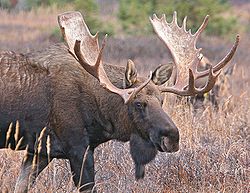 |
A. a. gigas | Alaska Alaska Alaska is the largest state in the United States by area. It is situated in the northwest extremity of the North American continent, with Canada to the east, the Arctic Ocean to the north, and the Pacific Ocean to the west and south, with Russia further west across the Bering Strait... and western Yukon. Largest subspecies and largest deer on earth. |
| Shiras Moose | A. a. shirasi | Wyoming Wyoming Wyoming is a state in the mountain region of the Western United States. The western two thirds of the state is covered mostly with the mountain ranges and rangelands in the foothills of the Eastern Rocky Mountains, while the eastern third of the state is high elevation prairie known as the High... , Idaho Idaho Idaho is a state in the Rocky Mountain area of the United States. The state's largest city and capital is Boise. Residents are called "Idahoans". Idaho was admitted to the Union on July 3, 1890, as the 43rd state.... , Utah Utah Utah is a state in the Western United States. It was the 45th state to join the Union, on January 4, 1896. Approximately 80% of Utah's 2,763,885 people live along the Wasatch Front, centering on Salt Lake City. This leaves vast expanses of the state nearly uninhabited, making the population the... , Colorado Colorado Colorado is a U.S. state that encompasses much of the Rocky Mountains as well as the northeastern portion of the Colorado Plateau and the western edge of the Great Plains... , Washington, Oregon Oregon Oregon is a state in the Pacific Northwest region of the United States. It is located on the Pacific coast, with Washington to the north, California to the south, Nevada on the southeast and Idaho to the east. The Columbia and Snake rivers delineate much of Oregon's northern and eastern... , and Montana Montana Montana is a state in the Western United States. The western third of Montana contains numerous mountain ranges. Smaller, "island ranges" are found in the central third of the state, for a total of 77 named ranges of the Rocky Mountains. This geographical fact is reflected in the state's name,... . Smallest subspecies. |
| † Caucasian Moose Caucasian Moose The Caucasian Moose was a subspecies of moose found in the Caucasus Mountains of Eastern Europe. It is widely believed to be extinct.... |
A. a. caucasicus | Caucasus Mountains Caucasus Mountains The Caucasus Mountains is a mountain system in Eurasia between the Black Sea and the Caspian Sea in the Caucasus region .The Caucasus Mountains includes:* the Greater Caucasus Mountain Range and* the Lesser Caucasus Mountains.... . Extinct due to loss of habitat and overhunting. Range would have included Iran Iran Iran , officially the Islamic Republic of Iran , is a country in Southern and Western Asia. The name "Iran" has been in use natively since the Sassanian era and came into use internationally in 1935, before which the country was known to the Western world as Persia... , Russia Russia Russia or , officially known as both Russia and the Russian Federation , is a country in northern Eurasia. It is a federal semi-presidential republic, comprising 83 federal subjects... , Georgia Georgia (country) Georgia is a sovereign state in the Caucasus region of Eurasia. Located at the crossroads of Western Asia and Eastern Europe, it is bounded to the west by the Black Sea, to the north by Russia, to the southwest by Turkey, to the south by Armenia, and to the southeast by Azerbaijan. The capital of... , Azerbaijan Azerbaijan Azerbaijan , officially the Republic of Azerbaijan is the largest country in the Caucasus region of Eurasia. Located at the crossroads of Western Asia and Eastern Europe, it is bounded by the Caspian Sea to the east, Russia to the north, Georgia to the northwest, Armenia to the west, and Iran to... , and Turkey Turkey Turkey , known officially as the Republic of Turkey , is a Eurasian country located in Western Asia and in East Thrace in Southeastern Europe... . |
Diet
The moose is a herbivoreHerbivore
Herbivores are organisms that are anatomically and physiologically adapted to eat plant-based foods. Herbivory is a form of consumption in which an organism principally eats autotrophs such as plants, algae and photosynthesizing bacteria. More generally, organisms that feed on autotrophs in...
and is capable of consuming many types of plant or fruit. The average adult moose needs to consume 9770 Calories per day to maintain its body weight. Much of a moose's energy is derived from terrestrial vegetation, mainly consisting of forbs and other non-grasses, and fresh shoots from trees such as willow
Willow
Willows, sallows, and osiers form the genus Salix, around 400 species of deciduous trees and shrubs, found primarily on moist soils in cold and temperate regions of the Northern Hemisphere...
and birch
Birch
Birch is a tree or shrub of the genus Betula , in the family Betulaceae, closely related to the beech/oak family, Fagaceae. The Betula genus contains 30–60 known taxa...
. These plants are rather low in sodium, and moose generally need to consume a good quantity of aquatic plants. While much lower in energy, these plants provide the moose with its sodium requirements, and as much as half of their diet usually consists of aquatic plant life. In winter, moose are often drawn to roadways, to lick salt that is used as a snow and ice melter. A typical moose, weighing 360 kilograms, can eat up to 32 kg of food per day.
Moose lack upper front teeth, but have eight sharp incisors on the lower jaw. They also have a tough tongue, lips and gums, which aid in the eating of woody vegetation. Moose have six pairs of molars and, ahead of those, six pairs of premolars, to grind up their food. A moose's diet often depends on its location, but they seem to prefer the new growths from trees such as white birch, trembling aspen
Trembling aspen
Trembling aspen is the popular name for either*Populus tremuloides *Populus tremula...
and striped maple
Striped Maple
Acer pensylvanicum is a species of maple native to northern and montane forests in eastern North America from southern Ontario east to Nova Scotia and south to Wisconsin, Ohio, and New Jersey, and also at higher elevations in the Appalachian Mountains south to northern Georgia.It is a small...
, among many others. Many aquatic plants include lilies
Water lily
The phrase "water lily" is used to describe aquatic plants of the following families, which have lily pads:* Nymphaeaceae* Nelumbonaceae , also called "lotus"Water lily may also refer to:...
and pondweed
Pondweed
Pondweed refers to many species and genera of aquatic plants and green algae:*Potamogeton, a diverse and worldwide genus*Elodea, found in North America*Aponogeton, in Africa, Asia and Australasia*Groenlandia, a genus of aquatic plants...
. Moose are excellent swimmers and are known to wade into water to eat aquatic plants. In non polar regions this trait serves a second purpose in cooling down the moose on summer days and ridding itself of black flies. Moose are thus attracted to marshes and river banks during warmer months as both provide suitable vegetation to eat and water to wet themselves in.
Antlers
The male's antlers grow as cylindrical beams projecting on each side of the head at right angles to the midline of the skull, and then fork. The lower prong of this fork may be either simple, or divided into two or three tines, with some flattening.In the North Siberian elk (A. a. bedfordiae), the posterior division of the main fork divides into three tines, with no distinct flattening. In the common elk (A. a. alces) this branch usually expands into a broad palmation, with one large tine at the base, and a number of smaller snags on the free border. There is, however, a Scandinavia
Scandinavia
Scandinavia is a cultural, historical and ethno-linguistic region in northern Europe that includes the three kingdoms of Denmark, Norway and Sweden, characterized by their common ethno-cultural heritage and language. Modern Norway and Sweden proper are situated on the Scandinavian Peninsula,...
n breed of the common elk in which the antlers are simpler, and recall those of the East Siberian animals.
The palmation appears to be more marked in North American moose (A. a. americanus) than in the typical Scandinavian elk.
If a bull moose is castrated, either by accidental or chemical means, he will quickly shed his current set of antlers and then immediately begin to grow a new set of misshapen and deformed antlers that he will wear the rest of his life without ever shedding again. The distinctive looking appendages (often referred to as "devil's antlers") are the source of several myths and legends among many groups of Inuit
Inuit
The Inuit are a group of culturally similar indigenous peoples inhabiting the Arctic regions of Canada , Denmark , Russia and the United States . Inuit means “the people” in the Inuktitut language...
as well as several other tribes of indigenous peoples of North America.
In extremely rare circumstances a cow moose may grow antlers. This is usually attributed to a hormone imbalance.
Size and weight
Pound (mass)
The pound or pound-mass is a unit of mass used in the Imperial, United States customary and other systems of measurement...
s) and females weigh 270–360 kg (600–800 pounds). The largest of all is the Alaskan subspecies (A. a. gigas), which can stand over 2.1 m (7 ft) at the shoulder, has a span across the antlers of 1.8 m (6 ft) and averages 634.5 kg (1,396 lbs) in males and 478 kg (1,052 lbs) in females. Typically, however, the antlers of a mature specimen are between 1.2 m (3.9 ft) and 1.5 m (4.9 ft). The largest confirmed size for this species was a bull shot at the Yukon River
Yukon River
The Yukon River is a major watercourse of northwestern North America. The source of the river is located in British Columbia, Canada. The next portion lies in, and gives its name to Yukon Territory. The lower half of the river lies in the U.S. state of Alaska. The river is long and empties into...
in September 1897 weighing 820 kg (1,800 lb) and was 233 cm (92 in) tall at the shoulder. The Moose of Alaska matches the extinct Irish Elk
Irish Elk
The Irish Elk or Giant Deer , was a species of Megaloceros and one of the largest deer that ever lived. Its range extended across Eurasia, from Ireland to east of Lake Baikal, during the Late Pleistocene. The latest known remains of the species have been carbon dated to about 7,700 years ago...
as the largest deer of all time. Behind only the bison
Bison
Members of the genus Bison are large, even-toed ungulates within the subfamily Bovinae. Two extant and four extinct species are recognized...
, the Moose is the second largest land animal in both North America
North America
North America is a continent wholly within the Northern Hemisphere and almost wholly within the Western Hemisphere. It is also considered a northern subcontinent of the Americas...
and Europe
Europe
Europe is, by convention, one of the world's seven continents. Comprising the westernmost peninsula of Eurasia, Europe is generally 'divided' from Asia to its east by the watershed divides of the Ural and Caucasus Mountains, the Ural River, the Caspian and Black Seas, and the waterways connecting...
. The life span of an average moose is about 15–25 years.
Social structure and reproduction
Moose are mostly diurnal. They are generally solitary with the strongest bonds between mother and calf. Although moose rarely gather in groups, there may be several in close proximity during the mating season.Mating occurs in September and October. The males are polygamous and will seek several females to breed with. During this times both sexes will call to each other. Males produce heavy grunting sounds that can be heard from up to 500 meters away, while females produce wail-like sounds. Males will fight for access to females. They either assess which is larger, with the smaller bull retreating, or they may engage in battles, usually only involving the antlers.
Female moose have an eight-month gestation period, usually bearing one calf, or twins if food is plentiful, in May or June. Newborn moose have fur with a reddish hue in contrast to the brown appearance of an adult. The young will stay with the mother until just before the next young are born.
Aggression
Moose are not usually aggressive towards humans, but can be provoked or frightened to behave with aggression. In terms of raw numbers, they attack more people than bearBear
Bears are mammals of the family Ursidae. Bears are classified as caniforms, or doglike carnivorans, with the pinnipeds being their closest living relatives. Although there are only eight living species of bear, they are widespread, appearing in a wide variety of habitats throughout the Northern...
s and wolves combined, but usually with only minor consequences. When harassed or startled by people or in the presence of a dog
Dog
The domestic dog is a domesticated form of the gray wolf, a member of the Canidae family of the order Carnivora. The term is used for both feral and pet varieties. The dog may have been the first animal to be domesticated, and has been the most widely kept working, hunting, and companion animal in...
, moose may charge. Also, as with bears or any wild animal, moose that have become habituated to being fed by people may act aggressively when denied food. During the fall mating season, bull moose may be aggressive toward humans due to the high hormone levels they experience. Cows with young calves are very protective and will attack humans who come too close, especially if they come between mother and calf. Unlike other dangerous animals, moose are not territorial, and do not view humans as food, and will therefore usually not pursue humans if they simply run away. Like any wild animal, moose are unpredictable and should be given a respectful amount of space.
Natural predators
Brown Bear
The brown bear is a large bear distributed across much of northern Eurasia and North America. It can weigh from and its largest subspecies, the Kodiak Bear, rivals the polar bear as the largest member of the bear family and as the largest land-based predator.There are several recognized...
are also known to prey on moose, although bears are more likely to take over a wolf kill or to take young moose than to hunt adult moose on their own. American black bear
American black bear
The American black bear is a medium-sized bear native to North America. It is the continent's smallest and most common bear species. Black bears are omnivores, with their diets varying greatly depending on season and location. They typically live in largely forested areas, but do leave forests in...
s and cougars can be significant predators of moose calves in May and June. Killer Whales are the moose's only known marine predator as they have been known to prey on them when swimming between islands out of North America's Northwest Coast.
In some areas, moose are the primary source of food for wolves. Moose usually flee upon detecting wolves. Wolves usually follow moose at a distance of 100 to 400 m (328.1 to 1,312.3 ), occasionally at a distance of 2 to 3 km (1.2 to 1.9 ). Attacks from wolves against young moose may last seconds, though sometimes they can be drawn out for days with adults. Sometimes, wolves will chase moose into shallow streams or onto frozen rivers, where their mobility is greatly impeded. Moose will sometimes stand their ground and defend themselves by charging at the wolves or lashing out at them with their powerful hooves. Wolves typically kill moose by tearing at their haunches and perineum
Perineum
In human anatomy, the perineum is a region of the body including the perineal body and surrounding structures...
, causing massive blood loss. Occasionally, a wolf may immobilise a moose by biting its sensitive nose, the pain of which can paralyze
Paralysis
Paralysis is loss of muscle function for one or more muscles. Paralysis can be accompanied by a loss of feeling in the affected area if there is sensory damage as well as motor. A study conducted by the Christopher & Dana Reeve Foundation, suggests that about 1 in 50 people have been diagnosed...
a moose. Wolf packs primarily target calves and elderly animals, but can and will take healthy, adult moose. Moose between the ages of two and eight are rarely killed by wolves. Though moose are usually hunted by packs, there are cases in which single wolves have successfully killed moose.
History
Cave painting
Cave paintings are paintings on cave walls and ceilings, and the term is used especially for those dating to prehistoric times. The earliest European cave paintings date to the Aurignacian, some 32,000 years ago. The purpose of the paleolithic cave paintings is not known...
s reveal that moose have been hunted since the Stone Age
Stone Age
The Stone Age is a broad prehistoric period, lasting about 2.5 million years , during which humans and their predecessor species in the genus Homo, as well as the earlier partly contemporary genera Australopithecus and Paranthropus, widely used exclusively stone as their hard material in the...
. Excavations in Alby, Sweden
Alby, Öland
Alby is a village on the Baltic Sea in the Hulterstad district at the western fringe of the Stora Alvaret. Archaeological evidence indicates this settlement to have been one of the oldest on the island of Öland, with excavations, dating to the paleolithic era, showing the presence of...
, adjacent to the Stora Alvaret
Stora Alvaret
The Stora Alvaret is a limestone barren plain on the island of Öland, Sweden. Because of the thin soil mantle and high pH levels, a great assortment of vegetation is found including numerous rare species. Stora Alvaret has been designated as a World Heritage Site by UNESCO due to its...
have yielded elk antlers in wooden hut remains from 6000 BC, indicating some of the earliest elk hunting in northern Europe. In northern Scandinavia one can still find remains of trapping pit
Trapping pit
Trapping pits are deep pits dug into the ground, or built from stone, in order to trap animals.European rock drawings and cave paintings reveal that the elk and moose have been hunted since the stone age using trapping pits. In Northern Scandinavia one can still find remains of trapping pits used...
s used for hunting elk. These pits, which can be up to 4 × 7 m wide and 2 m deep, would have been camouflaged with branches and leaves. They would have had steep sides lined with planks, making it impossible for the elk to escape once it fell in. The pits are normally found in large groups, crossing the elk's regular paths and stretching over several kilometres. Remains of wooden fences designed to guide the animals toward the pits have been found in bogs and peat. In Norway, an early example of these trapping devices has been dated to around 3,700 BC. Trapping elk in pits is an extremely effective hunting method, and as early as the 16th century the Norwegian government tried to restrict their use. Nevertheless, the method was in use until the 19th century.
The earliest recorded description of the elk is in Julius Caesar
Julius Caesar
Gaius Julius Caesar was a Roman general and statesman and a distinguished writer of Latin prose. He played a critical role in the gradual transformation of the Roman Republic into the Roman Empire....
's Commentarii de Bello Gallico
Commentarii de Bello Gallico
Commentarii de Bello Gallico is Julius Caesar's firsthand account of the Gallic Wars, written as a third-person narrative. In it Caesar describes the battles and intrigues that took place in the nine years he spent fighting local armies in Gaul that opposed Roman domination.The "Gaul" that Caesar...
, where it is described thus:
- "There are also [animals], which are called elks. The shape of these, and the varied colour of their skins, is much like roes, but in size they surpass them a little and are destitute of horns, and have legs without joints and ligatures; nor do they lie down for the purpose of rest, nor, if they have been thrown down by any accident, can they raise or lift themselves up. Trees serve as beds to them ; they lean themselves against them, and thus reclining only slightly, they take their rest; when the huntsmen have discovered from the footsteps of these animals whither they are accustomed to betake themselves, they either undermine all the trees at the roots, or cut into them so far that the upper part of the trees may appear to be left standing. When they have leant upon them, according to their habit, they knock down by their weight the unsupported trees, and fall down themselves along with them."
In book 8, chapter 16 of Pliny the Elder
Pliny the Elder
Gaius Plinius Secundus , better known as Pliny the Elder, was a Roman author, naturalist, and natural philosopher, as well as naval and army commander of the early Roman Empire, and personal friend of the emperor Vespasian...
's Natural History from 77 AD the elk and an animal called achlis, which is presumably the same animal, are described thus:
- "...there is, also, the elk, which strongly resembles our steers, except that it is distinguished by the length of the ears and of the neck. There is also the achlis, which is produced in the land of Scandinavia; it has never been seen in this city, although we have had descriptions of it from many persons; it is not unlike the elk, but has no joints in the hind leg. Hence, it never lies down, but reclines against a tree while it sleeps; it can only be taken by previously cutting into the tree, and thus laying a trap for it, as otherwise, it would escape through its swiftness. Its upper lip is so extremely large, for which reason it is obliged to go backwards when grazing; otherwise, by moving onwards, the lip would get doubled up."
As food
Moose are hunted as a gameGame (food)
Game is any animal hunted for food or not normally domesticated. Game animals are also hunted for sport.The type and range of animals hunted for food varies in different parts of the world. This will be influenced by climate, animal diversity, local taste and locally accepted view about what can or...
species in many of the countries where they are found. Moose meat tastes, wrote Henry David Thoreau
Henry David Thoreau
Henry David Thoreau was an American author, poet, philosopher, abolitionist, naturalist, tax resister, development critic, surveyor, historian, and leading transcendentalist...
in “The Maine Woods”, “like tender beef, with perhaps more flavour; sometimes like veal
Veal
Veal is the meat of young cattle , as opposed to meat from older cattle. Though veal can be produced from a calf of either sex and any breed, most veal comes from male calves of dairy cattle breeds...
”. While the flesh has protein
Protein
Proteins are biochemical compounds consisting of one or more polypeptides typically folded into a globular or fibrous form, facilitating a biological function. A polypeptide is a single linear polymer chain of amino acids bonded together by peptide bonds between the carboxyl and amino groups of...
levels similar to other comparable red meat
Red meat
Red meat in traditional culinary terminology is meat which is red when raw and not white when cooked. In the nutritional sciences, red meat includes all mammal meat. Red meat includes the meat of most adult mammals and some fowl ....
s (e.g. beef
Beef
Beef is the culinary name for meat from bovines, especially domestic cattle. Beef can be harvested from cows, bulls, heifers or steers. It is one of the principal meats used in the cuisine of the Middle East , Australia, Argentina, Brazil, Europe and the United States, and is also important in...
, deer
Deer
Deer are the ruminant mammals forming the family Cervidae. Species in the Cervidae family include white-tailed deer, elk, moose, red deer, reindeer, fallow deer, roe deer and chital. Male deer of all species and female reindeer grow and shed new antlers each year...
and elk
Elk
The Elk is the large deer, also called Cervus canadensis or wapiti, of North America and eastern Asia.Elk may also refer to:Other antlered mammals:...
) it has a low fat
Fat
Fats consist of a wide group of compounds that are generally soluble in organic solvents and generally insoluble in water. Chemically, fats are triglycerides, triesters of glycerol and any of several fatty acids. Fats may be either solid or liquid at room temperature, depending on their structure...
content and the fat that is found is made up of a higher proportion of polyunsaturated fat
Polyunsaturated fat
In nutrition, polyunsaturated fat, or polyunsaturated fatty acid, are fatty acids in which more than one carbon–carbon double bond exists within the representative molecule. That is, the molecule has two or more points on its structure capable of supporting hydrogen atoms not currently part of the...
s (rather than saturated fat
Saturated fat
Saturated fat is fat that consists of triglycerides containing only saturated fatty acids. Saturated fatty acids have no double bonds between the individual carbon atoms of the fatty acid chain. That is, the chain of carbon atoms is fully "saturated" with hydrogen atoms...
s).
Cadmium
Cadmium
Cadmium is a chemical element with the symbol Cd and atomic number 48. This soft, bluish-white metal is chemically similar to the two other stable metals in group 12, zinc and mercury. Similar to zinc, it prefers oxidation state +2 in most of its compounds and similar to mercury it shows a low...
levels are high in Finnish elk liver
Liver
The liver is a vital organ present in vertebrates and some other animals. It has a wide range of functions, including detoxification, protein synthesis, and production of biochemicals necessary for digestion...
and kidneys, with the result that consumption of these organs from elk more than one year old is prohibited in Finland. Cadmium intake has been found to be elevated amongst all consumers of elk meat, though the elk meat was found to contribute only slightly to the daily cadmium intake. However the consumption of moose liver or kidneys significantly increased cadmium intake, with the study revealing that heavy consumers of moose organs have a relatively narrow safety margin below the levels which would probably cause adverse health effects.
Dr. Valerius Geist, who emigrated to Canada from the Soviet Union, wrote in his 1999 book Moose: Behaviour, Ecology, Conservation:
Those who care most passionately about moose are—paradoxically—hunters, in particular people who live in wilderness and rural communities and those who depend on moose for food. In Sweden, no fall menu is without a mouthwatering moose dish. The Swedes fence their highways to reduce moose fatalities and design moose-proof cars. Sweden is less than half as large as the Canadian province of British Columbia, but the annual take of moose in Sweden—upward of 150,000—is twice that of the total moose harvest in North America. That is how much Swedes cherish their moose.
Boosting of moose populations in Alaska for hunting purposes is one of the reasons given for allowing aerial or airborne methods to remove wolves in designated areas, e.g., Craig Medred: "A kill of 124 wolves would thus translate to [the survival of] 1488 moose or 2976 caribou or some combination thereof". Many scientists believe that this artificial inflation of game populations is actually detrimental to both caribou and moose populations as well as the ecosystem as a whole. This is because studies have shown that when these game populations are artificially boosted, it leads to both habitat destruction and a crash in these populations
Vehicle collisions
Windshield
The windshield or windscreen of an aircraft, car, bus, motorbike or tram is the front window. Modern windshields are generally made of laminated safety glass, a type of treated glass, which consists of two curved sheets of glass with a plastic layer laminated between them for safety, and are glued...
, crushing the front roof support beams and anyone in the front seats. Collisions of this type are frequently lethal; seatbelts offer no protection, and airbag
Airbag
An Airbag is a vehicle safety device. It is an occupant restraint consisting of a flexible envelope designed to inflate rapidly during an automobile collision, to prevent occupants from striking interior objects such as the steering wheel or a window...
s may not deploy or be of much use if they do. Although vehicles with higher clearances (such as trucks) are typically immune from this effect, the force of striking any 270+ kg (600+ pound) object at high speed should not be underestimated. These risks led to the development of a vehicle test referred to as the "moose test
Moose test
A moose test or elk test is a test to determine how a certain vehicle acts when the driver evades a suddenly appearing obstacle...
" .
Moose warning signs are used on roads in regions where there is a danger of collision with the animal. The triangular warning signs common in Sweden, Norway, and Finland have become coveted souvenirs among tourists traveling in these countries, causing the road authorities so much expense that the moose signs have been replaced with image-less generic warning signs in some regions.
Norwegian newspaper Aftenposten
Aftenposten
Aftenposten is Norway's largest newspaper. It retook this position in 2010, taking it from the tabloid Verdens Gang which had been the largest newspaper for several decades. It is based in Oslo. The morning edition, which is distributed across all of Norway, had a circulation of 250,179 in 2007...
estimated in January 2008 that some 13,000 moose had died in collisions with Norwegian trains since 2000. The state agency in charge of railroad infrastructure (Jernbaneverket) plans to spend 80 million Norwegian kroner to reduce collision rate in the future by fencing the railways, clearing vegetation from near the tracks, and providing alternative snow-free feeding places for the animals elsewhere.
In the Canadian province of New Brunswick
New Brunswick
New Brunswick is one of Canada's three Maritime provinces and is the only province in the federation that is constitutionally bilingual . The provincial capital is Fredericton and Saint John is the most populous city. Greater Moncton is the largest Census Metropolitan Area...
, collisions with moose are frequent enough that all new highways have fences to prevent moose from accessing the road, similar to how it has long been done in Finland, Norway, and Sweden. Demonstratively, Highway 7 between Fredericton and Saint John
Saint John, New Brunswick
City of Saint John , or commonly Saint John, is the largest city in the province of New Brunswick, and the first incorporated city in Canada. The city is situated along the north shore of the Bay of Fundy at the mouth of the Saint John River. In 2006 the city proper had a population of 74,043...
, which has one of the highest frequencies of moose collisions in the province, did not have these fences until 2008, although it was and continues to be extremely well signed. In Newfoundland and Labrador
Newfoundland and Labrador
Newfoundland and Labrador is the easternmost province of Canada. Situated in the country's Atlantic region, it incorporates the island of Newfoundland and mainland Labrador with a combined area of . As of April 2011, the province's estimated population is 508,400...
, it is recommended to motorists to use caution between dusk and dawn, because that is when moose are most active and most difficult to see, increasing the risk of collisions. Local moose sightings are often reported on radio stations so that motorists can take care while driving in particular areas.
In Sweden a fence will not be placed unless the road meets the minimum requirement of one accident, involving a moose, per kilometre road and year.
Domestication
Domestication of moose was investigated in the Soviet UnionSoviet Union
The Soviet Union , officially the Union of Soviet Socialist Republics , was a constitutionally socialist state that existed in Eurasia between 1922 and 1991....
before World War II
World War II
World War II, or the Second World War , was a global conflict lasting from 1939 to 1945, involving most of the world's nations—including all of the great powers—eventually forming two opposing military alliances: the Allies and the Axis...
. Early experiments were inconclusive, but with the creation of a moose farm at Pechora-Ilych Nature Reserve
Pechora-Ilych Nature Reserve
Pechora-Ilych Nature Reserve is a nature reserve in the Komi Republic, Russia. It currently occupies 7,213 square kilometers and forms the core of the World Heritage Site Virgin Komi Forests.-Location:...
in 1949 a small-scale moose domestication program was started, involving attempts at selective breeding
Selective breeding
Selective breeding is the process of breeding plants and animals for particular genetic traits. Typically, strains that are selectively bred are domesticated, and the breeding is sometimes done by a professional breeder. Bred animals are known as breeds, while bred plants are known as varieties,...
of animals based on their behavioural characteristics. Since 1963, the programme has continued at Kostroma Moose Farm
Kostroma Moose Farm
Kostroma Moose Farm is an experimental farm in Kostroma Oblast, Russia, where a herd of moose is kept, primarily for milk production; the farm supplies moose's milk to a nearby sanitorium...
, which had a herd of 33 tame
Domestication
Domestication or taming is the process whereby a population of animals or plants, through a process of selection, becomes accustomed to human provision and control. In the Convention on Biological Diversity a domesticated species is defined as a 'species in which the evolutionary process has been...
moose as of 2003. Although at this stage the farm is not expected to be a profit-making enterprise, it obtains some income from the sale of moose milk and from visiting tourist groups. Its main value, however, is seen in the opportunities it offers for the research in the physiology
Physiology
Physiology is the science of the function of living systems. This includes how organisms, organ systems, organs, cells, and bio-molecules carry out the chemical or physical functions that exist in a living system. The highest honor awarded in physiology is the Nobel Prize in Physiology or...
and behaviour of the moose, as well as in the insights it provides into the general principles of animal domestication
Domestication
Domestication or taming is the process whereby a population of animals or plants, through a process of selection, becomes accustomed to human provision and control. In the Convention on Biological Diversity a domesticated species is defined as a 'species in which the evolutionary process has been...
.
In Sweden there was a debate in the late 18th century about the national value of using the moose as a domestic animal. Among other things, the moose was proposed to be used in postal distribution, and there was a suggestion to develop a moose-mounted cavalry. Such proposals remained unimplemented, mainly because the extensive hunting for moose nearly drove it to extinction and because of moose aggressiveness during the rutting period.
Further reading
- (Alces alces) A journal devoted to the biology and management of moose Centre for Northern Forest Ecosystem Research