

Old Style and New Style dates

Encyclopedia
Old Style and New Style (N.S.) are used in English language historical studies either to indicate that the start of the Julian year has been adjusted to start on 1 January (N.S.) even though documents written at the time use a different start of year (O.S.); or to indicate that a date conforms to the Julian calendar (O.S.), formerly in use in many countries, rather than the Gregorian calendar
(N.S.).
The Gregorian calendar replaced the Julian in Catholic countries beginning in 1582. This change was also implemented in Protestant
and Orthodox countries after a significant delay. In England and Wales
, Ireland
and the British colonies, the change of the start of the year and the change over from the Julian calendar occurred in 1752 via the Calendar (New Style) Act 1750
. In Scotland
, the legal start of the year had already been moved to 1 January (in 1600), but Scotland otherwise continued to use the Julian Calendar until 1752. Many cultures and countries now using the Gregorian calendar have different old styles of dating, depending on the type of calendar they used before the change.
The internationally used Latin cognates of O.S. are stili veteris or stilo vetere, abbreviated st.v. and translating as "(of) old style", and the respective cognates of N.S. are stili novi or stilo novo, abbreviated st.n. and translating as "(of) new style". Like the English speaking countries, other countries may use additional local language cognates like the German
a.St. ("alten Stils" for O.S.). Also, parts of the Latin abbreviations may be capitalized, e.g., St.n. or St.N. for stili novi.
is universally known to have been fought on 14 October 1066. But the start of the Julian year was not always 1 January, and was altered at different times in different countries.
From the 12th century to 1752, the civil or legal year in England began on 25 March (Lady Day
) so for example the execution of Charles I
was recorded at the time in Parliament as happening on 30 January 1648 (Old Style). In modern English-language texts this date is usually recorded as "30 January 1649" (New Style). A full conversion of the date into the Gregorian calendar is 9 February 1649, the date by which his contemporaries in some parts of continental Europe would have recorded his execution. 25 March in New Style is 6 April, and this date is still the first day of the fiscal year in the United Kingdom
.
The O.S./N.S. designation is particularly relevant for dates which fall between the start of the modern year (1 January) and the start of the contemporary year, which was 25 March in England up until 1752 (see Julian year article).
During the transition years between the first introduction of the Gregorian calendar on continental Europe and its introduction in Britain, contemporary usage in England started to change. In Britain 1 January was celebrated as the New Year festival, but the "year starting 25th March was called the Civil or Legal Year, although the phrase Old Style was more commonly used." To reduce misunderstandings on the date, it was normal in parish registers to place a new year heading after 24 March, for example 1661 had another heading at the end of the following December indicating "1661/62". This was to explain to the reader that the year was 1661 Old Style and 1662 New Style.
The Julian calendar
was formerly in use in many European countries and their colonies, rather than the Gregorian calendar
, currently in use in most countries. Consequently and to avoid ambiguity, "Old Style" (O.S.) and "New Style" (N.S.) are sometimes added to historical dates to identify which system is being used (when giving a date in the period when both systems were in parallel use). This notation is used in Western European (and colonial) history: similar notations are in use for the equivalent conversions in Eastern Europe and Asia.
For a period of 170 years (1582–1752), both dating systems were in concurrent use in different parts of Western Europe and its colonies. The Julian calendar had drifted by 11 days from the solar calendar (due to its excess of leap years), so dates differ between the systems. System conversion for secular use occurred in Eastern Orthodox countries as late as the 20th century, and has still not occurred for ecclesiastic use in some of these countries.
Catholic
countries such as Italy
, Poland
, Spain
, and Portugal
were first to change to the Gregorian calendar. Thursday, 4 October 1582 was followed by Friday, 15 October 1582, with ten days "missing". Countries that did not change until the 18th century observed an additional leap year
, necessitating eleven "missing days". Some countries did not change until the 19th or 20th century, necessitating one or two more "missing days".
France
changed from Julian to Gregorian Calendar on 9 December 1582 (O.S.) where the next day was 20 December 1582 (N.S.). France used the French Republican Calendar
from 22 September 1792 (N.S.) to 31 December 1805 (N.S.).
Ireland, (and under the provisions of the Calendar (New Style) Act 1750
), Great Britain and the British colonies, changed from Julian to Gregorian Calendar at midnight on Wednesday 2 September 1752, the next day was Thursday 14 September 1752.
In Russia, the terms "Old Style" and "New Style" have the same significance as elsewhere. The start of the year was moved to 1 January in 1700, but the Gregorian calendar was introduced there much later, on 14 February 1918 (Gregorian calendar) in Soviet Russia (which became the Soviet Union
in 1922). Hence the October Revolution
of 1917 is so called, despite having started on 7 November under the Gregorian calendar (25 October [Julian calendar]). Articles about the October Revolution which mention this date difference tend to do a full conversion to the dates from Julian to the Gregorian calendar. For example the article "The October (November) Revolution" the Encyclopædia Britannica
uses the format of "25 October (7 November, New Style);" to describe the date of the start of the revolution.
It is sometimes remarked that William Shakespeare
and Miguel de Cervantes
died on the same date, 23 April 1616, but not on the same day. England
was still using the Julian calendar in 1616, while Spain
was using the Gregorian calendar. Cervantes actually died ten days before Shakespeare.
's victory at the Battle of Austerlitz
was the confusion between the Russians, who were using the Julian calendar, and the Austrians, who were using the Gregorian calendar, over the date that their forces should combine. However, this tale is not supported in a contemporary account from a major-general of the Austrian army, who tells of a joint advance of the Russian and Austrian forces (in which he himself took part) five days before the battle, and it is explicitly rejected in Goetz's recent book-length study of the battle.
Usually, the mapping of new dates onto old dates with a start of year adjustment works well with little confusion for events which happened before the introduction of the Gregorian Calendar. For example the Battle of Agincourt
is universally known to have been fought on 25 October 1415, which is Saint Crispin's Day. But for the period between the first introduction of the Gregorian calendar on 15 October 1582 and its introduction in Britain on 14 September 1752, there can be considerable confusion between events in continental western Europe and in British domains. Events in continental western Europe are usually reported in English language histories as happening under the Gregorian calendar. For example the Battle of Blenheim
is always given as 13 August 1704. However confusion occurs when an event affects both. For example William III of England
arrived at Brixham
in England on 5 November (Julian calendar), after setting sail from the Netherlands
on 11 November (Gregorian calendar).
The Battle of the Boyne
took place only a few months later in Ireland on 1 July 1690 "Old Style". However, it is commemorated as taking place on 12 July "New Style" by the Orange
parades on "The Twelfth
", and is an exception to the usual historical method of commemorating events of that period within Great Britain and Ireland by mapping the Julian date directly onto the modern Gregorian calendar (as happens for example with Guy Fawkes Night
on 5 November).
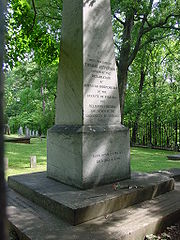 Because of the differences, English people and their correspondents often employed two dates, dual dating
, more or less automatically, as Benjamin Woolley observed in his biography of Dr John Dee
, The Queen's Conjurer. Dee fought unsuccessfully for England to embrace the 1583/4 date set for the change. Woolley wrote because of "the decision, England remained outside the Gregorian system for a further 170 years, communications during that period customarily carrying two dates, one 'O.S.' or Old Style, the other 'N.S.' or New Style." Thomas Jefferson
, for example, lived during the time Great Britain, Ireland and the British colonies eventually converted to the Gregorian calendar, so he instructed that his tombstone bear his dates of birth and death in the Old Style and New Style, respectively. At Jefferson's birth the difference would have been eleven days between styles, had the New Style been converted to yet, as is evidenced by his "original" birthday of 2 April and his New Style birthday of 13 April.
, Korea
, and China
started using the Gregorian calendar on 1 January 1873, 1896, and 1912, respectively. They had used lunisolar calendar
s previously. None of them used the Julian calendar; the Old Style and New Style dates in these countries usually mean the older lunisolar dates and the newer Gregorian calendar dates respectively. In these countries, the old style calendars were similar but not all the same. The Arabic numerals
may be used for both calendar dates in modern Japanese and Korean languages, but not Chinese.
Japan currently uses two eras: The Western era and a modified traditional Japanese era name
(nengō). The months and days are those of the Gregorian calendar, but the year is either the Western year number or a year of the nengō of the emperor on the throne. Since 1873, an era and the first year of that era has begun on the day of the year that the emperor ascended the throne. The second year of that era began on the next 1 January even if the first year contained only a few days. All subsequent years of that era began on 1 January until that emperor died. For example, the first year of the Showa Era, used by Emperor Hirohito
, contained only the last six days of 1926, while Showa 64, his last year, contained only the first seven days of 1989. The current Gregorian year corresponds to Heisei
.
, which still used the lunisolar calendar. The lunisolar Korean calendar
is now used in very limited unofficial purposes only.
In North Korea
, the New Style calendar is used, but with Kim Il-Sung
's year of birth used as year 0.
-led Republic of China
government adopted the Gregorian calendar on 1 January 1912. It kept the lunisolar Chinese calendar
as well, especially for the timing of traditional holidays. The geographical reference for China standard time (UTC+8
) has been longitude 120°E since 1929. When the Communists took over China in the late 1940s they kept this two-calendar system for the People's Republic of China
. Today China
, Hong Kong
, Macau
, Malaysia, Indonesia
, Singapore
and Taiwan
all observe traditional holidays based on the traditional calendar, such as Lunar New Year
, while timing other holidays, especially national anniversaries, according to the Gregorian calendar.
In China national guidelines (GB
/T 15835-1995, General rules for writing numerals in publications) require writing new style dates with Arabic numerals but old-style dates with Chinese character
s. The use of Arabic numerals is considered overly casual for old-style dates.
In Taiwan it is common to see Arabic numerals in new-style dates, though Chinese characters sometimes appear in these. Chinese characters are normally used for old-style dates. The calendar year in Taiwan
is determined, according to the Kuomintang
refugee custom, from the founding of their Republic of China government in 1912.
Gregorian calendar
The Gregorian calendar, also known as the Western calendar, or Christian calendar, is the internationally accepted civil calendar. It was introduced by Pope Gregory XIII, after whom the calendar was named, by a decree signed on 24 February 1582, a papal bull known by its opening words Inter...
(N.S.).
The Gregorian calendar replaced the Julian in Catholic countries beginning in 1582. This change was also implemented in Protestant
Protestant Reformation
The Protestant Reformation was a 16th-century split within Western Christianity initiated by Martin Luther, John Calvin and other early Protestants. The efforts of the self-described "reformers", who objected to the doctrines, rituals and ecclesiastical structure of the Roman Catholic Church, led...
and Orthodox countries after a significant delay. In England and Wales
England and Wales
England and Wales is a jurisdiction within the United Kingdom. It consists of England and Wales, two of the four countries of the United Kingdom...
, Ireland
Kingdom of Ireland
The Kingdom of Ireland refers to the country of Ireland in the period between the proclamation of Henry VIII as King of Ireland by the Crown of Ireland Act 1542 and the Act of Union in 1800. It replaced the Lordship of Ireland, which had been created in 1171...
and the British colonies, the change of the start of the year and the change over from the Julian calendar occurred in 1752 via the Calendar (New Style) Act 1750
Calendar (New Style) Act 1750
The Calendar Act 1750 is an Act of the Parliament of Great Britain...
. In Scotland
Scotland
Scotland is a country that is part of the United Kingdom. Occupying the northern third of the island of Great Britain, it shares a border with England to the south and is bounded by the North Sea to the east, the Atlantic Ocean to the north and west, and the North Channel and Irish Sea to the...
, the legal start of the year had already been moved to 1 January (in 1600), but Scotland otherwise continued to use the Julian Calendar until 1752. Many cultures and countries now using the Gregorian calendar have different old styles of dating, depending on the type of calendar they used before the change.
The internationally used Latin cognates of O.S. are stili veteris or stilo vetere, abbreviated st.v. and translating as "(of) old style", and the respective cognates of N.S. are stili novi or stilo novo, abbreviated st.n. and translating as "(of) new style". Like the English speaking countries, other countries may use additional local language cognates like the German
Germany
Germany , officially the Federal Republic of Germany , is a federal parliamentary republic in Europe. The country consists of 16 states while the capital and largest city is Berlin. Germany covers an area of 357,021 km2 and has a largely temperate seasonal climate...
a.St. ("alten Stils" for O.S.). Also, parts of the Latin abbreviations may be capitalized, e.g., St.n. or St.N. for stili novi.
Differences between the start of the year
When recording British history it is usual to use the dates recorded at the time of the event with the year adjusted to start on the first of January. So, for example, the Battle of HastingsBattle of Hastings
The Battle of Hastings occurred on 14 October 1066 during the Norman conquest of England, between the Norman-French army of Duke William II of Normandy and the English army under King Harold II...
is universally known to have been fought on 14 October 1066. But the start of the Julian year was not always 1 January, and was altered at different times in different countries.
From the 12th century to 1752, the civil or legal year in England began on 25 March (Lady Day
Lady Day
In the western Liturgical year, Lady Day is the traditional name of the Feast of the Annunciation of the Blessed Virgin in some English speaking countries. It is the first of the four traditional English quarter days. The "Lady" was the Virgin Mary. The term derives from Middle English, when some...
) so for example the execution of Charles I
Charles I of England
Charles I was King of England, King of Scotland, and King of Ireland from 27 March 1625 until his execution in 1649. Charles engaged in a struggle for power with the Parliament of England, attempting to obtain royal revenue whilst Parliament sought to curb his Royal prerogative which Charles...
was recorded at the time in Parliament as happening on 30 January 1648 (Old Style). In modern English-language texts this date is usually recorded as "30 January 1649" (New Style). A full conversion of the date into the Gregorian calendar is 9 February 1649, the date by which his contemporaries in some parts of continental Europe would have recorded his execution. 25 March in New Style is 6 April, and this date is still the first day of the fiscal year in the United Kingdom
United Kingdom
The United Kingdom of Great Britain and Northern IrelandIn the United Kingdom and Dependencies, other languages have been officially recognised as legitimate autochthonous languages under the European Charter for Regional or Minority Languages...
.
The O.S./N.S. designation is particularly relevant for dates which fall between the start of the modern year (1 January) and the start of the contemporary year, which was 25 March in England up until 1752 (see Julian year article).
During the transition years between the first introduction of the Gregorian calendar on continental Europe and its introduction in Britain, contemporary usage in England started to change. In Britain 1 January was celebrated as the New Year festival, but the "year starting 25th March was called the Civil or Legal Year, although the phrase Old Style was more commonly used." To reduce misunderstandings on the date, it was normal in parish registers to place a new year heading after 24 March, for example 1661 had another heading at the end of the following December indicating "1661/62". This was to explain to the reader that the year was 1661 Old Style and 1662 New Style.
Differences between Julian and Gregorian dates
| Time period (from 1 March of first year to 28 February of last year) |
Сorrection, days |
|---|---|
| 1–100 | −2 |
| 100–200 | −1 |
| 200–300 | 0 |
| 300–500 | +1 |
| 500–600 | +2 |
| 600–700 | +3 |
| 700–900 | +4 |
| 900–1000 | +5 |
| 1000–1100 | +6 |
| 1100–1300 | +7 |
| 1300–1400 | +8 |
| 1400–1500 | +9 |
| 1500–1700 | +10 |
| 1700–1800 | +11 |
| 1800–1900 | +12 |
| 1900–2100 | +13 |
| 2100–2200 | +14 |
The Julian calendar
Julian calendar
The Julian calendar began in 45 BC as a reform of the Roman calendar by Julius Caesar. It was chosen after consultation with the astronomer Sosigenes of Alexandria and was probably designed to approximate the tropical year .The Julian calendar has a regular year of 365 days divided into 12 months...
was formerly in use in many European countries and their colonies, rather than the Gregorian calendar
Gregorian calendar
The Gregorian calendar, also known as the Western calendar, or Christian calendar, is the internationally accepted civil calendar. It was introduced by Pope Gregory XIII, after whom the calendar was named, by a decree signed on 24 February 1582, a papal bull known by its opening words Inter...
, currently in use in most countries. Consequently and to avoid ambiguity, "Old Style" (O.S.) and "New Style" (N.S.) are sometimes added to historical dates to identify which system is being used (when giving a date in the period when both systems were in parallel use). This notation is used in Western European (and colonial) history: similar notations are in use for the equivalent conversions in Eastern Europe and Asia.
For a period of 170 years (1582–1752), both dating systems were in concurrent use in different parts of Western Europe and its colonies. The Julian calendar had drifted by 11 days from the solar calendar (due to its excess of leap years), so dates differ between the systems. System conversion for secular use occurred in Eastern Orthodox countries as late as the 20th century, and has still not occurred for ecclesiastic use in some of these countries.
Catholic
Roman Catholic Church
The Catholic Church, also known as the Roman Catholic Church, is the world's largest Christian church, with over a billion members. Led by the Pope, it defines its mission as spreading the gospel of Jesus Christ, administering the sacraments and exercising charity...
countries such as Italy
History of Italy during foreign domination and the unification
The history of Italy in the Early Modern period was partially characterized by foreign domination:Following the Italian Wars , Italy saw a long period of relative peace, first under Habsburg Spain and then under Habsburg Austria . During the Napoleonic era, Italy was a client state of the French...
, Poland
Polish-Lithuanian Commonwealth
The Polish–Lithuanian Commonwealth was a dualistic state of Poland and Lithuania ruled by a common monarch. It was the largest and one of the most populous countries of 16th- and 17th‑century Europe with some and a multi-ethnic population of 11 million at its peak in the early 17th century...
, Spain
Habsburg Spain
Habsburg Spain refers to the history of Spain over the 16th and 17th centuries , when Spain was ruled by the major branch of the Habsburg dynasty...
, and Portugal
Iberian Union
The Iberian union was a political unit that governed all of the Iberian Peninsula south of the Pyrenees from 1580–1640, through a dynastic union between the monarchies of Portugal and Spain after the War of the Portuguese Succession...
were first to change to the Gregorian calendar. Thursday, 4 October 1582 was followed by Friday, 15 October 1582, with ten days "missing". Countries that did not change until the 18th century observed an additional leap year
Leap year
A leap year is a year containing one extra day in order to keep the calendar year synchronized with the astronomical or seasonal year...
, necessitating eleven "missing days". Some countries did not change until the 19th or 20th century, necessitating one or two more "missing days".
France
Early Modern France
Kingdom of France is the early modern period of French history from the end of the 15th century to the end of the 18th century...
changed from Julian to Gregorian Calendar on 9 December 1582 (O.S.) where the next day was 20 December 1582 (N.S.). France used the French Republican Calendar
French Republican Calendar
The French Republican Calendar or French Revolutionary Calendar was a calendar created and implemented during the French Revolution, and used by the French government for about 12 years from late 1793 to 1805, and for 18 days by the Paris Commune in 1871...
from 22 September 1792 (N.S.) to 31 December 1805 (N.S.).
Ireland, (and under the provisions of the Calendar (New Style) Act 1750
Calendar (New Style) Act 1750
The Calendar Act 1750 is an Act of the Parliament of Great Britain...
), Great Britain and the British colonies, changed from Julian to Gregorian Calendar at midnight on Wednesday 2 September 1752, the next day was Thursday 14 September 1752.
In Russia, the terms "Old Style" and "New Style" have the same significance as elsewhere. The start of the year was moved to 1 January in 1700, but the Gregorian calendar was introduced there much later, on 14 February 1918 (Gregorian calendar) in Soviet Russia (which became the Soviet Union
Soviet Union
The Soviet Union , officially the Union of Soviet Socialist Republics , was a constitutionally socialist state that existed in Eurasia between 1922 and 1991....
in 1922). Hence the October Revolution
October Revolution
The October Revolution , also known as the Great October Socialist Revolution , Red October, the October Uprising or the Bolshevik Revolution, was a political revolution and a part of the Russian Revolution of 1917...
of 1917 is so called, despite having started on 7 November under the Gregorian calendar (25 October [Julian calendar]). Articles about the October Revolution which mention this date difference tend to do a full conversion to the dates from Julian to the Gregorian calendar. For example the article "The October (November) Revolution" the Encyclopædia Britannica
Encyclopædia Britannica
The Encyclopædia Britannica , published by Encyclopædia Britannica, Inc., is a general knowledge English-language encyclopaedia that is available in print, as a DVD, and on the Internet. It is written and continuously updated by about 100 full-time editors and more than 4,000 expert...
uses the format of "25 October (7 November, New Style);" to describe the date of the start of the revolution.
It is sometimes remarked that William Shakespeare
William Shakespeare
William Shakespeare was an English poet and playwright, widely regarded as the greatest writer in the English language and the world's pre-eminent dramatist. He is often called England's national poet and the "Bard of Avon"...
and Miguel de Cervantes
Miguel de Cervantes
Miguel de Cervantes Saavedra was a Spanish novelist, poet, and playwright. His magnum opus, Don Quixote, considered the first modern novel, is a classic of Western literature, and is regarded amongst the best works of fiction ever written...
died on the same date, 23 April 1616, but not on the same day. England
England
England is a country that is part of the United Kingdom. It shares land borders with Scotland to the north and Wales to the west; the Irish Sea is to the north west, the Celtic Sea to the south west, with the North Sea to the east and the English Channel to the south separating it from continental...
was still using the Julian calendar in 1616, while Spain
Spain
Spain , officially the Kingdom of Spain languages]] under the European Charter for Regional or Minority Languages. In each of these, Spain's official name is as follows:;;;;;;), is a country and member state of the European Union located in southwestern Europe on the Iberian Peninsula...
was using the Gregorian calendar. Cervantes actually died ten days before Shakespeare.
Possible date conflicts
Occasionally using different calendars has caused confusion between contemporaries. For example, it is related that one of the contributory factors for NapoleonNapoleon I of France
Napoleon Bonaparte was a French military and political leader during the latter stages of the French Revolution.As Napoleon I, he was Emperor of the French from 1804 to 1815...
's victory at the Battle of Austerlitz
Battle of Austerlitz
The Battle of Austerlitz, also known as the Battle of the Three Emperors, was one of Napoleon's greatest victories, where the French Empire effectively crushed the Third Coalition...
was the confusion between the Russians, who were using the Julian calendar, and the Austrians, who were using the Gregorian calendar, over the date that their forces should combine. However, this tale is not supported in a contemporary account from a major-general of the Austrian army, who tells of a joint advance of the Russian and Austrian forces (in which he himself took part) five days before the battle, and it is explicitly rejected in Goetz's recent book-length study of the battle.
Usually, the mapping of new dates onto old dates with a start of year adjustment works well with little confusion for events which happened before the introduction of the Gregorian Calendar. For example the Battle of Agincourt
Battle of Agincourt
The Battle of Agincourt was a major English victory against a numerically superior French army in the Hundred Years' War. The battle occurred on Friday, 25 October 1415 , near modern-day Azincourt, in northern France...
is universally known to have been fought on 25 October 1415, which is Saint Crispin's Day. But for the period between the first introduction of the Gregorian calendar on 15 October 1582 and its introduction in Britain on 14 September 1752, there can be considerable confusion between events in continental western Europe and in British domains. Events in continental western Europe are usually reported in English language histories as happening under the Gregorian calendar. For example the Battle of Blenheim
Battle of Blenheim
The Battle of Blenheim , fought on 13 August 1704, was a major battle of the War of the Spanish Succession. Louis XIV of France sought to knock Emperor Leopold out of the war by seizing Vienna, the Habsburg capital, and gain a favourable peace settlement...
is always given as 13 August 1704. However confusion occurs when an event affects both. For example William III of England
William III of England
William III & II was a sovereign Prince of Orange of the House of Orange-Nassau by birth. From 1672 he governed as Stadtholder William III of Orange over Holland, Zeeland, Utrecht, Guelders, and Overijssel of the Dutch Republic. From 1689 he reigned as William III over England and Ireland...
arrived at Brixham
Brixham
Brixham is a small fishing town and civil parish in the county of Devon, in the south-west of England. Brixham is at the southern end of Torbay, across the bay from Torquay, and is a fishing port. Fishing and tourism are its major industries. At the time of the 2001 census it had a population of...
in England on 5 November (Julian calendar), after setting sail from the Netherlands
Netherlands
The Netherlands is a constituent country of the Kingdom of the Netherlands, located mainly in North-West Europe and with several islands in the Caribbean. Mainland Netherlands borders the North Sea to the north and west, Belgium to the south, and Germany to the east, and shares maritime borders...
on 11 November (Gregorian calendar).
The Battle of the Boyne
Battle of the Boyne
The Battle of the Boyne was fought in 1690 between two rival claimants of the English, Scottish and Irish thronesthe Catholic King James and the Protestant King William across the River Boyne near Drogheda on the east coast of Ireland...
took place only a few months later in Ireland on 1 July 1690 "Old Style". However, it is commemorated as taking place on 12 July "New Style" by the Orange
Orange Institution
The Orange Institution is a Protestant fraternal organisation based mainly in Northern Ireland and Scotland, though it has lodges throughout the Commonwealth and United States. The Institution was founded in 1796 near the village of Loughgall in County Armagh, Ireland...
parades on "The Twelfth
The Twelfth
The Twelfth is a yearly Protestant celebration held on 12 July. It originated in Ireland during the 18th century. It celebrates the Glorious Revolution and victory of Protestant king William of Orange over Catholic king James II at the Battle of the Boyne...
", and is an exception to the usual historical method of commemorating events of that period within Great Britain and Ireland by mapping the Julian date directly onto the modern Gregorian calendar (as happens for example with Guy Fawkes Night
Guy Fawkes Night
Guy Fawkes Night, also known as Guy Fawkes Day, Bonfire Night and Firework Night, is an annual commemoration observed on 5 November, primarily in England. Its history begins with the events of 5 November 1605, when Guy Fawkes, a member of the Gunpowder Plot, was arrested while guarding...
on 5 November).
Dual dating
In historical materials, dates will often be indicated with what appears to be duplicate, or excessive digits, sometimes separated by a hyphen or a slash. This is often referred to as double dating. The need for double dating arose from the transition from an older calendar to a newer one...
, more or less automatically, as Benjamin Woolley observed in his biography of Dr John Dee
John Dee (mathematician)
John Dee was an English mathematician, astronomer, astrologer, occultist, navigator, imperialist and consultant to Queen Elizabeth I. He devoted much of his life to the study of alchemy, divination and Hermetic philosophy....
, The Queen's Conjurer. Dee fought unsuccessfully for England to embrace the 1583/4 date set for the change. Woolley wrote because of "the decision, England remained outside the Gregorian system for a further 170 years, communications during that period customarily carrying two dates, one 'O.S.' or Old Style, the other 'N.S.' or New Style." Thomas Jefferson
Thomas Jefferson
Thomas Jefferson was the principal author of the United States Declaration of Independence and the Statute of Virginia for Religious Freedom , the third President of the United States and founder of the University of Virginia...
, for example, lived during the time Great Britain, Ireland and the British colonies eventually converted to the Gregorian calendar, so he instructed that his tombstone bear his dates of birth and death in the Old Style and New Style, respectively. At Jefferson's birth the difference would have been eleven days between styles, had the New Style been converted to yet, as is evidenced by his "original" birthday of 2 April and his New Style birthday of 13 April.
Countries that used lunisolar calendars
JapanMeiji period
The , also known as the Meiji era, is a Japanese era which extended from September 1868 through July 1912. This period represents the first half of the Empire of Japan.- Meiji Restoration and the emperor :...
, Korea
Korean Empire
The Greater Korean Empire was an empire of Korea that succeeded the Joseon Dynasty.In October 1897, Emperor Gojong proclaimed the new entity at Gyeongungung Palace and oversaw the partially successful modernization of the military, economy, land system, education system, and various industries...
, and China
China
Chinese civilization may refer to:* China for more general discussion of the country.* Chinese culture* Greater China, the transnational community of ethnic Chinese.* History of China* Sinosphere, the area historically affected by Chinese culture...
started using the Gregorian calendar on 1 January 1873, 1896, and 1912, respectively. They had used lunisolar calendar
Lunisolar calendar
A lunisolar calendar is a calendar in many cultures whose date indicates both the moon phase and the time of the solar year. If the solar year is defined as a tropical year then a lunisolar calendar will give an indication of the season; if it is taken as a sidereal year then the calendar will...
s previously. None of them used the Julian calendar; the Old Style and New Style dates in these countries usually mean the older lunisolar dates and the newer Gregorian calendar dates respectively. In these countries, the old style calendars were similar but not all the same. The Arabic numerals
Arabic numerals
Arabic numerals or Hindu numerals or Hindu-Arabic numerals or Indo-Arabic numerals are the ten digits . They are descended from the Hindu-Arabic numeral system developed by Indian mathematicians, in which a sequence of digits such as "975" is read as a numeral...
may be used for both calendar dates in modern Japanese and Korean languages, but not Chinese.
Japan
Japan started using the Gregorian calendar on 1 January 1873, locally known as . The preceding day, 31 December 1872, was .Japan currently uses two eras: The Western era and a modified traditional Japanese era name
Japanese era name
The Japanese era calendar scheme is a common calendar scheme used in Japan, which identifies a year by the combination of the and the year number within the era...
(nengō). The months and days are those of the Gregorian calendar, but the year is either the Western year number or a year of the nengō of the emperor on the throne. Since 1873, an era and the first year of that era has begun on the day of the year that the emperor ascended the throne. The second year of that era began on the next 1 January even if the first year contained only a few days. All subsequent years of that era began on 1 January until that emperor died. For example, the first year of the Showa Era, used by Emperor Hirohito
Hirohito
, posthumously in Japan officially called Emperor Shōwa or , was the 124th Emperor of Japan according to the traditional order, reigning from December 25, 1926, until his death in 1989. Although better known outside of Japan by his personal name Hirohito, in Japan he is now referred to...
, contained only the last six days of 1926, while Showa 64, his last year, contained only the first seven days of 1989. The current Gregorian year corresponds to Heisei
Heisei
is the current era name in Japan. The Heisei era started on 8 January 1989, the first day after the death of the reigning Emperor, Hirohito. His son, Akihito, succeeded to the throne...
.
Korea
Korea started using the Gregorian calendar on 1 January 1896, which was the 17th day of the 11th lunar month in not only Korea but also in ChinaQing Dynasty
The Qing Dynasty was the last dynasty of China, ruling from 1644 to 1912 with a brief, abortive restoration in 1917. It was preceded by the Ming Dynasty and followed by the Republic of China....
, which still used the lunisolar calendar. The lunisolar Korean calendar
Korean calendar
The traditional Korean calendar is a lunisolar calendar, like the traditional calendars of other East Asian countries. Dates are calculated from Korea's meridian, and observances and festivals are based in Korean culture....
is now used in very limited unofficial purposes only.
In North Korea
North Korea
The Democratic People’s Republic of Korea , , is a country in East Asia, occupying the northern half of the Korean Peninsula. Its capital and largest city is Pyongyang. The Korean Demilitarized Zone serves as the buffer zone between North Korea and South Korea...
, the New Style calendar is used, but with Kim Il-Sung
Kim Il-sung
Kim Il-sung was a Korean communist politician who led the Democratic People's Republic of Korea from its founding in 1948 until his death in 1994. He held the posts of Prime Minister from 1948 to 1972 and President from 1972 to his death...
's year of birth used as year 0.
China and Taiwan
In China the KuomintangKuomintang
The Kuomintang of China , sometimes romanized as Guomindang via the Pinyin transcription system or GMD for short, and translated as the Chinese Nationalist Party is a founding and ruling political party of the Republic of China . Its guiding ideology is the Three Principles of the People, espoused...
-led Republic of China
Republic of China
The Republic of China , commonly known as Taiwan , is a unitary sovereign state located in East Asia. Originally based in mainland China, the Republic of China currently governs the island of Taiwan , which forms over 99% of its current territory, as well as Penghu, Kinmen, Matsu and other minor...
government adopted the Gregorian calendar on 1 January 1912. It kept the lunisolar Chinese calendar
Chinese calendar
The Chinese calendar is a lunisolar calendar, incorporating elements of a lunar calendar with those of a solar calendar. It is not exclusive to China, but followed by many other Asian cultures as well...
as well, especially for the timing of traditional holidays. The geographical reference for China standard time (UTC+8
UTC+8
UTC+08:00 is an identifier for a time offset from UTC of +08:00. In ISO 8601 the associated time would be written as .With an estimated population of 1.53 billion living within the time zone, roughly 22.5% of the world population, it is the most populous time zone in world, as well as a possible...
) has been longitude 120°E since 1929. When the Communists took over China in the late 1940s they kept this two-calendar system for the People's Republic of China
People's Republic of China
China , officially the People's Republic of China , is the most populous country in the world, with over 1.3 billion citizens. Located in East Asia, the country covers approximately 9.6 million square kilometres...
. Today China
China
Chinese civilization may refer to:* China for more general discussion of the country.* Chinese culture* Greater China, the transnational community of ethnic Chinese.* History of China* Sinosphere, the area historically affected by Chinese culture...
, Hong Kong
Hong Kong
Hong Kong is one of two Special Administrative Regions of the People's Republic of China , the other being Macau. A city-state situated on China's south coast and enclosed by the Pearl River Delta and South China Sea, it is renowned for its expansive skyline and deep natural harbour...
, Macau
Macau
Macau , also spelled Macao , is, along with Hong Kong, one of the two special administrative regions of the People's Republic of China...
, Malaysia, Indonesia
Indonesia
Indonesia , officially the Republic of Indonesia , is a country in Southeast Asia and Oceania. Indonesia is an archipelago comprising approximately 13,000 islands. It has 33 provinces with over 238 million people, and is the world's fourth most populous country. Indonesia is a republic, with an...
, Singapore
Singapore
Singapore , officially the Republic of Singapore, is a Southeast Asian city-state off the southern tip of the Malay Peninsula, north of the equator. An island country made up of 63 islands, it is separated from Malaysia by the Straits of Johor to its north and from Indonesia's Riau Islands by the...
and Taiwan
Taiwan
Taiwan , also known, especially in the past, as Formosa , is the largest island of the same-named island group of East Asia in the western Pacific Ocean and located off the southeastern coast of mainland China. The island forms over 99% of the current territory of the Republic of China following...
all observe traditional holidays based on the traditional calendar, such as Lunar New Year
Lunar New Year
Lunar New Year refers to the beginning of the year in several calendars. It is commonly assumed that they are all based on a lunar calendar, although some are actually based on a lunisolar calendar....
, while timing other holidays, especially national anniversaries, according to the Gregorian calendar.
In China national guidelines (GB
Guobiao
Guóbiāo is usually the phonetic transcription of the word "National Standards" in Chinese.It could mean any of the standards issued by the Standardization Administration of China , the Chinese National Committee of the ISO and IEC....
/T 15835-1995, General rules for writing numerals in publications) require writing new style dates with Arabic numerals but old-style dates with Chinese character
Chinese character
Chinese characters are logograms used in the writing of Chinese and Japanese , less frequently Korean , formerly Vietnamese , or other languages...
s. The use of Arabic numerals is considered overly casual for old-style dates.
In Taiwan it is common to see Arabic numerals in new-style dates, though Chinese characters sometimes appear in these. Chinese characters are normally used for old-style dates. The calendar year in Taiwan
Minguo calendar
The Republic of China calendar is the method of numbering years currently used in the Republic of China . It was used in mainland China from 1912 until the founding of the People's Republic of China in 1949....
is determined, according to the Kuomintang
Kuomintang
The Kuomintang of China , sometimes romanized as Guomindang via the Pinyin transcription system or GMD for short, and translated as the Chinese Nationalist Party is a founding and ruling political party of the Republic of China . Its guiding ideology is the Three Principles of the People, espoused...
refugee custom, from the founding of their Republic of China government in 1912.
External links
- Details of conversion for many countries
- Side-by-side Old style–New style reference
- Time to Take Note: The 1752 Calendar Change from Ancestry.com
- Calendar Converter Date converter for many systems, from John WalkerJohn Walker (programmer)John Walker is a computer programmer and a co-founder of the computer-aided design software company Autodesk, and a co-author of early versions of AutoCAD, a product Autodesk originally acquired from programmer Michael Riddle...