
Home      Discussion      Topics      Dictionary      Almanac
Signup       Login
Presentation of Mary

Presentation of Mary

Overview
The Presentation of the Blessed Virgin Mary (as it is known in the West), or The Entry of the Most Holy Theotokos
Theotokos
Theotokos is the Greek title of Mary, the mother of Jesus used especially in the Eastern Orthodox, Oriental Orthodox, and Eastern Catholic Churches. Its literal English translations include God-bearer and the one who gives birth to God. Less literal translations include Mother of God...

 into the Temple
(its name in the East), is a liturgical
Liturgy
Liturgy is either the customary public worship done by a specific religious group, according to its particular traditions or a more precise term that distinguishes between those religious groups who believe their ritual requires the "people" to do the "work" of responding to the priest, and those...

 feast celebrated by the Roman Catholic
Roman Catholic Church
The Catholic Church, also known as the Roman Catholic Church, is the world's largest Christian church, with over a billion members. Led by the Pope, it defines its mission as spreading the gospel of Jesus Christ, administering the sacraments and exercising charity...

, Eastern Catholic, and Orthodox Churches.
Discussion
Ask a question about 'Presentation of Mary'
Start a new discussion about 'Presentation of Mary'
Answer questions from other users
Full Discussion Forum
 
Unanswered Questions
Recent Discussions
Encyclopedia
The Presentation of the Blessed Virgin Mary (as it is known in the West), or The Entry of the Most Holy Theotokos
Theotokos
Theotokos is the Greek title of Mary, the mother of Jesus used especially in the Eastern Orthodox, Oriental Orthodox, and Eastern Catholic Churches. Its literal English translations include God-bearer and the one who gives birth to God. Less literal translations include Mother of God...

 into the Temple
(its name in the East), is a liturgical
Liturgy
Liturgy is either the customary public worship done by a specific religious group, according to its particular traditions or a more precise term that distinguishes between those religious groups who believe their ritual requires the "people" to do the "work" of responding to the priest, and those...

 feast celebrated by the Roman Catholic
Roman Catholic Church
The Catholic Church, also known as the Roman Catholic Church, is the world's largest Christian church, with over a billion members. Led by the Pope, it defines its mission as spreading the gospel of Jesus Christ, administering the sacraments and exercising charity...

, Eastern Catholic, and Orthodox Churches.

The feast is associated with an event recounted not in the New Testament
New Testament
The New Testament is the second major division of the Christian biblical canon, the first such division being the much longer Old Testament....

, but in the apocryphal Infancy Narrative of James
Gospel of James
The Gospel of James, also known as the Infancy Gospel of James or the Protoevangelium of James, is an apocryphal Gospel probably written about AD 145, which expands backward in time the infancy stories contained the Gospels of Matthew and Luke, and presents a narrative concerning the birth and...

. According to that text, Mary's parents, Joachim
Joachim
Saint Joachim was the husband of Saint Anne and the father of Mary, the mother of Jesus in the Roman Catholic, Orthodox, and Anglican traditions. The story of Joachim and Anne appears first in the apocryphal Gospel of James...

 and Anne
Saint Anne
Saint Hanna of David's house and line, was the mother of the Virgin Mary and grandmother of Jesus Christ according to Christian and Islamic tradition. English Anne is derived from Greek rendering of her Hebrew name Hannah...

, who had been childless, received a heavenly message that they would bear a child. In thanksgiving for the gift of their daughter, they brought her, when still a child, to the Temple in Jerusalem
Temple in Jerusalem
The Temple in Jerusalem or Holy Temple , refers to one of a series of structures which were historically located on the Temple Mount in the Old City of Jerusalem, the current site of the Dome of the Rock. Historically, these successive temples stood at this location and functioned as the centre of...

 to consecrate her to God. Mary remained in the Temple until puberty, at which point she was assigned to Joseph as guardian. Later versions of the story (such as the Gospel of Pseudo-Matthew
Gospel of Pseudo-Matthew
The Gospel of Pseudo-Matthew is a part of the New Testament apocrypha, and sometimes goes by the name of The Infancy Gospel of Matthew, but the actual name of the text in antiquity was The Book About the Origin of the Blessed Mary and the Childhood of the Savior...

 and the Gospel of the Nativity of Mary) tell us that Mary was taken to the Temple at around the age of three in fulfillment of a vow
Vow
A vow is a promise or oath.-Marriage vows:Marriage vows are binding promises each partner in a couple makes to the other during a wedding ceremony. Marriage customs have developed over history and keep changing as human society develops...

. Tradition held that she was to remain there to be educated in preparation for her role as Mother of God.

History


The "Presentation of the Blessed Virgin Mary" is a pious belief, but not a defined matter of faith. The feast originated as a result of the dedication of the Basilica of Saint Mary the New, built in the year 543 by the Byzantines
Byzantine Empire
The Byzantine Empire was the Eastern Roman Empire during the periods of Late Antiquity and the Middle Ages, centred on the capital of Constantinople. Known simply as the Roman Empire or Romania to its inhabitants and neighbours, the Empire was the direct continuation of the Ancient Roman State...

 under Emperor Justinian I
Justinian I
Justinian I ; , ; 483– 13 or 14 November 565), commonly known as Justinian the Great, was Byzantine Emperor from 527 to 565. During his reign, Justinian sought to revive the Empire's greatness and reconquer the lost western half of the classical Roman Empire.One of the most important figures of...

 near the site of the ruined Temple in Jerusalem. This basilica was destroyed by the Sassanid Persians
Persian people
The Persian people are part of the Iranian peoples who speak the modern Persian language and closely akin Iranian dialects and languages. The origin of the ethnic Iranian/Persian peoples are traced to the Ancient Iranian peoples, who were part of the ancient Indo-Iranians and themselves part of...

 under Khosrau II
Khosrau II
250px|thumb|Khosrau II 250px|thumb|Khosrau II 250px|thumb|Khosrau II (Khosrow II, Chosroes II, or Xosrov II in classical sources, sometimes called Parvez, "the Ever Victorious" – (in Persian: خسرو پرویز), was the twenty-second Sassanid King of Persia, reigning from 590 to 628...

 after the Siege of Jerusalem
Siege of Jerusalem (614)
The Siege of Jerusalem in 614 was part of the final phase of the Byzantine-Sassanid Wars. The Persian Shah Khosrau II appointed his generals to conquer the Byzantine controlled areas of the Near East, establishing a strategic alliance with the Jewish population of the Sassanid Persia...

 (614). The feast continued to be celebrated throughout the East, was celebrated in the monasteries of Southern Italy by the ninth century, and was introduced into the Papal Chapel in Avignon
Avignon
Avignon is a French commune in southeastern France in the départment of the Vaucluse bordered by the left bank of the Rhône river. Of the 94,787 inhabitants of the city on 1 January 2010, 12 000 live in the ancient town centre surrounded by its medieval ramparts.Often referred to as the...

 in 1372 by decree of Pope Gregory XI
Pope Gregory IX
Pope Gregory IX, born Ugolino di Conti, was pope from March 19, 1227 to August 22, 1241.The successor of Pope Honorius III , he fully inherited the traditions of Pope Gregory VII and of his uncle Pope Innocent III , and zealously continued their policy of Papal supremacy.-Early life:Ugolino was...

. The feast was included in the Roman Missal in 1472, but was suppressed by Pope Pius V
Pope Pius V
Pope Saint Pius V , born Antonio Ghislieri , was Pope from 1566 to 1572 and is a saint of the Catholic Church. He is chiefly notable for his role in the Council of Trent, the Counter-Reformation, and the standardization of the Roman liturgy within the Latin Church...

 in 1568. As a result, it did not appear in the Tridentine Calendar
Tridentine Calendar
The Tridentine Calendar is the calendar of saints to be honoured in the course of the liturgical year in the official liturgy of the Roman Rite as reformed by Pope Pius V, implementing a decision of the Council of Trent, which entrusted the task to the Pope....

. Pope Sixtus V
Pope Sixtus V
Pope Sixtus V , born Felice Peretti di Montalto, was Pope from 1585 to 1590.-Early life:The chronicler Andrija Zmajević states that Felice's family originated from modern-day Montenegro...

 reintroduced it into the Roman Calendar in 1585. Pope Clement VIII
Pope Clement VIII
Pope Clement VIII , born Ippolito Aldobrandini, was Pope from 30 January 1592 to 3 March 1605.-Cardinal:...

 made this feast a greater double in 1597. The feast also continued as a memorial in the Roman Calendar of 1969.

Liturgical celebration


The Eastern Orthodox Church
Eastern Orthodox Church
The Orthodox Church, officially called the Orthodox Catholic Church and commonly referred to as the Eastern Orthodox Church, is the second largest Christian denomination in the world, with an estimated 300 million adherents mainly in the countries of Belarus, Bulgaria, Cyprus, Georgia, Greece,...

 celebrates it on November 21 as one of its twelve Great Feasts. For those churches which follow the Julian Calendar
Julian calendar
The Julian calendar began in 45 BC as a reform of the Roman calendar by Julius Caesar. It was chosen after consultation with the astronomer Sosigenes of Alexandria and was probably designed to approximate the tropical year .The Julian calendar has a regular year of 365 days divided into 12 months...

, November 21 falls on December 4 of the modern Gregorian Calendar
Gregorian calendar
The Gregorian calendar, also known as the Western calendar, or Christian calendar, is the internationally accepted civil calendar. It was introduced by Pope Gregory XIII, after whom the calendar was named, by a decree signed on 24 February 1582, a papal bull known by its opening words Inter...

. The first documented celebration of the feast in any calendar is the mention of the Εἴσοδος τῆς Παναγίας Θεοτόκου (Entry of the All-Holy Theotokos
Theotokos
Theotokos is the Greek title of Mary, the mother of Jesus used especially in the Eastern Orthodox, Oriental Orthodox, and Eastern Catholic Churches. Its literal English translations include God-bearer and the one who gives birth to God. Less literal translations include Mother of God...

, i.e., into the Temple) in the 11th-century menology of the Eastern Roman (also known as Byzantine
Byzantine
Byzantine usually refers to the Roman Empire during the Middle Ages.Byzantine may also refer to:* A citizen of the Byzantine Empire, or native Greek during the Middle Ages...

) emperor Basil II
Basil II
Basil II , known in his time as Basil the Porphyrogenitus and Basil the Young to distinguish him from his ancestor Basil I the Macedonian, was a Byzantine emperor from the Macedonian dynasty who reigned from 10 January 976 to 15 December 1025.The first part of his long reign was dominated...

. In the Orthodox Church the feast always falls during the Nativity Fast
Nativity Fast
The Nativity Fast is a period of abstinence and penance practiced by the Eastern Orthodox, Oriental Orthodox, and Eastern Catholic Churches, in preparation for the Nativity of Christ, . The fast is similar to the Western Advent, except that it runs for 40 days instead of four weeks. The fast is...

, and on the day of the feast the fasting
Fasting
Fasting is primarily the act of willingly abstaining from some or all food, drink, or both, for a period of time. An absolute fast is normally defined as abstinence from all food and liquid for a defined period, usually a single day , or several days. Other fasts may be only partially restrictive,...

 rules are lessened somewhat so that fish, wine and oil may be eaten.

For the Roman Catholic Church
Roman Catholic Church
The Catholic Church, also known as the Roman Catholic Church, is the world's largest Christian church, with over a billion members. Led by the Pope, it defines its mission as spreading the gospel of Jesus Christ, administering the sacraments and exercising charity...

, on the day of the Presentation of the Blessed Virgin Mary, "we celebrate that dedication of herself which Mary made to God from her very childhood under the inspiration of the Holy Spirit who filled her with grace at her Immaculate Conception
Immaculate Conception
The Immaculate Conception of Mary is a dogma of the Roman Catholic Church, according to which the Virgin Mary was conceived without any stain of original sin. It is one of the four dogmata in Roman Catholic Mariology...

."


November 21 is also a "Pro Orantibus" Day, a day of prayer for cloistered religious
Nun
A nun is a woman who has taken vows committing her to live a spiritual life. She may be an ascetic who voluntarily chooses to leave mainstream society and live her life in prayer and contemplation in a monastery or convent...

 "totally dedicated to God in prayer, silence and concealment."

The Presentation in art


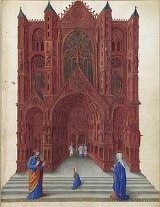
Western depictions usually focused on the lone figure of the young Mary climbing the steep steps of the Temple, having left her parents at the bottom, and climbing towards the chief priest and other Temple figures at the top of the steps. The Presentation was one of the usual scenes in larger cycles of the Life of the Virgin
Life of the Virgin
The Life of the Virgin, showing narrative scenes from the life of Mary, the mother of Jesus, is a common subject for pictorial cycles in Christian art, often complementing, or forming part of, a cycle on the Life of Christ. In both cases the number of scenes shown varies greatly with the space...

, although it was not usually one of the scenes shown in a Book of Hours
Book of Hours
The book of hours was a devotional book popular in the later Middle Ages. It is the most common type of surviving medieval illuminated manuscript. Like every manuscript, each manuscript book of hours is unique in one way or another, but most contain a similar collection of texts, prayers and...

.

External links