

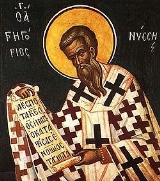
Gregory of Nyssa

Encyclopedia
St. Gregory of Nyssa (c 335 – after 394) was a Christian
bishop
and saint
. He was a younger brother of Basil the Great and a good friend of Gregory of Nazianzus
. His significance has long been recognized in the Eastern Orthodox, Oriental Orthodox, Eastern Catholic and Roman Catholic branches of Christianity
. Some historians identify Theosebia
the deaconess
as his wife, others hold that she, like Macrina the Younger, was actually a sister of Gregory and Basil.
Gregory along with his brother Basil of Caesarea
and Gregory of Nazianzus
are known as the Cappadocian Fathers
. They attempted a synthesis of Christian philosophy
and Greek philosophy
.
in 372. Nyssa is in a region then called Cappadocia
, in modern-day Turkey
. His brother Basil appointed him bishop in Nyssa because he wanted an episcopal
ally near to his metropolitan
see
of Caesarea. He was present at the Council
of Antioch
, and later at the Second Ecumenical Council
(381) which took place in Constantinople
. There he defended the Nicene Creed
against the Arians
.
. The first is his doctrine of the Trinity
, a development of the theology of Basil and their mutual friend Gregory Nazianzus. The second is his spiritual theology, which posited God as infinite and salvation as potentially universal. The traditional 19th Century Western interpretation found in older sources such as Schaff-Herzog (the Universalist historian George T. Knight
, 1912) and the Catholic Encyclopedia (Pierre Batiffol
, 1914) that Gregory of Nyssa taught universal salvation, or meant this by his use of the Greek term apokatastasis, is disputed by Eastern Theologians as incorrect. Gregory's views on this subject are being reassessed in the West.
Eastern theologians also dispute the Western interpretation of Gregory as a philosopher, and specifically of the Neoplatonic variety.
, Son
, and Holy Spirit
are three in the same way that Peter, Paul, and Timothy are three men. So why do we not say there are three Gods? Gregory answers that, normally, we can distinguish between different members of the same class by the fact that they have different shapes, sizes, and colors. Even if they are identical, they still occupy different points in space. But none of this is true of incorporeal
beings like God. Even lesser spiritual beings can still be distinguished by their varying degrees of goodness, but this does not apply to God either. In fact, the only way to tell the three Persons apart is by their mutual relations — thus, the only difference between the Father and the Son is that the former is the Father of the latter, and the latter is the Son of the former. As Gregory puts it, it is impossible to think of one member of the Trinity without thinking of the others too: they are like a chain of three links, pulling each other along.
Gregory's Trinitarian doctrine can be found in his Why there are not three Gods and in a letter to his younger brother Peter ("On the difference between ousia and hypostasis") which has been erroneously classified as Basil's 38th letter.
 Gregory is the first Christian theologian clearly and systematically to argue for the infinity of God, and one of the earliest Church Fathers to reveal some universalist tendencies. However, it isn't entirely clear what Gregory's actual position on universalism was since he displays marked non-universalist tendencies also. For instance, in Chapter 7 of Gregory's "Great Catechism" he says:
"Man, like some earthen potsherd, is resolved again into the dust of the ground, in order to secure that he may part with the soil he has now contracted, and that he may, through the resurrection, be reformed anew after the original pattern; at least if in this life that now is he has preserved what belongs to that image."
Origen of Alexandria, a major influence on Gregory, had explicitly argued that God is limited, since to be limited is to be clearly defined and knowable. Gregory, however, argues that if God is limited he must be limited by something greater than himself. As there is nothing greater than God, He is therefore without boundaries (gr. apeiron), and thus infinite. The idea had partly been developed by Neoplatonic philosophers, especially Plotinus
. But Gregory is the first to defend it fully, perhaps apart from some hints in the work of Irenaeus of Lyons and Clement of Alexandria
.
Accordingly, Gregory argues that since God is infinite he cannot be comprehended. Origen had spoken of the spiritual journey as a progression of increasing illumination, as the mystic
studies Scripture and comes to learn more about God. Nyssa taught on the other hand that God was knowable in his manifestations but that ultimately one must transcend knowledge or gnosis
(since knowledge is based on reflection). Gnosis is limited and can become a barrier between man and God. If one wishes to commune with God one must enter into the Divine filial relation with God the Father through Jesus Christ, one in ousia
with the Father which results in pure faith without any preconceived notions of God. Once one reaches this point one can commune with God just as Moses did in Nyssa's mystical classic, The Life of Moses.
, then spiritual illumination
, and finally a darkness of the mind in contemplation
of the God who in being or essence (ousia) cannot be comprehended.
Like earlier authors, including Philo
, he uses the story of Moses
as an allegory for the spiritual life. Moses first meets God in the burning bush, a theophany
of light and illumination, but then he meets him again in the cloud, where he realizes that God cannot be seen by the eyes. Ascending Mount Sinai, he finally comes to the "divine darkness", and realizes that God cannot be known by the mind either.
It is only through not-knowing and not-seeing that God can, paradoxically, be known and seen, knowledge that can only be gained through an "ascending life of holiness." This notion would be extremely influential in both Western and Eastern spirituality, via the mystical writings of Pseudo-Dionysius the Areopagite
, and later in the anonymous 14th century work, The Cloud of Unknowing
. Thus he is a major figure in the history of apophatic theology and spirituality.
 Related to this is Gregory's idea of epektasis (ἐπέκτασις) or constant progress. Platonic metaphysics holds that stability is perfection and change is for the worse. In contrast, Gregory described the ideal of human perfection as constant progress in virtue
and godliness. In his theology, God himself has always been perfect and has never changed, and never will. Humanity fell from grace in the Garden of Eden
, but rather than return to an unchanging state, humanity's goal is to become more and more perfect, more like God
, even though humanity will never understand, much less attain, God's transcendence
. This idea has had a profound influence on the Eastern Orthodox teaching regarding theosis
or "divinization". While the question of salvation or damnation is settled at the moment of death, nobody is known to have been damned and so prayers are offered for absolutely all the dead, even for those who seem to have been great sinners.
Probably in view of these teachings, Gregory of Nyssa is not listed as a Doctor of the Church
among Roman Catholics. His suspected Origenism is also a probable cause of his lacking an official liturgical commemoration in the Roman Catholic Church.http://www.newadvent.org/cathen/05075a.htm However, he is venerated as "Saint Gregory of Nyssa" in the Eastern Catholic Churches, and included on their liturgical calendars. The Eastern Orthodox and Catholic churches venerate him as "Saint Gregory of Nyssa" on account of (1) his pedigree among other "Saints", chiefly his brother Basil and sister Macrina; (2) his work in the Second Great Ecumenical Council of the Church, especially in defense of the "Holy Spirit"; (3) his esteemed place among the "Cappadocian Fathers" because of his stalwart defense of the Holy Trinity; (4) the tacit veneration of St. Gregory by the 7th Great Ecumenical Council, especially the appellations "holy" and "doctor", as well as their inclusion of a biographical anecdote from Gregory's life which was used, in part, to support the Council's decision against the "iconoclasts"; (5) his holy life and example.
These views led Gregory to his famous attack on slavery. In his homilies on Ecclesiastes Gregory writes:
Every human being has in a sense “been granted authority over everything on earth”, and so domination of one person over another is a failure to acknowledge this fact. Because of this Gregory claimed that human governments experience “quickly-repeated revolutions” for this very reason that it is “impracticable that those to whom nature has given equal rights should be excluded from power” and that “her impulse is instinct in all to make themselves equal with the dominant party, when all are of the same blood”.
About magistrates holding high offices, Gregory writes:
. Furthermore, his spiritual writings include Life of Moses, Life of Macrina (his older sister), the Life of Gregory Thaumaturgos, and 15 homilies On the Song of Songs. A large number of letters, sermons, philosophical works and short essays on a number of topics also survive.
Christian
A Christian is a person who adheres to Christianity, an Abrahamic, monotheistic religion based on the life and teachings of Jesus of Nazareth as recorded in the Canonical gospels and the letters of the New Testament...
bishop
Bishop
A bishop is an ordained or consecrated member of the Christian clergy who is generally entrusted with a position of authority and oversight. Within the Catholic Church, Eastern Orthodox, Oriental Orthodox Churches, in the Assyrian Church of the East, in the Independent Catholic Churches, and in the...
and saint
Saint
A saint is a holy person. In various religions, saints are people who are believed to have exceptional holiness.In Christian usage, "saint" refers to any believer who is "in Christ", and in whom Christ dwells, whether in heaven or in earth...
. He was a younger brother of Basil the Great and a good friend of Gregory of Nazianzus
Gregory of Nazianzus
Gregory of Nazianzus was a 4th-century Archbishop of Constantinople. He is widely considered the most accomplished rhetorical stylist of the patristic age...
. His significance has long been recognized in the Eastern Orthodox, Oriental Orthodox, Eastern Catholic and Roman Catholic branches of Christianity
Christianity
Christianity is a monotheistic religion based on the life and teachings of Jesus as presented in canonical gospels and other New Testament writings...
. Some historians identify Theosebia
Theosebia
Theosebia, also known as Theosebia the Deaconess is a 4th century Christian leader recognized as a saint in the Eastern Orthodox Church.As a saint she is referred to as Blessed Theosebia the Deaconess....
the deaconess
Deaconess
Deaconess is a non-clerical order in some Christian denominations which sees to the care of women in the community. That word comes from a Greek word diakonos as well as deacon, which means a servant or helper and occurs frequently in the Christian New Testament of the Bible. Deaconesses trace...
as his wife, others hold that she, like Macrina the Younger, was actually a sister of Gregory and Basil.
Gregory along with his brother Basil of Caesarea
Basil of Caesarea
Basil of Caesarea, also called Saint Basil the Great, was the bishop of Caesarea Mazaca in Cappadocia, Asia Minor . He was an influential 4th century Christian theologian...
and Gregory of Nazianzus
Gregory of Nazianzus
Gregory of Nazianzus was a 4th-century Archbishop of Constantinople. He is widely considered the most accomplished rhetorical stylist of the patristic age...
are known as the Cappadocian Fathers
Cappadocian Fathers
The Cappadocian Fathers are Basil the Great , who was bishop of Caesarea; Basil's brother Gregory of Nyssa , who was bishop of Nyssa; and a close friend, Gregory of Nazianzus , who became Patriarch of Constantinople...
. They attempted a synthesis of Christian philosophy
Christian philosophy
Christian philosophy may refer to any development in philosophy that is characterised by coming from a Christian tradition.- Origins of Christian philosophy :...
and Greek philosophy
Greek philosophy
Ancient Greek philosophy arose in the 6th century BCE and continued through the Hellenistic period, at which point Ancient Greece was incorporated in the Roman Empire...
.
Biography
Despite reservations, he consented to become bishop of NyssaNyssa (Cappadocia)
Nyssa was a Roman/late-Roman town of Cappadocia. It is located near to the modern town of Harmandalı, Ortaköy district, Aksaray province, in south-central Turkey....
in 372. Nyssa is in a region then called Cappadocia
Cappadocia
Cappadocia is a historical region in Central Anatolia, largely in Nevşehir Province.In the time of Herodotus, the Cappadocians were reported as occupying the whole region from Mount Taurus to the vicinity of the Euxine...
, in modern-day Turkey
Turkey
Turkey , known officially as the Republic of Turkey , is a Eurasian country located in Western Asia and in East Thrace in Southeastern Europe...
. His brother Basil appointed him bishop in Nyssa because he wanted an episcopal
Bishop
A bishop is an ordained or consecrated member of the Christian clergy who is generally entrusted with a position of authority and oversight. Within the Catholic Church, Eastern Orthodox, Oriental Orthodox Churches, in the Assyrian Church of the East, in the Independent Catholic Churches, and in the...
ally near to his metropolitan
Metropolitan bishop
In Christian churches with episcopal polity, the rank of metropolitan bishop, or simply metropolitan, pertains to the diocesan bishop or archbishop of a metropolis; that is, the chief city of a historical Roman province, ecclesiastical province, or regional capital.Before the establishment of...
see
Episcopal See
An episcopal see is, in the original sense, the official seat of a bishop. This seat, which is also referred to as the bishop's cathedra, is placed in the bishop's principal church, which is therefore called the bishop's cathedral...
of Caesarea. He was present at the Council
Synod
A synod historically is a council of a church, usually convened to decide an issue of doctrine, administration or application. In modern usage, the word often refers to the governing body of a particular church, whether its members are meeting or not...
of Antioch
Antioch
Antioch on the Orontes was an ancient city on the eastern side of the Orontes River. It is near the modern city of Antakya, Turkey.Founded near the end of the 4th century BC by Seleucus I Nicator, one of Alexander the Great's generals, Antioch eventually rivaled Alexandria as the chief city of the...
, and later at the Second Ecumenical Council
First Council of Constantinople
The First Council of Constantinople is recognized as the Second Ecumenical Council by the Assyrian Church of the East, the Oriental Orthodox, the Eastern Orthodox, the Roman Catholics, the Old Catholics, and a number of other Western Christian groups. It was the first Ecumenical Council held in...
(381) which took place in Constantinople
Constantinople
Constantinople was the capital of the Roman, Eastern Roman, Byzantine, Latin, and Ottoman Empires. Throughout most of the Middle Ages, Constantinople was Europe's largest and wealthiest city.-Names:...
. There he defended the Nicene Creed
Nicene Creed
The Nicene Creed is the creed or profession of faith that is most widely used in Christian liturgy. It is called Nicene because, in its original form, it was adopted in the city of Nicaea by the first ecumenical council, which met there in the year 325.The Nicene Creed has been normative to the...
against the Arians
Arianism
Arianism is the theological teaching attributed to Arius , a Christian presbyter from Alexandria, Egypt, concerning the relationship of the entities of the Trinity and the precise nature of the Son of God as being a subordinate entity to God the Father...
.
Theology and writings
Gregory made two major contributions to Christian theologyTheology
Theology is the systematic and rational study of religion and its influences and of the nature of religious truths, or the learned profession acquired by completing specialized training in religious studies, usually at a university or school of divinity or seminary.-Definition:Augustine of Hippo...
. The first is his doctrine of the Trinity
Trinity
The Christian doctrine of the Trinity defines God as three divine persons : the Father, the Son , and the Holy Spirit. The three persons are distinct yet coexist in unity, and are co-equal, co-eternal and consubstantial . Put another way, the three persons of the Trinity are of one being...
, a development of the theology of Basil and their mutual friend Gregory Nazianzus. The second is his spiritual theology, which posited God as infinite and salvation as potentially universal. The traditional 19th Century Western interpretation found in older sources such as Schaff-Herzog (the Universalist historian George T. Knight
George T. Knight (Universalist)
The Rev. George T. Knight, D.D, was an American Universalist teacher at the Crane Theological School, a Universalist seminary at Tufts University.-References:...
, 1912) and the Catholic Encyclopedia (Pierre Batiffol
Pierre Batiffol
Pierre Batiffol was a prominent French catholic priest and Church historian, known particularly as a historian of dogma....
, 1914) that Gregory of Nyssa taught universal salvation, or meant this by his use of the Greek term apokatastasis, is disputed by Eastern Theologians as incorrect. Gregory's views on this subject are being reassessed in the West.
Eastern theologians also dispute the Western interpretation of Gregory as a philosopher, and specifically of the Neoplatonic variety.
Trinity
Following Basil's lead, Gregory argues that the three Persons of the Trinity can be understood along the model of three members of a single class: thus, the FatherGod the Father
God the Father is a gendered title given to God in many monotheistic religions, particularly patriarchal, Abrahamic ones. In Judaism, God is called Father because he is the creator, life-giver, law-giver, and protector...
, Son
God the Son
God the Son is the second person of the Trinity in Christian theology. The doctrine of the Trinity identifies Jesus of Nazareth as God the Son, united in essence but distinct in person with regard to God the Father and God the Holy Spirit...
, and Holy Spirit
Holy Spirit
Holy Spirit is a term introduced in English translations of the Hebrew Bible, but understood differently in the main Abrahamic religions.While the general concept of a "Spirit" that permeates the cosmos has been used in various religions Holy Spirit is a term introduced in English translations of...
are three in the same way that Peter, Paul, and Timothy are three men. So why do we not say there are three Gods? Gregory answers that, normally, we can distinguish between different members of the same class by the fact that they have different shapes, sizes, and colors. Even if they are identical, they still occupy different points in space. But none of this is true of incorporeal
Incorporeal
Incorporeal or uncarnate means without the nature of a body or substance . The idea of incorporeality refers to the notion that there is an incorporeal realm of existence, or "place", that is distinct from the corporeal or material universe. Incorporeal beings or objects are not made out of matter...
beings like God. Even lesser spiritual beings can still be distinguished by their varying degrees of goodness, but this does not apply to God either. In fact, the only way to tell the three Persons apart is by their mutual relations — thus, the only difference between the Father and the Son is that the former is the Father of the latter, and the latter is the Son of the former. As Gregory puts it, it is impossible to think of one member of the Trinity without thinking of the others too: they are like a chain of three links, pulling each other along.
Gregory's Trinitarian doctrine can be found in his Why there are not three Gods and in a letter to his younger brother Peter ("On the difference between ousia and hypostasis") which has been erroneously classified as Basil's 38th letter.
Infinity
"Man, like some earthen potsherd, is resolved again into the dust of the ground, in order to secure that he may part with the soil he has now contracted, and that he may, through the resurrection, be reformed anew after the original pattern; at least if in this life that now is he has preserved what belongs to that image."
Origen of Alexandria, a major influence on Gregory, had explicitly argued that God is limited, since to be limited is to be clearly defined and knowable. Gregory, however, argues that if God is limited he must be limited by something greater than himself. As there is nothing greater than God, He is therefore without boundaries (gr. apeiron), and thus infinite. The idea had partly been developed by Neoplatonic philosophers, especially Plotinus
Plotinus
Plotinus was a major philosopher of the ancient world. In his system of theory there are the three principles: the One, the Intellect, and the Soul. His teacher was Ammonius Saccas and he is of the Platonic tradition...
. But Gregory is the first to defend it fully, perhaps apart from some hints in the work of Irenaeus of Lyons and Clement of Alexandria
Clement of Alexandria
Titus Flavius Clemens , known as Clement of Alexandria , was a Christian theologian and the head of the noted Catechetical School of Alexandria. Clement is best remembered as the teacher of Origen...
.
Accordingly, Gregory argues that since God is infinite he cannot be comprehended. Origen had spoken of the spiritual journey as a progression of increasing illumination, as the mystic
Mysticism
Mysticism is the knowledge of, and especially the personal experience of, states of consciousness, i.e. levels of being, beyond normal human perception, including experience and even communion with a supreme being.-Classical origins:...
studies Scripture and comes to learn more about God. Nyssa taught on the other hand that God was knowable in his manifestations but that ultimately one must transcend knowledge or gnosis
Gnosis
Gnosis is the common Greek noun for knowledge . In the context of the English language gnosis generally refers to the word's meaning within the spheres of Christian mysticism, Mystery religions and Gnosticism where it signifies 'spiritual knowledge' in the sense of mystical enlightenment.-Related...
(since knowledge is based on reflection). Gnosis is limited and can become a barrier between man and God. If one wishes to commune with God one must enter into the Divine filial relation with God the Father through Jesus Christ, one in ousia
Ousia
Ousia is the Ancient Greek noun formed on the feminine present participle of ; it is analogous to the English participle being, and the modern philosophy adjectival ontic...
with the Father which results in pure faith without any preconceived notions of God. Once one reaches this point one can commune with God just as Moses did in Nyssa's mystical classic, The Life of Moses.
Stages
In his Life of Moses, Gregory speaks of three stages of spiritual growth: initial darkness of ignoranceIgnorance
Ignorance is a state of being uninformed . The word ignorant is an adjective describing a person in the state of being unaware and is often used as an insult...
, then spiritual illumination
Illumination
Illumination, an observable property and effect of light, may also refer to:* Illumination , the use of light sources* Illumination , the use of light and shadow in art...
, and finally a darkness of the mind in contemplation
Theoria
For other uses of the term "contemplation", see Contemplation Theoria is Greek for contemplation. It corresponds to the Latin word contemplatio, "looking at", "gazing at", "being aware of".- Introduction :...
of the God who in being or essence (ousia) cannot be comprehended.
Like earlier authors, including Philo
Philo
Philo , known also as Philo of Alexandria , Philo Judaeus, Philo Judaeus of Alexandria, Yedidia, "Philon", and Philo the Jew, was a Hellenistic Jewish Biblical philosopher born in Alexandria....
, he uses the story of Moses
Moses
Moses was, according to the Hebrew Bible and Qur'an, a religious leader, lawgiver and prophet, to whom the authorship of the Torah is traditionally attributed...
as an allegory for the spiritual life. Moses first meets God in the burning bush, a theophany
Theophany
Theophany, from the Ancient Greek , meaning "appearance of God"), refers to the appearance of a deity to a human or other being, or to a divine disclosure....
of light and illumination, but then he meets him again in the cloud, where he realizes that God cannot be seen by the eyes. Ascending Mount Sinai, he finally comes to the "divine darkness", and realizes that God cannot be known by the mind either.
It is only through not-knowing and not-seeing that God can, paradoxically, be known and seen, knowledge that can only be gained through an "ascending life of holiness." This notion would be extremely influential in both Western and Eastern spirituality, via the mystical writings of Pseudo-Dionysius the Areopagite
Pseudo-Dionysius the Areopagite
Pseudo-Dionysius the Areopagite, also known as Pseudo-Denys, was a Christian theologian and philosopher of the late 5th to early 6th century, the author of the Corpus Areopagiticum . The author is identified as "Dionysos" in the corpus, which later incorrectly came to be attributed to Dionysius...
, and later in the anonymous 14th century work, The Cloud of Unknowing
The Cloud of Unknowing
The Cloud of Unknowing is an anonymous work of Christian mysticism written in Middle English in the latter half of the 14th century. The text is a spiritual guide on contemplative prayer in the late Middle Ages.Manuscripts of the work are today at British Library and Cambridge University Library...
. Thus he is a major figure in the history of apophatic theology and spirituality.
Epektasis (constant progress)
Virtue
Virtue is moral excellence. A virtue is a positive trait or quality subjectively deemed to be morally excellent and thus is valued as a foundation of principle and good moral being....
and godliness. In his theology, God himself has always been perfect and has never changed, and never will. Humanity fell from grace in the Garden of Eden
Garden of Eden
The Garden of Eden is in the Bible's Book of Genesis as being the place where the first man, Adam, and his wife, Eve, lived after they were created by God. Literally, the Bible speaks about a garden in Eden...
, but rather than return to an unchanging state, humanity's goal is to become more and more perfect, more like God
God
God is the English name given to a singular being in theistic and deistic religions who is either the sole deity in monotheism, or a single deity in polytheism....
, even though humanity will never understand, much less attain, God's transcendence
Transcendence (religion)
In religion transcendence refers to the aspect of God's nature which is wholly independent of the physical universe. This is contrasted with immanence where God is fully present in the physical world and thus accessible to creatures in various ways...
. This idea has had a profound influence on the Eastern Orthodox teaching regarding theosis
Theosis
In Christian theology, divinization, deification, making divine or theosis is the transforming effect of divine grace. This concept of salvation is historical and fundamental for Christian understanding that is prominent in the Eastern Orthodox Church and also in the Catholic Church, and is a...
or "divinization". While the question of salvation or damnation is settled at the moment of death, nobody is known to have been damned and so prayers are offered for absolutely all the dead, even for those who seem to have been great sinners.
Probably in view of these teachings, Gregory of Nyssa is not listed as a Doctor of the Church
Doctor of the Church
Doctor of the Church is a title given by a variety of Christian churches to individuals whom they recognize as having been of particular importance, particularly regarding their contribution to theology or doctrine.-Catholic Church:In the Catholic Church, this name is given to a saint from whose...
among Roman Catholics. His suspected Origenism is also a probable cause of his lacking an official liturgical commemoration in the Roman Catholic Church.http://www.newadvent.org/cathen/05075a.htm However, he is venerated as "Saint Gregory of Nyssa" in the Eastern Catholic Churches, and included on their liturgical calendars. The Eastern Orthodox and Catholic churches venerate him as "Saint Gregory of Nyssa" on account of (1) his pedigree among other "Saints", chiefly his brother Basil and sister Macrina; (2) his work in the Second Great Ecumenical Council of the Church, especially in defense of the "Holy Spirit"; (3) his esteemed place among the "Cappadocian Fathers" because of his stalwart defense of the Holy Trinity; (4) the tacit veneration of St. Gregory by the 7th Great Ecumenical Council, especially the appellations "holy" and "doctor", as well as their inclusion of a biographical anecdote from Gregory's life which was used, in part, to support the Council's decision against the "iconoclasts"; (5) his holy life and example.
Anthropology, social ethics and the critique of slavery
Though often philosophical in nature, Gregory's anthropological views can be understood as a biblical reflection on what it means for humankind to be created in the image of God. Meditating upon Gen. 1:27, Gregory argues that the soul, having the ability of rationality and free will, is the image of God. The soul is like a mirror reflecting the beauty and goodness of God, while sin is that which prevents the “buried beauty of the soul to shine forth”. Despite of sin, the image of God is present in all human beings. Our whole nature, Gregory argues, “is, so to say, one image of Him Who is”, which also means that the soul “does not admit the distinction of male and female”. This also suggests the metaphysical unity of humanity, and so every injustice is against humankind as such.These views led Gregory to his famous attack on slavery. In his homilies on Ecclesiastes Gregory writes:
- “God said, Let us make man in our own image and likeness. If he is in the likeness of God, and rules the whole earth, and has been granted authority over everything on earth from God, who is his buyer, tell me? Who is his seller? To God alone belongs this power; or, rather, not even to God himself. For his gracious gifts, it [Scripture] says, are irrevocable. God would not therefore reduce the human race to slavery, since He himself, when we had been enslaved to sin, spontaneously recalled us to freedom. But if God does not enslave what is free, who is he that sets his own power above God’s?”
Every human being has in a sense “been granted authority over everything on earth”, and so domination of one person over another is a failure to acknowledge this fact. Because of this Gregory claimed that human governments experience “quickly-repeated revolutions” for this very reason that it is “impracticable that those to whom nature has given equal rights should be excluded from power” and that “her impulse is instinct in all to make themselves equal with the dominant party, when all are of the same blood”.
About magistrates holding high offices, Gregory writes:
- “How can a man be master of another's life, if he is not even master of his own? Hence he ought to be poor in spirit, and look at Him who for our sake became poor of His own will; let him consider that we are all equal by nature, and not exalt himself impertinently against his own race on account of that deceptive show of office[...]”
Other subjects
In his catechetical work, "An Address on Religious Instruction" Gregory explicates his thought on the theistic differentiation between Christianity, Hellenism and Judaism. While he works out his notion of the Incarnation and the Atonement in his "An Address on Religious Instruction," one is also introduced to the ransom theory of atonementAtonement (ransom view)
The ransom view of the atonement, is one of several doctrines in Christian theology related to the meaning and effect of the death of Jesus Christ. The first major theory of the atonement, the ransom theory of atonement originated in the early Church, particularly in the work of Origen...
. Furthermore, his spiritual writings include Life of Moses, Life of Macrina (his older sister), the Life of Gregory Thaumaturgos, and 15 homilies On the Song of Songs. A large number of letters, sermons, philosophical works and short essays on a number of topics also survive.
Greek text
- Systematic publication of his works is proceeding in a collection, Gregorii Nysseni Opera, dominated by the work of the philologist, Werner Jaeger.
- Several volumes of his writings have appeared in the Sources ChrétiennesSources chretiennesSources Chrétiennes is a bilingual collection of patristic texts founded in Lyon in 1942 by the Jesuits Jean Daniélou, Claude Mondésert, and Henri de Lubac....
collection, the first publication of which was Jean Daniélou's translation (later edition) of his Life of Moses (1941). - James Herbert Strawley (ed.), The Catechetical oration of Gregory of Nyssa, Cambridge, 1903 online
English translations
- Phillip Schaff and Henry Wace (Ed.) Nicene and Post-Nicene Fathers. Eerdmans Grand Rapids 1974 (reprint)
- Ascetical Works (Fathers of the Church, v. 58), trans. Virginia Woods Callahan, CUA Press, 1967
- Commentary on the Song of Songs, trans. Casimir McCambley, Hellenic College Press, 1987
- Contra Eunomium II, trans. Stuart G. Hall, Proceedings of the 10th International Colloquium on Gregory of Nyssa (Olomouc, September 15–18, 2004), edited by Lenka Karfíková, Scot Douglass and Johannes Zachhuber, Leiden: Brill, 2007
- From glory to glory: texts from Gregory of Nyssa's mystical writings, selected and with an introd. by Jean Daniélou. Translated and edited by Herbert Musurillo. New York: Scribner, 1961.
- Stuart G. Hall (trans.), Gregory of Nyssa: Homilies on the Beatitudes. An English Version with Commentary and Supporting Studies. Proceedings of the Eighth International Colloquium on Gregory of Nyssa (Paderborn, 14–18 September 1998), edited by Hubertus R. Drobner and Albert Viciano
- Stuart G. Hall (ed. and trans.), Gregory of Nyssa: Homilies on Ecclesiastes: an English version with supporting studies, Proceedings of the Seventh International Colloquium on Gregory of Nyssa (St. Andrews, 5–10 September 1990), Berlin and New York: Walter de Gruyter, 1993
- Anna M. Silvas, Gregory of Nyssa: The Letters. Introduction, Translation and Commentary, Leiden: Brill, 2006
- The Life of Moses, trans. Abraham J. Malherbe and Everett Ferguson, Paulist Press, 1978 (repr. HarperCollins Spiritual Classics, 2006)
- The Lord's Prayer. The Beatitudes, trans. Hilda C. Graef, Newman Press, 1954
- On the Soul and Resurrection, trans. Catharine P. Roth, Popular Patristics Series (Crestwood, NY: St. Vladimir’s Seminary Press, 1993).
- Ronald Heine, ed., Gregory of Nyssa’s Treatise on the Inscriptions of the Psalms, Oxford Early Christian Studies (New York: Oxford University Press, 1995).
- A. Spira and C. Klock, eds., The Easter Sermons of Gregory of Nyssa: Translation and Commentary (Cambridge: Philadelphia Patristic Foundation, 1981). Containing Stuart G. Hall's translations of "In Sanctum Pascha," "De tridui spatio," and "In Sanctum et Salutare Pascha."
Reference works
- Friedhelm Mann (ed.), Lexicon Gregorianum: Wörterbuch zu den Schriften Gregors von Nyssa, 7 vols., Leiden: Brill, 1998–2008
- Lucas Francisco Mateo-Seco and Giulio Mapser (Ed.) The Brill Dictionary of Gregory of Nyssa. Brill Leiden 2010
See also
- Cappadocian FathersCappadocian FathersThe Cappadocian Fathers are Basil the Great , who was bishop of Caesarea; Basil's brother Gregory of Nyssa , who was bishop of Nyssa; and a close friend, Gregory of Nazianzus , who became Patriarch of Constantinople...
- Gregory of NazianzusGregory of NazianzusGregory of Nazianzus was a 4th-century Archbishop of Constantinople. He is widely considered the most accomplished rhetorical stylist of the patristic age...
- Saint Basil
- Origen of Alexandria
- Eunomius of CyzicusEunomius of CyzicusEunomius , one of the leaders of the extreme or "anomoean" Arians, who are sometimes accordingly called Eunomians, was born at Dacora in Cappadocia early in the 4th century....
External links
- Gregory of Nyssa Home Page includes many English translations of his writings, with introductions
- Alternate online source 19th century translations of most of Gregory's most important works
- Gregory of Nyssa Bilingual Anthology, The Making of Man (in English and Greek), Select Resources
- On 'Not Three Gods' Easy-to-access version
- St. Gregory of Nyssa from The Catholic Encyclopedia
- Gregory of Nyssa from "The Internet Encyclopedia of Philosophy"
- Opera Omnia by MigneMignéMigné is a commune in the Indre department in central France.-References:*...
, Patrologia GraecaPatrologia GraecaThe Patrologia Graeca is an edited collection of writings by the Christian Church Fathers and various secular writers, in the ancient Koine or medieval variants of the Greek language. It consists of 161 volumes produced in 1857–1866 by J. P. Migne's Imprimerie Catholique...
with analytical indexes - Relics of St. Gregory of Nyssa
- St. Gregory the Bishop of Nyssa Orthodox iconIconAn icon is a religious work of art, most commonly a painting, from Eastern Christianity and in certain Eastern Catholic churches...
and synaxarion - Saint Gregory of Nyssa Church of Trapezunta, Pontus
- Saint Gregory of Nyssa Episcopal Church San Francisco, CA
- Schaff's Nicene and Post-Nicene Fathers (online), including the works of St. Gregory
- Early Church Fathers: Gregory of Nyssa
