

Paschal cycle

Encyclopedia
Moveable feast
In Christianity, a moveable feast or movable feast is a holy day – a feast day or a fast day – whose date is not fixed to a particular day of the calendar year but moves in response to the date of Easter, the date of which varies according to a complex formula...
s built around Pascha
Easter
Easter is the central feast in the Christian liturgical year. According to the Canonical gospels, Jesus rose from the dead on the third day after his crucifixion. His resurrection is celebrated on Easter Day or Easter Sunday...
(Easter). The cycle consists of approximately ten weeks before and seven weeks after Pascha. The ten weeks before Pascha are known as the period of the Triodion
Triodion
The Triodion , also called the Lenten Triodion , is the liturgical book used by the Eastern Orthodox and Eastern Catholic Churches of Byzantine rite during Great Lent, the three preparatory weeks leading up to it, and during Holy Week.Many canons in the Triodion contain only three odes or...
(referring to the liturgical book
Liturgical book
A liturgical book is a book published by the authority of a church, that contains the text and directions for the liturgy of its official religious services.-Roman Catholic:...
that contains the services for this liturgical season). This period includes the three weeks preceding Great Lent
Great Lent
Great Lent, or the Great Fast, is the most important fasting season in the church year in Eastern Christianity, which prepares Christians for the greatest feast of the church year, Pascha . In many ways Great Lent is similar to Lent in Western Christianity...
(the "pre-Lenten period"), the forty days of Lent, and Holy Week
Holy Week
Holy Week in Christianity is the last week of Lent and the week before Easter...
. The 50 days following Pascha are called the Pentecostarion
Pentecostarion
The Pentecostarion is the liturgical book used by the Eastern Orthodox and Eastern Catholic Churches which follow the Byzantine Rite during the Paschal Season which extends from Pascha to the Sunday following All Saints Sunday The Pentecostarion (Greek: Πεντηκοστάριον, Pentekostárion; Slavonic:...
(again, named after the liturgical book).
The Sunday of each week has a special commemoration, named for the Gospel reading
Gospel (liturgy)
The Gospel in Christian liturgy refers to a reading from the Gospels used during various religious services, including Mass or Divine Liturgy . In many Christian churches, all present stand when a passage from one of the Gospels is read publicly, and sit when a passage from a different part of the...
assigned to that day. Certain other weekdays have special commemorations of their own (see outline, below). The entire cycle revolves around Pascha. The weeks before Pascha end on Sunday (i.e., the Week of the Prodigal Son begins on the Monday that follows the Publican and the Pharisee). This is because everything in the Lenten period is looking forward towards Pascha. Starting on Pascha, the weeks again begin on Sunday (i.e., Thomas Week begins on the Sunday of St. Thomas).
While the Pentecostarion closes after All Saints Sunday, the Paschal cycle continues throughout the entire year, until the beginning of the next Pre-Lenten period. The Tone of the Week
Octoechos (liturgy)
The Octoechos —literally, the book "of the Eight Tones"—contains an eight-week cycle, providing texts to be chanted for every day at Vespers, Matins, the Divine Liturgy, Compline and the Midnight Office...
, the Epistle
Epistle
An epistle is a writing directed or sent to a person or group of people, usually an elegant and formal didactic letter. The epistle genre of letter-writing was common in ancient Egypt as part of the scribal-school writing curriculum. The letters in the New Testament from Apostles to Christians...
and Gospel
Gospel (liturgy)
The Gospel in Christian liturgy refers to a reading from the Gospels used during various religious services, including Mass or Divine Liturgy . In many Christian churches, all present stand when a passage from one of the Gospels is read publicly, and sit when a passage from a different part of the...
readings at the Divine Liturgy
Divine Liturgy
Divine Liturgy is the common term for the Eucharistic service of the Byzantine tradition of Christian liturgy. As such, it is used in the Eastern Orthodox and Eastern Catholic Churches. Armenian Christians, both of the Armenian Apostolic Church and of the Armenian Catholic Church, use the same term...
, and the 11 Matins Gospels with their accompanying hymns are dependent on it.
(For fixed feast
Fixed feast
A fixed feast is an annual celebration that is held on the same calendar date every year, such as Christmas, as distinguished from moveable feasts, such as Easter, whose calendar date varies....
s, see Eastern Orthodox Church calendar. For this year's date for Pascha, see Easter
Easter
Easter is the central feast in the Christian liturgical year. According to the Canonical gospels, Jesus rose from the dead on the third day after his crucifixion. His resurrection is celebrated on Easter Day or Easter Sunday...
. For the method used to calculate the date of Pascha, see Computus
Computus
Computus is the calculation of the date of Easter in the Christian calendar. The name has been used for this procedure since the early Middle Ages, as it was one of the most important computations of the age....
.)
Pre-Lent

- ZacchaeusZacchaeusZacchaeus , according to chapter 19 of the gospel of Luke, was a superintendent of customs; a chief tax-gatherer at Jericho...
Sunday (Slavic tradition) or Sunday of the Canaanite (Greek tradition): 11th Sunday before Pascha - The Publican and the PhariseePharisee and the PublicanThe parable of the Pharisee and the Publican , is a parable of Jesus that appears in only one of the Canonical gospels of the New Testament. According to , a Pharisee, obsessed by his own virtue, is contrasted with a tax collector who humbly asks God for mercy.This parable demonstrates the need to...
: 10th Sunday before Pascha (70 days) - The Prodigal Son: 9th Sunday before Pascha (63 days)
- The Last JudgmentLast JudgmentThe Last Judgment, Final Judgment, Day of Judgment, Judgment Day, or The Day of the Lord in Christian theology, is the final and eternal judgment by God of every nation. The concept is found in all the Canonical gospels, particularly the Gospel of Matthew. It will purportedly take place after the...
; also, Meat-Fare Sunday (the last day meat may be eaten): 8th Sunday before Pascha (56 days) - Sunday of Forgiveness; also, Cheese-Fare Sunday (the last day dairy products may be consumed — during Great Lent fish, wine, and olive oil will be allowed only on certain days): 7th Sunday before Pascha (40 days)
Great Lent
- Clean MondayClean MondayClean Monday , also known as Pure Monday, Ash Monday, Monday of Lent or Green Monday, is the first day of the Eastern Orthodox Christian and Eastern Catholic Great Lent...
, the actual beginning of Great Lent: 48 days before Pascha - TheodoreTheodore of AmaseaSee also Theodore StratelatesSaint Theodore of Amasea is one of the two saints called Theodore who are venerated as Warrior Saints and Great Martyrs in the Eastern Orthodox Church. He is also known as Theodore Tiro...
Saturday—1st Saturday in Great Lent—commemorating of the "miracle of the kolyva" (boiled wheat) by Theodore of TyroTheodore of AmaseaSee also Theodore StratelatesSaint Theodore of Amasea is one of the two saints called Theodore who are venerated as Warrior Saints and Great Martyrs in the Eastern Orthodox Church. He is also known as Theodore Tiro...
during the reign of Julian the ApostateJulian the ApostateJulian "the Apostate" , commonly known as Julian, or also Julian the Philosopher, was Roman Emperor from 361 to 363 and a noted philosopher and Greek writer.... - Triumph of Orthodoxy—1st Sunday of Lent—commemoration of the restoration of icons after the defeat of the iconoclastIconoclasmIconoclasm is the deliberate destruction of religious icons and other symbols or monuments, usually with religious or political motives. It is a frequent component of major political or religious changes...
heresyHeresyHeresy is a controversial or novel change to a system of beliefs, especially a religion, that conflicts with established dogma. It is distinct from apostasy, which is the formal denunciation of one's religion, principles or cause, and blasphemy, which is irreverence toward religion...
in 843: 6th Sunday before Pascha (42 days) - Memorial Saturdays—2nd, 3rd, and 4th Saturdays of Great Lent—commemorative Divine LiturgiesDivine LiturgyDivine Liturgy is the common term for the Eucharistic service of the Byzantine tradition of Christian liturgy. As such, it is used in the Eastern Orthodox and Eastern Catholic Churches. Armenian Christians, both of the Armenian Apostolic Church and of the Armenian Catholic Church, use the same term...
and memorial serviceMemorial service (Orthodox)A memorial service is a liturgical observance in honor of the departed which is served in the Eastern Orthodox and Greek-Catholic Churches.-The service:In the Eastern Church, the various prayers for the departed have as their purpose: to pray for the repose...
s for the dead are celebrated on the - Saint Gregory PalamasGregory PalamasGregory Palamas was a monk of Mount Athos in Greece and later the Archbishop of Thessaloniki known as a preeminent theologian of Hesychasm. The teachings embodied in his writings defending Hesychasm against the attack of Barlaam are sometimes referred to as Palamism, his followers as Palamites...
—2nd Sunday of Lent—5th Sunday before Pascha (35 days) - Adoration of the CrossFeast of the CrossIn the Christian liturgical calendar, there are several different Feasts of the Cross, all of which commemorate the cross used in the crucifixion of Jesus....
4th Sunday before Pascha and 3rd Sunday of Lent(28 days) - Saint John of the LadderJohn ClimacusSaint John Climacus , also known as John of the Ladder, John Scholasticus and John Sinaites, was a 7th century Christian monk at the monastery on Mount Sinai. He is revered as a saint by the Roman Catholic, Oriental Orthodox, Eastern Orthodox and Eastern Catholic churches.We have almost no...
—4th Sunday of Lent—3rd Sunday before Pascha (21 days) - Saturday of the AkathistAkathistThe Akathist Hymn is a hymn of Eastern Orthodox and Eastern Catholic tradition dedicated to a saint, holy event, or one of the persons of the Holy Trinity...
—5th Saturday of Great Lent - Saint Mary of EgyptMary of EgyptMary of Egypt is revered as the patron saint of penitents, most particularly in the Eastern Orthodox, Oriental Orthodox, and Eastern Catholic churches, as well as in the Roman Catholic and Anglican churches.-Life:...
—5th Sunday of Lent—2nd Sunday before Pascha (14 days)
Great and Holy Week
- Lazarus SaturdayLazarus SaturdayLazarus Saturday, in the Orthodox Church and those Eastern Catholic Churches which follow the Byzantine Rite, is the day before Palm Sunday, and is liturgically linked to it...
, the beginning of Holy Week (8 days before Pascha) - Palm SundayPalm SundayPalm Sunday is a Christian moveable feast that falls on the Sunday before Easter. The feast commemorates Jesus' triumphal entry into Jerusalem, an event mentioned in all four Canonical Gospels. ....
, or the Triumphant Entry of ChristChristChrist is the English term for the Greek meaning "the anointed one". It is a translation of the Hebrew , usually transliterated into English as Messiah or Mashiach...
into Jerusalem: last Sunday before Pascha (7 days) - Great and Holy MondayHoly MondayHoly Monday or Great and Holy Monday is the Monday of Holy Week, which precedes the commemoration of the Death and Resurrection of Jesus. It is the second day of Holy Week.-Events on the Real Day:...
: Joseph the All-ComelyJoseph (Hebrew Bible)Joseph is an important character in the Hebrew bible, where he connects the story of Abraham, Isaac and Jacob in Canaan to the subsequent story of the liberation of the Israelites from slavery in Egypt....
(from the Old TestamentOld TestamentThe Old Testament, of which Christians hold different views, is a Christian term for the religious writings of ancient Israel held sacred and inspired by Christians which overlaps with the 24-book canon of the Masoretic Text of Judaism...
), who was sold into slavery by his brethren, and the withering of the fig tree (6 days)*Great and Holy TuesdayHoly TuesdayHoly Tuesday or Great and Holy Tuesday is the Tuesday of Holy Week, which precedes the commemoration of the death of Jesus.-Western Christianity:...
: Parable of the Ten VirginsParable of the Ten VirginsThe Parable of the Ten Virgins, also known as the parable of the Wise and Foolish Virgins, is one of the well known parables of Jesus. It appears in only one of the Canonical gospels of the New Testament...
(5 days) [*Great and Holy WednesdayHoly WednesdayIn Christianity, Holy Wednesday is the Wednesday of the Holy Week, the week before Easter...
: Anointing of Jesus with myrrhMyrrhMyrrh is the aromatic oleoresin of a number of small, thorny tree species of the genus Commiphora, which grow in dry, stony soil. An oleoresin is a natural blend of an essential oil and a resin. Myrrh resin is a natural gum....
by Mary of Bethany (Sister of Lazarus and Martha) in the house of Simon the LeperSimon the LeperSimon the Leper is a biblical figure mentioned by the Gospels according to Matthew and Mark . These two books narrate how Jesus made a visit to the house of Simon the Leper at Bethany during the course of which a woman anoints the head of Jesus with costly ointment. Bethany was the home of Simon...
in Bethany; also, the Holy Unction (4 days) - Great and Holy ThursdayMaundy ThursdayMaundy Thursday, also known as Holy Thursday, Covenant Thursday, Great & Holy Thursday, and Thursday of Mysteries, is the Christian feast or holy day falling on the Thursday before Easter that commemorates the Last Supper of Jesus Christ with the Apostles as described in the Canonical gospels...
: The washing of the disciples' feet, the institution of the Holy EucharistEucharistThe Eucharist , also called Holy Communion, the Sacrament of the Altar, the Blessed Sacrament, the Lord's Supper, and other names, is a Christian sacrament or ordinance...
, the "Marvelous Prayer", and the betrayal by Judas IscariotJudas IscariotJudas Iscariot was, according to the New Testament, one of the twelve disciples of Jesus. He is best known for his betrayal of Jesus to the hands of the chief priests for 30 pieces of silver.-Etymology:...
(3 days) - Great and Holy FridayGood FridayGood Friday , is a religious holiday observed primarily by Christians commemorating the crucifixion of Jesus Christ and his death at Calvary. The holiday is observed during Holy Week as part of the Paschal Triduum on the Friday preceding Easter Sunday, and may coincide with the Jewish observance of...
: The holy, saving and lifegiving PassionPassion (Christianity)The Passion is the Christian theological term used for the events and suffering – physical, spiritual, and mental – of Jesus in the hours before and including his trial and execution by crucifixion...
of Christ; Joseph of ArimatheaJoseph of ArimatheaJoseph of Arimathea was, according to the Gospels, the man who donated his own prepared tomb for the burial of Jesus after Jesus' Crucifixion. He is mentioned in all four Gospels.-Gospel references:...
(2 days) - Great and Holy SaturdayHoly SaturdayHoly Saturday , sometimes known as Easter Eve or Black Saturday, is the day after Good Friday. It is the day before Easter and the last day of Holy Week in which Christians prepare for Easter...
: The SepulchreSepulchreThe rock-cut tombs in ancient Israel are a group of hundreds of rock-cut tombs constructed in Israel in ancient times. They were cut into the rock, sometimes with elaborate facades and multiple burial chambers. Some are free-standing, but most are caves. Each tomb typically belonged to a...
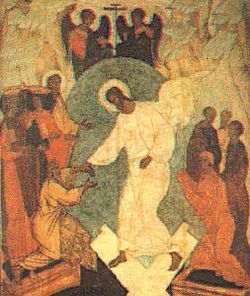
of Christ, his descent into HadesHadesHades , Hadēs, originally , Haidēs or , Aidēs , meaning "the unseen") was the ancient Greek god of the underworld. The genitive , Haidou, was an elision to denote locality: "[the house/dominion] of Hades". Eventually, the nominative came to designate the abode of the dead.In Greek mythology, Hades...
to raise up mankind and defeat the powers of death (last day before Pascha)
Great and Holy Pascha
- The ResurrectionResurrectionResurrection refers to the literal coming back to life of the biologically dead. It is used both with respect to particular individuals or the belief in a General Resurrection of the dead at the end of the world. The General Resurrection is featured prominently in Jewish, Christian, and Muslim...
of Jesus Christ: very late Saturday night (with the processionCrucessionA Crucession, or Cross Procession , is a procession that takes place in the Eastern Orthodox and Eastern Catholic liturgical traditions. The name derives from the fact that the procession is headed by a cross....
starting at midnight) - AgapeAgapeAgape is one of the Greek words translated into English as love, one which became particularly appropriated in Christian theology as the love of God or Christ for mankind. In the New Testament, it refers to the fatherly love of God for humans, as well as the human reciprocal love for God; the term...
VespersVespersVespers is the evening prayer service in the Western Catholic, Eastern Catholic, and Eastern Orthodox, Anglican, and Lutheran liturgies of the canonical hours...
: Proclamation of the GospelGospelA gospel is an account, often written, that describes the life of Jesus of Nazareth. In a more general sense the term "gospel" may refer to the good news message of the New Testament. It is primarily used in reference to the four canonical gospels of Matthew, Mark, Luke, and John...
to all the ends of the Earth, symbolized by the reading of the Gospel in various languages from the four corners of the Church building (Sunday afternoon)
Pentecostarion (Paschaltide)
- Bright WeekBright WeekBright Week or Renewal Week is the name used by the Eastern Orthodox Church and Eastern Catholic Churches of the Byzantine Rite for the period of seven days beginning on Pascha and continuing up to the following Sunday, which is known as Thomas Sunday...
: Week following Pascha - Thomas Sunday (Sunday of Saint Thomas): 1st Sunday after Pascha (7 days)
- Radonitsa: Tuesday after Thomas Sunday (9 days)
- The Holy MyrrhbearersMyrrhbearersIn Eastern Orthodoxy the Myrrhbearers are the individuals mentioned in the New Testament who were directly involved in the burial or who discovered the empty tomb following the resurrection of Jesus...
: 2nd Sunday after Pascha (14 days) - The Paralytic: 3rd Sunday after Pascha (21 days)
- The Samaritan Woman (Photini): 4th Sunday after Pascha (28 days)
- The Blind Man: 5th Sunday after Pascha (35 days)
- The Ascension of Jesus Christ (39 days)
- The Fathers of the First Ecumenical Council: 6th Sunday after Pascha (40 days)
- PentecostPentecostPentecost is a prominent feast in the calendar of Ancient Israel celebrating the giving of the Law on Sinai, and also later in the Christian liturgical year commemorating the descent of the Holy Spirit upon the disciples of Christ after the Resurrection of Jesus...
, when the Holy SpiritHoly SpiritHoly Spirit is a term introduced in English translations of the Hebrew Bible, but understood differently in the main Abrahamic religions.While the general concept of a "Spirit" that permeates the cosmos has been used in various religions Holy Spirit is a term introduced in English translations of...
descended on the Apostles: 7th Sunday after Pascha (49 days) - All SaintsAll SaintsAll Saints' Day , often shortened to All Saints, is a solemnity celebrated on 1 November by parts of Western Christianity, and on the first Sunday after Pentecost in Eastern Christianity, in honour of all the saints, known and unknown...
: 8th Sunday after Pascha (56 days)