
Hanukkah also known as the
Festival of Lights, is an eight-day
Jewish holidayJewish holidays are days observed by Jews as holy or secular commemorations of important events in Jewish history. In Hebrew, Jewish holidays and festivals, depending on their nature, may be called yom tov or chag or ta'anit...
commemorating the rededication of the
Holy TempleThe Temple in Jerusalem or Holy Temple , refers to one of a series of structures which were historically located on the Temple Mount in the Old City of Jerusalem, the current site of the Dome of the Rock. Historically, these successive temples stood at this location and functioned as the centre of...
(the
Second TempleThe Jewish Second Temple was an important shrine which stood on the Temple Mount in Jerusalem between 516 BCE and 70 CE. It replaced the First Temple which was destroyed in 586 BCE, when the Jewish nation was exiled to Babylon...
) in
Jerusalem at the time of the Maccabean Revolt of the 2nd century BCE. Hanukkah is observed for eight nights and days, starting on the 25th day of
KislevKislev Kislev Tiberian ; also Chislev is the third month of the civil year and the ninth month of the ecclesiastical year on the Hebrew calendar....
according to the
Hebrew calendarThe Hebrew calendar , or Jewish calendar, is a lunisolar calendar used today predominantly for Jewish religious observances. It determines the dates for Jewish holidays and the appropriate public reading of Torah portions, yahrzeits , and daily Psalm reading, among many ceremonial uses...
, which may occur at any time from late November to late December in the
Gregorian calendarThe Gregorian calendar, also known as the Western calendar, or Christian calendar, is the internationally accepted civil calendar. It was introduced by Pope Gregory XIII, after whom the calendar was named, by a decree signed on 24 February 1582, a papal bull known by its opening words Inter...
.
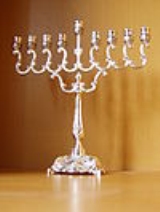
The festival is observed by the kindling of the lights of a unique candelabrum, the nine-branched
Menorah or
Hanukiah, one additional light on each night of the holiday, progressing to eight on the final night. The typical Menorah consists of eight branches with an additional raised branch. The extra light is called a
shamashA Gabbai is a person who assists in the running of a synagogue and ensures that the needs are met, for example the Jewish prayer services run smoothly, or an assistant to a rabbi...
(Hebrew: שמש, "attendant" or "sexton") and is given a distinct location, usually above or below the rest. The purpose of the
shamash is to have a light available for use, as using the Hanukkah lights themselves is forbidden.
Etymology
The name "Hanukkah" derives from the Hebrew verb "חנך", meaning "to dedicate". On Hanukkah, the Jews regained control of Jerusalem and rededicated the Temple.
Many homiletical explanations have been given for the name:
- The name can be broken down into חנו כ"ה, "they rested on the twenty-fifth", referring to the fact that the Jews ceased fighting on the 25th day of Kislev
Kislev Kislev Tiberian ; also Chislev is the third month of the civil year and the ninth month of the ecclesiastical year on the Hebrew calendar....
, the day on which the holiday begins.
- חנוכה (Hanukkah) is also the Hebrew acronym for ח נרות והלכה כבית הלל — "Eight candles, and the halakha is like the House of Hillel". This is a reference to the disagreement between two rabbinical schools of thought — the House of Hillel
Hillel was a famous Jewish religious leader, one of the most important figures in Jewish history. He is associated with the development of the Mishnah and the Talmud...
and the House of ShammaiShammai was a Jewish scholar of the 1st century, and an important figure in Judaism's core work of rabbinic literature, the Mishnah....
— on the proper order in which to light the Hanukkah flames. Shammai opined that eight candles should be lit on the first night, seven on the second night, and so on down to one on the last night. Hillel argued in favor of starting with one candle and lighting an additional one every night, up to eight on the eighth night. Jewish law adopted the position of Hillel.
Mishna and Talmud
The story of Hanukkah, along with its laws and customs, is entirely missing from the Mishna apart from several passing references (Bikkurim 1:6, Rosh HaShanah 1:3, Taanit 2:10, Megillah 3:4 and 3:6, Moed Katan 3:9, and Bava Kama 6:6).
Rav Nissim GaonNissim ben Jacob , was a rabbi best known today for his Talmudic commentary ha-Mafteach, by which title he is also known.-Biography:Rav Nissim studied at the Kairouan yeshiva, initially under his father - Jacob ben Nissim who...
postulates in his
Hakdamah Le'mafteach Hatalmud that information on the holiday was so commonplace that the Mishna felt no need to explain it.
Reuvein MargoliesReuvein Margolies, was an Israeli author and Talmudic scholar.- Early life :...
suggests that as the Mishnah was redacted after the Bar Kochba revolt, its editors were reluctant to include explicit discussion of a holiday celebrating another relatively recent revolt against a foreign ruler, for fear of antagonizing the Romans.
Hanukkah is described in the
TalmudThe Talmud is a central text of mainstream Judaism. It takes the form of a record of rabbinic discussions pertaining to Jewish law, ethics, philosophy, customs and history....
. The
GemaraThe Gemara is the component of the Talmud comprising rabbinical analysis of and commentary on the Mishnah. After the Mishnah was published by Rabbi Judah the Prince The Gemara (also transliterated Gemora or, less commonly, Gemorra; from Aramaic גמרא gamar; literally, "[to] study" or "learning by...
, in tractate
Shabbat 21, focuses on
ShabbatShabbat is the seventh day of the Jewish week and a day of rest in Judaism. Shabbat is observed from a few minutes before sunset on Friday evening until a few minutes after when one would expect to be able to see three stars in the sky on Saturday night. The exact times, therefore, differ from...
candles and moves to Hanukkah candles and says that after the forces of Antiochus IV had been driven from the Temple, the Maccabees discovered that almost all of the ritual olive oil had been profaned. They found only a single container that was still
sealA seal can be a figure impressed in wax, clay, or some other medium, or embossed on paper, with the purpose of authenticating a document ; but the term can also mean the device for making such impressions, being essentially a mould with the mirror image of the design carved in sunken- relief or...
ed by the
High PriestThe High Priest was the chief religious official of Israelite religion and of classical Judaism from the rise of the Israelite nation until the destruction of the Second Temple of Jerusalem...
, with enough oil to keep the menorah in the Temple lit for a single day. They used this, yet it burned for eight days (the time it took to have new oil pressed and made ready).
The Talmud presents three options:
- The law requires only one light each night per household,
- A better practice is to light one light each night for each member of the household
- The most preferred practice is to vary the number of lights each night.
Except in times of danger, the lights were to be placed outside one's door, on the opposite side of the Mezuza, or in the window closest to the street.
RashiShlomo Yitzhaki , or in Latin Salomon Isaacides, and today generally known by the acronym Rashi , was a medieval French rabbi famed as the author of a comprehensive commentary on the Talmud, as well as a comprehensive commentary on the Tanakh...
, in a note to
Shabbat 21b, says their purpose is to publicize the miracle.
Narrative of Josephus
The ancient Jewish Historian Flavius
JosephusTitus Flavius Josephus , also called Joseph ben Matityahu , was a 1st-century Romano-Jewish historian and hagiographer of priestly and royal ancestry who recorded Jewish history, with special emphasis on the 1st century AD and the First Jewish–Roman War, which resulted in the Destruction of...
narrates in his book Jewish Antiquities XII, how the victorious Judas Maccabbeus ordered lavish yearly eight-day festivities after rededicating the Temple in Jerusalem that had been profaned by Antiochus IV Epiphanes.
JosephusTitus Flavius Josephus , also called Joseph ben Matityahu , was a 1st-century Romano-Jewish historian and hagiographer of priestly and royal ancestry who recorded Jewish history, with special emphasis on the 1st century AD and the First Jewish–Roman War, which resulted in the Destruction of...
does not say the festival was called Hannukkah but rather the "Festival of Lights":
"Now Judas celebrated the festival of the restoration of the sacrifices of the temple for eight days, and omitted no sort of pleasures thereon; but he feasted them upon very rich and splendid sacrifices; and he honored God, and delighted them by hymns and psalms. Nay, they were so very glad at the revival of their customs, when, after a long time of intermission, they unexpectedly had regained the freedom of their worship, that they made it a law for their posterity, that they should keep a festival, on account of the restoration of their temple worship, for eight days. And from that time to this we celebrate this festival, and call it Lights. I suppose the reason was, because this liberty beyond our hopes appeared to us; and that thence was the name given to that festival. Judas also rebuilt the walls round about the city, and reared towers of great height against the incursions of enemies, and set guards therein. He also fortified the city Bethsura, that it might serve as a citadel against any distresses that might come from our enemies."
Other ancient sources
The story of Hanukkah is alluded to in the book of
1 MaccabeesThe First book of Maccabees is a book written in Hebrew by a Jewish author after the restoration of an independent Jewish kingdom, about the latter part of the 2nd century BC. The original Hebrew is lost and the most important surviving version is the Greek translation contained in the Septuagint...
and
2 Maccabees2 Maccabees is a deuterocanonical book of the Bible, which focuses on the Jews' revolt against Antiochus IV Epiphanes and concludes with the defeat of the Syrian general Nicanor in 161 BC by Judas Maccabeus, the hero of the work....
but Hanukkah is not specially mentioned; rather, a story similar in character, and obviously older in date, is the one alluded to in 2 Maccabees 1:18
et seq according to which the relighting of the altar fire by
NehemiahNehemiah ]]," Standard Hebrew Nəḥemya, Tiberian Hebrew Nəḥemyāh) is the central figure of the Book of Nehemiah, which describes his work rebuilding Jerusalem and purifying the Jewish community. He was the son of Hachaliah, Nehemiah ]]," Standard Hebrew Nəḥemya, Tiberian Hebrew Nəḥemyāh) is the...
was due to a miracle which occurred on the 25th of Kislev, and which appears to be given as the reason for the selection of the same date for the rededication of the altar by Judah Maccabee.
Another source is the
Megillat AntiochusMegillat Antiochus is a work recounting the story of Hanukkah and the history of the victory of the Maccabees over the Seleucid Empire....
. This work (also known as "Megillat HaHasmonaim", "Megillat Hanukkah" or "Megillat Yevanit") is in both
AramaicAramaic is a group of languages belonging to the Afroasiatic language phylum. The name of the language is based on the name of Aram, an ancient region in central Syria. Within this family, Aramaic belongs to the Semitic family, and more specifically, is a part of the Northwest Semitic subfamily,...
and
HebrewHebrew is a Semitic language of the Afroasiatic language family. Culturally, is it considered by Jews and other religious groups as the language of the Jewish people, though other Jewish languages had originated among diaspora Jews, and the Hebrew language is also used by non-Jewish groups, such...
; the Hebrew version is a literal translation from the Aramaic original. Recent scholarship dates it to somewhere between the 2nd and 5th Centuries, probably in the 2nd century, with the Hebrew dating to the 7th century. It was published for the first time in
MantuaMantua is a city and comune in Lombardy, Italy and capital of the province of the same name. Mantua's historic power and influence under the Gonzaga family, made it one of the main artistic, cultural and notably musical hubs of Northern Italy and the country as a whole...
in 1557.
Saadia GaonSaʻadiah ben Yosef Gaon was a prominent rabbi, Jewish philosopher, and exegete of the Geonic period.The first important rabbinic figure to write extensively in Arabic, he is considered the founder of Judeo-Arabic literature...
, who translated it into
ArabicArabic is a name applied to the descendants of the Classical Arabic language of the 6th century AD, used most prominently in the Quran, the Islamic Holy Book...
in the 9th century, ascribed it to the Maccabees themselves, disputed by some, since it gives dates as so many years before the destruction of the second temple in 70 CE. The Hebrew text with an English translation can be found in the
SiddurA siddur is a Jewish prayer book, containing a set order of daily prayers. This article discusses how some of these prayers evolved, and how the siddur, as it is known today has developed...
of
Philip BirnbaumPhilip Birnbaum was an author and translator, best known for his translation and annotation of the siddur , first published in 1949.-Biography:...
.
The Christian Bible refers to Jesus being at the Jerusalem Temple during "the feast of the dedication and it was winter" in John 10:22-23.
Background
JudeaJudea or Judæa was the name of the mountainous southern part of the historic Land of Israel from the 8th century BCE to the 2nd century CE, when Roman Judea was renamed Syria Palaestina following the Jewish Bar Kokhba revolt.-Etymology:The...
was part of the
Ptolemaic KingdomThe Ptolemaic Kingdom in and around Egypt began following Alexander the Great's conquest in 332 BC and ended with the death of Cleopatra VII and the Roman conquest in 30 BC. It was founded when Ptolemy I Soter declared himself Pharaoh of Egypt, creating a powerful Hellenistic state stretching from...
of Egypt until 200 BCE when King
Antiochus III the GreatAntiochus III the Great Seleucid Greek king who became the 6th ruler of the Seleucid Empire as a youth of about eighteen in 223 BC. Antiochus was an ambitious ruler who ruled over Greater Syria and western Asia towards the end of the 3rd century BC...
of Syria defeated King
Ptolemy V EpiphanesPtolemy V Epiphanes , son of Ptolemy IV Philopator and Arsinoe III of Egypt, was the fifth ruler of the Ptolemaic dynasty. He became ruler at the age of five, and under a series of regents the kingdom was paralyzed.-Regency infighting:Ptolemy Epiphanes was only a small boy when his father, Ptolemy...
of Egypt at the
Battle of PaniumThe Battle of Panium was fought in 200 BC between Seleucid and Ptolemaic forces as part of the Syrian Wars. The Seleucids were led by Antiochus III the Great, while the Ptolemaic army was led by Scopas of Aetolia. The Seleucids won the battle...
.
JudeaJudea or Judæa was the name of the mountainous southern part of the historic Land of Israel from the 8th century BCE to the 2nd century CE, when Roman Judea was renamed Syria Palaestina following the Jewish Bar Kokhba revolt.-Etymology:The...
became at that moment part of the
Seleucid EmpireThe Seleucid Empire was a Greek-Macedonian state that was created out of the eastern conquests of Alexander the Great. At the height of its power, it included central Anatolia, the Levant, Mesopotamia, Persia, today's Turkmenistan, Pamir and parts of Pakistan.The Seleucid Empire was a major centre...
of Syria. King
Antiochus III the GreatAntiochus III the Great Seleucid Greek king who became the 6th ruler of the Seleucid Empire as a youth of about eighteen in 223 BC. Antiochus was an ambitious ruler who ruled over Greater Syria and western Asia towards the end of the 3rd century BC...
wanting to conciliate his new Jewish subjects guaranteed their right to "live according to their ancestral customs" and to continue to practice their religion in the Temple of Jerusalem. However in 175 BCE,
Antiochus IV EpiphanesAntiochus IV Epiphanes ruled the Seleucid Empire from 175 BC until his death in 164 BC. He was a son of King Antiochus III the Great. His original name was Mithridates; he assumed the name Antiochus after he ascended the throne....
, the son of Antiochus III invaded Judea, ostensibly at the request of the sons of Tobias. The
TobiadsThe Tobiads were a Jewish or Ammonite faction at the beginning of the Maccabean period. They were phil-Hellene, in other words supporters of the Hellenistic tendencies in Judaism in the early years of the 2nd century BCE.-Accounts:...
, who led the
Hellenizing Jewish factionHellenistic Judaism was a movement which existed in the Jewish diaspora that sought to establish a Hebraic-Jewish religious tradition within the culture and language of Hellenism...
in Jerusalem, were expelled to Syria around 170 BCE when the high priest Onias and his pro-Egyptian faction wrested control from them. The exiled Tobiads lobbied Antiochus IV Epiphanes to recapture Jerusalem. As the ancient Jewish historian Flavius Josephus tells us "The king being thereto disposed beforehand, complied with them, and came upon the Jews with a great army, and took their city by force, and slew a great multitude of those that favored Ptolemy, and sent out his soldiers to plunder them without mercy. He also spoiled the temple, and put a stop to the constant practice of offering a daily sacrifice of expiation for three years and six months."
Traditional view
When the
Second TempleThe Jewish Second Temple was an important shrine which stood on the Temple Mount in Jerusalem between 516 BCE and 70 CE. It replaced the First Temple which was destroyed in 586 BCE, when the Jewish nation was exiled to Babylon...
in Jerusalem was looted and services stopped,
JudaismJudaism ) is the "religion, philosophy, and way of life" of the Jewish people...
was outlawed. In 167 BCE
AntiochusAntiochus IV Epiphanes ruled the Seleucid Empire from 175 BC until his death in 164 BC. He was a son of King Antiochus III the Great. His original name was Mithridates; he assumed the name Antiochus after he ascended the throne....
ordered an altar to
ZeusIn the ancient Greek religion, Zeus was the "Father of Gods and men" who ruled the Olympians of Mount Olympus as a father ruled the family. He was the god of sky and thunder in Greek mythology. His Roman counterpart is Jupiter and his Etruscan counterpart is Tinia.Zeus was the child of Cronus...
erected in the Temple. He banned circumcision and ordered pigs to be sacrificed at the altar of the temple.Antiochus's actions provoked a large-scale revolt.
MattityahuMattathias ben Johanan was a Jewish priest whose role in the Jewish revolt against the Syrian Greeks is related in the Books of the Maccabees...
, a
Jewish priestA Kohen is the Hebrew word for priest. Jewish Kohens are traditionally believed and halachically required to be of direct patrilineal descent from the Biblical Aaron....
, and his five sons
JochananJohn Gaddi was the oldest of the sons of Mattathias, and brother of Judas Maccabeus. His 'nickname' Gaddi is a Hebrew term, meaning "My Fortune"...
,
SimeonSimon Thassi was the second son of Mattathias and thus a member of the Hasmonean family. The name "Thassi" has an uncertain meaning...
,
EleazarEleazar Avaran, also known as Eleazar Maccabeus, Eleazar Hachorani/Choran was the fourth son of Mattathias and the younger brother of Judas Maccabeus. He was killed at the Battle of Beth-zechariah during the Maccabean revolt. Eleazar Avaran, also known as Eleazar Maccabeus, Eleazar...
,
JonathanJonathan Apphus was leader of the Hasmonean Dynasty of Judea from 161 to 143 BCE. The name Apphus could mean = "the dissembler", "the Wary", or "the diplomat", in allusion to a trait prominent in him -Leader of the Jews:...
, and
JudahJudah Maccabee was a Kohen and a son of the Jewish priest Mattathias...
led a rebellion against Antiochus. Judah became known as Yehuda HaMakabi ("Judah the Hammer"). By 166 BCE Mattathias had died, and Judah took his place as leader. By 165 BCE the Jewish revolt against the Seleucid monarchy was successful. The Temple was liberated and rededicated. The festival of Hanukkah was instituted to celebrate this event. Judah ordered the Temple to be cleansed, a new altar to be built in place of the polluted one and new holy vessels to be made. According to the Talmud, olive oil was needed for the menorah in the Temple, which was required to burn throughout the night every night. The story goes that there was only enough oil to burn for one day, yet it burned for eight days, the time needed to prepare a fresh supply of oil for the menorah. An eight day festival was declared by the Jewish sages to commemorate this miracle.
The version of the story in 1 Maccabees states that an eight day celebration of songs and sacrifices was proclaimed upon re-dedication of the altar, and makes no mention of the miracle of the oil. A number of historians believe that the reason for the eight day celebration was that the first Hanukkah was a belated celebration of
SukkotSukkot is a Biblical holiday celebrated on the 15th day of the month of Tishrei . It is one of the three biblically mandated festivals Shalosh regalim on which Hebrews were commanded to make a pilgrimage to the Temple in Jerusalem.The holiday lasts seven days...
and
Shemini AtzeretShemini Atzeret is a Jewish holiday. It is celebrated on the 22nd day of the Hebrew month of Tishrei. In the Diaspora, an additional day is celebrated, the second day being separately referred to as Simchat Torah...
. During the war the Jews were not able to celebrate the these festivals, when lamps were lit in the Temple (Suk.v. 2–4).
Modern scholarship
Some modern scholars argue that the king was intervening in an internal
civil warA civil war is a war between organized groups within the same nation state or republic, or, less commonly, between two countries created from a formerly-united nation state....
between the traditionalist Jews and the Hellenized Jews in Jerusalem.
These competed violently over who would be the
High PriestThe High Priest was the chief religious official of Israelite religion and of classical Judaism from the rise of the Israelite nation until the destruction of the Second Temple of Jerusalem...
, with traditionalists with Hebrew/Aramaic names like
OniasOnias III was a Jewish High Priest, the son of Simon II. He is described as a pious man who, unlike the Hellenizers, fought for Judaism. Seleucus Philopator defrayed all the expenses connected with the sanctuary and was friendly to the Jews...
contesting with Hellenizing High Priests with Greek names like
JasonJason of the Oniad family, brother to Onias III, was a High Priest in the Temple in Jerusalem.Jason became high priest in 175 BCE after the accession of Antiochus Epiphanes to the throne of the Seleucid Empire....
and
MenelausMenelaus was High Priest in Jerusalem from 171 BC to about 161 BC. He was the successor of Jason, the brother of Onias III.The sources are divided as to his origin...
. In particular Jason's Hellenistic reforms would prove to be a decisive factor leading to eventual conflict within the ranks of Judaism. Other authors point to possible socioeconomic reasons in addition to the religious reasons behind the civil war.
What began in many respects as a civil war escalated when the Hellenistic kingdom of Syria sided with the
Hellenizing JewsHellenistic Judaism was a movement which existed in the Jewish diaspora that sought to establish a Hebraic-Jewish religious tradition within the culture and language of Hellenism...
in their conflict with the traditionalists.
As the conflict escalated, Antiochus took the side of the Hellenizers by prohibiting the religious practices the traditionalists had rallied around. This may explain why the king, in a total departure from Seleucid practice in all other places and times, banned a traditional religion.
Hanukkah rituals
Hanukkah is celebrated by a series of rituals that are performed every day throughout the 8-day holiday, some are family-based and others communal. There are special additions to the daily prayer service, and a section is added to the blessing after meals. Hanukkah is not a "Sabbath-like" holiday, and there is no obligation to refrain from
activities that are forbidden on the SabbathThe commandment to keep Shabbat as a day of rest is repeated many times in the Tanakh, the Hebrew Bible. The commandment is usually expressed in English in terms of refraining from the doing of work on Shabbat, but the Hebrew term used in the Bible is melakha , which has a slightly different...
, as specified in the
Shulkhan Arukh. Adherents go to work as usual, but may leave early in order to be home to kindle the lights at nightfall. There is no religious reason for schools to be closed, although, in Israel, schools close from the second day for the whole week of Hanukkah. Many families exchange gifts each night, and fried foods are eaten.
Kindling the Hanukkah lights
The single light each night for eight nights. As a universally practiced "beautification" of the
mitzvahThe primary meaning of the Hebrew word refers to precepts and commandments as commanded by God...
, the number of lights lit is increased by one each night. An extra light called a
shamash, meaning "attendant" or "sexton," is also lit each night, and is given a distinct location, usually higher, lower, or to the side of the others. The purpose of the extra light is to adhere to the prohibition, specified in the Talmud (Tracate Shabbat 21b–23a), against using the Hanukkah lights for anything other than publicizing and meditating on the Hanukkah story. This differs from
SabbathShabbat is the seventh day of the Jewish week and a day of rest in Judaism. Shabbat is observed from a few minutes before sunset on Friday evening until a few minutes after when one would expect to be able to see three stars in the sky on Saturday night. The exact times, therefore, differ from...
candles which are meant to be used for illumination. Hence, if one were to need extra illumination on Hanukkah, the
shamash candle would be available and one would avoid using the prohibited lights. Some light the
shamash candle first and then use it to light the others. So all together, including the
shamash, two lights are lit on the first night, three on the second and so on, ending with nine on the last night, for a total of 44 (36, excluding the
shamash).
The lights can be candles or oil lamps. Electric lights are sometimes used and are acceptable in places where open flame is not permitted, such as a hospital room. Most Jewish homes have a special candelabrum or oil lamp holder for Hanukkah, which holds eight lights plus the additional
shamash light.
The reason for the Hanukkah lights is not for the "lighting of the house within", but rather for the "illumination of the house without," so that passersby should see it and be reminded of the holiday's miracle. Accordingly, lamps are set up at a prominent window or near the door leading to the street. It is customary amongst some Ashkenazim to have a separate menorah for each family member (customs vary), whereas most Sephardim light one for the whole household. Only when there was danger of antisemitic persecution were lamps supposed to be hidden from public view, as was the case in
PersiaIran , officially the Islamic Republic of Iran , is a country in Southern and Western Asia. The name "Iran" has been in use natively since the Sassanian era and came into use internationally in 1935, before which the country was known to the Western world as Persia...
under the rule of the
ZoroastriansZoroastrianism is a religion and philosophy based on the teachings of prophet Zoroaster and was formerly among the world's largest religions. It was probably founded some time before the 6th century BCE in Greater Iran.In Zoroastrianism, the Creator Ahura Mazda is all good, and no evil...
, or in parts of Europe before and during World War II. However, most
HasidicHasidic Judaism or Hasidism, from the Hebrew —Ḥasidut in Sephardi, Chasidus in Ashkenazi, meaning "piety" , is a branch of Orthodox Judaism that promotes spirituality and joy through the popularisation and internalisation of Jewish mysticism as the fundamental aspects of the Jewish faith...
groups light lamps near an inside doorway, not necessarily in public view. According to this tradition, the lamps are placed on the opposite side from the
mezuzahA mezuzah is usually a metal or wooden rectangular object that is fastened to a doorpost of a Jewish house. Inside it is a piece of parchment inscribed with specified Hebrew verses from the Torah...
, so that when one passes through the door he is surrounded by the holiness of
mitzvoth.
Generally women are exempt in Jewish law from time-bound positive commandments, however the Talmud requires that women engage in the mitzvah of lighting Hanukkah candles “for they too were involved in the miracle.”
Candlelighting time
Hanukkah lights should burn for at least one half hour after it gets dark. The custom of the
Vilna GaonElijah ben Shlomo Zalman Kramer, known as the Vilna Gaon or Elijah of Vilna and simply by his Hebrew acronym Gra or Elijah Ben Solomon, , was a Talmudist, halachist, kabbalist, and the foremost leader of non-hasidic Jewry of the past few centuries...
observed by many residents of Jerusalem as the custom of the city, is to light at sundown, although most Hassidim light later, even in Jerusalem. Many Hasidic Rebbes light much later, because they fulfill the obligation of publicizing the miracle by the presence of their Hasidim when they kindle the lights. Inexpensive small wax candles sold for Hanukkah burn for approximately half an hour, so on most days this requirement can be met by lighting the candles when it is dark outside. Friday night presents a problem, however. Since candles may not be lit on the
ShabbatShabbat is the seventh day of the Jewish week and a day of rest in Judaism. Shabbat is observed from a few minutes before sunset on Friday evening until a few minutes after when one would expect to be able to see three stars in the sky on Saturday night. The exact times, therefore, differ from...
itself, the candles must be lit before sunset. However, they must remain lit until the regular time—thirty minutes after nightfall—and inexpensive Hanukkah candles do not burn long enough to meet the requirement. A simple solution is to use longer candles, or the traditional oil lamps. In keeping with the above-stated prohibition, the Hanukkah menorah is lit first, followed by the Shabbat candles which signify its onset.
Blessings over the candles
Typically three blessings (
Brachot singular
Brachah) are recited during this eight-day festival. On the first night of Hanukkah, Jews recite all three blessings; on all subsequent nights, they recite only the first two. The blessings are said before or after the candles are lit depending on tradition. On the first night of Hanukkah one light (candle, lamp, or electric) is lit on the right side of the Menorah, on the following night a second light is placed to the left of the first candle and so on, proceeding from right to left over the eight nights. On each night, the leftmost candle is lit first, and lighting proceeds from left to right.
For the full text of the blessings, see List of Jewish prayers and blessings: Hanukkah.
Hanerot Halalu
During or after the lights are kindled the hymn
Hanerot Halalu is recited. There are several differing versions; the version presented here is recited in many Ashkenazic communities:
Ashkenazi version:
| Transliteration |
English |
| Hanneirot hallalu anachnu madlikin 'al hannissim ve'al hanniflaot 'al hatteshu'ot ve'al hammilchamot she'asita laavoteinu bayyamim haheim, (u)bazzeman hazeh 'al yedei kohanekha hakkedoshim. Vekhol-shemonat yemei Hanukkah hanneirot hallalu kodesh heim, ve-ein lanu reshut lehishtammesh baheim ella lir'otam bilvad kedei lehodot ul'halleil leshimcha haggadol 'al nissekha ve'al nifleotekha ve'al yeshu'otekha. |
We light these lights for the miracles and the wonders, for the redemption and the battles that you made for our forefathers, in those days at this season, through your holy priests A Kohen is the Hebrew word for priest. Jewish Kohens are traditionally believed and halachically required to be of direct patrilineal descent from the Biblical Aaron.... . During all eight days of Hanukkah these lights are sacred, and we are not permitted to make ordinary use of them except for to look at them in order to express thanks and praise to Your great Name for Your miracles, Your wonders and Your salvations. |
Maoz Tzur
Each night after the lighting of the candles, the hymn
Ma'oz Tzur"Ma'oz Tzur" , is a Jewish liturgical poem or piyyut. It is written in Hebrew, and is sung on the holiday of Hanukkah, after lighting the festival lights. The name is a reference to the Hasmonean stronghold of Beth-zur. This Hebrew song is thought to have been written sometime in the 13th century...
is sung. The song contains six stanzas. The first and last deal with general themes of divine salvation, and the middle four deal with events of persecution in
Jewish historyJewish history is the history of the Jews, their religion and culture, as it developed and interacted with other peoples, religions and cultures. Since Jewish history is over 4000 years long and includes hundreds of different populations, any treatment can only be provided in broad strokes...
, and praises God for survival despite these tragedies (
the exodusThe Exodus is the story of the departure of the Israelites from ancient Egypt described in the Hebrew Bible.Narrowly defined, the term refers only to the departure from Egypt described in the Book of Exodus; more widely, it takes in the subsequent law-givings and wanderings in the wilderness...
from Egypt, the
Babylonian captivityThe Babylonian captivity was the period in Jewish history during which the Jews of the ancient Kingdom of Judah were captives in Babylon—conventionally 587–538 BCE....
, the miracle of the holiday of
PurimPurim is a Jewish holiday that commemorates the deliverance of the Jewish people in the ancient Persian Empire from destruction in the wake of a plot by Haman, a story recorded in the Biblical Book of Esther .Purim is celebrated annually according to the Hebrew calendar on the 14th...
, and the
HasmoneanThe Hasmonean dynasty , was the ruling dynasty of Judea and surrounding regions during classical antiquity. Between c. 140 and c. 116 BCE, the dynasty ruled semi-autonomously from the Seleucids in the region of Judea...
victory).
Other customs
After lighting the candles and Ma'oz Tzur, singing other Hanukkah songs is customary in many Jewish homes. Some
HasidicHasidic Judaism or Hasidism, from the Hebrew —Ḥasidut in Sephardi, Chasidus in Ashkenazi, meaning "piety" , is a branch of Orthodox Judaism that promotes spirituality and joy through the popularisation and internalisation of Jewish mysticism as the fundamental aspects of the Jewish faith...
and Sephardi Jews recite
PsalmsThe Book of Psalms , commonly referred to simply as Psalms, is a book of the Hebrew Bible and the Christian Bible...
, such as Psalms 30, 67, and 91. In North America and in Israel it is common to exchange presents or give children presents at this time. In addition, many families encourage their children to give
tzedakahTzedakah or Ṣ'daqah in Classical Hebrew is a Hebrew word commonly translated as charity, though it is based on the Hebrew word meaning righteousness, fairness or justice...
in lieu of presents for themselves.
Special additions to daily prayers
An addition is made to the "
hoda'ah" (thanksgiving) benediction in the
AmidahThe Amidah , also called the Shmoneh Esreh , is the central prayer of the Jewish liturgy. This prayer, among others, is found in the siddur, the traditional Jewish prayer book...
, called
Al ha-Nissim ("On/about the Miracles"). This addition refers to the victory achieved over the Syrians by the Hasmonean Mattathias and his sons.
The same prayer is added to the grace after meals. In addition, the
HallelHallel is a Jewish prayer—a verbatim recitation from Psalms 113–118, which is used for praise and thanksgiving that is recited by observant Jews on Jewish holidays.-Holy days:...
Psalms are sung during each morning service and the
TachanunTachanun or , also called nefillat apayim is part of Judaism's morning and afternoon services, after the recitation of the Amidah, the central part of the daily Jewish prayer services...
penitential prayers are omitted. The Torah is read every day in the
synagogueA synagogue is a Jewish house of prayer. This use of the Greek term synagogue originates in the Septuagint where it sometimes translates the Hebrew word for assembly, kahal...
, the first day beginning from
NumbersThe Book of Numbers is the fourth book of the Hebrew Bible, and the fourth of five books of the Jewish Torah/Pentateuch....
6:22 (according to some customs, Numbers 7:1), and the last day ending with Numbers 8:4. Since Hanukkah lasts eight days it includes at least one, and sometimes two,
Jewish SabbathsShabbat is the seventh day of the Jewish week and a day of rest in Judaism. Shabbat is observed from a few minutes before sunset on Friday evening until a few minutes after when one would expect to be able to see three stars in the sky on Saturday night. The exact times, therefore, differ from...
(Saturdays). The weekly
Torah portionThis article is about the divisions of the Torah into weekly readings. For this week's Torah portion, see Torah portionThe weekly Torah portion |Sidra]]) is a section of the Torah read in Jewish services...
for the first Sabbath is almost always
MiketzMiketz or Mikeitz is the tenth weekly Torah portion in the annual Jewish cycle of Torah reading. It constitutes Genesis Jews in the Diaspora read it the tenth Sabbath after Simchat Torah. Generally, it is read on the Sabbath of Chanukah...
, telling of
JosephJoseph is an important character in the Hebrew bible, where he connects the story of Abraham, Isaac and Jacob in Canaan to the subsequent story of the liberation of the Israelites from slavery in Egypt....
's dream and his enslavement in
EgyptAncient Egypt was an ancient civilization of Northeastern Africa, concentrated along the lower reaches of the Nile River in what is now the modern country of Egypt. Egyptian civilization coalesced around 3150 BC with the political unification of Upper and Lower Egypt under the first pharaoh...
. The
HaftarahThe haftarah or haftoroh is a series of selections from the books of Nevi'im of the Hebrew Bible that is publicly read in synagogue as part of Jewish religious practice...
reading for the first Sabbath Hanukkah is
ZechariahThe Book of Zechariah is the penultimate book of the twelve minor prophets in the Hebrew and Christian Bible, attributed to the prophet Zechariah.-Historical context:...
2:14–4:7. When there is a second Sabbath on Hanukkah, the
Haftarah reading is from I Kings 7:40–50. The Hanukkah
menorah is also kindled daily in the synagogue, at night with the blessings and in the morning without the blessings. The menorah is not lit on the Sabbath, but rather prior to the beginning of the Sabbath at night and not at all during the day.
During the
Middle AgesThe Middle Ages is a periodization of European history from the 5th century to the 15th century. The Middle Ages follows the fall of the Western Roman Empire in 476 and precedes the Early Modern Era. It is the middle period of a three-period division of Western history: Classic, Medieval and Modern...
"
Megillat AntiochusMegillat Antiochus is a work recounting the story of Hanukkah and the history of the victory of the Maccabees over the Seleucid Empire....
" was read in the Italian synagogues on Hanukkah just as the
Book of EstherThe Book of Esther is a book in the Ketuvim , the third section of the Jewish Tanakh and is part of the Christian Old Testament. The Book of Esther or the Megillah is the basis for the Jewish celebration of Purim...
is read on
PurimPurim is a Jewish holiday that commemorates the deliverance of the Jewish people in the ancient Persian Empire from destruction in the wake of a plot by Haman, a story recorded in the Biblical Book of Esther .Purim is celebrated annually according to the Hebrew calendar on the 14th...
. It still forms part of the liturgy of the
Yemenite JewsYemenite Jews are those Jews who live, or whose recent ancestors lived, in Yemen . Between June 1949 and September 1950, the overwhelming majority of Yemen's Jewish population was transported to Israel in Operation Magic Carpet...
.
Zot Hanukkah
The last day of Hanukkah is known as
Zot Hanukkah, from the verse read on this day in the synagogue (Numbers 7:84,
Zot Chanukat Hamizbe'ach, "This was the dedication of the altar"). According to the teachings of
KabbalahKabbalah/Kabala is a discipline and school of thought concerned with the esoteric aspect of Rabbinic Judaism. It was systematized in 11th-13th century Hachmei Provence and Spain, and again after the Expulsion from Spain, in 16th century Ottoman Palestine...
and
HasidismHasidic Judaism or Hasidism, from the Hebrew —Ḥasidut in Sephardi, Chasidus in Ashkenazi, meaning "piety" , is a branch of Orthodox Judaism that promotes spirituality and joy through the popularisation and internalisation of Jewish mysticism as the fundamental aspects of the Jewish faith...
, this day is the final "seal" of the High Holiday season of
Yom KippurYom Kippur , also known as Day of Atonement, is the holiest and most solemn day of the year for the Jews. Its central themes are atonement and repentance. Jews traditionally observe this holy day with a 25-hour period of fasting and intensive prayer, often spending most of the day in synagogue...
, and is considered a time to repent out of love for God. In this spirit, many Hasidic Jews wish each other
Gmar chatimah tovah ("may you be sealed totally for good"), a traditional greeting for the Yom Kippur season. It is taught in Hasidic and Kabbalistic literature that this day is particularly auspicious for the fulfillment of prayers.
Symbolic importance
The classical rabbis downplayed the military and nationalistic dimensions of Hanukkah, and some even interpreted the emphasis upon the story of the miracle oil as a diversion away from the struggle with empires that had led to the disastrous downfall of Jerusalem to the Romans. With the advent of Zionism and the state of Israel, these themes were reconsidered. In modern Israel, the national and military aspects of Hanukkah became, once again, more dominant.
In North America especially, Hanukkah gained increased importance with many Jewish families in the latter half of the 20th century, including large numbers of
secular JewsSecular Jewish culture embraces several related phenomena; above all, it is the international culture of secular communities of Jewish people, but it can also include the cultural contributions of individuals who identify as secular Jews...
, who wanted a Jewish alternative to the
ChristmasChristmas or Christmas Day is an annual holiday generally celebrated on December 25 by billions of people around the world. It is a Christian feast that commemorates the birth of Jesus Christ, liturgically closing the Advent season and initiating the season of Christmastide, which lasts twelve days...
celebrations that often overlap with Hanukkah. Though it was traditional among Ashkenazi Jews to give "gelt" or money coins to children during Hanukkah, in many families this has changed into gifts in order to prevent Jewish children from feeling left out of the Christmas gift giving.
While Hanukkah is a relatively minor Jewish holiday, as indicated by the lack of religious restrictions on work other than a few minutes after lighting the candles, in North America, Hanukkah has taken a place equal to Passover as a symbol of Jewish identity. Both the Israeli and North American versions of Hanukkah emphasize resistance, focusing on some combination of national liberation and religious freedom as the defining meaning of the holiday.
Hanukkah music
A large number of songs have been written on Hanukkah themes, perhaps more so than for any other Jewish holiday. Some of the best known are "
Hanukkiah Li Yesh" ("I Have a Hanukkah Menora"), "
Ocho Kandelikas"Ocho Kandelikas" is a Jewish song celebrating the holiday of Hanukkah. The song is sung in Ladino, a Spanish-derived language traditionally associated with the Sephardic Jewish community, whose ancestors lived in Spain before the 15th century CE. The song is often performed in an Argentine...
" ("Eight Little Candles"), "
Kad Katan" ("A Small Jug"), "
S'vivon Sov Sov Sov" ("Dreidel, Spin and Spin"),
Haneirot Halolu" ("These Candles which we light"), "
Mi Yimalel" (Who can Retell") and "
Ner Li, Ner Li" ("I have a Candle"). The most well known in English-speaking countries include "Dreidel, Dreidel, Dreidel" and "Chanukah, Oh Chanukah".
Hanukkah foods
There is a custom of eating foods fried or baked in oil (preferably
olive oilOlive oil is an oil obtained from the olive , a traditional tree crop of the Mediterranean Basin. It is commonly used in cooking, cosmetics, pharmaceuticals, and soaps and as a fuel for traditional oil lamps...
) to commemorate the miracle of a small flask of oil keeping the flame in the Temple alight for eight days. Traditional foods include potato pancakes, known as
latkes in
YiddishYiddish is a High German language of Ashkenazi Jewish origin, spoken throughout the world. It developed as a fusion of German dialects with Hebrew, Aramaic, Slavic languages and traces of Romance languages...
, especially among
AshkenaziAshkenazi Jews, also known as Ashkenazic Jews or Ashkenazim , are the Jews descended from the medieval Jewish communities along the Rhine in Germany from Alsace in the south to the Rhineland in the north. Ashkenaz is the medieval Hebrew name for this region and thus for Germany...
families. Sephardi, Polish and
Israeli families eat jam-filled
doughnutA doughnut or donut is a fried dough food and is popular in many countries and prepared in various forms as a sweet snack that can be homemade or purchased in bakeries, supermarkets, food stalls, and franchised specialty outlets...
s ,
bimuelosA Buñuelo alternatively called bimuelo, birmuelo, bermuelo, burmuelo, bonuelo; ) is a fried dough ball. It is a popular snack in Argentina, Colombia, Cuba, Mexico, Spain, Peru, the Philippines, Turkey, Greece, Morocco, and is a tradition at Christmas, Ramadan and among Sephardic Jews at...
(fritters) and
sufganiyotA sufganiyah is a ball-shaped doughnut that is first deep-fried, then pierced and injected with jelly or custard, and then topped with powdered sugar. It is similar to the German Berliner, the Polish pączki, or the Russian ponchik...
which are
deep-friedFrying is the cooking of food in oil or another fat, a technique that originated in ancient Egypt around 2500 BC. Chemically, oils and fats are the same, differing only in melting point, but the distinction is only made when needed. In commerce, many fats are called oils by custom, e.g...
in oil. Bakeries in Israel have popularized many new types of fillings for
sufganiyot besides the traditional strawberry jelly filling, including chocolate cream, vanilla cream, cappucino and others. In recent years, downsized, "mini" sufganiyot containing half the calories of the regular, 400-to-600-calorie version have become popular.There is also a tradition of eating cheese products on Hanukkah recorded in rabbinic literature. This custom is seen as a commemoration of the involvement of Judith and women in the events of Hanukkah.
Dreidel
The
dreidelA dreidel is a four-sided spinning top, played with during the Jewish holiday of Hanukkah.Each side of the dreidel bears a letter of the Hebrew alphabet:נ ,ג ,ה ,ש ,...
, or
sevivon in Hebrew, is a four-sided spinning top that children play with on Hanukkah. Each side is imprinted with a Hebrew letter. These letters are an acronym for the Hebrew words נס גדול היה שם (N
es G
adol H
aya Sham
, "A great miracle happened there"), referring to the miracle of the oil that took place in the Beit HamikdashThe Temple in Jerusalem or Holy Temple , refers to one of a series of structures which were historically located on the Temple Mount in the Old City of Jerusalem, the current site of the Dome of the Rock. Historically, these successive temples stood at this location and functioned as the centre of...
.
(
NunNun is the fourteenth letter of many Semitic abjads, including Phoenician, Aramaic, Hebrew and Arabic alphabet . It is the third letter in Thaana , pronounced as "noonu"...
)
ג (
GimelGimel is the third letter of many Semitic alphabets, including Phoenician, Aramaic, Hebrew , Syriac and Arabic...
)
ה (
HeyHe is the fifth letter of many Semitic alphabets, including Phoenician , Aramaic, Hebrew , Syriac and Arabic . Its sound value is a voiceless glottal fricative ....
)
ש (
ShinShin literally means "Sharp" ; It is the twenty-first letter in many Semitic abjads, including Phoenician , Aramaic/Hebrew , and Arabic ....
)
On dreidels sold in Israel, the fourth side is inscribed with the letter פ (
PePe is the seventeenth letter in many Semitic abjads, including Phoenician, Aramaic, Hebrew Pei and Persian, Arabic ....
)
, rendering the acronym נס גדול היה פה (Nes Gadol Haya Po, "A great miracle happened here"), referring to the fact that the miracle occurred in the land of Israel. Stores in
HarediHaredi or Charedi/Chareidi Judaism is the most conservative form of Orthodox Judaism, often referred to as ultra-Orthodox. A follower of Haredi Judaism is called a Haredi ....
neighbourhoods sell the traditional
Shin dreidels as well.
Some Jewish commentators ascribe symbolic significance to the markings on the dreidel. One commentary, for example, connects the four letters with the four exiles to which the nation of Israel was historically subject: Babylonia, Persia, Greece, and Rome.
After lighting the Hanukkah menorah, it is customary in many homes to play the dreidel game: Each player starts out with 10 or 15 coins (real or of chocolate), nuts, raisins, candies or other markers, and places one marker in the "pot." The first player spins the dreidel, and depending on which side the dreidel falls on, either wins a marker from the pot or gives up part of his stash. The code (based on a
YiddishYiddish is a High German language of Ashkenazi Jewish origin, spoken throughout the world. It developed as a fusion of German dialects with Hebrew, Aramaic, Slavic languages and traces of Romance languages...
version of the game) is as follows:
- Nun–nisht, "nothing"–nothing happens and the next player spins
- Gimel–gants, "all"–the player takes the entire pot
- Hey–halb, "half"–the player takes half of the pot, rounding up if there is an odd number
- Shin–shtel ayn, "put in"–the player puts one marker in the pot
Another version differs:
- Nun–nim, "take"–the player takes one from the pot
- Gimel–gib, "give"–the player puts one in the pot
- Hey–halb, "half"–the player takes half of the pot, rounding up if there is an odd number
- Shin–shtil, "still" (as in "stillness")–nothing happens and the next player spins
The game may last until one person has won everything.
The dreidel is believed to commemorate a game devised by the Jews to camouflage the fact that they were
studying TorahTorah study is the study by Jewish people of the Torah, Hebrew Bible, Talmud, responsa, rabbinic literature and similar works, all of which are Judaism's religious texts...
, which was outlawed by Greeks. The Jews would gather in caves to study, posting a lookout to alert the group to the presence of Greek soldiers. If soldiers were spotted, the Jews would hide their scrolls and spin tops, so the Greeks thought they were gambling, not learning.
Hanukkah gelt
Hanukkah gelt (
YiddishYiddish is a High German language of Ashkenazi Jewish origin, spoken throughout the world. It developed as a fusion of German dialects with Hebrew, Aramaic, Slavic languages and traces of Romance languages...
for "money") is often distributed to children to enhance their enjoyment of the holiday. The amount is usually in small coins, although grandparents or other relatives may give larger sums as an official Hanukkah gift. In Israel, Hanukkah
gelt is known as
dmei Hanukkah. Many Hasidic
RebbeRebbe , which means master, teacher, or mentor, is a Yiddish word derived from the Hebrew word Rabbi. It often refers to the leader of a Hasidic Jewish movement...
s distribute coins to those who visit them during Hanukkah. Hasidic Jews consider this to be an auspicious blessing from the Rebbe, and a
segulah for success. Rabbi Abraham P. Bloch has written, “The tradition of giving money (Chanukah gelt) to children is of long standing. The custom had its origin in the seventeenth-century practice of Polish Jewry to give money to their small children for distribution to their teachers. In time, as children demanded their due, money was also given to children to keep for themselves. Teen-age boys soon came in for their share. According to Magen Avraham (18th cent.), it was the custom for poor yeshiva students to visit homes of Jewish benefactors who dispensed Chanukah money (Orach Chaim 670). The rabbis approved of the custom of giving money on Chanukah because it publicized the story of the miracle of the oil.” 20th century
AmericanThe United States of America is a federal constitutional republic comprising fifty states and a federal district...
chocolatierA chocolatier is someone who makes confectionery from chocolate. Chocolatiers are distinct from chocolate makers, who create chocolate from cacao beans and other ingredients.Professional chocolatiers study topics including the following:...
s picked up on the gift/coin concept by creating
chocolate geltHanukkah gelt refers to money as well as chocolate coins given to Jewish children on the festival of Hanukkah. The word gelt means money in Yiddish. In addition to being given on Hanukkah, chocolate coins are a popular Christmas present as well.-Money:...
.
Judith and Holofernes
The eating of dairy foods, especially cheese, on Hanukkah is a minor custom that has its roots in the story of Judith. The deuterocanonical book of Judith (Yehudit or Yehudis in Hebrew), which is not part of the Tanach, records that,
HolofernesIn the deuterocanonical Book of Judith Holofernes was an invading general of Nebuchadnezzar. Nebuchadnezzar dispatched Holofernes to take vengeance on the nations of the west that had withheld their assistance to his reign...
, an Assyrian general, had surrounded the village of Bethulia as part of his campaign to conquer Judea. After intense fighting, the water supply of the Jews is cut off and the situation became desperate. Judith, a pious widow, told the city leaders that she had a plan to save the city. Judith went to the Assyrian camps and pretended to surrender. She met Holofernes, who was smitten by her beauty. She went back to his tent with him, where she plied him with cheese and wine. When he fell into a drunken sleep, Judith beheaded him and escaped from the camp, taking the severed head with her (the
beheading of Holofernes by JudithThe bronze sculpture Judith and Holofernes , created by Donatello at the end of his career, can be seen in the Hall of Lilies , in the Palazzo Vecchio, Florence, Italy. A copy stands in one of the sculpture's original positions on the Piazza della Signoria, in front of the Palazzo Vecchio...
has historically been a popular theme in art). When Holofernes' soldiers found his corpse, they were overcome with fear; the Jews, on the other hand, were emboldened, and launched a successful counterattack. The town was saved, and the Assyrians defeated.
Alternative spellings
In
HebrewHebrew is a Semitic language of the Afroasiatic language family. Culturally, is it considered by Jews and other religious groups as the language of the Jewish people, though other Jewish languages had originated among diaspora Jews, and the Hebrew language is also used by non-Jewish groups, such...
, the word Hanukkah is written
or
(Ḥǎnukkâh). It is most commonly transliterated to English as
Chanukah or
Hanukkah, the former because the sound represented by "CH" ([χ], similar to the
ScottishScots is the Germanic language variety spoken in Lowland Scotland and parts of Ulster . It is sometimes called Lowland Scots to distinguish it from Scottish Gaelic, the Celtic language variety spoken in most of the western Highlands and in the Hebrides.Since there are no universally accepted...
pronunciation of "
lochLoch is the Irish and Scottish Gaelic word for a lake or a sea inlet. It has been anglicised as lough, although this is pronounced the same way as loch. Some lochs could also be called a firth, fjord, estuary, strait or bay...
") does not exist in the English language. Furthermore, the letter "
chet-People:* Children of Heth, a Canaanite nation in the Hebrew Bible, purportedly named after Heth, son of Canaan, son of Ham, son of Noah* figures in the Book of Mormon:** Heth , an early Jaredite** Heth a later Jaredite...
" (
), which is the first letter in the Hebrew spelling, is pronounced differently in modern Hebrew (
voiceless uvular fricative) than in classical Hebrew (
voiceless pharyngeal fricativeThe voiceless pharyngeal fricative is a type of consonantal sound, used in some spoken languages. The symbol in the International Phonetic Alphabet that represents this sound is h-bar .-Features:Features of the voiceless pharyngeal fricative:...
), and neither of those sounds is unambiguously representable in English spelling. Moreover, the 'kaf' consonant is geminate in classical (but not modern) Hebrew. Adapting the classical Hebrew pronunciation with the geminate and pharyngeal Ḥeth can lead to the spelling "Hanukkah"; while adapting the modern Hebrew pronunciation with no gemination and uvular Ḥeth leads to the spelling "Chanukah".
In
Simple(6,74)
English(7,74)
Gematria(8,74) there are two codes being dealt with: [1] the number of letters in a word, name, or phrase is significant, i.e. Hanukkah(8)/Chanukah(8) and
Passover(8) are each an eight-day(8) festival(8) and [2] the sum of the most basic letter-number substitution is significant using
the key(74) of A=1...Z=26, i.e. Jewish=74 Hanukkah=75 Menorah=74.
Historic timeline

- 198 BCE: Armies of the Seleucid King Antiochus III (Antiochus the Great) oust Ptolemy V
Ptolemy V Epiphanes , son of Ptolemy IV Philopator and Arsinoe III of Egypt, was the fifth ruler of the Ptolemaic dynasty. He became ruler at the age of five, and under a series of regents the kingdom was paralyzed.-Regency infighting:Ptolemy Epiphanes was only a small boy when his father, Ptolemy...
from Judea and Samaria.
- 175 BCE: Antiochus IV (Epiphanes) ascends the Seleucid throne.
- 168 BCE: Under the reign of Antiochus IV, the Temple is looted, Jews are massacred, and Judaism
Judaism ) is the "religion, philosophy, and way of life" of the Jewish people...
is outlawed.
- 167 BCE: Antiochus orders an altar to Zeus
In the ancient Greek religion, Zeus was the "Father of Gods and men" who ruled the Olympians of Mount Olympus as a father ruled the family. He was the god of sky and thunder in Greek mythology. His Roman counterpart is Jupiter and his Etruscan counterpart is Tinia.Zeus was the child of Cronus...
erected in the Temple. Mattathias, and his five sons John, Simon, Eleazar, Jonathan, and Judah lead a rebellion against Antiochus. Judah becomes known as Judah Maccabe (Judah The Hammer).
- 166 BCE: Mattathias dies, and Judah takes his place as leader. The Hasmonean
The Hasmonean dynasty , was the ruling dynasty of Judea and surrounding regions during classical antiquity. Between c. 140 and c. 116 BCE, the dynasty ruled semi-autonomously from the Seleucids in the region of Judea...
Jewish Kingdom begins; It lasts until 63 BCE
- 165 BCE: The Jewish revolt against the Seleucid monarchy is successful. The Temple is liberated and rededicated (Hanukkah).
- 142 BCE: Establishment of the Second Jewish Commonwealth. The Seleucids recognize Jewish autonomy. The Seleucid kings have a formal overlordship, which the Hasmoneans acknowledged. This inaugurates a period of great geographical expansion, population growth, and religious, cultural and social development.
- 139 BCE: The Roman Senate
The Senate of the Roman Republic was a political institution in the ancient Roman Republic, however, it was not an elected body, but one whose members were appointed by the consuls, and later by the censors. After a magistrate served his term in office, it usually was followed with automatic...
recognizes Jewish autonomy.
- 131 BCE: Antiochus VII dies. The Hasmonean
The Hasmonean dynasty , was the ruling dynasty of Judea and surrounding regions during classical antiquity. Between c. 140 and c. 116 BCE, the dynasty ruled semi-autonomously from the Seleucids in the region of Judea...
Jewish Kingdom throws off Syrian rule completely
- 130 BCE: Antiochus VII besieges Jerusalem, but withdraws.
- 96 BCE: An eight year civil war begins.
- 83 BCE: Consolidation of the Kingdom in territory east of the Jordan River.
- 63 BCE: The Hasmonean Jewish Kingdom comes to an end because of rivalry between the brothers Aristobulus II
Aristobulus II was the Jewish High Priest and King of Judea, 66 BC to 63 BC, from the Hasmonean Dynasty.-Family:Aristobulus was the younger son of Alexander Jannaeus, King and High Priest, and Alexandra Salome. After the death of Alexander in 76 BC, his widow succeeded to the rule of Judea and...
and Hyrcanus IIHyrcanus II, a member of the Hasmonean dynasty, was the Jewish High Priest and King of Judea in the 1st century BC.-Accession:Hyrcanus was the eldest son of Alexander Jannaeus, King and High Priest, and Alexandra Salome...
, both of whom appeal to the Roman RepublicThe Roman Republic was the period of the ancient Roman civilization where the government operated as a republic. It began with the overthrow of the Roman monarchy, traditionally dated around 508 BC, and its replacement by a government headed by two consuls, elected annually by the citizens and...
to intervene and settle the power struggle on their behalf. The Roman general Gnaeus Pompeius Magnus (Pompey the Great) is dispatched to the area. 12 thousand Jews are massacred as Romans enter Jerusalem. The Priests of the Temple are struck down at the Altar. Rome annexes Judea.
Battles of the Maccabean revolt
Key battles between the
MaccabeesThe Maccabees were a Jewish rebel army who took control of Judea, which had been a client state of the Seleucid Empire. They founded the Hasmonean dynasty, which ruled from 164 BCE to 63 BCE, reasserting the Jewish religion, expanding the boundaries of the Land of Israel and reducing the influence...
and the Seleucid Syrian-Greeks:
- Battle of Adasa
The Battle of Adasa was fought in 13th of the month Adar, 161 BC at Adasa , near Beth-horon, between the Maccabees of Judas Maccabeus and the Seleucid Army, whose army was led by Nicanor. Maccabeus won this battle, while Nicanor was killed. For a few years this day was celebrated as the "Day of...
(Judas MaccabeusJudah Maccabee was a Kohen and a son of the Jewish priest Mattathias...
leads the Jews to victory against the forces of Nicanor.)
- Battle of Beth Horon
The Battle of Beth Horon was fought in 166 BC between Jewish forces led by Judas Maccabaeus and a Seleucid Empire force under the command of Seron....
(Judas Maccabeus defeats the forces of Seron.)
- Battle of Beth-zechariah
The Battle of Beth-Zechariah was fought between the Jewish Maccabeans and Greek forces during the Maccabean revolt against the Seleucid Empire.-Background:...
(Elazar the Maccabee is killed in battle. Lysias has success in battle against the Maccabess, but allows them temporary freedom of worship.)
- Battle of Beth Zur
The Battle of Beth Zur was fought between the Maccabees led by Judas Maccabeus and a Seleucid Greek army led by Viceroy Lysias in 164 BCE. Maccabeus won the battle, and was able to recapture Jerusalem soon after. The Jews did not fight in open terrain; they used guerrilla and hit and run tactics...
(Judas Maccabeus defeats the army of LysiasLysias, or Lusias was a 2nd century Seleucid General and governor of Syria under the Seleucid Empire.He was described as, "A noble man, and one of the blood royal"...
, recapturing Jerusalem.)
- Dathema
Dathema or Diathema was the name of a fortress in Gilead to which the Jews fled when hard pressed by Timotheus of Ammon. There they shut themselves in, prepared for a siege, and sent to Judas Maccabeus for aid...
(A Jewish fortress saved by Judas Maccabeus.)
- Battle of Elasa
The Battle of Elasa was fought between Jewish and Seleucid armies during the Maccabean Revolt against the Seleucid Empire.-Background:In 160 BC, the Seleucid King Demetrius, on campaign in the east, left his general Bacchides to govern the western portion of the empire...
(Judas Maccabeus dies in battle against the army of King DemetriusDemetrius I , surnamed Soter , was a ruler of the Hellenistic Seleucid Empire....
and Bacchides. He is succeeded by Jonathan MaccabaeusJonathan Apphus was leader of the Hasmonean Dynasty of Judea from 161 to 143 BCE. The name Apphus could mean = "the dissembler", "the Wary", or "the diplomat", in allusion to a trait prominent in him -Leader of the Jews:...
and Simon MaccabaeusSimon Thassi was the second son of Mattathias and thus a member of the Hasmonean family. The name "Thassi" has an uncertain meaning...
who continue to lead the Jews in battle.)
- Battle of Emmaus
The Battle of Emmaus took place in 166 BC between the Hasmonean forces of Judea, led by Judas Maccabeus, also spelled Machabeus, or Maccabaeus, known to history as Judas the Hammer, and the third expedition of Greek forces given by Antiochus IV Epiphanes to Lysias...
(Judas Maccabeus fights the forces of LysiasLysias, or Lusias was a 2nd century Seleucid General and governor of Syria under the Seleucid Empire.He was described as, "A noble man, and one of the blood royal"...
and Georgias).
- Battle of Wadi Haramia
The Battle of Wadi Haramia was the first Hand to hand combat battle fought between the Maccabees and the Seleucid Empire in 167 BC. The Jewish forces were led by Judas Maccabaeus and the Seleucid army force was under the command of Apollonius....
.
Dates
The dates of Hanukkah are determined by the
Hebrew calendarThe Hebrew calendar , or Jewish calendar, is a lunisolar calendar used today predominantly for Jewish religious observances. It determines the dates for Jewish holidays and the appropriate public reading of Torah portions, yahrzeits , and daily Psalm reading, among many ceremonial uses...
. Hanukkah begins at the 25th day of
KislevKislev Kislev Tiberian ; also Chislev is the third month of the civil year and the ninth month of the ecclesiastical year on the Hebrew calendar....
and concludes on the 2nd or 3rd day of
TevetTebet is the fourth month of the civil year and the tenth month of the ecclesiastical year on the Hebrew calendar. It follows Kislev and precedes Shevat. It is a winter month of 29 days...
(Kislev can have 29 or 30 days). The Jewish day begins at sunset, whereas the
Gregorian calendarThe Gregorian calendar, also known as the Western calendar, or Christian calendar, is the internationally accepted civil calendar. It was introduced by Pope Gregory XIII, after whom the calendar was named, by a decree signed on 24 February 1582, a papal bull known by its opening words Inter...
begins the day at midnight. Hanukkah begins on sunset of the date listed.
- December 20, 2011
- December 8, 2012
- November 27, 2013
- December 16, 2014
- December 6, 2015
- December 24, 2016
- December 12, 2017
- December 2, 2018
- December 22, 2019
- December 10, 2020
Hanukkah in the White House
The United States has a history of recognizing and celebrating Hanukkah in a number of ways, from menorah lighting ceremonies to a 1996 postage stamp, jointly issued with Israel, to special receptions in the White House (although the United States has not had any Jewish presidents).
One of the earliest links with the White House occurred in 1951, when Israeli Prime Minister
David Ben-Gurion' was the first Prime Minister of Israel.Ben-Gurion's passion for Zionism, which began early in life, led him to become a major Zionist leader and Executive Head of the World Zionist Organization in 1946...
presented United States President Harry Truman with a Hanukkah Menorah. But it was not until 1979 that a sitting president,
Jimmy CarterJames Earl "Jimmy" Carter, Jr. is an American politician who served as the 39th President of the United States and was the recipient of the 2002 Nobel Peace Prize, the only U.S. President to have received the Prize after leaving office...
took part in a public Hanukkah candle-lighting ceremony on the
National MallThe National Mall is an open-area national park in downtown Washington, D.C., the capital of the United States. The National Mall is a unit of the National Park Service , and is administered by the National Mall and Memorial Parks unit...
, followed by the first Hanukkah candle-lighting ceremony in the
White HouseThe White House is the official residence and principal workplace of the president of the United States. Located at 1600 Pennsylvania Avenue NW in Washington, D.C., the house was designed by Irish-born James Hoban, and built between 1792 and 1800 of white-painted Aquia sandstone in the Neoclassical...
itself, led by President
Bill ClintonWilliam Jefferson "Bill" Clinton is an American politician who served as the 42nd President of the United States from 1993 to 2001. Inaugurated at age 46, he was the third-youngest president. He took office at the end of the Cold War, and was the first president of the baby boomer generation...
.
In 2001, President
George W. BushGeorge Walker Bush is an American politician who served as the 43rd President of the United States, from 2001 to 2009. Before that, he was the 46th Governor of Texas, having served from 1995 to 2000....
held an official Hanukkah reception in the White House in conjunction with the candle-lighting ceremony, and since then this ceremony has become an annual tradition attended by Jewish leaders from around the country. In 2008, George Bush linked the occasion to the 1951 gift by using that menorah for the ceremony, with a grandson of Ben-Gurion and a grandson of Truman lighting the candles.
Green Hanukkah
Some Jews in North America and Israel have taken up environmental concerns in relation to Hanukkah's "miracle of the oil", emphasizing reflection on
energy conservationEnergy conservation refers to efforts made to reduce energy consumption. Energy conservation can be achieved through increased efficient energy use, in conjunction with decreased energy consumption and/or reduced consumption from conventional energy sources...
and
energy independenceNorth American energy independence is a stated goal of those who believe that the North American nations - the USA, Canada and Mexico - must reduce their reliance on oil purchased from outside the continent....
. An example of this is the Coalition on the Environment and Jewish Life's renewable energy campaign.
See also
- Hanukkah bush
A Hanukkah bush is a bush or tree—real or simulated—that some North American Jewish families display in their homes for the duration of Hanukkah...
- Hasmonean kingdom
- Hellenistic Judaism
Hellenistic Judaism was a movement which existed in the Jewish diaspora that sought to establish a Hebraic-Jewish religious tradition within the culture and language of Hellenism...
- Jewish holiday
Jewish holidays are days observed by Jews as holy or secular commemorations of important events in Jewish history. In Hebrew, Jewish holidays and festivals, depending on their nature, may be called yom tov or chag or ta'anit...
s
External links