

Purim

Encyclopedia
Purim is a Jewish holiday
that commemorates the deliverance of the Jewish people in the ancient Persian Empire
from destruction in the wake of a plot by Haman, a story recorded in the Biblical
Book of Esther
(Megillat Esther).
Purim is celebrated annually according to the Hebrew calendar
on the 14th day of the Hebrew month of Adar
(Adar II in leap years), the day following the victory of the Jews over their enemies. Purim begins at sundown. In cities that were protected by a surrounding wall at the time of Joshua
, Purim is celebrated on the 15th of the month; Everywhere else, Purim is on the 14th, while the 15th is known as Shushan Purim. Due to Jerusalem's importance, it celebrates Purim on the 15th despite it not having been surrounded by a wall since the time of Joshua
. This is to prevent less holy cities having an advantage over Jerusalem.
Purim is characterized by public recitation of the Scroll of Esther (keriat ha-megillah), additions to the prayers and the grace after meals (al hannisim), giving mutual gifts of food and drink (mishloach manot
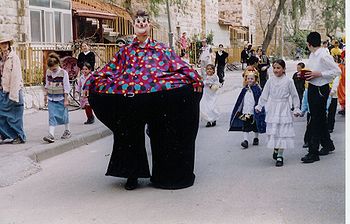
), giving charity to the poor (mattanot la-evyonim), and a celebratory meal (se'udat Purim); other customs include drinking wine, wearing of masks and costumes, and public celebration.
According to the Book of Esther
, Haman
, royal vizier
to King Ahasuerus
planned to kill the Jews, but his plans were foiled by Mordecai
and Queen Esther
. The day of deliverance became a day of feasting and rejoicing.
, which became the last of the 24 books of the Tanakh
to be canonized by the Sages of the Great Assembly
. It is dated to the fourth century BCE and according to the Talmud was a redaction by the Great Assembly of an original text by Mordecai.
The tractate Megillah in the Mishnah
(redacted c. 200 CE) records the laws relating to Purim. The accompanying Tosefta
(redacted in the same period) and Gemara
(in the Jerusalem and Babylonian Talmud redacted c. 400 CE and c. 600 CE respectively) record additional contextual details such as Vashti having been the daughter of Belshazzar
as well as details that accord with Josephus' such as Esther having been of royal descent. Brief mention of Esther is made in tractate Chullin (Bavli Chullin 139b) and idolatry relating to worship of Haman is discussed in tractate Sanhedrin (Sanhedrin 61b).
The Esther Rabbah
is a Midrash
ic text divided in two parts. The first part dated to c. 500 CE provides an exegetical commentary on the first two chapters of the Hebrew Book of Esther and provided source material for the Targum Sheni. The second part may have been redacted as late as the eleventh century CE and contains commentary on the remaining chapters of Esther. It too contains the additional contextual material found in the Josippon.
At this feast Ahasuerus gets thoroughly drunk and orders his wife Vashti
to display her beauty before the people and nobles wearing her royal crown. She refuses, and Ahasuerus decides to remove her from her post. He then orders all young women to be presented to him, so he can choose a new queen to replace Vashti. One of these is Esther, who was orphaned at a young age and was being fostered by her cousin Mordecai
. She finds favor in the king's eyes, and is made his new wife. Esther does not reveal that she is Jewish.
Shortly afterwards, Mordecai discovers a plot by courtiers Bigthan and Teresh to kill Ahasuerus. They are apprehended and hanged, and Mordecai's service to the king is recorded.
Ahasuerus appoints Haman
as his prime minister. Mordecai, who sits at the palace gates, falls into Haman's disfavor as he refuses to bow down to him. Having found out that Mordecai is Jewish, Haman plans to kill not just Mordecai but the entire Jewish minority in the empire. He obtains Ahasuerus' permission to execute this plan, and he casts lots to choose the date on which to do this – the thirteenth of the month of Adar. When Mordecai finds out about the plans he orders widespread penitence and fasting. Esther discovers what has transpired; she requests that all Jews of Shushan fast and pray for three days together with her, and on the third day she seeks an audience with Ahasuerus, during which she invites him to a feast in the company of Haman. During the feast, she asks them to attend a further feast the next evening. Meanwhile, Haman is again offended by Mordecai and builds a gallows for him, with the intention to hang him there the very next day.
That night, Ahasuerus suffers from insomnia, and when the court's records are read to him to help him sleep, he learns of the services rendered by Mordecai in the previous plot against his life. Ahasuerus is told that Mordecai had not received any recognition for saving the king's life. Just then, Haman appears, and King Ahasuerus asks Haman what should be done for the man that the King wishes to honor. Thinking that the King is referring to Haman himself, Haman says that the honoree should be dressed in the king's royal robes and led around on the king's royal horse. To Haman's horror, the king instructs Haman to do so to Mordecai.
Later that evening, Ahasuerus and Haman attend Esther's second banquet, at which she reveals that she is Jewish and that Haman is planning to exterminate her people, which includes her. Ahasuerus instead orders Haman hanged on the gallows that he had prepared for Mordecai. The previous decree against the Jews could not be annulled, so the King allows Mordecai and Esther to write another decree as they wish. They write one that allows the Jews to defend themselves during attacks. As a result, on 13 Adar, five hundred attackers and Haman's ten sons are killed in Shushan. Throughout the empire 75,000 of the Jews' enemies are killed (Esther 9:16). On the 14th, another 300 are killed in Shushan. No spoils are taken.
Mordecai assumes the position of second in rank to Ahasuerus, and institutes an annual commemoration of the delivery of the Jewish people from annihilation.
recounts the origins of Purim in Book 11 of his Antiquities of the Jews. He follows the Hebrew Book of Esther but shows awareness of some of the additional material found in the Greek version in that he too identifies Ahasuerus as Artaxerxes
and provides the text of the king's letter. He also provides additional information on the dating of events relative to Ezra and Nehemiah. Josephus also records the Persian persecution of Jews and mentions Jews being forced to worship at Persian erected shrines. Berossus
(early third century BCE) provides context for the account in that he records the introduction of idols of Anahita
under Artaxerxes II Mnemon throughout the Persian Empire. An account of the origins of Purim is also included in chapter 4 of the tenth century CE compilation of Jewish history, the Josippon
. It too follows the original biblical account and includes additional traditions matching those found in the Greek version and Josephus (whom the author claims as a source) with the exception of the details of the letters found in the latter works. It also provides other contextual information relating Jewish and Persian history such as the identification of Darius the Mede
as the uncle and father-in-law of Cyrus.
A brief Persian account of events is provided by Islamic historian Muhammad ibn Jarir al-Tabari
in his History of the Prophets and Kings (completed 915 CE). Basing his account on Jewish and Christian sources, al-Tabari provides additional details such as the original Persian form "Asturya" for "Esther". He places events during the rule of Ardashir Bahman (Artaxerxes II), but confuses him with Ardashir al-Tawil al-Ba (Artaxerxes I), while assuming Ahasuerus to be the name of a co-ruler. Another brief Persian account is recorded by Masudi in The Meadows of Gold
(completed 947 CE). He refers to a Jewish woman who had married the Persian King Bahman (Artaxerxes II), and delivered her people, thus corroborating this identification of Ahasuerus. He also mentions the woman's daughter, Khumay, who is not known in Jewish tradition but is well remembered in Persian folklore. Al-Tabari calls her Khumani and tells how her father (Ardashir Bahman) married her. Ferdowsi
in his Shahnameh
(c. 1000 CE) also tells of King Bahman marrying Khumay.
, Purim has more of a national than a religious character, and its status as a holiday is on a lesser level than those days ordained holy by the Torah
. Accordingly, business transactions and even manual labor are allowed on Purim. A special prayer ("Al ha-Nissim"—"For the Miracles") is inserted into the Amidah
during evening, morning and afternoon prayers, as well as is included in the Birkat Hamazon
("Grace after Meals.")
The four main mitzvot
(obligations) of the day are:
 The first religious ceremony ordained for the celebration of Purim is the reading of the Book of Esther (the "Megillah") in the synagogue
, a regulation ascribed in the Talmud
(Megillah 2a) to the Sages of the Great Assembly
, of which Mordecai
is reported to have been a member. Originally this enactment was for the 14th of Adar only; later, however, Rabbi Joshua ben Levi
(3rd century CE) prescribed that the Megillah should also be read on the eve of Purim. Further, he obliged women to attend the reading of the Megillah, in as much as it was a woman, Queen Esther
, through whom the miraculous deliverance of the Jews was accomplished.
In the Mishnah
, the recitation of a benediction on the reading of the Megillah is not yet a universally recognized obligation. However, the Talmud
, a later work, prescribed three benedictions before the reading and one benediction after the reading. The Talmud added other provisions. For example, the reader is to pronounce the names of the ten sons of Haman
in one breath, to indicate their simultaneous death. The congregation was to recite aloud with the reader the verses , , and , which relate the origin of Mordecai and his triumph.
The Megillah is read with a cantillation
(a traditional chant) differing from that used in the customary reading of the Torah
. Besides the traditional cantillation, there are several verses or short phrases in the Megillah that are chanted in a different chant, the chant that is traditional for the reading of the book of Lamentations. These verses are particularly sad, or they refer to Jews being in exile. When the Megillah reader jumps to the melody of the book of Lamentations for these phrases, it heightens the feeling of sadness in the listener.
In some places, the Megillah is not chanted, but is read like a letter, because of the name iggeret ("epistle"), which is applied to the Book of Esther. It has been also customary since the time of the early Medieval era of the Geonim
to unroll the whole Megillah before reading it, in order to give it the appearance of an epistle. According to Halakha
("Jewish law"), the Megillah may be read in any language intelligible to the audience.
According to the Mishnah (Megillah 30b), , the story of the attack on the Jews by Amalek
, the progenitor of Haman, is also to be read.
Some Modern Orthodox leaders have held that women can serve as public Megillah readers. Women's megillah readings have become increasingly common in more liberal Modern Orthodox Judaism
, though women may only read for other women, according to Ashkenazi authorities.
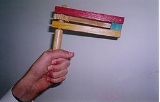
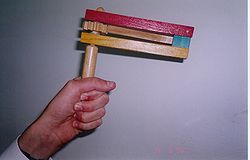 When Haman's name is read out during the public chanting of the Megillah in the synagogue, which occurs 54 times, the congregation engages in noisemaking to blot out his name. The practice can be traced back to the Tosafists
(the leading French and German rabbis of the 13th century). In accordance with a passage in the Midrash
, where the verse "Thou shalt blot out the remembrance of Amalek
" is explained to mean "even from wood and stones." A custom developed of writing the name of Haman, the offspring of Amalek, on two smooth stones, and knocking them together until the name was blotted out. Some wrote the name of Haman on the soles of their shoes, and at the mention of the name stamped with their feet as a sign of contempt. Another method was to use a noisy rattle
, called a ra'ashan (from the Hebrew ra-ash, meaning "noise") and in Yiddish
a . Some of the rabbis protested against these uproarious excesses, considering them a disturbance of public worship, but the custom of using a rattle
in the synagogue on Purim is now universal, with the exception of Spanish and Portuguese Jews
, who consider them a breach of decorum.
 The Book of Esther prescribes "the sending of portions one man to another, and gifts to the poor" (9:22). According to halakha
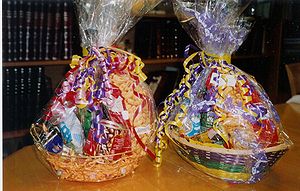
, each adult must give two different foods to one person, and two charitable donations to two poor people. The food parcels are called mishloach manot
("sending of portions"), and in some circles the custom has evolved into a major gift-giving event.
To fulfill the mitzvah of giving charity to two poor people, one can give either food or money equivalent to the amount of food that is eaten at a regular meal. It is better to spend more on charity than on the giving of mishloach manot. In the synagogue, regular collections of charity are made on the festival and the money is distributed among the needy. No distinction is made among the poor; anyone who is willing to accept charity is allowed to participate. It is obligatory upon the poorest Jew, even one who is himself dependent on charity, to give to other poor people.
stated that one should drink on Purim until he can no longer distinguish between the phrases arur Haman ("Cursed is Haman") and baruch Mordechai ("Blessed is Mordecai"). Alcoholic consumption was later codified by the early authorities, and while some advocated total intoxication, others, consistent with the opinion of many early and later rabbis, taught that one should only should drink a little more than usual and then fall asleep, whereupon one will certainly not be able to tell the difference between arur Haman and baruch Mordecai. Other authorities, including the Magen Avraham
, have written that one should drink until one is unable to calculate the numerical values
of both phrases.
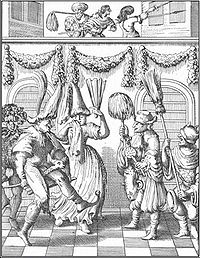
and spread across Europe. The practice was only introduced into Middle Eastern countries much later during the 19th-century. The first among Jewish codifiers to mention the custom was Mahari Minz
(d. 1508 at Venice). While some authorities were concerned about the possible infringement of biblical law were men to don women's apparel, the accepted consensus was to permit all masquerade, as it was viewed as a form of merry-making. Some rabbis went as far to allow the wearing of rabbinically-forbidden shatnez
.
Other reasons given for the custom: It is a way of emulating God who "disguised" his presence behind the natural events described in the Purim story, and has remained concealed (yet ever-present) in Jewish history since the times of the destruction of the first Temple. Since charity is a central feature of the day, when givers and/or recipients disguise themselves this allows greater anonymity thus preserving the dignity of the recipient.
Persian Exile throughout the Purim story, and since hides behind alludes to hidden aspect of the miracle of Purim which was "disguised" by natural events.
was historically a comic dramatisation that attempted to convey the saga of the Purim story. By the 18th century, in some parts of Eastern Europe, the Purim plays had evolved into broad-ranging satires with music and dance for which the story of Esther was little more than a pretext. Indeed, by the mid-19th century, some were even based on other biblical stories. Today, Purim spiels can revolve around anything relating to Jews and Judaism that will bring cheer and comic relief to an audience celebrating the day.
of Haman on Purim. The spectacle aroused the wrath of the early Christians who interpreted it as a disguised attempt to ridicule their faith and prohibitions were issued against such displays under the reign of Flavius Augustus Honorius (395–423) and of Theodosius II
(408–450). The custom was popular during the Geonic period
(ninth and tenth centuries), and a 14th-century scholar
described how people would ride through the streets of Provence
holding fir branches and blowing trumpets around a puppet of Haman which was hanged and later burnt. The practice continued into the 20th century, with children treating Haman as a sort of "Guy Fawkes
." In the early 1950s, the custom was still observed in Iran and some remote communities in Kurdistan where young Muslims would sometimes join in.
 On Purim, triangular pastries called Hamantasch
en ("Haman's pockets") or Oznei Haman ("Haman's ears") are served. A sweet cookie dough is rolled out, cut into circles, and traditionally filled with prune
or mun, a sweet poppy seed
filling, then wrapped up into a triangular shape with the filling either hidden or showing. Among Sephardi
a thin dough called Fazuelos
are eaten as well as a range of baked or fried pastries called Orejas de Haman (Haman's Ears) or Hojuelas de Haman are eaten. These pastries are also known as Oznei Haman.
Seeds and nuts are customarily eaten on Purim, as the Talmud relates that Queen Esther ate only these foodstuffs in the palace of Ahasuerus, since she had no access to kosher food. More recently, prunes, dates, apricots, and chocolate fillings have been introduced. This pastry belongs to the Ashkenazi cuisine.
Kreplach
, a kind of dumpling
filled with cooked meat, chicken or liver and served in soup, are also traditionally served by Ashkenazi Jews on Purim. 'Hiding' the meat inside serves as another reminder of the story of Esther – the only book of Hebrew Scriptures that does not contain a single reference to God who seems to hide behind the scenes.
Aranygaluska, a dessert consisting of fried dough balls and vanilla custard, is traditional for Jews of Hungarian and Romanian descent.
Special breads are also baked among various communities. In Moroccan Jewish communities, a Purim bread called Ojos de Haman or Eyes of Haman is sometimes baked in the shape of Haman's head, and the eyes which are made of eggs are plucked out to demonstrate the destruction of Haman.
Among the Polish Jews, Koilitch, a raisin Purim challah which is baked in a long twisted ring and topped with small colorful candies is meant to evoke the colorful nature of the holiday.
, observed before Purim, on the 13th of Adar, is an original part of the Purim celebration, referred to in Esther 9:31–32. The first who mentions the Fast of Esther is Rabbi Achai Gaon
(Acha of Shabcha) (8th century CE) in She'iltot 4; the reason there given for its institution is based on an interpretation of , and Talmud Megillah 2a: "The 13th was the time of gathering", which gathering is explained to have had also the purpose of public prayer and fasting. Some, however, used to fast three days in commemoration of the fasting of Esther; but as fasting was prohibited during the month of Nisan, the first and second Mondays and the Thursday following Purim were chosen. The fast of the 13th is still commonly observed; but when that date falls on Sabbath
, the fast is pushed forward to the preceding Thursday, Friday being needed to prepare for Sabbath and the following Purim festival.
prayer and having a more elaborate meal than on ordinary days.
Purim is celebrated on the Adar 14 because the Jews in unwalled cities fought their enemies on Adar 13 and rested the following day. However, in Shushan, the walled capital city of the Persian Empire, the Jews were involved in defeating their enemies on Adar 13–14 and rested on the 15th (Esther 9:20–22). In commemoration of this, it was decided that while the victory would be celebrated universally on Adar 14, for Jews living in Shushan, the holiday would be held on Adar 15. Later, in deference to Jerusalem, the Sages determined that Purim would be celebrated on Adar 15 in all cities which had been enclosed by a wall at the time of Joshua
's conquest of the Land of Israel
. This criterion allowed the city of Jerusalem to retain its importance for Jews, and although Shushan was not walled at the time of Joshua, it was made an exception since the miracle occurred there.
Today, there is debate as to whether outlying neighborhoods of Jerusalem are obliged to observe Purim on the 14th or 15th of Adar. Further doubts have arisen as to whether other cities were sufficiently walled in Joshua's era. It is therefore customary in certain towns including Hebron
, Safed
, Tiberias, Acre
, Ashdod, Ashkelon
, Beersheva, Beit She'an, Beit Shemesh, Gaza
, Gush Halav, Haifa
, Jaffa
, Lod
, Ramlah and Shechem
to celebrate Purim on the 14th and hold an additional megillah reading on the 15th with no blessings. In the diaspora
, Jews in Baghdad
, Damascus
and Prague
celebrate Purim on the 14th and hold an additional megillah reading on the 15th with no blessings. Since today we are not sure where the walled cities from Joshuah's time are, the only city that celebrates only Shushan Purim is Jerusalem.
, the holiday is celebrated over a period of three days. The megilla reading and distribution of charity takes place on the Friday (Adar 14), which day is called Purim dePrazos. The Al ha-Nissim prayer is only recited on Sabbath (Adar 15), which is Purim itself, and the Torah portion for Purim is read for maftir
. On Sunday (Adar 16), called Purim Meshullash, mishloach manot are sent and the festive Purim meal is held. The minimum interval between occurrences of Purim Meshulash is three years (1974 to 1977; 2005 to 2008). The maximum interval is twenty years, (1954 to 1974; will occur again 2025 to 2045). Other possible intervals are four years (1977 to 1981; 2001 to 2005); seven years (1994 to 2001); and thirteen years (1981 to 1994; 2008 to 2021).
s, however, celebrate it in the first month of Adar.) The 14th of the first Adar is then called Purim Katan ("Little Purim" in Hebrew
) and the 15th is Shushan Purim Katan, for which there no set observances but have a minor holiday aspect to it. The distinctions between the first and the second Purim in leap years are mentioned in the Mishnah
.
attempted to exterminate the Jewish community. According to some sources, the influential Rabbi Moses Sofer
(the Chasam Sofer), who was born in Frankfurt
, celebrated Purim Vintz every year, even when he served as a rabbi in Pressburg
.
There is a tradition in the Hasidic
Chabad
movement that supposedly Joseph Stalin died at a result of some metaphysical intervention of the seventh Chabad leader, Rabbi Menachem Mendel Schneerson
, during the recitation of a discourse at a public Purim Farbrengen
. Stalin was suddenly paralysed on 1 March 1953, which corresponds to Purim 1953, and died 4 days later. Due to Stalin's death, nation-wide pogrom
s against Jews throughout the Soviet Union were averted, as Stalin's infamous doctors' plot
was halted.
Rabbi Yom-Tov Lipmann Heller
(1579–1654) of Kraków
, Poland
, asked that his family henceforth celebrate a private Purim, marking the end of his many troubles, including having faced trumped-up charges. Since Purim is preceded by a fast day, the rabbi also directed his descendants to have a (private) fast day, the 5th day of Tamuz, marking one of his imprisonments (1629), this one lasting for 40 days.
, and especially in the present Jewish diaspora
, God's presence has been felt more at certain times than at others. Megillat Esther (and the omission of God's name in it) serves to show that although God may not be conspicuously present at times, He nevertheless plays (and has played) an important role in everyone's lives and in the future of the Jewish nation. In remembrance of how God remained hidden throughout the Purim miracle, Jews dress up on Purim and many hide their faces.
banned and forbade the observance of Purim. In a speech made on November 10, 1938, (the day after kristallnacht
), Julius Streicher
surmised that just as "the Jew butchered 75,000 Persians" in one night, the same fate would have befallen the German people had the Jews succeeded in inciting a war against Germany; the "Jews would have instituted a new Purim festival in Germany."
Nazi attacks against Jews often coincided with Jewish festivals. On Purim 1942, ten Jews were hanged in Zduńska Wola
to avenge the hanging of Haman's ten sons. In a similar incident in 1943, the Nazis shot ten Jews from the Piotrków
ghetto
. On Purim eve that same year, over 100 Jewish doctors and their families were shot by the Nazis in Czestochowa
. The following day, Jewish doctors were taken from Radom
and shot nearby in Szydlowiec
.
In an apparent connection made by Hitler between his Nazi regime and the role of Haman, he stated in a speech made on January 30, 1944, that if the Nazis were defeated, the Jews could celebrate "a second Purim". Seconds before he was hanged, Julius Streicher called out "Purim Fest 1946!"
. Some women pray there in the belief that Esther can work miracles.
Jewish holiday
Jewish holidays are days observed by Jews as holy or secular commemorations of important events in Jewish history. In Hebrew, Jewish holidays and festivals, depending on their nature, may be called yom tov or chag or ta'anit...
that commemorates the deliverance of the Jewish people in the ancient Persian Empire
Achaemenid Empire
The Achaemenid Empire , sometimes known as First Persian Empire and/or Persian Empire, was founded in the 6th century BCE by Cyrus the Great who overthrew the Median confederation...
from destruction in the wake of a plot by Haman, a story recorded in the Biblical
Hebrew Bible
The Hebrew Bible is a term used by biblical scholars outside of Judaism to refer to the Tanakh , a canonical collection of Jewish texts, and the common textual antecedent of the several canonical editions of the Christian Old Testament...
Book of Esther
Book of Esther
The Book of Esther is a book in the Ketuvim , the third section of the Jewish Tanakh and is part of the Christian Old Testament. The Book of Esther or the Megillah is the basis for the Jewish celebration of Purim...
(Megillat Esther).
Purim is celebrated annually according to the Hebrew calendar
Hebrew calendar
The Hebrew calendar , or Jewish calendar, is a lunisolar calendar used today predominantly for Jewish religious observances. It determines the dates for Jewish holidays and the appropriate public reading of Torah portions, yahrzeits , and daily Psalm reading, among many ceremonial uses...
on the 14th day of the Hebrew month of Adar
Adar
Adar is the sixth month of the civil year and the twelfth month of the ecclesiastical year on the Hebrew calendar. It is a winter month of 29 days...
(Adar II in leap years), the day following the victory of the Jews over their enemies. Purim begins at sundown. In cities that were protected by a surrounding wall at the time of Joshua
Joshua
Joshua , is a minor figure in the Torah, being one of the spies for Israel and in few passages as Moses's assistant. He turns to be the central character in the Hebrew Bible's Book of Joshua...
, Purim is celebrated on the 15th of the month; Everywhere else, Purim is on the 14th, while the 15th is known as Shushan Purim. Due to Jerusalem's importance, it celebrates Purim on the 15th despite it not having been surrounded by a wall since the time of Joshua
Joshua
Joshua , is a minor figure in the Torah, being one of the spies for Israel and in few passages as Moses's assistant. He turns to be the central character in the Hebrew Bible's Book of Joshua...
. This is to prevent less holy cities having an advantage over Jerusalem.
Purim is characterized by public recitation of the Scroll of Esther (keriat ha-megillah), additions to the prayers and the grace after meals (al hannisim), giving mutual gifts of food and drink (mishloach manot
Mishloach manot
Mishloach manot , and also called a Purim basket, are gifts of food or drink that are sent to friends, relatives, neighbors, teachers, business associates, and any other acquaintances on Purim day. The mitzvah of giving mishloach manot derives from the Book of Esther...
), giving charity to the poor (mattanot la-evyonim), and a celebratory meal (se'udat Purim); other customs include drinking wine, wearing of masks and costumes, and public celebration.
According to the Book of Esther
Book of Esther
The Book of Esther is a book in the Ketuvim , the third section of the Jewish Tanakh and is part of the Christian Old Testament. The Book of Esther or the Megillah is the basis for the Jewish celebration of Purim...
, Haman
Haman (Bible)
Haman is the main antagonist in the Book of Esther, who, according to Old Testament tradition, was a 5th Century BC noble and vizier of the Persian empire under King Ahasuerus, traditionally identified as Artaxerxes II...
, royal vizier
Vizier
A vizier or in Arabic script ; ; sometimes spelled vazir, vizir, vasir, wazir, vesir, or vezir) is a high-ranking political advisor or minister in a Muslim government....
to King Ahasuerus
Ahasuerus
Ahasuerus is a name used several times in the Hebrew Bible, as well as related legends and Apocrypha. This name is applied in the Hebrew Scriptures to three rulers...
planned to kill the Jews, but his plans were foiled by Mordecai
Mordecai
Mordecai or Mordechai is one of the main personalities in the Book of Esther in the Hebrew Bible. He was the son of Jair, of the tribe of Benjamin.-Biblical account:...
and Queen Esther
Esther
Esther , born Hadassah, is the eponymous heroine of the Biblical Book of Esther.According to the Bible, she was a Jewish queen of the Persian king Ahasuerus...
. The day of deliverance became a day of feasting and rejoicing.
Book of Esther
The primary source relating to the origin of Purim is the Book of EstherBook of Esther
The Book of Esther is a book in the Ketuvim , the third section of the Jewish Tanakh and is part of the Christian Old Testament. The Book of Esther or the Megillah is the basis for the Jewish celebration of Purim...
, which became the last of the 24 books of the Tanakh
Tanakh
The Tanakh is a name used in Judaism for the canon of the Hebrew Bible. The Tanakh is also known as the Masoretic Text or the Miqra. The name is an acronym formed from the initial Hebrew letters of the Masoretic Text's three traditional subdivisions: The Torah , Nevi'im and Ketuvim —hence...
to be canonized by the Sages of the Great Assembly
Great Assembly
The Great Assembly or Anshei Knesset HaGedolah , also known as the Great Synagogue, was, according to Jewish tradition, an assembly of 120 scribes, sages, and prophets, in the period from the end of the Biblical prophets to the time of the development of Rabbinic Judaism, marking a transition from...
. It is dated to the fourth century BCE and according to the Talmud was a redaction by the Great Assembly of an original text by Mordecai.
The tractate Megillah in the Mishnah
Mishnah
The Mishnah or Mishna is the first major written redaction of the Jewish oral traditions called the "Oral Torah". It is also the first major work of Rabbinic Judaism. It was redacted c...
(redacted c. 200 CE) records the laws relating to Purim. The accompanying Tosefta
Tosefta
The Tosefta is a compilation of the Jewish oral law from the period of the Mishnah.-Overview:...
(redacted in the same period) and Gemara
Gemara
The Gemara is the component of the Talmud comprising rabbinical analysis of and commentary on the Mishnah. After the Mishnah was published by Rabbi Judah the Prince The Gemara (also transliterated Gemora or, less commonly, Gemorra; from Aramaic גמרא gamar; literally, "[to] study" or "learning by...
(in the Jerusalem and Babylonian Talmud redacted c. 400 CE and c. 600 CE respectively) record additional contextual details such as Vashti having been the daughter of Belshazzar
Belshazzar
Belshazzar, or Balthazar , was a 6th century BC prince of Babylon, the son of Nabonidus and the last king of Babylon according to the Book of Daniel . Like his father, it is believed by many scholars that he was an Assyrian. In Daniel Belshazzar, or Balthazar , was a 6th century BC prince of...
as well as details that accord with Josephus' such as Esther having been of royal descent. Brief mention of Esther is made in tractate Chullin (Bavli Chullin 139b) and idolatry relating to worship of Haman is discussed in tractate Sanhedrin (Sanhedrin 61b).
The Esther Rabbah
Esther Rabbah
Esther Rabbah is the midrash to the Book of Esther in the current Midrash editions. From its plan and scope it is apparently an incomplete collection from the rich haggadic material furnished by the comments on the scroll of Esther, which has been read since early times at the public service on...
is a Midrash
Midrash
The Hebrew term Midrash is a homiletic method of biblical exegesis. The term also refers to the whole compilation of homiletic teachings on the Bible....
ic text divided in two parts. The first part dated to c. 500 CE provides an exegetical commentary on the first two chapters of the Hebrew Book of Esther and provided source material for the Targum Sheni. The second part may have been redacted as late as the eleventh century CE and contains commentary on the remaining chapters of Esther. It too contains the additional contextual material found in the Josippon.
Purim story
The Book of Esther begins with a six month (180 day) drinking feast given by King Ahasuerus, for the army of Persia and Media, for the civil servants and princes in the 127 provinces of his kingdom, at the conclusion of which a seven day drinking feast for the inhabitants of Shushan, rich and poor with a separate drinking feast for the women organised by the Queen Vashti in the pavilion of the Royal courtyard.At this feast Ahasuerus gets thoroughly drunk and orders his wife Vashti
Vashti
Queen Vashti is the first wife of King Ahasuerus in the Book of Esther, a book included in the Hebrew Bible and read on the Jewish holiday of Purim. She is banished for her refusal to appear at the king's banquet, and Esther is chosen to succeed her as queen. In the Midrash, Vashti is described...
to display her beauty before the people and nobles wearing her royal crown. She refuses, and Ahasuerus decides to remove her from her post. He then orders all young women to be presented to him, so he can choose a new queen to replace Vashti. One of these is Esther, who was orphaned at a young age and was being fostered by her cousin Mordecai
Mordecai
Mordecai or Mordechai is one of the main personalities in the Book of Esther in the Hebrew Bible. He was the son of Jair, of the tribe of Benjamin.-Biblical account:...
. She finds favor in the king's eyes, and is made his new wife. Esther does not reveal that she is Jewish.
Shortly afterwards, Mordecai discovers a plot by courtiers Bigthan and Teresh to kill Ahasuerus. They are apprehended and hanged, and Mordecai's service to the king is recorded.
Ahasuerus appoints Haman
Haman (Bible)
Haman is the main antagonist in the Book of Esther, who, according to Old Testament tradition, was a 5th Century BC noble and vizier of the Persian empire under King Ahasuerus, traditionally identified as Artaxerxes II...
as his prime minister. Mordecai, who sits at the palace gates, falls into Haman's disfavor as he refuses to bow down to him. Having found out that Mordecai is Jewish, Haman plans to kill not just Mordecai but the entire Jewish minority in the empire. He obtains Ahasuerus' permission to execute this plan, and he casts lots to choose the date on which to do this – the thirteenth of the month of Adar. When Mordecai finds out about the plans he orders widespread penitence and fasting. Esther discovers what has transpired; she requests that all Jews of Shushan fast and pray for three days together with her, and on the third day she seeks an audience with Ahasuerus, during which she invites him to a feast in the company of Haman. During the feast, she asks them to attend a further feast the next evening. Meanwhile, Haman is again offended by Mordecai and builds a gallows for him, with the intention to hang him there the very next day.
That night, Ahasuerus suffers from insomnia, and when the court's records are read to him to help him sleep, he learns of the services rendered by Mordecai in the previous plot against his life. Ahasuerus is told that Mordecai had not received any recognition for saving the king's life. Just then, Haman appears, and King Ahasuerus asks Haman what should be done for the man that the King wishes to honor. Thinking that the King is referring to Haman himself, Haman says that the honoree should be dressed in the king's royal robes and led around on the king's royal horse. To Haman's horror, the king instructs Haman to do so to Mordecai.
Later that evening, Ahasuerus and Haman attend Esther's second banquet, at which she reveals that she is Jewish and that Haman is planning to exterminate her people, which includes her. Ahasuerus instead orders Haman hanged on the gallows that he had prepared for Mordecai. The previous decree against the Jews could not be annulled, so the King allows Mordecai and Esther to write another decree as they wish. They write one that allows the Jews to defend themselves during attacks. As a result, on 13 Adar, five hundred attackers and Haman's ten sons are killed in Shushan. Throughout the empire 75,000 of the Jews' enemies are killed (Esther 9:16). On the 14th, another 300 are killed in Shushan. No spoils are taken.
Mordecai assumes the position of second in rank to Ahasuerus, and institutes an annual commemoration of the delivery of the Jewish people from annihilation.
Classical and medieval reference
The first century CE historian JosephusJosephus
Titus Flavius Josephus , also called Joseph ben Matityahu , was a 1st-century Romano-Jewish historian and hagiographer of priestly and royal ancestry who recorded Jewish history, with special emphasis on the 1st century AD and the First Jewish–Roman War, which resulted in the Destruction of...
recounts the origins of Purim in Book 11 of his Antiquities of the Jews. He follows the Hebrew Book of Esther but shows awareness of some of the additional material found in the Greek version in that he too identifies Ahasuerus as Artaxerxes
Artaxerxes II of Persia
Artaxerxes II Mnemon was king of Persia from 404 BC until his death. He was a son of Darius II of Persia and Parysatis.-Reign:...
and provides the text of the king's letter. He also provides additional information on the dating of events relative to Ezra and Nehemiah. Josephus also records the Persian persecution of Jews and mentions Jews being forced to worship at Persian erected shrines. Berossus
Berossus
Berossus was a Hellenistic-era Babylonian writer, a priest of Bel Marduk and astronomer writing in Greek, who was active at the beginning of the 3rd century BC...
(early third century BCE) provides context for the account in that he records the introduction of idols of Anahita
Anahita
Anahita is the Old Persian form of the name of an Iranian goddess and appears in complete and earlier form as ' ; the Avestan language name of an Indo-Iranian cosmological figure venerated as the divinity of 'the Waters' and hence associated with fertility, healing and wisdom...
under Artaxerxes II Mnemon throughout the Persian Empire. An account of the origins of Purim is also included in chapter 4 of the tenth century CE compilation of Jewish history, the Josippon
Josippon
Josippon is the name usually given to a popular chronicle of Jewish history from Adam to the age of Titus, attributed to an author Josippon or Joseph ben Gorion....
. It too follows the original biblical account and includes additional traditions matching those found in the Greek version and Josephus (whom the author claims as a source) with the exception of the details of the letters found in the latter works. It also provides other contextual information relating Jewish and Persian history such as the identification of Darius the Mede
Darius the Mede
Darius the Mede is a biblical person in the Book of Daniel, Chapters 6-9, who rules over Babylon after King Belshazzar is deposed. The author of the book of Daniel indicated that Darius was about 62 years old when he was 'made king over Babylon.[5:31] He is best known for having been forced into...
as the uncle and father-in-law of Cyrus.
A brief Persian account of events is provided by Islamic historian Muhammad ibn Jarir al-Tabari
Muhammad ibn Jarir al-Tabari
Abu Ja'far Muhammad ibn Jarir al-Tabari was a prominent and influential Sunni scholar and exegete of the Qur'an from Persia...
in his History of the Prophets and Kings (completed 915 CE). Basing his account on Jewish and Christian sources, al-Tabari provides additional details such as the original Persian form "Asturya" for "Esther". He places events during the rule of Ardashir Bahman (Artaxerxes II), but confuses him with Ardashir al-Tawil al-Ba (Artaxerxes I), while assuming Ahasuerus to be the name of a co-ruler. Another brief Persian account is recorded by Masudi in The Meadows of Gold
The Meadows of Gold
Meadows of Gold and Mines of Gems is an historical account in Arabic of the beginning of the world starting with Adam and Eve up to and through the late Abbasid Caliphate by medieval Baghdadi historian Masudi .Its only English version is the abridged The Meadows of...
(completed 947 CE). He refers to a Jewish woman who had married the Persian King Bahman (Artaxerxes II), and delivered her people, thus corroborating this identification of Ahasuerus. He also mentions the woman's daughter, Khumay, who is not known in Jewish tradition but is well remembered in Persian folklore. Al-Tabari calls her Khumani and tells how her father (Ardashir Bahman) married her. Ferdowsi
Ferdowsi
Ferdowsi was a highly revered Persian poet. He was the author of the Shahnameh, the national epic of Iran and related societies.The Shahnameh was originally composed by Ferdowsi for the princes of the Samanid dynasty, who were responsible for a revival of Persian cultural traditions after the...
in his Shahnameh
Shahnameh
The Shahnameh or Shah-nama is a long epic poem written by the Persian poet Ferdowsi between c.977 and 1010 AD and is the national epic of Iran and related societies...
(c. 1000 CE) also tells of King Bahman marrying Khumay.
Customs
Like HanukkahHanukkah
Hanukkah , also known as the Festival of Lights, is an eight-day Jewish holiday commemorating the rededication of the Holy Temple in Jerusalem at the time of the Maccabean Revolt of the 2nd century BCE...
, Purim has more of a national than a religious character, and its status as a holiday is on a lesser level than those days ordained holy by the Torah
Torah
Torah- A scroll containing the first five books of the BibleThe Torah , is name given by Jews to the first five books of the bible—Genesis , Exodus , Leviticus , Numbers and Deuteronomy Torah- A scroll containing the first five books of the BibleThe Torah , is name given by Jews to the first five...
. Accordingly, business transactions and even manual labor are allowed on Purim. A special prayer ("Al ha-Nissim"—"For the Miracles") is inserted into the Amidah
Amidah
The Amidah , also called the Shmoneh Esreh , is the central prayer of the Jewish liturgy. This prayer, among others, is found in the siddur, the traditional Jewish prayer book...
during evening, morning and afternoon prayers, as well as is included in the Birkat Hamazon
Birkat Hamazon
Birkat Hamazon or Birkath Hammazon, , known in English as the Grace After Meals, , is a set of Hebrew blessings that Jewish Law prescribes following a meal that includes bread or matzoh made from one or all of wheat, barley, rye, oats, spelt...
("Grace after Meals.")
The four main mitzvot
Mitzvah
The primary meaning of the Hebrew word refers to precepts and commandments as commanded by God...
(obligations) of the day are:
- Listening to the public reading, usually in synagogueSynagogueA synagogue is a Jewish house of prayer. This use of the Greek term synagogue originates in the Septuagint where it sometimes translates the Hebrew word for assembly, kahal...
, of the Book of EstherBook of EstherThe Book of Esther is a book in the Ketuvim , the third section of the Jewish Tanakh and is part of the Christian Old Testament. The Book of Esther or the Megillah is the basis for the Jewish celebration of Purim...
in the evening and again in the following morning (k'riat megillah) - Sending food gifts to friends (mishloach manotMishloach manotMishloach manot , and also called a Purim basket, are gifts of food or drink that are sent to friends, relatives, neighbors, teachers, business associates, and any other acquaintances on Purim day. The mitzvah of giving mishloach manot derives from the Book of Esther...
) - Giving charity to the poor (matanot la'evyonim)
- Eating a festive meal (se`udah)
Reading of the Megillah
Synagogue
A synagogue is a Jewish house of prayer. This use of the Greek term synagogue originates in the Septuagint where it sometimes translates the Hebrew word for assembly, kahal...
, a regulation ascribed in the Talmud
Talmud
The Talmud is a central text of mainstream Judaism. It takes the form of a record of rabbinic discussions pertaining to Jewish law, ethics, philosophy, customs and history....
(Megillah 2a) to the Sages of the Great Assembly
Great Assembly
The Great Assembly or Anshei Knesset HaGedolah , also known as the Great Synagogue, was, according to Jewish tradition, an assembly of 120 scribes, sages, and prophets, in the period from the end of the Biblical prophets to the time of the development of Rabbinic Judaism, marking a transition from...
, of which Mordecai
Mordecai
Mordecai or Mordechai is one of the main personalities in the Book of Esther in the Hebrew Bible. He was the son of Jair, of the tribe of Benjamin.-Biblical account:...
is reported to have been a member. Originally this enactment was for the 14th of Adar only; later, however, Rabbi Joshua ben Levi
Joshua ben Levi
Joshua ben Levi or Yehoshua ben Levi was an amora who lived in the land of Israel of the first half of the third century. He headed the school of Lydda in the southern Land of Israel. He was an elder contemporary of Johanan bar Nappaha and Resh Lakish, who presided over the school in Tiberias...
(3rd century CE) prescribed that the Megillah should also be read on the eve of Purim. Further, he obliged women to attend the reading of the Megillah, in as much as it was a woman, Queen Esther
Esther
Esther , born Hadassah, is the eponymous heroine of the Biblical Book of Esther.According to the Bible, she was a Jewish queen of the Persian king Ahasuerus...
, through whom the miraculous deliverance of the Jews was accomplished.
In the Mishnah
Mishnah
The Mishnah or Mishna is the first major written redaction of the Jewish oral traditions called the "Oral Torah". It is also the first major work of Rabbinic Judaism. It was redacted c...
, the recitation of a benediction on the reading of the Megillah is not yet a universally recognized obligation. However, the Talmud
Talmud
The Talmud is a central text of mainstream Judaism. It takes the form of a record of rabbinic discussions pertaining to Jewish law, ethics, philosophy, customs and history....
, a later work, prescribed three benedictions before the reading and one benediction after the reading. The Talmud added other provisions. For example, the reader is to pronounce the names of the ten sons of Haman
Haman (Bible)
Haman is the main antagonist in the Book of Esther, who, according to Old Testament tradition, was a 5th Century BC noble and vizier of the Persian empire under King Ahasuerus, traditionally identified as Artaxerxes II...
in one breath, to indicate their simultaneous death. The congregation was to recite aloud with the reader the verses , , and , which relate the origin of Mordecai and his triumph.
The Megillah is read with a cantillation
Cantillation
Cantillation is the ritual chanting of readings from the Hebrew Bible in synagogue services. The chants are written and notated in accordance with the special signs or marks printed in the Masoretic text of the Hebrew Bible to complement the letters and vowel points...
(a traditional chant) differing from that used in the customary reading of the Torah
Torah
Torah- A scroll containing the first five books of the BibleThe Torah , is name given by Jews to the first five books of the bible—Genesis , Exodus , Leviticus , Numbers and Deuteronomy Torah- A scroll containing the first five books of the BibleThe Torah , is name given by Jews to the first five...
. Besides the traditional cantillation, there are several verses or short phrases in the Megillah that are chanted in a different chant, the chant that is traditional for the reading of the book of Lamentations. These verses are particularly sad, or they refer to Jews being in exile. When the Megillah reader jumps to the melody of the book of Lamentations for these phrases, it heightens the feeling of sadness in the listener.
In some places, the Megillah is not chanted, but is read like a letter, because of the name iggeret ("epistle"), which is applied to the Book of Esther. It has been also customary since the time of the early Medieval era of the Geonim
Geonim
Geonim were the presidents of the two great Babylonian, Talmudic Academies of Sura and Pumbedita, in the Abbasid Caliphate, and were the generally accepted spiritual leaders of the Jewish community world wide in the early medieval era, in contrast to the Resh Galuta who wielded secular authority...
to unroll the whole Megillah before reading it, in order to give it the appearance of an epistle. According to Halakha
Halakha
Halakha — also transliterated Halocho , or Halacha — is the collective body of Jewish law, including biblical law and later talmudic and rabbinic law, as well as customs and traditions.Judaism classically draws no distinction in its laws between religious and ostensibly non-religious life; Jewish...
("Jewish law"), the Megillah may be read in any language intelligible to the audience.
According to the Mishnah (Megillah 30b), , the story of the attack on the Jews by Amalek
Amalek
The Amalekites are a people mentioned a number of times in the Hebrew Bible. They are considered to be descended from an ancestor Amalek....
, the progenitor of Haman, is also to be read.
Women and Megillah reading
Women have an obligation to hear the Megillah because "they also were involved in that miracle." Most Orthodox communities, including Modern Orthodox ones, however, generally do not allow women to lead the Megillah reading except in rare circumstances owing to the notion of "Kavod HaTzibbur". Authorities who hold that women should not read the Megilla for themselves, because of an uncertainty as to which blessing they should recite upon the reading, nonetheless agree that they have an obligation to hear it read. According to these authorities if women, or men for that matter, cannot attend the services in the synagogue, the Megillah should be read for them in private by any male over the age of thirteen. Often in Orthodox communities there is a special public reading only for women, conducted either in a private home or in a synagogue, but the Megillah is read by a man.Some Modern Orthodox leaders have held that women can serve as public Megillah readers. Women's megillah readings have become increasingly common in more liberal Modern Orthodox Judaism
Modern Orthodox Judaism
Modern Orthodox Judaism is a movement within Orthodox Judaism that attempts to synthesize Jewish values and the observance of Jewish law, with the secular, modern world....
, though women may only read for other women, according to Ashkenazi authorities.
Blotting out Haman's name
Tosafists
Tosafists were medieval rabbis from France and Germany who are among those known in Talmudical scholarship as Rishonim who created critical and explanatory glosses on the Talmud. These were collectively called Tosafot , because they were additions on the commentary of Rashi...
(the leading French and German rabbis of the 13th century). In accordance with a passage in the Midrash
Midrash
The Hebrew term Midrash is a homiletic method of biblical exegesis. The term also refers to the whole compilation of homiletic teachings on the Bible....
, where the verse "Thou shalt blot out the remembrance of Amalek
Amalek
The Amalekites are a people mentioned a number of times in the Hebrew Bible. They are considered to be descended from an ancestor Amalek....
" is explained to mean "even from wood and stones." A custom developed of writing the name of Haman, the offspring of Amalek, on two smooth stones, and knocking them together until the name was blotted out. Some wrote the name of Haman on the soles of their shoes, and at the mention of the name stamped with their feet as a sign of contempt. Another method was to use a noisy rattle
Ratchet (instrument)
A ratchet, also called a noisemaker , is an orchestral musical instrument played by percussionists. Operating on the principle of the ratchet device, a gearwheel and a stiff board is mounted on a handle, which can be freely rotated...
, called a ra'ashan (from the Hebrew ra-ash, meaning "noise") and in Yiddish
Yiddish language
Yiddish is a High German language of Ashkenazi Jewish origin, spoken throughout the world. It developed as a fusion of German dialects with Hebrew, Aramaic, Slavic languages and traces of Romance languages...
a . Some of the rabbis protested against these uproarious excesses, considering them a disturbance of public worship, but the custom of using a rattle
Ratchet (instrument)
A ratchet, also called a noisemaker , is an orchestral musical instrument played by percussionists. Operating on the principle of the ratchet device, a gearwheel and a stiff board is mounted on a handle, which can be freely rotated...
in the synagogue on Purim is now universal, with the exception of Spanish and Portuguese Jews
Spanish and Portuguese Jews
Spanish and Portuguese Jews are a distinctive sub-group of Sephardim who have their main ethnic origins within the Jewish communities of the Iberian peninsula and who shaped communities mainly in Western Europe and the Americas from the late 16th century on...
, who consider them a breach of decorum.
Food gifts and charity
Halakha
Halakha — also transliterated Halocho , or Halacha — is the collective body of Jewish law, including biblical law and later talmudic and rabbinic law, as well as customs and traditions.Judaism classically draws no distinction in its laws between religious and ostensibly non-religious life; Jewish...
, each adult must give two different foods to one person, and two charitable donations to two poor people. The food parcels are called mishloach manot
Mishloach manot
Mishloach manot , and also called a Purim basket, are gifts of food or drink that are sent to friends, relatives, neighbors, teachers, business associates, and any other acquaintances on Purim day. The mitzvah of giving mishloach manot derives from the Book of Esther...
("sending of portions"), and in some circles the custom has evolved into a major gift-giving event.
To fulfill the mitzvah of giving charity to two poor people, one can give either food or money equivalent to the amount of food that is eaten at a regular meal. It is better to spend more on charity than on the giving of mishloach manot. In the synagogue, regular collections of charity are made on the festival and the money is distributed among the needy. No distinction is made among the poor; anyone who is willing to accept charity is allowed to participate. It is obligatory upon the poorest Jew, even one who is himself dependent on charity, to give to other poor people.
Festive drinking
On Purim day, a festive meal called the Se`udat Purim is held. The drinking of wine features prominently in keeping with the jovial nature of the feast. This is based on the fact that the salvation of the Jews occurred through wine and the Sages of the TalmudChazal
Chazal or Ḥazal is an acronym for the Hebrew "Ḥakhameinu Zikhronam Liv'rakha",...
stated that one should drink on Purim until he can no longer distinguish between the phrases arur Haman ("Cursed is Haman") and baruch Mordechai ("Blessed is Mordecai"). Alcoholic consumption was later codified by the early authorities, and while some advocated total intoxication, others, consistent with the opinion of many early and later rabbis, taught that one should only should drink a little more than usual and then fall asleep, whereupon one will certainly not be able to tell the difference between arur Haman and baruch Mordecai. Other authorities, including the Magen Avraham
Avraham Gombiner
Abraham Abele Gombiner , known as the Magen Avraham, born in Gąbin , Poland, was a rabbi, Talmudist and a leading religious authority in the Jewish community of Kalish, Poland during the seventeenth century. His full name is Avraham Avli ben Chaim HaLevi from the town of Gombin...
, have written that one should drink until one is unable to calculate the numerical values
Gematria
Gematria or gimatria is a system of assigning numerical value to a word or phrase, in the belief that words or phrases with identical numerical values bear some relation to each other, or bear some relation to the number itself as it may apply to a person's age, the calendar year, or the like...
of both phrases.
Greetings
It is common to greet one another on Purim in Hebrew Chag Purim Sameach or in Yiddish Freilichin Purim. The Hebrew greeting loosely translates to "Happy Purim Holiday" and the Yiddish translates to "A Festive Purim".Masquerading
The custom of masquerading in costume and the wearing of masks probably originated among the Italian Jews at the end of the 15th-century. The concept was possibly influenced by the Roman carnivalCarnival
Carnaval is a festive season which occurs immediately before Lent; the main events are usually during February. Carnaval typically involves a public celebration or parade combining some elements of a circus, mask and public street party...
and spread across Europe. The practice was only introduced into Middle Eastern countries much later during the 19th-century. The first among Jewish codifiers to mention the custom was Mahari Minz
Judah ben Eliezer ha-Levi Minz
Judah ben Eliezer ha-Levi Minz , also known as Mahari Minz, was the most prominent Italian rabbi of his time. He officiated as rabbi of Padua for forty-seven years, during which time he had a great number of pupils, among whom were his son Abraham Minz, and the latter's son-in-law Meir...
(d. 1508 at Venice). While some authorities were concerned about the possible infringement of biblical law were men to don women's apparel, the accepted consensus was to permit all masquerade, as it was viewed as a form of merry-making. Some rabbis went as far to allow the wearing of rabbinically-forbidden shatnez
Shatnez
Shatnez is the prohibition in Jewish law derived from the Torah that prohibits the wearing of a fabric containing both wool and linen ; this forbidden mixture is referred to in Judaism as shatnez...
.
Other reasons given for the custom: It is a way of emulating God who "disguised" his presence behind the natural events described in the Purim story, and has remained concealed (yet ever-present) in Jewish history since the times of the destruction of the first Temple. Since charity is a central feature of the day, when givers and/or recipients disguise themselves this allows greater anonymity thus preserving the dignity of the recipient.
Persian Exile throughout the Purim story, and since hides behind alludes to hidden aspect of the miracle of Purim which was "disguised" by natural events.
Purim spiel
A Purim spielPurim spiel
A Purim Spiel, or Purimshpil, meaning a Purim play—shpil means 'game' or ' play' in Yiddish. .A Purim Spiel is usually a comic dramatization, as a traditional type of Jewish play, or informal theatrical production, with participants, usually children, wearing costumes that depict the characters in...
was historically a comic dramatisation that attempted to convey the saga of the Purim story. By the 18th century, in some parts of Eastern Europe, the Purim plays had evolved into broad-ranging satires with music and dance for which the story of Esther was little more than a pretext. Indeed, by the mid-19th century, some were even based on other biblical stories. Today, Purim spiels can revolve around anything relating to Jews and Judaism that will bring cheer and comic relief to an audience celebrating the day.
Burning of Haman's effigy
As early as the fifth century, there was a custom to burn an effigyEffigy
An effigy is a representation of a person, especially in the form of sculpture or some other three-dimensional form.The term is usually associated with full-length figures of a deceased person depicted in stone or wood on church monuments. These most often lie supine with hands together in prayer,...
of Haman on Purim. The spectacle aroused the wrath of the early Christians who interpreted it as a disguised attempt to ridicule their faith and prohibitions were issued against such displays under the reign of Flavius Augustus Honorius (395–423) and of Theodosius II
Theodosius II
Theodosius II , commonly surnamed Theodosius the Younger, or Theodosius the Calligrapher, was Byzantine Emperor from 408 to 450. He is mostly known for promulgating the Theodosian law code, and for the construction of the Theodosian Walls of Constantinople...
(408–450). The custom was popular during the Geonic period
Geonim
Geonim were the presidents of the two great Babylonian, Talmudic Academies of Sura and Pumbedita, in the Abbasid Caliphate, and were the generally accepted spiritual leaders of the Jewish community world wide in the early medieval era, in contrast to the Resh Galuta who wielded secular authority...
(ninth and tenth centuries), and a 14th-century scholar
Kalonymus ben Kalonymus
Kalonymus ben Kalonymus ben Meir was a Provençal Jewish philosopher and translator. He studied philosophy and rabbinical literature at Salonica, under the direction of Senior Astruc de Noves and Moses ben Solomon of Beaucaire...
described how people would ride through the streets of Provence
Provence
Provence ; Provençal: Provença in classical norm or Prouvènço in Mistralian norm) is a region of south eastern France on the Mediterranean adjacent to Italy. It is part of the administrative région of Provence-Alpes-Côte d'Azur...
holding fir branches and blowing trumpets around a puppet of Haman which was hanged and later burnt. The practice continued into the 20th century, with children treating Haman as a sort of "Guy Fawkes
Guy Fawkes
Guy Fawkes , also known as Guido Fawkes, the name he adopted while fighting for the Spanish in the Low Countries, belonged to a group of provincial English Catholics who planned the failed Gunpowder Plot of 1605.Fawkes was born and educated in York...
." In the early 1950s, the custom was still observed in Iran and some remote communities in Kurdistan where young Muslims would sometimes join in.
Purim songs
Songs associated with Purim are based on sources that are Talmudic, liturgical and cultural. Traditional Purim songs include Mishenichnas Adar marbim be-simcha ("When [the Hebrew month of] Adar enters, we have a lot of joy"—Mishnah Taanith 4:1) and LaYehudim haitah orah ve-simchah ve-sasson ve-yakar ("The Jews had light and gladness, joy and honor"—Esther 8:16). The Shoshanat Yaakov prayer is sung at the conclusion of the Megillah reading. A number of children's songs (with non-liturgical sources) also exist: Once There Was a Wicked Wicked Man, Ani Purim, Chag Purim, Chag Purim, Chag Gadol Hu LaYehudim, Mishenichnas Adar, Shoshanas Yaakov, Al HaNisim, VeNahafoch Hu, LaYehudim Hayesa Orah, U Mordechai Yatza, Kacha Yay'aseh, Chayav Inish, Utzu Eitzah.Traditional foods
Hamantasch
A hamantash is a pastry in Ashkenazi Jewish cuisine recognizable for its three-cornered shape...
en ("Haman's pockets") or Oznei Haman ("Haman's ears") are served. A sweet cookie dough is rolled out, cut into circles, and traditionally filled with prune
Prune
A prune is any of various plum cultivars, mostly Prunus domestica or European Plum, sold as fresh or dried fruit. The dried fruit is also referred to as a dried plum...
or mun, a sweet poppy seed
Poppy seed
Poppy seed is an oilseed obtained from the opium poppy . The tiny kidney-shaped seeds have been harvested from dried seed pods by various civilizations for thousands of years...
filling, then wrapped up into a triangular shape with the filling either hidden or showing. Among Sephardi
Sephardi Jews
Sephardi Jews is a general term referring to the descendants of the Jews who lived in the Iberian Peninsula before their expulsion in the Spanish Inquisition. It can also refer to those who use a Sephardic style of liturgy or would otherwise define themselves in terms of the Jewish customs and...
a thin dough called Fazuelos
Fazuelos
Fazuelos, fijuelas or deblas are traditional Jewish pastries. They are the Sephardic equivalent to the Ashkenazi hamantashen. They represent "Haman's ears" and they are usually eaten for Purim, although some families eat them at the end of Yom Kippur.Specifically, a fazuelo is a fried thin dough...
are eaten as well as a range of baked or fried pastries called Orejas de Haman (Haman's Ears) or Hojuelas de Haman are eaten. These pastries are also known as Oznei Haman.
Seeds and nuts are customarily eaten on Purim, as the Talmud relates that Queen Esther ate only these foodstuffs in the palace of Ahasuerus, since she had no access to kosher food. More recently, prunes, dates, apricots, and chocolate fillings have been introduced. This pastry belongs to the Ashkenazi cuisine.
Kreplach
Kreplach
Kreplach are small dumplings filled with ground meat, mashed potatoes or another filling, usually boiled and served in chicken soup. They are similar to Italian tortellini and Chinese wontons. The dough is traditionally made of flour, water and eggs, kneaded and rolled out thin...
, a kind of dumpling
Dumpling
Dumplings are cooked balls of dough. They are based on flour, potatoes or bread, and may include meat, fish, vegetables, or sweets. They may be cooked by boiling, steaming, simmering, frying, or baking. They may have a filling, or there may be other ingredients mixed into the dough. Dumplings may...
filled with cooked meat, chicken or liver and served in soup, are also traditionally served by Ashkenazi Jews on Purim. 'Hiding' the meat inside serves as another reminder of the story of Esther – the only book of Hebrew Scriptures that does not contain a single reference to God who seems to hide behind the scenes.
Aranygaluska, a dessert consisting of fried dough balls and vanilla custard, is traditional for Jews of Hungarian and Romanian descent.
Special breads are also baked among various communities. In Moroccan Jewish communities, a Purim bread called Ojos de Haman or Eyes of Haman is sometimes baked in the shape of Haman's head, and the eyes which are made of eggs are plucked out to demonstrate the destruction of Haman.
Among the Polish Jews, Koilitch, a raisin Purim challah which is baked in a long twisted ring and topped with small colorful candies is meant to evoke the colorful nature of the holiday.
Fasts
The Fast of EstherFast of Esther
The Fast of Esther is a Jewish fast from dawn until dusk on Purim eve, commemorating the three-day fast observed by the Jewish people in the story of Purim...
, observed before Purim, on the 13th of Adar, is an original part of the Purim celebration, referred to in Esther 9:31–32. The first who mentions the Fast of Esther is Rabbi Achai Gaon
Achai Gaon
Achai Gaon was a leading scholar in the period of the Geonim, an 8th-century Talmudist of high renown. He enjoys the distinction of being the first rabbinical author known to history after the close of the Talmud...
(Acha of Shabcha) (8th century CE) in She'iltot 4; the reason there given for its institution is based on an interpretation of , and Talmud Megillah 2a: "The 13th was the time of gathering", which gathering is explained to have had also the purpose of public prayer and fasting. Some, however, used to fast three days in commemoration of the fasting of Esther; but as fasting was prohibited during the month of Nisan, the first and second Mondays and the Thursday following Purim were chosen. The fast of the 13th is still commonly observed; but when that date falls on Sabbath
Shabbat
Shabbat is the seventh day of the Jewish week and a day of rest in Judaism. Shabbat is observed from a few minutes before sunset on Friday evening until a few minutes after when one would expect to be able to see three stars in the sky on Saturday night. The exact times, therefore, differ from...
, the fast is pushed forward to the preceding Thursday, Friday being needed to prepare for Sabbath and the following Purim festival.
Shushan Purim
Shushan Purim falls on Adar 15 and is the day on which Jews in Jerusalem celebrate Purim. The day is also universally observed by omitting the TachanunTachanun
Tachanun or , also called nefillat apayim is part of Judaism's morning and afternoon services, after the recitation of the Amidah, the central part of the daily Jewish prayer services...
prayer and having a more elaborate meal than on ordinary days.
Purim is celebrated on the Adar 14 because the Jews in unwalled cities fought their enemies on Adar 13 and rested the following day. However, in Shushan, the walled capital city of the Persian Empire, the Jews were involved in defeating their enemies on Adar 13–14 and rested on the 15th (Esther 9:20–22). In commemoration of this, it was decided that while the victory would be celebrated universally on Adar 14, for Jews living in Shushan, the holiday would be held on Adar 15. Later, in deference to Jerusalem, the Sages determined that Purim would be celebrated on Adar 15 in all cities which had been enclosed by a wall at the time of Joshua
Joshua
Joshua , is a minor figure in the Torah, being one of the spies for Israel and in few passages as Moses's assistant. He turns to be the central character in the Hebrew Bible's Book of Joshua...
's conquest of the Land of Israel
Land of Israel
The Land of Israel is the Biblical name for the territory roughly corresponding to the area encompassed by the Southern Levant, also known as Canaan and Palestine, Promised Land and Holy Land. The belief that the area is a God-given homeland of the Jewish people is based on the narrative of the...
. This criterion allowed the city of Jerusalem to retain its importance for Jews, and although Shushan was not walled at the time of Joshua, it was made an exception since the miracle occurred there.
Today, there is debate as to whether outlying neighborhoods of Jerusalem are obliged to observe Purim on the 14th or 15th of Adar. Further doubts have arisen as to whether other cities were sufficiently walled in Joshua's era. It is therefore customary in certain towns including Hebron
Hebron
Hebron , is located in the southern West Bank, south of Jerusalem. Nestled in the Judean Mountains, it lies 930 meters above sea level. It is the largest city in the West Bank and home to around 165,000 Palestinians, and over 500 Jewish settlers concentrated in and around the old quarter...
, Safed
Safed
Safed , is a city in the Northern District of Israel. Located at an elevation of , Safed is the highest city in the Galilee and of Israel. Due to its high elevation, Safed experiences warm summers and cold, often snowy, winters...
, Tiberias, Acre
Acre
The acre is a unit of area in a number of different systems, including the imperial and U.S. customary systems. The most commonly used acres today are the international acre and, in the United States, the survey acre. The most common use of the acre is to measure tracts of land.The acre is related...
, Ashdod, Ashkelon
Ashkelon
Ashkelon is a coastal city in the South District of Israel on the Mediterranean coast, south of Tel Aviv, and north of the border with the Gaza Strip. The ancient seaport of Ashkelon dates back to the Neolithic Age...
, Beersheva, Beit She'an, Beit Shemesh, Gaza
Gaza
Gaza , also referred to as Gaza City, is a Palestinian city in the Gaza Strip, with a population of about 450,000, making it the largest city in the Palestinian territories.Inhabited since at least the 15th century BC,...
, Gush Halav, Haifa
Haifa
Haifa is the largest city in northern Israel, and the third-largest city in the country, with a population of over 268,000. Another 300,000 people live in towns directly adjacent to the city including the cities of the Krayot, as well as, Tirat Carmel, Daliyat al-Karmel and Nesher...
, Jaffa
Jaffa
Jaffa is an ancient port city believed to be one of the oldest in the world. Jaffa was incorporated with Tel Aviv creating the city of Tel Aviv-Yafo, Israel. Jaffa is famous for its association with the biblical story of the prophet Jonah.-Etymology:...
, Lod
Lod
Lod is a city located on the Sharon Plain southeast of Tel Aviv in the Center District of Israel. At the end of 2010, it had a population of 70,000, roughly 75 percent Jewish and 25 percent Arab.The name is derived from the Biblical city of Lod...
, Ramlah and Shechem
Shechem
Shechem was a Canaanite city mentioned in the Amarna letters, and is mentioned in the Hebrew Bible as an Israelite city of the tribe of Manasseh and the first capital of the Kingdom of Israel...
to celebrate Purim on the 14th and hold an additional megillah reading on the 15th with no blessings. In the diaspora
Jewish diaspora
The Jewish diaspora is the English term used to describe the Galut גלות , or 'exile', of the Jews from the region of the Kingdom of Judah and Roman Iudaea and later emigration from wider Eretz Israel....
, Jews in Baghdad
Baghdad
Baghdad is the capital of Iraq, as well as the coterminous Baghdad Governorate. The population of Baghdad in 2011 is approximately 7,216,040...
, Damascus
Damascus
Damascus , commonly known in Syria as Al Sham , and as the City of Jasmine , is the capital and the second largest city of Syria after Aleppo, both are part of the country's 14 governorates. In addition to being one of the oldest continuously inhabited cities in the world, Damascus is a major...
and Prague
Prague
Prague is the capital and largest city of the Czech Republic. Situated in the north-west of the country on the Vltava river, the city is home to about 1.3 million people, while its metropolitan area is estimated to have a population of over 2.3 million...
celebrate Purim on the 14th and hold an additional megillah reading on the 15th with no blessings. Since today we are not sure where the walled cities from Joshuah's time are, the only city that celebrates only Shushan Purim is Jerusalem.
Purim Meshulash
Purim Meshulash, or the three-fold Purim, is a somewhat rare calendric occurrence that affects how Purim is observed in Jerusalem (and, in theory at least, in other cities that were surrounded by wall in ancient times). When Shushan Purim (Adar 15) falls on SabbathShabbat
Shabbat is the seventh day of the Jewish week and a day of rest in Judaism. Shabbat is observed from a few minutes before sunset on Friday evening until a few minutes after when one would expect to be able to see three stars in the sky on Saturday night. The exact times, therefore, differ from...
, the holiday is celebrated over a period of three days. The megilla reading and distribution of charity takes place on the Friday (Adar 14), which day is called Purim dePrazos. The Al ha-Nissim prayer is only recited on Sabbath (Adar 15), which is Purim itself, and the Torah portion for Purim is read for maftir
Maftir
Maftir properly refers to the last person called to the Torah on Shabbat and holiday mornings: this person also reads the haftarah portion from a related section of the Nevi'im ....
. On Sunday (Adar 16), called Purim Meshullash, mishloach manot are sent and the festive Purim meal is held. The minimum interval between occurrences of Purim Meshulash is three years (1974 to 1977; 2005 to 2008). The maximum interval is twenty years, (1954 to 1974; will occur again 2025 to 2045). Other possible intervals are four years (1977 to 1981; 2001 to 2005); seven years (1994 to 2001); and thirteen years (1981 to 1994; 2008 to 2021).
Purim Katan
During leap years on the Hebrew calendar, Purim is celebrated in the second month of Adar. (The KaraiteKaraite Judaism
Karaite Judaism or Karaism is a Jewish movement characterized by the recognition of the Tanakh alone as its supreme legal authority in Halakhah, as well as in theology...
s, however, celebrate it in the first month of Adar.) The 14th of the first Adar is then called Purim Katan ("Little Purim" in Hebrew
Hebrew language
Hebrew is a Semitic language of the Afroasiatic language family. Culturally, is it considered by Jews and other religious groups as the language of the Jewish people, though other Jewish languages had originated among diaspora Jews, and the Hebrew language is also used by non-Jewish groups, such...
) and the 15th is Shushan Purim Katan, for which there no set observances but have a minor holiday aspect to it. The distinctions between the first and the second Purim in leap years are mentioned in the Mishnah
Mishnah
The Mishnah or Mishna is the first major written redaction of the Jewish oral traditions called the "Oral Torah". It is also the first major work of Rabbinic Judaism. It was redacted c...
.
Communal Purims
Until recently, many Jewish communities around the world celebrated local "Purims" that commemorated its deliverance from a particular antisemitic ruler or group. The best known is Purim Vintz, traditionally celebrated in Frankfurt am Main, one week after the regular Purim. This commemorates the Fettmilch uprising (1616–1620), in which one Vincenz FettmilchVincenz Fettmilch
Vincenz Fettmilch was a grocer and gingerbread baker who led the Fettmilch uprising of the guilds in 1612-1616 to get rid of foreigners in the city, whom they viewed as competition and usurers.Fettmilch settled in Frankfurt in 1602...
attempted to exterminate the Jewish community. According to some sources, the influential Rabbi Moses Sofer
Moses Sofer
Moses Schreiber, known to his own community and Jewish posterity as Moshe Sofer, also known by his main work Chasam Sofer, , , was one of the leading Orthodox rabbis of European Jewry in the first half of the nineteenth century...
(the Chasam Sofer), who was born in Frankfurt
Frankfurt
Frankfurt am Main , commonly known simply as Frankfurt, is the largest city in the German state of Hesse and the fifth-largest city in Germany, with a 2010 population of 688,249. The urban area had an estimated population of 2,300,000 in 2010...
, celebrated Purim Vintz every year, even when he served as a rabbi in Pressburg
Bratislava
Bratislava is the capital of Slovakia and, with a population of about 431,000, also the country's largest city. Bratislava is in southwestern Slovakia on both banks of the Danube River. Bordering Austria and Hungary, it is the only national capital that borders two independent countries.Bratislava...
.
There is a tradition in the Hasidic
Hasidic Judaism
Hasidic Judaism or Hasidism, from the Hebrew —Ḥasidut in Sephardi, Chasidus in Ashkenazi, meaning "piety" , is a branch of Orthodox Judaism that promotes spirituality and joy through the popularisation and internalisation of Jewish mysticism as the fundamental aspects of the Jewish faith...
Chabad
Chabad
Chabad or Chabad-Lubavitch is a major branch of Hasidic Judaism.Chabad may also refer to:*Chabad-Strashelye, a defunct branch of the Chabad school of Hasidic Judaism*Chabad-Kapust or Kapust, a defunct branch of the Chabad school of Hasidic Judaism...
movement that supposedly Joseph Stalin died at a result of some metaphysical intervention of the seventh Chabad leader, Rabbi Menachem Mendel Schneerson
Menachem Mendel Schneerson
Menachem Mendel Schneerson , known as the Lubavitcher Rebbe or just the Rebbe among his followers, was a prominent Hasidic rabbi who was the seventh and last Rebbe of the Chabad-Lubavitch movement. He was fifth in a direct paternal line to the third Chabad-Lubavitch Rebbe, Menachem Mendel...
, during the recitation of a discourse at a public Purim Farbrengen
Farbrengen
A Farbrengen is a Hasidic gathering. This term is only used by Chabad-Lubavitch Hasidim, as other Hasidim have a Tish. It may consist of explanations of general Torah subjects, with an emphasis on Hasidic philosophy, relating of Hasidic stories, and lively Hasidic melodies, with refreshments being...
. Stalin was suddenly paralysed on 1 March 1953, which corresponds to Purim 1953, and died 4 days later. Due to Stalin's death, nation-wide pogrom
Pogrom
A pogrom is a form of violent riot, a mob attack directed against a minority group, and characterized by killings and destruction of their homes and properties, businesses, and religious centres...
s against Jews throughout the Soviet Union were averted, as Stalin's infamous doctors' plot
Doctors' plot
The Doctors' plot was the most dramatic anti-Jewish episode in the Soviet Union during Joseph Stalin's regime, involving the "unmasking" of a group of prominent Moscow doctors, predominantly Jews, as conspiratorial assassins of Soviet leaders...
was halted.
Rabbi Yom-Tov Lipmann Heller
Yom-Tov Lipmann Heller
Yom-Tov Lipmann ben Nathan ha-Levi Heller, , was a Bohemian rabbi and Talmudist, best-known for writing a commentary on the Mishnah called the Tosafot Yom-Tov...
(1579–1654) of Kraków
Kraków
Kraków also Krakow, or Cracow , is the second largest and one of the oldest cities in Poland. Situated on the Vistula River in the Lesser Poland region, the city dates back to the 7th century. Kraków has traditionally been one of the leading centres of Polish academic, cultural, and artistic life...
, Poland
Poland
Poland , officially the Republic of Poland , is a country in Central Europe bordered by Germany to the west; the Czech Republic and Slovakia to the south; Ukraine, Belarus and Lithuania to the east; and the Baltic Sea and Kaliningrad Oblast, a Russian exclave, to the north...
, asked that his family henceforth celebrate a private Purim, marking the end of his many troubles, including having faced trumped-up charges. Since Purim is preceded by a fast day, the rabbi also directed his descendants to have a (private) fast day, the 5th day of Tamuz, marking one of his imprisonments (1629), this one lasting for 40 days.
Rabbinic interpretations
Traditional Jews believe that God is hidden behind all the events of the Megillah. Rabbis referred to God's role as hester panim, or "hiding of the Face", which is also said to be hinted at in a word play (Megillat Hester) regarding the Hebrew name for the Book of Esther, Megillat Esther—literally, "revelation of [that which is] hidden"). Although Jews believe that everything turned out for the best as a direct result of Divine intervention (that is, a series of miracles), the Book of Esther lacks any mention of God's name, and the events described in it appear to have been nothing more than a result of natural occurrences. On the other hand, Jewish philosophers and scriptural commentators believe that God's name is omitted to emphasize the very point that God remained hidden throughout the story, but was nonetheless present and played a large role in its outcome. Furthermore, this lesson can be applied on a much larger scale: Throughout Jewish historyJewish history
Jewish history is the history of the Jews, their religion and culture, as it developed and interacted with other peoples, religions and cultures. Since Jewish history is over 4000 years long and includes hundreds of different populations, any treatment can only be provided in broad strokes...
, and especially in the present Jewish diaspora
Jewish diaspora
The Jewish diaspora is the English term used to describe the Galut גלות , or 'exile', of the Jews from the region of the Kingdom of Judah and Roman Iudaea and later emigration from wider Eretz Israel....
, God's presence has been felt more at certain times than at others. Megillat Esther (and the omission of God's name in it) serves to show that although God may not be conspicuously present at times, He nevertheless plays (and has played) an important role in everyone's lives and in the future of the Jewish nation. In remembrance of how God remained hidden throughout the Purim miracle, Jews dress up on Purim and many hide their faces.
Purim and the Nazis
Adolf HitlerAdolf Hitler
Adolf Hitler was an Austrian-born German politician and the leader of the National Socialist German Workers Party , commonly referred to as the Nazi Party). He was Chancellor of Germany from 1933 to 1945, and head of state from 1934 to 1945...
banned and forbade the observance of Purim. In a speech made on November 10, 1938, (the day after kristallnacht
Kristallnacht
Kristallnacht, also referred to as the Night of Broken Glass, and also Reichskristallnacht, Pogromnacht, and Novemberpogrome, was a pogrom or series of attacks against Jews throughout Nazi Germany and parts of Austria on 9–10 November 1938.Jewish homes were ransacked, as were shops, towns and...
), Julius Streicher
Julius Streicher
Julius Streicher was a prominent Nazi prior to World War II. He was the founder and publisher of Der Stürmer newspaper, which became a central element of the Nazi propaganda machine...
surmised that just as "the Jew butchered 75,000 Persians" in one night, the same fate would have befallen the German people had the Jews succeeded in inciting a war against Germany; the "Jews would have instituted a new Purim festival in Germany."
Nazi attacks against Jews often coincided with Jewish festivals. On Purim 1942, ten Jews were hanged in Zduńska Wola
Zdunska Wola
Zduńska Wola is a town in central Poland with 44,671 inhabitants .Situated in the Łódź Voivodeship , previously in Sieradz Voivodeship . It is the seat of Zduńska Wola County.- Famous people from Zduńska Wola :...
to avenge the hanging of Haman's ten sons. In a similar incident in 1943, the Nazis shot ten Jews from the Piotrków
Piotrków
Piotrków may refer to the following places in Poland:*Piotrków Trybunalski, a city in Piotrków County, Łódź Voivodeship*Piotrków Kujawski, a city in Gmina Piotrków Kujawski in Radziejów County, Kuyavian-Pomeranian Voivodeship...
ghetto
Ghetto
A ghetto is a section of a city predominantly occupied by a group who live there, especially because of social, economic, or legal issues.The term was originally used in Venice to describe the area where Jews were compelled to live. The term now refers to an overcrowded urban area often associated...
. On Purim eve that same year, over 100 Jewish doctors and their families were shot by the Nazis in Czestochowa
Czestochowa
Częstochowa is a city in south Poland on the Warta River with 240,027 inhabitants . It has been situated in the Silesian Voivodeship since 1999, and was previously the capital of Częstochowa Voivodeship...
. The following day, Jewish doctors were taken from Radom
Radom
Radom is a city in central Poland with 223,397 inhabitants . It is located on the Mleczna River in the Masovian Voivodeship , having previously been the capital of Radom Voivodeship ; 100 km south of Poland's capital, Warsaw.It is home to the biennial Radom Air Show, the largest and...
and shot nearby in Szydlowiec
Szydlowiec
Szydłowiec is a town in Szydłowiec County, Mazovian Voivodeship, Poland, with 15,243 inhabitants . It is the seat of Szydłowiec Commune...
.
In an apparent connection made by Hitler between his Nazi regime and the role of Haman, he stated in a speech made on January 30, 1944, that if the Nazis were defeated, the Jews could celebrate "a second Purim". Seconds before he was hanged, Julius Streicher called out "Purim Fest 1946!"
Iranian Jewish customs
Iranian Jews consider themselves descendants of Esther. On Purim, Iranian Jews visit the tombs of Esther and Mordecai in HamadanHamadan
-Culture:Hamadan is home to many poets and cultural celebrities. The city is also said to be among the world's oldest continuously inhabited cities.Handicrafts: Hamadan has always been well known for handicrafts like leather, ceramic, and beautiful carpets....
. Some women pray there in the belief that Esther can work miracles.
See also
- Jewish holidays
- Public holidays in IsraelPublic holidays in IsraelNote: for exact dates in the Gregorian calendar see Jewish holidays 2000-2050.Israeli law designates 9 days of official holiday during the year. Of these, Independence Day is supposed to be observed by all citizens, while others are Jewish religious holidays which non-Jews or non-Jewish communities...
- Jewish holidays 2000–2050