
All Topics  
John Chrysostom

 
John Chrysostom

   Email Print
   Bookmark   Link


John Chrysostom


Saint John Chrysostom (c. 347–407, ), archbishop
Archbishop

In Christianity, an archbishop is an elevated bishop. In the Roman Catholic Church, the Anglican Communion and others, this means that they lead a diocese of particular importance called an archdiocese, or in the Anglican Communion an Ecclesiastical Province, but this is not always the case....
 of Constantinople
Constantinople

Constantinople was the empire capital of the Roman Empire , the Byzantine Empire , the Latin Empire , and the Ottoman Empire . Strategically located between the Golden Horn and the Sea of Marmara at the point where Europe meets Asia, Byzantine Constantinople had been the capital of a Christendom empire, successor to ancient ancient Greece...
, was an important Early Church Father. He is known for his eloquence in preaching
Sermon

A sermon is an public speaking by a prophet or member of the clergy. Sermons address a Bible, Theology, Religion, or Morality topic, usually expounding on a type of belief, law or Human behavior within both past and present contexts....
 and public speaking
Public speaking

Public speaking is the process of Speech communication to a group of people in a structured, deliberate manner intended to inform, influence, or entertain the listeners....
, his denunciation of abuse of authority by both ecclesiastical and political leaders, the Divine Liturgy of St. John Chrysostom, and his ascetic sensibilities. After his death (or, according to some sources, during his life) he was given the Greek
Greek language

Greek is an Indo-European languages native to the southern Balkan peninsula, the language of the Greek people. It forms an independent branch within Indo-European....
 surname chrysostomos, meaning "golden mouthed", rendered in English as Chrysostom.

The Orthodox
Eastern Orthodox Church

The Eastern Orthodox Church is the second largest single Christian communion in the world with an estimated 225 million members worldwide. It is considered by its adherents to be the Four Marks of the Church established by Jesus Christ and his Apostles nearly 2000 years ago....
 and Eastern Catholic Churches honor him as a saint
Saint

A saint in Christianity is a human being who has been called to holiness. The term is used differently by various denominations, with some, such as the Anglicans, Methodists, and Lutherans distinguishing between Saints and saints....
 (feast days: November 13 and January 27) and count him among the Three Holy Hierarchs
Three Holy Hierarchs

The Three Holy Hierarchs of Eastern Christianity refers to Basil of Caesarea , Gregory of Nazianzus and John Chrysostom. They were highly influential bishops of the early church who played pivotal roles in shaping Christian theology....
 (feast day, January 30), together with Saints Basil the Great and Gregory Nazianzus.


Discussion
Ask a question about 'John Chrysostom'
Start a new discussion about 'John Chrysostom'
Answer questions from other users
Full Discussion Forum


Timeline

347   Born

354   Libanius becomes a teacher of rhetoric in Antioch; his students include John Chrysostom and Theodore of Mopsuestia.

370   John Chrysostom is baptized.

379   John Chrysostom writes a book on the Christian education of children.

381   John Chrysostom becomes a deacon.

382   First sermons declaring the virginity of Mary are given by John Chrysostom.

386   John Chrysostom becomes a presbyter; he also writes eight homilies ''"adversus iudaeos"'', "against the Jews".

398   John Chrysostom becomes archbishop of Constantinople.

403   Synod of the Oak deposes and banishes John Chrysostom, bishop of Constantinople, but shortly after he is recalled only to be banished again. =

404   John Chrysostom is deposed again, and Archbishop Atticus of Constantinople becomes Archbishop of Constantinople.


Quotations


Prayer for our enemies is the very highest summit of self-control.

Praying against ones personal enemies is a transgression of law.

We are commanded to have only one enemy, the devil. With him never be reconciled! But with a brother, never be at enmity in thy heart.

And as a spark falling upon a wide ocean quickly disappears, so whatever events happen to the man who fears God, these, falling as it were upon an immense ocean of joy, are quenched and destroyed!

If in order to put an end to public wars, and tumults, and battles, the Priest is exhorted to offer prayers for kings and governors, much more ought private individuals to do it.


Encyclopedia


Saint John Chrysostom (c. 347–407, ), archbishop
Archbishop

In Christianity, an archbishop is an elevated bishop. In the Roman Catholic Church, the Anglican Communion and others, this means that they lead a diocese of particular importance called an archdiocese, or in the Anglican Communion an Ecclesiastical Province, but this is not always the case....
 of Constantinople
Constantinople

Constantinople was the empire capital of the Roman Empire , the Byzantine Empire , the Latin Empire , and the Ottoman Empire . Strategically located between the Golden Horn and the Sea of Marmara at the point where Europe meets Asia, Byzantine Constantinople had been the capital of a Christendom empire, successor to ancient ancient Greece...
, was an important Early Church Father. He is known for his eloquence in preaching
Sermon

A sermon is an public speaking by a prophet or member of the clergy. Sermons address a Bible, Theology, Religion, or Morality topic, usually expounding on a type of belief, law or Human behavior within both past and present contexts....
 and public speaking
Public speaking

Public speaking is the process of Speech communication to a group of people in a structured, deliberate manner intended to inform, influence, or entertain the listeners....
, his denunciation of abuse of authority by both ecclesiastical and political leaders, the Divine Liturgy of St. John Chrysostom, and his ascetic sensibilities. After his death (or, according to some sources, during his life) he was given the Greek
Greek language

Greek is an Indo-European languages native to the southern Balkan peninsula, the language of the Greek people. It forms an independent branch within Indo-European....
 surname chrysostomos, meaning "golden mouthed", rendered in English as Chrysostom.

The Orthodox
Eastern Orthodox Church

The Eastern Orthodox Church is the second largest single Christian communion in the world with an estimated 225 million members worldwide. It is considered by its adherents to be the Four Marks of the Church established by Jesus Christ and his Apostles nearly 2000 years ago....
 and Eastern Catholic Churches honor him as a saint
Saint

A saint in Christianity is a human being who has been called to holiness. The term is used differently by various denominations, with some, such as the Anglicans, Methodists, and Lutherans distinguishing between Saints and saints....
 (feast days: November 13 and January 27) and count him among the Three Holy Hierarchs
Three Holy Hierarchs

The Three Holy Hierarchs of Eastern Christianity refers to Basil of Caesarea , Gregory of Nazianzus and John Chrysostom. They were highly influential bishops of the early church who played pivotal roles in shaping Christian theology....
 (feast day, January 30), together with Saints Basil the Great and Gregory Nazianzus. He is recognized by the Roman Catholic Church
Roman Catholic Church

The Roman Catholic Church, officially known as the Catholic Church is the world's largest Christianity Ecclesia , representing over half of all Christians and one-sixth of the world population....
 as a saint and Doctor of the Church
Doctor of the Church

Doctor of the Church is a title given by a variety of Christian churches to individuals whom they recognize as having been of particular importance, particularly regarding their additions to theological or doctrinal matters....
. Churches of the Western
Western Christianity

Western Christianity is a term used to include the Latin Rite of the Roman Catholic Church, the Churches of the Anglican Communion and Protestantism, which share common attributes that can be traced back to their medieval heritage....
 tradition, including the Roman Catholic Church, some Anglican provinces, and parts of the Lutheran Church, commemorate him on September 13. Some Lutheran and many Anglican provinces commemorate him on the traditional Eastern feast day of January 27. The Coptic Orthodox Church of Alexandria recognizes John Chrysostom as a saint (feast days: 16 Thout
Thout

Thout, also known as Tout, , is the first month of the Coptic calendar. It lies between 11 September and 10 October of the Gregorian calendar....
 and 17 Hathor
Month of Hathor

Hathor also known as Hatour is the third month of the Coptic calendar. It lies between November 11 and December 9 of the Gregorian calendar....
).

Chrysostom is known in Christianity chiefly as a preacher
Preacher

Preacher is a term the for someone who preaches sermons or gives homilies.Some believe a preacher is distinct from a theologian by focusing on the communication rather than the development of doctrine....
, theologian and liturgist, particularly in the Eastern Orthodox Church. Among his sermons, eight directed against the Jews remain controversial for their impact on the development of Christian antisemitism.

He is sometimes referred to as John of Antioch, though that name more properly refers to the bishop of Antioch named John
John of Antioch

John of Antioch was List of Patriarchs of Antioch and led a group of moderate Eastern bishops during the Nestorianism controversy. He is sometimes confused with John Chrysostom, who is occasionally also referred to as John of Antioch....
.

Biography

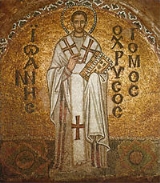
John Chrysostom Louvre Oa3970

Early life and education

John was born in Antioch
Antioch

Antioch on the Orontes was an ancient city on the eastern side of the Orontes River. It is near the modern city of Antakya, Turkey.Founded near the end of the 4th century BC by Seleucus I Nicator, one of Alexander the Great's generals, Antioch eventually rivaled Alexandria as the chief city of the nearer East and was a cradle of gentile hi...
 in 349. Different scholars describe his mother Anthusa as a pagan
Paganism

Paganism is the blanket term given to describe religions and spiritual practices of pre-Christian Europe, and by extension a term for polytheistic?traditions or folk religion?worldwide seen from a Western or Christian viewpoint....
 or as a Christian, and his father was a high ranking military
Military

A military is an organization authorized by its nation to use force, usually including use of weapons, in defending its country by combating actual or Threat of force ....
 officer. John's father died soon after his birth and he was raised by his mother. He was baptised
Baptism

In Christianity, baptism is the ritual act, with the use of water, by which one is admitted as a full member of the Christian Church and, in the view of some, as a member of the particular Church in which the baptism is administered....
 in 368 or 373 and tonsure
Tonsure

Tonsure is the practice of some Christianity churches, mystics, Buddhist novices and Bhikkhus, and some Hindu temples of cutting the hair from the scalp of clerics, devotees or holy people as a symbol of their renunciation of worldly fashion and esteem....
d as a reader (one of the minor orders
Minor orders

The minor orders are the lowest ranks in the Clergy#Christian clergy. The most recognized minor orders are porter , Reader , exorcist, Cantor and acolyte....
 of the Church). As a result of his mother's influential connections in the city, John began his education under the pagan teacher Libanius
Libanius

Libanius was a Greek-speaking teacher of rhetoric of the later Roman Empire, an educated Pagan of the Sophist school in an Empire that was turning Christian....
. From Libanius John acquired the skills for a career in rhetoric
Rhetoric

Rhetoric is the art of using language as a means to persuade. Along with logic and dialectic, rhetoric is one of the three ancient arts of discourse....
, as well as a love of the Greek language and literature
Greek literature

Greek literature refers to those writings autochthonic to the areas of Greeks influence, typically though not necessarily in one of the Greek dialects, throughout the whole period in which the Greek language people have existed....
. As he grew older, however, he became more deeply committed to Christianity and went on to study theology
Theology

Theology is the study of the existence or attributes of a deity or gods, or more generally the study of religion or spirituality. It is sometimes contrasted with religious studies: theology is understood as the study of religion from an internal perspective , and religious studies as the study of religion from an external perspective....
 under Diodore of Tarsus (founder of the re-constituted School of Antioch
School of Antioch

The School of Antioch was one of the two major centers of the study of biblical exegesis and theology; the other was the catechetical school of Alexandria....
). According to the Christian historian Sozomen
Sozomen

Salminius Hermias Sozomenus was a historian of the Christianity church....
, Libanius was supposed to have said on his deathbed that John would have been his successor "if the Christians had not taken him from us". He lived with extreme asceticism
Asceticism

Asceticism describes a life-style characterized by abstinence from various sorts of worldly pleasures often with the aim of pursuing religious and spirituality goals....
 and became a hermit
Hermit

A hermit is a person who lives to some greater or lesser degree in solitude and/or isolation from society.In Christianity the term was originally applied to a Christian who lives the eremitic life out of a religious conviction, namely the Catholic spirituality#Desert spirituality of the Old Testament ....
 circa 375; he spent the next two years continually standing, scarcely sleeping, and committing the Bible
Bible

The Bible is the central religious text of Judaism and Christianity. The exact Books of the Bible is dependent on the religious traditions of specific denominations....
 to memory. As a consequence of these practices, his stomach and kidneys were permanently damaged and poor health forced him to return to Antioch.

Priesthood and service in Antioch

He was ordained as a deacon
Deacon

Deacon is a role in the Christianity that is generally associated with service of some kind, but which varies among theological and denominational traditions....
 in 381 by Saint Meletius of Antioch
Meletius of Antioch

Saint Meletius of Antioch was the Christianity bishop, or Patriarch of Antioch, from 360 until his death. His staunch support of the First Council of Nicaea of the church led to his exile three times under Arianism emperors....
, and was ordained as a presbyter
Presbyter

Presbyter in the New Testament refers to a leader in local Christian congregations, then a synonym of episkopos . In modern usage, it is distinct from bishop and synonymous with priest, pastor, Elder , or religious minister in various Christian denominations....
 (that is, a priest
Priest

A priest or priestess is a person having the authority or power to administer religious rites; in particular, rites of sacrifice to, and propitiation of, a deity or deities....
) in 386 by Bishop Flavian I of Antioch
Flavian I of Antioch

Flavian I of Antioch was a bishop or Patriarch of Antioch from 381 until his death.He was born about 320, most probably in Antioch. He inherited great wealth, but resolved to devote his riches and his talents to the service of the church....
. Over the course of twelve years, he gained popularity because of the eloquence of his public speaking, especially his insightful expositions of Bible passages and moral teaching. The most valuable of his works from this period are his Homilies on various books of the Bible. He emphasised charitable giving and was concerned with the spiritual and temporal needs of the poor. He also spoke out against abuse of wealth and personal property:

His straightforward understanding of the Scriptures (in contrast to the Alexandrian tendency towards allegorical interpretation
Allegorical interpretation

Allegorical interpretation is the approach which assigns ahigher-than-literal interpretation to the contents of a text .The method has its origins in both Greek thought and in the Rabbinic literature of the Land of Israel....
) meant that the themes of his talks were practical, explaining the Bible's application to everyday life. Such straightforward preaching helped Chrysostom to garner popular support. He founded a series of hospitals in Constantinople to care for the poor.

One incident that happened during his service in Antioch illustrates the influence of his sermons. When Chrysostom arrived in Antioch, the bishop of the city had to intervene with Emperor Theodosius I
Theodosius I

Flavius Theodosius , also called Theodosius I and Theodosius the Great , was Roman Emperor from 379 to 395. Reuniting the eastern and western portions of the empire, Theodosius was the last emperor of both the Eastern Roman Empire and Western Roman Empire....
 on behalf of citizens who had gone on a rampage mutilating statues of the Emperor and his family. During the weeks of Lent
Lent

Lent, in Christianity, is the period of the liturgical year leading up to Easter. Conventionally it is described as being forty days long, though different Christian denominations calculate the forty days differently....
 in 397, John preached twenty-one sermons in which he entreated the people to see the error of their ways. These made a lasting impression on the general population of the city: many pagans converted to Christianity as a result of the sermons. As a result, Theodosius' vengeance was not as severe as it might have been.

Archbishop of Constantinople


In 398, John was requested, against his will, to take the position of Archbishop of Constantinople. He deplored the fact that Imperial court protocol would now assign to him access to privileges greater than the highest state officials. During his time as Archbishop he adamantly refused to host lavish social gatherings, which made him popular with the common people, but unpopular with wealthy citizens and the clergy. His reforms of the clergy were also unpopular with these groups. He told visiting regional preachers to return to the churches they were meant to be serving — without any payout.

His time in Constantinople was more tumultuous than his time in Antioch. Theophilus
Theophilus of Alexandria

Theophilus of Alexandria, was Pope of Alexandria, Egypt from 385 to 412. He is regarded as a saint by the Coptic Orthodox Church.He was a Coptic Pope at a time of conflict between the newly dominant Christians and the pagan establishment in Alexandria, each supported by a segment of the Alexandrian populace....
, the Patriarch of Alexandria
Patriarch of Alexandria

The Patriarch of Alexandria is the Archbishop of Alexandria and Cairo, Egypt. Historically, this office has included the designation of Pope , and did so earlier than that of the Bishop of Rome....
, wanted to bring Constantinople under his sway and opposed John's appointment to Constantinople. Being an opponent of Origen
Origen

Origen was an Early Christianity scholar, theology, and one of the most distinguished of the early Church father of the Christian Church. According to tradition, he is held to have been an Ancient Egypt who taught in Alexandria, reviving the Catechetical School of Alexandria where Clement of Alexandria had taught....
's teachings, he accused John of being too partial to the teachings of that theologian. Theophilus had disciplined four Egypt
Egypt

Egypt is a country mainly in North Africa, with the Sinai Peninsula forming a land bridge in Western Asia. Covering an area of about , Egypt borders the Mediterranean Sea to the north, the Gaza Strip and Israel to the northeast, the Red Sea to the east, Sudan to the south and Libya to the west....
ian monk
Monk

A Monk is a person who practices religious asceticism, the unconditioning of mind and body in favor of the realization of one's true nature, and does so living either alone or with any number of like-minded people, whilst always maintaining some degree of physical separation from those not sharing the same purpose....
s (known as "the tall brothers") over their support of Origen's teachings. They fled to and were welcomed by John. He made another enemy in Aelia Eudoxia
Aelia Eudoxia

Aelia Eudoxia was the Empress consort of the Byzantine Empire emperor Arcadius....
, the wife of the eastern Emperor Arcadius
Arcadius

Flavius Arcadius was Roman Emperors in the Eastern half of the Roman Empire from 395 until his death.Arcadius was born in Spain, the elder son of Theodosius I and Aelia Flaccilla, and brother of Flavius Augustus Honorius, who would become a Western Roman Emperor....
, who assumed (perhaps with justification) that his denunciations of extravagance in feminine dress were aimed at herself.

Depending on one's outlook, John was either tactless or fearless when denouncing offences in high places. An alliance was soon formed against him by Eudoxia, Theophilus and others of his enemies. They held a synod
Synod

A synod is a council of a Ecclesia , usually a Christianity church, convened to decide an issue of doctrine, administration or application. An ecumenical council is so named because it is a synod of the whole church ...
 in 403 (the Synod of the Oak
Synod of the Oak

The Synod of the Oak was a provincial synod, held in Constantinople in July of 403, which condemned and deposition John Chrysostom as Patriarch of Constantinople....
) to charge John, in which his connection to Origen was used against him. It resulted in his deposition and banishment. He was called back by Arcadius almost immediately, as the people became "tumultuous" over his departure. There was also an earthquake
Earthquake

An earthquake is the result of a sudden release of energy in the Earth's crust that creates seismic waves. Earthquakes are recorded with a seismometer, also known as a seismograph....
 the night of his arrest, which Eudoxia took for a sign of God
God

God is a deity in theism and deism religions and other belief systems, representing either the sole deity in monotheism, or a principal deity in polytheism....
's anger, prompting her to ask Arcadius for John's reinstatement. Peace was short-lived. A silver statue of Eudoxia was erected near his cathedral
Cathedral

A cathedral is a Christian church that contains the seat of a bishop. It is a Religion building for worship, specifically of a denomination with an episcopal hierarchy, such as the Roman Catholic Church, Anglicanism, Orthodox Christian and some Lutheranism churches, which serves as a bishop's seat, and thus as the central church of a dioc...
. John denounced the dedication ceremonies. He spoke against her in harsh terms: "Again Herodias raves; again she is troubled; she dances again; and again desires to receive John's head in a charger," an allusion to the events surrounding the death of John the Baptist
John the Baptist

John the Baptist was a mission preacher and a major religious figure who led a movement of baptism at the Jordan River in expectation of a divine apocalypse that would restore occupied Israel....
. Once again he was banished, this time to the Caucasus
Caucasus

The Caucasus or Caucas is a geopolitical region located between Europe, Asia, and the Middle East. It is home to Europe's highest mountain ....
 in Armenia
Armenia

Armenia , officially the Republic of Armenia , is a landlocked mountainous country in South Caucasus between the Black Sea and the Caspian Sea....
.

Pope Innocent I
Pope Innocent I

Pope Saint Innocent I was pope from 401 to March 12, 417.He was, according to his biographer in the Liber Pontificalis, the son of a man called Innocens of Albano; but according to his contemporary Jerome, his father was Pope Anastasius I , whom he was called by the unanimous voice of the clergy and laity to succeed ....
 protested at this banishment, but to no avail. Innocent sent a delegation to intercede on behalf of John in 405. It was led by Gaudentius of Brescia; Gaudentius and his companions, two bishops, encountered many difficulties and never reached their goal of entering Constantinople
Constantinople

Constantinople was the empire capital of the Roman Empire , the Byzantine Empire , the Latin Empire , and the Ottoman Empire . Strategically located between the Golden Horn and the Sea of Marmara at the point where Europe meets Asia, Byzantine Constantinople had been the capital of a Christendom empire, successor to ancient ancient Greece...
.

John wrote letters which still held great influence in Constantinople. As a result of this, he was further exiled to Pitiunt (Abkhazia
Abkhazia

Abkhazia is a disputed region on the eastern coast of the Black Sea. Since its declaration of independence from Georgia in 1991 during the Georgian?Abkhaz conflict, it is governed by the International recognition of Abkhazia and South Ossetia Republic of Abkhazia....
 region of Georgia
Georgia (country)

Georgia is a transcontinental country in the Caucasus region, located at the dividing line between Europe and Asia. It is bordered by the Russia to the north, Azerbaijan to the east, Armenia to the south, and Turkey to the southwest....
) where his tomb is the shrine for pilgrims. He never reached this destination, as he died during the journey. His last words are said to have been, "d??a t? ?e? p??t?? ??e?e?" (Glory be to God for all things).

Writings


Homilies

Known as "the greatest preacher in the early church", John's sermons have been one of his greatest lasting legacies. Chrysostom's extant homiletical works are vast, including many hundreds of exegetical sermons on both the New Testament
New Testament

The New Testament is the name given to the second major division of the Christianity Bible, the first such division being the much longer Old Testament....
 (especially the works of Saint Paul
Paul of Tarsus

Saint Paul, also called Paul the Apostle, the Apostle Paul or Paul of Tarsus , was a Hellenistic Judaism, who called himself the "Apostle to the Gentiles", and was, together with Saint Peter and James the Just, the most notable of early Christian missionaries....
) and the Old Testament
Old Testament

In Western Christianity, the Old Testament refers to the books that form the first of the two-part Christianity Bible Biblical canon. These works correspond to the Hebrew Bible , with some variations and additions....
 (particularly on Genesis
Genesis

Genesis or Breishit is the first book of the Bible used by Judaism and Christianity, and the first of five books of the Pentateuch or Torah....
). Among his extant exegetical works are sixty-seven homilies on Genesis
Genesis

Genesis or Breishit is the first book of the Bible used by Judaism and Christianity, and the first of five books of the Pentateuch or Torah....
, fifty-nine on the Psalms
Psalms

Psalms is a book of the Hebrew Bible , included in the collected works known as the "Writings" or Ketuvim....
, ninety on the Gospel of Matthew
Gospel of Matthew

The Gospel of Matthew is one of the four canonical gospels in the New Testament and is a synoptic gospel. It narrates an account of the New Testament view on Jesus' life and Ministry of Jesus of Jesus of Nazareth....
, eighty-eight on the Gospel of John
Gospel of John

The Gospel of John is the fourth gospel in the Biblical canon of the New Testament, traditionally ascribed to John the Evangelist. Like the three synoptic gospels, it contains an account of some of the actions and sayings of Jesus of Nazareth, but differs from them in ethos and theological emphases....
, and fifty-five on the Acts of the Apostles
Acts of the Apostles

The Acts of the Apostles is a book of the Bible, which now stands fifth in the New Testament. It is commonly referred to as simply Acts. The title "Acts of the Apostles" was first used by Irenaeus in the late second century, but some have suggested that the title "Acts" be interpreted as "the Acts of the Holy Spirit" or even "the Acts...
.

The sermons were written down by the audience and subsequently circulated, revealing a style that tended to be direct and greatly personal, but was also formed by the rhetorical conventions of his time and place. In general, his homiletical theology displays much characteristic of the Antiochian school (i.e., somewhat more literal in interpreting Biblical events), but he also uses a good deal of the allegorical interpretation more associated with the Alexandrian school
Alexandrian school

The Alexandrian school is a collective designation for certain tendencies in literature, philosophy, medicine, and the sciences that developed in the Hellenistic civilization cultural center of Alexandria, Egypt during the Hellenistic era and Roman periods....
.

John's social and religious world was formed by the continuing and pervasive presence of paganism in the life of the city. One of his regular topics was the paganism in the culture of Constantinople, and in his sermons he thunders against popular pagan amusements: the theatre
Theatre of Ancient Greece

The theatre of ancient Greece, or ancient Greek drama, is a Theatre culture that flourished in Classical Greece between c. 550 and c. 220 BCE....
, horseraces
Chariot racing

Chariot racing was one of the most popular Ancient Greece, Roman Empire and Byzantine empire sports. Chariot racing was often dangerous to both driver and horse?they frequently suffered serious injury and even death?but generated strong spectator enthusiasm....
, and the revelry surrounding holidays. In particular, he criticized Christians for taking part in such activities:
"If you ask [Christians] who is Amos
Amos (prophet)

Amos is one of the twelve minor prophets in the Hebrew Bible, and putative author of the speeches reported in the Book of Amos. The only direct information about him comes from this book....
 or Obadiah
Obadiah

Obadiah is a Bible Theophory in the Bible name, meaning "servant of Jehovah" It is cognate to the Arabic language name `Ubaidallah . The form of his name used in the Septuagint is Obdios; in Latin it is Abdias....
, how many apostles there were or prophets, they stand mute; but if you ask them about the horses or drivers, they answer with more solemnity than sophists
Sophism

Sophism can mean two very different things: In the modern definition, a sophism is a confusing or illogical argument used for deceiving someone....
 or rhetors".


John's homilies on Paul's Epistles proceed linearly, methodically treating the texts verse by verse, often going into great detail. He shows a concern to be understood by laypeople, sometimes offering colorful analogies and practical examples. At other times, he offers extended comments clearly intended to address the theological subtleties of a heretical misreading, or to demonstrate the presence of a deeper theme.

One of the recurring features of John's sermons is his emphasis on care for the needy. Echoing themes found in the Gospel of Matthew, he calls upon the rich to lay aside materialism in favor of helping the poor, often employing all of his rhetorical skills to shame wealthy people to abandon conspicuous consumption: "It is not possible for one to be wealthy and just at the same time." "Do you pay such honor to your excrements as to receive them into a silver chamber-pot when another man made in the image of God is perishing in the cold?"

Treatises

Outside of his sermons, a number of John's other treatises have had a lasting influence. One such work is John's early treatise Against Those Who Oppose the Monastic Life, written while he was a deacon (sometime before 386), which was directed to parents, pagan as well as Christian, whose sons were contemplating a monastic vocation. The book is a sharp attack on the values of Antiochene upper-class urban society written by someone who was a member of that class. Chrysostom also writes that, already in his day, it was customary for Antiochenes to send their sons to be educated by monks. Other important treatises written by John include On the Priesthood (one of his earlier works), Instructions to Catechumens, and On the Incomprehensibility of the Divine Nature. In addition, he wrote a series of well-known letters to the deaconess
Deaconess

Deaconess comes from a Greek word diakonos . This Greek word means a servant or helper and occurs frequently in the Christian New Testament of the Bible and is sometimes applied to Christ himself....
 Olympias
Olympias

Olympias , ca. 376–316 BC, was an Epirote princess, the fourth wife of King Philip II of Macedon of Macedon and mother of Alexander the Great....
.

Sermons on Jews and Judaizing Christians

During his first two years as a presbyter in Antioch (386-387), Chrysostom denounced Jew
Jew

A Jew is a member of the Jewish people, an ethnoreligious group that traces its ancestry to the Israelites or Hebrews of the Ancient Near East....
s and Judaizing Christians
Judaizers

Judaizers and Judaizing, see also Wiktionary:Judaization, refer to those who teach the necessity of obedience to the Law of Moses by Christians, which is normally considered a requisite only for the followers of Judaism, the parent religion of Christianity....
 in a series of eight sermons delivered to Christians in his congregation who were taking part in Jewish festivals and other Jewish observances. It is disputed whether the main target were specifically Judaizers or Jews in general. His homilies were expressed in the conventional manner, utilizing the uncompromising rhetorical form known as the psogos (Greek: blame).

One of the purposes of these homilies was to prevent Christians from participating in Jewish customs, and thus prevent the perceived erosion of Chrysostom's flock. In his sermons, Chrysostom criticized those "Judaizing Christians", who were participating in Jewish festivals and taking part in other Jewish observances, such as the shabbat
Shabbat

Shabbat or Shabbos , is the weekly day of rest in Judaism, symbolizing the seventh day in Genesis, after the six days of creation. Though it is commonly said to be the Saturday of each week, it is observed from sundown on Friday until the appearance of three stars in the sky on Saturday night....
, submitted to circumcision
Circumcision in the Bible

Male circumcision, when practiced as a rite, has its foundations in the Bible, in the Covenant #Abrahamic Covenant, such as , and is therefore practiced by Jews and Muslims and some Christians, those who constitute the Abrahamic religions....
 and made pilgrimage to Jewish holy places. Chrysostom claimed that on the shabbats and Jewish festivals synagogue
Synagogue

A synagogue is a Jewish house of prayer.Synagogues usually have a large hall for prayer , smaller rooms for study and sometimes a social hall and offices....
s were full of Christians, especially women, who loved the solemnity of the Jewish liturgy, enjoyed listening to the shofar
Shofar

A shofar is a horn used for Jewish religious purposes. Shofar-blowing is incorporated in synagogue services on Rosh Hashanah and Yom Kippur....
 on Rosh Hashanah
Rosh Hashanah

Rosh Hashanah is a Jewish holiday commonly referred to as the "Judaism New Year." It is observed on the first day of Tishrei, the seventh month of the Hebrew calendar, as ordained in the Torah, in ....
, and applauded famous preachers in accordance with the contemporary custom. A more recent apologetic theory is that he instead tried to persuade Jewish Christians
Jewish Christians

Jewish Christians is a term with two meanings, a historical one and a contemporary one.The historical term refers to Early Christians of or attracted to Jewish culture....
, who for centuries had kept connections with Jews and Judaism
Judaism

Judaism is a set of beliefs and practices originating in the Hebrew Bible , as later further explored and explained in the Talmud and other texts....
, to choose between Judaism and Christianity.

Chrysostom held Jews responsible for the crucifixion of Jesus
Crucifixion of Jesus

The crucifixion of Jesus is an event described in all four gospels which takes place immediately after Arrest of Jesus and Sanhedrin Trial of Jesus....
 and deicide
Deicide

The responsibility for the Death and resurrection of Jesus has, in Christianity, both historical and theological aspects. In addition, the deicide charge against Jews is among the cornerstones of antisemitism....
 (killing God, see "Jewish deicide
Jewish deicide

Jewish deicide is an antisemitic canard that placed the responsibility for the death of Jesus on the Jewish people as a whole.This deicide accusation is expressed in the ethnoreligious slur "Christ killer"....
" for the subject) and added that they continued to rejoice in Jesus's death. He compared the synagogue to a pagan temple, representing it as the source of all vice
Vice

Vice is a practice or habit considered immoral, depraved, and/or degrading in the associated society. In more minor usage, vice can refer to a fault, a defect, an infirmity or merely a bad habit....
s and heresies. He described it as a place worse than a brothel
Brothel

A brothel, also known as a bordello, cathouse or whorehouse, is an establishment specifically dedicated to prostitution, providing the prostitutes a place to meet and to have sex with clients....
 and a drinking shop
Bar (establishment)

A bar is a business that serves drinks, especially alcoholic beverages such as beer, liquor, and mixed drinks, for consumption on the premises....
; it was a den of scoundrels, the repair of wild beasts, a temple of demons, the refuge of brigands and debauchees, and the cavern of devils, a criminal assembly of the assassins of Christ
Jewish deicide

Jewish deicide is an antisemitic canard that placed the responsibility for the death of Jesus on the Jewish people as a whole.This deicide accusation is expressed in the ethnoreligious slur "Christ killer"....
. Palladius, Chrysostom's contemporary biographer, also recorded his claim that among the Jews the priesthood may be purchased and sold for money. Finally, he declared that he - in accordance with the sentiments of the saints - hated both the synagogue and the Jews.

In Greek
Greek language

Greek is an Indo-European languages native to the southern Balkan peninsula, the language of the Greek people. It forms an independent branch within Indo-European....
 the sermons are called Kata Ioudaion (?at? ???da???), which is translated as Adversus Judaeos in Latin and Against the Jews in English. The most recent scholarly translations, claiming that Chrysostom's primary targets were members of his own congregation who continued to observe the Jewish feasts and fasts, give the sermons the more sympathetic title Against Judaizing Christians. The original Benedictine editor of the homilies, Bernard de Montfaucon
Bernard de Montfaucon

Bernard de Montfaucon was a French Benedictine monk and scholar.He published L'antiquit? expliqu?e et repr?sent?e en figures between 1719 and 1724....
, gives the following footnote to the title: "A discourse against the Jews; but it was delivered against those who were Judaizing and keeping the fasts with them [the Jews]." As such, some have claimed that the original title misrepresents the contents of the discourses, which show that Chrysostom's primary targets were members of his own congregation who continued to observe the Jewish feasts and fasts. Sir Henry Savile
Sir Henry Savile

Sir Henry Savile , was an English scholar, Warden of Merton College, Oxford, and Provost of Eton....
, in his 1612 edition of Homilies 27 of Volume 6 (which is Discourse I in Patrologia Graeca
Patrologia Graeca

The Patrologia Graeca is an edited collection of writings by the Christian Church Fathers and various secular writers, in the ancient Koine or Medieval Greek variants of the Greek language....
's Adversus Iudaeos), gives the title: "Chrysostom's Discourse Against Those Who Are Judaizing and Observing Their Fasts."

Liturgy

Beyond his preaching, the other lasting legacy of John is his influence on Christian liturgy. Two of his writings are particularly notable. He harmonized the liturgical life of the Church by revising the prayers and rubrics of the Divine Liturgy
Divine Liturgy

The Divine Liturgy is the common term for the Eucharistic service of the Byzantine church tradition of Christian liturgy. As such, it is used in the Eastern Orthodoxy and Eastern Catholic Churches....
, or celebration of the Holy Eucharist. To this day, Eastern Orthodox and most Eastern Catholic Churches typically celebrate the Divine Liturgy of St. John Chrysostom. These same churches also read his Catechetical Homily (Hieratikon) at every Easter
Easter

Easter is the most important religious feast in the Christianity liturgical year.Christians believe that Jesus was Resurrection of Jesus from the dead three days after his Crucifixion of Jesus, and celebrate this resurrection on Easter Day or Easter Sunday , two days after Good Friday....
, the greatest feast of the church year.

Legacy and influence

Zlatoust
During a time when city clergy were subject to criticism for their high lifestyle, John was determined to reform his clergy in Constantinople. These efforts were met with resistance and limited success. He was an excellent preacher. As a theologian, he has been and continues to be very important in Eastern Christianity
Eastern Christianity

Eastern Christianity refers collectively to the Christianity traditions and churches which developed in the Balkans, Eastern Europe, Asia Minor, the Middle East, Christianity in Africa and southern India over several centuries of religious antiquity....
, and is generally considered the most prominent doctor of the Greek Church, but has been less important to Western Christianity. His writings have survived to the present day more so than any of the other Greek Fathers. He rejected the contemporary trend for allegory, instead speaking plainly and applying Bible passages and lessons to everyday life.

His exile demonstrated the rivalry between Constantinople and Alexandria for recognition as the preeminent Eastern See, while in the west, the Pope
Pope

The Pope is the Bishop of Rome, the leader of the Roman Catholic Church and head of state of Vatican City. The current pope is Pope Benedict XVI, who was elected April 19, 2005 in Papal conclave, 2005....
's primacy remained unquestioned.

Influence on the Catechism of the Catholic Church and clergy

Chrysostom's influence on church teachings is interwoven throughout the current Catechism of the Catholic Church
Catechism of the Catholic Church

The Catechism of the Catholic Church or CCC, is an official exposition of the teachings of the Roman Catholic Church. It was first published in Latin and French in 1992 by the authority of Pope John Paul II....
 (revised 1992). The Catechism cites him in eighteen sections, particularly his reflections on the purpose of prayer and the meaning of the Lord's Prayer
Lord's Prayer

The Lord's Prayer, also known as the Our Father or Pater noster, is probably the best-known prayer in Christianity. On Easter Sunday 2007 it was estimated that 2 billion Catholic, Protestant and Eastern Orthodox Christians read, recited, or sang the short prayer in hundreds of languages in houses of worship of all shapes and size...
:

Christian clerics, such as R.S. Storr, refer to him as "one of the most eloquent preachers who ever since apostolic times have brought to men the divine tidings of truth and love", and the 19th century John Henry Cardinal Newman
John Henry Cardinal Newman

Venerable John Henry Newman, Oratory of Saint Philip Neri was a Roman Catholic Priesthood and Cardinal who converted to Roman Catholicism from Anglicanism in October 1845....
 described Chrysostom as a "bright, cheerful, gentle soul; a sensitive heart."

Antisemitism

Chrysostom's Adversus Judaeos homilies have been circulated by many groups to foster anti-Semitism
Anti-Semitism

Antisemitism is prejudice against or hostility towards Jews.This prejudice or hostility is usually characterized by a combination of Religion, Race , cultural and ethnic group biases....
. James Parkes called the writing on Jews "the most horrible and violent denunciations of Judaism to be found in the writings of a Christian theologian". His sermons against Jews gave momentum to the idea that Jews are collectively responsible for the death of Jesus. British historian Paul Johnson claimed that Chrysostom's homilies "became the pattern for anti-Jewish tirades, making the fullest possible use (and misuse) of key passages in the gospels of Saints Matthew and John. Thus a specifically Christian anti-Semitism, presenting the Jews as murderers of Christ
Jesus

Jesus of Nazareth , also known as Jesus Christ, is the central figure of Christianity and is revered by most Christian churches as the Son of God and the Incarnation ....
, was grafted on to the seething mass of pagan smears and rumours, and Jewish communities were now at risk in every Christian city." During World War II, the Nazi Party in Germany abused his work in an attempt to legitimize the Holocaust in the eyes of German and Austrian Christians. His works were frequently quoted and reprinted as a witness for the prosecution.

After World War II, the Christian churches denounced Nazi use of Chrysostom's works, explaining his words with reference to the historical context. According to Laqueur, it was argued that in the 4th century, the general discourse was brutal and aggressive and that at the time when the Christian church was fighting for survival and recognition, mercy and forgiveness were not in demand. According to Patristics
Patristics

Patristics or Patrology is the study of early Christian writers, known as the Church Fathers. The names derive from the Latin pater . The period is generally considered to run from the end of New Testament times until around the 8th century....
 scholars, opposition to any particular view during the late fourth century was conventionally expressed in a manner, utilizing the rhetorical form known as the psogos, whose literary conventions were to vilify opponents in an uncompromising manner; thus, it has been argued that to call Chrysostom an "anti-Semite" is to employ anachronistic terminology in a way incongruous with historical context and record.

Music and literature

Chrysostom's liturgical legacy has inspired several musical compositions. Noteworthy among these are: Sergei Rachmaninoff
Sergei Rachmaninoff

Sergei Vasilievich Rachmaninoff was a Russian composer, pianist, and conducting. He was one of the finest pianists of his day and, as a composer, the last great representative of Russian late Romantic music in classical music....
's Liturgy of St. John Chrysostom, Op.31, composed in 1910, one of his two major unaccompanied choral works; Pyotr Tchaikovsky's Liturgy of St. John Chrysostom
Liturgy of St. John Chrysostom (Tchaikovsky)

Pyotr Ilyich Tchaikovsky composed a Liturgy of St John Chrysostom, Op. 41, in 1880. The Divine Liturgy of St. John Chrysostom is the primary worship service of the Eastern Orthodox Church....
, Op.41; Ukrainian composer Kyrylo Stetsenko
Kyrylo Stetsenko

Kyrylo Hryhorovych Stetsenko was a prolific Ukrainians composer, Conductor , critic, and teacher. He was also an Orthodox Priest and the Minister of Education of the shortlived Ukrainian People's Republic....
's Liturgy of St. John Chrysostom; and Arvo Pärt
Arvo Pärt

Arvo P?rt , is an Estonian classical composer. P?rt works in a minimalist style that employs tintinnabulation and hypnotic repetitions influenced by the intellectual counterpoint elements of European jazz, but fitting into European-American classical post-modernism rather than so-called world music....
's Litany, which sets seven sentence prayers of Chrysostom's Divine Liturgy for chorus and orchestra; and .

James Joyce
James Joyce

James Augustine Aloysius Joyce was an Ireland expatriate author of the 20th century. He is best known for his landmark novel Ulysses and its controversial successor Finnegans Wake , as well as the short story collection Dubliners and the semi-autobiographical novel A Portrait of the Artist as a Young Man ....
's novel Ulysses
Ulysses (novel)

Ulysses is a novel by James Joyce, first serialized in parts in the American journal The Little Review from March 1918 to December 1920, then published in its entirety by Sylvia Beach on February 2, 1922, in Paris....
 includes a character named Mulligan who brings 'Chrysostomos' into another character's mind because Mulligan's gold-stopped teeth and his gift of the gab earn him the title which St. John Chrysostom's preaching earned him, 'golden-mouthed': Chrysostomos also refers to Stephen, the independent and exiled genius:

Relics

John Chrysostom died in the city of Comana in the year 407 on his way to his place of exile. There his relic
Relic

A relic is an object or a personal item of Religion significance, carefully preserved with an air of veneration as a tangible memorial. Relics are an important aspect of some forms of Buddhism, Christianity, Hinduism, shamanism, and many other religions....
s remained until 438 when, thirty years after his death, they were transferred to Constantinople
Constantinople

Constantinople was the empire capital of the Roman Empire , the Byzantine Empire , the Latin Empire , and the Ottoman Empire . Strategically located between the Golden Horn and the Sea of Marmara at the point where Europe meets Asia, Byzantine Constantinople had been the capital of a Christendom empire, successor to ancient ancient Greece...
 during the reign of the Empress Eudoxia
Eudoxia

Eudoxia, or Eudokia is the English language transliteration of the Greek language feminine personal name ??d???a Evdokia. It was mainly popular in late antiquity and in the Middle Ages, but is still in use today....
's son, the Emperor Theodosius II
Theodosius II

Flavius Theodosius , called the Calligrapher, known in English as Theodosius II, was an Eastern Roman Empire , mostly known for the law code bearing his name, the Codex Theodosianus, and the Walls of Constantinople#The Theodosian Walls of Constantinople built during his reign....
 (408-450), under the guidance of John's disciple, St. Proclus, who by that time had become Archbishop of Constantinople (434-447).

John's relics were looted from Constantinople by Crusaders
Fourth Crusade

The Fourth Crusade was originally designed to conquer Islam Jerusalem by means of an invasion through Egypt. Instead, in April 1204, the Crusaders of Western Europe invaded and conquered the Christianity city of Constantinople, capital of the Byzantine Empire....
 in 1204 and brought to Rome, but were returned to the Orthodox on November 27, 2004 by Pope John Paul II
Pope John Paul II

Pope John Paul II John Paul II is widely acclaimed as one of the most influential leaders of the twentieth century. He has been Pope_John_Paul_II#Role_in_the_fall_of_Communism in bringing down communism in Eastern Europe, as well as significantly improving the Roman Catholic Church's relations with Judaism, the Eastern Orthodox Church, and A...
. His silver and jewel-encrusted skull is now kept in the Vatopedi
Vatopedi

The Holy and Great Monastery of Vatopedi on the Mount Athos was built during the second half of the 10th century, by three monks, Athanasius, Nicholas, and Antonius from Edirne, who were the pupils of Athanasius the Athonite....
 Monastery
Monastery

Monastery , a term derived from the Greek language word ???ast?????, neut. of ???ast????? - monasterios denotes the building, or complex of buildings, that houses a room reserved for prayer as well as the domestic quarters and workplace of Monk, whether monks or nuns, and whether living in Cenobium or alone ....
 on Mount Athos
Mount Athos

Mount Athos is a mountain on the peninsula of the same name in Macedonia , of northern Greece, called in Greek language Agion Oros , or in English, "Holy Mountain"....
 in northern Greece, and is credited by Christians with miraculous
Miracle

File:Folio 171r - The Raising of Lazarus.jpgA miracle is a sensibly perceptible interruption of the laws of nature, such that can only be explained by divine intervention, and is sometimes associated with a miracle-worker....
 healings. His is also preserved on Mount Athos, and numerous smaller relics are scattered throughout the world.

Collected works

Widely used editions of Chrysostom's works are available in Greek, Latin, English, and French. The Greek edition is edited by Sir Henry Savile (eight volumes, Eton, 1613); the most complete Greek and Latin edition is edited by Bernard de Montfaucon (thirteen volumes, Paris, 1718-38) republished in 1834-40). There is an English translation in the first series of the Nicene and Post-Nicene Fathers (London and New York, 1889-90). A selection of his writings has been published more recently in the original with facing French translation in Sources Chrétiennes
Sources chretiennes

Sources Chr?tiennes is a bilingual collection of patristics founded in Lyon in 1943 by the Jesuits Jean Dani?lou, Claude Mond?sert, and Henri de Lubac....
.

External links

  • by Pope Benedict XVI
    Pope Benedict XVI

    Pope Benedict XVI is the List of popes and reigning Pope, by virtue of his office of Bishop of Rome, the head of the Roman Catholic Church and, as such, monarch of the Vatican City....
  • article from The Catholic Encyclopedia (Newadvent Website)
  • Orthodox icon
    Icon

    An 'icon' is a religious work of art, most commonly a painting, from Eastern Christianity. More broadly the term is used in a wide number of contexts for an image, picture, or representation; it is a sign or likeness that stands for an object by signifying or representing it either concretely or by analogy, as in semiotics; by extension, ...
     and synaxarion (November 13 feast day)
  • (January 27 feast day)
  • (January 30 feast day)


Works

  • Writings of Chrysostom in the edition of the Nicene and Post-Nicene Fathers:
    • '
  • Easter Sermon of St. John Chrysostom
  • by Migne Patrologia Graeca
    Patrologia Graeca

    The Patrologia Graeca is an edited collection of writings by the Christian Church Fathers and various secular writers, in the ancient Koine or Medieval Greek variants of the Greek language....
     with analytical indexes