


Holy Family

Encyclopedia
The Holy Family consists of the Child Jesus
, the Virgin Mary, and Saint Joseph
.
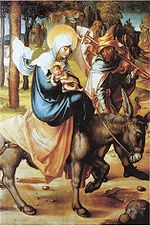 The Feast of the Holy Family is a liturgical
celebration in the Roman Catholic Church
in honor of Jesus of Nazareth, his mother, the Blessed Virgin Mary, and his foster father, Saint Joseph, as a family. The Feast of the Holy Family is celebrated on the Sunday following Christmas, unless that Sunday is January 1st, in which case it is celebrated on December 30th.
Veneration of the Holy Family was formally begun in the 17th century by Mgr François de Laval
, a Canadian bishop who founded a Confraternity
.
The feast of the Holy Family was instituted by Pope Leo XIII
in 1893 on the Sunday within the Octave
of the Epiphany
; that is to say, on the Sunday between January 7 through January 13, all inclusive (see General Roman Calendar of 1962
). The calendar of the 1962 Roman Missal
, whose use is still authorized, keeps the celebration on that date.
In the 1962 calendar, the feast was always on a Sunday and, if it fell on 13 January, it replaced the Commemoration of the Baptism of the Lord, to which the 1962 calendar assigned that date. It was never a holy day of obligation
, but when its celebration fell on a Sunday, there is an obligation to attend Mass on that day.
In the calendar promulgated in 1969, the feast was moved to the Sunday within the Octave of Christmas
, between Christmas and New Year's Day
(both exclusive), or when there is no Sunday within the Octave (if both Christmas Day and the Solemnity of Mary, Mother of God are Sundays), it is held on 30 December, a Friday in such years. (In other words, the feast is on the same day as the Tridentine-rite Mass of the Sunday within the Octave of Christmas
.)
The members of the Holy Family are the patrons of the Congregation of Holy Cross
. The Holy Cross Sisters are dedicated to the Immaculate Heart of Mary
, the Holy Cross Brothers to St. Joseph and the Priests of Holy Cross to the Sacred Heart
.
The Sons of the Holy Family
is also a religious congregation devoted to the Holy Family.
Child Jesus
The Child Jesus represents Jesus from his Nativity to age 12. At 13 he was considered to be adult, in accordance with the Jewish custom of his time, and that of most Christian cultures until recent centuries.The Child Jesus is frequently depicted in art, from around the third or fourth century...
, the Virgin Mary, and Saint Joseph
Saint Joseph
Saint Joseph is a figure in the Gospels, the husband of the Virgin Mary and the earthly father of Jesus Christ ....
.
Liturgy
Liturgy is either the customary public worship done by a specific religious group, according to its particular traditions or a more precise term that distinguishes between those religious groups who believe their ritual requires the "people" to do the "work" of responding to the priest, and those...
celebration in the Roman Catholic Church
Roman Catholic Church
The Catholic Church, also known as the Roman Catholic Church, is the world's largest Christian church, with over a billion members. Led by the Pope, it defines its mission as spreading the gospel of Jesus Christ, administering the sacraments and exercising charity...
in honor of Jesus of Nazareth, his mother, the Blessed Virgin Mary, and his foster father, Saint Joseph, as a family. The Feast of the Holy Family is celebrated on the Sunday following Christmas, unless that Sunday is January 1st, in which case it is celebrated on December 30th.
Veneration of the Holy Family was formally begun in the 17th century by Mgr François de Laval
François de Laval
This article is in part a sermon and generally comes close to hagiography.Blessed François-Xavier de Montmorency-Laval was the first Roman Catholic bishop of Quebec and was one of the most influential men of his day. He was appointed when he was 36 years old by Pope Alexander VII. He was a member...
, a Canadian bishop who founded a Confraternity
Confraternity
A confraternity is normally a Roman Catholic or Orthodox organization of lay people created for the purpose of promoting special works of Christian charity or piety, and approved by the Church hierarchy...
.
The feast of the Holy Family was instituted by Pope Leo XIII
Pope Leo XIII
Pope Leo XIII , born Vincenzo Gioacchino Raffaele Luigi Pecci to an Italian comital family, was the 256th Pope of the Roman Catholic Church, reigning from 1878 to 1903...
in 1893 on the Sunday within the Octave
Octave (liturgical)
"Octave" has two senses in Christian liturgical usage. In the first sense, it is the eighth day after a feast, reckoning inclusively, and so always falls on the same day of the week as the feast itself. The word is derived from Latin octava , with dies understood...
of the Epiphany
Epiphany (Christian)
Epiphany, or Theophany, meaning "vision of God",...
; that is to say, on the Sunday between January 7 through January 13, all inclusive (see General Roman Calendar of 1962
General Roman Calendar of 1962
This article lists the feast days of the General Roman Calendar as it was in 1962, following the reforms that Pope John XXIII introduced with his motu proprio Rubricarum instructum of 23 July 1960...
). The calendar of the 1962 Roman Missal
Roman Missal
The Roman Missal is the liturgical book that contains the texts and rubrics for the celebration of the Mass in the Roman Rite of the Catholic Church.-Situation before the Council of Trent:...
, whose use is still authorized, keeps the celebration on that date.
In the 1962 calendar, the feast was always on a Sunday and, if it fell on 13 January, it replaced the Commemoration of the Baptism of the Lord, to which the 1962 calendar assigned that date. It was never a holy day of obligation
Holy Day of Obligation
In the Catholic Church, Holy Days of Obligation or Holidays of Obligation, less commonly called Feasts of Precept, are the days on which, as of the Code of Canon Law states,-Eastern Catholic Churches:...
, but when its celebration fell on a Sunday, there is an obligation to attend Mass on that day.
In the calendar promulgated in 1969, the feast was moved to the Sunday within the Octave of Christmas
Christmas
Christmas or Christmas Day is an annual holiday generally celebrated on December 25 by billions of people around the world. It is a Christian feast that commemorates the birth of Jesus Christ, liturgically closing the Advent season and initiating the season of Christmastide, which lasts twelve days...
, between Christmas and New Year's Day
New Year's Day
New Year's Day is observed on January 1, the first day of the year on the modern Gregorian calendar as well as the Julian calendar used in ancient Rome...
(both exclusive), or when there is no Sunday within the Octave (if both Christmas Day and the Solemnity of Mary, Mother of God are Sundays), it is held on 30 December, a Friday in such years. (In other words, the feast is on the same day as the Tridentine-rite Mass of the Sunday within the Octave of Christmas
Sunday within the Octave of Christmas
The Sunday within the Octave of Christmas is a liturgical celebration in the Tridentine rite of the Roman Catholic Church which, in missals before 1962, takes place on either December 29, December 30, or December 31. If one of these three days is a Sunday, the celebration occurs on that day...
.)
Cultural references
A pious practice among Catholics is to write "J.M.J" at the top of letters and personal notes as a reference to Jesus, Mary, and Joseph as the Holy Family.The members of the Holy Family are the patrons of the Congregation of Holy Cross
Congregation of Holy Cross
The Congregation of Holy Cross or Congregatio a Sancta Cruce is a Catholic congregation of priests and brothers founded in 1837 by Blessed Father Basil Anthony-Marie Moreau, CSC, in Le Mans, France....
. The Holy Cross Sisters are dedicated to the Immaculate Heart of Mary
Immaculate Heart of Mary
The Immaculate Heart of Mary originally The Sacred Heart of Mary is a devotional name used to refer to the interior life of Mary, her joys and sorrows, her virtues and hidden perfections, and, above all, her virginal love for God, her maternal love for her Son, Jesus, and her compassionate love for...
, the Holy Cross Brothers to St. Joseph and the Priests of Holy Cross to the Sacred Heart
Sacred Heart
The Sacred Heart is one of the most famous religious devotions to Jesus' physical heart as the representation of His divine love for Humanity....
.
The Sons of the Holy Family
Sons of the Holy Family
The Congregation of the Sons of the Holy Family, Jesus, Mary and Joseph is an Institute of Consecrated Life for priests in the Catholic Church. The congregation is dedicated to educating the young and strengthening Catholic family life.-Foundation:...
is also a religious congregation devoted to the Holy Family.