

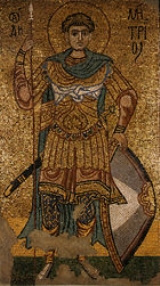
Saint Demetrius of Thessaloniki

Encyclopedia
Saint Demetrius of Thessaloniki
was a Christian
martyr
, who lived in the early 4th century.
During the Middle Ages, he came to be revered as one of the most important Orthodox military saints, often paired with Saint George
. His feast day
is 26 October for Christians following the Gregorian calendar
and 8 November for Christians following the Julian calendar
.
 The spelling "Demetrius" is a romanization of the ancient Greek pronunciation; the Byzantine
and Modern Greek
pronunciation is romanized as Dimitrios. See Demetrios for more on the etymology of the name.
In Russian
, he is called Димитрий Солунский ([dimitri solunski] 'Dimitri of Saloniki') and was a patron saint of the ruling Rurikid family from the late 11th century on. Izyaslav I of Kiev (whose Christian name was Dimitry) founded the first East Slavic monastery dedicated to this saint. The name Dimitry is in common use.
The Bulgarian Orthodox Church
and the Bulgarian people revere St. Demetrius on 26 October as Димитровден (Dimitrovden).
The Serbian Orthodox Church
reveres St. Demetrius as Mitar or " Димитрије " , having a feast of Mitrovdan on 8 November.
He is known in Lebanon
as Mar Dimitri or Mitri for short, which is a common name among Christian Lebanese.
He is known in the Coptic Church as "St. Demetrius of Thessalonica". He is venerated in the Coptic Church on 8 November.
 The earliest written accounts of his life were compiled in the 9th century, although there are earlier images of him, and accounts from the 7th century of his miracles. The biographies have Demetrius as a young man of senatorial family who was run through with spears in around 306 AD
in Thessaloniki, during the Christian
persecutions of the emperor Diocletian
or Galerius
, which matches his depiction in the 7th century mosaics.
are obscure; the first evidence comes about 150 years after his martyrdom. Therefore some modern scholars question the historicity of the man.
One theory is that his veneration was transferred from Sirmium
when Thessaloniki replaced it as the main military base in the area in 441/442 AD
. His very large church in Thessaloniki, the Hagios Demetrios, dates from the mid-5th century, so he clearly had a large following by then. Thessaloniki remained a centre of his veneration, and he is the patron saint
of the city.
After the growth of his veneration as saint, the city of Thessaloniki suffered repeated attacks and sieges from the Slavic peoples
who moved into the Balkans
, and Demetrius was credited with many miraculous interventions to defend the city. Hence later traditions about Demetrius regard him as a soldier in the Roman army, and he came to be regarded as an important military martyr. Unsurprisingly, he was extremely popular in the Middle Ages
, and along with Saint George
, was the patron of the Crusades
.
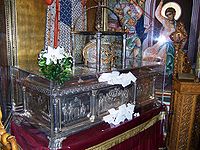
Some scholars believe that for four centuries after his death, St. Demetrius had no physical relics, and in their place an unusual empty shrine called the "ciborium
" was built inside Hagios Demetrios. What is currently purported as his remains subsequently appeared in Thessaloniki, but the local archbishop (John of Thessaloniki, 7th century) was publicly dismissive of their authenticity. These are now also kept in Hagios Demetrios. According to believers, these relics were ascertained to be genuine after they started emitting a liquid and strong scented myrrh
. This gave the saint the epithet "Myrovlētēs" . This has been attested in modern times as well, and the relics continually stream myrrh which has to be collected constantly in order to prevent the reliquary from overflowing. If ever visiting Hagios Demetrius church, one can see a sarcaphagus that is worn down in several areas from the myrrh streaming from his relics.
In the Russian Orthodox Church
, the Saturday before the Feast of St. Demetrius is a memorial day commemorating the soldiers who fell in the Battle of Kulikovo
(1380), under the leadership of St. Demetrius of the Don. This day is known as Demetrius Saturday.
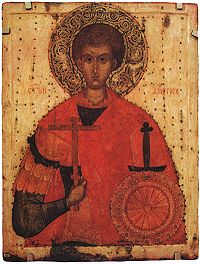
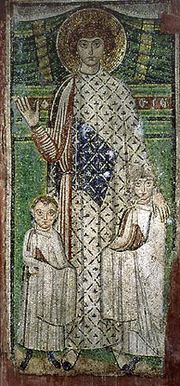 St. Demetrius was initially depicted in icon
s and mosaic
s as a young man in patterned robes with the distinctive tablion of the senatorial class across his chest. Miraculous military interventions were attributed to him during several attacks on Thessaloniki, and he gradually became thought of as a soldier: a Constantinopolitan ivory of the late 10th century shows him as an infantry soldier (Metropolitan Museum of Art
). But an icon of the late 11th century in Sinai shows him as before, still a civilian. This may be due to iconic depiction customs on how saints are depicted.
Another Sinai icon, of the Crusader
period and painted by a French artist working in the Holy Land
in the second half of the 12th century, shows what then became the most common depiction. Demetrius, bearded, rather older, and on a dark horse, rides together with St George, unbearded and on a white horse. Both are dressed as cavalry
men. Also, while St. George is often shown spearing a dragon, St. Demetrius is depicted spearing the gladiator
Lyaeos, who according to story was responsible for killing many Christians. Lyaeos is commonly depicted below Demetrius and lying supine, having already been defeated; Lyaeos is traditionally drawn much smaller than Demetrius. In traditional hagiography
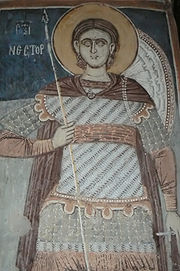
, Demetrius did not directly kill Lyaeos, but rather through his prayers the gladiator was defeated by Demetrius' disciple, Nestor.
A modern Greek iconographic convention depicts Demetrius with the Great White Tower
in the background. The anachronistic White Tower acts as a symbolic depiction of the city of Thessaloniki, despite having been built in the 16th century, centuries after his life, and the exact architecture of the older tower that stood at the same site in earlier times is unknown. Again, iconography often depicts saints holding a church or protecting a city that did not even exist when they were alive.
Thessaloniki
Thessaloniki , historically also known as Thessalonica, Salonika or Salonica, is the second-largest city in Greece and the capital of the region of Central Macedonia as well as the capital of the Decentralized Administration of Macedonia and Thrace...
was a Christian
Christianity
Christianity is a monotheistic religion based on the life and teachings of Jesus as presented in canonical gospels and other New Testament writings...
martyr
Martyr
A martyr is somebody who suffers persecution and death for refusing to renounce, or accept, a belief or cause, usually religious.-Meaning:...
, who lived in the early 4th century.
During the Middle Ages, he came to be revered as one of the most important Orthodox military saints, often paired with Saint George
Saint George
Saint George was, according to tradition, a Roman soldier from Syria Palaestina and a priest in the Guard of Diocletian, who is venerated as a Christian martyr. In hagiography Saint George is one of the most venerated saints in the Catholic , Anglican, Eastern Orthodox, and the Oriental Orthodox...
. His feast day
Calendar of saints
The calendar of saints is a traditional Christian method of organizing a liturgical year by associating each day with one or more saints and referring to the feast day of said saint...
is 26 October for Christians following the Gregorian calendar
Gregorian calendar
The Gregorian calendar, also known as the Western calendar, or Christian calendar, is the internationally accepted civil calendar. It was introduced by Pope Gregory XIII, after whom the calendar was named, by a decree signed on 24 February 1582, a papal bull known by its opening words Inter...
and 8 November for Christians following the Julian calendar
Julian calendar
The Julian calendar began in 45 BC as a reform of the Roman calendar by Julius Caesar. It was chosen after consultation with the astronomer Sosigenes of Alexandria and was probably designed to approximate the tropical year .The Julian calendar has a regular year of 365 days divided into 12 months...
.
Name
Byzantine
Byzantine usually refers to the Roman Empire during the Middle Ages.Byzantine may also refer to:* A citizen of the Byzantine Empire, or native Greek during the Middle Ages...
and Modern Greek
Modern Greek
Modern Greek refers to the varieties of the Greek language spoken in the modern era. The beginning of the "modern" period of the language is often symbolically assigned to the fall of the Byzantine Empire in 1453, even though that date marks no clear linguistic boundary and many characteristic...
pronunciation is romanized as Dimitrios. See Demetrios for more on the etymology of the name.
In Russian
Russian language
Russian is a Slavic language used primarily in Russia, Belarus, Uzbekistan, Kazakhstan, Tajikistan and Kyrgyzstan. It is an unofficial but widely spoken language in Ukraine, Moldova, Latvia, Turkmenistan and Estonia and, to a lesser extent, the other countries that were once constituent republics...
, he is called Димитрий Солунский ([dimitri solunski] 'Dimitri of Saloniki') and was a patron saint of the ruling Rurikid family from the late 11th century on. Izyaslav I of Kiev (whose Christian name was Dimitry) founded the first East Slavic monastery dedicated to this saint. The name Dimitry is in common use.
The Bulgarian Orthodox Church
Bulgarian Orthodox Church
The Bulgarian Orthodox Church - Bulgarian Patriarchate is an autocephalous Eastern Orthodox Church with some 6.5 million members in the Republic of Bulgaria and between 1.5 and 2.0 million members in a number of European countries, the Americas and Australia...
and the Bulgarian people revere St. Demetrius on 26 October as Димитровден (Dimitrovden).
The Serbian Orthodox Church
Serbian Orthodox Church
The Serbian Orthodox Church is one of the autocephalous Orthodox Christian churches, ranking sixth in order of seniority after Constantinople, Alexandria, Antioch, Jerusalem, and Russia...
reveres St. Demetrius as Mitar or " Димитрије " , having a feast of Mitrovdan on 8 November.
He is known in Lebanon
Lebanon
Lebanon , officially the Republic of LebanonRepublic of Lebanon is the most common term used by Lebanese government agencies. The term Lebanese Republic, a literal translation of the official Arabic and French names that is not used in today's world. Arabic is the most common language spoken among...
as Mar Dimitri or Mitri for short, which is a common name among Christian Lebanese.
He is known in the Coptic Church as "St. Demetrius of Thessalonica". He is venerated in the Coptic Church on 8 November.
Life
306
Year 306 was a common year starting on Tuesday of the Julian calendar. At the time, it was known as the Year of the Consulship of Constantius and Valerius...
in Thessaloniki, during the Christian
Christian
A Christian is a person who adheres to Christianity, an Abrahamic, monotheistic religion based on the life and teachings of Jesus of Nazareth as recorded in the Canonical gospels and the letters of the New Testament...
persecutions of the emperor Diocletian
Diocletian
Diocletian |latinized]] upon his accession to Diocletian . c. 22 December 244 – 3 December 311), was a Roman Emperor from 284 to 305....
or Galerius
Galerius
Galerius , was Roman Emperor from 305 to 311. During his reign he campaigned, aided by Diocletian, against the Sassanid Empire, sacking their capital Ctesiphon in 299. He also campaigned across the Danube against the Carpi, defeating them in 297 and 300...
, which matches his depiction in the 7th century mosaics.
Veneration of Sainthood
The origins of his venerationVeneration
Veneration , or veneration of saints, is a special act of honoring a saint: an angel, or a dead person who has been identified by a church committee as singular in the traditions of the religion. It is practiced by the Eastern Orthodox Church, the Roman Catholic, and Eastern Catholic Churches...
are obscure; the first evidence comes about 150 years after his martyrdom. Therefore some modern scholars question the historicity of the man.
One theory is that his veneration was transferred from Sirmium
Sirmium
Sirmium was a city in ancient Roman Pannonia. Firstly mentioned in the 4th century BC and originally inhabited by the Illyrians and Celts, it was conquered by the Romans in the 1st century BC and subsequently became the capital of the Roman province of Lower Pannonia. In 294 AD, Sirmium was...
when Thessaloniki replaced it as the main military base in the area in 441/442 AD
442
Year 442 was a common year starting on Thursday of the Julian calendar. At the time, it was known as the Year of the Consulship of Dioscorus and Eudoxius...
. His very large church in Thessaloniki, the Hagios Demetrios, dates from the mid-5th century, so he clearly had a large following by then. Thessaloniki remained a centre of his veneration, and he is the patron saint
Patron saint
A patron saint is a saint who is regarded as the intercessor and advocate in heaven of a nation, place, craft, activity, class, clan, family, or person...
of the city.
After the growth of his veneration as saint, the city of Thessaloniki suffered repeated attacks and sieges from the Slavic peoples
Slavic peoples
The Slavic people are an Indo-European panethnicity living in Eastern Europe, Southeast Europe, North Asia and Central Asia. The term Slavic represents a broad ethno-linguistic group of people, who speak languages belonging to the Slavic language family and share, to varying degrees, certain...
who moved into the Balkans
Balkans
The Balkans is a geopolitical and cultural region of southeastern Europe...
, and Demetrius was credited with many miraculous interventions to defend the city. Hence later traditions about Demetrius regard him as a soldier in the Roman army, and he came to be regarded as an important military martyr. Unsurprisingly, he was extremely popular in the Middle Ages
Middle Ages
The Middle Ages is a periodization of European history from the 5th century to the 15th century. The Middle Ages follows the fall of the Western Roman Empire in 476 and precedes the Early Modern Era. It is the middle period of a three-period division of Western history: Classic, Medieval and Modern...
, and along with Saint George
Saint George
Saint George was, according to tradition, a Roman soldier from Syria Palaestina and a priest in the Guard of Diocletian, who is venerated as a Christian martyr. In hagiography Saint George is one of the most venerated saints in the Catholic , Anglican, Eastern Orthodox, and the Oriental Orthodox...
, was the patron of the Crusades
Crusades
The Crusades were a series of religious wars, blessed by the Pope and the Catholic Church with the main goal of restoring Christian access to the holy places in and near Jerusalem...
.
Some scholars believe that for four centuries after his death, St. Demetrius had no physical relics, and in their place an unusual empty shrine called the "ciborium
Ciborium
thumb|250px|[[Silver-gilt]] ciboriumA ciborium is a vessel, normally in metal...
" was built inside Hagios Demetrios. What is currently purported as his remains subsequently appeared in Thessaloniki, but the local archbishop (John of Thessaloniki, 7th century) was publicly dismissive of their authenticity. These are now also kept in Hagios Demetrios. According to believers, these relics were ascertained to be genuine after they started emitting a liquid and strong scented myrrh
Myrrh
Myrrh is the aromatic oleoresin of a number of small, thorny tree species of the genus Commiphora, which grow in dry, stony soil. An oleoresin is a natural blend of an essential oil and a resin. Myrrh resin is a natural gum....
. This gave the saint the epithet "Myrovlētēs" . This has been attested in modern times as well, and the relics continually stream myrrh which has to be collected constantly in order to prevent the reliquary from overflowing. If ever visiting Hagios Demetrius church, one can see a sarcaphagus that is worn down in several areas from the myrrh streaming from his relics.
In the Russian Orthodox Church
Russian Orthodox Church
The Russian Orthodox Church or, alternatively, the Moscow Patriarchate The ROC is often said to be the largest of the Eastern Orthodox churches in the world; including all the autocephalous churches under its umbrella, its adherents number over 150 million worldwide—about half of the 300 million...
, the Saturday before the Feast of St. Demetrius is a memorial day commemorating the soldiers who fell in the Battle of Kulikovo
Battle of Kulikovo
The Battle of Kulikovo was a battle between Tatar Mamai and Muscovy Dmitriy and portrayed by Russian historiography as a stand-off between Russians and the Golden Horde. However, the political situation at the time was much more complicated and concerned the politics of the Northeastern Rus'...
(1380), under the leadership of St. Demetrius of the Don. This day is known as Demetrius Saturday.
Iconography
Icon
An icon is a religious work of art, most commonly a painting, from Eastern Christianity and in certain Eastern Catholic churches...
s and mosaic
Mosaic
Mosaic is the art of creating images with an assemblage of small pieces of colored glass, stone, or other materials. It may be a technique of decorative art, an aspect of interior decoration, or of cultural and spiritual significance as in a cathedral...
s as a young man in patterned robes with the distinctive tablion of the senatorial class across his chest. Miraculous military interventions were attributed to him during several attacks on Thessaloniki, and he gradually became thought of as a soldier: a Constantinopolitan ivory of the late 10th century shows him as an infantry soldier (Metropolitan Museum of Art
Metropolitan Museum of Art
The Metropolitan Museum of Art is a renowned art museum in New York City. Its permanent collection contains more than two million works, divided into nineteen curatorial departments. The main building, located on the eastern edge of Central Park along Manhattan's Museum Mile, is one of the...
). But an icon of the late 11th century in Sinai shows him as before, still a civilian. This may be due to iconic depiction customs on how saints are depicted.
Another Sinai icon, of the Crusader
Crusades
The Crusades were a series of religious wars, blessed by the Pope and the Catholic Church with the main goal of restoring Christian access to the holy places in and near Jerusalem...
period and painted by a French artist working in the Holy Land
Holy Land
The Holy Land is a term which in Judaism refers to the Kingdom of Israel as defined in the Tanakh. For Jews, the Land's identifiction of being Holy is defined in Judaism by its differentiation from other lands by virtue of the practice of Judaism often possible only in the Land of Israel...
in the second half of the 12th century, shows what then became the most common depiction. Demetrius, bearded, rather older, and on a dark horse, rides together with St George, unbearded and on a white horse. Both are dressed as cavalry
Cavalry
Cavalry or horsemen were soldiers or warriors who fought mounted on horseback. Cavalry were historically the third oldest and the most mobile of the combat arms...
men. Also, while St. George is often shown spearing a dragon, St. Demetrius is depicted spearing the gladiator
Gladiator
A gladiator was an armed combatant who entertained audiences in the Roman Republic and Roman Empire in violent confrontations with other gladiators, wild animals, and condemned criminals. Some gladiators were volunteers who risked their legal and social standing and their lives by appearing in the...
Lyaeos, who according to story was responsible for killing many Christians. Lyaeos is commonly depicted below Demetrius and lying supine, having already been defeated; Lyaeos is traditionally drawn much smaller than Demetrius. In traditional hagiography
Hagiography
Hagiography is the study of saints.From the Greek and , it refers literally to writings on the subject of such holy people, and specifically to the biographies of saints and ecclesiastical leaders. The term hagiology, the study of hagiography, is also current in English, though less common...
, Demetrius did not directly kill Lyaeos, but rather through his prayers the gladiator was defeated by Demetrius' disciple, Nestor.
A modern Greek iconographic convention depicts Demetrius with the Great White Tower
White Tower of Thessaloniki
The White Tower of Thessaloniki , is a monument and museum on the waterfront of the city of Thessaloniki, capital of the region of Macedonia in northern Greece and a symbol of Greek sovereignty over Macedonia...
in the background. The anachronistic White Tower acts as a symbolic depiction of the city of Thessaloniki, despite having been built in the 16th century, centuries after his life, and the exact architecture of the older tower that stood at the same site in earlier times is unknown. Again, iconography often depicts saints holding a church or protecting a city that did not even exist when they were alive.
Relic
On June 28, 2007, police recovered a silver box said to contain Demetrius' ankle bone. The relic had been stolen from a Greek Orthodox cathedral that shares his name in Astoria, QueensAstoria, Queens
Astoria is a neighborhood in the northwestern corner of the borough of Queens in New York City. Located in Community Board 1, Astoria is bounded by the East River and is adjacent to three other Queens neighborhoods: Long Island City, Sunnyside , and Woodside...
External links
- David Woods, St Demetrius from his Military Martyrs Web site. Includes article on Origins of the Cult, the Passion and Miracles by Anastasius the Librarian (BHL 2122 and 2123), images & links.
- The Life Of The Holy Great Martyr Of Christ Saint Demetrios The Myrrh-Bearer of Thessalonica Compiled by Fr. Demetrios Serfes
- Holy, Glorious Demetrius the Myrrhgusher of Thessalonica Orthodox iconIconAn icon is a religious work of art, most commonly a painting, from Eastern Christianity and in certain Eastern Catholic churches...
and synaxarion