


Matins Gospel

Encyclopedia
The Matins Gospel is the solemn chanting of a lection
from one of the Four Gospels
during Matins
in the Orthodox Church
and those Eastern Catholic churches which follow the Byzantine Rite
.
The reading of the Gospel is the highpoint of the service, and takes place near the end of the festive portion of the service known as the Polyeleos
. During the Divine Liturgy
the Gospel is usually read by the deacon
, but the Matins Gospel is read by the priest
. However, if the bishop
is present, he will usually be the one who reads the Matins Gospel.
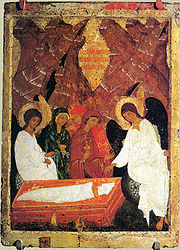 Every Sunday is a commemoration of the Resurrection of Jesus
, and so it is always observed as a feast (in the Slavic churches it is customary to serve an All-Night Vigil
every Saturday night).
The Sunday Matins Gospels (known as the "Matins Resurrection Gospels") are an eleven-week cycle of readings taken from the Gospel accounts of the Resurrection appearances of Jesus
.
The Sunday Matins Gospels are:
The cycle begins on the Sunday after Pentecost
, and continues up to, but not including, Palm Sunday
of the succeeding year. The eleven lessons are read in order and without interruption, except on Great Feasts of the Lord—which have their own Matins Gospels—until Pascha
(Easter) of the following year. During the Pentecostarion
(the period from Pascha until Pentecost), the same Gospels are read at Sunday Matins, but not in the same order.
The Gospel reading is preceded by a prokeimenon
, a selection from the Psalms relevant to the theme of the resurrection. These prokeimena are chanted according to an eight-week cycle known as the Octoechos
, and are chanted in a different liturgical mode
each week of the cycle. The deacon then leads the choir in chanting, "Let every breath praise the Lord", which is chanted in the same mode as the prokeimenon.
On Sundays, the Matins Gospel is read at the Holy Table (altar), which symbolizes the Tomb of Christ. The priest does not hold the Gospel Book
during the reading, but reads it as it lies open on the Holy Table. Immediately after the reading, the priest kisses the Gospel Book and hands it to the deacon who brings it out through the Holy Doors and stands on the ambon
, holding the Gospel aloft for all to see, while the choir chants the following Hymn of the Resurrection:
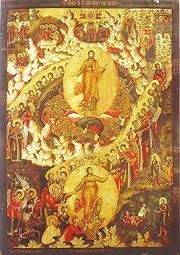
During the Paschal season this hymn is chanted three times.
The Gospel Book is then brought into center of nave
and placed on an analogion
to be venerated
by the faithful. The reason for this is that the Orthodox consider the Gospel Book to be an icon
of Christ. The deacon holding the Gospel, and the priest following him, symbolize the angel
s announcing the resurrection to the Myrrhbearers
; the bringing forth of the Gospel Book into the center of the temple symbolizes Jesus' appearances to the disciples after his resurrection; and in venerating the Gospel Book the faithful are greeting the resurrected Christ, as the Apostles did .
Later in the Matins service, there are two sets of hymns which are chanted in accordance with the Matins Resurrection Gospel that was read that week. One is the Exapostilarion
, which is chanted at the end of the canon
, and the other is a sticheron
called the Eothinon (εωθινόν) which is chanted at the end of Lauds
. The Eothinion is chanted to its own special melody, known as an idiomelon
. Both of these sets of hymns are traditionally attributed to the Emperor Constantine VII Porphyrogenitus.
If a Great Feast of the Lord ( Transfiguration
, Theophany, etc.) falls on a Sunday, the normal Sunday Resurrection service, including its Matins Gospel, is replaced entirely by the service for the feast. If a Great Feast of the Theotokos
(Mother of God) falls on a Sunday, it is combined with the normal Sunday service, but the Matins Gospel read is the one for the Theotokos. If the feast day of a saint falls on Sunday, it is combined with the normal Sunday service, but the Matins Gospel read is for the Sunday.
and on the more solemn feast days of saint
s (i.e., days with Polyeleos
or All-Night Vigil
--weekdays on which lower-ranking saints are commemorated do not have a Matins Gospel). The Matins Gospels on feast days are different from the ones read on Sundays, and are selected for the specific occasion being commemorated. The Matins Gospel read on Great Feasts of the Theotokos is always .
The prokeimenon which precedes the feast day Gospel is different from the Sunday prokeimena, and is relevant to the theme of the feast. It is almost invariably chanted in the Fourth liturgical mode, as is "Let every breath praise the Lord". On feast days, the Gospel is not read at the Holy Table, but is brought into the center to the nave by the deacon, who holds the Gospel Book while the priest chants the Matins Gospel in front of the icon
of the feast being celebrated. Immediately after the reading, the Gospel Book is returned to its place on the Holy Table, and the faithful instead venerate the icon of the feast. "Having beheld the Resurrection of Christ" is not chanted, except during the Paschal season, when it is chanted once on weekdays, regardless of the rank of the feast. On feast days, after the faithful have venerated the icon of the feast, they are anointed
(myrovania) on the forehead with blessed oil.
The Exapostilarion and Lauds
Sticheron
on feast days are also relevant to the theme of the feast, and have been composed by different hymnographers.
there is a reading of the Gospel at Matins, covering the theme of that day:
On Great and Holy Friday there are Twelve Matins Gospels recounting the Passion
from the Last Supper
to the sealing of the tomb, interspersed throughout the Matins service. During the reading of each of these twelve Gospels, the faithful stand holding lighted candle
s.
On Great and Holy Saturday the Matins Gospel is not read in its normal place, but is read near the end of the service before the litanies
and Dismissal
.
Lection
A lection is a reading, in this context, from Scripture.The custom of reading the books of Moses in the synagogues on the Sabbath day was a very ancient one. The addition of lections from the prophetic books had been made afterwards and was in existence at the time of Jesus, as may be gathered...
from one of the Four Gospels
Gospel
A gospel is an account, often written, that describes the life of Jesus of Nazareth. In a more general sense the term "gospel" may refer to the good news message of the New Testament. It is primarily used in reference to the four canonical gospels of Matthew, Mark, Luke, and John...
during Matins
Matins
Matins is the early morning or night prayer service in the Roman Catholic, Anglican, Lutheran and Eastern Orthodox liturgies of the canonical hours. The term is also used in some Protestant denominations to describe morning services.The name "Matins" originally referred to the morning office also...
in the Orthodox Church
Eastern Orthodox Church
The Orthodox Church, officially called the Orthodox Catholic Church and commonly referred to as the Eastern Orthodox Church, is the second largest Christian denomination in the world, with an estimated 300 million adherents mainly in the countries of Belarus, Bulgaria, Cyprus, Georgia, Greece,...
and those Eastern Catholic churches which follow the Byzantine Rite
Byzantine Rite
The Byzantine Rite, sometimes called the Rite of Constantinople or Constantinopolitan Rite is the liturgical rite used currently by all the Eastern Orthodox Churches, by the Greek Catholic Churches , and by the Protestant Ukrainian Lutheran Church...
.
The reading of the Gospel is the highpoint of the service, and takes place near the end of the festive portion of the service known as the Polyeleos
Polyeleos
The Polyeleos is a festive portion of the Matins or All-Night Vigil service as observed on higher-ranking feast days in the Eastern Orthodox and Byzantine Rite Catholic Churches...
. During the Divine Liturgy
Divine Liturgy
Divine Liturgy is the common term for the Eucharistic service of the Byzantine tradition of Christian liturgy. As such, it is used in the Eastern Orthodox and Eastern Catholic Churches. Armenian Christians, both of the Armenian Apostolic Church and of the Armenian Catholic Church, use the same term...
the Gospel is usually read by the deacon
Deacon
Deacon is a ministry in the Christian Church that is generally associated with service of some kind, but which varies among theological and denominational traditions...
, but the Matins Gospel is read by the priest
Priest
A priest is a person authorized to perform the sacred rites of a religion, especially as a mediatory agent between humans and deities. They also have the authority or power to administer religious rites; in particular, rites of sacrifice to, and propitiation of, a deity or deities...
. However, if the bishop
Bishop
A bishop is an ordained or consecrated member of the Christian clergy who is generally entrusted with a position of authority and oversight. Within the Catholic Church, Eastern Orthodox, Oriental Orthodox Churches, in the Assyrian Church of the East, in the Independent Catholic Churches, and in the...
is present, he will usually be the one who reads the Matins Gospel.
Sunday
Resurrection of Jesus
The Christian belief in the resurrection of Jesus states that Jesus returned to bodily life on the third day following his death by crucifixion. It is a key element of Christian faith and theology and part of the Nicene Creed: "On the third day he rose again in fulfillment of the Scriptures"...
, and so it is always observed as a feast (in the Slavic churches it is customary to serve an All-Night Vigil
All-Night Vigil
The All-Night Vigil , Opus 37, is an a cappella choral composition by Sergei Rachmaninoff,written and premiered in 1915. It consists of settings of texts taken from the Russian Orthodox All-night vigil ceremony. It has been praised as Rachmaninoff's finest achievement and "the greatest musical...
every Saturday night).
The Sunday Matins Gospels (known as the "Matins Resurrection Gospels") are an eleven-week cycle of readings taken from the Gospel accounts of the Resurrection appearances of Jesus
Resurrection appearances of Jesus
The major Resurrection appearances of Jesus in the Canonical gospels are reported to have occurred after his death, burial and resurrection, but prior to his Ascension. Among these primary sources, most scholars believe First Corinthians was written first, authored by Paul of Tarsus along with...
.
The Sunday Matins Gospels are:
The cycle begins on the Sunday after Pentecost
Pentecost
Pentecost is a prominent feast in the calendar of Ancient Israel celebrating the giving of the Law on Sinai, and also later in the Christian liturgical year commemorating the descent of the Holy Spirit upon the disciples of Christ after the Resurrection of Jesus...
, and continues up to, but not including, Palm Sunday
Palm Sunday
Palm Sunday is a Christian moveable feast that falls on the Sunday before Easter. The feast commemorates Jesus' triumphal entry into Jerusalem, an event mentioned in all four Canonical Gospels. ....
of the succeeding year. The eleven lessons are read in order and without interruption, except on Great Feasts of the Lord—which have their own Matins Gospels—until Pascha
Easter
Easter is the central feast in the Christian liturgical year. According to the Canonical gospels, Jesus rose from the dead on the third day after his crucifixion. His resurrection is celebrated on Easter Day or Easter Sunday...
(Easter) of the following year. During the Pentecostarion
Pentecostarion
The Pentecostarion is the liturgical book used by the Eastern Orthodox and Eastern Catholic Churches which follow the Byzantine Rite during the Paschal Season which extends from Pascha to the Sunday following All Saints Sunday The Pentecostarion (Greek: Πεντηκοστάριον, Pentekostárion; Slavonic:...
(the period from Pascha until Pentecost), the same Gospels are read at Sunday Matins, but not in the same order.
The Gospel reading is preceded by a prokeimenon
Prokeimenon
In the liturgical practice of the Orthodox Church, a Prokeimenon is a psalm or canticle refrain sung responsorially at certain specified points of the Divine Liturgy or the Divine Office, usually to introduce a scripture reading...
, a selection from the Psalms relevant to the theme of the resurrection. These prokeimena are chanted according to an eight-week cycle known as the Octoechos
Octoechos (liturgy)
The Octoechos —literally, the book "of the Eight Tones"—contains an eight-week cycle, providing texts to be chanted for every day at Vespers, Matins, the Divine Liturgy, Compline and the Midnight Office...
, and are chanted in a different liturgical mode
Octoechos
Oktōēchos is the name of the eight mode system used for the composition of religious chant in Syrian, Coptic, Byzantine, Armenian, Latin and Slavic churches since the middle ages...
each week of the cycle. The deacon then leads the choir in chanting, "Let every breath praise the Lord", which is chanted in the same mode as the prokeimenon.
On Sundays, the Matins Gospel is read at the Holy Table (altar), which symbolizes the Tomb of Christ. The priest does not hold the Gospel Book
Gospel Book
The Gospel Book, Evangelion, or Book of the Gospels is a codex or bound volume containing one or more of the four Gospels of the Christian New Testament...
during the reading, but reads it as it lies open on the Holy Table. Immediately after the reading, the priest kisses the Gospel Book and hands it to the deacon who brings it out through the Holy Doors and stands on the ambon
Ambon (liturgy)
The Ambon or Ambo is a projection coming out from the soleas in an Eastern Orthodox, Oriental Orthodox and Eastern Catholic church. The ambon stands directly in front of the Holy Doors...
, holding the Gospel aloft for all to see, while the choir chants the following Hymn of the Resurrection:
Having beheld the Resurrection of Christ, let us worship the holy Lord Jesus, the only sinless one. We venerate Thy cross, O Christ, and Thy holy Resurrection we praise and glorify. For Thou art our God, and we know none other than Thee. We call on Thy name. O come, all ye faithful, let us venerate Christ's holy Resurrection. For behold, through the cross joy hath come into all the world. Ever blessing the Lord, we praise his Resurrection: for by enduring the cross, he hath slain death by death.
During the Paschal season this hymn is chanted three times.
The Gospel Book is then brought into center of nave
Nave
In Romanesque and Gothic Christian abbey, cathedral basilica and church architecture, the nave is the central approach to the high altar, the main body of the church. "Nave" was probably suggested by the keel shape of its vaulting...
and placed on an analogion
Analogion
An Analogion is a lectern or slanted stand on which icons or the Gospel Book are placed for veneration by the faithful in the Eastern Orthodox Church and Eastern Catholic Churches...
to be venerated
Veneration
Veneration , or veneration of saints, is a special act of honoring a saint: an angel, or a dead person who has been identified by a church committee as singular in the traditions of the religion. It is practiced by the Eastern Orthodox Church, the Roman Catholic, and Eastern Catholic Churches...
by the faithful. The reason for this is that the Orthodox consider the Gospel Book to be an icon
Icon
An icon is a religious work of art, most commonly a painting, from Eastern Christianity and in certain Eastern Catholic churches...
of Christ. The deacon holding the Gospel, and the priest following him, symbolize the angel
Angel
Angels are mythical beings often depicted as messengers of God in the Hebrew and Christian Bibles along with the Quran. The English word angel is derived from the Greek ἄγγελος, a translation of in the Hebrew Bible ; a similar term, ملائكة , is used in the Qur'an...
s announcing the resurrection to the Myrrhbearers
Myrrhbearers
In Eastern Orthodoxy the Myrrhbearers are the individuals mentioned in the New Testament who were directly involved in the burial or who discovered the empty tomb following the resurrection of Jesus...
; the bringing forth of the Gospel Book into the center of the temple symbolizes Jesus' appearances to the disciples after his resurrection; and in venerating the Gospel Book the faithful are greeting the resurrected Christ, as the Apostles did .
Later in the Matins service, there are two sets of hymns which are chanted in accordance with the Matins Resurrection Gospel that was read that week. One is the Exapostilarion
Exapostilarion
The Exapostilarion is a hymn or group of hymns chanted in the Eastern Orthodox and Greek-Catholic Churches at the conclusion of the Canon near the end of Matins...
, which is chanted at the end of the canon
Canon (hymnography)
A canon is a structured hymn used in a number of Eastern Orthodox services. It consists of nine odes, sometimes called canticles or songs depending on the translation, based on the Biblical canticles. Most of these are found in the Old Testament, but the final ode is taken from the Magnificat and...
, and the other is a sticheron
Sticheron
A sticheron is a particular kind of hymn used in the Divine Liturgy, acolouthia or other services of the Orthodox Church and those Eastern Catholic Churches which follow the Byzantine Rite....
called the Eothinon (εωθινόν) which is chanted at the end of Lauds
Lauds
Lauds is a divine office that takes place in the early morning hours and is one of the two major hours in the Roman Catholic Liturgy of the Hours. In the Eastern Orthodox tradition, it forms part of the Office of Matins...
. The Eothinion is chanted to its own special melody, known as an idiomelon
Idiomelon
Idiomelon —pl. idiomela—is a type of hymn found in the liturgical books used in the Eastern Orthodox Church and those Eastern Catholic Churches which follow the Rite of Constantinople...
. Both of these sets of hymns are traditionally attributed to the Emperor Constantine VII Porphyrogenitus.
If a Great Feast of the Lord ( Transfiguration
Transfiguration of Jesus
The Transfiguration of Jesus is an event reported in the New Testament in which Jesus is transfigured and becomes radiant upon a mountain. The Synoptic Gospels describe it, and 2 Peter 1:16-18 refers to it....
, Theophany, etc.) falls on a Sunday, the normal Sunday Resurrection service, including its Matins Gospel, is replaced entirely by the service for the feast. If a Great Feast of the Theotokos
Theotokos
Theotokos is the Greek title of Mary, the mother of Jesus used especially in the Eastern Orthodox, Oriental Orthodox, and Eastern Catholic Churches. Its literal English translations include God-bearer and the one who gives birth to God. Less literal translations include Mother of God...
(Mother of God) falls on a Sunday, it is combined with the normal Sunday service, but the Matins Gospel read is the one for the Theotokos. If the feast day of a saint falls on Sunday, it is combined with the normal Sunday service, but the Matins Gospel read is for the Sunday.
Feast Days
Matins Gospels are also read on the Great Feasts of the Orthodox ChurchGreat Feasts of the Orthodox Church
The feast of the Resurrection of Jesus, called Pascha , is the greatest of the feasts of the Eastern Orthodox Church. In addition, there are other days of great importance in the life of the Church - the Twelve Great Feasts ....
and on the more solemn feast days of saint
Saint
A saint is a holy person. In various religions, saints are people who are believed to have exceptional holiness.In Christian usage, "saint" refers to any believer who is "in Christ", and in whom Christ dwells, whether in heaven or in earth...
s (i.e., days with Polyeleos
Polyeleos
The Polyeleos is a festive portion of the Matins or All-Night Vigil service as observed on higher-ranking feast days in the Eastern Orthodox and Byzantine Rite Catholic Churches...
or All-Night Vigil
All-Night Vigil
The All-Night Vigil , Opus 37, is an a cappella choral composition by Sergei Rachmaninoff,written and premiered in 1915. It consists of settings of texts taken from the Russian Orthodox All-night vigil ceremony. It has been praised as Rachmaninoff's finest achievement and "the greatest musical...
--weekdays on which lower-ranking saints are commemorated do not have a Matins Gospel). The Matins Gospels on feast days are different from the ones read on Sundays, and are selected for the specific occasion being commemorated. The Matins Gospel read on Great Feasts of the Theotokos is always .
The prokeimenon which precedes the feast day Gospel is different from the Sunday prokeimena, and is relevant to the theme of the feast. It is almost invariably chanted in the Fourth liturgical mode, as is "Let every breath praise the Lord". On feast days, the Gospel is not read at the Holy Table, but is brought into the center to the nave by the deacon, who holds the Gospel Book while the priest chants the Matins Gospel in front of the icon
Icon
An icon is a religious work of art, most commonly a painting, from Eastern Christianity and in certain Eastern Catholic churches...
of the feast being celebrated. Immediately after the reading, the Gospel Book is returned to its place on the Holy Table, and the faithful instead venerate the icon of the feast. "Having beheld the Resurrection of Christ" is not chanted, except during the Paschal season, when it is chanted once on weekdays, regardless of the rank of the feast. On feast days, after the faithful have venerated the icon of the feast, they are anointed
Anointing
To anoint is to pour or smear with perfumed oil, milk, water, melted butter or other substances, a process employed ritually by many religions. People and things are anointed to symbolize the introduction of a sacramental or divine influence, a holy emanation, spirit, power or God...
(myrovania) on the forehead with blessed oil.
The Exapostilarion and Lauds
Lauds
Lauds is a divine office that takes place in the early morning hours and is one of the two major hours in the Roman Catholic Liturgy of the Hours. In the Eastern Orthodox tradition, it forms part of the Office of Matins...
Sticheron
Sticheron
A sticheron is a particular kind of hymn used in the Divine Liturgy, acolouthia or other services of the Orthodox Church and those Eastern Catholic Churches which follow the Byzantine Rite....
on feast days are also relevant to the theme of the feast, and have been composed by different hymnographers.
Holy Week
On each day of Holy WeekHoly Week
Holy Week in Christianity is the last week of Lent and the week before Easter...
there is a reading of the Gospel at Matins, covering the theme of that day:
- Great and Holy Monday: —The Withering of the Fig Tree, Parable of the Two Sons (Parables of JesusParables of JesusThe parables of Jesus can be found in all the Canonical gospels as well as in some of the non-canonical gospels but are located mainly within the three synoptic gospels. They represent a key part of the teachings of Jesus, forming approximately one third of his recorded teachings...
) - Great and Holy Tuesday: —Woes of the PhariseesWoes of the PhariseesThe Woes of the Pharisees is a list of criticisms by Jesus against Scribes and Pharisees and Lawyers that is present in the Gospel of Luke and Gospel of Matthew...
, EschatologyEschatologyEschatology is a part of theology, philosophy, and futurology concerned with what are believed to be the final events in history, or the ultimate destiny of humanity, commonly referred to as the end of the world or the World to Come...
, Jesus' mourning for Jerusalem - Great and Holy Wednesday: —
- Great and Holy Thursday: —
On Great and Holy Friday there are Twelve Matins Gospels recounting the Passion
Passion (Christianity)
The Passion is the Christian theological term used for the events and suffering – physical, spiritual, and mental – of Jesus in the hours before and including his trial and execution by crucifixion...
from the Last Supper
Last Supper
The Last Supper is the final meal that, according to Christian belief, Jesus shared with his Twelve Apostles in Jerusalem before his crucifixion. The Last Supper provides the scriptural basis for the Eucharist, also known as "communion" or "the Lord's Supper".The First Epistle to the Corinthians is...
to the sealing of the tomb, interspersed throughout the Matins service. During the reading of each of these twelve Gospels, the faithful stand holding lighted candle
Candle
A candle is a solid block or cylinder of wax with an embedded wick, which is lit to provide light, and sometimes heat.Today, most candles are made from paraffin. Candles can also be made from beeswax, soy, other plant waxes, and tallow...
s.
On Great and Holy Saturday the Matins Gospel is not read in its normal place, but is read near the end of the service before the litanies
Ektenia
Ektenia , often called simply Litany, is a prayerful petition in the Eastern Orthodox/Eastern Catholic liturgy...
and Dismissal
Benediction
A benediction is a short invocation for divine help, blessing and guidance, usually at the end of worship service.-Judaism:...
.