
All Topics  
Yom Kippur


   Email Print
   Bookmark   Link


Yom Kippur


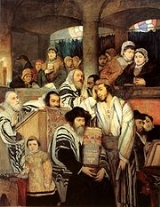
Yom Kippur (), also known in English as the Day of Atonement, is the most solemn and important of the Jewish holiday
Jewish holiday

A Jewish holiday or festival is a day or series of days observed by Jews as a holy or secular commemoration of an important event in Jewish history....
s. Its central themes are atonement
Atonement in Judaism

In Judaism, atonement is the process of causing a transgression to be forgiven or pardoned....
 and repentance
Repentance in Judaism

Repentance in Judaism known as teshuva , is the way of atoning for sin in Judaism.According to halakha, if someone commits a sin, a forbidden act, he can be forgiven for that sin if he performs teshuva, which includes:...
. Jews traditionally observe this holy day with a 25-hour period of fasting
Ta'anit

A ta'anit or taanis is a Fasting in Judaism. A Jewish fast may have one or more purposes, including:*A tool for repentance*An expression of mourning...
 and intensive prayer
Jewish services

Jewish services are the prayer recitations that form part of the observance of Judaism. These prayers, often with instructions and commentary, are found in the siddur, the traditional Jewish prayer book....
, often spending most of the day in synagogue
Synagogue

A synagogue is a Jewish house of prayer.Synagogues usually have a large hall for prayer , smaller rooms for study and sometimes a social hall and offices....
 services.

Yom Kippur is the tenth and final day of the Ten Days of Repentance
Ten Days of Repentance

The Ten Days of Repentance are the first ten days of the Judaism month of Tishrei, beginning on the Jewish holiday of Rosh Hashanah and ending on Yom Kippur....
 which begin with Rosh Hashanah
Rosh Hashanah

Rosh Hashanah is a Jewish holiday commonly referred to as the "Judaism New Year." It is observed on the first day of Tishrei, the seventh month of the Hebrew calendar, as ordained in the Torah, in ....
. According to Jewish tradition, God inscribes each person's fate for the coming year into a "book" on Rosh Hashanah and waits until Yom Kippur to "seal" the verdict.


Discussion
Ask a question about 'Yom Kippur'
Start a new discussion about 'Yom Kippur'
Answer questions from other users
Full Discussion Forum


Encyclopedia


Yom Kippur (), also known in English as the Day of Atonement, is the most solemn and important of the Jewish holiday
Jewish holiday

A Jewish holiday or festival is a day or series of days observed by Jews as a holy or secular commemoration of an important event in Jewish history....
s. Its central themes are atonement
Atonement in Judaism

In Judaism, atonement is the process of causing a transgression to be forgiven or pardoned....
 and repentance
Repentance in Judaism

Repentance in Judaism known as teshuva , is the way of atoning for sin in Judaism.According to halakha, if someone commits a sin, a forbidden act, he can be forgiven for that sin if he performs teshuva, which includes:...
. Jews traditionally observe this holy day with a 25-hour period of fasting
Ta'anit

A ta'anit or taanis is a Fasting in Judaism. A Jewish fast may have one or more purposes, including:*A tool for repentance*An expression of mourning...
 and intensive prayer
Jewish services

Jewish services are the prayer recitations that form part of the observance of Judaism. These prayers, often with instructions and commentary, are found in the siddur, the traditional Jewish prayer book....
, often spending most of the day in synagogue
Synagogue

A synagogue is a Jewish house of prayer.Synagogues usually have a large hall for prayer , smaller rooms for study and sometimes a social hall and offices....
 services.

Yom Kippur is the tenth and final day of the Ten Days of Repentance
Ten Days of Repentance

The Ten Days of Repentance are the first ten days of the Judaism month of Tishrei, beginning on the Jewish holiday of Rosh Hashanah and ending on Yom Kippur....
 which begin with Rosh Hashanah
Rosh Hashanah

Rosh Hashanah is a Jewish holiday commonly referred to as the "Judaism New Year." It is observed on the first day of Tishrei, the seventh month of the Hebrew calendar, as ordained in the Torah, in ....
. According to Jewish tradition, God inscribes each person's fate for the coming year into a "book" on Rosh Hashanah and waits until Yom Kippur to "seal" the verdict. During the Ten Days of Repentance, a Jew tries to amend his behavior and seek forgiveness for wrongs done against God (bein adam leMakom) and against his fellow man (bein adam lechavero). The evening and day of Yom Kippur are set aside for public and private petitions and confessions of guilt (Vidui). At the end of Yom Kippur, one considers himself absolved by God.

The Yom Kippur prayer service includes several unique aspects. One is the actual number of prayer services. Unlike a regular day, which has three prayer services (Ma'ariv, the evening prayer; Shacharit, the morning prayer; and Mincha, the afternoon prayer), or a Shabbat
Shabbat

Shabbat or Shabbos , is the weekly day of rest in Judaism, symbolizing the seventh day in Genesis, after the six days of creation. Though it is commonly said to be the Saturday of each week, it is observed from sundown on Friday until the appearance of three stars in the sky on Saturday night....
 or Yom Tov, which have four prayer services (Ma'ariv; Shacharit; Musaf, the additional prayer; and Mincha), Yom Kippur has five prayer services (Ma'ariv; Shacharit; Musaf; Mincha; and Ne'ilah, the closing prayer). The prayer services also include a public confession of sins (Vidui) and a reenactment of the special Yom Kippur avodah (service) of the Kohen Gadol
Kohen Gadol

Kohen Gadol or Kohen ha-Gadol is the title of wiktionary:High Priest of early Israelite religion and of Classical Age Judaism from the rise of the Israelite nation until the destruction of the Second Temple of Jerusalem....
 in the Holy Temple in Jerusalem.

Observances


General observances

decrees that Yom Kippur is a strict day of rest and of fasting.

Five additional prohibitions are traditionally observed, as detailed in the Jewish oral tradition
Oral Torah

A term used to denote the legal and interpretative traditions which were transmitted Speech, and which were not written in the Torah. According to Rabbinic Judaism, the oral Torah, oral Law, or oral tradition was given by God orally to Moses in conjunction with the written Torah ....
 (Mishnah
Mishnah

The Mishnah or Mishna is a major work of Rabbinic literature, and the first major redaction into written form of Jewish oral traditions, called the Oral Torah....
 tractate Yoma
Yoma

Yoma is the fifth tractate of Moed of the Mishnah and of the Talmud. It is concerned mainly with the laws of the Jewish holiday Yom Kippur, on which Jews atone for their sins from the previous year....
 8:1):

  1. Eating and drinking
  2. Wearing leather shoes
  3. Bathing/washing
  4. Anointing oneself with perfumes or lotions
  5. Sexual relations


Total abstention from food and drink usually begins 30 minutes before sundown (called tosefet Yom Kippur, lit. "Addition to Yom Kippur"), and ends after nightfall the following day. Although the fast is required of all healthy adults, it is waived in the case of certain medical conditions. Virtually all Jewish holidays involve a ritual feast, but since Yom Kippur involves fasting, Jewish law
Halakha

Halakha ? also Hebrew transliteration Halocho and Halacha ? is the collective body of Judaism religious law, including biblical law and later talmudic and rabbinic law, as well as customs and traditions....
 requires one to eat a large and festive meal on the afternoon before Yom Kippur, after the Mincha afternoon prayer. Wearing white clothing is traditional to symbolize one’s purity on this day. Many Orthodox
Orthodox Judaism

Orthodox Judaism is a Jewish denominations of Judaism that adheres to a relatively strict constructionist and application of the laws and ethics first canonized in the Talmudic texts and as subsequently developed and applied by the later authorities known as the Gaonim, Rishonim, and Acharonim....
 men immerse themselves in a mikvah
Mikvah

Mikvah is a ritual bath designed for the purpose of ritual washing in Judaism#Full-body immersion. The word "mikvah", as used in the Hebrew Bible, literally means a "collection" - generally, a collection of water....
 on the day before Yom Kippur.

Eve of Yom Kippur


Erev Yom Kippur (lit. "eve of day of atonement") is the day preceding Yom Kippur, corresponding to the ninth day of the Hebrew month of Tishrei
Tishrei

Tishrei is the first month of the civil year and the seventh month of the ecclesiastical year in the Hebrew calendar. The name comes from the Talmud....
. This day is commemorated with two festive meals, the giving of charity, and asking others for forgiveness.

Before sunset on Yom Kippur eve, worshippers gather in the synagogue
Synagogue

A synagogue is a Jewish house of prayer.Synagogues usually have a large hall for prayer , smaller rooms for study and sometimes a social hall and offices....
. The Ark
Ark (synagogue)

The Ark or Torah Ark in a synagogue is known in Hebrew as the Aron Kodesh by the Ashkenazim and as the Hekh?l amongst most Sefardim....
 is opened and two people take from it two Sifrei Torah
Sefer Torah

A Sefer Torah is a specially hand-written copy of the Torah or Pentateuch, which is the holiest book within Judaism and venerated by Jews. It must meet extremely strict standards of production....
 (Torah scrolls). Then they take their places, one on each side of the cantor
Hazzan

A hazzan or chazzan is a Jewish cantor, a musician trained in the vocal arts who helps lead the synagogue in songful prayer.There are many rules relating to how a cantor should lead services, but the idea of a cantor as a paid professional does not exist in classical rabbinic sources....
, and the three recite:
In the tribunal of Heaven and the tribunal of earth, by the permission of God—praised be He—and by the permission of this holy congregation, we hold it lawful to pray with transgressors."


The cantor then chants the Kol Nidre
Kol Nidre

Kol Nidre or Kol Nidrei is a Jewish services recited in the synagogue at the beginning of the evening service on Yom Kippur, the Day of Atonement....
 prayer (Hebrew: ?? ????) in Aramaic, not Hebrew
Hebrew language

Hebrew is a Semitic languages of the Afro-Asiatic languages. Modern Hebrew is spoken by more than seven million people in Israel and Classical Hebrew is used for prayer or study in Jews communities around the world....
. Its name is taken from the opening words, meaning “All vows”:

All personal vows we are likely to make, all personal oaths and pledges we are likely to take between this Yom Kippur and the next Yom Kippur, we publicly renounce. Let them all be relinquished and abandoned, null and void, neither firm nor established. Let our personal vows, pledges and oaths be considered neither vows nor pledges nor oaths.


The leader and the congregation then say together three times “May all the people of Israel be forgiven, including all the strangers who live in their midst, for all the people are in fault.” The Torah scrolls are then replaced, and the customary evening service
Jewish services

Jewish services are the prayer recitations that form part of the observance of Judaism. These prayers, often with instructions and commentary, are found in the siddur, the traditional Jewish prayer book....
 begins.

Prayer services

Many married men wear a kittel
Kittel

A kittel, also spelled kitl, is a white robe which serves as a burial shroud for male Jews. It is also worn on special occasions by Ashkenazi Jews Jews....
, a white robe-like garment for evening prayers on Yom Kippur. They also wear a tallit
Tallit

The taleth or talet tallit , also tallis is a Jewish prayer shawl worn while reciting morning prayers as well as in the synagogue on Sabbath and holidays....
, the only evening service of the year in which this is done. Prayer services begin with the prayer known as “Kol Nidre
Kol Nidre

Kol Nidre or Kol Nidrei is a Jewish services recited in the synagogue at the beginning of the evening service on Yom Kippur, the Day of Atonement....
,” which must be recited before sunset, and continue with the evening prayers (Ma'ariv or Arvith), which includes an extended Selichot
Selichot

Selichot are Judaism penitential poems and prayers, especially those said in the period leading up to the High Holidays, and on Fast Days. The Thirteen Attributes of Mercy are a central theme throughout the prayers....
 service.

The morning prayer service is preceded by litanies and petitions of forgiveness called selichot; on Yom Kippur, many selichot are woven into the liturgy
Liturgy

A liturgy is the customary public worship done by a specific religious group, according to their particular traditions. The word may refer to an elaborate formal ritual such as the Eastern Orthodox Divine Liturgy and Mass , or a daily activity such as the Muslim salat and Jewish Jewish services....
. The morning prayers are followed by an added prayer (Musaf) as on all other holidays. This is followed by Mincha (the afternoon prayer) which includes a reading (Haftarah
Haftarah

The haftarah or haftorah is a series of selections from the books of Nevi'im of the Hebrew Bible that is publicly read in synagogue as part of Judaism....
) of the Book of Jonah
Book of Jonah

In the Hebrew Bible, the Book of Jonah is the fifth book in a series of books called the Minor Prophets. Unlike other prophetic books however, this book is not a record of a prophet?s words toward Israel....
, which has as its theme the story of God's willingness to forgive those who repent. The service concludes with the Ne'ilah prayer, which begins shortly before sunset, when the "gates of prayer" will be closed. Yom Kippur comes to an end with a recitation of Shema Yisrael
Shema Yisrael

Shema Yisrael are the first two words of a section of the Torah that is a centerpiece of the morning and evening Jewish services. The first verse encapsulates the Monotheism essence of Judaism: "Hear, O Israel: the Lord is our God, the Lord is One." The Shema is considered the most important prayer in Judaism, and its twice-daily recit...
 and the blowing of the shofar
Shofar

A shofar is a horn used for Jewish religious purposes. Shofar-blowing is incorporated in synagogue services on Rosh Hashanah and Yom Kippur....
, which marks the conclusion of the fast.

The Avodah: Remembering the Temple service

A recitation of the sacrificial service of the Temple in Jerusalem
Temple in Jerusalem

The Temple in Jerusalem or Holy Temple , refers to a series of structures located on the Temple Mount in the old city of Jerusalem. Historically, two temples were built at this location, and a The Third Temple features in Jewish eschatology....
 traditionally features prominently in both the liturgy and the religious thought of the holiday. Specifically, the Avodah (“service”) in the musaf prayer recounts the sacrificial ceremonies in great detail.

This traditional prominence is rooted in the Babylonian Talmud’s description of how to attain atonement following the destruction of the Temple. According to Talmud tractate Yoma
Yoma

Yoma is the fifth tractate of Moed of the Mishnah and of the Talmud. It is concerned mainly with the laws of the Jewish holiday Yom Kippur, on which Jews atone for their sins from the previous year....
, in the absence of a Temple, Jews are obligated to study the High Priest’s ritual on Yom Kippur, and this study helps achieve atonement for those who are unable to benefit from its actual performance. In Orthodox Judaism
Orthodox Judaism

Orthodox Judaism is a Jewish denominations of Judaism that adheres to a relatively strict constructionist and application of the laws and ethics first canonized in the Talmudic texts and as subsequently developed and applied by the later authorities known as the Gaonim, Rishonim, and Acharonim....
, accordingly, studying the Temple ritual on Yom Kippur represents a positive rabbinically-ordained obligation
Mitzvah

This article is about commandments in Judaism. For the Jewish rite of passage, see Bar Mitzvah and Bat MitzvahMitzvah is a word used in Judaism to refer to the 613 Mitzvot given in the Torah and the Mitzvah#Rabbinical_mitzvot instituted later for a total of 620....
 which Jews seeking atonement are required to fulfill.

In Orthodox, most Conservative
Conservative Judaism

Conservative Judaism is a modern Jewish denominations of Judaism that arose out of intellectual currents in Germany in the mid-19th century and took institutional form in the United States in the early 1900s....
, and some progressive
Progressive Judaism

Progressive Judaism is an umbrella term used by strands of Judaism which affiliate to the World Union for Progressive Judaism. They embrace pluralism, modernity, equality and social justice as core values and believe that such values are consistent with a committed Jewish life....
 synagogues a detailed description of the Temple ritual is recited on the day. In most Orthodox and some Conservative synagogues, the entire congregation prostrates
Prostration

Prostration is the placement of the body in a reverentially or submissively prone position. Major world religions employ prostration either as an act of submissiveness to God or gods, or as a means of embodying reverence for a noble person, persons or doctrine....
 themselves at each point in the recitation where the Kohen Gadol
Kohen Gadol

Kohen Gadol or Kohen ha-Gadol is the title of wiktionary:High Priest of early Israelite religion and of Classical Age Judaism from the rise of the Israelite nation until the destruction of the Second Temple of Jerusalem....
 (High Priest) would pronounce the Tetragrammaton
Tetragrammaton

Tetragrammaton The letters, properly read from right to left , are:|-! Hebrew !! Letter name !! Pronunciation|-valign=top| ?'...
 (God’s holiest name, according to Judaism).

The main section of the Avodah is a threefold recitation of the High Priest’s actions regarding expiation in the Holy of Holies
Holy of Holies

The Holy of Holies is a term in the Hebrew Bible which referred to the inner sanctuary of the Tabernacle and later the Temple in Jerusalem which could be entered only by the Kohen Gadol on Yom Kippur....
. Performing the sacrificial acts and reciting Leviticus
Leviticus

Leviticus is third book of the Torah , the name given in Judaism to the first five books of the Hebrew Bible .Leviticus contains laws and priestly rituals, but in a wider sense is about the working out of Covenant set out in Genesis and Exodus - what is seen in the Torah as the consequences of entering into a special relationship with God...
 16:30, “for on this day atonement shall be made for you, to atone for you for all your sins, before God…” (he would recite the Tetragrammaton at this point, to which the people would prostrate to the ground) and after extending the Name, he would finish the verse “…you shall be purified.” He would first ask for forgiveness for himself and his family (“Your pious man”), then for the priestly caste (“Your holy people”), and finally for all of Israel (“Your upright children”). (These three times, plus in some congregations the Alenu prayer during the Musaf Amidah
Amidah

The Amidah , also called the Shmona Esre , is the central prayer of the Siddur. As Judaism's prayer par excellence, the Amidah is often designated simply as tfila in Rabbinic literature....
 on Yom Kippur and Rosh Hashanah
Rosh Hashanah

Rosh Hashanah is a Jewish holiday commonly referred to as the "Judaism New Year." It is observed on the first day of Tishrei, the seventh month of the Hebrew calendar, as ordained in the Torah, in ....
, are the only times in Jewish services
Jewish services

Jewish services are the prayer recitations that form part of the observance of Judaism. These prayers, often with instructions and commentary, are found in the siddur, the traditional Jewish prayer book....
 when Jews engage in complete full-body prostration, with the exception of some Yemenite Jews
Yemenite Jews

Yemenite Jews are those Jews who live, or whose recent ancestors lived, in Yemen , on the southern tip of the Arabian peninsula. Virtually the entire Jewish population emigrated from Yemen between June 1949 and September 1950 in what was deemed Operation Magic Carpet ....
 and talmedhei haRambam who may prostrate themselves on other occasions during the year). A variety of liturgical poems are added, including a poem recounting the radiance of the countenance of the Kohen Gadol
Kohen Gadol

Kohen Gadol or Kohen ha-Gadol is the title of wiktionary:High Priest of early Israelite religion and of Classical Age Judaism from the rise of the Israelite nation until the destruction of the Second Temple of Jerusalem....
 after exiting the Holy of Holies, traditionally believed to emit palpable light in a manner echoing the Bible
Bible

The Bible is the central religious text of Judaism and Christianity. The exact Books of the Bible is dependent on the religious traditions of specific denominations....
's account of the countenance of Moses
Moses

Moses is a Hebrew Bible Hebrews religious leader, lawgiver, prophet, to whom the Mosaic authorship of the Torah is traditionally attributed. Also called Moshe Rabbeinu in Hebrew , he is the most important prophet in Judaism, and also an important prophet of Christianity, Islam, the Bah?'? Faith, Rastafari movement, Chrislam and many ot...
 after descending from Mount Sinai
Mount Sinai

Mount Sinai , also known as Mount Horeb, Mount Musa, Gebel Musa or Jabal Musa by the Bedouin, is the name of a mountain in the Sinai Peninsula....
, as well as prayers for the speedy rebuilding of the Temple and the restoration of sacrificial worship
Korban

Korban , in Judaism, is the term for a variety of Sacrifice described and commanded in the Torah. Such sacrifices were offered in a variety of settings by the ancient Israelites, and later by the Jewish priesthood, the Kohen, at the Temple in Jerusalem....
. There are a variety of other customs, such as hand gestures to mime the sprinkling of blood (one sprinkling upwards and seven downwards per set of eight).

Orthodox liturgies include prayers lamenting the inability to perform the Temple service and petitioning for its restoration, which Conservative synagogues generally omit. In some Conservative synagogues, only the Hazzan
Hazzan

A hazzan or chazzan is a Jewish cantor, a musician trained in the vocal arts who helps lead the synagogue in songful prayer.There are many rules relating to how a cantor should lead services, but the idea of a cantor as a paid professional does not exist in classical rabbinic sources....
 engages in full prostration. Some Conservative synagogues abridge the recitation of the Avodah service to varying degrees, and some omit it entirely. Many Reform
Reform Judaism

Reform Judaism refers to the spectrum of beliefs, practices and organizational infrastructure associated with Reform Judaism in Reform Judaism and in Reform Judaism ....
 and Reconstructionist
Reconstructionist Judaism

Reconstructionist Judaism is a modern American-based Judaism Jewish denominations based on the ideas of the late Mordecai Kaplan . The movement views Judaism as a progressively evolving civilization....
 services omit the entire service as inconsistent with modern sensibilities.

Observance among secular Jews

Yom Kippur is considered one of the holiest of Jewish holidays, and it is observed by many secular Jews
Secular Jewish culture

Secular Jewish culture embraces several related phenomena; above all, it is the culture of Secularity communities of Jewish people, but it can also include the cultural contributions of individuals who identify as secular Jews, or even those of religious Jews working in cultural areas not generally considered to be connected to religion....
 who may not observe other holidays. Many secular Jews fast and attend synagogue on Yom Kippur, where the number of worshippers attending is often double or triple the normal attendance.

Yom Kippur in Israel

Yom Kippur is a legal holiday in the modern state of Israel. There are no radio or television broadcasts, airports are shut down, there is no public transportation, and all shops and businesses are closed. In 1973, an air raid siren was sounded on the afternoon of Yom Kippur and radio broadcasts were resumed to alert the public to the surprise attack that launched the Yom Kippur War
Yom Kippur War

The Yom Kippur War, Ramadan War or October War , also known as the 1973 Arab-Israeli War and the Fourth Arab-Israeli War, was fought from October 6 to October 26, 1973 by a coalition of Arab states led by Egypt and Syria against Israel....
.

In 2008, 63% percent of the Jewish people of Israel
Israel

Israel officially the State of Israel , is a country in the Middle East located on the eastern shore of the Mediterranean Sea. It borders Lebanon in the north, Syria in the northeast, Jordan in the east, and Egypt on the southwest, and contains geographically diverse features within its relatively small area....
 said that they were intending to fast on Yom Kippur. This may be the reason that it is very common in Israel
Israel

Israel officially the State of Israel , is a country in the Middle East located on the eastern shore of the Mediterranean Sea. It borders Lebanon in the north, Syria in the northeast, Jordan in the east, and Egypt on the southwest, and contains geographically diverse features within its relatively small area....
 to wish "Tsom Kal" (an easy fast) to everyone before Yom Kippur, even if you don't know whether they will fast or not.

It is considered "bad form" to eat in public on Yom Kippur or to drive a motor vehicle. There is no legal prohibition on driving or eating in public, and from the strict legal point of view any person has the right to do so — but in practice such actions are frowned upon. Allowance is made for ambulances and emergency vehicles, but there have been incidents where even they are not tolerated.

Over the last few decades, bicycle-riding on the empty streets has become a new “tradition” among secular Israeli
Secular Jewish culture

Secular Jewish culture embraces several related phenomena; above all, it is the culture of Secularity communities of Jewish people, but it can also include the cultural contributions of individuals who identify as secular Jews, or even those of religious Jews working in cultural areas not generally considered to be connected to religion....
 youngsters, especially on the eve of Yom Kippur. In consequence, Yom Kippur is jocularly referred to as the “Festival of Bicycles.” Bicycle sales rise in the weeks before Yom Kippur, and companies have taken to advertising children’s bicycles as “Yom Kippur specials.”

Yom Kippur in the Bible

The Torah
Torah

The term "Torah" , or Five Books of Moses or Pentateuch, refers to the entirety of Judaism's founding Halakha and ethical religious texts....
 calls the day Yom HaKippurim (???? ?????????????) and in decrees a strict prohibition of work and affliction of the soul upon the tenth day of the seventh month, later known as Tishrei
Tishrei

Tishrei is the first month of the civil year and the seventh month of the ecclesiastical year in the Hebrew calendar. The name comes from the Talmud....
. The rites for Yom Kippur are set forth in the sixteenth chapter of Leviticus
Leviticus

Leviticus is third book of the Torah , the name given in Judaism to the first five books of the Hebrew Bible .Leviticus contains laws and priestly rituals, but in a wider sense is about the working out of Covenant set out in Genesis and Exodus - what is seen in the Torah as the consequences of entering into a special relationship with God...
 (cf. Exodus
Exodus

Exodus is the second book of the Jewish Torah and of the Christian Old Testament. It tells how Moses leads the Israelites out of Egypt and through the wilderness to the Mountain of God Sinai....
 30:10; Leviticus 23:27–31, 25:9; Numbers
Book of Numbers

The Book of Numbers, , is the fourth book of the Torah, the Tanakh, and the Old Testament. In the Greek language Septuagint it is called Arithmoi, or Numbers....
 29:7–11). It is described as a solemn fast, on which no food or drink could be consumed, and on which all work is forbidden.

Midrashic interpretation

The midrashim described in this section need sources cited from Midrashic literature

Traditionally, Yom Kippur is considered the date on which Moses
Moses

Moses is a Hebrew Bible Hebrews religious leader, lawgiver, prophet, to whom the Mosaic authorship of the Torah is traditionally attributed. Also called Moshe Rabbeinu in Hebrew , he is the most important prophet in Judaism, and also an important prophet of Christianity, Islam, the Bah?'? Faith, Rastafari movement, Chrislam and many ot...
 received the second set of Ten Commandments
Ten Commandments

The Ten Commandments, or Decalogue, are a list of religious and moral imperatives that, according to Judeo-Christian tradition, were authored by God and given to Moses on the mountain referred to as "Biblical Mount Sinai" or "Mount Horeb" in the form of two stone tablets....
. It occurred following the completion of the second 40 days of instructions from God. At this same time, the Israelites were granted atonement for the sin of the Golden Calf
Golden calf

The golden calf was an idolatry made for the Israelites during Moses' absence, as he went up to Mount Sinai. According to the Hebrew Bible, the calf was made by Aaron to satisfy the Israelites, whereas the Quran indicates the maker to be Samiri....
; hence, its designation as the Day of Atonement.

View of contemporary Biblical scholarship

According to textual scholars
Textual criticism

Textual criticism is a branch of literary criticism that is concerned with the identification and removal of transcription errors in the Writing of manuscripts....
, the biblical regulations covering Yom Kippur are spliced together from multiple source texts, as indicated by evidence such as with the duplication
Doublet

Doublet may refer to:*Doublet , a man's snug-fitting buttoned jacket that was worn from the late 14th century to the mid 17th century*Doublet , an assembled gem composed in two sections, such as a garnet overlaying green glass...
 of the confession over the bullock, and the incongruity in one verse stating that the high priest should not enter the Holy of Holies (with the inference that there are exceptions for certain explicitly identified festivals), and the next verse indicating that they can enter whenever they wish (as long as a specific ritual is carried out first). Although Rashi
Rashi

Rabbi Shlomo Yitzhaki, , better known by the acronym Rashi , , was a rabbi from France, famed as the author of the first comprehensive commentary on the Talmud, and Jewish commentaries on the Bible....
 tried to find a harmonistic explanation for this incongruity, the Leviticus Rabbah
Leviticus Rabbah

Leviticus Rabbah, Vayikrah Rabbah, or Wayikra Rabbah is a homiletic midrash to the Biblical book of Leviticus . It is referred to by Nathan ben Jehiel in his Aruk as well as by Rashi in his commentaries on and elsewhere....
 maintains that it was indeed the case that the high priest could enter at any time if these rituals were carried out. Textual scholars argue that the ritual is composed from three sources, and a couple of redactional additions:
  • prerequisite rituals before the high priest can enter the Holy of Holies (on any occasion), namely a sin offering and a whole offering, followed by the filling of the Holy of Holies with a cloud of incense while wearing linen garments
  • regulations which establish an annual day of fasting and rest, during which the sanctuary and people are purified, without stating the ritual for doing so; this regulation is very similar to the one in the Holiness Code
  • later elaborations of the ceremony, which include the sprinkling of the blood on the mercy seat, and the use of a scapegoat sent to Azazel; the same source also being responsible for small alterations to related regulations
  • the redactional additions


According to biblical scholars
Biblical criticism

Biblical criticism is "the study and investigation of biblical writings that seeks to make discerning and discriminating judgments about these writings." It asks when and where a particular text originated; how, why, by whom, for whom, and in what circumstances it was produced; what influences were at work in its production; what sources we...
, the original ceremony was simply the ritual purification of the sanctuary from any accidental ritual impurity, at the start of each new year, as seen in the Book of Ezekiel
Book of Ezekiel

The Book of Ezekiel is a book of the Hebrew Bible named after the prophet Ezekiel....
, which textual scholars date to before the priestly source
Priestly source

The Priestly Source is posited as the most recent of the four chief sources of the Torah, as postulated by the long-established "standard" Wellhausen formulation of the Documentary Hypothesis ....
, but after JE
JE

JE is a hypothetical intermediate source text of the Torah postulated by the Documentary Hypothesis. It is a combination and redaction of the Jahwist and Elohist source texts....
. According to the Book of Ezekiel, the sanctuary was to be cleansed by the sprinkling of bullock's blood, on the first day of the first and of the seventh months — near the start of the Civil year and of the Ecclesiastical year, respectively; although the masoretic text
Masoretic Text

The Masoretic Text is the Hebrew language text of the Jewish Bible . It defines not just the Development of the Jewish Bible canon, but also the precise letter-text of the biblical books in Judaism, as well as their niqqud and cantillation for both public reading and private study....
 of the Book of Ezekiel has the second of these cleansings on the seventh of the first month, biblical scholars regard the Septuagint
Septuagint

The Septuagint , or simply "LXX", is the Koine Greek version of the Hebrew Bible, translated in stages between the 3rd century BC and 1st century BC in Alexandria....
, which has the second cleaning as being the first of the seventh month, as being more accurate here. It appears that during the period that the Holiness Code and the Book of Ezekiel were written, the new year began on the tenth day of the seventh month, and thus biblical scholars believe that by the time the Priestly Code was compiled, the date of the new year and of the day of atonement had swapped around.

Yom Kippur in Mishnaic and Talmudic literature


The Temple service

The following summary of the Temple service is based on the traditional Jewish religious account described in Mishnah
Mishnah

The Mishnah or Mishna is a major work of Rabbinic literature, and the first major redaction into written form of Jewish oral traditions, called the Oral Torah....
 tractate Yoma
Yoma

Yoma is the fifth tractate of Moed of the Mishnah and of the Talmud. It is concerned mainly with the laws of the Jewish holiday Yom Kippur, on which Jews atone for their sins from the previous year....
, appearing in contemporary traditional Jewish prayerbooks for Yom Kippur, and studied as part of a traditional Jewish Yom Kippur worship service.

While the Temple
Temple in Jerusalem

The Temple in Jerusalem or Holy Temple , refers to a series of structures located on the Temple Mount in the old city of Jerusalem. Historically, two temples were built at this location, and a The Third Temple features in Jewish eschatology....
 was standing in Jerusalem
Jerusalem

Jerusalem is the capital of Israel and its List of Israeli cities in both population and area, with a population of 747,600 residents over an area of if Positions on Jerusalem East Jerusalem is included....
 (from Biblical times through 70 C.E.), the Kohen Gadol
Kohen Gadol

Kohen Gadol or Kohen ha-Gadol is the title of wiktionary:High Priest of early Israelite religion and of Classical Age Judaism from the rise of the Israelite nation until the destruction of the Second Temple of Jerusalem....
 (High Priest) performed a complex set of special services and sacrifices for Yom Kippur. These services were considered to be the most important parts of Yom Kippur, as through them the Kohen Gadol made atonement for all Jews in the world. During the service, the Kohen Gadol entered the Holy of Holies
Holy of Holies

The Holy of Holies is a term in the Hebrew Bible which referred to the inner sanctuary of the Tabernacle and later the Temple in Jerusalem which could be entered only by the Kohen Gadol on Yom Kippur....
 in the center of the Temple, the only time of the year that anyone went inside. Doing so required special purification and preparation, including five immersions in a mikvah
Mikvah

Mikvah is a ritual bath designed for the purpose of ritual washing in Judaism#Full-body immersion. The word "mikvah", as used in the Hebrew Bible, literally means a "collection" - generally, a collection of water....
 (ritual bath), and four changes of clothing.

Seven days prior to Yom Kippur, the Kohen Gadol was sequestered in the Parhedrin chamber in the Temple, where he reviewed the service with the Temple sages, and was sprinkled with spring water containing ashes of the Red Heifer
Red heifer

In Abrahamic religions, the Red Heifer was a sacrificial cow whose ashes were used for the ritual purification of people who came into contact with a corpse....
 as purification. The Talmud
Talmud

The Talmud is a record of rabbinic discussions pertaining to Halakha, Jewish ethics, customs, and history. It is a central text of mainstream Judaism....
 (Tractate Yoma
Yoma

Yoma is the fifth tractate of Moed of the Mishnah and of the Talmud. It is concerned mainly with the laws of the Jewish holiday Yom Kippur, on which Jews atone for their sins from the previous year....
) also reports that he practiced the incense offering ritual in the Avitnas chamber.

On the day of Yom Kippur, the Kohen Gadol had to follow a precise order of services, sacrifices, and purifications:
  • Morning (Tamid) Offering The Kohen Gadol first performed the regular daily (Tamid) offering — usually performed by ordinary priests — in special golden garments, after immersing in a mikvah
    Mikvah

    Mikvah is a ritual bath designed for the purpose of ritual washing in Judaism#Full-body immersion. The word "mikvah", as used in the Hebrew Bible, literally means a "collection" - generally, a collection of water....
     and washing his hands and feet.
  • Garment Change 1 The Kohen Gadol immersed in a special mikvah in the Temple courtyard and changed into special linen garments, and washed his hands and feet twice, once after removing the golden garments and once before putting on the linen garments.
  • Bull as Personal Sin-Offering The Kohen Gadol leaned (performed Semikha
    Semicha in sacrifices

    Semicha in sacrifices was the placing/leaning [of the hands] before the offering of a korban in the Temple in Jerusalem. This involved pressing firmly on the head of the sacrificial animal, thereby symbolically "transmitting" sins onto the animal or, in other interpretations , to transform the sacrifice into an offering acceptable...
    )
    and made a confession over the bull on behalf of himself and his household, pronouncing the Tetragrammaton
    Tetragrammaton

    Tetragrammaton The letters, properly read from right to left , are:|-! Hebrew !! Letter name !! Pronunciation|-valign=top| ?'...
    . The people prostrated themselves when they heard. He then slaughtered the bull as a chatat (sin-offering) and received its blood in a bowl.
  • Lottery of the goats At the Eastern (Nikanor) gate, the Kohen Gadol drew lots from a lottery box over two goat
    Goat

    The domestic goat is a subspecies of goat domesticated from the wild goat of southwest Asia and Eastern Europe. The goat is a member of the Bovidae family and is closely related to the sheep: both are in the goat-antelope subfamily Caprinae....
    s. One was selected “for the Lord,” and one “for Azazel
    Azazel

    Azazel is an enigmatic name from the Hebrew Bible and Apocrypha, where the name is used interchangeably with Rameel and Gadriel. The word's first appearance is in Leviticus 16, where a goat is designated "for Azazel" and outcast in the desert as part of Yom Kippur....
    .” The Kohen Gadol tied a red band around the horns of the goat “for Azazel.”
  • Incense Preparation The Kohen Gadol ascended the mizbeach (altar) and took a shovel full of ember
    Ember

    For the book series by Jeanne DuPrau, see The City of Ember.Embers are the glowing, hot coals made of greatly heated wood, coal or other carbon based material that remain after, or sometimes precede a fire....
    s with a special shovel. He was brought incense
    Incense

    Incense is composed of aromatic Biotic material materials. It releases fragrant smoke when burned. The term incense refers to the substance itself, rather than to the odor that it produces....
    . He filled his hands and placed it in a vessel. (The Talmud
    Talmud

    The Talmud is a record of rabbinic discussions pertaining to Halakha, Jewish ethics, customs, and history. It is a central text of mainstream Judaism....
     considered this the most physically difficult part of the service, as the Kohen Gadol had to keep the shovelful of glowing coal
    Coal

    Coal is a readily combustion black or brownish-black sedimentary rock. The harder forms, such as anthracite, can be regarded as metamorphic rock because of later exposure to elevated temperature and pressure....
    s balanced and prevent its contents from dropping, using his armpit or teeth, while filling his hands with the incense).
  • Incense Offering Holding the shovel and the vessel, he entered the Kadosh Hakadashim, the Temple’s Holy of Holies
    Holy of Holies

    The Holy of Holies is a term in the Hebrew Bible which referred to the inner sanctuary of the Tabernacle and later the Temple in Jerusalem which could be entered only by the Kohen Gadol on Yom Kippur....
    . In the days of the First Temple, he placed the shovel between the poles of the Ark of the Covenant
    Ark of the Covenant

    The Ark of the Covenant is described in the Bible as a sacred container, where in rested the Tablets of stone containing the Ten Commandments as well as Aaron's rod and manna....
    . In the days of the Second Temple
    Second Temple

    The Second Temple was the reconstructed Temple in Jerusalem which stood between 516 BCE and 70 CE. During this time, it was the center of Judaism worship, which focused on the sacrifices known as the korbanot....
    , he put the shovel where the Ark would have been. He waited until the chamber filled with smoke and left.
  • Sprinkling of Blood in the Holy of Holies The Kohen Gadol took the bowl with the bull’s blood and entered the Most Holy Place again. He sprinkled the bull’s blood with his finger eight times, before the Ark in the days of the First Temple, where it would have been in the days of the Second. The Kohen Gadol then left the Holy of Holies, putting the bowl on a stand in front of the Parochet
    Parochet

    Parochet is the curtain on the front of the Aron Kodesh in a synagogue that covers the Sifrei Torah . In most cases, behind the parochet is also a door....
     (curtain separating the Holy from the Holy of Holies).
  • Goat for the Lord as Sin-Offering for Kohanim
    Kohen

    A kohen is a Jew who is a direct male descendant of the Bible Aaron, brother of Moses, with a separate status in Judaism. Another term for the descendants of Aaron are the Aaronites or Aaronids....
     The Kohen Gadol went to the eastern end of the Israelite courtyard near the Nikanor Gate, laid his hands (semikha
    Semicha in sacrifices

    Semicha in sacrifices was the placing/leaning [of the hands] before the offering of a korban in the Temple in Jerusalem. This involved pressing firmly on the head of the sacrificial animal, thereby symbolically "transmitting" sins onto the animal or, in other interpretations , to transform the sacrifice into an offering acceptable...
    ) on the goat “for the Lord,” and pronounced confession
    Confession

    The confession of one's sins is a religious practice important to many faiths, e.g., Roman Catholicism and Eastern Orthodoxy....
     on behalf of the Kohanim (priests). The people prostrated themselves when he pronounced the Tetragrammaton. He then slaughtered the goat, and received its blood in another bowl.
  • Sprinkling of blood in the Holy Standing in the Hekhal
    Hekhal

    The Hekhal , Hebrew Language ?????, also known as the Sanctuary or Holy, was the part of Tabernacle and Temple in Jerusalem between the outer altar, where most Korban were performed, and the Holy of Holies originally containing the Ark of the Covenant....
     (Holy), on the other side of the Parochet from the Holy of Holies, the Kohen Gadol took the bull's blood from the stand and sprinkled it with his finger eight times in the direction of the Parochet. He then took the bowl with the goat's blood and sprinkled it eight times in the same manner, putting it back on the stand.
  • Smearing of blood on the Golden (Incense) Altar The Kohen Gadol removed the goat’s blood from the stand and mixed it with the bull's blood. Starting at the northeast corner, he then smeared the mixture of blood on each of the four corners of the Golden (Incense) altar in the Haichal. He then sprinkled the blood eight times on the altar.
  • Goat for Azazel The Kohen Gadol left the Haichal and walked to the east side of the Azarah (Israelite courtyard). Near the Nikanor Gate, he leaned his hands (Semikha) on the goat “for Azazel” and confessed the sins of the entire people of Israel. The people prostrated themselves when he pronounced the Tetragrammaton. While he made a general confession, individuals in the crowd at the Temple would confess privately. The Kohen Gadol then sent the goat off “to the wilderness.” In practice, to prevent its return to human habitation, the goat was led to a cliff outside Jerusalem and pushed off its edge.
  • Preparation of sacrificial animals While the goat “for Azazel” was being led to the cliff, the Kohen Gadol removed the insides of the bull, and intertwined the bodies of the bull and goat. Other people took the bodies to the Beit HaDeshen (place of the ashes). They were burned there after it was confirmed that the goat “for Azazel” had reached the wilderness.
  • Reading the Torah After it was confirmed that the goat “for Azazzel” had been pushed off the cliff, the Kohen Gadol passed through the Nikanor Gate into the Ezrat Nashim (Women’s Courtyard) and read sections of the Torah describing Yom Kippur and its sacrifice
    Korban

    Korban , in Judaism, is the term for a variety of Sacrifice described and commanded in the Torah. Such sacrifices were offered in a variety of settings by the ancient Israelites, and later by the Jewish priesthood, the Kohen, at the Temple in Jerusalem....
    s.
  • Garment change 2 The Kohen Gadol removed his linen garments, immersed in the mikvah in the Temple courtyard, and changed into a second set of special golden garments. He washed his hands and feet both before removing the linen garments and after putting on the golden ones.
  • Offering of Rams The Kohen Gadol offered two rams as an olah offering, slaughtering them on the north side of the mizbeach (outer altar), receiving their blood in a bowl, carrying the bowl to the outer altar, and dashing the blood on the northeast and southwest corners of the Outer Altar. He dismembered the rams and burned the parts entirely on the outer altar. He then offered the accompanying mincha (grain) offerings and nesachim (wine-libations).
  • Musaf Offering The Kohen Gadol then offered the Musaf offering.
  • Burning of Innards The Kohen Gadol placed the insides of the bull and goat on the outer altar and burned them entirely.
  • *Garment change 3 The Kohen Gadol removed his golden garments, immersed in the mikvah, and changed to a new set of linen garments, again washing his hands and feet twice.
  • Removal of Incense from the Holy of Holies The Kohen Gadol returned to the Holy of Holies and removed the bowl of incense and the shovel.
  • Garment Change 4 The Kohen Gadol removed his linen garments, immersed in the mikvah, and changed into a third set of golden garments, again washing his hands and feet twice.
  • Evening (Tamid) Offering The Kohen Gadol completed the afternoon portion of the regular (tamid) daily offering in the special golden garments. He washed his hands and feet a tenth time.


The Kohen Gadol wore five sets of garments (three golden and two white linen), immersed in the mikvah five times, and washed his hands and feet ten times. Sacrifices included two (daily) lambs, one bull, two goats, and two rams, with accompanying mincha (meal) offerings, wine libations, and three incense offerings (the regular two daily and an additional one for Yom Kippur). The Kohen Gadol entered the Holy of Holies three times. The Tetragrammaton was pronounced three times, once for each confession.

Yom Kippur and the Bnai Noah


Yom Kippur is one of the Holy Days observed by the B’nei Noah, gentiles who adhere to the Seven Laws of Noah and are under the knowledgeable guidance of Orthodox Judaism
Orthodox Judaism

Orthodox Judaism is a Jewish denominations of Judaism that adheres to a relatively strict constructionist and application of the laws and ethics first canonized in the Talmudic texts and as subsequently developed and applied by the later authorities known as the Gaonim, Rishonim, and Acharonim....
.

Christians and Yom Kippur

In Christianity
Christianity

Christianity is a Monotheistic religion #Christian view religion centered on the life and teachings of Jesus as New Testament view on Jesus' life....
 the phrase Day of Atonement is usually taken to refer to a more singular eschatological
Eschatology

Eschatology is a part of theology and philosophy concerned with what is believed to be the final events in the history of the world, or the ultimate destiny of All humanity, commonly referred to as the end of the world....
 event also known as Judgment Day, and most Christians ignore Yom Kippur as they do not consider it to be part of the New Covenant
New Covenant

The term New Covenant is used in the Bible to refer to an Messianic Age following a period of trial and judgment. As are all Covenant between God and man described in the Bible, it is "a bond in blood sovereignly administered by God." ...
. However, many Christian theologians
Christian theology

Christian theology is discourse concerning Christianity faith. Christian theologians use biblical exegesis, rationality analysis and argument to understanding, explanation, test, critic#critique, defend or promote Christianity....
 and scholars acknowledge that there is a strong connection between the two days; for example, one Christian theologian argues that Yom Kippur is the foreshadowing pre-text of Christ's future judgment of mankind.

In the Eastern Orthodox Church
Eastern Orthodox Church

The Eastern Orthodox Church is the second largest single Christian communion in the world with an estimated 225 million members worldwide. It is considered by its adherents to be the Four Marks of the Church established by Jesus Christ and his Apostles nearly 2000 years ago....
, the Fast Day
Fast Day

A Fast Day is a day of religious fasting observed at various periods by different religious groups, Jewish, Christian, and other, sometimes with the authority of government....
 of the Exaltation of the Holy Cross is observed on September 14 in the Julian Calendar
Julian calendar

The Julian calendar, a reform of the Roman calendar, was introduced by Julius Caesar in 46 BC, and came into force in 45 BC . It was chosen after consultation with the astronomer Sosigenes of Alexandria and was probably designed to approximate the tropical year, known at least since Hipparchus....
, roughly coinciding with Yom Kippur (which oscillates with respect to the Julian and Gregorian Calendar
Gregorian calendar

The Gregorian calendar is the internationally accepted civil calendar. It was first proposed by the Calabrian doctor Aloysius Lilius, and decreed by Pope Gregory XIII, after whom it was named, on 24 February 1582 by the papal bull Inter gravissimas....
s). One Orthodox priest – Rev. Patrick Reardon – argues that it is obviously derived from Yom Kippur, and that everyone realizes this. The Amish
Amish

The various Amish or Amish Mennonite church fellowships are Christian religious denominations, and form a very traditional subgrouping of Mennonite churches....
 Christians also observe a Fast Day on October 11 in the Gregorian Calendar, which similarly coincides roughly with Yom Kippur.

However, Yom Kippur is most comparable to the Christian holy day of Good Friday
Good Friday

Good Friday, also called Holy Friday, Great Friday or Black Friday, is the Friday preceding Easter Sunday . It commemorates the Crucifixion of Jesus Christ and his death at Golgotha....
. As Yom Kippur is seen as the day for atonement of sins, so is Good Friday depicted as the event which Christ
Christ

Christ is the English language term for the Greek meaning "the anointing", which is a title given to the Reigning Messiah in the given age of the Zodiac....
 granted humanity atonement through his death and resurrection.

Yom Kippur in Islamic tradition

According to Sunni
Sunni Islam

Sunni Islam is the Demographics of Islam Divisions of Islam of Islam. Sunni Islam is also referred to as Ahl as-Sunnah wa?l-Jama?ah or Ahl as-Sunnah for short....
 tradition, when Muhammad
Muhammad

Muhammad Patronymic#Arabic Abd Allah ibn Abd al Muttalib , is the founder of the Major religious groups of Islam and is regarded by Muslims as a Rasul and prophet of , the last and the greatest law-bearer in a series of prophets....
 arrived in Medina
Medina

Medina is a city in the Hejaz region of western Saudi Arabia, and serves as the capital of the Al Madinah Province. It is the second holiest city in Islam, and the burial place of the Prophet Muhammad....
 in 622 CE, he found that the Jews there fasted on the 10th day of Muharram
Muharram

Muharram is the first month of the Islamic calendar. It is one of the four sacred months of the year in which fighting is prohibited. Since the Islamic calendar is lunar, Muharram moves from year to year when compared with the Gregorian calendar....
 and asked them the reason for their fasting on this day. They said, “This is a blessed day. On this day God saved the Children of Israel from their enemy (in Egypt) and so Moses fasted on this day giving thanks to God.” Muhammad said, “We are closer to Musa than you are". He fasted on that day and commanded Muslims to fast on this day. This day is known as Ashura
Ashura

Ashura may refer to:*Ashura, meaning "tenth" in Arabic.*The Day of Ashura, , Islamic day of mourning.*King Ashura, character from the manga series Tsubasa:Reservoir Chronicle...
.

The fasting suggests Yom Kippur while the Exodus story suggests Passover
Passover

Passover is a Jewish and Samaritan holy day and festival commemorating God sparing the Israelites when He killed the first born of Egypt, and is followed by the seven day Feast of the Unleavened Bread commemorating the Exodus from Ancient Egypt and the liberation of the Israelites from Judaism and slavery....
. Later, Muhammad mentioned that Muslims would have their sins forgiven if they repented sincerely and fasted on Ashura. There are conflicting accounts as to whether it corresponds with Passover or with Yom Kippur. Furthermore, Ashura no longer generally coincides with either days, since the Quran prohibited intercalation into the lunar calendar, resulting in the gradual shift of the start of the 354 day Islamic year
Islamic calendar

The Islamic calendar or Muslim calendar or Hijri calendar is a lunar calendar used to date events in many predominantly Muslim countries, and used by Muslims everywhere to determine the proper day on which to celebrate Islamic holy days and festivals....
 with respect to the solar year, while the lunisolar Hebrew Calendar
Hebrew calendar

The Hebrew calendar or Jewish calendar is a lunisolar calendar used by Jews, now predominantly for religious purposes. It is used to reckon the Jewish New Year and dates for Jewish holidays, and also to determine appropriate Torah reading of Torah portions, Yahrzeits , and daily Psalm reading, among many ceremonial uses....
 retains intercalation.

See also

  • Break fast
    Break fast

    A break-fast is the meal eaten after Judaism fast days such as Yom Kippur and Tisha B'Av. During a Jewish fast, no food or drink is consumed, including bread and water....
  • Kol Nidre
    Kol Nidre

    Kol Nidre or Kol Nidrei is a Jewish services recited in the synagogue at the beginning of the evening service on Yom Kippur, the Day of Atonement....


External links

  • at Chabad.org
    Chabad.org

    Chabad.org is the flagship website of the Chabad-Lubavitch Hasidic Judaism movement. It serves not just its own members but Jews worldwide in general....
  • at MavenSearch