

Liturgical colours

Encyclopedia
Liturgical colours are those specific colours which are used for vestment
s and hangings within the context of Christian
liturgy
. The symbolism of violet
, white
, green
, red
, gold
, black
, rose
, and other colours may serve to underline moods appropriate to a season of the liturgical year
or may highlight a special occasion.
There is a distinction between the colour of the vestments worn by the clergy and their choir dress
, which with a few exceptions does not change with the liturgical seasons.
, as reformed by Pope Paul VI
, the following colours are used.
On more solemn days, festive, that is, more precious, sacred vestments may be used, even if not of the colour of the day. Such vestments may, for instance, be made from cloth of gold
or cloth of silver. Moreover, the Conference of Bishops may determine and propose to the Apostolic See adaptations suited to the needs and culture of peoples.
Ritual Masses are celebrated in their proper colour, in white, or in a festive colour. Masses for Various Needs, on the other hand, are celebrated in the colour proper to the day or the season or in violet if they bear a penitential character. Votive Masses are celebrated in the colour suited to the Mass itself or even in the colour proper to the day or the season.
as revised by Pope John XXIII
in 1962, was authorised for use as an extraordinary form of the Roman Rite
by Pope Benedict XVI
by the 2007 motu proprio
entitled Summorum Pontificum
. Pope John XXIII's revision of the Missal incorporated changes that he had made with his motu proprio Rubricarum instructum of 29 July 1960. The following are the small differences between its rules for liturgical colours and the later rules:
Pope Pius X
raised the rank of Sundays of ordinary time, so that on those that fell within octaves green was used instead of the colour of the octave, as had previously been the rule.
The rules on liturgical colours before the time of Pope Pius X were essentially those indicated in the edition of the Roman Missal that Pope Pius V
promulgated in 1570, except for the addition of feasts not included in his Missal. The scheme of colours in his Missal reflected usage that had become fixed in Rome by the twelfth century.
, which is used by all the member churches of the Eastern Orthodox Church
and the Eastern Catholic Churches of Byzantine Rite, does not have a universal system of colours, with the service-books of the Byzantine tradition only specifying "light" or "dark" vestments in the service books. In the Greek tradition, maroon or burgundy
are common for solemn feast days, and a wide variety of colours are used at other times, the most common of which are gold and white.
Slavic-use churches and others influenced by Western traditions have adopted a cycle of liturgical colours. The particulars may change from place to place, but generally:
The colours would be changed before Vespers
on the eve of the day being commemorated. During Great Feasts, the colour is changed before the vespers service that begins the first day of a forefeast, and remains until the apodosis (final day of the afterfeast
).
Under Western influence, black is often used for funerals, weekdays in Great Lent and Holy Week in the Slavic churches, as a sign of penance
and mourning, but in the second half of the 20th century, the ancient white became more common, as a sign of the hope of the Resurrection.
's Nastol'naya Kniga Sviashchenno-sluzhitelia, up to eight different liturgical colours may be used throughout the year. Exact usage of these colours varies, but the following are the most common uses.
and Eritrea
, uses only white vestments, with gold and silver being considered variations of white.
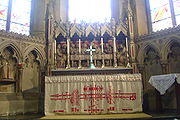 Most Anglican churches use the colours appointed in the Roman Rite, usually in its post-1969 form, with the exception of Sarum Blue replacing Violet for Advent, but some use the earlier form, with, for instance, black in place of red on Good Friday
. Some churches use black at masses for the dead, but more commonly white or purple is used. For historical reasons much of the worldwide Anglican Communion takes a noticeable lead from the practice of the Church of England
. Since the 1980 Alternative Service Book
liturgical colours have been recommended for seasons, with more detailed advice offered as part of the Common Worship
series of liturgies, including colours for all Sundays and festivals printed in the 'core volume' next to collects. The Church's published Lectionary now makes detailed suggestions for liturgical colour throughout the year, which corresponds almost exactly with the above table of Roman Rite (post-1969 usage) usage with five minor exceptions, and one more significant one: there is no reference in Anglican usage to masses of deceased popes and cardinals; no liturgical colour at all is suggested for Holy Saturday (the words "hangings removed" are printed); the recommendation of red for confirmation rites is extended also to ordination rites; Lenten Array (unbleached linen) continues to be listed as an alternative option to purple during Lent; the option exists for using red instead of green during the "Kingdom Season", the four last Sundays of the liturgical year, culminating in Christ the King
, as is common is some Lutheran traditions (see below); finally, more significantly, the Church of England provision suggests white throughout the Sundays after Epiphany as a distinct "Epiphany season", with ordinary time commencing the day after Candlemas. The Church of England suggested scheme of colours also indicates where gold vestments should be used in those churches which possess both gold and white as distinct colours. The use of rose-pink vestments, as in the Roman Rite table above, was mentioned as an option in early editions of Common Worship, and is a listed option in the annual published lectionary; however, later Common Worship publications have begun to refer to this practice as "traditional" reflecting its resurgence.
, uses the same colour scheme as that of the Anglicans and their Scandinavian Lutheran counterparts, but with the use of gold only for the Easter Vigil and Easter Sunday services, with Holy Week using scarlet in place of crimson – congregations lacking scarlet vestments use purple from Palm Sunday through Holy Wednesday and white for Maundy Thursday. Black, traditionally used by the Anglican Communion for Good Friday and funerals, was used by the ELCA only for Ash Wednesday, but effective with the new Evangelical Lutheran Worship
(ELW) book, which replaces the Lutheran Book of Worship
(LBW), black is no longer suggested for Ash Wednesday or Good Friday – purple may be used for Ash Wednesday and no colour for Good Friday. In addition, the ELW suggests that blue, the traditional colour for Advent (with purple being the alternate), be used for the Advent season, reflecting the traditional use of blue in the Scandinavian Lutheran churches.
Both the Lutheran Church - Missouri Synod
(LCMS) and the Wisconsin Evangelical Lutheran Synod
(WELS), along with the United Methodist Church
use a similar system, but with purple being the primary colour for both Advent and Lent (with blue being the alternate colour for Advent only), and the use of gold in place of white for both Christmas and Easter (in similar practice to the Roman Catholic Church). In the WELS, the use of red is also done during the Period of End Times, a period of the Church in regards to the teachings of the Book of Revelation, culminating in the creation of the New Jerusalem (corresponding to Christ the King in the ELCA). In all three churches, including the ELCA, red is also worn on the last Sunday of October, in celebration of the Reformation
on October 31, when Martin Luther
nailed the 95 Theses
onto the door of Wittenberg Castle Church.
churches, historically especially Methodists
, and today many mainline Protestants, use a colour scheme similar to those used by Anglicans and Roman Catholics, although the practice is not universally followed. Many Protestant churches do not use liturgical colours at all. The United Methodist Church, prior to the early-1990s, used red solely for Pentecost, even including the Sundays after Pentecost Sunday, with the use of green being reserved for the season of Kingdomtide
, which usually lasted from late August/early September until Christ the King (the last Sunday in Kingdomtide). Since the publication of the 1992 Book of Worship, the UMC has followed the ELCA practice of wearing red only for Pentecost and Reformation Sundays and green for the rest of the Pentecost season.
The Presbyterian Church (USA)
has sanctioned the use of liturgical colours and promoted their use in the 1993 Book of Common Worship (although their use was also promoted in the church's annual Planning Calendars beginning in the 1980s). Advent and Lent are periods of preparation and repentance and are represented by the colour purple. The feasts of Christmas Day and Christmastide, Epiphany Sunday, Baptism of the Lord Sunday, Transfiguration Sunday, Easter Season, Trinity Sunday, and Christ the King Sunday are represented by white. Green is the colour for periods of Ordinary Time. Red is for Pentecost Sunday, but may also be used for ordinations, and church anniversaries. Red or purple is appropriate for Palm Sunday. During Holy Week, the church may use purple or remain bare (although a few churches will use black for Good Friday).
Similarly, the United Church of Christ
includes indications of which liturgical colour to use for each Sunday in its annual calendar. The general Western pattern is followed, with either Purple or Blue recommended for Advent.
Vestment
Vestments are liturgical garments and articles associated primarily with the Christian religion, especially among Latin Rite and other Catholics, Eastern Orthodox, Anglicans, and Lutherans...
s and hangings within the context of Christian
Christianity
Christianity is a monotheistic religion based on the life and teachings of Jesus as presented in canonical gospels and other New Testament writings...
liturgy
Liturgy
Liturgy is either the customary public worship done by a specific religious group, according to its particular traditions or a more precise term that distinguishes between those religious groups who believe their ritual requires the "people" to do the "work" of responding to the priest, and those...
. The symbolism of violet
Violet (color)
As the name of a color, violet is synonymous with a bluish purple, when the word "purple" is used in the common English language sense of any color between blue and red, not including either blue or red...
, white
White
White is a color, the perception of which is evoked by light that stimulates all three types of color sensitive cone cells in the human eye in nearly equal amounts and with high brightness compared to the surroundings. A white visual stimulation will be void of hue and grayness.White light can be...
, green
Green
Green is a color, the perception of which is evoked by light having a spectrum dominated by energy with a wavelength of roughly 520–570 nanometres. In the subtractive color system, it is not a primary color, but is created out of a mixture of yellow and blue, or yellow and cyan; it is considered...
, red
Red
Red is any of a number of similar colors evoked by light consisting predominantly of the longest wavelengths of light discernible by the human eye, in the wavelength range of roughly 630–740 nm. Longer wavelengths than this are called infrared , and cannot be seen by the naked eye...
, gold
Gold (color)
Gold, also called golden, is one of a variety of orange-yellow color blends used to give the impression of the color of the element gold....
, black
Black
Black is the color of objects that do not emit or reflect light in any part of the visible spectrum; they absorb all such frequencies of light...
, rose
Rose (color)
Rose is the color halfway between red and magenta on the HSV color wheel, also known as the RGB color wheel, on which it is at hue angle of 330 degrees.Rose is one of the tertiary colors on the HSV color wheel...
, and other colours may serve to underline moods appropriate to a season of the liturgical year
Liturgical year
The liturgical year, also known as the church year, consists of the cycle of liturgical seasons in Christian churches which determines when feast days, including celebrations of saints, are to be observed, and which portions of Scripture are to be read. Distinct liturgical colours may appear in...
or may highlight a special occasion.
There is a distinction between the colour of the vestments worn by the clergy and their choir dress
Choir dress
Choir dress is the vesture of the clerics, seminarians and religious of traditional churches worn for public prayer, either apart from the eucharist or by those attending the eucharist as the clergy part of the congregation rather than as the celebrants...
, which with a few exceptions does not change with the liturgical seasons.
Post-1969 Rubrics
In the Roman RiteRoman Rite
The Roman Rite is the liturgical rite used in the Diocese of Rome in the Catholic Church. It is by far the most widespread of the Latin liturgical rites used within the Western or Latin autonomous particular Church, the particular Church that itself is also called the Latin Rite, and that is one of...
, as reformed by Pope Paul VI
Pope Paul VI
Paul VI , born Giovanni Battista Enrico Antonio Maria Montini , reigned as Pope of the Catholic Church from 21 June 1963 until his death on 6 August 1978. Succeeding Pope John XXIII, who had convened the Second Vatican Council, he decided to continue it...
, the following colours are used.
| Colour | |Optional Usage | |
|---|---|---|
|
||
|
Advent Advent is a season observed in many Western Christian churches, a time of expectant waiting and preparation for the celebration of the Nativity of Jesus at Christmas. It is the beginning of the Western liturgical year and commences on Advent Sunday, called Levavi... Lent In the Christian tradition, Lent is the period of the liturgical year from Ash Wednesday to Easter. The traditional purpose of Lent is the preparation of the believer – through prayer, repentance, almsgiving and self-denial – for the annual commemoration during Holy Week of the Death and... Holy Saturday Holy Saturday , sometimes known as Easter Eve or Black Saturday, is the day after Good Friday. It is the day before Easter and the last day of Holy Week in which Christians prepare for Easter... Anointing of the Sick Anointing of the Sick, known also by other names, is distinguished from other forms of religious anointing or "unction" in that it is intended, as its name indicates, for the benefit of a sick person... |
Gaudete Sunday Gaudete Sunday is the third Sunday of Advent in the liturgical calendar of the Western Church, including the Catholic Church, the Anglican Communion, the Lutheran Churches, and some liturgical Protestant churches... (Third Sunday of Advent) Laetare Sunday Laetare Sunday , so called from the incipit of the Introit at Mass, "Laetare Jerusalem" , is a name often used to denote the fourth Sunday of the season of Lent in the Christian liturgical calendar... (Fourth Sunday of Lent) Requiem A Requiem or Requiem Mass, also known as Mass for the dead or Mass of the dead , is a Mass celebrated for the repose of the soul or souls of one or more deceased persons, using a particular form of the Roman Missal... and offices for the dead |
|
| White |
Christmas Christmas or Christmas Day is an annual holiday generally celebrated on December 25 by billions of people around the world. It is a Christian feast that commemorates the birth of Jesus Christ, liturgically closing the Advent season and initiating the season of Christmastide, which lasts twelve days... to the Baptism of the Lord Baptism of the Lord The Baptism of the Lord is the feast day commemorating the baptism of Jesus in the Jordan River by John the Baptist. Originally the baptism of Christ was celebrated on Epiphany, which commemorates the coming of the Magi, the baptism of Christ, and the wedding at Cana... ) Feasts of the Lord Jesus Christ Feasts of the Lord Jesus Christare specific days of the yeardistinguished in the liturgical calendaras being significant days for the celebration of events in the life of Jesus Christ and his veneration, for the commemoration of His relics, signs and miracles... of a joyful nature (i.e. not those of His Passion) Blessed Virgin Mary (Roman Catholic) Roman Catholic veneration of the Blessed Virgin Mary is based on Holy Scripture: In the fullness of time, God sent his son, born of a virgin. The mystery of the incarnation of the Son of God through Mary thus signifies her honour as Mother of God... Angel Angels are mythical beings often depicted as messengers of God in the Hebrew and Christian Bibles along with the Quran. The English word angel is derived from the Greek ἄγγελος, a translation of in the Hebrew Bible ; a similar term, ملائكة , is used in the Qur'an... John the Evangelist Saint John the Evangelist is the conventional name for the author of the Gospel of John... Conversion of Paul The Conversion of Paul the Apostle, as depicted in the Christian Bible, refers to an event reported to have taken place in the life of Paul of Tarsus which led him to cease persecuting early Christians and to himself become a follower of Jesus; it is normally dated by researchers to AD 33–36... Nativity of St. John the Baptist The Nativity of St. John the Baptist is a Christian feast day celebrating the birth of John the Baptist, a prophet who foretold the coming of the Messiah in the person of Jesus and who baptized Jesus.-Significance:Christians have long interpreted the life of John the Baptist as a preparation for... All Saints All Saints' Day , often shortened to All Saints, is a solemnity celebrated on 1 November by parts of Western Christianity, and on the first Sunday after Pentecost in Eastern Christianity, in honour of all the saints, known and unknown... Saint A saint is a holy person. In various religions, saints are people who are believed to have exceptional holiness.In Christian usage, "saint" refers to any believer who is "in Christ", and in whom Christ dwells, whether in heaven or in earth... Baptism In Christianity, baptism is for the majority the rite of admission , almost invariably with the use of water, into the Christian Church generally and also membership of a particular church tradition... Catholic marriage Catholic marriage, also called matrimony, is a "covenant by which a man and a woman establish between themselves a partnership of the whole of life and which is ordered by its nature to the good of the spouses and the procreation and education of offspring... Ordination In general religious use, ordination is the process by which individuals are consecrated, that is, set apart as clergy to perform various religious rites and ceremonies. The process and ceremonies of ordination itself varies by religion and denomination. One who is in preparation for, or who is... |
Requiem A Requiem or Requiem Mass, also known as Mass for the dead or Mass of the dead , is a Mass celebrated for the repose of the soul or souls of one or more deceased persons, using a particular form of the Roman Missal... and offices for the dead where the Conference of Bishops has permitted it . |
|
Palm Sunday Palm Sunday is a Christian moveable feast that falls on the Sunday before Easter. The feast commemorates Jesus' triumphal entry into Jerusalem, an event mentioned in all four Canonical Gospels. .... Good Friday Good Friday , is a religious holiday observed primarily by Christians commemorating the crucifixion of Jesus Christ and his death at Calvary. The holiday is observed during Holy Week as part of the Paschal Triduum on the Friday preceding Easter Sunday, and may coincide with the Jewish observance of... Pentecost Pentecost is a prominent feast in the calendar of Ancient Israel celebrating the giving of the Law on Sinai, and also later in the Christian liturgical year commemorating the descent of the Holy Spirit upon the disciples of Christ after the Resurrection of Jesus... Feast of the Cross In the Christian liturgical calendar, there are several different Feasts of the Cross, all of which commemorate the cross used in the crucifixion of Jesus.... Apostle (Christian) The term apostle is derived from Classical Greek ἀπόστολος , meaning one who is sent away, from στέλλω + από . The literal meaning in English is therefore an "emissary", from the Latin mitto + ex... and Evangelists Four Evangelists In Christian tradition the Four Evangelists are Matthew, Mark, Luke, and John, the authors attributed with the creation of the four Gospel accounts in the New Testament that bear the following titles:*Gospel according to Matthew*Gospel according to Mark... (except St. John) Martyr A martyr is somebody who suffers persecution and death for refusing to renounce, or accept, a belief or cause, usually religious.-Meaning:... Confirmation (Christian sacrament) Confirmation is a rite of initiation in Christian churches, normally carried out through anointing and/or the laying on of hands and prayer for the purpose of bestowing the Gift of the Holy Spirit.... Requiem A Requiem or Requiem Mass, also known as Mass for the dead or Mass of the dead , is a Mass celebrated for the repose of the soul or souls of one or more deceased persons, using a particular form of the Roman Missal... celebrated by the Pope Pope The Pope is the Bishop of Rome, a position that makes him the leader of the worldwide Catholic Church . In the Catholic Church, the Pope is regarded as the successor of Saint Peter, the Apostle... Requiem A Requiem or Requiem Mass, also known as Mass for the dead or Mass of the dead , is a Mass celebrated for the repose of the soul or souls of one or more deceased persons, using a particular form of the Roman Missal... of deceased Popes Pope The Pope is the Bishop of Rome, a position that makes him the leader of the worldwide Catholic Church . In the Catholic Church, the Pope is regarded as the successor of Saint Peter, the Apostle... and Cardinals Cardinal (Catholicism) A cardinal is a senior ecclesiastical official, usually an ordained bishop, and ecclesiastical prince of the Catholic Church. They are collectively known as the College of Cardinals, which as a body elects a new pope. The duties of the cardinals include attending the meetings of the College and... |
||
| Rose |
Gaudete Sunday Gaudete Sunday is the third Sunday of Advent in the liturgical calendar of the Western Church, including the Catholic Church, the Anglican Communion, the Lutheran Churches, and some liturgical Protestant churches... (Third Sunday of Advent) Laetare Sunday Laetare Sunday , so called from the incipit of the Introit at Mass, "Laetare Jerusalem" , is a name often used to denote the fourth Sunday of the season of Lent in the Christian liturgical calendar... (Fourth Sunday of Lent) |
|
|
Halloween Hallowe'en , also known as Halloween or All Hallows' Eve, is a yearly holiday observed around the world on October 31, the night before All Saints' Day... Requiem A Requiem or Requiem Mass, also known as Mass for the dead or Mass of the dead , is a Mass celebrated for the repose of the soul or souls of one or more deceased persons, using a particular form of the Roman Missal... and offices for the dead |
||
On more solemn days, festive, that is, more precious, sacred vestments may be used, even if not of the colour of the day. Such vestments may, for instance, be made from cloth of gold
Cloth of gold
Cloth of gold is a fabric woven with a gold-wrapped or spun weft - referred to as "a spirally spun gold strip". In most cases, the core yarn is silk wrapped with a band or strip of high content gold filé...
or cloth of silver. Moreover, the Conference of Bishops may determine and propose to the Apostolic See adaptations suited to the needs and culture of peoples.
Ritual Masses are celebrated in their proper colour, in white, or in a festive colour. Masses for Various Needs, on the other hand, are celebrated in the colour proper to the day or the season or in violet if they bear a penitential character. Votive Masses are celebrated in the colour suited to the Mass itself or even in the colour proper to the day or the season.
Regional and situational exceptions
Some particular variations:- Blue, a colour associated with the Virgin Mary, is allowed for the feast of the Immaculate ConceptionImmaculate ConceptionThe Immaculate Conception of Mary is a dogma of the Roman Catholic Church, according to which the Virgin Mary was conceived without any stain of original sin. It is one of the four dogmata in Roman Catholic Mariology...
in some dioceses in SpainSpainSpain , officially the Kingdom of Spain languages]] under the European Charter for Regional or Minority Languages. In each of these, Spain's official name is as follows:;;;;;;), is a country and member state of the European Union located in southwestern Europe on the Iberian Peninsula...
, PortugalPortugalPortugal , officially the Portuguese Republic is a country situated in southwestern Europe on the Iberian Peninsula. Portugal is the westernmost country of Europe, and is bordered by the Atlantic Ocean to the West and South and by Spain to the North and East. The Atlantic archipelagos of the...
, MexicoMexicoThe United Mexican States , commonly known as Mexico , is a federal constitutional republic in North America. It is bordered on the north by the United States; on the south and west by the Pacific Ocean; on the southeast by Guatemala, Belize, and the Caribbean Sea; and on the east by the Gulf of...
and South AmericaSouth AmericaSouth America is a continent situated in the Western Hemisphere, mostly in the Southern Hemisphere, with a relatively small portion in the Northern Hemisphere. The continent is also considered a subcontinent of the Americas. It is bordered on the west by the Pacific Ocean and on the north and east...
. In the PhilippinesPhilippinesThe Philippines , officially known as the Republic of the Philippines , is a country in Southeast Asia in the western Pacific Ocean. To its north across the Luzon Strait lies Taiwan. West across the South China Sea sits Vietnam...
it is authorised for all feasts of the Virgin Mary, a practice followed in some other places without official authorisation. There have also been unauthorised uses of blue in place of violet for the season of Advent, as a symbol of expectation and hope - the blue of a new day. - White or cloth of gold was traditionally used when celebrating a novenaNovenaIn the Catholic Church, a novena is a devotion consisting of a prayer repeated on nine successive days, asking to obtain special graces. The prayers may come from prayer books, or consist of the recitation of the Rosary , or of short prayers through the day...
from 16 to 24 December in accordance with a SpanishSpainSpain , officially the Kingdom of Spain languages]] under the European Charter for Regional or Minority Languages. In each of these, Spain's official name is as follows:;;;;;;), is a country and member state of the European Union located in southwestern Europe on the Iberian Peninsula...
custom that was abolished in that country in the 1950s, but that still holds in the PhilippinesPhilippinesThe Philippines , officially known as the Republic of the Philippines , is a country in Southeast Asia in the western Pacific Ocean. To its north across the Luzon Strait lies Taiwan. West across the South China Sea sits Vietnam...
. Further, if not enough vestments of the proper colour are available (particularly in concelebrations), white may always be substituted.
Pre-1969 Rubrics
The Roman MissalRoman Missal
The Roman Missal is the liturgical book that contains the texts and rubrics for the celebration of the Mass in the Roman Rite of the Catholic Church.-Situation before the Council of Trent:...
as revised by Pope John XXIII
Pope John XXIII
-Papal election:Following the death of Pope Pius XII in 1958, Roncalli was elected Pope, to his great surprise. He had even arrived in the Vatican with a return train ticket to Venice. Many had considered Giovanni Battista Montini, Archbishop of Milan, a possible candidate, but, although archbishop...
in 1962, was authorised for use as an extraordinary form of the Roman Rite
Extraordinary form of the Roman Rite
"An extraordinary form of the Roman Rite" is a phrase used in Pope Benedict XVI's motu proprio Summorum Pontificum to describe the liturgy of the 1962 Roman Missal, widely referred to as the "Tridentine Mass"...
by Pope Benedict XVI
Pope Benedict XVI
Benedict XVI is the 265th and current Pope, by virtue of his office of Bishop of Rome, the Sovereign of the Vatican City State and the leader of the Catholic Church as well as the other 22 sui iuris Eastern Catholic Churches in full communion with the Holy See...
by the 2007 motu proprio
Motu proprio
A motu proprio is a document issued by the Pope on his own initiative and personally signed by him....
entitled Summorum Pontificum
Summorum Pontificum
Summorum Pontificum is an Apostolic Letter of Pope Benedict XVI, issued "motu proprio" . The document specified the rules, for the Latin Rite of the Catholic Church, for celebrating Mass according to the "Missal promulgated by John XXIII in 1962" , and for administering most of the sacraments in...
. Pope John XXIII's revision of the Missal incorporated changes that he had made with his motu proprio Rubricarum instructum of 29 July 1960. The following are the small differences between its rules for liturgical colours and the later rules:
| Colour | Violet |
|
Ember days In the liturgical calendar of the Western Christian churches, Ember days are four separate sets of three days within the same week — specifically, the Wednesday, Friday, and Saturday — roughly equidistant in the circuit of the year, that were formerly set aside for fasting and prayer... Rogation days Rogation days are, in the calendar of the Western Church, four days traditionally set apart for solemn processions to invoke God's mercy. They are April 25, the Major Rogation, coinciding with St... Vigil A vigil is a period of purposeful sleeplessness, an occasion for devotional watching, or an observance... of Christmas Christmas Christmas or Christmas Day is an annual holiday generally celebrated on December 25 by billions of people around the world. It is a Christian feast that commemorates the birth of Jesus Christ, liturgically closing the Advent season and initiating the season of Christmastide, which lasts twelve days... Septuagesima Septuagesima is the name for the ninth Sunday before Easter, the third before Ash Wednesday. The term is sometimes applied also to the period that begins on this day and ends on Shrove Tuesday, the day before Ash Wednesday, when Lent begins. This period is also known as the pre-Lenten season or... , Sexagesima Sexagesima Sexagesima , or, in full, Sexagesima Sunday, is the name for the second Sunday before Ash Wednesday in the Gregorian Rite liturgical calendar of the Roman Catholic Church, and also in that of some Protestant denominations, particularly those with Anglican and Lutheran origins.The name "Sexagesima"... , and Quinquagesima Quinquagesima Quinquagesima is the name used in the Western Church for the Sunday before Ash Wednesday. It was also called Quinquagesima Sunday, Quinquagesimae, Estomihi, or Shrove Sunday... Palm Sunday Palm Sunday is a Christian moveable feast that falls on the Sunday before Easter. The feast commemorates Jesus' triumphal entry into Jerusalem, an event mentioned in all four Canonical Gospels. .... (Mass only) Holy Week Holy Week in Christianity is the last week of Lent and the week before Easter... Good Friday Good Friday , is a religious holiday observed primarily by Christians commemorating the crucifixion of Jesus Christ and his death at Calvary. The holiday is observed during Holy Week as part of the Paschal Triduum on the Friday preceding Easter Sunday, and may coincide with the Jewish observance of... Holy Saturday Holy Saturday , sometimes known as Easter Eve or Black Saturday, is the day after Good Friday. It is the day before Easter and the last day of Holy Week in which Christians prepare for Easter... Easter Vigil The Easter Vigil, also called the Paschal Vigil or the Great Vigil of Easter, is a service held in many Christian churches as the first official celebration of the Resurrection of Jesus. Historically, it is during this service that people are baptized and that adult catechumens are received into... Vigil A vigil is a period of purposeful sleeplessness, an occasion for devotional watching, or an observance... of Pentecost Pentecost Pentecost is a prominent feast in the calendar of Ancient Israel celebrating the giving of the Law on Sinai, and also later in the Christian liturgical year commemorating the descent of the Holy Spirit upon the disciples of Christ after the Resurrection of Jesus... Vigil A vigil is a period of purposeful sleeplessness, an occasion for devotional watching, or an observance... of The Nativity of St. John the Baptist Nativity of St. John the Baptist The Nativity of St. John the Baptist is a Christian feast day celebrating the birth of John the Baptist, a prophet who foretold the coming of the Messiah in the person of Jesus and who baptized Jesus.-Significance:Christians have long interpreted the life of John the Baptist as a preparation for... Vigil A vigil is a period of purposeful sleeplessness, an occasion for devotional watching, or an observance... of Ss. Peter and Paul Feast of Saints Peter and Paul The Feast of Saints Peter and Paul, or the Solemnity of Saints Peter and Paul, is a liturgical feast in honour of the martyrdom in Rome of the apostles Saint Peter and Saint Paul, which is observed on 29 June... Vigil A vigil is a period of purposeful sleeplessness, an occasion for devotional watching, or an observance... of St. Lawrence Vigil A vigil is a period of purposeful sleeplessness, an occasion for devotional watching, or an observance... of The Assumption Assumption of Mary According to the belief of Christians of the Roman Catholic Church, Eastern Orthodoxy, Oriental Orthodoxy, and parts of the Anglican Communion and Continuing Anglicanism, the Assumption of Mary was the bodily taking up of the Virgin Mary into Heaven at the end of her life... Forty Hours' Devotion Forty Hours' Devotion, called Quarant' Ore or written in one word Quarantore, is a Roman Catholic exercise of devotion in which continuous prayer is made for forty hours before the Blessed Sacrament exposed... is ongoing) Exorcism Exorcism is the religious practice of evicting demons or other spiritual entities from a person or place which they are believed to have possessed... during the Sacrament of Baptism Baptism In Christianity, baptism is for the majority the rite of admission , almost invariably with the use of water, into the Christian Church generally and also membership of a particular church tradition... |
Ember days In the liturgical calendar of the Western Christian churches, Ember days are four separate sets of three days within the same week — specifically, the Wednesday, Friday, and Saturday — roughly equidistant in the circuit of the year, that were formerly set aside for fasting and prayer... Rogation days Rogation days are, in the calendar of the Western Church, four days traditionally set apart for solemn processions to invoke God's mercy. They are April 25, the Major Rogation, coinciding with St... Vigil A vigil is a period of purposeful sleeplessness, an occasion for devotional watching, or an observance... of Christmas Christmas Christmas or Christmas Day is an annual holiday generally celebrated on December 25 by billions of people around the world. It is a Christian feast that commemorates the birth of Jesus Christ, liturgically closing the Advent season and initiating the season of Christmastide, which lasts twelve days... Septuagesima Septuagesima is the name for the ninth Sunday before Easter, the third before Ash Wednesday. The term is sometimes applied also to the period that begins on this day and ends on Shrove Tuesday, the day before Ash Wednesday, when Lent begins. This period is also known as the pre-Lenten season or... , Sexagesima Sexagesima Sexagesima , or, in full, Sexagesima Sunday, is the name for the second Sunday before Ash Wednesday in the Gregorian Rite liturgical calendar of the Roman Catholic Church, and also in that of some Protestant denominations, particularly those with Anglican and Lutheran origins.The name "Sexagesima"... , and Quinquagesima Quinquagesima Quinquagesima is the name used in the Western Church for the Sunday before Ash Wednesday. It was also called Quinquagesima Sunday, Quinquagesimae, Estomihi, or Shrove Sunday... Palm Sunday Palm Sunday is a Christian moveable feast that falls on the Sunday before Easter. The feast commemorates Jesus' triumphal entry into Jerusalem, an event mentioned in all four Canonical Gospels. .... (Mass only) Holy Week Holy Week in Christianity is the last week of Lent and the week before Easter... Good Friday Good Friday , is a religious holiday observed primarily by Christians commemorating the crucifixion of Jesus Christ and his death at Calvary. The holiday is observed during Holy Week as part of the Paschal Triduum on the Friday preceding Easter Sunday, and may coincide with the Jewish observance of... Holy Saturday Holy Saturday , sometimes known as Easter Eve or Black Saturday, is the day after Good Friday. It is the day before Easter and the last day of Holy Week in which Christians prepare for Easter... Easter Vigil The Easter Vigil, also called the Paschal Vigil or the Great Vigil of Easter, is a service held in many Christian churches as the first official celebration of the Resurrection of Jesus. Historically, it is during this service that people are baptized and that adult catechumens are received into... Vigil A vigil is a period of purposeful sleeplessness, an occasion for devotional watching, or an observance... of Pentecost Pentecost Pentecost is a prominent feast in the calendar of Ancient Israel celebrating the giving of the Law on Sinai, and also later in the Christian liturgical year commemorating the descent of the Holy Spirit upon the disciples of Christ after the Resurrection of Jesus... Vigil A vigil is a period of purposeful sleeplessness, an occasion for devotional watching, or an observance... of The Nativity of St. John the Baptist Nativity of St. John the Baptist The Nativity of St. John the Baptist is a Christian feast day celebrating the birth of John the Baptist, a prophet who foretold the coming of the Messiah in the person of Jesus and who baptized Jesus.-Significance:Christians have long interpreted the life of John the Baptist as a preparation for... Vigil A vigil is a period of purposeful sleeplessness, an occasion for devotional watching, or an observance... of Ss. Peter and Paul Feast of Saints Peter and Paul The Feast of Saints Peter and Paul, or the Solemnity of Saints Peter and Paul, is a liturgical feast in honour of the martyrdom in Rome of the apostles Saint Peter and Saint Paul, which is observed on 29 June... Vigil A vigil is a period of purposeful sleeplessness, an occasion for devotional watching, or an observance... of St. Lawrence Vigil A vigil is a period of purposeful sleeplessness, an occasion for devotional watching, or an observance... of The Assumption Assumption of Mary According to the belief of Christians of the Roman Catholic Church, Eastern Orthodoxy, Oriental Orthodoxy, and parts of the Anglican Communion and Continuing Anglicanism, the Assumption of Mary was the bodily taking up of the Virgin Mary into Heaven at the end of her life... Forty Hours' Devotion Forty Hours' Devotion, called Quarant' Ore or written in one word Quarantore, is a Roman Catholic exercise of devotion in which continuous prayer is made for forty hours before the Blessed Sacrament exposed... is ongoing) Exorcism Exorcism is the religious practice of evicting demons or other spiritual entities from a person or place which they are believed to have possessed... during the Sacrament of Baptism Baptism In Christianity, baptism is for the majority the rite of admission , almost invariably with the use of water, into the Christian Church generally and also membership of a particular church tradition... |
|---|---|---|---|---|
| White |
Octave (liturgical) "Octave" has two senses in Christian liturgical usage. In the first sense, it is the eighth day after a feast, reckoning inclusively, and so always falls on the same day of the week as the feast itself. The word is derived from Latin octava , with dies understood... of The Immaculate Conception Immaculate Conception The Immaculate Conception of Mary is a dogma of the Roman Catholic Church, according to which the Virgin Mary was conceived without any stain of original sin. It is one of the four dogmata in Roman Catholic Mariology... Octave (liturgical) "Octave" has two senses in Christian liturgical usage. In the first sense, it is the eighth day after a feast, reckoning inclusively, and so always falls on the same day of the week as the feast itself. The word is derived from Latin octava , with dies understood... of Christmas Christmas Christmas or Christmas Day is an annual holiday generally celebrated on December 25 by billions of people around the world. It is a Christian feast that commemorates the birth of Jesus Christ, liturgically closing the Advent season and initiating the season of Christmastide, which lasts twelve days... Octave (liturgical) "Octave" has two senses in Christian liturgical usage. In the first sense, it is the eighth day after a feast, reckoning inclusively, and so always falls on the same day of the week as the feast itself. The word is derived from Latin octava , with dies understood... of St. John John the Evangelist Saint John the Evangelist is the conventional name for the author of the Gospel of John... Vigil A vigil is a period of purposeful sleeplessness, an occasion for devotional watching, or an observance... of The Epiphany Octave (liturgical) "Octave" has two senses in Christian liturgical usage. In the first sense, it is the eighth day after a feast, reckoning inclusively, and so always falls on the same day of the week as the feast itself. The word is derived from Latin octava , with dies understood... of The Epiphany Octave (liturgical) "Octave" has two senses in Christian liturgical usage. In the first sense, it is the eighth day after a feast, reckoning inclusively, and so always falls on the same day of the week as the feast itself. The word is derived from Latin octava , with dies understood... of St. Joseph Vigil A vigil is a period of purposeful sleeplessness, an occasion for devotional watching, or an observance... of Easter Easter Easter is the central feast in the Christian liturgical year. According to the Canonical gospels, Jesus rose from the dead on the third day after his crucifixion. His resurrection is celebrated on Easter Day or Easter Sunday... on Holy Saturday Holy Saturday Holy Saturday , sometimes known as Easter Eve or Black Saturday, is the day after Good Friday. It is the day before Easter and the last day of Holy Week in which Christians prepare for Easter... (Mass only) Octave (liturgical) "Octave" has two senses in Christian liturgical usage. In the first sense, it is the eighth day after a feast, reckoning inclusively, and so always falls on the same day of the week as the feast itself. The word is derived from Latin octava , with dies understood... of Easter Easter Easter is the central feast in the Christian liturgical year. According to the Canonical gospels, Jesus rose from the dead on the third day after his crucifixion. His resurrection is celebrated on Easter Day or Easter Sunday... Vigil A vigil is a period of purposeful sleeplessness, an occasion for devotional watching, or an observance... of The Ascension Octave (liturgical) "Octave" has two senses in Christian liturgical usage. In the first sense, it is the eighth day after a feast, reckoning inclusively, and so always falls on the same day of the week as the feast itself. The word is derived from Latin octava , with dies understood... of The Ascension Octave (liturgical) "Octave" has two senses in Christian liturgical usage. In the first sense, it is the eighth day after a feast, reckoning inclusively, and so always falls on the same day of the week as the feast itself. The word is derived from Latin octava , with dies understood... of Corpus Christi Corpus Christi (feast) Corpus Christi is a Latin Rite solemnity, now designated the solemnity of The Most Holy Body and Blood of Christ . It is also celebrated in some Anglican, Lutheran and Old Catholic Churches. Like Trinity Sunday and the Solemnity of Christ the King, it does not commemorate a particular event in... Octave (liturgical) "Octave" has two senses in Christian liturgical usage. In the first sense, it is the eighth day after a feast, reckoning inclusively, and so always falls on the same day of the week as the feast itself. The word is derived from Latin octava , with dies understood... of The Sacred Heart Sacred Heart The Sacred Heart is one of the most famous religious devotions to Jesus' physical heart as the representation of His divine love for Humanity.... Octave (liturgical) "Octave" has two senses in Christian liturgical usage. In the first sense, it is the eighth day after a feast, reckoning inclusively, and so always falls on the same day of the week as the feast itself. The word is derived from Latin octava , with dies understood... of The Nativity of St. John the Baptist Nativity of St. John the Baptist The Nativity of St. John the Baptist is a Christian feast day celebrating the birth of John the Baptist, a prophet who foretold the coming of the Messiah in the person of Jesus and who baptized Jesus.-Significance:Christians have long interpreted the life of John the Baptist as a preparation for... Octave (liturgical) "Octave" has two senses in Christian liturgical usage. In the first sense, it is the eighth day after a feast, reckoning inclusively, and so always falls on the same day of the week as the feast itself. The word is derived from Latin octava , with dies understood... of The Assumption Assumption of Mary According to the belief of Christians of the Roman Catholic Church, Eastern Orthodoxy, Oriental Orthodoxy, and parts of the Anglican Communion and Continuing Anglicanism, the Assumption of Mary was the bodily taking up of the Virgin Mary into Heaven at the end of her life... Octave (liturgical) "Octave" has two senses in Christian liturgical usage. In the first sense, it is the eighth day after a feast, reckoning inclusively, and so always falls on the same day of the week as the feast itself. The word is derived from Latin octava , with dies understood... of The Nativity of Mary Nativity of Mary The Nativity of Mary, or Birth of the Virgin and various permutations, is celebrated as a liturgical feast in the Roman Catholic calendar of saints and in most Anglican liturgical calendars on 8 September, nine months after the solemnity of her Immaculate Conception, celebrated on 8 December... Octave (liturgical) "Octave" has two senses in Christian liturgical usage. In the first sense, it is the eighth day after a feast, reckoning inclusively, and so always falls on the same day of the week as the feast itself. The word is derived from Latin octava , with dies understood... of All Saints All Saints All Saints' Day , often shortened to All Saints, is a solemnity celebrated on 1 November by parts of Western Christianity, and on the first Sunday after Pentecost in Eastern Christianity, in honour of all the saints, known and unknown... Baptism In Christianity, baptism is for the majority the rite of admission , almost invariably with the use of water, into the Christian Church generally and also membership of a particular church tradition... (post-exorcism) |
Octave (liturgical) "Octave" has two senses in Christian liturgical usage. In the first sense, it is the eighth day after a feast, reckoning inclusively, and so always falls on the same day of the week as the feast itself. The word is derived from Latin octava , with dies understood... of Christmas Christmas Christmas or Christmas Day is an annual holiday generally celebrated on December 25 by billions of people around the world. It is a Christian feast that commemorates the birth of Jesus Christ, liturgically closing the Advent season and initiating the season of Christmastide, which lasts twelve days... Easter Vigil The Easter Vigil, also called the Paschal Vigil or the Great Vigil of Easter, is a service held in many Christian churches as the first official celebration of the Resurrection of Jesus. Historically, it is during this service that people are baptized and that adult catechumens are received into... (Mass only) Octave (liturgical) "Octave" has two senses in Christian liturgical usage. In the first sense, it is the eighth day after a feast, reckoning inclusively, and so always falls on the same day of the week as the feast itself. The word is derived from Latin octava , with dies understood... of Easter Easter Easter is the central feast in the Christian liturgical year. According to the Canonical gospels, Jesus rose from the dead on the third day after his crucifixion. His resurrection is celebrated on Easter Day or Easter Sunday... Vigil A vigil is a period of purposeful sleeplessness, an occasion for devotional watching, or an observance... of The Ascension Baptism In Christianity, baptism is for the majority the rite of admission , almost invariably with the use of water, into the Christian Church generally and also membership of a particular church tradition... (post-exorcism) |
Octave (liturgical) "Octave" has two senses in Christian liturgical usage. In the first sense, it is the eighth day after a feast, reckoning inclusively, and so always falls on the same day of the week as the feast itself. The word is derived from Latin octava , with dies understood... of Christmas Christmas Christmas or Christmas Day is an annual holiday generally celebrated on December 25 by billions of people around the world. It is a Christian feast that commemorates the birth of Jesus Christ, liturgically closing the Advent season and initiating the season of Christmastide, which lasts twelve days... Easter Vigil The Easter Vigil, also called the Paschal Vigil or the Great Vigil of Easter, is a service held in many Christian churches as the first official celebration of the Resurrection of Jesus. Historically, it is during this service that people are baptized and that adult catechumens are received into... (Mass only) Octave (liturgical) "Octave" has two senses in Christian liturgical usage. In the first sense, it is the eighth day after a feast, reckoning inclusively, and so always falls on the same day of the week as the feast itself. The word is derived from Latin octava , with dies understood... of Easter Easter Easter is the central feast in the Christian liturgical year. According to the Canonical gospels, Jesus rose from the dead on the third day after his crucifixion. His resurrection is celebrated on Easter Day or Easter Sunday... Vigil A vigil is a period of purposeful sleeplessness, an occasion for devotional watching, or an observance... of The Ascension Baptism In Christianity, baptism is for the majority the rite of admission , almost invariably with the use of water, into the Christian Church generally and also membership of a particular church tradition... (post-exorcism) |
|
| Red |
Octave (liturgical) "Octave" has two senses in Christian liturgical usage. In the first sense, it is the eighth day after a feast, reckoning inclusively, and so always falls on the same day of the week as the feast itself. The word is derived from Latin octava , with dies understood... of The Holy Innocents Octave (liturgical) "Octave" has two senses in Christian liturgical usage. In the first sense, it is the eighth day after a feast, reckoning inclusively, and so always falls on the same day of the week as the feast itself. The word is derived from Latin octava , with dies understood... of St. Stephen Saint Stephen Saint Stephen The Protomartyr , the protomartyr of Christianity, is venerated as a saint in the Roman Catholic, Anglican, Lutheran, Oriental Orthodox and Eastern Orthodox Churches.... Vigil A vigil is a period of purposeful sleeplessness, an occasion for devotional watching, or an observance... of Pentecost Pentecost Pentecost is a prominent feast in the calendar of Ancient Israel celebrating the giving of the Law on Sinai, and also later in the Christian liturgical year commemorating the descent of the Holy Spirit upon the disciples of Christ after the Resurrection of Jesus... (Mass only) Octave (liturgical) "Octave" has two senses in Christian liturgical usage. In the first sense, it is the eighth day after a feast, reckoning inclusively, and so always falls on the same day of the week as the feast itself. The word is derived from Latin octava , with dies understood... of Pentecost Pentecost Pentecost is a prominent feast in the calendar of Ancient Israel celebrating the giving of the Law on Sinai, and also later in the Christian liturgical year commemorating the descent of the Holy Spirit upon the disciples of Christ after the Resurrection of Jesus... Octave (liturgical) "Octave" has two senses in Christian liturgical usage. In the first sense, it is the eighth day after a feast, reckoning inclusively, and so always falls on the same day of the week as the feast itself. The word is derived from Latin octava , with dies understood... of Ss. Peter and Paul Feast of Saints Peter and Paul The Feast of Saints Peter and Paul, or the Solemnity of Saints Peter and Paul, is a liturgical feast in honour of the martyrdom in Rome of the apostles Saint Peter and Saint Paul, which is observed on 29 June... Octave (liturgical) "Octave" has two senses in Christian liturgical usage. In the first sense, it is the eighth day after a feast, reckoning inclusively, and so always falls on the same day of the week as the feast itself. The word is derived from Latin octava , with dies understood... of St. Lawrence |
Palm Sunday Palm Sunday is a Christian moveable feast that falls on the Sunday before Easter. The feast commemorates Jesus' triumphal entry into Jerusalem, an event mentioned in all four Canonical Gospels. .... Vigil A vigil is a period of purposeful sleeplessness, an occasion for devotional watching, or an observance... of Pentecost Pentecost Pentecost is a prominent feast in the calendar of Ancient Israel celebrating the giving of the Law on Sinai, and also later in the Christian liturgical year commemorating the descent of the Holy Spirit upon the disciples of Christ after the Resurrection of Jesus... (Mass only) Octave (liturgical) "Octave" has two senses in Christian liturgical usage. In the first sense, it is the eighth day after a feast, reckoning inclusively, and so always falls on the same day of the week as the feast itself. The word is derived from Latin octava , with dies understood... of Pentecost Pentecost Pentecost is a prominent feast in the calendar of Ancient Israel celebrating the giving of the Law on Sinai, and also later in the Christian liturgical year commemorating the descent of the Holy Spirit upon the disciples of Christ after the Resurrection of Jesus... |
Palm Sunday Palm Sunday is a Christian moveable feast that falls on the Sunday before Easter. The feast commemorates Jesus' triumphal entry into Jerusalem, an event mentioned in all four Canonical Gospels. .... Vigil A vigil is a period of purposeful sleeplessness, an occasion for devotional watching, or an observance... of Pentecost Pentecost Pentecost is a prominent feast in the calendar of Ancient Israel celebrating the giving of the Law on Sinai, and also later in the Christian liturgical year commemorating the descent of the Holy Spirit upon the disciples of Christ after the Resurrection of Jesus... (Mass only) Octave (liturgical) "Octave" has two senses in Christian liturgical usage. In the first sense, it is the eighth day after a feast, reckoning inclusively, and so always falls on the same day of the week as the feast itself. The word is derived from Latin octava , with dies understood... of Pentecost Pentecost Pentecost is a prominent feast in the calendar of Ancient Israel celebrating the giving of the Law on Sinai, and also later in the Christian liturgical year commemorating the descent of the Holy Spirit upon the disciples of Christ after the Resurrection of Jesus... |
|
| Rose |
Gaudete Sunday Gaudete Sunday is the third Sunday of Advent in the liturgical calendar of the Western Church, including the Catholic Church, the Anglican Communion, the Lutheran Churches, and some liturgical Protestant churches... Laetare Sunday Laetare Sunday , so called from the incipit of the Introit at Mass, "Laetare Jerusalem" , is a name often used to denote the fourth Sunday of the season of Lent in the Christian liturgical calendar... |
Gaudete Sunday Gaudete Sunday is the third Sunday of Advent in the liturgical calendar of the Western Church, including the Catholic Church, the Anglican Communion, the Lutheran Churches, and some liturgical Protestant churches... Laetare Sunday Laetare Sunday , so called from the incipit of the Introit at Mass, "Laetare Jerusalem" , is a name often used to denote the fourth Sunday of the season of Lent in the Christian liturgical calendar... |
Gaudete Sunday Gaudete Sunday is the third Sunday of Advent in the liturgical calendar of the Western Church, including the Catholic Church, the Anglican Communion, the Lutheran Churches, and some liturgical Protestant churches... Laetare Sunday Laetare Sunday , so called from the incipit of the Introit at Mass, "Laetare Jerusalem" , is a name often used to denote the fourth Sunday of the season of Lent in the Christian liturgical calendar... |
|
| Black |
Good Friday Good Friday , is a religious holiday observed primarily by Christians commemorating the crucifixion of Jesus Christ and his death at Calvary. The holiday is observed during Holy Week as part of the Paschal Triduum on the Friday preceding Easter Sunday, and may coincide with the Jewish observance of... Forty Hours' Devotion Forty Hours' Devotion, called Quarant' Ore or written in one word Quarantore, is a Roman Catholic exercise of devotion in which continuous prayer is made for forty hours before the Blessed Sacrament exposed... is ongoing) Requiem A Requiem or Requiem Mass, also known as Mass for the dead or Mass of the dead , is a Mass celebrated for the repose of the soul or souls of one or more deceased persons, using a particular form of the Roman Missal... |
Good Friday Good Friday , is a religious holiday observed primarily by Christians commemorating the crucifixion of Jesus Christ and his death at Calvary. The holiday is observed during Holy Week as part of the Paschal Triduum on the Friday preceding Easter Sunday, and may coincide with the Jewish observance of... (main liturgy) Forty Hours' Devotion Forty Hours' Devotion, called Quarant' Ore or written in one word Quarantore, is a Roman Catholic exercise of devotion in which continuous prayer is made for forty hours before the Blessed Sacrament exposed... is ongoing) Requiem A Requiem or Requiem Mass, also known as Mass for the dead or Mass of the dead , is a Mass celebrated for the repose of the soul or souls of one or more deceased persons, using a particular form of the Roman Missal... |
Good Friday Good Friday , is a religious holiday observed primarily by Christians commemorating the crucifixion of Jesus Christ and his death at Calvary. The holiday is observed during Holy Week as part of the Paschal Triduum on the Friday preceding Easter Sunday, and may coincide with the Jewish observance of... (main liturgy) Forty Hours' Devotion Forty Hours' Devotion, called Quarant' Ore or written in one word Quarantore, is a Roman Catholic exercise of devotion in which continuous prayer is made for forty hours before the Blessed Sacrament exposed... is ongoing) Requiem A Requiem or Requiem Mass, also known as Mass for the dead or Mass of the dead , is a Mass celebrated for the repose of the soul or souls of one or more deceased persons, using a particular form of the Roman Missal... |
|
Pope Pius X
Pope Pius X
Pope Saint Pius X , born Giuseppe Melchiorre Sarto, was the 257th Pope of the Catholic Church, serving from 1903 to 1914. He was the first pope since Pope Pius V to be canonized. Pius X rejected modernist interpretations of Catholic doctrine, promoting traditional devotional practices and orthodox...
raised the rank of Sundays of ordinary time, so that on those that fell within octaves green was used instead of the colour of the octave, as had previously been the rule.
The rules on liturgical colours before the time of Pope Pius X were essentially those indicated in the edition of the Roman Missal that Pope Pius V
Pope Pius V
Pope Saint Pius V , born Antonio Ghislieri , was Pope from 1566 to 1572 and is a saint of the Catholic Church. He is chiefly notable for his role in the Council of Trent, the Counter-Reformation, and the standardization of the Roman liturgy within the Latin Church...
promulgated in 1570, except for the addition of feasts not included in his Missal. The scheme of colours in his Missal reflected usage that had become fixed in Rome by the twelfth century.
Byzantine Rite
The Byzantine RiteByzantine Rite
The Byzantine Rite, sometimes called the Rite of Constantinople or Constantinopolitan Rite is the liturgical rite used currently by all the Eastern Orthodox Churches, by the Greek Catholic Churches , and by the Protestant Ukrainian Lutheran Church...
, which is used by all the member churches of the Eastern Orthodox Church
Eastern Orthodox Church
The Orthodox Church, officially called the Orthodox Catholic Church and commonly referred to as the Eastern Orthodox Church, is the second largest Christian denomination in the world, with an estimated 300 million adherents mainly in the countries of Belarus, Bulgaria, Cyprus, Georgia, Greece,...
and the Eastern Catholic Churches of Byzantine Rite, does not have a universal system of colours, with the service-books of the Byzantine tradition only specifying "light" or "dark" vestments in the service books. In the Greek tradition, maroon or burgundy
Burgundy (color)
Burgundy is a shade of purplish red associated with the Burgundy wine of the same name, which in turn is named after the Burgundy region of France. The color burgundy is similar to other shades of dark red such as maroon...
are common for solemn feast days, and a wide variety of colours are used at other times, the most common of which are gold and white.
Slavic-use churches and others influenced by Western traditions have adopted a cycle of liturgical colours. The particulars may change from place to place, but generally:
| Colour | |Other Usage/Notes | |
|---|---|---|
| Gold |
|
|
| Light Blue |
Theotokos Theotokos is the Greek title of Mary, the mother of Jesus used especially in the Eastern Orthodox, Oriental Orthodox, and Eastern Catholic Churches. Its literal English translations include God-bearer and the one who gives birth to God. Less literal translations include Mother of God... |
|
| Purple or Dark Red |
Great Lent Great Lent, or the Great Fast, is the most important fasting season in the church year in Eastern Christianity, which prepares Christians for the greatest feast of the church year, Pascha . In many ways Great Lent is similar to Lent in Western Christianity... |
|
| Red |
Feast of the Cross In the Christian liturgical calendar, there are several different Feasts of the Cross, all of which commemorate the cross used in the crucifixion of Jesus.... John the Baptist John the Baptist was an itinerant preacher and a major religious figure mentioned in the Canonical gospels. He is described in the Gospel of Luke as a relative of Jesus, who led a movement of baptism at the Jordan River... Nativity Fast The Nativity Fast is a period of abstinence and penance practiced by the Eastern Orthodox, Oriental Orthodox, and Eastern Catholic Churches, in preparation for the Nativity of Christ, . The fast is similar to the Western Advent, except that it runs for 40 days instead of four weeks. The fast is... Apostles' Fast The Apostles' Fast, also called the Fast of the Holy Apostles, the Fast of Peter and Paul, or sometimes St. Peter's Fast, is a fast observed by Eastern Orthodox, Oriental Orthodox and Eastern Catholic Christians... |
|
| Green |
Palm Sunday Palm Sunday is a Christian moveable feast that falls on the Sunday before Easter. The feast commemorates Jesus' triumphal entry into Jerusalem, an event mentioned in all four Canonical Gospels. .... Pentecost Pentecost is a prominent feast in the calendar of Ancient Israel celebrating the giving of the Law on Sinai, and also later in the Christian liturgical year commemorating the descent of the Holy Spirit upon the disciples of Christ after the Resurrection of Jesus... |
|
| Black |
Holy Week Holy Week in Christianity is the last week of Lent and the week before Easter... (except Holy Thursday) |
|
| White |
Nativity of Jesus The Nativity of Jesus, or simply The Nativity, refers to the accounts of the birth of Jesus in two of the Canonical gospels and in various apocryphal texts.... Theophany Theophany, from the Ancient Greek , meaning "appearance of God"), refers to the appearance of a deity to a human or other being, or to a divine disclosure.... |
|
The colours would be changed before Vespers
Vespers
Vespers is the evening prayer service in the Western Catholic, Eastern Catholic, and Eastern Orthodox, Anglican, and Lutheran liturgies of the canonical hours...
on the eve of the day being commemorated. During Great Feasts, the colour is changed before the vespers service that begins the first day of a forefeast, and remains until the apodosis (final day of the afterfeast
Afterfeast
An Afterfeast is a period of celebration attached to one of the Great Feasts celebrated by the Eastern Orthodox and Eastern Catholic Churches ....
).
Under Western influence, black is often used for funerals, weekdays in Great Lent and Holy Week in the Slavic churches, as a sign of penance
Penance
Penance is repentance of sins as well as the proper name of the Roman Catholic, Orthodox Christian, and Anglican Sacrament of Penance and Reconciliation/Confession. It also plays a part in non-sacramental confession among Lutherans and other Protestants...
and mourning, but in the second half of the 20th century, the ancient white became more common, as a sign of the hope of the Resurrection.
Russian Liturgical Colours
According to the Russian Orthodox ChurchRussian Orthodox Church
The Russian Orthodox Church or, alternatively, the Moscow Patriarchate The ROC is often said to be the largest of the Eastern Orthodox churches in the world; including all the autocephalous churches under its umbrella, its adherents number over 150 million worldwide—about half of the 300 million...
's Nastol'naya Kniga Sviashchenno-sluzhitelia, up to eight different liturgical colours may be used throughout the year. Exact usage of these colours varies, but the following are the most common uses.
| Colour | |Uncommon/Other Usage | |
|---|---|---|
| Gold |
|
|
| Light Blue |
Marian feast days Marian feast days are specific holy days of the liturgical year celebrated by Christians as significant Marian days for the celebration of events in the life of the Blessed Virgin Mary and her veneration... |
|
| Purple or Dark Red |
|
|
| Red |
|
|
| Green |
|
|
| Black |
|
|
| White |
|
|
| Orange or Rust |
|
|
Coptic and Ethiopic Rites
The Coptic tradition, followed also in EthiopiaEthiopia
Ethiopia , officially known as the Federal Democratic Republic of Ethiopia, is a country located in the Horn of Africa. It is the second-most populous nation in Africa, with over 82 million inhabitants, and the tenth-largest by area, occupying 1,100,000 km2...
and Eritrea
Eritrea
Eritrea , officially the State of Eritrea, is a country in the Horn of Africa. Eritrea derives it's name from the Greek word Erethria, meaning 'red land'. The capital is Asmara. It is bordered by Sudan in the west, Ethiopia in the south, and Djibouti in the southeast...
, uses only white vestments, with gold and silver being considered variations of white.
Anglicanism
Good Friday
Good Friday , is a religious holiday observed primarily by Christians commemorating the crucifixion of Jesus Christ and his death at Calvary. The holiday is observed during Holy Week as part of the Paschal Triduum on the Friday preceding Easter Sunday, and may coincide with the Jewish observance of...
. Some churches use black at masses for the dead, but more commonly white or purple is used. For historical reasons much of the worldwide Anglican Communion takes a noticeable lead from the practice of the Church of England
Church of England
The Church of England is the officially established Christian church in England and the Mother Church of the worldwide Anglican Communion. The church considers itself within the tradition of Western Christianity and dates its formal establishment principally to the mission to England by St...
. Since the 1980 Alternative Service Book
Alternative Service Book
The Alternative Service Book 1980 was the first complete prayer book produced by the Church of England since 1662. Its name derives from the fact that it was proposed not as a replacement for the Book of Common Prayer but merely as an alternative to it...
liturgical colours have been recommended for seasons, with more detailed advice offered as part of the Common Worship
Common Worship
Common Worship is the name given to the series of services authorised by the General Synod of the Church of England and launched on the first Sunday of Advent in 2000. It represents the most recent stage of development of the Liturgical Movement within the Church and is the successor to the...
series of liturgies, including colours for all Sundays and festivals printed in the 'core volume' next to collects. The Church's published Lectionary now makes detailed suggestions for liturgical colour throughout the year, which corresponds almost exactly with the above table of Roman Rite (post-1969 usage) usage with five minor exceptions, and one more significant one: there is no reference in Anglican usage to masses of deceased popes and cardinals; no liturgical colour at all is suggested for Holy Saturday (the words "hangings removed" are printed); the recommendation of red for confirmation rites is extended also to ordination rites; Lenten Array (unbleached linen) continues to be listed as an alternative option to purple during Lent; the option exists for using red instead of green during the "Kingdom Season", the four last Sundays of the liturgical year, culminating in Christ the King
Christ the King
Christ the King is a title of Jesus based on several passages of Scripture. It is used by most Christians. The Roman Catholic Church, together with many Protestant denominations, including the Anglican Churches, Presbyterians, Lutherans and Methodists, celebrate the Feast of Christ the King on the...
, as is common is some Lutheran traditions (see below); finally, more significantly, the Church of England provision suggests white throughout the Sundays after Epiphany as a distinct "Epiphany season", with ordinary time commencing the day after Candlemas. The Church of England suggested scheme of colours also indicates where gold vestments should be used in those churches which possess both gold and white as distinct colours. The use of rose-pink vestments, as in the Roman Rite table above, was mentioned as an option in early editions of Common Worship, and is a listed option in the annual published lectionary; however, later Common Worship publications have begun to refer to this practice as "traditional" reflecting its resurgence.
Lutheranism
The Evangelical Lutheran Church in AmericaEvangelical Lutheran Church in America
The Evangelical Lutheran Church in America is a mainline Protestant denomination headquartered in Chicago, Illinois. The ELCA officially came into existence on January 1, 1988, by the merging of three churches. As of December 31, 2009, it had 4,543,037 baptized members, with 2,527,941 of them...
, uses the same colour scheme as that of the Anglicans and their Scandinavian Lutheran counterparts, but with the use of gold only for the Easter Vigil and Easter Sunday services, with Holy Week using scarlet in place of crimson – congregations lacking scarlet vestments use purple from Palm Sunday through Holy Wednesday and white for Maundy Thursday. Black, traditionally used by the Anglican Communion for Good Friday and funerals, was used by the ELCA only for Ash Wednesday, but effective with the new Evangelical Lutheran Worship
Evangelical Lutheran Worship
Evangelical Lutheran Worship or ELW is the current, primary liturgical and worship guidebook and hymnal for use in the Evangelical Lutheran Church in America and the Evangelical Lutheran Church in Canada, replacing its three predecessors, the Lutheran Book of Worship , the Hymnal Supplemental , and...
(ELW) book, which replaces the Lutheran Book of Worship
Lutheran Book of Worship
Lutheran Book of Worship is a worship book and hymnal used by several Lutheran denominations in North America. It is often referred to by its initials as the LBW, and in the Evangelical Lutheran Church in America the LBW is sometimes called the "green book" as opposed to With One Voice, a...
(LBW), black is no longer suggested for Ash Wednesday or Good Friday – purple may be used for Ash Wednesday and no colour for Good Friday. In addition, the ELW suggests that blue, the traditional colour for Advent (with purple being the alternate), be used for the Advent season, reflecting the traditional use of blue in the Scandinavian Lutheran churches.
Both the Lutheran Church - Missouri Synod
Lutheran Church - Missouri Synod
The Lutheran Church–Missouri Synod is a traditional, confessional Lutheran denomination in the United States. With 2.3 million members, it is both the eighth largest Protestant denomination and the second-largest Lutheran body in the U.S. after the Evangelical Lutheran Church in America. The Synod...
(LCMS) and the Wisconsin Evangelical Lutheran Synod
Wisconsin Evangelical Lutheran Synod
The Wisconsin Evangelical Lutheran Synod is a North American Confessional Lutheran denomination of Christianity. Characterized as theologically conservative, it was founded in 1850 in Milwaukee, Wisconsin. As of 2008, it had a baptized membership of over 389,364 in more than 1,290 congregations,...
(WELS), along with the United Methodist Church
United Methodist Church
The United Methodist Church is a Methodist Christian denomination which is both mainline Protestant and evangelical. Founded in 1968 by the union of The Methodist Church and the Evangelical United Brethren Church, the UMC traces its roots back to the revival movement of John and Charles Wesley...
use a similar system, but with purple being the primary colour for both Advent and Lent (with blue being the alternate colour for Advent only), and the use of gold in place of white for both Christmas and Easter (in similar practice to the Roman Catholic Church). In the WELS, the use of red is also done during the Period of End Times, a period of the Church in regards to the teachings of the Book of Revelation, culminating in the creation of the New Jerusalem (corresponding to Christ the King in the ELCA). In all three churches, including the ELCA, red is also worn on the last Sunday of October, in celebration of the Reformation
Protestant Reformation
The Protestant Reformation was a 16th-century split within Western Christianity initiated by Martin Luther, John Calvin and other early Protestants. The efforts of the self-described "reformers", who objected to the doctrines, rituals and ecclesiastical structure of the Roman Catholic Church, led...
on October 31, when Martin Luther
Martin Luther
Martin Luther was a German priest, professor of theology and iconic figure of the Protestant Reformation. He strongly disputed the claim that freedom from God's punishment for sin could be purchased with money. He confronted indulgence salesman Johann Tetzel with his Ninety-Five Theses in 1517...
nailed the 95 Theses
95 Theses
The Ninety-Five Theses on the Power and Efficacy of Indulgences , commonly known as , was written by Martin Luther, 1517 and is widely regarded as the primary catalyst for the Protestant Reformation...
onto the door of Wittenberg Castle Church.
Other Protestants
Some ProtestantProtestantism
Protestantism is one of the three major groupings within Christianity. It is a movement that began in Germany in the early 16th century as a reaction against medieval Roman Catholic doctrines and practices, especially in regards to salvation, justification, and ecclesiology.The doctrines of the...
churches, historically especially Methodists
Methodism
Methodism is a movement of Protestant Christianity represented by a number of denominations and organizations, claiming a total of approximately seventy million adherents worldwide. The movement traces its roots to John Wesley's evangelistic revival movement within Anglicanism. His younger brother...
, and today many mainline Protestants, use a colour scheme similar to those used by Anglicans and Roman Catholics, although the practice is not universally followed. Many Protestant churches do not use liturgical colours at all. The United Methodist Church, prior to the early-1990s, used red solely for Pentecost, even including the Sundays after Pentecost Sunday, with the use of green being reserved for the season of Kingdomtide
Kingdomtide
Kingdomtide is a liturgical season observed in the autumn by the United Methodist Church, particularly in the United States, and certain other Protestant denominations.-Methodist and Presbyterian Usage:...
, which usually lasted from late August/early September until Christ the King (the last Sunday in Kingdomtide). Since the publication of the 1992 Book of Worship, the UMC has followed the ELCA practice of wearing red only for Pentecost and Reformation Sundays and green for the rest of the Pentecost season.
The Presbyterian Church (USA)
Presbyterian Church (USA)
The Presbyterian Church , or PC, is a mainline Protestant Christian denomination in the United States. Part of the Reformed tradition, it is the largest Presbyterian denomination in the U.S...
has sanctioned the use of liturgical colours and promoted their use in the 1993 Book of Common Worship (although their use was also promoted in the church's annual Planning Calendars beginning in the 1980s). Advent and Lent are periods of preparation and repentance and are represented by the colour purple. The feasts of Christmas Day and Christmastide, Epiphany Sunday, Baptism of the Lord Sunday, Transfiguration Sunday, Easter Season, Trinity Sunday, and Christ the King Sunday are represented by white. Green is the colour for periods of Ordinary Time. Red is for Pentecost Sunday, but may also be used for ordinations, and church anniversaries. Red or purple is appropriate for Palm Sunday. During Holy Week, the church may use purple or remain bare (although a few churches will use black for Good Friday).
Similarly, the United Church of Christ
United Church of Christ
The United Church of Christ is a mainline Protestant Christian denomination primarily in the Reformed tradition but also historically influenced by Lutheranism. The Evangelical and Reformed Church and the Congregational Christian Churches united in 1957 to form the UCC...
includes indications of which liturgical colour to use for each Sunday in its annual calendar. The general Western pattern is followed, with either Purple or Blue recommended for Advent.