
All Topics  
Pope Pius X

 
Pope Pius X

   Email Print
   Bookmark   Link


Pope Pius X


Pope St. Pius X (Latin
Ecclesiastical Latin

Ecclesiastical Latin is the Latin used by the Roman Catholic Church in all periods for ecclesiastical purposes. It can be distinguished from Classical Latin by some lexical variations, a simplified syntax in some cases, and, commonly, an Italianate pronunciation....
: Pius PP. X) (June 2, 1835—August 20, 1914), born Giuseppe Melchiorre Sarto, was the 257th Pope
Pope

The Pope is the Bishop of Rome, the leader of the Roman Catholic Church and head of state of Vatican City. The current pope is Pope Benedict XVI, who was elected April 19, 2005 in Papal conclave, 2005....
 of the Roman Catholic Church
Roman Catholic Church

The Roman Catholic Church, officially known as the Catholic Church is the world's largest Christianity Ecclesia , representing over half of all Christians and one-sixth of the world population....
, serving from 1903 to 1914, succeeding Pope Leo XIII
Pope Leo XIII

Pope Leo XIII , born Count Vincenzo Gioacchino Raffaele Luigi Pecci, was the 256th Pope of the Roman Catholic Church, reigning from 1878 to 1903, succeeding Pope Pius IX....
 (1878–1903). He was the first pope since Pope Pius V
Pope Pius V

Pope Saint Pius V , born Antonio Ghislieri was Pope from 1566 to 1572 and is a saint of the Roman Catholic Church. He is chiefly notable for his role in the implementation of the Council of Trent, the Counterreformation and the standardisation of the liturgy....
 (1566–72) to be canonized
Canonization

Canonization is the act by which a particular Christian church declares a deceased person to be a saint and is included in the canon, or list, of recognized saints....
. Pius X codified Catholic doctrines to inspire conformity in the church and rejected modern values. His most important reform codified Church law in a central fashion.


Discussion
Ask a question about 'Pope Pius X'
Start a new discussion about 'Pope Pius X'
Answer questions from other users
Full Discussion Forum


Encyclopedia


Pope St. Pius X (Latin
Ecclesiastical Latin

Ecclesiastical Latin is the Latin used by the Roman Catholic Church in all periods for ecclesiastical purposes. It can be distinguished from Classical Latin by some lexical variations, a simplified syntax in some cases, and, commonly, an Italianate pronunciation....
: Pius PP. X) (June 2, 1835—August 20, 1914), born Giuseppe Melchiorre Sarto, was the 257th Pope
Pope

The Pope is the Bishop of Rome, the leader of the Roman Catholic Church and head of state of Vatican City. The current pope is Pope Benedict XVI, who was elected April 19, 2005 in Papal conclave, 2005....
 of the Roman Catholic Church
Roman Catholic Church

The Roman Catholic Church, officially known as the Catholic Church is the world's largest Christianity Ecclesia , representing over half of all Christians and one-sixth of the world population....
, serving from 1903 to 1914, succeeding Pope Leo XIII
Pope Leo XIII

Pope Leo XIII , born Count Vincenzo Gioacchino Raffaele Luigi Pecci, was the 256th Pope of the Roman Catholic Church, reigning from 1878 to 1903, succeeding Pope Pius IX....
 (1878–1903). He was the first pope since Pope Pius V
Pope Pius V

Pope Saint Pius V , born Antonio Ghislieri was Pope from 1566 to 1572 and is a saint of the Roman Catholic Church. He is chiefly notable for his role in the implementation of the Council of Trent, the Counterreformation and the standardisation of the liturgy....
 (1566–72) to be canonized
Canonization

Canonization is the act by which a particular Christian church declares a deceased person to be a saint and is included in the canon, or list, of recognized saints....
. Pius X codified Catholic doctrines to inspire conformity in the church and rejected modern values. His most important reform codified Church law in a central fashion. He was a pastoral pope, encouraging personal piety and a life-style reflecting Christian values. He was born in the pastoral town of Riese.

Pope Pius was a Marian Pope, whose encyclical Ad Diem Illum
Ad Diem Illum

Ad diem Illum Laetissimum is an encyclical of Saint Pope Pius X on the Immaculate Conception, Given at Rome in St. Peter's on the second day of February, 1904, in the first year of his Pontificate....
 expresses his desire through Mary to renew all things in Christ, which he had defined as his motto in his first encyclical. Pius believed that there is no surer or more direct road than by Mary to achieve this goal. Pius X was the only Pope in the 20th century with extensive pastoral experience at the parish
Parish

A parish is a local church; it is an administrative unit typically found in Roman Catholic, Anglican, United Methodist, and Presbyterianism churches....
 level, and pastoral concerns permeated his papacy; he favoured the use of the vernacular in catechesis. Frequent communion was a lasting innovation of his papacy. Pius X, like Pope Pius IX
Pope Pius IX

Blessed Pope Pius IX , born Giovanni Maria Mastai-Ferretti, was Pope from June 16, 1846 until his death. His was the longest reign in Church history, lasting 32 years....
, was considered by some to be too outspoken or brusque. His direct style and condemnations did not gain him much support in the aristocratic societies of pre-World War I
World War I

World War I, or the First World War , was a global military conflict which involved the Great powers, organized into two opposing military alliances: the Allies of World War I and the Central Powers....
 in Europe.

His immediate predecessor had actively promoted a synthesis between the Catholic Church and secular culture; faith and science; and divine revelation and reason. Pius X defended the Catholic faith against popular 19th century views such as indifferentism
Indifferentism

In the Catholic Church, indifferentism is a condemned Christian heresy that holds that one religion is as good as another, and that all religions are equally valid paths to salvation....
 and relativism
Relativism

Relativism is the idea that some elements or aspects of experience or culture are relative to, i.e., dependent on, other elements or aspects.Common statements that might be considered relativistic include...
 which his predecessors had warned against as well. He followed the example of Leo XIII by promoting Thomas Aquinas
Thomas Aquinas

Saint Thomas Aquinas, Dominican Order was a priest of the Roman Catholic Church in the Dominican Order from Italy, and an immensely influential philosopher and theologian in the tradition of scholasticism, known as Doctor Angelicus and Doctor Communis....
 and Thomism
Thomism

Thomism is the philosophical school that arose as a legacy of the work and thought of Thomas Aquinas. The word comes from the name of its originator, whose Summa Theologica is arguably second only to the Bible in importance to the Roman Catholic Church....
 as the only theology to be taught in Catholic institutions. Pius opposed the theological school of thought known as modernism
Modernism (Roman Catholicism)

Modernism in the Roman Catholic Church is a theological viewpoint that usually includes a specific type of Rationalism approach to the Bible, secularism and modern philosophy systems; it is regarded as heresy by the Catholic Church....
, which claimed that Catholic dogma
Dogma (Roman Catholic)

Dogma explains the concept of dogma from a Roman Catholic perspective. Dogma refers to an article of faith revealed by God, which the magisterium of the Church presents to be believed....
 itself should be modernized and blended with ninteenth century philosophies. He viewed modernism as an import of secular errors affecting three areas of Roman Catholic belief: theology
Theology

Theology is the study of the existence or attributes of a deity or gods, or more generally the study of religion or spirituality. It is sometimes contrasted with religious studies: theology is understood as the study of religion from an internal perspective , and religious studies as the study of religion from an external perspective....
, philosophy
Philosophy

Philosophy is the study of general problems concerning matters such as existence, knowledge, truth, beauty, justice, validity, mind, and language....
 and dogma.

Personally, Pius combined within himself a strong sense of compassion
Compassion

Compassion is commonly defined as a profound human emotion prompted by the suffering of others. More vigorous than empathy, the feeling commonly gives rise to an active desire to alleviate another's suffering....
, benevolence
Benevolence

Benevolence is the expression of kindness and altruism.Benevolence means much good for others. As such, it is a form of love. But some theologians, such as Thomas Jay Oord, have argued that love involves both giving and receiving....
, poverty
Poverty

Poverty is the shortage of common things such as food, clothing, shelter and safe drinking water, all of which determine our quality of life. It may also include the lack of access to opportunities such as education and employment which aid the escape from poverty and/or allow one to enjoy the respect of fellow citizens....
, but also stubbornness, and a certain stiffness. He wanted to be pastor and was the only pope in the 20th century who gave Sunday sermons every week. His charity was extraordinary, filling the Vatican with refugees from the 1908 Messina quake, long before the Italian government began to act on its own. He rejected any kind of favours for his family, his brother remained a postal clerk, his favourite nephew stayed on as village priest, and his three sisters lived together close to poverty in Rome. He often referred to his own humble origins, taking up the causes of poor people. I was born poor, I have lived poor, and I wish to die poor. Considered a holy person by many, public veneration of Pope Pius began soon after his death. Numerous petitions resulted in an early process of beatification
Beatification

Beatification is a recognition accorded by the Catholic church of a dead person's accession to Heaven and capacity to intercede on behalf of individuals who pray in his or her name ....
.

Early life and ministry

Giuseppe Melchiorre Sarto was born in Riese, province of Treviso
Province of Treviso

The Province of Treviso is a Provinces of Italy in the Veneto region of Italy. Its capital is the city of Treviso.The province has an area of 2,477 km?, and a total population of 859.244 ....
 (Veneto
Veneto

Veneto or Venetia , is one of the 20 Regions of Italy of Italy. Its population is about 4.8 million, and its capital is Venice. Once the cradle of the renowned Republic of Venice, then a land of mass emigration, Veneto is today among the wealthiest and most industrialized regions of Italy....
), Italy
Italy

Italy , officially the Italian Republic , is a country located on the Italian Peninsula in Southern Europe and on the two largest islands in the Mediterranean Sea, Sicily and Sardinia....
. He was the second born of ten children of Giovanni Battista Sarto (1792–1852) and Margarita Sanson (1813–1894). He was baptized June 3 1835. Giuseppe's childhood was one of poverty, being the son of the village postman. Though poor, his parents valued education, and Giuseppe walked 6 kilometers to school each day.

At a young age , Giuseppe studied Latin with his village priest, and went on to study at the gymnasium
Gymnasium (school)

A gymnasium is a type of school providing secondary education in some parts of Europe, comparable to English Grammar schools in the United Kingdoms or sixth form colleges and U.S....
 of Castelfranco Veneto
Castelfranco Veneto

Castelfranco Veneto is a town and comune of Veneto, northern Italy, in the province of Treviso, 25 km by rail from the town of Treviso....
. "In 1850 he received the tonsure
Tonsure

Tonsure is the practice of some Christianity churches, mystics, Buddhist novices and Bhikkhus, and some Hindu temples of cutting the hair from the scalp of clerics, devotees or holy people as a symbol of their renunciation of worldly fashion and esteem....
 from the Bishop of Treviso, and was given a scholarship [from] the Diocese of Treviso" to attend the Seminary of Padua
Padua

Padua is a city in the Veneto, northern Italy. It is the capital of the province of Padua and the economic and communications hub of the area. Padua's population is 212,500 ....
, "where he finished his classical, philosophical, and theological studies with distinction".

On September 18, 1858, Giuseppe Sarto was ordained a priest, and became chaplain at Tombolo
Tombolo

A tombolo or sometimes ayre is a deposition landform in which an island is attached to the mainland by a narrow piece of land such as a spit or bar ....
. While there, Father Sarto expanded his knowledge of theology
Theology

Theology is the study of the existence or attributes of a deity or gods, or more generally the study of religion or spirituality. It is sometimes contrasted with religious studies: theology is understood as the study of religion from an internal perspective , and religious studies as the study of religion from an external perspective....
, studying both Saint Thomas Aquinas and Canon law
Canon law (Catholic Church)

Canon Law, the ecclesiastical law of the Catholic Church, is a fully developed legal system, with all the necessary elements: courts, lawyers, judges, a fully articulated legal code and principles of legal interpretation....
, while carrying out most of the functions of the parish
Parish

A parish is a local church; it is an administrative unit typically found in Roman Catholic, Anglican, United Methodist, and Presbyterianism churches....
 pastor, who was quite ill. In 1867, he was named Arch-Priest of Salzano
Salzano

Salzano is a town and Comune in the province of Venice, located 15 kilometres from Venice . As of 2007 Salzano had an estimated population of 11,953....
. Here he restored the Church and expanded the hospital, the funds coming from his own begging, wealth and labor. He became popular with the people when he worked to assist the sick during the cholera
Cholera

Cholera, sometimes known as Asiatic or epidemic cholera, is an infectious gastroenteritis caused by enterotoxin-producing strains of the bacterium Vibrio cholerae....
 plague that swept into northern Italy in the early 1870s. He was made Canon
Canon (priest)

A canon is a priest who is a member of certain bodies of the Christianity clergy subject to an ecclesiastical rule .Originally, a canon was a cleric living with others in a clergyhouse or, later, in one of the houses within the precinct or close of a cathedral and ordering his life according to the orders or rules of the church....
 (or Chancellor) of the Cathedral and Diocese of Treviso, holding offices such as spiritual director, rector
Rector

The word rector has a number of different meanings, but all of them indicate an academic, religious or political administrator.The word "rector" also appears in many modern languages, such as Albanian, Dutch language, Spanish language, Catalan language and Romanian language....
 of the Treviso seminary, and examiner of the clergy. As Chancellor he made it possible for public school
Public school

The term public school has two distinct meanings depending on the location of usage:* in the United States, Australia and Canada: A school funded from tax revenue and most commonly administered to some degree by government or local government agencies....
 students to receive religious instruction.

In 1878 Bishop Zanelli died, leaving the Bishopric of Treviso
Treviso

Treviso is a city in the Veneto, northern Italy. It is the capital of Treviso province and the municipality has 81,627 inhabitants : some 3.000 live within the Venetian walls or in the historical and monumental center, some 80,000 live in the urban center proper, while the city hinterland has a population of approximately 170,000....
 vacant. Following Zanelli's death, the canons of cathedral chapters (of which Monsignor Sarto was one) inherited the episcopal jurisdiction as corporate body, and were chiefly responsible for the election of a Vicar-Capitular who would take over the responsibilities of Treviso until a new bishop
Bishop

A bishop is an ordination or consecration member of the Clergy#Christian clergy who is generally entrusted with a position of authority and oversight....
 was named. In 1879, Sarto was elected to the position, which he served in from December of that year to June 1880.

After 1880, Sarto taught dogmatic theology
Dogmatic theology

Dogmatic theology is that part of theology which treats the theoretical truths of faith concerning God and his works, whereas moral theology has for its subject matter the practical truths of morality....
 and moral theology at the seminary
Seminary

A seminary, theological college, or divinity school is a specialized and often live-in higher education institution for the purpose of instructing students in philosophy, theology, spirituality and the religious life, usually in order to prepare them to become members of the clergy....
 in Treviso.

Cardinal and Patriarch

Pope Leo XIII
Pope Leo XIII

Pope Leo XIII , born Count Vincenzo Gioacchino Raffaele Luigi Pecci, was the 256th Pope of the Roman Catholic Church, reigning from 1878 to 1903, succeeding Pope Pius IX....
 made him a cardinal
Cardinal (Catholicism)

A cardinal is a senior Ecclesiology official, usually a Bishop , of the Catholic Church. They are collectively known as the College of Cardinals, which as a body elects a new pope....
 in a secret consistory
Consistory

AntiquityOriginally, the Latin word consistorium meant simply 'sitting together', just as the Greek synedrion .In the Roman empire, it was specifically applied to a formal meeting of the Comites consistoriales, i.e....
 on June 12 1893. He was named Cardinal-Priest of San Bernardo alle Terme
San Bernardo alle Terme

San Bernardo alle Terme is a basilica churches of Rome Rome.The church was built in 1598 in one of the tower-shape spheristerium of the external perimeter of the Baths of Diocletian....
. Three days after this, Cardinal Sarto was publicly named Patriarch of Venice
Patriarch of Venice

The Patriarch of Venice is one of the few Patriarchs in the Latin Rite of the Roman Catholic Church. The diocese of Venice was created in 774, but it was only in 1457 that its bishops were accorded the title of the patriarch by the Pope, for political considerations....
. This caused difficulty, however, as the government of the reunified Italy
Italy

Italy , officially the Italian Republic , is a country located on the Italian Peninsula in Southern Europe and on the two largest islands in the Mediterranean Sea, Sicily and Sardinia....
 claimed the right to nominate the Patriarch based on its previous alleged exercise by the Emperor of Austria
Emperor of Austria

The phrase Emperor of Austria describes an hereditary imperial title and position proclaimed in 1804 by the Austria Habsburg Holy Roman Empire Francis II, Holy Roman Emperor and continually held by him and his immediate successors until the Habsburg dynasty was overthrown in 1918....
. The poor relations between the Roman Curia
Curia

A curia in early Ancient Rome times was a subdivision of the people, i.e. more or less a tribe, and with a metonymy it came to mean also the meeting place where the tribe discussed its affairs....
 and the Italian civil government since the annexation of the Papal States
Papal States

The Papal States, State of the Church or Pontifical States were one of the major historical states of Italy from roughly the 6th century until the Italian peninsula was unified in 1861 by the Kingdom of Piedmont-Sardinia ....
 in 1870 placed additional strain on the appointment. The number of vacant sees
Episcopal See

An episcopal see is, in the original sense, the official seat of a bishop. This seat, which is also referred to the bishop's cathedra, is placed in the bishop's principal church, which is therefore called the bishop's cathedral....
 soon grew to thirty. Sarto was finally permitted to assume the position of Patriarch in 1894.

As Cardinal and Patriarch, Sarto steered clear of political involvement, allocating his time for social works and strengthening parochial banks. However, in his first pastoral letter
Pastoral letter

A Pastoral letter, often called simply a pastoral, is an open letter addressed by a bishop to the clergy or laity of his diocese, or to both, containing either general admonition, instruction or consolation, or directions for behaviour in particular circumstances....
 to the Venetians, Cardinal Sarto argued that in matters pertaining to the Pope, "There should be no questions, no subtleties, no opposing of personal rights to his rights, but only obedience."

Papal election

On July 20 1903, Leo XIII died, and at the end of that month the conclave convened to elect his successor. According to historians, the favorite was the late Pope's secretary of state, Mariano Cardinal Rampolla del Tindaro. On the first ballot, Cardinal Rampolla received 24 votes, Cardinal Gotti had 17 votes, and Cardinal Sarto 5 votes. On the second ballot, Rampolla had gained 5 votes, as did Sarto. The next day, it seemed that Rampolla would be elected. However, the veto
Veto

A veto, Latin for "I forbid", is used to denote that a certain party has the right to stop unilaterally a piece of legislation. In practice, the veto can be absolute or limited ...
 (jus exclusivae) against Rampolla's nomination, by Polish Cardinal Jan Puzyna
Jan Maurycy Pawel Cardinal Puzyna de Kosielsko

Prince Jan Maurycy Pawel Cardinal Puzyna de Kosielsko was a Roman Catholic Church auxiliary bishop of Lw?w from 1886 to 1895, and the List of Roman Catholic bishops of Krak?w from 1895 until his death in 1911....
 from Cracow in the name of Emperor Franz Joseph (1848–1916) of Austria-Hungary
Austria-Hungary

Austria-Hungary, also known as the Austro-Hungarian Empire, the Dual Monarchy or the Kaiserlich und k?niglich Monarchy was a state in Central Europe ruled by the House of Habsburg, constitutionally a personal union between the crowns of the Austrian Empire and the Kingdom of Hungary....
, was proclaimed. Many among the conclave, including Rampolla, protested the veto, and it was even suggested that he be elected pope despite the veto.

However, the third vote had already begun, and thus the conclave had to continue with the voting, which resulted in no clear winner, though it did indicate that many of the conclave wished to turn their support to Sarto, who had 21 votes upon counting. The fourth vote showed Rampolla with 30 votes and Sarto with 24. It seemed clear that the cardinals were moving toward Cardinal Sarto.

On the following morning, the fifth vote of the conclave was taken, and the count had Rampolla with 10 votes, Gotti with 2 votes, and Sarto with 50 votes. Thus, on 4 August 1903, Cardinal Sarto was elected to the 257th pontificate. This marked the last time a veto
Veto

A veto, Latin for "I forbid", is used to denote that a certain party has the right to stop unilaterally a piece of legislation. In practice, the veto can be absolute or limited ...
 would be exercised by a Catholic monarch in the proceedings of the conclave.

At first, it is reported, Sarto declined the nomination, feeling unworthy. Additionally, he had been deeply saddened by the use of the Austro-Hungarian veto
Veto

A veto, Latin for "I forbid", is used to denote that a certain party has the right to stop unilaterally a piece of legislation. In practice, the veto can be absolute or limited ...
 and vowed to rescind these powers and excommunicate anyone who leaked information during a conclave. With the cardinals asking him to reconsider, it is further reported, he went into solitude, and took the position after deep prayer and the urging of his fellow cardinals.

In accepting the papacy, Sarto took as his papal name Pius X, out of respect for his recent predecessors of the same name, particularly Pope Pius IX
Pope Pius IX

Blessed Pope Pius IX , born Giovanni Maria Mastai-Ferretti, was Pope from June 16, 1846 until his death. His was the longest reign in Church history, lasting 32 years....
 (1846–78), who had fought against theological liberals and for papal supremacy. Pius X's traditional coronation
Papal Coronation

The Papal Coronation is the ceremony in which a new pope is crowned as earthly head of the Roman Catholic Church, sovereignty of Vatican City, and Monarch of the Holy See....
 took place on the following Sunday, 9 August 1903.

Pontificate


The pontificate of Pius X was noted for its conservative theology and reforms in liturgy and church law. In what became his motto, the Pope stated in 1903 that his papacy will undertake Instaurare Omnia in Christo, or "to restore all things in Christ
Christ

Christ is the English language term for the Greek meaning "the anointing", which is a title given to the Reigning Messiah in the given age of the Zodiac....
." In his first encyclical (E Supremi Apostolatus, October 4, 1903), he stated that his overriding policy as follows: "We champion the authority of God
God

God is a deity in theism and deism religions and other belief systems, representing either the sole deity in monotheism, or a principal deity in polytheism....
. His authority and Commandments should be recognized, deferred to, and respected."

Church reforms and theology


Restoration in Christ and mariology
Pius X promoted daily communion. In his 1904 encyclical Ad Diem Illum
Ad Diem Illum

Ad diem Illum Laetissimum is an encyclical of Saint Pope Pius X on the Immaculate Conception, Given at Rome in St. Peter's on the second day of February, 1904, in the first year of his Pontificate....
, he views Mary in context of "restoring everything in Christ". Spiritually we all are her children and she is the mother of us, therefore, she is to be revered like a mother. Christ is the Word made Flesh and the Savior of mankind. He had a physical body like every other man: and as Savior of the human family, he had a spiritual and mystical body, the Church. This, the Pope argues has consequences for our view of the Blessed Virgin.

She did not conceive the Eternal Son of God merely that He might be made man taking His human nature from her, but also, by giving him her human nature, that He might be the Redeemer of men. Mary, carrying the Savior within her, also carried all those whose life was contained in the life of the Savior. Therefore all the faithful united to Christ, are members of His body, of His flesh, and of His bones from the womb of Mary like a body united to its head. Though a spiritual and mystical fashion, all are children of Mary, and she is their Mother. Mother, spiritually, but truly Mother of the members of Christ.(S. Aug. L. de S. Virginitate, c. 6).

Tra le sollecitudini and Gregorian chant

Within three months of his coronation, Pius X published his motu proprio
Motu proprio

A motu proprio is a document issued by the Pope on his own initiative and personally signed by him.It may be addressed to the whole Church, to part of it, or to some individuals....
 Tra le sollecitudini (possibly co-written by his friend Lorenzo Perosi
Don Lorenzo Perosi

Monsignor Lorenzo Perosi was an Italian composer of sacred music and the only member of the Giovane Scuola who did not write opera. In the late 1890s, while he was still only in his 20s, Perosi was an internationally celebrated composer of sacred music, especially large-scale oratorios....
). Classical and Baroque
Baroque music

Baroque music describes a period or style of European classical music approximately extending from Dates of classical music eras. This era is said to begin in music after the Renaissance music and was followed by the Classical music era....
 compositions had long been favoured over Gregorian chant
Gregorian chant

Gregorian chant is the central tradition of Western plainsong, a form of monophony liturgy chant in Western Christianity that accompanied the celebration of Mass and other ritual services....
 in ecclesiastical music. The Pope announced a return to earlier musical styles, championed by Don Perosi
Don Lorenzo Perosi

Monsignor Lorenzo Perosi was an Italian composer of sacred music and the only member of the Giovane Scuola who did not write opera. In the late 1890s, while he was still only in his 20s, Perosi was an internationally celebrated composer of sacred music, especially large-scale oratorios....
. Since 1898, Perosi had been Director of the Sistine Chapel Choir
Sistine Chapel Choir

The Sistine Chapel Choir is a choir based in Vatican City and is one of the oldest religious choirs in the world....
, a title which Pius X upgraded to "Perpetual Director." The Pope's choice of Dom Joseph Pothier to supervise the new editions of chant led to the official adoption of the Solesmes edition of Gregorian chant.

Liturgical changes
In his papacy, Pius X worked to increase devotion in the lives of the clergy
Clergy

Clergy is the generic term used to describe the formal religious leadership within a given religion. The term comes from the Greek language ?????? - kleros, "a lot", "that which is assigned by lot" or metaphorically, "heritage"....
 and laity
Laity

In religious organizations, the laity comprises all persons who are not clergy. A person who is a member of a religious order who is not Holy Orders clergy is considered as a member of the laity, even though they are members of a religious order ....
, particularly in the Liturgy of the Hours
Liturgy of the hours

The Liturgy of the Hours or Divine Office is the official set of daily prayers prescribed by the Roman Catholic Church to be recited at the canonical hours by the Clergy#Christian_clergy, Christian monasticism, and laity....
 (which he reformed considerably - see Reform of the Roman Breviary by Pope Pius X) and the Holy Mass
Mass (liturgy)

The Mass is the Eucharistic celebration in the Latin liturgical rites of the Roman Catholic Church. The term is used also of similar celebrations in Old Catholic Churches, in the Anglo-Catholic tradition of Anglicanism, and in some largely High Church Lutheranism Lutheranism regions, including the Scandinavian and Baltic states countries....
.

In addition to restoring to prominence the Gregorian Chant, he placed a renewed liturgical
Liturgy

A liturgy is the customary public worship done by a specific religious group, according to their particular traditions. The word may refer to an elaborate formal ritual such as the Eastern Orthodox Divine Liturgy and Mass , or a daily activity such as the Muslim salat and Jewish Jewish services....
 emphasis on the Eucharist
Eucharist

The Eucharist, also called Holy Communion or Lord's Supper and other names, is a Christianity sacrament commemorating, by consecrating bread and wine, the Last Supper, the final meal that Jesus Christ shared with his disciples before his arrest, and eventual crucifixion, when he gave them bread saying, "This is my body", and wine...
, saying, "Holy Communion is the shortest and safest way to Heaven." To this end, he encouraged frequent reception of Holy Communion. This extended to children, who had reached the "age of discretion" (about seven years old), as well, though he did not permit a return to the older practice of infant communion
Infant communion

Infant Communion refers to the practice of giving the Eucharist, often in the form of consecrated wine, to infants and children. This practice is standard in the Eastern Orthodox Church and the Eastern Catholic Churches; here, communion is given at the Divine Liturgy to all baptized and Chrismation church members regardless of age....
. In conjunction, he also emphasized frequent recourse to the Sacrament of Penance
Sacrament of Penance (Catholic Church)

In Roman Catholic teaching, the Sacraments of Penance is the method given by Christ to the Church by which individual men and women may be freed from sins committed after receiving Baptism....
 in order that Holy Communion would be received worthily. Pius X's devotion to the Eucharist would eventually earn him the honorific of "Pope of the Blessed Sacrament," by which he is still known among his devotees.

Anti-modernism
Pius X's papacy featured vigorous condemnation of what he termed 'modernists
Modernism (Roman Catholicism)

Modernism in the Roman Catholic Church is a theological viewpoint that usually includes a specific type of Rationalism approach to the Bible, secularism and modern philosophy systems; it is regarded as heresy by the Catholic Church....
' and 'relativists
Relativism

Relativism is the idea that some elements or aspects of experience or culture are relative to, i.e., dependent on, other elements or aspects.Common statements that might be considered relativistic include...
' who endangered the Catholic faith
Roman Catholic Church

The Roman Catholic Church, officially known as the Catholic Church is the world's largest Christianity Ecclesia , representing over half of all Christians and one-sixth of the world population....
 (see for example his Oath Against Modernism
Oath Against Modernism

The Oath against Modernism was issued by the Roman Catholic Church Pope, Saint Pius X, on September 1, 1910, and mandated that "all clergy, pastors, confessors, preachers, religious superiors, and professors in philosophical-theological seminaries" should swear to it....
). This is perhaps the most controversial aspect of his papacy.

Modernism and relativism, in terms of their presence in the Church, were theological trends that tried to assimilate modern philosophers like Kant
Immanuel Kant

Immanuel Kant was an 18th-century German Philosophy from the Kingdom of Prussia city of K?nigsberg . He is regarded as one of the most influential thinkers of modern Europe and of the late Age of Enlightenment....
 into church theology, in much the same way Aristotelian philosophy
Aristotle

Aristotle was a Greeks philosopher, a student of Plato and teacher of Alexander the Great. He wrote on many subjects, including physics, metaphysics, Poetics , theater, music, logic, rhetoric, politics, government, ethics, biology and zoology....
 was united with theology by the scholastics
Scholasticism

Scholasticism was the dominant form of theology and philosophy in the Western Europe in the Middle Ages, particularly in the 12th, 13th, and 14th centuries....
. Modernists justified this change with the idea that beliefs of the Church have evolved throughout its history and continue to evolve. Anti-modernists viewed these notions as contrary to the dogmas and traditions of the Catholic Church.

In a decree, entitled Lamentabili sane exitu (or "A Lamentable Departure Indeed"), issued 3 July 1907, Pius X formally condemned sixty-five modernist or relativist propositions concerning the nature of the Church, revelation
Revelation

Revelation is the act of revealing or disclosing, or making something obvious and clearly understood through active or passive communication with the divinity....
, biblical exegesis, the sacraments, and the divinity of Christ
Christ

Christ is the English language term for the Greek meaning "the anointing", which is a title given to the Reigning Messiah in the given age of the Zodiac....
. This was followed by the encyclical Pascendi Dominici Gregis
Pascendi Dominici Gregis

Pascendi dominici gregis was a Papal encyclical promulgated by Pope Pius X on 8 September 1907.The pope condemned Modernism_%28Roman_Catholicism%29, and a whole range of other evolutionary principles concerning Roman Catholic dogma, as well as condemning Jews to eternal damnation....
 (or "Feeding the Lord's Flock"), which characterized Modernism as the "synthesis of all heresies
Heresy

Heresy is an introduced change to some system of belief, especially a religion, that conflicts with the previously established canon of that belief....
." Following these, Pius X ordered that all clerics take the Sacrorum antistitum, an oath against Modernism. He also encouraged the formation and efforts of Sodalitium Pianum (or League of Pius V), an anti-Modernist network of informants.

Pius X's aggressive stance against modernism caused some disruption within the Church. Although only about forty clerics refused to take the oath, Catholic scholarship with modernistic tendencies was substantially discouraged. Theologians
Theology

Theology is the study of the existence or attributes of a deity or gods, or more generally the study of religion or spirituality. It is sometimes contrasted with religious studies: theology is understood as the study of religion from an internal perspective , and religious studies as the study of religion from an external perspective....
 who wished to pursue lines of inquiry in line with secularism, modernism, or relativism had to stop, or face conflict with the papacy, and possibly even excommunication
Excommunication

Excommunication is a religious censure used to deprive or suspend membership in a religious community. The word literally means putting [someone] out of full communion....
.

Catechism of Saint Pius X
The Catechism of Pope St. Pius X is his realization of a simple, plain, brief, popular Catechism
Catechism

A catechism is a summary or exposition of doctrine, traditionally used in Christian religious teaching from New Testament times to the present....
 for uniform use throughout the whole world; it was used in the ecclesiastical province of Rome and for some years in other parts of Italy; it was not, however, prescribed for use throughout the universal church. The characteristics of Pius X were "simplicity of exposition and depth of content. Also because of this, St. Pius X's catechism might have friends in the future." The Cathechism was extolled as a method of religious teaching in his encyclical "Acerbo Nimis" of April 1905.

The Catechism of Saint Pius X was issued in 1908, (in Italian (Catechismo della dottrina Cristiana, Pubblicato per Ordine del Sommo Pontifice San Pio X), and dealt in less than 50 pages with all relevant questions of faith and morality in a simple but comprehensive form, which is one reason for its continued popularity, according to Joseph Ratzinger. An English translation runs to more than 115 pages.

Asked in 2003, whether the almost 100-year-old Catechism of Saint Pius X was still valid, Cardinal Joseph Ratzinger
Pope Benedict XVI

Pope Benedict XVI is the List of popes and reigning Pope, by virtue of his office of Bishop of Rome, the head of the Roman Catholic Church and, as such, monarch of the Vatican City....
 said: "The faith as such is always the same. Hence the Catechism of Saint Pius X always preserves its value. Whereas ways of transmitting the contents of the faith can change instead. And hence one may wonder whether the Catechism of Saint Pius X can in that sense still be considered valid today."

Reform of Canon Law
The Canon Law
Canon law

Canon law is internal ecclesiastical law governing the Roman Catholic Church, the Eastern Orthodox Church churches, and the Anglicanism of churches....
s of the Catholic Church varied from region to region with no overall prescriptions. On March 19, 1904, Pope Pius X named a commission of Cardinals to draft a universal set of laws to be the Canon law for the twentieth century. Two of his successors worked in the commission, G. della Chiesa, to become Pope Benedict XV
Pope Benedict XV

Pope Benedict XV , , , born Giacomo Paolo Giovanni Battista della Chiesa, reigned as Pope from September 3, 1914 to January 22, 1922, succeeding Pope Pius X ....
 and Eugenio Pacelli, to become Pope Pius XII
Pope Pius XII

Pope Pius XII , born Eugenio Maria Giuseppe Giovanni Pacelli , reigned as the 260th pope, head of the Roman Catholic Church and monarch of Vatican City, from March 2, 1939 until his death in 1958....
. The new Canon Law
Canon law

Canon law is internal ecclesiastical law governing the Roman Catholic Church, the Eastern Orthodox Church churches, and the Anglicanism of churches....
 was decreed after the death of Pius X, by Benedict XV in 1917.

Reform of Church administration
Pius X reformed the Roman curia
Roman Curia

The Roman Curia is the administrative apparatus of the Holy See and the central governing body of the entire Roman Catholic Church, together with the Pope....
 with the constitution Sapienti Consilio, and specified new rules enforcing a bishop's oversight of seminaries in the encyclical Pieni L'Animo. He established regional seminaries (closing some smaller ones), and promulgated a new plan of seminary study. He also barred clergy from administering social organizations.

Church policies towards secular governments


Pius X reversed the accommodating approach of Leo XIII towards secular governments, appointing Rafael Cardinal Merry del Val as Secretary of State. When the President of France
France

France , officially the French Republic , is a country whose Metropolitan France is located in Western Europe and that also comprises various Overseas departments and territories of France....
 Émile Loubet
Émile Loubet

?mile Fran?ois Loubet was a France politician and the 8th President of France....
 visited Italian monarch
King of Italy

King of Italy is a title adopted by many rulers of the Italian peninsula after the fall of the Roman Empire. Until 1870, however, no ?King of Italy? ruled the whole peninsula, though some pretended to such authority....
 Victor Emmanuel III (1900–46), Pius X, still refusing to accept the annexation of the Papal territories by Italy, reproached the French president for this visit and refused to meet him. This led to a diplomatic break with France, and in 1905 France issued a Law of Separation, which separated church and state
Separation of church and state

Separation of church and state is a political and legal doctrine that government and religion institutions are to be kept separate and independent from each other....
, and which the Pope denounced. The effect of this separation was the Church’s loss of its government funding in France. Eventually, France expelled the Jesuits and broke off diplomatic relations with the Vatican.

The Pope adopted a similar position toward secular governments in other parts of the world: in Portugal
Portugal

Portugal , officially the Portuguese Republic , is a country on the Iberian Peninsula. Located in southwestern Europe, Portugal is the westernmost country of mainland Europe and is bordered by the Atlantic Ocean to the west and south and by Spain to the north and east....
, Ireland
Ireland

Ireland is the List of islands by area in Europe, and the twentieth-largest island in the world. It lies to the north-west of continental Europe and is surrounded by hundreds of islands and islet....
, Poland
Poland

Poland , officially the Republic of Poland , is a country in Central Europe. Poland is bordered by Germany to the west; the Czech Republic and Slovakia to the south; Ukraine, Belarus and Lithuania to the east; and the Baltic Sea and Kaliningrad Oblast, a Russian Enclave and exclave, to the north....
, Ethiopia
Ethiopia

Ethiopia , officially the Federal Democratic Republic of Ethiopia, is a landlocked country situated in the Horn of Africa. Ethiopia is bordered by Eritrea to the north, Sudan to the west, Kenya to the south, Somalia to the east and Djibouti to the northeast....
, and a number of other states with large Catholic populations. His actions and statements against international relations with Italy angered the secular powers of these countries, as well as a few others, like England
England

native_name =|conventional_long_name = England|common_name = England|image_flag = Flag of England.svg|image_coat = England COA.svg|symbol_type = Royal Coat of Arms...
 and Russia
Russia

Russia , or the Russian Federation , is a list of countries spanning more than one continent country extending over much of northern Eurasia....
.

In 1908 the papal decree Ne Temere
Ne Temere

Ne Temere was a decree of the Roman Catholic Congregation of the Council regulating the canon law of the Church about marriage for Roman Catholics ....
 came into effect which complicated mixed marriages
Interreligious marriage

Interfaith marriage, traditionally called mixed marriage, is marriage between partners professing different religions. Some religious law prohibit interfaith marriage, and while others do allow it, most restrict it....
. Marriages not performed by a Roman Catholic priest were declared legal but religiously invalid, worrying some Protestants that the Church would counsel separation for couples married in a Protestant church or by civil service. Priests were given discretion to refuse to perform mixed marriages or lay conditions upon them, commonly including a requirement that the children be raised Roman Catholic. The decree proved particularly divisive in Ireland
Ireland

Ireland is the List of islands by area in Europe, and the twentieth-largest island in the world. It lies to the north-west of continental Europe and is surrounded by hundreds of islands and islet....
, which has a large Protestant minority, and contributed indirectly to the subsequent political conflict there.

As secular authority challenged that of the papacy, Pius X became more aggressive. He suspended the Opera dei Congressi
Opera dei Congressi

The Opera dei Congressi or Work of the Congress was a Roman Catholic organisation that promoted Catholic ideas and culture. It was created in 1874, and observed of the positions of the Catholic Church, in particular Non Expedit....
, which coordinated the work of Catholic associations in Italy, as well as condemned Le Sillon, a French social movement that tried to reconcile the Church with liberal
Liberalism

Liberalism is a broad class of political philosophy that considers individualism liberty and equality to be the most important political goals....
 political views. He also opposed trade union
Trade union

A trade union or labor union is an organization run by and for workers who have banded together to achieve common goals in key areas such as wages, hours, and working conditions....
s that were not exclusively Catholic.

Pius X partially lifted decrees forbidding Italian Catholics from voting; however, he never recognized Italy.

Relations with the Kingdom of Italy
Kingdom of Italy (1861–1946)

The Kingdom of Italy was a state forged in 1861 by the Italian unification under the influence of the Kingdom of Sardinia; it existed until 1946 when the Italians opted for a republican constitution....
Initially Pius maintained his prisoner in the Vatican
Prisoner in the Vatican

A prisoner in the Vatican is what Pope Pius IX claimed to be after the army of the Kingdom of Italy entered Rome , as a component of Italian unification, and ending the millennial temporal power of the popes over central Italy....
 stance but with the rise of socialism
Socialism

Socialism refers to a broad set of economic theories of social organization advocating public or state ownership and administration of the means of production and distribution of goods, and a society characterized by equality for all individuals, with a fair or Egalitarianism method of compensation....
 he began to allow the non expedit
Non Expedit

Non Expedit were the words with which the Holy See enjoined upon Italian Catholics the policy of abstention from the polls in parliamentary elections....
 to be relaxed. In 1905 in his encyclical
Encyclical

An encyclical was originally a Flyer letter sent to all the churches of a particular area in the ancient Christian church. At that time, the word could be used for a letter sent out by any bishop....
 Il Fermo Proposito he allowed Catholics to vote when they were ‘help[ing] the maintenance of social order’ by voting for deputies who were not socialist.

Relations with Russia

Under Pius X, the traditionally difficult situation of Polish Catholics in Russia did not improve. Although Tsar Nicolas issued a decree February 22, 1903, promising religious freedom for the Catholic Church, and, in 1905, promulgated a constitution, which included religious freedom, the Russian Orthodox Church felt threatened and insisted on stiff interpretations. Papal degrees were not permitted and contacts with the Vatican remained outlawed. A religious movement the Mariavites, supported and financed by Russia, began to gain ground among the Polish faithful, although the Pope had condemned it in 1907. In his encyclical
Encyclical

An encyclical was originally a Flyer letter sent to all the churches of a particular area in the ancient Christian church. At that time, the word could be used for a letter sent out by any bishop....
 Tribus Circiter? Pope Pius wrote to the episcopate, warning against national radicals and asks for peace and order. In 1907 he signed an agreement, which prescribes mandatory Russian history and literature courses in Catholic seminaries in Polish Russia, in exchange for greater rights for the faithful.

Afterwards, he felt betrayed by the Russians who did not ease the conditions of Polish faithful: At his last public reception of the Diplomatic Corps, Pope Pius X publicly told the Russian ambassador Nelidoff,
  • We will not accept greetings or congratulations from Russia, which did not keep a single promise to us and or to the Catholics in Russia.


As a surprised Nelodoff disagreed, the Pope rose from his throne and asked the ambassador to leave the room.

Other activities

In addition to the political defense of the Church, liturgical changes, anti-modernism, and the beginning of the codification of Canon law
Canon law (Catholic Church)

Canon Law, the ecclesiastical law of the Catholic Church, is a fully developed legal system, with all the necessary elements: courts, lawyers, judges, a fully articulated legal code and principles of legal interpretation....
, the papacy of Pius X saw the reorganization of the Roman Curia
Roman Curia

The Roman Curia is the administrative apparatus of the Holy See and the central governing body of the entire Roman Catholic Church, together with the Pope....
. Also, to update the education of priests, seminaries and their curricula were reformed.

Pius X beatified
Beatification

Beatification is a recognition accorded by the Catholic church of a dead person's accession to Heaven and capacity to intercede on behalf of individuals who pray in his or her name ....
 ten individuals and canonized
Canonization

Canonization is the act by which a particular Christian church declares a deceased person to be a saint and is included in the canon, or list, of recognized saints....
 four. Those beatified during his pontificate, were Marie Genevieve Meunier (1906), Rose Chretien (1906), Valentin Faustino Berri Ochoa (1906), Saint Clarus (1907), Zdislava Berka
Zdislava Berka

Zdislava Berka was the wife of Havel of Markvartice, Duke of Lemberk. She was a particularly austere and generous woman who founded a convent and was eventually recognized as a saint of the Roman Catholic Church....
 (1907), John Bosco
John Bosco

John Bosco was a Roman Catholic Church priest from Italy, and recognized Education, who put into practice the dogma of his religion, employing teaching methods based on love rather than punishment....
 (1907), John van Ruysbroeck (1908), Andrew Nam Thung (1909), Agatha Lin (1909), Agnes De (1909), Joan of Arc
Joan of Arc

Saint Joan of Arc also known as the Maid of Orleans, is a national heroine of France and a Roman Catholic saint. A peasant girl born in eastern France, she led the French army to several important victories during the Hundred Years' War, claiming divine guidance, and was indirectly responsible for the coronation of Charles VII of Franc...
 (1909), and John Eudes (1909). Those canonized by him were Alexander Sauli
Alexander Sauli

Saint Alexander Sauli, the "Apostle of Corsica" was born at Milan, 25 February 15 1535, of an illustrious Lombard family. He died at Calozza, 11 October 1592, and was interred at Pavia....
 (1904), Gerard Majella
Gerard Majella

Saint Gerard Majella is a Roman Catholic saint. He is the saint whose intercession is requested for children , childbirth, mothers , motherhood, falsely accused people, good confessions, lay brothers and Muro Lucano, Italy....
 (1904), Clement Mary Hofbauer (1909), and Joseph Oriol
Joseph Oriol

Saint Joseph Oriol is venerated as a saint by the Catholic Church. He is called the "Thaumaturgus of Barcelona." A native of Barcelona, he studied in the University of Barcelona, receiving the degree of Doctor of Theology, 1 August, 1674....
 (1909).

Pius X published sixteen encyclicals; among them was Vehementer nos
Vehementer Nos

Vehementer Nos was a papal encyclical promulgated by Pope Pius X on November 2, 1906. Occasioned by the France 1905 French law on the separation of Church and State providing for the separation of church and state, it denounced the proposition that the state should be separated from the church as "a thesis absolutely false, a most pernici...
 on February 11, 1906, which condemned the 1905 French law on the separation of the State and the Church. Pius X also confirmed the existence of Limbo
Limbo

In Roman Catholic Church theology, Limbo is an idea about the afterlife condition of those who die in original sin without being assigned to the Hell of the damned....
 in Roman Catholic theology in his 1905 Catechism
Catechism

A catechism is a summary or exposition of doctrine, traditionally used in Christian religious teaching from New Testament times to the present....
, saying that the unbaptized "do not have the joy of God but neither do they suffer... they do not deserve Paradise, but neither do they deserve Hell or Purgatory
Purgatory

Purgatory is the condition or process of purification or temporary punishment in which the souls of those who die in a state of grace are made ready for heaven....
." On November 23, 1903, Pius X issued a papal directive, a motu proprio
Motu proprio

A motu proprio is a document issued by the Pope on his own initiative and personally signed by him.It may be addressed to the whole Church, to part of it, or to some individuals....
, that banned women from singing in church choirs.

In the Prophecy of St. Malachy
Prophecy of the Popes

The Prophecy of the Popes, attributed to Saint Malachy, is a list of 112 short phrases in Latin . They purport to describe each of the Roman Catholic popes , beginning with Pope Celestine II and concluding with a later added pope described in the prophecy as "Peter the Roman", whose pontificate will end in the destruction of the city of Rom...
, the collection of 112 prophecies about the Popes, Pius X appears as Ignis Ardens or "Burning Fire."

Death and burial

In 1913 Pius X suffered a heart attack, and subsequently lived in the shadow of poor health. In 1914, the Pope fell ill on the Feast of the Assumption of Mary
Assumption of Mary

The Roman Catholic Church teaches as Dogma that the Mary , "having completed the course of her earthly life, was assumed body and soul into heavenly glory." This means that Mary was transported into Heaven with her body and soul united....
 (15 August), an illness from which he would not recover. His condition was worsened by the events leading to the outbreak of World War I
World War I

World War I, or the First World War , was a global military conflict which involved the Great powers, organized into two opposing military alliances: the Allies of World War I and the Central Powers....
 (1914–18), which reportedly sent the 79 year-old Pope into a state of horror and melancholy. He died on 20 August, 1914 of a heart attack, only a few hours after the death of Jesuit leader
Superior General of the Society of Jesus

The Superior General of the Society of Jesus is the official title of the leader of the Society of Jesus—the Roman Catholic religious order, also known as the Jesuits....
 Franz Xavier Wernz
Franz Xavier Wernz

Franz Xavier Wernz, S.J. was the twenty-fifth Superior General of the Society of Jesus. He was born in Rottweil, W?rttemberg .Father Wernz was the first of the eight children of parents with deep faith and piety....
.

Following his death, Pius X was buried in a simple and unadorned tomb in the crypt below St. Peter's Basilica
St. Peter's Basilica

The Basilica of Saint Peter , officially known in Italian language as the Basilica di San Pietro in Vaticano and commonly known as St. Peter's Basilica, is located within the Vatican City....
. Papal physicians had been in the habit of removing organs to aid the embalming process. Pius X expressly prohibited this, however, and none of his successors have allowed the practice to be reinstituted.


Canonization


Although Pius X's canonization took place in 1954, the events leading up to it began immediately with his death. A letter of 24 September 1916 by Monsignor Leo, Bishop of Nicotera and Tropea, referred to Pius X as "a great Saint and a great Pope." To accommodate the large number of pilgrims seeking access to his tomb, in excess of what the crypt would hold, "a small metal cross was set into the floor of the basilica," which read Pius Papa X, "so that the faithful might kneel down directly above the tomb". Masses were held near his tomb until 1930.

Devotion to Pius X between the two world war
World war

A world war is a war affecting the majority of the world's most powerful and populous nations. World wars span several continents, and last for multiple years....
s remained high. On 14 February 1923, in honor of the 20th anniversary of his accession to the papacy, the first moves toward his canonization
Canonization

Canonization is the act by which a particular Christian church declares a deceased person to be a saint and is included in the canon, or list, of recognized saints....
 began with the formal appointment of those who would carry out his cause. The event was marked by the erecting of a monument in his memory in St. Peter's Basilica
St. Peter's Basilica

The Basilica of Saint Peter , officially known in Italian language as the Basilica di San Pietro in Vaticano and commonly known as St. Peter's Basilica, is located within the Vatican City....
. On 19 August 1939, Pope Pius XII
Pope Pius XII

Pope Pius XII , born Eugenio Maria Giuseppe Giovanni Pacelli , reigned as the 260th pope, head of the Roman Catholic Church and monarch of Vatican City, from March 2, 1939 until his death in 1958....
 (1939–58) delivered a tribute to Pius X at Castel Gandolfo
Castel Gandolfo

Castel Gandolfo is a small Italy town in Lazio that occupies a height overlooking Lake Albano about 30 km south-east of Rome, on the Alban Hills....
. On 12 February 1943, a further development of Pius X's cause was achieved, when he was declared to have displayed heroic virtue
Heroic virtue

Heroic virtue is a phrase coined by Augustine of Hippo to describe the virtue ethics of early Christian martyrs. The Greek pagan term hero described a person with possibly superhuman abilities and great goodness, and "it connotes a degree of bravery, fame, and distinction which places a man high above his fellows" ....
s, gaining therefore the title "Venerable".

On 19 May 1944, Pius X's coffin was exhumed and was taken to the Chapel of the Holy Crucifix in St. Peter's Basilica for the canonical examination. Upon opening the coffin, the examiners found the body of Pius X remarkably well preserved, despite the fact that he had died 30 years before and had made wishes not to be embalmed. According to Jerome Dai-Gal, "all of the body" of Pius X "was in an excellent state of conservation". After the examination and the end of the apostolic process towards Pius X's cause, Pius XII bestowed the title of Venerable
Venerable

The Venerable is used as a style or epithet in several Christianity. It is also the common English language translation of a number of Buddhist titles....
 Servant of God upon Pius X. His body was exposed for 45 days, before being placed back in his tomb.

Following this, the process towards beatification
Beatification

Beatification is a recognition accorded by the Catholic church of a dead person's accession to Heaven and capacity to intercede on behalf of individuals who pray in his or her name ....
 began, and thus investigations by the Sacred Congregation of Rites
Congregation for the Causes of Saints

The Sacred Congregation for the Causes of Saints is the congregation of the Roman Curia which oversees the complex process which leads to the canonization of saints, passing through the steps of a declaration of "heroic virtues" and beatification....
 (S.C.R.) into miracle
Miracle

File:Folio 171r - The Raising of Lazarus.jpgA miracle is a sensibly perceptible interruption of the laws of nature, such that can only be explained by divine intervention, and is sometimes associated with a miracle-worker....
s performed by intercessory work of Pius X subsequently took place. The S.C.R. would eventually recognize two miracles. The first involved Sr. Marie-Françoise Deperras, a nun who had bone cancer and was cured on 7 December 1928 during a novena
Novena

Novena is the feminine form of the Medieval Latin word, novenus, "ninth", which is the ordinal number from novem, nine.In the Catholic Church, a novena is a devotion consisting of prayer said on nine successive days, asking to obtain special graces....
 in which a relic of Pius X was placed on her chest. The second involved Sr. Benedetta De Maria, who had cancer
Cancer

Cancer is a class of diseases in which a group of cell display uncontrolled growth , invasion , and sometimes metastasis . These three malignant properties of cancers differentiate them from benign tumors, which are self-limited, do not invade or metastasize....
, and in a novena started in 1938, she eventually touched a relic statue of Pius X and was cured.

Pope Pius XII
Pope Pius XII

Pope Pius XII , born Eugenio Maria Giuseppe Giovanni Pacelli , reigned as the 260th pope, head of the Roman Catholic Church and monarch of Vatican City, from March 2, 1939 until his death in 1958....
 officially approved the two miracles on 11 February 1951; and on 4 March, Pius XII, in his De Tuto, declared that the Church could proceed in the beatification of the Venerable Pope Pius X. His beatification took place on 3 June 1951 at St. Peter's before 23 cardinals, hundreds of bishops and archbishops, and a crowd of 100,000 faithful. During his beatification decree, Pius XII referred to Pius X as "Pope of the Eucharist", in honor of Pius X's expansion of the rite to children.

Following his beatification, on 17 February 1952, Pius X's body was transferred from its tomb to the Vatican basilica and placed under the altar of the chapel of the Presentation. The pontiff's body lies within a glass and bronze-work sarcophagus for the faithful to see.

On 29 May 1954, less than three years after his beatification, Pius X was canonized, following the S.C.R.'s recognition of two more miracles. The first involved Francesco Belsami, an attorney from Naples
Naples

Naples is a city in southern Italy, the capital of the region of Campania and of the province of Naples. The city is known for its rich history, art, culture and gastronomy, playing an important role throughout much of its existence; it is over 2,800 years old....
 who had a fatal pulmonary abscess
Abscess

An abscess is a collection of pus that has accumulated in a cavity formed by the tissue on the basis of an infection process or other foreign materials ....
, who was cured upon placing a picture of the Blessed Pope Pius X upon his chest. The second miracle involved Sr. Maria Ludovica Scorcia, a nun who was afflicted with a serious neurotropic
Nervous system

The nervous system is a Neural network of specialized cells that communicate information about an animal's surroundings and itself. It processes this information and causes reactions in other parts of the body....
 virus
Virus

A virus is a Optical microscope#Limitations of light microscopes infectious agent that is unable to grow or reproduce outside a host cell . Viruses infect all cellular life....
, and who, upon several novenas, was entirely cured. The Canonization mass was presided over by Pius XII at Saint Peter's Basilica before a crowd of about 800,000 of the faithful and church officials at St. Peter's Basilica. Pius X became the first Pope to be canonized since the 17th century.

Prayer cards often depict the sanctified Pontiff with instruments of Holy Communion
Eucharist

The Eucharist, also called Holy Communion or Lord's Supper and other names, is a Christianity sacrament commemorating, by consecrating bread and wine, the Last Supper, the final meal that Jesus Christ shared with his disciples before his arrest, and eventual crucifixion, when he gave them bread saying, "This is my body", and wine...
. In addition to being celebrated as the "Pope of the Blessed Sacrament," St. Pius X is also the patron saint of emigrants from Treviso. He is honored in numerous parishes in Italy, Germany, Belgium, Canada, and the United States.

Pius X's feast day was assigned in 1955 to 3 September, to be celebrated as a Double. It remained thus for 15 years. In the 1960 calendar (incorporated in the 1962 Roman Missal
Roman Missal

The Roman Missal is the Liturgical books of the Roman rite that contains the texts and rubric s for the celebration of the Mass in the Roman Rite of the Catholic Church....
 of Pope John XXIII
Pope John XXIII

Blessed Pope John XXIII , born Angelo Giuseppe Roncalli , known as Blessed John XXIII since his beatification, was elected as the 261st Pope of the Roman Catholic Church and monarch of Vatican City on 28 October 1958....
, whose continued use as an extraordinary form of the Roman Rite
Extraordinary form of the Roman Rite

An extraordinary form of the Roman Rite is a form of the Roman Catholic liturgy that differs from the normal form of that Latin liturgical rites....
 is authorized under the conditions indicated in the motu proprio Summorum Pontificum) the rank was changed to Third-Class Feast. The rank in the General Roman Calendar since 1969 is that of Memorial and the feast day is obligatorily celebrated on 21 August, closer to the day of his death (20 August, impeded by the feast day of St Bernard).

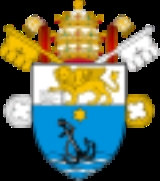
Papal coat of arms

The papal arms
Papal coat of arms

For at least 800 years, each Pope has had his own personal coat of arms that serves as a symbol of his papacy. The first Pope whose arms are known with certainty is Pope Innocent IV ....
 of Pius X are composed of the traditional elements of all papal heraldry
Heraldry

Heraldry is the profession, study, or art of devising, granting, and blazoning Coat of arms and ruling on questions of rank or protocol, as exercised by an officer of arms....
 prior to Pope Benedict XVI
Pope Benedict XVI

Pope Benedict XVI is the List of popes and reigning Pope, by virtue of his office of Bishop of Rome, the head of the Roman Catholic Church and, as such, monarch of the Vatican City....
: the shield, the papal tiara
Papal Tiara

The Papal Tiara, also known as the Triple Tiara, or in Latin language as the 'Triregnum', and in Italian language as the 'Triregno', is the three-tiered Gemstone papal Crown , supposedly of Byzantine Empire and Persian Empire origin, that is a prominent symbol of the Pope....
, and the keys
Papal regalia and insignia

Papal regalia and insignia are the official items of attire and decoration proper to the Pope in his capacity as the head of the Roman Catholic Church and Monarch of the Vatican City....
. The tiara and keys are typical symbols used in the coats of arms of pontiffs, which symbolize their authority.

The shield of Pius X's coat of arms is charged in two basic parts, as it is per fess. In chief (the top part of the shield) shows the arms of the Patriarch of Venice, which Pius X was from 1893–1903. It consists of the lion of St. Mark proper and haloed in silver upon a silver-white background, displaying a book with the inscription of PAX TIBI MARCE, which refers to the motto of Venice Pax tibi Marce, Evangelista meus, which is Latin for Peace to you, Mark my evangelist. This motto refers to Venice as the final resting place of Saint Mark. Renditions of this part of Pius X's arms depict the lion either with or without a sword, and sometimes only one side of the book is written on.

The shield displays the arms Pius X took as Bishop of Mantua: an anchor proper cast into a stormy sea (the blue and silver wavy lines), lit up by a single six-pointed star of gold. These were inspired by Hebrews 6:19, which states that the hope we have is the sure and steadfast anchor of the soul. Pius X, then Bishop Sarto, stated that "hope is the sole companion of my life, the greatest support in uncertainty, the strongest power in situations of weakness."

Although not present upon his arms, the only motto attributed to Pope Pius X is the one for which he is best remembered: instaurare omnia in Christo (Latin for "To restore all things in Christ"). These words were the last he spoke before he died.

Sources

    • Rafael Cardinal Merry del Val, Pope Pius X, Rome, Vatican 1920
    • Catechismo della dottrina Cristiana, Pubblicato per Ordine del Sommo Pontifice San Pio X, Il Sabato, 1999
    • The Catechism of St.Pius http://www.stjamescatholic.org/ebooks/catechism_st_pp_pius_x.pdf


See also

  • St. Pius X Seminary
    St. Pius X Seminary

    St. Pius X Seminary is a Roman Catholic seminary located in Lawaan, Roxas City, Capiz in the Philippines. File:Ggerergdfggdr.JPGThe seminary is situated in the heart of the Lawaan hills on the top of a knoll rising more than 30 feet above sea level....
    , Philippines
    Philippines

    The Philippines, officially known as the Republic of the Philippines, is a country in Southeast Asia with Manila as its capital city. It comprises 7,107 islands in the western Pacific Ocean....
  • Society of St. Pius X
    Society of St. Pius X

    The Society of St. Pius X is an international Traditionalist Catholic organisation, founded in 1970 by the France Archbishop Marcel Lefebvre....
  • List of Encyclicals of Pope Pius X
    List of Encyclicals of Pope Pius X

    This article contains a list of Encyclicals of Pope Pius X. Pope Pius X issued 17 Papal Encyclicals during his reign as Pope:...
  • Reform of the Roman Breviary by Pope Pius X


Bibliography

  • F. A. Forbes
    F. A. Forbes

    F. A. Forbes was the nom de plume of Mother Frances Alice Monica Forbes, RSCJ, a sister of the Society of the Sacred Heart, Scotland....
    , Pope St. Pius X, London: Burns Oates & Washbourne Ltd 1918/TAN Books and Publishers, Inc (revised 1954)
  • J.O. Smit & G. dal Gal. Beato Pio X, Amsterdam: N.V. Drukkerij De Tijd 1951 (translated by J.H. van der Veldt as St. Pius X Pope, Boston, Mass.: Daughters of St. Paul 1965)
  • G.A. Bavoux, Le porteur de lumière, Paris: Pygmalion 1996


External links