

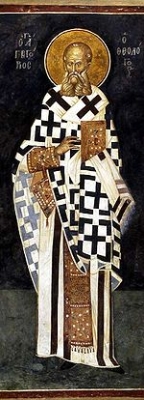
Gregory of Nazianzus

Encyclopedia
Gregory of Nazianzus (also known as Gregory the Theologian or Gregory Nazianzen) was a 4th-century Archbishop
of Constantinople
. He is widely considered the most accomplished rhetorical stylist of the patristic age
. As a classically trained speaker and philosopher he infused Hellenism
into the early church, establishing the paradigm of Byzantine
theologians and church officials.
Gregory made a significant impact on the shape of Trinitarian
theology
among both Greek-
and Latin
-speaking theologians, and he is remembered as the "Trinitarian Theologian". Much of his theological work continues to influence modern theologians, especially in regard to the relationship among the three Persons of the Trinity. Along with the two brothers Basil the Great and Gregory of Nyssa
, he is known as one of the Cappadocian Fathers
.
Gregory is a saint
in both Eastern
and Western Christianity
. In the Roman Catholic Church
he is numbered among the Doctors of the Church
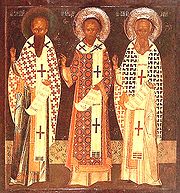
; in Eastern Orthodoxy and the Eastern Catholic Churches he is revered as one of the Three Holy Hierarchs
, along with Basil the Great and John Chrysostom
.
, in southwest Cappadocia
. His parents, Gregory
and Nonna
, were wealthy land-owners. In AD
325 Nonna converted her husband (an hypsistarian) to Christianity; he was subsequently ordained as bishop of Nazianzus in 328 or 329. The young Gregory and his brother, Caesarius, first studied at home with their uncle Amphylokhios. Gregory went on to study advanced rhetoric and philosophy in Nazianzus, Caesarea, Alexandria
and Athens
. On the way to Athens his ship encountered a violent storm, and the terrified Gregory prayed to Christ that if he would deliver him, he would dedicate his life to His service. While at Athens, he developed a close friendship with his fellow student Basil of Caesarea
and also made the acquaintance of Flavius Claudius Julianus, who would later become the emperor known as Julian the Apostate
. In Athens, Gregory studied under the famous rhetoricians Himerius
and Proaeresius. Upon finishing his education, he taught rhetoric in Athens for a short time.
by his father, who wanted him to assist with caring for local Christians. The younger Gregory, who had been considering a monastic existence, resented his father's decision to force him to choose between priestly services and a solitary existence, calling it an "act of tyranny". Leaving home after a few days, he met his friend Basil at Annesoi, where the two lived as ascetics. However, Basil urged him to return home to assist his father, which he did for the next year. Arriving at Nazianzus, Gregory found the local Christian community split by theological differences and his father accused of heresy by local monks. Gregory helped to heal the division through a combination of personal diplomacy and oratory.
By this time Emperor Julian had publicly declared himself in opposition to Christianity. In response to the emperor's rejection of the Christian faith, Gregory composed his Invectives Against Julian between 362 and 363. Invectives asserts that Christianity will overcome imperfect rulers such as Julian through love and patience. This process as described by Gregory is the public manifestation of the process of deification (theosis
), which leads to a spiritual elevation and mystical union with God. Julian resolved, in late 362, to vigorously prosecute Gregory and his other Christian critics; however, the emperor perished the following year during a campaign against the Persians. With the death of the emperor, Gregory and the Eastern churches were no longer under the threat of persecution, as the new emperor Jovian was an avowed Christian and supporter of the church.
Gregory spent the next few years combating Arianism
, which threatened to divide the region of Cappadocia. In this tense environment, Gregory interceded on behalf of his friend Basil with Bishop Eusebius of Caesarea
(Maritima). The two friends then entered a period of close fraternal cooperation as they participated in a great rhetorical contest of the Caesarean church precipitated by the arrival of accomplished Arian theologians and rhetors. In the subsequent public debates, presided over by agents of the emperor Valens
, Gregory and Basil emerged triumphant. This success confirmed for both Gregory and Basil that their futures lay in administration of the church. Basil, who had long displayed inclinations to the episcopacy, was elected bishop of the see of Caesarea in Cappadocia in 370.
in 372 by Basil. This was a see newly created by Basil in order to strengthen his position in his dispute with Anthimus
, bishop of Tyana
. The ambitions of Gregory's father to have his son rise in the church hierarchy and the insistence of his friend Basil convinced Gregory to accept this position despite his reservations. Gregory would later refer to his episcopal ordination as forced upon him by his strong-willed father and Basil. Describing his new bishopric, Gregory lamented how it was nothing more than an "utterly dreadful, pokey little hole; a paltry horse-stop on the main road... devoid of water, vegetation, or the company of gentlemen... this was my Church of Sasima!" He made little effort to administer his new diocese, complaining to Basil that he preferred instead to pursue a contemplative life.
By late 372 Gregory returned to Nazianzus to assist his dying father with the administration of his diocese. This strained his relationship with Basil, who insisted that Gregory assume his post at Sasima. Gregory retorted that he had no intention to continue to play the role of pawn to advance Basil's interests. He instead focused his attention on his new duties as co-adjutor of Nazianzus. It was here that Gregory preached the first of his great episcopal orations.
Following the deaths of his mother and father in 374, Gregory continued to administer the diocese of Nazianzus but refused to be named bishop. Donating most of his inheritance to the needy, he lived an austere existence. At the end of 375 he withdrew to a monastery at Seleukia
, living there for three years. Near the end of this period his friend Basil died. Although Gregory's health did not permit him to attend the funeral, he wrote a heartfelt letter of condolence to Basil's brother, Gregory of Nyssa
and composed twelve memorial poems dedicated to the memory of his departed friend.
, a steadfast supporter of Nicene orthodoxy, was good news to those who wished to purge Constantinople of Arian
and Apollinarian
domination. The exiled Nicene party gradually returned to the city. From his deathbed, Basil reminded them of Gregory's capabilities and likely recommended his friend to champion the trinitarian cause in Constantinople.
In 379, the Antioch synod and its archbishop, Meletios, asked Gregory to go to Constantinople to lead a theological campaign to win over that city to Nicene orthodoxy. After much hesitation, Gregory agreed. His cousin Theodosia offered him a villa for his residence; Gregory immediately transformed much of it into a church, naming it Anastasia, "a scene for the resurrection of the faith". From this little chapel he delivered five powerful discourses on Nicene doctrine, explaining the nature of the Trinity and the unity of the Godhead. Refuting the Eunomion denial of the Holy Spirit's divinity, Gregory offered this argument:
Gregory's homilies were well-received and attracted ever-growing crowds to Anastasia. Fearing his popularity, his opponents decided to strike. On the vigil of Easter in 379, an Arian mob burst into his church during worship services, wounding Gregory and killing another bishop. Escaping the mob, Gregory next found himself betrayed by his erstwhile friend, the philosopher Maximus the Cynic
. Maximus, who was in secret alliance with Peter, bishop of Alexandria, attempted to seize Gregory's position and have himself ordained bishop of Constantinople. Shocked, Gregory decided to resign his office, but the faction faithful to him induced him to stay and ejected Maximus. However, the episode left him embarrassed and exposed him to criticism as a provincial simpleton unable to cope with intrigues of the imperial city.
Affairs in Constantinople remained confused as Gregory's position was still unofficial and Arian priests occupied many important churches. The arrival of the emperor Theodosius in 380 settled matters in Gregory's favor. The emperor, determined to eliminate Arianism, expelled Bishop Demophilus
. Gregory was subsequently enthroned as bishop of Constantinople at the Basilica of the Apostles, replacing Demophilus.
 Theodosius wanted to further unify the entire empire behind the orthodox position and decided to convene a church council to resolve matters of faith and discipline. Gregory was of similar mind, wishing to unify Christianity. In the spring of 381 they convened the Second Ecumenical Council
in Constantinople, which was attended by 150 Eastern bishops. After the death of the presiding bishop, Meletius of Antioch
, Gregory was selected to lead the Council. Hoping to reconcile the West with the East, he offered to recognize Paulinus
as Patriarch of Antioch. The Egyptian and Macedonian bishops who had supported Maximus's ordination arrived late for the Council. Once there, they refused to recognise Gregory's position as head of the church of Constantinople, arguing that his transfer from the See of Sasima was canonically illegitimate.
Gregory was physically exhausted and worried that he was losing the confidence of the bishops and the emperor. Rather than press his case and risk further division, he decided to resign his office: "Let me be as the Prophet Jonah! I was responsible for the storm, but I would sacrifice myself for the salvation of the ship. Seize me and throw me... I was not happy when I ascended the throne, and gladly would I descend it." He shocked the Council with his surprise resignation and then delivered a dramatic speech to Theodosius asking to be released from his offices. The emperor, moved by his words, applauded, commended his labor and granted his resignation. The Council asked him to appear once more for a farewell ritual and celebratory orations. Gregory used this occasion to deliver a final address (Or. 42) and then departed.
Returning to his homeland of Cappadocia, Gregory once again resumed his position as bishop of Nazianzus. He spent the next year combating the local Appolinarian heretics and struggling with periodic illness. He also began composing De Vita Sua, his autobiographical poem. By the end of 383 he found his health too feeble to cope with episcopal duties. Gregory established Eulalius as bishop of Nazianzus and then withdrew into the solitude of Arianzum. After enjoying five peaceful years in retirement at his family estate, he died on January 25 in 389
.
Throughout his life Gregory faced stark choices. Should he pursue studies as a rhetor or philosopher? Would a monastic life be more appropriate than public ministry? Was it better to blaze his own path or follow the course mapped for him by his father and Basil? Gregory's writings illuminate the conflicts which both tormented and motivated him. Biographers suggest that it was this dialectic which defined him, forged his character and inspired his search for meaning and truth.
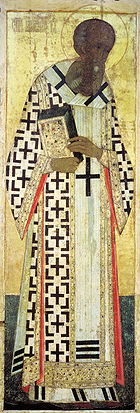
. He is especially noted for his contributions to the field of pneumatology
—that is, theology concerning the nature of the Holy Spirit
. In this regard, Gregory is the first to use the idea of procession to describe the relationship between the Spirit and the Godhead: "The Holy Spirit is truly Spirit, coming forth from the Father indeed but not after the manner of the Son, for it is not by generation but by procession, since I must coin a word for the sake of clearness." Although Gregory does not fully develop the concept, the idea of procession would shape most later thought about the Holy Spirit.
He emphasized that Jesus did not cease to be God when he became a man, nor did he lose any of his divine attributes when he took on human nature. Furthermore, Gregory asserted that Christ was fully human, including a full human soul. He also proclaimed the eternality of the Holy Spirit, saying that the Holy Spirit's actions were somewhat hidden in the Old Testament
but much clearer since the ascension of Jesus into Heaven and the descent of the Holy Spirit at the feast of Pentecost.
In contrast to the Neo-Arian belief that the Son is ahomoios, or "unlike" the Father, and with the Semi-Arian assertion that the Son is homoiousios, or "like" the Father, Gregory and his fellow Cappadocians maintained the Nicaean doctrine of homoousia
, or consubstantiality
of the Son with the Father. The Cappadocian Fathers asserted that God's nature is unknowable to man; helped to develop the framework of hypostases, or three persons united in a single Godhead; illustrated how Jesus is the eikon
of the Father; and explained the concept of theosis
, the belief that all Christians can be assimilated with God in "imitation of the incarnate Son as the divine model."
Some of Gregory's theological writings suggest that, like his friend Gregory of Nyssa
, he may have supported some form of the doctrine of apocatastasis
, the belief that God will bring all of creation into harmony with the Kingdom of Heaven. This led some late-nineteenth century Christian universalists
, notably J. W. Hanson and Philip Schaff
, to describe Gregory's theology as universalist. This view of Gregory is also held by some modern theologians, such as John Sachs
who said that Gregory had "leanings" toward apocatastasis, but in a "cautious, undogmatic" way. However, it is not clear or universally accepted that Gregory held to the doctrine of apocatastasis.
Apart from the several theological discourses, Gregory was also one of the most important early Christian men of letters, a very accomplished orator, perhaps one of the greatest of his time, and also a very prolific poet, writing several poems with theological and moral matter and some with biographical content, about himself and about his friends (one short poem, "Eis ta Emmetra", actually lays down some rules for the composition of poetry).
— a title held by no others save John the Apostle
and Symeon the New Theologian
. He is widely quoted by Eastern Orthodox theologians and highly regarded as a defender of the Christian faith. His contributions to Trinitarian theology
are also influential and often cited in the Western churches. Paul Tillich
credits Gregory of Nazianzus for having "created the definitive formulae for the doctrine of the trinity".
in 950, into the church of the Holy Apostles. Part of the relics were taken from Constantinople by Crusaders during the Fourth Crusade
, in 1204, and ended up in Rome
. On November 27, 2004, those relics, along with those of John Chrysostom
, were returned to Istanbul
(Constantinople
) by Pope John Paul II
, with the Vatican
retaining a small portion of both. The relics are now enshrined in the Patriarchal Cathedral of St. George
in the Fanar
.
Gregory Nazianzen's feast day is on January 2. Previously it was on May 9, a date mistakenly given as that of his death It was ranked as a double in the Tridentine Calendar
, becoming a third-class feast in 1960 and an obligatory memorial in 1969, all of them equivalent ranks.
The Eastern Orthodox Church
and the Eastern Catholic Churches celebrate two feast days in honor of Gregory: January 25 as his primary feast and January 30, known as the feast of the Three Great Hierarchs, which commemorates him along with John Chrysoston and Basil of Caesarea.
The Church of England
commemorates him, with Basil the Great, on January 2; the Episcopal Church
commemorates him on March 9.
Archbishop
An archbishop is a bishop of higher rank, but not of higher sacramental order above that of the three orders of deacon, priest , and bishop...
of Constantinople
Constantinople
Constantinople was the capital of the Roman, Eastern Roman, Byzantine, Latin, and Ottoman Empires. Throughout most of the Middle Ages, Constantinople was Europe's largest and wealthiest city.-Names:...
. He is widely considered the most accomplished rhetorical stylist of the patristic age
Church Fathers
The Church Fathers, Early Church Fathers, Christian Fathers, or Fathers of the Church were early and influential theologians, eminent Christian teachers and great bishops. Their scholarly works were used as a precedent for centuries to come...
. As a classically trained speaker and philosopher he infused Hellenism
Hellenistic philosophy
Hellenistic philosophy is the period of Western philosophy that was developed in the Hellenistic civilization following Aristotle and ending with the beginning of Neoplatonism.-Pythagoreanism:...
into the early church, establishing the paradigm of Byzantine
Byzantine Empire
The Byzantine Empire was the Eastern Roman Empire during the periods of Late Antiquity and the Middle Ages, centred on the capital of Constantinople. Known simply as the Roman Empire or Romania to its inhabitants and neighbours, the Empire was the direct continuation of the Ancient Roman State...
theologians and church officials.
Gregory made a significant impact on the shape of Trinitarian
Trinity
The Christian doctrine of the Trinity defines God as three divine persons : the Father, the Son , and the Holy Spirit. The three persons are distinct yet coexist in unity, and are co-equal, co-eternal and consubstantial . Put another way, the three persons of the Trinity are of one being...
theology
Theology
Theology is the systematic and rational study of religion and its influences and of the nature of religious truths, or the learned profession acquired by completing specialized training in religious studies, usually at a university or school of divinity or seminary.-Definition:Augustine of Hippo...
among both Greek-
Greek language
Greek is an independent branch of the Indo-European family of languages. Native to the southern Balkans, it has the longest documented history of any Indo-European language, spanning 34 centuries of written records. Its writing system has been the Greek alphabet for the majority of its history;...
and Latin
Latin
Latin is an Italic language originally spoken in Latium and Ancient Rome. It, along with most European languages, is a descendant of the ancient Proto-Indo-European language. Although it is considered a dead language, a number of scholars and members of the Christian clergy speak it fluently, and...
-speaking theologians, and he is remembered as the "Trinitarian Theologian". Much of his theological work continues to influence modern theologians, especially in regard to the relationship among the three Persons of the Trinity. Along with the two brothers Basil the Great and Gregory of Nyssa
Gregory of Nyssa
St. Gregory of Nyssa was a Christian bishop and saint. He was a younger brother of Basil the Great and a good friend of Gregory of Nazianzus. His significance has long been recognized in the Eastern Orthodox, Oriental Orthodox, Eastern Catholic and Roman Catholic branches of Christianity...
, he is known as one of the Cappadocian Fathers
Cappadocian Fathers
The Cappadocian Fathers are Basil the Great , who was bishop of Caesarea; Basil's brother Gregory of Nyssa , who was bishop of Nyssa; and a close friend, Gregory of Nazianzus , who became Patriarch of Constantinople...
.
Gregory is a saint
Saint
A saint is a holy person. In various religions, saints are people who are believed to have exceptional holiness.In Christian usage, "saint" refers to any believer who is "in Christ", and in whom Christ dwells, whether in heaven or in earth...
in both Eastern
Eastern Christianity
Eastern Christianity comprises the Christian traditions and churches that developed in the Balkans, Eastern Europe, Asia Minor, the Middle East, Northeastern Africa, India and parts of the Far East over several centuries of religious antiquity. The term is generally used in Western Christianity to...
and Western Christianity
Western Christianity
Western Christianity is a term used to include the Latin Rite of the Catholic Church and groups historically derivative thereof, including the churches of the Anglican and Protestant traditions, which share common attributes that can be traced back to their medieval heritage...
. In the Roman Catholic Church
Roman Catholic Church
The Catholic Church, also known as the Roman Catholic Church, is the world's largest Christian church, with over a billion members. Led by the Pope, it defines its mission as spreading the gospel of Jesus Christ, administering the sacraments and exercising charity...
he is numbered among the Doctors of the Church
Doctor of the Church
Doctor of the Church is a title given by a variety of Christian churches to individuals whom they recognize as having been of particular importance, particularly regarding their contribution to theology or doctrine.-Catholic Church:In the Catholic Church, this name is given to a saint from whose...
; in Eastern Orthodoxy and the Eastern Catholic Churches he is revered as one of the Three Holy Hierarchs
Three Holy Hierarchs
The Three Holy Hierarchs of Eastern Christianity refers to Basil the Great , Gregory the Theologian and John Chrysostom. They were highly influential bishops of the early church who played pivotal roles in shaping Christian theology...
, along with Basil the Great and John Chrysostom
John Chrysostom
John Chrysostom , Archbishop of Constantinople, was an important Early Church Father. He is known for his eloquence in preaching and public speaking, his denunciation of abuse of authority by both ecclesiastical and political leaders, the Divine Liturgy of St. John Chrysostom, and his ascetic...
.
Early life and education
Gregory was born in the family estate of Karbala outside the village of Arianzus, near NazianzusNazianzus
Nazianzus is a Roman Catholic titular metropolitan see in the former Roman province of Cappadocia Tertia.-History:Nazianzus was a small town the history of which is completely unknown...
, in southwest Cappadocia
Cappadocia
Cappadocia is a historical region in Central Anatolia, largely in Nevşehir Province.In the time of Herodotus, the Cappadocians were reported as occupying the whole region from Mount Taurus to the vicinity of the Euxine...
. His parents, Gregory
Gregory of Nazianzus the Elder
Gregory the Elder, or Gregory of Nazianzus the Elder, was the bishop of the see of Nazianzus in Roman province of Cappadocia...
and Nonna
Nonna of Nazianzus
Saint Nonna of Nazianzus was the wife of Gregory of Nazianzus the Elder, and the mother of Gregory the Theologian, Caesarius, and Gorgonia. She lived in Cappadocia, a province of the Roman Empire in present-day central Turkey.-Life:...
, were wealthy land-owners. In AD
Anno Domini
and Before Christ are designations used to label or number years used with the Julian and Gregorian calendars....
325 Nonna converted her husband (an hypsistarian) to Christianity; he was subsequently ordained as bishop of Nazianzus in 328 or 329. The young Gregory and his brother, Caesarius, first studied at home with their uncle Amphylokhios. Gregory went on to study advanced rhetoric and philosophy in Nazianzus, Caesarea, Alexandria
Alexandria
Alexandria is the second-largest city of Egypt, with a population of 4.1 million, extending about along the coast of the Mediterranean Sea in the north central part of the country; it is also the largest city lying directly on the Mediterranean coast. It is Egypt's largest seaport, serving...
and Athens
Athens
Athens , is the capital and largest city of Greece. Athens dominates the Attica region and is one of the world's oldest cities, as its recorded history spans around 3,400 years. Classical Athens was a powerful city-state...
. On the way to Athens his ship encountered a violent storm, and the terrified Gregory prayed to Christ that if he would deliver him, he would dedicate his life to His service. While at Athens, he developed a close friendship with his fellow student Basil of Caesarea
Basil of Caesarea
Basil of Caesarea, also called Saint Basil the Great, was the bishop of Caesarea Mazaca in Cappadocia, Asia Minor . He was an influential 4th century Christian theologian...
and also made the acquaintance of Flavius Claudius Julianus, who would later become the emperor known as Julian the Apostate
Julian the Apostate
Julian "the Apostate" , commonly known as Julian, or also Julian the Philosopher, was Roman Emperor from 361 to 363 and a noted philosopher and Greek writer....
. In Athens, Gregory studied under the famous rhetoricians Himerius
Himerius
Himerius , Greek sophist and rhetorician. 24 of his orations have reached us complete, and fragments of 12 others.- Life and works :...
and Proaeresius. Upon finishing his education, he taught rhetoric in Athens for a short time.
Priesthood
In 361 Gregory returned to Nazianzus and was ordained a presbyterPresbyter
Presbyter in the New Testament refers to a leader in local Christian congregations, then a synonym of episkopos...
by his father, who wanted him to assist with caring for local Christians. The younger Gregory, who had been considering a monastic existence, resented his father's decision to force him to choose between priestly services and a solitary existence, calling it an "act of tyranny". Leaving home after a few days, he met his friend Basil at Annesoi, where the two lived as ascetics. However, Basil urged him to return home to assist his father, which he did for the next year. Arriving at Nazianzus, Gregory found the local Christian community split by theological differences and his father accused of heresy by local monks. Gregory helped to heal the division through a combination of personal diplomacy and oratory.
By this time Emperor Julian had publicly declared himself in opposition to Christianity. In response to the emperor's rejection of the Christian faith, Gregory composed his Invectives Against Julian between 362 and 363. Invectives asserts that Christianity will overcome imperfect rulers such as Julian through love and patience. This process as described by Gregory is the public manifestation of the process of deification (theosis
Theosis
In Christian theology, divinization, deification, making divine or theosis is the transforming effect of divine grace. This concept of salvation is historical and fundamental for Christian understanding that is prominent in the Eastern Orthodox Church and also in the Catholic Church, and is a...
), which leads to a spiritual elevation and mystical union with God. Julian resolved, in late 362, to vigorously prosecute Gregory and his other Christian critics; however, the emperor perished the following year during a campaign against the Persians. With the death of the emperor, Gregory and the Eastern churches were no longer under the threat of persecution, as the new emperor Jovian was an avowed Christian and supporter of the church.
Gregory spent the next few years combating Arianism
Arianism
Arianism is the theological teaching attributed to Arius , a Christian presbyter from Alexandria, Egypt, concerning the relationship of the entities of the Trinity and the precise nature of the Son of God as being a subordinate entity to God the Father...
, which threatened to divide the region of Cappadocia. In this tense environment, Gregory interceded on behalf of his friend Basil with Bishop Eusebius of Caesarea
Eusebius of Caesarea
Eusebius of Caesarea also called Eusebius Pamphili, was a Roman historian, exegete and Christian polemicist. He became the Bishop of Caesarea in Palestine about the year 314. Together with Pamphilus, he was a scholar of the Biblical canon...
(Maritima). The two friends then entered a period of close fraternal cooperation as they participated in a great rhetorical contest of the Caesarean church precipitated by the arrival of accomplished Arian theologians and rhetors. In the subsequent public debates, presided over by agents of the emperor Valens
Valens
Valens was the Eastern Roman Emperor from 364 to 378. He was given the eastern half of the empire by his brother Valentinian I after the latter's accession to the throne...
, Gregory and Basil emerged triumphant. This success confirmed for both Gregory and Basil that their futures lay in administration of the church. Basil, who had long displayed inclinations to the episcopacy, was elected bishop of the see of Caesarea in Cappadocia in 370.
Episcopate in Sasima and Nazianzus
Gregory was ordained Bishop of SasimaSasima
Sasima is a Roman Catholic titular see in the former Roman province of Cappadocia.-History:Sasima is mentioned in only three non-religious documents: "Itiner. Anton.", 144; "Itiner. Hiersol.", 577; Hierocles, 700, 6. The very small town is known for being the first see of St. Gregory of Nazianzus...
in 372 by Basil. This was a see newly created by Basil in order to strengthen his position in his dispute with Anthimus
Anthimus of Tyana
Anthimus of Tyana was a Christian bishop of the Cappadocian city of Tyana. Tyana increased in prominence when Roman Emperor Valens divided Cappadocia into two provinces and Tyana became the capital of Cappadocian Secundus in 371...
, bishop of Tyana
Tyana
Tyana or Tyanna was an ancient city in the Anatolian region of Cappadocia, in modern south-central Turkey. It was the capital of a Luwian-speaking Neo-Hittite kingdom in the 1st millennium BC.-History:...
. The ambitions of Gregory's father to have his son rise in the church hierarchy and the insistence of his friend Basil convinced Gregory to accept this position despite his reservations. Gregory would later refer to his episcopal ordination as forced upon him by his strong-willed father and Basil. Describing his new bishopric, Gregory lamented how it was nothing more than an "utterly dreadful, pokey little hole; a paltry horse-stop on the main road... devoid of water, vegetation, or the company of gentlemen... this was my Church of Sasima!" He made little effort to administer his new diocese, complaining to Basil that he preferred instead to pursue a contemplative life.
By late 372 Gregory returned to Nazianzus to assist his dying father with the administration of his diocese. This strained his relationship with Basil, who insisted that Gregory assume his post at Sasima. Gregory retorted that he had no intention to continue to play the role of pawn to advance Basil's interests. He instead focused his attention on his new duties as co-adjutor of Nazianzus. It was here that Gregory preached the first of his great episcopal orations.
Following the deaths of his mother and father in 374, Gregory continued to administer the diocese of Nazianzus but refused to be named bishop. Donating most of his inheritance to the needy, he lived an austere existence. At the end of 375 he withdrew to a monastery at Seleukia
Silifke
-Antiquity:Located a few miles from the mouth of the Calycadnus River, Seleucia was founded by Seleucus I Nicator in the early 3rd century BCE, one of several cities he named after himself. It is probable that there were already towns called Olbia and Hyria and that Seleucus I merely united them...
, living there for three years. Near the end of this period his friend Basil died. Although Gregory's health did not permit him to attend the funeral, he wrote a heartfelt letter of condolence to Basil's brother, Gregory of Nyssa
Gregory of Nyssa
St. Gregory of Nyssa was a Christian bishop and saint. He was a younger brother of Basil the Great and a good friend of Gregory of Nazianzus. His significance has long been recognized in the Eastern Orthodox, Oriental Orthodox, Eastern Catholic and Roman Catholic branches of Christianity...
and composed twelve memorial poems dedicated to the memory of his departed friend.
Gregory at Constantinople
Emperor Valens died in 378. The accession of Theodosius ITheodosius I
Theodosius I , also known as Theodosius the Great, was Roman Emperor from 379 to 395. Theodosius was the last emperor to rule over both the eastern and the western halves of the Roman Empire. During his reign, the Goths secured control of Illyricum after the Gothic War, establishing their homeland...
, a steadfast supporter of Nicene orthodoxy, was good news to those who wished to purge Constantinople of Arian
Arianism
Arianism is the theological teaching attributed to Arius , a Christian presbyter from Alexandria, Egypt, concerning the relationship of the entities of the Trinity and the precise nature of the Son of God as being a subordinate entity to God the Father...
and Apollinarian
Apollinarism
Apollinarism or Apollinarianism was a view proposed by Apollinaris of Laodicea that Jesus could not have had a human mind; rather, that Jesus had a human body and lower soul but a divine mind....
domination. The exiled Nicene party gradually returned to the city. From his deathbed, Basil reminded them of Gregory's capabilities and likely recommended his friend to champion the trinitarian cause in Constantinople.
In 379, the Antioch synod and its archbishop, Meletios, asked Gregory to go to Constantinople to lead a theological campaign to win over that city to Nicene orthodoxy. After much hesitation, Gregory agreed. His cousin Theodosia offered him a villa for his residence; Gregory immediately transformed much of it into a church, naming it Anastasia, "a scene for the resurrection of the faith". From this little chapel he delivered five powerful discourses on Nicene doctrine, explaining the nature of the Trinity and the unity of the Godhead. Refuting the Eunomion denial of the Holy Spirit's divinity, Gregory offered this argument:
Gregory's homilies were well-received and attracted ever-growing crowds to Anastasia. Fearing his popularity, his opponents decided to strike. On the vigil of Easter in 379, an Arian mob burst into his church during worship services, wounding Gregory and killing another bishop. Escaping the mob, Gregory next found himself betrayed by his erstwhile friend, the philosopher Maximus the Cynic
Maximus I of Constantinople
Maximus, also known as Maximus I or Maximus the Cynic, was the intrusive archbishop of Constantinople in 380, where he became a rival of Gregory Nazianzus.-Biography:...
. Maximus, who was in secret alliance with Peter, bishop of Alexandria, attempted to seize Gregory's position and have himself ordained bishop of Constantinople. Shocked, Gregory decided to resign his office, but the faction faithful to him induced him to stay and ejected Maximus. However, the episode left him embarrassed and exposed him to criticism as a provincial simpleton unable to cope with intrigues of the imperial city.
Affairs in Constantinople remained confused as Gregory's position was still unofficial and Arian priests occupied many important churches. The arrival of the emperor Theodosius in 380 settled matters in Gregory's favor. The emperor, determined to eliminate Arianism, expelled Bishop Demophilus
Demophilus of Constantinople
Demophilus was bishop of Berea and bishop of Constantinople from 370 until expelled in 380.-Biography:Born of good family in Thessalonica, he was elected by the Arians to the bishopric of Constantinople. The opinion of the populace, however, were much divided...
. Gregory was subsequently enthroned as bishop of Constantinople at the Basilica of the Apostles, replacing Demophilus.
Second Ecumenical Council and retirement to Arianzum
First Council of Constantinople
The First Council of Constantinople is recognized as the Second Ecumenical Council by the Assyrian Church of the East, the Oriental Orthodox, the Eastern Orthodox, the Roman Catholics, the Old Catholics, and a number of other Western Christian groups. It was the first Ecumenical Council held in...
in Constantinople, which was attended by 150 Eastern bishops. After the death of the presiding bishop, Meletius of Antioch
Meletius of Antioch
Saint Meletius of Antioch was a Christian bishop, or Patriarch of Antioch, from 360 until his death. There were contrasting view about his theological position: on the one hand, he was exiled three times under Arian emperors; on the other, he was strongly opposed by those faithful to the memory...
, Gregory was selected to lead the Council. Hoping to reconcile the West with the East, he offered to recognize Paulinus
Paulinus, Bishop of Antioch
Paulinus was a claimant to the See of Antioch from 362 to 388. He was supported by members of the Eustathian party, and was a rival to Meletius of Antioch. The Eustathians objected to Miletius having been consecrated by Arians, and had begun to meet separately...
as Patriarch of Antioch. The Egyptian and Macedonian bishops who had supported Maximus's ordination arrived late for the Council. Once there, they refused to recognise Gregory's position as head of the church of Constantinople, arguing that his transfer from the See of Sasima was canonically illegitimate.
Gregory was physically exhausted and worried that he was losing the confidence of the bishops and the emperor. Rather than press his case and risk further division, he decided to resign his office: "Let me be as the Prophet Jonah! I was responsible for the storm, but I would sacrifice myself for the salvation of the ship. Seize me and throw me... I was not happy when I ascended the throne, and gladly would I descend it." He shocked the Council with his surprise resignation and then delivered a dramatic speech to Theodosius asking to be released from his offices. The emperor, moved by his words, applauded, commended his labor and granted his resignation. The Council asked him to appear once more for a farewell ritual and celebratory orations. Gregory used this occasion to deliver a final address (Or. 42) and then departed.
Returning to his homeland of Cappadocia, Gregory once again resumed his position as bishop of Nazianzus. He spent the next year combating the local Appolinarian heretics and struggling with periodic illness. He also began composing De Vita Sua, his autobiographical poem. By the end of 383 he found his health too feeble to cope with episcopal duties. Gregory established Eulalius as bishop of Nazianzus and then withdrew into the solitude of Arianzum. After enjoying five peaceful years in retirement at his family estate, he died on January 25 in 389
389
Year 389 was a common year starting on Monday of the Julian calendar. At the time, it was known as the Year of the Consulship of Timasius and Promotus...
.
Throughout his life Gregory faced stark choices. Should he pursue studies as a rhetor or philosopher? Would a monastic life be more appropriate than public ministry? Was it better to blaze his own path or follow the course mapped for him by his father and Basil? Gregory's writings illuminate the conflicts which both tormented and motivated him. Biographers suggest that it was this dialectic which defined him, forged his character and inspired his search for meaning and truth.
Legacy
Theological and other works
Gregory's most significant theological contributions arose from his defense of the Nicene doctrine of the TrinityTrinity
The Christian doctrine of the Trinity defines God as three divine persons : the Father, the Son , and the Holy Spirit. The three persons are distinct yet coexist in unity, and are co-equal, co-eternal and consubstantial . Put another way, the three persons of the Trinity are of one being...
. He is especially noted for his contributions to the field of pneumatology
Pneumatology
Pneumatology is the study of spiritual beings and phenomena, especially the interactions between humans and God.Pneuma is Greek for "breath", which metaphorically describes a non-material being or influence....
—that is, theology concerning the nature of the Holy Spirit
Holy Spirit
Holy Spirit is a term introduced in English translations of the Hebrew Bible, but understood differently in the main Abrahamic religions.While the general concept of a "Spirit" that permeates the cosmos has been used in various religions Holy Spirit is a term introduced in English translations of...
. In this regard, Gregory is the first to use the idea of procession to describe the relationship between the Spirit and the Godhead: "The Holy Spirit is truly Spirit, coming forth from the Father indeed but not after the manner of the Son, for it is not by generation but by procession, since I must coin a word for the sake of clearness." Although Gregory does not fully develop the concept, the idea of procession would shape most later thought about the Holy Spirit.
He emphasized that Jesus did not cease to be God when he became a man, nor did he lose any of his divine attributes when he took on human nature. Furthermore, Gregory asserted that Christ was fully human, including a full human soul. He also proclaimed the eternality of the Holy Spirit, saying that the Holy Spirit's actions were somewhat hidden in the Old Testament
Old Testament
The Old Testament, of which Christians hold different views, is a Christian term for the religious writings of ancient Israel held sacred and inspired by Christians which overlaps with the 24-book canon of the Masoretic Text of Judaism...
but much clearer since the ascension of Jesus into Heaven and the descent of the Holy Spirit at the feast of Pentecost.
In contrast to the Neo-Arian belief that the Son is ahomoios, or "unlike" the Father, and with the Semi-Arian assertion that the Son is homoiousios, or "like" the Father, Gregory and his fellow Cappadocians maintained the Nicaean doctrine of homoousia
Homoousian
Homoousian is a technical theological term used in discussion of the Christian understanding of God as Trinity. The Nicene Creed describes Jesus as being homooúsios with God the Father — that is, they are of the "same substance" and are equally God...
, or consubstantiality
Consubstantiality
Consubstantial is an adjective used in Latin Christian christology, coined by Tertullian in Against Hermogenes 44, used to translate the Greek term homoousios...
of the Son with the Father. The Cappadocian Fathers asserted that God's nature is unknowable to man; helped to develop the framework of hypostases, or three persons united in a single Godhead; illustrated how Jesus is the eikon
Icon
An icon is a religious work of art, most commonly a painting, from Eastern Christianity and in certain Eastern Catholic churches...
of the Father; and explained the concept of theosis
Theosis
In Christian theology, divinization, deification, making divine or theosis is the transforming effect of divine grace. This concept of salvation is historical and fundamental for Christian understanding that is prominent in the Eastern Orthodox Church and also in the Catholic Church, and is a...
, the belief that all Christians can be assimilated with God in "imitation of the incarnate Son as the divine model."
Some of Gregory's theological writings suggest that, like his friend Gregory of Nyssa
Gregory of Nyssa
St. Gregory of Nyssa was a Christian bishop and saint. He was a younger brother of Basil the Great and a good friend of Gregory of Nazianzus. His significance has long been recognized in the Eastern Orthodox, Oriental Orthodox, Eastern Catholic and Roman Catholic branches of Christianity...
, he may have supported some form of the doctrine of apocatastasis
Apocatastasis
Apocatastasis is reconstitution, restitution, or restoration to the original or primordial condition.-Etymology and definition:The Liddell and Scott Lexicon entry, gives the following examples of usage:* “τοῦ ἐνδεοῦς” Aristotle MM, 1205a4; into its nature εἰς φύσιν id...
, the belief that God will bring all of creation into harmony with the Kingdom of Heaven. This led some late-nineteenth century Christian universalists
Universal reconciliation
In Christian theology, universal reconciliation is the doctrine that all sinful and alienated human souls—because of divine love and mercy—will ultimately be reconciled to God.Universal salvation may be related to the perception of a problem of Hell, standing opposed to ideas...
, notably J. W. Hanson and Philip Schaff
Philip Schaff
Philip Schaff , was a Swiss-born, German-educated Protestant theologian and a historian of the Christian church, who, after his education, lived and taught in the United States.-Biography:...
, to describe Gregory's theology as universalist. This view of Gregory is also held by some modern theologians, such as John Sachs
John Sachs
John Sachs is a British television presenter, voiceover and commentator known for his narration on the original series of Gladiators and as a long time DJ on London's 95.8 CapitalFM....
who said that Gregory had "leanings" toward apocatastasis, but in a "cautious, undogmatic" way. However, it is not clear or universally accepted that Gregory held to the doctrine of apocatastasis.
Apart from the several theological discourses, Gregory was also one of the most important early Christian men of letters, a very accomplished orator, perhaps one of the greatest of his time, and also a very prolific poet, writing several poems with theological and moral matter and some with biographical content, about himself and about his friends (one short poem, "Eis ta Emmetra", actually lays down some rules for the composition of poetry).
Influence
Gregory's great nephew Nichobulos served as his literary executor, preserving and editing many of his writings. A cousin, Eulalios, published several of Gregory's more noteworthy works in 391. By 400, Rufinius began translating his orations into Latin. As Gregory's works circulated throughout the empire they influenced theological thought. His orations were cited as authoritative by the First Council of Ephesus in 431. By 451 he was designated Theologus, or Theologian by the Council of ChalcedonCouncil of Chalcedon
The Council of Chalcedon was a church council held from 8 October to 1 November, 451 AD, at Chalcedon , on the Asian side of the Bosporus. The council marked a significant turning point in the Christological debates that led to the separation of the church of the Eastern Roman Empire in the 5th...
— a title held by no others save John the Apostle
John the Apostle
John the Apostle, John the Apostle, John the Apostle, (Aramaic Yoħanna, (c. 6 - c. 100) was one of the Twelve Apostles of Jesus. He was the son of Zebedee and Salome, and brother of James, another of the Twelve Apostles...
and Symeon the New Theologian
Symeon the New Theologian
Symeon the New Theologian was a Byzantine Christian monk and poet who was the last of three saints canonized by the Eastern Orthodox church and given the title of "Theologian"...
. He is widely quoted by Eastern Orthodox theologians and highly regarded as a defender of the Christian faith. His contributions to Trinitarian theology
Trinitarian Theology
Trinitarian theology is a way of doing systematic theology that understands the Trinity to be the foundational doctrine that permeates all areas of theology as opposed to one point of doctrine in systematics...
are also influential and often cited in the Western churches. Paul Tillich
Paul Tillich
Paul Johannes Tillich was a German-American theologian and Christian existentialist philosopher. Tillich was one of the most influential Protestant theologians of the 20th century...
credits Gregory of Nazianzus for having "created the definitive formulae for the doctrine of the trinity".
Relics
Following his death, Saint Gregory was buried at Nazianzus. His relics were transferred to ConstantinopleConstantinople
Constantinople was the capital of the Roman, Eastern Roman, Byzantine, Latin, and Ottoman Empires. Throughout most of the Middle Ages, Constantinople was Europe's largest and wealthiest city.-Names:...
in 950, into the church of the Holy Apostles. Part of the relics were taken from Constantinople by Crusaders during the Fourth Crusade
Fourth Crusade
The Fourth Crusade was originally intended to conquer Muslim-controlled Jerusalem by means of an invasion through Egypt. Instead, in April 1204, the Crusaders of Western Europe invaded and conquered the Christian city of Constantinople, capital of the Eastern Roman Empire...
, in 1204, and ended up in Rome
Rome
Rome is the capital of Italy and the country's largest and most populated city and comune, with over 2.7 million residents in . The city is located in the central-western portion of the Italian Peninsula, on the Tiber River within the Lazio region of Italy.Rome's history spans two and a half...
. On November 27, 2004, those relics, along with those of John Chrysostom
John Chrysostom
John Chrysostom , Archbishop of Constantinople, was an important Early Church Father. He is known for his eloquence in preaching and public speaking, his denunciation of abuse of authority by both ecclesiastical and political leaders, the Divine Liturgy of St. John Chrysostom, and his ascetic...
, were returned to Istanbul
Istanbul
Istanbul , historically known as Byzantium and Constantinople , is the largest city of Turkey. Istanbul metropolitan province had 13.26 million people living in it as of December, 2010, which is 18% of Turkey's population and the 3rd largest metropolitan area in Europe after London and...
(Constantinople
Constantinople
Constantinople was the capital of the Roman, Eastern Roman, Byzantine, Latin, and Ottoman Empires. Throughout most of the Middle Ages, Constantinople was Europe's largest and wealthiest city.-Names:...
) by Pope John Paul II
Pope John Paul II
Blessed Pope John Paul II , born Karol Józef Wojtyła , reigned as Pope of the Catholic Church and Sovereign of Vatican City from 16 October 1978 until his death on 2 April 2005, at of age. His was the second-longest documented pontificate, which lasted ; only Pope Pius IX ...
, with the Vatican
Vatican City
Vatican City , or Vatican City State, in Italian officially Stato della Città del Vaticano , which translates literally as State of the City of the Vatican, is a landlocked sovereign city-state whose territory consists of a walled enclave within the city of Rome, Italy. It has an area of...
retaining a small portion of both. The relics are now enshrined in the Patriarchal Cathedral of St. George
Church of St. George, Istanbul
The Church of St. George is the principal Greek Orthodox cathedral still in use in Istanbul, the largest city in Turkey and , the capital of the Byzantine Empire until 1453...
in the Fanar
Fener
Fener is a neighborhood midway up the Golden Horn within the district of Fatih in Istanbul , Turkey. The streets in the area are full of historic wooden houses, churches, and synagogues dating from Byzantine and Ottoman eras. The area's name is a Turkish transliteration of the original Greek φανάρι...
.
Feast day
In the Roman Catholic calendar of saintsRoman Catholic calendar of saints
The General Roman Calendar indicates the days of the year to which are assigned the liturgical celebrations of saints and of the mysteries of the Lord that are to be observed wherever the Roman Rite is used...
Gregory Nazianzen's feast day is on January 2. Previously it was on May 9, a date mistakenly given as that of his death It was ranked as a double in the Tridentine Calendar
Tridentine Calendar
The Tridentine Calendar is the calendar of saints to be honoured in the course of the liturgical year in the official liturgy of the Roman Rite as reformed by Pope Pius V, implementing a decision of the Council of Trent, which entrusted the task to the Pope....
, becoming a third-class feast in 1960 and an obligatory memorial in 1969, all of them equivalent ranks.
The Eastern Orthodox Church
Eastern Orthodox Church
The Orthodox Church, officially called the Orthodox Catholic Church and commonly referred to as the Eastern Orthodox Church, is the second largest Christian denomination in the world, with an estimated 300 million adherents mainly in the countries of Belarus, Bulgaria, Cyprus, Georgia, Greece,...
and the Eastern Catholic Churches celebrate two feast days in honor of Gregory: January 25 as his primary feast and January 30, known as the feast of the Three Great Hierarchs, which commemorates him along with John Chrysoston and Basil of Caesarea.
The Church of England
Church of England
The Church of England is the officially established Christian church in England and the Mother Church of the worldwide Anglican Communion. The church considers itself within the tradition of Western Christianity and dates its formal establishment principally to the mission to England by St...
commemorates him, with Basil the Great, on January 2; the Episcopal Church
Episcopal Church (United States)
The Episcopal Church is a mainline Anglican Christian church found mainly in the United States , but also in Honduras, Taiwan, Colombia, Ecuador, Haiti, the Dominican Republic, Venezuela, the British Virgin Islands and parts of Europe...
commemorates him on March 9.
See also
- Saint Basil
- List of Constantinople patriarchs
- Ecumenical Patriarch of Constantinople
Further reading
- Michael Azkoul, "St. Gregory the Theologian: Poetry and Faith," Patristic and Byzantine Review 14.1–3 (1995): 59–68.
- Brian Daley, ed., Gregory Nazianzen. Early Church Fathers. London: Routledge, an imprint of Taylor & Francis Books, 2005. ISBN 0-415-12181-7, pp. 192.
- K. Demoen, "Biblical vs. Non-Biblical Vocabulary in Gregorius Nazianzenus; a Quantitative Approach," Informatique 2 (1988–89): 243–53.
- J. Egan, "Gregory of Nazianzus and the Logos Doctrine," J. Plevnic, ed., Word and Spirit: Essays in Honor of David Michael Stanley. Willowdale, ON: 1975. pp. 281–322.
- Anna-Stina Ellverson, The Dual Nature of Man: A Study in the Theological Anthropology of Gregory of Nazianzus. Acta Universitatis Upsaliensis, 1981. ISBN 91-554-1206-8. {Amazon.com}
- Gerald Fitzpatrick, "St Gregory Nazianzen: Education for Salvation," Patristic and Byzantine Review 10.1–2 (1991): 47–55.
- R.C. Gregg, Consolation Philosophy: Greek and Christian Paideia in Basil and the Two Gregories. Washington, DC: Catholic University of America Press, 1975. ISBN 0-8132-1000-3. {Amazon.com}
- Edward R. Hardy, ed. Christology of the Later Fathers, J. Baillie et al., eds. Library of Christian Classics, Vol. 3. Philadelphia: Westminster, 1995. Pbk. ISBN 0-664-24152-2
- Carol Harrison & Brian Daley (Editor). Gregory Nazianzen. Routledge, 1999. ISBN 0-415-12181-7
- V. Harrison, "Some Aspects of Saint Gregory (Nazianzen) the Theologian's Soteriology," Greek Orthodox Theological Review 34 (1989): 19–43/11–8.
- Susan R. Holman, "Healing the Social Leper in Gregory of Nyssa's and Gregory of Nazianzus's peri philoptochias," Harvard Theological ReviewHarvard Theological ReviewHarvard Theological Review is a journal of theology, published by Harvard Divinity School. It was founded in 1908.-External links:* * * * at the Internet Archive...
92.3 (1999): 283–309. - M. Edmund Hussey,."The Theology of the Holy Spirit in the Writings of St. Gregory of Nazianzus," Diakonia 14.3 (1979): 224–233.
- George A. Kennedy, Greek Rhetoric Under Christian Emperors. Princeton: Princeton University Press, 1983. ISBN 0-691-03565-2. pp. 215–239. {Amazon.com}
- Vasiliki Limberis, ."'Religion' as the Cipher for Identity: The Cases of Emperor Julian, Libanius, and Gregory Nazianzus," Harvard Theological ReviewHarvard Theological ReviewHarvard Theological Review is a journal of theology, published by Harvard Divinity School. It was founded in 1908.-External links:* * * * at the Internet Archive...
93.4 (2000): 373–400. - N.B. McLynn, "The Other Olympias: Gregory of Nazianzen and the Family of Vitalianus," ZAC 2 (1998): 227–46.
- Ruth Majercik, "A Reminiscence of the Chaldean Oracles at Gregory of Nazianzus, Or. 29,2," Vigiliae Christianae 52.3 (1998): 286–292.
- P.J. Maritz, "Logos Articulation in Gregory of Nazianzus," Acta Patristica et Byzantina 6 (1995): 99–108.
- E.P. Meijuring, "The Doctrine of the Will and the Trinity in the Orations of Gregory of Nazianzus," Nederlands Theologisch Tijdschrift 27.3 (1973): 224–34.
- Celica Milovanovic-Barham, "Gregory of Nazianzus: Ars Poetica (In suos versus: Carmen 2.1.39)," Journal of Early Christian StudiesJournal of Early Christian StudiesThe Journal of Early Christian Studies is an academic journal founded in 1993 and is the official publication of the North American Patristics Society. It is devoted to the study of patristics, that is Christianity in the ancient period of roughly C.E. 100-700. The current editor is David Brakke of...
5.4 (1997): 497–510. - H. Musurillo, "The Poetry of Gregory of Nazianzus," Thought 45 (1970): 45–55.
- T.A. Noble, "Gregory Nazianzen's Use of Scripture in Defence of the Deity of the Spirit," Tyndale BulletinTyndale BulletinThe Tyndale Bulletin is an academic journal published by Tyndale House in Cambridge....
39 (1988): 101–23. - F.W. Norris, "Of Thorns and Roses: The Logic of Belief in Gregory of Nazianzen," Church History, Vol. 53 (1984): 455–64.
- F.W. Norris, "The Tetragrammaton in Gregory Nazianzen (Or. 30.17)," Vigiliae Christianae 43 (1989): 339–44.
- F.W. Norris, Faith Gives Fullness to Reasoning: The Five Theological Orations of Gregory Nazianzen. Supplements to Vigiliae Christianae, Vol 13. Leiden: Brill, 1990. ISBN 90-04-09253-6. p. 314. {Amazon.com}
- Jay Wesley Richards, "Can a Male Savior Save Women?: Gregory of Nazianzus on the Logos' Assumption of Human Nature," Christian Scholar's Review 28.1 (1998): 42–57.
- K. Skurat, "St. Gregory of Nazianzus on Philosophy and Knowledge of God," Journal of Moscow Patriarchate 10 (October 1989): 57–62.
- Frank Thielman, "The Place of the Apocalypse in the Canon of St Gregory Nazianzen," Tyndale BulletinTyndale BulletinThe Tyndale Bulletin is an academic journal published by Tyndale House in Cambridge....
49.1 (1998): 155–7. - Steven Peter Tsichlis, "The Nature of Theology in the Theological Orations of St. Gregory Nazianzus," Diakonia 16.3 (1981): 238–46.
- Raymond Van Dam, "Self-Representation in the Will of Gregory of Nazianzus," Journal of Theological Studies 46.1 (1995): 118–48.
- Kenneth Paul Wesche, "The Union of God and Man in Jesus Christ in the Thought of Gregory of Nazianzus," St. Vladimir's Theological Quarterly 28.2 (1984): 83–98.
- Donald F. Winslow, "Gregory of Nazianzus and Love for the Poor," Anglican Theological Review 47 (1965): 348–59.
- Donald F. Winslow, The Dynamics of Salvation: A Study in Gregory of Nazianzus. Cambridge, MA: North American Patristic Society, 1979. ISBN 0-915646-06-4.
External links
Links to English translations of works from Gr. of Nazianzus, website documentacatholicaomnia (Opera Omnia by Migne Patrologia Graeca with analytical indexes).- Louvain-la-Neuve University hosts an important website NAZIANZOS devoted to the study of Gregory Nazianzene's works in Greek and other ancient languages.
- The Theology of St. Gregory
- Early Church Fathers: Gregory of Nazianzus
- Greek texts with commentaries: Arthur James Mason, The five theological orations of Gregory of Nazianzus, Cambridge, 1899
- Unabridged audiobook at LibriVoxLibriVoxLibriVox is an online digital library of free public domain audiobooks, read by volunteers and is probably, since 2007, the world's most prolific audiobook publisher...