


Pope Clement VIII

Encyclopedia
Pope Clement VIII born Ippolito Aldobrandini, was Pope
from 30 January 1592 to 3 March 1605.
. Pope Sixtus V
named him major penitentiary
in January 1586 and in 1588 sent him as legate in Poland
. He placed himself under the direction of the reformer Philip Neri
, who for thirty years was his confessor. Aldobrandini won the gratitude of the Habsburg
s by his successful diplomatic efforts in Poland to obtain the release of the imprisoned Archduke Maximilian, the defeated claimant to the Polish throne.
(1591), another stormy conclave
ensued, where a determined minority of Italian Cardinals were unwilling to be dictated to by Philip II of Spain
. Cardinal Aldobrandini's election on 30 January 1592, was received as a portent of more balanced and liberal Papal policy in European affairs. He took the non-politicised name Clement VIII. He proved to be an able Pope, with an unlimited capacity for work and a lawyer's eye for detail, and a wise statesman, the general object of whose policy was to free the Papacy from its dependence upon Spain
.
In 1597, he established the Congregatio de Auxiliis
which was to settle the theological controversy between the Dominican Order
and the Jesuits
concerning the respective role of efficacious grace and free will
. Although the debate tended toward a condemnation of Molinism
's insistence on free will to the detriment of efficacious grace, the important influence of the Jesuit Order — among other considerations — which, beside important political and theological power in Europe, had also various missions abroad (Jesuit Reducciones in South America, missions in China
, etc.), led the Pope to abstain from an official condemnation of the Jesuits. In 1611 and again in 1625 a decree prohibited any discussion of the matter, although it was often informally avoided by the publication of commentaries on Thomas Aquinas
.
of 1600, three million pilgrims visited the holy places. The Synod of Brest was held 1595 in Lithuania
, by which a great part of the Ruthenia
n clergy and people were reunited to Rome.
Clement VIII presided at the conferences to determine the questions of grace
and free will
, controverted between the Jesuits and Dominicans
, were commenced under him, but he abstained from pronouncing a decision.
(17 April 1594), Julian of Cuenca
(18 October 1594), and Raymond of Peñafort
(1601).
(1589–1610), after long negotiations, carried on with great dexterity through Cardinal Arnaud d'Ossat
, that resolved the complicated situation in France. Henry embraced Catholicism on 25 July 1593. After a pause to assess Henry IV's sincerity, Clement VIII braved Spanish displeasure, and in the autumn of 1595 he solemnly absolved Henry IV, thus putting an end to the thirty years' religious war in France
and winning a powerful ally.
, died childless (27 October 1597), and the Pope resolved to attach the stronghold of the Este
family to the states of the Church. Though Spain and the Empire
encouraged Alfonso II's illegitimate cousin, Cesare d'Este
, to withstand the Pope, they were deterred from giving him any material aid by Henry IV's threats, and a papal army entered Ferrara almost unopposed.
which put an end to their long contest, and he negotiated peace between France and Savoy
as well.
, which would become known as ""The Long War
" and would continue past Clement's own lifetime. Facilitated by the Pope, a treaty of alliance was signed in Prague
by the Holy Roman Emperor
, Rudolf II
and Sigismund Báthory
of Transylvania. Aron Vodă of Moldavia
and Michael the Brave of Wallachia joined the alliance later that year. Clement VIII himself lent the Emperor valuable assistance in men and money.
(1585–90) in crushing banditry in the papal provinces of Umbria and the Marche and in punishing the lawlessness of the Roman nobility. Upon his ascension to the papal throne in 1592, he immediately had several noble troublemakers put to death. These included most famously Troio Savelli, scion of a powerful ancient Roman family, and the youthful and noble Beatrice Cenci
, who had murdered her father - probably as a consequence of his repeated abuses. The latter case prompted many requests of clemency - rejected by the Pope, who passed the confiscated Cenci property to his own family.
Clement's strict ways also concerned philosophical and religious matters. In 1599 he ordered the Italian miller Menocchio
- who had formed the belief that God was not eternal but had Himself once been created out of chaos - to be burned at the stake. A more famous case was the trial for heresy
of the philosopher Giordano Bruno
, who was burned at the stake
in 1600, to the lasting horror of liberal contemporaries and historians. Pope Clement VIII participated personally in the final phases of the trial, inviting the Cardinals
in charge of the case to proceed with the verdict, in practice condemning Bruno to death.
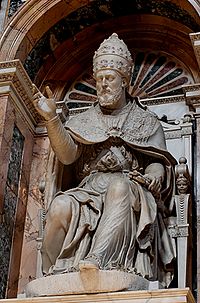 Clement VIII was afflicted by gout
, and was forced to spend much of his later life immobilized in bed. He died in March of 1605, leaving a reputation for prudence, munificence, ruthlessness and capacity for business. Clement was buried in St. Peter's Basilica
, and later Pope Paul V
(1605–21) had a mausoleum built for him in the Borghese Chapel of Santa Maria Maggiore, where the remains were transferred in 1646.
His reign is especially distinguished by the number and beauty of his medals. Clement VIII founded the Collegio Clementino
for the education of the sons of the richer classes, and augmented the number of national colleges in Rome by opening the Collegio Scozzese for the training of missionaries to Scotland
.
Coffee
aficionados often claim that the spread of its popularity is due to Pope Clement VIII's influence. Being pressured by his advisers to declare coffee the "bitter invention of Satan
" because of its popularity among Muslims and it being a sort of antithesis or substitute for wine
(which was used in the Eucharist
), upon tasting it he instead declared that, "This devil's drink is so delicious...we should cheat the devil by baptizing it." The year often cited is 1600. It is not clear whether this is a true story, but it may have been found amusing at the time.
in the album The Metal Opera
(2000) by German heavy metal band Avantasia
, where he plays vital role in the fantasy
-styled plot. However the character is rather loosely based on the real person, and as such the Pope is shown in rather negative light, impersonating hipocrisy, intolerance and blind lust for power.
According to the Polish legend, Clemens was a became a fan of beer made in Warka
. While he got sick in Rome, he asked for "piva di Varva" (beer from Warka); the monks around him though he was praying thus chanted "Santa Piva ora pro nobi"
(Saint Beer; pray for us).
Pope
The Pope is the Bishop of Rome, a position that makes him the leader of the worldwide Catholic Church . In the Catholic Church, the Pope is regarded as the successor of Saint Peter, the Apostle...
from 30 January 1592 to 3 March 1605.
Cardinal
He was made Cardinal-Priest of S. Pancrazio in 1585 by Pope Gregory XIIIPope Gregory XIII
Pope Gregory XIII , born Ugo Boncompagni, was Pope from 1572 to 1585. He is best known for commissioning and being the namesake for the Gregorian calendar, which remains the internationally-accepted civil calendar to this date.-Youth:He was born the son of Cristoforo Boncompagni and wife Angela...
. Pope Sixtus V
Pope Sixtus V
Pope Sixtus V , born Felice Peretti di Montalto, was Pope from 1585 to 1590.-Early life:The chronicler Andrija Zmajević states that Felice's family originated from modern-day Montenegro...
named him major penitentiary
Apostolic Penitentiary
The Apostolic Penitentiary, formerly called the Supreme Tribunal of the Apostolic Penitentiary, is one of the three tribunals of the Roman Curia. The Apostolic Penitentiary is chiefly a tribunal of mercy, responsible for issues relating to the forgiveness of sins in the Catholic Church.The...
in January 1586 and in 1588 sent him as legate in Poland
Poland
Poland , officially the Republic of Poland , is a country in Central Europe bordered by Germany to the west; the Czech Republic and Slovakia to the south; Ukraine, Belarus and Lithuania to the east; and the Baltic Sea and Kaliningrad Oblast, a Russian exclave, to the north...
. He placed himself under the direction of the reformer Philip Neri
Philip Neri
Saint Philip Romolo Neri , also known as Apostle of Rome, was an Italian priest, noted for founding a society of secular priests called the "Congregation of the Oratory".-Early life:...
, who for thirty years was his confessor. Aldobrandini won the gratitude of the Habsburg
Habsburg
The House of Habsburg , also found as Hapsburg, and also known as House of Austria is one of the most important royal houses of Europe and is best known for being an origin of all of the formally elected Holy Roman Emperors between 1438 and 1740, as well as rulers of the Austrian Empire and...
s by his successful diplomatic efforts in Poland to obtain the release of the imprisoned Archduke Maximilian, the defeated claimant to the Polish throne.
Election
After the death of Pope Innocent IXPope Innocent IX
Pope Innocent IX , born Giovanni Antonio Facchinetti, was Pope from 29 October 1591 to his death on 30 December of the same year...
(1591), another stormy conclave
Papal conclave, 1592
The Papal conclave of January 10 – January 30, 1592 was the papal conclave that elected Pope Clement VIII in succession to Pope Innocent IX.- Death of Innocent IX:...
ensued, where a determined minority of Italian Cardinals were unwilling to be dictated to by Philip II of Spain
Philip II of Spain
Philip II was King of Spain, Portugal, Naples, Sicily, and, while married to Mary I, King of England and Ireland. He was lord of the Seventeen Provinces from 1556 until 1581, holding various titles for the individual territories such as duke or count....
. Cardinal Aldobrandini's election on 30 January 1592, was received as a portent of more balanced and liberal Papal policy in European affairs. He took the non-politicised name Clement VIII. He proved to be an able Pope, with an unlimited capacity for work and a lawyer's eye for detail, and a wise statesman, the general object of whose policy was to free the Papacy from its dependence upon Spain
Spain
Spain , officially the Kingdom of Spain languages]] under the European Charter for Regional or Minority Languages. In each of these, Spain's official name is as follows:;;;;;;), is a country and member state of the European Union located in southwestern Europe on the Iberian Peninsula...
.
In 1597, he established the Congregatio de Auxiliis
Congregatio de Auxiliis
The Congregatio de Auxiliis was a commission established by Pope Clement VIII to settle a theological controversy regarding divine grace that arose between the Dominicans and the Jesuits towards the close of the sixteenth century...
which was to settle the theological controversy between the Dominican Order
Dominican Order
The Order of Preachers , after the 15th century more commonly known as the Dominican Order or Dominicans, is a Catholic religious order founded by Saint Dominic and approved by Pope Honorius III on 22 December 1216 in France...
and the Jesuits
Society of Jesus
The Society of Jesus is a Catholic male religious order that follows the teachings of the Catholic Church. The members are called Jesuits, and are also known colloquially as "God's Army" and as "The Company," these being references to founder Ignatius of Loyola's military background and a...
concerning the respective role of efficacious grace and free will
Free will
"To make my own decisions whether I am successful or not due to uncontrollable forces" -Troy MorrisonA pragmatic definition of free willFree will is the ability of agents to make choices free from certain kinds of constraints. The existence of free will and its exact nature and definition have long...
. Although the debate tended toward a condemnation of Molinism
Molinism
Molinism, named after 16th Century Jesuit theologian Luis de Molina, is a religious doctrine which attempts to reconcile the providence of God with human free will. William Lane Craig is probably its best known advocate today, though other important Molinists include Alfred Freddoso, Alvin...
's insistence on free will to the detriment of efficacious grace, the important influence of the Jesuit Order — among other considerations — which, beside important political and theological power in Europe, had also various missions abroad (Jesuit Reducciones in South America, missions in China
Jesuit China missions
The history of the missions of the Jesuits in China is part of the history of relations between China and the Western world. The missionary efforts and other work of the Society of Jesus, or Jesuits, between the 16th and 17th century played a significant role in continuing the transmission of...
, etc.), led the Pope to abstain from an official condemnation of the Jesuits. In 1611 and again in 1625 a decree prohibited any discussion of the matter, although it was often informally avoided by the publication of commentaries on Thomas Aquinas
Thomas Aquinas
Thomas Aquinas, O.P. , also Thomas of Aquin or Aquino, was an Italian Dominican priest of the Catholic Church, and an immensely influential philosopher and theologian in the tradition of scholasticism, known as Doctor Angelicus, Doctor Communis, or Doctor Universalis...
.
Jubilee of 1600
During the jubileeJubilee (Christian)
The concept of the Jubilee is a special year of remission of sins and universal pardon. In the Biblical Book of Leviticus, a Jubilee year is mentioned to occur every fifty years, in which slaves and prisoners would be freed, debts would be forgiven and the mercies of God would be particularly...
of 1600, three million pilgrims visited the holy places. The Synod of Brest was held 1595 in Lithuania
Lithuania
Lithuania , officially the Republic of Lithuania is a country in Northern Europe, the biggest of the three Baltic states. It is situated along the southeastern shore of the Baltic Sea, whereby to the west lie Sweden and Denmark...
, by which a great part of the Ruthenia
Ruthenia
Ruthenia is the Latin word used onwards from the 13th century, describing lands of the Ancient Rus in European manuscripts. Its geographic and culturo-ethnic name at that time was applied to the parts of Eastern Europe. Essentially, the word is a false Latin rendering of the ancient place name Rus...
n clergy and people were reunited to Rome.
Clement VIII presided at the conferences to determine the questions of grace
Divine grace
In Christian theology, grace is God’s gift of God’s self to humankind. It is understood by Christians to be a spontaneous gift from God to man - "generous, free and totally unexpected and undeserved" - that takes the form of divine favour, love and clemency. It is an attribute of God that is most...
and free will
Free will
"To make my own decisions whether I am successful or not due to uncontrollable forces" -Troy MorrisonA pragmatic definition of free willFree will is the ability of agents to make choices free from certain kinds of constraints. The existence of free will and its exact nature and definition have long...
, controverted between the Jesuits and Dominicans
Dominican Order
The Order of Preachers , after the 15th century more commonly known as the Dominican Order or Dominicans, is a Catholic religious order founded by Saint Dominic and approved by Pope Honorius III on 22 December 1216 in France...
, were commenced under him, but he abstained from pronouncing a decision.
Canonisations and beatifications
Clement VIII canonised HyacinthSaint Hyacinth
Saint Hyacinth, O.P., was educated in Paris and Bologna. A Doctor of Sacred Studies and a secular priest, he worked to reform women's monasteries in his native Poland...
(17 April 1594), Julian of Cuenca
Julian of Cuenca
Saint Julian of Cuenca was the second bishop of Cuenca, Spain, and was also a professor, hermit, priest, and preacher. -Biography:...
(18 October 1594), and Raymond of Peñafort
Raymond of Peñafort
Saint Raymond of Penyafort, O.P. is a Dominican friar who compiled the Decretals of Gregory IX, a collection of canon laws that remained part of church law until the Code of Canon Law was promulgated in 1917...
(1601).
Reconciliation with France
The most remarkable event of Clement VIII's reign was the reconciliation to the Church of Henry IV of FranceHenry IV of France
Henry IV , Henri-Quatre, was King of France from 1589 to 1610 and King of Navarre from 1572 to 1610. He was the first monarch of the Bourbon branch of the Capetian dynasty in France....
(1589–1610), after long negotiations, carried on with great dexterity through Cardinal Arnaud d'Ossat
Arnaud d'Ossat
Arnaud d'Ossat was a French diplomat and writer, and a Cardinal of the Roman Catholic Church, whose personal tact and diplomatic skill steered the perilous course of French diplomacy with the Papacy in the reign of Henry IV of France.-Early life and studies:Arnaud d'Ossat was born at...
, that resolved the complicated situation in France. Henry embraced Catholicism on 25 July 1593. After a pause to assess Henry IV's sincerity, Clement VIII braved Spanish displeasure, and in the autumn of 1595 he solemnly absolved Henry IV, thus putting an end to the thirty years' religious war in France
France
The French Republic , The French Republic , The French Republic , (commonly known as France , is a unitary semi-presidential republic in Western Europe with several overseas territories and islands located on other continents and in the Indian, Pacific, and Atlantic oceans. Metropolitan France...
and winning a powerful ally.
Expansion of the Papal States
Henry IV's friendship was of essential importance to the Papacy two years later, when Alfonso II, Duke of FerraraFerrara
Ferrara is a city and comune in Emilia-Romagna, northern Italy, capital city of the Province of Ferrara. It is situated 50 km north-northeast of Bologna, on the Po di Volano, a branch channel of the main stream of the Po River, located 5 km north...
, died childless (27 October 1597), and the Pope resolved to attach the stronghold of the Este
Este
The House of Este is a European princely dynasty. It is split into two branches; the elder is known as the House of Welf-Este or House of Welf historically rendered in English, Guelf or Guelph...
family to the states of the Church. Though Spain and the Empire
Holy Roman Empire
The Holy Roman Empire was a realm that existed from 962 to 1806 in Central Europe.It was ruled by the Holy Roman Emperor. Its character changed during the Middle Ages and the Early Modern period, when the power of the emperor gradually weakened in favour of the princes...
encouraged Alfonso II's illegitimate cousin, Cesare d'Este
Cesare d'Este
Cesare d'Este was Duke of Modena and Reggio from 1597 until his death. During his reign, in 1598, the House of Este lost the Duchy of Ferrara.-Biography:...
, to withstand the Pope, they were deterred from giving him any material aid by Henry IV's threats, and a papal army entered Ferrara almost unopposed.
Peace of Vervins
In 1598 Clement VIII won more credit for the papacy by bringing about a definite treaty of peace between Spain and France in the Peace of VervinsPeace of Vervins
The Peace of Vervins was signed between the representatives of Henry IV of France and Philip II of Spain, on 2 May 1598, at the small town of Vervins in Picardy, northern France, close to the territory of the Habsburg Netherlands...
which put an end to their long contest, and he negotiated peace between France and Savoy
Savoy
Savoy is a region of France. It comprises roughly the territory of the Western Alps situated between Lake Geneva in the north and Monaco and the Mediterranean coast in the south....
as well.
War with the Ottoman Empire
In 1595, Clement VIII initiated an alliance of Christian European powers to take part in the war with the Ottoman Empire, fought mainly in HungaryOttoman Hungary
History of Ottoman Hungary refers to the history of parts of the Ottoman Empire situated in what today is Hungary, in the period from 1541 to 1699.-History:...
, which would become known as ""The Long War
Long War (Ottoman wars)
The Long War took place from 1591 or 1593 to 1604 or 1606 and was one of the numerous military conflicts between the Habsburg Monarchy and the Ottoman Empire that developed after the Battle of Mohács.- History :The major participants of this war were the Habsburg Monarchy ,...
" and would continue past Clement's own lifetime. Facilitated by the Pope, a treaty of alliance was signed in Prague
Prague
Prague is the capital and largest city of the Czech Republic. Situated in the north-west of the country on the Vltava river, the city is home to about 1.3 million people, while its metropolitan area is estimated to have a population of over 2.3 million...
by the Holy Roman Emperor
Holy Roman Empire
The Holy Roman Empire was a realm that existed from 962 to 1806 in Central Europe.It was ruled by the Holy Roman Emperor. Its character changed during the Middle Ages and the Early Modern period, when the power of the emperor gradually weakened in favour of the princes...
, Rudolf II
Rudolf II, Holy Roman Emperor
Rudolf II was Holy Roman Emperor , King of Hungary and Croatia , King of Bohemia and Archduke of Austria...
and Sigismund Báthory
Sigismund Báthory
Sigismund Báthory was Prince of Transylvania.-Biography:Hailing from the Báthory family's Somlyó branch, he was the son of Christopher Báthory, Voivod of Transylvania, and nephew of Stephen Báthory, King of Poland...
of Transylvania. Aron Vodă of Moldavia
Moldavia
Moldavia is a geographic and historical region and former principality in Eastern Europe, corresponding to the territory between the Eastern Carpathians and the Dniester river...
and Michael the Brave of Wallachia joined the alliance later that year. Clement VIII himself lent the Emperor valuable assistance in men and money.
Law enforcement
Clement VIII was as vigorous as Pope Sixtus VPope Sixtus V
Pope Sixtus V , born Felice Peretti di Montalto, was Pope from 1585 to 1590.-Early life:The chronicler Andrija Zmajević states that Felice's family originated from modern-day Montenegro...
(1585–90) in crushing banditry in the papal provinces of Umbria and the Marche and in punishing the lawlessness of the Roman nobility. Upon his ascension to the papal throne in 1592, he immediately had several noble troublemakers put to death. These included most famously Troio Savelli, scion of a powerful ancient Roman family, and the youthful and noble Beatrice Cenci
Beatrice Cenci
Beatrice Cenci was an Italian noblewoman. She is famous as the protagonist in a lurid murder trial in Rome....
, who had murdered her father - probably as a consequence of his repeated abuses. The latter case prompted many requests of clemency - rejected by the Pope, who passed the confiscated Cenci property to his own family.
Clement's strict ways also concerned philosophical and religious matters. In 1599 he ordered the Italian miller Menocchio
Menocchio
Menocchio, also known as Domenico Scandella, was a Friulian miller born in 1532 in the village of Montereale, twenty-five kilometers north of Pordenone...
- who had formed the belief that God was not eternal but had Himself once been created out of chaos - to be burned at the stake. A more famous case was the trial for heresy
Heresy
Heresy is a controversial or novel change to a system of beliefs, especially a religion, that conflicts with established dogma. It is distinct from apostasy, which is the formal denunciation of one's religion, principles or cause, and blasphemy, which is irreverence toward religion...
of the philosopher Giordano Bruno
Giordano Bruno
Giordano Bruno , born Filippo Bruno, was an Italian Dominican friar, philosopher, mathematician and astronomer. His cosmological theories went beyond the Copernican model in proposing that the Sun was essentially a star, and moreover, that the universe contained an infinite number of inhabited...
, who was burned at the stake
Burned at the Stake
Burned at the Stake is a 1981 film directed by Bert I. Gordon. It stars Susan Swift and Albert Salmi.-Cast:*Susan Swift as Loreen Graham / Ann Putnam*Albert Salmi as Captaiin Billingham*Guy Stockwell as Dr. Grossinger*Tisha Sterling as Karen Graham...
in 1600, to the lasting horror of liberal contemporaries and historians. Pope Clement VIII participated personally in the final phases of the trial, inviting the Cardinals
Cardinal (Catholicism)
A cardinal is a senior ecclesiastical official, usually an ordained bishop, and ecclesiastical prince of the Catholic Church. They are collectively known as the College of Cardinals, which as a body elects a new pope. The duties of the cardinals include attending the meetings of the College and...
in charge of the case to proceed with the verdict, in practice condemning Bruno to death.
Later life and death
Gout
Gout is a medical condition usually characterized by recurrent attacks of acute inflammatory arthritis—a red, tender, hot, swollen joint. The metatarsal-phalangeal joint at the base of the big toe is the most commonly affected . However, it may also present as tophi, kidney stones, or urate...
, and was forced to spend much of his later life immobilized in bed. He died in March of 1605, leaving a reputation for prudence, munificence, ruthlessness and capacity for business. Clement was buried in St. Peter's Basilica
St. Peter's Basilica
The Papal Basilica of Saint Peter , officially known in Italian as ' and commonly known as Saint Peter's Basilica, is a Late Renaissance church located within the Vatican City. Saint Peter's Basilica has the largest interior of any Christian church in the world...
, and later Pope Paul V
Pope Paul V
-Theology:Paul met with Galileo Galilei in 1616 after Cardinal Bellarmine had, on his orders, warned Galileo not to hold or defend the heliocentric ideas of Copernicus. Whether there was also an order not to teach those ideas in any way has been a matter for controversy...
(1605–21) had a mausoleum built for him in the Borghese Chapel of Santa Maria Maggiore, where the remains were transferred in 1646.
His reign is especially distinguished by the number and beauty of his medals. Clement VIII founded the Collegio Clementino
Collegio Clementino
The Collegio Clementino is a palace in Rome, central Italy, sited between the Strada del'Orso and the banks of the Tiber. It was founded by Pope Clement VIII in 1595, to host Slavonian refugees. Giacomo della Porta was commissioned to erect a suitable building to house them, which would be one of...
for the education of the sons of the richer classes, and augmented the number of national colleges in Rome by opening the Collegio Scozzese for the training of missionaries to Scotland
Scotland
Scotland is a country that is part of the United Kingdom. Occupying the northern third of the island of Great Britain, it shares a border with England to the south and is bounded by the North Sea to the east, the Atlantic Ocean to the north and west, and the North Channel and Irish Sea to the...
.
Coffee
See also: History of coffeeHistory of coffee
The history of coffee goes at least as far back as the thirteenth century. The Kefficho People who were the first to discover and recognize the energizing effect of the coffee bean plant. The story of Kaldi, the 9th-century Ethiopian goatherd who discovered coffee, did not appear in writing until...
Coffee
Coffee
Coffee is a brewed beverage with a dark,init brooo acidic flavor prepared from the roasted seeds of the coffee plant, colloquially called coffee beans. The beans are found in coffee cherries, which grow on trees cultivated in over 70 countries, primarily in equatorial Latin America, Southeast Asia,...
aficionados often claim that the spread of its popularity is due to Pope Clement VIII's influence. Being pressured by his advisers to declare coffee the "bitter invention of Satan
Satan
Satan , "the opposer", is the title of various entities, both human and divine, who challenge the faith of humans in the Hebrew Bible...
" because of its popularity among Muslims and it being a sort of antithesis or substitute for wine
Wine
Wine is an alcoholic beverage, made of fermented fruit juice, usually from grapes. The natural chemical balance of grapes lets them ferment without the addition of sugars, acids, enzymes, or other nutrients. Grape wine is produced by fermenting crushed grapes using various types of yeast. Yeast...
(which was used in the Eucharist
Eucharist
The Eucharist , also called Holy Communion, the Sacrament of the Altar, the Blessed Sacrament, the Lord's Supper, and other names, is a Christian sacrament or ordinance...
), upon tasting it he instead declared that, "This devil's drink is so delicious...we should cheat the devil by baptizing it." The year often cited is 1600. It is not clear whether this is a true story, but it may have been found amusing at the time.
In popular culture
Pope Clement VIII appears as one of dramatis personaeDramatis Personae
Dramatis Personae is a poetry collection by Robert Browning. It was published in 1864.- Background :Browning wrote the collection in London, where he had returned with his son after his wife's death. It was his first publication after a nine-year hiatus...
in the album The Metal Opera
The Metal Opera
The Metal Opera is the first full-length album by Tobias Sammet's side project opera, Avantasia. It is a concept album and a rock opera, and further information on the story can be found here.- Track listing :All music and lyrics by Tobias Sammet...
(2000) by German heavy metal band Avantasia
Avantasia
Avantasia is a heavy metal project created by Tobias Sammet, vocalist and frontman of the band Edguy. The project's title is a portmanteau of the words "avalon" and "fantasia" and describes "a world beyond human imagination"...
, where he plays vital role in the fantasy
Fantasy
Fantasy is a genre of fiction that commonly uses magic and other supernatural phenomena as a primary element of plot, theme, or setting. Many works within the genre take place in imaginary worlds where magic is common...
-styled plot. However the character is rather loosely based on the real person, and as such the Pope is shown in rather negative light, impersonating hipocrisy, intolerance and blind lust for power.
According to the Polish legend, Clemens was a became a fan of beer made in Warka
Warka
Warka is a town in central Poland, located on the left bank of the Pilica river , with 11,035 inhabitants . It has been situated in Grójec County, in the Masovian Voivodeship, since 1999; previously it was in the Radom Voivodeship from 1975 to 1998.Warka obtained its city charter in 1321...
. While he got sick in Rome, he asked for "piva di Varva" (beer from Warka); the monks around him though he was praying thus chanted "Santa Piva ora pro nobi"
(Saint Beer; pray for us).