


History of Korea

Encyclopedia
The Korean Peninsula
was inhabited from the Lower Paleolithic
about 400,000-500,000 years ago. Archeological evidence indicates that the presence of modern humans in northeast Asia dates to 39,000 years ago. The earliest known Korean pottery dates to around 8000 BC, and the Neolithic
period began before 6000 BC, followed by the Bronze Age
around 800 BC, and the Iron Age
begins around 400 BC. Korea is considered to be one of the oldest countries in the world.
In the legend, the Gojoseon
(Old Joseon) kingdom was founded in northern Korea and Manchuria by 2333 BC. The Gija Joseon
was founded in 12th century BC, whose existence became a controversy today. The Jin state forms in southern Korea in the 3rd century BC. Gojoseon was invaded by Han dynasty
in the 2nd century BC which resulted in the fall of Gojoseon later led to successor warring states, Proto–Three Kingdoms period spans the later Iron Age. Since 1st century, Goguryeo
, Baekje
, and Silla
grew to control the peninsula and Manchuria as the Three Kingdoms
(57 BC – 668 AD) until the unification by Silla in 676. In 698, Dae Jo-yeong established Kingdom of Balhae
, which led to the North South States Period
(698–926).
In the late 9th century, Silla was divided into the Later Three Kingdoms (892–936), which ended with the unification of the Goryeo Dynasty. During the Goryeo period, laws were codified, a civil service system was introduced, and Buddhism
flourished.
In 1392, general Yi Seong-gye
established the Joseon Dynasty
(1392–1910) after a coup. King Sejong the Great
(1418–1450) implemented numerous administrative, social, and economical reforms, established royal authority in the early years of the dynasty, and promulgated Hangul
, the Korean alphabet.
In 18th century, Korea was faced with internal strife, power struggles, international pressure, and rebellions at home, and the Joseon Dynasty declined rapidly in the late 19th century. In 1897, Korean Empire
(1897–1910) succeeded Joseon Dynasty. However, Imperial Japan forced the Korean Empire to sign the Eulsa Treaty
and in 1910 annexed the Korean Empire.
Korean resistance
was manifested in the widespread nonviolent March 1st Movement
of 1919 during the occupation. Thereafter the greater resistance movements
, coordinated by the Provisional Government of the Republic of Korea
in exile, was largely active in neighboring Manchuria, China and Siberia
.
After the liberation in 1945, the partition of Korea created the modern two states of North and South Korea. In 1948, new governments were established, the nominally Capitalist South Korea
("Republic of Korea") and Communist North Korea
("Democratic People's Republic of Korea") divided at the 38th parallel. The unresolved tensions of the division surfaced in the Korean War
of 1950, when North Korea invaded South Korea.
 No Homo erectus
has been found in the Korean Peninsula
. However, tool-making artifacts from the Palaeolithic period have been found in present-day North Hamgyong, South P'yongan, Gyeonggi, and north and south Chungcheong Provinces of Korea., which dates the Paleolithic Age to half a million years ago. However, the predominant view is that the Korean people of today are not the ethnic descendants of these Paleolithic inhabitants.
dates back to around 8000 BC or before, and evidence of Mesolithic
Pit-Comb Ware culture
or Yungimun Pottery is found throughout the peninsula. An example of a Yungimun-era site is in Jeju-do
. Jeulmun or Comb-pattern Pottery is found after 7000 BC, and pottery with comb-patterns over the whole vessel is found concentrated at sites in west-central Korea when a number of settlements such as Amsa-dong
existed. Jeulmun pottery bears basic design and form similarities to that of the Russian Maritime Province, Mongolia
, and the Amur and Sungari river basins of Manchuria
and the Jōmon culture in Japan.
(c. 1500–300 BC).
People in southern Korea adopted intensive dry-field and paddy-field
agriculture with a multitude of crops in the Early Mumun Period (1500–850 BC). The first societies led by big-men or chiefs emerged in the Middle Mumun (850–550 BC), and the first ostentatious elite burials can be traced to the Late Mumun (c. 550–300 BC). Bronze production began in the Middle Mumun and became increasingly important in Mumun ceremonial and political society after 700 BC. The Mumun is the first time that villages rose, became large, and then fell: some important examples include Songguk-ri
, Daepyeong
, and Igeum-dong. The increasing presence of long-distance trade, an increase in local conflicts, and the introduction of bronze and iron metallurgy are trends denoting the end of the Mumun around 300 BC.

 Gojoseon
was the first Korea
n kingdom. The founding legend of Gojoseon, which is recorded in the Samguk Yusa
(1281) and other Korean medieval books, states that the country was established in 2333 BC by Dangun
, said to be descended from the heavens. However, no evidence has been found that supports whatever facts may lie beneath this myth.
The first kingdom of Gojoseon in the historical records is Gija Joseon
, which was founded in 12th century BC by Chinese Shang
dynasty descendants named Gija and ended in 195 BC. The relative records can be found in Records of the Grand Historian
in 91 BC, Book of Han
in AD 111, Book of the Later Han in 5th century and Records of Three Kingdoms
in 3rd century.
The historical existence of Gojoseon kingdom probably arose around the 8th century BC in Liaoning
. By about the 4th century BC, the kingdoms of Gojoseon had developed to the point where their existence was known even in China, and around 400 BC moved its capital to Pyongyang
, the capital of modern North Korea
.
In 194 BC, King Jun fled to Jin state after a coup by Wiman
. Later the Han Dynasty
defeated the Wiman Joseon
and set up Four Commanderies of Han
in 108 BC, and Jin later evolved into the Samhan
confederacies.
Many smaller states sprang from the former territory of Gojoseon such as Buyeo
, Okjeo
, Dongye
. Goguryeo
and Baekje
. The Three Kingdoms
refer to Goguryeo
, Baekje
, and Silla
, although Buyeo and the Gaya confederacy
existed into 5th and 6th centuries respectively.
is often held to have begun around 900-800 BC in Korea. Bronze daggers, mirrors, and weaponry have been found, as well as evidence of walled-town polities. Rice, red beans, soybeans and millet were cultivated, and rectangular pit-houses and increasingly larger dolmen
burial sites are found throughout the peninsula. Contemporaneous records suggest that Gojoseon transitioned from a feudal federation of walled cities into a centralised kingdom at least before the 4th century BC.
It is believed that by the 3rd century BC, iron culture was developing and the warring states of China pushed refugees eastward and south. Around this time, a state called Jin
arose in the southern part of the Korean peninsula. Very little is known about Jin, but it established relations with Han China and exported artifacts to the Yayoi of Japan
.

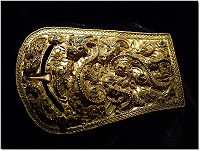 The Proto–Three Kingdoms period, sometimes called the Several States Period (열국시대)
, is the time before the rise of the Three Kingdoms of Korea
, which included Goguryeo
, Silla
, and Baekje
, and occurred after the fall of Gojoseon
. This time period consisted of numerous states that sprang up from the former territories of Gojoseon. Among these states, the largest and most influential were Dongbuyeo
and Bukbuyeo.
, Buyeo
arose in today's North Korea
and southern Manchuria
, from about the 2nd century BC to 494. Its remnants were absorbed by Goguryeo
in 494, and both Goguryeo and Baekje
, two of the Three Kingdoms of Korea
, considered themselves its successor.
Although records are sparse and contradictory, it is thought that in 86 BC, Dongbuyeo
(East Buyeo) branched out, after which the original Buyeo is sometimes referred to as Bukbuyeo (North Buyeo). Jolbon Buyeo
was the predecessor to Goguryeo
, and in 538, Baekje renamed itself Nambuyeo (South Buyeo).
Okjeo
was a tribal state that was located in the northern Korean Peninsula
, and was established after the fall of Gojoseon. Okjeo had been a part of Gojoseon
before its fall. It never became a fully developed kingdom due to the intervention of its neighboring kingdoms. Okjeo became a tributary of Goguryeo, and was eventually annexed into Goguryeo by Gwanggaeto Taewang
in the 5th century.
Dongye
was another small kingdom that was situated in the northern Korean Peninsula
. Dongye bordered Okjeo
, and the two kingdoms faced the same fate of becoming tributaries of the growing empire of Goguryeo
. Dongye was also a former part of Gojoseon
before its fall.
, Jinhan, and Byeonhan. The Samhan were located in the southern region of the Korean Peninsula
. The Han countries were strictly governed by law, with religion playing an important role. Mahan was the largest, consisting of 54 states, and assumed political, economic, and cultural dominance. Byeonhan and Jinhan both consisted of 12 states, bringing a total of 78 states within the Samhan. The Samhan were eventually conquered by Baekje
, Silla
, and Gaya
in the 4th century.
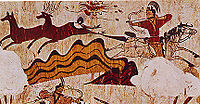
 Goguryeo was founded in 37 BC by Jumong
(posthumous name Dongmyeongseong). Later, King Taejo
centralized the government. Goguryeo was also the first Korean kingdom to adopt Buddhism as the state religion in 372, under King Sosurim
's reign.
Goguryeo reached its zenith in the 5th century, when reign of the King Gwanggaeto
and his son, King Jangsu
expanded into almost all of Manchuria and part of inner Mongolia, and took the Seoul
region from Baekje. Gwanggaeto and Jangsu subdued Baekje and Silla during their times.
Goguryeo later fought and defeated massive Chinese
invasions in the Goguryeo-Sui War of 598 – 614, contributing to Sui
's fall, and continued to repel the Tang dynasty
under several important generals including Yeon Gaesomun
and Yang Manchun
(see Goguryeo–Tang Wars).
However, numerous wars with China exhausted Goguryeo and it fell into a weak state. After internal power struggles, it was conquered by an allied Silla-Tang forces in 668.

's foundation by King Onjo in 18 BC as stated in the Samguk Sagi
, followed those of its neighbors and rivals, Goguryeo
and Silla
.
The Sanguo Zhi mentions Baekje as a member of the Mahan confederacy
in the Han River
basin (near present-day Seoul
). It expanded into the southwest (Chungcheong
and Jeolla
provinces) of the peninsula and became a significant political and military power. In the process, Baekje came into fierce confrontation with Goguryeo and the Chinese commanderies in the vicinity of its territorial ambitions.
At its peak in the 4th century, it had absorbed all of the Mahan states and subjugated most of the western Korean peninsula (including the modern provinces of Gyeonggi, Chungcheong
, and Jeolla
, as well as part of Hwanghae
and Gangwon
) to a centralized government. Baekje acquired Chinese culture and technology through contacts with the Southern Dynasties
during the expansion of its territory.
Baekje played a fundamental role in transmitting cultural developments, such as Chinese characters, Buddhism
, iron-making, advanced pottery
, and ceremonial burial into ancient Japan
. Other aspects of culture were also transmitted when the Baekje court retreated to Japan after Baekje was conquered. Baekje was defeated by a coalition of Silla and Tang Dynasty
forces in 660.
 According to legend, the kingdom Silla
began with the unification of six chiefdoms of the Jinhan confederacy
by Bak Hyeokgeose in 57 BC, in the southeastern area of Korea. Its territory included the present-day port city of Busan
, and Silla later emerged as a sea power responsible for destroying Japanese pirates, especially during the Unified Silla
period.
Silla artifacts, including unique gold metalwork, show influence from the northern nomadic steppes, with less Chinese influence than are shown by Goguryeo and Baekje. Silla expanded rapidly by occupying the Han River
basin and uniting the city states.
By the 2nd century, Silla existed as a large state, occupying and influencing nearby city states. Silla began to gain power when it annexed Gaya confederacy
in 562. Silla often faced pressure from Baekje and Japan, and at various times allied and warred with Baekje and Goguryeo
.
In 660, King Muyeol of Silla
ordered his armies to attack Baekje
. General Kim Yu-shin, aided by Tang
forces, conquered Baekje. In 661, Silla and Tang moved on Goguryeo
but were repelled. King Munmu
, son of Muyeol and nephew of General Kim launched another campaign in 667 and Goguryeo fell in the following year.
was a confederacy of chiefdoms in the Nakdong River
valley of southern Korea
, growing out of the Byeonhan confederacy
of the Samhan
period. Gaya's plains were rich in iron, so export of iron tools to other countries was possible and agriculture flourished. In early centuries, Confederacy led by Geumgwan Gaya
in Gimhae
region. However, its leading power was changed by Daegaya
in Goryeong region after the 5th century.
Constantly engaged in war with the three kingdoms surrounding it, Gaya was not developed to form a unified state, and ultimately absorbed into Silla
in 562.
and Balhae
, during the time when Silla controlled the Korean peninsula while Balhae expanded into Manchuria
. During this time, culture and technology significantly advanced, especially in Unified Silla.
established territories in the former Goguryeo
, and began to administer and establish communities in Baekje
. Silla attacked the Chinese in Baekje and northern Korea in 671, China then invaded Silla in 674 but Silla defeated the Chinese army in the north. Silla drove the Tang forces out of the peninsula by 676 to achieve unification of most of the Three Kingdoms.
Unified Silla was a time when Korean arts flourished dramatically and Buddhism became a large part of Silla culture. Buddhist monasteries such as the temple Bulguksa
are examples of advanced Korean architecture and Buddhist influence. State-sponsored art and architecture from this period include Hwangnyongsa
Temple, Bunhwangsa
Temple, and the World Heritage Site
Seokguram
Grotto.
Silla began to experience political troubles in 780. This severely weakened Silla and soon thereafter, descendants of the former Baekje established Hubaekje
. In the north, rebels revived Goguryeo, beginning the Later Three Kingdoms
period.
Unified Silla lasted for 267 years until, under King Gyeongsun
, it was defeated by Goryeo
in 935.
 Balhae
was founded only thirty years after Goguryeo had fallen. It was founded in the northern part of former lands of Goguryeo by Dae Joyeong, a former Goguryeo general. Balhae controlled the northern areas of the Korean Peninsula
, much of Manchuria (though it didn't occupy Liaodong peninsula for much of history), and expanded into present-day Russian Maritime Province
. Balhae styled itself as Goguryeo's successor state. It also adapted the culture of Tang Dynasty
, such as the government structure and geopolitical system.
In a time of relative peace and stability in the region, Balhae flourished, especially during the long reign of the third Emperor Mun (r. 737–793) and King Seon
. However, Balhae was severely weakened by the 10th century, and the Khitan
Liao Dynasty
conquered Balhae in 926.
No historical records from Balhae have survived, and the Liao left no histories of Balhae. Goryeo
absorbed some Balhae territory and received Balhae refugees, including the crown prince and the royal family, but compiled no known histories of Balhae either. The Samguk Sagi
("History of the Three Kingdoms"), for instance, includes passages on Balhae, but does not include a dynastic history of Balhae. The 18th century Joseon dynasty
historian Yu Deukgong advocated the proper study of Balhae as part of Korean history, and coined the term "North and South States Period" to refer to this era.
, Hubaekje
("Later Baekje
"), and Taebong
(also known as Hugoguryeo, "Later Goguryeo
"). The latter two, established as Unified Silla
declined in power, were viewed as heirs to the earlier Three Kingdoms of Korea
.
Taebong
(Later Goguryeo) was originally led by Gung Ye
, a Buddhist monk who founded Later Goguryeo. The unpopular Gung Ye was deposed by Wang Geon
(877–943) in 918. Wang Geon was popular with his people, and he decided to unite the entire peninsula under one government. He attacked Later Baekje in 934 and received the surrender of Silla in the following year. In 936, Goryeo conquered Hubaekje
.
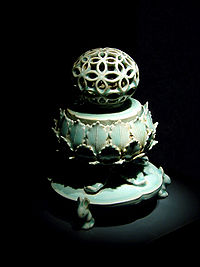 Goryeo
was founded in 918 AD and by 936, replaced Silla as the ruling dynasty of Korea. "Goryeo" was named as Wang Geon
deemed the nation as a successor of Goguryeo
. The dynasty lasted until 1392, and it is the source of the English name "Korea."
During this period laws were codified, and a civil service system was introduced. Buddhism
flourished, and spread throughout the peninsula. The development of celadon
pottery flourished in the 12th and 13th century. The publication of Tripitaka Koreana
onto 80,000 wooden blocks and the invention of movable-metal-type printing press
attest to Goryeo's cultural achievements.
In 1231 the Mongols
began its campaigns against Korea
and after 25 years of struggle, the royal family relented by signing a treaty with the Mongols. For the following 80 years Goryeo survived, but became a vassal of the Mongol-ruled Yuan Dynasty
in China
.
In the 1350s, the Yuan Dynasty declined rapidly due to internal struggles. King Gongmin
was free at last to reform a Goryeo government. Gongmin had various problems that needed to be dealt with, which included the removal of pro-Mongol aristocrats and military officials, the question of land holding, and quelling the growing animosity between the Buddhists and Confucian scholars.
The Goryeo dynasty would last until 1392. Taejo of Joseon
, who was the founder and the first king of the Joseon Dynasty
of Korea, would easily take power in a coup and establish the Joseon Dynasty
.
.jpg)
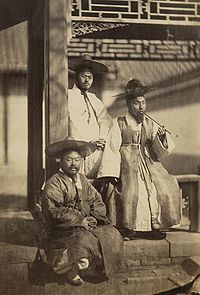
established the Joseon Dynasty
(1392–1910) named in honor of the ancient kingdom Gojoseon
and its idealistic Confucianism
-based politics.
King Taejo
moved the capital to Hanyang
(modern-day Seoul
) and built Gyeongbokgung
palace. In 1394 he adopted Neo-Confucianism
as the country's official religion, and pursued the creation of a strong bureaucratic state. The following monarchs, King Taejong
and King Sejong the Great, implemented numerous administrative, social, and economical reforms and established royal authority in the early years of the dynasty.
Internal conflicts within the royal court, civil unrest and other political struggles plagued the nation in the years that followed, worsened by the Japanese invasion of Korea between 1592 and 1598. Toyotomi Hideyoshi
ordered the forces and tried to invade the Asian continent
through Korea, but was eventually repelled by righteous armies
, Admiral Yi Sun-sin
and assistance from Ming China. This war also saw the rise of the career of Admiral Yi Sun-sin
with the "turtle ship
".
As Joseon was striving to rebuild itself after the war, it once again suffered from the invasions by the Manchu
in the 1620s and 1630s. Different views regarding foreign policy divided the royal court, and ascensions to the throne during that period were decided after much political conflict and struggle.
A long period of peace followed during the years of King Yeongjo
and King Jeongjo
, who led a new renaissance of the Joseon dynasty, with fundamental reforms to ease the political tension between the Confucian scholars, who mainly held high positions.
However, corruption in government and social unrest prevailed in the years thereafter, causing numerous civil uprisings and revolts. The government made sweeping reforms in the late 19th century, but adhered to a strict isolationist policy, earning Joseon the nickname "Hermit Kingdom
". The policy had been established primarily for protection against Western imperialism
, but before long Joseon was forced to open trade, beginning an era leading into Japanese colonial rule
.
, which emphasizes morality, righteousness, and practical ethics. Wide interest in scholarly study resulted in the establishment of private academies and educational institutions. Many documents were written about history, geography, medicine, and Confucian principles. The arts flourished in painting, calligraphy, music, dance, and ceramics.
The most notable cultural event of this era is the promulgation of the Korean alphabet Hangul
by King Sejong the Great
in 1446. This period also saw various other cultural, scientific and technological advances.
During Joseon, a social hierarchy system existed that greatly affected Korea's social development. The king and the royal family were atop the hereditary system, with the next tier being a class of civil or military officials and land owners known as yangban
, who worked for the government and lived off the efforts of tenant farmers and slaves.
A middle class, jungin, were technical specialists such as scribes, medical officers, technicians in science-related fields, artists and musicians. Commoners, i.e. peasants, constituted the largest class in Joseon. They had obligations to pay taxes, provide labor, and serve in the military. By paying land taxes to the state, they were allowed to cultivate land and farm. The lowest class included tenant farmers, slaves, entertainers, craftsmen, prostitutes, laborers, shamans, vagabonds, outcasts, soldiers and criminals. Although slave status was hereditary, they were sold at officially set prices, and the mistreatment of slaves was strictly forbidden.
This yangban focused system started to change in the late 17th century as many political, economic and social changes came into place. By the 19th century, new commercial groups emerged, and the active social mobility caused the yangban class to expand, resulting in the weakening of the old class system. The Joseon government ordered the freedom of official slaves in 1801. The class system of Joseon was completely banned in 1894.
 Joseon dealt with a pair of Japanese invasions from 1592 to 1598 (Imjin War or the Seven Years war). Prior to the war, Korea sent two ambassadors to scout for any signs of Japan's intentions of invading Korea. However, they came back with 2 different reports, and while the politicians split into sides and fought, no proactive measures were taken.
This conflict brought prominence to Admiral Yi Sun-sin
as he repelled the Japanese forces with his invention, and innovative use of the turtle ship
, a massive, yet swift, ramming/cannon ship fitted with iron spikes and, according to some sources, an iron-plated deck). The use of the hwacha
was also highly effective in repelling the Japanese invaders from the land.
Subsequently, Korea was invaded by the Manchus in 1627 (see the First Manchu invasion of Korea
) and again in 1636 (see the Second Manchu invasion of Korea
), after which the Joseon dynasty recognized the suzerainty of the Qing Empire.
During the 19th century, Joseon Korea tried to control foreign influence by closing the borders to all nations but China. In 1853 the USS South America, an American gunboat, visited Busan
for 10 days and had amiable contact with local Korean officials. Several Americans who were shipwrecked on Korea in 1855 and 1865 were also treated well and sent to China for repatriation. The Joseon court which ruled Korea was well aware of the foreign invasions and treaties involving Qing China, as well as the First
and Second Opium War
s, and followed a cautious policy of slow exchange with the West.
In 1866, reacting to greater numbers of Korean converts, the Korean court clamped down on the illicit French missionaries, massacring French Catholic missionaries and Korean converts alike. That same year France invaded and occupied portions of Ganghwa Island in the fall of 1866. The Korean army lost heavily, but the French abandoned the island.
The General Sherman, a British-owned armed merchant marine sidewheel schooner, attempted to open Korea to trade in 1866. After an initial miscommunication, the ship sailed upriver and became stranded near Pyongyang. After being ordered to leave by Korean officials, the American crewmen killed four Korean inhabitants, kidnapped a military officer and engaged in sporadic fighting that continued for four days. After two efforts to destroy the ship failed, the USS General Sherman was finally set aflame by Korean fireships laden with explosives.
In response, the United States confronted Korea militarily in 1871, killing 243 Koreans then withdrawing, this incident is called the Sinmiyangyo
in Korea. Five years later, the reclusive Korea signed a trade treaty with Japan, and in 1882 signed a treaty with the United States, ending several centuries of isolationism.
In 1885, United Kingdom
occupied Geomun Island until 1887.
By 1876, a rapidly modernizing Japan
forced Korea to open its ports and successfully challenged the Qing Empire in the Sino-Japanese War
(1894–1895). In 1895, the Japanese were involved in the murder of Empress Myeongseong, who had sought Russian help, and the Russians were forced to retreat from Korea. (Though they came back at the beginning of the 20th century.)
 As a result of the Sino-Japanese War
(1894–1895), the 1895 Maguan Treaty (Treaty of Shimonoseki
) was concluded between China and Japan. According to Article I of this treaty, which stipulated the abolision of traditional relationships with China, Joseon became an independent state and was freed from political influences of China.
In 1897, Joseon was renamed the Korean Empire
, and King Gojong became Emperor Gojong. The imperial government aimed to become a strong and independent nation by implementing domestic reforms; strengthening military forces, developing commerce and industry, and surveying land ownership. Organizations like the Independence Club
also rallied to assert the rights of the Joseon people, but clashed with the government which proclaimed absolute monarchy and power.
Russian influence was strong in the Empire until being defeated by Japan in the Russo-Japanese War
(1904–1905). Korea effectively became a protectorate
of Japan on 17 November 1905, the 1905 Protectorate Treaty
having been promulgated without Emperor Gojong's required seal.
Following the signing of the treaty, many intellectuals and scholars set up various organizations and associations, embarking on patriotic movements for independence. In 1909, independence fighter An Jung-geun
assassinated Itō Hirobumi
, the Resident-General of Korea
, for Ito Hirobumi's role of intruding on the internal affairs of Korean politics, This prompted the Japanese to ban all political organisations and proceed with plans for annexation.
 In 1910 Japan
effectively annexed Korea
by the Japan–Korea Annexation Treaty. While the legality of the treaty is still asserted by Japan, it is generally not accepted in Korea because it was not signed by the Emperor of Korea as required and violated international convention on external pressures regarding treaties. Korea was controlled by Japan
under a Governor-General of Korea
until Japan's unconditional surrender to the Allied Forces, on 15 August 1945, with de jure sovereignty deemed to have passed from Joseon Dynasty to the Provisional Government of the Republic of Korea
.
After the annexation, Japan set out to repress all Korean tradition and culture, develop and implement reforms for their benefit. European-styled transport
and communication
networks were established across the nation in order to extract the resources and labor of the Korean people; these networks were almost all destroyed later during the Korean War. The banking system was consolidated and the Korean currency abolished. The Japanese removed the Joseon
hierarchy, destroyed the palace of Gyeongbokgung
and replaced it with office buildings.
After Emperor Gojong died in January 1919, with a rumor of poisoning, independence rallies against Japanese invaders took place nationwide on 1 March 1919 (the March 1st Movement
). This movement was suppressed by force and about 7,000 were killed by Japanese soldiers and police. An estimated 2 million people took part in peaceful, pro-liberation rallies although Japanese records claim less than half million. This movement was partly inspired by United States president Woodrow Wilson
's speech of 1919, declaring support for right of self determination and an end to colonial rule for Europeans. No comment was made by Wilson on Korean independence, perhaps as a pro-Japan faction in the USA sought trade inroads into China through the Korean peninsula.
The Provisional Government of the Republic of Korea
was established in Shanghai
, China, in an aftermath of March 1 Movement, which coordinated the Liberation effort and resistance against Japanese control. Some of the achievements of the Provisional Government include the Battle of Chingshanli
of 1920 and the ambush of Japanese Military Leadership in China in 1932. The Provisional Government is considered to be the de jure government of the Korean people between the period 1919 to 1948, and its legitimacy is enshrined in the preamble to the constitution
of the South Korea.
Continued anti-Japanese
uprisings, such as the nationwide uprising of students in November 1929, led to the strengthening of military rule in 1931. After the outbreaks of the Sino-Japanese War in 1937 and World War II
Japan attempted to exterminate Korea as a nation. The continuance of Korean culture
itself began to be illegal. Worship at Japanese Shinto
shrines was made compulsory. The school curriculum was radically modified to eliminate teaching in the Korean language and history within Korea. The Korean language was banned and Koreans were forced to adopt Japanese names, and newspapers were prohibited from publishing in Korean. Numerous Korean cultural artifacts were destroyed or taken to Japan. According to an investigation by the South Korean government, 75,311 cultural assets were taken from Korea.
Some Koreans left the Korean peninsula
to Manchuria
and Primorsky Krai
. Koreans in Manchuria formed resistance groups known as Dongnipgun (Liberation Army) which would travel in and out of the Korean-Chinese boundary, fighting guerrilla warfare
with the Japanese forces. These guerilla armies would come together in 1940s as Korean Liberation Army
and the Liberation Army took part in allied action in China and parts of South East Asia. Tens of thousands of Koreans also joined the Peoples Liberation Army and the National Revolutionary Army
.
During World War II
, Koreans were forced to support the Japanese war effort. Tens of thousands of men were conscripted into Japan's military. Around 200,000 girls and women, mostly from Korea and China, were conscripted into sexual slavery, with the euphemism
"comfort women
". Previous Korean "comfort women" are still protesting against the Japanese Government for compensation of their sufferings.
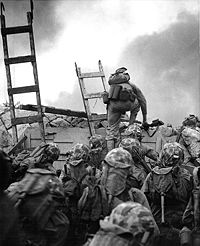 The unconditional surrender of Japan, combined with fundamental shifts in global politics and ideology, led to the division of Korea into two occupation zones effectively starting on September 8, 1945, with the United States
administering the southern half of the peninsula and the Soviet Union
taking over the area north of the 38th parallel
. The Provisional Government was ignored, mainly due to American misconception that it was too communist-aligned. This division was meant to be temporary and was first intended to return a unified Korea back to its people until the United States, United Kingdom
, Soviet Union
, and Republic of China
could arrange a trusteeship administration.
At the Cairo Conference
on November 22, 1943, it was agreed that Korea would be free: "in due course Korea shall become free and independent”; at a later meeting in Yalta
in February 1945, it was agreed to establish a four-power trusteeship over Korea. On August 9, 1945, Soviet
tanks entered northern Korea
from Siberia
, meeting little to no resistance. Japan surrendered to the Allied Forces on August 15, 1945.
In December 1945, a conference convened in Moscow
to discuss the future of Korea. A 5-year trusteeship was discussed, and a joint Soviet-American commission was established. The commission met intermittently in Seoul
but deadlocked over the issue of establishing a national government. In September 1947, with no solution in sight, the United States
submitted the Korean question to the UN General Assembly.
Initial hopes for a unified
, independent Korea quickly evaporated as the politics of the Cold War
and opposition to the trusteeship plan from Korean anti-communists resulted in the 1948 establishment of two separate nations with diametrically opposed political, economic, and social systems. On June 25, 1950, the Security Council of the United Nations
recognised the Republic of Korea
as the sole legal government of Korea. In June 1950 the Korean War
broke out when North Korea breached the 38th parallel line to invade the South, ending any hope of a peaceful reunification for the time being. After the war a Geneva conference
failed to adopt a declaration for a unified Korea. Beginning with Syngman Rhee
, a series of oppressive autocratic governments took power in South Korea, initially with American support and influence. The country eventually transitioned to become a market-oriented democracy in the 1980s, largely due to popular demand for reform. Due to the Soviet occupation of North Korea, post-independence North Korea established a communist government, with ties to the Union of Soviet Socialist Republics and China.
See History of North Korea
and History of South Korea
for the post-war period.
Korean Peninsula
The Korean Peninsula is a peninsula in East Asia. It extends southwards for about 684 miles from continental Asia into the Pacific Ocean and is surrounded by the Sea of Japan to the south, and the Yellow Sea to the west, the Korea Strait connecting the first two bodies of water.Until the end of...
was inhabited from the Lower Paleolithic
Lower Paleolithic
The Lower Paleolithic is the earliest subdivision of the Paleolithic or Old Stone Age. It spans the time from around 2.5 million years ago when the first evidence of craft and use of stone tools by hominids appears in the current archaeological record, until around 300,000 years ago, spanning the...
about 400,000-500,000 years ago. Archeological evidence indicates that the presence of modern humans in northeast Asia dates to 39,000 years ago. The earliest known Korean pottery dates to around 8000 BC, and the Neolithic
Neolithic
The Neolithic Age, Era, or Period, or New Stone Age, was a period in the development of human technology, beginning about 9500 BC in some parts of the Middle East, and later in other parts of the world. It is traditionally considered as the last part of the Stone Age...
period began before 6000 BC, followed by the Bronze Age
Bronze Age
The Bronze Age is a period characterized by the use of copper and its alloy bronze as the chief hard materials in the manufacture of some implements and weapons. Chronologically, it stands between the Stone Age and Iron Age...
around 800 BC, and the Iron Age
Iron Age
The Iron Age is the archaeological period generally occurring after the Bronze Age, marked by the prevalent use of iron. The early period of the age is characterized by the widespread use of iron or steel. The adoption of such material coincided with other changes in society, including differing...
begins around 400 BC. Korea is considered to be one of the oldest countries in the world.
In the legend, the Gojoseon
Gojoseon
Gojoseon was an ancient Korean kingdom. Go , meaning "ancient," distinguishes it from the later Joseon Dynasty; Joseon, as it is called in contemporaneous writings, is also romanized as Chosŏn....
(Old Joseon) kingdom was founded in northern Korea and Manchuria by 2333 BC. The Gija Joseon
Gija Joseon
Gija Joseon describes the period after the alleged arrival of Gija in the northwest of Korean peninsula. It was considered by most of the Chinese and the Korean scholars as a part of the Gojoseon period of Korean history...
was founded in 12th century BC, whose existence became a controversy today. The Jin state forms in southern Korea in the 3rd century BC. Gojoseon was invaded by Han dynasty
Han Dynasty
The Han Dynasty was the second imperial dynasty of China, preceded by the Qin Dynasty and succeeded by the Three Kingdoms . It was founded by the rebel leader Liu Bang, known posthumously as Emperor Gaozu of Han. It was briefly interrupted by the Xin Dynasty of the former regent Wang Mang...
in the 2nd century BC which resulted in the fall of Gojoseon later led to successor warring states, Proto–Three Kingdoms period spans the later Iron Age. Since 1st century, Goguryeo
Goguryeo
Goguryeo or Koguryŏ was an ancient Korean kingdom located in present day northern and central parts of the Korean Peninsula, southern Manchuria, and southern Russian Maritime province....
, Baekje
Baekje
Baekje or Paekche was a kingdom located in southwest Korea. It was one of the Three Kingdoms of Korea, together with Goguryeo and Silla....
, and Silla
Silla
Silla was one of the Three Kingdoms of Korea, and one of the longest sustained dynasties in...
grew to control the peninsula and Manchuria as the Three Kingdoms
Three Kingdoms of Korea
The Three Kingdoms of Korea refer to the ancient Korean kingdoms of Goguryeo, Baekje and Silla, which dominated the Korean peninsula and parts of Manchuria for much of the 1st millennium...
(57 BC – 668 AD) until the unification by Silla in 676. In 698, Dae Jo-yeong established Kingdom of Balhae
Balhae
Balhae was a Manchurian kingdom established after the fall of Goguryeo. After Goguryeo's capital and southern territories fell to Unified Silla, Dae Jo-yeong, a Mohe general, whose father was Dae Jung-sang, established Jin , later called Balhae.Balhae occupied southern parts of Manchuria and...
, which led to the North South States Period
North South States Period
North South States Period refers to the period in Korean history when Silla and Balhae coexisted in the south and north of the peninsula, respectively.-Unified Silla:...
(698–926).
In the late 9th century, Silla was divided into the Later Three Kingdoms (892–936), which ended with the unification of the Goryeo Dynasty. During the Goryeo period, laws were codified, a civil service system was introduced, and Buddhism
Buddhism
Buddhism is a religion and philosophy encompassing a variety of traditions, beliefs and practices, largely based on teachings attributed to Siddhartha Gautama, commonly known as the Buddha . The Buddha lived and taught in the northeastern Indian subcontinent some time between the 6th and 4th...
flourished.
In 1392, general Yi Seong-gye
Taejo of Joseon
Taejo of Joseon , born Yi Seong-gye, whose changed name is Yi Dan, was the founder and the first king of the Joseon Dynasty of Korea, and the main figure in overthrowing the Goryeo Dynasty...
established the Joseon Dynasty
Joseon Dynasty
Joseon , was a Korean state founded by Taejo Yi Seong-gye that lasted for approximately five centuries. It was founded in the aftermath of the overthrow of the Goryeo at what is today the city of Kaesong. Early on, Korea was retitled and the capital was relocated to modern-day Seoul...
(1392–1910) after a coup. King Sejong the Great
Sejong the Great of Joseon
Sejong the Great was the fourth king of the Joseon Dynasty of Korea. During his regency, he reinforced Korean Confucian policies and executed major legal amendments . He also used the creation of Hangul and the advancement of technology to expand his territory...
(1418–1450) implemented numerous administrative, social, and economical reforms, established royal authority in the early years of the dynasty, and promulgated Hangul
Hangul
Hangul,Pronounced or ; Korean: 한글 Hangeul/Han'gŭl or 조선글 Chosŏn'gŭl/Joseongeul the Korean alphabet, is the native alphabet of the Korean language. It is a separate script from Hanja, the logographic Chinese characters which are also sometimes used to write Korean...
, the Korean alphabet.
In 18th century, Korea was faced with internal strife, power struggles, international pressure, and rebellions at home, and the Joseon Dynasty declined rapidly in the late 19th century. In 1897, Korean Empire
Korean Empire
The Greater Korean Empire was an empire of Korea that succeeded the Joseon Dynasty.In October 1897, Emperor Gojong proclaimed the new entity at Gyeongungung Palace and oversaw the partially successful modernization of the military, economy, land system, education system, and various industries...
(1897–1910) succeeded Joseon Dynasty. However, Imperial Japan forced the Korean Empire to sign the Eulsa Treaty
Eulsa Treaty
The Japan–Korea Treaty of 1905, also known as the Eulsa Treaty or Japan–Korea Protectorate Treaty, was made between the Empire of Japan and the Korean Empire in 1905. Negotiations were concluded on November 17, 1905....
and in 1910 annexed the Korean Empire.
Korean resistance
Korean independence movement
The Korean independence movement grew out of the Japanese colonial rule of the Korean peninsula from 1910 to 1945. After the Japanese surrendered, Korea became independent; that day is now an annual holiday called Gwangbokjeol in South Korea, and Chogukhaebangŭi nal in North Korea.-Background:In...
was manifested in the widespread nonviolent March 1st Movement
March 1st Movement
The March 1st Movement, or Samil Movement, was one of the earliest public displays of Korean resistance during the occupation of the Korean Empire by Japan. The name refers to an event that occurred on March 1, 1919, hence the movement's name, literally meaning "Three-One Movement" or "March First...
of 1919 during the occupation. Thereafter the greater resistance movements
Korean independence movement
The Korean independence movement grew out of the Japanese colonial rule of the Korean peninsula from 1910 to 1945. After the Japanese surrendered, Korea became independent; that day is now an annual holiday called Gwangbokjeol in South Korea, and Chogukhaebangŭi nal in North Korea.-Background:In...
, coordinated by the Provisional Government of the Republic of Korea
Provisional Government of the Republic of Korea
The Provisional Government of the Republic of Korea was the partially recognised government in exile of Korea, based in Shanghai, China, and later in Chongqing, during the Colonial Korea.-History:...
in exile, was largely active in neighboring Manchuria, China and Siberia
Siberia
Siberia is an extensive region constituting almost all of Northern Asia. Comprising the central and eastern portion of the Russian Federation, it was part of the Soviet Union from its beginning, as its predecessor states, the Tsardom of Russia and the Russian Empire, conquered it during the 16th...
.
After the liberation in 1945, the partition of Korea created the modern two states of North and South Korea. In 1948, new governments were established, the nominally Capitalist South Korea
South Korea
The Republic of Korea , , is a sovereign state in East Asia, located on the southern portion of the Korean Peninsula. It is neighbored by the People's Republic of China to the west, Japan to the east, North Korea to the north, and the East China Sea and Republic of China to the south...
("Republic of Korea") and Communist North Korea
North Korea
The Democratic People’s Republic of Korea , , is a country in East Asia, occupying the northern half of the Korean Peninsula. Its capital and largest city is Pyongyang. The Korean Demilitarized Zone serves as the buffer zone between North Korea and South Korea...
("Democratic People's Republic of Korea") divided at the 38th parallel. The unresolved tensions of the division surfaced in the Korean War
Korean War
The Korean War was a conventional war between South Korea, supported by the United Nations, and North Korea, supported by the People's Republic of China , with military material aid from the Soviet Union...
of 1950, when North Korea invaded South Korea.
Prehistory
Homo erectus
Homo erectus is an extinct species of hominid that lived from the end of the Pliocene epoch to the later Pleistocene, about . The species originated in Africa and spread as far as India, China and Java. There is still disagreement on the subject of the classification, ancestry, and progeny of H...
has been found in the Korean Peninsula
Korean Peninsula
The Korean Peninsula is a peninsula in East Asia. It extends southwards for about 684 miles from continental Asia into the Pacific Ocean and is surrounded by the Sea of Japan to the south, and the Yellow Sea to the west, the Korea Strait connecting the first two bodies of water.Until the end of...
. However, tool-making artifacts from the Palaeolithic period have been found in present-day North Hamgyong, South P'yongan, Gyeonggi, and north and south Chungcheong Provinces of Korea., which dates the Paleolithic Age to half a million years ago. However, the predominant view is that the Korean people of today are not the ethnic descendants of these Paleolithic inhabitants.
Jeulmun Pottery Period
The earliest known Korean potteryKorean pottery
Korean ceramic history begins with the oldest earthenware from around 8000 BC.-Three Kingdoms pottery:-Goryeo Dynasty porcelain:The Goryeo Dynasty achieved the unification of the Later Three Kingdoms under King Taejo...
dates back to around 8000 BC or before, and evidence of Mesolithic
Mesolithic
The Mesolithic is an archaeological concept used to refer to certain groups of archaeological cultures defined as falling between the Paleolithic and the Neolithic....
Pit-Comb Ware culture
Pit-Comb Ware culture
The Pit–Comb Ware culture Comb Ceramic culture was a northeast European culture of pottery-making hunter-gatherers. It existed from around 4200 BC to around 2000 BC...
or Yungimun Pottery is found throughout the peninsula. An example of a Yungimun-era site is in Jeju-do
Jeju-do
Jeju-do is the only special autonomous province of South Korea, situated on and coterminous with the country's largest island. Jeju-do lies in the Korea Strait, southwest of Jeollanam-do Province, of which it was a part before it became a separate province in 1946...
. Jeulmun or Comb-pattern Pottery is found after 7000 BC, and pottery with comb-patterns over the whole vessel is found concentrated at sites in west-central Korea when a number of settlements such as Amsa-dong
Amsa-dong
Amsa-dong is a dong, neighbourhood of Gangdong-gu in Seoul, South Korea. The dong is well-known for the Amsa-dong Preshistoric Settlement Site in which Neolithic remains were excavated after a large number of diagonal-line patterned earthenware underneath the earth were accidentally uncovered by a...
existed. Jeulmun pottery bears basic design and form similarities to that of the Russian Maritime Province, Mongolia
Mongolia
Mongolia is a landlocked country in East and Central Asia. It is bordered by Russia to the north and China to the south, east and west. Although Mongolia does not share a border with Kazakhstan, its western-most point is only from Kazakhstan's eastern tip. Ulan Bator, the capital and largest...
, and the Amur and Sungari river basins of Manchuria
Manchuria
Manchuria is a historical name given to a large geographic region in northeast Asia. Depending on the definition of its extent, Manchuria usually falls entirely within the People's Republic of China, or is sometimes divided between China and Russia. The region is commonly referred to as Northeast...
and the Jōmon culture in Japan.
Mumun Pottery Period
Archaeological evidence demonstrates that agricultural societies and the earliest forms of social-political complexity emerged in the Mumun Pottery PeriodMumun pottery period
The Mumun pottery period is an archaeological era in Korean prehistory that dates to approximately 1500-300 BC This period is named after the Korean name for undecorated or plain cooking and storage vessels that form a large part of the pottery assemblage over the entire length of the period, but...
(c. 1500–300 BC).
People in southern Korea adopted intensive dry-field and paddy-field
Paddy field
A paddy field is a flooded parcel of arable land used for growing rice and other semiaquatic crops. Paddy fields are a typical feature of rice farming in east, south and southeast Asia. Paddies can be built into steep hillsides as terraces and adjacent to depressed or steeply sloped features such...
agriculture with a multitude of crops in the Early Mumun Period (1500–850 BC). The first societies led by big-men or chiefs emerged in the Middle Mumun (850–550 BC), and the first ostentatious elite burials can be traced to the Late Mumun (c. 550–300 BC). Bronze production began in the Middle Mumun and became increasingly important in Mumun ceremonial and political society after 700 BC. The Mumun is the first time that villages rose, became large, and then fell: some important examples include Songguk-ri
Songguk-ri
Songguk-ri is a Middle and Late Mumun period archaeological site in Buyeo-gun, Chungcheongnam-do, South Korea. Songguk-ri is a settlement and burial site that is important in the study of Korean prehistory. It is registered as Historical Site No. 249...
, Daepyeong
Daepyeong
Daepyeong is the name of a complex prehistoric archaeological site located in the Nam River valley near Jinju in South Gyeongsang Province, South Korea...
, and Igeum-dong. The increasing presence of long-distance trade, an increase in local conflicts, and the introduction of bronze and iron metallurgy are trends denoting the end of the Mumun around 300 BC.
Gojoseon
Gojoseon
Gojoseon was an ancient Korean kingdom. Go , meaning "ancient," distinguishes it from the later Joseon Dynasty; Joseon, as it is called in contemporaneous writings, is also romanized as Chosŏn....
was the first Korea
Korea
Korea ) is an East Asian geographic region that is currently divided into two separate sovereign states — North Korea and South Korea. Located on the Korean Peninsula, Korea is bordered by the People's Republic of China to the northwest, Russia to the northeast, and is separated from Japan to the...
n kingdom. The founding legend of Gojoseon, which is recorded in the Samguk Yusa
Samguk Yusa
Samguk Yusa, or Memorabilia of the Three Kingdoms, is a collection of legends, folktales, and historical accounts relating to the Three Kingdoms of Korea , as well as to other periods and states before, during, and after the Three Kingdoms period.The text was written in Classical Chinese, which was...
(1281) and other Korean medieval books, states that the country was established in 2333 BC by Dangun
Dangun
Dangun Wanggeom was the legendary founder of Gojoseon, the first Korean kingdom, around present-day Liaoning, Manchuria, and the Korean Peninsula. He is said to be the "grandson of heaven", and to have founded the kingdom in 2333 BC...
, said to be descended from the heavens. However, no evidence has been found that supports whatever facts may lie beneath this myth.
The first kingdom of Gojoseon in the historical records is Gija Joseon
Gija Joseon
Gija Joseon describes the period after the alleged arrival of Gija in the northwest of Korean peninsula. It was considered by most of the Chinese and the Korean scholars as a part of the Gojoseon period of Korean history...
, which was founded in 12th century BC by Chinese Shang
Shang
The shang is a flat ritual upturned handbell employed by Bönpo and Asian shamans. The sizes of the shang range from approximately 3 to 20 inches in diameter. It is traditionally held to have originated in Zhangzhung and is symbolically similar to the tantric dril-bhu. Shang are traditionally...
dynasty descendants named Gija and ended in 195 BC. The relative records can be found in Records of the Grand Historian
Records of the Grand Historian
The Records of the Grand Historian, also known in English by the Chinese name Shiji , written from 109 BC to 91 BC, was the Magnum opus of Sima Qian, in which he recounted Chinese history from the time of the Yellow Emperor until his own time...
in 91 BC, Book of Han
Book of Han
The Book of Han, Hanshu or History of the Former Han Dynasty |Fan Ye]] . Various scholars have estimated that the earliest material covered in the book dates back to between 206 and 202 BCE...
in AD 111, Book of the Later Han in 5th century and Records of Three Kingdoms
Records of Three Kingdoms
Records of Three Kingdoms , is regarded as the official and authoritative historical text on the Three Kingdoms period of Chinese history covering the years 184-280 CE. Written by Chen Shou in the 3rd century, the work combines the smaller histories of the rival states of Cao Wei , Shu Han and...
in 3rd century.
The historical existence of Gojoseon kingdom probably arose around the 8th century BC in Liaoning
Liaoning
' is a province of the People's Republic of China, located in the northeast of the country. Its one-character abbreviation is "辽" , a name taken from the Liao River that flows through the province. "Níng" means "peace"...
. By about the 4th century BC, the kingdoms of Gojoseon had developed to the point where their existence was known even in China, and around 400 BC moved its capital to Pyongyang
Pyongyang
Pyongyang is the capital of the Democratic People's Republic of Korea, commonly known as North Korea, and the largest city in the country. Pyongyang is located on the Taedong River and, according to preliminary results from the 2008 population census, has a population of 3,255,388. The city was...
, the capital of modern North Korea
North Korea
The Democratic People’s Republic of Korea , , is a country in East Asia, occupying the northern half of the Korean Peninsula. Its capital and largest city is Pyongyang. The Korean Demilitarized Zone serves as the buffer zone between North Korea and South Korea...
.
In 194 BC, King Jun fled to Jin state after a coup by Wiman
Wiman of Gojoseon
Wiman was a refugee from the State of Yan who established a kingdom in north-western Korea in the 2nd century BC. He was the first figure in the history of Korea to have been recorded in documents from the same time period.-Biography:...
. Later the Han Dynasty
Han Dynasty
The Han Dynasty was the second imperial dynasty of China, preceded by the Qin Dynasty and succeeded by the Three Kingdoms . It was founded by the rebel leader Liu Bang, known posthumously as Emperor Gaozu of Han. It was briefly interrupted by the Xin Dynasty of the former regent Wang Mang...
defeated the Wiman Joseon
Wiman Joseon
Wiman Joseon was part of the Gojoseon period of Korean history. It began with Wiman's seizure of the throne from Gojoseon's King Jun and ended with the death of King Ugeo who was a grandson of Wiman.-Founding:...
and set up Four Commanderies of Han
Four Commanderies of Han
The Four Commanderies of Han are Lelang, Lintun, Xuantu and Zhenfan commanderies in northern Korean Peninsula and part of the Liaodong Peninsula. set up by Emperor Wu of the Han Dynasty in early 2nd century BC after his conquest of Wiman Joseon...
in 108 BC, and Jin later evolved into the Samhan
Samhan
The Samhan period of Korean history comprises confederacies of Mahan, Jinhan, and Byeonhan in central and southern Korean peninsula, during the final century BCE and the early centuries CE....
confederacies.
Many smaller states sprang from the former territory of Gojoseon such as Buyeo
Buyeo kingdom
Buyeo or Puyŏ , Fuyu in Chinese, was an ancient Korean kingdom located from today's Manchuria to northern North Korea, from around the 2nd century BC to 494. Its remnants were absorbed by the neighboring and brotherhood kingdom of Goguryeo in 494...
, Okjeo
Okjeo
Okjeo was Korean tribal state which arose in the northern Korean peninsula from perhaps 2nd century BCE to 5th century CE.Dong-okjeo occupied roughly the area of the Hamgyŏng provinces of North Korea, and Buk-okjeo occupied the Duman River region.Dong-okjeo was often simply called Okjeo, while...
, Dongye
Dongye
Dongye, which means the Eastern Ye, was a Korean chiefdom which occupied portions of the northeastern Korean peninsula from roughly 3rd-century BCE to around early 5th-century. It bordered Goguryeo and Okjeo to the north, Jinhan to the south, and China's Lelang Commandery to the west...
. Goguryeo
Goguryeo
Goguryeo or Koguryŏ was an ancient Korean kingdom located in present day northern and central parts of the Korean Peninsula, southern Manchuria, and southern Russian Maritime province....
and Baekje
Baekje
Baekje or Paekche was a kingdom located in southwest Korea. It was one of the Three Kingdoms of Korea, together with Goguryeo and Silla....
. The Three Kingdoms
Three Kingdoms of Korea
The Three Kingdoms of Korea refer to the ancient Korean kingdoms of Goguryeo, Baekje and Silla, which dominated the Korean peninsula and parts of Manchuria for much of the 1st millennium...
refer to Goguryeo
Goguryeo
Goguryeo or Koguryŏ was an ancient Korean kingdom located in present day northern and central parts of the Korean Peninsula, southern Manchuria, and southern Russian Maritime province....
, Baekje
Baekje
Baekje or Paekche was a kingdom located in southwest Korea. It was one of the Three Kingdoms of Korea, together with Goguryeo and Silla....
, and Silla
Silla
Silla was one of the Three Kingdoms of Korea, and one of the longest sustained dynasties in...
, although Buyeo and the Gaya confederacy
Gaya confederacy
Gaya was a confederacy of territorial polities in the Nakdong River basin of southern Korea, growing out of the Byeonhan confederacy of the Samhan period.The traditional period used by historians for Gaya chronology is 42–532 CE...
existed into 5th and 6th centuries respectively.
Metallurgy
The Bronze AgeBronze Age
The Bronze Age is a period characterized by the use of copper and its alloy bronze as the chief hard materials in the manufacture of some implements and weapons. Chronologically, it stands between the Stone Age and Iron Age...
is often held to have begun around 900-800 BC in Korea. Bronze daggers, mirrors, and weaponry have been found, as well as evidence of walled-town polities. Rice, red beans, soybeans and millet were cultivated, and rectangular pit-houses and increasingly larger dolmen
Dolmen
A dolmen—also known as a portal tomb, portal grave, dolmain , cromlech , anta , Hünengrab/Hünenbett , Adamra , Ispun , Hunebed , dös , goindol or quoit—is a type of single-chamber megalithic tomb, usually consisting of...
burial sites are found throughout the peninsula. Contemporaneous records suggest that Gojoseon transitioned from a feudal federation of walled cities into a centralised kingdom at least before the 4th century BC.
It is believed that by the 3rd century BC, iron culture was developing and the warring states of China pushed refugees eastward and south. Around this time, a state called Jin
Jin (Korean history)
Jin state was an early Korean, Iron Age state which occupied some portion of the southern Korean peninsula during the 2nd and 3rd centuries BC, bordering the Korean kingdom Gojoseon to the north. Its capital was somewhere south of the Han River...
arose in the southern part of the Korean peninsula. Very little is known about Jin, but it established relations with Han China and exported artifacts to the Yayoi of Japan
Japan
Japan is an island nation in East Asia. Located in the Pacific Ocean, it lies to the east of the Sea of Japan, China, North Korea, South Korea and Russia, stretching from the Sea of Okhotsk in the north to the East China Sea and Taiwan in the south...
.
Proto–Three Kingdoms
, is the time before the rise of the Three Kingdoms of Korea
Three Kingdoms of Korea
The Three Kingdoms of Korea refer to the ancient Korean kingdoms of Goguryeo, Baekje and Silla, which dominated the Korean peninsula and parts of Manchuria for much of the 1st millennium...
, which included Goguryeo
Goguryeo
Goguryeo or Koguryŏ was an ancient Korean kingdom located in present day northern and central parts of the Korean Peninsula, southern Manchuria, and southern Russian Maritime province....
, Silla
Silla
Silla was one of the Three Kingdoms of Korea, and one of the longest sustained dynasties in...
, and Baekje
Baekje
Baekje or Paekche was a kingdom located in southwest Korea. It was one of the Three Kingdoms of Korea, together with Goguryeo and Silla....
, and occurred after the fall of Gojoseon
Gojoseon
Gojoseon was an ancient Korean kingdom. Go , meaning "ancient," distinguishes it from the later Joseon Dynasty; Joseon, as it is called in contemporaneous writings, is also romanized as Chosŏn....
. This time period consisted of numerous states that sprang up from the former territories of Gojoseon. Among these states, the largest and most influential were Dongbuyeo
Dongbuyeo
Dongbuyeo was an ancient Korean kingdom that developed from Bukbuyeo, until conquered by the early Goguryeo, which then grew into one of the Three Kingdoms of Korea...
and Bukbuyeo.
Buyeo and other Northern states
After the fall of GojoseonGojoseon
Gojoseon was an ancient Korean kingdom. Go , meaning "ancient," distinguishes it from the later Joseon Dynasty; Joseon, as it is called in contemporaneous writings, is also romanized as Chosŏn....
, Buyeo
Buyeo kingdom
Buyeo or Puyŏ , Fuyu in Chinese, was an ancient Korean kingdom located from today's Manchuria to northern North Korea, from around the 2nd century BC to 494. Its remnants were absorbed by the neighboring and brotherhood kingdom of Goguryeo in 494...
arose in today's North Korea
North Korea
The Democratic People’s Republic of Korea , , is a country in East Asia, occupying the northern half of the Korean Peninsula. Its capital and largest city is Pyongyang. The Korean Demilitarized Zone serves as the buffer zone between North Korea and South Korea...
and southern Manchuria
Manchuria
Manchuria is a historical name given to a large geographic region in northeast Asia. Depending on the definition of its extent, Manchuria usually falls entirely within the People's Republic of China, or is sometimes divided between China and Russia. The region is commonly referred to as Northeast...
, from about the 2nd century BC to 494. Its remnants were absorbed by Goguryeo
Goguryeo
Goguryeo or Koguryŏ was an ancient Korean kingdom located in present day northern and central parts of the Korean Peninsula, southern Manchuria, and southern Russian Maritime province....
in 494, and both Goguryeo and Baekje
Baekje
Baekje or Paekche was a kingdom located in southwest Korea. It was one of the Three Kingdoms of Korea, together with Goguryeo and Silla....
, two of the Three Kingdoms of Korea
Three Kingdoms of Korea
The Three Kingdoms of Korea refer to the ancient Korean kingdoms of Goguryeo, Baekje and Silla, which dominated the Korean peninsula and parts of Manchuria for much of the 1st millennium...
, considered themselves its successor.
Although records are sparse and contradictory, it is thought that in 86 BC, Dongbuyeo
Dongbuyeo
Dongbuyeo was an ancient Korean kingdom that developed from Bukbuyeo, until conquered by the early Goguryeo, which then grew into one of the Three Kingdoms of Korea...
(East Buyeo) branched out, after which the original Buyeo is sometimes referred to as Bukbuyeo (North Buyeo). Jolbon Buyeo
Jolbon
Jolbon was a small, Korean tribal state which arose in the northern Korean peninsula from perhaps 1st century BCE.In 37 BCE, Jumong had fled from Dongbuyeo to avoid death at the hands of Dongbuyeo's Crown Prince Daeso, who presented great jealousy towards Jumong...
was the predecessor to Goguryeo
Goguryeo
Goguryeo or Koguryŏ was an ancient Korean kingdom located in present day northern and central parts of the Korean Peninsula, southern Manchuria, and southern Russian Maritime province....
, and in 538, Baekje renamed itself Nambuyeo (South Buyeo).
Okjeo
Okjeo
Okjeo was Korean tribal state which arose in the northern Korean peninsula from perhaps 2nd century BCE to 5th century CE.Dong-okjeo occupied roughly the area of the Hamgyŏng provinces of North Korea, and Buk-okjeo occupied the Duman River region.Dong-okjeo was often simply called Okjeo, while...
was a tribal state that was located in the northern Korean Peninsula
Korean Peninsula
The Korean Peninsula is a peninsula in East Asia. It extends southwards for about 684 miles from continental Asia into the Pacific Ocean and is surrounded by the Sea of Japan to the south, and the Yellow Sea to the west, the Korea Strait connecting the first two bodies of water.Until the end of...
, and was established after the fall of Gojoseon. Okjeo had been a part of Gojoseon
Gojoseon
Gojoseon was an ancient Korean kingdom. Go , meaning "ancient," distinguishes it from the later Joseon Dynasty; Joseon, as it is called in contemporaneous writings, is also romanized as Chosŏn....
before its fall. It never became a fully developed kingdom due to the intervention of its neighboring kingdoms. Okjeo became a tributary of Goguryeo, and was eventually annexed into Goguryeo by Gwanggaeto Taewang
Gwanggaeto the Great of Goguryeo
Gwanggaeto the Great of Goguryeo was the nineteenth monarch of Goguryeo, the northernmost of the Three Kingdoms of Korea. His full posthumous name roughly means "Very Greatest King, Broad Expander of Territory, buried in Gukgangsang.", sometimes abbreviated to Hotaewang or Taewang...
in the 5th century.
Dongye
Dongye
Dongye, which means the Eastern Ye, was a Korean chiefdom which occupied portions of the northeastern Korean peninsula from roughly 3rd-century BCE to around early 5th-century. It bordered Goguryeo and Okjeo to the north, Jinhan to the south, and China's Lelang Commandery to the west...
was another small kingdom that was situated in the northern Korean Peninsula
Korean Peninsula
The Korean Peninsula is a peninsula in East Asia. It extends southwards for about 684 miles from continental Asia into the Pacific Ocean and is surrounded by the Sea of Japan to the south, and the Yellow Sea to the west, the Korea Strait connecting the first two bodies of water.Until the end of...
. Dongye bordered Okjeo
Okjeo
Okjeo was Korean tribal state which arose in the northern Korean peninsula from perhaps 2nd century BCE to 5th century CE.Dong-okjeo occupied roughly the area of the Hamgyŏng provinces of North Korea, and Buk-okjeo occupied the Duman River region.Dong-okjeo was often simply called Okjeo, while...
, and the two kingdoms faced the same fate of becoming tributaries of the growing empire of Goguryeo
Goguryeo
Goguryeo or Koguryŏ was an ancient Korean kingdom located in present day northern and central parts of the Korean Peninsula, southern Manchuria, and southern Russian Maritime province....
. Dongye was also a former part of Gojoseon
Gojoseon
Gojoseon was an ancient Korean kingdom. Go , meaning "ancient," distinguishes it from the later Joseon Dynasty; Joseon, as it is called in contemporaneous writings, is also romanized as Chosŏn....
before its fall.
Samhan
Samhan (삼한, 三韓) refers to the three confederacies of MahanMahan confederacy
Mahan was a loose confederacy of statelets that existed from around the 1st century BCE to 3rd century CE in the southern Korean peninsula in the Chungcheong and Jeolla provinces. Arising out of the confluence of Gojoseon migration and the Jin state federation, Mahan was one of the Samhan , along...
, Jinhan, and Byeonhan. The Samhan were located in the southern region of the Korean Peninsula
Korean Peninsula
The Korean Peninsula is a peninsula in East Asia. It extends southwards for about 684 miles from continental Asia into the Pacific Ocean and is surrounded by the Sea of Japan to the south, and the Yellow Sea to the west, the Korea Strait connecting the first two bodies of water.Until the end of...
. The Han countries were strictly governed by law, with religion playing an important role. Mahan was the largest, consisting of 54 states, and assumed political, economic, and cultural dominance. Byeonhan and Jinhan both consisted of 12 states, bringing a total of 78 states within the Samhan. The Samhan were eventually conquered by Baekje
Baekje
Baekje or Paekche was a kingdom located in southwest Korea. It was one of the Three Kingdoms of Korea, together with Goguryeo and Silla....
, Silla
Silla
Silla was one of the Three Kingdoms of Korea, and one of the longest sustained dynasties in...
, and Gaya
Gaya confederacy
Gaya was a confederacy of territorial polities in the Nakdong River basin of southern Korea, growing out of the Byeonhan confederacy of the Samhan period.The traditional period used by historians for Gaya chronology is 42–532 CE...
in the 4th century.
Three Kingdoms Era
Goguryeo
Dongmyeongseong of Goguryeo
King Dongmyeong of Goguryeo or Dongmyeongseongwang , which literally means "Holy King of the East". also known by his birth name Jumong, was the founding monarch of Goguryeo, the northernmost of the Three Kingdoms of Korea. In the Gwanggaeto Stele, he is called Chumo-wang ...
(posthumous name Dongmyeongseong). Later, King Taejo
Taejo of Goguryeo
King Taejo of Goguryeo was the sixth monarch of Goguryeo, the northernmost of the Three Kingdoms of Korea. He is sometimes called Taejo the Great. He rose to the throne following the assassination of King Mobon. Under his reign, the young state expanded its territory and developed into a...
centralized the government. Goguryeo was also the first Korean kingdom to adopt Buddhism as the state religion in 372, under King Sosurim
Sosurim of Goguryeo
King Sosurim of Goguryeo was the 17th ruler of Goguryeo, the northernmost of the Three Kingdoms of Korea. He was the son of King Gogugwon.-Background and Rise to the throne:...
's reign.
Goguryeo reached its zenith in the 5th century, when reign of the King Gwanggaeto
Gwanggaeto the Great of Goguryeo
Gwanggaeto the Great of Goguryeo was the nineteenth monarch of Goguryeo, the northernmost of the Three Kingdoms of Korea. His full posthumous name roughly means "Very Greatest King, Broad Expander of Territory, buried in Gukgangsang.", sometimes abbreviated to Hotaewang or Taewang...
and his son, King Jangsu
Jangsu of Goguryeo
Emperor Jangsu of Goguryeo was the 20th monarch of Goguryeo, the northernmost of the Three Kingdoms of Korea. He was born in 394, the eldest son of King Gwanggaeto the Great...
expanded into almost all of Manchuria and part of inner Mongolia, and took the Seoul
Seoul
Seoul , officially the Seoul Special City, is the capital and largest metropolis of South Korea. A megacity with a population of over 10 million, it is the largest city proper in the OECD developed world...
region from Baekje. Gwanggaeto and Jangsu subdued Baekje and Silla during their times.
Goguryeo later fought and defeated massive Chinese
China
Chinese civilization may refer to:* China for more general discussion of the country.* Chinese culture* Greater China, the transnational community of ethnic Chinese.* History of China* Sinosphere, the area historically affected by Chinese culture...
invasions in the Goguryeo-Sui War of 598 – 614, contributing to Sui
Sui Dynasty
The Sui Dynasty was a powerful, but short-lived Imperial Chinese dynasty. Preceded by the Southern and Northern Dynasties, it ended nearly four centuries of division between rival regimes. It was followed by the Tang Dynasty....
's fall, and continued to repel the Tang dynasty
Tang Dynasty
The Tang Dynasty was an imperial dynasty of China preceded by the Sui Dynasty and followed by the Five Dynasties and Ten Kingdoms Period. It was founded by the Li family, who seized power during the decline and collapse of the Sui Empire...
under several important generals including Yeon Gaesomun
Yeon Gaesomun
Yeon Gaesomun was a powerful and controversial military dictator and Generalissimo in the waning days of Goguryeo, which was one of the Three Kingdoms of ancient Korea. Yeon is also remembered for a number of successful resistance in military conflicts with Tang Dynasty under Emperor Li Shimin and...
and Yang Manchun
Yang Manchun
Yang Manchun is the name given to the Goguryeo commander of Ansi fortress in the 640s.Ansi fortress was located on the Goguryeo-Chinese border, probably present-day Haicheng. Yang is sometimes credited with saving the kingdom by his refusal to surrender the fortress to invading Tang...
(see Goguryeo–Tang Wars).
However, numerous wars with China exhausted Goguryeo and it fell into a weak state. After internal power struggles, it was conquered by an allied Silla-Tang forces in 668.
Baekje
BaekjeBaekje
Baekje or Paekche was a kingdom located in southwest Korea. It was one of the Three Kingdoms of Korea, together with Goguryeo and Silla....
's foundation by King Onjo in 18 BC as stated in the Samguk Sagi
Samguk Sagi
Samguk Sagi is a historical record of the Three Kingdoms of Korea: Goguryeo, Baekje and Silla. The Samguk Sagi is written in Classical Chinese and its compilation was ordered by Goryeo's King Injong Samguk Sagi (History of the Three Kingdoms) is a historical record of the Three Kingdoms of...
, followed those of its neighbors and rivals, Goguryeo
Goguryeo
Goguryeo or Koguryŏ was an ancient Korean kingdom located in present day northern and central parts of the Korean Peninsula, southern Manchuria, and southern Russian Maritime province....
and Silla
Silla
Silla was one of the Three Kingdoms of Korea, and one of the longest sustained dynasties in...
.
The Sanguo Zhi mentions Baekje as a member of the Mahan confederacy
Mahan confederacy
Mahan was a loose confederacy of statelets that existed from around the 1st century BCE to 3rd century CE in the southern Korean peninsula in the Chungcheong and Jeolla provinces. Arising out of the confluence of Gojoseon migration and the Jin state federation, Mahan was one of the Samhan , along...
in the Han River
Han River (Korea)
The Han River is a major river in South Korea and the fourth longest river on the Korean peninsula after the Amnok, Duman, and Nakdong rivers. It is formed by the confluence of the Namhan River , which originates in Mount Daedeok, and the Bukhan River , which originates on the slopes of Mount...
basin (near present-day Seoul
Seoul
Seoul , officially the Seoul Special City, is the capital and largest metropolis of South Korea. A megacity with a population of over 10 million, it is the largest city proper in the OECD developed world...
). It expanded into the southwest (Chungcheong
Chungcheong
Chungcheong was one of the eight provinces of Korea during the Joseon Dynasty. Chungcheong was located in the southwest of Korea...
and Jeolla
Jeolla
Jeolla was a province in southwestern Korea, one of the historical Eight Provinces of Korea during the Joseon Dynasty. It consisted of the modern South Korean provinces of North Jeolla, South Jeolla and the Special City of Gwangju as well as Jeju Island...
provinces) of the peninsula and became a significant political and military power. In the process, Baekje came into fierce confrontation with Goguryeo and the Chinese commanderies in the vicinity of its territorial ambitions.
At its peak in the 4th century, it had absorbed all of the Mahan states and subjugated most of the western Korean peninsula (including the modern provinces of Gyeonggi, Chungcheong
Chungcheong
Chungcheong was one of the eight provinces of Korea during the Joseon Dynasty. Chungcheong was located in the southwest of Korea...
, and Jeolla
Jeolla
Jeolla was a province in southwestern Korea, one of the historical Eight Provinces of Korea during the Joseon Dynasty. It consisted of the modern South Korean provinces of North Jeolla, South Jeolla and the Special City of Gwangju as well as Jeju Island...
, as well as part of Hwanghae
Hwanghae
Hwanghae was one of the Eight Provinces of Korea during the Joseon Dynasty. Hwanghae was located in the northwest of Korea. The provincial capital was Haeju.The regional name for the province was Haesŏ .-History:...
and Gangwon
Gangwon-do (South Korea)
Gangwon-do is a province of South Korea, with its capital at Chuncheon. Before the division of Korea in 1945, Gangwon and its North Korean neighbour Kangwŏn formed a single province.-History:...
) to a centralized government. Baekje acquired Chinese culture and technology through contacts with the Southern Dynasties
Southern dynasties
The Southern dynasties comprise the Liu Song, Southern Qi, Liang Dynasty and Chen Dynasty, whose capital were at Jiankang , and Emperor Yuan of Liang, as well as the later Western Liang emperors , also set their...
during the expansion of its territory.
Baekje played a fundamental role in transmitting cultural developments, such as Chinese characters, Buddhism
Buddhism
Buddhism is a religion and philosophy encompassing a variety of traditions, beliefs and practices, largely based on teachings attributed to Siddhartha Gautama, commonly known as the Buddha . The Buddha lived and taught in the northeastern Indian subcontinent some time between the 6th and 4th...
, iron-making, advanced pottery
Pottery
Pottery is the material from which the potteryware is made, of which major types include earthenware, stoneware and porcelain. The place where such wares are made is also called a pottery . Pottery also refers to the art or craft of the potter or the manufacture of pottery...
, and ceremonial burial into ancient Japan
Japan
Japan is an island nation in East Asia. Located in the Pacific Ocean, it lies to the east of the Sea of Japan, China, North Korea, South Korea and Russia, stretching from the Sea of Okhotsk in the north to the East China Sea and Taiwan in the south...
. Other aspects of culture were also transmitted when the Baekje court retreated to Japan after Baekje was conquered. Baekje was defeated by a coalition of Silla and Tang Dynasty
Tang Dynasty
The Tang Dynasty was an imperial dynasty of China preceded by the Sui Dynasty and followed by the Five Dynasties and Ten Kingdoms Period. It was founded by the Li family, who seized power during the decline and collapse of the Sui Empire...
forces in 660.
Silla
Silla
Silla was one of the Three Kingdoms of Korea, and one of the longest sustained dynasties in...
began with the unification of six chiefdoms of the Jinhan confederacy
Jinhan confederacy
Jinhan was a loose confederacy of chiefdoms that existed from around the 1st century BC to the 4th century AD in the southern Korean peninsula, to the east of the Nakdong River valley, Gyeongsang Province. Jinhan was one of the Samhan , along with Byeonhan and Mahan...
by Bak Hyeokgeose in 57 BC, in the southeastern area of Korea. Its territory included the present-day port city of Busan
Busan
Busan , formerly spelled Pusan is South Korea's second largest metropolis after Seoul, with a population of around 3.6 million. The Metropolitan area population is 4,399,515 as of 2010. It is the largest port city in South Korea and the fifth largest port in the world...
, and Silla later emerged as a sea power responsible for destroying Japanese pirates, especially during the Unified Silla
Unified Silla
Unified Silla or Later Silla is the name often applied to the Korean kingdom of Silla, one of the Three Kingdoms of Korea, when it conquered Baekje in 660 and Goguryeo in 668, unifying the southern portion of the Korean peninsula...
period.
Silla artifacts, including unique gold metalwork, show influence from the northern nomadic steppes, with less Chinese influence than are shown by Goguryeo and Baekje. Silla expanded rapidly by occupying the Han River
Han River (Korea)
The Han River is a major river in South Korea and the fourth longest river on the Korean peninsula after the Amnok, Duman, and Nakdong rivers. It is formed by the confluence of the Namhan River , which originates in Mount Daedeok, and the Bukhan River , which originates on the slopes of Mount...
basin and uniting the city states.
By the 2nd century, Silla existed as a large state, occupying and influencing nearby city states. Silla began to gain power when it annexed Gaya confederacy
Gaya confederacy
Gaya was a confederacy of territorial polities in the Nakdong River basin of southern Korea, growing out of the Byeonhan confederacy of the Samhan period.The traditional period used by historians for Gaya chronology is 42–532 CE...
in 562. Silla often faced pressure from Baekje and Japan, and at various times allied and warred with Baekje and Goguryeo
Goguryeo
Goguryeo or Koguryŏ was an ancient Korean kingdom located in present day northern and central parts of the Korean Peninsula, southern Manchuria, and southern Russian Maritime province....
.
In 660, King Muyeol of Silla
Muyeol of Silla
King Taejong Muyeol , born Kim Chunchu, was the 29th monarch of the southern Korean kingdom of Silla and ruled from 654 to 661. He is credited for leading the unification of the Three Kingdoms of Korea...
ordered his armies to attack Baekje
Baekje
Baekje or Paekche was a kingdom located in southwest Korea. It was one of the Three Kingdoms of Korea, together with Goguryeo and Silla....
. General Kim Yu-shin, aided by Tang
Tang Dynasty
The Tang Dynasty was an imperial dynasty of China preceded by the Sui Dynasty and followed by the Five Dynasties and Ten Kingdoms Period. It was founded by the Li family, who seized power during the decline and collapse of the Sui Empire...
forces, conquered Baekje. In 661, Silla and Tang moved on Goguryeo
Goguryeo
Goguryeo or Koguryŏ was an ancient Korean kingdom located in present day northern and central parts of the Korean Peninsula, southern Manchuria, and southern Russian Maritime province....
but were repelled. King Munmu
Munmu of Silla
Munmu of Silla was the thirtieth king of the Korean kingdom of Silla. He is usually considered to have been the first ruler of the Unified Silla period. Munmu was the son of King Muyeol and Munmyeong, who was the younger sister of Kim Yu-shin...
, son of Muyeol and nephew of General Kim launched another campaign in 667 and Goguryeo fell in the following year.
Gaya
GayaGaya confederacy
Gaya was a confederacy of territorial polities in the Nakdong River basin of southern Korea, growing out of the Byeonhan confederacy of the Samhan period.The traditional period used by historians for Gaya chronology is 42–532 CE...
was a confederacy of chiefdoms in the Nakdong River
Nakdong River
The Nakdong River is the longest river in South Korea, and passes through major cities such as Daegu and Busan.-Geography:...
valley of southern Korea
Korea
Korea ) is an East Asian geographic region that is currently divided into two separate sovereign states — North Korea and South Korea. Located on the Korean Peninsula, Korea is bordered by the People's Republic of China to the northwest, Russia to the northeast, and is separated from Japan to the...
, growing out of the Byeonhan confederacy
Byeonhan confederacy
Byeonhan, also known as Byeonjin, was a loose confederacy of chiefdoms that existed from around the beginning of the Common Era to the 4th century in the southern Korean peninsula...
of the Samhan
Samhan
The Samhan period of Korean history comprises confederacies of Mahan, Jinhan, and Byeonhan in central and southern Korean peninsula, during the final century BCE and the early centuries CE....
period. Gaya's plains were rich in iron, so export of iron tools to other countries was possible and agriculture flourished. In early centuries, Confederacy led by Geumgwan Gaya
Geumgwan Gaya
Geumgwan Gaya , also known as Bon-Gaya or Garakguk , was the ruling city-state of the Gaya confederacy during the Three Kingdoms Period in Korea. It is believed to have been located around the modern-day city of Gimhae, Southern Gyeongsang province, near the mouth of the Nakdong River...
in Gimhae
Gimhae
Gimhae, also commonly spelled Kimhae, is a city in South Gyeongsang Province, South Korea. Gimhae is known to locals as "The Paris of Gyeongsangnamdo." It is the seat of the large Gimhae Kim clan, one of the largest Kim clans in Korea...
region. However, its leading power was changed by Daegaya
Daegaya
Daegaya was a city-state in the Gaya confederacy during the Korean Three Kingdoms period. Daegaya was located in present-day Goryeong County, in North Gyeongsang Province of South Korea...
in Goryeong region after the 5th century.
Constantly engaged in war with the three kingdoms surrounding it, Gaya was not developed to form a unified state, and ultimately absorbed into Silla
Silla
Silla was one of the Three Kingdoms of Korea, and one of the longest sustained dynasties in...
in 562.
North and South States
The term North-South States refers to Unified SillaUnified Silla
Unified Silla or Later Silla is the name often applied to the Korean kingdom of Silla, one of the Three Kingdoms of Korea, when it conquered Baekje in 660 and Goguryeo in 668, unifying the southern portion of the Korean peninsula...
and Balhae
Balhae
Balhae was a Manchurian kingdom established after the fall of Goguryeo. After Goguryeo's capital and southern territories fell to Unified Silla, Dae Jo-yeong, a Mohe general, whose father was Dae Jung-sang, established Jin , later called Balhae.Balhae occupied southern parts of Manchuria and...
, during the time when Silla controlled the Korean peninsula while Balhae expanded into Manchuria
Manchuria
Manchuria is a historical name given to a large geographic region in northeast Asia. Depending on the definition of its extent, Manchuria usually falls entirely within the People's Republic of China, or is sometimes divided between China and Russia. The region is commonly referred to as Northeast...
. During this time, culture and technology significantly advanced, especially in Unified Silla.
Unified Silla (Later Silla)
After the unification wars, the Tang DynastyTang Dynasty
The Tang Dynasty was an imperial dynasty of China preceded by the Sui Dynasty and followed by the Five Dynasties and Ten Kingdoms Period. It was founded by the Li family, who seized power during the decline and collapse of the Sui Empire...
established territories in the former Goguryeo
Goguryeo
Goguryeo or Koguryŏ was an ancient Korean kingdom located in present day northern and central parts of the Korean Peninsula, southern Manchuria, and southern Russian Maritime province....
, and began to administer and establish communities in Baekje
Baekje
Baekje or Paekche was a kingdom located in southwest Korea. It was one of the Three Kingdoms of Korea, together with Goguryeo and Silla....
. Silla attacked the Chinese in Baekje and northern Korea in 671, China then invaded Silla in 674 but Silla defeated the Chinese army in the north. Silla drove the Tang forces out of the peninsula by 676 to achieve unification of most of the Three Kingdoms.
Unified Silla was a time when Korean arts flourished dramatically and Buddhism became a large part of Silla culture. Buddhist monasteries such as the temple Bulguksa
Bulguksa
Bulguksa is a head temple of the Jogye Order of Korean Buddhism in the North Gyeongsang province in South Korea. It is home to seven National treasures of South Korea, including Dabotap and Seokgatap stone pagodas, Cheongun-gyo , and two gilt-bronze statues of Buddha. The temple is classified as...
are examples of advanced Korean architecture and Buddhist influence. State-sponsored art and architecture from this period include Hwangnyongsa
Hwangnyongsa
Hwangnyongsa, or Hwangnyong Temple, is the name of a former Buddhist temple in the city of Gyeongju, South Korea. Built in the 6th century, it was the center of state-sponsored Buddhism during the Silla and Unified Silla eras...
Temple, Bunhwangsa
Bunhwangsa
Bunhwangsa is a temple complex from the Old Silla era of Korea. It is located in Gyeongju. The temple is recorded to have been built in 634 under the auspices of Queen Seondeok...
Temple, and the World Heritage Site
World Heritage Site
A UNESCO World Heritage Site is a place that is listed by the UNESCO as of special cultural or physical significance...
Seokguram
Seokguram
The Seokguram Grotto is a hermitage and part of the Bulguksa temple complex. It lies four kilometers east of the temple on Mt. Tohamsan, in Gyeongju, South Korea. It is classified as National Treasure No. 24 by the South Korean government and is located at 994, Jinhyeon-dong, Gyeongju-si,...
Grotto.
Silla began to experience political troubles in 780. This severely weakened Silla and soon thereafter, descendants of the former Baekje established Hubaekje
Hubaekje
Hubaekje, or Later Baekje, was one of the Later Three Kingdoms of Korea, along with Hugoguryeo and Silla. It was officially founded by the disaffected Silla general Gyeon Hwon in 900, and fell to Wanggeon's Goryeo army in 936. Its capital was at Jeonju, in present-day North Jeolla province...
. In the north, rebels revived Goguryeo, beginning the Later Three Kingdoms
Later Three Kingdoms
The Later Three Kingdoms of Korea consisted of Silla, Hubaekje , and Hugoguryeo . The latter two were viewed as heirs to the earlier Three Kingdoms of Korea, which had been united by Silla, even though Hugoguryeo has little to do with Goguryeo...
period.
Unified Silla lasted for 267 years until, under King Gyeongsun
Gyeongsun of Silla
Gyeongsun of Silla was the 56th and final ruler of the Korean kingdom of Silla. A sixth-generation descendant of King Munseong, he was the son of Hyojong by Princess Gyea, who was the daughter of King Heongang...
, it was defeated by Goryeo
Goryeo
The Goryeo Dynasty or Koryŏ was a Korean dynasty established in 918 by Emperor Taejo. Korea gets its name from this kingdom which came to be pronounced Korea. It united the Later Three Kingdoms in 936 and ruled most of the Korean peninsula until it was removed by the Joseon dynasty in 1392...
in 935.
Balhae
Balhae
Balhae was a Manchurian kingdom established after the fall of Goguryeo. After Goguryeo's capital and southern territories fell to Unified Silla, Dae Jo-yeong, a Mohe general, whose father was Dae Jung-sang, established Jin , later called Balhae.Balhae occupied southern parts of Manchuria and...
was founded only thirty years after Goguryeo had fallen. It was founded in the northern part of former lands of Goguryeo by Dae Joyeong, a former Goguryeo general. Balhae controlled the northern areas of the Korean Peninsula
Korean Peninsula
The Korean Peninsula is a peninsula in East Asia. It extends southwards for about 684 miles from continental Asia into the Pacific Ocean and is surrounded by the Sea of Japan to the south, and the Yellow Sea to the west, the Korea Strait connecting the first two bodies of water.Until the end of...
, much of Manchuria (though it didn't occupy Liaodong peninsula for much of history), and expanded into present-day Russian Maritime Province
Primorsky Krai
Primorsky Krai , informally known as Primorye , is a federal subject of Russia . Primorsky means "maritime" in Russian, hence the region is sometimes referred to as Maritime Province or Maritime Territory. Its administrative center is in the city of Vladivostok...
. Balhae styled itself as Goguryeo's successor state. It also adapted the culture of Tang Dynasty
Tang Dynasty
The Tang Dynasty was an imperial dynasty of China preceded by the Sui Dynasty and followed by the Five Dynasties and Ten Kingdoms Period. It was founded by the Li family, who seized power during the decline and collapse of the Sui Empire...
, such as the government structure and geopolitical system.
In a time of relative peace and stability in the region, Balhae flourished, especially during the long reign of the third Emperor Mun (r. 737–793) and King Seon
Seon of Balhae
Dae Insu, also known as King Seon was the 10th king of the Korean kingdom of Balhae. He restored national strength, and is remembered today as the last of the great Balhae rulers before its fall.- Background :...
. However, Balhae was severely weakened by the 10th century, and the Khitan
Khitan people
thumb|250px|Khitans [[Eagle hunting|using eagles to hunt]], painted during the Chinese [[Song Dynasty]].The Khitan people , or Khitai, Kitan, or Kidan, were a nomadic Mongolic people, originally located at Mongolia and Manchuria from the 4th century...
Liao Dynasty
Liao Dynasty
The Liao Dynasty , also known as the Khitan Empire was an empire in East Asia that ruled over the regions of Manchuria, Mongolia, and parts of northern China proper between 9071125...
conquered Balhae in 926.
No historical records from Balhae have survived, and the Liao left no histories of Balhae. Goryeo
Goryeo
The Goryeo Dynasty or Koryŏ was a Korean dynasty established in 918 by Emperor Taejo. Korea gets its name from this kingdom which came to be pronounced Korea. It united the Later Three Kingdoms in 936 and ruled most of the Korean peninsula until it was removed by the Joseon dynasty in 1392...
absorbed some Balhae territory and received Balhae refugees, including the crown prince and the royal family, but compiled no known histories of Balhae either. The Samguk Sagi
Samguk Sagi
Samguk Sagi is a historical record of the Three Kingdoms of Korea: Goguryeo, Baekje and Silla. The Samguk Sagi is written in Classical Chinese and its compilation was ordered by Goryeo's King Injong Samguk Sagi (History of the Three Kingdoms) is a historical record of the Three Kingdoms of...
("History of the Three Kingdoms"), for instance, includes passages on Balhae, but does not include a dynastic history of Balhae. The 18th century Joseon dynasty
Joseon Dynasty
Joseon , was a Korean state founded by Taejo Yi Seong-gye that lasted for approximately five centuries. It was founded in the aftermath of the overthrow of the Goryeo at what is today the city of Kaesong. Early on, Korea was retitled and the capital was relocated to modern-day Seoul...
historian Yu Deukgong advocated the proper study of Balhae as part of Korean history, and coined the term "North and South States Period" to refer to this era.
Later Three Kingdoms
The Later Three Kingdoms (892 – 936 CE) consisted of SillaSilla
Silla was one of the Three Kingdoms of Korea, and one of the longest sustained dynasties in...
, Hubaekje
Hubaekje
Hubaekje, or Later Baekje, was one of the Later Three Kingdoms of Korea, along with Hugoguryeo and Silla. It was officially founded by the disaffected Silla general Gyeon Hwon in 900, and fell to Wanggeon's Goryeo army in 936. Its capital was at Jeonju, in present-day North Jeolla province...
("Later Baekje
Baekje
Baekje or Paekche was a kingdom located in southwest Korea. It was one of the Three Kingdoms of Korea, together with Goguryeo and Silla....
"), and Taebong
Taebong
Taebong or Later Goguryeo was a state established by Gung Ye on the Korean peninsula in 901, during the Later Three Kingdoms period.-History:...
(also known as Hugoguryeo, "Later Goguryeo
Goguryeo
Goguryeo or Koguryŏ was an ancient Korean kingdom located in present day northern and central parts of the Korean Peninsula, southern Manchuria, and southern Russian Maritime province....
"). The latter two, established as Unified Silla
Unified Silla
Unified Silla or Later Silla is the name often applied to the Korean kingdom of Silla, one of the Three Kingdoms of Korea, when it conquered Baekje in 660 and Goguryeo in 668, unifying the southern portion of the Korean peninsula...
declined in power, were viewed as heirs to the earlier Three Kingdoms of Korea
Three Kingdoms of Korea
The Three Kingdoms of Korea refer to the ancient Korean kingdoms of Goguryeo, Baekje and Silla, which dominated the Korean peninsula and parts of Manchuria for much of the 1st millennium...
.
Taebong
Taebong
Taebong or Later Goguryeo was a state established by Gung Ye on the Korean peninsula in 901, during the Later Three Kingdoms period.-History:...
(Later Goguryeo) was originally led by Gung Ye
Gung Ye
Gung Ye was the king of the short-lived Hugoguryeo on the Korean peninsula. Although he was a member of the Silla royal family, he became a victim of the power struggle among the royal family members during the late 9th century...
, a Buddhist monk who founded Later Goguryeo. The unpopular Gung Ye was deposed by Wang Geon
Taejo of Goryeo
Taejo of Goryeo was the founder of the Goryeo Dynasty, which ruled Korea from the 10th to the 14th century. Taejo ruled from 918 to 943.-Background:...
(877–943) in 918. Wang Geon was popular with his people, and he decided to unite the entire peninsula under one government. He attacked Later Baekje in 934 and received the surrender of Silla in the following year. In 936, Goryeo conquered Hubaekje
Hubaekje
Hubaekje, or Later Baekje, was one of the Later Three Kingdoms of Korea, along with Hugoguryeo and Silla. It was officially founded by the disaffected Silla general Gyeon Hwon in 900, and fell to Wanggeon's Goryeo army in 936. Its capital was at Jeonju, in present-day North Jeolla province...
.
Goryeo
Goryeo
The Goryeo Dynasty or Koryŏ was a Korean dynasty established in 918 by Emperor Taejo. Korea gets its name from this kingdom which came to be pronounced Korea. It united the Later Three Kingdoms in 936 and ruled most of the Korean peninsula until it was removed by the Joseon dynasty in 1392...
was founded in 918 AD and by 936, replaced Silla as the ruling dynasty of Korea. "Goryeo" was named as Wang Geon
Taejo of Goryeo
Taejo of Goryeo was the founder of the Goryeo Dynasty, which ruled Korea from the 10th to the 14th century. Taejo ruled from 918 to 943.-Background:...
deemed the nation as a successor of Goguryeo
Goguryeo
Goguryeo or Koguryŏ was an ancient Korean kingdom located in present day northern and central parts of the Korean Peninsula, southern Manchuria, and southern Russian Maritime province....
. The dynasty lasted until 1392, and it is the source of the English name "Korea."
During this period laws were codified, and a civil service system was introduced. Buddhism
Buddhism
Buddhism is a religion and philosophy encompassing a variety of traditions, beliefs and practices, largely based on teachings attributed to Siddhartha Gautama, commonly known as the Buddha . The Buddha lived and taught in the northeastern Indian subcontinent some time between the 6th and 4th...
flourished, and spread throughout the peninsula. The development of celadon
Celadon
Celadon is a term for ceramics denoting both a type of glaze and a ware of a specific color, also called celadon. This type of ware was invented in ancient China, such as in the Zhejiang province...
pottery flourished in the 12th and 13th century. The publication of Tripitaka Koreana
Tripitaka Koreana
The Tripitaka Koreana or Palman Daejanggyeong is a Korean collection of the Tripitaka , carved onto 81,258 wooden printing blocks in the 13th century...
onto 80,000 wooden blocks and the invention of movable-metal-type printing press
Printing press
A printing press is a device for applying pressure to an inked surface resting upon a print medium , thereby transferring the ink...
attest to Goryeo's cultural achievements.
In 1231 the Mongols
Mongols
Mongols ) are a Central-East Asian ethnic group that lives mainly in the countries of Mongolia, China, and Russia. In China, ethnic Mongols can be found mainly in the central north region of China such as Inner Mongolia...
began its campaigns against Korea
Mongol invasions of Korea
The Mongol invasions of Korea consisted of a series of campaigns by the Mongol Empire against Korea, then known as Goryeo, from 1231 to 1270...
and after 25 years of struggle, the royal family relented by signing a treaty with the Mongols. For the following 80 years Goryeo survived, but became a vassal of the Mongol-ruled Yuan Dynasty
Yuan Dynasty
The Yuan Dynasty , or Great Yuan Empire was a ruling dynasty founded by the Mongol leader Kublai Khan, who ruled most of present-day China, all of modern Mongolia and its surrounding areas, lasting officially from 1271 to 1368. It is considered both as a division of the Mongol Empire and as an...
in China
China
Chinese civilization may refer to:* China for more general discussion of the country.* Chinese culture* Greater China, the transnational community of ethnic Chinese.* History of China* Sinosphere, the area historically affected by Chinese culture...
.
In the 1350s, the Yuan Dynasty declined rapidly due to internal struggles. King Gongmin
Gongmin of Goryeo
King Gongmin ruled Goryeo Dynasty Korea from 1351 until 1374.he was the second son of King Chungsuk. In addition to his various Korean names , he bore the Mongolian name Bayàn Temür .-Early life:...
was free at last to reform a Goryeo government. Gongmin had various problems that needed to be dealt with, which included the removal of pro-Mongol aristocrats and military officials, the question of land holding, and quelling the growing animosity between the Buddhists and Confucian scholars.
The Goryeo dynasty would last until 1392. Taejo of Joseon
Taejo of Joseon
Taejo of Joseon , born Yi Seong-gye, whose changed name is Yi Dan, was the founder and the first king of the Joseon Dynasty of Korea, and the main figure in overthrowing the Goryeo Dynasty...
, who was the founder and the first king of the Joseon Dynasty
Joseon Dynasty
Joseon , was a Korean state founded by Taejo Yi Seong-gye that lasted for approximately five centuries. It was founded in the aftermath of the overthrow of the Goryeo at what is today the city of Kaesong. Early on, Korea was retitled and the capital was relocated to modern-day Seoul...
of Korea, would easily take power in a coup and establish the Joseon Dynasty
Joseon Dynasty
Joseon , was a Korean state founded by Taejo Yi Seong-gye that lasted for approximately five centuries. It was founded in the aftermath of the overthrow of the Goryeo at what is today the city of Kaesong. Early on, Korea was retitled and the capital was relocated to modern-day Seoul...
.
Joseon
Political history
In 1392, the general Yi Seong-gyeTaejo of Joseon
Taejo of Joseon , born Yi Seong-gye, whose changed name is Yi Dan, was the founder and the first king of the Joseon Dynasty of Korea, and the main figure in overthrowing the Goryeo Dynasty...
established the Joseon Dynasty
Joseon Dynasty
Joseon , was a Korean state founded by Taejo Yi Seong-gye that lasted for approximately five centuries. It was founded in the aftermath of the overthrow of the Goryeo at what is today the city of Kaesong. Early on, Korea was retitled and the capital was relocated to modern-day Seoul...
(1392–1910) named in honor of the ancient kingdom Gojoseon
Gojoseon
Gojoseon was an ancient Korean kingdom. Go , meaning "ancient," distinguishes it from the later Joseon Dynasty; Joseon, as it is called in contemporaneous writings, is also romanized as Chosŏn....
and its idealistic Confucianism
Confucianism
Confucianism is a Chinese ethical and philosophical system developed from the teachings of the Chinese philosopher Confucius . Confucianism originated as an "ethical-sociopolitical teaching" during the Spring and Autumn Period, but later developed metaphysical and cosmological elements in the Han...
-based politics.
King Taejo
Taejo of Joseon
Taejo of Joseon , born Yi Seong-gye, whose changed name is Yi Dan, was the founder and the first king of the Joseon Dynasty of Korea, and the main figure in overthrowing the Goryeo Dynasty...
moved the capital to Hanyang
Hanyang
Hanyang was one of the three cities that merged into modern-day Wuhan, the capital of the Hubei province, People's Republic of China. Currently, it is a district and stands between the Han River and the Yangtze River, where the former falls into the latter...
(modern-day Seoul
Seoul
Seoul , officially the Seoul Special City, is the capital and largest metropolis of South Korea. A megacity with a population of over 10 million, it is the largest city proper in the OECD developed world...
) and built Gyeongbokgung
Gyeongbokgung
Gyeongbokgung, also known as Gyeongbokgung Palace or Gyeongbok Palace, is a royal palace located in northern Seoul, South Korea. First constructed in 1394 and reconstructed in 1867, it was the main and largest palace of the Five Grand Palaces built by the Joseon Dynasty...
palace. In 1394 he adopted Neo-Confucianism
Neo-Confucianism
Neo-Confucianism is an ethical and metaphysical Chinese philosophy influenced by Confucianism, that was primarily developed during the Song Dynasty and Ming Dynasty, but which can be traced back to Han Yu and Li Ao in the Tang Dynasty....
as the country's official religion, and pursued the creation of a strong bureaucratic state. The following monarchs, King Taejong
Taejong of Joseon
King Taejong was the third king of the Joseon Dynasty in Korea and the father of King Sejong the Great.-Founding of Joseon:...
and King Sejong the Great, implemented numerous administrative, social, and economical reforms and established royal authority in the early years of the dynasty.
Internal conflicts within the royal court, civil unrest and other political struggles plagued the nation in the years that followed, worsened by the Japanese invasion of Korea between 1592 and 1598. Toyotomi Hideyoshi
Toyotomi Hideyoshi
was a daimyo warrior, general and politician of the Sengoku period. He unified the political factions of Japan. He succeeded his former liege lord, Oda Nobunaga, and brought an end to the Sengoku period. The period of his rule is often called the Momoyama period, named after Hideyoshi's castle...
ordered the forces and tried to invade the Asian continent
Asia
Asia is the world's largest and most populous continent, located primarily in the eastern and northern hemispheres. It covers 8.7% of the Earth's total surface area and with approximately 3.879 billion people, it hosts 60% of the world's current human population...
through Korea, but was eventually repelled by righteous armies
Righteous army
Righteous armies, sometimes called irregular armies or militias, have appeared several times in Korean history, when the national armies were in need of assistance....
, Admiral Yi Sun-sin
Yi Sun-sin
Yi Sun-shin was a Korean naval commander, famed for his victories against the Japanese navy during the Imjin war in the Joseon Dynasty, and is well-respected for his exemplary conduct on and off the battlefield not only by Koreans, but by Japanese Admirals as well...
and assistance from Ming China. This war also saw the rise of the career of Admiral Yi Sun-sin
Yi Sun-sin
Yi Sun-shin was a Korean naval commander, famed for his victories against the Japanese navy during the Imjin war in the Joseon Dynasty, and is well-respected for his exemplary conduct on and off the battlefield not only by Koreans, but by Japanese Admirals as well...
with the "turtle ship
Turtle ship
The Turtle ship, also known as Geobukseon or Kobukson , was a type of large warship belonging to the Panokseon class in Korea that was used intermittently by the Royal Korean Navy during the Joseon Dynasty from the early 15th century up until the 19th century.The first references to older, first...
".
As Joseon was striving to rebuild itself after the war, it once again suffered from the invasions by the Manchu
Manchu invasion of Korea
During the 17th century, there were two Manchu invasions of Korea:*First Manchu expedition to Korea, in 1627*Second Manchu expedition to Korea, in 1637...
in the 1620s and 1630s. Different views regarding foreign policy divided the royal court, and ascensions to the throne during that period were decided after much political conflict and struggle.
A long period of peace followed during the years of King Yeongjo
Yeongjo of Joseon
Yeongjo was the twenty-first king of the Korean Joseon Dynasty. He was the second son of Sukjong by Lady Suk-bin of the Choi clan , succeeded his older brother Gyeongjong.-Reign:...
and King Jeongjo
Jeongjo of Joseon
King Jeongjo was the 22nd ruler of the Joseon Dynasty of Korea. He made various attempts to reform and improve the nation of Joseon. He was preceded by his grandfather King Yeongjo and succeeded by his son King Sunjo...
, who led a new renaissance of the Joseon dynasty, with fundamental reforms to ease the political tension between the Confucian scholars, who mainly held high positions.
However, corruption in government and social unrest prevailed in the years thereafter, causing numerous civil uprisings and revolts. The government made sweeping reforms in the late 19th century, but adhered to a strict isolationist policy, earning Joseon the nickname "Hermit Kingdom
Hermit kingdom
Hermit kingdom is a pejorative term applied to any country or society which willfully walls itself off from the rest of the world. The Joseon Dynasty of Korea was frequently described as a hermit kingdom during the latter part of the dynasty...
". The policy had been established primarily for protection against Western imperialism
Imperialism
Imperialism, as defined by Dictionary of Human Geography, is "the creation and/or maintenance of an unequal economic, cultural, and territorial relationships, usually between states and often in the form of an empire, based on domination and subordination." The imperialism of the last 500 years,...
, but before long Joseon was forced to open trade, beginning an era leading into Japanese colonial rule
Korea under Japanese rule
Korea was under Japanese rule as part of Japan's 35-year imperialist expansion . Japanese rule ended in 1945 shortly after the Japanese defeat in World War II....
.
Culture and society
Joseon's culture was based on the philosophy of Neo-ConfucianismNeo-Confucianism
Neo-Confucianism is an ethical and metaphysical Chinese philosophy influenced by Confucianism, that was primarily developed during the Song Dynasty and Ming Dynasty, but which can be traced back to Han Yu and Li Ao in the Tang Dynasty....
, which emphasizes morality, righteousness, and practical ethics. Wide interest in scholarly study resulted in the establishment of private academies and educational institutions. Many documents were written about history, geography, medicine, and Confucian principles. The arts flourished in painting, calligraphy, music, dance, and ceramics.
The most notable cultural event of this era is the promulgation of the Korean alphabet Hangul
Hangul
Hangul,Pronounced or ; Korean: 한글 Hangeul/Han'gŭl or 조선글 Chosŏn'gŭl/Joseongeul the Korean alphabet, is the native alphabet of the Korean language. It is a separate script from Hanja, the logographic Chinese characters which are also sometimes used to write Korean...
by King Sejong the Great
Sejong the Great of Joseon
Sejong the Great was the fourth king of the Joseon Dynasty of Korea. During his regency, he reinforced Korean Confucian policies and executed major legal amendments . He also used the creation of Hangul and the advancement of technology to expand his territory...
in 1446. This period also saw various other cultural, scientific and technological advances.
During Joseon, a social hierarchy system existed that greatly affected Korea's social development. The king and the royal family were atop the hereditary system, with the next tier being a class of civil or military officials and land owners known as yangban
Yangban
The yangban were part of the traditional ruling class or nobles of dynastic Korea during the Joseon Dynasty. The yangban were either landed or unlanded aristocracy who comprised the Korean Confucian idea of a "scholarly official." In reality, they were basically administrators and bureaucrats who...
, who worked for the government and lived off the efforts of tenant farmers and slaves.
A middle class, jungin, were technical specialists such as scribes, medical officers, technicians in science-related fields, artists and musicians. Commoners, i.e. peasants, constituted the largest class in Joseon. They had obligations to pay taxes, provide labor, and serve in the military. By paying land taxes to the state, they were allowed to cultivate land and farm. The lowest class included tenant farmers, slaves, entertainers, craftsmen, prostitutes, laborers, shamans, vagabonds, outcasts, soldiers and criminals. Although slave status was hereditary, they were sold at officially set prices, and the mistreatment of slaves was strictly forbidden.
This yangban focused system started to change in the late 17th century as many political, economic and social changes came into place. By the 19th century, new commercial groups emerged, and the active social mobility caused the yangban class to expand, resulting in the weakening of the old class system. The Joseon government ordered the freedom of official slaves in 1801. The class system of Joseon was completely banned in 1894.
Foreign invasions
This conflict brought prominence to Admiral Yi Sun-sin
Yi Sun-sin
Yi Sun-shin was a Korean naval commander, famed for his victories against the Japanese navy during the Imjin war in the Joseon Dynasty, and is well-respected for his exemplary conduct on and off the battlefield not only by Koreans, but by Japanese Admirals as well...
as he repelled the Japanese forces with his invention, and innovative use of the turtle ship
Turtle ship
The Turtle ship, also known as Geobukseon or Kobukson , was a type of large warship belonging to the Panokseon class in Korea that was used intermittently by the Royal Korean Navy during the Joseon Dynasty from the early 15th century up until the 19th century.The first references to older, first...
, a massive, yet swift, ramming/cannon ship fitted with iron spikes and, according to some sources, an iron-plated deck). The use of the hwacha
Hwacha
Hwacha or Hwach'a is the world's first multiple rocket launcher developed and used in Joseon Korea. It had the ability to fire up to 100 steel-tipped rockets, or 200 Singijeon flaming arrow projectiles from a range of 500 yards in multiple salvos...
was also highly effective in repelling the Japanese invaders from the land.
Subsequently, Korea was invaded by the Manchus in 1627 (see the First Manchu invasion of Korea
First Manchu invasion of Korea
The First Manchu invasion of Korea occurred in 1627, when Hong Taiji led the Manchu army against Korea's Joseon dynasty. It was followed by the Second Manchu invasion of Korea.-Background:...
) and again in 1636 (see the Second Manchu invasion of Korea
Second Manchu invasion of Korea
The second Manchu invasion of Korea occurred in 1636, when the Manchu Qing Empire brought Korea's Joseon dynasty into submission. It followed the first Manchu invasion of Korea of 1627.-Background:...
), after which the Joseon dynasty recognized the suzerainty of the Qing Empire.
During the 19th century, Joseon Korea tried to control foreign influence by closing the borders to all nations but China. In 1853 the USS South America, an American gunboat, visited Busan
Busan
Busan , formerly spelled Pusan is South Korea's second largest metropolis after Seoul, with a population of around 3.6 million. The Metropolitan area population is 4,399,515 as of 2010. It is the largest port city in South Korea and the fifth largest port in the world...
for 10 days and had amiable contact with local Korean officials. Several Americans who were shipwrecked on Korea in 1855 and 1865 were also treated well and sent to China for repatriation. The Joseon court which ruled Korea was well aware of the foreign invasions and treaties involving Qing China, as well as the First
First Opium War
The First Anglo-Chinese War , known popularly as the First Opium War or simply the Opium War, was fought between the United Kingdom and the Qing Dynasty of China over their conflicting viewpoints on diplomatic relations, trade, and the administration of justice...
and Second Opium War
Second Opium War
The Second Opium War, the Second Anglo-Chinese War, the Second China War, the Arrow War, or the Anglo-French expedition to China, was a war pitting the British Empire and the Second French Empire against the Qing Dynasty of China, lasting from 1856 to 1860...
s, and followed a cautious policy of slow exchange with the West.
In 1866, reacting to greater numbers of Korean converts, the Korean court clamped down on the illicit French missionaries, massacring French Catholic missionaries and Korean converts alike. That same year France invaded and occupied portions of Ganghwa Island in the fall of 1866. The Korean army lost heavily, but the French abandoned the island.
The General Sherman, a British-owned armed merchant marine sidewheel schooner, attempted to open Korea to trade in 1866. After an initial miscommunication, the ship sailed upriver and became stranded near Pyongyang. After being ordered to leave by Korean officials, the American crewmen killed four Korean inhabitants, kidnapped a military officer and engaged in sporadic fighting that continued for four days. After two efforts to destroy the ship failed, the USS General Sherman was finally set aflame by Korean fireships laden with explosives.
In response, the United States confronted Korea militarily in 1871, killing 243 Koreans then withdrawing, this incident is called the Sinmiyangyo
Sinmiyangyo
The United States expedition to Korea, the Shinmiyangyo, or simply the Korean Expedition, in 1871, was the first American military action in Korea. It took place predominantly on and around the Korean island of Ganghwa...
in Korea. Five years later, the reclusive Korea signed a trade treaty with Japan, and in 1882 signed a treaty with the United States, ending several centuries of isolationism.
In 1885, United Kingdom
United Kingdom
The United Kingdom of Great Britain and Northern IrelandIn the United Kingdom and Dependencies, other languages have been officially recognised as legitimate autochthonous languages under the European Charter for Regional or Minority Languages...
occupied Geomun Island until 1887.
By 1876, a rapidly modernizing Japan
Meiji period
The , also known as the Meiji era, is a Japanese era which extended from September 1868 through July 1912. This period represents the first half of the Empire of Japan.- Meiji Restoration and the emperor :...
forced Korea to open its ports and successfully challenged the Qing Empire in the Sino-Japanese War
First Sino-Japanese War
The First Sino-Japanese War was fought between Qing Dynasty China and Meiji Japan, primarily over control of Korea...
(1894–1895). In 1895, the Japanese were involved in the murder of Empress Myeongseong, who had sought Russian help, and the Russians were forced to retreat from Korea. (Though they came back at the beginning of the 20th century.)
Korean Empire
First Sino-Japanese War
The First Sino-Japanese War was fought between Qing Dynasty China and Meiji Japan, primarily over control of Korea...
(1894–1895), the 1895 Maguan Treaty (Treaty of Shimonoseki
Treaty of Shimonoseki
The Treaty of Shimonoseki , known as the Treaty of Maguan in China, was signed at the Shunpanrō hall on April 17, 1895, between the Empire of Japan and Qing Empire of China, ending the First Sino-Japanese War. The peace conference took place from March 20 to April 17, 1895...
) was concluded between China and Japan. According to Article I of this treaty, which stipulated the abolision of traditional relationships with China, Joseon became an independent state and was freed from political influences of China.
In 1897, Joseon was renamed the Korean Empire
Korean Empire
The Greater Korean Empire was an empire of Korea that succeeded the Joseon Dynasty.In October 1897, Emperor Gojong proclaimed the new entity at Gyeongungung Palace and oversaw the partially successful modernization of the military, economy, land system, education system, and various industries...
, and King Gojong became Emperor Gojong. The imperial government aimed to become a strong and independent nation by implementing domestic reforms; strengthening military forces, developing commerce and industry, and surveying land ownership. Organizations like the Independence Club
Independence Club
The Independence Club was founded through the initiative of Philip Jaisohn on July 2, 1896, by the Korean Ministry of Foreign affairs.-See also:*Tongnip Sinmun *People's joint association*Seo Jae-pil...
also rallied to assert the rights of the Joseon people, but clashed with the government which proclaimed absolute monarchy and power.
Russian influence was strong in the Empire until being defeated by Japan in the Russo-Japanese War
Russo-Japanese War
The Russo-Japanese War was "the first great war of the 20th century." It grew out of rival imperial ambitions of the Russian Empire and Japanese Empire over Manchuria and Korea...
(1904–1905). Korea effectively became a protectorate
Protectorate
In history, the term protectorate has two different meanings. In its earliest inception, which has been adopted by modern international law, it is an autonomous territory that is protected diplomatically or militarily against third parties by a stronger state or entity...
of Japan on 17 November 1905, the 1905 Protectorate Treaty
Eulsa Treaty
The Japan–Korea Treaty of 1905, also known as the Eulsa Treaty or Japan–Korea Protectorate Treaty, was made between the Empire of Japan and the Korean Empire in 1905. Negotiations were concluded on November 17, 1905....
having been promulgated without Emperor Gojong's required seal.
Following the signing of the treaty, many intellectuals and scholars set up various organizations and associations, embarking on patriotic movements for independence. In 1909, independence fighter An Jung-geun
An Jung-geun
An Jung-geun or Ahn Jung-geun was a Korean independence activist, nationalist, and pan-Asianist....
assassinated Itō Hirobumi
Ito Hirobumi
Prince was a samurai of Chōshū domain, Japanese statesman, four time Prime Minister of Japan , genrō and Resident-General of Korea. Itō was assassinated by An Jung-geun, a Korean nationalist who was against the annexation of Korea by the Japanese Empire...
, the Resident-General of Korea
Resident-General of Korea
When Korea was a protectorate of Japan, Japan was represented by the Resident-General.- List of Japanese Residents-General :#Itō Hirobumi#Sone Arasuke#Terauchi Masatake...
, for Ito Hirobumi's role of intruding on the internal affairs of Korean politics, This prompted the Japanese to ban all political organisations and proceed with plans for annexation.
Japanese rule
Japan
Japan is an island nation in East Asia. Located in the Pacific Ocean, it lies to the east of the Sea of Japan, China, North Korea, South Korea and Russia, stretching from the Sea of Okhotsk in the north to the East China Sea and Taiwan in the south...
effectively annexed Korea
Korea
Korea ) is an East Asian geographic region that is currently divided into two separate sovereign states — North Korea and South Korea. Located on the Korean Peninsula, Korea is bordered by the People's Republic of China to the northwest, Russia to the northeast, and is separated from Japan to the...
by the Japan–Korea Annexation Treaty. While the legality of the treaty is still asserted by Japan, it is generally not accepted in Korea because it was not signed by the Emperor of Korea as required and violated international convention on external pressures regarding treaties. Korea was controlled by Japan
Japan
Japan is an island nation in East Asia. Located in the Pacific Ocean, it lies to the east of the Sea of Japan, China, North Korea, South Korea and Russia, stretching from the Sea of Okhotsk in the north to the East China Sea and Taiwan in the south...
under a Governor-General of Korea
Governor-General of Korea
The post of Japanese Governor-General of Korea served as the chief administrator of the Japanese government in Korea while it was held as the Japanese colony of Chōsen from 1910 to 1945...
until Japan's unconditional surrender to the Allied Forces, on 15 August 1945, with de jure sovereignty deemed to have passed from Joseon Dynasty to the Provisional Government of the Republic of Korea
Provisional Government of the Republic of Korea
The Provisional Government of the Republic of Korea was the partially recognised government in exile of Korea, based in Shanghai, China, and later in Chongqing, during the Colonial Korea.-History:...
.
After the annexation, Japan set out to repress all Korean tradition and culture, develop and implement reforms for their benefit. European-styled transport
Transport
Transport or transportation is the movement of people, cattle, animals and goods from one location to another. Modes of transport include air, rail, road, water, cable, pipeline, and space. The field can be divided into infrastructure, vehicles, and operations...
and communication
Communication
Communication is the activity of conveying meaningful information. Communication requires a sender, a message, and an intended recipient, although the receiver need not be present or aware of the sender's intent to communicate at the time of communication; thus communication can occur across vast...
networks were established across the nation in order to extract the resources and labor of the Korean people; these networks were almost all destroyed later during the Korean War. The banking system was consolidated and the Korean currency abolished. The Japanese removed the Joseon
Joseon Dynasty
Joseon , was a Korean state founded by Taejo Yi Seong-gye that lasted for approximately five centuries. It was founded in the aftermath of the overthrow of the Goryeo at what is today the city of Kaesong. Early on, Korea was retitled and the capital was relocated to modern-day Seoul...
hierarchy, destroyed the palace of Gyeongbokgung
Gyeongbokgung
Gyeongbokgung, also known as Gyeongbokgung Palace or Gyeongbok Palace, is a royal palace located in northern Seoul, South Korea. First constructed in 1394 and reconstructed in 1867, it was the main and largest palace of the Five Grand Palaces built by the Joseon Dynasty...
and replaced it with office buildings.
After Emperor Gojong died in January 1919, with a rumor of poisoning, independence rallies against Japanese invaders took place nationwide on 1 March 1919 (the March 1st Movement
March 1st Movement
The March 1st Movement, or Samil Movement, was one of the earliest public displays of Korean resistance during the occupation of the Korean Empire by Japan. The name refers to an event that occurred on March 1, 1919, hence the movement's name, literally meaning "Three-One Movement" or "March First...
). This movement was suppressed by force and about 7,000 were killed by Japanese soldiers and police. An estimated 2 million people took part in peaceful, pro-liberation rallies although Japanese records claim less than half million. This movement was partly inspired by United States president Woodrow Wilson
Woodrow Wilson
Thomas Woodrow Wilson was the 28th President of the United States, from 1913 to 1921. A leader of the Progressive Movement, he served as President of Princeton University from 1902 to 1910, and then as the Governor of New Jersey from 1911 to 1913...
's speech of 1919, declaring support for right of self determination and an end to colonial rule for Europeans. No comment was made by Wilson on Korean independence, perhaps as a pro-Japan faction in the USA sought trade inroads into China through the Korean peninsula.
The Provisional Government of the Republic of Korea
Provisional Government of the Republic of Korea
The Provisional Government of the Republic of Korea was the partially recognised government in exile of Korea, based in Shanghai, China, and later in Chongqing, during the Colonial Korea.-History:...
was established in Shanghai
Shanghai
Shanghai is the largest city by population in China and the largest city proper in the world. It is one of the four province-level municipalities in the People's Republic of China, with a total population of over 23 million as of 2010...
, China, in an aftermath of March 1 Movement, which coordinated the Liberation effort and resistance against Japanese control. Some of the achievements of the Provisional Government include the Battle of Chingshanli
Battle of Chingshanli
The Battle of Qingshanli was fought over six days in October 1920 between the Imperial Japanese Army and Korean armed groups in a densely-wooded region of eastern Manchuria called Qīngshānlǐ...
of 1920 and the ambush of Japanese Military Leadership in China in 1932. The Provisional Government is considered to be the de jure government of the Korean people between the period 1919 to 1948, and its legitimacy is enshrined in the preamble to the constitution
Constitution
A constitution is a set of fundamental principles or established precedents according to which a state or other organization is governed. These rules together make up, i.e. constitute, what the entity is...
of the South Korea.
Continued anti-Japanese
Anti-Japanese sentiment in Korea
The Anti-Japanese sentiment in Korea is complex and multi-faceted. Anti-Japanese sentiment attitudes in the Korea can be traced back to the effects of Japanese pirate raids and the Japanese invasions of Korea , such as dismembering more than 20,000 noses and ears from Koreans and bringing them back...
uprisings, such as the nationwide uprising of students in November 1929, led to the strengthening of military rule in 1931. After the outbreaks of the Sino-Japanese War in 1937 and World War II
World War II
World War II, or the Second World War , was a global conflict lasting from 1939 to 1945, involving most of the world's nations—including all of the great powers—eventually forming two opposing military alliances: the Allies and the Axis...
Japan attempted to exterminate Korea as a nation. The continuance of Korean culture
Culture of Korea
The current political separation of North and South Korea has resulted in divergence in modern Korean cultures; nevertheless, the traditional culture of Korea is historically shared by both states.-Dance:...
itself began to be illegal. Worship at Japanese Shinto
Shinto
or Shintoism, also kami-no-michi, is the indigenous spirituality of Japan and the Japanese people. It is a set of practices, to be carried out diligently, to establish a connection between present day Japan and its ancient past. Shinto practices were first recorded and codified in the written...
shrines was made compulsory. The school curriculum was radically modified to eliminate teaching in the Korean language and history within Korea. The Korean language was banned and Koreans were forced to adopt Japanese names, and newspapers were prohibited from publishing in Korean. Numerous Korean cultural artifacts were destroyed or taken to Japan. According to an investigation by the South Korean government, 75,311 cultural assets were taken from Korea.
Some Koreans left the Korean peninsula
Korean Peninsula
The Korean Peninsula is a peninsula in East Asia. It extends southwards for about 684 miles from continental Asia into the Pacific Ocean and is surrounded by the Sea of Japan to the south, and the Yellow Sea to the west, the Korea Strait connecting the first two bodies of water.Until the end of...
to Manchuria
Manchuria
Manchuria is a historical name given to a large geographic region in northeast Asia. Depending on the definition of its extent, Manchuria usually falls entirely within the People's Republic of China, or is sometimes divided between China and Russia. The region is commonly referred to as Northeast...
and Primorsky Krai
Primorsky Krai
Primorsky Krai , informally known as Primorye , is a federal subject of Russia . Primorsky means "maritime" in Russian, hence the region is sometimes referred to as Maritime Province or Maritime Territory. Its administrative center is in the city of Vladivostok...
. Koreans in Manchuria formed resistance groups known as Dongnipgun (Liberation Army) which would travel in and out of the Korean-Chinese boundary, fighting guerrilla warfare
Guerrilla warfare
Guerrilla warfare is a form of irregular warfare and refers to conflicts in which a small group of combatants including, but not limited to, armed civilians use military tactics, such as ambushes, sabotage, raids, the element of surprise, and extraordinary mobility to harass a larger and...
with the Japanese forces. These guerilla armies would come together in 1940s as Korean Liberation Army
Korean Liberation Army
The Korean Liberation Army, established on September 17, 1941 in Chongqing, China, was the armed force of the Provisional Government of the Republic of Korea...
and the Liberation Army took part in allied action in China and parts of South East Asia. Tens of thousands of Koreans also joined the Peoples Liberation Army and the National Revolutionary Army
National Revolutionary Army
The National Revolutionary Army , pre-1928 sometimes shortened to 革命軍 or Revolutionary Army and between 1928-1947 as 國軍 or National Army was the Military Arm of the Kuomintang from 1925 until 1947, as well as the national army of the Republic of China during the KMT's period of party rule...
.
During World War II
World War II
World War II, or the Second World War , was a global conflict lasting from 1939 to 1945, involving most of the world's nations—including all of the great powers—eventually forming two opposing military alliances: the Allies and the Axis...
, Koreans were forced to support the Japanese war effort. Tens of thousands of men were conscripted into Japan's military. Around 200,000 girls and women, mostly from Korea and China, were conscripted into sexual slavery, with the euphemism
Euphemism
A euphemism is the substitution of a mild, inoffensive, relatively uncontroversial phrase for another more frank expression that might offend or otherwise suggest something unpleasant to the audience...
"comfort women
Comfort women
The term "comfort women" was a euphemism used to describe women forced into sexual slavery by the Japanese military during World War II.Estimates vary as to how many women were involved, with numbers ranging from as low as 20,000 from some Japanese scholars to as high as 410,000 from some Chinese...
". Previous Korean "comfort women" are still protesting against the Japanese Government for compensation of their sufferings.
The division of Korea
United States
The United States of America is a federal constitutional republic comprising fifty states and a federal district...
administering the southern half of the peninsula and the Soviet Union
Soviet Union
The Soviet Union , officially the Union of Soviet Socialist Republics , was a constitutionally socialist state that existed in Eurasia between 1922 and 1991....
taking over the area north of the 38th parallel
38th parallel north
The 38th parallel north is a circle of latitude that is 38 degrees north of the Earth's equatorial plane. It crosses Europe, the Mediterranean Sea, Asia, the Pacific Ocean, North America, and the Atlantic Ocean...
. The Provisional Government was ignored, mainly due to American misconception that it was too communist-aligned. This division was meant to be temporary and was first intended to return a unified Korea back to its people until the United States, United Kingdom
United Kingdom
The United Kingdom of Great Britain and Northern IrelandIn the United Kingdom and Dependencies, other languages have been officially recognised as legitimate autochthonous languages under the European Charter for Regional or Minority Languages...
, Soviet Union
Soviet Union
The Soviet Union , officially the Union of Soviet Socialist Republics , was a constitutionally socialist state that existed in Eurasia between 1922 and 1991....
, and Republic of China
Republic of China
The Republic of China , commonly known as Taiwan , is a unitary sovereign state located in East Asia. Originally based in mainland China, the Republic of China currently governs the island of Taiwan , which forms over 99% of its current territory, as well as Penghu, Kinmen, Matsu and other minor...
could arrange a trusteeship administration.
At the Cairo Conference
Cairo Conference
The Cairo Conference of November 22–26, 1943, held in Cairo, Egypt, addressed the Allied position against Japan during World War II and made decisions about postwar Asia...
on November 22, 1943, it was agreed that Korea would be free: "in due course Korea shall become free and independent”; at a later meeting in Yalta
Yalta
Yalta is a city in Crimea, southern Ukraine, on the north coast of the Black Sea.The city is located on the site of an ancient Greek colony, said to have been founded by Greek sailors who were looking for a safe shore on which to land. It is situated on a deep bay facing south towards the Black...
in February 1945, it was agreed to establish a four-power trusteeship over Korea. On August 9, 1945, Soviet
Soviet Union
The Soviet Union , officially the Union of Soviet Socialist Republics , was a constitutionally socialist state that existed in Eurasia between 1922 and 1991....
tanks entered northern Korea
Korea
Korea ) is an East Asian geographic region that is currently divided into two separate sovereign states — North Korea and South Korea. Located on the Korean Peninsula, Korea is bordered by the People's Republic of China to the northwest, Russia to the northeast, and is separated from Japan to the...
from Siberia
Siberia
Siberia is an extensive region constituting almost all of Northern Asia. Comprising the central and eastern portion of the Russian Federation, it was part of the Soviet Union from its beginning, as its predecessor states, the Tsardom of Russia and the Russian Empire, conquered it during the 16th...
, meeting little to no resistance. Japan surrendered to the Allied Forces on August 15, 1945.
In December 1945, a conference convened in Moscow
Moscow
Moscow is the capital, the most populous city, and the most populous federal subject of Russia. The city is a major political, economic, cultural, scientific, religious, financial, educational, and transportation centre of Russia and the continent...
to discuss the future of Korea. A 5-year trusteeship was discussed, and a joint Soviet-American commission was established. The commission met intermittently in Seoul
Seoul
Seoul , officially the Seoul Special City, is the capital and largest metropolis of South Korea. A megacity with a population of over 10 million, it is the largest city proper in the OECD developed world...
but deadlocked over the issue of establishing a national government. In September 1947, with no solution in sight, the United States
United States
The United States of America is a federal constitutional republic comprising fifty states and a federal district...
submitted the Korean question to the UN General Assembly.
Initial hopes for a unified
Korean reunification
Korean reunification refers to the hypothetical future reunification of North Korea and South Korea under a single government...
, independent Korea quickly evaporated as the politics of the Cold War
Cold War
The Cold War was the continuing state from roughly 1946 to 1991 of political conflict, military tension, proxy wars, and economic competition between the Communist World—primarily the Soviet Union and its satellite states and allies—and the powers of the Western world, primarily the United States...
and opposition to the trusteeship plan from Korean anti-communists resulted in the 1948 establishment of two separate nations with diametrically opposed political, economic, and social systems. On June 25, 1950, the Security Council of the United Nations
United Nations
The United Nations is an international organization whose stated aims are facilitating cooperation in international law, international security, economic development, social progress, human rights, and achievement of world peace...
recognised the Republic of Korea
South Korea
The Republic of Korea , , is a sovereign state in East Asia, located on the southern portion of the Korean Peninsula. It is neighbored by the People's Republic of China to the west, Japan to the east, North Korea to the north, and the East China Sea and Republic of China to the south...
as the sole legal government of Korea. In June 1950 the Korean War
Korean War
The Korean War was a conventional war between South Korea, supported by the United Nations, and North Korea, supported by the People's Republic of China , with military material aid from the Soviet Union...
broke out when North Korea breached the 38th parallel line to invade the South, ending any hope of a peaceful reunification for the time being. After the war a Geneva conference
Geneva Conference (1954)
The Geneva Conference was a conference which took place in Geneva, Switzerland, whose purpose was to attempt to find a way to unify Korea and discuss the possibility of restoring peace in Indochina...
failed to adopt a declaration for a unified Korea. Beginning with Syngman Rhee
Syngman Rhee
Syngman Rhee or Yi Seungman was the first president of South Korea. His presidency, from August 1948 to April 1960, remains controversial, affected by Cold War tensions on the Korean peninsula and elsewhere. Rhee was regarded as an anti-Communist and a strongman, and he led South Korea through the...
, a series of oppressive autocratic governments took power in South Korea, initially with American support and influence. The country eventually transitioned to become a market-oriented democracy in the 1980s, largely due to popular demand for reform. Due to the Soviet occupation of North Korea, post-independence North Korea established a communist government, with ties to the Union of Soviet Socialist Republics and China.
See History of North Korea
History of North Korea
The history of North Korea formally begins with the establishment of the Democratic People's Republic of Korea in 1948 in the aftermath of division of Korea.-The early years:...
and History of South Korea
History of South Korea
The history of South Korea formally begins with the establishment of South Korea on 15 August 1948, although Syngman Rhee had declared the establishment in Seoul on 13 August....
for the post-war period.
See also
- Military history of KoreaMilitary history of KoreaKoreas military history spans back thousands of years, beginning with the early struggles of the ancient Kingdom of Gojoseon. Its long history consists of the many successful repulsions of major invasions and defensive against foreign invasions...
- National Treasure of South Korea
- Prehistory of Korea
- Timeline of Korean historyTimeline of Korean historyThis is a timeline of the history of Korea. Some dates prior to the 6th century CE are speculative or approximate.-Prehistory:*400th to 500th millennium BC: Beginning of the Paleolithic period....
Specialized studies
- Kim, Byung-Kook, and Ezra F. Vogel, eds. The Park Chung Hee Era: The Transformation of South Korea (Harvard University Press; 2011) 744 pages studies of on modernization under Park, 1961–1979.
External links
- Korean History online, Korean History Information Center
- Timeline of Korean Dynasties
- Korea's history, Asian Info Organization
- Archival Heritage of Korea
- Kyujanggak Archive, pdf files of Korean classics in their original written classical Chinese
- Korean History :Bibliography, Center for Korean Studies, University of Hawaii at Manoa
- History of Korea, KBS World
- Korean History Time Line
- The Korea Society Podcast: History of Korea Part 1&2History of South KoreaThe history of South Korea formally begins with the establishment of South Korea on 15 August 1948, although Syngman Rhee had declared the establishment in Seoul on 13 August....