


Syngman Rhee

Encyclopedia
Syngman Rhee or Yi Seungman (March 26, 1875 – July 19, 1965; i sɯŋman) was the first president
of South Korea
. His presidency, from August 1948 to April 1960, remains controversial, affected by Cold War
tensions on the Korean peninsula and elsewhere. Rhee was regarded as an anti-Communist and a strongman
, and he led South Korea through the Korean War
. His presidency ended in resignation following popular protests against a disputed election. He died in exile in Hawaii
.
, Hwanghae Province to Yi Gyeong-seon, a royal aristocrat. By birth, Rhee was a member of a royal cadet branch of the House of Yi, the House of Grand Prince Royal Yangnyeong. Rhee attended Pai Chai Hak Dang, but he soon became active in Korea's struggle against Japan
ese hegemony
. He was arrested in 1897 for demonstrating against the Japanese monarchy, being subsequently released in 1904 and going to the United States
, where he enrolled in a Methodist missionary
school. With assistance from the missionaries, he then went on to college, obtaining a B.A.
from George Washington University
and Harvard University
, and a Ph.D.
from Princeton University
. He began writing his name in the Western manner, with the personal name preceding the family name.
In 1911, he returned to Korea (which had, by this time, been annexed by Japan) and served as a YMCA
coordinator and missionary. His political activism attracted unwelcome attention from the occupying army. In 1919, all of the major pro-independence factions formed the Provisional Government of the Republic of Korea
in Shanghai
. Rhee was elected the president, a post he held for six years. In 1925 he was removed from office following his impeachment
by the Provisional Assembly for misuse of his authority— an event that would foreshadow his later political career.
before the other independence leaders. Backed by the United States, Rhee was appointed head of the Korean government in 1945. Rhee began a campaign to "remove Communism"; however, in speeches during the later years of his presidency, Rhee frequently equated his political opponents with Communists.
Rhee won a seat at the First Assembly of South Korea on 10 May 1948 by one parliamentary vote after left-wing parties boycotted the election
. He was elected as the Speaker of the Constituent Assembly on May 31. Rhee was then elected the first president
of South Korea
defeating Kim Gu
, the last president of the Provisional Government by a margin of 82-13, on 20 July. On 15 August, Rhee formally took over power from the US military and de jure sovereignty of Korean people from the Provisional Government. A year later, Kim Gu was assassinated by Ahn Doo-hee
. Some speculate that Rhee was behind this assassination.
and began arresting and eliminating leftist political organizers. He allowed the internal security force (headed by his right-hand man, Kim Chang-ryong
) to detain and torture suspected Communists and North Korea
n agents. His government also oversaw several massacres, the most notable one
being on Jeju island, where over 30,000 protesters were killed by police.
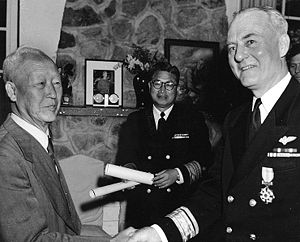 At the outbreak of hostilities in June 1950, all South Korean resistance at the 38th parallel
was overwhelmed by the North Korean offensive. By June 26, it was apparent that the KPA would occupy Seoul. Rhee, who was afraid of a mass insurrection in Seoul, forbade the military from revealing the situation, and instead fled the city on June 27. At midnight on June 28, the South Korean military destroyed the Han Bridge, thereby preventing thousands of citizens from fleeing. On June 28, North Korean soldiers occupied Seoul.
During the North Korean occupation of Seoul, Rhee established a temporary government in Busan
and created a defensive perimeter along the Naktong Bulge. A series of battles ensued, which would later be known collectively as the Battle of Naktong Bulge
.
Restored as South Korea's leader after the recapture of Seoul, Rhee's relationship with the United States became strained after he refused to agree to a number of ceasefire proposals that might have ended the Korean War. Rhee wanted to become the leader of a unified Korea so he vetoed any plans that failed to destroy Kim Il-Sung
. He also wanted stronger methods to be used against the government of Mao Zedong
, expressing annoyance that the U.S. was reluctant to bomb China with nuclear weaponry.
, died shortly before the March 15 elections.
Rhee wanted his protégé, Lee Gibung, elected as the independent Vice President - a separate office under Korean law at that time. When Lee, who was running against Chang Myon
(the ambassador to the United States during the Korean War) won the vote with a wide margin, the opposition claimed the election was rigged. This triggered anger among segments of the Korean populace. When police shot demonstrators in Masan
, the student-led April 19 Movement forced Rhee to resign on April 26. In addition to being the object of popular protests, Rhee was accused by Kim Yong Kap
, Deputy Minister of Finance, of embezzling more than $20 million in government funds.
On April 28, a DC-4 belonging to the United States Central Intelligence Agency
and operated by Civil Air Transport
flew Rhee out of South Korea as protestors converged on the Blue House
. The former president, Franziska Donner (his Austrian-born
wife), and adopted son then lived in exile in Honolulu, Hawaii
.
 Rhee died of a stroke
on July 19, 1965. A week later, his body was returned to Seoul and buried in the Seoul National Cemetery
.
residence, Ihwajang, is currently used for the presidential memorial museum. The Woo-Nam Presidential Preservation Foundation has been set up to honour his legacy.
Rhee is accused of having a dictatorial and corrupt government. His reaction to any opposition was marked with brutality, for instance allowing the police at Masan
and Seoul
to open fire at the strikers, killing over 100, and brutally murdering a high school student named Kim Ju-Yeol (김주열). Rhee was extremely authoritarian, arresting any civilians who opposed him, whether legislators or vagabonds. In one instance, in Gyeongnam on May 27, 1952, forty legislators were arrested by the military police simply because they were heading to the senate. A similar instance occurred in Masan on April 18, 1960 when Rhee secretly ordered the police and bribed criminal organizations to break up the strikers.
President of South Korea
The President of the Republic of Korea is, according to the Constitution of the Republic of Korea, chief executive of the government, commander-in-chief of the armed forces, and the head of state of the Republic of Korea...
of South Korea
South Korea
The Republic of Korea , , is a sovereign state in East Asia, located on the southern portion of the Korean Peninsula. It is neighbored by the People's Republic of China to the west, Japan to the east, North Korea to the north, and the East China Sea and Republic of China to the south...
. His presidency, from August 1948 to April 1960, remains controversial, affected by Cold War
Cold War
The Cold War was the continuing state from roughly 1946 to 1991 of political conflict, military tension, proxy wars, and economic competition between the Communist World—primarily the Soviet Union and its satellite states and allies—and the powers of the Western world, primarily the United States...
tensions on the Korean peninsula and elsewhere. Rhee was regarded as an anti-Communist and a strongman
Strongman (politics)
A strongman is a political leader who rules by force and runs an authoritarian regime. The term is often used interchangeably with "dictator," but differs from a "warlord".A strongman is not necessarily always a formal head of government, however...
, and he led South Korea through the Korean War
Korean War
The Korean War was a conventional war between South Korea, supported by the United Nations, and North Korea, supported by the People's Republic of China , with military material aid from the Soviet Union...
. His presidency ended in resignation following popular protests against a disputed election. He died in exile in Hawaii
Hawaii
Hawaii is the newest of the 50 U.S. states , and is the only U.S. state made up entirely of islands. It is the northernmost island group in Polynesia, occupying most of an archipelago in the central Pacific Ocean, southwest of the continental United States, southeast of Japan, and northeast of...
.
Early life
Syngman Rhee was born in KaesongKaesong
Kaesŏng is a city in North Hwanghae Province, southern North Korea , a former Directly Governed City, and the capital of Korea during the Koryo Dynasty. The city is near Kaesŏng Industrial Region and it contains the remains of the Manwoldae palace. It was formally named Songdo while it was the...
, Hwanghae Province to Yi Gyeong-seon, a royal aristocrat. By birth, Rhee was a member of a royal cadet branch of the House of Yi, the House of Grand Prince Royal Yangnyeong. Rhee attended Pai Chai Hak Dang, but he soon became active in Korea's struggle against Japan
Japan
Japan is an island nation in East Asia. Located in the Pacific Ocean, it lies to the east of the Sea of Japan, China, North Korea, South Korea and Russia, stretching from the Sea of Okhotsk in the north to the East China Sea and Taiwan in the south...
ese hegemony
Hegemony
Hegemony is an indirect form of imperial dominance in which the hegemon rules sub-ordinate states by the implied means of power rather than direct military force. In Ancient Greece , hegemony denoted the politico–military dominance of a city-state over other city-states...
. He was arrested in 1897 for demonstrating against the Japanese monarchy, being subsequently released in 1904 and going to the United States
United States
The United States of America is a federal constitutional republic comprising fifty states and a federal district...
, where he enrolled in a Methodist missionary
Missionary
A missionary is a member of a religious group sent into an area to do evangelism or ministries of service, such as education, literacy, social justice, health care and economic development. The word "mission" originates from 1598 when the Jesuits sent members abroad, derived from the Latin...
school. With assistance from the missionaries, he then went on to college, obtaining a B.A.
Bachelor of Arts
A Bachelor of Arts , from the Latin artium baccalaureus, is a bachelor's degree awarded for an undergraduate course or program in either the liberal arts, the sciences, or both...
from George Washington University
George Washington University
The George Washington University is a private, coeducational comprehensive university located in Washington, D.C. in the United States...
and Harvard University
Harvard University
Harvard University is a private Ivy League university located in Cambridge, Massachusetts, United States, established in 1636 by the Massachusetts legislature. Harvard is the oldest institution of higher learning in the United States and the first corporation chartered in the country...
, and a Ph.D.
Ph.D.
A Ph.D. is a Doctor of Philosophy, an academic degree.Ph.D. may also refer to:* Ph.D. , a 1980s British group*Piled Higher and Deeper, a web comic strip*PhD: Phantasy Degree, a Korean comic series* PhD Docbook renderer, an XML renderer...
from Princeton University
Princeton University
Princeton University is a private research university located in Princeton, New Jersey, United States. The school is one of the eight universities of the Ivy League, and is one of the nine Colonial Colleges founded before the American Revolution....
. He began writing his name in the Western manner, with the personal name preceding the family name.
In 1911, he returned to Korea (which had, by this time, been annexed by Japan) and served as a YMCA
YMCA
The Young Men's Christian Association is a worldwide organization of more than 45 million members from 125 national federations affiliated through the World Alliance of YMCAs...
coordinator and missionary. His political activism attracted unwelcome attention from the occupying army. In 1919, all of the major pro-independence factions formed the Provisional Government of the Republic of Korea
Provisional Government of the Republic of Korea
The Provisional Government of the Republic of Korea was the partially recognised government in exile of Korea, based in Shanghai, China, and later in Chongqing, during the Colonial Korea.-History:...
in Shanghai
Shanghai
Shanghai is the largest city by population in China and the largest city proper in the world. It is one of the four province-level municipalities in the People's Republic of China, with a total population of over 23 million as of 2010...
. Rhee was elected the president, a post he held for six years. In 1925 he was removed from office following his impeachment
Impeachment
Impeachment is a formal process in which an official is accused of unlawful activity, the outcome of which, depending on the country, may include the removal of that official from office as well as other punishment....
by the Provisional Assembly for misuse of his authority— an event that would foreshadow his later political career.
Rise to power
After liberation in 1945, Rhee returned to SeoulSeoul
Seoul , officially the Seoul Special City, is the capital and largest metropolis of South Korea. A megacity with a population of over 10 million, it is the largest city proper in the OECD developed world...
before the other independence leaders. Backed by the United States, Rhee was appointed head of the Korean government in 1945. Rhee began a campaign to "remove Communism"; however, in speeches during the later years of his presidency, Rhee frequently equated his political opponents with Communists.
Rhee won a seat at the First Assembly of South Korea on 10 May 1948 by one parliamentary vote after left-wing parties boycotted the election
Election boycott
An election boycott is the boycotting of an election by a group of voters, each of whom abstains from voting.Boycotting may be used as a form of political protest where voters feel that electoral fraud is likely, or that the electoral system is biased against its candidates, or that the polity...
. He was elected as the Speaker of the Constituent Assembly on May 31. Rhee was then elected the first president
President of South Korea
The President of the Republic of Korea is, according to the Constitution of the Republic of Korea, chief executive of the government, commander-in-chief of the armed forces, and the head of state of the Republic of Korea...
of South Korea
South Korea
The Republic of Korea , , is a sovereign state in East Asia, located on the southern portion of the Korean Peninsula. It is neighbored by the People's Republic of China to the west, Japan to the east, North Korea to the north, and the East China Sea and Republic of China to the south...
defeating Kim Gu
Kim Gu
Kim Gu , the sixth and later the last president of the Provisional Government of the Republic of Korea, was a Korean politician, educator, leader of Korean independence movement against the Japanese occupation of Korea that lasted from 1910 to 1945, and reunification activist who had struggled for...
, the last president of the Provisional Government by a margin of 82-13, on 20 July. On 15 August, Rhee formally took over power from the US military and de jure sovereignty of Korean people from the Provisional Government. A year later, Kim Gu was assassinated by Ahn Doo-hee
Ahn Doo-hee
Ahn Doo-hee carried out the assassination of nationalist Korean leader Kim Gu on June 26, 1949. Officially, it is maintained that Ahn Doo-hee acted alone, although some have theorized that Ahn was part of a broader conspiracy. The existence of a conspiracy, however, is not directly supported by...
. Some speculate that Rhee was behind this assassination.
Political repression
When Rhee assumed power in 1948, he immediately enacted laws that outlawed political dissentPolitical dissent
Political dissent refers to any expression designed to convey dissatisfaction with or opposition to the policies of a governing body. Such expression may take forms from vocal disagreement to civil disobedience to the use of violence. Historically, repressive governments have sought to punish...
and began arresting and eliminating leftist political organizers. He allowed the internal security force (headed by his right-hand man, Kim Chang-ryong
Kim Chang-ryong
Kim Chang-Ryong , was a high-ranking officer in the Republic of Korea Army, head of the Korean Counter-intelligence Corps, and Korean President Syngman Rhee's most trusted right hand man...
) to detain and torture suspected Communists and North Korea
North Korea
The Democratic People’s Republic of Korea , , is a country in East Asia, occupying the northern half of the Korean Peninsula. Its capital and largest city is Pyongyang. The Korean Demilitarized Zone serves as the buffer zone between North Korea and South Korea...
n agents. His government also oversaw several massacres, the most notable one
Jeju massacre
The Jeju Uprising was a revolt on Jeju island off the south coast of the Korean Peninsula, beginning on April 3, 1948. Between 14,000 and 60,000 individuals were killed in fighting or execution between various fractions on the island...
being on Jeju island, where over 30,000 protesters were killed by police.
Korean War
38th parallel north
The 38th parallel north is a circle of latitude that is 38 degrees north of the Earth's equatorial plane. It crosses Europe, the Mediterranean Sea, Asia, the Pacific Ocean, North America, and the Atlantic Ocean...
was overwhelmed by the North Korean offensive. By June 26, it was apparent that the KPA would occupy Seoul. Rhee, who was afraid of a mass insurrection in Seoul, forbade the military from revealing the situation, and instead fled the city on June 27. At midnight on June 28, the South Korean military destroyed the Han Bridge, thereby preventing thousands of citizens from fleeing. On June 28, North Korean soldiers occupied Seoul.
During the North Korean occupation of Seoul, Rhee established a temporary government in Busan
Busan
Busan , formerly spelled Pusan is South Korea's second largest metropolis after Seoul, with a population of around 3.6 million. The Metropolitan area population is 4,399,515 as of 2010. It is the largest port city in South Korea and the fifth largest port in the world...
and created a defensive perimeter along the Naktong Bulge. A series of battles ensued, which would later be known collectively as the Battle of Naktong Bulge
Battle of Naktong Bulge
The First Battle of Naktong Bulge was an engagement between United States and North Korean forces early in the Korean War from August 5–19, 1950 in the vicinity of Yongsan and the Naktong River in South Korea. It was a part of the Battle of Pusan Perimeter, and was one of several large engagements...
.
Restored as South Korea's leader after the recapture of Seoul, Rhee's relationship with the United States became strained after he refused to agree to a number of ceasefire proposals that might have ended the Korean War. Rhee wanted to become the leader of a unified Korea so he vetoed any plans that failed to destroy Kim Il-Sung
Kim Il-sung
Kim Il-sung was a Korean communist politician who led the Democratic People's Republic of Korea from its founding in 1948 until his death in 1994. He held the posts of Prime Minister from 1948 to 1972 and President from 1972 to his death...
. He also wanted stronger methods to be used against the government of Mao Zedong
Mao Zedong
Mao Zedong, also transliterated as Mao Tse-tung , and commonly referred to as Chairman Mao , was a Chinese Communist revolutionary, guerrilla warfare strategist, Marxist political philosopher, and leader of the Chinese Revolution...
, expressing annoyance that the U.S. was reluctant to bomb China with nuclear weaponry.
Re-election
Because of widespread discontent with Rhee's corruption and political repression, it was considered unlikely that Rhee would be re-elected by the National Assembly. To circumvent this, Rhee attempted to amend the constitution to allow him to hold elections for the presidency by direct popular vote. When the Assembly rejected this amendment, Rhee ordered a mass arrest of opposition politicians and then passed the desired amendment in July 1952. During the following presidential election, he received 74% of the vote.Resignation and exile
In 1960, Rhee assured his fourth term in office as President with 90% of the vote. The victory came after the main opposition candidate, Cho Byeong-okCho Byeong-ok
Cho Byeong-ok was a South Korean politician. He ran against incumbent president Syngman Rhee in the 1960 Presidential Elections but died just days before the election. Rhee received 90% of the vote....
, died shortly before the March 15 elections.
Rhee wanted his protégé, Lee Gibung, elected as the independent Vice President - a separate office under Korean law at that time. When Lee, who was running against Chang Myon
Chang Myon
Chang Myon , or John Myun Chang, was a South Korean politician and educator. He was the Vice President of the First Republic and the Prime Minister of the Second Republic...
(the ambassador to the United States during the Korean War) won the vote with a wide margin, the opposition claimed the election was rigged. This triggered anger among segments of the Korean populace. When police shot demonstrators in Masan
Masan
Masan was a formerly a municipal city in South Gyeongsang Province, South Korea. The city was situated on Masan Bay , approximately 35 km west of Busan. It was known for its textile industry, and it was the site of Hite Brewery's production facilities.During the control of the Mongolians, the...
, the student-led April 19 Movement forced Rhee to resign on April 26. In addition to being the object of popular protests, Rhee was accused by Kim Yong Kap
Kim Yong Kap
Kim Yong Kap was the Deputy Minister of Finance of South Korea during the Korean War....
, Deputy Minister of Finance, of embezzling more than $20 million in government funds.
On April 28, a DC-4 belonging to the United States Central Intelligence Agency
Central Intelligence Agency
The Central Intelligence Agency is a civilian intelligence agency of the United States government. It is an executive agency and reports directly to the Director of National Intelligence, responsible for providing national security intelligence assessment to senior United States policymakers...
and operated by Civil Air Transport
Civil Air Transport
Civil Air Transport was a Chinese airline, later owned by the CIA, that supported United States covert operations throughout East and Southeast Asia...
flew Rhee out of South Korea as protestors converged on the Blue House
Cheong Wa Dae
The Cheongwadae or Blue House is the executive office and official residence of the South Korean head of state, the President of the Republic of Korea...
. The former president, Franziska Donner (his Austrian-born
Austria
Austria , officially the Republic of Austria , is a landlocked country of roughly 8.4 million people in Central Europe. It is bordered by the Czech Republic and Germany to the north, Slovakia and Hungary to the east, Slovenia and Italy to the south, and Switzerland and Liechtenstein to the...
wife), and adopted son then lived in exile in Honolulu, Hawaii
Hawaii
Hawaii is the newest of the 50 U.S. states , and is the only U.S. state made up entirely of islands. It is the northernmost island group in Polynesia, occupying most of an archipelago in the central Pacific Ocean, southwest of the continental United States, southeast of Japan, and northeast of...
.
Death
Stroke
A stroke, previously known medically as a cerebrovascular accident , is the rapidly developing loss of brain function due to disturbance in the blood supply to the brain. This can be due to ischemia caused by blockage , or a hemorrhage...
on July 19, 1965. A week later, his body was returned to Seoul and buried in the Seoul National Cemetery
Seoul National Cemetery
The Seoul National Cemetery is located in Dongjak-dong, Dongjak-gu, Seoul, South Korea. When established by presidential decree of Syngman Rhee in 1956, it was the country's only national cemetery. An additional national cemetery was established in 1974 in Daejeon...
.
Legacy and analysis
Rhee's former SeoulSeoul
Seoul , officially the Seoul Special City, is the capital and largest metropolis of South Korea. A megacity with a population of over 10 million, it is the largest city proper in the OECD developed world...
residence, Ihwajang, is currently used for the presidential memorial museum. The Woo-Nam Presidential Preservation Foundation has been set up to honour his legacy.
Rhee is accused of having a dictatorial and corrupt government. His reaction to any opposition was marked with brutality, for instance allowing the police at Masan
Masan
Masan was a formerly a municipal city in South Gyeongsang Province, South Korea. The city was situated on Masan Bay , approximately 35 km west of Busan. It was known for its textile industry, and it was the site of Hite Brewery's production facilities.During the control of the Mongolians, the...
and Seoul
Seoul
Seoul , officially the Seoul Special City, is the capital and largest metropolis of South Korea. A megacity with a population of over 10 million, it is the largest city proper in the OECD developed world...
to open fire at the strikers, killing over 100, and brutally murdering a high school student named Kim Ju-Yeol (김주열). Rhee was extremely authoritarian, arresting any civilians who opposed him, whether legislators or vagabonds. In one instance, in Gyeongnam on May 27, 1952, forty legislators were arrested by the military police simply because they were heading to the senate. A similar instance occurred in Masan on April 18, 1960 when Rhee secretly ordered the police and bribed criminal organizations to break up the strikers.
See also
- List of Korea-related topics
- President of South KoreaPresident of South KoreaThe President of the Republic of Korea is, according to the Constitution of the Republic of Korea, chief executive of the government, commander-in-chief of the armed forces, and the head of state of the Republic of Korea...