

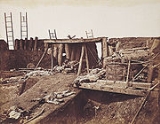
Second Opium War

Encyclopedia
The Second Opium War, the Second Anglo-Chinese War, the Second China War, the Arrow War, or the Anglo-French expedition to China, was a war pitting the British Empire
and the Second French Empire
against the Qing Dynasty
of China, lasting from 1856 to 1860. It was fought over similar issues as the First Opium War
.
trade, opening all of China to British merchants, and exempting foreign imports from internal transit duties. The "Arrow War" refers to the name of a vessel which became the starting point of the conflict. The importance of the opium
factor in the war is in debate among historians.
. Some of the shared goals of the western powers were the expansion of their overseas markets and the establishment of new ports of call. The French Treaty of Huangpu and the American Wangxia Treaty
both contained clauses allowing renegotiation of the treaties after 12 years. In an effort to expand their privileges in China, Britain
demanded the Qing authorities renegotiate the Treaty of Nanking
(signed in 1842), citing their most favoured nation
status. The British demands included opening all of China to British merchants, legalising the opium trade, exempting foreign imports from internal transit duties, suppression of piracy, regulation of the coolie
trade, permission for a British ambassador to reside in Beijing and for the English-language version of all treaties to take precedence over the Chinese.
The Qing Dynasty
court rejected the demands from Britain, France, and the US.
and smuggling
. Twelve Chinese crew members were arrested on suspicion of piracy by the Chinese authorities. The British officials in Guangzhou
demanded the release of the sailors, claiming that because the ship had recently been British-registered, it was protected under the Treaty of Nanking. The British insisted that the Arrow had been flying a British ensign and that the Qing soldiers had insulted the flag. As China insisted that it did not hang out the national flag at that time, negotiations eventually broke down, but not before all sailors had been returned to the British with a letter promising great care would be taken that British ships were not boarded improperly. In fact, the registration of the nationality of the Arrow had expired, in which case she did not have the right to fly the ensign, and her crew's arrest by the Qing authorities was lawful in any case. Richard Cobden
, a British MP of the time, describes the events conducted by the British under Sir John Bowring the day after the prisoners' release given in a speech to parliament:
Faced with fighting the Taiping Rebellion
, the Qing government was in no position to resist the West militarily. This came to be known as the Arrow Incident.
from the Pearl River
. The governor of Guangdong
and Guangxi
provinces, Yeh Mingchen
, ordered all Chinese soldiers manning the forts not to resist the British incursion. After taking the fort near Guangzhou with little effort, the British Army attacked Guangzhou.
Meanwhile, in Hong Kong, there was an attempt to poison the British Superintendent of Trade, Sir John Bowring and his family in January. However, the baker who had been charged with lacing bread with arsenic
bungled the attempt by putting an excess of the poison into the dough. This meant that his victims threw up sufficient quantities of the poison as to only have a non-lethal dose left in their system. Criers
were sent out with an alert, averting disaster.
When known in Britain, the issue became the subject of controversy. The British House of Commons
on 3 March passed a resolution by 263 to 249 against the Government saying: That this House has heard with concern of the conflicts which have occurred between the British and Chinese authorities on the Canton River; and, without expressing an opinion as to the extent to which the Government of China may have afforded this country cause of complaint respecting the non-fulfilment of the Treaty of 1842, this House considers that the papers which have been laid on the table fail to establish satisfactory grounds for the violent measures resorted to at Canton in the late affair of the Arrow, and that a Select Committee be appointed to inquire into the state of our commercial relations with China. In response,Lord Palmerston
assaulted the patriotism of the Whigs who sponsored the resolution and Parliament was dissolved.
 Following the election
and an increased majority for Palmerston, the voices within the Whig faction who were in support of China were hushed, and the new parliament decided to seek redress from China based on the report about the Arrow Incident submitted by Harry Parkes
, British Consul to Guangzhou. The French Empire
, the United States
, and the Russian Empire
received requests from Britain to form an alliance.
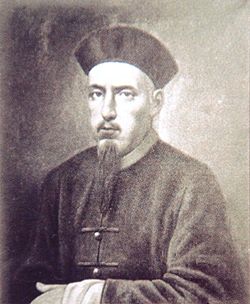
, Father August Chapdelaine ("Father Chapdelaine Incident"), by Chinese local authorities in Guangxi province.
The United States and Russia
sent envoys to Hong Kong to offer help to the British and French, though in the end they sent no military aid. The U.S. was involved in two campaigns however, the first in retaliation for a Chinese attack on a U.S. Navy
officer
. The resulting campaign was the Battle of the Pearl River Forts
, near Canton
. The second was in 1859 when a U.S. warship, the bombarded the Taku Forts
in support of British and French troops on the ground.
The British and the French joined forces under Admiral Sir Michael Seymour. The British army led by Lord Elgin
, and the French army led by Gros
, attacked and occupied Guangzhou in late 1857. Ye Mingchen
was captured, and Bo-gui, the governor of Guangdong, surrendered. A joint committee of the Alliance was formed. Bo-gui remained at his original post in order to maintain order on behalf of the victors. The British-French Alliance maintained control of Guangzhou for nearly four years. Ye Mingchen was exiled to Calcutta
, India, where he starved himself to death.
The coalition then cruised north to briefly capture the Taku Forts
near Tianjin
in May 1858.
The major points of the treaty were:
was signed with Russia to revise the Chinese and Russian border as determined by the Nerchinsk Treaty in 1689. Russia gained the left bank of the Amur River, pushing the border back from the Argun River
. The treaty gave Russia control over a non-freezing area on the Pacific coast, where Russia founded the city of Vladivostok
in 1860.

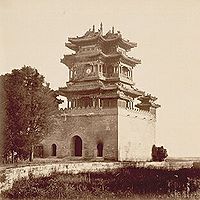
to guard the Taku (Dagu) Forts near Tianjin. Sengge Richen reinforced the Taku Forts with added artillery. He also brought 4,000 Mongolian cavalry from Chahar
and Suiyuan.
In June 1859, a British naval force with 2,200 troops and 21 ships, under the command of Admiral Sir James Hope, sailed north from Shanghai to Tianjin
with newly appointed Anglo-French envoys for the embassies in Beijing. They sailed to the mouth of the Hai River
guarded by the Taku Forts near Tianjin and demanded to continue inland to Beijing. Sengge Rinchen replied that the Anglo-French envoys may land up the coast at Beitang and proceed to Beijing but refused to allow armed troops to accompany them to the Chinese capital. The Anglo-French forces insisted on landing at Taku instead of Beitang and escorting the trip to Beijing. On the night of 24 June 1859, a small batch of British forces blew up iron obstacles that the Chinese had placed in the Baihe River. The next day, the British forces sought to forcibly sail into the river, and shelled Taku Fort. They encountered fierce resistance from Sengge Rinchen's positions. After one day and one night's fighting, four gunboats were lost and two others severely damaged. The convoy withdrew under the cover of fire from a naval squadron commanded by Commodore Josiah Tattnall
. Tattnall's intervention violated U.S. neutrality in China. For a time, anti-foreign resistance reached a crescendo
within the Qing Court.
In the summer of 1860, a larger Anglo-French force (11,000 British under General James Hope Grant
, 6,700 French under General Cousin-Montauban
) with 173 ships sailed from Hong Kong and captured the port cities of Yantai
and Dalian
to seal the Bohai Gulf. Then they carried out a landing near at Beitang (also spelled "Pei Tang"), some 3 kilometres (1.9 mi) from the Taku Forts on 3 August, which they captured after three weeks on 21 August. After taking Tienstin on 3 August, the Anglo-French forces marched inland toward Beijing. The Xianfeng Emperor then dispatched ministers for peace talks, but relations broke down completely when a British diplomatic envoy, Harry Parkes
, was arrested during negotiations on 18 September. He and his small entourage were imprisoned and interrogated. Half were alleged murdered by the Chinese in a fashion by slow slicing with the application of tourniquets to severed limbs to prolong the torture; this infuriated British leadership upon discovery in October). The bodies were unrecognizable. The Anglo-French invasion clashed with Sengge Rinchen's Mongolian cavalry on 18 September near Zhangjiawan
before proceeding toward the outskirts of Beijing for a decisive battle in Tongzhou District, Beijing.
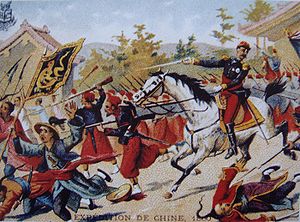
On 21 September, at the Battle of Palikao
, Sengge Rinchen's 10,000 troops including elite Mongolian cavalry were completely annihilated after several doomed frontal charges against concentrated firepower of the Anglo-French forces, which entered Beijing on 6 October.
(Yihe Yuan) and Old Summer Palace
(Yuan Ming Yuan) immediately (as it was full of valuable artwork). After Parkes and the surviving diplomatic prisoners were freed, Lord Elgin
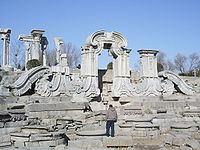
ordered the Summer Palaces destroyed starting on 18 October. Beijing was not occupied; the Anglo-French army remained outside the city.
The destruction of the Forbidden City
was discussed, as proposed by Lord Elgin to discourage the Chinese from using kidnapping as a bargaining tool, and to exact revenge on the mistreatment of their prisoners. Elgin's decision was further motivated by the torture and murder of almost twenty Western prisoners, including two British envoys and a journalist for The Times
. The Russian envoy Count Ignatiev
and the French diplomat Baron Gros
settled on the burning of the Summer Palaces instead, since it was "least objectionable" and would not jeopardise the treaty signing.
on 18 October 1860, bringing The Second Opium War to an end.
The British, French and—thanks to the schemes of Ignatiev—the Russians were all granted a permanent diplomatic presence in Beijing (something the Qing resisted to the very end as it suggested equality between China and the European powers). The Chinese had to pay 8 million tael
s to Britain and France. Britain acquired Kowloon (next to Hong Kong). The opium trade was legalised and Christians were granted full civil rights
, including the right to own property, and the right to evangelise
.
The content of the Convention of Peking included:
Two weeks later, Ignatiev forced the Qing government to sign a "Supplementary Treaty of Peking" which ceded the land east of the Ussuri River
(forming part of Outer Manchuria
) to the Russians. The defeat of the Imperial army by a relatively small Anglo-French military force (outnumbered at least 10 to 1 by the Qing army) coupled with the flight (and subsequent death) of the Emperor and the burning of the Summer Palace was a shocking blow to the once powerful Qing Dynasty. "Beyond a doubt, by 1860 the ancient civilisation that was China had been thoroughly defeated and humiliated by the West." After this war, a major modernisation movement, known as the Self-Strengthening Movement
, began in China in the 1860s and several institutional reforms were initiated.
British Empire
The British Empire comprised the dominions, colonies, protectorates, mandates and other territories ruled or administered by the United Kingdom. It originated with the overseas colonies and trading posts established by England in the late 16th and early 17th centuries. At its height, it was the...
and the Second French Empire
Second French Empire
The Second French Empire or French Empire was the Imperial Bonapartist regime of Napoleon III from 1852 to 1870, between the Second Republic and the Third Republic, in France.-Rule of Napoleon III:...
against the Qing Dynasty
Qing Dynasty
The Qing Dynasty was the last dynasty of China, ruling from 1644 to 1912 with a brief, abortive restoration in 1917. It was preceded by the Ming Dynasty and followed by the Republic of China....
of China, lasting from 1856 to 1860. It was fought over similar issues as the First Opium War
First Opium War
The First Anglo-Chinese War , known popularly as the First Opium War or simply the Opium War, was fought between the United Kingdom and the Qing Dynasty of China over their conflicting viewpoints on diplomatic relations, trade, and the administration of justice...
.
Names
"Second War" and "Arrow War" are both used in the literature. "Second Opium War" refers to one of the British strategic objectives: legalizing the opium trade, expanding coolieCoolie
Historically, a coolie was a manual labourer or slave from Asia, particularly China, India, and the Phillipines during the 19th century and early 20th century...
trade, opening all of China to British merchants, and exempting foreign imports from internal transit duties. The "Arrow War" refers to the name of a vessel which became the starting point of the conflict. The importance of the opium
Opium
Opium is the dried latex obtained from the opium poppy . Opium contains up to 12% morphine, an alkaloid, which is frequently processed chemically to produce heroin for the illegal drug trade. The latex also includes codeine and non-narcotic alkaloids such as papaverine, thebaine and noscapine...
factor in the war is in debate among historians.
Background
The 1850s saw the rapid growth of imperialismImperialism
Imperialism, as defined by Dictionary of Human Geography, is "the creation and/or maintenance of an unequal economic, cultural, and territorial relationships, usually between states and often in the form of an empire, based on domination and subordination." The imperialism of the last 500 years,...
. Some of the shared goals of the western powers were the expansion of their overseas markets and the establishment of new ports of call. The French Treaty of Huangpu and the American Wangxia Treaty
Treaty of Wanghia
The Treaty of Wanghia , is a diplomatic agreement between the Qing Dynasty of China and the United States, signed on 3 July 1844 in the Kun Iam Temple...
both contained clauses allowing renegotiation of the treaties after 12 years. In an effort to expand their privileges in China, Britain
United Kingdom
The United Kingdom of Great Britain and Northern IrelandIn the United Kingdom and Dependencies, other languages have been officially recognised as legitimate autochthonous languages under the European Charter for Regional or Minority Languages...
demanded the Qing authorities renegotiate the Treaty of Nanking
Treaty of Nanking
The Treaty of Nanking was signed on 29 August 1842 to mark the end of the First Opium War between the United Kingdom of Great Britain and Ireland and the Qing Dynasty of China...
(signed in 1842), citing their most favoured nation
Most favoured nation
In international economic relations and international politics, most favoured nation is a status or level of treatment accorded by one state to another in international trade. The term means the country which is the recipient of this treatment must, nominally, receive equal trade advantages as the...
status. The British demands included opening all of China to British merchants, legalising the opium trade, exempting foreign imports from internal transit duties, suppression of piracy, regulation of the coolie
Coolie
Historically, a coolie was a manual labourer or slave from Asia, particularly China, India, and the Phillipines during the 19th century and early 20th century...
trade, permission for a British ambassador to reside in Beijing and for the English-language version of all treaties to take precedence over the Chinese.
The Qing Dynasty
Qing Dynasty
The Qing Dynasty was the last dynasty of China, ruling from 1644 to 1912 with a brief, abortive restoration in 1917. It was preceded by the Ming Dynasty and followed by the Republic of China....
court rejected the demands from Britain, France, and the US.
Outbreak
On 8 October 1856, Qing officials boarded the Arrow, a Chinese-owned ship (a lorcha) that had been registered in Hong Kong and was suspected of piracyPiracy
Piracy is an act of robbery or criminal violence at sea. The term can include acts committed on land, in the air, or in other major bodies of water or on a shore. It does not normally include crimes committed against persons traveling on the same vessel as the perpetrator...
and smuggling
Smuggling
Smuggling is the clandestine transportation of goods or persons, such as out of a building, into a prison, or across an international border, in violation of applicable laws or other regulations.There are various motivations to smuggle...
. Twelve Chinese crew members were arrested on suspicion of piracy by the Chinese authorities. The British officials in Guangzhou
Guangzhou
Guangzhou , known historically as Canton or Kwangchow, is the capital and largest city of the Guangdong province in the People's Republic of China. Located in southern China on the Pearl River, about north-northwest of Hong Kong, Guangzhou is a key national transportation hub and trading port...
demanded the release of the sailors, claiming that because the ship had recently been British-registered, it was protected under the Treaty of Nanking. The British insisted that the Arrow had been flying a British ensign and that the Qing soldiers had insulted the flag. As China insisted that it did not hang out the national flag at that time, negotiations eventually broke down, but not before all sailors had been returned to the British with a letter promising great care would be taken that British ships were not boarded improperly. In fact, the registration of the nationality of the Arrow had expired, in which case she did not have the right to fly the ensign, and her crew's arrest by the Qing authorities was lawful in any case. Richard Cobden
Richard Cobden
Richard Cobden was a British manufacturer and Radical and Liberal statesman, associated with John Bright in the formation of the Anti-Corn Law League as well as with the Cobden-Chevalier Treaty...
, a British MP of the time, describes the events conducted by the British under Sir John Bowring the day after the prisoners' release given in a speech to parliament:
Operations were commenced against the Barrier Forts on the Canton River. From 23 October to 13 November, these naval and military operations were continuous. The Barrier Forts, the Bogue Forts, the Blenheim Forts, and the Dutch Folly Forts, and twenty-three Chinese junks, were all taken or destroyed. The suburbs of Canton were pulled, burnt, or battered down, that the ships might fire upon the walls of the town[.]
Faced with fighting the Taiping Rebellion
Taiping Rebellion
The Taiping Rebellion was a widespread civil war in southern China from 1850 to 1864, led by heterodox Christian convert Hong Xiuquan, who, having received visions, maintained that he was the younger brother of Jesus Christ, against the ruling Manchu-led Qing Dynasty...
, the Qing government was in no position to resist the West militarily. This came to be known as the Arrow Incident.
British attacks
Although the British were delayed by the Indian Mutiny of 1857, they followed up the Arrow Incident in 1856 and attacked GuangzhouGuangzhou
Guangzhou , known historically as Canton or Kwangchow, is the capital and largest city of the Guangdong province in the People's Republic of China. Located in southern China on the Pearl River, about north-northwest of Hong Kong, Guangzhou is a key national transportation hub and trading port...
from the Pearl River
Pearl River (China)
The Pearl River or less commonly, the "Guangdong River" or "Canton River" etc., , is an extensive river system in southern China. The name Pearl River is usually used as a catchment term to refer to the watersheds of the Xi Jiang , the Bei Jiang , and the Dong Jiang...
. The governor of Guangdong
Guangdong
Guangdong is a province on the South China Sea coast of the People's Republic of China. The province was previously often written with the alternative English name Kwangtung Province...
and Guangxi
Guangxi
Guangxi, formerly romanized Kwangsi, is a province of southern China along its border with Vietnam. In 1958, it became the Guangxi Zhuang Autonomous Region of the People's Republic of China, a region with special privileges created specifically for the Zhuang people.Guangxi's location, in...
provinces, Yeh Mingchen
Ye Mingchen
Ye Mingchen was a high-ranking Chinese official during the Qing Dynasty, known for his resistance to British influence in Guangzhou in the aftermath of the First Opium War.-Early career:...
, ordered all Chinese soldiers manning the forts not to resist the British incursion. After taking the fort near Guangzhou with little effort, the British Army attacked Guangzhou.
Meanwhile, in Hong Kong, there was an attempt to poison the British Superintendent of Trade, Sir John Bowring and his family in January. However, the baker who had been charged with lacing bread with arsenic
Arsenic
Arsenic is a chemical element with the symbol As, atomic number 33 and relative atomic mass 74.92. Arsenic occurs in many minerals, usually in conjunction with sulfur and metals, and also as a pure elemental crystal. It was first documented by Albertus Magnus in 1250.Arsenic is a metalloid...
bungled the attempt by putting an excess of the poison into the dough. This meant that his victims threw up sufficient quantities of the poison as to only have a non-lethal dose left in their system. Criers
Town crier
A town crier, or bellman, is an officer of the court who makes public pronouncements as required by the court . The crier can also be used to make public announcements in the streets...
were sent out with an alert, averting disaster.
When known in Britain, the issue became the subject of controversy. The British House of Commons
British House of Commons
The House of Commons is the lower house of the Parliament of the United Kingdom, which also comprises the Sovereign and the House of Lords . Both Commons and Lords meet in the Palace of Westminster. The Commons is a democratically elected body, consisting of 650 members , who are known as Members...
on 3 March passed a resolution by 263 to 249 against the Government saying: That this House has heard with concern of the conflicts which have occurred between the British and Chinese authorities on the Canton River; and, without expressing an opinion as to the extent to which the Government of China may have afforded this country cause of complaint respecting the non-fulfilment of the Treaty of 1842, this House considers that the papers which have been laid on the table fail to establish satisfactory grounds for the violent measures resorted to at Canton in the late affair of the Arrow, and that a Select Committee be appointed to inquire into the state of our commercial relations with China. In response,Lord Palmerston
assaulted the patriotism of the Whigs who sponsored the resolution and Parliament was dissolved.
United Kingdom general election, 1857
-Seats summary:-References:*F. W. S. Craig, British Electoral Facts: 1832-1987* British Electoral Facts 1832-1999, compiled and edited by Colin Rallings and Michael Thrasher *...
and an increased majority for Palmerston, the voices within the Whig faction who were in support of China were hushed, and the new parliament decided to seek redress from China based on the report about the Arrow Incident submitted by Harry Parkes
Harry Smith Parkes
Sir Harry Smith Parkes was a 19th century British diplomat who worked mainly in China and Japan...
, British Consul to Guangzhou. The French Empire
Second French Empire
The Second French Empire or French Empire was the Imperial Bonapartist regime of Napoleon III from 1852 to 1870, between the Second Republic and the Third Republic, in France.-Rule of Napoleon III:...
, the United States
United States
The United States of America is a federal constitutional republic comprising fifty states and a federal district...
, and the Russian Empire
Russian Empire
The Russian Empire was a state that existed from 1721 until the Russian Revolution of 1917. It was the successor to the Tsardom of Russia and the predecessor of the Soviet Union...
received requests from Britain to form an alliance.
Intervention of France
France joined the British action against China, prompted by the execution of a French missionaryMissionary
A missionary is a member of a religious group sent into an area to do evangelism or ministries of service, such as education, literacy, social justice, health care and economic development. The word "mission" originates from 1598 when the Jesuits sent members abroad, derived from the Latin...
, Father August Chapdelaine ("Father Chapdelaine Incident"), by Chinese local authorities in Guangxi province.
The United States and Russia
Russia
Russia or , officially known as both Russia and the Russian Federation , is a country in northern Eurasia. It is a federal semi-presidential republic, comprising 83 federal subjects...
sent envoys to Hong Kong to offer help to the British and French, though in the end they sent no military aid. The U.S. was involved in two campaigns however, the first in retaliation for a Chinese attack on a U.S. Navy
United States Navy
The United States Navy is the naval warfare service branch of the United States Armed Forces and one of the seven uniformed services of the United States. The U.S. Navy is the largest in the world; its battle fleet tonnage is greater than that of the next 13 largest navies combined. The U.S...
officer
Officer (armed forces)
An officer is a member of an armed force or uniformed service who holds a position of authority. Commissioned officers derive authority directly from a sovereign power and, as such, hold a commission charging them with the duties and responsibilities of a specific office or position...
. The resulting campaign was the Battle of the Pearl River Forts
Battle of the Pearl River Forts
The Battle of the Pearl River Forts, or the Battle of the Barrier Forts, in late 1856, was an amphibious assault and short occupation conducted by the United States Navy against a series of forts along China's Pearl River...
, near Canton
Guangzhou
Guangzhou , known historically as Canton or Kwangchow, is the capital and largest city of the Guangdong province in the People's Republic of China. Located in southern China on the Pearl River, about north-northwest of Hong Kong, Guangzhou is a key national transportation hub and trading port...
. The second was in 1859 when a U.S. warship, the bombarded the Taku Forts
Battle of Taku Forts (1859)
The Second Battle of Taku Forts, in June 1859, was an Anglo-French attack on a series of Chinese forts protecting Taku, China during the Second Opium War...
in support of British and French troops on the ground.
The British and the French joined forces under Admiral Sir Michael Seymour. The British army led by Lord Elgin
James Bruce, 8th Earl of Elgin
Sir James Bruce, 8th Earl of Elgin and 12th Earl of Kincardine, KT, GCB, PC , was a British colonial administrator and diplomat...
, and the French army led by Gros
Jean-Baptiste Louis Gros
Jean-Baptiste Louis Gros was a French ambassador and one of the first daguerrotypists. Baron and French chargé d'affaires in Bogotá , Athens and Ambassador to London - during which period he also travelled to China and Japan in 1857 and 1858 — he produced many famous daguerrotypes — chief among...
, attacked and occupied Guangzhou in late 1857. Ye Mingchen
Ye Mingchen
Ye Mingchen was a high-ranking Chinese official during the Qing Dynasty, known for his resistance to British influence in Guangzhou in the aftermath of the First Opium War.-Early career:...
was captured, and Bo-gui, the governor of Guangdong, surrendered. A joint committee of the Alliance was formed. Bo-gui remained at his original post in order to maintain order on behalf of the victors. The British-French Alliance maintained control of Guangzhou for nearly four years. Ye Mingchen was exiled to Calcutta
Kolkata
Kolkata , formerly known as Calcutta, is the capital of the Indian state of West Bengal. Located on the east bank of the Hooghly River, it was the commercial capital of East India...
, India, where he starved himself to death.
The coalition then cruised north to briefly capture the Taku Forts
Taku Forts
The Dagu Forts , also called the Peiho Forts are forts located by the Hai River estuary, in Tanggu District, Tianjin municipality, in northeastern China. They are located 60 km southeast of the Tianjin urban center.-History:The first fort was built during the reign of the Ming Jiajing...
near Tianjin
Tianjin
' is a metropolis in northern China and one of the five national central cities of the People's Republic of China. It is governed as a direct-controlled municipality, one of four such designations, and is, thus, under direct administration of the central government...
in May 1858.
Treaties of Tientsin
In June 1858, the first part of the war ended with the four Treaties of Tientsin, to which Britain, France, Russia, and the U.S. were parties. These treaties opened 11 more ports to Western trade. The Chinese initially refused to ratify the treaties.The major points of the treaty were:
- Britain, France, Russia, and the U.S. would have the right to establish diplomatic legationLegationA legation was the term used in diplomacy to denote a diplomatic representative office lower than an embassy. Where an embassy was headed by an Ambassador, a legation was headed by a Envoy Extraordinary and Minister Plenipotentiary....
s (small embassies) in Peking (a closed city at the time) - Ten more Chinese ports would be opened for foreign trade, including Niuzhuang, Tamsui, Hankou, and NanjingNanjing' is the capital of Jiangsu province in China and has a prominent place in Chinese history and culture, having been the capital of China on several occasions...
- The right of all foreign vessels including commercial ships to navigate freely on the Yangtze RiverYangtze RiverThe Yangtze, Yangzi or Cháng Jiāng is the longest river in Asia, and the third-longest in the world. It flows for from the glaciers on the Tibetan Plateau in Qinghai eastward across southwest, central and eastern China before emptying into the East China Sea at Shanghai. It is also one of the...
- The right of foreigners to travel in the internal regions of China, which had been formerly banned
- China was to pay an indemnity to Britain and France in 8 million taelTaelTael can refer to any one of several weight measures of the Far East. Most commonly, it refers to the Chinese tael, a part of the Chinese system of weights and currency....
s of silver each
Treaty of Aigun
On 28 May 1858, the separate Treaty of AigunTreaty of Aigun
The Treaty of Aigun was a 1858 treaty between the Russian Empire, and the empire of the Qing Dynasty, the sinicized-Manchu rulers of China, that established much of the modern border between the Russian Far East and Manchuria , which is now known as Northeast China...
was signed with Russia to revise the Chinese and Russian border as determined by the Nerchinsk Treaty in 1689. Russia gained the left bank of the Amur River, pushing the border back from the Argun River
Argun River
Argun River may refer to*Argun River , in Georgia and Russia*Argun River , part of the Russia–China border...
. The treaty gave Russia control over a non-freezing area on the Pacific coast, where Russia founded the city of Vladivostok
Vladivostok
The city is located in the southern extremity of Muravyov-Amursky Peninsula, which is about 30 km long and approximately 12 km wide.The highest point is Mount Kholodilnik, the height of which is 257 m...
in 1860.
Second phase
Anglo-French invasion
In June 1858, shortly after the Qing Court agreed to the disadvantageous treaties, more hawkish ministers prevailed upon the Xianfeng Emperor to resist encroachment by the West. On 2 June 1858, the Xianfeng Emperor ordered the Mongolian general Sengge RinchenSengge Rinchen
Sengge Rinchen was a Mongol nobleman and general during the Qing dynasty, who is mainly known for his role during the Second Opium War and the suppression of the Taiping and Nian rebellions.-Background:...
to guard the Taku (Dagu) Forts near Tianjin. Sengge Richen reinforced the Taku Forts with added artillery. He also brought 4,000 Mongolian cavalry from Chahar
Chahar (province)
Chahar , also known as Chaha'er, Chakhar, or Qahar, was a province of China in existence from 1912 to 1936, mostly covering territory in what is part of eastern Inner Mongolia. It was named after the Chahar Mongolians....
and Suiyuan.
In June 1859, a British naval force with 2,200 troops and 21 ships, under the command of Admiral Sir James Hope, sailed north from Shanghai to Tianjin
Tianjin
' is a metropolis in northern China and one of the five national central cities of the People's Republic of China. It is governed as a direct-controlled municipality, one of four such designations, and is, thus, under direct administration of the central government...
with newly appointed Anglo-French envoys for the embassies in Beijing. They sailed to the mouth of the Hai River
Hai River
The Hai River , previously called Bai He , is a river in the People's Republic of China which flows through Beijing and Tianjin before emptying into the Yellow Sea at the Bohai Gulf.The Hai River at Tianjin is formed by the confluence of five rivers, the Southern Canal, Ziya...
guarded by the Taku Forts near Tianjin and demanded to continue inland to Beijing. Sengge Rinchen replied that the Anglo-French envoys may land up the coast at Beitang and proceed to Beijing but refused to allow armed troops to accompany them to the Chinese capital. The Anglo-French forces insisted on landing at Taku instead of Beitang and escorting the trip to Beijing. On the night of 24 June 1859, a small batch of British forces blew up iron obstacles that the Chinese had placed in the Baihe River. The next day, the British forces sought to forcibly sail into the river, and shelled Taku Fort. They encountered fierce resistance from Sengge Rinchen's positions. After one day and one night's fighting, four gunboats were lost and two others severely damaged. The convoy withdrew under the cover of fire from a naval squadron commanded by Commodore Josiah Tattnall
Josiah Tattnall
Commodore Josiah Tattnall, Jr. was an officer in the United States Navy during the War of 1812, the Second Barbary War, and the Mexican-American War. He later served in the Confederate Navy during the American Civil War....
. Tattnall's intervention violated U.S. neutrality in China. For a time, anti-foreign resistance reached a crescendo
Crescendo
-In music:*Crescendo, a passage of music during which the volume gradually increases, see Dynamics * Crescendo , a Liverpool-based electronic pop band* "Diminuendo and Crescendo in Blue", one of Duke Ellington's longer-form compositions...
within the Qing Court.
In the summer of 1860, a larger Anglo-French force (11,000 British under General James Hope Grant
James Hope Grant
General Sir James Hope Grant GCB , British general, was the fifth and youngest son of Francis Grant of Kilgraston, Perthshire, and brother of Sir Francis Grant, President of the Royal Academy.-Military career:...
, 6,700 French under General Cousin-Montauban
Charles Cousin-Montauban, Comte de Palikao
Charles Guillaume Marie Appollinaire Antoine Cousin Montauban, comte de Palikao was a French general and statesman.-Biography:Montauban was born in Paris. As a cavalry officer he saw much service in Algeria, but he was still only a colonel when in 1847 he effected the capture of Abdel Kadir...
) with 173 ships sailed from Hong Kong and captured the port cities of Yantai
Yantai
Yantai is a prefecture-level city in northeastern Shandong province, People's Republic of China. Located on the southern coast of the Bohai Sea and the eastern coast of the Laizhou Bay, Yantai borders the cities of Qingdao and Weihai to the southwest and east respectively.The largest fishing...
and Dalian
Dalian
Dalian is a major city and seaport in the south of Liaoning province, Northeast China. It faces Shandong to the south, the Yellow Sea to the east and the Bohai Sea to the west and south. Holding sub-provincial administrative status, Dalian is the southernmost city of Northeast China and China's...
to seal the Bohai Gulf. Then they carried out a landing near at Beitang (also spelled "Pei Tang"), some 3 kilometres (1.9 mi) from the Taku Forts on 3 August, which they captured after three weeks on 21 August. After taking Tienstin on 3 August, the Anglo-French forces marched inland toward Beijing. The Xianfeng Emperor then dispatched ministers for peace talks, but relations broke down completely when a British diplomatic envoy, Harry Parkes
Harry Smith Parkes
Sir Harry Smith Parkes was a 19th century British diplomat who worked mainly in China and Japan...
, was arrested during negotiations on 18 September. He and his small entourage were imprisoned and interrogated. Half were alleged murdered by the Chinese in a fashion by slow slicing with the application of tourniquets to severed limbs to prolong the torture; this infuriated British leadership upon discovery in October). The bodies were unrecognizable. The Anglo-French invasion clashed with Sengge Rinchen's Mongolian cavalry on 18 September near Zhangjiawan
Battle of Zhangjiawan
Battle of Zhangjiawan was fought at the village of Zhangjiawan by British and French forces during the Second Opium War on the morning of 18 September 1860.- Battle :...
before proceeding toward the outskirts of Beijing for a decisive battle in Tongzhou District, Beijing.
On 21 September, at the Battle of Palikao
Battle of Palikao
The Battle of Palikao was fought at the bridge of Palikao by Anglo-French forces against China during the Second Opium War on the morning of 21 September 1860...
, Sengge Rinchen's 10,000 troops including elite Mongolian cavalry were completely annihilated after several doomed frontal charges against concentrated firepower of the Anglo-French forces, which entered Beijing on 6 October.
Burning of the Summer Palaces
With the Qing army devastated, Emperor Xianfeng fled the capital, leaving his brother, Prince Gong, to be in charge of negotiations. Xianfeng first fled to the Chengde Summer Palace and then to Rehe Province. Anglo-French troops in Beijing began looting the Summer PalaceSummer Palace
The Summer Palace is a palace in Beijing, China. The Summer Palace is mainly dominated by Longevity Hill and the Kunming Lake. It covers an expanse of 2.9 square kilometers, three quarters of which is water....
(Yihe Yuan) and Old Summer Palace
Old Summer Palace
The Old Summer Palace, known in China as Yuan Ming Yuan , and originally called the Imperial Gardens, was a complex of palaces and gardens in Beijing...
(Yuan Ming Yuan) immediately (as it was full of valuable artwork). After Parkes and the surviving diplomatic prisoners were freed, Lord Elgin
James Bruce, 8th Earl of Elgin
Sir James Bruce, 8th Earl of Elgin and 12th Earl of Kincardine, KT, GCB, PC , was a British colonial administrator and diplomat...
ordered the Summer Palaces destroyed starting on 18 October. Beijing was not occupied; the Anglo-French army remained outside the city.
The destruction of the Forbidden City
Forbidden City
The Forbidden City was the Chinese imperial palace from the Ming Dynasty to the end of the Qing Dynasty. It is located in the middle of Beijing, China, and now houses the Palace Museum...
was discussed, as proposed by Lord Elgin to discourage the Chinese from using kidnapping as a bargaining tool, and to exact revenge on the mistreatment of their prisoners. Elgin's decision was further motivated by the torture and murder of almost twenty Western prisoners, including two British envoys and a journalist for The Times
The Times
The Times is a British daily national newspaper, first published in London in 1785 under the title The Daily Universal Register . The Times and its sister paper The Sunday Times are published by Times Newspapers Limited, a subsidiary since 1981 of News International...
. The Russian envoy Count Ignatiev
Nicholas Pavlovich Ignatiev
Count Nikolay Pavlovich Ignatyev was a Russian statesman and diplomat...
and the French diplomat Baron Gros
Jean-Baptiste Louis Gros
Jean-Baptiste Louis Gros was a French ambassador and one of the first daguerrotypists. Baron and French chargé d'affaires in Bogotá , Athens and Ambassador to London - during which period he also travelled to China and Japan in 1857 and 1858 — he produced many famous daguerrotypes — chief among...
settled on the burning of the Summer Palaces instead, since it was "least objectionable" and would not jeopardise the treaty signing.
Aftermath
After the Xianfeng emperor and his entourage fled Beijing, the June 1858 Treaty of Tianjin was finally ratified by the emperor's brother, Yixin, the Prince Gong, in the Convention of PekingConvention of Peking
The Convention of Peking or the First Convention of Peking is the name used for three different unequal treaties, which were concluded between Qing China and the United Kingdom, France, and Russia.-Background:...
on 18 October 1860, bringing The Second Opium War to an end.
The British, French and—thanks to the schemes of Ignatiev—the Russians were all granted a permanent diplomatic presence in Beijing (something the Qing resisted to the very end as it suggested equality between China and the European powers). The Chinese had to pay 8 million tael
Tael
Tael can refer to any one of several weight measures of the Far East. Most commonly, it refers to the Chinese tael, a part of the Chinese system of weights and currency....
s to Britain and France. Britain acquired Kowloon (next to Hong Kong). The opium trade was legalised and Christians were granted full civil rights
Civil rights
Civil and political rights are a class of rights that protect individuals' freedom from unwarranted infringement by governments and private organizations, and ensure one's ability to participate in the civil and political life of the state without discrimination or repression.Civil rights include...
, including the right to own property, and the right to evangelise
Evangelism
Evangelism refers to the practice of relaying information about a particular set of beliefs to others who do not hold those beliefs. The term is often used in reference to Christianity....
.
The content of the Convention of Peking included:
- China's signing of the Treaty of Tianjin
- Opening Tianjin as a trade port
- Cede No.1 District of KowloonKowloonKowloon is an urban area in Hong Kong comprising the Kowloon Peninsula and New Kowloon. It is bordered by the Lei Yue Mun strait in the east, Mei Foo Sun Chuen and Stonecutter's Island in the west, Tate's Cairn and Lion Rock in the north, and Victoria Harbour in the south. It had a population of...
(south of present day Boundary StreetBoundary Street[[Image:Boundary st hongkong.JPG|thumb|right|250px|Boundary Street near [[Kowloon Tong]]Boundary Street is a three-lane one-way street in [[Kowloon]], [[Hong Kong]]...
) to Britain - Freedom of religion established in China
- British ships were allowed to carry indentured Chinese to the Americas
- Indemnity to Britain and France increasing to 8 million taels of silver apiece
- Legalization of the opium trade
Two weeks later, Ignatiev forced the Qing government to sign a "Supplementary Treaty of Peking" which ceded the land east of the Ussuri River
Ussuri River
The Usuri ula is a river in the south of the Outer Manchuria and east of Inner Manchuria . It rises in the Sikhote-Alin range, flowing north, forming part of the Sino-Russian border based on the Sino-Russian Convention of Peking in 1860, until it joins the Amur River at Khabarovsk . It is...
(forming part of Outer Manchuria
Outer Manchuria
Outer Manchuria , is the territory ceded by China to Russia in the Treaty of Aigun in 1858 and the Treaty of Peking in 1860. . The northern part of the area was also in dispute between 1643 and 1689...
) to the Russians. The defeat of the Imperial army by a relatively small Anglo-French military force (outnumbered at least 10 to 1 by the Qing army) coupled with the flight (and subsequent death) of the Emperor and the burning of the Summer Palace was a shocking blow to the once powerful Qing Dynasty. "Beyond a doubt, by 1860 the ancient civilisation that was China had been thoroughly defeated and humiliated by the West." After this war, a major modernisation movement, known as the Self-Strengthening Movement
Self-Strengthening Movement
The Self-Strengthening Movement , c 1861–1895, was a period of institutional reforms initiated during the late Qing Dynasty following a series of military defeats and concessions to foreign powers....
, began in China in the 1860s and several institutional reforms were initiated.
See also
- Unequal treatiesUnequal Treaties“Unequal treaty” is a term used in specific reference to a number of treaties imposed by Western powers, during the 19th and early 20th centuries, on Qing Dynasty China and late Tokugawa Japan...
- Anglo-Chinese relationsAnglo-Chinese relationsBritish–Chinese relations , also known as Sino-British relations and Anglo-Chinese relations, refers to the interstate relations between China and the United Kingdom. Although on opposing sides of the Cold War, both countries were allies during World War II, and are members of the UN...
- Imperialism in AsiaImperialism in AsiaImperialism in Asia traces its roots back to the late 15th century with a series of voyages that sought a sea passage to India in the hope of establishing direct trade between Europe and Asia in spices. Before 1500 European economies were largely self-sufficient, only supplemented by minor trade...
- Taiping RebellionTaiping RebellionThe Taiping Rebellion was a widespread civil war in southern China from 1850 to 1864, led by heterodox Christian convert Hong Xiuquan, who, having received visions, maintained that he was the younger brother of Jesus Christ, against the ruling Manchu-led Qing Dynasty...
- Nien RebellionNien RebellionThe Nien Rebellion was an armed uprising that took place in northern China from 1851 to 1868, contemporaneously with Taiping Rebellion in South China...
- Miao Rebellion (1854–73)
- Dungan revolt (1862–1877)
- Panthay Rebellion
Further reading
- G. F. Bartle, Sir John Bowring and the Arrow war in China, Bulletin of the John Rylands Library, Manchester, 43:2 (1961), 293–316
- Jack Beeching, The Chinese Opium Wars (1975), ISBN 0-15-617094-9
- Bonner-Smith and E. Lumley, The Second China War, 1944.
- W. Travis Hanes III and Frank Sanello, The Opium Wars, 2002, ISBN 0-7607-7638-5
- Immanual Hsu, The Rise of Modern China, 1985.
- Henry Loch, Personal narrative of occurrences during Lord Elgin's second embassy to China 1860, 1869.
- Erik Ringmar, Fury of the Europeans: Liberal Barbarism and the Destruction of the Emperor's Summer Palace
- J. W. Wong, Deadly Dreams: Opium, Imperialism, and the Arrow War (1856–1860) in China, (Cambridge: Cambridge University Press) 1998.