

Mumun pottery period

Encyclopedia
The Mumun pottery period is an archaeological era in Korean prehistory
that dates to approximately 1500-300 BC This period is named after the Korean name for undecorated or plain cooking and storage vessels that form a large part of the pottery
assemblage over the entire length of the period, but especially 850-550 BC.
The Mumun period is known for the origins of intensive agriculture and complex societies in both the Korean Peninsula
and the Japanese Archipelago
. This period or parts of it have sometimes been labelled as the "Korean Bronze Age
", after Thomsen's
19th century Three-age system
classification of human prehistory. However, the application of such terminology in the Korean case is misleading since local bronze production did not occur until approximately the late 8th century BC at the earliest, bronze artifacts are rare, and the distribution of bronze is highly regionalized until after 300 BC A boom in the archaeological excavations of Mumun Period sites since the mid-1990s has recently increased our knowledge about this important formative period in the prehistory of East Asia
.
The Mumun period is preceded by the Jeulmun Pottery Period
(c. 8000-1500 BC). The Jeulmun was a period of hunting, gathering, and small-scale cultivation of plants. The origins of the Mumun Period are not well known, but the megalith
ic burials, Mumun pottery, and large settlements found in the Liao River
Basin and North Korea
c. 1800-1500 probably indicate the origins of the Mumun Period of Southern Korea. Slash-and-burn cultivators who used Mumun pottery displaced people using Jeulmun Period subsistence patterns.
, fishing, hunting, and discrete settlements with rectangular semi-subterranean pit-houses. The social scale of Early Mumun societies was egalitarian in nature, but the latter part of this period is characterized by increasing intra-settlement competition and perhaps the presence of part-time "big-man" leadership. Early Mumun settlements are relatively concentrated in the river valleys formed by tributaries of the Geum River
in West-central Korea. However, one of the largest Early Mumun settlements, Eoeun (Hangeul: 어은), is located in the Middle Nam River valley in South-central Korea. In the latter Early Mumun, large settlements composed of many long-houses
such as Baekseok-dong (Hangeul: 백석동) appeared in the area of modern Cheonan
City, Chungcheong Nam-do.
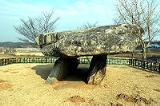
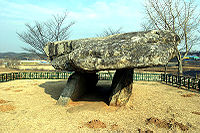
Important long-term traditions related to Mumun ceremonial and mortuary systems originated in this sub-period. These traditions include the construction of megalithic burials
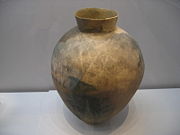
, the production of red-burnished pottery, and production of polished groundstone daggers.
 The Middle (or Classic) Mumun (c. 850-550 BC) is characterized by intensive agriculture, as evidenced by the large and expansive dry-field remains (c. 32,500 square metres) recovered at Daepyeong
, a sprawling settlement with several multiple ditch enclosures, hundreds of pit-houses, specialized production, and evidence of the presence of incipient elites and social competition. A number of wet-field features have been excavated in southern Korea, indicating that paddy field
rice-farming was also practiced.
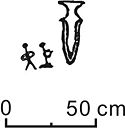 Burials dating to the latter part of the Middle Mumun (c. 700-550 BC) contain a few high status mortuary offerings such as bronze artifacts. Bronze production probably began around this time in Southern Korea. Other high status burials contain greenstone (or jade
) ornaments. A number of megalithic burials with deep shaft interments, substantial 'pavements' of rounded cobblestone, and prestige artifacts such as bronze daggers, jade, and red-burnished vessels were built in the vicinity of the southern coast in the Late Middle Mumun. High status megalithic burials and large raised-floor buildings at the Deokcheon-ni (Hangeul: 덕천리) and Igeum-dong site
s in Gyeongsang Nam-do provide further evidence of the growth of social inequality and the existence of polities that were organized in ways that appear to be similar to simple "chiefdoms".
Korean archaeologists sometimes refer to Middle Mumun culture as Songguk-ri
Culture (Hanja: 松菊里 文化; Hangeul: 송국리 문화). Co-occurring artifacts and features that are grouped together as Songguk-ri Culture are found in settlement sites in the Hoseo and Honam
regions of southeast Korea, but Songguk-ri Culture settlements are also found in western Yeongnam. Excavations have also revealed Songguk-ri settlements in the Ulsan and Gimhae areas. In 2005 archaeologists uncovered Songguk-ri Culture pit-houses at a site deep in the interior of Gangwon Province
. The ultimate geographic reach of Songguk-ri Culture appears to have been Jeju Island
and western Japan
.
Mumun culture is the beginning of a long-term tradition of rice-farming in Korea that links Mumun Culture with the present-day, but evidence from the Early and Middle Mumun suggests that, although rice
was grown, it was not the dominant crop. During the Mumun people grew millet
s, barley
, wheat
, legumes, and continued to hunt and fish.
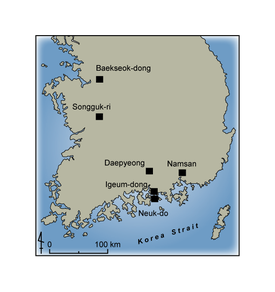
City, Gyeongsang Nam-do. A shellmidden (shellmound) was found in the vicinity of Namsan, indicating that, in addition to agriculture, shellfish exploitation was part of the Late Mumun subsistence system in some areas. Pit-houses at Namsan were located inside a ring-ditch that is some 4.2 m deep and 10 m in width. Why would such a formidable ring-ditch, so massive in size, have been necessary? One possible answer is intergroup conflict. Archaeologists propose that the Late Mumun was a period of conflict between groups of people.
The number of settlements in the Late Mumun is much lower than in the previous sub-period. This indicates that populations were reorganized and settlement was probably more concentrated in a smaller number of larger settlements. There are a number of reasons why this could have occurred. There are some indications that conflict increased or climatic change led to crop failures.
Notably, according to the traditional Yayoi chronological sequence, Mumun-esque settlements appeared in Northern Kyūshū
(Japan
) during the Late Mumun. The Mumun period ends when iron appeared in the archaeological record along with pit-houses that had interior composite hearth-ovens reminiscent of the historic period (Hangeul: 아궁이, agungi).
Some scholars suggest that the Mumun pottery period should be extended to c. 0 BC because of the presence of an undecorated ware that was popular between 400 BC and 0 BC called jeomtodae (ko:점토대). However, bronze became very important in ceremonial and elite life from 300 BC. Additionally, iron tools are increasingly found in Southern Korea after 300 BC These factors clearly differentiate the time period 300 BC - 0 from the cultural, technological, and social scale that was present in the Mumun pottery period. The unequal presence of bronze and iron in increased amounts from a few high status graves after 300 BC as sets this time apart from the Mumun pottery period. It is thus that, as a cultural-technical period, the Mumun was finished by approximately 300 BC.
From about 300 BC, bronze objects became the most valued prestige mortuary goods, but iron objects were traded and then produced in the Korean peninsula
at that time. The Late Mumun-Early Iron age
Neuk-do Island Shellmidden Site yielded a small number of iron objects, Lelang and Yayoi pottery, and other evidence showing that beginning in the Late Mumun, local societies were drawn into closer economic and political contact with the societies of the Late Zhou
, Final Jōmon, and Early Yayoi.
, the Mumun is composed of the following elements:
Prehistoric Korea
The Prehistoric Korea is the era of human existence in the Korean Peninsula for which written records did not exist. It, however, constitutes the greatest segment of the Korean past and is the major object of study in the disciplines of archaeology, geology, and...
that dates to approximately 1500-300 BC This period is named after the Korean name for undecorated or plain cooking and storage vessels that form a large part of the pottery
Pottery
Pottery is the material from which the potteryware is made, of which major types include earthenware, stoneware and porcelain. The place where such wares are made is also called a pottery . Pottery also refers to the art or craft of the potter or the manufacture of pottery...
assemblage over the entire length of the period, but especially 850-550 BC.
The Mumun period is known for the origins of intensive agriculture and complex societies in both the Korean Peninsula
Korean Peninsula
The Korean Peninsula is a peninsula in East Asia. It extends southwards for about 684 miles from continental Asia into the Pacific Ocean and is surrounded by the Sea of Japan to the south, and the Yellow Sea to the west, the Korea Strait connecting the first two bodies of water.Until the end of...
and the Japanese Archipelago
Japanese Archipelago
The , which forms the country of Japan, extends roughly from northeast to southwest along the northeastern coast of the Eurasia mainland, washing upon the northwestern shores of the Pacific Ocean...
. This period or parts of it have sometimes been labelled as the "Korean Bronze Age
Bronze Age
The Bronze Age is a period characterized by the use of copper and its alloy bronze as the chief hard materials in the manufacture of some implements and weapons. Chronologically, it stands between the Stone Age and Iron Age...
", after Thomsen's
Christian Jürgensen Thomsen
Christian Jürgensen Thomsen was a Danish archaeologist.In 1816 he was appointed head of 'antiquarian' collections which later developed into the National Museum of Denmark in Copenhagen. While organizing and classifying the antiquities for exhibition, he decided to present them chronologically...
19th century Three-age system
Three-age system
The three-age system in archaeology and physical anthropology is the periodization of human prehistory into three consecutive time periods, named for their respective tool-making technologies:* The Stone Age* The Bronze Age* The Iron Age-Origin:...
classification of human prehistory. However, the application of such terminology in the Korean case is misleading since local bronze production did not occur until approximately the late 8th century BC at the earliest, bronze artifacts are rare, and the distribution of bronze is highly regionalized until after 300 BC A boom in the archaeological excavations of Mumun Period sites since the mid-1990s has recently increased our knowledge about this important formative period in the prehistory of East Asia
East Asia
East Asia or Eastern Asia is a subregion of Asia that can be defined in either geographical or cultural terms...
.
The Mumun period is preceded by the Jeulmun Pottery Period
Jeulmun pottery period
The Jeulmun Pottery Period is an archaeological era in Korean prehistory that dates to approximately 8000-1500 BC.. It is named after the decorated pottery vessels that form a large part of the pottery assemblage consistently over the above period, especially 4000-2000 BC. Jeulmun means...
(c. 8000-1500 BC). The Jeulmun was a period of hunting, gathering, and small-scale cultivation of plants. The origins of the Mumun Period are not well known, but the megalith
Megalith
A megalith is a large stone that has been used to construct a structure or monument, either alone or together with other stones. Megalithic describes structures made of such large stones, utilizing an interlocking system without the use of mortar or cement.The word 'megalith' comes from the Ancient...
ic burials, Mumun pottery, and large settlements found in the Liao River
Liao River
The Liao River is the principal river in northeast China . The province of Liaoning and the Liaodong Peninsula derive their names from the river....
Basin and North Korea
North Korea
The Democratic People’s Republic of Korea , , is a country in East Asia, occupying the northern half of the Korean Peninsula. Its capital and largest city is Pyongyang. The Korean Demilitarized Zone serves as the buffer zone between North Korea and South Korea...
c. 1800-1500 probably indicate the origins of the Mumun Period of Southern Korea. Slash-and-burn cultivators who used Mumun pottery displaced people using Jeulmun Period subsistence patterns.
Early Mumun
The Early (or Formative) Mumun (c. 1500-850 BC) is characterized by shifting cultivationShifting cultivation
Shifting cultivation is an agricultural system in which plots of land are cultivated temporarily, then abandoned. This system often involves clearing of a piece of land followed by several years of wood harvesting or farming, until the soil loses fertility...
, fishing, hunting, and discrete settlements with rectangular semi-subterranean pit-houses. The social scale of Early Mumun societies was egalitarian in nature, but the latter part of this period is characterized by increasing intra-settlement competition and perhaps the presence of part-time "big-man" leadership. Early Mumun settlements are relatively concentrated in the river valleys formed by tributaries of the Geum River
Geum River
The Geum-gang River is located in South Korea. It is a major river that originates in Jangsu-eub, North Jeolla Province. It flows northward through North Jeolla and North Chungcheong Provinces and then changes direction in the vicinity of Greater Daejeon and flows southwest through South...
in West-central Korea. However, one of the largest Early Mumun settlements, Eoeun (Hangeul: 어은), is located in the Middle Nam River valley in South-central Korea. In the latter Early Mumun, large settlements composed of many long-houses
Long house
A longhouse or long house is a type of long, proportionately narrow, single-room building built by peoples in various parts of the world including Asia, Europe and North America....
such as Baekseok-dong (Hangeul: 백석동) appeared in the area of modern Cheonan
Cheonan
Cheonan is a city located in the northeast corner of South Chungcheong, a province of South Korea, and is 83.6 km south of the capital, Seoul...
City, Chungcheong Nam-do.
Important long-term traditions related to Mumun ceremonial and mortuary systems originated in this sub-period. These traditions include the construction of megalithic burials
Dolmen
A dolmen—also known as a portal tomb, portal grave, dolmain , cromlech , anta , Hünengrab/Hünenbett , Adamra , Ispun , Hunebed , dös , goindol or quoit—is a type of single-chamber megalithic tomb, usually consisting of...
, the production of red-burnished pottery, and production of polished groundstone daggers.
Middle Mumun
Daepyeong
Daepyeong is the name of a complex prehistoric archaeological site located in the Nam River valley near Jinju in South Gyeongsang Province, South Korea...
, a sprawling settlement with several multiple ditch enclosures, hundreds of pit-houses, specialized production, and evidence of the presence of incipient elites and social competition. A number of wet-field features have been excavated in southern Korea, indicating that paddy field
Paddy field
A paddy field is a flooded parcel of arable land used for growing rice and other semiaquatic crops. Paddy fields are a typical feature of rice farming in east, south and southeast Asia. Paddies can be built into steep hillsides as terraces and adjacent to depressed or steeply sloped features such...
rice-farming was also practiced.
Jade
Jade is an ornamental stone.The term jade is applied to two different metamorphic rocks that are made up of different silicate minerals:...
) ornaments. A number of megalithic burials with deep shaft interments, substantial 'pavements' of rounded cobblestone, and prestige artifacts such as bronze daggers, jade, and red-burnished vessels were built in the vicinity of the southern coast in the Late Middle Mumun. High status megalithic burials and large raised-floor buildings at the Deokcheon-ni (Hangeul: 덕천리) and Igeum-dong site
Igeum-dong site
Igeum-dong is a complex archaeological site located in Igeum-dong, Samcheonpo in Sacheon-si, South Gyeongsang Province, South Korea. This prehistoric archaeological site is important in Korean prehistory because it represents solid evidence that simple chiefdoms formed in as early as the Middle...
s in Gyeongsang Nam-do provide further evidence of the growth of social inequality and the existence of polities that were organized in ways that appear to be similar to simple "chiefdoms".
Korean archaeologists sometimes refer to Middle Mumun culture as Songguk-ri
Songguk-ri
Songguk-ri is a Middle and Late Mumun period archaeological site in Buyeo-gun, Chungcheongnam-do, South Korea. Songguk-ri is a settlement and burial site that is important in the study of Korean prehistory. It is registered as Historical Site No. 249...
Culture (Hanja: 松菊里 文化; Hangeul: 송국리 문화). Co-occurring artifacts and features that are grouped together as Songguk-ri Culture are found in settlement sites in the Hoseo and Honam
Honam
Honam is a region coinciding with the former Jeolla Province in what is now South Korea. Today, the term refers to North and South Jeolla Provinces....
regions of southeast Korea, but Songguk-ri Culture settlements are also found in western Yeongnam. Excavations have also revealed Songguk-ri settlements in the Ulsan and Gimhae areas. In 2005 archaeologists uncovered Songguk-ri Culture pit-houses at a site deep in the interior of Gangwon Province
Gangwon-do (South Korea)
Gangwon-do is a province of South Korea, with its capital at Chuncheon. Before the division of Korea in 1945, Gangwon and its North Korean neighbour Kangwŏn formed a single province.-History:...
. The ultimate geographic reach of Songguk-ri Culture appears to have been Jeju Island
Jeju-do
Jeju-do is the only special autonomous province of South Korea, situated on and coterminous with the country's largest island. Jeju-do lies in the Korea Strait, southwest of Jeollanam-do Province, of which it was a part before it became a separate province in 1946...
and western Japan
Japan
Japan is an island nation in East Asia. Located in the Pacific Ocean, it lies to the east of the Sea of Japan, China, North Korea, South Korea and Russia, stretching from the Sea of Okhotsk in the north to the East China Sea and Taiwan in the south...
.
Mumun culture is the beginning of a long-term tradition of rice-farming in Korea that links Mumun Culture with the present-day, but evidence from the Early and Middle Mumun suggests that, although rice
Rice
Rice is the seed of the monocot plants Oryza sativa or Oryza glaberrima . As a cereal grain, it is the most important staple food for a large part of the world's human population, especially in East Asia, Southeast Asia, South Asia, the Middle East, and the West Indies...
was grown, it was not the dominant crop. During the Mumun people grew millet
Millet
The millets are a group of small-seeded species of cereal crops or grains, widely grown around the world for food and fodder. They do not form a taxonomic group, but rather a functional or agronomic one. Their essential similarities are that they are small-seeded grasses grown in difficult...
s, barley
Barley
Barley is a major cereal grain, a member of the grass family. It serves as a major animal fodder, as a base malt for beer and certain distilled beverages, and as a component of various health foods...
, wheat
Wheat
Wheat is a cereal grain, originally from the Levant region of the Near East, but now cultivated worldwide. In 2007 world production of wheat was 607 million tons, making it the third most-produced cereal after maize and rice...
, legumes, and continued to hunt and fish.
Late Mumun
The Late (or Post-classic) Mumun (550-300 BC) is characterized by increasing conflict, fortified hilltop settlements, and a concentration of population in the southern coastal area. A Late Mumun occupation was found at the Namsan settlement, located on the top of a hill 100 m above sea level in modern ChangwonChangwon
Changwon is a city in and the capital of Gyeongsangnam-do in South Korea. Changwon city is 8th most populous city in South Korea, with a 2010 established population of 1,089,039. It encompasses a land area of on southeastern of South Korea. The population of Southeastern part of Korea, that...
City, Gyeongsang Nam-do. A shellmidden (shellmound) was found in the vicinity of Namsan, indicating that, in addition to agriculture, shellfish exploitation was part of the Late Mumun subsistence system in some areas. Pit-houses at Namsan were located inside a ring-ditch that is some 4.2 m deep and 10 m in width. Why would such a formidable ring-ditch, so massive in size, have been necessary? One possible answer is intergroup conflict. Archaeologists propose that the Late Mumun was a period of conflict between groups of people.
The number of settlements in the Late Mumun is much lower than in the previous sub-period. This indicates that populations were reorganized and settlement was probably more concentrated in a smaller number of larger settlements. There are a number of reasons why this could have occurred. There are some indications that conflict increased or climatic change led to crop failures.
Notably, according to the traditional Yayoi chronological sequence, Mumun-esque settlements appeared in Northern Kyūshū
Kyushu
is the third largest island of Japan and most southwesterly of its four main islands. Its alternate ancient names include , , and . The historical regional name is referred to Kyushu and its surrounding islands....
(Japan
Japan
Japan is an island nation in East Asia. Located in the Pacific Ocean, it lies to the east of the Sea of Japan, China, North Korea, South Korea and Russia, stretching from the Sea of Okhotsk in the north to the East China Sea and Taiwan in the south...
) during the Late Mumun. The Mumun period ends when iron appeared in the archaeological record along with pit-houses that had interior composite hearth-ovens reminiscent of the historic period (Hangeul: 아궁이, agungi).
Some scholars suggest that the Mumun pottery period should be extended to c. 0 BC because of the presence of an undecorated ware that was popular between 400 BC and 0 BC called jeomtodae (ko:점토대). However, bronze became very important in ceremonial and elite life from 300 BC. Additionally, iron tools are increasingly found in Southern Korea after 300 BC These factors clearly differentiate the time period 300 BC - 0 from the cultural, technological, and social scale that was present in the Mumun pottery period. The unequal presence of bronze and iron in increased amounts from a few high status graves after 300 BC as sets this time apart from the Mumun pottery period. It is thus that, as a cultural-technical period, the Mumun was finished by approximately 300 BC.
From about 300 BC, bronze objects became the most valued prestige mortuary goods, but iron objects were traded and then produced in the Korean peninsula
Korean Peninsula
The Korean Peninsula is a peninsula in East Asia. It extends southwards for about 684 miles from continental Asia into the Pacific Ocean and is surrounded by the Sea of Japan to the south, and the Yellow Sea to the west, the Korea Strait connecting the first two bodies of water.Until the end of...
at that time. The Late Mumun-Early Iron age
Iron Age
The Iron Age is the archaeological period generally occurring after the Bronze Age, marked by the prevalent use of iron. The early period of the age is characterized by the widespread use of iron or steel. The adoption of such material coincided with other changes in society, including differing...
Neuk-do Island Shellmidden Site yielded a small number of iron objects, Lelang and Yayoi pottery, and other evidence showing that beginning in the Late Mumun, local societies were drawn into closer economic and political contact with the societies of the Late Zhou
Zhou
Zhou may refer to:*Zhou Dynasty , a Chinese Dynasty *Zhou Predynastic Lineage, the antecedents to the above Zhou Dynasty*Northern Zhou , a Chinese Dynasty...
, Final Jōmon, and Early Yayoi.
Mumun cultural traits
As an archaeological cultureArchaeological culture
An archaeological culture is a recurring assemblage of artifacts from a specific time and place, which are thought to constitute the material culture remains of a particular past human society. The connection between the artifacts is based on archaeologists' understanding and interpretation and...
, the Mumun is composed of the following elements:
Subsistence
- Broad-spectrum subsistence was practiced through the Early Mumun. That is to say, evidence excavated from pit-houses and other outdoor householdHouseholdThe household is "the basic residential unit in which economic production, consumption, inheritance, child rearing, and shelter are organized and carried out"; [the household] "may or may not be synonymous with family"....
features indicates that hunting, fishing, and foragingForaging- Definitions and significance of foraging behavior :Foraging is the act of searching for and exploiting food resources. It affects an animal's fitness because it plays an important role in an animal's ability to survive and reproduce...
was occurring in addition to agriculture.
- stone toolStone toolA stone tool is, in the most general sense, any tool made either partially or entirely out of stone. Although stone tool-dependent societies and cultures still exist today, most stone tools are associated with prehistoric, particularly Stone Age cultures that have become extinct...
s used in agricultural subsistence activities are common and include semi-lunar blades.
- Intensive wet-field agriculture (paddy farming) was in place in the Middle Mumun. However, even the pit-houses of settlements associated with wet-field archaeological features show evidence that people were also engaged to some degree in hunting and fishing.
Settlement
- Large rectangular-shaped pit-housePit-houseA pit-house is a dwelling dug into the ground which may also be layered with stone.These structures may be used as places to tell stories, dance, sing, celebrate, and store food. In archaeology, pit-houses are also termed sunken featured buildings and are found in numerous cultures around the world...
s were used in Early Mumun. These pit-houses had one or more hearths, and pit-houses with up to 6 hearths indicate that such features were the living spaces for multiple generations of the same household.
- Some time after 900 BC, small pit-houses were the norm. The plan-shape of these pit-houses are square, circular and oval. They do not have interior hearthHearthIn common historic and modern usage, a hearth is a brick- or stone-lined fireplace or oven often used for cooking and/or heating. For centuries, the hearth was considered an integral part of a home, often its central or most important feature...
s — instead, the central area of the pit-house floor is equipped with a shallow oval 'work-pit'.
- Archaeologists see this change in architectureArchitectureArchitecture is both the process and product of planning, designing and construction. Architectural works, in the material form of buildings, are often perceived as cultural and political symbols and as works of art...
as a social shift in the household. Namely, the tight and multi-generational unit housed under one roof in the Early Mumun changed fundamentally into households formed of groups of semi-independent nuclear familyNuclear familyNuclear family is a term used to define a family group consisting of a father and mother and their children. This is in contrast to the smaller single-parent family, and to the larger extended family. Nuclear families typically center on a married couple, but not always; the nuclear family may have...
units in separate pit-houses.
- The average settlement in the Mumun was small, but settlements with as many as several hundred pit-houses emerged in the Middle Mumun.
Economy
- Household production was the basic mode of the Mumun economy, but specialized craft production and a big-man-style redistributive prestige economy emerged in the Middle Mumun.
- Archaeological evidence has documented cases in which it appears that surplus production of crops, stone tools, and pottery occurred in the Middle Mumun.
- Artifacts that illustrate regional redistributive systems and exchange include greenstone ornaments, bronze objects, and some kinds of red-burnished pottery.
Mortuary practices
- Megalithic burials, stone-cist burials, and jar burials are found.
- Some burials in the latter part of the Middle Mumun are especially large and required a significant amount of labour to construct. A small number of Middle Mumun burials contain prestige/ceremonial artifacts such as bronze, greenstone, groundstone daggers, and red-burnished ware.
See also
- List of archaeological periods - master list
- List of Korea-related topics
- Prehistoric KoreaPrehistoric KoreaThe Prehistoric Korea is the era of human existence in the Korean Peninsula for which written records did not exist. It, however, constitutes the greatest segment of the Korean past and is the major object of study in the disciplines of archaeology, geology, and...
- Liaoning bronze dagger cultureLiaoning bronze dagger cultureThe Liaoning bronze dagger culture is an archeological complex of the late Bronze Age in Korea and China. Artifacts from the culture are found primarily in the Liaoning area of Manchuria and in the Korean peninsula. Various other bronze artifacts, including ornaments and weapons, are associated...