

Gongmin of Goryeo

Encyclopedia
Korea
Korea ) is an East Asian geographic region that is currently divided into two separate sovereign states — North Korea and South Korea. Located on the Korean Peninsula, Korea is bordered by the People's Republic of China to the northwest, Russia to the northeast, and is separated from Japan to the...
from 1351 until 1374.
he was the second son of King Chungsuk
Chungsuk of Goryeo
King Chungsuk was king of the Goryeo , from 1313 to 1330 and again from 1332 to 1339.In 1314 King Chungseon passed the throne to his son Chungsuk. In 1321 Chungsuk fathered his son Chunghye. This prompted the previous crown prince of Goryeo, Öljeitü, to establish an alliance with King Sidibala, and...
. In addition to his various Korean names (see right), he bore the Mongolian
Mongolian language
The Mongolian language is the official language of Mongolia and the best-known member of the Mongolic language family. The number of speakers across all its dialects may be 5.2 million, including the vast majority of the residents of Mongolia and many of the Mongolian residents of the Inner...
name Bayàn Temür (伯顔帖木兒).
Early life
Goryeo had been a dependency of the Mongol Yuan DynastyYuan Dynasty
The Yuan Dynasty , or Great Yuan Empire was a ruling dynasty founded by the Mongol leader Kublai Khan, who ruled most of present-day China, all of modern Mongolia and its surrounding areas, lasting officially from 1271 to 1368. It is considered both as a division of the Mongol Empire and as an...
since Mongol invasion of Korea. Starting with King Chungnyeol
Chungnyeol of Goryeo
Chungnyeol of Goryeo was the 25th ruler of the medieval Korean kingdom of Goryeo. He was the son of Wonjong, his predecessor on the throne....
, prospective rulers of Korea married Mongol princesses and were customarily sent to the Yuan Court, in effect, as hostages. As per this custom, King Gongmin spent many years in the Yuan court, being sent there in 1341, before ascending the Korean throne. He married the Mongol princess Queen Noguk
Queen Noguk
Queen Noguk , also known as Queen Indeok, was a Mongolian princess and later became queen of Korea, who followed the Yuan Dynasty custom of marrying Goryeo princes in to the family line....
. But in the mid-14th century Yuan was beginning to crumble, soon to be replaced by the Ming dynasty
Ming Dynasty
The Ming Dynasty, also Empire of the Great Ming, was the ruling dynasty of China from 1368 to 1644, following the collapse of the Mongol-led Yuan Dynasty. The Ming, "one of the greatest eras of orderly government and social stability in human history", was the last dynasty in China ruled by ethnic...
in 1368.
Reign
With the disintegration of Yuan, which had influenced the Korean peninsulaKorean Peninsula
The Korean Peninsula is a peninsula in East Asia. It extends southwards for about 684 miles from continental Asia into the Pacific Ocean and is surrounded by the Sea of Japan to the south, and the Yellow Sea to the west, the Korea Strait connecting the first two bodies of water.Until the end of...
since the Mongol invasions of Korea
Mongol invasions of Korea
The Mongol invasions of Korea consisted of a series of campaigns by the Mongol Empire against Korea, then known as Goryeo, from 1231 to 1270...
of 1238, Gongmin began efforts to reform Goryeo government. His first act was to remove all pro-Mongol aristocrats and military officers from their positions. These deposed people formed a dissident faction which plotted an unsuccessful coup against the king. High official Jo Il-sin even tried to take over the government, but this rebellion was put down by general Choe Yeong
Choe Yeong
Choe Yeong , also romanized as Choi Young, was a Korean general born in Cheorwon, Gangwon Province, in Goryeo .-Early years:...
.
During Mongol invasion of Korea, between the 1250s and the 1270s, Mongols had annexed northern provinces of Korea and incorporated them into their empire as Ssangseong (쌍성총관부, 雙城摠管府) and Dongnyeong Prefectures (동녕부, 東寧府). In 1356, Goryeo army retook these provinces partly thanks to defection from Yi Ja-chun
Yi Ja-chun
Yi Ja-chun was a minor military officer of the Yuan Dynasty and the father of Yi Seong-gye, the founder of the Joseon Dynasty...
, a minor Korean official in service of Mongols in Ssangseong, and his son Yi Seonggye. In addition, Generals Yi Seonggye and Ji Yongsu led a campaign into Liaoyang
Liaoyang
Liaoyang is a city in China, Liaoning province, located in the middle of the Liaodong Peninsula. The city is situated on the T'ai-tzu River and forms with Anshan a built up area of 2,057,200 inhabitants in 2010....
.
A second internal problem was the question of land holdings. The land-grant system had broken down, and Mongol-favoured officials, along with a handful of landed gentry, owned the vast majority of agricultural land, which was worked by tenant farmers and bondsmen. However, King Gongmin's attempt at land reform was met with opposition and subterfuge from those officials who were supposed to implement his reforms, as they were landowners themselves.
The third problem was that the Wokou
Wokou
Wokou , which literally translates as "Japanese pirates" in English, were pirates of varying origins who raided the coastlines of China and Korea from the 13th century onwards...
who had been troubling the peninsula for some time were no longer hit-and-run bandits, but had become well-organised military marauders raiding deep into the country. Generals Choe Yeong and Yi Seonggye were called upon by Gongmin to combat them.
The fourth problem were the Red Turban troops
Red Turbans invasions of Korea
The Red Turban invasions of Korea occurred in the 14th century between Goryeo Dynasty and Chinese Red Turban army.-Background:Goryeo had been a dependency of the Mongol Yuan Dynasty since Mongol invasion of Korea. However, mid-14th century, King Gongmin began efforts to reform Goryeo government and...
, which invaded Goryeo twice in the years (1359 and 1361). In 1361, the Red Turban troops occupied Kaesong for a short period, but escaped with bare life by general Choe Yeong, Yi Seonggye, Jeong Seun, Yi Bang-sil.
It was during the reign of Gongmin that a Goryeo diplomat stationed in China named Mun Ik-jeom managed to smuggle cotton
Cotton
Cotton is a soft, fluffy staple fiber that grows in a boll, or protective capsule, around the seeds of cotton plants of the genus Gossypium. The fiber is almost pure cellulose. The botanical purpose of cotton fiber is to aid in seed dispersal....
seeds back into Goryeo, introducing them to the Korean peninsula for the first time.
Although the relationship between Queen Noguk and the king was very close, they failed to conceive an heir for many years. Despite suggestions of receiving a second wife, the king ignored these requests. Queen Noguk
Queen Noguk
Queen Noguk , also known as Queen Indeok, was a Mongolian princess and later became queen of Korea, who followed the Yuan Dynasty custom of marrying Goryeo princes in to the family line....
became pregnant in 1365 but died during the child birth which led to the king's depression and mental instability. He became indifferent to politics and entrusted a great task to monk Shin Don
Shin Don
Shin Don was a Korean Buddhist monk during the Goryeo Dynasty. His Dharma name was Pyeonjo.-Summary:He was a Buddhist monk. He had the full confidence of King Gongmin, and he tried to reform the society of Goryeo. King Gongmin judged Shin Don clever...
. However, after six years, Shin Don lost his position. Gongmin spent his time pursuing boys and religious affairs.
Goryeo's entrenched bureaucracy never forgave King Gongmin for his reform efforts. They interpreted his policy of cutting all ties with the Yuan
Yuan Dynasty
The Yuan Dynasty , or Great Yuan Empire was a ruling dynasty founded by the Mongol leader Kublai Khan, who ruled most of present-day China, all of modern Mongolia and its surrounding areas, lasting officially from 1271 to 1368. It is considered both as a division of the Mongol Empire and as an...
and establishing relations with Ming
Ming Dynasty
The Ming Dynasty, also Empire of the Great Ming, was the ruling dynasty of China from 1368 to 1644, following the collapse of the Mongol-led Yuan Dynasty. The Ming, "one of the greatest eras of orderly government and social stability in human history", was the last dynasty in China ruled by ethnic...
China
China
Chinese civilization may refer to:* China for more general discussion of the country.* Chinese culture* Greater China, the transnational community of ethnic Chinese.* History of China* Sinosphere, the area historically affected by Chinese culture...
as a direct threat to their status and feared that further attempts at reform might yet be made. Kaesong
Kaesong
Kaesŏng is a city in North Hwanghae Province, southern North Korea , a former Directly Governed City, and the capital of Korea during the Koryo Dynasty. The city is near Kaesŏng Industrial Region and it contains the remains of the Manwoldae palace. It was formally named Songdo while it was the...
's deposed pro-Mongol faction battled to protect its position and hoped to renew ties with the Mongols who had helped them gain and hold their wealth in the first place.
Death
In 1374, he was killed by Choe Man-saeng (최만생) and others. One of the young men, Hong Ryun (홍륜) had relations with one of Gongmin's concubines, which led to Gongmin's anger. So before Gongmin could kill him, Hong Ryun and Choe Man-saeng killed Gongmin in his sleep.After his death, a high official Yi In-im assumed the helm of the government, and Yi enthroned eleven-year-old King U
U of Goryeo
U of Goryeo ruled Goryeo from 1374 until 1388.-Cultural background:In the thirteenth century, Mongol forces had advanced into China, and established the Yuan Dynasty in 1271...
.
Although he did not receive a temple name of an emperor, because the political situation of the time following his death did not recognize him as such, he proclaimed himself emperor as a part of reformations he undertook in order to reinstate Goryeo's position as an independent nation.
As An Artist
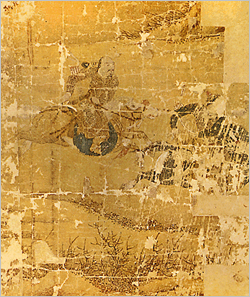
King Gongmin was well known for his artistic skills and are referred to as one of the best artists of the Goryeo period. He was also well-known for his calligraphy works. Example of his works are Cheonsan Daeryeopdo《천산대렵도(天山大獵圖)》, Potrait of Queen Noguk《노국대장공주진(眞)》, Buddha's Leaving Mountain《석가출산상(釋迦出山像)》, Picture of Epang Palace《아방궁도(阿房宮圖)》, Hyeonreung Sansudo《현릉산수도(玄陵山水圖)》, Dongjabohyeon Yugabaeksangdo《동자보현육아백상도(童子普賢六牙白象圖)》.Depiction in art and media
- The Korean TV dramaKorean dramaKorean drama refers to televised dramas, in a miniseries format, produced in the Korean language. Many of these dramas have become popular throughout Asia and have contributed to the general phenomenon of the Korean wave, known as "Hallyu", and also "Drama Fever" in some countries...
Shin Don features a depiction of King Gongmin. - The film entitled "A Frozen FlowerA Frozen FlowerA Frozen Flower is a 2008 South Korean film. It is directed by Yoo Ha and stars Zo In Sung, Ju Jin-mo and Song Ji-hyo. The historical film is set Goryeo Dynasty and is loosely based on the reign of Gongmin of Goryeo , but it does not strictly comply with historical facts...
" was inspired to a certain extent from his life.
See also
- List of Korea-related topics
- History of KoreaHistory of KoreaThe Korean Peninsula was inhabited from the Lower Paleolithic about 400,000-500,000 years ago. Archeological evidence indicates that the presence of modern humans in northeast Asia dates to 39,000 years ago. The earliest known Korean pottery dates to around 8000 BC, and the Neolithic period began...
- List of Korean monarchs
- Tomb of King KongminTomb of King KongminThe Tomb of King Kongmin, more correctly known as the Hyonjongrung Royal Tomb, is a 14th-century mausoleum located in Haeson-ri, Kaepung County just outside of the city of Kaesong, North Korea...