

.gif)
Gangwon-do (South Korea)

Encyclopedia
Gangwon-do is a province
of South Korea
, with its capital at Chuncheon
. Before the division of Korea
in 1945, Gangwon and its North Korea
n neighbour Kangwŏn formed a single province.
of Korea during the Joseon Dynasty
. The province was formed in 1395, and derived its name from the names of the principal cities of Gangneung
(강릉; 江陵) and the provincial capital Wonju
(원주; 原州).
In 1895, Gangwon-do was replaced by the Districts of Chuncheon (Chuncheon-bu; 춘천부; 春川府) in the west and Gangneung (Gangneung-bu; 강릉부; 江陵府) in the east. (Wonju became part of Chungju
District.)
In 1896, Korea was redivided into thirteen provinces, and the two districts were merged to re-form Gangwon-do Province. Although Wonju rejoined Gangwon-do province, the provincial capital was moved to Chuncheon, where it remains today.
In 1945, Gangwon-do (along with the rest of Korea) was divided by the 38th parallel north
in 1945 into U.S. American and Soviet
zones of occupation in the south and north respectively, which led to Wonsan
joining the province's northern half in 1946 to serve as its administrative center. In 1948, the southern half of the province became part of the new Republic of Korea
. As a result of the Korean War
Armistice Agreement of 1953, the boundary between the South and North Korean portions of the province was shifted northward to the Military Demarcation Line
. The province's boundaries have remained the same since 1953.
province, on the south by the provinces of Chungcheongbuk-do
and Gyeongsangbuk-do
, and on the east by the Sea of Japan
(East Sea). To the north lies the province's North Korea
n counterpart, Kangwŏn province. The province's landscape is dominated by the Taebaek Mountains
(Taebaek Sanmaek) which almost reach the sea. As a consequence the coast is steep.
and pollock
). Mineral resources of the province include iron
, coal
, fluorite
, limestone
and tungsten
. There are hydroelectric and thermoelectric power
plants.
(the provincial capital), Gangneung
, Sokcho
, Wonju
, and Donghae
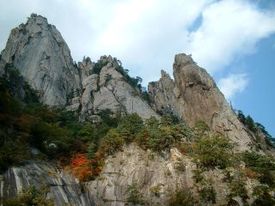
. Seoraksan
(mountain; 1,708 m) and Mt. Odae
(1,563 m) with its ski run, attract a large number of national tourists. Both are located in national parks in the Taebaek Mountains. South Korea's largest limestone cave, Hwanseongul, receives over one million visitors a year.
, while the region east of the mountains is called Yeongdong
. The term "Yeongdong" is frequently used in reference to transportation services from Seoul
, the national capital. Thus, one might catch a bus or train on the "Yeongdong Line
," or drive to Gangneung
on the Yeongdong Expressway
.
, and hanja
.
made with seawater
.
Administrative divisions of South Korea
||South Korea is divided into 8 provinces , 1 special autonomous province , 6 metropolitan cities , and 1 special city...
of South Korea
South Korea
The Republic of Korea , , is a sovereign state in East Asia, located on the southern portion of the Korean Peninsula. It is neighbored by the People's Republic of China to the west, Japan to the east, North Korea to the north, and the East China Sea and Republic of China to the south...
, with its capital at Chuncheon
Chuncheon
Chuncheon is the capital of Gangwon Province, South Korea. The city lies in the northeast of the country, located in a basin formed by the Soyang River and Han River. There are some large lakes around the city, most notably Lake Soyang and Lake Uiam...
. Before the division of Korea
Division of Korea
The division of Korea into North Korea and South Korea stems from the 1945 Allied victory in World War II, ending Japan's 35-year colonial rule of Korea. In a proposal opposed by nearly all Koreans, the United States and the Soviet Union agreed to temporarily occupy the country as a trusteeship...
in 1945, Gangwon and its North Korea
North Korea
The Democratic People’s Republic of Korea , , is a country in East Asia, occupying the northern half of the Korean Peninsula. Its capital and largest city is Pyongyang. The Korean Demilitarized Zone serves as the buffer zone between North Korea and South Korea...
n neighbour Kangwŏn formed a single province.
History
Gangwon-do was one of the Eight ProvincesEight Provinces (Korea)
During most of the Joseon Dynasty, Korea was divided into eight provinces . The eight provinces' boundaries remained unchanged for almost five centuries from 1413 to 1895, and formed a geographic paradigm that is still reflected today in the Korean Peninsula's administrative divisions, dialects,...
of Korea during the Joseon Dynasty
Joseon Dynasty
Joseon , was a Korean state founded by Taejo Yi Seong-gye that lasted for approximately five centuries. It was founded in the aftermath of the overthrow of the Goryeo at what is today the city of Kaesong. Early on, Korea was retitled and the capital was relocated to modern-day Seoul...
. The province was formed in 1395, and derived its name from the names of the principal cities of Gangneung
Gangneung
Gangneung is a city in Gangwon-do, on the east coast of South Korea. It has a population of 229,869 . Gangneung is the economic centre of the Yeongdong region of eastern Gangwon Province. Gangneung has many tourist attractions, like Jeongdongjin, one of the most famous towns in Korea...
(강릉; 江陵) and the provincial capital Wonju
Wonju
Wonju is the most populous city in Gangwon province, South Korea.Wonju is a city approximately east of Seoul and the capital can be reached within 1hr 30minutes by bus or train. Wonju is home to three major universities which attract many students from Seoul and elsewhere. They provide facilities...
(원주; 原州).
In 1895, Gangwon-do was replaced by the Districts of Chuncheon (Chuncheon-bu; 춘천부; 春川府) in the west and Gangneung (Gangneung-bu; 강릉부; 江陵府) in the east. (Wonju became part of Chungju
Chungju
Chungju is a city in North Chungcheong province, South Korea. Namsan is a mountain located on the outskirts of the city.The city is famous for the annual martial arts festival held in October. Also of note, UN Secretary-General, Ban Ki-moon grew up here....
District.)
In 1896, Korea was redivided into thirteen provinces, and the two districts were merged to re-form Gangwon-do Province. Although Wonju rejoined Gangwon-do province, the provincial capital was moved to Chuncheon, where it remains today.
In 1945, Gangwon-do (along with the rest of Korea) was divided by the 38th parallel north
38th parallel north
The 38th parallel north is a circle of latitude that is 38 degrees north of the Earth's equatorial plane. It crosses Europe, the Mediterranean Sea, Asia, the Pacific Ocean, North America, and the Atlantic Ocean...
in 1945 into U.S. American and Soviet
Soviet Union
The Soviet Union , officially the Union of Soviet Socialist Republics , was a constitutionally socialist state that existed in Eurasia between 1922 and 1991....
zones of occupation in the south and north respectively, which led to Wonsan
Wonsan
Wŏnsan is a port city and naval base in southeastern North Korea. It is the capital of Kangwŏn Province. The population of the city is estimated to have been 331,000 in 2000. Notable people from Wŏnsan include Kim Ki Nam, diplomat and Secretary of the Workers' Party.- History :The original name of...
joining the province's northern half in 1946 to serve as its administrative center. In 1948, the southern half of the province became part of the new Republic of Korea
South Korea
The Republic of Korea , , is a sovereign state in East Asia, located on the southern portion of the Korean Peninsula. It is neighbored by the People's Republic of China to the west, Japan to the east, North Korea to the north, and the East China Sea and Republic of China to the south...
. As a result of the Korean War
Korean War
The Korean War was a conventional war between South Korea, supported by the United Nations, and North Korea, supported by the People's Republic of China , with military material aid from the Soviet Union...
Armistice Agreement of 1953, the boundary between the South and North Korean portions of the province was shifted northward to the Military Demarcation Line
Military Demarcation Line (Korea)
The Military Demarcation Line , sometimes referred to as the Armistice Line, is the land border or demarcation line between North Korea and South Korea. On either side of the line is the Korean Demilitarized Zone...
. The province's boundaries have remained the same since 1953.
Location
Gangwon-do is bounded on the west by Gyeonggi-doGyeonggi-do
Gyeonggi-do is the most populous province in South Korea. The provincial capital is located at Suwon. Seoul—South Korea's largest city and national capital—is located in the heart of the province, but has been separately administered as a provincial-level special city since 1946...
province, on the south by the provinces of Chungcheongbuk-do
Chungcheongbuk-do
Chungcheongbuk-do is a province in the centre of South Korea. It was formed in 1896 from the northeastern half of the former Chungcheong province...
and Gyeongsangbuk-do
Gyeongsangbuk-do
Gyeongsangbuk-do or shortly Gyeongbuk is a province in eastern South Korea. The province was formed in 1896 from the northern half of the former Gyeongsang province, remained a province of Korea until the country's division in 1945, then became part of South Korea.The Gyeongsangbuk-do Office is...
, and on the east by the Sea of Japan
Sea of Japan
The Sea of Japan is a marginal sea of the western Pacific Ocean, between the Asian mainland, the Japanese archipelago and Sakhalin. It is bordered by Japan, North Korea, Russia and South Korea. Like the Mediterranean Sea, it has almost no tides due to its nearly complete enclosure from the Pacific...
(East Sea). To the north lies the province's North Korea
North Korea
The Democratic People’s Republic of Korea , , is a country in East Asia, occupying the northern half of the Korean Peninsula. Its capital and largest city is Pyongyang. The Korean Demilitarized Zone serves as the buffer zone between North Korea and South Korea...
n counterpart, Kangwŏn province. The province's landscape is dominated by the Taebaek Mountains
Taebaek Mountains
The Taebaek Mountains are a mountain range in both North Korea and South Korea. They form the main ridge of the Korean peninsula.-Geography:...
(Taebaek Sanmaek) which almost reach the sea. As a consequence the coast is steep.
Resources
The area of Gangwon-do is 16894 km² (6,522.81 sq mi), of which four fifths are woodland. Edible alpine plants and mushrooms are harvested in these forests. The province is renowned for its agricultural produce, in particular potatoes and fish (cuttlefishCuttlefish
Cuttlefish are marine animals of the order Sepiida. They belong to the class Cephalopoda . Despite their name, cuttlefish are not fish but molluscs....
and pollock
Pollock
Pollock is the common name used for either of the two species of marine fish in the Pollachius genus. Both P. pollachius and P. virens are commonly referred to as pollock. Other names for P...
). Mineral resources of the province include iron
Iron
Iron is a chemical element with the symbol Fe and atomic number 26. It is a metal in the first transition series. It is the most common element forming the planet Earth as a whole, forming much of Earth's outer and inner core. It is the fourth most common element in the Earth's crust...
, coal
Coal
Coal is a combustible black or brownish-black sedimentary rock usually occurring in rock strata in layers or veins called coal beds or coal seams. The harder forms, such as anthracite coal, can be regarded as metamorphic rock because of later exposure to elevated temperature and pressure...
, fluorite
Fluorite
Fluorite is a halide mineral composed of calcium fluoride, CaF2. It is an isometric mineral with a cubic habit, though octahedral and more complex isometric forms are not uncommon...
, limestone
Limestone
Limestone is a sedimentary rock composed largely of the minerals calcite and aragonite, which are different crystal forms of calcium carbonate . Many limestones are composed from skeletal fragments of marine organisms such as coral or foraminifera....
and tungsten
Tungsten
Tungsten , also known as wolfram , is a chemical element with the chemical symbol W and atomic number 74.A hard, rare metal under standard conditions when uncombined, tungsten is found naturally on Earth only in chemical compounds. It was identified as a new element in 1781, and first isolated as...
. There are hydroelectric and thermoelectric power
Thermoelectric power
Thermoelectric power can refer to two things:# Electrical power generated from a heat source, such as burning fossil fuel-coal,oils, indirectly through devices like steam turbines....
plants.
Cities and parks
The main cities in the province are ChuncheonChuncheon
Chuncheon is the capital of Gangwon Province, South Korea. The city lies in the northeast of the country, located in a basin formed by the Soyang River and Han River. There are some large lakes around the city, most notably Lake Soyang and Lake Uiam...
(the provincial capital), Gangneung
Gangneung
Gangneung is a city in Gangwon-do, on the east coast of South Korea. It has a population of 229,869 . Gangneung is the economic centre of the Yeongdong region of eastern Gangwon Province. Gangneung has many tourist attractions, like Jeongdongjin, one of the most famous towns in Korea...
, Sokcho
Sokcho
Sokcho is a city in Gangwon-do province, South Korea. It is located in the far northeast of Gangwon-do. Lying north of the 38th parallel, the city belonged to North Korea from 1945 until the end of the Korean War, when the dividing line between the two Korean states was officially altered....
, Wonju
Wonju
Wonju is the most populous city in Gangwon province, South Korea.Wonju is a city approximately east of Seoul and the capital can be reached within 1hr 30minutes by bus or train. Wonju is home to three major universities which attract many students from Seoul and elsewhere. They provide facilities...
, and Donghae
Donghae City
Donghae is a city in Gangwon Province, South Korea. There are two major ports: Donghae Harbor and Mukho Harbor. The city is located on the Yeongdong Line railroad and the Donghae Expressway. Numerous caverns are found in the city, as in neighboring Samcheok...
. Seoraksan
Seoraksan
Seoraksan is the highest mountain in the Taebaek mountain range in the Gangwon province in eastern South Korea. It is located in a national park near the city of Sokcho. After the Hallasan volcano on Jeju Island and Jirisan in the south, Seoraksan is the third highest mountain in South Korea. The...
(mountain; 1,708 m) and Mt. Odae
Odaesan
Odaesan is a mountain in Gangwon, South Korea, standing at the junction of the districts of Gangneung, Pyeongchang, and Hongcheon. A major national landmark, it is the centerpiece of Odaesan National Park...
(1,563 m) with its ski run, attract a large number of national tourists. Both are located in national parks in the Taebaek Mountains. South Korea's largest limestone cave, Hwanseongul, receives over one million visitors a year.
Regions
Gangwon-do and its North Korean counterpart Kangwŏn are together referred to as the Gwandong region. The region west of the Taebaek Mountains is called YeongseoYeongseo
Yeongseo is the western, inland region of Gangwon Province, South Korea and Kangwon Province, North Korea. It is divided from the coastal Yeongdong region by the Taebaek Mountains. The name yeongseo reflects this distinction; it literally means “west of the passes”. The region is marked by high...
, while the region east of the mountains is called Yeongdong
Yeongdong
This article is about Yeongdong, a region in eastern Korea. For the county of the same name in North Chungcheong Province, South Korea, see Yeongdong County....
. The term "Yeongdong" is frequently used in reference to transportation services from Seoul
Seoul
Seoul , officially the Seoul Special City, is the capital and largest metropolis of South Korea. A megacity with a population of over 10 million, it is the largest city proper in the OECD developed world...
, the national capital. Thus, one might catch a bus or train on the "Yeongdong Line
Yeongdong Line
The Yeongdong Line is a line of Korail. It connects Yeongju in North Gyeongsang Province with Gangneung in Gangwon Province. From Yeongju, it crosses the Taebaek Mountains and reaches the Sea of Japan at Donghae, thence proceeding north to Gangneung.At Yeongju, the line connects with the...
," or drive to Gangneung
Gangneung
Gangneung is a city in Gangwon-do, on the east coast of South Korea. It has a population of 229,869 . Gangneung is the economic centre of the Yeongdong region of eastern Gangwon Province. Gangneung has many tourist attractions, like Jeongdongjin, one of the most famous towns in Korea...
on the Yeongdong Expressway
Yeongdong Expressway
The Yeongdong Expressway is a freeway in South Korea. Numbered 50, it connects the Seoul area with Gangwon Province. It is named from Yeongdong, an old name for Gangwon. The road has its western end in Namdong-gu of Incheon Metropolitan City. Its eastern end lies in Gangneung near the east...
.
Administrative divisions
Gangwon-do is divided into 7 cities (si) and 11 counties (gun). The names below are given in English, hangulHangul
Hangul,Pronounced or ; Korean: 한글 Hangeul/Han'gŭl or 조선글 Chosŏn'gŭl/Joseongeul the Korean alphabet, is the native alphabet of the Korean language. It is a separate script from Hanja, the logographic Chinese characters which are also sometimes used to write Korean...
, and hanja
Hanja
Hanja is the Korean name for the Chinese characters hanzi. More specifically, it refers to those Chinese characters borrowed from Chinese and incorporated into the Korean language with Korean pronunciation...
.
Cities
|
Samcheok Samcheok is a city in Gangwon-do, South Korea.-Ancient age & Three Kingdom:* It was called "Siljikguk or Siljikgokguk"* 102 under the rule of Silla * 468 under the rule of Goguryeo... (삼척시, 三陟市) Sokcho Sokcho is a city in Gangwon-do province, South Korea. It is located in the far northeast of Gangwon-do. Lying north of the 38th parallel, the city belonged to North Korea from 1945 until the end of the Korean War, when the dividing line between the two Korean states was officially altered.... (속초시, 束草市) |
Taebaek Taebaek is a city in Gangwon province, South Korea. Its name is shared with that of the Taebaek Mountains.-Climate:-Sister cities: Helong, Jilin since August 29, 1995 Baguio City, Philippines since April 25, 2006 Suzhou, China since March 8, 2005 Gaoan, China since June 23, 2004 Changchun, China... (태백시, 太白市) Wonju Wonju is the most populous city in Gangwon province, South Korea.Wonju is a city approximately east of Seoul and the capital can be reached within 1hr 30minutes by bus or train. Wonju is home to three major universities which attract many students from Seoul and elsewhere. They provide facilities... (원주시, 原州市) |
Counties
|
Hwacheon County Hwacheon County is a county in Gangwon Province, South Korea. The northern border parallels the Korean Demilitarized Zone, as close as 9 km in some places. Neighboring counties are Cheorwon to the northwest and north, Yanggu to the east, Chuncheon to the south, and the Gyeonggi-do province to... (화천군, 華川郡) Inje County Inje County is a county in Gangwon Province, South Korea. It has the lowest population density of any South Korean county.-History:... (인제군, 麟蹄郡) Jeongseon County Jeongseon is a county in Gangwon Province, South Korea. It is famous as the hometown of "Jeongseon Arirang," a traditional Korean folksong... (정선군, 旌善郡) Pyeongchang County Pyeongchang is a county in Gangwon province, South Korea located in the Taebaek Mountains region. It is also home to several Buddhist temples, including Woljeongsa. It is located approximately east of Seoul, the capital of South Korea... (평창군, 平昌郡) |
Yangyang County Yangyang County is a county in Gangwon Province, South Korea. The county is located in the northeast of the country in Gangwon-do... (양양군, 襄陽郡) |
Culture
Gangwon-do is known throughout Korea for its production of sundubu, a variety of soft tofuTofu
is a food made by coagulating soy milk and then pressing the resulting curds into soft white blocks. It is part of East Asian and Southeast Asian cuisine such as Chinese, Japanese, Korean, Indonesian, Vietnamese, and others. There are many different varieties of tofu, including fresh tofu and tofu...
made with seawater
Seawater
Seawater is water from a sea or ocean. On average, seawater in the world's oceans has a salinity of about 3.5% . This means that every kilogram of seawater has approximately of dissolved salts . The average density of seawater at the ocean surface is 1.025 g/ml...
.