
All Topics  
Sejong the Great of Joseon

 
Sejong the Great of Joseon

   Email Print
   Bookmark   Link


Sejong the Great of Joseon


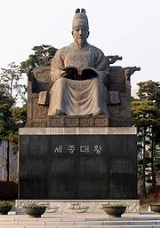
Sejong the Great (May 6, 1397 May 18, 1450, r. 1418 - 1450) was the fourth king of the Joseon Dynasty
Joseon Dynasty

Joseon , was a sovereign state founded by Taejo Taejo of Joseon, and lasted for approximately five centuries. It was founded in the aftermath of the overthrow of the Goryeo Kingdom at what is today the city of Kaesong....
 of Korea
Korea

Korea is a geographic area composed of two sovereign countries, a civilization, and a former state situated on the Korean Peninsula in East Asia....
. He is best remembered for creating the Korean alphabet hangul
Hangul

Hangul is the native alphabet of the Korean language, as distinguished from the logogram Sino-Korean vocabulary hanja system. It was created in the mid-fifteenth century, and is now the official writing system of both North Korea and South Korea, being co-official in the Yanbian Korean Autonomous Prefecture of China....
, despite strong opposition from the scholars educated in hanja
Hanja

Hanja is the Korean language name for Chinese characters. More specifically, it refers to those Chinese characters borrowed from Chinese language and incorporated into the Korean language with Korean pronunciation....
 (Chinese script). Sejong is one of only two Korean rulers posthumously honored with the appellation "the Great
List of people known as The Great

This is a list of people whose names in English language are commonly appended with the phrase "the Great", or who were called that or an equivalent phrase in their own language....
," the other being Gwanggaeto the Great of Goguryeo
Gwanggaeto the Great of Goguryeo

Gwanggaeto the Great of Goguryeo was the nineteenth monarch of Goguryeo, the northernmost of the Three Kingdoms of Korea. His full posthumous name roughly means "Very Greatest King, Broad Expander of Territory, buried in Gukgangsang.", sometimes abbreviated to Hotaewang or Taewang....
.

ng was the third son of King Taejong
Taejong of Joseon

Taejong was the third king of the Joseon Dynasty in Korea and the father of Sejong the Great of Joseon....
.


Discussion
Ask a question about 'Sejong the Great of Joseon'
Start a new discussion about 'Sejong the Great of Joseon'
Answer questions from other users
Full Discussion Forum


Encyclopedia


Sejong the Great (May 6, 1397 May 18, 1450, r. 1418 - 1450) was the fourth king of the Joseon Dynasty
Joseon Dynasty

Joseon , was a sovereign state founded by Taejo Taejo of Joseon, and lasted for approximately five centuries. It was founded in the aftermath of the overthrow of the Goryeo Kingdom at what is today the city of Kaesong....
 of Korea
Korea

Korea is a geographic area composed of two sovereign countries, a civilization, and a former state situated on the Korean Peninsula in East Asia....
. He is best remembered for creating the Korean alphabet hangul
Hangul

Hangul is the native alphabet of the Korean language, as distinguished from the logogram Sino-Korean vocabulary hanja system. It was created in the mid-fifteenth century, and is now the official writing system of both North Korea and South Korea, being co-official in the Yanbian Korean Autonomous Prefecture of China....
, despite strong opposition from the scholars educated in hanja
Hanja

Hanja is the Korean language name for Chinese characters. More specifically, it refers to those Chinese characters borrowed from Chinese language and incorporated into the Korean language with Korean pronunciation....
 (Chinese script). Sejong is one of only two Korean rulers posthumously honored with the appellation "the Great
List of people known as The Great

This is a list of people whose names in English language are commonly appended with the phrase "the Great", or who were called that or an equivalent phrase in their own language....
," the other being Gwanggaeto the Great of Goguryeo
Gwanggaeto the Great of Goguryeo

Gwanggaeto the Great of Goguryeo was the nineteenth monarch of Goguryeo, the northernmost of the Three Kingdoms of Korea. His full posthumous name roughly means "Very Greatest King, Broad Expander of Territory, buried in Gukgangsang.", sometimes abbreviated to Hotaewang or Taewang....
.

Early life

Sejong was the third son of King Taejong
Taejong of Joseon

Taejong was the third king of the Joseon Dynasty in Korea and the father of Sejong the Great of Joseon....
. When he was twelve, he became Grand Prince Chungnyeong' (; ) and married a daughter of Shim On (; ) of Cheongsong (; ), commonly known as Lady Shim (; ), who later was given the title Queen Consort Soheon (; ).

As a young prince, Sejong excelled in various studies and was favored by King Taejong over his two older brothers.

Sejong's ascension to the throne was different from those of most other kings. The eldest prince, Yangnyeong , viewing himself as lacking in the requisite skills for kingship, believed that Sejong was destined to become king. Together with the second Prince Hyoryeong , he believed it was their duty to place Sejong as king. So they acted extremely rudely in the court, and soon were banished from Seoul. This plot of the two princes ultimately brought Sejong to the throne. The eldest prince became a wandering traveler and lived in the mountains. The second son traveled to a Buddhist temple, where he became a monk.

In August of 1418, following Taejong's abdication two months earlier, Sejong ascended the throne. However, Taejong still retained certain powers at court particularly regarding military matters until he passed away in 1422.

Strengthening of Korean Military

Sejong
King Sejong was an effective military planner. In May of 1419, King Sejong, under the advice and guidance of his father Taejong, embarked upon the Gihae Eastern Expedition
Oei Invasion

The Oei Invasion was the 1419 invasion of Japan, Tsushima Island led by the Joseon Dynasty....
, the ultimate goal of this military expedition was to remove the nuisance of Japanese pirates who had been operating out of Tsushima
Tsushima

Tsushima may refer to:* Tsushima, Nagasaki, a city in Nagasaki Prefecture * Tsushima Basin, also known as Ulleung Basin, located at the juncture of the Sea of Japan and the Korea Strait...
. During the expedition, 700 Japanese were killed, and another 110 were captured in combat, while 180 Korean soldiers were killed. At least 140 kidnapped Chinese were liberated by this expedition. In September of 1419 the Daimyo of Tsushima, Sadamori, capitulated to the Joseon court.

The Treaty of Gyehae
Treaty of Gyehae

The Treaty of Gyehae, also called in Japan, was signed in 1443 between the Joseon dynasty and So clan as a means of controlling Wokou and legitimizing trade between Tsushima island and a Korean port....
 was signed in 1443, in which the Daimyo of Tsushima recognized and obeyed the suzerainty of the King of Joseon; in return, the Joseon court rewarded the So clan preferential rights regarding trade between Japan and Korea.

On the northern border, Sejong established four forts and six posts (hangul
Hangul

Hangul is the native alphabet of the Korean language, as distinguished from the logogram Sino-Korean vocabulary hanja system. It was created in the mid-fifteenth century, and is now the official writing system of both North Korea and South Korea, being co-official in the Yanbian Korean Autonomous Prefecture of China....
: ???? hanja
Hanja

Hanja is the Korean language name for Chinese characters. More specifically, it refers to those Chinese characters borrowed from Chinese language and incorporated into the Korean language with Korean pronunciation....
: ????) to safeguard his people from the hostile Chinese and Manchurian nomads living in Manchuria. He also created various military regulations to strengthen the safety of his kingdom. King Sejong supported the advancement of Korean military technology and cannon development increased. Different kinds of mortars and fire arrows were tested as well using gunpowder.

In 1433, Sejong sent Kim Jong-seo (hangul
Hangul

Hangul is the native alphabet of the Korean language, as distinguished from the logogram Sino-Korean vocabulary hanja system. It was created in the mid-fifteenth century, and is now the official writing system of both North Korea and South Korea, being co-official in the Yanbian Korean Autonomous Prefecture of China....
: ???, hanja
Hanja

Hanja is the Korean language name for Chinese characters. More specifically, it refers to those Chinese characters borrowed from Chinese language and incorporated into the Korean language with Korean pronunciation....
: ???), a prominent general, north to destroy the Manchu. Kim's military campaign captured several castles, pushed north, and restored Korean territory, roughly the present-day border between North Korea and China.

Science and technology

Korean Waterclock
Sejong is credited with technological advances during his reign, yet historian Yung Sik Kim points out that Sejong's own scientific knowledge of technical subjects or his attitudes towards them are little known and have yet to be thoroughly studied.

King Sejong wanted to help farmers so he decided to create a farmer's handbook. The book—the Nongsa chiksol—contained information about the different farming techniques that he told scientists to gather in different regions of Korea. These techniques were needed in order to maintain the newly-adopted methods of intensive, continuous cultivation in Korean agriculture.

During his rule, Jang Yeong-sil
Jang Yeong-sil

Jang Yeong-sil was a Korean scientist and astronomer during the Joseon Dynasty . Although Jang was born as a serf or slave, King Sejong the Great's new policy of breaking class barriers placed on the national civil service allowed Jang to work at the royal palace....
 (hangul
Hangul

Hangul is the native alphabet of the Korean language, as distinguished from the logogram Sino-Korean vocabulary hanja system. It was created in the mid-fifteenth century, and is now the official writing system of both North Korea and South Korea, being co-official in the Yanbian Korean Autonomous Prefecture of China....
: ???, hanja
Hanja

Hanja is the Korean language name for Chinese characters. More specifically, it refers to those Chinese characters borrowed from Chinese language and incorporated into the Korean language with Korean pronunciation....
: ???) became known as a prominent inventor. Jang was naturally a creative and smart thinker as a young person. However, Jang was at the bottom of the social class. Taejong, the father of Sejong, noticed Jang's skill and immediately called him to his court in Seoul. Upon giving Jang a government position and power to invent anything, the officials protested, believing that a low class person could not rise to power as a noble or a higher class. Sejong instead believed that Jang had the skill and supported his projects. Jang created new significant designs for water clock
Water clock

A water clock or clepsydra is any timekeeper operated by means of a regulated flow of liquid into or out from a vessel where the amount is then measured....
s, armillary sphere
Armillary sphere

An armillary sphere is a model of the celestial sphere....
s, and sundial
Sundial

A sundial is a device that measures time by the position of the Sun. In common designs such as the horizontal sundial, the sun casts a shadow from its style onto a flat surface marked with lines indicating the hours of the day....
s. However, his most impressive invention came in 1442, the world's first rain gauge
Rain gauge

A rain gauge is a type of instrument used by Meteorology and hydrologists to gather and measure the amount of liquid precipitation over a set period of time....
; this model has not survived, since the oldest existent East Asian rain gauge is one made in 1770, during the reign period of King Youngjo. According to Daily Records of the Royal Secretariat(hanja
Hanja

Hanja is the Korean language name for Chinese characters. More specifically, it refers to those Chinese characters borrowed from Chinese language and incorporated into the Korean language with Korean pronunciation....
:?????]], King Youngjo wanted to revive the glorious times of King Sejong the great, and so read chronicles of Sejong's era. When he found the statements of invention of rain-gauge, King Youngjo ordered to reproduce the rain-gauge. Since there is a mark of the Qing Dynasty
Qing Dynasty

The Qing Dynasty , also known as the Manchu Dynasty, followed the Ming Dynasty in History of China, and was the last ruling Chinese Dynasties of China, ruling from 1644 to 1912 ....
 ruler Qianlong
Qianlong Emperor

The Qianlong Emperor was the fifth emperor of the Manchu-led Qing Dynasty, and the fourth Qing dynasty emperors to rule over China. The fourth son of the Yongzheng Emperor, he reigned officially from October 11, 1736 to February 7, 1795....
 (r. 1735–1796) of China, dated 1770, this Korean rain-gauge is sometimes misunderstood as being imported from China.

Sejong wanted to reform the Korean calendar
Korean calendar

The traditional Korean calendar is a lunisolar calendar which, like the traditional calendars of other East Asian countries, was based on the Chinese calendar....
 system that had focused on the latitude
Latitude

Latitude, usually denoted symbolically by the Greek letter phi gives the location of a place on Earth north or south of the equator. Lines of Latitude are the horizontal lines shown running east-to-west on maps ....
 of the Chinese capital. Sejong, for the first time in Korean history, had his astronomers create a calendar that based the primary position of latitude on the Korean capital of Seoul
Seoul

Seoul is the Capital and largest city of South Korea. With a population of over 10 million, It is one of the world's List of cities proper by population.The Seoul National Capital Area - which includes the major port city of Incheon and satellite towns in Gyeonggi-do, has 24.5 million inhabitants and is the world's second largest List of me...
. This new system allowed Korean astronomers to accurately predict the timing of solar eclipse
Solar eclipse

A solar eclipse occurs when the Moon passes between the Sun and the Earth so that the Sun is wholly or partially obscured. This can only happen during a new moon, when the Sun and Moon are in conjunction as seen from the Earth....
 and lunar eclipse
Lunar eclipse

A lunar eclipse occurs whenever the Moon passes through some portion of the Earth's shadow. This can occur only when the Sun, Earth, and Moon are aligned exactly, or very closely so, with the Earth in the middle....
.

In the realm of traditional Korean medicine
Traditional Korean medicine

Traditional Korean medicine developed with the influence of other traditional medicine. Its techniques in treatment and diagnosis are similar to other traditional medicine....
, two important treatises were written during the reign of Sejong. These were the Hyangyak chipsongbang and the Uibang yuch'wi, which the historian Yung Sik Kim says represented "Koreans' efforts to develop their own system of medical knowledge, distinct from that of China."

Literature

Sejong supported literature, and encouraged high class officials and scholars to study at the court. King Sejong also oversaw, and perhaps participated himself, in the creation of the written language of hangul and announced it to the Korean people in the Hunminjeongeum
Hunmin Jeongeum

Promulgated in September or October 1446, Hunminjeongeum was an entirely new and native writing system for the Korean people. The script was initially named after the publication, but later came to be known as hangul....
, meaning "The verbally right sounds meant to teach the people."

Sejong depended on the agricultural produce of Joseon's farmers, so he allowed them to pay more or less tax according to fluctuations of economic prosperity or hard times. Because of this, farmers could worry less about tax quotas and work instead at surviving and selling their crops. Once the palace had a significant surplus of food, King Sejong then distributed food to poor peasants or farmers who needed it. In 1429 Nongsa-jikseol (hangul
Hangul

Hangul is the native alphabet of the Korean language, as distinguished from the logogram Sino-Korean vocabulary hanja system. It was created in the mid-fifteenth century, and is now the official writing system of both North Korea and South Korea, being co-official in the Yanbian Korean Autonomous Prefecture of China....
: ????, hanja
Hanja

Hanja is the Korean language name for Chinese characters. More specifically, it refers to those Chinese characters borrowed from Chinese language and incorporated into the Korean language with Korean pronunciation....
: ????) was compiled under the supervision of King Sejong. It was the first book about Korean farming, dealing with aspect like planting, harvesting, and seed and soil treatment.

Although most of the government officials and the aristocracy opposed the usage of hangul, lower classes embraced it, became literate, and were able to communicate with one another in writing.

Sejong's personal writings are also highly regarded. He composed the famous Yongbi Eocheon Ga ("Songs of Flying Dragons", 1445), Seokbo Sangjeol ("Episodes from the Life of Buddha", July 1447), Worin Cheon-gang Jigok ("Songs of the Moon Shining on a Thousand Rivers", July 1447), and the reference Dongguk Jeong-un ("Dictionary of Proper Sino-Korean Pronunciation", September 1447).

Sejong established the Hall of Worthies
Hall of Worthies

The Hall of Worthies or Jiphyeonjeon was set up by King Sejong the Great of Joseon of the Joseon Dynasty in Korea in 1420. It consisted of scholars selected by the king....
 (; ; Jiphyeonjeon) in 1420 in the Gyeongbokgung
Gyeongbokgung

Gyeongbokgung also known as Gyeongbok Palace is a palace located in northern Seoul, South Korea. It was the main and largest palace of the Joseon Dynasty and one of the Five Grand Palaces built by the Joseon Dynasty....
. It consisted of scholars selected by the king. The Hall participated in various scholarly endeavors, of which the best-known may be the compilation of the Hunmin Jeongeum
Hunmin Jeongeum

Promulgated in September or October 1446, Hunminjeongeum was an entirely new and native writing system for the Korean people. The script was initially named after the publication, but later came to be known as hangul....
, in which the hangul
Hangul

Hangul is the native alphabet of the Korean language, as distinguished from the logogram Sino-Korean vocabulary hanja system. It was created in the mid-fifteenth century, and is now the official writing system of both North Korea and South Korea, being co-official in the Yanbian Korean Autonomous Prefecture of China....
 writing system was first formulated.

Hangul

Hunmin Jeong Eum
King Sejong the Great made a great impact on Korean history with his introduction of hangul
Hangul

Hangul is the native alphabet of the Korean language, as distinguished from the logogram Sino-Korean vocabulary hanja system. It was created in the mid-fifteenth century, and is now the official writing system of both North Korea and South Korea, being co-official in the Yanbian Korean Autonomous Prefecture of China....
, the native phonetic alphabet system for the Korean language
Korean language

Korean is the official language of North Korea and South Korea. It is also one of the two official languages in the Yanbian Korean Autonomous Prefecture in People's Republic of China....
.

Before the creation of hangul, only members of the highest class were literate (hanja was typically used to write Korean by using adapted Chinese characters while Hanmun was sometimes used to write court documents in classical Chinese). One would have to learn the quite complex hanja characters in order to read and write. Further, despite modifications to the Chinese characters, hanja could prove cumbersome to transcribe the Korean language due to the latter differing considerably from Chinese in its grammar and sentence order.

King Sejong presided over the introduction of the 28 letters of the Korean alphabet in order that Koreans from all classes could read and write. He also attempted to establish a cultural identity of his people through a unique script. First published in 1446, anyone could learn hangul in a matter of days. It was banned under the Japanese occupation.

Death and legacy

Sejong Tomb 1
Sejong died at the age of 53 and was buried at the Yeong Mausoleum (; ) in 1450. His successor was his first son, Munjong
Munjong of Joseon

King Munjong , the fifth King of the Joseon Dynasty. ruled Korea from 1450 to 1452. He was the eldest son of King Sejong the Great, and succeeded him in 1450, but died of disease two years later....
. The street Sejongno
Sejongno

Sejongno is a street that cuts through Jongno-gu in downtown Seoul. It is named after Sejong the Great of Joseon. The street is only 600 meters in length, but thanks to its central location it is of great symbolic importance....
 and the Sejong Center for the Performing Arts
Sejong Center

Sejong Center for the Performing Arts is the largest arts and cultural complex in Seoul, South Korea. It has an interior area of 53,202m?. It is situated in the center of the capital, on Sejongno, a main road that cuts through the capital city of the Joseon Dynasty....
 both located in central Seoul
Seoul

Seoul is the Capital and largest city of South Korea. With a population of over 10 million, It is one of the world's List of cities proper by population.The Seoul National Capital Area - which includes the major port city of Incheon and satellite towns in Gyeonggi-do, has 24.5 million inhabitants and is the world's second largest List of me...
 are named after King Sejong, and he is depicted on the South Korea
South Korea

South Korea, officially the Republic of Korea , ), often referred to as Korea and the "names of Korea#Revival of the names", is a Semi-presidential system republic in East Asia, located in the southern half of the Korean Peninsula....
n 10,000-Won
South Korean won

The won is the currency of South Korea. A single won is divided into 100 jeon, the monetary subunit. The jeon is not used anymore for everyday transactions, and appear only on foreign exchange rates....
 note.

In early 2007, the Republic of Korea government has decided to create a special administrative district out of part of the present Chungcheongnam-do
Chungcheongnam-do

Chungcheongnam-do is a Administrative divisions of South Korea in the west of South Korea. The province was formed in 1896 from the southwestern half of the former Chungcheong province, remained a province of Korea until the country's Division of Korea in 1945, then became part of South Korea....
 Province
Province

A province is a territorial unit, almost always an administrative division, within a country or state....
, near what is presently Daejeon
Daejeon

Daejeon is the capital city of Chungcheongnamdo Province, located in the center of South Korea. It is the fifth largest city in South Korea, with a population of 1,442,856 at the end of 2005....
. The new district will be named Sejong Special Autonomous City, and is to replace Seoul
Seoul

Seoul is the Capital and largest city of South Korea. With a population of over 10 million, It is one of the world's List of cities proper by population.The Seoul National Capital Area - which includes the major port city of Incheon and satellite towns in Gyeonggi-do, has 24.5 million inhabitants and is the world's second largest List of me...
 as the future capital of the Republic of Korea.

The life of Sejong was depicted in the KBS Korean historical drama King Sejong the Great (TV series)
King Sejong the Great (TV series)

Daewang Sejong is a new South Korean Historical Drama airing on Korean Broadcasting System, following after Dae Jo Yeong long epic 136 episodes....
 in 2008.

Family

  • Father: King Taejong
    Taejong of Joseon

    Taejong was the third king of the Joseon Dynasty in Korea and the father of Sejong the Great of Joseon....
  • Mother: Queen Wongyeong of the Yeoheung Min clan (???? ??)
  • Consorts:
  1. Queen Soheon of the Cheongsong Shim clan (???? ??)
  2. Royal Noble Consort Yeong of the Kang clan (?? ??)
  3. Royal Noble Consort Shin of the Kim clan (?? ??)
  4. Royal Noble Consort Hye of the Yang clan (?? ??)
  5. Park Gwi-in (?? ??)
  6. Choi Gwi-in (?? ??)
  7. Hong So-yong (?? ??)
  8. Lee Suk-won (?? ??)
  9. Song Sang-chim (?? ??)
  10. Cha Sa-gi (?? ??)
  • Issue:
  1. Royal Prince Successor
    Munjong of Joseon

    King Munjong , the fifth King of the Joseon Dynasty. ruled Korea from 1450 to 1452. He was the eldest son of King Sejong the Great, and succeeded him in 1450, but died of disease two years later....
    , 1st Son of Queen Soheon of the Cheongsong Shim clan.
  2. Grand Prince Suyang
    Sejo of Joseon

    Sejo of Joseon was the seventh king of the Joseon Dynasty of Korea. Born in 1417 as Yi Yu, King Sejong the Great's second son, he showed great ability at archery, horseriding and martial arts....
    , 2nd Son of Queen Soheon of the Cheongsong Shim clan.
  3. Grand Prince Anpyeong, 3rd Son of Queen Soheon of the Cheongsong Shim clan.
  4. Grand Prince Imyeong, 4th Son of Queen Soheon of the Cheongsong Shim clan.
  5. Grand Prince Gwangpyeong, 5th Son of Queen Soheon of the Cheongsong Shim clan.
  6. Grand Prince Geumseong, 6th Son of Queen Soheon of the Cheongsong Shim clan.
  7. Grand Prince Pyeongwon, 7th son of Queen Soheon of the Cheongsong Shim clan.
  8. Grand Prince Yeongeung, 8th Son of Queen Soheon of the Cheongsong Shim clan.
  9. Prince Hwaui, Only Son of Royal Noble Consort Yeong of the Kang clan.
  10. Prince Gyeyang, 1st Son of Royal Noble Consort Shin of the Kim clan.
  11. Prince Uichang, 2nd Son of Royal Noble Consort Shin of the Kim clan.
  12. Prince Milseong, 3rd Son of Royal Noble Consort Shin of the Kim clan.
  13. Prince Ikhyang, 4th Son of Royal Noble Consort Shin of the Kim clan.
  14. Prince Yeonghae, 5th Son of Royal Noble Consort Shin of the Kim clan.
  15. Prince Damyang, 6th Son of Royal Noble Consort Shin of the Kim clan.
  16. Prince Hannam, 1st Son of Royal Noble Consort Hye of the Yang clan.
  17. Prince Suchun, 2nd Son of Royal Noble Consort Hye of the Yang clan.
  18. Prince Yeongpung, 3rd Son of Royal Noble Consort Hye of the Yang clan.
  19. Princess Jeongso, 1st Daughter of Queen Soheon of the Cheongsong Shim clan.
  20. Princess Jeongui, 2nd Daughter of Queen Soheon of the Cheongsong Shim clan.
  21. 2 Daughters of Royal Noble Consort Shin of the Kim clan.
  22. Princess Jeongan, Only Daughter of Lee Suk-won.
  23. Prince Jeonghyeon, Only Daughter of Song Sang-chim.
  24. A Daughter of Cha Sa-gi.


His full posthumous name

  • King Sejong Jangheon Yeongmun Yemu Inseong Myeonghyo
  • ??????????????
  • ??????????????


See also

  • List of Korea-related topics
    List of Korea-related topics

    This is a list of articles on Korea-related people, places, things, and concepts. For help on how to use this list, see the #Introduction below....
  • History of Korea
    History of Korea

    The history of Korea stretches from Lower Paleolithic times to the present. The earliest known Korean pottery dates to around 8000 BC, and the Neolithic period began before 6000 BC, followed by the Bronze Age around 2500 BC....
  • Rulers of Korea
  • Sejongno
    Sejongno

    Sejongno is a street that cuts through Jongno-gu in downtown Seoul. It is named after Sejong the Great of Joseon. The street is only 600 meters in length, but thanks to its central location it is of great symbolic importance....
  • Sejong the Great class destroyer
  • Sejong Center
    Sejong Center

    Sejong Center for the Performing Arts is the largest arts and cultural complex in Seoul, South Korea. It has an interior area of 53,202m?. It is situated in the center of the capital, on Sejongno, a main road that cuts through the capital city of the Joseon Dynasty....


Further reading

  • King Sejong the Great: the Light of Fifteenth Century Korea, Young-Key Kim-Renaud, International Circle of Korean Linguistics
    International Circle of Korean Linguistics

    The International Circle of Korean Linguistics is a scholarly organization dedicated to the promotion of awareness of, the dissemination of information about, and the facilitation of communication among those in the field of, Korean language and linguistics....
    , 1992, softcover, 119 pages, ISBN 1-882177-00-2
  • Kim-Renaud, Young-Key. 2000. Sejong's theory of literacy and writing. Studies in the Linguistic Sciences 30.1:13-46.
  • Gale, James Scarth. History of the Korean People Annotated and introduction by Richard Rutt. Seoul: Royal Asiatic Society, 1972..


External links