
All Topics  
First Opium War

 
First Opium War

   Email Print
   Bookmark   Link


First Opium War


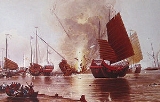
The First Opium War or the First Anglo-Chinese War was fought between the British East India Company
East India Company

East India Company was a historical English company, founded in 1600, and chartered with the monopoly of trading with Southeast Asia, East Asia, and India....
 and the Qing Dynasty
Qing Dynasty

The Qing Dynasty , also known as the Manchu Dynasty, followed the Ming Dynasty in History of China, and was the last ruling Chinese Dynasties of China, ruling from 1644 to 1912 ....
 of China
China

China is a Culture of China, an ancient civilization, and, depending on perspective, a national or multinational entity extending over a large area in East Asia....
 from 1839 to 1842 with the aim of forcing China to allow free trade
Free trade

Free trade is a type of trade policy that allows traders to act and transact without coercive interference from government. Thus, the policy permits trading partners mutual gains from trade, with goods and services produced according to the law of comparative advantage....
, particularly in opium
Opium

Opium is a narcotic formed from the latex released by lacerating the immature seed pods of Opium poppy . It contains up to 12% morphine, an opiate alkaloid, which is most frequently processed chemically to produce heroin for the illegal drug trade....
. The Treaty of Nanjing, first of the unequal treaties
Unequal Treaties

Unequal Treaties is a term used in reference to the type of treaties signed by several East Asian states, including Qing Dynasty China, late Tokugawa shogunate Japan, and late Joseon Dynasty Korea, with Western world and the post-Meiji Restoration Empire of Japan, during the 19th and early 20th centuries....
, granted an indemnity to Britain, opening of five Treaty Ports
Treaty ports

Treaty ports were port cities in China, Japan and Korea opened to foreign trade by the Unequal Treaties.The first five treaty ports in China were established at the conclusion of the First Opium War by the Nanjing Treaty in 1842....
, and the cession of Hong Kong
Hong Kong

Hong Kong , officially the Hong Kong Special Administrative Region, is a territory located in Southern China in East Asia, bordering the province of Guangdong to the north and facing the South China Sea to the east, west and south....
, ending the monopoly of trading in the Canton System
Canton System

The Canton System served as a means for China to control trade with the west within its own country....
. The wars are often cited as the end of China's isolation and the beginning of modern Chinese history.

ng the 19th century, trading in goods from China was extremely lucrative for Europeans and Chinese merchants alike.


Discussion
Ask a question about 'First Opium War'
Start a new discussion about 'First Opium War'
Answer questions from other users
Full Discussion Forum


Encyclopedia


The First Opium War or the First Anglo-Chinese War was fought between the British East India Company
East India Company

East India Company was a historical English company, founded in 1600, and chartered with the monopoly of trading with Southeast Asia, East Asia, and India....
 and the Qing Dynasty
Qing Dynasty

The Qing Dynasty , also known as the Manchu Dynasty, followed the Ming Dynasty in History of China, and was the last ruling Chinese Dynasties of China, ruling from 1644 to 1912 ....
 of China
China

China is a Culture of China, an ancient civilization, and, depending on perspective, a national or multinational entity extending over a large area in East Asia....
 from 1839 to 1842 with the aim of forcing China to allow free trade
Free trade

Free trade is a type of trade policy that allows traders to act and transact without coercive interference from government. Thus, the policy permits trading partners mutual gains from trade, with goods and services produced according to the law of comparative advantage....
, particularly in opium
Opium

Opium is a narcotic formed from the latex released by lacerating the immature seed pods of Opium poppy . It contains up to 12% morphine, an opiate alkaloid, which is most frequently processed chemically to produce heroin for the illegal drug trade....
. The Treaty of Nanjing, first of the unequal treaties
Unequal Treaties

Unequal Treaties is a term used in reference to the type of treaties signed by several East Asian states, including Qing Dynasty China, late Tokugawa shogunate Japan, and late Joseon Dynasty Korea, with Western world and the post-Meiji Restoration Empire of Japan, during the 19th and early 20th centuries....
, granted an indemnity to Britain, opening of five Treaty Ports
Treaty ports

Treaty ports were port cities in China, Japan and Korea opened to foreign trade by the Unequal Treaties.The first five treaty ports in China were established at the conclusion of the First Opium War by the Nanjing Treaty in 1842....
, and the cession of Hong Kong
Hong Kong

Hong Kong , officially the Hong Kong Special Administrative Region, is a territory located in Southern China in East Asia, bordering the province of Guangdong to the north and facing the South China Sea to the east, west and south....
, ending the monopoly of trading in the Canton System
Canton System

The Canton System served as a means for China to control trade with the west within its own country....
. The wars are often cited as the end of China's isolation and the beginning of modern Chinese history.

Background

During the 19th century, trading in goods from China was extremely lucrative for Europeans and Chinese merchants alike. Due to the Qing Dynasty's trade restrictions, whereby international trade was only allowed to take place in Canton (Guangzhou
Guangzhou

'Guangzhou' is the Capital and a sub-provincial city of Guangdong Province of China in the northern and southern China part of the People's Republic of China....
) conducted by imperially sanctioned monopolies, it became uneconomic to trade in low-value manufactured consumer products that the average Chinese could buy from the British like the Indians did.

Instead, the Sino-British trade
Old China Trade

The Old China Trade was the name given to the early commerce between the Qing Empire and the United States, spanning from the end of the American Revolutionary War in 1783 to the Treaty of Wanghia in 1844....
 became dominated by high-value luxury items such as tea
Tea

Tea refers to the agricultural products of the leaves, leaf buds, and internodes of the Camellia sinensis plant, prepared and cured by various methods....
 (from China to Britain) and silver
Silver

Silver is a chemical element with the chemical symbol Ag and atomic number 47. A soft, white, lustrous transition metal, it has the highest electrical conductivity of any element and the highest thermal conductivity of any metal....
 (from Britain to China), to the extent that European specie
Currency

A currency is a Medium of exchange, facilitating the trade of goods and/or Service s. It is coins and paper bills used as money. It is one form of money, where money is anything that serves as a medium of exchange, a store of value, and a standard of value....
 metals became widely used in China. Britain had been on the gold standard
Gold standard

The gold standard is a monetary system in which a region's common media of exchange are paper notes that are normally freely convertible into pre-set, fixed quantities of gold....
 since the 18th century, so it had to purchase silver from continental Europe to supply the Chinese appetite for silver, which was a costly process at a time before demonetization of silver by Germany
Germany

Germany , officially the Federal Republic of Germany , is a country in Central Europe. It is bordered to the north by the North Sea, Denmark, and the Baltic Sea; to the east by Poland and the Czech Republic; to the south by Austria and Switzerland; and to the west by France, Luxembourg, Belgium, and the Netherlands....
 in the 1870s. In casting about for other possible commodities to reverse the flow of silver out of the country and into China, the British discovered opium. Opium as a medicinal ingredient was documented in texts as early as the Ming dynasty but its recreational use was limited and there were laws in place against its abuse. It was with the mass quantities introduced by the British motivated by the equalization of trade that the drug became prevalent. British importation of opium in large amounts began in 1781 and between 1821 and 1837 import increased fivefold. The drug was produced in the traditionally cotton growing regions of India (under British government monopoly (Bengal
Bengal

Bengal , is a historical and geographical region in the northeast of South Asia. Today it is mainly divided between the independent sovereign nation of the Bangladesh and the state of West Bengal in India, although some regions of the previous kingdoms of Bengal are now part of the neighboring Indian states of Bihar, Assam, Tripura and Oris...
) and in the Princely states (Malwa) and was sold on the condition that it be shipped by British traders to China. The Qing government had largely ignored the problem until the drug had spread widely in Chinese society.

Alarmed by the reverse in silver flow and the epidemic of addiction (an estimated 2 million Chinese were habitual users), the Qing government attempted to end the opium trade, but its efforts were complicated by corrupt local officials (including the Viceroy of Canton). In one isolated incident, in 1818, the Laurel carried word to Sydney of a US ship laden with opium and treasure which was invaded by Chinese pirates. The crew of the US vessel had all been killed, but for the escaping first mate, who later identified the pirates to the authorities. In 1839, the Qing Emperor appointed Lin Zexu
Lin Zexu

Lin Zexu He is most recognized for his conduct and his constant position on the "high moral ground" in his fight, as a "shepherd" of his people, against the opium trade in Guangzhou....
 as the governor of Canton with the goal of reducing and eliminating the Opium trade. On his arrival, Lin Zexu banned the sale of opium, asked that all opium be surrendered to the Chinese authorities, and asked that all foreign traders sign a 'no opium trade' bond the breaking of which was punishable by death. He also forced the British hand by closing the channel to Canton, effectively holding British traders hostage in Canton. The British Chief Superintendent of Trade in China, Charles Elliot
Charles Elliot

Charles Elliot, also Charles Elliott was a British naval officer, diplomat and colonial administrator. Born in England, he joined the British Royal Navy in 1816....
 (who, surprisingly, broke the blockade to arrive in Canton) got the British traders to agree to hand over their opium stock with the promise of eventual compensation for their loss from the British Government. (This promise, and the inability of the British government to pay it without causing a political storm, was an important cause for the subsequent British action.) Overall 20,000 chests each holding about 120 pounds) were handed over and destroyed in May 1839. Following the collection and destruction of the opium, Lin Zexu wrote a "memorial" to the Queen of Great Britain in an unsuccessful attempt to stop the trade of the drug, as it had poisoned thousands of Chinese civilians (the memorial never reached the Queen).

Kowloon Incident (July 1839)


After the chest seizure in April the atmosphere grew tense and at the end of June the Chinese coast guard in Kowloon arrested the comador of the Carnatic, a British clipper. On Sunday, July 7, 1839, a large group of British and American sailors, including crew from the Carnatic, was ashore at Kowloon
Kowloon

Kowloon refers to an urban area in Hong Kong made up of Kowloon Peninsula and New Kowloon, bordered by the Lei Yue Mun strait in the east, Mei Foo Sun Chuen and Stonecutters Island in the west, Tate's Cairn and Lion Rock in the north, and Victoria Harbour in the south....
, a provisioning point, and found a supply of samshu, a rice liquor, in the village of Chien-sha-tsui. In the ensuing riot the sailors vandalized a temple and killed a man named Lin Weixi. Because China did not have a jury trial system or evidentiary process (the magistrate was the prosecutor, judge, jury and would-be executioner), the British government and community in China wanted "extraterritoriality
Extraterritoriality

Extraterritoriality is the state of being exempt from the jurisdiction of local law, usually as the result of diplomatic negotiations. Extraterritoriality can also be applied to physical places, such as embassy, consulates, or military bases of foreign countries, or offices of the United Nations....
", which meant that British subjects would only be tried by British judges. When the Qing authorities demanded the men be handed over for trial, the British refused. Six sailors were tried by the British authorities in Canton (Guangzhou
Guangzhou

'Guangzhou' is the Capital and a sub-provincial city of Guangdong Province of China in the northern and southern China part of the People's Republic of China....
), but they were immediately released after they reached England. Charles Elliott's authority is in dispute; the British government later claimed that without authority from the Qing government he had no legal right to try anyone, although according to the British Act of Parliament that gave him authority over British merchants and sailors, 'he was expressly appointed to preside over ' Court of Justice with Criminal an Admiralty Jurisdiction for the trial of offenses committed by His Majesty's subjects in the said Dominions or on the high sea within a hundred miles of the coast of China'".

The Qing authorities also insisted that British merchants not be allowed to trade unless they signed a bond, under penalty of death, promising not to smuggle opium, agreeing to follow Chinese laws, and acknowledging Qing legal jurisdiction. Refusing to hand over any suspects or agree to the bonds, Charles Elliot ordered the British community to withdraw from Canton and prohibited trade with the Chinese. Some merchants who didn't deal in opium were willing to sign the bond, thereby weakening the British trading position.

War

Preparing for war, the British seized Hong Kong (then a minor outpost) as a base on 23 August 1839. In late October the Thomas Coutts arrived in China and sailed to Guangdong
Guangdong

Guangdong is a political divisions of China on the southern coast of People's Republic of China. The province is also known by an alternative English language name, the Canton Province....
. This ship was owned by Quakers who refused to deal in opium, and its captain, Smith, believed Elliot had exceeded his legal authority by banning trade. The captain negotiated with the governor of Canton and hoped that all British ships could unload their goods at Chuenpeh, an island near Humen
Humen Town

Humen , also known as Taiping, is a county-level city within the Dongguan prefecture-level city, on the eastern side of the Bocca Tigris on the east bank of the Pearl River Delta, in the Guangdong Province of southern China....
. In order to prevent other British ships from following the Thomas Coutts, Elliot ordered a blockade of the Pearl River (China)
Pearl River (China)

The Pearl River or Zhu Jiang, or less commonly, the "Guangdong River" , is China's third longest river , and second largest by volume ....
. Fighting began on 3 November 1839, when a second British ship, the Royal Saxon, attempted to sail to Guangdong. Then the Volage and Hyacinth
HMS Hyacinth (1829)

HMS Hyacinth was a British sixth rate Sloop-of-war; she fought alongside HMS Volage and destroyed 29 Chinese ships in the First Opium War....
 fired a warning shot at the Royal Saxon. The official Qing navy's report claimed that the navy attempted to protect the British merchant vessel and also reported a great victory for that day. Elliot reports that they were protecting their 29 ships in Chuenpeh between the Qing batteries. Elliot knew that Chinese would reject any contacts with British and there would be an attack with fire boats. Elliot ordered all ships to leave Chuenpeh and head for Tung Lo Wan, from Macau
Macau

The Macau Special Administrative Region, , commonly known as Macau or Macao , is one of the two special administrative region of the People's Republic of China, the other being Hong Kong....
, but the merchants liked to harbor in Hong Kong. In reality, they were out-classed by the Royal Naval vessels and many Chinese ships were sunk. In 1840 Elliot asked the Portuguese governor in Macau to let British ships load and unload their goods at Macau and they would pay rents and any duties. The governor refused for fear that the Qing Government would discontinue to supply food and other necessities to Macau. On 14 January 1840, the Qing Emperor asked all foreigners in China to stop helping British in China.

Lord Palmerston, the English Foreign Secretary, initiated the Opium War in order to obtain full compensation for the destroyed opium. China lost the war and was forced to open its five ports to foreign merchants and to permit a territorial concession of Hong Kong.

The war was denounced in Parliament as unjust and iniquitous by young William Ewart Gladstone, who criticized Lord Palmerston's willingness to protect an infamous contraband traffic. Outrage was expressed by the public and the press in America and England as there was a perception that British interests may well have been simply supporting the drugs trade.

In retaliation, the British Government and British East India Company
British East India Company

The East India Company was an early England joint-stock company that was formed initially for pursuing trade with the Indies, but that ended up trading with the Indian subcontinent and China....
 had reached a conclusion that they would attack Guangdong
Battle of Canton

The Battle of Canton was fought on May 21, 1841 between Great Britain and Qing Dynasty, during the First Opium War. The British captured the city with an amphibious attack....
. The military cost would be paid by the British Government. In June 1840, an expeditionary force of 15 barracks ships, 4 steam-powered gunboats and 25 smaller boats with 4000 marines reached Guangdong from Singapore
Singapore

Singapore , officially the Republic of Singapore, is an island country microstate located at the southern tip of the Malay Peninsula. It lies 137 kilometres north of the equator, south of the Malaysian state of Johor and north of Indonesia's Riau Islands....
. The marines were headed by James Bremer
James Bremer

Sir James John Gordon Bremer was rear-admiral in the United Kingdom of Great Britain and Ireland Royal Navy. He was distinguished in the Burmese and Chinese wars....
. Bremer demanded the Qing Government compensate the British for losses suffered from interrupted trade. Following the orders of Lord Palmerston, then Foreign secretary of Britain, the British expedition blockaded the Mouth of Pearl River
Bocca Tigris

Bocca Tigris or the Bogue is a narrow strait in the Pearl River Delta, where the Pearl River discharges into the South China Sea. Since 1997, the strait is crossed by the Humen Pearl River Bridge....
 and moved north to take Chusan.

The next year, 1841, the British captured the Bogue forts which guarded the mouth of the Pearl River—the waterway between Hong Kong and Canton. By January 1841, British forces commanded the high ground around Canton and defeated the Chinese at Ningbo
Ningbo

Ningbo is a seaport with sub-provincial city. The city has a population of 2,182,000 and is situated in northeastern Zhejiang province of China, People's Republic of China....
 and at the military post of Chinghai.

By the middle of 1842, the British had defeated the Chinese at the mouth of their other great riverine trade route, the Yangtze
Yangtze River

The Yangtze River, or Chang Jiang , is the longest river in China and Asia, and the List of rivers by length in the world, after the Nile in Africa and the Amazon River in South America....
, and were occupying Shanghai
Shanghai

Shanghai is the List of cities in the People's Republic of China by population in China and one of the List of metropolitan areas by population in the world, with over 20 million people....
. The Qing
Qing Dynasty

The Qing Dynasty , also known as the Manchu Dynasty, followed the Ming Dynasty in History of China, and was the last ruling Chinese Dynasties of China, ruling from 1644 to 1912 ....
 government proved incapable of dealing with Western Powers on an equal basis, either politically or militarily. The war finally ended in August 1842, with the signing of China's first Unequal Treaty
Unequal Treaties

Unequal Treaties is a term used in reference to the type of treaties signed by several East Asian states, including Qing Dynasty China, late Tokugawa shogunate Japan, and late Joseon Dynasty Korea, with Western world and the post-Meiji Restoration Empire of Japan, during the 19th and early 20th centuries....
, the Treaty of Nanjing. Gen. Sir Anthony Blaxland Stransham led the Royal Marines during the Opium War as a young officer, and as the 'Grand Old Man of the Army', was awarded two knighthoods by Queen Victoria.

Legacies of the War

The ease with which the British forces had defeated the Chinese armies seriously affected the Qing Dynasty's prestige. This almost certainly contributed to the Taiping Rebellion
Taiping Rebellion

The Taiping Rebellion was a large-scale revolt in China from 1850 to 1864, during the Qing Dynasty, by an army led by Heterodoxy Christianity convert Hong Xiuquan....
 (1850–1864). The success of the First Opium War allowed the British to resume the drug trafficking within China. It also paved the way for the opening of the lucrative Chinese market and Chinese society to missionary endeavors.

Among the most notable figures in the events leading up to military action in the Opium War was the man the Manchu
Manchu

The Manchu people are a Tungusic peoples who originated in Manchuria . During their rise in the seventeenth century, with the help of Ming rebels , they conquered the Ming Dynasty and founded the Qing Dynasty, which ruled China until its abolition in 1911 after the Xinhai Revolution, which established Republic of China in its place....
 Daoguang emperor assigned to suppress the opium trade; Lin Zexu
Lin Zexu

Lin Zexu He is most recognized for his conduct and his constant position on the "high moral ground" in his fight, as a "shepherd" of his people, against the opium trade in Guangzhou....
, known for his superlative service under the Qing Dynasty as "Lin the Clear Sky". Although he had some initial success, with the arrest of 1,700 opium dealers and the destruction of 2.6 million pounds of opium, he was made a scapegoat for the actions leading to British retaliation, and was blamed for ultimately failing to stem the tide of opium import and use in China. Nevertheless, Lin Zexu is popularly viewed as a hero of 19th century China, and his likeness has been immortalized at various locations around the world.

See also

  • Second Opium War
    Second Opium War

    The Second Opium War, the Second Anglo-Chinese War, the Arrow War, or the Anglo-French expedition to China, was a war of the British Empire and the Second French Empire against the Qing Dynasty of China from 1856-1860....
  • David Sassoon
    David Sassoon

    David Sassoon was the treasurer of Baghdad between 1817 and 1829 and the leader of the History of the Jews in India ....
  • Anglo-Chinese relations
    Anglo-Chinese relations

    British-Chinese relations , also known as Sino-British relations and Anglo-Chinese relations, refers to the international relations between China and the United Kingdom....
  • William Jardine (surgeon)
    William Jardine (surgeon)

    Dr. William Jardine was a ship surgery who went into the agency trading and opium smuggling businesses in China, where he became a powerful merchant and was instrumental in starting the First Opium War....
  • William John Napier, 9th Lord Napier
  • History of China
    History of China

    China civilization originated in various city-states along the Yellow River valley in the Neolithic era. The written history of China begins with the Shang Dynasty ....
  • British military history
    British military history

    The military history of the peoples of the British Isles is long and varied, extending from the prehistoric and ancient historic period, through the Roman invasion of Britain of Julius Caesar and Claudius, with the subsequent Roman Britain of most of the island; warfare in the Great Britain in the Middle Ages, including the invasions of the S...
  • Forbes family
    Forbes family

    The Forbes family is a wealthy extended American family originating in Boston, Massachusetts. The family's fortune originates from trading between North America and China in the 19th century plus other investments in the same period....