


Treaty of Shimonoseki

Encyclopedia
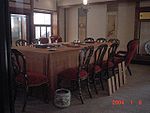
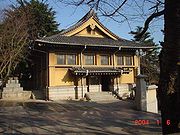
The Treaty of Shimonoseki (Japanese: 下関条約, "Shimonoseki Jōyaku"), known as the Treaty of Maguan in China, was signed at the Shunpanrō hall on April 17, 1895, between the Empire of Japan
and Qing Empire of China
, ending the First Sino-Japanese War
. The peace conference took place from March 20 to April 17, 1895. This treaty followed and superseded the Sino-Japanese Friendship and Trade Treaty
of 1871.
The treaty ended the First Sino-Japanese War
of 1894–1895 as a clear victory for Japan. In this treaty
, China recognized the independence of Korea and renounced any claims to that country. It also ceded the Liaodong Peninsula (then known to the Western press as Liaotung, now southern part of modern Liaoning
province), and the islands of Taiwan
(Formosa) and Penghu to Japan. China also paid Japan a war indemnity of 200 million Kuping taels
, payable over seven years, and the signing of a commercial treaty similar to ones previously signed by China with various western powers in the aftermath of the First
and Second Opium War
s. This commercial treaty confirmed the opening of various ports and rivers to Japanese trade. As a result of the Treaty of Shimonoseki (1895), China recognized the "full and complete independence and autonomy" of Joseon. In the next year Yeongeunmun was demolished leaving its two stone pillars.
One kuping (treasury) tael is about 37.3 grams in weight. The 200 million kuping taels is about 7.45 million kg of silver.
Later Japan was forced to re-cede the Liaodong peninsula, after the Triple intervention
of Russia, Germany and France, and asked for more money — an additional 30 million kuping (1.12 million kg) of silver — from China, the total amount thus being over 8,500 tons of silver. Russia later took control of the peninsula and the geopolitically
strategic Port Arthur.
At the peace conference between Imperial Japan and Qing Dynasty, Li Hongzhang
and Li Jingfang, the ambassadors at the negotiation desk of Qing Dynasty, originally did not plan to split Taiwan away from the Mainland because they also realised Taiwan’s great location for trading with the West. Therefore, even though Qing Dynasty had lost wars against Britain and France in the 19th century, Emperor of Qing was serious to keep Taiwan under its control. On 20th March 1895, at Sunpanro (春帆楼) in Shimonoseki in Japan, 1-month-long peace conference had started.
At the first half for the conference, Ito and Li were talked mainly about a cease-fire agreement, and at the second half of the conference, the contents of the peace treaty were discussed. Ito and Mutsu claimed that to yield the full sovereignty of Taiwan was absolute condition and then requested Li to hand over full sovereignty of Penghu Islands and the eastern portion of the bay of Liaodong Peninsula. Li Hongzhang rejected with providing a reason that Taiwan never became a battlefield at the first Sino-Japan War between 1894 and 1895. Even at the final stage of the conference, although Li Hongzhang agreed with transferring full sovereignty of Penghu islands and the eastern portion of the bay of Liaodong Peninsula to Imperial Japan, he still refused to hand over Taiwan. Li stated about Taiwan that, ‘Taiwan is already independent enough, and impossible to give other country (台湾已立一行省、不能送給他国).’
However, Imperial Japan was too strong for Qing Dynasty to cope with, and eventually Li gave Taiwan up. Li used this sentence to describe Taiwan that, ‘On Taiwan islands, flowers are not fragrant; birds do not sing; men are not in-officious; and women are not passionate, either (花不香、鳥不語、男無義、女無情). There is no pity to hand it over.’ Here, on 17th April 1895, the peace treaty with Imperial Japan and Qing Dynasty has been signed up. More importantly, this made a huge shift in Taiwan because this signing up with the peace treaty meant the end of the long control of Qing Dynasty for more than 200 years, and the beginning of taking a step of modernisation with Imperial Japan.
 The treaty was drafted with John W. Foster
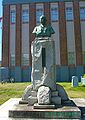
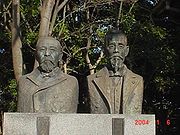
, former American Secretary of State, advising the Qing Dynasty. It was signed by Count Ito Hirobumi
and Viscount Mutsu Munemitsu
for the Emperor of Japan
and Li Hongzhang
and Li Jingfang on behalf of the Emperor of China
. Before the treaty was signed, Li Hongzhang
was attacked by a right-wing Japanese extremist on March 24: he was fired at and wounded on his way back to his lodgings at Injoji temple. The public outcry aroused by the assassination attempt caused the Japanese to temper their demands and agree to a temporary armistice. The conference was temporarily adjourned and resumed on April 10.
of Russia, France, and Germany, western powers all active in China, with established enclaves and ports, just six days after its signing. They demanded that Japan withdraw its claim on the Liaodong peninsula, concerned that Lüshun, then called Port Arthur by Westerners, would fall under Japanese control. Tsar
Nicholas II of Russia
(a de jure
ally of France) and his imperial advisors, including his cousin-advisor-friend-rival Kaiser
Wilhelm II of Germany, had designs on Port Arthur, which could serve as Russia's long sought-after 'ice-free' port.
Under threat of war from three Western political power
s, in November 1895, Japan — a weaker emerging nation not yet perceived as even a regional power — receded ('ceded back') control of the territory and withdrew its de jure claim on the Liaotung peninsula in return for an increased war indemnity from China of 30 million Taels. At that time, the European powers were not concerned with any of the other conditions, or the free hand Japan had been granted in Korea under the other terms of the Treaty of Shimonoseki, and this would prove to be a diplomatically short-sighted error.
Within months after Japan re-ceded the Liaodong peninsula, Russia started construction on the peninsula and a railway to Harbin from Port Arthur, despite a protesting China
. Eventually, Russia agreed to offer a diplomatic solution (See Kwantung Leased Territory
) to the Chinese Empire, and agreed to a token lease of the region to save face, instead of annexing Manchuria outright, its de-facto
effect. Within two years, Germany, France, and Great Britain had similarly taken advantage of the economic and political opportunities in the weak Chinese Empire, each taking control of significant local regions. Japan also took note of how the international community allowed the great powers to treat weaker nation states, and continued its remarkable measures to bootstrap itself into a modern industrial state and military power, with great success as it would demonstrate in the Russo-Japanese War
less than a decade later.
In Taiwan, pro-Qing officials and elements of the local gentry declared a Republic of Formosa
in 1895, but failed to win international recognition.
In China, the Treaty was considered a national humiliation by the bureaucracy and greatly weakened support for the Qing dynasty. The previous decades of the Self-Strengthening Movement
were considered to be a failure, and support grew for more radical changes in China's political and social systems which led to Hundred Days' Reform
and the abolition of the bureaucratic examinations followed by the fall of the Qing dynasty itself in 1911.
The Triple Intervention
is regarded by many Japanese historians as being a crucial historic turning point in Japanese foreign affairs – from this point on, the nationalist, expansionist, and militant elements began to join ranks and steer Japan from a foreign policy based mainly on economic hegemony toward outright imperialism — a case of the coerced turning increasingly to coercion.
 Both the Republic of China
, now controlling Taiwan, and the People's Republic of China, now controlling mainland China consider that the provisions of the treaty transferring Taiwan to Japan to have been reversed by the Instrument of Surrender of Japan. Additionally, it is alleged that on April 28, 1952 the contents of the Treaty of Shimonoseki treaty were formally nullified through what is commonly known as the Treaty of Taipei
with the Republic of China
. However, writing in 1972 in Tokyo, Chairman Ng of the World United Formosans for Independence argued that only those provisions of the 1895 treaty which had not yet been fulfilled in their entirety could be subject to nullification. The cession provision which had already been carried out was no longer existent and, therefore, could no longer be subjected to nullification. In support of this reasoning, Chairman Ng points to the reparations provision of Article IV of the 1895 treaty, as well as additional reparations provisions from earlier Sino-Japanese agreements & treaties. These were all regarded as "fulfilled provisions" and not subject to later nullification or cancellation. The People's Republic of China does not recognize the Treaty of Taipei
.
), before inking the lease of the territory
.
When the de-facto governance of Port Arthur and the Liaodong peninsula was granted de jure to Russia by China along with an increase in other rights she had obtained in Manchuria (especially those in Jilin
and Heilongjiang
provinces) the construction of the 550 mile Southern spurline of the Manchurian Railway was redoubled. Russia finally seemed to have gotten what the Russian Empire
had been wanting in its quest to become a global power since the reign of Peter the Great
. This ice-free natural harbor of Port Arthur/Lüshun would serve to make Russia a great sea as well as the largest land power. Russia needed this ice-free port to achieve world power status as it was tired of being blocked by the balance of power
politics in Europe (The Ottoman Empire and its allies had repeatedly frustrated Russian power fruition).
However, the omission of the geopolitical reality in ignoring the free hand Japan had been granted by the Treaty (of Shimonoseki) with respect to Korea and Japan was short-sighted of Russia with respect to its strategic goals; to get to and maintain a strong point in Port Arthur Russia would have to dominate and control many additional hundreds of miles of Eastern Manchuria (the Fengtian province of Imperial China, modern Jilin
and Heilongjiang
) up to Harbin
. Japan had long considered the lands paralleling the whole Korean border as part of its strategic Sphere of Influence
. By leasing Liaodong and railway concessions, Russia crashed its Sphere of Influence squarely into Japan's.
This acted as a further goad to emerging Japanese anger at their disrespectful treatment by all the West. In the immediate fallout of the Triple Intervention, Japanese popular resentment at Russia's deviousness and the perceived weakness of its own government caving in to foreign pressure led to riots in Tokyo. The disturbance almost brought down the government, as well as a strengthening of imperial and expansionist factions within Japan. The Russian spear into the sphere also brought about the ensuing struggle with Russia for dominance in Korea and Manchuria. These events eventually led to the Russo-Japanese War
of 1904–1905 by a renewed and modernized Japanese military.
Empire of Japan
The Empire of Japan is the name of the state of Japan that existed from the Meiji Restoration on 3 January 1868 to the enactment of the post-World War II Constitution of...
and Qing Empire of China
Qing Dynasty
The Qing Dynasty was the last dynasty of China, ruling from 1644 to 1912 with a brief, abortive restoration in 1917. It was preceded by the Ming Dynasty and followed by the Republic of China....
, ending the First Sino-Japanese War
First Sino-Japanese War
The First Sino-Japanese War was fought between Qing Dynasty China and Meiji Japan, primarily over control of Korea...
. The peace conference took place from March 20 to April 17, 1895. This treaty followed and superseded the Sino-Japanese Friendship and Trade Treaty
Sino-Japanese Friendship and Trade Treaty
The Sino-Japanese Friendship and Trade Treaty was the first treaty between Japan and China It was signed on 13 September 1871 in Tientsin by Date Munenari and Plenipotentiary Li Hongzhang....
of 1871.
Treaty terms
- Article 1: China recognizes definitively the full and complete independenceIndependenceIndependence is a condition of a nation, country, or state in which its residents and population, or some portion thereof, exercise self-government, and usually sovereignty, over its territory....
and autonomy of KoreaKoreaKorea ) is an East Asian geographic region that is currently divided into two separate sovereign states — North Korea and South Korea. Located on the Korean Peninsula, Korea is bordered by the People's Republic of China to the northwest, Russia to the northeast, and is separated from Japan to the...
, and, in consequence, the payment of tributeTributeA tribute is wealth, often in kind, that one party gives to another as a sign of respect or, as was often the case in historical contexts, of submission or allegiance. Various ancient states, which could be called suzerains, exacted tribute from areas they had conquered or threatened to conquer...
and the performance of ceremonies and formalities by Korea to China, that are in derogationDerogationDerogation is the partial revocation of a law, as opposed to abrogation or the total abolition of a law. The term is used in both civil law and common law. It is sometimes used, loosely, to mean abrogation, as in the legal maxim: Lex posterior derogat priori, i.e...
of such independence and autonomy, shall wholly cease for the future. - Articles 2 & 3: China cedes to Japan in perpetuity and full sovereignty of the Penghu group, TaiwanTaiwanTaiwan , also known, especially in the past, as Formosa , is the largest island of the same-named island group of East Asia in the western Pacific Ocean and located off the southeastern coast of mainland China. The island forms over 99% of the current territory of the Republic of China following...
and the eastern portion of the bay of Liaodong Peninsula together with all fortifications, arsenals and public property. - Article 4: China agrees to pay to Japan as a war indemnity the sum of 200,000,000 Kuping taelTaelTael can refer to any one of several weight measures of the Far East. Most commonly, it refers to the Chinese tael, a part of the Chinese system of weights and currency....
s - Article 6: China opens ShashihShashi DistrictShashi District is a district within the main urban area of the Jingzhou Prefecture-level City, Hubei Province, China. It is located on the left bank of the Yangtze River, between Yichang and Wuhan...
, ChungkingChongqingChongqing is a major city in Southwest China and one of the five national central cities of China. Administratively, it is one of the PRC's four direct-controlled municipalities , and the only such municipality in inland China.The municipality was created on 14 March 1997, succeeding the...
, SoochowSuzhouSuzhou , previously transliterated as Su-chou, Suchow, and Soochow, is a major city located in the southeast of Jiangsu Province in Eastern China, located adjacent to Shanghai Municipality. The city is situated on the lower reaches of the Yangtze River and on the shores of Taihu Lake and is a part...
and HangchowHangzhouHangzhou , formerly transliterated as Hangchow, is the capital and largest city of Zhejiang Province in Eastern China. Governed as a sub-provincial city, and as of 2010, its entire administrative division or prefecture had a registered population of 8.7 million people...
to Japan. Moreover, China is to grant Japan most-favored-nation treatment.
The treaty ended the First Sino-Japanese War
First Sino-Japanese War
The First Sino-Japanese War was fought between Qing Dynasty China and Meiji Japan, primarily over control of Korea...
of 1894–1895 as a clear victory for Japan. In this treaty
Treaty
A treaty is an express agreement under international law entered into by actors in international law, namely sovereign states and international organizations. A treaty may also be known as an agreement, protocol, covenant, convention or exchange of letters, among other terms...
, China recognized the independence of Korea and renounced any claims to that country. It also ceded the Liaodong Peninsula (then known to the Western press as Liaotung, now southern part of modern Liaoning
Liaoning
' is a province of the People's Republic of China, located in the northeast of the country. Its one-character abbreviation is "辽" , a name taken from the Liao River that flows through the province. "Níng" means "peace"...
province), and the islands of Taiwan
Taiwan
Taiwan , also known, especially in the past, as Formosa , is the largest island of the same-named island group of East Asia in the western Pacific Ocean and located off the southeastern coast of mainland China. The island forms over 99% of the current territory of the Republic of China following...
(Formosa) and Penghu to Japan. China also paid Japan a war indemnity of 200 million Kuping taels
Tael
Tael can refer to any one of several weight measures of the Far East. Most commonly, it refers to the Chinese tael, a part of the Chinese system of weights and currency....
, payable over seven years, and the signing of a commercial treaty similar to ones previously signed by China with various western powers in the aftermath of the First
First Opium War
The First Anglo-Chinese War , known popularly as the First Opium War or simply the Opium War, was fought between the United Kingdom and the Qing Dynasty of China over their conflicting viewpoints on diplomatic relations, trade, and the administration of justice...
and Second Opium War
Second Opium War
The Second Opium War, the Second Anglo-Chinese War, the Second China War, the Arrow War, or the Anglo-French expedition to China, was a war pitting the British Empire and the Second French Empire against the Qing Dynasty of China, lasting from 1856 to 1860...
s. This commercial treaty confirmed the opening of various ports and rivers to Japanese trade. As a result of the Treaty of Shimonoseki (1895), China recognized the "full and complete independence and autonomy" of Joseon. In the next year Yeongeunmun was demolished leaving its two stone pillars.
Value of the indemnity
In the treaty, China had to pay an indemnity of 200 million silver kuping taels to Japan.One kuping (treasury) tael is about 37.3 grams in weight. The 200 million kuping taels is about 7.45 million kg of silver.
Later Japan was forced to re-cede the Liaodong peninsula, after the Triple intervention
Triple Intervention
The was a diplomatic intervention by Russia, Germany, and France on 23 April 1895 over the terms of the Treaty of Shimonoseki signed between Japan and Qing dynasty China that ended the First Sino-Japanese War.-Treaty of Shimonoseki:...
of Russia, Germany and France, and asked for more money — an additional 30 million kuping (1.12 million kg) of silver — from China, the total amount thus being over 8,500 tons of silver. Russia later took control of the peninsula and the geopolitically
Geopolitics
Geopolitics, from Greek Γη and Πολιτική in broad terms, is a theory that describes the relation between politics and territory whether on local or international scale....
strategic Port Arthur.
The Treaty of Shimonoseki and Taiwan
During the summit between Japanese and Qing representatives in March and April 1895, Prime Minister Hirobumi Ito and Foreign Minister Munemitsu Mutsu were serious about reducing the power of Qing Dynasty on not only Korean Peninsula but also Taiwan islands. Moreover, Mutsu had already noticed its importance in order to expand Japanese military power towards South China and Southeast Asia. It was also time of imperialism so that Japan wished to follow what the West was doing. Imperial Japan was seeking for enough colonies and resources in Korean Peninsula and Mainland China to compete with Western powers at that time, and this was the only way to prove how fast Imperial Japan since Meiji Restoration in 1867 had run after the West and how serious it was about amending unequal treaties among Western powers.At the peace conference between Imperial Japan and Qing Dynasty, Li Hongzhang
Li Hongzhang
Li Hongzhang or Li Hung-chang , Marquis Suyi of the First Class , GCVO, was a leading statesman of the late Qing Empire...
and Li Jingfang, the ambassadors at the negotiation desk of Qing Dynasty, originally did not plan to split Taiwan away from the Mainland because they also realised Taiwan’s great location for trading with the West. Therefore, even though Qing Dynasty had lost wars against Britain and France in the 19th century, Emperor of Qing was serious to keep Taiwan under its control. On 20th March 1895, at Sunpanro (春帆楼) in Shimonoseki in Japan, 1-month-long peace conference had started.
At the first half for the conference, Ito and Li were talked mainly about a cease-fire agreement, and at the second half of the conference, the contents of the peace treaty were discussed. Ito and Mutsu claimed that to yield the full sovereignty of Taiwan was absolute condition and then requested Li to hand over full sovereignty of Penghu Islands and the eastern portion of the bay of Liaodong Peninsula. Li Hongzhang rejected with providing a reason that Taiwan never became a battlefield at the first Sino-Japan War between 1894 and 1895. Even at the final stage of the conference, although Li Hongzhang agreed with transferring full sovereignty of Penghu islands and the eastern portion of the bay of Liaodong Peninsula to Imperial Japan, he still refused to hand over Taiwan. Li stated about Taiwan that, ‘Taiwan is already independent enough, and impossible to give other country (台湾已立一行省、不能送給他国).’
However, Imperial Japan was too strong for Qing Dynasty to cope with, and eventually Li gave Taiwan up. Li used this sentence to describe Taiwan that, ‘On Taiwan islands, flowers are not fragrant; birds do not sing; men are not in-officious; and women are not passionate, either (花不香、鳥不語、男無義、女無情). There is no pity to hand it over.’ Here, on 17th April 1895, the peace treaty with Imperial Japan and Qing Dynasty has been signed up. More importantly, this made a huge shift in Taiwan because this signing up with the peace treaty meant the end of the long control of Qing Dynasty for more than 200 years, and the beginning of taking a step of modernisation with Imperial Japan.
Signatories and diplomats
John W. Foster
John Watson Foster was an American military man, journalist and diplomat.Born in Petersburg, Indiana, and raised in Evansville, Indiana, he was first a lawyer and then served as general for the Union in the American Civil War. Following the war he worked as a journalist, editing the Evansville...
, former American Secretary of State, advising the Qing Dynasty. It was signed by Count Ito Hirobumi
Ito Hirobumi
Prince was a samurai of Chōshū domain, Japanese statesman, four time Prime Minister of Japan , genrō and Resident-General of Korea. Itō was assassinated by An Jung-geun, a Korean nationalist who was against the annexation of Korea by the Japanese Empire...
and Viscount Mutsu Munemitsu
Mutsu Munemitsu
Count was a statesman and diplomat in Meiji period Japan.-Early life:Mutsu Munemitsu was born in Wakayama domain, Kii Province as the sixth son of Date Munehiro, a samurai retainer of the Kii Tokugawa clan...
for the Emperor of Japan
Emperor of Japan
The Emperor of Japan is, according to the 1947 Constitution of Japan, "the symbol of the state and of the unity of the people." He is a ceremonial figurehead under a form of constitutional monarchy and is head of the Japanese Imperial Family with functions as head of state. He is also the highest...
and Li Hongzhang
Li Hongzhang
Li Hongzhang or Li Hung-chang , Marquis Suyi of the First Class , GCVO, was a leading statesman of the late Qing Empire...
and Li Jingfang on behalf of the Emperor of China
Emperor of China
The Emperor of China refers to any sovereign of Imperial China reigning between the founding of Qin Dynasty of China, united by the King of Qin in 221 BCE, and the fall of Yuan Shikai's Empire of China in 1916. When referred to as the Son of Heaven , a title that predates the Qin unification, the...
. Before the treaty was signed, Li Hongzhang
Li Hongzhang
Li Hongzhang or Li Hung-chang , Marquis Suyi of the First Class , GCVO, was a leading statesman of the late Qing Empire...
was attacked by a right-wing Japanese extremist on March 24: he was fired at and wounded on his way back to his lodgings at Injoji temple. The public outcry aroused by the assassination attempt caused the Japanese to temper their demands and agree to a temporary armistice. The conference was temporarily adjourned and resumed on April 10.
Entry of the Western powers
The conditions imposed by Japan on China led to the Triple InterventionTriple Intervention
The was a diplomatic intervention by Russia, Germany, and France on 23 April 1895 over the terms of the Treaty of Shimonoseki signed between Japan and Qing dynasty China that ended the First Sino-Japanese War.-Treaty of Shimonoseki:...
of Russia, France, and Germany, western powers all active in China, with established enclaves and ports, just six days after its signing. They demanded that Japan withdraw its claim on the Liaodong peninsula, concerned that Lüshun, then called Port Arthur by Westerners, would fall under Japanese control. Tsar
Tsar
Tsar is a title used to designate certain European Slavic monarchs or supreme rulers. As a system of government in the Tsardom of Russia and Russian Empire, it is known as Tsarist autocracy, or Tsarism...
Nicholas II of Russia
Nicholas II of Russia
Nicholas II was the last Emperor of Russia, Grand Prince of Finland, and titular King of Poland. His official short title was Nicholas II, Emperor and Autocrat of All the Russias and he is known as Saint Nicholas the Passion-Bearer by the Russian Orthodox Church.Nicholas II ruled from 1894 until...
(a de jure
De jure
De jure is an expression that means "concerning law", as contrasted with de facto, which means "concerning fact".De jure = 'Legally', De facto = 'In fact'....
ally of France) and his imperial advisors, including his cousin-advisor-friend-rival Kaiser
Kaiser
Kaiser is the German title meaning "Emperor", with Kaiserin being the female equivalent, "Empress". Like the Russian Czar it is directly derived from the Latin Emperors' title of Caesar, which in turn is derived from the personal name of a branch of the gens Julia, to which Gaius Julius Caesar,...
Wilhelm II of Germany, had designs on Port Arthur, which could serve as Russia's long sought-after 'ice-free' port.
Under threat of war from three Western political power
Political power
Political power is a type of power held by a group in a society which allows administration of some or all of public resources, including labour, and wealth. There are many ways to obtain possession of such power. At the nation-state level political legitimacy for political power is held by the...
s, in November 1895, Japan — a weaker emerging nation not yet perceived as even a regional power — receded ('ceded back') control of the territory and withdrew its de jure claim on the Liaotung peninsula in return for an increased war indemnity from China of 30 million Taels. At that time, the European powers were not concerned with any of the other conditions, or the free hand Japan had been granted in Korea under the other terms of the Treaty of Shimonoseki, and this would prove to be a diplomatically short-sighted error.
Within months after Japan re-ceded the Liaodong peninsula, Russia started construction on the peninsula and a railway to Harbin from Port Arthur, despite a protesting China
Qing Dynasty
The Qing Dynasty was the last dynasty of China, ruling from 1644 to 1912 with a brief, abortive restoration in 1917. It was preceded by the Ming Dynasty and followed by the Republic of China....
. Eventually, Russia agreed to offer a diplomatic solution (See Kwantung Leased Territory
Kwantung Leased Territory
The Kwantung Leased Territory was a territory in the southern part of the Liaodong Peninsula in Inner Manchuria that existed from 1898 to 1945. It was one of the numerous territorial concessions that the Empire of China was compelled to award to foreign countries at the end of the 19th century...
) to the Chinese Empire, and agreed to a token lease of the region to save face, instead of annexing Manchuria outright, its de-facto
De facto
De facto is a Latin expression that means "concerning fact." In law, it often means "in practice but not necessarily ordained by law" or "in practice or actuality, but not officially established." It is commonly used in contrast to de jure when referring to matters of law, governance, or...
effect. Within two years, Germany, France, and Great Britain had similarly taken advantage of the economic and political opportunities in the weak Chinese Empire, each taking control of significant local regions. Japan also took note of how the international community allowed the great powers to treat weaker nation states, and continued its remarkable measures to bootstrap itself into a modern industrial state and military power, with great success as it would demonstrate in the Russo-Japanese War
Russo-Japanese War
The Russo-Japanese War was "the first great war of the 20th century." It grew out of rival imperial ambitions of the Russian Empire and Japanese Empire over Manchuria and Korea...
less than a decade later.
In Taiwan, pro-Qing officials and elements of the local gentry declared a Republic of Formosa
Republic of Formosa
The Republic of Formosa was a short-lived republic that existed on the island of Taiwan in 1895 between the formal cession of Taiwan by the Qing Dynasty of China to the Empire of Japan by the Treaty of Shimonoseki and its invasion and occupation by Japanese troops...
in 1895, but failed to win international recognition.
In China, the Treaty was considered a national humiliation by the bureaucracy and greatly weakened support for the Qing dynasty. The previous decades of the Self-Strengthening Movement
Self-Strengthening Movement
The Self-Strengthening Movement , c 1861–1895, was a period of institutional reforms initiated during the late Qing Dynasty following a series of military defeats and concessions to foreign powers....
were considered to be a failure, and support grew for more radical changes in China's political and social systems which led to Hundred Days' Reform
Hundred Days' Reform
The Hundred Days' Reform was a failed 104-day national cultural, political and educational reform movement from 11 June to 21 September 1898 in late Qing Dynasty China. It was undertaken by the young Guangxu Emperor and his reform-minded supporters...
and the abolition of the bureaucratic examinations followed by the fall of the Qing dynasty itself in 1911.
The Triple Intervention
Triple Intervention
The was a diplomatic intervention by Russia, Germany, and France on 23 April 1895 over the terms of the Treaty of Shimonoseki signed between Japan and Qing dynasty China that ended the First Sino-Japanese War.-Treaty of Shimonoseki:...
is regarded by many Japanese historians as being a crucial historic turning point in Japanese foreign affairs – from this point on, the nationalist, expansionist, and militant elements began to join ranks and steer Japan from a foreign policy based mainly on economic hegemony toward outright imperialism — a case of the coerced turning increasingly to coercion.
Republic of China
The Republic of China , commonly known as Taiwan , is a unitary sovereign state located in East Asia. Originally based in mainland China, the Republic of China currently governs the island of Taiwan , which forms over 99% of its current territory, as well as Penghu, Kinmen, Matsu and other minor...
, now controlling Taiwan, and the People's Republic of China, now controlling mainland China consider that the provisions of the treaty transferring Taiwan to Japan to have been reversed by the Instrument of Surrender of Japan. Additionally, it is alleged that on April 28, 1952 the contents of the Treaty of Shimonoseki treaty were formally nullified through what is commonly known as the Treaty of Taipei
Treaty of Taipei
The Sino-Japanese Peace Treaty , commonly known as the Treaty of Taipei , was a peace treaty between Japan and the Republic of China signed in Taipei, Taiwan on April 28, 1952...
with the Republic of China
Republic of China
The Republic of China , commonly known as Taiwan , is a unitary sovereign state located in East Asia. Originally based in mainland China, the Republic of China currently governs the island of Taiwan , which forms over 99% of its current territory, as well as Penghu, Kinmen, Matsu and other minor...
. However, writing in 1972 in Tokyo, Chairman Ng of the World United Formosans for Independence argued that only those provisions of the 1895 treaty which had not yet been fulfilled in their entirety could be subject to nullification. The cession provision which had already been carried out was no longer existent and, therefore, could no longer be subjected to nullification. In support of this reasoning, Chairman Ng points to the reparations provision of Article IV of the 1895 treaty, as well as additional reparations provisions from earlier Sino-Japanese agreements & treaties. These were all regarded as "fulfilled provisions" and not subject to later nullification or cancellation. The People's Republic of China does not recognize the Treaty of Taipei
Treaty of Taipei
The Sino-Japanese Peace Treaty , commonly known as the Treaty of Taipei , was a peace treaty between Japan and the Republic of China signed in Taipei, Taiwan on April 28, 1952...
.
Prelude to war
Russia wasted little time after the Triple Intervention to move men and materials down into the Liaodong to start building a railroad from both ends — Port Arthur and Harbin, as it already had railway construction in progress across northern Inner Manchuria to shorten the rail route to Russia's sole Pacific Ocean naval base at Sakhalin Island, a port closed by ice four months of each year. Russia also improved the port facilities at Port Arthur and founded the commercial port town at Dalny (DalianDalian
Dalian is a major city and seaport in the south of Liaoning province, Northeast China. It faces Shandong to the south, the Yellow Sea to the east and the Bohai Sea to the west and south. Holding sub-provincial administrative status, Dalian is the southernmost city of Northeast China and China's...
), before inking the lease of the territory
Kwantung Leased Territory
The Kwantung Leased Territory was a territory in the southern part of the Liaodong Peninsula in Inner Manchuria that existed from 1898 to 1945. It was one of the numerous territorial concessions that the Empire of China was compelled to award to foreign countries at the end of the 19th century...
.
When the de-facto governance of Port Arthur and the Liaodong peninsula was granted de jure to Russia by China along with an increase in other rights she had obtained in Manchuria (especially those in Jilin
Jilin
Jilin , is a province of the People's Republic of China located in the northeastern part of the country. Jilin borders North Korea and Russia to the east, Heilongjiang to the north, Liaoning to the south, and Inner Mongolia to the west...
and Heilongjiang
Heilongjiang
For the river known in Mandarin as Heilong Jiang, see Amur River' is a province of the People's Republic of China located in the northeastern part of the country. "Heilongjiang" literally means Black Dragon River, which is the Chinese name for the Amur. The one-character abbreviation is 黑...
provinces) the construction of the 550 mile Southern spurline of the Manchurian Railway was redoubled. Russia finally seemed to have gotten what the Russian Empire
Russian Empire
The Russian Empire was a state that existed from 1721 until the Russian Revolution of 1917. It was the successor to the Tsardom of Russia and the predecessor of the Soviet Union...
had been wanting in its quest to become a global power since the reign of Peter the Great
Peter I of Russia
Peter the Great, Peter I or Pyotr Alexeyevich Romanov Dates indicated by the letters "O.S." are Old Style. All other dates in this article are New Style. ruled the Tsardom of Russia and later the Russian Empire from until his death, jointly ruling before 1696 with his half-brother, Ivan V...
. This ice-free natural harbor of Port Arthur/Lüshun would serve to make Russia a great sea as well as the largest land power. Russia needed this ice-free port to achieve world power status as it was tired of being blocked by the balance of power
Balance of power in international relations
In international relations, a balance of power exists when there is parity or stability between competing forces. The concept describes a state of affairs in the international system and explains the behavior of states in that system...
politics in Europe (The Ottoman Empire and its allies had repeatedly frustrated Russian power fruition).
However, the omission of the geopolitical reality in ignoring the free hand Japan had been granted by the Treaty (of Shimonoseki) with respect to Korea and Japan was short-sighted of Russia with respect to its strategic goals; to get to and maintain a strong point in Port Arthur Russia would have to dominate and control many additional hundreds of miles of Eastern Manchuria (the Fengtian province of Imperial China, modern Jilin
Jilin
Jilin , is a province of the People's Republic of China located in the northeastern part of the country. Jilin borders North Korea and Russia to the east, Heilongjiang to the north, Liaoning to the south, and Inner Mongolia to the west...
and Heilongjiang
Heilongjiang
For the river known in Mandarin as Heilong Jiang, see Amur River' is a province of the People's Republic of China located in the northeastern part of the country. "Heilongjiang" literally means Black Dragon River, which is the Chinese name for the Amur. The one-character abbreviation is 黑...
) up to Harbin
Harbin
Harbin ; Manchu language: , Harbin; Russian: Харби́н Kharbin ), is the capital and largest city of Heilongjiang Province in Northeast China, lying on the southern bank of the Songhua River...
. Japan had long considered the lands paralleling the whole Korean border as part of its strategic Sphere of Influence
Sphere of influence
In the field of international relations, a sphere of influence is a spatial region or conceptual division over which a state or organization has significant cultural, economic, military or political influence....
. By leasing Liaodong and railway concessions, Russia crashed its Sphere of Influence squarely into Japan's.
This acted as a further goad to emerging Japanese anger at their disrespectful treatment by all the West. In the immediate fallout of the Triple Intervention, Japanese popular resentment at Russia's deviousness and the perceived weakness of its own government caving in to foreign pressure led to riots in Tokyo. The disturbance almost brought down the government, as well as a strengthening of imperial and expansionist factions within Japan. The Russian spear into the sphere also brought about the ensuing struggle with Russia for dominance in Korea and Manchuria. These events eventually led to the Russo-Japanese War
Russo-Japanese War
The Russo-Japanese War was "the first great war of the 20th century." It grew out of rival imperial ambitions of the Russian Empire and Japanese Empire over Manchuria and Korea...
of 1904–1905 by a renewed and modernized Japanese military.
See also
- Unequal treaty
- Triple InterventionTriple InterventionThe was a diplomatic intervention by Russia, Germany, and France on 23 April 1895 over the terms of the Treaty of Shimonoseki signed between Japan and Qing dynasty China that ended the First Sino-Japanese War.-Treaty of Shimonoseki:...
- Kwantung Leased TerritoryKwantung Leased TerritoryThe Kwantung Leased Territory was a territory in the southern part of the Liaodong Peninsula in Inner Manchuria that existed from 1898 to 1945. It was one of the numerous territorial concessions that the Empire of China was compelled to award to foreign countries at the end of the 19th century...
- Chinese Eastern RailwayChinese Eastern RailwayThe Chinese Eastern Railway or was a railway in northeastern China . It connected Chita and the Russian Far East. English-speakers have sometimes referred to this line as the Manchurian Railway...
- South Manchuria RailwaySouth Manchuria RailwayThe , and operated within China in the Japanese-controlled South Manchuria Railway Zone. The railway itself ran from Lüshun Port at the southern tip of the Liaodong Peninsula to Harbin, where it connected to the Chinese Eastern Railway.-History:...
- Yeongeunmun
- Independence GateIndependence GateThe Independence Gate is a memorial gate located in Seoul, South Korea. The gate was built following the first Sino-Japanese war to inspire a spirit of independence away from previous Korean arrangement as a Chinese protectorate...
- Ryukyu territorial question